



Abstract
Transnational education has been widely offered through partnerships between minority world English-speaking countries such as the USA, UK, Australia, and Canada and majority world countries such as China, with a host of claimed benefits including opportunities to learn multiple languages. Despite its apparent opportunities, transnational education has also been identified as having the potential to forward neocolonialism and reproduce Western-centric linguistic and cultural hegemony through its imposition of English and English-related curricula onto majority world contexts. Contemporaneously, teachers, through their participation in implementing curriculum, have been documented as playing a crucial role in challenging neocolonial practices in transnational literacy education. To better understand and illustrate the role of teachers in transnational education implementation, this exploratory case study investigated three English teachers’ implementation of English curricula in a Canadian transnational education program located in China. Qualitative data sources included classroom observations and teacher interviews. The study was informed by the nested pedagogical orientations of literacy education (i.e., transmission, social constructivist, and transformative pedagogical orientations). Findings suggest that the teachers operated through transmission and social constructivist orientations and the various factors that mediated the implemented curricula: the programmatic curricular expectations, the local and global standardized tests, and students’ varied English proficiency levels. These factors concerted to enact literacy curricula that reinforced neocolonial power relations that privileged English academic literacy and Western-centric knowledges and ways of teaching. The article provides recommendations to resist neocolonial values and practices in literacy curriculum in globalized schooling contexts.
I Introduction
Over the last decades, English-speaking countries such as the USA, UK, Australia, and Canada have been competing for K-12 transnational education (Parkes & Han, 2015; Zhang, 2022) by offering programs rooted in their respective governmental curricula. These transnational education programs offer foreign curricula as a pathway for students in host countries in majority world contexts to access higher education in English-speaking countries (Lim, 2016). Since the 1990s, China has hosted an increasing number of transnational education programs that have become an educational alternative for Chinese students (Lim, 2016). The rapid growth of these programs is related to the increasing number of high-socioeconomic-status families and internationalization of basic education in China (Wang, 2017). Despite the apparent opportunities offered by transnational education, scholars have also raised concerns about transnational education because of its imposition of English-related literacy and curricula onto majority world contexts (e.g. Lee & Gough, 2020; Zhang, 2022). Acting as a potential form of neocolonialism, transnational education could limit space for educators to differentiate host countries’ curricula when they cross borders (e.g. Lawton et al., 2013), diminish language diversity, and jeopardize local education (International Association of Universities, 2012). Responding to the scant literature on problematizing powers and influences of Western-centric literacy curricula in K-12 transnational education (Zhang, 2022), the research team – comprised of literacy curriculum scholars with experience studying Canadian, Chinese, and transnational education – undertook this study to explore English literacy teachers’ implementation of curricula and the factors influencing it.
Neocolonialism concerns minority world countries’ practices to maintain their influences in majority world countries (e.g. Altbach, 1971; Xu, 2021). Xu contends that neocolonialism in transnational education takes place through practices such as: employing Western-centric pedagogies and curricula and using dominant languages of former colonial powers (e.g. English) as the medium of instruction. Canadian–Chinese transnational education is a prime juncture for understanding the issues of neocolonialism such as linguistic and cultural imperialism and Westernization through English literacy education given the rapid expansion of Canadian transnational education programs overseas. According to the Canadian Information Centre for International Credentials (CICIC), in 2023, 126 Canadian offshore schools offered elementary and secondary education around the globe, with 67 offshore schools located in over 40 cities in China. Since the first Canadian offshore school in China that was established by the province of British Columbia (BC) in 1995, the number of such schools has surged, providing curricula from Nova Scotia, BC, New Brunswick, and Ontario (Wang, 2017). Currently, 23 Canadian offshore schools in China are solely inspected and certified by the BC government (Canadian Information Centre for International Credentials [CICIC], 2024).
This project is situated in a Chinese-Canadian transnational education program in an economically developed city of Mainland China. The school used both subject area curricula transplanted from BC, in which English is used as the medium of instruction and some Chinese mandatory subjects are taught by Chinese teachers. Graduates are awarded both a Chinese high school diploma and the BC Certificate of Graduate: a credential that has aided recipients to gain admittance to universities in English-speaking countries. This school was an optimum site for exploring the role of teachers in transnational education curricula with findings offering insights to problematize neocolonial practices and values.
II Literature review
Over the past few decades, China has witnessed profound changes in its primary and secondary school systems and expansion of K-12 transnational education (Wang, 2017). With China’s rapid development of the market economy, the Chinese government has allowed the growth of private schools (Wang, 2017). Transnational education programs and Sino-foreign cooperative schools have increased, with the government’s intention to introduce high-quality foreign educational resources and strengthen international exchanges and collaboration through education (China’s Ministry of Education, 2003). The growth of offshore schools in China is also a consequence of market forces (Zhang & Heydon, 2015), parents’ interests (Wang, 2017), and the competitiveness of Sino-foreign secondary collaborative programs (Lim, 2016). For instance, some transnational education programs use bilingual and bicultural curricula to attract wealthy Chinese families who opt their children out of Gaokao: the competitive high-stakes national higher education entrance examination (Zhang & Heydon, 2015).
Existing studies report that transnational education curricula help students prepare linguistically and culturally for studying abroad, allowing them to engage with various curricula, languages, cultures, and forms of literacy (Zhang, 2022, 2023; Zhang et al., 2020). However, there are also documented controversies over social equity issues in transnational education (e.g. Ragoonaden & Akehurst, 2013; Wang, 2017). First, Wang (2017) reports that tuition fees in transnational education programs in China are much higher than in local public schools, and these programs are not affordable for most Chinese families. Transnational education thus tends to drive Chinese education towards marketization and aggravates elitism and social stratification. Second, the literature has identified the impacts of English dominance and cultural biases on students in transnational education programs in China (e.g. Ragoonaden & Akehurst, 2013). Some Chinese-Canadian programs marketed their bilingual and bicultural curricula as a way to support students’ development in bilingual and intercultural competences (e.g. Schuetze, 2008), however, their main focus was placed on English courses and improving students’ English language proficiency so that they are better prepared for higher education in minority world countries (e.g. Zhang, 2022). Local Chinese students have been reported to have difficulties understanding the Western worldviews, values, and beliefs transmitted in textbooks and study materials (Wang, 2017). Specifically, Steffenhagen (2013) reports that school exams in transnational programs are culturally biased against students who did not grow up in the West and did not understand exam texts that are replete with slang and metaphorical language. Zhang and Heydon (2014) point out that students in transnational education programs need to take internationalized English-language tests (e.g. TOEFL and IELTS) to apply to overseas universities, and those tests center transnational curricula on preparing students for those English exams. Preparing for such tests risked privileging Western-centric literacy assessments, promoted the literacy practices of the dominant culture, and disengaged students in learning subjects in their heritage language (Zhang & Heydon, 2014). Hence, scholars advocating decolonization in transnational higher education contend that transnational education programs should respect local languages, cultures, and histories and focus on reciprocal teaching and learning (e.g. Knight, 2020; Ziguras & Lucas, 2020).
Studies report that some Canadian transnational education programs in China use a hybrid curriculum model that includes both Canadian and Chinese public-school curricula with the expressed attempt to promote bilingual and bicultural education (e.g. Zhang, 2015; Zhang et al., 2020). However, scholars have reported a power imbalance between the Canadian and Chinese curricula and classes in those programs (e.g. Ragoonaden & Akehurst, 2013; Xu, 2021; Zhang, 2015). Zhang (2015) highlights a case where Mandarin literacy courses were compressed and marginalized because of the school’s strategic emphasis on math and English-related courses to prepare students for postsecondary study overseas. A hybrid model allows transnational education students to receive credits and diplomas from both Canadian and Chinese education systems, but research documents that there are limited opportunities for students to use and develop their metalinguistic and cultural repertoires in different languages (Zhang, 2015, 2022; Zhang & Heydon, 2014, 2016; Zhang et al., 2020). In a Canadian transnational education program in Hong Kong, for example, Mandarin and English languages were taught as separate entities, which limited the students’ intellectual, epistemic, cultural, and linguistic resources for meaning making (Zhang, 2022).
The literature recommends egalitarian pedagogies that fuse local and extra-local conceptions of teaching and learning (e.g. Ansari, 2022; Chatterjee & Barber; 2021; Ragoonaden & Akehurst, 2013), yet such pedagogies are scant in secondary school transnational education. For instance, the Zhang (2022) study above found that reciprocal exchanges among teachers about different language-teaching pedagogies were scarce in the school. Canadian principals of other offshore schools in China reported that the Chinese teachers were generally skeptical about Canadian teachers’ learner-centered pedagogies (MacKinnon & MacLean, 2021). Zhang’s (2019) case study of a Canadian school in Macau is a rare finding of how school policymakers and teachers combined efforts to adapt the Canadian literacy curricula and responded to students’ diverse needs and fluid identities in the local/global encounters.
Adding to the list of potential problems with transnational education is the literature that shows that some transnational education programs focus on print-based literacy practices to the detriment of the opportunities for expanded literacy and identity options offered by multimodal literacies (e.g. Zhang, 2015, 2022). Factors such as insufficient investment in technological facilities and standardized tests have been found to contribute to the privileging of print-based literacy (e.g. Zhang et al., 2020). For students with low English-language proficiency, focusing on standardized test scores and print literacy has been found to constrain possibilities for learners to make meaning through multiple modes and to forge understandings of themselves in and through this meaning making (Zhang & Heydon, 2014). Also, teachers’ pedagogical practices are inevitably affected by the expectations of these international English tests (Zhang & Heydon, 2014). For example, teachers may focus on students’ test-taking skills to help them achieve high scores on IELTS or TOEFL tests (Zhang, 2015). Research indicates resisting this negative washback is possible, though difficult. Zhang (2022), for example, notes that in a Canadian school in Hong Kong, the school’s advocacy of multimedia literacies and its technological advancement provided students with abundant semiotic resources for collaborative and creative meaning making. However, these accomplishments were largely due to two English literacy teachers who explicitly resisted forces (e.g. curricula from the International Baccalaureate) that would emphasize on narrow academic literacy. Studies have also revealed teacher–student negotiations about ways to add academic literacy skills to their literacy repertoires (Zhang & Heydon, 2014) and highlighted students’ preference for interactive and critically oriented pedagogies employed by Canadian teachers (Zhang, 2015, 2022).
In all, what this literature suggests are some of the effects of transnational education on bi/multilingual learners’ literacy learning and identity options and the limited knowledge about how teachers have been involved in the implementation of transnational education, most particularly literacy curricula. To contribute to the existent knowledge about the local, national/provincial, and national circuits that affect equity through implemented transnational education curricula, this study looked at a transnational education program that used both British Columbia and Chinese secondary school curricula. The study asked: How are the BC English literacy curricula implemented by teachers in a transnational education program in China? What are the factors that affected the implementation? What are the implications for resisting neocolonial practices and values that are entrenched in transnational curricula?
III Theoretical framework
The study is informed by understandings of curriculum, literacy, and pedagogy, all of which are focused on understanding (de)colonizing curricula. The study focuses on implemented curricula. Scholars have suggested the importance of differentiating intended curriculum and implemented curriculum (Deng, 2009; Eisner, 2002; Westbury, 2003), with intended curriculum defining ‘aims, content, activities, and sequence’ (Eisner, 2002, p. 32) and implemented curriculum referring to how the intended curriculum is actualized in the real world of schools. Such a differentiation is especially needed for teachers, researchers, and policy makers in globalized school settings to examine how the intended curricula that were developed in home countries for their specific student populations and sociocultural contexts are actualized in transnational education classrooms with different student demographics and contexts and with what effects.
The study is concerned with disrupting linguistic and cultural dominance that is entrenched in implemented English curricula in a transnational context. Toward this end, we have found Cummins’s (2006) pedagogical orientations of literacy education helpful to guide our analysis of English literacy teachers’ pedagogical orientations in the transnational education spaces. Cummins proposes three orientations to highlight the power relationships between various literacy practices: transmission, social constructivist, and transformative. Cummins developed the three orientations to foreground the implications for students’ linguistic, semiotic, and cultural repertoires. The pedagogical orientation of transmission lies in the inner circle, with a focus on teachers explicitly imparting information and skills prescribed in the curriculum to the students. This orientation recognizes power differentials between language and literacy practices and seeks to explicitly empower students to acquire high value literacy practices that may be taken-for-granted by social elites (Delpit, 1995). Social constructivism, in the middle circle, focuses on pedagogies to promote students’ thinking abilities and promoting teacher–student interactions in which knowledge is co-constructed. Social constructivism also conveys an implicit purpose to acculturate learners to a specific academic discourse, that is, to acquire norms and practices in an academic community to gain access to a specific cultural and academic community (Zhang, 2011). The transformative orientation builds on the orientations of knowledge transmission and knowledge co-construction. However, it supports students’ critical literacy, namely, to support learners to examine the learned concepts and ideas critically in relation to their social relevance and to put the learned knowledge into play in the world of ideas and understand how their insights can impact people and issues in the world. Cummins (2006) expresses that these orientations must be nested within one another when implemented. The nested model addresses how the three pedagogical orientations of literacy education can be interwoven to support learners’ meaning making and sense of self in the world. The model enabled this study to explore transnational English literacy teachers’ pedagogical orientations that might expand or constrain transnational education students’ meaning-making.
The dimensions of curriculum and the nested pedagogical orientations guided our data analysis to examine whether and how teachers pedagogically problematized the linguistic and cultural assimilation processes that are entrenched in transnational education and supported the cultural, linguistic, and semiotic repertoires of students in transnational education classrooms.
IV Methodology
This exploratory case study explored ‘how’ and ‘what’ questions (Yin, 2014). To ensure credible findings, we used data collection triangulation (e.g. collecting data from multiple sources) and researcher triangulation (e.g. two authors conducting thematic analysis of interviews and observations) (Lincoln & Guba, 1985). The multiple data sources include: teacher interviews and classroom observations (i.e. field notes, audio transcriptions, and pictures). Following ethical approval, the research team identified and contacted a school that was accredited by the Canadian province of British Columbia, located in China. Researchers in the study observed 31 sessions of English literacy teacher participants’ literacy classes based on their availability and interviewed them about their teaching practices. From March 30 to April 28, 2017, we observed 31 sessions of Ms. Moran’s, Mr. Johnson’s, and Ms. Smith’s English courses (all pseudonyms) (For participant profiles, see Table 1).
Participant profiles.
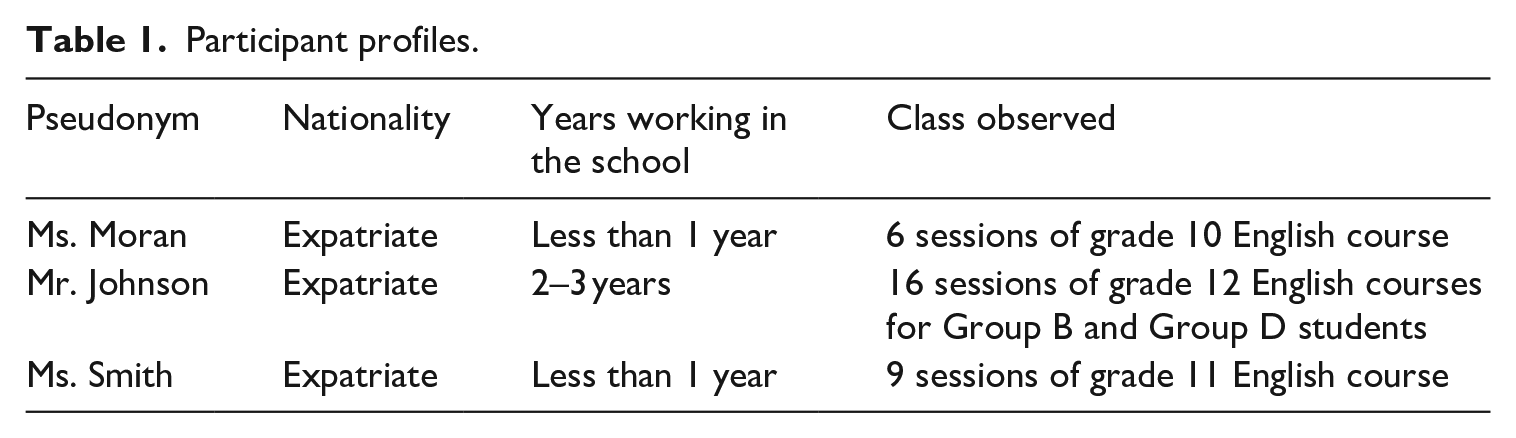
All sessions were 70 minutes long. The length of observation of each class depended on intensity of the class and a cycle of literacy-related activities as defined by the instructors. Mr. Johnson took charge of Group B and Group D students. He said that Group D was made up of students with average or higher English-proficiency levels than Group B students.
We adopted the constant comparison method to analyse the collected interview and classroom observation data (e.g. Cohen et al., 2018; Glaser & Strauss, 1967). Themes inductively emerged from data and were deductively generated from the nested pedagogical orientations. While identifying themes, the authors constantly compared the interview and classroom observation data to identify common themes and subthemes in various sources of data. This process of constant comparison helped us identify categories, ‘around which most data are focused and to which they relate’ (Cohen et al., 2018, p. 720). Deductive themes include: transmission-oriented teaching practice, social constructivist teaching approach, and transformative pedagogy. Inductive themes emerging from observation and interview data are related to the impacts of standardized tests and students’ varied English proficiency levels on the teachers’ pedagogical practices. Below we embed vignettes of observed English classes as narrative descriptions to show literacy events (i.e. activities where literacy has a role) (Barton & Hamilton, 1998) and the use of semiotic resources (e.g. the use of media, material, and languages in the teaching and learning literacy) (Zhang et al., 2023).
V Findings and discussion
In this section, we organize the findings according to the three pedagogical orientations. Our main findings show that in the program these orientations were not nested within one another. Instead, the dominant use of transmission reflected a form of neocolonialism. For instance, teacher participants used the transmission and social constructivist orientations for assimilation purposes (e.g. to prepare learners for their future studies in English-speaking countries) and to meet the expectations of standardized English exams.
1 Transmission orientation
Classroom observation data (i.e. field notes, audio transcriptions, and pictures) show that most of the three teachers’ literacy teaching was based in the transmission orientation. Their enactment of this orientation featured attempts to transfer directly to the students, Western-centric and English-related literacy knowledge and skills as articulated in the expectations of the Canadian curricula and standardized English tests. The school’s focus on preparing students for standardized English tests tended to normalize binaries of L1/L2 and multimodal/print literacies and privileged English and academic literacy.
Most of the observation data of Ms. Moran’s English literacy classes show a focus on transmitting English literacy knowledge and skills with limited connections to students’ first languages and their life experience. Vignette 1 serves as an example of Ms. Moran’s teaching that focused on transmitting the English language knowledge to students. In five out of the six observed classes, she used teacher-led question-and-answer (Q&A) and her self-selected examples.
Vignette 1 Ms. Moran explains the similarities and differences between similes and metaphors. Then she lectures to the class: ‘One important thing to remember about metaphors: If the person is actually the word that you’re using, it’s not a metaphor. So, for example, if you were describing how good Tim is at basketball, you could say, oh, he is a pro. But if you were talking about Jeremy Lin, that’s not a metaphor because he is a literal professional. He gets paid to play basketball. Same thing if you’re talking about Einstein – he is an actual genius; it’s not a metaphor. If you’re talking about (a student), it’s a metaphor saying she’s smart – or maybe you are a genius, I don’t know what your IQ is, but ... does that make sense?’ Ms. Moran concludes: ‘Okay, so just because we see ‘is’ does not mean it’s a metaphor.’
In Vignette 1, Ms. Moran elaborated on an important feature of metaphors by using examples of famous people she thought students might know, such as Albert Einstein and a Taiwanese-American basketball player Jeremy Lin. There were few opportunities in Ms. Moran’s class for the students to bring into the class what they already knew about literary devices in Chinese and examples of their own interests. Instead of being co-producers of knowledge, the students were involved in teacher-centered knowledge transmission. In most of the observed classes, students seemed disengaged, as evident in the long wait time and silence after Ms. Moran asked questions about literary devices and the implications of her selected sentences using these literary devices. In the interview, Ms. Moran shared that most students in her class ‘are not really big fans of learning English ... They’re a class that’s a little bit hard to motivate at times. There are some that seem to really enjoy it and some who just could not care less.’ Ms. Moran attributed the students’ disengagement to their perceived low levels of English proficiency and motivation to learn English.
Classroom observations of Ms. Moran’s and Mr. Johnson’s classes reveal that their teaching focused on test-taking skills for English exams. Ms. Moran prepared students for a standardized test to earn a BC graduation certificate, while Mr. Johnson imparted skills for students’ upcoming mid-term exam, which he marked himself. We observed that quiz reviews occupied most of Ms. Moran’s English literacy classes, and exam handouts were used frequently when she taught test-taking techniques. The quizzes used in her classes were passages with multiple choice questions and a writing task to test students’ literal comprehension of the passages. Ms. Moran also occasionally reinforced test-taking techniques. For example, she told students not to copy too much information directly from the article when working on the writing task but to make personal connections with ideas to earn marks on the exam. Our classroom observation of Mr. Johnson’s first two classes revealed his pedagogical preference for supporting students’ creative and multimodal meaning making. However, he had to succumb to test preparation for the approaching Grade 12 BC provincial literacy exam. Classroom observation data show that he frequently mentioned the difficulty of the upcoming test and then reassured the students with techniques to ‘attack’ the exam. He stated to the class, for instance, It will be the most difficult English exam you’ve had so far ... You have to write two essays and answer questions in two hours. It is a little bit more challenging ... comparative essay, we’re going to do this mid-term ... we’re going to prepare for it. It’s going to be a good practice for your provincial exam. And the good news is, after this exam, we can talk about this exam and think about ways we can do it better. We will prepare you. You guys will be okay.
After reintroducing and re-explaining the requirement of the comparative essay in the writing exam, Mr. Johnson taught them to organize an essay plan. He said: So, I hope this (essay plan) makes you feel a little bit better about your exam. If you have this, you got 4 out of 6. And if you can write very clearly and express your ideas very well, 5 out of 6, 6 out of 6. But we should all try to get that 4 ... Alright, how many people still feel really bad about this exam?
In nine out of the 16 observed classes, Mr. Johnson directed the classes to acquiring skills for test-taking. From these classes, we recognized a pattern in his teaching: (1) asking students to collect information from the assigned reading; (2) analysing the collected information and the essay questions through Q&A activities; (3) making essay plans using Word documents; and (4) assigning homework (e.g. completing the essay plan that did not get finished in the classroom or writing paragraphs from the completed essay plan).
Classroom observation data also show the tensions that Ms. Moran and Mr. Johnson attempted to address when they tried to attend to academic literacy expectations and incorporate multiple modes in teaching. When communicating her perception of literacy in the interview, Ms. Moran mentioned the six prescribed learning objectives of the BC English literacy curriculum (i.e. speaking, listening, reading, writing, viewing, and representing). However, when it came to evaluating these objectives, she focused most on reading and writing, hence her teaching emphasized print literacy. She expressed that she knew she needed to do more teaching of listening, viewing, and representing. Ms. Moran also used PowerPoints, iPads, smartphones, school-issued laptops, and tablets in the teaching and assigned multimodal response activities such as posters for the novel, Bridge to Terabithia (Paterson, 1977), but marked them as writing. She also shared in the interview that her students viewed a TED Talks video and finished a comprehension quiz on the video and it was marked as reading. Mr. Johnson shared in the interview that he tried to engage learners in multimodality and encouraged students to express their ideas in various modes, such as using flow chart with pictures and sketching out ideas as a pre-writing activity. He also admitted that though the BC provincial curriculum provides clear standards regarding writing, critical analysis, reading comprehension, and vocabulary, he found it challenging to understand the provincial standards about how to define and assess students’ ‘expressions in other forms’ that were ‘outside of what is being assessed in a provincial exam’. Mr. Johnson pointed out the tension between the BC curriculum expectations and the standardized literacy test his students would need to complete. Different from the BC curricular emphasis on expansive literacy options, the provincial exam expectations on academic literacy constrained students’ meaning making options.
In sum, there was a salient pedagogical focus on English academic literacy outcomes and preparing the students for standardized English tests. In the lessons that focused on English test preparations, there was limited space for the teachers to use culturally and linguistically responsive teaching to promote students’ subjectivities and encourage different perspectives when analysing and creating texts.
2 Social constructivist orientation
Class observation data show that Mr. Johnson and Ms. Smith enacted pedagogies in line with the social constructivist orientation. They provided opportunities for students to co-construct knowledge with peers and teachers through discussion and to bring in students’ out-of-school experience and their preferred languages and modes for meaning making. It is also worth noting that Mr. Johnson’s incorporation of small-group discussions on exam essay questions and novels mainly focused on test preparation for the BC provincial literacy exam.
In four out of the nine observed classes, Ms. Smith incorporated students’ linguistic repertoires in both languages of English and Mandarin. For example, she engaged students in dialogic and multimodal presentation activities that connected content with students’ out-of-school experiences.
Vignette 2 Ms. Smith connects students’ interests in pop music and poem writing. She says, ‘We are going to be looking at some poetry and you guys have already written me some poems. Now you are going to be writing your own poem and presenting it to the class. First, we’re going to look at “Fireworks” by Katy Perry.’ Then Ms. Smith presents the lyrics and asks students to listen to the song while reading the lyrics. She adds, ‘If you feel tempted to sing along, please, do not hold back.’ After playing the song, Ms. Smith asks the class a series of simple questions, ‘What’s the song about?’, ‘What is she saying about fireworks?’, and ‘A firework is beautiful. Katy Perry is saying you are a firework. What poetic device is that?’, and ‘Why metaphor?’ Then Ms. Smith presents an assignment to involve students in poem creation, lyrics appreciation, and presentations. She provides students with two options: (1) writing a free verse poem of 8 to 10 lines and illustrating poetic devices in the poem and (2) using their phones to pick an English or Chinese song that describes how they are feeling that day and identifying poetic devices in the lyrics. Ms. Smith encourages students to incorporate multiple modes in their presentation: ‘You can play the song for us, make us listen to it, and then start talking about the song. Or you can play the song after your presentation ... If you want to show us a video, go for it. If you feel like singing and it will make your presentation better, go for it.’ In the class, Ms. Smith gives students time to discuss and prepare. Students are encouraged to use PowerPoint, laptop, VPN, and Wi-Fi to search for information about songs and their corresponding poetic devices.
As is evident in Vignette 2, both class observation and interview data show Ms. Smith’s efforts to encourage students’ use of their bilingual repertoires in her literacy classes. She communicated in the interview, We often joke around about the language barrier, and they’ll say something in their mother tongue and I’ll say something in my mother tongue. And it’s amazing how much I’ve learned thus far just from the kids because I don’t have a Mandarin tutor or anything like that. And they’re often very interested in ‘How do you say this in an African language?’ and ‘Which African language?’
Ms. Smith had rich experience learning multiple languages. In Vignette 2, she encouraged students to use and translate Chinese lyrics in their presentations. In the interview, Ms. Smith also expressed her appreciation of her students being her ‘walking lessons’ of Mandarin. In contrast, in April 20th’s class, Ms. Moran explained the expectations of the group presentations and did not allow the incorporation of Chinese resources. She said, ‘If you translate it from Chinese, you’re going to lose marks because the point of this is to have proper English.’ When students discussed in Mandarin about their presentations, she also reminded them to use English only.
Both class observation and interview data show that Mr. Johnson encouraged students to connect literacy learning with their out-of-school experience, but mainly for the purposes of preparing students for speaking tests and their overseas life afterwards. For instance, in his April 21’s class to Group B students, Mr. Johnson distributed a list of ‘Identity Questions about Next Year’. With these questions, he tried to engage students in speaking activities by making connections to their current learning experience at this Canadian offshore school and their anticipation of their next year’s overseas life. They talked about Chinese food and what food they could expect to find in Canada. Students shared, in English, dishes they could cook. Mr. Johnson asked students who had travelled and what they had experienced abroad. Group B students who were able to speak confidently in English shared their experiences. On the same day, Group D students were concerned that their English language proficiency would be a barrier for their future life in English-speaking countries. Mr. Johnson reassured them that Canada is a multicultural and multilingual country and people speak English in different ways. To respond to Group D students’ questions about racism in Canada, Mr. Johnson shared his own story about racism and encouraged students’ sharing of their prior travelling experience in Canada. It is worth noting that the class discussions did not move beyond personal experience sharing to include students’ critical reflections of social issues such as racism.
In occasions when Mr. Johnson and Ms. Smith asked students to do presentations, they encouraged students to use multiple modes. As is shown above, observation data of Ms. Smith’s classes show students’ multimodal presentations about poetic devices in the lyrics such as consonance, hyperbole, metaphor, and personification. In one of Mr. Johnson’s classes, he asked students to respond to a book they read in class: The story of a shipwrecked sailor (García Márquez, 1986). The book is based on a true story about a man who was lost at sea for 10 days without food or water. Students were asked to design performances about what the protagonist experienced; such details are not mentioned in the book. Students were asked to select from three main options that combined writing and performance elements: dialogue and performance, short story and dramatic reading, and movie with subtitles. To model how students could perform if they chose to do a video, Mr. Johnson showed a video of Jimmy Fallon singing a duet and playing both roles of a song from Beauty and the beast. Classroom observation data show students’ presentations were multimodal. They included students’ performances of scenes from the televised series ‘Sherlock Holmes’ (Gatiss et al., 2010–2017) and ‘BoJack Horseman’ (Bob-Waksberg et al., 2014–2020), a dramatic reading of a collectively written story with pictures displayed through a projector, and a digital story with popsicle-stick characters and background music. These presentations connected to students’ out-of-school interests and show collective, multimodal meaning making. However, despite Mr. Johnson’s statement in his interview that he preferred these ostensibly social constructivist forms of teaching and their accompanying opportunities to imagine, create, and perform, they were rare in Mr. Johnson’s observed class because he was trying to prepare students for the upcoming exam. He expressed in the interview that he preferred to ‘incorporating different styles of delivering content’, that is, to making teaching ‘less teacher-focused’ and ‘more kinesthetic and visual’. His preferred multimodal ways of meaning making were in line with his understanding of the BC literacy curriculum. As he shared, ‘The idea of literacy going away from just like a numeracy or a simple understanding of text base and talking about different ways that people are able to communicate with each other and various forms of expression.’ However, preparing students for the high-stakes literacy test constrained the space in Mr. Johnson’s classes to promote students’ creative thinking and active learning.
In seven sessions of the 16 observed classes, we observed Mr. Johnson encouraging students to share ideas with peers to co-construct literacy knowledge. In these classes, Mr. Johnson invited students to discuss with their peers about cultures, selected reading, and exam-oriented essay plans. For instance, in April 19’s class with Group D students, Mr. Johnson invited students to share their ideas of essay plans. He said in class that doing this would help students ‘think about different ways’ that they can answer the exam question. In April 20’s class for Group B students, Mr. Johnson asked students to introduce to their peers their experienced cultures and the cultures of their future destinations for future overseas study. He showed a music video of the Spice Girls, a popular female group in the 90s. He used the music video to emphasize that ‘women, you can do anything, you can be anything, and show your girl power’. Then he encouraged students to share their familiar music and pop groups to explore the cultural similarities and differences. Class observation data show that students were actively involved in the classroom activity, discussing and introducing pop stars in the students’ situated lifeworlds. Mr. Johnson knew little about the pop culture in China, so students suggested that he google the groups they mentioned. Mr. Johnson said in class: This is what’s going to happen a lot next year. You and a person from another country are going to talk about your culture. What do you like? What do I like? So one thing you could do to prepare yourself is ... watch something from Japan, watch something from America, listen to something from Italy – you cannot know everything, but it’s nice to just get some experience.
The knowledge co-construction through group and whole-class interactions mainly served the purposes of acculturating students for their overseas life and preparing them for the standardized exam.
Mr. Johnson’s and Ms. Smith’s literacy teaching practices reflect the social constructivist orientation. There are also a few observed scenarios of creative, multimodal meaning making in their classes. These scenarios showcase these two teachers’ efforts to shift away from the focus on academic literacy and their awareness to be inclusive of transnational students’ local experiences.
3 Transformative orientation
Observation and interview data show that the transformative orientation was less evident in all three teachers’ English literacy teaching.
There were few opportunities in Ms. Moran’s and Ms. Smith’s observed classes to explore issues of power, culture, and identity (Luke, 2012; Zhang, 2023) and potential actions that transnational education students could take to effect social changes. Ms. Smith shared in her interview that as an educator from Africa she wanted to help her students to ‘break stereotypes’ about Africa, African people, and African languages. But the conversations in her classroom concerning stereotypes were generally about clarifying that Africa is a continent, not a country, and people from Africa speak different languages including English. She acknowledged in the interview that she had never heard about critical literacy. She also reasoned in the interview that the transmission orientation or what she called ‘the standardized method of instruction’ was a necessary ‘basic for the entire class’ because there was only one student with what she assessed as enough facility with English to handle ‘some higher order questions’. Echoing Ms. Moran’s sharing about her less motivated students, Ms. Smith also communicated that ‘It’s pretty sad, but it’s true that not everyone likes English, not everyone likes language, and it is not an easy thing for them to learn.’
We observed a fleeting moment in Ms. Moran’s classes when she brought up a critical issue of totalitarian practices. In this class, Ms. Moran spent most of the time explaining literary examples of paradox and oxymoron. When explaining the example of ‘War is peace’, she said, War and peace are opposites – they’re not the same thing. This quote is from the book 1984, by George Orwell, where it’s like a government who wants everyone to think the same way and do all the same things and they’re always at war with a different country. So they want the people who live in the countries to think that that’s a good thing. That’s where this comes from.
In our companion article on transnational students’ lived experience, we mentioned that most of the student participants chose this Canadian offshore school because they disliked their prior learning experience in local public schools (Zhang et al., 2024). According to these participants, learning in those schools contained punishment and criticism from teachers and too much pressure from high-stakes tests. However, in Ms. Moran’s classes, there was a scarcity of opportunities for students to make connections to their lived experiences and their understanding of power, control, and totalitarianism.
In Mr. Johnson’s class, we noticed reading materials and writing tasks concerning social inequalities and power. For example, he asked the students to read two speeches by Barack Obama (United States Capitol, 2013) and highlight the main idea of each. He wrote on the board: ‘What is Barack Obama’s attitude towards Rosa Parks?’ He asked students to use the information from the speeches and design an essay plan for a comparative essay question. He then created a Word document to show the comparative essay structure to students.
Vignette 3 After students finish reading, Mr. Johnson starts a round of teacher-led questions: ‘Okay, so who is Rosa Parks?’, ‘What did she do that was so important?’, ‘Okay, what time is this? This is not now? Like 500 years ago, maybe 70 or 80 years ago. Now if we think about America, we have a bus, 80 years ago, where do Black people sit on the bus?’, ‘Now, did Rosa Parks sit in the back?’ , ‘No. Where did she sit?’, ‘And then what did the bus driver do? Goodbye Rosa Parks, right? Get off the bus. So goodbye, get off the bus, and then nothing else happened? What did many Black people do after this event? Does anybody know about the history? ... When we talk about Women’s Day, what did people do on Women’s Day?’ , ‘Protest, a protest. Lots of people come together and they ...?’ , and ‘Kind of like a fight, but they share their ideas ... same thing at that time – lots of Black people came together and they said, we want ... what do you think they want?’ Mr. Johnson keeps raising probing questions after students’ short answers to the above questions. He concludes the interaction by saying, ‘We are normal people; we are just like you. We should sit wherever we want ... just like you do.’ Then Mr. Johnson and the students move on and compare the information in the two speeches. Students type their ideas into the template that Mr. Johnson created.
The teacher-led conversation reveals the opportunity that the students had to reflect on white privilege and racial discrimination using simple English expressions, for example, students’ single word answers to Mr. Johnson’s questions (e.g. ‘freedom’, ‘revolution’, and ‘protest’). But there were missed opportunities to engage students to critically analyse the historical, sociocultural, and political relationships that could connect to the students’ memories, knowledges, and life experience about privileges and discrimination. The pedagogical practice mainly focused on training students to compose essay plans as test preparation.
A similar scenario was observed in Mr. Johnson’s writing class. In class, Mr. Johnson selected a writing example of ‘Bullying is a serious problem in our schools’ to teach students writing techniques. He encouraged students to present their main ideas and provide examples to show the effects of school bullying. He then emphasized and explained the importance of ‘because’ clauses in writing. Through the teacher–student interaction, students responded with their own ‘because’ clauses to support the statement that bullying is a serious problem in school, for example, ‘because it greatly affects physical and mental health’, ‘because it can negatively influence students’ futures’, and ‘because it can destroy people’s confidence’. Class observation data show Mr. Johnson’s teaching of essay-writing skills and his engagement of students in discussion about school bullying as a serious social issue. However, the class focused on preparing students for the writing test which discourages students’ connection to their lived experience about school bullying. The test-oriented teaching and learning limited the opportunities to activate students’ text-to-self connection to shape their critical consciousness about bullying and possible actions to take to tackle school bullying in real-life situations.
To sum up, findings show that the transformative pedagogy was less evident in all three teachers’ teaching practices.
VI Conclusions and significance
The study found the predominant use of a transmission orientation in the courses. While there were some instances of social constructivist and, to a lesser extent, transformative orientations, these orientations were not nested within one another for the ultimate promotion of transformation. Findings also show that teachers’ perceptions of literacy, the BC provincial curricular expectations, the local and global standardized tests, and students’ varied English proficiency levels joined to affect the teachers’ pedagogical orientations in the transnational literacy classes. These factors concerted to affect the implemented literacy curricula that reinforced forms of neocolonialism such as neoliberal accountability that prioritized English-related literacies that are articulated in the expectations of the Canadian curricula and standardized English tests. The school’s focus on the local and global standardized tests tended to normalize binaries of L1/L2 and multimodal/print literacies and privileged English and academic literacy. The normalized binaries constrained transnational education learners’ opportunities to build from and affirm their linguistic, cultural, and semiotic repertoires.
Almost all of Ms. Moran’s observed classes were oriented toward imparting knowledge and skills about using ‘proper English’. There were limited opportunities for students in the globalized schooling context to critically engage with language varieties and their exploration of their own linguistic and cultural assets through situated interaction and negotiation. The implemented curricula had limited space to support transnational education students’ translanguaging practices whereby students make meaning within a unitary assemblage of two or more languages (García et al., 2021). The teacher-led activities in Mr. Moran’s classes also centered around the BC provincial exam expectations. There were limited opportunities for the students to connect to their own local experiences, prior knowledges, cultural and linguistic backgrounds, and personal interests. In the interview, Ms. Moran commented that students had less interest in English learning and were hard to motivate. This was reflected in the classroom observation in which students were ‘receiving objects’ (Freire, 1970) of the delivered language knowledge and skills. Such a pedagogical focus on proper English use also echoes the Canadian principal’s understanding of the program’s focus, namely, ‘providing students with an education that can get them into a university in North America’ (Zhang et al., in preparation). Frieson and Scalise (2021) critiqued the realities of linguistic imperialism that reinforces ‘hegemonic whiteness and the fallacy of monolingual ideologies’ (p. 226). Resisting neocolonial practices and values that are encoded in transnational education curricula requires teachers’ and students’ collective problematization of the ‘colonial ideology of linguistic hierarchies’ and ‘the superiority of colonial languages’ (Probyn, 2019, p. 220).
This study’s findings echo recent findings about how local and global standardized tests reinforce the importance of academic literacy (e.g. academic writing and oral presentation skills) and affect literacy pedagogies in transnational education settings (Zhang, 2023). Ms. Moran’s and Mr. Johnson’s grade 10 and 12 students bore the pressure of the BC provincial exams, namely grade 10 and grade 12 literacy tests. These tests were developed for Canadian students in BC and could be culturally biased against students located in transnational school settings. Our observation took place during the school’s midterm examination preparation. Ms. Moran focused on imparting test-preparation skills. Some of Mr. Johnson’s classes also focused on teaching comparative essay writing skills for the school’s mid-term exam, which was a mock test of the BC provincial exams. All the three teachers expressed that their students’ varied English proficiency levels mediated their teaching practices, which partially resulted in their test-oriented teaching to help students survive the BC educational system. Such a knowledge transmission approach limited space for students to build on their personal life experiences and generate alternative understandings of the learned content which was developed in a different context and for a different student population. Focusing on English academic literacy and prioritizing standardized English exam expectations in transnational education could privilege white monolingual English users’ forms of academic meaning making (García et al., 2021; Zhang, 2022). Decentering Western-centric ways of teaching and meaning making in cross-border education contexts shall provide space to include learners’ multiple forms of meaning making to address educational inequity issues.
In the observed classes of all three teachers, the transformative pedagogy was less evident than the other two pedagogical orientations. There is little evidence that shows the three English literacy teachers’ engagement of students in critical analysis of history, social culture, and power. Pedagogically, we suggest that English literacy education should not only focus on transmitting Western-centric content and English-only knowledge prescribed in the curriculum but also on supporting students’ linguistic, cultural, and semiotic repertoires to advocate for social justice. Existent studies conceptualize places as generative and agentive spatial repertoires that affect transnational students’ meaning making (e.g. Canagarajah, 2018; Zhang, 2023). For example, Zhang’s (2023) study on a transnational education program in Hong Kong shows that transnational students’ cross-border encounters with local-global places were agentive in powerful meaning making. Students’ exploration of their encounters with different places (e.g. their cross-border bodily movements, their situated lifeworlds in their home countries, and their experiences in culturally and linguistically diverse international schools) could generate alternative understandings of texts and critical meaning making that uses diverse linguistic, cultural, and semiotic resources to advocate for social equity. By incorporating culturally and linguistically responsive teaching, teachers should support students’ cultural and linguistic repertoires to promote their own subjectivities and encourage different perspectives when analysing and creating texts. We also propose the expansive use of multiple modes and media to support students’ out-of-school semiotic choices in their meaning making and enable their critical understanding of how knowledge intersects with power, history, society, and culture (e.g. Zhang, 2022, 2023).
Transnational education programs and globalized curricula hold potential to nurture responsible global citizens; however, transnational education institutions and educators should create opportunities for students to investigate the entangled effects of globalization, linguistic imperialism, and standardization upon diverse students’ meaning making and becoming (e.g. Zhang, 2023). The findings of this study could shed light on curriculum making and teacher education for globalized schooling contexts to enable policy makers and educators to challenge the privileging of curricula from developed countries and decenter Western-centric knowledge transmission.
Footnotes
Funding
The author(s) disclosed receipt of the following financial support for the research, authorship, and/or publication of this article: We appreciate the support of all of our participants and the financial support from Social Sciences and Humanities Research Council (SSHRC), Canada (file number: 430-2016-00840).
