



Abstract
Evidence from recent studies has shown that sustained perseverance and passion for long-term goals in the domain of second language (L2) learning – a personality trait called L2 grit – is associated with various aspects of language learning, including positive psychological attributes (e.g. motivation, beliefs, and emotions), actions (e.g. learning efforts and strategy use), and achievement (e.g. course and task performance). Meanwhile, relatively little has been written about the mechanism through which such relationships emerge. Expanding upon L2 grit’s association with self-regulated learning (SRL) behaviors and SRL-related psychological variables, this study explores the development of L2 grit and its role in language achievement using the SRL framework. One hundred and eight English majors in Japan responded to a questionnaire, granted permission to access their L2 class records, and completed a standardized L2 test. The main findings include: (1) the psychological attributes that facilitate SRL may play a critical role in increasing levels of L2 grit, (2) the relationship between L2 grit and achievement in language classes was mediated by behavioral self-regulation (intensified learning efforts), and (3) L2 grit may promote different types of self-regulatory behaviors depending on learners’ status (i.e. learning experience and proficiency levels) and learning situations (e.g. learning content and goals). The results provide one explanation for the superior performance of gritty learners in L2 classes observed in previous studies.
Keywords
I Introduction
Self-regulated learning (SRL) is a cyclical process wherein individuals work toward achieving their goals in specific social settings, including the modulation of affect, cognition, and behavior (Panadero, 2017). Existing meta-analyses have confirmed a positive relationship between SRL (or the use of SRL strategies) and learning outcomes in various academic domains with diverse age groups (Dent & Koenka, 2016; Dignath & Büttner, 2008; Donker et al., 2014; Sitzmann & Ely, 2011). The effectiveness of SRL has also frequently been reported in the field of second language (L2) education (R. Zhang & Zou, 2024); and Chen’s (2022) meta-analysis concluded that SRL interventions improve self-regulatory behaviors in language learning and L2 test/task performance across age groups and educational levels. Regarding the types and effectiveness of interventions, Dignath and Büttner’s (2008) meta-analysis found that SRL interventions could be most effective when they are based on the social cognitive theory (Bandura, 1977), which places emphasis on learners’ psychology in self-regulation processes.
Previous L2 studies have shown that the social cognitive model of SRL proves useful in elucidating the role of learners’ psychology in the complex and dynamic process of language learning. For instance, Bai and Guo (2019) found that motivation and beliefs not only predicted self-regulatory behaviors among young L2 learners, but also noted variations in the relationship between motivation, beliefs, and behaviors depending on the learners’ L2 proficiency. The findings of Wilby (2020) also showed that the relationship between motivation, belief, and self-regulation underwent major changes even during a 4-week language course. Outside of motivation and belief, Shen et al. (2023) confirmed that emotions, both positive and negative types, were predictive in university-level L2 learners’ self-regulatory behaviors.
Existing studies have highlighted the importance of motivation, beliefs, and emotions in the process of self-regulated language learning (SRLL). In this study, we propose a potential benefit of incorporating a new concept, personality trait, into the body of SRLL research. The psychology literature suggests that personality traits affect outcomes in various life domains by engendering relatively enduring patterns of thoughts, feelings, and behaviors in new and uncertain situations (Bleidorn et al., 2019). Given the continual need for learning new and complex linguistic and socio-linguistic rules in L2 learning, personality may play a critical role in shaping individual differences in SRLL (i.e. how learners modulate their affect, cognition, and behavior). In addition, previous research has suggested that, while personality traits are often relatively stable within individuals, self-regulatory behaviors can be beneficial in cultivating personality traits advantageous to achieving specific goals (Hennecke et al., 2014). This means that the SRL framework can be valuable in understanding not only how personality affects SRLL but also in what way SRLL is associated with the development of personality traits that are beneficial for L2 learning.
The personality trait that this study focuses on is called L2 grit; that is, a higher-order construct composed of sustained perseverance and passion for L2 goals (Alamer, 2021; Sudina et al., 2021; Teimouri, Plonsky, & Tabandeh, 2022). Having higher levels of perseverance and passion is considered beneficial for promoting L2 learning, and empirical studies have demonstrated L2 grit’s relevance to psychological and behavioral factors, and relative success in L2 learning. The former was measured in terms of, for instance, enjoyment (Elahi Shirvan et al., 2021; Pawlak, Csizér, et al., 2022; Pawlak, Zarrinabadi, & Kruk, 2022), motivation (Paradowski & Jelińska, 2023; Sudina et al., 2021), learning effort (Sudina & Plonsky, 2021; Teimouri, Plonsky, & Tabandeh, 2022), and engagement (Sadoughi & Hejazi, 2023); and the latter, in terms of vocabulary size (Alamer, 2021), writing quality (J. Zhang & Zhang, 2023), course performance (Sudina & Plonsky, 2021; Teimouri, Plonsky, & Tabandeh, 2022; Teimouri, Tabandeh, & Tahmouresi, 2022), and proficiency (Mikami, 2024). One limitation of these studies is that they explored either the affect–grit relationship, grit–behavior relationship, or grit–achievement relationship, leaving the general mechanism/s that unify all these relationships open for further investigation. Based on the observations that learners’ psychology matters in the SRLL process and self-regulation behaviors can induce personality change, we contend that self-regulation can be a key mechanism worth exploring in the study of L2 grit. Specifically, we believe that (1) motivation, beliefs, and emotions that promote SRLL contribute to higher levels of L2 grit, and (2) L2 grit is related to language success through SRLL.
In what follows, this article elaborates on the social cognitive model of SRLL and how motivation, beliefs, emotions, and L2 grit are related to SRLL. It then presents the findings of our empirical study, which examines the feasibility of our propositions.
1 The social cognitive model
This section will describe the characteristics of the social cognitive view of SRLL by reviewing the triadic model (Zimmerman, 1989, 2000, 2013). This model is useful in comprehending the role of L2 learners’ psychology and contextuality in determining their learning approaches and strategies (Shen et al., 2023). In the triadic model, self-regulation operates through a cyclical interaction involving three levels: the person, behavior, and environment levels. These levels are interconnected through a feedback loop, leading to covert/person-level, behavioral, and environmental self-regulation. In the following passages, we will elucidate the model in more detail with reference to Figure 1.
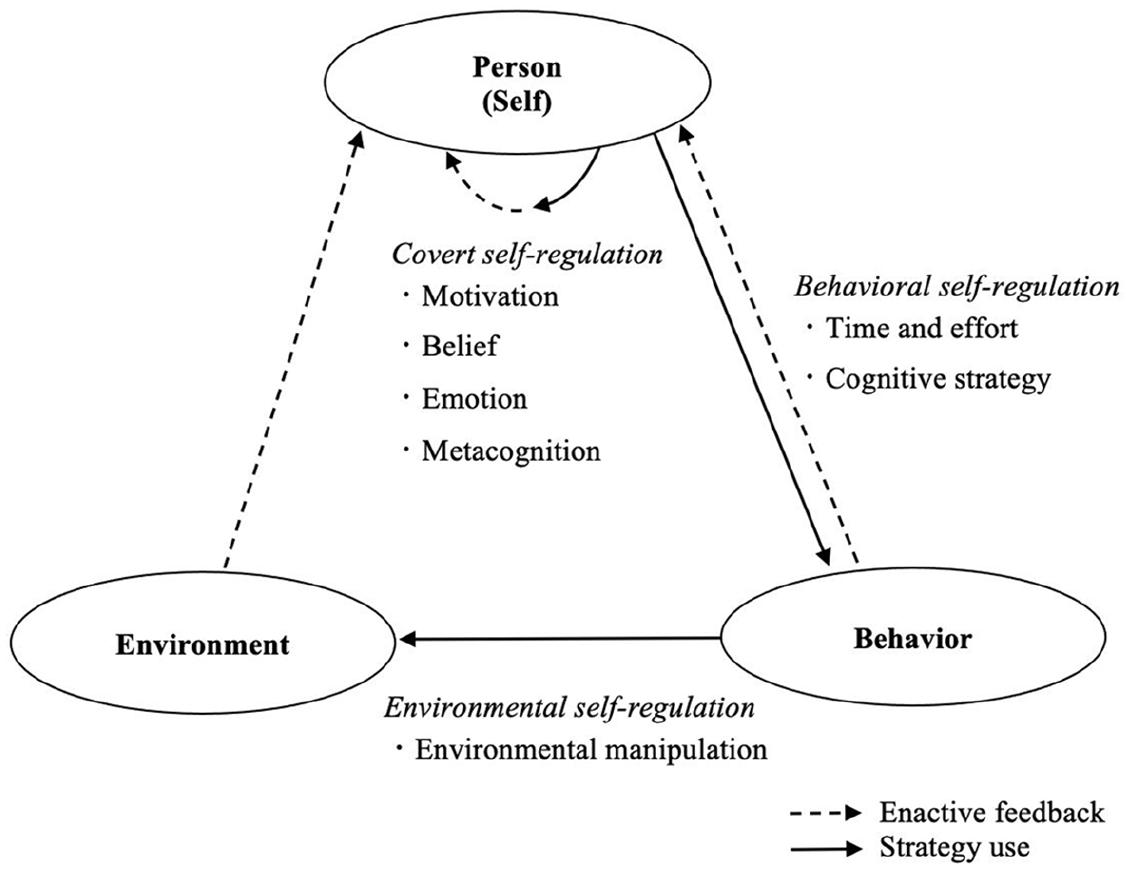
The triadic model of self-regulated language learning (SRLL).
First, person-level self-regulation involves (meta)cognitive and affective processes. Regarding the former, learners have some degree of metacognitive knowledge about their own L2 skills, which can form the foundation for the use of cognitive strategies (Sardegna et al., 2018). In addition, learners’ motivation, beliefs, and emotions can also affect how they engage in L2 activities (Lou & Noels, 2017; Macintyre, 2017; Yousefi & Mahmoodi, 2022). The solid arrow from Person to Behavior in Figure 1 indicates that all these factors are involved in the determination of learning approaches and strategies. The person-level also entails the schematic process of monitoring and adjusting the cognitive and affective states (i.e. covert self-regulation). For instance, when learners self-assess their mastery of L2 grammar they have learnt, they are using a metacognitive strategy aiming at a better understanding of their own knowledge state (Pintrich et al., 1991). Also, achieving satisfactory performance in such attempts can strengthen learners’ belief in their own capability to use relevant grammar rules (i.e. self-efficacy) through enactive feedback.
Next, behavioral self-regulation refers to behavioral adjustments in terms of learning approaches and strategies. Adjustments may take the form of changes in the amount of time and effort one invests in learning activities or the frequency with which one uses specific strategies in such activities (Bai & Guo, 2019; Zhao et al., 2023). The implementation of behavioral self-regulation provides learners with feedback regarding how effective and enjoyable strategies/activities were, which shape learners’ responses and future behavior (see the broken arrow from Behavior to Person in Figure 1).
Lastly, environmental self-regulation refers to learners’ efforts to adjust learning environments in their favor. Attempts to manipulate one’s learning environment (e.g. finding more opportunities to communicate in their L2) entail a series of behavioral actions aimed at expanding one’s L2 community (Papi et al., 2019; Sasaki, 2011; Shen et al., 2023) (see the solid arrow from Behavior to Environment). These actions may involve, for instance, finding conversation partners within one’s immediate social circle or online. Feedback from Environment to Person in Figure 1 is the perceived effectiveness of environmental manipulation strategies in assisting L2 learning, which can influence the intensity and duration of strategy implementation.
2 Learners’ psychology and SRLL
a Motivation/ideal L2 self
To gain a better understanding of the value of the social cognitive view of SRLL, it is useful to review an ongoing discussion concerning the association between motivation and language achievement. Motivation has long been considered a prerequisite for initiating and sustaining language learning (Dörnyei & Ryan, 2015), and the intensity of one’s ideal L2 self-image (Ideal L2 Self) has repeatedly been identified as a predictor of intended learning efforts (Teimouri, 2017; Yousefi & Mahmoodi, 2022). At the same time, however, Al-Hoorie’s (2018) meta-analysis revealed a lack of clarity in the relationship between intended efforts and objective achievement measures (r = .12 [95% CI: –.12, .34]). One underlying reason for this is, as Al-Hoorie argued, the limited use of objective performance measures in motivation research. Another potential explanation is the use of both hypothetical and behavioral items as effort measures (Papi et al., 2019; Yousefi & Mahmoodi, 2022). When comparing these types of items (e.g. items beginning with ‘I wish . . .’ vs. ‘I am trying . . .’), only the latter represents the actual effort one puts into learning. This provides a convincing rationale for only using the behavioral items/indexes in exploring the motivation–achievement relationship. On this point, the SRL framework is valuable as it enables us to use various behavioral measures, including the usage frequency of metacognitive, cognitive, and environmental strategies. Indeed, recent studies have highlighted that Ideal L2 Self not only correlated with actual learning behaviors (Saito et al., 2018), but was also connected to better L2 performance/achievement through the frequent use of self-regulatory strategies (Papi & Khajavy, 2021; Zhao et al., 2023).
b Belief
Belief is what learners believe about themselves and language learning. On this topic, Bai and Guo (2019) provided insightful findings by exploring how motivation and two belief types affect L2 writers’ learning process. One belief type was self-efficacy. This belief has long been considered a key variable underlying successful SRLL (Chen et al., 2022; Wilby, 2020), as self-efficacious learners perceive a sense of control over their learning process and such a perception in turn assists them to be more active in pursuing their goals (Y. Wang et al., 2021). Another belief type was growth mindset, which refers to what learners believe about the growth potential of language intelligence. Growth mindset can also be of importance in promoting the pursuit of L2 goals in that it leads to greater mastery responses and less helpless responses particularly in challenging situations (Lou & Noels, 2017). Using these belief variables, Bai and Guo (2019) confirmed that interest in L2 writing (a motivation variable) exhibited a stronger connection with low-achieving students’ SRL strategy uses. In contrast, among medium and high achievers, the use of these strategies was more strongly facilitated by growth mindset and self-efficacy in writing, with both belief types showing positive associations with interest. Bai and Guo (2019) took this as an indication that L2 learners at different proficiency levels ‘may configure their motivational factors in different ways in order to achieve their desired learning goals appropriate to their own situations’ (p. 394). This suggests that specific types of beliefs facilitate self-regulatory behaviors together with motivation, depending on learners’ L2 proficiency levels and goal settings.
c Emotion
Emotion can be described as spontaneous and functional reactions to specific matters or events (de Dios Martínez Agudo, 2018). Emotion can also be broadly divided into negative and positive types (e.g. hate vs. love) (MacIntyre & Vincze, 2017; Shen et al., 2023; Y. Wang et al., 2021). Both negative and positive emotions experienced during L2 activities trigger situational adaptations, and the accumulation of such adaptations can in turn lead to individual differences in L2 learning and use. We can see such examples in the results of Li’s (2022) meta-analysis, where anxiety was related to the less frequent use of reading strategies, and in Saito et al.’s (2018) longitudinal study, which highlighted the importance of enjoyment in enhancing the comprehensibility of L2 speech in a classroom setting.
In comparison, positive emotions are shown to be more beneficial than negative ones in promoting L2 learning. For instance, MacIntyre and Vincze (2017) reported the relative importance of positive emotions over negative types in shaping motivation, self-perceived L2 competence, and learning efforts. In addition, Y. Wang et al. (2021) observed that self-efficacious learners tended to experience more positive emotions in L2 learning and scored higher in language tests. Regarding its relationship with SRLL, Shen et al. (2023) found that enjoyment, a positive emotional state that arises when learners’ needs are fulfilled (Botes et al., 2021), had consistent positive relationships with all metacognitive, behavioral, and environmental self-regulation variables, while negative emotions (anger, anxiety, and shame) predominantly exhibited negative associations with the self-regulatory behaviors.
d L2 grit
We have seen that L2 learners’ motivation, beliefs, and emotions interact with each other in initiating and maintaining SRLL. In this section, we develop the arguments that (1) these attributes may also contribute to higher levels of L2 grit, and (2) gritty L2 learners achieve relative success through SRLL.
The first argument is derived from the observation that L2 grit has been positively related to key attributes for successful SRLL; they are: Ideal L2 Self (Alamer, 2021), growth mindset (Paradowski & Jelińska, 2023; Sadoughi & Hejazi, 2023; Teimouri, Plonsky, & Tabandeh, 2022), efficacy belief (Pawlak, Zarrinabadi, & Kruk, 2022), and enjoyment (Elahi Shirvan et al., 2021; Pawlak, Csizér, et al., 2022). One possible interpretation of these results is that these positive attributes are facilitative of SRLL; and the SRL process, including mastery experience and positive affective states elicited by such experiences, can lead to the relatively enduring traits of perseverance and passion for L2 goals.
Regarding enjoyment, if it is an emotional state frequently experienced in L2 learning, this can lead to positive changes in learning motivation (MacIntyre & Vincze, 2017; Saito et al., 2018) and efficacy belief (Y. Wang et al., 2021). Concerning Ideal L2 Self, a perceived gap between learners’ current and ideal self-images can be a motivator for enhancing strategic approaches to learning (Papi & Khajavy, 2021; Zhao et al., 2023). As for beliefs, self-efficacy helps learners to engage in effortful tasks by maintaining a sense of control (Bai & Guo, 2019). An incremental view on language intelligence (i.e. growth mindset) can also assist learners’ pursuit of L2 goals in the presence of challenges (Lou & Noels, 2017). As learning progresses, self-regulatory behaviors fostered by these attributes may become habitual, contributing to increased levels of L2 grit.
Our second argument posits that L2 grit is related to language outcomes through SRLL. As reviewed in Teimouri, Plonsky, and Tabandeh (2022), the concept of L2 grit was introduced partly due to grit’s relatively weak correlations with academic outcomes, including language achievement, when measured as how gritty one generally is (for further discussion on the nature of grit, see Credé et al., 2017; Lam & Zhou, 2022). To address this issue, Teimouri and associates developed a scale designed to measure grit specific to language learning (see also Alamer, 2021); and since then, L2 studies have illustrated the grit–achievement relationship with greater clarity (for a detailed review, see Demir, 2024). These findings underscore the value of understanding why gritty learners excel in language learning, and we consider SRLL serves as an underlying link. Supporting evidence for this assertion comes from recent studies highlighting L2 grit’s positive relationship with multiple aspects of SRL. To begin with, successful SRL requires proactive engagement in the cyclical process of self-regulation over an extended duration (e.g. continuous monitoring of learning progress). On this point, Sadoughi and Hejazi (2023) showed that L2 grit predicts academic engagement, encompassing agentic, behavioral, emotional, and cognitive engagements. The available data also suggest that L2 grit promotes the use of strategic approaches necessary for SRLL. Examples of such approaches can be seen in Solhi et al. (2023), where gritty learners showed more frequent use of an emotional regulation strategy, and in Sudina and Plonsky (2021), a study which demonstrated a strong correlation between L2 grit and intended learning effort, including looking for more opportunities for L2 activities. If grit personality facilitates learners’ use of emotional regulation strategy (Solhi et al., 2023), there is a possibility that the same trait also affects frequency of use of other types of strategies for better learning outcomes. In addition, the results of Sudina and Plonsky (2021) indicate that gritty learners tend to seek to create opportunities for self-improvement by adjusting their learning environment (i.e. environmental self-regulation). Given these findings, it is a logical possibility that SRLL is an underlying mechanism behind the grit–achievement relationship.
3 The current study
As reviewed above, the existing research findings indicate the possible contribution of SRLL in linking (1) positive psychological attributes with L2 grit, and (2) increased levels of L2 grit with relative success in L2 learning. The aim of this study was, therefore, to investigate the underlying mechanism in the development of L2 grit and its contribution to language success using the SRL framework. The present study is based on the following hypotheses:
• Hypothesis 1: SRLL-related psychological attributes (Ideal L2 Self, growth mindset, self-efficacy, and enjoyment) can positively predict levels of L2 grit.
• Hypothesis 2: SRLL mediates the relationship between L2 grit and language achievement.
II Method
1 Participants
One hundred and eight English majors at a Japanese university participated in this research (45 female and 63 male participants, 19–23 years of age) (M = 19.62, Mdn = 20.00, SD = 0.71). All participants spoke Japanese as their first language, and no one had extended study abroad experience. The participants had studied English as a school subject for between 6 and 8 years before enrolling in university. At the time of the study (April 2023), they had experienced various types of English as a second language (ESL) university classes for 2 to 3 years (M = 2.52 years, Mdn = 3.00, SD = 0.50). These include Communicative Grammar, Reading/Writing Skills, Integrated English, and Collaborative Projects in English.
2 Measurement instruments
a Questionnaire
The questionnaire consisted of two parts. The first part asked respondents to report their name, gender, age, year at university, and L2 learning experience. The second part consisted of 80 items, whereby participants were asked to indicate the extent to which certain qualities or situations applied to them. All questionnaire items, except those related to L2 grit, underwent back-translation between English and Japanese to ensure equivalency in meanings. In what follows, we will first provide information on the five psychological indexes.
L2 grit
The two components of L2 grit, perseverance of effort (POE) and consistency of interest (COI), were measured using the Japanese version of the L2-Grit Scale (nine 5-point Likert items; Sudina et al., 2021). The former represents one’s persistence in the achievement of goals, and the latter the constancy of interest in the pursuit of goals. Of the nine items, five measure POE, and the remaining four assess aspects related to COI. Questions include ‘When it comes to English, I am a hard-working learner’ (POE) and ‘My interests in learning English change from year to year’ (COI). Among the available language-domain-specific grit measures (e.g. Alamer, 2021; X. Zhang et al., 2023), the L2-Grit Scale was the most widely validated at the time of our investigation (Mikami, 2024; Sudina et al., 2021; Sudina & Plonsky, 2021; R. Wei et al., 2020).
Ideal L2 self
The Ideal L2 Self/Own Scale (four 6-point Likert items; Papi et al., 2019) was employed to assess Ideal L2 self (IL2S) levels. This index was chosen due to its empirical association with strategic learning behaviors and L2 outcomes (Papi et al., 2019; Papi & Khajavy, 2021). Questions include ‘I can imagine a day when I speak English fluently with international friends/colleagues.’
Self-efficacy
The Self-Efficacy Scale (four 7-point Likert items; Bai & Wang, 2020) was used to measure self-efficacy in L2 learning. This index was selected based on its empirical association with SRLL behaviors (Bai & Wang, 2020). Questions include ‘I expect to do well in learning English.’
Growth mindset
Growth mindset was measured using the Incremental Sub-Scale of the Language Mindsets Inventory (nine 6-point Likert items; Lou & Noels, 2017). This index was adopted based on its empirical association with SRLL (Bai & Guo, 2019; Bai & Wang, 2020). Questions include ‘In learning a foreign language, if you work hard at it, you will always get better.’
Enjoyment
The Short Form of the Foreign Language Enjoyment Scale (nine 5-point Likert items; Botes et al., 2021) was used to assess the typical levels of enjoyment that the participants feel in ESL classes. Slight modifications were made because the original instruction (‘In the foreign language class . . .’) and one item (‘I enjoy it’) were designed to assess enjoyment experienced in a specific class, whereas our participants are involved in multiple L2 classes. For this reason, the instruction and relevant item have been revised to ‘In English classes I have been taking . . .’ and ‘I enjoy them.’ Enjoyment has previously been demonstrated to support SRLL (Shen et al., 2023; Zhao et al., 2023).
The questionnaire also included five SRLL measures aimed at assessing the person-level, behavioral, and environmental self-regulation. The person-level process in the triadic SRL model, as reviewed earlier, involves the planning, monitoring, and adaptation of learning; and a range of strategies and approaches are employed in the behavioral and environmental processes aimed at facilitating learning (Zimmerman, 1989, 2000, 2013).
Metacognitive Self-Regulation (MCSR)
MCSR refers to the extent to which individuals focus on planning, monitoring, and regulating their cognitive processes to enhance L2 learning (the person-level process). A sub-scale of the Motivated Strategies for Learning Questionnaire was used to measure this (twelve 7-point Likert items; Pintrich et al., 1991). Slight modifications were made to the descriptions that ask respondents to refer to their MCSR in an unspecified class, with the aim of limiting the context to ESL classes. Questions include ‘When studying for English classes, I try to determine which concepts I don't understand well.’
Rehearsing and Memorizing Strategies (R&MS)
R&MS is one form of behavioral self-regulation employed to facilitate L2 vocabulary learning. The R&MS sub-scale (five 4-point Likert items) of the Questionnaire of English Self-Regulated Learning Strategies (QESRLS; C. Wang & Bai, 2017) was used to measure this. Questions include ‘I read new words repeatedly in order to memorize them.’
Organizing and Transforming Strategies (O&TS)
O&TS also represents a form of behavioral self-regulation, which is used to facilitate information processing and learning. Another QESRLS sub-scale (eighteen 4-point Likert items) was used to measure this. Questions include ‘I write an outline after reading an English article.’
Motivated L2 Learning Behavior (L2MLB)
L2MLB is a part of the behavioral self-regulation process, which focuses on the intensity of efforts made for L2 learning. The Motivated Behavior Scale (five 6-point Likert items; Papi et al., 2019) was used to measure this. Questions include ‘I spend a lot of time studying English.’
Eager L2 Use (Eager)
Eager is a form of environmental self-regulation. It represents the intensity of efforts made to create or participate in environments where learners have more opportunities for L2 learning and use. The Eager L2 Use Scale (five 6-point Likert items; Papi et al., 2019) was used to measure this. Questions include ‘I put myself in situations where I can frequently use English to interact with others.’
b Performance measures
L2 grit, sustained perseverance and passion could be assumed to be of particular relevance to long-term achievement by sustaining learning behaviors despite challenges and obstacles (Khajavy et al., 2021; Teimouri, Plonsky, & Tabandeh, 2022). For this reason, this study employed two types of performance measures that improve as a result of continuous efforts, rather than those that can be improved by short-term/narrowly focused efforts.
The first measure is the grade point average in L2 classes (L2-GPA) (for similar performance measures, see Rose et al., 2020; Yuksel et al., 2023); that is, the average (mean) of the grade points earned across all ESL classes that the participants have ever taken (number of credits attempted: M = 24.64, SD = 11.30, Mdn = 21.05). L2-GPA represents overall success in classroom L2 learning (score range: 0.00–4.00). If L2 grit is related to SRLL, gritty individuals would make constant adjustments in their learning in response to course demands, such as using various approaches and strategies necessary for success in, for instance, grammar, reading, writing, presentation, and communication classes; and such strategic efforts could lead to success in ESL classes. The use of L2-GPA also serves as a countermeasure for the issue of cherry-picking, which can occur when researchers rely on a limited number of course grades or in-class test scores when investigating the grit–achievement relationship.
A limitation of L2-GPA is that course grades do not always, or do not entirely, reflect L2 attainment (Brown et al., 2018). Therefore, to examine how SRLL mediates the relationship between grit personality and absolute levels of L2 attainment, this study measured the participants’ L2 proficiency (Proficiency) using an internationally administered standardized test called TOEIC®. TOEIC® is a 2-hour test and consists of reading and listening sections (100 comprehension questions for each section; score range: 10–990). This test was considered an appropriate measure for the present project because (1) the validity and reliability of the test are well-documented (Y. Wei & Low, 2017) and (2) the use of a standardized test facilitates comparisons with results obtained elsewhere.
3 Procedure
We set the minimum sample size for this study at 100 participants. This decision was prompted by the combination of the study’s cross-sectional design and the use of specific achievement measures. Particularly, due to the cross-sectional design, it was necessary to account for the moderating effect of L2 learning experience/years of L2 learning when examining the mediation effects of SRLL on the grit–achievement relationship. Conducting such an analysis, known as the moderated mediation analysis, requires relatively large samples. However, it was also expected that the inclusion of the long-term achievement measure (L2-GPA) and the 2-hour test (Proficiency) would place limitations on our sample size. In this context, we referred to the data reported in Xu et al. (2024) to ascertain the minimum adequate sample size for the moderated mediation analyses (n > 100).
An invitation to participate in this study was sent via email to 135 students in the target department, and 108 participants agreed to take part. They first gave permission for their academic records to be accessed, and then responded to the online questionnaires. All questionnaire items required a response, and the order of questions was randomized for each participant. The participants then sat the proficiency test for 2 hours. The first author downloaded the academic records from the university’s database, and the proficiency test was scored by the official testing organization.
4 Data analysis
There were no missing data for any variables, and all negatively worded items were reverse scored. All psychological and SRLL scales had previously undergone validation in their original and other contexts. The groups of question items were thus treated as latent construct indicators when their reliability coefficients exceeded the common threshold of .70 in all of Cronbach’s α, McDonald’s ωt, and the greatest lower bound (GLB). This requirement was set because each reliability index has the potential to produce unreliable estimates under certain conditions, such as a small number of items, unequal variances, and high skewness (Malkewitz et al., 2023). Only R&MS did not meet the requirement and was excluded from further analysis at this point (Table 1).
Descriptive statistics on the 14 indexes (raw scores).

Notes. n = 108; L2 grit = language-domain-specific grit; POE = perseverance of effort; COI = consistency of interest; IL2S = Ideal Second Language (L2) Self; MCSR = metacognitive self-regulation; R&MS = rehearsing and memorizing strategies; O&TS = organizing and transforming strategies; L2MLB = L2 motivated learning behavior; L2-GPA = the grade point average in L2 classes.
The normality of distributions was evaluated by the one-sample Kolmogorov–Smirnov test, and all target variables were found to be normally distributed (D = 0.05–0.11, p = .172–.903). All variables were standardized and centered before analyses, and a variance inflation factor (VIF) of less than 10 was taken to imply absence of multicollinearity. All analyses were 2-tailed (n = 108), and the risks of statistical Type 1 and 2 errors were set to .05 and .20 respectively. The false discovery rate method (Benjamini & Hochberg, 2000) was used to control for Type I errors. SPSS and AMOS (ver. 27), Langtest (Mizumoto, 2023), and G*power 3 (Faul et al., 2007) were employed for statistical computations.
Multiple regression and relative weight analyses, and the Boruta algorithm, were used to assess the importance of the SRLL-related psychological attributes in explaining the levels of the L2 grit components (POE and COI) (hypothesis 1). The two components, rather than their higher-order construct, were the focus because (1) each L2 grit component has been shown to play a unique role in L2 learning (Alamer, 2021; Pawlak, Zarrinabadi, & Kruk, 2022; Sudina et al., 2021; Sudina & Plonsky, 2021; Teimouri, Plonsky, & Tabandeh, 2022), and (2) if each component exhibits a unique relationship with SRLL, it provides more nuanced insights into future research and educational practices. The regression and relative weight analyses were used to determine the extent to which IL2S, growth mindset, self-efficacy, and enjoyment predict levels of POE and COI. In other words, we gained the adjusted R2 values and relative weights (RWs) for each predictor through these analyses (Mizumoto, 2023). Boruta is a Random Forest-based feature selection method (Kursa & Rudnicki, 2010). In brief, it creates pseudo-copies of all target attributes/variables and utilizes the Random Forest algorithm to provide an unbiased and stable selection of important attributes. For all three types of analyses mentioned above, we included the participants’ year at school (Year at School) as an additional predictor, because we employed a cross-sectional design and recognized the potential influence of learning experience on SRLL (Wilby, 2020) and levels of L2 grit (Elahi Shirvan et al., 2021; Teimouri, Tabandeh, & Tahmouresi, 2022). The use of Year at School enabled us to assess the relative importance of each positive variable and learning experience in levels of POE and COI.
A similar variable importance selection procedure was taken as an initial step in examining the mediation effects of SRLL in the grit–achievement relationship (hypothesis 2). We first evaluated the importance of MCSR, O&TS, L2MLB, Eager, and Year at School in explaining the scores of L2-GPA and Proficiency. We then performed moderated mediation analyses using the SRLL variables that were confirmed to be important in the first-step analyses. As shown in Figure 2, we tested the models in which SRLL mediates the relationship between L2 grit (POE and COI) and language achievement (L2-GPA and Proficiency), and Year at School moderates the mediation effects.
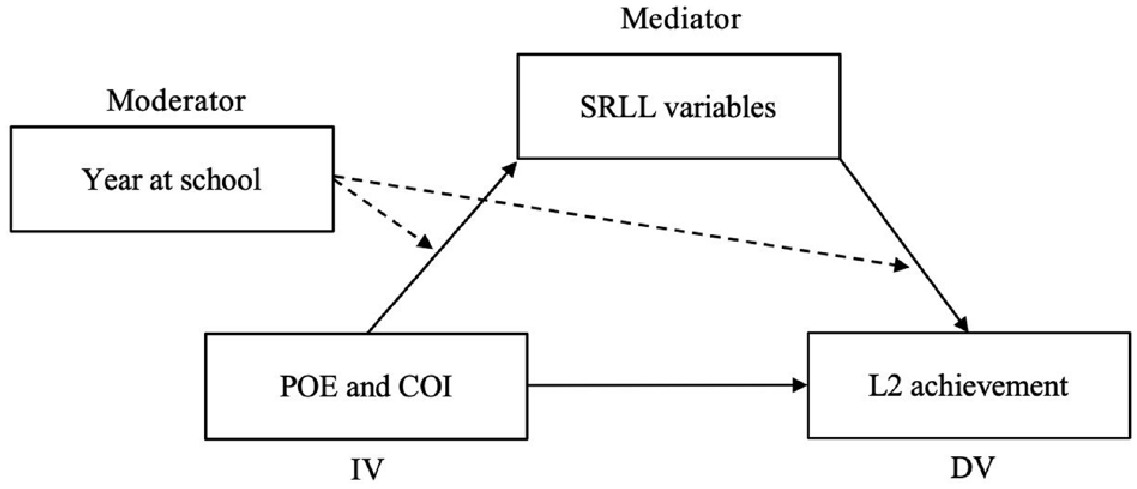
Hypothesized theoretical model.
III Results
1 Descriptive statistics
Descriptive statistics are reported in Table 1 (n = 108). On average, the participants displayed relatively high scores on all psychological and SRLL indexes, particularly on COI (M = 3.69/5.00), growth mindset (M = 4.40/6.00), and enjoyment (M = 3.66/5.00). Regarding the performance measures, there were noticeable variations in both L2-GPA (M = 2.49/4.00, SD = 0.80) and Proficiency (M = 437/990, SD = 129).
2 Correlation matrix
Table 2 shows the zero-order correlations between the target variables (r) and the partial correlations after controlling for the influence of year at school (rs). With the exception of COI’s relationships with growth mindset and Eager, POE and COI had significant partial correlations with all target variables, ranging from rs = .28–.60 for the positive psychological variables, rs = .27–.85 for the SRLL variables, and rs = .31–.44 for the achievement measures. There was also a strong correlation (i.e. r > .60; Plonsky & Oswald, 2014) between the two performance measures (L2-GPA–Proficiency: rs = .62), showing that participants who performed well in ESL classes generally also excelled in the proficiency test.
Zero-order and partial correlation matrices.
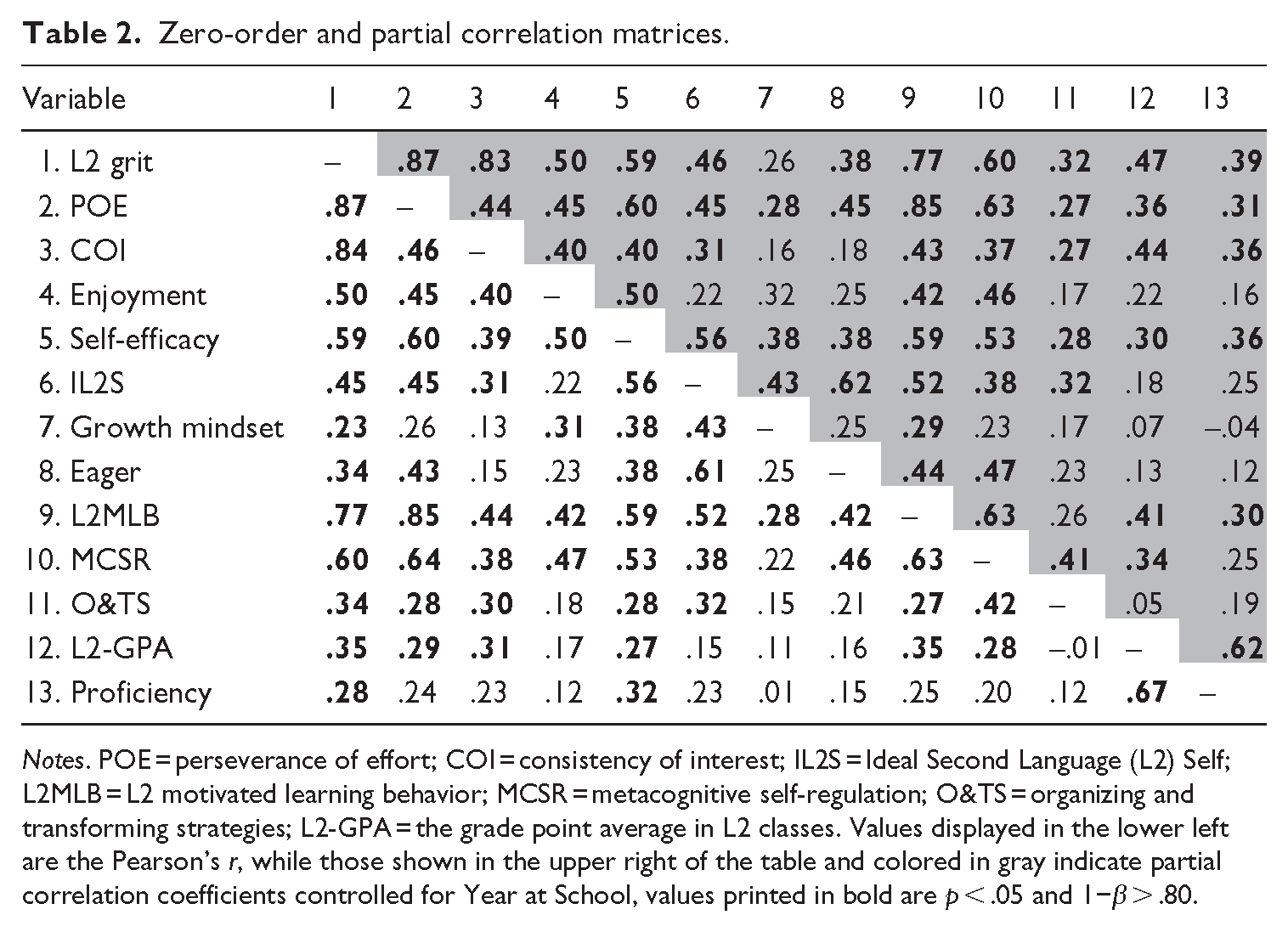
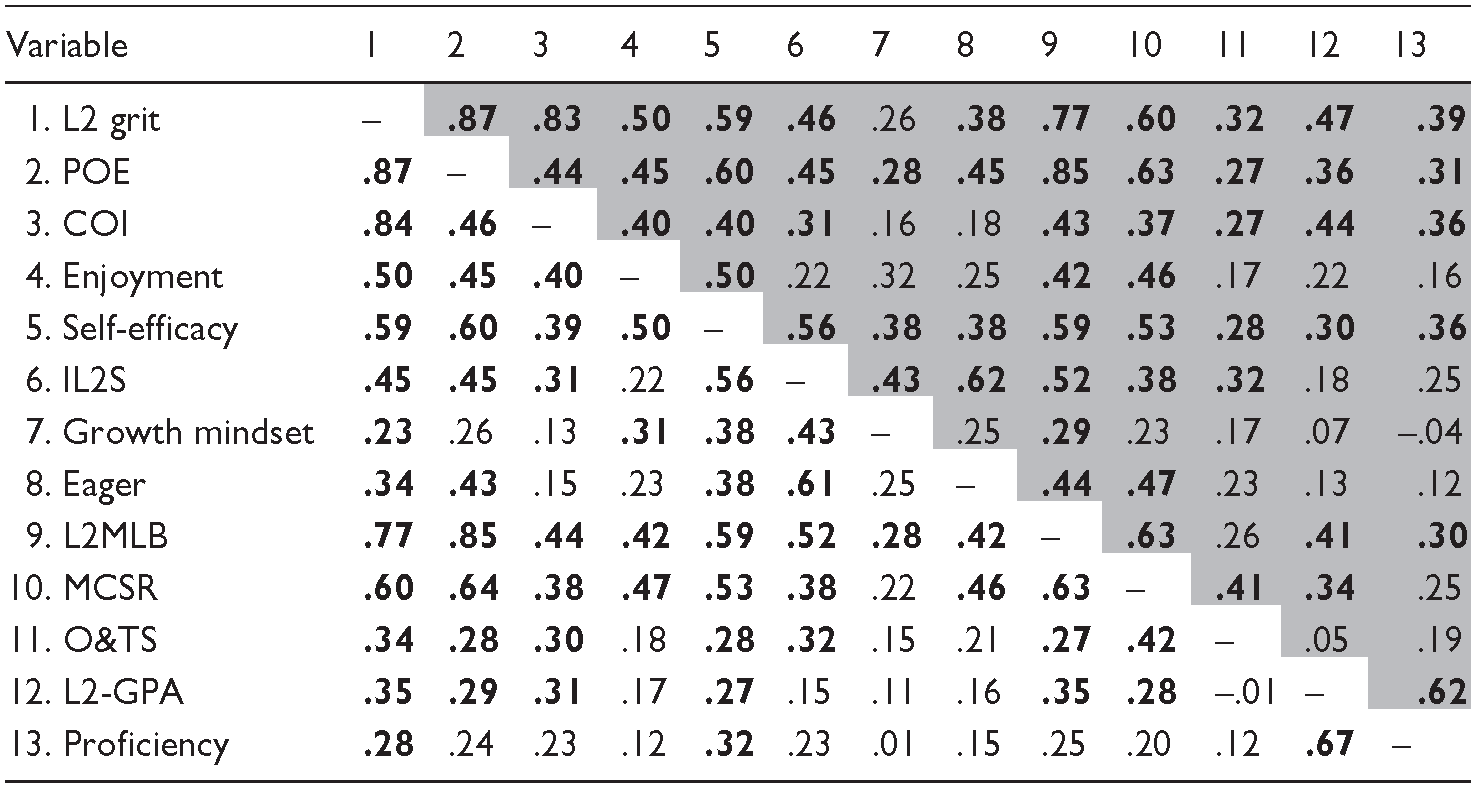
Notes. POE = perseverance of effort; COI = consistency of interest; IL2S = Ideal Second Language (L2) Self; L2MLB = L2 motivated learning behavior; MCSR = metacognitive self-regulation; O&TS = organizing and transforming strategies; L2-GPA = the grade point average in L2 classes. Values displayed in the lower left are the Pearson’s r, while those shown in the upper right of the table and colored in gray indicate partial correlation coefficients controlled for Year at School, values printed in bold are p < .05 and 1−β > .80.
a Hypothesis 1: Importance of SRLL-related psychological attributes to POE and COI levels
Table 3 summarizes the results of multiple regression and relative weight analyses. The residual distributions were found to be normal (D = 0.06–0.07, p = .755–.828), and all VIF values were below 1.88. The five variables together explained 40% and 25% of the variance in POE and COI, respectively. With respect to POE, self-efficacy was most strongly associated with POE (RW = 45.17%), followed by enjoyment (RW = 24.38%) and IL2S (RW = 22.96%). Meanwhile, the level of COI was primarily explained by enjoyment (RW = 36.19%), followed by self-efficacy (RW = 24.63%), Year at School (RW = 20.10%) and IL2S (RW = 16.96%). Year at School emerged as a significant variable only in the model including COI, and it was negatively related to COI (β = –.22).
Relative importance of five variables in predicting perseverance of effort (POE) and consistency of interest (COI).

Notes. RW = Relative Weight (when the CI does not include zero, weights are significant at p < .05); RW (%) represents the rescaled weight (i.e. the relative importance of the predictor variables in explaining the dependent variable); DV = dependent variable.
The same trends were observed for the important variables selected by the Boruta algorithm (Figures 3 and 4). Specifically, self-efficacy, IL2S, and enjoyment were found to be important predictors of both POE and COI. Year at School was also selected in the model including COI (Figure 4).
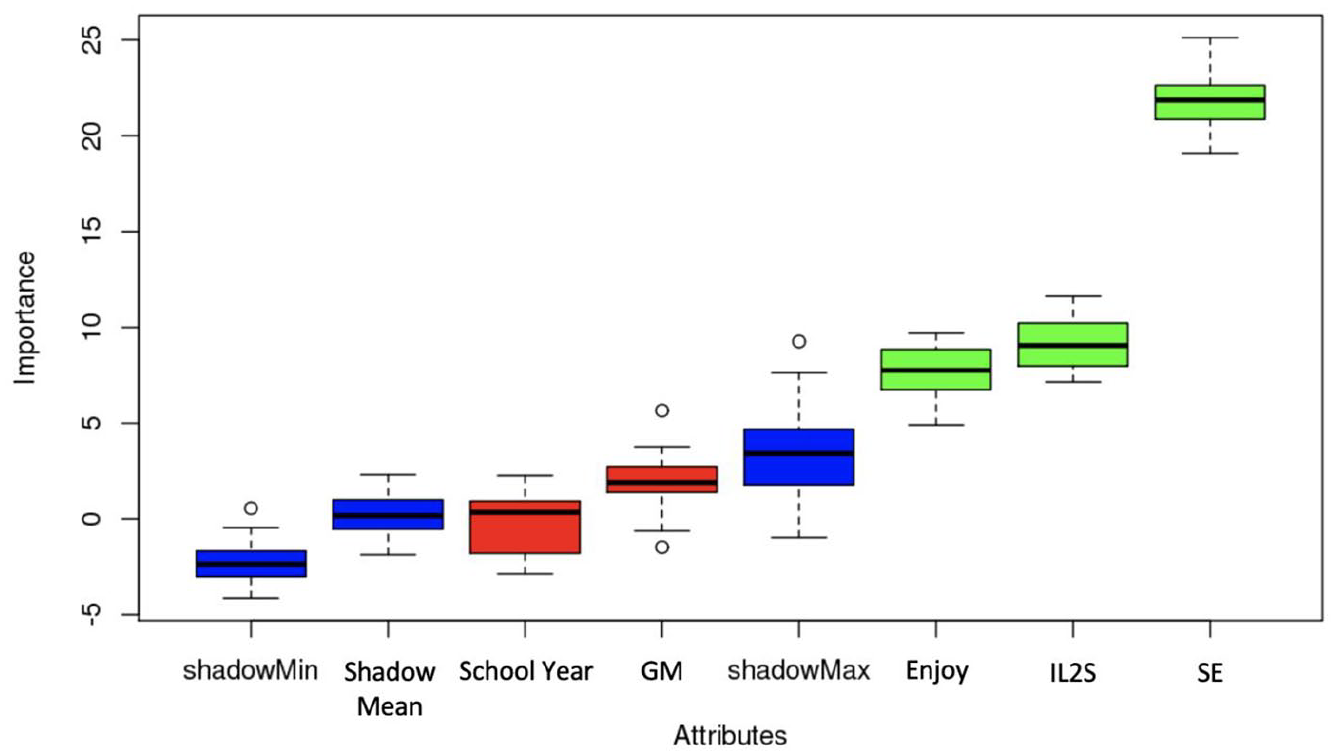
Variable importance of perseverance of effort (POE) using random forest.
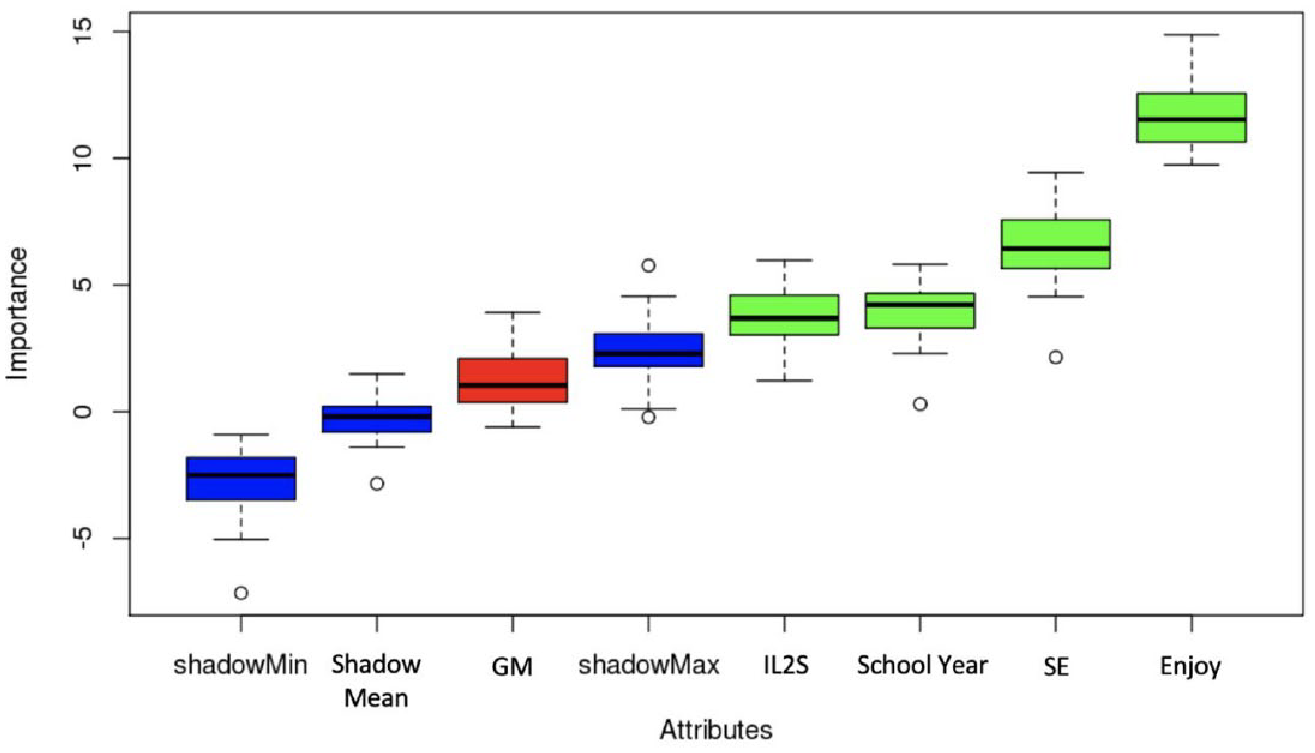
Variable importance of consistency of interest (COI) using random forest.
b Hypothesis 2: The mediating role of SRLL in the grit–achievement relationship
Table 4 presents the results of multiple regression and relative weight analyses. The residual distributions were found to be normal (D = 0.07, p = .593–.680), and all VIF values were below 1.98. The five variables together explained 27% and 17% of the variance in L2-GPA and Proficiency, respectively. Regarding L2-GPA, Year at School emerged as the strongest predictor. L2MLB demonstrated the second strongest positive association with the L2-GPA score (RW = 31.44%), succeeded by MCSR (RW = 16.97%). As for Proficiency, although the model itself was significant and adequately powered, their relative weights were found to be non-significant at p < .05.
Relative importance of five variables in predicting achievement measures.

Note. RW = Relative Weight (when the CI does not include zero, weights are significant at p < .05); RW(%) represents the rescaled weight (i.e. the relative importance of the predictor variables in explaining the dependent variable); DV = dependent variable.
Figures 5 and 6 show the variables selected by the Boruta algorithm. With regard to L2-GPA, the results resembled those obtained in the first-step analyses; that is, Year at School, L2MLB, and MCSR were identified as the important variables (Figure 5). Meanwhile, in relation to Proficiency, Year at School and L2MLB were selected as the important features (Figure 6).
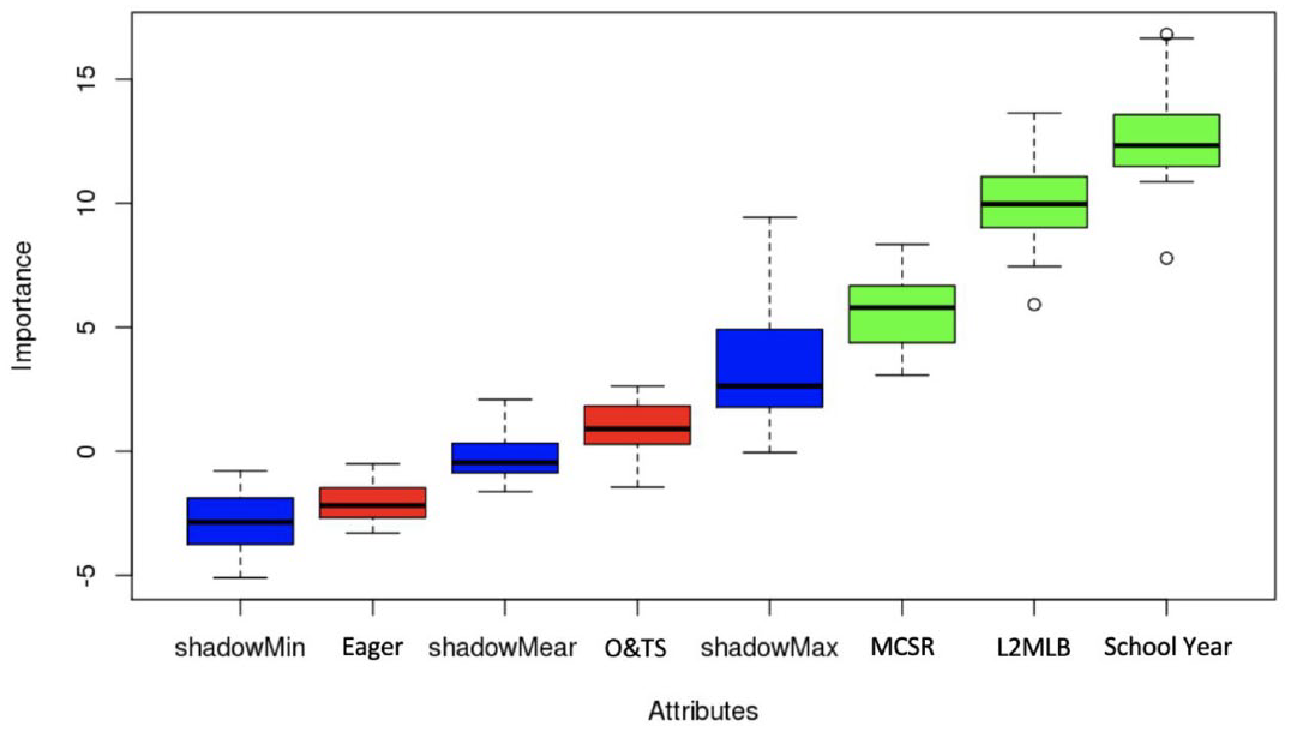
Variable importance of the grade point average in L2 classes (L2-GPA) using random forest.
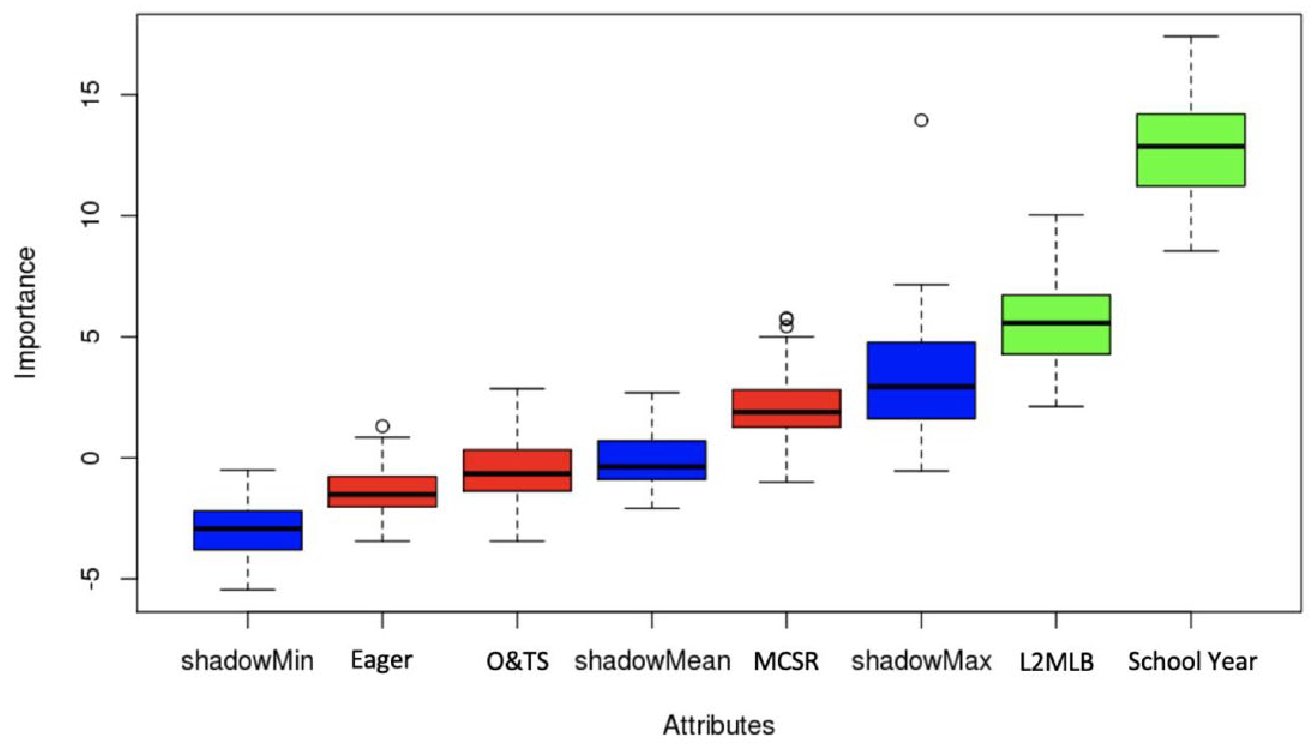
Variable importance of Proficiency using random forest.
Based on the results produced by the first-step analyses, we conducted moderated mediation analyses. When L2-GPA was the dependent variable, L2MLB and MCSR were set as the mediators in the relationship between L2 grit (POE and COI) and achievement. In terms of Proficiency, based on the results produced by the Boruta algorithm, L2MLB was used as the mediator. Years at school was the moderator in all models.
Table 5 summarizes the results of the moderated mediation analyses. Significant indirect effects were found for L2MLB as a mediator of the POE–GPA relationship (β = .33, p = .014) and COI–GPA relationship (β = .11, p = .013). Full mediation was observed for the POE–L2MLB–GPA model (i.e. the total effect was significant, but the direct effect was not) (β = .34, p < .001 → β = .01, p = .940); and partial mediation was present for the COI–L2MLB–GPA model (i.e. the direct effect remains significant) (β = .41, p < .001 → β = .31, p = .001). Regarding Proficiency, only the direct paths from POE and COI to the outcome were significant (POE: β = .30, p = .001; COI: β = .33, p < .001). MCSR and L2MLB only neared the threshold of significance as a mediator of the COI–GPA relationship (β = .06, p = .079) and the COI–Proficiency relationship (β = .07, p = .099).
Moderated mediation analyses for POE or COI (IV), SRLL (mediator), year at school (moderator), and achievement (DV).

Notes. **p < .01; *p < .05; +p < .10; Boot 95% CI = BCa bootstrapped CIs using 20,000 repetitions; DV = dependent variable; IV = independent variable.
Conditional indirect effects were observed in the POE–L2MLB–GPA and COI–L2MLB–GPA models (Table 6). Here, we can see that mediation was found only for learners with less ESL experience (i.e. the cases of –1SD). In contrast, for those participants with prolonged ESL experience (+1SD), only the direct paths from POE and COI to L2-GPA were found to be significant (β = .30 and .52, respectively).
Conditional indirect effect (POE or COI → L2MLB → L2-GPA).

Notes. **p < .01; *p < .05; Boot 95% CI = BCa bootstrapped CIs using 20,000 repetitions.
IV Discussion
Hypothesis 1: SRLL-related psychological attributes positively predict levels of L2 grit
Hypothesis 1 was mostly supported in that three out of four target variables (i.e. IL2S, self-efficacy, and enjoyment) were confirmed to be important in explaining the levels of POE and COI. Although longitudinal confirmation is crucial, these results lend preliminary support to the notion that psychological attributes facilitating SRLL are key to the development of gritty personality in L2 learning. An implication of the present results is that, in situations where language teachers wish to enhance their students’ grittiness, it appears advantageous to support their SRLL by cultivating ideal L2 self-image, evoking feelings of enjoyment, and enhancing the perception of control over L2 activities.
The results also indicate that self-efficacy has greater relevance to POE levels than to COI, and this trend is reversed when it comes to enjoyment. This raises the possibility that the ability to exert persistent effort in L2 learning may be strongly associated with a sense of control over the learning process, while typical levels of enjoyment may be particularly important for the ability to maintain enthusiasm and interest in L2 learning.
The unique associations of self-efficacy and enjoyment imply that different teaching approaches can be taken in promoting learners’ POE and COI, depending on the context. When there is a specific need for increased persistence in L2 learning, then goal settings and perceived progress, factors known to contribute to higher levels of self-efficacy (Dent & Koenka, 2016; Sitzmann & Ely, 2011; Zimmerman, 1990, 2000), could also promote perseverance. The use of formative assessment is one way to achieve this by (1) providing students with feedback on their performance against their L2 goals and (2) enabling them to make necessary improvements (Xiao & Yang, 2019). Meanwhile, when teachers wish to promote the passion aspect of L2 grit, the creation of a positive class atmosphere could be effective. As L2 enjoyment is reported to be highly influenced by external factors including teachers and peers (Pan & Zhang, 2023), language teachers should establish and maintain rapport with their students and strengthen the bonds among students in their classroom. Such efforts are expected to lead to enduring passion for L2 learning.
Interestingly, our result was incompatible with Solhi et al.’s (2023) cross-sectional data that growth mindset was associated positively with levels of L2 grit. This discrepancy may arise from the contextual differences between our ESL environment and Solhi et al.’s (2023) English as a foreign language (EFL) environment. As the participants of this study chose to study English as their major, they likely held a positive belief in the incremental potential of language intelligence from the time they began their L2 learning. It may be the case that this belief remains relatively stable as they spend time in the ESL environment, while pronounced individual differences emerge in learners’ ideal self-image, sense of control over L2 tasks, and levels of enjoyment as their L2 learning progresses at different paces. This may account for the absence of a clear relationship between growth mindset and L2 grit in this study. Meanwhile, because EFL learners’ growth mindset tends to exhibit greater variability compared to that of ESL learners (Lou & Noels, 2017), higher levels of growth mindset in Solhi et al. (2023) may have more directly facilitated the development of grittiness in language learning.
Another notable result is that Year at School was negatively related to levels of COI, while its association with POE was not confirmed. One possible explanation for this is the presence of a plateau in the passion aspect of L2 grit. The participants of this study had been studying English within the English department for 2 to 3 years at the time of our investigation. L2 activities offered in the target department may have been particularly novel and authentic for the participants during the early stages of their university lives. Such early-stage learning experiences may strongly contribute to the development of passion for L2 learning, which may then plateau or even experience a slight decline as L2 learning becomes a more routine and integrated aspect of their lives. This possibility is worthy of investigation using a longitudinal design, as it allows for a deeper understanding of the developmental process of L2 grit over time (Elahi Shirvan et al., 2021).
Hypothesis 2: SRLL mediates the grit–achievement relationship
Hypothesis 2 was only partially supported. Specifically, of the three SRL processes, only the behavioral process represented by ML2LB significantly mediated the POE–GPA and COI–GPA relationships, and no clear evidence of mediation was found concerning Proficiency.
The relationship between perseverance and L2-GPA was fully mediated by motivated learning behaviors, and partial mediation was identified in the case of passion. These results, albeit partial, suggest a possible explanation for why gritty learners’ L2 class performance was better in previous studies (Sudina & Plonsky, 2021; Teimouri, Plonsky, & Tabandeh, 2022). Specifically, both the perseverance and passion components of L2 grit appear to enhance the intensity of learning efforts to varying degrees, and these efforts in turn contribute to consistently higher achievement in L2 classes. Integrating these results with the findings related to hypothesis 1, we propose the following notion: the psychological attributes that facilitate SRLL contribute to higher levels of L2 grit, subsequently enhancing classroom L2 learning by intensifying learning efforts.
Another interesting finding was that the mediation of motivated learning behavior in the POE–GPA and COI–GPA relationships was clear only for the participants with shorter ESL experience, whereas the direct paths from POE and COI to L2-GPA remained significant for those with prolonged learning experience. These results imply that L2 grit may be related to different types of self-regulatory behaviors depending on the stage of learning that individuals are in. Prior SRLL research has demonstrated that the association between psychological attributes and self-regulation is dynamic, depending particularly on L2 learning experiences (Wilby, 2020) and proficiency levels (Bai & Guo, 2019). Given these findings, the conditional indirect effects observed in this study may mirror the dynamic relationship between grittiness and L2 development. It may be the case that gritty L2 learners initially intensify their efforts to enhance their language skills in ESL classes; and as they gain a deeper understanding of their progress and become more knowledgeable about self-management in these classes, their approaches may evolve toward adopting strategies to effectively achieve higher-level performance in ESL classes.
While these results offer some insights, we did not find that self-level SRL behavior (i.e. MCSR) mediated the relationship between L2 grit and L2-GPA. Moreover, no clear evidence of mediation was found when absolute L2 attainment was the target variable. We, however, believe that these results do not necessarily negate the utility of the SRL framework in investigating the link between the grit–achievement relationship.
Our argument is that L2 grit may promote different types of self-regulatory behaviors in response to learning situations, just as the grit–GPA relationship may be mediated by different behaviors depending on the stage of learning. The SRLL indexes employed in this study represent the behaviors that broadly contribute to the development of L2 knowledge and skills (e.g. using metacognitive strategies for effective learning and Eager for expanding L2 use opportunities). On this point, L2 grit is a goal-oriented personality, and the world ‘goal’ can encompass both situational and individual dimensions. For example, one may strive to improve their performance in ESL classes as a situational goal with the individual (and ultimate) goal of achieving their ideal level of L2 proficiency. Given this possibility, the mediating role of the three SRL processes may be better elucidated when we focus on the behaviors that help learners achieve higher performance in particular learning situations. In the context of classroom learning, learners may try to create environments where they can concentrate on the tasks at hand (Zimmerman, 1989) rather than seeking out L2 use opportunities. They may also leverage teachers’ feedback as a resource for enhancing their metacognitive skills (Yang et al., 2023) before effectively monitoring their own learning. When it comes to test performance, it could be advantageous to concentrate on actions more closely aligned with the constructs that a particular test aims to measure. On this point, Zhao et al. (2023) recently found the mediation of reading-to-write strategies in the relationship between Ideal L2 Self and integrated writing task performance. In this study, as the proficiency test consisted of reading and listening comprehension questions, it could be the case that an environmental strategy of actively seeking opportunities for written and auditory input outside the classroom is a potentially important predictor of learners’ scores on the test.
Another interesting finding is that significant direct paths were observed between both grit components and two achievement measures (L2-GPA and Proficiency). These data add to the growing body of literature on how L2 grit components are associated with language achievement. Previous studies have found a consistent positive relationship between POE and language achievement, whereas a much weaker or even negative relationship has been observed between COI and achievement measures (Alamer, 2021; Sudina et al., 2021; Teimouri, Plonsky, & Tabandeh, 2022; J. Zhang & Zhang, 2023). At the same time, however, COI emerged as the only significant predictor of class exam scores in Sudina and Plonsky (2021), and J. Zhang and Zhang (2023) found that COI was more strongly related to the quality of narrative writing compared to POE (for a general review, see Demir, 2024). These mixed findings could reflect the fact that L2 grit components contribute to different outcomes depending on learners’ status and situations. Our results suggested that the grit–achievement relationship could be mediated by different types of self-regulatory behaviors depending on learners’ status (e.g. learning experience and proficiency levels) and learning situations (e.g. learning contents and goals). Additionally, Sudina et al. (2021) demonstrated that the association between L2 grit components and achievement can vary across learning contexts. These findings together suggest the possibility that both learner and situational factors can moderate the grit–behavior and grit–achievement relationships. It may therefore be beneficial for future research to consider such factors in their assessment and discussion of the relationship between L2 grit components and outcome variables. Such consideration could advance our understanding of the role of L2 grit in specific learning stages and situations.
Limitations
Several limitations must be noted. The first is the sample size of this study. We employed a 2-hour standardized test (TOEIC®) and L2-GPA as performance measures. The use of such measures increases the practicality and comparability of the results. The downside of this, however, is that our final sample size was limited to 108, which is relatively small compared with similar studies. This sample size may be a factor behind the result that two mediators (i.e. MCSR and L2MLB) only came close to significance in the moderated mediation analyses. For this reason, the use of larger samples (potentially by collecting data from multiple sites) is advisable in future studies.
The second limitation relates to the correlational nature of this study. Due to the novelty of L2 grit, previous research has predominantly used a cross-sectional design, and this study adopted the same approach. Nonetheless, given that our results underscore the importance of accounting for L2 learning stage when evaluating the role of L2 grit in linguistic success, the adoption of longitudinal designs and SRL models that help explain changes in self-regulation (e.g. the cyclical phase model in Zimmerman, 2013) should be encouraged in future research.
Relatedly, the final limitation of this study is that our results only partially supported the mediating role of SRLL in the grit–achievement relationship. The behavioral scales employed in this study were considered suitable for representing each of the three processes of the triadic SRL model (Shen et al., 2023; Zimmerman, 1989, 2000, 2013). However, considering the potential influence of L2 grit on different self-regulatory behaviors based on learners’ status and learning settings, a contextual focus should be emphasized in selecting or developing SRLL indexes in future studies.
V Conclusions
Using the SRL framework, this study investigated the underlying mechanism in the development of L2 grit and its contribution to language achievement. The results showed that the psychological attributes facilitating self-regulation in L2 learning (i.e. Ideal L2 Self, self-efficacy, and enjoyment) were important in explaining levels of the two L2 grit components, and both of these components were related to higher achievement in ESL classes through motivated learning behavior. Based on these results, we proposed the possibility that the three attributes contribute to higher levels of L2 grit, subsequently enhancing classroom L2 learning by intensifying learning efforts. Our results also suggested that L2 grit may promote different types of self-regulatory behaviors depending on learners’ status (i.e. learning experience and proficiency levels) and learning situations (e.g. learning contents and goals). Meanwhile, the cross-sectional design of this study limited the establishment of cause-and-effect relationships among variables studied. Hence, future research should adopt a longitudinal design to examine how SRL (1) influences levels of L2 grit and (2) mediates the grit–achievement relationship, considering learners’ status and learning settings.
Footnotes
Acknowledgements
We are grateful to Dr Natalie-Anne Hall for English language editing. Note that this work was supported by the Japan Society for the Promotion of Science (number 24K04118 and 24K04144).
Author contributions
Hitoshi Mikami collected the data and wrote the first draft. Both authors contributed to the design and analysis of the data, and revised the drafts.
Funding
The author(s) disclosed receipt of the following financial support for the research, authorship, and/or publication of this article: This work was supported by the Japan Society for the Promotion of Science (24K04118 and 24K04144).
Ethics approval
Ethical approval was granted by the university where the first and second authors were affiliated.
Consent to participate
All participants provided their written informed consent to participate in this study.

Availability of data and material
The datasets generated for this study will be made available by the first author upon reasonable request.