



Abstract
Most research on task-based language teaching (TBLT) has focused on specific factors that play a role in task-based performance and learning, whereas considerably fewer studies have paid attention to how TBLT curricula have been developed and delivered in second language (L2) teaching contexts. However, it has been argued that the latter type of evaluative inquiry is crucial in order to advance the educational significance of the approach. While more evaluation studies have been published in recent years, few of them adopt a multi-methodological, longitudinal and cyclical perspective. The current study examines the planning and implementation of task-based instruction in a university-level Spanish as a foreign language program over a five-year period, with a particular emphasis on instructors’ and students’ perceptions about the approach. Data sources consisted of notes from meetings with instructors, classroom observations, students’ perceptions collected through journals, focus groups and questionnaires, and instructors’ perceptions collected through a questionnaire. The qualitative and quantitative analysis of these data revealed critical aspects of the planning phase, positive and challenging components of the approach, modifications made in response to participants’ perceptions, as well as a gradual increase regarding the level of acceptance of task-based instruction throughout the implementation. Implications for the implementation and evaluation of TBLT in other second language educational contexts are discussed.
Keywords
I Introduction
In the last three decades, task-based language teaching (TBLT) has gained popularity in the field of Second Language Education. During this time, research about different aspects of task-based instruction has been instrumental in determining elements of task design that facilitate the development of second language (L2) proficiency. While this body of research undoubtedly has much to offer to our understanding of instructed language learning, it has mainly focused on discrete tasks per se rather than on how tasks are implemented in pedagogical contexts (Bygate, 2016; Ellis, 2018). 1 Norris notes that ‘our discussions and interests in TBLT have been somewhat distracted from the ‘big picture’ of task-based education’ (Norris, 2015, p. 29) since ‘TBLT in its original manifestations in the language teaching and applied linguistics literature was an educational proposal’ (p. 29). Indeed, TBLT emerged as an innovative approach to syllabus design (Long & Crookes, 1992) in response to perceived shortcomings of, and dissatisfaction with, existing pedagogical approaches in specific contexts (e.g. Prabhu, 1987). In the light of this, Norris (2015; Norris & Davis, 2021) proposes program evaluation as an appropriate and useful framework for research focusing on the design and implementation of TBLT in educational settings. Although a number of TBLT evaluations have been published in recent years, such studies are still few and, with a few exceptions (e.g. González-Lloret & Nielson, 2015; Towell & Tomlinson, 1999), the majority of them report one-off implementations of TBLT, resulting in a dearth of insights beyond the initial implementation of the approach. Thus, locally situated, longitudinal and cyclical evaluation studies that examine the planning and implementation of TBLT are arguably needed in order to better understand how TBLT curricula are put into practice in different contexts and, consequently, to advance the educational significance of the approach (Bygate, 2016, 2020; Ellis, 2018; Ellis et al., 2020; Long, 2015, 2016; Norris, 2015). This article reports a study evaluating the development and implementation of a task-based Spanish as a foreign language program at a Canadian university over a five-year period.
II Background
1 TBLT as an educational proposal
Unlike synthetic syllabi, which are organized around linguistic forms, in TBLT tasks are the organizational principle around which syllabi and curricula are designed. A task is defined as ‘an activity in which a person engages in order to attain an objective, and which necessitates the use of language’ (Van den Branden, 2006, p. 4). TBLT is based on the notion of learning by doing; that is, ‘people not only learn language in order to make functional use of it, but also . . . by making functional use of it’ (Erlam, 2016, p. 280; emphasis in the original). In TBLT, learners are engaged in the holistic use of language in communicative activities that resemble real-life situations (Long, 2015), thus providing learning opportunities that prepare them to use the language beyond the classroom (Norris, 2009). In its original conceptualization, TBLT ‘was intended to guide the design and delivery of key components of any language educational program, from teacher practice to curriculum to materials to assessment’ (Norris, 2015, p. 30). Therefore, TBLT aims to address questions regarding the identification of learning needs, the selection of objectives, task and syllabus design, as well as the evaluation of programs.
2 Evaluations of TBLT
Calls for evaluation studies have emphasized the need to understand how TBLT works in actual classrooms and how teachers and learners react to the approach (e.g. Ellis et al., 2020; Newton, 2021; Norris & Davis, 2021). Norris (2006) defines evaluation as ‘the gathering of information about any of the variety of elements that constitute educational programs, for a variety of purposes that primarily include understanding, demonstrating, improving, and judging program value’ (p. 579). Recent trends in evaluation emphasize a comprehensive conception that places a strong focus on program processes, on the wide range of evaluation purposes, and on the usefulness of its findings (Kiely & Rea-Dickins, 2005; Norris, 2016). Such a broad perspective of evaluation entails a holistic, formative orientation that aims at capturing the multi-faceted and complex nature of any program and that emphasizes program development and improvement. Thus, evaluations of this kind are often embedded from the outset in the planning of a program, take place during several cycles of implementation, collect data from multiple sources, and, crucially, involve participation of key stakeholders such as teachers and learners in the process (Kiely & Rea-Dickins, 2009; Norris, 2015, 2016; Ross, 2009).
An increasing number of TBLT implementation studies have incorporated specific aspects of evaluative inquiry in their design. Some of these studies examined differences between TBLT and other forms of instruction. Overall, the findings show that learners who received task-based instruction performed as well as, or better than, learners who were instructed following other approaches, particularly in regards to oral proficiency measures (e.g. González-Lloret & Nielson, 2015; Lai et al., 2011; Park, 2012; Shintani, 2013). Nevertheless, any claims of causality based on these results need to be taken with certain caution given that in a pretest-posttest design aimed at evaluating a whole program it is almost impossible to control the multiple factors at play (Long, 2015; Norris, 2015).
A number of studies have focused on teachers’ perceptions of TBLT, thus acknowledging the key role that teachers play in the adoption of any pedagogical innovation. The majority of these studies report overall positive views about the approach, which is often seen as engaging and motivating, particularly because of its relevance to real-world learners’ needs and its strong focus on communication skills (Andon & Eckerth, 2009; East, 2018; Harris, 2018; Jeon, 2006; Liu & Ren, 2021; Liu et al., 2021; McDonough & Chaikitmongkol, 2007; Nguyen et al., 2023; Park, 2012; Siddiqui & Winke, 2023; Xu & Fan, 2022). However, many teachers believe that TBLT does not emphasize grammar instruction sufficiently, which often results in teachers adapting it to fit their preference for a more teacher-centered style (Andon & Eckerth, 2009; Carless, 2004; Chen & Wright, 2017; Duong & Nguyen, 2021; East, 2018, 2019; Harris, 2018; Lopes, 2004; Peng & Pyper, 2019; Tinker Sachs, 2007; Watson Todd, 2006). Other challenges in implementing TBLT include the lack of readily-available resources for teaching with tasks (East, 2019; Harris, 2018; Li & Thomas, 2023; Liu & Ren, 2021; Liu & Xiong, 2016; Liu et al., 2021; Peng & Pyper, 2019; Xu & Fan, 2022), the lack of time to develop task-based lessons and materials (Duong & Nguyen, 2021; East, 2019; Li & Thomas, 2023; Lin & Wu, 2012; Nguyen et al., 2023; Park, 2012; Peng & Pyper, 2019), lack of training in TBLT (Liu & Ren, 2021; Liu et al., 2021; Peng & Pyper, 2019; Xu & Fan, 2022), and contextual factors such as large class sizes (Duong & Nguyen, 2021; Lin & Wu, 2012; Liu & Ren, 2021; Liu & Xiong, 2016; Nguyen et al., 2023; Siddiqui & Winke, 2023) and unsuitability in relation to mandated curricula or examination expectations (Duong & Nguyen, 2021; East, 2019; Lin & Wu, 2012; Liu & Ren, 2021; Liu et al., 2021; Nguyen et al., 2023; Xu & Fan, 2022).
Similar to teachers, most learners also react positively to TBLT. The emphasis on developing communication skills applicable in the real world, as well as the perceived improvement of those skills, are frequently cited as positive factors (Bao & Du, 2015; González-Lloret & Nielson, 2015; Huang & Nisbet, 2020; Kim et al., 2017; Lai et al., 2011; Lee, 2016; Lopes, 2004; McDonough & Chaikitmongkol, 2007; Park, 2012; Payant & Bright, 2017; Tinker Sachs, 2007; Towell & Tomlinson, 1999; Wu et al., 2016; Xu & Fan, 2022). Learners often show an appreciation for the collaborative and learning-by-doing nature of TBLT (González-Lloret & Nielson, 2015; Lai et al., 2011; Lee, 2016; Wu et al., 2016). Among others, some of the reported challenges are a preference for individual work and teacher-fronted instruction in some educational settings (Bao & Du, 2015; Huang & Nisbet, 2020; Lai et al., 2011; Park, 2012) and the fact that the number of activities in some implementations made TBLT too demanding (Kim et al., 2017; McDonough & Chaikitmongkol, 2007). The challenging aspect of task-based instruction most frequently reported by learners is its perceived lack of grammar focus and the associated concern of how this might affect the development of accuracy in the L2 (González-Lloret & Nielson, 2015; Kim et al., 2017; Lai et al., 2011; Lopes, 2004; Park, 2012; Towell & Tomlinson, 1999).
Teachers and students’ perceptions of tasks, particularly in relation to grammar instruction, often influence the type of approach that is implemented. In some cases (e.g. González-Lloret & Nielson, 2015; Kim et al., 2017; McDonough & Chaikitmongkol, 2007), implementations remain close to strong forms of TBLT similar to Ellis’ (2003), Long’s (2015) or Willis and Willis’ (2007) models. In many other contexts (e.g. Andon & Eckerth, 2009; Bao & Du, 2015; Carless, 2004; Chen & Wright, 2017; East, 2018; Huang & Nisbet, 2020; Liu & Ren, 2021; Watson Todd, 2006; Xu & Fan, 2022), however, perceived challenges of teaching with tasks lead to implementing weak forms of TBLT, also labeled as task-supported language teaching (TSLT). In many of these cases, such approaches are described as consisting of planned language-focused work, typically in the form of teacher-fronted presentation and controlled practice exercises, followed by the use of tasks for communicative practice. Thus, weak forms of TBLT or TSLT seem more likely to be adopted by L2 teaching professionals than strong forms of TBLT (Boers & Faez, 2023; Chen & Wright, 2017).
Interestingly, the few studies that have examined changes in teachers’ and learners’ perceptions (e.g. Kim et al., 2017; McDonough & Chaikitmongkol, 2007) or that examined perceptions over several cycles of implementation (e.g. Lopes, 2004; Towell & Tomlinson, 1999; Watson Todd, 2006) show that repeated engagement with the approach and subsequent modifications to the initial implementation result in higher acceptance rates from both teachers and learners. This latter observation underscores the importance of adopting a long-term, cyclical approach to evaluation and of involving key stakeholders in the process. As Norris emphasizes: it may be that without evaluation included as a fundamental component of task-based innovations, and especially evaluation that attends to and acts upon the needs of teachers and learners in the immediate term, the chances of TBLT being adopted, implemented, and sustained successfully are dramatically reduced (Norris, 2015, p. 52).
This article reports an internally driven, formative oriented evaluation study carried out over the planning phase and three cycles of implementation that focuses mainly on instructors’ and students’ perceptions. The following research questions guided the study:
• Research question 1: What decisions were made during the planning phase and how did they affect the planned approach?
• Research question 2: What were the instructors’ and students’ experiences with and perceptions about TBLT?
• Research question 3: How did instructors’ and students’ perceptions evolve over several cycles of implementation?
• Research question 4: What modifications, if any, were made to the implementation of the approach?
III The study
1 Instructional context and participants
The study took place at a large research university in Western Canada. At this university, Spanish language courses are offered at three levels of instruction. The first two levels, which are the focus of the study, roughly correspond to the A1–A2 and B1 levels of the Common European Framework of Reference (CEFR; Council of Europe, 2001), and they are intended for students who want to learn Spanish for general purposes. On average, the beginners’ and intermediate level courses serve about 300 students per academic term.
Eleven Spanish language instructors made up the instructional team during the time of the study. Six of them participated in the planning phase and in the three cycles of implementation, and five were graduate students who only taught during one or two of the cycles. These instructors were either part-time teaching staff or graduate students who had completed, in the case of the former, or were completing, in the case of the latter, a graduate degree in Spanish and Latin American Studies or in Applied Linguistics, and who had received language pedagogy training consistent with TBLT principles. The six part-time instructors had between 9 and 16 years of teaching experience, whereas the graduate students had one year of experience at most.
The other group of participants were university-level students recruited from beginner and intermediate-level Spanish language classes over a period of three consecutive academic years. Because participants were recruited at the beginning of every term, some students likely participated in the study in both terms of the same academic year. Moreover, some participants who had enrolled in the beginner-level classes in the first and second years of implementation and who continued taking Spanish at the intermediate level during the second and third years of implementation, respectively, may have participated in the study during two academic years. 2 The majority of the students enrolled in such classes are in their late teens or early twenties, although a small percentage of more mature students also take Spanish classes. Although language backgrounds are very diverse, English is the dominant first language (L1) in this instructional context. None of the students in those classes are native speakers of Spanish. As we will see below, the number of participants varied depending on the data sources.
2 Data collection instruments and procedures
a Learning journals
Participating students were asked to keep a weekly learning journal about their perceptions of the approach. They received a list of suggestions (Appendix A in supplemental material) that they could address in their entries, but they were free to write about any topic of their choice. Sixty-seven students volunteered to keep the learning journal, but only 31 of them wrote entries on a regular basis.
b Focus groups
Sixty-five students volunteered to participate in semi-structured focus groups at the end of each term. The questions (Appendix B in supplemental material) aimed at eliciting students’ reflections about their overall experience, aspects of the approach that worked well and those that could be improved, as well as specific features of TBLT. Focus groups consisted of three to five students, and the discussions lasted for about an hour on average.
c Students’ questionnaire
The students’ questionnaire (Appendix C in supplemental material) was developed so that items would reflect defining features of TBLT (e.g. real-life relevance, focus on communication, collaborative and learning-by-doing nature of the approach) as well as themes (e.g. improvement of proficiency and grammar instruction within TBLT) that consistently emerged in the journals and focus groups collected during the first term of implementation. There were 44 statements to which the participants had to respond indicating their agreement on a 6-point Likert scale, and most of the statements were grouped into multi-item scales intended to tap on specific aspects of the implementation, as reported in Section IV (see also scales in Tables 1 and 2). The scales consisted of up to three positively-worded items and at least one negatively-worded one in order to reduce response bias (Dörnyei, 2009). Furthermore, there were two open-ended questions about what aspects of the approach worked well and what aspects could be improved. A draft of the questionnaire was sent to the Spanish language instructors and to two colleagues with extensive expertise in L2 pedagogy and TBLT for feedback. The revised version was piloted with the students registered in the Spanish classes during the second term of implementation, and an item analysis was conducted to fine-tune the instrument. The analysis revealed that there were no items with a substantial number of missing responses, and that the ranges of responses exhibited sufficient variation. To determine the internal consistency of the multi-item scales, Cronbach’s α and corrected item-total correlation coefficients were calculated for each of them. All scales obtained a Cronbach’s α value higher than .70 and a medium-to-high correlation coefficient (.30 or higher), indicating that they were reliable. Two individual items were added to the questionnaire after the pilot phase, which did not affect the reliability of the other multi-item scales. The overall reliability of the questionnaire was .86. The questionnaire was administered at the end of every academic term during the implementation and 376 students completed it. 3
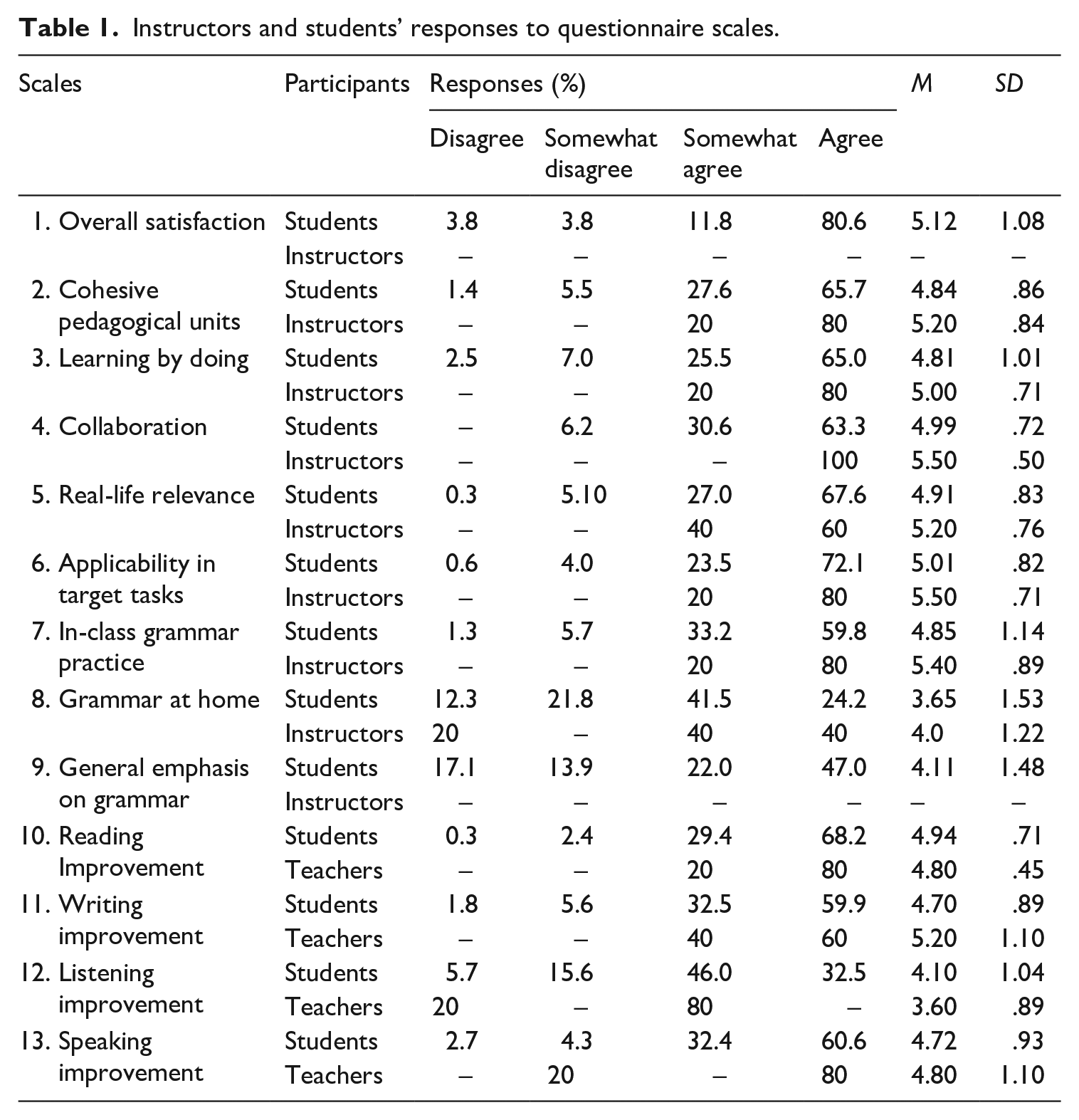
Instructors and students’ responses to questionnaire scales.
Students’ average ratings organized by cohort.
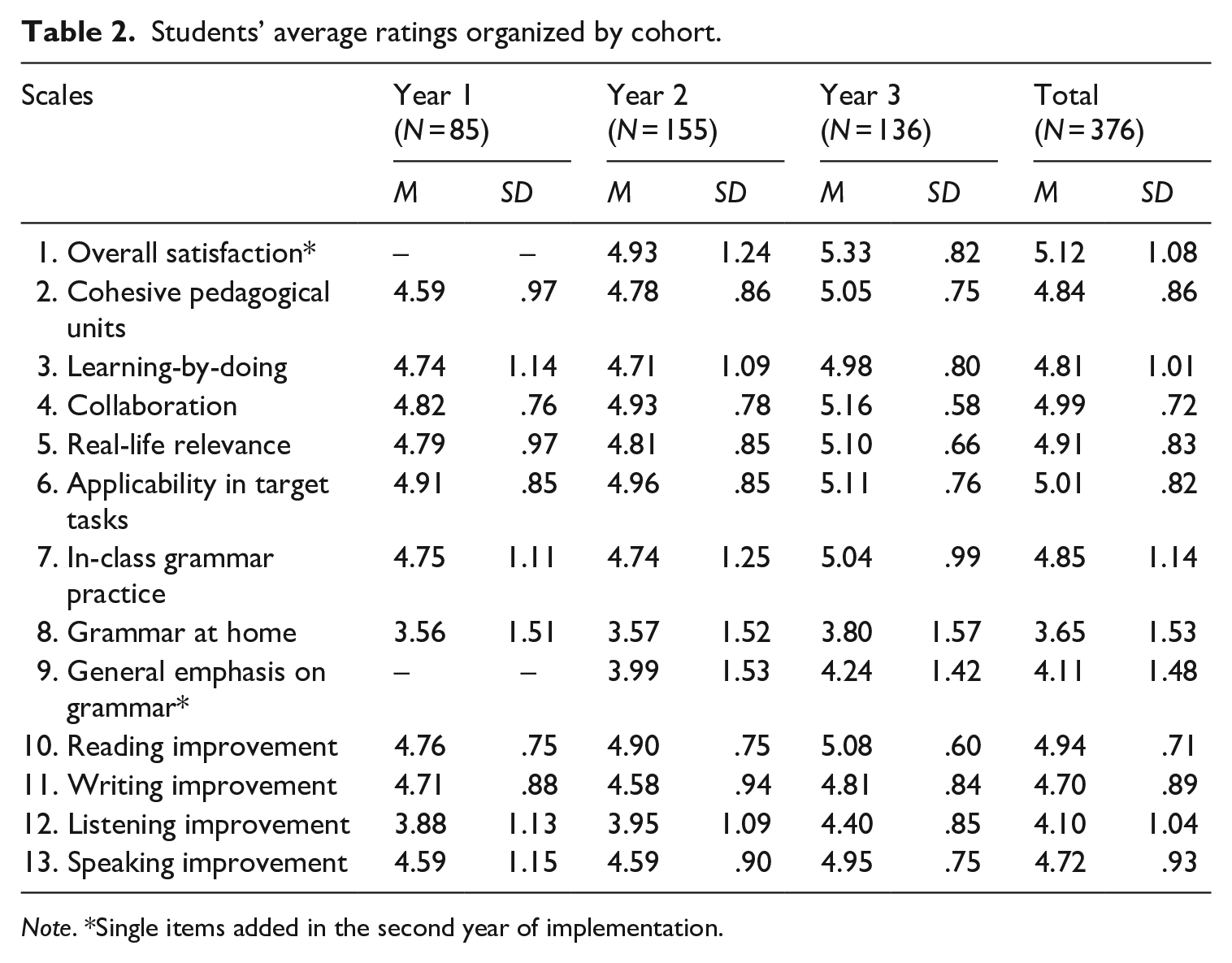
Note. *Single items added in the second year of implementation.
d Instructors’ questionnaire
At the end of the evaluation, instructors were invited to complete an anonymous questionnaire about their experiences with the approach. 4 The questionnaire contained 15 Likert-scale items about different aspects of the approach (e.g. real-life relevance, focus on communication, grammar instruction; see Table 1 in Section III) and five open-ended questions (Appendix D in supplemental material). When the questionnaire was administered, there were eight instructors in the instructional team, and five of them responded.
e Observations
Over the three cycles of implementation, I observed 28 classes to gather information about the actual implementation of the program, keeping detailed notes about pedagogical activities and materials used in those classes, as well as students’ reactions to them (for the guiding questions used for these observations, see Appendix E in supplemental material).
f Field notes
Notes from meetings with individual instructors and with the instructional team, as well as from professional development sessions, were used to keep a record of the issues discussed and the decisions made during the planning and implementation phases of the evaluation, instructors’ views about the approach, as well as our responses to any issues that arose.
3 Data analysis
Responses to the instructors and students’ questionnaires were analysed quantitatively using SPSS. Descriptive statistics (frequencies, mean and standard deviation) were computed for each of the multi-item scales. Additionally, one-way ANOVAs and t-tests were computed to examine differences between students’ responses in each of the cycles of implementation. Data collected through journals, focus groups, field notes, observations and the open-ended questions in the instructors and students’ questionnaires were analysed qualitatively in a cyclical, iterative approach (Merriam & Tisdell, 2016) in which the initial analysis of some pieces of data informed subsequent data collection. For example, as noted above, the development of the students’ questionnaire was informed by the data collected in journals and focus groups. Likewise, class observations informed the topics that were discussed at meetings with instructors.
The initial analysis of the qualitative data followed an inductive process (Saldaña, 2021) in which themes emerged from the data. Thus, a graduate research assistant and I openly coded notes from meetings during the planning phase and the first term of implementation, as well as journals and focus groups from that first term. Further interpretation of and reflection on these open codes (axial coding) led to grouping recurring and related themes into a preliminary set of categories to be used in ensuing analyses. Two graduate research assistants and I sorted new data from the subsequent cycles of implementation into those categories. Additionally, we developed new categories for those data segments that did not fit the initial category set. This process resulted in an exhaustive but manageable set of categories (e.g. ‘real-life relevance’, ‘collaborative nature’, ‘grammar instruction’ or ‘target tasks’; see Section IV) that represented all relevant data and that was responsive to the four research questions of the study.
IV Findings
1 Planning TBLT
This section addresses research question 1, and the main data source are the notes taken during the instructional team meetings during the planning phase. The initial impetus for engaging in a program review came from a common concern of our language instructors: in foreign language-learning settings such as ours, learners have limited exposure to the L2 outside the classroom, which affects the development of their communicative ability. To address this concern, we explored the possibility of adopting TBLT because it could provide students with meaningful opportunities to use the language in class. In the planning phase, we followed Rogers’ (2003) initial stages in the ‘innovation-decision process’: knowledge, persuasion and decision. Thus, so that the team would gain a better understanding of TBLT and, in turn, would be able to make an informed decision, we held several meetings and organized professional development sessions in which we discussed task-based ideas, examined examples of task sequences, and addressed instructors’ concerns. Having developed a positive disposition towards the approach, the team agreed that TBLT seemed suitable for our students and that it would be feasible to put it into practice.
In our context, in which Spanish does not have a significant presence outside the classroom, most students do not have specific language learning needs. 5 Therefore, rather than surveying students about their needs, we specified learning outcomes based on the A1, A2 (for beginners’ courses) and B1 (for intermediate) descriptors of the CEFR (Council of Europe, 2001, pp. 24, 57–87). Subsequently, using the domains described in the CEFR (Council of Europe, 2001, p. 45) and the themes listed in the Breakthrough, Waystage and Threshold levels (Trim, 2009; van Ek & Trim, 1990a, 1990b) as guidelines, we identified topics of potential interest or usefulness for our students. In turn, those outcomes and topics were the basis to determine target task types 6 that would meet students’ potential needs within a general purposes foreign language program (Norris, 2009). For example, under the public domain, the Breakthrough level identifies ‘shopping’ as a theme, and lists several specific notions (Trim, 2009, pp. 45–46). Thus, a related task type would be ‘making decisions regarding the purchase of goods’.
Another issue that we faced was the lack of adequate resources to develop our own pedagogical materials for four full-fledged task-based courses. Thus, we examined several commercial textbooks and we decided to adopt Gente hoy 1 (Martín Peris & Sans Baulenas, 2013) and Gente hoy 2 (Martín Peris & Sans Baulenas, 2014), for the beginners and intermediate levels, respectively. These materials are aligned with the A1–A2 and B1 levels of the CEFR and follow Estaire and Zanón’s (1994) and Martín Peris’ (1999) recommendations for task-based pedagogy. Thus, target tasks constitute the central component from which the content and activities in the textbook units derive. Additionally, these target tasks matched the task types that we identified as valuable for a general purposes program. As an example of a specific target task, continuing with the ‘shopping’ theme mentioned above, the unit about this topic in the A1–A2 textbook includes a task in which students, working in pairs or small groups, first have to find out about two classmates’ likes, hobbies, etc. Then, based on this information, the groups have to discuss and decide on possible birthday gifts for those two classmates (for additional examples of an enabling activity and a target task, see also Appendices F and G, respectively, in supplemental material). The pre-task phase in every unit consists of enabling tasks (Estaire & Zanón, 1994), that is, language and content-focused activities intended to prepare learners to carry out the target task. These activities introduce vocabulary and structures in context through multimodal texts similar to those that learners might encounter in real life. This phase also contains interactive activities that elicit language production, in which learners use vocabulary and grammar learned in previous units or new vocabulary and grammar they may have noticed in the input-providing activities. In addition, some units have a few awareness-raising activities that provide explicit grammar instruction, albeit mainly inductively and often embedded within activities that focus on the functional use of those forms.
The choice of a textbook that included some planned language-focused work before the target task addressed in part some instructors’ concerns regarding grammar instruction, given that for them it was important to have such activities in order to enable students to complete the target tasks. Therefore, the planned approach in our program can be described as a weak form of TBLT. However, it is necessary to emphasize that in our approach tasks are the central element that determine the content and activities in a pedagogical sequence, and thus play a key role in the design and organization of the syllabus. In sum, the approach in our context was similar to the models in Estaire and Zanón (1994), Nunan (2004) and Müller-Hartmann and Schocker-von Ditfurth (2011).
2 Instructors’ and students’ perceptions and modifications to the approach
This section presents the instructors’ and students’ perceptions about different aspects of the TBLT program (research questions 2 and 3). The section also describes the modifications made to the approach at different times during the implementation in response to those perceptions (research question 4). Table 1 presents the instructors and students’ level of agreement with the questionnaire scales regarding aspects of TBLT expressed in percentages and it also reports the mean and standard deviation for each scale. Table 2 reports the mean and standard deviation of the learners’ responses for those same scales organized by cohort, which illustrates how learners’ perceptions evolved over the three cycles of implementation. In what follows, the statistical data will be presented together with illustrative qualitative comments from focus groups, journals and questionnaires.
a Overall reactions to TBLT
Instructors were quite enthusiastic about TBLT because it was consistent with their pedagogical beliefs and their everyday practice. One of them noted that it was ‘a refinement of what I was already doing’. They particularly appreciated the strong ‘focus on using the language’, which meant ‘teaching in a practical and realistic way that allows the students to communicate in real life’. Another instructor noted that ‘the most rewarding aspect for me is to see how fast students improve, how they go from knowing almost nothing to be able to communicate and express themselves.’ Their endorsement of the approach became apparent in the lessons observed, in which the majority of the activities focused on developing the learners’ ability to participate in meaningful communication in the real world. They consisted of input-providing and interactive activities intended to prepare learners for the target tasks, and they mainly relied on collaborative and hands-on work. In some of the lessons observed, however, interactive activities were sometimes preceded by deductive grammar instruction and occasionally followed by decontextualized grammar exercises (see Section IV.2.g below).
Over 90% of the students reacted positively to TBLT (item 1, Table 1), and their ratings between the second and third cycles of implementation (Table 2) showed a significant increase (t = –3.25, p < .01, d = .38). A small number of learners found the approach somewhat unstructured and requested more guidance ‘about the way that this model works’ because ‘it’s so different from what we are used to’. In response to these requests, in the second and third years of implementation, we decided to devote some time at the beginning of each term to discuss the main principles of TBLT with the students in an attempt to increase their awareness of the pedagogical rationale behind the approach. Overall, comments about the approach were mostly positive and highlighted its strong emphasis on communication: ‘I liked that TBLT seems quite practical in that we weren’t spending a lot of time memorizing verb conjugations. Instead we seemed to focus on actually using and understanding the language.’ Students found TBLT ‘a lot more fun and a lot more engaging’ than other approaches they had experienced, and classes ‘had a more relaxed feel’, which ‘makes it easier to learn’.
b Cohesive pedagogical units
Most instructors and students (80% and 65.7%, respectively) perceived the pedagogical units as cohesive (item 2) in terms of content, skills and linguistic resources being connected to one another. For one instructor, ‘the units are generally well designed and integrate grammar and vocabulary quite well.’ One student felt that the way units were organized ‘just makes more sense, because everything is interconnected’ and another one noted that the content ‘definitely had like a flow to it’. Students’ positive perceptions about this aspect increased significantly over time, F(2, 364) = 7.929, p < .01, with a significant difference between years 1 and 3 (t = 3.66, p < .01, d = .55), and years 2 and 3 (t = 2.79, p < .01, d = .33).
c Learning-by-doing nature
Another aspect of TBLT that was positively perceived by instructors and students was its learning-by-doing nature, as shown by the agreement percentages in Table 1 (item 3; 80% and 65%, respectively). Learners’ ratings increased significantly over time: F(2, 365) = 3.296, p < .05, more specifically between years 2 and 3, (t = 2.31, p < .05, d = .28). Several students highlighted this aspect of the approach in their comments. For one of them ‘probably one of my favorite parts about the whole program in itself is that it’s very hands-on’, and another student noted that ‘the learning-by-doing method really worked well for me because I was not forced to simply memorize.’
d Collaborative nature
Similarly, instructors and students also appreciated the collaborative nature of TBLT (item 4; 100% and 63.3%, respectively). The students’ ratings showed a significant increase over time: F(2, 367) = 8.043, p < .01, and planned comparisons showed that the significant increase took place between years 1 and 3 (t = 3.55, p < .01, d = .52) and years 2 and 3 (t = 2.91, p < .01, d = .33). Collaboration in class activities was perceived as an efficient way to use the language that ‘can help you learn quicker’ and as a socialization tool that ‘helps you to get to know your classmates’. However, for some students collaboration also proved to be challenging in class activities when classmates resorted frequently to their L1 or they did not stay on task, as well as for graded group assignments, particularly regarding managing busy schedules, students’ with different levels of proficiency, and uncooperative groupmates. As one learner put it: Group work always has the potential to get really messy. Some people might ride the coat tails while others may take over. Then for those groups that do share the workload, most times members will want to meet to discuss/go over the presentation sometime before it is due. This creates scheduling nightmares.
e Real-life relevance
Instructors agreed, although two of them only somewhat, that the skills and knowledge developed by students would allow them to use the language in real-life situations (item 5). This aspect of TBLT often came up in conversations with instructors as one that they particularly viewed positively. In one instructor’s opinion, ‘the real-life scenarios created in class were the highlights of the semester’ for both students and instructors. Likewise, most students (67.6%) also regarded TBLT’s focus on developing skills and knowledge to be able to communicate in real-life situations positively. Their perceptions significantly increased over the three cycles of implementation, F(2, 367) = 6.540, p < .01, showing a significant difference between years 1 and 3 (t = 2.54, p < .05, d = .39), and years 2 and 3 (t = 3.22, p < .01, d = .38). Students also mentioned this aspect of the approach in their comments frequently. In their view, the topics of the pedagogical units were ‘relevant to what we are doing’, ‘stuff you can connect to’ and that ‘you actually use in your life’. One student noted that the course content ‘prepares us for getting around in a Spanish-speaking country, which is a major reason why people take these courses in the first place’. Even though opportunities to experience Spanish outside the classroom were rare, when they happened they served as confirmation of the usefulness of what they had learned in class for real-life situations, as the following two excerpts show: Just last night, [name of friend], she was born in Chile, I was talking to her on the phone and we actually spoke in Spanish for probably half an hour and at the end she’s just like ‘[name of participant], I’m so impressed. Like you should tell your teachers because I don’t know if you see it, but we just had like a real conversation like’ . . . And I’m thinking back on it and I’m thinking about what we talked about and it’s like there’s no way I could have communicated that a couple of months ago. Today I had the opportunity to be in a Spanish immersive environment. A friend brought me as his guest to a health talk put on by the Mexican Embassy in [name of city]. It was totally in Spanish. I was a bit overwhelmed at first but then I settled into it and was surprised at how much I got out of it.
f Target tasks
Target tasks were another aspect of TBLT to which the participants reacted positively. In their questionnaire responses, instructors and students agreed that the knowledge and skills developed throughout the pedagogical units would enable them to complete the tasks (item 6, 80% and 72.1%, respectively). Although learners’ perceptions about this aspect increased from one implementation cycle to the next, the differences were not significant: F(2, 360) = 1.907, p = .150. Participants also commented frequently about this aspect. According to one instructor, target tasks ‘allow the students to put into practice everything learned during the unit and even recycle some skills and contents from previous units’, which, in another instructor’s view, ‘is more meaningful than just studying for a quiz or test’. Similarly, in one student’s opinion, ‘the tasks had a practical aspect that forced us to use the knowledge we had obtained in a meaningful way.’ For another student, tasks gave ‘people opportunity to be able to excel at the best way that they are learning’. They also appreciated the different types of tasks they had to complete: ‘I think that the variety of assignments is the best thing about the course because it encourages using what we learn in class in many different ways.’
Despite these positive views, the number of graded tasks during the first term of implementation proved to be overwhelming for instructors, who felt they did not have enough time to provide meaningful feedback, and for students, who according to their comments ‘continuously [felt] anxiety about deadlines’. Therefore, in the second term of implementation, the number of graded target tasks was reduced from nine in the A1–A2 courses and ten in the B1 courses to five in the A1 course and six in the A2 and B1 courses, which resulted in a more manageable workload. It must be noted that, rather than eliminating the other target tasks altogether, the instructional team decided to keep them as non-graded tasks because of their pedagogical value.
g Grammar instruction
Grammar instruction proved to be a somewhat contentious issue for both instructors and students. Indeed, there were numerous comments about grammar instruction as both a positive and a challenging aspect. Instructors appreciated ‘the movement away from traditionally grammar-heavy textbooks/approaches’ as well as the different approach to grammar instruction: One of my concerns was that grammar was going to be relegated in order to focus on the communicative aspect of the language. I was wrong. Although grammar is certainly not taught in the traditional way, it’s always present, introduced in a more natural way, and with equally effective results as before.
Likewise, some students also reacted positively to grammar instruction in TBLT: ‘you are getting thrown into a Spanish speaking environment and you kind of have to pick things up on your own, and I think that it’s like a really great way to learn.’ They acknowledged that ‘just through the conversational stuff, even if we’re not consciously aware of it, we’re still learning quite a bit’.
Their positive views about grammar instruction were also evident in participants’ responses to the questionnaire. As the data for item 7 in Table 1 show, the majority of instructors (80%) and students (59.8%) believed that grammar work in class mainly took place within meaningful communicative activities that resembled real-life situations. Learners’ perceptions in this regard (Table 2) differed significantly over time, F(2, 372) = 3.191, p < .05, and planned comparisons showed a significant difference between years 2 and 3 (t = 2.24, p < .05, d = .26) and close to significant between years 1 and 3 (t = 1.93, p = .056, d = .28).
At the same time, some instructors felt that there was ‘less focused emphasis on grammar teaching, which for some students is very important’. In their view, ‘the biggest challenge was finding a balance between implementing the method fully and giving answers to certain students’ tendency of overanalysing grammar.’ Another instructor noted that ‘sometimes it is a little easier and less time-consuming to explain grammar contents directly than having students figure out the grammar rule by themselves’. A number of students also felt that they did not ‘spend enough time on grammar’ and, consequently, that ‘it doesn’t really feel like we’re learning.’ They also showed concerns about accuracy: ‘I fear that I may learn things wrongly or wrongly apply my knowledge and assume that it’s correct.’ Some students indicated that they preferred learning new grammar concepts ‘through traditional methods like single assignments and handouts’, which they considered ‘very helpful for memorizing verb conjugations’.
In the questionnaire, participants were also asked whether, in their view, there were enough opportunities to work on grammar at home (Table 1, item 8). While most of their responses indicated agreement or slight agreement, those percentages were somewhat low, and a considerable percentage of students (34.1%) and one of the instructors (20%) felt that that was not the case. This was also apparent in the mean for instructors and students’ responses regarding this item (4.0 and 3.65, respectively). Although the mean rating increased slightly from years 1 and 2 to year 3, the difference was not significant: F(2, 373) = .984, p = .375. An additional item asking whether the approach emphasizes grammar sufficiently (item 9) was added to the students’ questionnaire in year 2. The mean rating (4.11) shows a slight agreement that this was the case. Even though the rating increased from year 2 to year 3, the difference was not significant (t = –1.39, p = .165, d = .17).
Instructors’ struggles with grammar instruction also became apparent in class observations, particularly in the first year of implementation, in which interactive activities were sometimes preceded by deductive explanations and occasionally followed by grammar practice in the form of fill-in-the-blanks exercises, as noted above. When discussing these instances in individual and team meetings, instructors expressed concerns that learners, particularly at the beginners’ level, would not be able to complete the target tasks unless they provided some scaffolding through which new structures would be presented explicitly beforehand. To address those concerns, during individual and team meetings in that first year of implementation, we discussed ways to use the input-providing and interactive activities as models where learners may notice new structures and vocabulary, and we examined strategies to facilitate such noticing. Instructors were also encouraged to focus on form reactively, by providing corrective feedback or in response to students’ questions, and to provide inductive grammar instruction. In addition, in response to instructors’ concerns as well as to students’ reactions, in the second year of implementation, we provided self-study materials (grammar mini-lessons and exercises) in our learning management system (LMS) for those students who wished to complete additional grammar work on their own.
During the second cycle of implementation, instructors’ efforts to implement those suggestions were noticeable in the lessons observed. Most of those lessons contained either inductive grammar instruction or no explicit grammar instruction at all. Moreover, while concerns about grammar instruction were occasionally brought up in meetings, instructors reported feeling more comfortable with the approach and the strategies they had been provided with. In the third year of the program, some of the classes observed still contained explicit grammar instruction, but most of those instances were brief, mainly inductive, and often in response to learners’ requests. That is not to say, however, that deductive grammar instruction did not occur at all. Admittedly, in meetings and in the questionnaire some instructors reported doing so sporadically.
h Students’ proficiency development
In addition to their perceptions about TBLT features, participants were also asked about students’ proficiency development. The data in Table 1 indicate that both instructors and students felt that learners’ proficiency had improved considerably with respect to reading (item 10), writing (item 11) and speaking (item 13). However, both groups of participants felt somewhat less confident regarding learners’ listening skills (item 12) as the percentages and lower mean ratings indicate. With respect to reading (Table 2, item 10), a one-way ANOVA and planned comparisons showed a significant increase of students’ perceptions over time, F(2, 358) = 5.604, p < .01, and between years 1 and 3 (t = 3.24, p < .01, d = .49) and years 2 and 3 (t = 2.20, p < .05, d = .26). As for writing (item 11), however, there was no significant increase, F(2, 366) = 2.313, p = .10. Although the students offered few comments about reading and writing, they mainly expressed perceived improvement and thus confirmed the questionnaire results.
Regarding listening (item 12 in Table 2), perceptions of improvement increased significantly during the implementation, F(2, 365) = 10.728, p < .01, and more specifically between year 1 and year 3 (t = 3.69, p < .01, d = .54) and year 2 and year 3 (t = 3.71, p < .01, d = .46). Despite that increase, the lower perceptions regarding improvement of listening skills were often attributed to the nature of the listening materials. While students appreciated being exposed to authentic materials and understood that ‘real-life pace’ is something that ‘you have to get used to’, they also felt that ‘one of the hardest things of the course is really trying to understand what natural Spanish speakers are saying.’ The main reasons for this were the speed and, to a lesser extent, the predominant Peninsular Spanish variety in the audio materials. To address the latter concern, in the second and third years of implementation we incorporated listening activities featuring other varieties of Spanish in every unit of the courses. In addition, instructors were encouraged to emphasize listening activities and to provide strategy training in class. Despite these changes likely contributing to an increased perception of improvement, listening continued to receive an array of comments during the implementation.
With respect to speaking, learners’ perceptions about their improvement also increased significantly throughout the implementation, F(2, 367) = 7.853, p < .01, specifically from year 1 to year 3 (t = 2.87, p < .01, d = .39) and from year 2 to year 3 (t = 3.30, p < .01, d = .43). Speaking received the highest number of positive comments from both instructors and students, and the vast majority of them highlighted the numerous opportunities for meaningful communication and the sense of improvement. Instructors thought that it was very rewarding ‘to see students speak in Spanish without being afraid of making mistakes’ and to hear them ‘communicating effectively and appropriately in different situations’. Likewise, students valued that ‘there is a lot of conversation aspects to the assignments and to the in-class work’ and felt that ‘because of this, my confidence and ability to speak Spanish (even if my grammar is not perfect) to native speakers of the language has increased significantly’.
i Getting used to TBLT
The increase in positive perceptions about many of the aspects of the implemented program, as shown in Table 2 and by the ANOVA and t-tests computed on those data, points towards an increasingly higher level of acceptance of TBLT throughout the three cycles of implementation. This gradual acceptance was also evident in some of the instructors and students’ comments. Instructors expressed an awareness of feeling more comfortable with the approach in meetings during the third year of implementation and in their questionnaire responses. As one instructor put it: it took me some time to get used to the task-based approach, because I hadn’t developed strategies to present the material in a way that satisfied me and that I considered effective. After that period of getting used to, things improved very quickly.
Some students expressed this realization similarly at the end of the term. For one of them, ‘in retrospect, I thought this course was taught very effectively. However when classes first started, I was missing the worksheets for practicing grammar and conjugation.’ Another one said that ‘I find that now I much prefer the task-based approach because it was the best way to increase my speaking, understanding and reading skills.’ These excerpts seem to point to a period of adjustment that both instructors and students needed to get used to TBLT.
V Discussion and implications
This evaluation study examined how a task-based program was planned and put into practice, how instructors and students reacted to it, and how their concerns were addressed. The findings of this study show that instructors and students reacted positively to TBLT in general and to many of its features. These results are consistent with those of previous TBLT implementations. More specifically, the strong emphasis on developing knowledge and skills to be able to communicate in real-world situations (Andon & Eckerth, 2009; Bao & Du, 2015; East, 2018; González-Lloret & Nielson, 2015; Huang & Nisbet, 2020; Jeon, 2006; Kim et al., 2017; Lai et al., 2011; Lee, 2016; Liu & Ren, 2021; Liu et al., 2021; McDonough & Chaikitmongkol, 2007; Narcy-Combes & McAllister, 2011; Nguyen et al., 2023; Siddiqui & Winke, 2023; Xu & Fan, 2022) and the relevance of tasks for students’ interests and needs (Andon & Eckerth, 2009; González-Lloret & Nielson, 2015; Lai et al., 2011; Lopes, 2004; McDonough & Chaikitmongkol, 2007; Park, 2012; Wu et al., 2016) are among the most frequently cited aspects. In this sense, one of the positive outcomes of TBLT implementations is that they often help students appreciate the usefulness of those skills and knowledge. Additionally, instructors and students appreciate other features of TBLT such as its hands-on (González-Lloret & Nielson, 2015; Lai et al., 2011; Wu et al., 2016) and collaborative nature (Jeon, 2006; Lee, 2016; Liu & Ren, 2021; Liu et al., 2021; Siddiqui & Winke, 2023), as well as the perceived improvement of students’ proficiency (González-Lloret & Nielson, 2015; Jeon, 2006; Liu et al., 2021; Narcy-Combes & McAllister, 2011; Towell & Tomlinson, 1999; Wu et al., 2016). Thus, the fact that many TBLT features are well-received by instructors and students in different instructional contexts speaks to its value as an educational project.
While instructors and students found the input-providing and interactive activities useful to enable learners to complete the target tasks and to develop knowledge and skills for real-life language use, during the first year of implementation some instructors occasionally reverted to more traditional techniques for grammar instruction. This was partly due to their beliefs that students needed to be taught grammar explicitly to be able to complete target tasks, and partly due to a number of students indicating a preference for such techniques. Instructors’ and students’ perceptions that TBLT does not focus on explicit grammar instruction sufficiently are common in implementations of the approach (Bao & Du, 2015; Duong & Nguyen, 2021; Kim et al., 2017; Lai et al., 2011; Lopes, 2004; Park, 2012; Towell & Tomlinson, 1999), and often reflect a lack of compatibility between their beliefs and TBLT principles. This was certainly the case for a number of students in our classes who expressed a preference for explicit grammar work. For our instructors, however, although some of them felt more comfortable introducing grammar explicitly before the target task, it was important to all of them to continue devoting most of the instructional time to pedagogical tasks that would help develop learners’ ability to use the language in real life. Consequently, they were open to alternative grammar instruction techniques as those suggested at meetings. Their willingness to embrace those suggestions may be due to their having been actively involved in the planning phase and the resulting sense of ownership of the approach. Instructors in this study were thus similar to those described in East (2018) in that they attempted to ‘reconcile explicit grammar teaching with a learner-centred noticing principle and reflection on language in actual use’ (p. 228); that is, what East calls the ‘directed noticing’ model. While having explicit grammar activities in the pre-task phase is a point of contention in theoretical accounts of TBLT (Ellis, 2018; Long, 2015), their close proximity with activities that entail meaningful language use is regarded positively (Van Gorp & Bogaert, 2006), and such practices are not at odds with some models of task-based instruction (e.g. Estaire & Zanón, 1994; Müller-Hartmann & Schocker-von Ditfurth, 2011; Nunan, 2004).
Contextual factors such as official curricula and examinations as well as teachers’ beliefs regarding the role of tasks and explicit grammar instruction within a given syllabus have a strong influence on the type of approach implemented. As discussed in Section II, implementations in many contexts, including in the present study, correspond to weak forms of TBLT or TSLT. It is worth noting certain discrepancies regarding how these terms are used in the literature. Quite often, they are used interchangeably and they are intended to distinguish TBLT as originally conceived (Long & Crookes, 1992) from any other forms of teaching with tasks. In this broad sense, thus, tasks are used in TSLT ‘in different ways to serve different types of pedagogic purposes’ (Samuda & Bygate, 2008, p. 212) even though ‘tasks themselves are not the central unit of activity within the overall programme of instruction, nor are they associated with a particular syllabus type’ (p. 213). TSLT has also been narrowly interpreted as an approach in which ‘the curriculum revolves around linguistic features and tasks are simply devices for practicing these features communicatively’ (Ellis, 2021, p. 21). Regardless of how these terms are interpreted, tasks need to play a central role and be used regularly for any approach to be considered task-supported (Boers & Faez, 2023; Samuda et al., 2018). Importantly, however, a distinction needs to be made in relation to the role that tasks play in the syllabus. Thus, on the one hand, there are those approaches in which tasks are used as mere communicative practice activities in syllabi structured around language forms (e.g. Andon & Eckerth, 2009; Bao & Du, 2015; Carless, 2004; Liu & Ren, 2021; Xu & Fan, 2022). On the other hand, there are those that incorporate language-focused work but in which, crucially, the task is the main organizing unit of the syllabus and, consequently, what determines the content and learning activities in pedagogical sequences. The approach reported in the present study corresponds to the latter type (see also East, 2018).
A second issue regarding the terms ‘weak form of TBLT’ or ‘TSLT’ has to do with the tendency to perceive them not only as ‘different from’ a strong form of TBLT, but also as ‘a lesser or imperfect form of “task-based” ’ (Samuda et al., 2018, p. 11) and, therefore, as ‘less worthy of empirical attention’ (p. 11). Thus, in studies where these forms of task-based instruction have been implemented, they are often evaluated from a deficiency perspective (McDonough, 2015), often emphasizing what such manifestations are lacking in comparison to theoretical accounts of TBLT. McDonough (2015) and Samuda et al. (2018), however, stress the potentially meaningful contributions that exploring such implementations can make to TBLT as a researched pedagogy. Indeed, it is revealing that many implementations of TBLT often do not correspond with strong forms of TBLT. Rather, either because of contextual factors or because of their own pedagogical beliefs, teachers in many contexts seem more willing to adopt modified versions of the approach. Thus, ‘weaker’ forms of TBLT may be a more practicable way of introducing tasks in the L2 classroom (Bygate, 2016).
The findings of this study have implications for L2 teaching professionals considering implementing task-based instruction in their educational context. Regarding the planning phase, as an instructional team, we identified the shortcomings of the previous approach, we established the compatibility of TBLT with our pedagogical beliefs, we determined its relevance to our students’ needs and its feasibility in our context, and we developed a better understanding of the approach. Together with the identification of TBLT materials for Spanish, these aspects constituted a convincing rationale for its implementation in our classes, and contributed to the team’s sense of ownership of the innovation. These steps are consistent with Rogers’ (2003) ‘innovation-decision process’ and with Ellis’ (1997) attributes for the success of innovations. Therefore, they constitute an essential starting point in the design of task-based programs because establishing the compatibility of teachers’ beliefs and practices with TBLT, and involving them in the decision-making process are major contributing factors to the successful adoption and implementation of the approach (e.g. Andon & Eckerth, 2009; Carless, 2004; Jeon, 2006; Liu et al., 2021; Peng & Pyper, 2019; Watson Todd, 2006). This points to the crucial role that teachers play in pedagogical innovation and underscores the fact that, ultimately, the success of TBLT largely depends on teachers’ willingness to try it out (Bygate, 2020; East, 2021).
Needs analysis, as Norris (2009) points out, has sometimes been misunderstood as relying mainly on learners being able to identify their own situations of language use. Although a survey of learners’ needs may be useful, it is not the only or the main source of information for a needs analysis (Long, 2015). Furthermore, while such a survey may be informative in contexts with clearly identifiable learner groups, it may be of little use in instructional contexts in which the target language has little presence outside the classroom (Ellis, 2018), as is the case in the current study. In such situations, it may be more productive to establish broad learning outcomes for the entire instructional program (Byrnes, 2015), and to identify target tasks based on potential areas of interest or future uses of the language that may be relevant for learners (Estaire & Zanón, 1994). Regardless of the instructional context, the important point is that learners’ needs, actual or potential, are taken into account when planning the curriculum (Norris, 2009).
Another factor that influenced our decisions was the lack of adequate resources and sufficient time to develop suitable materials for our program. Therefore, we adopted a task-based textbook that, importantly, aligned with the learning outcomes and target tasks that the instructional team had identified. While luckily such a textbook exists for Spanish, the dearth of readily-available TBLT materials and the lack of time to develop their own materials are two factors that teachers often identify as implementation challenges (e.g. Duong & Nguyen, 2021; East, 2019; Li & Thomas, 2023; Liu & Xiong, 2016; Liu et al., 2021; Park, 2012; Peng & Pyper, 2019; Tong et al., 2000). Although it might be desirable that teachers or institutions develop task-based lessons and materials appropriate for their context, the reality is that teachers rarely have the time to do so. As Ellis (2018) points out, however, the development of suitable materials would likely contribute considerably to the wider diffusion of TBLT in instructional contexts.
Evaluating TBLT during several cycles of implementation allowed responding to participants’ concerns by providing opportunities for students to become familiar with TBLT principles, by engaging instructors in different forms of professional development, and by making modifications to the approach. Understanding the challenges that instructors and students had with TBLT led to support and changes that arguably resulted in a more positive experience of the approach for all stakeholders. While such support and changes were intended to alleviate participants’ misgivings about TBLT, they also attempted to keep the implementation as close as possible to the planned approach. In relation to this, allowing time for stakeholders to adjust to the approach may have also contributed to their increased level of acceptance. In this sense, the longitudinal nature of the study also showed that initially instructors struggled with certain aspects of the approach but gradually came to terms with it, pointing to a process of ‘appropriation’ in which ‘teacher’s practices are changed and shaped by the innovation’ (Tong et al., 2000, p. 151). Likewise, students’ initial resistance gave way to increased acceptance towards the end of each term. As the data show, their reactions became increasingly positive throughout the implementation, often showing a statistically significant difference between the third year and the previous two. Continued support for instructors and students, modifications in the implementation that address their concerns, and time to adjust are crucial in the success of any innovation (Bao & Du, 2015; Carless, 2004; Chen & Wright, 2017; Kim et al., 2017; Lai et al., 2011; McDonough & Chaikitmongkol, 2007; Narcy-Combes & McAllister, 2011). Novelty may be threatening to students (Narcy-Combes & McAllister, 2011) as well as instructors (Prabhu, 1987) because it may conflict with their beliefs about language pedagogy, but support, modifications to the approach and time to get used to it often contribute to increased satisfaction (Lopes, 2004; Tong et al., 2000).
From a methodological standpoint, the use of multiple sources of data from a large number of participants for evaluation purposes provided a complete picture of instructors’ and students’ perceptions. On the one hand, the quantitative data from the student and instructor questionnaires presented a broad overview of their reactions to TBLT. On the other hand, the qualitative data from those questionnaires, the students’ journals and focus groups, and the notes from instructors’ meetings provided the level of detail necessary for a deep understanding of their perceptions.
Some limitations of the study should be acknowledged. Because of its focus on a Spanish language program at a Canadian university, the findings of the study may not be applicable to other instructional contexts and, therefore, more studies in other settings are needed. In addition, the study did not examine achievement of learning outcomes or proficiency development. Data about these aspects would have added valuable information regarding the success of TBLT. Finally, yet importantly, completion of the questionnaire and participation in focus groups and journals was voluntary. Thus, it is possible that students who were more receptive towards TBLT were the ones who participated and, as a result, responses may be positively skewed. However, the large number of participants over the three years of implementation and the considerable number of suggestions for improvement and comments about challenging aspects indicates that students who held negative views about some aspects of the approach also participated in the study.
VI Conclusions
This article responds to repeated calls for studies on how TBLT is applied in specific educational contexts. The study shows that planning and implementing a pedagogical innovation is a slow and dynamic process, one that takes instructors and students’ beliefs and needs, as well as contextual factors, as a starting point, that allows them time to get used to the innovation, that offers support to facilitate this process, and that considers their reactions to it as an essential component of curriculum development. These findings contribute in some measure to TBLT as a researched pedagogy as envisioned in Samuda et al. (2018). First, by reporting an internally-driven implementation and evaluation of task-based instruction in a Spanish language program at a Canadian University, the study constitutes a bottom-up orientation to research that focuses on the insights gained from the use of tasks in a local context. Additionally, while the findings of the study are relevant primarily to those stakeholders involved directly in the Spanish program, they may also serve as support to those L2 teaching professionals thinking of implementing and evaluating a task-based language program. Future evaluations of TBLT need to be longitudinal, embedded in the planning phase and over several cycles of implementation. At the same time, stakeholders’ needs, pedagogical beliefs and reactions to the approach should be at the centre of the evaluation given that, after all, the language program belongs to them. Finally, the study also provides an account of the type of task-based instruction implemented as well as examples of tasks: Influenced by instructors beliefs about language teaching and learning, in particular regarding the role of explicit grammar instruction, the planned and implemented approach can be described as what the literature considers a ‘weak’ form of TBLT, but in which, importantly, tasks play a central role as the main organizational unit in the syllabus. In sum, the findings of this study contribute to the growing body of evaluative research on TBLT in practice. These studies provide evidence of which TBLT ideas have been applied and how, which of these ideas work and which ones do not in particular contexts, how contextual factors and teachers and learners’ reactions often result in adjustments to the approach and, consequently, how some implementations sometimes deviate from theoretically-oriented accounts of TBLT. However, taken together, these studies show that, despite challenges, TBLT can be implemented successfully in many educational contexts. Importantly, thus, the fact that many TBLT ideas have been implemented productively in a variety of settings, and that overall they are well received by teachers and learners alike, is most definitely a sign of success of the educational project, one that the TBLT community should continue to build upon.
Supplemental Material
sj-docx-1-ltr-10.1177_13621688241263945 – Supplemental material for Implementation of task-based language teaching in a Spanish language program: Instructors’ and students’ perceptions
Supplemental material, sj-docx-1-ltr-10.1177_13621688241263945 for Implementation of task-based language teaching in a Spanish language program: Instructors’ and students’ perceptions by Xavier Gutiérrez in Language Teaching Research
Footnotes
Acknowledgements
I wish to thank the students and instructors that participated in this study for their meaningful contributions, my colleagues, Dr Claudia Kost and Dr Leila Ranta, for their insightful comments about the questionnaire, and Sergii Gorbachov, Olena Hlazkova, Sofía Monzón, and Laura Velázquez, the graduate research assistants, for providing invaluable help in the coding and analysis of the data. I am also grateful to the two anonymous reviewers and the editors of Language Teaching Research for their thoughtful comments and suggestions. Any errors, of course, are my own.
Funding
The author disclosed receipt of the following financial support for the research, authorship, and/or publication of this article: The research project reported in this article was funded by a Teaching and Learning Enhancement Fund grant from the Centre for Teaching and Learning at the University of Alberta.

Supplemental material
Supplemental material for this article is available online.
Notes
References
Supplementary Material
Please find the following supplemental material available below.
For Open Access articles published under a Creative Commons License, all supplemental material carries the same license as the article it is associated with.
For non-Open Access articles published, all supplemental material carries a non-exclusive license, and permission requests for re-use of supplemental material or any part of supplemental material shall be sent directly to the copyright owner as specified in the copyright notice associated with the article.
