



Abstract
This article delves into the concept of ‘puzzles’ in exploratory practice (EP), an innovative branch of inclusive practitioner research. EP encourages teachers and learners to define their own agendas (i.e. puzzles) to explore their practice. It has been argued that puzzles are most effective when framed as why questions (e.g. Why do we cheat?) rather than other types of questions. This is because why questions are believed to assist practitioners in gaining a deeper understanding of their practice. However, I have observed that learners often generate other forms of questions, such as what or how. Additionally, exploring a why question did not always lead to a deeper understanding. To address this issue, I conducted an investigation with my own 66 second-year undergraduate students in Japan to determine whether the puzzle had to be a why question in EP. The students created and investigated their puzzles using a preferred format of what, how, and why questions and shared their thoughts with their classmates through poster presentations. This was followed by questionnaires and focus group discussions where I asked for their thoughts on the differences between the three puzzles. The results revealed a general affinity between EP and why questions, but the qualitative analysis of EP posters suggested that, rather than the puzzle format itself, ensuring process-oriented puzzling in EP could be key to developing practitioners’ local understandings. This article highlights the significance of curiosity-driven ongoing engagement in practitioner research and discusses ways to cultivate this ‘I/we wonder’ mindset among practitioners.
I Introduction
As a practitioner-researcher, I have worked intensively on exploratory practice (EP) with more than 500 university students over the past five years. I was intrigued by the idea that EP involves everybody, especially learners, in the process of practitioner research. When I initially introduced the EP framework to my students, it quickly became evident that this could be a promising way of empowering my students as developing practitioners of learning. I was impressed by how my students, who had had negative experiences of learning English in the past such as failing exams, asked ‘why’ about their own practice, which reignited their motivation to learn the language (Kato & Hanks, 2022). EP created a space for both my students and me to ‘step back’ from busy routines (Allwright, 2003, p. 128) and engage in language learning and teaching practice with our curiosity-based puzzles.
Throughout my engagement with EP, one overarching question, a ‘meta-puzzle’ about EP (Hanks, 2017), has intrigued me: Why does the puzzle have to be a why question in EP? I was aware that my students, when invited to create a puzzle, tended to generate how or what questions, such as How can I/we learn English vocabulary more efficiently? and What makes it difficult for Japanese people to pronounce English? It was not that they resisted the idea of puzzles as why questions; instead, they naturally came up with other forms of questions, which piqued my curiosity. I was also aware that exploring the why question does not necessarily guarantee the development of their deeper understanding of practice, although this is the central purpose of engaging in EP. However, the meaning of ‘deeper understandings’ and how they are reflected in both the process and the product of EP remained unclear in prior practices and research. These inquiries led me to investigate how language learners, or ‘key developing practitioners’ (Allwright & Hanks, 2009), perceive the role of why questions compared to what and how questions, and how they expand their understandings through engaging with each puzzle.
II Practitioners setting their own agenda
In this article, both teachers and learners are considered practitioners. Although seldom discussed, the agenda can be set by both teachers and learners, which has been encouraged primarily in EP as inclusive practitioner research since the early 1990s (see Hanks, 2019). EP emphasizes the idea that learners can be regarded as ‘co-researchers’ (Allwright, 2003, p. 129) with the capacity to investigate their own classroom experiences. This article is grounded in the philosophy that learners’ voices should be heard, shared, and developed within the classroom. This approach aims to enrich communication among all class participants, including both learners and teachers, and to render language learning more relevant to their lives.
1 Puzzles, puzzling, and puzzlement
Taking puzzlement as its starting point, EP provides practitioners with opportunities to explore their curiosity and develop an understanding of their classroom lives in a collegial way. A puzzle is typically defined as ‘a why question, which both teachers and learners raise in relation to instances in their practice (learning, teaching, and quality of life) that appear as counterintuitive’ (Costantino, 2019, p. 75). An example of a teacher’s puzzle is, Why are students so much afraid of making mistakes? (Hanks, 2017, p. 118), and a learner’s puzzle is, Why don’t I speak English after nine years’ study? (p. 120). Interestingly, despite this definition of a puzzle as a why question, some EP practitioners have worked with other types of puzzles, such as what, how, or yes/no questions, in the actual classroom (see EP case studies reported in Dikilitaş & Hanks, 2018; Slimani-Rolls & Kiely, 2019). While there seem to be inconsistencies, EP practitioners, regardless of the puzzle type, put their heads together with an inquisitive attitude to better understand their learning and teaching practices.
The concept of ‘puzzle(ment)’ can be well understood in contrast to a ‘problem’. While ‘problems’ are essentially negative things that we would like to eliminate by seeking quick and easy answers to solve them, ‘puzzle(ment)’ can be an exploration of the positive uncertainty of things that we are willing to investigate (Hanks, 2017, p. 125). ‘Quick and easy answers’ are sometimes useful, but given that EP emphasizes the development of understandings (rather than solutions themselves) that lead to a better quality of classroom life, EP needs to be process-oriented (Breen, 2006). One may argue that puzzles are also solution-seeking, like crossword puzzles, but as EP focuses on the puzzler’s attitude, the state of being puzzled is more important than rushing to find solutions. ‘Puzzle(ment)’ needs to be understood not as a noun but as a verb, as in ‘being puzzled’ or ‘puzzling about’ (Wyatt et al., 2016). The focus is on the process as experienced during the engagement with a puzzle.
The puzzling process involves potentially exploitable pedagogic activities (PEPAs), which encompass normal pedagogic activities such as pair/group work, projects, presentations, and essays (Hanks, 2017, p. 268). For instance, poster presentations can offer learners opportunities to share and develop their thoughts among classmates, while learners can use their target language to create and present posters (e.g. Rio de Janeiro Exploratory Practice Group, 2021; Stewart et al., 2014). This integration of practitioner research with everyday language learning and teaching helps to make their exploration of puzzles sustainable.
2 Why should puzzles be why questions?
Sunderland (2010) pointed out that the explanatory nature of why questions can have a different role in research than other types of descriptive questions (e.g. what, how, when, where, is/are, and do/does). Answering a why question in research can be challenging due to the complexity of establishing causality, but EP encourages practitioners to prioritize why questions to gain a deeper understanding of their practice. Hanks (2017) compared the why (e.g. Why are my students motivated/demotivated?) and how (e.g. How can I motivate them?) questions, arguing that the two inquiries can follow different paths. She noted that how questions often lead practitioners towards ‘the kind of “technicist” solutions that merely scratch the surface’ of their practice (p. 244). Asking ‘why’ is considered appropriate in EP as it can lead to understandings instead of solutions. Practitioners may find it relevant to answer the why questions as they tend to reflect on ‘issues of immediate interest’ in their own practice (Allwright & Hanks, 2009, p. 176).
As a practitioner-researcher, I was convinced of the power of why questions to invite empathy from others and to create a dialogue among them. However, I also knew from experience that learners tend to create what and how questions when they are first invited to shape their puzzles in EP. I wondered why other forms of questions, such as what and how questions, could not play such a role in EP. Consequently, the following question emerged:
• Does the puzzle have to be a why question in EP?
To answer this central question, I aimed to investigate the following two sub-questions:
• Sub-question 1: Do learners choose why puzzles to explore issues of their immediate interest in EP?
• Sub-question 2: Does the puzzle format make a difference to learners’ engagement in EP? If so, how?
As there are many types of questions (Sunderland, 2010), I limited the scope to the comparison of what, how, and why questions, which I have often seen as learner puzzles in my previous EP experience. Sub-question 1 was intended to lay the groundwork for answering the central question. By examining the popularity among the three puzzle formats (i.e. what, how, and why questions), I aimed to clarify whether learners feel comfortable setting a why question in EP. Sub-question 2 was designed to investigate learners’ actual engagement in EP. I analysed whether a why question helps them develop a deeper understanding of their practice than the other two formats.
III Research design
This section reports on part of the educational design research (EDR) that was conducted over three years and aimed at clarifying the most facilitative syntactic form of the puzzle to develop practitioners’ understandings of their classroom lives. The previous two practices (Kato, 2023; Kato & Hanks, 2022) focused only on why questions and demonstrated that engaging with why questions helped learners to reinvigorate their motivation for language learning. In contrast, this article, or the third phase of EDR, challenged the conventional focus on why questions in EP. My students and I investigated how the differences in the interrogatives of puzzles (i.e. what, how, and why) would affect EP.
EDR involves collaboration between researchers and practitioners to develop contextually sensitive design principles and theories (McKenney & Reeves, 2019). This collaboration usually takes place between academics as ‘researchers’ and teachers as ‘practitioners’. However, this inclusive practitioner research considered both teachers and learners as individuals with the dual identity of researcher and practitioner. Thus, in this research, both my students and I (the teacher) played the roles of both researchers and practitioners, exploring an optimal form of the puzzle together through our constant discussions throughout the course.
1 Participants
A total of 66 students in two English classes, which I taught, participated in the exploration of puzzles in EP. Both classes A and B included 33 students each. They were second-year non-English majors at a private university in Japan, and around 20 years old at the time of the research. The course comprised 15 lessons, with each lesson lasting 90 minutes. Their proficiency was estimated to be about CEFR A2–B1 based on the in-house exams. Their motivation to learn English was generally low; they had studied hard to pass university entrance exams, but after entering university, most of them lost the motivation to continue to learn English. This was mainly because there was no longer an entrance exam for them, as they explained. However, they had to take my English course because it was mandatory for graduation.
As a practitioner, I have found EP to be effective for such students, especially when they lack a clear goal for learning English. Since my students have no choice but to take this compulsory course, they can easily fall into the routine of taking lessons without reflecting on their meaning. EP creates a space for such students to ‘step back’ (Allwright, 2003, p. 128) and take a moment to reflect on their practice. The very act of setting their own agenda can contribute to their development as learning practitioners (Kato, 2023; Kato & Hanks, 2022). However, the process of setting a meaningful puzzle to enrich their classroom life is not always smooth; if they do not value exploring their own puzzles, EP can easily become superficial and self-satisfying. Therefore, the starting point of setting a meaningful puzzle is an essential process, especially for my students, and this has been the focus of EDR over the past three years.
2 EP in the compulsory English course
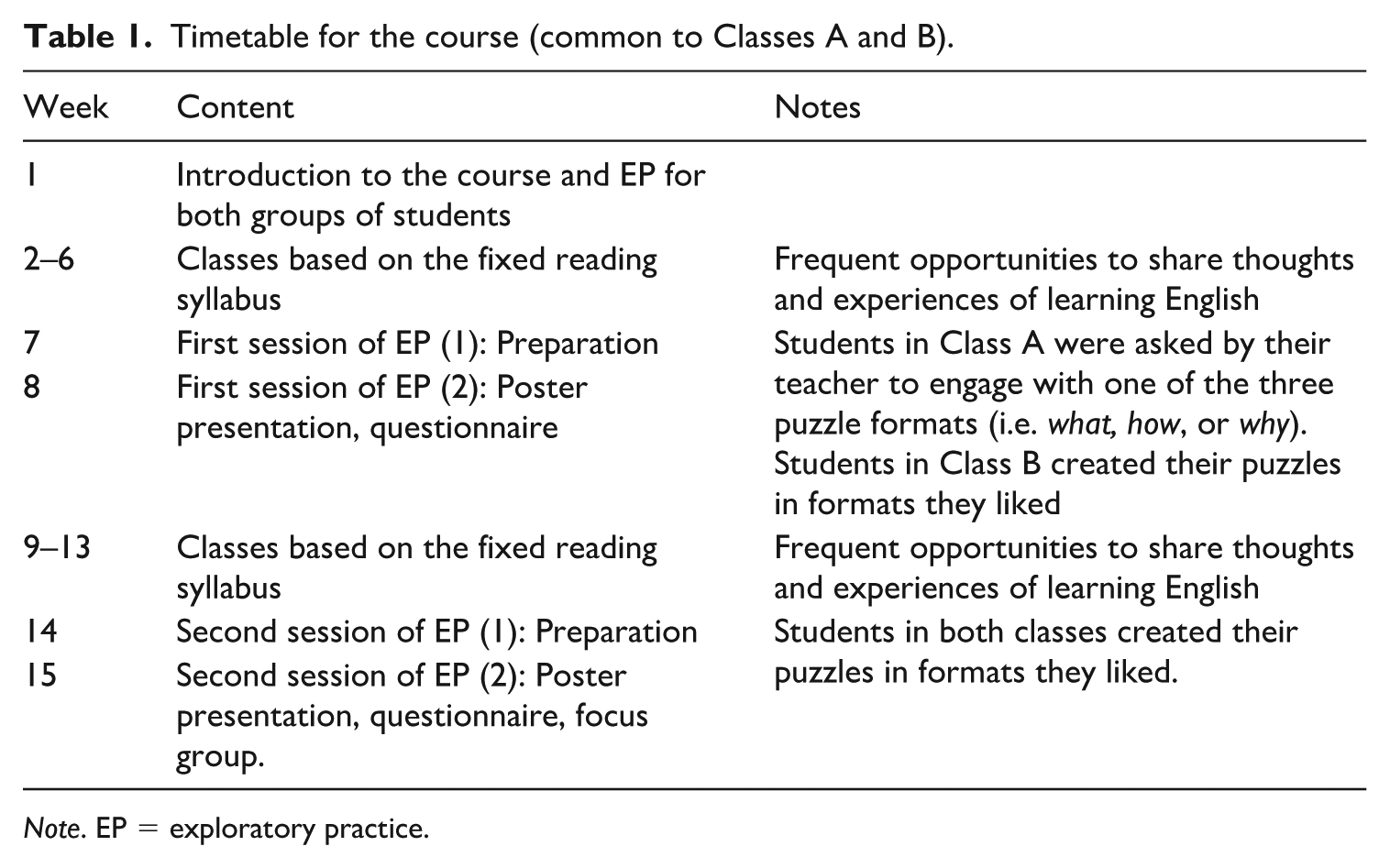
Teachers in charge of this course, not only the author, were required by the university to teach based on a common ‘unified textbook’ for the same course. However, there was still room for flexible lesson design at the discretion of the teachers during the semester. In this case, the four lessons were used specifically for EP (Table 1) but, throughout the course, I attempted to create an inclusive atmosphere in the classroom by providing them with opportunities to share their thoughts and experiences, both in groups and as a whole class. For example, when my students read a text aloud, I would ask them, Why do you think we read English texts aloud? and briefly share our thoughts. As I believe that there is no single best method for teaching English (Prabhu, 1990), I did not rush to judge their opinions but instead focused on listening to their opinions and facilitating their discussions. In another lesson, I handed out a sheet of paper entitled ‘English and me’ and asked my students to reflect on their language learning history by asking, What and how have you learned English so far? During these moments, we openly shared our thoughts and experiences, gradually creating a safe, inclusive atmosphere in the classroom.
Timetable for the course (common to Classes A and B).
Note. EP = exploratory practice.
Regarding the four EP lessons, in the first week, the students were introduced to the idea of EP. As their teacher, I briefly explained the seven principles of EP and showed them three examples of learner puzzles (i.e. What do we like about face-to-face English lessons?, How can we speak English more fluently and accurately?, and Why don’t I like pair/group work?). Although there were no specific EP lessons until Week 7, the students were constantly encouraged to find and make notes on their puzzles throughout the course to make puzzling a daily practice.
In the first session of EP (i.e. Weeks 7 and 8), the students in Class A were assigned one of the three puzzle formats (i.e. what, how, or why), while the students in Class B were allowed to use any puzzle format they preferred. In the second session (i.e. Weeks 14 and 15), students in both classes were allowed to create their puzzles in any format they liked. They created puzzles about their own practice (learning, teaching, and quality of life), as defined by Costantino (2019). The differentiation between the two classes was designed to fully answer sub-question 1, which is whether learners prefer why questions to what/how questions. While the students in Class B were asked to choose their puzzle freely from the first session, those in Class A did so after actually experiencing EP with each puzzle format. This study investigated whether the same trend could be confirmed for both classes.
In both the first and second EP sessions, students formulated their individual puzzles and explored them through self-reflection. During this process, most of the students sought the opinions of others by reading articles from websites freely available on the Internet and/or by conducting simple interviews and questionnaires with family members and friends. As their teacher, I supported their process of exploration by offering some advice and suggestions to help them answer their puzzles. In the first week of both EP sessions, they summarized their thoughts on a poster. In the second week, they made poster presentations in small groups of three or four to express their thoughts, share their struggles, and show empathy. To ensure linguistic inclusivity, supported by the concept of translanguaging (e.g. García & Li, 2014), students were allowed to use their mother tongue, Japanese, when necessary during the creation and sharing of English posters. This sharing process made the EP process more collegial and inclusive, which, according to the questionnaire results, many students preferred.
After each session, an online questionnaire was used to elicit their meta-reflection on EP by asking them how setting up the what, how, or why questions made a difference to their process of inquiry and how they felt about EP overall. Their comments in Japanese were translated into English using DeepL (https://www.deepl.com/translator) and checked by the author. Online focus group discussions were also conducted after the second session with three students from both classes to elicit their voices on the influence of the change in puzzle formats on their inquiry. I asked for voluntary participation after explaining the purpose and details of the interview (e.g. time required). After a final adjustment to the schedule, two groups of three students each, who had explored different forms of puzzle, joined the focus groups. Each interview lasted approximately 30 minutes and was moderated and recorded online by me (the author). Again, the Japanese transcripts were translated into English using DeepL.
3 Data analysis and reflections
This study used puzzles and posters as primary data, calculating the number of each puzzle format chosen by the students and undertaking a qualitative analysis of their EP posters. 1 The results of the questionnaires and focus groups were used as supplementary data to support the findings of the primary data.
For the poster analysis, I used a qualitative approach to analyse the students’ EP posters created in the second EP session (N = 66). It is important to note that ‘posters are not “products”, but are rather a punctuation point in an ongoing and sustainable process of understanding’ (Hanks, 2021, p. 10). Nevertheless, the posters represented a wealth of their thinking at the time, and thus I investigated whether there was a difference in the development of understanding represented in the what, how, and why posters.
I followed Hanks (2021), who applied the framework of ‘visual grammar’ primarily developed by Kress and van Leeuwen (1996) to the analysis of the EP posters. I analysed the multimodal affordances of visual images, including, but not limited to, shape, line, vector, colour, placement, and layout. For example, some of the students’ posters included circles and squares surrounding their ideas for the puzzles. According to Kress and van Leeuwen (1996), circles are usually associated with something organic, natural, and endless, while squares are associated with something mechanical, technological, and human-made, which can be positively associated with progress or negatively associated with oppression. It is also well known that the left side of a frame usually contains familiar information, while the right side is unfamiliar; the top frame tends to represent ideal (i.e. ‘what could be’ or more idealized and generalized) information, while the bottom frame contains real (‘what is’ or more specific, down-to-earth, and practical) information. Using these analytical frameworks, I repeatedly looked at the students’ posters and explored where the multimodal posters represented the development of their understanding of practice.
4 Research inclusivity
Inclusivity in EP can be defined as the involvement of all participants in the whole research process, particularly in agenda setting (Hanks, 2009). Among practitioner research families such as action research (e.g. Burns, 2010; Burns et al., 2022; Wallace, 1998) and reflective practice (e.g. Farrell, 2015; Mann & Walsh, 2017), EP is unique in its emphasis on the explicit inclusion of learners as co-researchers.
In the case of this research, the concept of inclusivity needs to be interpreted at two levels. At the ‘practice’ level, each student was involved in the entire EP-as-research process, which ensured the inclusivity of this research–practice; they created and investigated their own puzzles and shared their understandings in class, supported by me as their teacher. On the other hand, at the ‘meta-puzzling’ level, I invited the students to investigate how EP itself should be implemented, especially about puzzle formation in this case (i.e. Does the puzzle have to be a ‘why’ question in EP?). I asked them to participate in this meta-puzzling process to help me develop EP practice for my future students.
I have to admit that the degree of inclusivity of this meta-puzzle level was lower (or ‘indirect’) than that of the practice level because the meta-puzzle was created and explored primarily by me through the voices of the students, elicited from questionnaires and focus group interviews, and the final results were not shared with the students. In fact, this meta-puzzle has been developed through the work and voices of my former students over the years, as described in Section I, and the results will be shared with my future students in the form of my developed EP practice. Inclusivity at a meta-level may therefore seem limited when looking at data from one particular period, but it is actually seen as something that needs to be understood on a multi-year basis. As a teacher, I have attempted to listen to my students as much as possible and to incorporate their voices into my current and future courses. In this sense, I believe that inclusivity in this research has also been ensured to some extent at a meta-level, with all my former (and future) students participating in the long-term process of practice as research.
5 Ethics
This study, with the exception of the focus group discussions, was conducted as part of an English language course, and all students in both classes were expected to participate. However, they were asked in the consent form whether they agreed or disagreed with the publication of their papers, posters, and questionnaire responses in an academic paper, and only data from students who agreed to participate are reported in this article. There was no control group established in the study. The study was approved by the university’s Ethics Review Committee. It was clearly stated in the consent form that participation in the study was unrelated to their grades in the course.
IV Results
This section summarizes the findings along with the two sub-questions in this study. The results revealed the general popularity of why questions as puzzles in EP, but also the tendency of students to change their puzzles from why to what/how over the course of EP. Furthermore, the qualitative analysis of the EP posters (N = 66) showed that regardless of the puzzle format (i.e. what, how, or why), most of the students’ explorations were not deep enough and were categorized as ‘solution-focused’. However, the only four posters that were categorized as ‘understanding-focused’ happened to be all why questions.
1 Popularity among the three puzzle formats
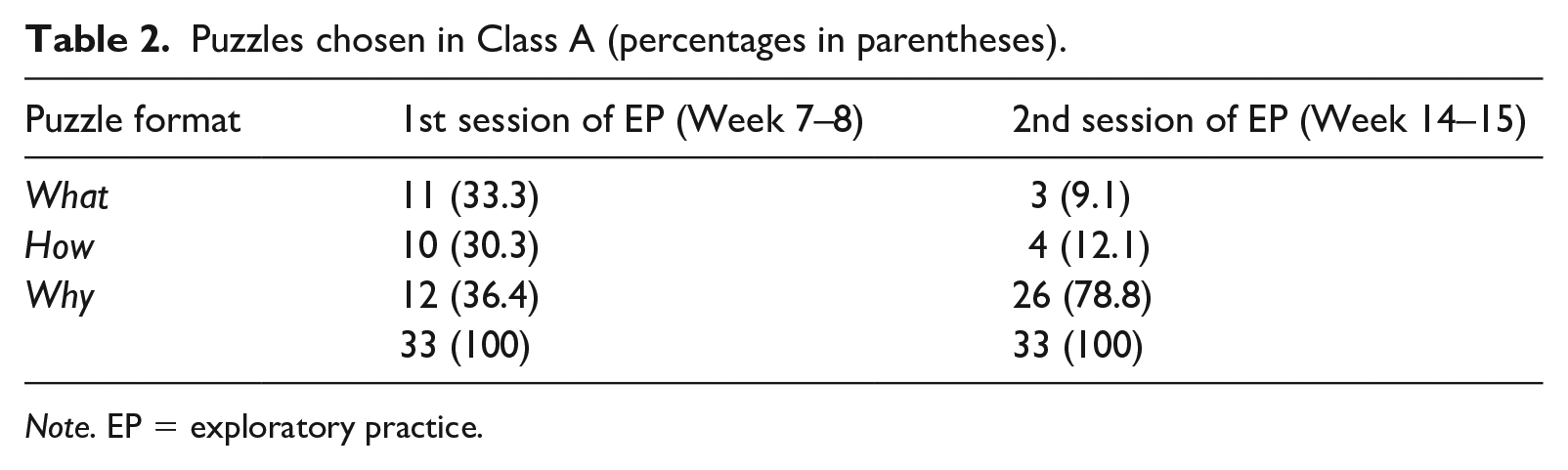
Sub-question 1 was set to clarify whether my students felt comfortable setting a why question in EP. The results showed that the why question was the most popular of the three formats. Both in the first session of EP in Class B and in the second session, when students in both Classes A and B were allowed to choose their own puzzle formats, more students chose why questions than any of the other formats (Tables 2 and 3).
Puzzles chosen in Class A (percentages in parentheses).
Note. EP = exploratory practice.
Puzzles chosen in Class B (percentages in parentheses).
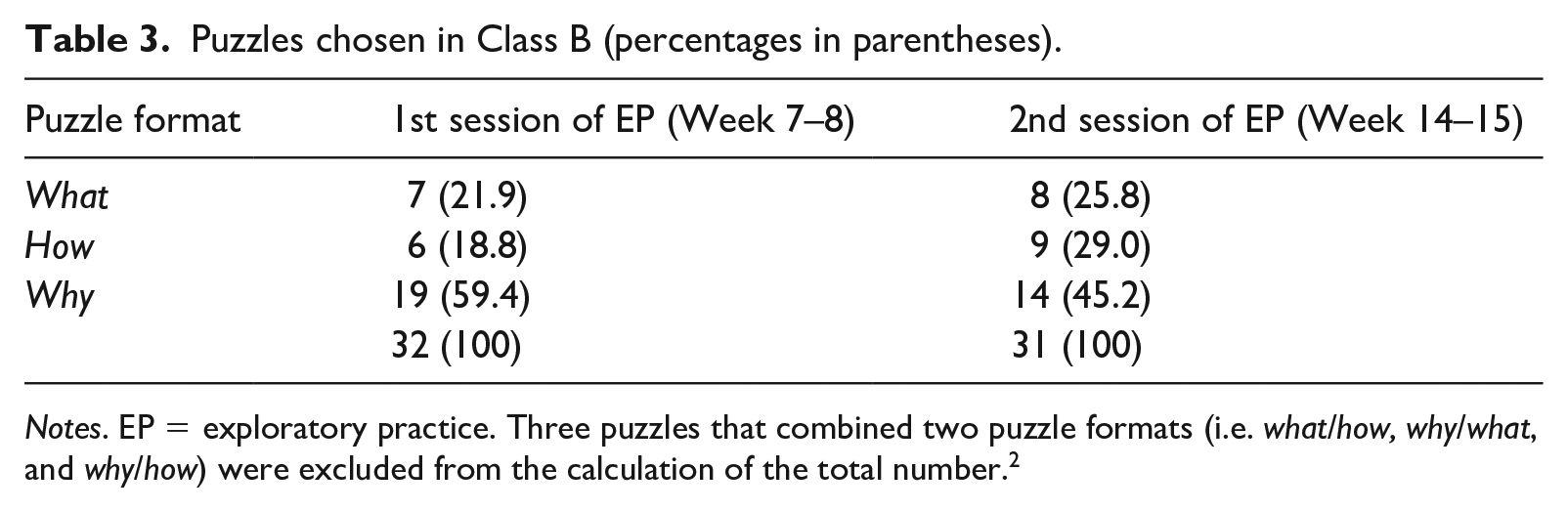
Notes. EP = exploratory practice. Three puzzles that combined two puzzle formats (i.e. what/how, why/what, and why/how) were excluded from the calculation of the total number. 2
The change in puzzles from the first to the second EP session was counted in both classes. Students in Class A were allowed to choose their puzzle format freely in the second session, while those in Class B did so from the first session. As Table 4 shows, the increase in the number of why questions in the second session of Class A was due to 17 students (51.5%) changing their puzzles from what/how to why questions. In Class B, although why questions were the most popular choice among students in both sessions, 11 students (36.6%) changed their puzzles from why to what/how questions in the second session. These results may indicate that why puzzles are a popular choice among learners in general, but more so in the early stages of EP. Some of them may prefer to change their puzzles from why to other puzzle formats in the course of EP.
The change in puzzles (percentages in parentheses).
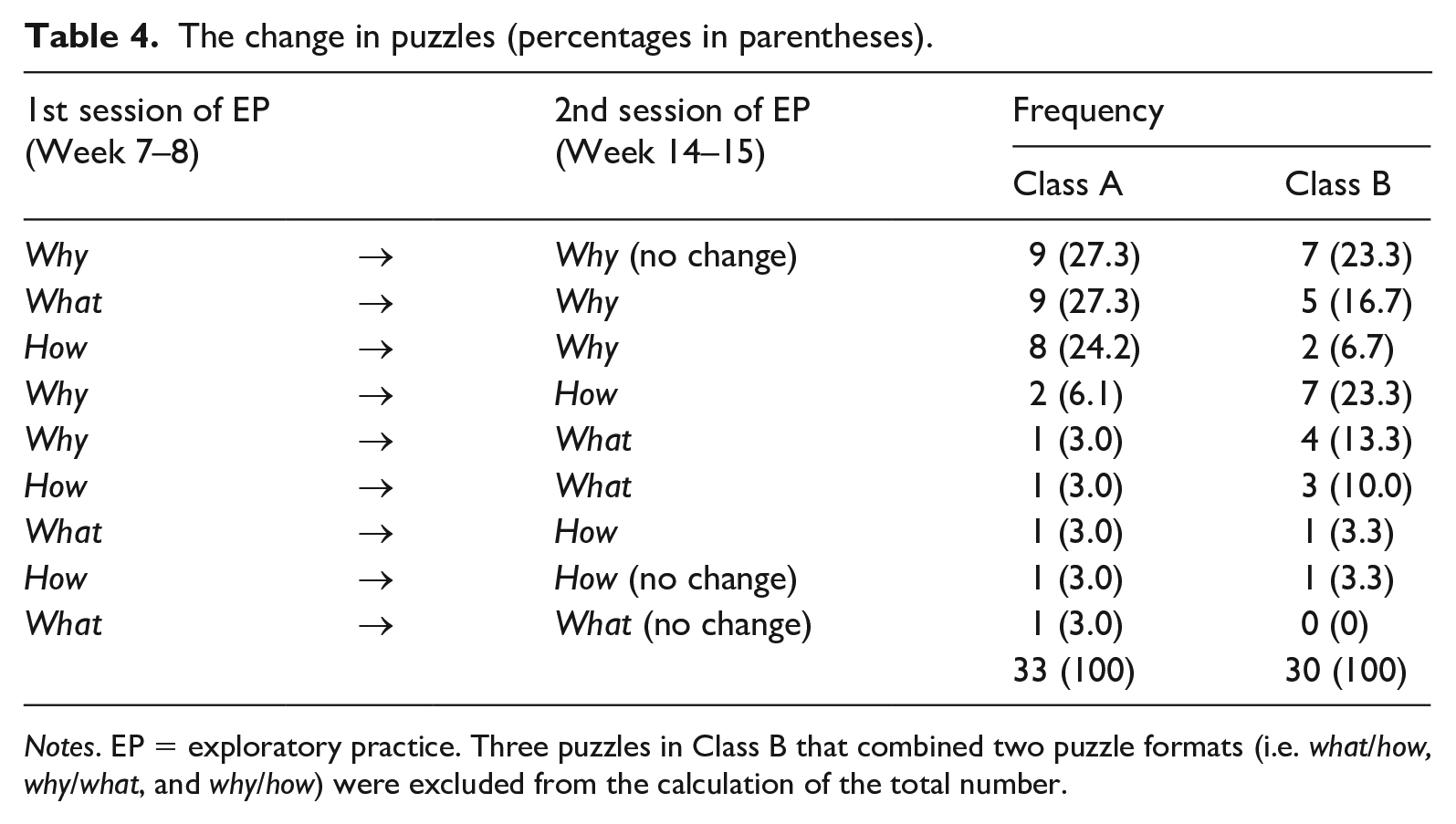
Notes. EP = exploratory practice. Three puzzles in Class B that combined two puzzle formats (i.e. what/how, why/what, and why/how) were excluded from the calculation of the total number.
2 The development of understandings reflected on the what, how, and why posters
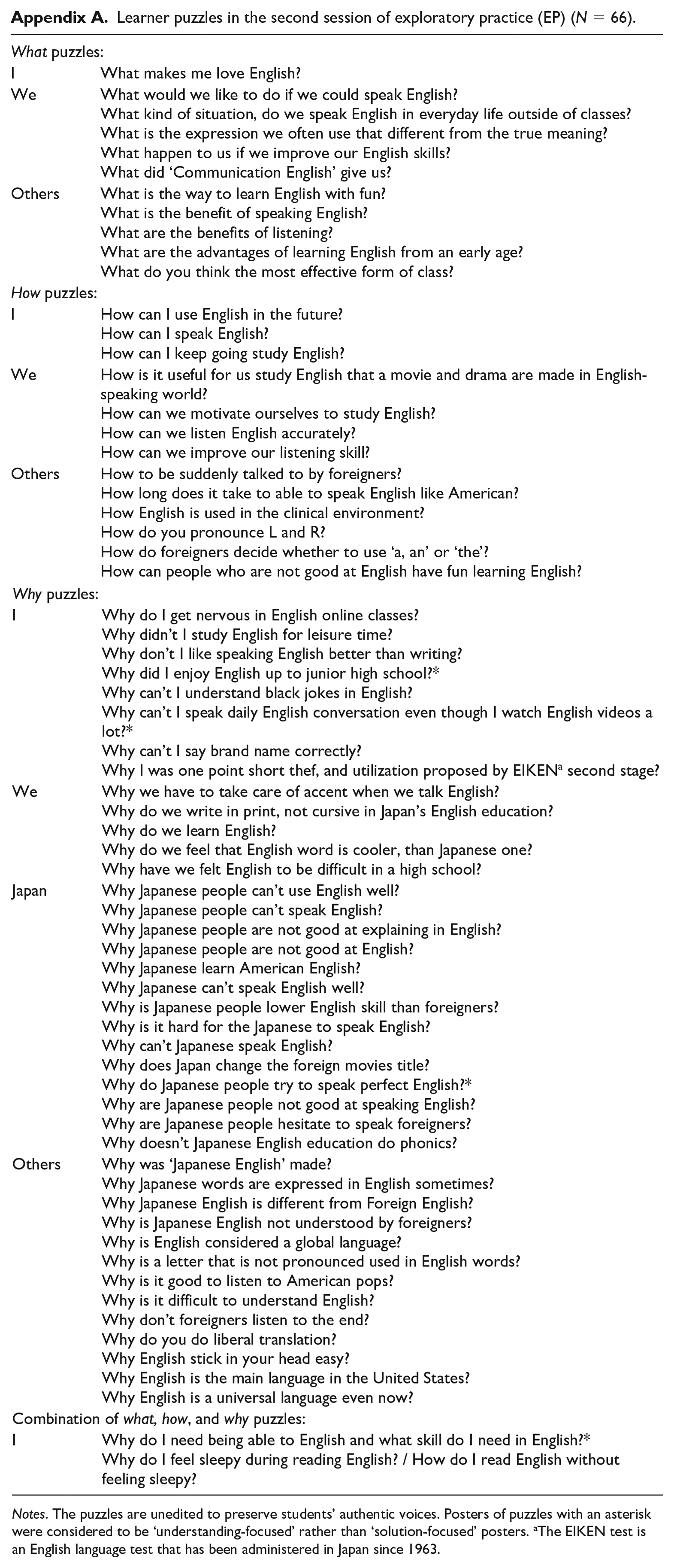
This section corresponds to sub-question 2. The qualitative analysis of the EP posters (N = 66) revealed that most of their work ended in solution-focused activities, but the only four posters categorized as ‘understanding-focused’ were all about why questions (for identification of the four puzzles, see Appendix A).
Solution-focused posters: the listing and linear exploration
The analysis revealed that the exploration of any puzzle can end in solution-focused activities that only superficially develop students’ understanding of their practice. For example, the what poster in Figure 1 is about the benefits of speaking English. Given that visual information tends to flow from left to right (Kress & van Leeuwen, 1996), the student has probably sought out his friends’ thoughts and compared them with the ideas in an online article and with his own thoughts. There are no visual images attached to this poster, and the layout of the poster is simple. At the bottom, in bold type, he concluded that speaking English makes one ‘cool’.
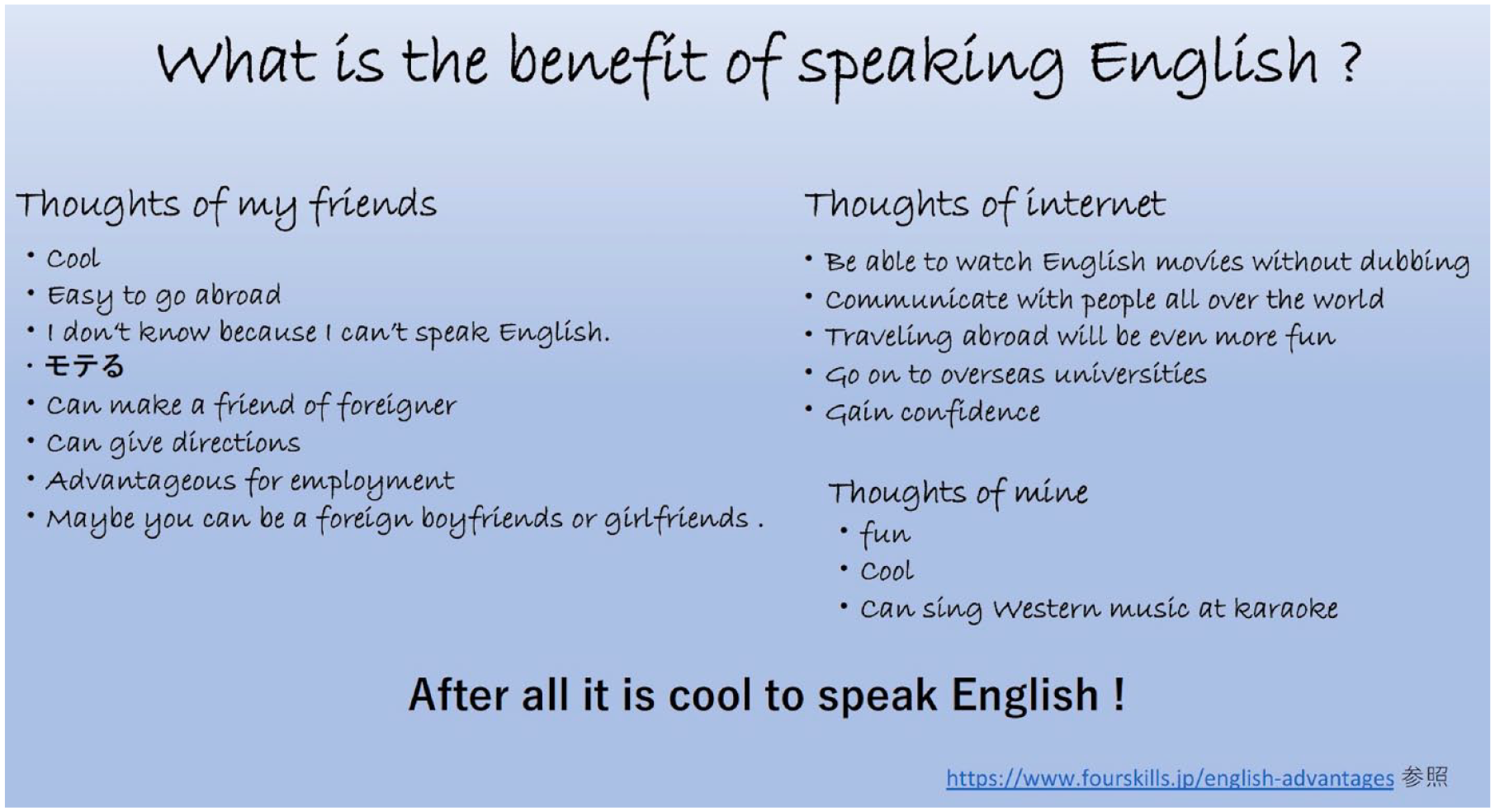
What puzzle: What is the benefit of speaking English?
This poster can be characterized by its listing nature of exploration. The ‘thoughts’ of his friends, the Internet, and his own are arranged in a parallel and equivalent way, and it was difficult to follow from this poster alone how he arrived at his conclusion. In this respect, the analysis of the questionnaires did not reveal any comments suggesting that this student had developed a deep understanding of his practice; he simply wrote, ‘It was interesting to see that the puzzles were completely different for different people’.
To develop his deeper understanding, he could have asked why English was cool for his friends (and himself), which might have broadened his views and ideas about the puzzle. It would also have been possible to paraphrase the original what puzzle into a different form of question: Why can’t I understand the benefits [reasons] of (practising) speaking English? This paraphrase could make it easier to share the puzzle with their acquaintances, possibly inviting a discussion about the need for English in Japanese society.
Another example is the how poster shown in Figure 2, which is about how to listen to English accurately. Referring to an article on a website, this student summarized the causes and methods of solving the problem. The three statements in each were squared, which can be associated with something ‘mechanical’ (Kress & van Leeuwen, 1996). At the bottom, his conclusion was written in bold: ‘If we do these three things, we will be able to listen (to) English accurately!!’. 3
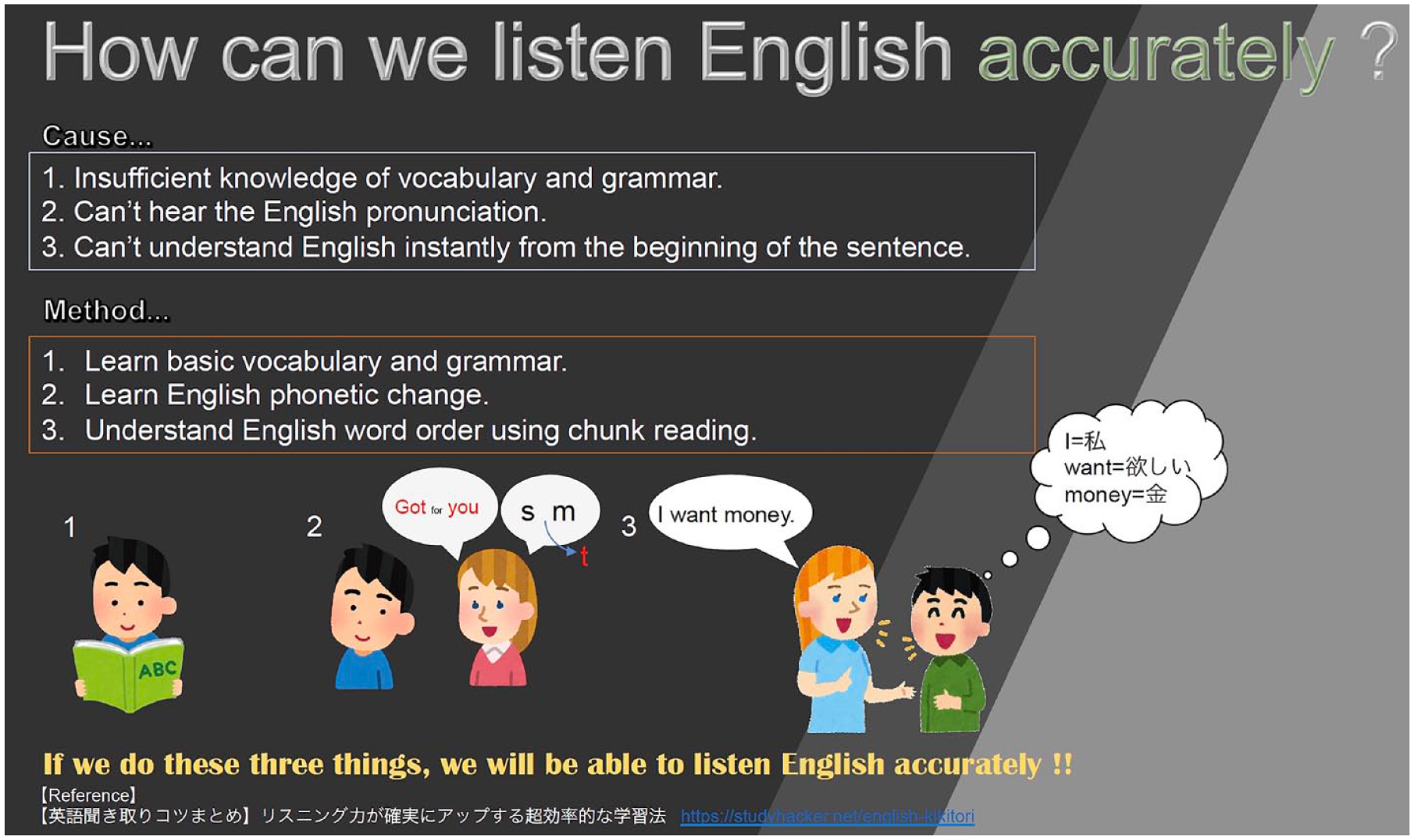
How puzzle: How can we listen (to) English accurately?
This poster can be characterized both by its listing and by its linear exploration of the puzzle. The three statements listed in ‘Cause’ correspond to those in ‘Method’, which leads us in a linear way to the conclusion at the bottom. The student’s own opinion does not seem to be included in the poster. Again, there were no comments in his questionnaire response suggesting that he had improved his understanding of his practice.
As with the previous example of the what question, it would have been possible to make his inquiry more process-oriented. For example, in addition to the quick solutions that he found on a website, he could have asked his friends for their thoughts on the three solutions that were found to be effective. Although he seemed satisfied with the solutions he elicited from the citation, his friend might have asked him what he meant by the word ‘accurately’. This kind of question can be a trigger for him to realize that there are multiple levels of ‘accuracy’ in understanding a speaker’s utterance (e.g. the three interconnected phases of perception, parsing, and utilization proposed by Anderson, 1995). By adding a sharing process to his inquiry, he could have better developed his understanding within his community.
These what and how posters might be categorized as solution-focused, scratching the surface of their practice (Hanks, 2017), but the data showed that this listing and linear nature of exploration were also present in the why puzzle posters. Figure 3 shows a puzzle that explores why Japanese learn American English. This student, aware of the idea of World Englishes, stepped back and asked why English education in Japan is mostly based on American English. Referring to the two academic articles (see bottom right of the poster), she gave three reasons and concluded that ‘history was involved’.

Why puzzle (1): Why (do the) Japanese learn American English?
As with the what and how posters shown in Figures 1 and 2, this poster can be characterized by its listing and linear nature of exploration. As the two vectors in the poster represent, the process of her exploration is presented in a linear way; she initiated her inquiry with a personal question, summarized the others’ opinions in the listing form (i.e. three reasons), and made a conclusive statement in bold. As the illustration of a girl with a question mark to the left of the vector suggests, she may have started her exploration out of curiosity, but rather than seeking her own answers, she seemed to rely on the opinions of others. In terms of the development of understanding, it was difficult to distinguish her investigations from those of the other students (Figures 1 and 2), as the nature of the puzzle investigations was similar.
To make her investigation more process-oriented, the student could have made the puzzle more relevant to her life. For example, she could have asked herself why she needed to learn American English. This self-reflective process might have taken her further than exploring the historical reason for learning American English. She might have felt like asking her classmates for their opinions, for example, by asking what kind of English(es) they wanted to learn. This exploration might have led her to question the current state of English education in Japan.
The analysis of the three posters above suggests that the understanding developed in EP was not deep enough, regardless of the puzzle format. In fact, the similarities between the three EP posters on what, how, and why puzzles echo the students’ voices elicited after the first EP session; nine students pointed out that the choice of puzzle format did not make a significant difference as long as the purpose of EP was met, as in the following quote:
I don’t think there is a difference between the three because the same theme can be explored with any of the questions: what, how, or why. (Hinako, Class B)
Understanding-focused posters: the process-oriented exploration
On the other hand, there were at least four understanding-oriented explorations found in their posters. EP emphasizes the process and facilitation of local understanding (Breen, 2006). These concepts are difficult to grasp and demonstrate, but the following examples, characterized by process-oriented, non-linear exploration, represent EP’s ideas better than the solution-focused examples presented in the previous section.
Figure 4 is a why poster dealing with why Japanese people (including the student who made the poster) try to speak perfect English. Given that information flows from left to right (Kress & van Leeuwen, 1996), she first reflected on her own experience of learning English while surrounded by returnee students and hypothesized that her lack of confidence (expressed as ‘unconfident’ in the poster) led her to demand perfection in speaking English. She then asked her friends for their opinions via social media and realized that they also felt some pressure to speak perfect English and also found other reasons for their lack of confidence that she had not considered before (e.g. some people make fun of imperfect speakers, the general disposition of the Japanese people, the influence of education). At the bottom of the poster, she suggested that to ‘have a spirit of challenge’ and to ‘swallow pride’ might be a way forward for her and many Japanese people to speak English.
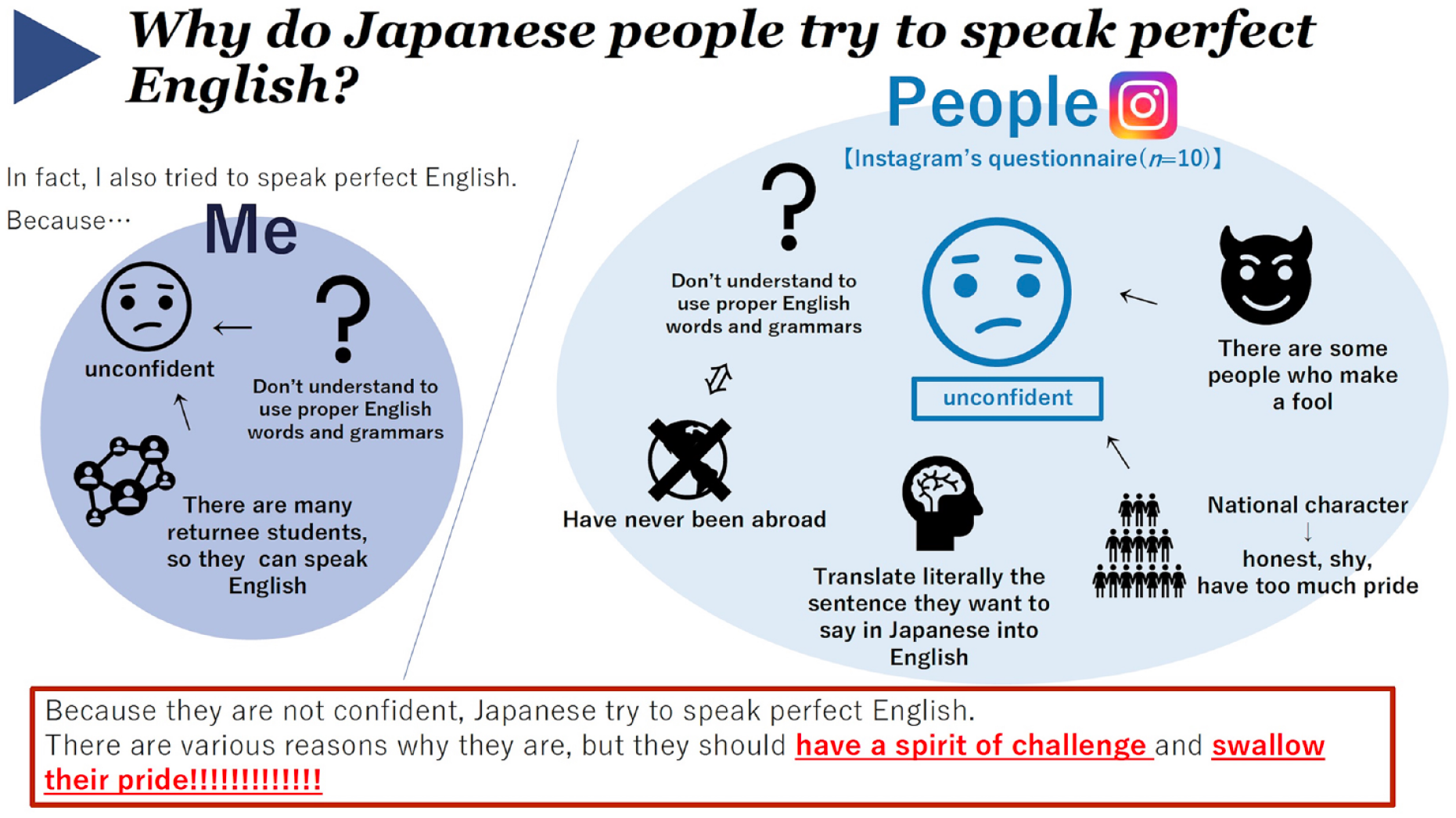
Why puzzle (2): Why do Japanese people try to speak perfect English?
Looking at the shape used in the poster, circles are used to describe thoughts about herself and her friends, while the bottom part of the conclusion is a square. As Kress and van Leeuwen (1996) suggested, circles tend to be associated with something organic, natural, and endless. These two circles may represent the process-oriented nature of her exploration. Unlike the solution-focused posters, this poster cannot be characterized simply by listing and linear exploration. As the uni- and bi-directional vectors in each circle show, she considered the relationship between the factors that make one ‘unconfident’, rather than simply listing the possible factors in a parallel and equivalent way. These characteristics can be regarded as evidence of her process- and understanding-oriented approach to EP. She responded to the questionnaire as follows: ‘It was very interesting to listen to other people’s presentations about their exploration of different puzzles. I would like to do it again.’
Figure 5 shows another poster created by a student who asked herself, Why can’t I speak daily English conversation even though I watch English videos a lot? As each colourful heading shows, she asks herself a series of questions (e.g. What about other languages?) to answer her original puzzle. Interestingly, she compared her English learning with her Korean learning and found that the type of video (e.g. YouTube) could affect the quality of language learning. She also asked her peer about this puzzle, although in this case she did not get a useful comment. Finally, through her self-reflection and the interview, she suggested four ways to develop her learning. In the focus group discussion, she reflected on her exploration and replied that, in the last part of her exploration, she expressed her own views on how she could speak everyday English conversation (e.g. Start by learning daily conversation (using YouTube etc.)). When asked about her reasons for engaging with a range of different questions, she replied, ‘Puzzles cannot be answered simply, because you can’t get an answer unless you find out in detail what caused them. You also have to think about what to do next, because just giving an answer is not a fundamental solution.’ The colourful headline on the poster and her comments in the focus group suggest that she moved from why questions to what, and then to how to answer her original puzzle. This exploration can be described as process-oriented, where she sought to understand her own puzzle from various angles.
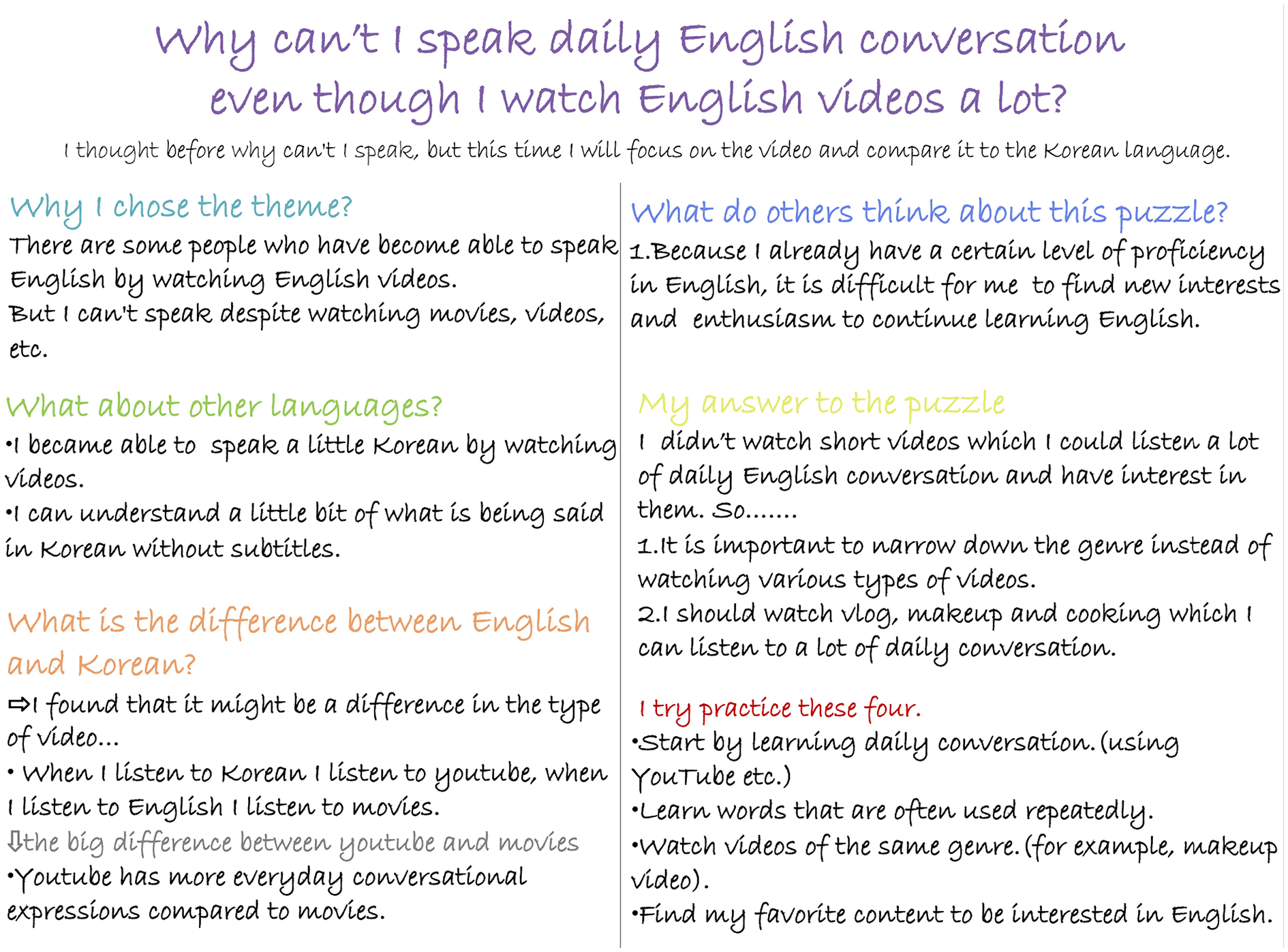
Why puzzle (3): Why can’t I speak daily English conversation even though I watch English videos a lot?
The qualitative analysis of these posters suggested that the more process-oriented the inquiry, the better the students developed their deeper understanding. Students began their inquiry with a personal question (associated with ‘relevance’ in practitioner research) and then shared the puzzle with people around them, which led to an expansion of their views (associated with ‘collegiality’). In the process, they looked at their puzzles from many angles to seek answers, often through a chain of different puzzles. As a result, the answer they arrived at was not something they ‘borrowed’ from someone else but was based on their own thoughts (local understanding). This kind of process-oriented exploration resonates well with the principles of EP (Allwright & Hanks, 2009; Hanks, 2017).
Interestingly, the four examples categorized as process-oriented were all about why questions, or at least included a why question (i.e. Why do I need being [to be] able to (speak) English and what skill do I need in English?). In this regard, six students suggested the potential ‘fundamentality’ of why questions in their questionnaire comments:
I think why is the most fundamental form of the three. Even if you think about a how or what puzzle, you will get to why. (Koki, Class A) I think all questions start with why. Based on the answer to why, we can explore what and how. (Chisa, Class B)
The potential fundamentality of why echoed what one student (Riho, the creator of the poster shown in Figure 5) said in a focus group: ‘The question format that comes first to my mind is why’ (Riho, Focus Group B). However, Ako in the same focus group said that she preferred what to shape a puzzle; and no consistent answers were obtained on the preference for the puzzle format. Kana in another group (Focus Group A) even commented that she had planned to change her topic depending on the puzzle format she was given in the first EP session. Chisa’s comment quoted above suggested that they would use a series of puzzles to explore their agendas at different stages, despite the potential ‘fundamentality’ of the why questions, so these opinions seemed to indicate that there may be more than one appropriate puzzle format.
V Discussion
This section addresses a general affinity between EP and why questions while claiming that asking why is not enough for practitioners to deepen their understanding of their practice. I argue that local understandings can only be developed through continuous process-oriented inquiry by practitioners.
1 Affinity between EP and why questions
The results showed that the why question was the most popular of the three formats, namely what, how, and why. The total number of puzzles chosen in Classes A and B indicated that most students preferred to use why questions as puzzles, even without being instructed to do so. This was supported by some of the students’ comments in their questionnaire responses and focus group discussions, where they said that puzzling starts with or leads to why. In addition, evidence of the understanding-focused exploration that is the purpose of EP was found in the four posters, all of which explored why questions. Overall, the results support the idea that why questions are appropriate in EP, as advocated by previous research (e.g. Allwright & Hanks, 2009; Banister, 2021; Hanks, 2017; Lyra et al., 2003; Miller et al., 2021).
2 Asking ‘why’ is not enough, though
However, not all students preferred the why frame (see Tables 2–4). The exploration of why puzzles did not necessarily lead to a better understanding of the practice than other forms of puzzles. The qualitative analysis of the posters revealed that the exploration of why (and what) puzzles can lead to superficial solution- or listing-focused activities. Despite the general preference for why puzzles, nine students explicitly stated that puzzles could be shaped in any format as long as the purpose of EP was met. As their comments suggested, the three formats appeared to be interchangeable in many cases: For example, a what puzzle (What makes me love English?) could be reformulated as a why puzzle (e.g. Why do I love English?) or a how puzzle (e.g. How did I fall in love with English?) although there is a possibility that each reformulated puzzle could be explored in a slightly different way and each question could have taken the process in a different direction.
Rather, the poster analysis revealed that encouraging process-oriented inquiry in EP is more important than setting a puzzle format for developing learners’ understanding of practice. As shown in Figures 4 and 5, process-oriented exploration of a local puzzle was likely to invite people to think together about the puzzle. Students did not end with a summary or list of findings but added their own thoughts and discoveries to the puzzle, suggesting an endeavour to understand their practice better. However, as discussed in Section IV, it was also considered possible to make a what- or how-based inquiry more process-oriented. Rather than satisfying their discussions with a quick answer to their puzzle, the students could have explored their tentative answers more deeply by seeking the opinions of their friends and family (i.e. their community members) or by adding more thoughts to further the conclusion they obtained. The same caveat applies to a why-based inquiry, as discussed in the analysis of the poster shown in Figure 3. It was not the case that asking ‘why’ alone was sufficient to develop their understanding.
3 Process-oriented exploration is essential
Although the original aim of this three-year EDR project was to clarify a syntactically optimal form of the puzzle to develop practitioners’ understanding, the answer varied between practitioners. Instead, the study showed that the process-oriented endeavour, as represented by the ‘I/we wonder’ 4 mindset, needs to be emphasized more than a specific interrogative word in a puzzle. Some students (e.g. Chisa) suggested in their questionnaire comments that their agendas could also be explored through a series of different questions. This chain of curiosity-driven puzzling, accompanied by extensive dialogue with the people around them, would be essential in deepening their process-oriented local understanding. This process is likely to continue until practitioners as puzzlers feel convinced, for, as Arendt (1994) puts it, ‘[u]nderstanding is unending and therefore cannot produce final results’ (p. 308). In this sense, engagement in EP could be described as an unending process of developing local understandings of puzzlers among the people involved.
4 Reflections and some promising directions
Reflecting on my own practice, I have identified at least two key issues to enhance the process-oriented and inclusive nature of EP. First, as a teacher who inevitably has power in the classroom, I need to have a process-oriented mindset myself. Before this research, I may have unconsciously focused on the ‘products’ of EP, such as a particular form of puzzle and final posters. It is true that these could be indicators of students’ engagement in EP, as analysed in this research, but what matters is the depth of their understanding developed during the process. This change in attitude has influenced the design of the PEPAs adopted in the classroom. For example, in my current practice, instead of creating individual posters, a group of three or four students form a group and create a group poster synchronously while discussing their shared puzzle. I keep telling them that the focus is not on the quality of the poster itself but on the development of their understanding, which can be shared through the reflections they write at the end of EP. This change in PEPA design has occurred because of a shift in my own mindset as a teacher towards a more process-oriented EP.
At the same time, learners need to have a process-oriented mindset. To truly enhance inclusivity in EP, it is crucial to ensure that learners take pleasure in the research itself rather than just being formally invited to participate. This could be achieved by finding curiosity-based puzzles that they are keen to contemplate and articulating them with appropriate terms. Providing them with sample puzzles using the what, how, and, especially, why frameworks, as this research has done, could assist them in shaping their ideas into accessible language. However, as it is not the form of the puzzle that is important but their own desire to explore, learners need to be encouraged to engage in a chain of puzzles when necessary. This process-oriented exploration and sharing will lead to a deeper understanding of the class participants while they use their target language wherever possible in different PEPAs, such as discussions and presentations.
Although developing an inclusive, process-oriented mindset in practitioners may take some time, especially for those who are new to the philosophy of EP (see Crane, 2015), activities that draw attention to various puzzles in the language classroom (e.g. English and me) and teachers’ daily comments about the wonders of classroom life (e.g. Why do we gather in the classroom at all?) will gradually cultivate the attitude of ‘I/we wonder’ in the classroom. When learners find puzzles that they cannot help but think about and feel that their contributions are essential, they can take learning as EP more seriously and enjoy it more.
VI Conclusions
Despite the affinity between EP and why questions, asking why was not enough for my students to develop their understanding of their practice. Their voices and EP posters revealed that what matters in EP is not the puzzle format itself but rather how practitioners engage in the process-oriented development of understandings. In this sense, any puzzle can serve as a starting point for EP, as long as practitioners are reminded that inquiry is an ongoing and curiosity-driven process. Nevertheless, as in my own practice, many learners may choose a why question as a starting point to explore issues of their immediate interest.
This special issue aimed to showcase recent advancements in inclusive practitioner research and offer a roadmap for future progress. This article (re)illuminated the significance of process-oriented, curious, and continuous engagement in practitioner research and raised the issue of how this attitude of ‘I/we wonder’ can be fostered among practitioners. The practice, or practitioner research, never ends, and I have been developing my own understanding of EP with my new students. Practitioners can only share their current understandings of their puzzles. Nevertheless, if more practitioners, including learners and teachers, explore their own agendas and share their developed practices more widely, these bottom-up collaborations will lead to the mutual enhancement of language classroom experiences, extending beyond a single classroom.
Footnotes
Appendix
Learner puzzles in the second session of exploratory practice (EP) (N = 66).
| What puzzles: | |
| I | What makes me love English? |
| We | What would we like to do if we could speak English? What kind of situation, do we speak English in everyday life outside of classes? What is the expression we often use that different from the true meaning? What happen to us if we improve our English skills? What did ‘Communication English’ give us? |
| Others | What is the way to learn English with fun? What is the benefit of speaking English? What are the benefits of listening? What are the advantages of learning English from an early age? What do you think the most effective form of class? |
| How puzzles: | |
| I | How can I use English in the future? How can I speak English? How can I keep going study English? |
| We | How is it useful for us study English that a movie and drama are made in English-speaking world? How can we motivate ourselves to study English? How can we listen English accurately? How can we improve our listening skill? |
| Others | How to be suddenly talked to by foreigners? How long does it take to able to speak English like American? How English is used in the clinical environment? How do you pronounce L and R? How do foreigners decide whether to use ‘a, an’ or ‘the’? How can people who are not good at English have fun learning English? |
| Why puzzles: | |
| I | Why do I get nervous in English online classes? Why didn’t I study English for leisure time? Why don’t I like speaking English better than writing? Why did I enjoy English up to junior high school?* Why can’t I understand black jokes in English? Why can’t I speak daily English conversation even though I watch English videos a lot?* Why can’t I say brand name correctly? Why I was one point short thef, and utilization proposed by EIKEN a second stage? |
| We | Why we have to take care of accent when we talk English? Why do we write in print, not cursive in Japan’s English education? Why do we learn English? Why do we feel that English word is cooler, than Japanese one? Why have we felt English to be difficult in a high school? |
| Japan | Why Japanese people can’t use English well? Why Japanese people can’t speak English? Why Japanese people are not good at explaining in English? Why Japanese people are not good at English? Why Japanese learn American English? Why Japanese can’t speak English well? Why is Japanese people lower English skill than foreigners? Why is it hard for the Japanese to speak English? Why can’t Japanese speak English? Why does Japan change the foreign movies title? Why do Japanese people try to speak perfect English?* Why are Japanese people not good at speaking English? Why are Japanese people hesitate to speak foreigners? Why doesn’t Japanese English education do phonics? |
| Others | Why was ‘Japanese English’ made? Why Japanese words are expressed in English sometimes? Why Japanese English is different from Foreign English? Why is Japanese English not understood by foreigners? Why is English considered a global language? Why is a letter that is not pronounced used in English words? Why is it good to listen to American pops? Why is it difficult to understand English? Why don’t foreigners listen to the end? Why do you do liberal translation? Why English stick in your head easy? Why English is the main language in the United States? Why English is a universal language even now? |
| Combination of what, how, and why puzzles: | |
| I | Why do I need being able to English and what skill do I need in English?* Why do I feel sleepy during reading English? / How do I read English without feeling sleepy? |
Notes. The puzzles are unedited to preserve students’ authentic voices. Posters of puzzles with an asterisk were considered to be ‘understanding-focused’ rather than ‘solution-focused’ posters. aThe EIKEN test is an English language test that has been administered in Japan since 1963.
Acknowledgements
The author would like to express his sincere gratitude to the editors of this special issue and the anonymous reviewers for their valuable comments and suggestions on an earlier version of this article.
Declaration of conflicting interests
The author(s) declared no potential conflicts of interest with respect to the research, authorship, and/or publication of this article.
Funding
The author(s) disclosed receipt of the following financial support for the research, authorship, and/or publication of this article: This work was supported by JSPS KAKENHI (grant number 20K13118).
