



Abstract
Despite the growing research on teachers’ identity tensions, the tensions experienced by teacher educators, especially that of in-service teacher educators, remain underexplored. To address this issue, this narrative inquiry investigates the identity tensions of English language teachers who concurrently perform the role of in-service teacher educators. The data consists of semi-structured interviews, narrative frames, and visual documents. The thematic analysis of the findings suggested that the participants experienced tensions at three levels: interpersonal, intrapersonal, and institutional. While coping with these tensions, they developed new interpersonal skills, continued their professional learning, received peer and mentor support, engaged in other communities of practice, and persisted on finding their own ways of developing. The study concludes that although tensions unsettle professional identity development, they might still offer new developmental trajectories and help in-service teacher educators strengthen their identity.
Keywords
I Introduction
Teacher educators (TEs) who constitute a diverse ‘professional group with distinctive knowledge bases, pedagogical expertise, engagement in scholarship and/or research’ (Murray et al., 2009, p. 41) facilitate both future and experienced teachers’ professional learning and development (Lunenberg et al., 2014). Through the ways they become TEs, the roles they enact, and the work they do may contextually vary (Murray et al., 2009; Yuan, 2020), their professional identity development is laden with challenges, especially during the transition from teacher to TE (Barkhuizen, 2021; Murray & Male, 2005; Trent, 2013). Similar to (beginning) teachers who experience professional identity tensions, broadly described as the ‘internal struggles between a teacher sees him/herself as a person and as a professional’ (M. Pillen et al., 2013, p. 87), TEs might experience identity tensions while developing a professional identity, conforming to multiple, new professional roles and expectations as well as earning credibility as TEs (Barkhuizen, 2021).
In contrast to the growing body of research on the identity tensions experienced by teachers (for example, Olsen, 2008; M. T. Pillen et al., 2013; Trent, 2012), there is a dearth of research into the corresponding process for (language) TEs, and studies that mention such tensions (e.g. Berry, 2007; Lunenberg et al., 2014; Williams et al., 2012; Wood & Borg, 2010) focus mostly on mainstream TEs who move from first-order teaching (pupils) to second-order teaching (future teachers) (Murray & Male, 2005). However, research on the tensions experienced by in-service teacher educators (ISTEs) who contribute to novice or experienced teachers’ lifelong learning by delivering courses, supervising, mentoring, and coaching (Fransson et al., 2009) as well as informing their pedagogy (Wright, 2009) within and outside their institutions is almost non-existent. Since TEs’ professional identities illuminate us on their contribution to teacher education, the challenges they face, and the ways they can be supported (Her et al., 2021; Yuan, 2016), how ISTEs establish and develop their professional identities in the face of consequent identity tensions warrant further investigation. Informed by these arguments on tensions, we approach professional identity from a post-structural perspective and conceptualize it as a multiple, contextual, ongoing construct (Akkerman & Meijer, 2011; Beijaard et al., 2004; Gee, 2000; Pennington & Richards, 2016; Yazan, 2018a) ‘shaped by a broad range of sociocultural power relationships, strongly influenced by any number of relevant contexts and relational’ (Dinkelman, 2011, p. 309). Adopting the narrative inquiry as our research method, we investigate the identity tensions experienced by seven English language teachers who simultaneously performed ISTE roles within Turkish higher education contexts.
II Literature review
1 Language teacher educator identity
Identity, which broadly refers to ‘being recognized as a “kind of person” in a given context’ is a multiple, dynamic construct (Gee, 2000, p. 99). Hence, people may have/perform different identities according to the context, such as the nature identity which is given by nature (e.g. being a British man), the institutional identity that is empowered by institutions (e.g. being a professor), the discourse identity that is recognized in interaction with others (e.g. being a charismatic leader), and the affinity identity that is gained through participation in distinctive practices shared by a group of people (e.g. being a Star Trek fan) (Gee, 2000). People can also negotiate and contest how these identities are perceived by themselves and others, that is they play an active role in their identity construction; how they will be recognized in different contexts (Gee, 2000).
These various forms of identity have led to an increasing interest in many fields, including (language) teacher education, with research focusing on teachers’ ‘professional, cultural, political, and individual identities which they claim or which are assigned to them’ (Varghese et al., 2005, p. 22), and more recently on professional identities of TEs, who contribute to teachers’ professional learning and development, to provide a better understanding of these professionals and the professional support they may need (Beijaard et al., 2004). Though it is still limited (Peercy et al., 2019; Yazan, 2018b), research on (language) TE’s professional identity suggests that teacher educator identity (TEI), similar to teacher identity, is a multiple, ongoing, cognitive, social, emotional, ideological, personal, and professional construct that ‘changes discursively in social interaction with pre- and in-service teachers, other teacher educators, language learners (and) administrators’ (Barkhuizen, 2021, p. 69). These identities may also be valued, acknowledged, or contested by both TEs themselves and other stakeholders (Barkhuizen, 2021).
(Language) TEI is also characterized as multiple since TEs usually equip themselves with an array of identities, such as teachers of teachers, coaches, mentors, researchers, and even learners (Lunenberg et al., 2014; Yuan & Lee, 2014). While grappling with these multiple identities, which may or may not conflict with each other, TEs might continue expanding their professional identities (Barkhuizen, 2021; Davey, 2013; Yuan & Lee, 2014) by drawing on specific experiences within institutional settings (Trent, 2013) and/or in broader educational contexts (Peercy et al., 2019). Regardless of their professional configurations (e.g. claiming themselves as TEs or being designated to these roles by their institutions), they may assert agency on their identities (Trent, 2013; Yazan, 2018b) by making intentional choices in their professional lives (Vähäsantanen et al., 2008) and continue to change both themselves and the contexts they are situated in (Barkhuizen, 2021).
In light of these theoretical arguments, we argue that TEI is shared, negotiated, contested and reconstructed as TEs (in our study ISTEs) engage in multiple roles, pedagogical activities, and initiatives with which they develop new insights into what and how they plan, conduct, and assess their teaching as well as their training. We underscore the role of multiple roles and identities, and how TEs perform these in and beyond their institutions while (re)constructing their professional identities through the interactions with students they teach and with colleagues they train in the developmental space as well as through their prior knowledge, experience, and professional learning. Since professional identity formation is an ongoing process of struggle (Beijaard et al., 2004), TEs may experience various tensions that could threaten, enrich or elucidate their professional identities to a certain extent.
2 Identity tensions of language teacher educators
Identity tensions, which have been mostly mentioned in studies that focused on student/novice teachers’ professional identity formation, are usually born from the collision of what teachers desire and what is professionally expected from them (M. Pillen et al., 2013; Van der Wal et al., 2019) or from the mismatch between their performed/actual and imagined/designated identities, that is between who they actually are and who they aspire to be (Fairley, 2020; Sfard & Prusak, 2005). Notwithstanding that, tensions could be triggered by external influences, such as people, situations, and institutions or internal factors like not being able to combine theoretical and practical knowledge (Fairley, 2020). They might also take place at different levels, such as interpersonal, intrapersonal, and situational (Van der Wal et al., 2019) and the impact they create may vary (Schaap et al., 2021). Though tensions could become worse (Anspal et al., 2019) or destructive in the absence of acknowledgment and adequate reflection (Fairley, 2020), they might still contribute to professional identity development by providing new learning experiences (Van der Wal et al., 2019) and might be lessened or eliminated through agency (Trent, 2013), critical reflection (Berry, 2007), supportive relationships, and by engaging in other communities of practices (Amott & Ang, 2020). From another perspective, they can be prevented, coped with existing or reinvented strategies, opposed or even resisted (Barkhuizen, 2021).
Like teachers, TEs were reported to experience tensions especially during the transition from teacher to TE, which was described as a ‘rocky road’ (Wood & Borg, 2010) and a process of boundary crossing, during which TEs step into the rather unfamiliar territory of teacher education (Engeström et al., 1995). This boundary crossing might not only bring about ‘opportunities for learning but (. . .) also potentially conflictual, marginalizing experiences’ (Trent, 2013, p. 262), which may lead to tensions that impact TEs’ professional identity development (Barkhuizen, 2021).
Beginning TEs often experience tensions when their past teaching experiences, which are often extensive (Boyd et al., 2011), conflict with new institutional and contextual expectations. Such transitional tensions might be aggravated by a new audience consisting of (student) teachers (Davey, 2013), uncertainty about the new roles (Berry, 2007), and feelings of de-skilling, novicehood, and discomfort (Field, 2012; Murray & Male, 2005; Williams & Ritter, 2010).
Juggling with multiple identities might be another source of identity tension for TEs. On one hand, they want to highlight their teacher identities and thus, credibility in the view of teachers (Williams et al., 2012; Yuan & Lee, 2014). On the other hand, they aspire to make TE identity along with others (e.g. researcher) salient so that they are accepted by their new communities (Barkhuizen, 2021). O’Dwyer and Atlı (2015) argued that grappling with multiple identities might be especially challenging for ISTEs, who concomitantly work as language teachers and ISTEs within the same institution, as they might face unrealistic expectations (e.g. being a perfect model) and struggle with balancing between being a colleague, a friend, and an ISTE.
The final major source of identity tensions concerns TEs’ knowledge base and pedagogical practices (Berry, 2007; Davey, 2013; Murray & Male, 2005). As underscored by Barkhuizen (2021) and Peercy et al. (2019), language TEs’ pedagogies and identities have an intricate relationship. While TEs’ ‘past and imagined future identities shape their pedagogies and all other aspects of their teacher education work’, their changing practices also affect ‘who they are and desire to be’ (Barkhuizen, 2021, p. 6). However, when enacting their pedagogical practices, TEs might contradict with institutional norms or dominant ideologies, and in the case of not being able to conform to these, they may feel marginalized and disidentify with their communities (Barkhuizen, 2021; Trent, 2013). In addition to such external tensions, they may be challenged with ‘competing demands in relation to their pedagogical purposes and values’, such as transmitting knowledge versus enabling self-discovery (Davey, 2013, p. 130) or with turning theoretical knowledge into practice or vice versa (Yuan & Lee, 2014).
The tensions we have discussed so far are mostly related to the transitional challenges of TEs who move from teaching pupils to teaching prospective teachers. O’Dwyer and Atlı (2015) mentioned some of the challenges ISTEs experience as juggling with multiple roles, gaining the trust of colleagues, and responding appropriately to their professional needs, and some others (Bullough, 2005; Clemans et al., 2010) pointed at the difficulty of being recognized as school-based TEs (e.g. mentors, professional development leaders) or feeling ready to acknowledge such a role. However, ISTEs’ professional identity development still needs to be explored. Given their important role in promoting teachers’ professional practices and career, and their need ‘to compose their own learning environment’ (Fransson et al., 2009, p. 80), understanding how they establish and further develop their ISTE identities despite the probable identity tensions may provide us with a better understanding of the work of and what is expected from these professionals.
III Method
1 Research design
Narrative inquiry refers to analysing personal narratives (stories) for research purposes (Barkhuizen et al., 2014). The reason behind our choice of this method is that it allows for gaining a deeper understanding of people’s experiences from their own perspectives in a diachronic way along with the people and places related to these experiences (Bell, 2002; McAdams, 2018). It also provides an opportunity to understand identity/development since narratives may functions as resources ‘that individuals draw upon in the construction of their identities’ (Barkhuizen, 2016, p. 29). In this regard, it matched our research purpose as we aimed at understanding the participants’ continuing experience of becoming ISTEs along with the identity tensions that they might have encountered.
2 Context and participants
This study was conducted in Turkey, where university language preparatory schools tend to provide teachers with in-service training programs on recent developments and techniques in language teaching (Balbay et al., 2018). The main reason for this training is that pre-service teacher education does not cover the teaching of young adult students (Balbay et al., 2018), who are ‘taught “foundation”, “basic” or “access” English’ for a year long before they enter their undergraduate programmes (British Council, 2015, p. 80). It is also practical and convenient for universities to appoint ISTEs, widely referred to as teacher trainers, from their staff to ‘teach and give on-site support’ (Roberts, 1998, p. 227).
The participants were purposively chosen among these ISTEs based on three criteria: Being actively responsible for in-service teachers’ professional development and learning, teaching ELT (English language teaching) related courses at higher education and performing both roles concurrently. The group consisted of six female and one male non-native speaker ISTEs. Three are in their thirties, four are in their forties. To secure anonymity, pseudonyms were used. Further demographic information on their professional experience and educational background is found in Table 1.
Demographic information of the participants.
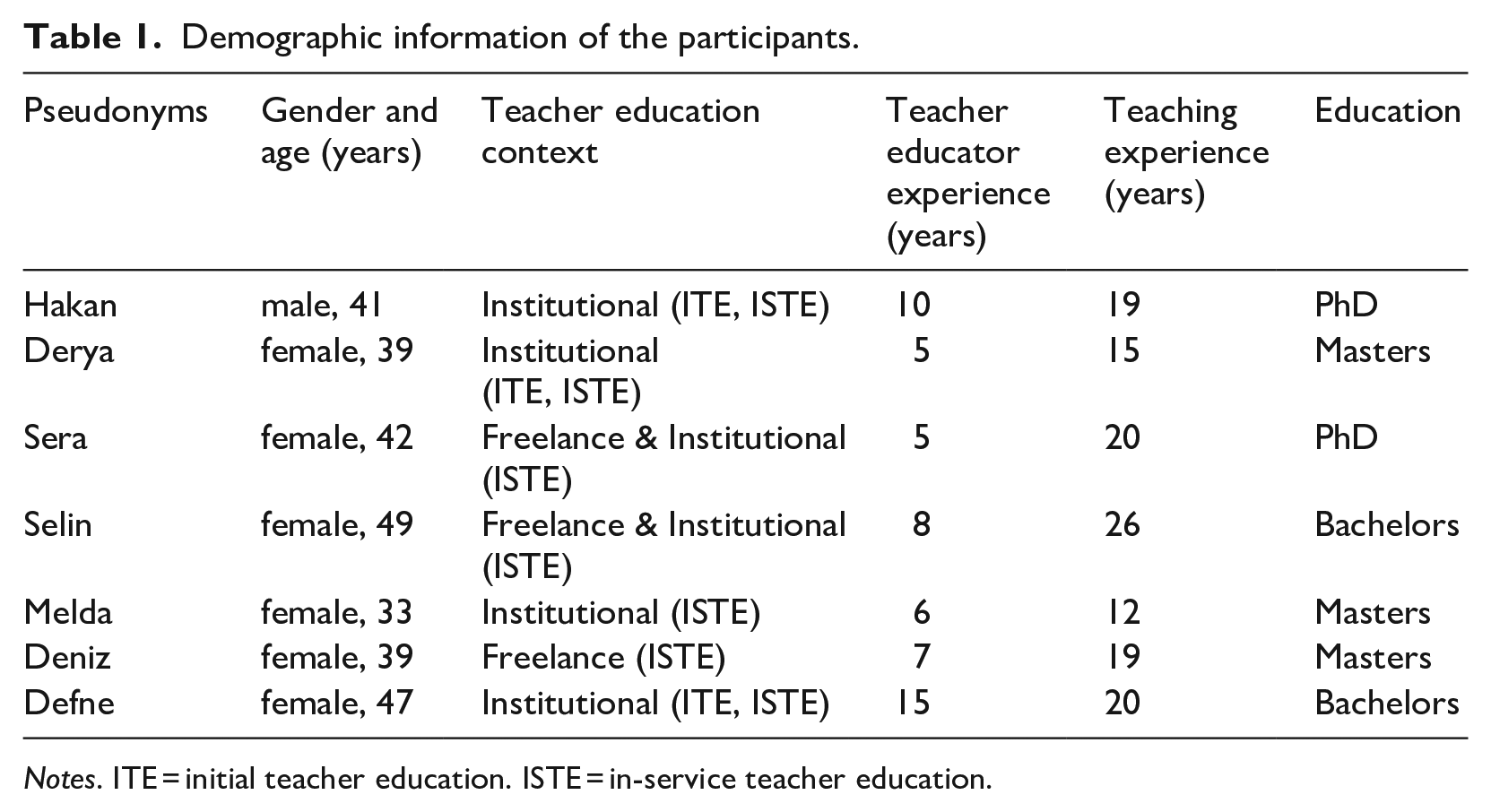
Notes. ITE = initial teacher education. ISTE = in-service teacher education.
3 Data collection
Data were collected through semi-structured narrative interviews and narrative frames, referring to ‘story template(s) consisting of a series of incomplete sentences’ which encourage participants to create ‘a coherent story by filling in the spaces according to their own experiences and their reflections’ (Barkhuizen et al., 2014, p. 45) over the course of a year. Upon granting verbal consent through e-mail and telephone calls, the participants were invited for their first interview at their convenience: meeting face-to-face or online, and usually in private settings as they were more likely to encourage conveying information (Edwards & Holland, 2013).
Three interviews, lasting between 40 and 80 minutes were conducted and recorded by the first author with each participant. Drawing on Seidman (2006) who favors three-interview series to obtain richer insights into participants’ context, experience, and reflections respectively, the interviews traced the stories of how the participants became ISTEs, how they developed their professional identities and how they negotiated their concurrent ISTE and teacher identities. In accordance with the narrative method and to enable more storytelling, the interviews were conducted with minimal inference from the interviewer (Jovchelovitch & Bauer, 2000) and involved broad, open-ended, less structured questions (Anderson & Kirkpatrick, 2016). Two visual documents were embedded into the interviews to obtain different perspectives of experience: in other words, tacit data (Bagnoli, 2009). To stimulate a more complete discussion of the participants’ contexts and how they position themselves in relation to trainee teachers (Barkhuizen et al., 2014), we used three photographs (chosen from online stock photos) that depicted different training environments wherein ISTEs and teachers have different interaction patterns (e.g. teachers having a group discussion facilitated by an ISTE). As for the second visual document, the participants were asked to illustrate their self-ascribed identities on a circular diagram, which was inspired by the relational maps used by Josselson (1996) and Bagnoli (2009). We used these diagrams to enable the participants to reflect on their professional identities by highlighting the relationships among their multiple identities.
As for the written documents, we used narrative frames, that were based on the key interview questions from each interview. In addition to supporting the interview data, the narrative frames enabled the participants to provide written snapshots of their professional experience as ISTEs (Barkhuizen et al., 2014) by ‘providing guidance and support in terms of the structure and content of what it is to be written’ (Yuan & Lee, 2014, p. 144).
4 Data analysis
The data were analysed through a (paradigmatic) analysis of narratives, which refers to ‘using stories as research data’ (Barkhuizen et al., 2014, p. 3). Such analysis shares similar characteristics with the thematic analysis as it entails finding common themes in the already storied data and focuses on ‘ “what” is said more than “how” it is said’ (Riessman, 2005, p. 2).
All interviews were transcribed manually by the first researcher, allowing familiarization with the data (Braun & Clarke, 2006). Then, we generated initial codes from the raw data which meant that we identified seemingly interesting segments relevant to our research purpose (Braun & Clarke, 2006). As the codes began to emerge, we repeatedly analysed them to specify the most striking. After the first step, we had created a separate narrative for each participant by theorizing from individual cases ‘rather than from component themes across cases’ (Riessman, 2008, p. 53). In the second step of our analysis, we looked for themes across the stories, and reread these to identify patterns. Following Braun and Clarke’s (2006) suggestion, we used visual aids (e.g. a mind-map) in the process of defining tentative themes. As the final step, we determined three overarching themes that explained the types of tensions the participants experienced.
5 Trustworthiness and ethics
Though narratives are empowered by their inherent subjectivity (Greenhalgh et al., 2005) and the purpose of gathering storied data is ‘not to determine if events actually happened but about the meaning experienced by people’ (Polkinghorne, 2007, p. 479), there are still potential threats to the validity of narrative inquiry.
One of these threats is that the experienced meanings provided by the participants may not be the mirror image of what happened (Polkinghorne, 2007). Therefore, to ‘bring more of their [the participants’] experienced meaning into awareness’ (Polkinghorne, 2007, p. 481), we remained as focused listeners, gave participants time to reflect on and maintained rapport to build a trusting relationship, while interviewing them three times.
A second threat relates to the interpretation of the narrative data. As the stories recounted by participants inevitably bear traces of researchers’ understanding, we involved the participants during our initial stage of analysis to reduce the risk of distorting the representational accuracy of the data (Barkhuizen et al., 2014) by asking them to conduct a member check on the stories we narrated. This way, they acted as spect-actors (Boal, 2005), whereby they were not only telling their stories but also actively reacting to and reshaping them (and thus their ISTE identities) with us as we narrated them (Saldanha et al., 2022). To further increase the representational accuracy and add ‘a flavor of the original texts’ (King, 2004, p. 268), we used low-inference descriptors, such as direct quotations (Ary et al., 2010). To maintain our neutrality, we ‘practiced reflexivity’ (Guba, 1981, p. 87) by keeping memos of reflection on the data and benefitted from peer debriefing, i.e. sharing data or findings with a critical friend or a colleague (Ary et al., 2010; Rallis & Rossman, 2009). As a final note, given that narrative inquiries are subjective, our study lacks generalizability (Barkhuizen et al., 2014), but nevertheless invites readers to make connections and comparisons with their own contexts.
An ethical approach is vital to narrative studies as inquirers gain information about people’s lives, in other words, ‘concrete human experience’ (Brinkmann & Kvale, 2005, p. 162). Therefore, we obtained participants’ informed consent repeatedly, ensured anonymity (using pseudonyms for participants, institutions, and people) and assured them that there would be no harmful consequences and only minimum disruption to the flow of their work and context (Creswell, 2014).
IV Findings
In this section, we categorize the participants into two groups based on their pathways to becoming ISTEs. Then, we present the themes of identity tensions at three levels as interpersonal, intrapersonal, and institutional.
1 Pathways to becoming ISTEs
The participants appeared to adopt their teacher educator positions either by top-down assignment, i.e. promotion to the role, or by claiming it personally. Defne, Hakan, Melda, and Derya demonstrated ‘a history of in-service learning and professional development that made them reach a level at which they were asked to engage into supporting the learning of teachers’ within their institutions (Fransson et al., 2009, p. 85). Therefore, in this study, we will refer to their ISTE identities as institution-identities, as defined by Gee (2000). Their roles as ISTEs include observing the teaching of and providing feedback to novice and experienced teachers, facilitating in-service teachers’ professional learning (running workshops, facilitating practitioner research), mentoring new teachers, and participating in curriculum and material development.
Selin, Deniz, and Sera’s ISTE identities, though ffurther recognized by their institutions, were initially claimed by themselves. In this respect, they have discourse-identities as they gradually became known as ISTEs within their professional periphery (Gee, 2000). Struggling with the mundane nature of teaching, and apprehensive for their future careers, they desired to maintain their teacher identities by giving it a new form (Trent, 2013), that is expanding and enriching it with ISTE identity. Their ISTE duties include providing one-shot or short-term teacher training services for in-service teachers (within and outside their institutions) and facilitating professional development and mentoring within their institutions while also teaching English classes.
Having said that, our participants experienced multidimensional tensions while sustaining the two interlinked roles, which involve teaching and training in their institutions and beyond. Now we present these three types of tensions we induced from the data.
2 Interpersonal tensions
As noted previously, four of the participants moved to an ISTE position within the same institution and were expected to enact dual roles as teachers and ISTEs simultaneously. While juggling with these two roles, they experienced or became anxious to experience interpersonal tensions because of the change of the dynamics between them and their colleagues. Such discomfort was well reflected in Derya’s statement: ‘I am working with/I was working with my colleagues. They were my friends. I worked with them and after seven years now I am the trainer’ (Interview 1). Her bewilderment was proved right as it took her a long time to break the ice with her colleagues when she abruptly found herself in charge of observing and assessing their teaching practices. Hakan, Defne and Melda were feeling restless as well since they knew their audience consisted of already ‘professional and adept’ teachers and it would be challenging to ‘give them something to make them feel we should listen to this person’. Though they did not provide concrete examples of collegial resistance as Derya did, they were still aware of the elephant in the room as could be seen from the following extracts:
There will always be challenges people with different personalities. Some can be very sensitive; some can be very defensive. The key here is not to break hearts really, that is my motto. Good sense of humor, being approachable, and being able to listen to people. . . You should be prepared to listen to people (Defne, Interview 1). You are at the spotlight; you should be confident and know what you are doing (Hakan, Interview 1). What I find difficult is the teachers who don’t have the same amount of motivation as I do for teaching and professional development (Melda, Narrative Frame).
Probably due to such concerns i.e. being able to engage (experienced) teachers in professional learning activities, showing confidence as an ISTE without disrupting collegial relationships, and sharing knowledge in an appropriate way, the participants invested in improving their interpersonal skills (e.g. body language, presentation skills, sense of humor, empathy, etc.). In fact, as Hakan and Selin mentioned, these skills were no less important than being a ‘good teacher’, which was according to them the main prerequisite of being a ‘good ISTE’.
In addition to these skills, some participants gave accounts of how they resorted to their natural identities (Gee, 2000) and personal traits. For instance, Derya, finetuned her assessor role by means of her ‘friend’ identity (referring to listening to her colleagues and counselling them) to gain their trust, whereas Deniz relied on her ‘kinesthetic’ personality to liven up her workshops and energize her audience. Selin, on the other hand, maintained a ‘motherly’ approach which she associated with ‘caring for and showing empathy’ to both students and teachers and this way kept her personal and professional identities in alignment.
Almost all participants recorded that they managed to earn credibility as ISTEs from their colleagues to a certain degree mostly based on the positive feedback they received over the years. However, we observed that they refrained and still refrain from claiming their institution-identities vis-à-vis their colleagues. Instead, by contesting these identities, they have featured themselves primarily as ‘share and care agents’ who like to help teachers by offering them new ideas and perspectives and additionally as ‘change agents’ who wish to create a change in teachers’ lives, and ‘facilitators’ who facilitate teachers’ professional development and learning. The discrepancy between the institutional ISTE identity and how the participants view themselves in this identity is exemplified in the following extract:
The head of my department introduces me to other people, ‘This is our teacher trainer’. I have to accept it of course when he says it (. . .) but most of my colleagues don’t call me a trainer (. . .). We are almost all at the same age and they generally see me as a friend, who likes sharing and creates some opportunities for sharing ideas (Melda, Interview, 1).
Surprisingly, Hakan, Defne, and Derya, who were also assigned with initial teacher education duties once or twice each year, seemed to be more at ease with acknowledging their ISTE identities in relation to novice/beginning teachers. They insinuated that they felt right in their ISTE positions when they ‘lead these teacher candidates in the right way’ or when they ‘saw their progress’. Even their role definitions (teaching, leading, etc.) changed when they mentioned this aspect of their ISTE identity. Probably, this seemed to them not as challenging as impressing and encouraging already experienced teachers.
3 Intrapersonal tensions
In this section, we provide examples of intrapersonal tensions emerging from the participants’ feelings of incompetency with regards to the knowledge of ‘the content and pedagogy of teacher education’ (Barkhuizen, 2021, p. 2) as well as the knowledge of the institutional or contextual operation of the job (Murray & Male, 2005). When the participants with institution-identities were designated to ISTE roles, they found themselves in the ‘position of expert [teacher] becomes novice [teacher educator]’ (Murray & Male, 2005, p. 136). To illustrate, Defne went through a process during which she felt like ‘a fish out of water’ and could not ascertain ‘what was really expected from her’. Though the more experienced ISTEs saw her ‘potential’, she doubted her competency assuming that most ISTEs were very experienced professionals who were native speakers of English. However, her self-questioning did not last long as she was gradually socialized (learning how to adjust to the new role; Murray & Male, 2005) to her new role through training courses sponsored by her institution and mentorship from more experienced ISTEs. In addition to the external support, her belief that she ‘could be one of them one day’ and her ‘self-motivated’ nature helped her to embrace and maintain the identity that was assigned to her when she least expected.
Like Defne, Melda and Derya reported feelings of self-doubt and incompetency. When they were designated to ISTE roles, they were aspiring teachers with ‘practical and innovative ideas’, yet they both felt lacking theoretical knowledge due to their non-educational science university degree. In addition, they were not very knowledgeable about, as Melda put it, ‘the subtleties’ of teacher education. Melda’s struggle, however, did not last long as she was gradually socialized by an experienced ISTE. Derya, on the other hand, was ‘thrown into the practice of teacher education’ (Berry, 2007, p. 8) when she found herself observing her colleagues although she ‘did not have any certificate let alone any background knowledge as to how observations are made’ (Interview 2). Interestingly, she found a partial solution to her struggle in the observations themselves. As she repeatedly told, these observation sessions functioned as bridges between theory and practice and helped both the observer and the observees to reflect on and consolidate their knowledge and practices. Like Melda, she was later provided with an institutionally sponsored ISTE training course. However, as they both acknowledged these courses did not suffice to teach them the knowledge of being an ISTE, which eventually led them to continue learning by reflecting on their practices, engaging in formal studies, attending conferences, interacting with peer or more experienced ISTEs, and joining wider ISTE communities.
The participants with discourse-identities experienced feelings of self-doubt and incompetency due to the discrepancy between how others (e.g. teachers, institutions, administrators) envisioned ISTEs and the ISTE identities they enacted. Deniz, for example, admitted being criticized by teachers who questioned her eligibility. Yet, she never claimed to be the ISTE people aspired to see (an expert who knows everything), but rather strived to be someone who just ‘put things into a platform so that others could pop on’, meaning that she wanted to help teachers who could not raise their voices, ask for help or question the dominant discourses. In this regard, she believed that the criticisms towards her were unwarranted as ‘she has just gone through the path’ (referring to her formal training and personal efforts). However, she could not help being affected by these assumptions and started to consider pursuing further formal studies, such as enrolling in a PhD program to increase her credibility in the eyes of other teachers.
For Sera, the source of feeling incompetent was ‘feeling not old (referring to wisdom) enough; not experienced enough’. However, the assumptions were not solely hers. During her formal instruction on the methodology of teacher education, she noticed that other ISTE candidates unquestioningly regarded age and wisdom as pre-requisites to being an ISTE, which delayed her adoption of such an identity. She was also disillusioned with the theoretical knowledge provided in the courses she attended. She reprimanded how these courses fell short of practical demonstrations and were somewhat ‘manipulative’, meaning that they showed teachers only a certain way of doing something and did not make room for ‘imagination’. As a result, she distanced herself from the local ISTE community and instead grew a sense of belonging to communities overseas and aimed at integrating what she learned there (e.g. non-formal learning) into her ISTE practices. She underscored that she wanted to ‘find her own way’ by which she could ‘stand out’ as an independent ISTE and teacher.
Selin was also feeling uncomfortable due to feeling behind in terms of academic qualifications (e.g. lacking a PhD qualification). Though she did not believe that having academic qualifications was the essence of being a good ISTE, she could not help but notice that those who held academic qualifications seemed to receive more credibility within higher education contexts. As she observed, being a native speaker of English also increased the credibility of ISTEs which eventually made her feel less visible and thus less secure about her ISTE identity. However, these did not deter her as she, just like Sera, wanted to find her own way and claim an ISTE identity in the way she imagined.
The participants seemed to have overcome their feelings of incompetency to a certain extent, however, the occasionally made statements such as, ‘a new field’, ‘one can never be done’, ‘a trainer-in-training’ in addition to the arguments such as ‘it (ISTE) is a big word to claim’ imply that the participants, irrespective of their ISTE experience, still feel a gap between who they are and who they want to be.
4 Institutional tensions
It appears from the findings that the participants especially with discourse-identities experienced institutional tensions. Despite being recognized as ISTEs in different contexts, they were not immediately able to activate this identity within their institutions, which resulted in a dissonance between their claimed identities and institutional identities. For example, Selin, who received invitations from other institutions to provide trainings or give seminars to teachers, noted with reproach that her institution recognized her ISTE identity rather late. Moreover, she argued that those who held higher academic credentials such as a doctorate degree, were given priority when assigning workshop or seminar presenters within her institution. She confessed to ‘feeling like an outsider at times’ as she began to realize the mismatch between her and her institution’s understanding of an ISTE.
Sera was feeling ‘like an outsider’ as well. As her story unfolded, it became clear that her recognition as an ISTE at her institution was delayed. Our interviews sparked an epiphany that she had already been acting like an ISTE in her institution. However, neither herself nor her colleagues regarded this as ISTE work until she ‘proved herself’ after collaboration with another teacher trainer during an overseas project. Nonetheless, she still disidentifies with the local teacher education context and adheres to ‘finding her own way’, shaping her ISTE identity with her personal experience, and claiming it in external contexts.
The group of participants with institution-identities, however, seem to have less institution-related tensions. They constantly mentioned the support of their administrators and more experienced trainers during their professional socialization. They also had peer ISTEs for consultation whenever needed. In addition, reduced teaching load due to their in-service education has allowed a balanced schedule for teaching and teacher education. However, there were still instances of institutional tensions within this group. Derya, for instance, reproached her institution for reducing their support after she received her official teacher trainer certification. She reported:
The institution is like, ’Now that you are a trainer, you don’t need to further develop yourself. You are done. In fact, you need it, but we are not the ones who will provide it’. (. . .) However, they should be the ones to lead you, to encourage you (Derya, Interview 2).
V Discussion
In this research, we explored the identity tensions of English language teachers who concurrently performed two roles as teachers and ISTEs and found that the participants’ professional identity development was disrupted by intrapersonal, interpersonal, and institutional tensions, especially during the initial phase of becoming an ISTE.
We observed an abundance of interpersonal tensions among the participants with institution-identities. A possible explanation is their vulnerable position, due to the need to gain credibility from their colleagues, most of whom were already qualified teachers. This finding highlights the importance and difficulty of establishing trusting relationships with colleagues and thus gaining credibility as ISTEs as also discussed by Bullock (2007), Clemans et al. (2010), O’Dwyer and Atlı (2015), and Wright and Bolitho (2007). However, the impact of such tensions differs according to the participants and contexts (Van der Wal et al., 2019). For example, Hakan, Melda and Defne, who were gradually socialized into their new roles through institutional support experienced less intense tensions, whereas Derya, who engaged in teacher training practices prior to her socialization faced with more concrete resistance and dealt not only with her tensions but also with her colleagues’ (O’Dwyer & Atlı, 2015).
To lessen/prevent such interpersonal tensions and to earn their colleagues’ trust, participants relied on improving their interpersonal skills, which seem foundational to an ISTE role (O’Dwyer & Atlı, 2015; Wright & Bolitho, 2007). Like the English language teacher in Bullough (2005) who shaped her mentor role with her mother (nurturer) identity, some participants in our study benefitted from additional strategies such as integrating their nature identities (Gee, 2000) and personal traits into their ISTE identities.
What we found most interesting was the way the participants reconstructed their ISTE identities to ensure their colleagues and other trainee teachers that they were not just institutionally designated professionals but rather ‘share and care agents’ who valued, respected, and cared for them. This might imply that the participants, probably because of these interpersonal tensions, renegotiated the assigned identities with self-conceptions and sustained their identities ‘through discourse and dialogue’ (Gee, 2000, p. 103). In a way, they demonstrated that ISTEs could still exert agency on the institutionally assigned identities (Dinkelman, 2011) and identity is more related to how people feel rather than what they perform (Britzman, 1993).
All participants, irrespective of their pathways to becoming ISTEs, experienced intrapersonal tensions embodied as feelings of incompetency and novicehood (Field, 2012; Murray & Male, 2005; Williams & Ritter, 2010; Williams et al., 2012). The participants, especially those with institution-identities, struggled with learning the contextual operation of teacher education/training; however, they eventually managed to cope with such tensions by institutional support and mentorship, in other words, by moving from legitimate peripheral participation (learning the job next to a more experienced educator) to full participation (undertaking the role of ISTE) through institutional support (Lave & Wenger, 1991).
The participants have also dealt with tensions caused by a lack of content and pedagogical knowledge of teacher education/training including conducting observations, combining theory with practice, sharing knowledge with teachers according to their needs and in appropriate ways (O’Dwyer & Atlı, 2015), which may point at a general issue that is the deficiency or lack of formal preparation for the TE role (Zeichner, 2005). Like many of their peers the participants mostly learned the job on the job or from colleagues (Swennen et al., 2009; Yuan & Lee, 2014), and thus felt the need to support this informal learning with formal learning opportunities (e.g. structured courses and formal mentor support) tailored for their needs. As is seen from the participants’ dedication to continued professional learning and hesitation to fully claim a TE identity, we argue that this kind of tensions might be continuing. However, as Fransson et al. (2009) argued ‘professional learning also requires challenges, confrontation, criticism and debate’ (p. 85) and as such these tensions eventually became productive and contributed to the participants’ professional learning and identity development (Smagorinsky et al., 2004).
Our findings also suggest that some intrapersonal tensions the participants with discourse-identities experienced were triggered with external sources. The assumptions, such as those who were native speakers of English, held higher academic credentials or applied certain pedagogies made better ISTEs, contested their feelings of competency and thus slowed down their adoption of ISTE identities (Izadinia, 2014) or resulted in loss of sense of belonging to certain educational contexts and displaying rather marginalized (or isolated) identities (Barkhuizen, 2021). The participants evaded these tensions by opposing to or resisting (Barkhuizen, 2021) the dominant discourses, in other words, by persisting on legitimizing their own practices. They have also engaged in different communities of practices (consisted of fellow ISTEs) to ‘participate in the professional debate that is needed to support their own reflection, learning and professional development’ (Fransson et al., 2009, p. 85).
As for the institution-related tensions, the participants with institution-identities, not surprisingly, seemed to experience them less since they were supported by mentors and peers in their workplace (Anspal et al., 2019). Moreover, their ISTE practices were mostly regulated and facilitated by their institutions. However, as Derya suggested, ISTEs might need institutional support even after their socialization to their new roles, especially to maintain their professional learning. The participants with discourse-identities, on the other hand, experienced such tensions especially when they asserted their ISTE identities, which they earned through discourse and without ‘the overt sanction and support of ‘official’ institutions’ (Gee, 2000, p. 103), within their institutions. Despite eventually gaining this recognition, they still feel marginalized and isolated at times due the mismatch between the institutions’ expectations from ISTEs (e.g. having higher academic credentials) and their own perceptions of an ISTE identity. However, despite these tensions, they have continued claiming their ISTE identities by enacting assigned and voluntary ISTE practices that reflected their own understandings of teacher education/training both inside and outside their institutions.
Though some previous research argued that wrestling with diverse roles and identities might be a source of tension for TEs (Barkhuizen, 2021; O’Dwyer & Atlı, 2015; Yuan & Lee, 2014), the participants seemed to be at ease attempting to reconcile multiple identities. In fact, they believe that these identities are linked, nurture one another and eventually enrich their core professional identity, which is being a language teacher. In a way, they have shown that, in spite of their multiple identities, language (IS)TEs’ core identity is always the teacher (Davey, 2013; Barkhuizen, 2021).
Another explanation for lack of such tensions may be that especially the group with institution-identities had advantages provided by their institutions, such as reduced teaching hours as well as the right to assert agency in their ISTE work, which helped them harmonize their ISTE and teacher identities. The other group, on the other hand, have already sought an escape from the mundane world of teaching like the language TEs in Davey’s (2013) study, and being an ISTE helped them to survive their teacher identities (Trent, 2013). Moreover, the participants were able to relate all their ISTE roles to a single characteristic, i.e. sharing knowledge and helping others to acquire this knowledge, which they found not very distant from what they did in their language teaching classrooms.
VI Conclusions
This study explored the identity tensions of a rather neglected group of professionals, that is the ISTEs who work in the field of English language teaching. The findings suggested that ISTEs’ professional identities might be disrupted by interpersonal, intrapersonal, or institutional tensions which might have varying degrees of impact and duration. On the other hand, how ISTEs deal with these tensions may vary based on their individual competencies. They may be able to cope with the tensions independently, seek external support, or resist them, each of which may have different consequences. Though tensions may sometimes result in discomfort, marginalization, and instability, they may still contribute to professional learning and development.
Our results also reveal that identities are earned, (re)constructed and sustained through individual investment in professional practices. Thus, although institutional support seemed to be the key factor, this support alone was not sufficient for the educators to fully grow into the role; in contrast, the institutionally unsupported participants benefitted from new insights and opportunities gained through their struggle to earn recognition, resisted the dominant discourses, and claimed the ownership of their identities in wider contexts.
Finally, all participants regardless of their experience, which was influenced by different sources of tensions, appeared to have developed their professional identities in various ways and with different motivational purposes as narrated in their stories. Since their reconstruction of professional identities took place through personal (claimed identity) and transformative (mutual handling of complementary roles as teachers and ISTEs) endeavors, their professional development as ISTEs became more empowered and agentic. Therefore, we may suggest that to fully claim an ISTE identity in presence of iteratively emerging tensions, one may need not only personal but also professional acknowledgment, expert recognition and constructive support from other colleagues and stakeholders, which could make tensions more manageable.
To conclude, the study offered some insights into the professional identity tensions experienced by ISTEs in the field of language teacher education. We believe that larger scaled studies with more participants and contexts might offer deeper insights into how ISTEs develop professional identities, what qualifications they need to have, what challenges they experience, and how they can be professionally supported.
Footnotes
Acknowledgements
We express our warmest thanks to the teacher educators who voluntarily shared with us their stories, and to Simon Mumford, who proofread the article.
Funding
The author(s) received no financial support for the research, authorship, and/or publication of this article.
