




Abstract
Reflecting the important role of collaborative dialogue in second language (L2) learning, collaborative writing tasks have been widely used in L2 classrooms to help students gain new knowledge and consolidate their existing knowledge about how the target language works. Although use of the first language (L1) during peer interaction has been criticized (Levine, 2003; Unamuno, 2008), collaborative dialogue research has identified how L1 English use serves several important sociocognitive functions and supports knowledge mediation in foreign language classrooms (Swain & Lapkin, 2013). This study also examines the sociocognitive functions served by English in an L2 French classroom but compares the functions used by L1 English (n = 13) and L2 English (n = 7) speakers during collaborative writing tasks. Their discussions during two collaborative writing tasks were transcribed, and their English use was analysed in terms of its sociocognitive function. Results showed that L1 and L2 English speakers used English for similar sociocognitive functions, mainly for generating ideas, managing the task, and discussing vocabulary. However, there were some different patterns in terms of how extensively English was used within a turn across the functions. Implications are discussed in terms of the potential benefits of using linguistic resources other than the target language in multilingual L2 classrooms.
Keywords
I Introduction
As documented in prior work on second language (L2) peer interaction, there is a positive relationship between L2 learning and collaborative dialogue, which entails problem-solving, negotiation of meaning, and discussion about how language works (Ahmadian & Tajabadi, 2020; Ahmadian, Amerian & Tajabadi, 2014; Mackey, 2012; Swain, 2000; Swain & Lapkin, 1998; Swain & Watanabe, 2013; Taguchi & Kim, 2016). Although collaborative dialogue can occur any time when L2 students are interacting, it has been shown to be prevalent during collaborative writing tasks where two or more students work as co-authors to jointly produce a single text, interacting throughout the planning, writing, and revising stages (Storch, 2013). The process of co-constructing a single text encourages students to reflect on meaning and language use, such as by discussing vocabulary or grammar issues that arise while they are writing (Fernández Dobao, 2012). These opportunities to discuss language while writing promotes learning, transfer, and consolidation of linguistic knowledge (Watanabe & Swain, 2007).
The benefits of collaborative dialogue for L2 learning can be understood through reference to Vygotsky’s (1981, 1986) sociocultural theory, which states that language mediates social interaction and psycholinguistic processes, thereby making language learning a social construct. Among other tools, language serves the learning process by helping students discuss how the language works, such as talking about the meaning and form of words or co-constructing a complex sentence. Several studies have highlighted the positive impact of collaborative dialogue during collaborative writing tasks on L2 students’ task performance and language development (e.g. Fernández Dobao, 2012; Kim, 2008; Shehadeh, 2011; Storch, 2005; Wigglesworth & Storch, 2009). Although these studies analysed what topics students talk about during collaborative writing tasks – such as content, language, or organization – fewer studies have explored whether their discussions are carried out in the L2 or first language (L1) or examined how students use their available languages while collaborating.
It is possible that collaborative writing research has focused on how students use the L2 because L1 use has long been a subject of controversy (Levine, 2003; Unamuno, 2008), with critics arguing that it is a detriment to students’ language development (e.g. Kellerman, 1995). For example, L1 use during peer interaction may be counterproductive and difficult for instructors to monitor (Carless, 2004). This perspective mainly seems to be informed by beliefs about best L2 teaching practices regarding exclusive target language use stemming from the perspective that the L1 may interfere with L2 language learning and use (e.g. Gass & Selinker, 1992; Kellerman, 1995; Odlin, 1989). More recently, however, positive views toward L1 use have emerged in that instructors regard it as a beneficial tool for classroom management that allows tasks to be completed more effectively while giving students more opportunities to express meaning, identity, and humor (Carless, 2004). Learners also seem to share a similarly positive perspective in that using their L1 can facilitate their L2 learning and give value to their prior knowledge (Brooks-Lewis, 2009). Thus, while educators and researchers have been concerned with variation in the amount of L1 use associated with proficiency (DiCamilla & Antón, 2012), task-type (Storch & Wigglesworth, 2003), and teacher monitoring (Behan, Turnbull & Spek, 1997), it is important to identify how learners draw upon their L1 as a cognitive tool during peer interaction and whether they use additional L2s for similar sociocognitive functions.
Working within the sociocultural framework, Antón and DiCamilla (1998) investigated the cognitive and social functions the L1 may serve in an L2 collaborative writing task by analysing L1 English use during L2 Spanish collaborative interaction. Beginning-level adult learners of Spanish co-constructed an informative text in pairs. Analysis of their recorded interactions showed that the L1 served cognitive functions such as providing scaffolded help to each other, which included assessing L2 forms, choosing appropriate linguistic items, and understanding the meaning of the text. In addition, the L1 also served social functions such as achieving intersubjectivity – helping learners to maintain a good cooperative atmosphere and a shared understanding. The authors concluded that L1 use emerged as a powerful psychological tool which instructors should not prohibit, as it helped students to generate content, reflect on their writing, and work through difficulties that arose, ultimately enabling effective dialogue.
Also situated within the sociocultural framework, Swain and Lapkin (2000) analysed grade 8 French immersion students’ L1 English use while co-constructing a story in L2 French during jigsaw and dictogloss tasks. While these tasks differed from Antón and DiCamilla’s (1998) collaborative writing task in that students were provided visual or aural stimuli of a story to jointly produce a written version, rather than generating completely original content, the collaborative dialogue similarly revealed the important functions of the L1. Even in a French immersion context where L1 use is typically restricted and viewed as counterproductive to the purpose of immersion, Swain and Lapkin demonstrated how this perspective is misinformed and English was only marginally attributed to off-task talk, contrary to what instructors may expect. Rather, their participants made use of English mainly to help them manage the task (make sense of the requirements or content), sequence their stories, and deliberate about word form or vocabulary. They concluded that the use of English helped these immersion students accomplish the task and enhanced their interpersonal interaction, as English was their shared L1.
Using similar collaborative tasks as Swain and Lapkin (dictogloss, jigsaw, and text reconstruction), De la Colina and García Mayo (2009) came to similar conclusions, but in a foreign language setting with Spanish L1 undergraduate students who were beginner learners of English. They classified the functions of learners’ L1 use as either metacognitive talk (i.e. talking about the task in terms of planning, verifying comprehension, monitoring the task), which lead to intersubjectivity, or metatalk (i.e. discussion about form, regarding vocabulary or grammar). Overall, they found that the learners mainly used Spanish to manage the task (clarify instructions, plan, organize, or evaluate their work), and to discuss vocabulary and grammar, showing that the L1 was useful for exchanging knowledge and establishing a common goal. In agreement with existing evidence (e.g. Macaro, 2005; Storch & Wigglesworth, 2003), De la Colina and García Mayo suggested that learners could work at a higher level by using their L1 rather than by relying solely on their L2 skills.
In sum, the research to date has demonstrated that speaking a shared L1 can be a useful tool for creating learning opportunities during peer interaction in foreign language classrooms. However, while these studies focused on shared L1 use, there is less research regarding the use of other languages beyond the L1. In multilingual settings, students may draw upon their entire repertoire of languages to communicate, including L2 English. In such linguistically diverse classrooms, it is important to consider peer interaction in the form of translanguaging, which has been defined as ‘the ability of multilingual speakers to shuttle between languages, treating the diverse languages that form their repertoire as an integrated system’ (Canagarajah, 2011, p. 401). These translanguaging practices have emerged in collaborative writing interaction with linguistically diverse peers, where students use their expanded linguistic repertoire to solve linguistic problems and co-construct ideas (Martin-Beltrán, 2014), suggesting that an L2 can also serve the learning of a third language through multilingual discourse practices. Because prior studies have shown that learners use a shared L1 during peer interaction to generate content, manage the task, and talk about language, those findings raise interesting questions about whether these functions also occur when learners use another shared L2 (English) rather than a shared L1.
In summary, shared L1 use has been studied across various learning contexts, including in second or foreign language classrooms (e.g. Antón & DiCamilla, 1998; Brooks & Donato, 1994; De la Colina & García Mayo, 2009) and in immersion classrooms (e.g. Behan et al., 1997; Swain & Lapkin, 2000). The current study extends this literature to a unique context of an L2 French classroom in Montreal, Canada where learners from diverse L1 backgrounds are part of a bilingual community encountering both English and French outside the classroom. In this context, we may expect students to display more linguistic dexterity compared to what has been observed in prior research in other L2 contexts due to their experience in a speech community where members regularly shuttle between English and French (Valenti, 2014). With the inclusion of more diverse language backgrounds, we may also see that English, despite being the L2 for some students, may serve similar sociocognitive functions as observed from the shared L1 studies (e.g. Antón & DiCamilla, 1998; Swain & Lapkin, 2000). Furthermore, this study expands collaborative writing research about student talk (e.g. Fernández Dobao, 2012; Storch, 2005) to include talk in an additional language that is neither the L1 nor the target language. More specifically, the goal is to shed light on how French learners draw upon their prior linguistic knowledge of English (whether it is their L1 or another L2) during collaborative writing tasks for different sociocognitive functions. This study was therefore guided by the following research question: What sociocognitive functions does English serve when English L1 and English L2 speakers carry out collaborative writing tasks in an L2 French classroom?
II Method
1 Participants
The participants were 20 undergraduate students (17 women, 3 men) at a Canadian English-medium university in Montreal, studying in a high-intermediate French class offered in the French Language Centre. As B2-level students, the class was designed to help them reach the C1 level in the Common European Framework of Reference for Languages. Their class met two times per week with three instructional hours a week and a total of 78 hours over the 13-week semester. The students were between the ages of 18 and 28 (M = 18.95, SD = 2.25), and had been studying French for an average of 7.75 years (SD = 3.65). Eleven of the students were international students who had been in Canada for an average of 2.32 years (SD = 3.51). There were 13 students whose first language (L1) was English, while the other seven students spoke English as an L2, and their L1s were Farsi, Spanish, Mandarin, Romanian, Japanese, with one student bilingual in Hindi and Urdu, and a second student bilingual in Mandarin and Japanese. The L2 English speaking students had met the minimum English proficiency level required for admission to their university (minimum TOEFL iBT score of 75 or equivalent) and were at the B2 to C1 levels in English in the Common European Framework of Reference for Languages. Regarding the linguistic repertoire of the 13 English L1 speakers, five of them stated that they knew an L2 other than French, while the remaining eight only had French as an L2. In terms of pairs for the collaborative writing activity, there were five pairs of students who both had English as an L1, two pairs where both students spoke English as an L2 (with different L1s), and three pairs of L1–L2 English speakers. It should also be noted that in this study we refer to L2 French to indicate an additional learned language, rather than specifically the second learned language, as French was the third language of these L2 English speakers.
2 Materials
The materials consisted of two collaborative writing tasks (Appendix 1). Two tasks were created because collaborative writing researchers have pointed out that it is important to consider students’ performance on multiple collaborative writing tasks rather than rely on ‘one-shot’ designs (Storch, 2016; Carver & Kim, 2020). Similar to an argumentative essay, these tasks required the students to take a position on the proposed issue, but they were also prompted to discuss the potential causes and suggest possible solutions. They were familiar with taking positions in writing, as they had practiced opinion essays in their previous French class. The first writing topic was about dumpster diving, where they responded to the prompt ‘Dumpster diving is a phenomenon that aims to avoid food waste.’ The writing topic for the second task was about job discrimination, where they responded to the prompt ‘People with tattoos face job discrimination.’ Each task also included a short video about the topic whose content they could use to support their ideas, as well as a checklist of guiding questions about content, organization and language that they could consult when revising their texts. Digital audio-recorders were given to each pair to record their conversation during the tasks.
3 Procedure
At the beginning of the semester, a member of the research team attended the French class to describe the research project and administer consent forms to request permission to use their written assignments for research purposes. The consent forms were returned to the researcher and the students’ decision to participate was not shared with the instructor. As part of the instructional activities, the first collaborative writing task was carried out during the fifth week of their 13-week semester, and the second writing task occurred during the ninth week. Both tasks were administered as part of the regularly scheduled lessons and were designed to provide students with practice writing opportunities before scheduled writing examinations. Students self-selected a partner who they worked with for both tasks. For each task, the topic was first introduced to students (5 minutes), after which they viewed the video and took notes (7 minutes). After the video, they worked with the partner to share their notes from the video and exchange ideas about the topic (7 minutes). They had 40 minutes to collaboratively write a single essay in response to the prompt. Finally, they used the checklist of guiding questions to revise the content, organization, and language of their text (7 minutes). A research assistant kept track of time to let the students know when to begin and end each stage of the writing process. The students’ interaction throughout the entire sequence was audio-recorded.
4 Data coding and analysis
The 20 audio-recordings of the two collaborative writing tasks were transcribed by a research assistant and verified for accuracy by a second research assistant. Following the units of analysis used by Storch and Aldosari (2010), the transcripts were analysed for the occurrence of English in terms of the number of words and turn type. The turns including English were classified as either predominant turns, which were turns that had as much or more English than French, or minor turns, which were turns with less English than French. As turn count alone can be an inexact measure due to varying turn lengths, both measures of word count and turn type were used to better reflect how English was distributed within the French dialogue. The English produced was then coded in terms of sociocognitive functions using a coding framework from prior research on L1 use during collaborative writing (e.g. De la Colina & García Mayo, 2009; Storch & Aldosari, 2010; Swain & Lapkin, 2000) and refined through an iterative examination of the data. This process resulted in eight coding categories and 20 subcategories. Table 1 provides a complete list of categories and examples from the transcripts, where English use is italicized. After training with the first author, a French–English bilingual research assistant coded all the transcripts for the 20 different functions.
Coding framework for English use during the second language (L2) French collaborative writing task.
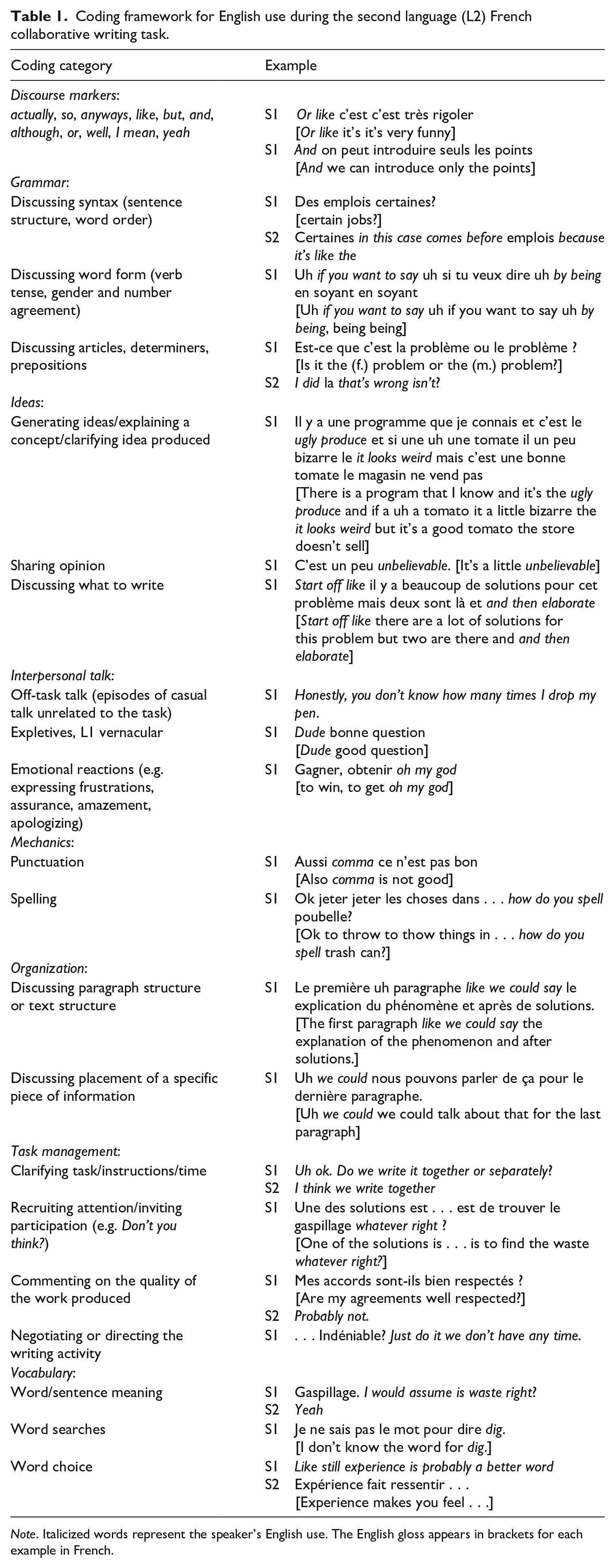
Note. Italicized words represent the speaker’s English use. The English gloss appears in brackets for each example in French.
Excerpt (1) from the dumpster diving task illustrates the coding of sociocognitive functions. In this example, Maria spoke Spanish as an L1, while Jason was an L1 English speaker. They were discussing how much food is wasted per year, and Jason used English when he had trouble finding the correct French verb for to waste: (1) 1 Maria Ok d’abord . . . la production. [Ok first . . . the production.] 2 Jason Oui uh j’ai écrit qu’il y a un tonne de la nourriture par an c’est le déchet et c’est bon fait je pense pour l’introduction . . . Est-ce qu’il a un verb pour le déchet? Parce qu’en anglais on peut dire a ton of food is wasted every year mais déchéter? [Yes uh I wrote that there is a ton of food each year that is waste and it’s good fact I think for the introduction . . . Is there a verb for waste? Because in English one can say ‘a ton of food is wasted every year’ but déchéter (invented word)?] 3 Maria Uh déchirer c’est pas déchirer c’est pas déchirer. [Uh to tear it’s not to tear it’s not to tear.] 4 Jason Je peux googler . . . gaspiller! [I can Google . . . to waste!] 5 Maria Oui gaspiller. [Yes to waste.] 6 Jason Oui uh ah oui gaspiller c’est throw away ou aussi être décheriner. [Yes uh ah yes to waste is throw away or also to be décheriner (invented word).]
To code this excerpt, both Turn 2 and Turn 6 were considered minor English turns, as they involved fewer English than French words. Furthermore, Turn 2 was coded under the category of Vocabulary with nine English words. This is because Jason used English to search for the word ‘to waste’ by first asking for the verb form of the noun ‘waste’ (which he knew in French) and then by using the verb in an English sentence to contextualize the word he was searching for. Finally, Turn 6 was coded as two English words for Vocabulary as well, as Jason was using English to define the meaning of gaspiller. It should be noted that the word ‘okay’ (as in Turn 1 of the example) was not coded as an English word, as it is often used in discourse by native French speakers. In addition, filled pauses (e.g. uh, um, ah) were not included in the word count for any category.
The first author, a proficient speaker of French and English, coded the discussions of 10 students (25% of the data) to check for interrater reliability of the turn types across sociocognitive functions. Interrater reliability was calculated as two-way, mixed consistency intraclass correlation coefficients for the total words in each of the eight sociocognitive functions, as well as the total number of predominant and minor turns per function. Across the eight functions, the coefficients ranged from .89 to 1 for word count, from .90 to 1 for predominant turns, and from .86 to 1 for minor turns.
III Results
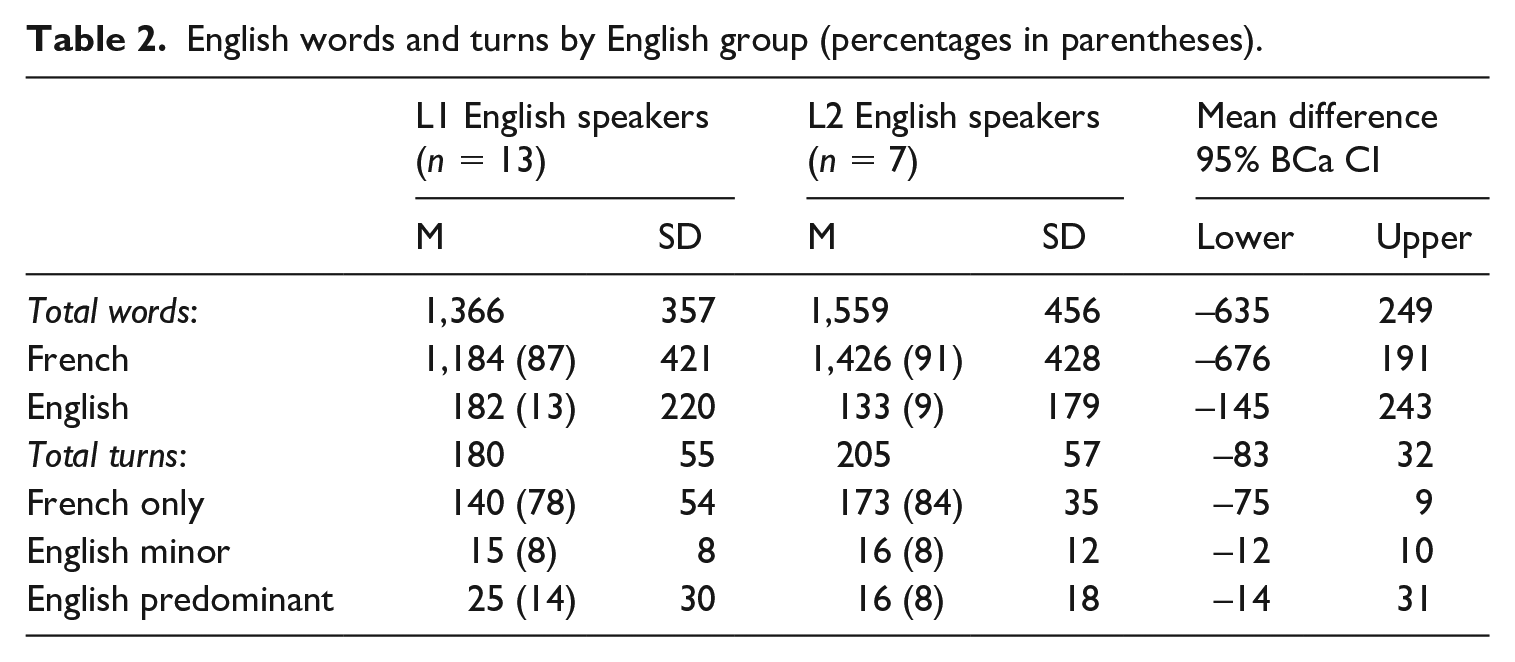
Before describing how students used English for various sociocognitive functions, it is first important to gain a general sense of their overall language production while carrying out the collaborative writing tasks. As shown in Table 2, the L1 and L2 English speakers predominantly spoke French both in terms of words (87% and 91%, respectively) and turns (78% and 84%, respectively). For their English use, the L1 English speakers spoke slightly more English (13%) and had more English predominant turns (14%) than the L2 English speakers. Due to the small sample size, unequal distribution of L1 and L2 English speakers, and variability in the data, inferential statistics were not carried out. However, as an additional descriptive tool, we examined the bias-corrected and accelerated (BCa) confidence intervals for the mean differences to confirm that the intervals crossed zero for all word and turn counts, which suggests that the two groups were similar (Field, 2018). As Larson-Hall and Herrington (2009) argue, non-parametric bootstrapping methods (random sampling procedures) are preferable for small sample sizes where a normal distribution is not assumed, and Plonsky, Egbert, and LaFlair (2014) confirm that they are ideal when normality assumptions are violated. Essentially, the BCa confidence intervals, which are considered the most accurate bootstrapping approach for the CI of the mean, adjust for the mean being unequal to the median (Larson-Hall, 2016).
English words and turns by English group (percentages in parentheses).
1 Sociocognitive functions: Word analysis
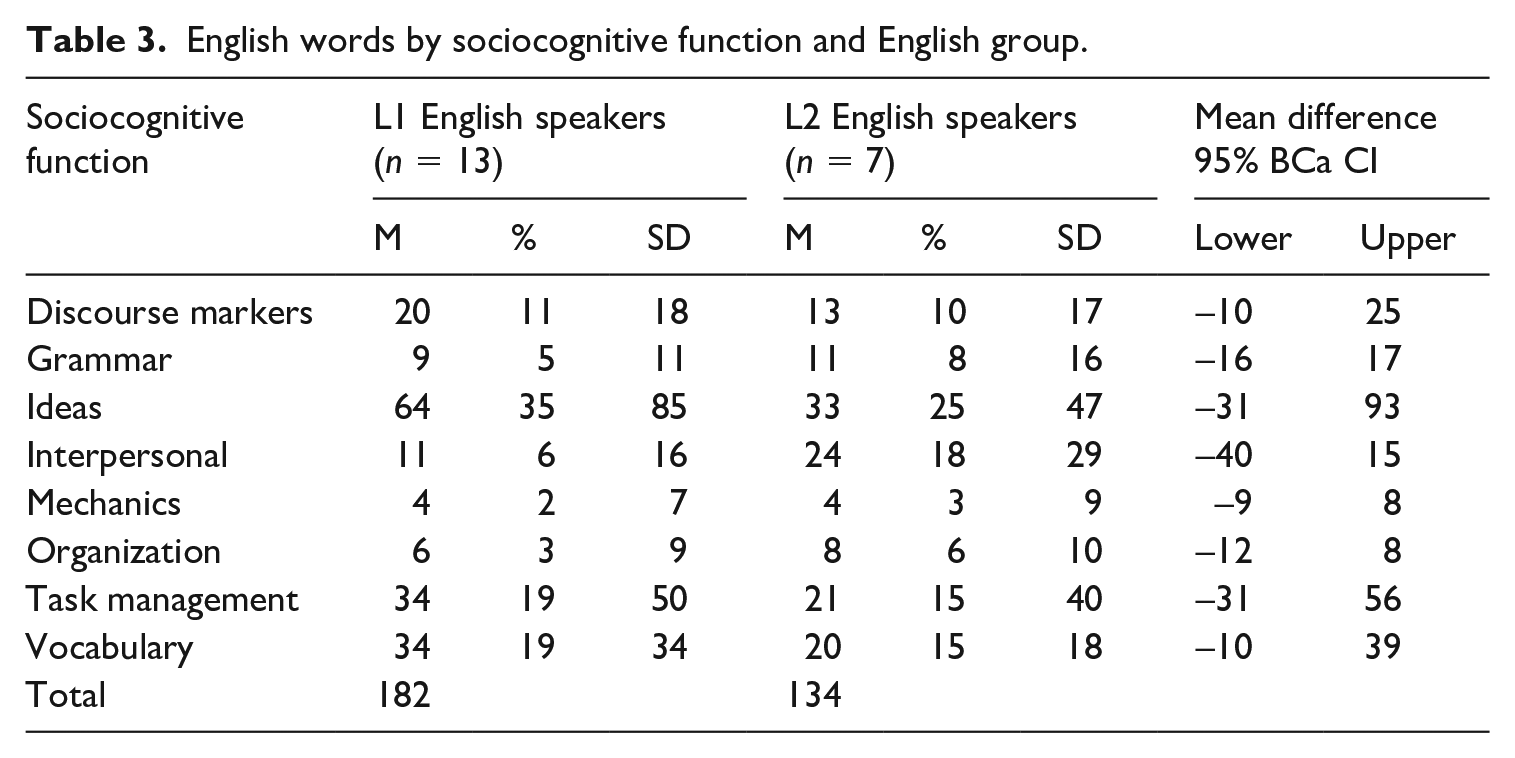
Turning to the research question, which asked about the students’ sociocognitive functions of English, we first addressed it by examining the mean words in each category across both tasks. As shown in Table 3, frequent sociocognitive functions for both groups included ideas, task management, and vocabulary. The sociocognitive function with the largest difference in percentage of English words (12%) occurred for the category of interpersonal talk. Examination of the BCa confidence intervals for the mean difference again revealed that the intervals crossed zero for all sociocognitive functions, suggesting that the English L1 and L2 speakers were similar in their English use.
English words by sociocognitive function and English group.
To illustrate the frequent sociocognitive functions identified by the descriptive statistics, we provide examples of the students’ use of English to generate ideas, discuss vocabulary, and manage the task. In (2) Tami (L1 Hindi and Urdu) uses a few English words to help her convey her idea in French, likely as a way to compensate for any French words she did not know. Therefore, English served as a tool to fill gaps in her French knowledge, allowing her to complete her French sentence and fully express her idea.
(2) Tami Oui parce qu’il y a des gens qui achètent beaucoup et more than they require beaucoup qu’ils ont besoin de et ça aussi les magasins doit donner les produits pour les homeless people et . . . [Yes because there are people who buy a lot and more than they require a lot that they need and also the stores must give products to homeless people and . . .]
In terms of vocabulary, students used English to clarify word meaning, debate word choice, and carry out word searches, as shown in (3) where Jan (L1 English) asks her partner (L1 English) for a synonym for frequent.
(3) Jan C’est – Qu’est-ce que c’est le mot? What’s another word for frequent? C’est usually? [It’s – What’s the word? What’s another word for frequent? It’s usually?] Mia C’est typiquement. [It’s typically.]
Turning to task management, in (4), Jia (L1 Mandarin) questions their determiner use, but Ami (L1 Japanese) attempts to move the task along by switching completely to English to say they will address the grammatical details during the editing stage.
(4) Jia Oui . . . est-ce que vidéo féminin ou masculin? Un vidéo la vidéo? [Yes . . . is video feminine or masculine? A (m.) video the (f.) video?] Ami We’ll come back to that. We’re like editing it afterwards so like.
To summarize the findings based on word count, both L1 and L2 English speakers were similar in terms of using English words primarily for ideas, vocabulary, and task management. Although word count provides an idea of how much English overall was attributed to each function, it does not illustrate if English was sporadically used within French sentences – as in (2) and (3) – or extensively used within turns entirely in English, as in (4). Therefore, to get additional insight into the students’ English use, we next compared how extensively they used English within a turn across sociocognitive functions.
2 Sociocognitive functions: Turn analysis
Whereas the previous analysis considered how many English words occurred across function types, here the focus is on the degree to which the turns in each sociocognitive function contained English. By differentiating between predominant turns, where English use was equal to or greater to French use, and minor turns (i.e. less English than French use), we can better capture students’ translanguaging practices in terms of how extensively they integrated English with French. As the previous analysis revealed that L1 and L2 English speakers used English similarly across the sociocognitive functions, the turn analysis reports their combined data. Table 4 provides the sum of predominant and minor English turns in the dataset by sociocognitive function.
Turns with English use by turn type and sociocognitive function.
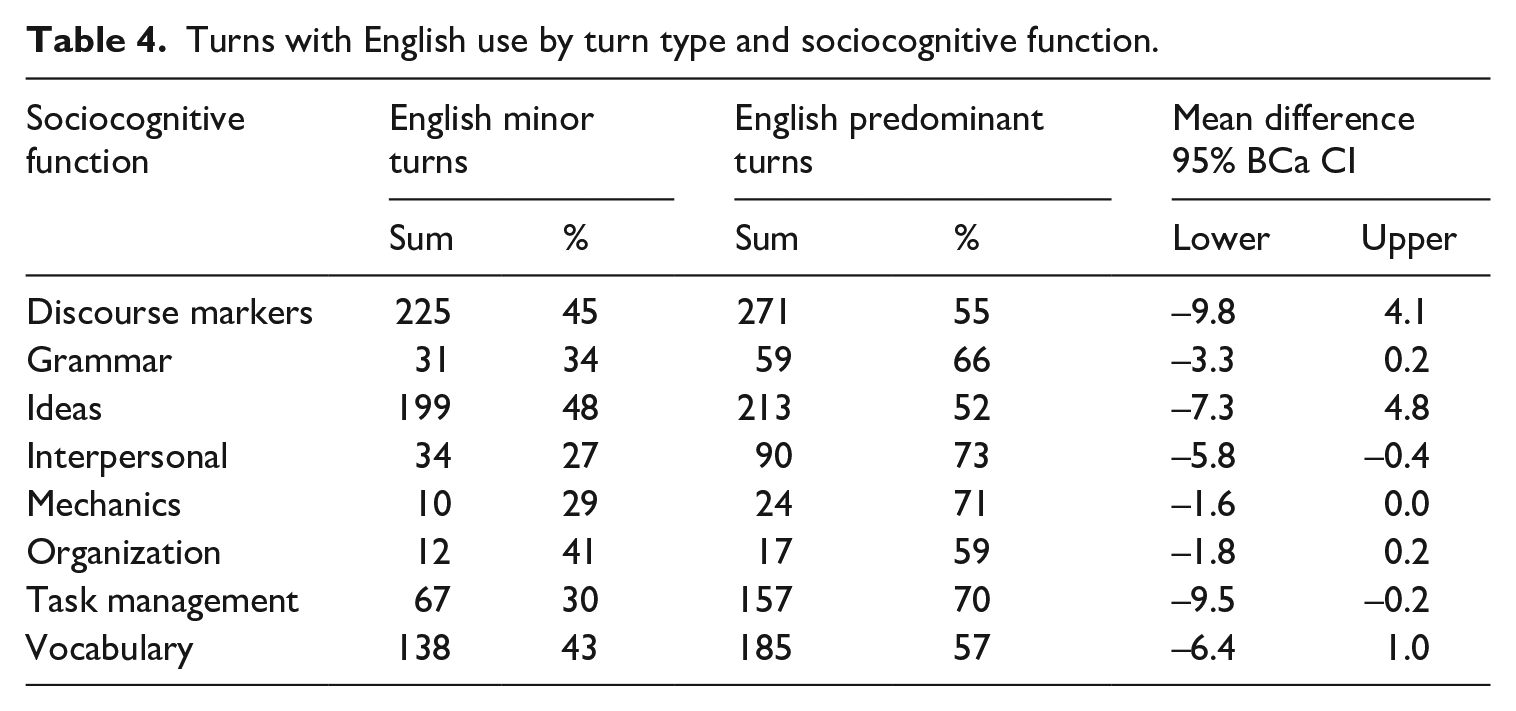
The percentage of English minor and predominant turns was relatively equal for the sociocognitive functions of discourse markers, grammar, ideas, organization, and vocabulary, and the confidence intervals confirm a lack of difference in turn type. However, for the sociocognitive functions of task management, interpersonal talk, and mechanics, the percentage of English predominant turns was higher than minor turns, and the confidence intervals do not cross zero. The tendency for students to use English predominant turns for task management was illustrated in (4) when Ami spoke exclusively in English to tell her partner that they would wait to address grammatical issues until the revision phase.
When transitioning from the writing task to off-task talk, the students would often do so by switching from French to using exclusively or predominantly English sentences. While English was used for expletives, L1 vernacular, and emotional reactions, interpersonal talk most frequently occurred in off-task talk, as illustrated in (5). In this example, Sarah (L1 English) spoke in French when declaring they had finished the task, but then switched to English when she transitioned to off-task talk, speaking about another class, then back to French when referring again to their task completion. Julie (L1 Romanian) also continued in English for the duration of their off-task discussion.
(5) Sarah C’est bizarre parce que nous avons fini. Et je ne sais pas d’autre nous pouvons faire. Donc c’est tout? . . . Oh, c’est qu’elle classe d’histoire? I know a bunch of people in my class. [It’s bizarre because we finished. And I don’t know what else we can do. So that’s everything? . . . Oh, which History class? I know a bunch of people in my class.] Julie Really? Sarah Oh, peut-être two. [Oh, maybe two] Julie I don’t know there’s this guy who is I think in most of my G classes. He’s like, I don’t know. He’s just always there. It’s kind of bizarre. I’m just like, hey, it’s you. Sarah Uh, nous avons fini. [Uh, we finished.]
Students often engaged in social chatting when they finished writing their essay instead of moving on to edit or revise the text, as in (5).
For mechanics, students used English to decide on punctuation or to determine the correct spelling of a word, including the correct placement of accents. In (6) Viki (L1 English) uses a predominantly English turn to ask her partner to verify her spelling of a French word.
(6) Viki Can you check par consequent . . . how to spell it and everything? [Can you check therefore . . . how to spell it and everything?]
To summarize the findings based on the turn analysis combined for both L1 and L2 English speakers, most of the sociocognitive functions of English tended to occur similarly in minor and predominant English turns. However, when using English to manage the task, to deliberate about mechanics, or to talk off-topic, students would primarily do so in predominantly English sentences.
IV Discussion
The research question asked how L1 and L2 English speakers use English during an L2 French collaborative writing task, which was investigated by analysing their English words and turns across sociocognitive functions. The results showed that regardless of English status, these students tended to use English for discussing or generating ideas for their text, deliberating about vocabulary, and managing the task (e.g. clarifying instructions, directing the writing activity). Similar patterns have emerged in prior work on L1 use during L2 collaboration where learners mostly used the L1 for coping with vocabulary (e.g. García Mayo & Hidalgo, 2017; Swain & Lapkin, 2000) or for task management (e.g. De la Colina & García Mayo, 2009; Swain & Lapkin, 2000). Therefore, as in other second or foreign language classrooms with mixed L1 backgrounds (e.g. Turnbull, 2018), English served an important role to bridge gaps in their French knowledge, as illustrated in (2) and (3). Furthermore, as prior L2 collaborative writing research has suggested that students benefit from their discussions of language and ideas (e.g. Fernández Dobao, 2012; Storch, 2005), our findings exemplify how English serves similar functions for both English L1 and L2 students.
A unique contribution of our study was that our analyses also considered how extensively English was used during a turn depending on its function, which would reveal how learners may use English in combination with the target language differently relative to its function. We found a larger proportion of English use for task management and interpersonal interaction consisted of predominant English turns. The finding that these students used English for interpersonal talk resembles Swain and Lapkin’s (2000) French immersion students, also within a Canadian context, who used English for interpersonal interaction in 12% to 17% of their English turns. Thus, while Swain and Lapkin claimed that English use between native speakers enhanced interpersonal interaction, our results suggest that this is also the case for L2 English speakers. DiCamilla and Antón (2012) acknowledged that by their nature, task management and interpersonal exchanges do not require target language use as much as other functions that aim to discuss content or form. Tognini and Oliver (2012) agree, stating that learners likely feel less confident using the target language for task management, as it would require more command of the language, as opposed to form-focused exchanges.
Although it was beyond the scope of the current study, a main limitation to our research was that we did not measure if English use across the various sociocognitive functions was linked to L2 learning. While our results suggested that English use likely provided opportunities for L2 development by sustaining effective collaboration in French, to achieve a more concrete measure of L2 learning, future studies may wish to examine the link between students’ English use during the collaborative writing discussions and their performance on the co-constructed French text as compared to either an individually written text without collaborative discussions, or to a co-constructed text with French-only collaborative discussions. Our data did not allow for these necessary within-group comparisons, as we did not have two texts from the same student in these different writing conditions. Another limitation was that we could not look extensively at how the L1 of the speaker’s partner may have affected their English use, as we did not have an equal distribution of pairs with same and different L1s. Therefore, it remains to be explored further how the function of a lingua franca may differ depending on if it is the shared L1 or not between interlocutors. Although exploratory in nature, another limitation of our study is the limited generalizability of our findings, given our small sample size, disproportion of L1 to L2 English speakers, and the high degree of variability observed in our data (as shown by the large standard deviations in Table 2). It is therefore quite possible that the patterns of translanguaging practices in our results cannot be extrapolated to other L1 and L2 English speakers. Nonetheless, our findings reveal interesting trends regarding the use of a lingua franca in the L2 classroom, and future research should continue to investigate the benefits of this underexplored resource, as well as other factors influencing its use.
In conclusion, the current study extended prior work on shared L1 use during L2 collaboration (e.g. Antón & DiCamilla, 1998; Storch & Aldosari, 2010; Swain & Lapkin, 2000) by demonstrating that when multilingual identities are accepted within a multilingual classroom and students are allowed to fully engage their linguistic repertoire during pair work, positive contributions can be made to maintaining successful collaborative dialogue. Some L2 French instructors may fear that the use of English during pair work may lead to off-task behavior and be counterproductive to their learning of French. However, these L2 French students predominantly spoke French and used English for relevant, on-task conversation with little off-task talk in English. This is not to say the use of English in L2 French classrooms should be encouraged, but rather that it does not have to be strictly forbidden; it can be put to good use, as shown in our study by the various cognitive and social functions it served – primarily to generate ideas, manage the task, or discuss vocabulary. While collaborative writing tasks tend to require much discussion of content and word choice (e.g. McDonough, Ammar & Michaud, 2022), it could be that if the students had not used English for such functions, they may not have accomplished the task as successfully, if at all. As such, our findings contribute to other existing evidence within the sociocultural view that using the L1 or an additional L2 while collaborating in the target language has pedagogical value, while prohibiting their use may diminish effective collaboration. Perhaps language teachers’ perspectives should shift from enforcing collaboration in the target language, to providing students with opportunities for collaboration with the target language.
Footnotes
Appendix 1
Acknowledgements
We would like to thank the instructors and students who participated in the study, particularly Gabriel Michaud, and the research assistants who helped with data collection, handling, and coding: Gabrielle Bertrand, Sylvie Bissonette, Helene Bramwell, Nadia Lemay, Coralie Robitaille, and Quinton Stotz.
Funding
The author(s) disclosed receipt of the following financial support for the research, authorship, and/or publication of this article: This work was supported by a grant awarded to the second and third authors by the Quebec Ministry of Education in collaboration with the Fonds du Recherche Société et Culture Action Concertée program (2018-LC-210816).
