



Abstract
Sociocultural theory (SCT) is a powerful basis for exploring and guiding L2 (second/foreign language) learner development. For the most part, however, the focus of classroom SCT-L2 has been on single activities, for example, teacher mediation of learners’ writing process or peer scaffolding. In this paper, we expand on these studies, building on Vygotsky’s (1997) metaphor of teacher as a creator of learner development. We propose how activities (1) where agency for guiding development lies with learners, (2) where the teacher takes the lead in guiding learner development, and (3) where opportunities for development emerge in dialogical interaction between the teacher and learners can be orchestrated to collectively create learner development. We report on an academic L2 English writing course at a Japanese university. The instructor first created opportunities for learner development in peer interactions. The instructor then built on the information received from these with regard to learners’ challenge with coherence in subsequent group dynamic assessment and frontal work using a SCOBA. Finally, the instructor traced the change in learners’ self-regulation in later peer interactions. We will focus on the development of one learner’s L2 English writing throughout the course, illustrating how insights into areas of learners’ struggle and mediated performance emerged in peer interaction, how the instructor built on these, and how this mediation guided the peer interaction to follow.
I Introduction
Sociocultural theory (SCT) is a powerful basis for studying and informing classroom interactions. The central principle of Vygotsky’s SCT in the classroom is pedagogical imperative, using theoretical principles and concepts to promote learner development (Lantolf & Poehner, 2014).
In SCT research, theoretical principles are used to induce a qualitative transformation, theory and practice forming a dialectical unity: praxis. Just as theoretical principles change practice, they are themselves validated in it. Importantly, interaction and learning are of no interest in SCT without their relationship with development (Poehner & Leontjev, forthcoming). The focus is on interaction as interpsychological activity leading development.
Vygotsky’s concept of Zone of Proximal Development (ZPD) informs the understanding of how development happens through mediation and how mediation as instructional practice can be orchestrated. Zone of Proximal Development postulates that learners’ independent performance reveals but a part of a picture, and learner abilities in the process of maturing emerging in their engagement with external mediation from more knowledgeable others should be taken into account (Vygotsky, 1978). Aljaafreh and Lantolf (1994) defined three main principles of mediation. These principles imply that mediation should be given when needed and that learners should engage in tasks beyond their unassisted capacity (contingency principle), mediation should start implicitly, gradually becoming more explicit (graduated principle), and should emerge in interaction rather than being provided unidirectionally (dialogical principle). Such orientation favours engagements between the teacher and a learner. However, this is not the only interactional configuration. Holzman’s (2018) discussion of ZPD as a cooperative activity allows for expanding the notion of the more knowledgeable other to include peers. Emerging on the interpersonal plane, mediational means allow completing tasks beyond each learner’s unassisted capacity and create opportunities for the development of all learners.
Such a collectivist interpretation of ZPD, the ‘distance between the present everyday actions of the individuals and the historically new form of the societal activity that can be collectively generated’ (Engeström, 2014, p. 138), allows for understanding development as emerging in peer interactions sans teacher as well as teacher mediating groups of learners. Indeed, Vygotsky (e.g. 1998, p. 204) discussed ZPD as optimum for ‘teaching both the group and each individual’.
A different way Vygotsky’s ideas have informed classroom activities is rooted in the understanding of development as a qualitative transformation of cognition through the internalization of novel ways of thinking (Galʹperin, 1978/1992). Known as Concept-Based Language Instruction (C-BLI), the approach forefronts L2 development through the use of concepts. These concepts are explicitly introduced to learners multimodally to help learners use these concepts to mediate their thinking processes and actions (Masuda & Ohta, 2021; Ohta, 2017).
Thus in ZPD activities, the teacher can be fully in control, place agency largely onto learners, or agency can be dynamically shifted from the teacher to learners and back during the activity. However, much of SCT research has focused on single ZPD activities, yet, the reality of the classroom requires a holistic longitudinal approach, merging these activities into one development-oriented process in which teaching, learning, and assessment are in a dialectical relationship (see Poehner & Leontjev, forthcoming). This study explores an implementation of such a process informed by Vygotsky’s (1997) discussion of teacher as a creator of learners’ development. We study how a course instructor orchestrated an L2 English academic writing course in a Japanese university.
II Literature review
1 Mediation and peer assisting behaviours
There is very little in Vygotsky’s writing that points towards teacher-learner interaction being the only way ZPD activities can be organized (Holzman, 2018; Zuckerman, 2003). As Donato (1994) illustrated, learners who are individually novices can collectively be experts, jointly performing on tasks outside of their individual performance (see also Buescher, 2015).
In L2 writing SCT research, it has been found that peer assistance in collaborative revision activities is not unidirectional but is co-constructed (de Guerrero & Villamil, 2020; Leontjev & Polari, 2022). Generally, this research argues for peer interactions allowing for insights into learners’ mediated development (see also Alharbi, 2020; Slavkov, 2015).
There is, however, a difference between learners’ helping behaviours and teachers consciously guiding learner development. Davin and Donato (2013, p. 17) found that while learners’ assistance can create opportunities for development, it is ‘haphazard and not graduated or contingent’ and almost exclusively focuses on task completion. Furthermore, as Leontjev and Polari (2022) argued, peer interactions provide teachers with information regarding the areas of learners’ struggles and can serve as part of classroom assessment.
We next discuss the assessment framework informed by SCT, focusing on assessing groups of learners.
2 Dynamic assessment and group dynamic assessment in the L2 classroom
The purpose of dynamic assessment (DA), a dialectical unity of teaching and assessment, is to diagnose learner abilities in the process of maturing, that is, learners’ ZPD (Poehner, 2008; Poehner & Leontjev, 2020). That is, the assessor intervenes to provide mediation whenever the learner struggles.
Informed by Aljaafreh and Lantolf’s (1994) study, mediation in DA starts as implicit mediation and gradually becomes more explicit. Two other principles – reciprocity and transcendence – are important (e.g. Feuerstein, Feuerstein, & Falik, 2010). Reciprocity refers to how learners respond to mediation and emerges from the understanding that mediation both limits how learners can react to it and creates novel ways to react (Poehner & Leontjev, 2020). Transcendence refers to how learners recontextualize knowledge emerging in DA in other contexts (Feuerstein et al., 2010).
Usually, DA of L2 writing is implemented as teacher-learner one-on-one interactions (e.g. Rahimi, Kushki, & Nassaji, 2015; Shrestha, 2020). However, such dyadic interactions are not always feasible in the classroom. Poehner (2009), thus, argued for shifting the focus of DA interactions from individuals to groups, proposing two ways that group dynamic assessment (G-DA) can be organized.
In cumulative G-DA, the mediator conducts several DA interactions with individual learners while other learners witness these interactions. Lantolf and Poehner’s (2011) study is an example of cumulative G-DA in an elementary L2 Spanish classroom. This G-DA procedure allowed for tracing that learners engaged in later DA interactions required gradually less support from the teacher. While the teacher promoted individual learners’ ZPDs in separate interactions, the group ZPD developed, too. The intention is, thus, to move the ZPD of the whole class while co-constructing ZPDs of individual learners.
Concurrent G-DA is different. There, the mediator shifts between different learner interactants within the same DA interaction, building on learners’ contributions when inviting other learners to the interaction. Alavi, Kaivanpanah, and Shabani (2012) report on a concurrent G-DA of L2 English listening. They explored how mediational means emerged as the mediator shifted the focus to different learners, tracing the learners’ development by noting the change in frequency of different mediational moves. They also illustrated how insights into learners’ struggles emerged in G-DA.
There have also been several studies merging cumulative and concurrent G-DA. This research (e.g. Kao, 2020; Miri et al., 2017) has found that the learners’ development was promoted through both of these approaches.
Levi’s (2017) study connects concurrent G-DA of L2 English learners’ speaking with the use of SCOBA or ‘schema for a complete orienting basis of action’ (see the following section). In a design involving a G-DA group with the SCOBA, the SCOBA activity only, and a control group, the author demonstrated that both treatment groups outperformed the control group. The author suggested that the G-DA involving SCOBA is a powerful way to develop learners’ speaking.
3 SCOBA
Concept-based language instruction (C-BLI), building on Galʹperin (1978/1992), was initiated in the L2 field by Negueruela (2003), who demonstrated that L2 learning could happen as a result of internalization of conceptual knowledge about language. During C-BLI, learners are guided from their current conceptual state to internalize a conceptualization represented by a model, diagram, or drawing called schema for a complete orienting basis of action (SCOBA), which mediates learners’ thinking about L2 concepts they need to master (Galʹperin, 1978/1992). The intention is to guide learners to develop a meaning-making process (Negueruela & Lantolf, 2006). Ohta (2017) outlines the following principles and stages of SCOBA instruction:
understanding learners’ current conceptual state
presenting the SCOBA
guiding learners’ performance mediated by the SCOBA through creating tasks eliciting its use.
For the internalization of the conceptual understanding that SCOBA represents, the process is orchestrated such that the instructor helps learners (1) orient to the concept, attaching meaning to it, (2) materialize it by manipulating objects representing the concept, (3) engage in a joint activity using overt speech, and (4) engage in individual activity using covert speech to mediate their actions. As learners internalize the SCOBA, the new concepts themselves become tools of thought (see Levi, 2017).
In a recent C-BLI study, Fernández and Donato (2020) provided a SCOBA that L2 Italian learners could use to assist them when ordering in a restaurant. Using the SCOBA, the learners eventually became fluent in the ordering process, no longer needing the SCOBA. Other L2 SCOBA research instruction includes Levi (2017), Negueruela and Lantolf (2006), Negueruela (2008), and Ohta (2017). The general finding is that SCOBA is a powerful tool to promote learners’ development through concept formation.
4 Teacher as creator
Peer interactions, G-DA, and SCOBA activities are powerful ways to promote learner development. Oftentimes missing in research, however, is their synthesis. Indeed, activities where the teacher is not directly involved, where the teacher is the main agent, and where the teacher engages in interaction with learners are all parts of the classroom. However, Vygotskian praxis compels us to recognize that practice without a theoretical foundation lacks as much as theory without practice. Rather, theoretical principles and concepts should be actively used to promote learner development through appropriately organized instruction (Lantolf & Poehner, 2014).
Hence, we argue, a look at classroom activities as ZPD activities together promoting learner development is needed. Here, Vygotsky’s argument for the teacher as a ‘creator’ of the learners’ development becomes useful. Indeed, Vygotsky (1997, p. 339) defined the role of the teacher as the ‘director of the social environment’. As Derry (2007, p. 61) maintains, for Vygotsky, the ‘learning environment requires design and cannot rely on the spontaneous response to an environment which is not constructed according to, or involves, some clearly worked out conceptual framework.’ Therefore, a design is needed involving a systematic use of various configurations of ZPD activities to guide learner development.
Davin (2011) found that those learners who could perform independently due to the G-DA assisted their peers. This suggests that one possible configuration of classroom activities is a G-DA followed by peer interaction, creating conditions for learners to internalize teacher mediation to guide their own and their peers’ development (see also Davin & Donato, 2013). Similarly, Poehner and Leontjev (forthcoming) discuss how in a course of L2 Japanese, based on a one-on-one DA activity, the teacher formed groups such that the learners had similar difficulties which were within the learners’ ZPDs. The authors illustrated that peer interaction sometimes created opportunities for learner development and provided information for the teacher to mediate the learners. These studies build an argument for merging different ZPD activities into a holistic development-oriented process.
That said, not many such studies exist, particularly what regards longitudinal exploration. This was the goal of the present study, which was realized by finding an answer to the following research question:
How does a teacher building on ZPD activities, merging them into one development-oriented process, guide the development of coherence in learner L2 academic writing?
To answer the research question, we explored learner developmental processes created in an L2 English academic writing classroom – the context of the study.
III Methodology
1 The context
The data were collected at an English as a medium of instruction Liberal Arts university in Japan. The fifteen-week English academic writing course was conducted via Zoom. The classes, which were recorded, were held twice a week and were arranged to present numerous opportunities for peers to discuss their work with each other and the instructor. The second author was the instructor.
2 Participants and data
The learner participants were 41 L1 (first language) Japanese students divided into three classes. On average, the learners were at an English proficiency level of TOEFL ITP 500–550 (B1–B2 on the CEFR scale) with study abroad experience. The participants were informed about the goals of the study and how their data were to be used and (pseudo-)anonymized for research purposes before they gave permission to use their data. While we analysed the whole data set, we will mainly focus on one learner, S2, discussing other learners when relevant.
The data come from (1) learners’ written assignments (two papers), including written comments from peers and the instructor, (2) video-recorded peer-review sessions, (3) video-recorded classroom activities, and (4) an end-of-course interview with S2 to triangulate the data from the peer-review sessions.
3 Procedures
The course objective was to lead the learners through synthesizing a primary research paper which was divided into two papers: a fact-based 1,000-word Rationale Synthesis paper (paper 1) to help learners conceptualize their research topic and, towards the end of the course, a 1,000-word Explanatory Synthesis paper (paper 2) presenting the arguments surrounding the facts they discussed in the first paper. During this process, the learners also began to write their methodology section.
There were two peer reviews, the first in week 4 (paper 1) and the second in week 10 (paper 2), in which the learners discussed their drafts, each preceded by two peers giving written comments (in MS-Word) on the drafts. The learners were instructed that the goal of the peer review was to help their peers to develop their writing, and they negotiated who would provide comments. The instructor also provided comments on the drafts. The instructor explained the identified issues, for example, ‘even better would be to start with the “story telling” and its connection which is why you’ll only focus on A.’ This was given to S2’s paper 1, which S2 started with presenting more specific information (standard A requiring significant actors to be from underrepresented groups) before moving onto more general information (story-telling). This order of arguments made it less clear for the reader what the significance of the issue was in the learner’s paper until later in the paper.
a Peer-review
The learners were asked to arrange a peer-review session with one of these peers via Zoom to discuss the comments they had received before the instructor planned to submit his comments on their drafts. Still, at least one learner arranged their interaction after receiving the instructor’s comments (the analysis revealed that the learner mentioned the instructor’s comments in the peer interaction).
The procedure was the same for both peer-review sessions. The instructor’s focus on coherence in the ZPD activities subsequent to the first paper was informed by his analysis of the learners’ drafts and video-recorded peer interactions, which showed that coherence was (1) one of the main challenges for this group of learners and (2) it was within the learners’ group ZPD. There were other activities in the course whose goal was to address other challenges, but these are outside the scope of this paper.
b Group dynamic assessment
The G-DA activity in week 7 focused on the methodology section in the learners’ papers. During the activity, the learners were asked to colour-code their drafts as follows:
information they were looking for (yellow)
reasons they looked for that information (green)
target subjects (blue)
reasons for this being their target subjects (pink)
how they were to collect the data and (red)
reasons for the methods of data collection (grey)
We focus on how the teacher engaged with the learners as a group when the learners were asked to select one text in their group and colour-code it.
c SCOBA
The SCOBA in week 9 of the course was not a part of the lesson plan but emerged when a learner inquired about the clear order of arguments in a text. The goal was to guide learners’ understanding of clear order in their writing. The following Zoom breakout room activity was modified to create an opportunity to actualize the SCOBA. The activity was informed by the first peer review and the G-DA activity.
The timeline of the activities we study is presented in Figure 1.
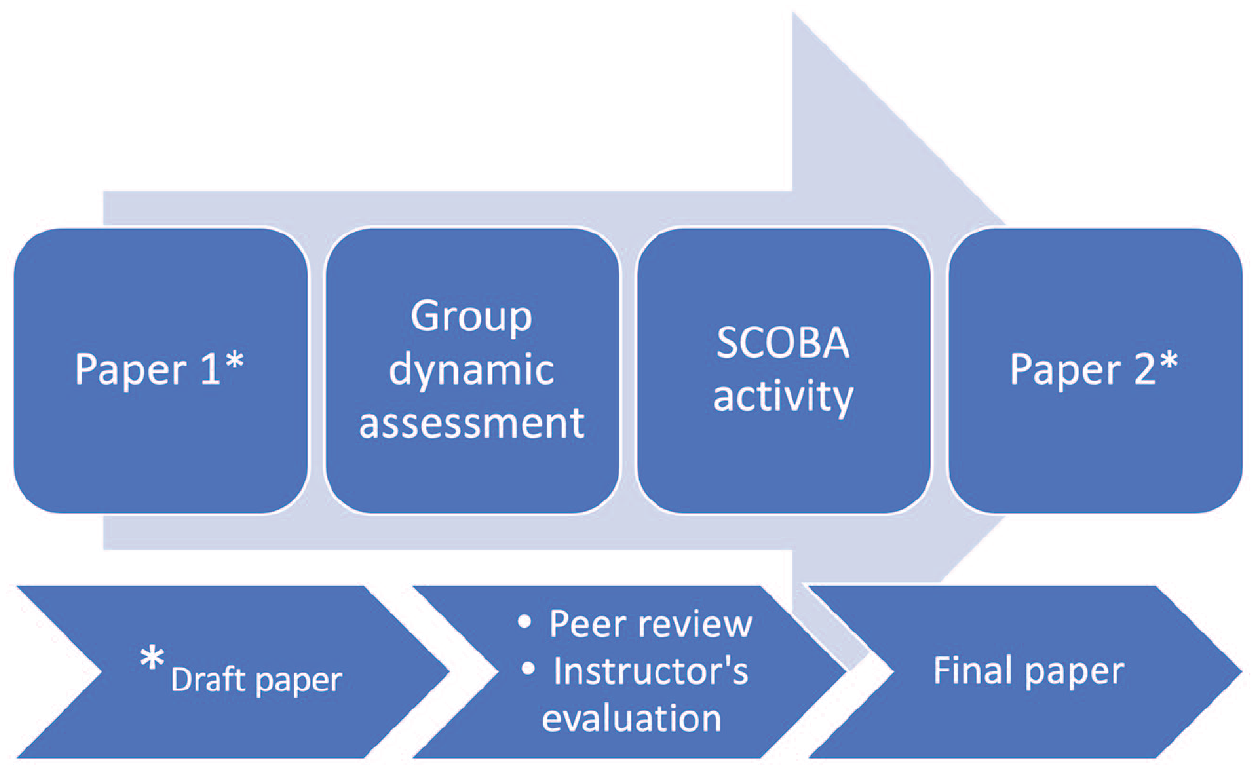
Course Zone of Proximal Development (ZPD) activities on the timeline.
4 Analysis
We independently classified which of the issues marked by the instructor in the learners’ drafts had to do with coherence, coming to a decision with regard to discordant cases. We then used a frequency analysis and McNemar test to compare the number of learners who had at least one such issue in the first paper to that in their second paper.
The interactional data analysis was analysed turn by turn. We paid attention to how the interaction shaped the turns, including how the learners reacted to their peers’ and the instructor’s assistance (reciprocity) and noting the quality of this assistance. We thus traced how the peers and the instructor created and limited opportunities for the learners to react, noting changes in learners’ responsiveness during and across the interactions. In the peer-review activities, we explored how the peer assistance and the previous ZPD activities in the second peer-review shaped the interaction. In the G-DA, we traced how the instructor, building on insights emerging in the peer-review and the learners’ responsiveness, invited learners into the interaction and mediated the learners. We will show how the insights from the G-DA activity led the instructor to introduce a model to guide learners’ thinking about coherence. We will, thus, explore how the ZPD activities collectively led to the development of learners’ understanding of coherence. We will indicate pauses in seconds with ‘( )’, comments, such as non-verbal actions with ‘(( ))’, and skipped parts of the transcript with ‘. . .’.
IV Results
We present the results in four sections: (1) confirming that there was a significant change in the learners’ writing with regard to coherence, (2) illustration of peer review sessions focusing on S2’s development, and (3 and 4) illustrating the G-DA and SCOBA activities.
1 Changes in learners’ unassisted performance
We studied the change in the learners’ independent performance by noting the change in the number of coherence issues in the initial drafts of each paper (prior to the modifications they made following the peer review and the instructor’s comments). The frequency analysis (Table 1) showed that while 25 learners had at least one coherence issue in the first paper draft, only 14 learners had at least one in the initial draft of the second paper.
Coherence issues in learners’ writing.
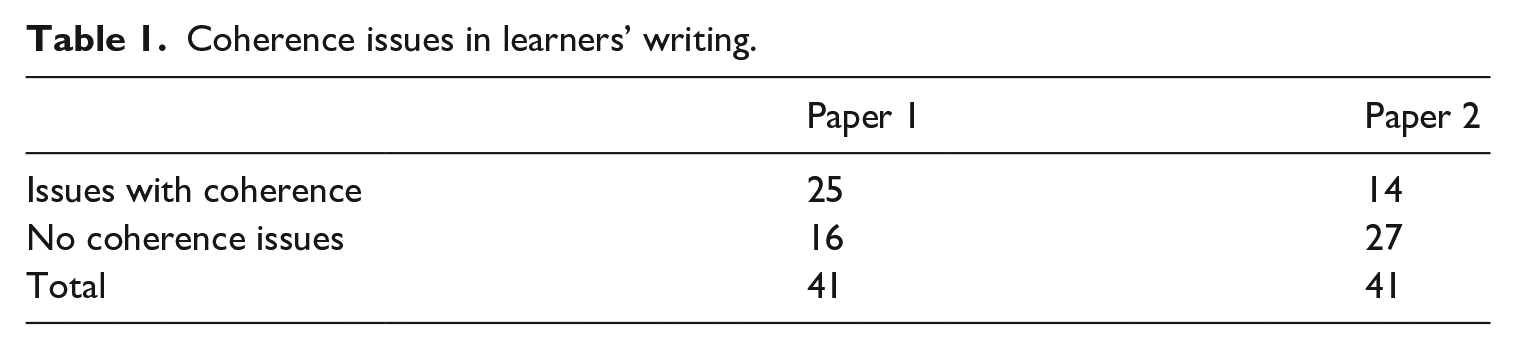
A McNemar test showed that fourteen learners who had at least one coherence issue had none in the second paper, and three learners who had none had at least one coherence issue on the second paper and demonstrated that this difference was statistically significant, p = .013. That is, as a group, the learners developed as far as coherence of their texts is concerned.
In the initial draft of the first paper (prior to the peer review and the revision), of the total of 66 instructor’s comments classified as coherence, 20 (30.3%) focused on asking learners to move information to an earlier part of the text so that the reader could understand the information presented later and 33 (50%) with asking learners elaborate what a paragraph/section is about. There were only five problems with cohesion, i.e. the learners not connecting sentences to preceding and following ones. Eight issues were classified as other.
In the initial draft of the second paper, of the total of 24 instructor’s comments classified as coherence issues, 7 (29%) comments focused on asking the learners to move information to an earlier place in the text, 10 (41.5%), on asking the learners to define what the paragraph/section was about, 2 (8.5%) focused on cohesion, and 5 (21%) were classified as other. The proportion of the types of coherence issues, therefore, stayed roughly the same, but there was a notable development in coherence overall.
We next illustrate how opportunities for learner development emerged during the peer review, how these yielded insights for the instructor, and allowed for guiding learner development.
2 Peer review sessions
We analysed all peer interactions; however, in this section, we focus on those involving S2. We next illustrate how insights into S2’s ZPD emerged in her interaction with S4 in the first peer-review session. Table 2 summarizes S2’s Paper 1 (Rationale Synthesis) and her struggle discussed in the peer-review.
S2’s Rationale Synthesis (Paper 1).
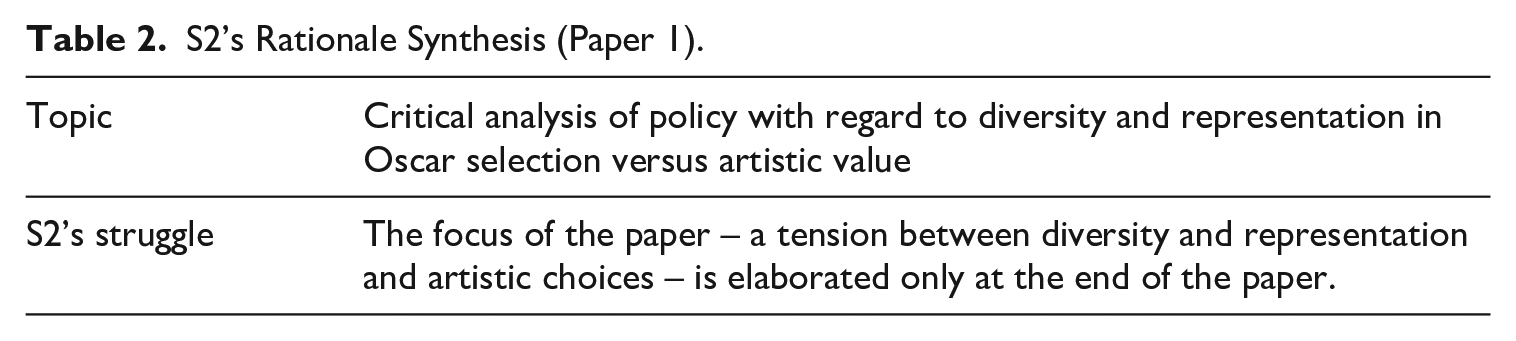
The issue in Rationale Synthesis 2 was raised by S4, as emerges from the following written comment: I could not see the potential conflict with introducing the new standards and how it will affect the values that you presented in this paper. Maybe including a sentence or two explaining how the standards might affect the values would solve this. Edit: There was a sentence in the conclusion.
This comment led to S2’s initiation, ‘did you understand the scheme of my research?’, triggering the exchange (Excerpt 1).
Excerpt 1: Identifying the problem 1. S4: . . . after reading the second time, I could see yeah, the purpose 2. S2: aah 3. S4: of what you were trying to write about. 4. S2: do you think I should have worded a little bit better so that you didn’t have to read it again? 5. S4: uhmm, well, to me, I thought the last line not the last line but the line in your conclusion . . . 6. S4: so maybe maybe 7. S2: mm 8. S4: something similar in the introduction 9. S2: would be better
In Excerpt 1, S2’s turns are minimal (except for Turn 4). Still, the proposed solution to the issue is co-constructed. In response to S2’s suggestion in Turn 4, S4 points out the idea in S2’s text that should be introduced earlier (Turn 8). However, even though S2 completes S4’s statement (Turn 9), which signals her emerging understanding, she still needs guidance to fully understand why (Excerpt 2).
Excerpt 2: Building an understanding of the problem 1. S2: okay, I get it now. Like I got a similar comment about that like introduction, and the conclusion doesn’t really match. So yeah I will I will change I will change the introduction so that it will match the conclusion. 2. S2: ((looks back at the comment that triggered the exchange)) so for your first reading, you couldn’t understand the eh fundamental conflict . . . 3. S2: okay, uhu, I’ll change that so that it will be easier for the reader to understand 4. . . . 5. S2: ((looks at S4’s comment that triggered the exchange, selects the part after the word ‘Edit’ with her mouse, laughs)) so this is from your second reading? 6. . . . 7. S4: yeah, basically, I mean like real comment that I had on your paper 8. S2: uhu 9. S4: was maybe yeah, the introduction 10. S2: uhu 11. S4: can maybe be rephrased to eh introduce the conflict a little bit better but aside from that, I think I got what you are trying to write. 12. S2: uh, okay, got it, so my writing isn’t as bad as I thought
In Turn 1, as reciprocity to S4’s guidance, S2 thinks in terms of matching the introduction with the conclusion, overlooking the reason for matching them. Hence, even though S2 states that she gets it (Turn 1), it seems her understanding is not complete; at least, she does not express it. S4 interprets S2’s question in Turn 4 such that she needs further guidance, eliciting the importance of the original comment he made (Turn 5) and making it an explanation for how S2 should introduce the conflict (Turn 9). We note that most of the instructor’s comments on S2’s first paper, too, referred to missing connections between the presented ideas.
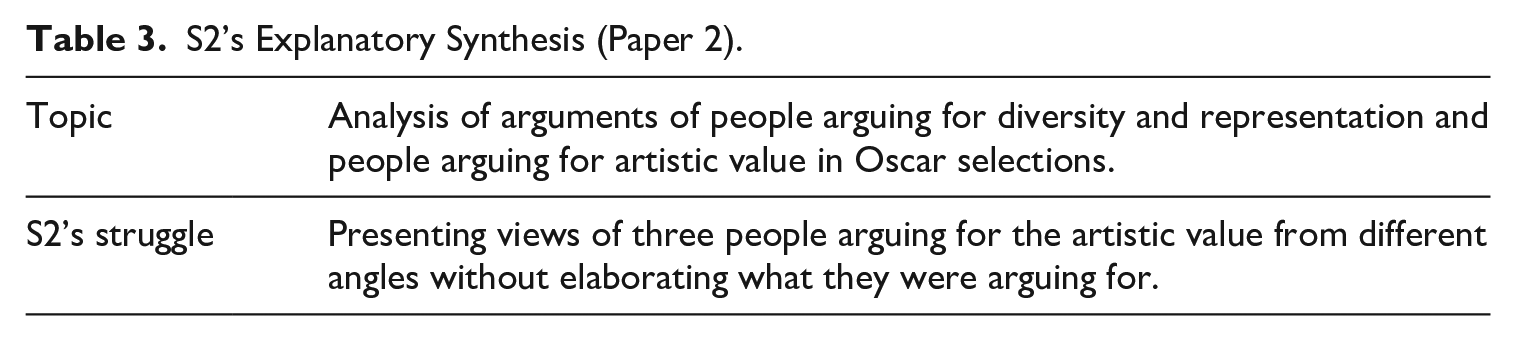
The interaction unfolds markedly differently in the second peer review. In it, S13 draws S2’s attention to the only coherence issue S2 had in Paper 2, as summarized in Table 3. In the interaction, S13 suggested that S2’s sentence ‘White (2020) also stated that the Oscars are defining artistry with diversity and inclusivity’ was not connected well to the rest of the paragraph (Excerpt 3).
S2’s Explanatory Synthesis (Paper 2).
Except 3: Connecting ideas in the second paper 1. S13: why did you put this here? I mean like I maybe my English [it has to do with] my English skills but like I cannot see any connections . . . 2. S2: oh, okay. Umm I think . . . I put White here because he was mainly opposed he opposed to the policy change 3. S13: mm 4. S2: but I it seems like I didn’t elaborate on that well, so um I will um how should I how should I explain it? Should I exp- should I just say in the first part of the sentence that White also argues that or White also opposes to the policy because of . . . 5. S13: un un ((nods)) White’s opinion related to also Viggo’s? . . . 6. S2: they are connected in the sense that they all agree they all disagree with the policy, but I I put this here because I um it’s another it’s another perspective, or it’s another view of why people wouldn’t like this policy in the first place, and I think art is I think he comes from the opinion that art is art is art doesn’t have to diverse and inclusive. 7. S13: umm 8. S2: so maybe that’s why maybe that’s why he’s opposed to that, but eh ((nods)) 9. S13: ah 10. S2: yeah. So: I’m guessing I should put that description there . . . 11. S13: ((nods)) 12. S2: okay, got it
S2’s questions to S13 (Turn 4) appear to be mediating S2’s thinking. This becomes apparent in Turn 6 (‘but I I put this here’), when S2 switches from answering S13’s question to engaging in a long string of self-communication, marked by hesitation and repetition. S13 turns are relatively brief, and together with S2’s development so far, they allow for different S2’s reciprocity and different ZPD to emerge. Through thinking aloud, S2 develops her understanding further, but she is not fully self-regulated, needing S13’s guidance (e.g. confirmation check in Turn 5) and her own thinking aloud to construct how she should change her text. As we will show later, this exchange is also mediated by the G-DA and the SCOBA activity.
We note that only one instructor’s comment on S2’s draft focused on coherence and referred to the same paragraph as S13 and S2 discussed: ‘Bill says that “people want to be hired because they are good, not because they fit a check box”.’ Therefore, the instructor, too, found it unclear why S2 referred to White, Viggo, and Maher in the same paragraph.
The interview illustrates the difference between the two peer interactions further. S2 revealed, ‘I used to say, “I got it” even though I didn’t . . . I didn’t want to dig further into what I was missing.’ She added, ‘I kind of reminded myself that when you don’t understand it, just ask . . . until I understand it, so I think that that was the big change that I had in the two reviews.’ It appears, then, that while S2 ended the two interactional episodes in the same way, her ‘okay got it’ had a different meaning.
3 Group dynamic assessment activity
The purpose of the G-DA activity was to assess where the learners were in their understanding of coherence and guide learner development. The instructor’s focus on coherence in these ZPD activities was guided by his evaluation of the learners’ drafts of the first paper and his analysis of the peer review sessions, which revealed that coherence was a challenge to many learners in the group (see Table 1). To begin with, the instructor introduced a mediational means – the colour-coding of their drafts, each colour specifying a kind of information. We enter the exchange when the instructor (T) poses a question to S35 (Excerpt 4).
Excerpt 4: Initiating and conducting cumulative G-DA 1. T: What was the biggest difficulty in writing a methodology section draft? 2. S35: For me, ahm, I just I troubled with how I lead my methodology section, like, how I structure the methodology section so. I think there was question before of what and why and how, but I just ignore the order, just organizing how it would be easier to discuss 3. T: yes, I think that you’ll see that when you colour, too, because you’ll see green and blue and pink and red all over the place 4. S35: mm 5. T: so the colouring might help you to organize it. 6. S2: oh wait, that reminds me I do have ((laughs)) it’s not a question for S35, so if the colours are all over the place when we revise it, do we have to should we have the same colours in the same eh preferably the same colours in the same paragraph 7. T: well, . . . S18 what do you think? 8. S18: (8.0) the same colour in the revised version (3.0)? 9. T: S2, can you repeat your question. 10. S2: So when we colour the methodology section right now, and we realize that the colours are scattered and all over the place when we revise it, is it best to have the same colours in in the same paragraph, or have them organized by colours? 11. S18: I think you should m:: organize by colour would be easier to see but (3.0) I’m not sure if it’s. I think that organizing by colour would be easier for us to see, but I don’t know it depends on the person? 12. T: Well, it’s a good question because I mean what you might find is that you do have generally the same colour in one area, but you might have other colours mixed in to kind of bring in information that you need to explain.
In Turn 1, the instructor’s focus is on probing (see Rahimi et al., 2015). S35 reveals that the instructions for the colour-coding activity made her realize that she ignores the order of information, presenting it in a way convenient to her. This gives the instructor the basis for the mediation, which starts implicitly in Turn 3, focusing the learners’ attention even more on the parameters of the task, and eliciting that the colouring should help in revision (Turn 5). However, the instructor does not elaborate how, allowing this to emerge in the interaction. The instructor’s intentionality is to orient learners’ thinking about how they organize information in terms of its function, creating an opportunity for them to reflect on their writing within these parameters. S2 does precisely this in Turn 6, proposing, albeit as a question, how she can revise her text.
Instead of directly addressing S2’s query, the instructor invites a different learner, S18, to the discussion, the intentionality being to build the learners’ group ZPD. The instructor gives S18 time (Turn 8), which serves as implicit mediation. Seeing S18’s hesitation, the instructor asks S2 to repeat her question, eliciting a reformulation from her. This helps S18 verbalize her understanding of the organization of the section with reference to S2’s query (Turn 11). Importantly, both learners mediate one another’s understanding. S2 proposes two options for S18. S18, in turn, strengthens S2’s understanding of how the text can be revised.
The instructor builds on this, stating that the learners might generally find one colour per paragraph/section – the central idea of the paragraph – but they may also find other colours/information supporting the main information. As mediation, this is now more explicit – the instructor is modelling what an effective paragraph could look like. However, the instructor does not state this directly, suggesting that this is what the learners ‘might find’.
Soon after, the instructor sends the learners to breakout rooms, asking them to select one text in each small group and colour-code it, reflecting on the process. The intention is to see how the interaction so far has mediated the learners’ thinking. Having witnessed the learners struggling with the assignment, the instructor soon summons them back to the main Zoom room (Excerpt 5).
Excerpt 5. Learners having a hard time 13. T: for some reason, you’re having a hard time! Yes no? 14. S2: yes. 15. T: Why is that? Actually, S2, ask S35 a question. 16. S2: ((laughs)) oh my god. How did it go with the colouring? 17. T: Excellent question. 18. S35: I thought it was fine, but I had a suggestion that we need to colour more precisely 19. S2: ((nods)) 20. T: ((nods several times in approval, smiling))
The instructor expresses that he recognized that the learners were struggling, which S2 acknowledges. The instructor, next, shifts the focus to the interaction between learners, requesting S2 to ask S35 (a learner from a different breakout room) a question (Turn 15). The selection is not coincidental – the instructor noticed that S35 suggested a more detailed colour-coding in her breakout room. While S2’s question is very general, it creates the opportunity for S35 to verbalize this experience, which S35 does (Turn 18).
Answering S2, S35 also equips other learners with a mediational means that allows establishing whether the colours (i.e. kinds of information) are indeed scattered in the text (rather than supporting the paragraph’s central idea). S2’s nodding indicates that she recognizes S35’s suggestion, which the instructor supports (Turn 20).
In the interaction that followed, S3 stated, ‘through colour coding, I can spot my, like, places where I have to improve on but I think . . . the colour coding for me is not was not hard, but the revision is going to be hard.’ This appears true for the whole group. As emerged from the modified colour-coded texts, the learners, generally, were able to identify the kinds of information in texts. However, almost all of them were not able to develop their methodology sections, as illustrated by S2’s modified methodology section (Figure 2).
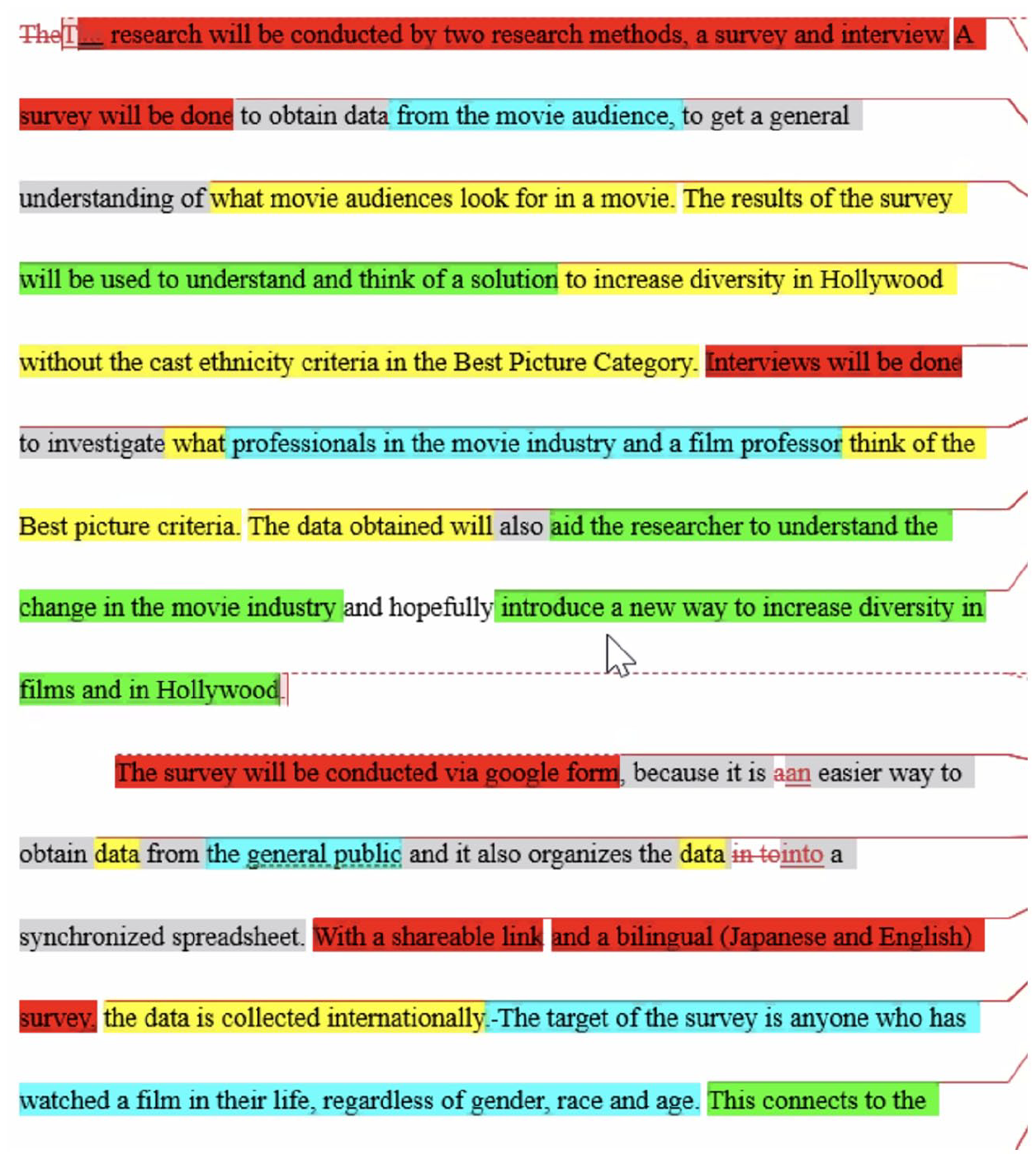
S2’s colour-coded and revised methodology.
In the first paragraph, there is still jumpiness indicated by the yellow text (the information S2 is looking for) interrupted by red (data collection instruments), light-blue (target audience), and grey (why the data are collected in a particular way), which does not support the central idea of the paragraph. The order in which the information appears seems random, too, with the previous information not supporting what follows.
This outcome led the instructor to opt for more explicit guidance.
4 A model to guide learner writing
The ZPD activity we illustrate is informed by C-BLI (Figure 3). The instructor, prompted by S13’s question (Excerpt 6, Turn 1), introduces a model and guides the learners as to how they can use it. The instructor uses the technology to manipulate the model, creating the SCOBA dynamically.
Excerpt 6: What is a clear order? 1. S13: what is a clear order for the reader to follow? 2. T: okay . . . We have gone over this a little bit before . . . ((shares a screen)) . . . you can do this in PowerPoint you can use it using post-it notes ((draws rectangles; Figure 3a)). But a clear order is in terms of how you think or what you think the reader is actually needing at this point to be able to understand what you are trying to say . . . you can put keywords here . . . here is a point I want to introduce first. What is the fashion industry? ((draws an arrow pointing to the first rectangle)). And here are some things that I want to say in terms of why it’s good ((draws an arrow pointing to the second rectangle)) . . . now I want to look . . . at the bad points ((writes an arrow pointing at the third rectangle)) . . . is this a clear order? . . . ((swaps the order of the second and the third rectangle; Figure3b)) let’s switch these around . . . Doesn’t sound like this is the correct order . . . ((puts the order of the rectangles into the initial position)) . . . If I start to now mess these up ((drags the second rectangle on top of the third rectangle (Figure 3c))) . . . fashion industry is bad, and the environment is bad, and everything is good. Well, this is good, but this is bad. Well, this is good. Oh, but this is bad, or well, this is bad . . . It’s kind of like, say, really mixed up. So what does the reader need? The reader wants to know this, and then once the reader knows this, then I can tell the reader this.
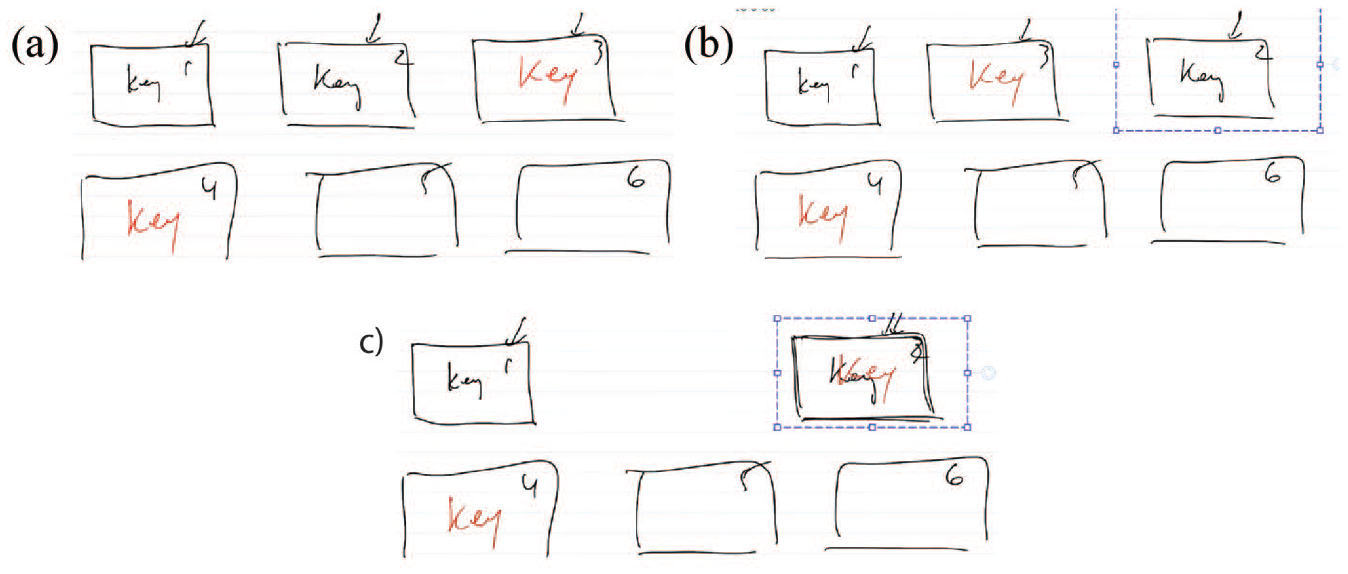
Clear order.
S13’s query confirms that while the learners’ understanding of organizing sections of their texts was within their group ZPD, some learners struggled to fully understand what a clear order means. In response to S13’s question, the instructor builds a model to mediate the learners’ thinking.
The instructor presents central ideas in paragraphs as ‘key points’ and simultaneously graphically as rectangles. The opposing ideas are then presented with a different colour (red; light-grey in greyscale). The instructor then (1) elicits the reader’s perspective, building on S2 revealing in G-DA that she focused on her convenience when ordering the information rather than thinking about the reader, (2) supplements the discussion with examples deriving from S13’s draft (connecting the abstract understanding represented by the model with the learners’ writing experiences), and (3) manipulates the order of the ideas in several ways.
The instructor recognizes that learners have some understanding of how rearranging parts of the text can make it more coherent for the reader (which was one purpose of the colour-coding activity).
Based on this, the instructor introduces the SCOBA to (a) help learners summarize the central idea of their text and (2) help them rearrange the order of the information. The instructor dynamically shifts the focus from the abstract to the specific level, using S13’s text as an example. The latter part of the SCOBA (Figure 3c) builds on what has emerged during and after the G-DA – the learners oscillating between the different kinds of information rather than thinking in terms of how other kinds of information in a paragraph support its central idea, presented as the main colour in the G-DA activity and as ‘key’ in the SCOBA.
An opportunity for the instructor to use G-DA activity and the SCOBA to mediate the learners’ thinking process together emerges when a different learner, S19, immediately after the instructor presents the SCOBA, asks if she can supplement others’ perspectives/arguments with further information. The instructor further mediates learners’ understanding of the difference between mixing several key arguments (Figure 3c) and supplementing the arguments, suggesting what this further information can be. To make the text more coherent, the instructor proposes that learners should verbalize for the reader the central idea of the paragraph, ‘here, I’m talking about this, and the reader says, “Oh, this is this perspective, or this is this perspective,” so, in my writing, I’m kind of defining these perspectives.’
The learners are next asked to go to breakout rooms and report to their peers what the definitions and main arguments are in their texts. The activity immediately follows the introduction of the SCOBA, so, in the instructor’s evaluation, the learners are likely to use the SCOBA as a mediational means in the activity.
V Discussion and conclusion
Drawing on Lantolf and Poehner’s (2014) argument for pedagogical imperative and Vygotskian notion of teacher as creator, we explored how various ZPD activities can be merged in the L2 classroom with the goal of creation of opportunities for learner development. We explored how the instructor orchestrated classroom ZPD activities such that they built on the emerging insights into students’ ZPDs with regard to coherence in L2 English academic writing, studying how the ZPD activities guided the learner development together. We illustrated this by focusing mainly on the development of one learner, S2, though we also checked that learners as a group developed in their unassisted performance with regard to coherence.
While learners’ struggles with coherence were evident in their unassisted performance (Table 1), the created opportunity for their mediated development to emerge in peer interaction allowed for qualitatively different insights. In our example, S2 depended on S4 in recognizing how to write coherently. S4 had to, eventually, be very explicit, but even that seemed insufficient for S2’s full understanding to emerge, as appears in S2’s end-of-course interview. It also appeared that S4 was subconsciously sensitive to S2’s ZPD, helping it emerge (see Davin & Donato, 2013). While we urge not to conflate learners’ helping behaviours with those of expert mediators (see Vygotsky, 1978), we agree with Davin and Donato (2013) that sometimes, development does happen in peer interaction (see also De Guerrero & Villamil, 2000). True, this development is not systematic (see Poehner & Leontjev, forthcoming). However, in many peer interactions in this study, such opportunities were created. Peer interactions also yielded insights into learners’ mediated performance, helping the instructor recognize that coherence was within the learners’ group ZPD and thus a suitable target for subsequent ZPD activities (see Poehner & Leontjev, forthcoming). The online modality of the course, too, mediated the ZPD activities, including the peer-review sessions being recorded, which provided the instructor with a deeper understanding of learner struggles.
In this study, the learners’ struggle had to do with learners presenting their ideas in a random order, not logically connecting them. S2’s emerging understanding of this is evident at the outset of the concurrent G-DA activity, which served as a starting point for the mediation. The graduated nature of this mediation allowed for a qualitatively different way of learners’ thinking about how they can make their texts coherent – not just having one kind of information in a paragraph but including other information to support the paragraphs’ central idea.
While the order in which the information was to be presented was also elicited in the colour-coding activity, this did not become the focus of the G-DA; yet, it remained an issue in learners’ writing. Hence, when the context allowed (S13’s query), this focus was taken up in the SCOBA activity. Indeed, it would be incorrect to consider the SCOBA activity separate from the colour-coding G-DA activity – they both created a full conceptual understanding of how ideas should be logically presented to the reader. The model in Figure 3 served as a means for the learners to structure their writing by paragraph, also eliciting the importance of informing the reader what the key point is. It, thus, created an opportunity for the learners to materialize the concept of coherence. The colour-coding G-DA activity, in turn, mediated the learners’ understanding of how the key point in the paragraph can be supported by other information. Hence, the two mediational means presented at separate times (differently from Levi, 2017) mediated the learners’ understanding of coherence together. We note that seen separately from the rest of the ZPD activities in the course, the model presented by the instructor was incomplete (incomplete schema of orienting basis for action or ISOBA; see Negueruela, 2003). Furthermore, the instructor opting for the incompleteness of the model stemmed from rearranging parts of the model having different meanings for different learners.
While the SCOBA activity was unplanned in the sense that it was not a part of the initial lesson plan, neither was it a ‘spontaneous response to an environment’ (Derry, 2007, p. 61), that is, simply a reaction to S13’s ‘what’s a clear order’ query, but built on systematic insights from the previous ZPD activities in the course. That is, the instructor had a grasp of the learners’ group ZPD with regard to coherence. Hence, unlike some previous research (e.g. Fernández & Donato, 2020) where the SCOBA is built into the course based on a priori understanding, it emerged based on the instructor’s insights. The instructor also created an opportunity for materializing the content of the SCOBA by suggesting how the learners adapt it for their own use – using PowerPoint or post-it notes to manipulate its elements to help them structure their writing.
All three activities ‘created’ the learners’ development as far as coherence in academic writing is concerned. The planned peer review, where more agency was with the learners, created a window into learners’ areas of struggle and ZPDs. In the planned G-DA activity, the agency was dynamically shifted between the teacher and different learners. In the ‘key point’ activity, the agency was with the instructor. The goal of all three, however, was to push learner development, informed by Vygotsky’s metaphor of teacher as creator.
To be sure, and as illustrated by focusing on S2 and one feature of academic writing – coherence – the learners’ development happened throughout the course. For S2, this was a movement from thinking that coherence was matching introduction to conclusion, to recognizing her issue being her presenting ideas scattered all over the place, to presenting it in a logical order and informing the reader what she is to write about in the paragraph. The instructor could see the change in S2’s mediated performance and that both S2 and S13 collectively built on the classroom activities. This manifested, for example, in S13 using the words ‘why is it here’, implying that S2 did not define the key point of the paragraph for the reader, creating an opportunity for S2 to formulate this key point. S2 and S13, therefore, demonstrated development through transcendence, applying the understanding of coherence gradually built in the ZPD activities in the course to a novel text. As a part of the internalization of the concept of coherence, the second peer review can be seen as the overt speech. However, some of S2’s turns can also be seen as covert speech, as she, in fact, answered her own questions, directing her own actions (Excerpt 3).
While teachers can find conducting such detailed analysis as we undertook unfeasible, this study can be helpful to teachers, informing their understanding of how SCT principles can be applied to orchestrate classroom activities (see also Davin & Donato, 2013; Leontjev & Polari, 2022). For example, observing peers’ comments and how the learners respond can provide insights into learners’ ZPDs, affording instructors to adjust subsequent classroom activities.
We note that not all peer interactions were equal in creating opportunities for development, with some peers focusing on explicit correction (see Davin & Donato, 2013). However, peer interactions together served as a basis for assessing and promoting learners’ group ZPD. Hence, peer interactions were beneficial because: (1) opportunities for development were sometimes created, and (2) peer interactions produced insights into learners’ performance which the instructor could act upon. Admittedly, not all learners agreed with their peers’ feedback, but the instructor made sure that they still engaged with it, asking learners to summarize how, if at all, they addressed it (not discussed in this paper). Thus, even lack of engagement served as information for the instructor, allowing him to mediate the learners’ thinking further. In addition, the instructor’s feedback was available to the learners. We recognize the benefits of forming pairs based on learners’ ZPDs (Poehner & Leontjev, forthcoming). However, we argue that in the present study, the learners could choose a peer they felt comfortable discussing their writing with and focus on what they considered important. Furthermore, different configurations in terms of learners’ ZPDs in different pairs allowed for richer information to build upon, as different ZPDs emerged as a result. Indeed, not all learners were able to arrange the peer-review sessions before the instructor sent his comments. However, this, too, gave the instructor information as to how the learners interpreted and built upon the instructor’s comments. We argue that the orientation to peer interactions as ZPD activities, where learners’ ZPDs and opportunities for development emerge, is more important than the exact configuration of these activities. Still, we suggest further research could consider how different ways to configure learner groups and pairs inform further classroom ZPD activities.
We should also mention that this study mainly focuses on the development of one learner and one aspect of learners’ academic writing – coherence. Hence, the findings are not generalizable to other learners and contexts, except for generalizability to theory, which posits that learners’ developmental trajectories are unique.
Each of the ZPD activities we analysed is valuable on its own. We could have concentrated only on peer interaction (see Leontjev & Polari, 2022) or only on the G-DA (see Poehner, 2009). Instead, we opted to look beyond these individual ZPD activities, adding to the SCT-L2 research on teachers as creators of learner development (Poehner & Leontjev, forthcoming). The three activities taken together allowed us to trace the change in learner development through the course systematically. The separate ZPD activities served as pieces of the puzzle for the learner developmental process. The teacher-as-creator metaphor provided us with the means of orchestrating classroom activities to become parts of this process. We argue, thus, that both the pieces and the whole picture are needed to create learners’ development.
Footnotes
Data availability
As the data are to be used elsewhere, we, at this point, choose not to publish the data set related to this study.
Ethics and integrity policy statement
We hereby confirm that we have upheld the rigorous ethical research standards, having receive the ethics approval at the second authors’ university, where the data were collected. We have also informed our participants:
• that their participation was voluntary;
• of the research purpose, the kinds of data collected and their use following the data anonymization (including for scientific publications and presentations and in further teaching development);
• the procedure of the research proper;
• of the direct benefits as well as potential risks;
• and there is no penalty in refusing to participate in the study as well as of the participants’ rights to withdraw from the study at any point.
Informed consent
We have received a written informed consent from each of the participants in the study.
Funding
The author(s) received no financial support for the research, authorship, and/or publication of this article.
