



Abstract
The past decades have witnessed an increasing number of studies documenting native English teachers’ (NETs’) challenges in professional development and collaboration with nonnative English teachers’ (NNETs’) across multiple educational contexts. There are also debates in TESOL regarding the essentialized dichotomy of NETs and NNETs with insufficient recognition of the educational and cultural experiences of teachers of English as a foreign language (EFL) / English as a second language (ESL). Little research has been conducted on the lived experiences of transnational multilingual NETs who work in heritage contexts; and how they position themselves when they conduct their teacher identity work and negotiate between heritage identity and NET identity. This study, drawing on the notion of ethical self-formation and its application in teacher identity research as a theoretical lens, addresses the gap by investigating the identity construction of two transnational NETs of Chinese ethnicity returning to their home context in Hong Kong to teach. The findings indicate that (1) the participants negotiated their multilingual identity and the monolingual NET identity ascribed in the workplace, (2) they developed counter-strategies to turn the knowledge of the local language and culture into resources in teaching, and (3) they agentively expanded the definition of NET and situated them in the full institutional and social context to consider their identity conflict and self-empowerment. The findings have implications for education policy to accommodate and value the plural-competences of NETs and NNETs.
Keywords
I Introduction
The native-nonnative dichotomy has been widely adopted as a dominant paradigm in research on language teacher identity formation, despite its essentialized nature (Aneja, 2016). The division of nativeness and nonnativeness has practical influences on issues such as teachers’ identity construction, benchmarking on the language teacher proficiency assessment, recruitment policy, and hiring decisions (e.g. Benson, 2012). Research has recently valued the multilingual backgrounds of nonnative English teachers (NNETs), who belong to the ethnolinguistic others involved in TESOL, regarding multicultural awareness and translanguaging use to enhance teaching effectiveness (e.g. Kubota, 2016). More recent research efforts have been made by researchers adopting a poststructuralist perspective on (non)native speakered teachers, moving beyond evaluating the criteria that define the native- and nonnativeness and/or highlight their advantages/disadvantages in teaching to focusing on the teachers’ lived experiences and exploring the dynamic and fluid construction of nativeness and nonnativeness as subjectivities (Aneja, 2016).
In this study, we adopt the notion of ethical self-formation (Foucault, 1997) and its application in teacher identity research (Clarke, 2008, 2009, 2010) as a theoretical lens to understand the critical teacher identity work concerning the native- and nonnative dichotomy. This study provides a narrative account of how two non-Caucasian-looking native English teachers (NETs) constructed their professional identity and regulated their linguistic and pedagogical practices in relation to their ethnicity and definition of native English teachers in Hong Kong schools. Specifically, the following research questions were addressed:
Research question 1: How is ethnicity related to the professional identity construction of the non-Caucasian NETs?
Research question 2: How do the non-Caucasian NETs construct their professional identity as a process of ethical self-formation?
The significance of this study is trifold. First, the findings will contribute to the literature on teacher identity research by exploring the identity formation of non-Caucasian multilingual NETs (both of whom are overseas returnees with the same ethnic background 1 ) whose use of mother language will counter the ascribed NET position. This will inform the scholarly discussion on the interplay between linguistic hegemony, ethnicity, and teacher professional development. Second, the findings will contribute to the scholarship on the use of Foucault’s notion of ethical self in exploring how the teachers reach a balance between ethical formation of teacher identity, self-creation/examination, and multiple forces of power. The consideration of subjectivity, normalization, and forces of power 2 would be especially meaningful for investigating the self-struggle and self-negotiation of ‘non-typical’ NETs with a non-Caucasian background. Third, the findings will inform education policymakers and school administrators on how to provide a conducive environment for multilingual NETs to deploy their repertoire during teaching and professional development.
1 NETs within the native/non-native dichotomy
An important line of inquiry in TESOL lies in the discussions on NETs and the related ideological and practical concerns. A growing number of studies on NETs has investigated (1) the challenges and contradictions encountered by NETs in the host educational context (e.g. Codó & Patiño-Santos, 2018), (2) the collaboration and power relations among NETs and NNETs which subsequently influence their positioning and participation in the community of practice (Hwang & Yim, 2019; Yim & Ahn, 2018; Yim, & Hwang, 2019), and how native-speakerism is constructed through the discursive practices of individuals and institutions (e.g. language policy) (Haim, Orland-Barak, & Goldberg, 2020; Vallente, 2020; Yang & Jang, 2022).
Research on the collaboration and interaction between NETs and NNETs revealed issues such as power conflicts, a lack of communication, and complex professional relationships between the two groups. Yim and Ahn (2018) examined the participation process of a novice NET teaching at a Korean primary school, focusing on how he negotiated his role in the community of practice. It was found that the participant was grounded in a marginalized social position. His linguistic power (being a native speaker of English) proved to be a double-edged sword. While he derived his sense of professionalism from nativeness, he was excluded from the local teaching community and thus limited in his career advancement. Similar findings were drawn from Hwang and Yim’s (2019) study. Exploring teacher identity of NETs and NNETs who engaged in co-teaching practices in primary education, they found that the hegemonic positions of NETs and NNETs fluctuate: while native-speakerism gave the NETs ‘linguistic capital’ – a form of symbolic capital – that legitimized their authority in English teaching, their limited knowledge and experience of local educational culture could put them in a disadvantaged position in classroom management, being regarded as ‘specific linguistic tools’ (Hwang & Yin, 2019, p. 15). Yim and Hwang (2019) identified two major factors affecting NETs’ participation in the teaching community: (1) their limited interaction with the NNETs, whose anxiety and reluctance in English communication exacerbated the already segregated school cultures, and (2) the NETs’ complex professional relationships with the NNETs, and their identity as contract teachers not given full responsibility in the classroom, let alone the co-teaching practices.
Research efforts have been made to investigate the native-speakerism ideology and its influence on NETs and NNETs identity construction. For example, Haim et al. (2020) explored teacher identity construction among a group of novice teachers of English as a foreign language (EFL) in Israel, including both NETs and NNETs, and found that some of the NETs are confident about their identity as standard linguistic models with cultural knowledge but insecure about grammar teaching, while some of the NNETs felt confident about their sensitivity to student needs but insecure about their English proficiency. They called for moving beyond the native/nonnative dichotomy and recognized differences instead of emphasizing superiority associated with the native norm. As a response to the NET/NNET dichotomy, Lee and Canagarajah (2019) proposed promoting translingual dispositions in language teacher identity construction in order to counter monolingual ideologies embedded in the dichotomy.
The shaping effect of language policy and education policy on native-speakerism ideology and the professional development of the NETs across different contexts has gained research attention. As Canagarajah (1999) argued, there were hidden economic, ideological, and political motivations behind the ‘native speaker fallacy’ (Phillipson, 1992). Haim et al. (2020) found that the English-only policy reinforced native-speakerism in the Korean EFL context, as the NETs outranked the NNETs despite the latter’s qualifications. They argued that the English-only language policy and its underlying social ideologies contributed to the struggles faced by NNETs as they attempted to construct their identity against dominant discourses. Jeon (2020) examined the government-funded English language teaching programs in three Asian contexts, namely Hong Kong’s Native-speaking English Teachers scheme (NET), the Japan Exchange and Teaching Program (JET), and the English Program (EPIK), and Teach and Learn in Korea (TaLK) in Korea. Compared to JET, EPIK and TaLK, the NET scheme in Hong Kong seeks to recruit more experienced native English-speaking teachers, emphasizes the importance of retention, and offers more competitive salaries and benefits. However, the NETs in Hong Kong also reported more difficulties working with local teachers and feeling less valued by local teachers.
The above review shows that the native-speakerism might dually marginalize both NETs and NNETs by excluding the former from the local professional community and devaluing the local experiences of the latter. Considering that NETs do not necessarily represent cultural hegemony, a more nuanced approach is needed to investigate the experiences of these transnational educators (e.g. Bonner II et al., 2015; Curtis & Romney, 2019; Lee & Jang, 2022). More research is needed to investigate the interplay between native-speakerism ideology and the localized variants of English, and to explore the ways of promoting legitimate participation of NETs in the local professional community. The research fills the gap by investigating the negotiation between teacher identity, ethnicity, language, culture and discourse on NET and NNET, experienced by two transnational NETs who are overseas returnees teaching in the heritage society.
2 The discursive construction of (non)speakering and (non)speakered
A recent theorization of (non)speakering and (non)speakered highlighted the historically and discursively constructed process which involved the constant interaction between individuals and institutions (Aneja, 2016). A historical analysis shows that native/nonnative-speakerist ideology arose from colonial governmentality (Flores, 2013), through which the imperialist European nations were constructed as having a higher ‘ethical, intellectual, and linguistic standard than their colonial subjects’ (Aneja, 2016, p. 576). In the job market, the native/nonnative-speakerist ideology was not merely reflected through the constructed linguistic legitimacy, but also the ethnic identity. For example, Bonfiglio (2013) mentioned a job advertisement in Singapore which highlighted ‘Caucasian’ in ‘native speaking Caucasian English teachers’ (p. 30). This advertisement produced a racialized discourse that sets up a division between Caucasian native-speakered versus non-Caucasian nonnative-speakered subjects. This is a process of legitimizing and marginalizing.
The above discussion emphasizes the necessity of moving beyond the binary between nativeness or nonnativeness, and considering the process of self-experimentation and critical thinking (Infinito, 2003a) in their construction of identities as English language teachers with multilingual and multicultural backgrounds. This process is based on the theory of ethical self-formation (Foucault, 1997) and its application in teacher identity research (Clarke, 2008, 2009, 2010). This theoretical approach would enable us to explore their exploration of spaces for new identity possibilities and delve into the discursive construction of (non)native speakered identity in a broader sense.
3 Theoretical framework: Teacher identity work as ethical self-formation
Foucault’s concept of ethical self is not concerned about the ethics in teaching practices (e.g. Wong & Canagarajah, 2009), nor the scholars’ ethical practice in their research (e.g. De Costa, 2016), but ‘a sort of work, an activity’ (p. 243) that requires self-governing or ‘technologies of the self’ (Foucault, 1988, p. 18) to achieve self-empowerment. Ethical self-formation is related to subjectivation, i.e. the conduct of conduct or self-governing, one’s engagement in moral conduct through establishing an interaction pattern with a rule and practicing it (Foucault, 1983). However, individuals can opt to conduct or show resistance to governance in the process of managing and producing freedom. Such resistance is defined as ‘counter-conduct’ that opposes the use of power to facilitate the implementation of rules and enforce compliance. Researchers call for a transcendence of the dichotomy between power and resistance, and assert that they are co-constitutive (Lindegaard, 2016).
Although Foucault’s notion of ethical self does not primarily focus on the moral code for what is (un)desirable, language teachers’ ethical self-formation is inevitably related to the social values and identity options that are constituted in discursive practices (Miller, Morgan & Medina, 2017). Ethical self-formation is a process with co-constitutive effects between individual operations and socio-cultural and socio-political factors. While teacher identity needs to be developed within ‘technologies of power’ (Foucault, 1988), teachers’ engagement with continued reflection (Infinito, 2003b) could help them establish awareness of dominating ideologies of teaching (Foucault, 1983) and then be agentive in transforming these ideologies in practice (Clarke & Phelan, 2015). We can safely say that teachers’ engagement in ethical self-work helps them enhance their reflexivity in the professional development process, and relate teaching practices to ideology and life experiences, which will potentially benefit teaching and learning in classroom contexts. Nonetheless, the practicing (rather than mastering) nature of ethical identity work is realized through teachers’ critical engagement with the ethical self-formation work, which would enable us to (1) move beyond a rigid and homogenous view of good teachers, (2) realize that teachers could practice their agentive power to explore new identity options from what is given (Clarke & Phelan, 2015), and (3) ‘engage in productive, practiced, ethical identity work rather than seeking the comfort that comes from a stable and/or familiar identity’ (Miller et al., 2017, p. 93).
Clarke’s (2009) ‘diagram for doing identity works’, informed by the four axes of Foucault’s (1983) approach to ethical self-formation, was adopted in this study to explore the professional identity construction of two multilingual NETs of Chinese ethnicity who worked in Hong Kong. The first axis is the ethical substance, ‘what part of my self pertains to teaching and what forms of subjectivity constitute – or what forms do I use to constitute – my teaching self’ (Clarke, 2009, p. 190). This component concerns how the teachers’ teaching practices, teacher-student interactions, teacher emotions, and values are relevant to the judgment of value and moral conduct. Teachers’ substance of teacher identity varied, which informed teachers’ practice and reflected the extent to which they are engaged with ‘adaptation and transformation’ (Miller et al., 2017, p. 95). For example, teachers whose substance was transformative practitioner would tend to explore new possibilities to transform in the classroom context with the awareness of the socio-cultural and economic situations in the broader social milieu (Morgan, 2009); teachers whose substance was technician would pay special attention to teaching techniques and the subsequent effect. We need to bear in mind that it is not merely the teachers’ choice to adopt certain identity roles, but the multiple contextual factors could also play concurrent parts.
The second axis concerns the authority sources of teacher identity, i.e. ‘why I should cultivate certain attitudes, beliefs and behaviors and what sources of discursive authority I recognize as a teacher’ (Clarke, 2009, p. 191). Authority sources, as ‘the modes of subjectivation’ (Foucault, 1997, p. 264), normalizes the framework against which teachers’ identity work could be evaluated. The authority sources vary among teachers. For example, while some teachers may value the theory over pedagogy, some may value altruism and others professionalism (Clarke, 2019; Gu & Lai, 2019). Authority sources have both validating and constraining effects on teacher identities (Miller et al., 2017). For example, the native-speakers’ linguistic norms and the related ones as indicated and emphasized in textbooks and the job market may influence the validation of English language teachers’ professional identities. They may feel that they can only gain legitimacy by achieving native English proficiency and their students achieving proficiency against native-speakers’ norms (Miller et al., 2017).
The third axis, self-practices, concerns physical, mental, or spiritual techniques, such as writing linguistic autobiographies and participating in professional learning, which the teachers employ to form the teaching identity (Clarke, 2009). Previous research indicates that these practices could help teachers to broaden their sense of identity and reflect on some imposed or predetermined identity (Pavlenko, 2003). For example, it was found that reflective identity work empowered the NNETs to construct an identity as proficient L2 users rather than one who has to reach the native level (Pavlenko, 2003), which was a process of establishing counter-discourse (Morgan & Ramanathan, 2005).
The fourth axis, telos, refers to the ideal or imagined identity of the teachers. Instead of a personal goal, telos is related to ‘broader sociopolitical values and expectations’ (Miller et al., 2017, p. 100). As Clarke (2010) argued, the telos of a language teacher promotes self-reflection and development through the teacher’s interaction with social norms, values, their own expectations, and experiences, and through reaching a balance between self-formation and forces of power.
This study, adopting a Foucauldian perspective on ethical self-formation (Foucault, 2000, 2008) and Clarke’s (2009) diagram for doing identity work (see Figure 1), explores the formation of ethical teacher self among two non-Caucasian NETs in Hong Kong. This Foucauldian framework on the ethical self concerns the process through which individuals do the identity work through reaching a balance between self-creation/examination and maintenance of an ethical space. The consideration of subjectivity, normalization, and forces of power would be especially meaningful for investigating the Chinese-looking multilingual NETs’ self-struggle and self-negotiation in the native-English-speakered discourse. It is important to note that the four-axes diagram was adopted for analytical convenience and they are closely interrelated. While the data interpretations are informed by the Foucault’s (1988) ethical self-formation and the four-axis diagram (Clarke, 2009), the two NETs’ ethical self-formation has been explored in an empirically based and holistic way in Section IV.
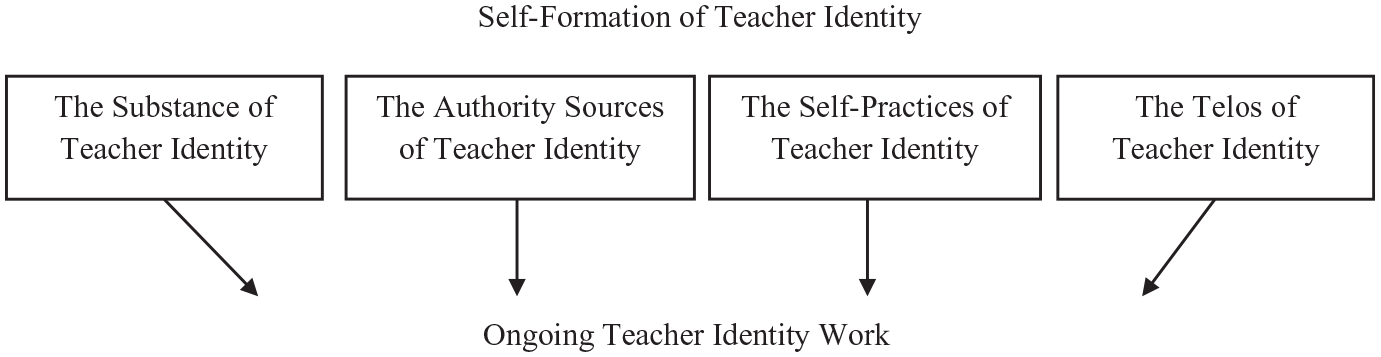
Diagram for doing teacher identity work.
II The study
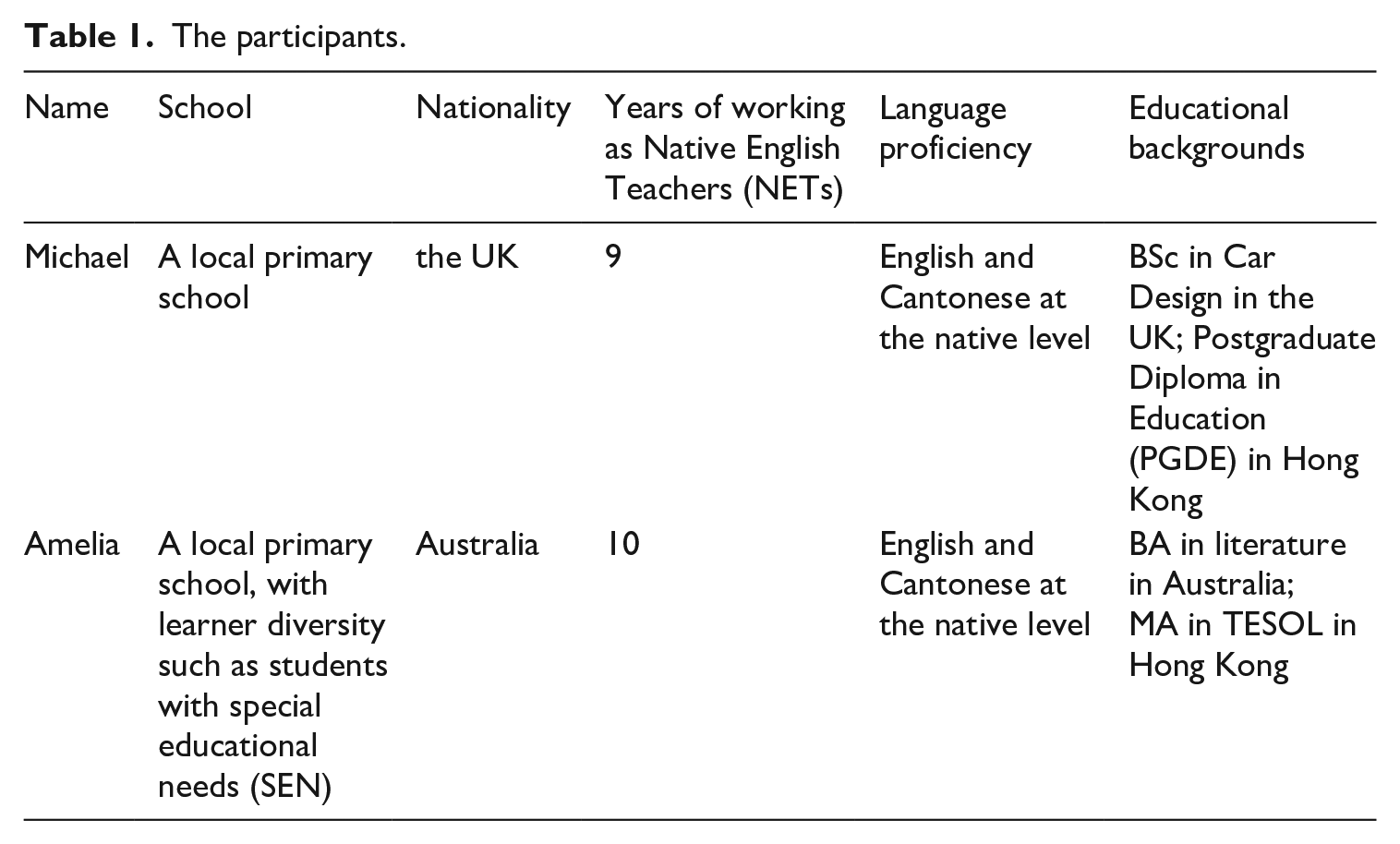
This study is part of a larger research project on the teaching and professional development of NETs in Hong Kong. The two focal participants in this study were selected due to the uniqueness of their background, i.e. English teachers of Chinese descent who were born and raised in English-speaking countries. Both of them (pseudonyms of Michael and Amelia) were recruited under the NET scheme of the Hong Kong government and were working in local mainstream primary schools where Chinese is used as the medium of instruction. Nevertheless, they were from different countries (the UK and Australia) and worked for different primary schools. Michael worked in one government-aided primary school with K1 to K5 students, who came mainly from families of lower socioeconomic status. Amelia worked in a primary school locating in a working-class area and she taught students from K1 to K6. Although the two schools both adopted the Space Town Literacy Programme for English reading and writing, both Michael and Amelia exerted efforts in self-making more tailored-made materials for their students. Such similarities and variations in the participants’ backgrounds enable us to analyse their teacher ethical self-formation process with a comparative and contrastive perspective. Table 1 provides the biographical information of the participants.
The participants.
The larger project collected multiple forms of data including semi-structured individual interviews (with an interval of three months), teaching materials, and communication through social media and emails. This study mainly drew on the interview data to investigate how the non-Caucasian NETs construct their professional identity and regulate their linguistic and pedagogical practices in relation to the negotiation of their ethnicity, the definition of NETs and the local views on NETs. For example, the following questions were asked: ‘could you please describe your working experiences as a NET?’, ‘how many languages do you speak and use and what are their proficiency levels’, ‘what language(s) do you use in teaching and if different languages are used’, ‘what language(s) do you use to communicate with your colleagues and if different languages are used’, ‘in what ways are you involved in curriculum development?’, ‘how do you collaborate with the local colleagues in teaching?’, ‘how would you respond to the contexts that your background is considered different from other NETs?’, ‘what are your beliefs about using multiple languages in English teaching and learning?’
Data analysis aligns with the qualitative interpretive paradigm and was conducted in tandem with data collection. In the second round of interviews, we further delved into the themes related to ethical self-formation drawn from the preliminary analysis of the first round of interviews and sought clarification and confirmation of the data interpretation from the participants. While we mainly drew on data from interviews in this article, teaching materials and social media interactions facilitated our understanding of their identity formation. The interview transcripts were read multiple times, and keywords and phrases concerning the two research questions were highlighted and coded. After a recursive coding process, we mapped out the two participants’ ethical self-formation process with reference to the theoretical framework (Clark, 2009; Foucault, 1988), the theoretical notions of subjectivity, normalization and power, as well as the relevant literature. Finally, the findings regarding the stories of Michael and Amelia were structured into four major themes (i.e. substance, authority source, self-practice, and telos) (Clarke, 2009), which we will detail in the following section.
III Findings
In this section, the two participants’ experiences of professional teacher identity construction as ethical self-formation were presented in the sequence of substance, authority sources, self-practices and telos. The narratives of the two participants in terms of the four axes of identity work were analysed and interpreted and compared. Constant case comparison has been done to reach an in-depth understanding of how elements such as ideologies, immediate working context and cultural backgrounds impact the professional identity construction.
1 Substance
a The story of Michael
Michael had the experience of working in two local primary schools in Hong Kong as a NET. While his colleagues in the first school were well aware of his bilingual ability in English and Cantonese, he chose to conceal his bilingual identity and presented the monolingual one, with the aim of maintaining a typical monolingual NET identity to suit the expectation of the teaching community and the parents. Michael mentioned his dilemma and the involved advantages and disadvantages regarding whether to present or hide his bilingual NET identity. He compared the experiences in two schools, which had influenced his substance of teacher identity:
In the previous school, my colleagues knew I can speak Chinese, so they always spoke to me in Chinese. I felt that I was much closer to my colleagues. Because they didn’t see a barrier to socializing. But my NET identity was doubted because they thought I was just one of them. Here, the teachers don’t know I can speak Chinese. And they really do avoid talking. I guess it’s awkward for them.
. . .
It’s like an identity crisis. What do you mean by a NET teacher by definition? That should be a teacher who is native in speaking English, not in appearance. So it can be quite a difficult thing to balance . . . It’s very interesting but also quite depressing, especially when going to interviews and sometimes interacting with people I don’t know, they assume that I’m not a NET teacher and it can be kind of hard for me sometimes.
Michael experienced an ambivalent position as to which identity (bilingual NET or monolingual NET) he presented in the workplace. In the former, while he could enjoy smoother socializing with local colleagues with the shared first language, his NET position was getting illegitimatized. His Chinese speaking would strengthen his illegitimacy as a result of his Chinese looking and he was regarded as an ‘unreal’ NET. However, in the current school, he experienced an identity crisis in concealing bilingual identity. This poses the necessity of redefining the very notion of ‘NET’ when the background of NETs is increasingly diversified.
Perhaps as a coping strategy in the face with the normalization process, i.e. a few accents associated with Caucasian-looking were regarded as legitimate English and as the prerequisite credentials for NETs, Michael established multiple identities, such as a NET with creativity, a NET with passions of working with children, a NET with intercultural competence, a NET with hidden multilingualism. This was reflected in his teaching practices and shown in the process of adaptation and transformation:
Coming from the UK, I didn’t study to be a teacher. I think like most NET teachers here, they didn’t originally start out being a teacher. I originally studied to be a car designer. Obviously, the design culture in Hong Kong is very different from that in the UK. So I tried doing other things and I started teaching. What motivates me is really this job I’m very privileged to have, I feel very lucky because I really enjoy working with the children. And I really appreciate the creative aspect of my job. I feel very blessed to have a job that allows me to use my creative background and creative thinking to teach children. I think that’s very motivating.
may I know what kind of creative ideas you have adopted in your English teaching?
I’m a very visual person. We like drawing and everything. So whenever I can, I try to bring a visual aspect to what I do in the classroom, for lower primary kids, P1-2, which I teach primarily. I think they are also very visual learners as well. I try to bring more instructive visual aspects in what I teach because sometimes learning English can be quite boring for them. I think it’s very important to make it a bit more artificial for them. A concept can be quite abstract and I try to make it more interesting for them.
While Michael found his Chinese ability could not be openly utilized in teaching, he developed more creative teaching materials with rich visual aspects (demonstrated by the powerpoint slides he shared with us), drawing on his designing background, to help the pupils learn through enhancing their learning motivation and catering to the needs of visual learners in particular. Michael further envisioned himself as a NET with bilingual and intercultural competence. For example,
My intercultural competence has been developed when working and living in Hong Kong. Other [monolingual] NETs will only see why are you doing it like this? Why? And I’ve seen many NET teachers misunderstand the situation because they don’t know the culture. If they understood the culture, there will be a lot less tension between NET teachers and local teachers . . . Some NETs are very proud of their heritage and they don’t really want to learn about other cultures sometimes. They feel they don’t have to. It’s like you pay me to be a NET teacher, you pay me to speak English. I’m not gonna learn another language. But for me, I think it’s important that you get involved. Because otherwise, you cannot relate yourself to the students. I think the students need to be able to relate to the teachers. If there is no common ground between students and teachers, sometimes you cannot communicate. Sometimes when we are talking, I do get the impression that they are judging each other’s culture. That’s what people do, that’s human. We do judge each other. I think sometimes when we are in this position as a NET teacher, we can’t do that. We have to be more open-minded.
Michael constructed his teacher identity through differentiating from the monolingual NETs. He found that he was more open to different cultures and could embrace diversity including cultures, languages and accents, and he owed this open attitude partially to his migrant and transnational experiences. Michael realized the importance of relating to the students and of helping students avoid the hierarchical perceptions among cultures. He believed that he could set up a professional image for a Chinese-looking person with high communicative competence in both English and Chinese, as an exemplar for the young English learners in his school. He hoped that he could turn the disadvantage of Chinese looking into an advantage as in the way to motivate the students to be bilingually professional:
When I was talking with my colleague, like with my friend, think if students can see that a Chinese looking person can be professional in English and Chinese, I think it’s a good goal, is a good aim for students. They can think I can do the same thing. I can do it. You can do it.
Michael also made use of bilingualism as a resource in teaching. He said,
The students don’t know that I can understand what they’re saying. I think that helps when they have a problem or even if like they want to go to the toilet. They don’t know how to say it in English. I can listen. I think that is quite a valuable skill to have. For example, if one student said he was not clear or I observed some points that needed more explanation from their talks in group work in Cantonese, I would provide immediate feedback and elaboration. More efficient. But when students asked, how do you know that, do you know Chinese? It’s always my excuse, that I’ve been in Hong Kong for nearly 10 years. I would say it would be embarrassing to say that I have learned no Chinese, right?
Michael caught the opportunity of making use of his Cantonese ability in an implicit way, to increase the teaching and learning efficiency. When the students were somewhat aware of his difference from other NETs in the sense of understanding them better, Michael framed the conversation to the necessity of learning local language and culture, which could potentially help the students set up the belief that a NET could be bilingual. When asked whether he had ever tried to use Cantonese in teaching, he said,
A little bit like as a joke. What I do is to replicate what they said. For example, like teaching vocabulary, I asked my co-teacher, how do you say that in Chinese? Okay, she says in Chinese, and then I replicate it. But not like saying it too well, so that the students can laugh. I want them to acknowledge that learning a language can be difficult. But it can also be a fun process and being not standard in accent is acceptable . . . I hope one day I can use Cantonese to assist my teaching. That’s cool.
Michael tried to enhance the students’ learning interest and encourage them to practice through replicating the co-teacher’s Chinese in a ‘non-standard’ way. Perhaps unaware, Michael presented an equal view towards languages and accents before the students and encouraged them to see learning as a process.
Michael displayed his subjectivity as being constitutive of holding flexible language ideology through replicating his local colleague’s Cantonese in a ‘non-standard’ way. It was also demonstrated by his open attitude towards cultural differences, i.e. being a creative teaching material developer through visualization and drawing on other semiotic and multimodal resources.
b The story of Amelia
Amelia also had working experiences in two primary schools. Similar to Michael, Amelia spoke Cantonese to the colleagues in the first school but not to the students. The use of Cantonese helped her befriend some colleagues but also received some misunderstanding and questioning on her legitimacy and professionalism:
I made some really good friends in that school. Some other colleagues just saw me in a strange way. They don’t know why you’re different because I have Chinese looking. As a NET, we are paid, at that time, higher. And we have less work in a way.
The experiences Amelia gained pushed her to set up a different identity in the second school where a strict monolingual practice in English lessons was implemented. Due to the illegitimate positioning she gained out of her Chinese looking and somewhat negative label placed on NETs, Amelia decided to establish a new NET identity with diligence and willingness to collaborate with local teachers. She said,
When I came to the school, I knew that it’s not a good idea to speak Cantonese. They did see me differently at the first. In the beginning, sometimes they don’t like NET teachers, because they have an image that teachers are not hard-working. So, when they first meet me, they don’t like me. But once they have worked with me, and they know that I’m not like that. I have pushed myself and they respect me for all the work I have done. I work a lot more in this school than I did in my last school. And I think even the teachers who have never worked with me, respect me and look at me differently as a NET.
With a strong will to remove the negative label placed on NETs, Amelia chose to conceal her Cantonese proficiency in the new school. Meanwhile, she also reported having worked very hard and gained respect from others. For example, in the interview, Amelia discussed her experience of designing new assessment materials for Zoom teaching, and she recommended a gifted class for P6 students so the school could cater to the variety of learners on campus. This helped her build rapport and trust with her local colleagues and supervisors.
According to Amelia, NET is labeled negatively in the workplace, especially at the second school. Therefore, as her substance of teaching identity, she constructed a new NET identity of being proactive, diligent, and observant.
2 Authority sources
a The story of Michael
Michael found that the authority sources for a NET came from a Caucasian background and ‘standard’ English accent, in both schools. For these ‘legitimate NETs’, Chinese ability would help strengthen their NET identity because their colleagues and students would perceive this as his/her efforts, commitment, and willingness to acculturate into the host society. However, the Chinese ability of a Chinese-looking NET would be detrimental to his legitimacy. Michael further mentioned that Chinese looking disqualified non-Caucasian-looking NETs in the job market:
The good of being multilingual is that I can help my students. I can understand them better, I can see the problems. But being a NET teacher, and having the appearance of a Chinese person, can be a disadvantage in the interview. I think schools sometimes want a poster boy or poster girl to promote the school.
While Michael recognized the value of his multicultural competence and transnational experience for teaching, he found that this background was a disadvantage in job interviews because NET represented a symbolic power for the school in student recruitment. His Chinese appearance could be regarded as weakening the school’s strength in English teaching. This implicitly reflects ‘the hegemony of native-speakerism in applied linguistics’ (Miller et al., 2017, p. 97).
Michael was suggested to hide the Chinese speaking ability in order to maintain authority as NET. He followed this and found that while the NET identity was protected to some extent, his involvement in school activities and communication with local teachers was largely compromised.
the panel meetings are all in Cantonese. They say, hey Michael, you don’t know Chinese, right? So, you don’t need to come. I get out of the meetings. but I think attending the meeting is quite important . . . It’s a mixed feeling because I have more time to do my own stuff. That’s great. But I feel like sometimes I’m missing out on voicing my opinion more, I’m missing out on decisions that are made without me, but do concern me.
Hiding Chinese ability further marginalized him from involvement in the school’s decision-making. Michael described this as ‘a surreal experience’:
You have to choose an identity. It’s like sometimes I am like playing a secret agent or something. It’s like, at school, I am this person, and after school, I am another person. And it’s weird.
Michael’s experiences demonstrate the importance of redefining NET by moving beyond the singular emphasis on native (and monolingual) speaking Caucasians and highlighting the unique contribution that non-Caucasian (and bi/multilingual) NETs can make because of their linguistic, social, and cultural repertoires. It is therefore important to authorize the non-Caucasian NETs’ legitimacy and professionalism and to give a fair account of their multilingual and transnational background as an asset to language education. Despite these challenges, Michael saw the possibilities of redefining NETs in the authorization process, stating, ‘it could become an extra motivation that makes me want to do even better and prove people wrong.’
b The story of Amelia
Amelia regarded her deepened understanding of the local teaching and the students’ needs through proactively working with local English teachers and her educational credentials as her authority sources. As she said,
Because of being in this profession for 10 years, I worked very closely with the local English teachers and the panels. I do have a very good understanding of what they do. But what they do is very different from what I do. It probably instantly does help me to design materials because I understand what students need. I also have two master’s degrees in both TESOL and master of education, I think it must have helped as well.
However, she found that her professional knowledge in the field and her intention and effort to be responsive to students’ needs could not always serve as her authority sources against the social norms that weighed her identity work. For example, at one point her NET identity was challenged by parents:
I have an unpleasant experience with one parent. They came for us for a lesson. My colleague was introducing me, and then they said this is our NET teacher. And then she pointed at me, and said ‘You are a NET teacher? You look just like me.’ Anyway, very unpleasant experience . . . They like me a lot now, but when they first meet me, a lot of parents just think you have a Chinese face, are you really a native English teacher?
How did you gain their trust?
I communicated with them all in English and tried to use a British accent. I created chances to talk to them. I hope one day I don’t do this, but gain trust through my professional teaching and caring.
Amelia understood normalization and what was valued in the local context, and she employed English monolingualism and the British accent, which is more highly valued in many postcolonial societies (Lai, 2020), to establish her legitimacy. Nonetheless, she viewed normalization as a process rather than an end. Gaining trust and legitimacy would be a foundation for positive change. Amelia raised the need to overcome such compromises and create a true bilingual self with professionalism and caring for students.
3 Self-practices
a The story of Michael
Michael’s self-practices in the process of constructing teacher identity were reflected in his reflection on his communication and co-teaching with local teachers, both as an observer and as a practitioner:
It’s kind of like a social experiment. That’s why I cannot imagine if my colleagues suddenly find out that I can understand what they’re saying. It’s like some sick joke. Because I’ve known them for five years, most of these people I work with, we have become friends and we get along a long time, but only in English.
. . .
I work with the local teachers on a daily basis and co-teach most of my lessons with them. It is like a little social experiment where you can see the different teaching styles, the different teachers. And some of them are more laid back. Some of them don’t care. Some of them are too involved. Some of them are very enthusiastic. And I’ve been very lucky to work with some very nice teachers, some of them are very, very helpful and they really enjoy it. Because I think co-teaching is a very good experience when it’s done well. I think it’s very beneficial for the students. It’s good to see how the local English teacher uses English to communicate with the NET. It’s like in real action, right? It’s like the language is in action, not just in the classroom. Even if it is a normal conversation, sometimes I intentionally included some language, grammar, or cultural points learned in the lessons. I think the children can pick up things from that.
These reflective practices helped Michael to ponder about his teaching and to explore more effective ways to interact with students by observing other teachers. Furthermore, he transformed co-teaching into a living scenario of communication between people with English as L1 and those with English as L2, which he demonstrated to students. He intentionally incorporated learning objectives (at the linguistic, grammatical, and sociocultural levels) into communication with local teachers to vividly portray cross-cultural communication through which students could have experiential learning, even if this objective was not explicitly stated in the lesson plan.
These reflective self-practices allowed Michael to have more identity options and to move from being a NET, as envisioned in the traditional native-speakerist discourse that is prevalent in many postcolonial contexts, to becoming an intercultural communicator with bicultural understanding and establishing both an insider and outsider perspective in the classroom.
b The story of Amelia
Amelia’s practices of ethical self-formation involve techniques to analyse the monolingual teaching strategy and seek the possibility of making changes in classroom practices. The school she was working in held strict monolingual ideology in teaching English because it was believed that using the first language would negatively influence the teaching effect and it was also considered as a sign of poor English proficiency:
My school is really against using the first language. A view that using the first language is evil. I don’t know how to explain it to them. There is a lot of research supporting how beneficial is to use the first language as a resource, as a strategy. I have not been able to convince her. There are times when I wasted so much time explaining in English and my colleague refused to use Chinese to explain a point that students didn’t understand. The teacher who is so proud of her English, she would refuse to explain.
Amelia found that the local English teachers saw the use of L1 or translanguaging (see Li, 2018) as a threat to their perceived English proficiency and professionalism, so they stuck to English monolingualism even though such strategy hindered students’ meaning-making in learning.
It seems a lot of the students need to flexibly use the first language to learn. I think it’s very important, but I cannot convince others as a NET teacher. This is a terrible waste of resources. Because for example, I keep my kids in class, they already understand a lot of concepts in the first language. Sometimes I do wish that I could just tell them what’s probably going on, like some very difficult vocabulary. I spent so much time explaining and I wish I could just tell them. In my master’s degree, I used Google Translate. Because I’m not supposed to say it. I typed the word in google translate occasionally when I taught on my own, and everyone understood that word straight away. It’s a dilemma for me, because of my Chinese face.
Amelia identified a strong need for L1-assisted teaching in her class with students who had lower language levels, but because of her NET identity, she was not legitimated to initiate the change. Amelia attempted to use Google Translate to facilitate student learning. This could be understood as her efforts to contest the monolingual L2 teaching ideology and to explore a way to validate the position of a new type of NET with non-Caucasian looking. Amelia further reflected on her teaching, noting that her background could help learners with diversity. For example, she noted, ‘my migrant experiences made me understand the migrant children and can relate to their feeling; my Chinese looking can help students know NETs could be different.’ We can see Amelia’s enhanced reflective ability as she negotiated with the discourse of ‘monolingual standard English’ teaching and found ways to capitalize on students’ bilingual skills in learning English, for example, through Google Translate.
4 Telos
a The story of Michael
The telos directly influences teachers’ identity work. Growing up in an area populated with residents with relatively low socio-economic status in Britain, Michael regarded Hong Kong as a ‘promise land’ for him and this explained why when he was in the first school, he was very eager to show others his Chinese background and bilingual ability. He said,
Growing up as a little boy in England, because I grew up in a bad area, I was told I didn’t belong there, I should go back. There was racism, so I think there will be no racism in Hong Kong. Because we look the same, right? And then I come here . . . It’s like when you go to interviews, and it’s weird because I’m disadvantaged for looking the way I am. We have to work twice as hard to get the same recognition.
Although the ‘dream land’ didn’t provide a space for him to realize the ideal self, Michael gained development from his teacher identity work in two schools and considered his power in turning his cross-cultural and bilingual competence into resources in future teaching:
I think if I am going to change to the 3rd school, I will do another action research. At the time, I am stronger and more confident about my multiple identities and cultural and linguistic competence . . . I think in my first interview I would just assert my skills. This is my skill set. This is what I can do. Either you take me or not. Because in previous interviews, they would ask me ‘if you say Chinese’, and I’ll say ‘just a little bit, not too much’. I would have to lie about it, to preserve the image, because I am afraid they would think I was born in Hong Kong and just have good English . . . I definitely see myself as a Chinese boy for the British passport. And that’s it. But I can’t tell anyone that in my current school.
your ideal identity influenced your teaching in the current school?
Yes, I encouraged my students to speak English and told them not to worry about accents. I won’t criticize them if they use Cantonese for something they don’t understand or in group discussions, because I can understand them and I believe it will help them learn better. I am a new type of NET for them. They feel happy that I understand them a lot.
Michael’s telos was shaped by his earlier life and educational experiences in the UK, where he ever experienced marginalization and even discrimination. He envisioned a multicultural and embracing environment in Hong Kong. However, the historically shaped NET definition again placed him in a double marginalization. His notions of a teacher identity were further shaped by the teaching practices in the two schools. We could see an evolution from a bilingual NET with colleagues and a monolingual NET with students, and then to a consistently monolingual NET in the school context. He gradually established a counter-discourse to the imposed and normalized fixed definition of NET and envisioned a new identity through which he would openly display his skills in the workplace if he had the opportunity to work in a new school.
b The story of Amelia
Amelia’s telos was shaped by her actual working experiences in the local schools. She would like to set up a new type of NET or change the title of NET:
there are only two types of English teachers now: NETs and NNETs. While most NETs cannot understand Cantonese, NNETs don’t want to use it in teaching. I hope I could be different and the social norms on English teachers could be broadened. I hope I can flexibly use my resources because our ultimate goal is to teach students and help them learn rather than be limited by social norms or standards.
Amelia’s telos included an imagination of a more inclusive environment regarding the diversity of English teachers and the necessity of moving beyond the NET/NNET division. She mentioned the constraining effect of the linguistic and cultural norms (i.e. monolingual and Caucasian-looking) on NETs and argued for a position for the non-Caucasian looking NETs which were regarded as non-standard according to the traditional NET norms. Doing so, Amelia called for more space accommodating more identity options between the essentialized NET/NNET dichotomy in TESOL.
IV Discussion and conclusions
Drawing on the notion of ethical self-formation (Foucault, 1997) and its application in teacher identity research (Clarke, 2008, 2009, 2010) as a theoretical lens, this study examined the teacher identity work of NETs of Chinese ethnicity who worked in Hong Kong primary schools. The experiences of the two teachers reflected that (1) faced with the illegitimate position of their NET identity based on Chinese appearance, where they concealed or did not conceal Chinese fluency, they constructed alternative identities, such as an intercultural communicator and a diligent NET who developed materials as the substance of teacher identity, to distinguish themselves from NETs in social nominalization; (2) the teachers found it difficult to achieve a balance between the disadvantage of non-Caucasian-looking in NET identity and the assumed advantage of professional knowledge, genuine care for students’ needs, and ability to relate to students through their common language and cultural understanding; (3) the teachers adopted reflective and analytical techniques in the unfavorable situation and defended ‘the deficit-oriented discourse’ of their Chinese-looking NET identity by exploring the space for implementing flexible translanguaging pedagogy to facilitate students’ learning; (4) the teachers argued against the NET/NNET divide for English teachers (see Haim et al., 2020) and called for the multiplicity of English teacher types with diverse resources. They envisioned an educational context beyond the nominalization of NETs in which they could asset the use of full skills.
Consistent with previous studies, the findings indicate that the standard English norms still exerted influence on teachers and students and the prevailing monolingual ideology in English teaching that views the standard (usually British and American) accents as the learning goal for students (Vallente, 2020), as well as the use of L1 as a deficit teaching approach and detrimental representation of teachers’ English proficiency. As a compromise, Amelia, who grew up in Australia, had to use a British accent to gain the trust from students’ parents who were suspicious of her NET identity.
As they were ethnolinguistically otherized in the labor market and workplace (see Kubota, 2016), the two participants experienced double marginalization; their Chinese looking weakened authority or legitimacy through the linguistic power of nativeness (part of social norms), as with other Caucasian NETs (Yim & Ahn, 2018). Meanwhile, the option imposed on them to hide their Chinese language proficiency excluded them from the involvement of the school affairs and management because the language was Cantonese.
While previous findings reported that NETs had limited interactions with the local teachers and that NETs maintained complex professional relationships with local teachers and were not entrusted with full responsibility in co-teaching by the former (Yim & Hwang, 2019), this study found that the two NETs with Chinese ethnicity proactively engaged in co-teaching in the following ways. Michael utilized his within-class communication with the local teachers as a vivid scenario for intercultural communication with his students; co-teaching for Amelia was a good opportunity to learn about the local teaching methods and the teacher-student interaction styles, which she used to identify students’ learning needs for her materials design.
The ‘effects of truth are produced within discourses which in themselves are neither true nor false’ historically and socioculturally (Foucault, 1980, p. 118). As reflected in the findings of this study, we can understand the native speaking as one form of ‘truth effect’ in which the linguistic standard and the associated ethnicity of NETs are formed as knowledge and produced as discourse in the field of English language teaching (ELT). This echoes Bonfiglio’s (2013) findings that applicants from non-Caucasian backgrounds were excluded from the criteria in NET recruitment. We understand this as a process of legitimization and marginalization.
The experiences of the two participants reflect the process of normalization involving comparison, differentiation, hierarchization, homogenization, and exclusion (Foucault, 1995). This is a gradual process and any deviation from the standardized norm is regarded as deficient or undesirable. For example, Michael and Amelia experienced challenges in the process of gaining the legitimate position of NETs. They were compared to other NETs in the conventional sense and their ethnic background was considered hierarchically, even though English was their first language. They tended to be excluded from the implicit NET standardization in job interviews, teaching, and interactions with students’ parents. At the micro-level, we can see that the two participants practiced agentive power to differentiate themselves from the other Caucasian NETs through identity work, showing themselves as innovative, creative, concerned about students’ needs, hardworking, keen to collaborate with local teachers, and professionally familiar with bilingualism in ELT.
The two participants were treated as homogeneous despite their different backgrounds and persona when they taught in different schools. This demonstrates the constructive power of institutions (such as schools, workplaces, and social sciences) on individuals and points to the need to highlight the unique linguistic and cultural repertoire of the transnational teachers and give them space to deploy these resources in teaching and co-teaching.
The concept of self in Foucault’s theory is historically and socioculturally constructed (Foucault, 1995). Findings suggest that the normalized ‘standard’ English user and the associated background implications construct identities such as native English speakers, non-native English speakers, native English speakers of Caucasian background, etc. The division between native and non-native English speakers and between Caucasian and non-Caucasian native English speakers limits the possibilities and opportunities of the different parties and impacts their self-positioning and other-positioning. The participants found that these norms, to a certain degree, impede individuals’ agency exertion and identity options (see DaSilva Iddings & Katz, 2007). In the normalization process, new power relations emerge and are reproduced, affecting teacher recruitment, curriculum development, and pedagogies, as reflected from the findings. The underlying rationale is that native English should be regarded as standard, the proficiency of which enables individuals to be more competitive in academic pursuit and the job market. This has implications for language and education policymakers to revisit the policy documents of curriculum, recruitment requirements, and language teacher proficiency assessment, with consideration of providing more identity options for transnational teachers and validating their repertoires as of value in the ELT classrooms.
The participants’ experiences show that this technology of normalization also tends to shape the language ideology in English classrooms as monolingualism of English, and subsequently influences pedagogical practices in the classroom. The findings reflect that the normalizing technologies of native standard English reinforce the monolingual ideology and the ideology of standard language, which constrains the options for other possibilities and flexible use of linguistic and semiotic resources. A fixed language view would potentially make teachers’ ethical beliefs compromised and then weaken the teaching effect (Bondy, 2016; de Jong, 2008). However, in this study, participants were found to be agentive in practicing flexible multilingual ideology in teaching, albeit in an implicit way, such as imitating the local teachers’ words in Cantonese (Michael) and using Google Translate (Amelia). The findings point to the importance of developing teachers’ reflective capacity in identity work and enhancing their awareness of ethical subjectivity as they ‘act on others’ (Foucault, 1997, p. 262) and negotiate power relations and educational discourses (Miller et al., 2017).
This study contributes to the literature by presenting the ethical identity work of two non-conventional NETs with Chinese ethnicity working in local schools in Hong Kong. The ethical self has been considered both a form of power and a product of power (Foucault, 1988). We explore how teachers experience their professional development with power interplay of ethnicity, linguistic hegemony within the NET/NNET dichotomy, and bi/multilingual competence. Foucault’s notion of ethical self and Clarke’s (2009) framework prove to be useful tools for examining teachers’ ethical identity work by analysing their substance of self, their efforts to authorize teacher identity, self-examination and creation, and the approaches they adopt to reach an ideal self. The findings suggest the necessity of providing an accommodating space for multilingual NETs to deploy their repertoire in teaching and in professional development. The findings also suggest that the NET/NNET dichotomy needs to be overcome and NETs need to be viewed as a heterogeneous group. Teaching has been traditionally characterized as a conservative and apolitical profession (Lortie, 1977). However, the findings suggest that it is time for teachers, principals, and policymakers to move beyond the tenets of merely envisaging and training English teachers to fit into a fixed standard. In this process, the transnational English teachers could be trained to incorporate more elements of intercultural knowledge and communication into curriculum design and play a role in fostering students’ multilingual identities. Given the influence of macro-level normalization on micro-level educational practices, teacher educators should be able to prepare teachers to think critically about conflicting educational discourses and to work in rapidly changing sociocultural contexts. In addition, stronger collaboration in the teaching community is needed so that teachers from different backgrounds can develop socially and culturally responsive pedagogies and achieve desirable professional development. This study is of international relevance in the age of globalization, where the fixed boundary of native English speakered may trespass.
Footnotes
Funding
The author(s) disclosed receipt of the following financial support for the research, authorship, and/or publication of this article: This research is supported by General Research Fund (GRF) (Project Number: 18621622), funded by Research Grant Council, Hong Kong, China.
