



Abstract
The relationship between foreign language anxiety (FLA) and foreign language enjoyment (FLE) experienced during a creative collaborative oral English-as-a-foreign-language task, and the relationships between FLE/FLA and task speech fluency were investigated. The task was performed by mid-intermediate/high-intermediate English learners (N = 43) in groups and culminated in 2-minute monologues by every participant, the breakdown (the ratio and length of mid- and end-AS unit pauses) and speed (mean length of run, articulation rate, and phonation time ratio) utterance fluency of which was measured. The relationship between FLA and FLE fluctuated between task parts, form negligible to medium-strong negative. There were numerous negative links between FLA and fluency, and less numerous positive links between FLE and fluency of various strength. These lend support to earlier claims that FLA is associated with impaired second language (L2) outcomes and positive emotions may facilitate L2 learning/performance. The links between fluency and FLA and FLE experienced during collaborative L2 processing/practice preceding the monologue the fluency of which was examined were more frequent and stronger than links with the emotions during the monologue, pointing to the possible depletion and improvement of L2 processing caused respectively by FLA and FLE especially during this stage. The emotions were linked especially with fluency indices associated with speech formulation/encoding. In regression analyses, proficiency was the strongest predictor of fluency, followed by much weaker predictive power FLA and then FLE, which may be related to participants’ relatively high L2 advancement. The results imply that L2 teachers exploit the emotional impact of learning tasks and attend to the emotional atmosphere of L2 classes, especially their enjoyability.
Keywords
I Introduction
Various positive and negative emotions play a role in second language acquisition (L2A) both in the classroom and out of it (e.g. Dewaele, 2013a; MacIntyre & Vincze, 2017; Piniel & Albert, 2018). Both emotion types influence and are influenced by many variables that reflect L2 learners’ cognition, affect, behavior, and L2 development, sometimes directly contributing to their very existence (e.g. L2 motivation; cf. MacIntyre & Vincze, 2017). Therefore, the emotional aspects of L2A have been studied for a while, leading to the establishment of emotional-reaction constructs which are specific to L2A. Their experience is different from the experience of their general emotion counterparts such as general anxiety and enjoyment. Two such emotions that have been studied the most in relation to L2A are foreign language (classroom) anxiety (FLA; Horwitz, Horwitz & Cope, 1986) and foreign language enjoyment (FLE; Dewaele & MacIntyre, 2014, 2016). While the former is now a mainstay of L2A research, the latter owes its existence to the recent recognition of the value of positive psychology for researching language learning and teaching (Gabryś-Barker & Gałajda, 2016; MacIntyre & Gregersen, 2014; MacIntyre, Gregersen & Mercer, 2016).
While the relations between these two emotions, especially FLA, and other psychological variables are quite well understood, their links with purely linguistic aspects of L2 development and performance are still understood quite poorly. Yet shedding light on them has the potential to inform both L2A theory and teaching practice. Regarding the former, better knowledge of the relations between L2 emotions and such linguistic variables as turn-taking, syntactic complexity of speech or its fluency may inform theories of L2A. Pedagogy-wise, this kind of knowledge will put language teachers in a better position to manage the emotional atmosphere of their classes to make sure students learn as effectively as possible, as well as to recognize the emotion-inducing aspects of their assessment of learners’ linguistic performance and interpret the assessments accordingly. For these reasons in this study an attempt was made to determine the extent of the relationships between FLA, FLE and speech fluency. In particular, the relationship between the two emotions experienced in relation to a fairly typical, creative collaborative L2 oral decision-making task which culminated in a short expository speech by every student, and the fluency of students’ speech was investigated. This scheme facilitated a relatively rare focus on the two emotions experienced right during task performance, that is, focus on FLA and FLE as states occurring in the here and now. This contrasts with examining L2-specific emotions occurring more generally in the course of students’ language learning, that is, as more trait-like phenomena, which has usually been done in previous research.
II Literature review
1 FLA and FLE, and their relation to language learning, achievement and performance
Negative emotions, including anxiety, may serve as warning signals that help humans avoid threatening and face-endangering situations, which for some individuals include instances of L2 use. However, these emotions are also associated with impaired learning processes and outcomes (Pekrun, 2014). This is true also of FLA, which MacIntyre (1999) defined as ‘the worry and negative emotional reaction aroused when learning or using a second language’ (p. 27). MacIntyre and Gardner (1994) demonstrated that as a negative emotion FLA may interfere with L2 learning at input, processing and output stages. The negative link between FLA and language achievement/performance has been confirmed by numerous studies (e.g. Dewaele & Alfawzan, 2018; Gkonou, Daubney & Dewaele, 2017; Hewitt & Stephenson, 2012; Kim, 2000), including several meta-analyses (Botes, Dewaele & Greiff, 2020; Teimouri et al., 2019; Zhang, 2019), which revealed not only a moderate to strong negative link between FLA and general L2 ability but also between FLA and specific skills such as speaking and listening. However, besides negative emotions, positive ones may also play a role in L2A.
Recently, positive psychology (Seligman & Csikszentmihalyi, 2000) has stressed the importance for human thriving of positive experiences and emotions. For example, according to broaden-and-build theory (Fredrickson, 2001, 2013), the value of positive emotions is that they broaden our experience, thought and action, and can even undo the effects of negative emotions (Boudreau, MacIntyre & Dewaele, 2018). Consequently, positive emotions such as enjoyment are believed to improve learning and cognitive performance, particularly when they are related to learning tasks and materials (Pekrun, 2014). In this, they differ from negative emotions, which interfere with learning by restricting experience and behavior. Because they are focused on defense in potentially dangerous situations rather than on thriving, negative emotions funnel into attention and awareness only those external stimuli which are believed to prompt defense and face-saving actions, leaving everything else unattended to.
Inspired by positive psychology, L2 researchers have increasingly focused on the positive aspects of L2 learning and teaching (e.g. Chen, Vallerand & Padilla, 2021; Dewaele et al., 2019b; Gabryś-Barker, 2014). This includes interest in the positive emotion of enjoyment, which, when accompanying L2 learning, is referred to as FLE (Dewaele & MacIntyre, 2014, 2016). It is an emotional reaction occurring when one is satisfied with one’s L2 learning, but it is distinct from simple pleasure: ‘Whereas enjoyment can be defined as a complex emotion, capturing interacting dimensions of challenge and perceived ability that reflect the human drive for success in the face of difficult tasks, pleasure is considered simply as an agreeable feeling’ (Dewaele & MacIntyre, 2016, pp. 216–217). To further understand the nature and complexity of FLE, researchers have investigated its factor structure, revealing social and private dimensions of FLE (Dewaele & MacIntyre, 2016; Saito et al., 2018). Social FLE refers to enjoyable relations with peers and the teacher, with the learner-teacher relation being especially important for Chinese/Eastern learners. Private FLE is related to one’s own (classroom) learning and enjoyable atmosphere (Li, Jiang & Dewaele, 2018), which is in turn related to enjoyable L2 classroom activities such as role play.
FLA and FLE are two distinct emotions experienced the most commonly in language learning (Bielak & Mystkowska-Wiertelak, 2020a; Piniel & Albert 2018), but they often interact. That they are not opposite ends of the same spectrum but rather separate dimensions (Dewaele & MacIntyre, 2014) is demonstrated by the long lists of their potential sources revealed by learners. FLA may be caused, among other things, by inappropriate error correction and unrealistic beliefs about language learning (Young, 1991), the learner’s personality (Dewaele, 2013b), incompatibility between learning and teaching styles (Gregersen, 2003), high creativity demands of L2 tasks (Kormos & Préfontaine, 2017) and learning difficulties such as dyslexia (Ganschow, Sparks & Schneider, 1995). In contrast, the sources of FLE include interesting classroom tasks, peers’ and teachers’ appreciation, realization of one’s progress, teacher’s skills and unpredictability, interaction with peers, and authentic language use (Dewaele & MacIntyre, 2014, 2016; Jiang & Dewaele, 2019). FLA and FLE are generally weakly negatively related (Dewaele & MacIntyre, 2014, 2016; Dewaele et al., 2018). Despite this, they can be experienced simultaneously, and individual learners can even correspond to different archetypes characterized by experiencing different combinations of high/low anxiety and high/low enjoyment (e.g. high anxiety and low enjoyment learners, high anxiety and high enjoyment learners, etc.; Elahi Shirvan & Talebzadeh, 2020). In other words, given that FLA and FLE can fluctuate, also on per-second timescales, their relationship may at certain times be positive, at others negative, and at still others close to zero (Boudreau et al., 2018).
In fact, the weak negative relation between FLA and FLE pertains mostly to their trait-like conceptualization, whereby they are not measured in specific situations but more generally. Regarding the state/trait distinction with respect to the two emotions, it should be explained that while both FLA and FLE may be measured as states, for example when experienced by learners while performing specific L2 tasks (as is done in this study), their trait-like conceptualization and measurement is a more complex and also more contentious matter. Researchers often call FLA a situation-specific emotion (Horwitz, 2017; Horwitz et al., 1986; MacIntyre, 2017), which Horwitz (2017) explains in the following words: ‘When individuals experience Language Anxiety, we could think about them as having the trait of feeling state anxiety when participating in (or sometimes even thinking about) language learning and/or use’ (p. 33). When reporting to what extent they experience this emotion in a ‘typical’ L2 class, learners give a more general assessment of their experience of FLA based on their memory of previous L2 classes. This evaluation is very likely to be different form their actual experience of FLA in any of the classes (Bieg, 2013). The same is true of FLE, which, however, when measured more generally, is probably even less trait-like than the ‘generalized’ (trait-like) FLA, a view supported by the fact that enjoyment is generally less strongly related to true personality traits than anxiety (Dewaele, 2013b; Dewaele & MacIntyre, 2019; Pan & Zhang, 2021). As discussed in more detail below, in comparison to FLA, FLE depends to a larger extent on learner-external factors.
Most research investigated FLA and FLE measured as typically occurring across L2 classes (e.g. Dewaele & MacIntyre, 2016; Saito et al., 2018), that is, as participants’ recollected tendencies to experience the emotions in L2A situations, generalized over time. However, new research suggests that FLE is more state-like than FLA because it depends more on the environment and the language teacher, in contrast to the more trait-like FLA, which depends primarily on learner-internal factors (Dewaele & Dewaele, 2020; Dewaele & MacIntyre, 2019; Dewaele et al., 2019a; Li, Huang & Li, 2021). Particularly, one source of FLA are learner personality traits such as neuroticism (Dewaele, 2013b), while FLE is predicted by such teacher personality traits as openness to experience, extraversion and agreeableness (Ahmadi-Azad, Asadollahfam & Zoghi, 2020), as well as teacher friendliness (Dewaele et al., 2019a). Despite being predominantly studied as generalized over time, FLA and FLE have also been investigated as dynamically fluctuating and interacting states occurring in the here and now (e.g. Boudreau et al., 2018; Elahi Shirvan & Taherian, 2020), which has revealed their dynamically changing relationship mentioned earlier. Boudreau et al. (2018) used the idiodynamic methodology to examine both anxiety and enjoyment experienced second-by-second in the course of two L2 French communication tasks by 10 learners. They found that the rapid within-person changes in the levels of the two emotions formed diverse patterns, from a reverse relationship (e.g. high anxiety, low enjoyment) to a positive relationship (e.g. high anxiety and enjoyment) to almost no relationship. The qualitative data considered in addition to quantitative measures showed that the fluctuating nature of the emotions and the relationship between them is related to how the L2 use situation is perceived and to learner beliefs such as their view of language errors, that is, whether they are an expected part of language learning.
The observation that FLA and FLE are the most common L2A emotions and their ambiguous relationship has prompted comparative investigations of the links between FLA and FLE on the one hand, and other important variables and contexts on the other. It was found that FLA is negatively and FLA is positively related to emotional intelligence, a variable related to better language performance (Resnik & Dewaele, 2020). Likewise, FLA has been found to be a negative predictor and FLE a positive predictor of willingness to communicate (Dewaele, 2019). In contrast to FLE, FLA tends to be lower in CLIL (content and language integrated learning) than in non-CLIL (De Smet et al., 2018). FLE (especially private), but not FLA, is related to the frequency of L2 use in the classroom (Saito et al., 2018).
We know that FLA often negatively predicts language achievement and performance (e.g. Dewaele & Alfawzan, 2018; Li, Dewaele & Jiang, 2020; MacIntyre & Gardner, 1994), but there is also some research suggesting a reverse (positive) relationship between FLE and L2 achievement/performance (e.g. Dewaele & Alfawzan, 2018; Jin & Zhang, 2021). In some studies both emotions emerged as predictors of FL achievement/performance. Dewaele and Alfawzan (2018) found that the positive effects of FLE slightly outweighed the negative effects of FLA on test results and proficiency scores. In Saito et al.’s (2018) study, FLE predicted short-term L2 comprehensibility development more than FLA. Papi and Khajavy (2021) found that FLE predicted eager L2 use, which in turn positively predicted L2 achievement, whereas FLA predicted vigilant L2 use, which in turn negatively predicted achievement. Li et al. (2018) noted that there may be limits on the predictive power of FLA (an upper limit) and FLE (a lower limit) because they found no link between English achievement and the emotions in a low-achievement group, who experienced high anxiety and very little enjoyment.
Some studies delved deeper into the links between FLA and the particularities of linguistic knowledge and performance, revealing a generally negative association between FLA and the learning/use of these language points. For example, a weak negative correlation between FLA and some aspects of oral exam performance, that is, grammatical accuracy and complexity, was identified (Phillips, 1992). MacIntyre and Gardner (1994) found somewhat stronger negative links between FLA and L2 vocabulary learning/use, syntactic complexity, and accent. Such effects of FLA on L2 performance and knowledge, as well as the effects on achievement, may be explained by the depletion of cognitive and attentional resources (working memory) caused by the experience of anxiety both during (earlier) learning/processing and during concurrent performance (Götz, 2013; Kormos, 2006, 2015; MacIntyre & Gardner, 1994). Even though there is not much experimental research, there seems to be an agreement that FLA may cause these knowledge/performance deficits, but its occurrence and negative impact can also result from learners’ awareness of their own task performance deficits and task difficulty perceptions (Bielak, Mystkowska-Wiertelak & Pawlak, 2020; MacIntyre, 2017; Sparks & Ganschow, 2007). In other words, in a vicious circle manner, FLA is both a cause and result of linguistic performance deficits (Alamer & Lee, 2021).
There is also some evidence of the positive association between enjoyment (or just ‘positive emotions’ in general) and specific aspects of L2 performance/learning. Brantmeier (2005) showed that ‘enjoyment of reading’ in L2 Spanish was positively related to reading comprehension. Ebrahimzadeh and Alavi (2017) found that ‘e-learning enjoyment’ predicts English vocabulary learning through playing and watching others play digital video games. However, in some studies it was found that positive emotions had no effect on L2 learning. For example Liu, Xu and Wang (2018) found that a positive emotional state had no effect on learning L2 morphosyntax, contrary to an induced negative emotional state, which actually facilitated learning. The authors argued that negative emotions (particularly sadness) rather than positive ones may be conducive to L2 learning in those tasks which favor deductive, analytic reasoning, that is, grammar learning tasks.
What may explain the positive FLE effects on the knowledge/learning of L2 specifics and L2 achievement is that it may free or sharpen cognitive and attentional resources in line with the tenets of broaden-and-build theory. As a positive emotion, it may also promote creative play and experimentation and therefore deeper information processing (Ryan, Connell & Plant, 1990). However, the ‘fun’ element may also inhibit language learning/performance by tying up cognitive resources in fun-making at the expense of purposeful learning (cf. Pekrun, 2014). It was also suggested that enjoyment may be created in lower ability learners by more ‘permissive’, less demanding courses (Clark, 1982). Further explaining the facilitative influence of positive emotions, enjoyment (and other positive emotions) and metacognitive (learning) strategies were found to be related (Goetz et al., 2006), also in L2 learning (L2 reading in particular; Kim, 2021). Moreover, the emotional and memory brain systems are closely interconnected (Brosch et al., 2013; Sylwester, 1994), suggesting another avenue through which FLE may help learning (but also admittedly FLA). Besides, the negative correlation between FLA and FLE and the fact that to some extent enjoyment may offset the undesirable consequences of anxiety (Boudreau et al., 2018) should be taken into account.
The ways in which FLA and FLE may impact on L2 performance and knowledge also pertain to L2 fluency. It is assumed in this study that this effect may occur via two avenues. If an L2 task consists of a preparatory stage, in which some initial processing and learning of linguistic material presumably take place in a collaborative fashion, followed by a stage in which the initially practiced elements are used in the final activity ‘product’ such as a monologue, the fluency displayed in the monologue is subject to the influence of FLA and FLE at both stages. In the practice part, the emotions may influence the absorption/processing of new vocabulary, grammatical items, and so on, as well as interactions (listening, speaking) between participants, and in the delivery part, they can affect concurrent performance.
2 L2 fluency and its relation to L2 emotions
Speech fluency is an important indicator of L2 ability, but it may be evaluated more or less objectively (Segalowitz, 2010). Fluency measures attempt to tap into an underlying abstract concept, the so-called ‘cognitive fluency’, which is a speaker’s efficiency of planning and encoding speech. ‘Utterance fluency’ is established more objectively, by measuring such temporal fluency indicators as the percentage of time spent speaking, the number of syllables per time unit, or the number/length of pauses. ‘Perceived fluency’ is less objective as it relies on listeners’ impressions concerning speakers’ cognitive fluency.
Two kinds or indices of utterance fluency called by Skehan (2009) ‘speed fluency’ and ‘breakdown fluency’ were examined in this study. The former include (a) mean length of run (MLR), which refers to the length of speech between pauses, (b) articulation rate (AR), which is the ratio of syllables per time unit, and (c) phonation–time ratio (PTR), which is the percentage of time spent speaking. These indices tend to be strongly related to perceived fluency and also to L2 proficiency, and they primarily reflect the degree of automatization of linguistic knowledge and ease of access to it (Pérez Castillejo, 2019, 2021). In other words, they refer to the formulation/encoding (Levelt, 1993) aspect of cognitive fluency. Breakdown fluency covers the frequency and length of pauses, which may occur within and between syntactic units such as clauses. Breakdown indices are less consistently related to perceived fluency, and those concerning pauses within syntactic units resemble speed fluency in indexing mostly formulation/encoding. By contrast, pauses between syntactic units are thought to be used by speakers to think what to say (cf. Pérez Castillejo, 2019, 2021). In other words, pauses between units pertain to the conceptualization (Levelt, 1993) aspect of cognitive fluency.
Several studies have examined the relationship between FLA and L2 fluency. MacIntyre and Gardner (1994) found a negative correlation between FLA and perceived fluency in an L2 oral self-description. Phillips (1992) and its replication Hewitt and Stephenson (2012) found weak relationships between performance criteria which may be reflective of speed (negative correlations) and breakdown (positive correlations) fluency and FLA in an L2 personal narrative oral exam. Pérez Castillejo (2019), whose speed and breakdown fluency measures were used in the present study to facilitate direct comparisons, found that FLA is a strong predictor of both speed and breakdown fluency under oral L2 test conditions (in personal narratives on familiar topics), and it is stronger than proficiency. In particular, this study, whose participants were low-level Spanish learners, revealed numerous medium and strong negative links between FLA and those fluency measures which index speech formulation/encoding (MLR, PTR and the ratio of mid-syntactic-unit pauses). The negative link between FLA and the length of pauses between syntactic units, which pertains mostly to message conceptualization, was weaker, but still non-negligible. Pérez Castillejo (2021) partially replicated Pérez Castillejo’s (2019) results, particularly those concerning the link between FLA and the fluency of speech formulation/encoding (specifically MLR and the ratio of mid-syntactic-unit pauses). However, the results concerning the relationship between FLA and the index of conceptualization fluency (the length of pauses between syntactic units) was not replicated, which the author thought indicated that the attention-depleting influence of anxiety is particularly strong for utterance formulation/encoding, but not conceptualization. Additionally, Pérez Castillejo (2021) noted that pauses between syntactic units may partially reflect both L1 and L2 speaking style (De Jong et al. 2015; Kahng, 2014) and therefore not be particularly susceptible to the influence of FLA. Pérez Castillejo (2021) also found that the predictive power of FLA and proficiency concerning L2 fluency was reversed (i.e. proficiency was a much stronger predictor) when fluency was measured in a task following another similar task, that is, in a condition of prior L2 processing. In contrast to most studies, Kormos and Préfontaine (2017) found that anxiety was not significantly related to fluency in several oral L2 tasks, but in this study general anxiety rather than FLA was measured, and the measurement relied on a single item rather than a composite scale.
To the best of the author’s knowledge, no study so far has directly investigated the relationship between FLE and L2 fluency. However, Dörnyei and Kormos (2000) found that motivational variables such as attitudes towards L2 tasks, which are grounded in positive emotions such as enjoyment, are related to the number of words produced and turns taken. Kormos and Dörnyei (2004) suggested that both more trait-like motivational dispositions and task-specific factors are related to such aspects of L2 task performance indicative of fluency, which warrants the examination of FLE in relation to different types of tasks. In Kormos and Préfontaine’s (2017) study, positive affect in the form of task motivation, self-perceived success and interest was sometimes but definitely not always related to utterance fluency in a variety of more and less cognitively demanding tasks. The authors did not offer a clear explanation for these ambiguous results. However, they also found that in some tasks there was a negative relationship between positive emotion variables (interest, task motivation) and fluency. They hypothesized that particularly high interest and task engagement levels may create so much attention-depleting and cognition-absorbing effort aimed at producing very precise and accurate language that fluency and other performance aspects may suffer. The inconclusive and insubstantial results concerning the link between positive emotions and fluency point to the need for more research.
III Motivation for the study
Given that the impact of emotions may differ as a function of contextual, situational and individual variables, investigating it should proceed among (a) various populations (b) of different levels of proficiency, and (c) in different situations/L2 tasks and in relation to (d) various aspects of proficiency/performance. This study’s design and sample offer a unique combination of these: The link between two L2-specific emotions and the fluency (fluency was rarely investigated in relation to FLA and never in relation to FLE) of fairly advanced (most studies on the FLA-fluency relationship focused on low-level learners) L1 Polish students majoring in English (English-as-a-foreign-language context) in the course of a creative oral classroom task (previous studies of the links between emotions and L2 performance focused on more generalized, trait-like L2-specific emotions) was investigated. Higher participant proficiency compared to previous research (e.g. Pérez Castillejo, 2019, 2021) may mean that in this study anxiety effects may be weaker due to more automatization in L2 use.
Moreover, the relationship between FLA and L2 fluency has been under-researched. From previous research, it is not entirely clear whether FLA is invariably more closely linked to those utterance fluency aspects which reflect the formulation/encoding component of speech production, even if a task is more demanding cognitively than the tasks previously considered. So far, fluency in less cognitively demanding personal narratives and self-descriptions has been investigated in relation to FLA (Hewitt & Stephenson, 2012; MacIntyre & Gardner, 1994; Pérez Castillejo, 2019, 2021; Phillips, 1992), while this study considers fluency in a more demanding task.
Given the arguments and evidence concerning FLE’s potential to influence L2 learning/performance, it is surprising that no studies so far have investigated the link between FLE and fluency. Also, it is not clear what exactly brings about the positive relationship between FLE and language achievement/performance, and studies concerning the interaction of FLE and specific aspects of L2 knowledge/performance may shed some light on it, also concerning the impact on message formulation/encoding versus conceptualization. Such research also has the potential to reveal whether specifically FLE rather than (or in addition to) some other types of enjoyment measured in earlier studies such as L2 reading enjoyment (Brantmeier, 2005) and e-learning enjoyment (Ebrahimzadeh & Alavi, 2017) relate to L2 outcomes.
Regarding the task-specific emotions investigated here, this is the first study with a design in which the links between FLA and FLE, and L2 performance (fluency in particular) are differentiated between emotions at what may be called a preparation stage (collaborative decision-making) in which some initial learning/processing may take place and emotions during concurrent performance (expository monologue). This way, at some rudimentary level, FLA and FLE dynamism is considered in this study, which is a relatively new but desirable research trend (Gurzynski-Weiss, 2020).
Besides, with FLA most probably preventing L2 learners from realizing their full potential, including the aspect of speech fluency (MacIntyre & Gardner, 1994; Pérez Castillejo, 2019, 2021), not much is known on its interaction with FLE in this respect, which this study also considers.
To expand on previous research in the above ways, in this study the relationship between FLE and FLA experienced during an oral EFL class task, and the relationships between FLE/FLA and speech fluency in the task were investigated. The task was performed by high-intermediate learners of English in small groups and culminated in 2-minute monologues by every participant. The fluency of these performances was operationalized as several types of both speed and breakdown utterance fluency. The following research questions were posed:
Research question 1: What is the relationship between task-specific FLA and FLE measured twice during a creative collaborative decision-making task?
Research question 2: What is the relationship between task-specific FLA and FLE measured twice during the task and L2 English fluency in its last part (a short expository L2 speech)?
Research question 3: What are the joint effects of the task-specific emotions and proficiency in predicting L2 English fluency in the last part of the task?
IV Method
1 Participants
Participants were 43 English majors (15 females, 9 males; age range: 20–22; L1: Polish) in a Polish mid-size town university. As sophomores and seniors, since Year 1 they have been attending an intensive multiple-component EFL course (pronunciation, grammar, speaking, writing, etc.) and a number of English-major courses taught predominantly in this language (e.g. English and American literature, linguistics, and history/culture). Their years of English learning experience also included previous school education (M = 12.8 yrs, range: 5–17). Self-assessed speaking ability on the 2–5 scale was M = 3.6 (range: 3–4). Participants’ English proficiency measured by the English Elicited Imitation Test (EIT, Ortega et al., 1999, 2002) was between mid-intermediate and high-intermediate (M = 78.08, range: 34.00–108.00).
2 The oral task
The task during which FLA, FLE and fluency were measured was a creative decision-making oral task adapted from Wang (2019) called ‘Escaping from shipwreck’. It resembled tasks used in participant’ EFL university speaking classes (except for the final recording), which contributes to the study’s ecological validity. Its structure is outlined in Table 1. First, in small groups participants collaboratively made a decision concerning what to take from a sinking ship to survive on a desert island. Then, each recorded a short monologue in which they explained their group’s decision. The Power Point slides used, the instruction participants read, and a more detailed task procedure description are included in Appendix 1. The task was piloted with nine students who were not subsequent participants, which resulted in small adjustments to the task procedure.
Structure of the oral task.
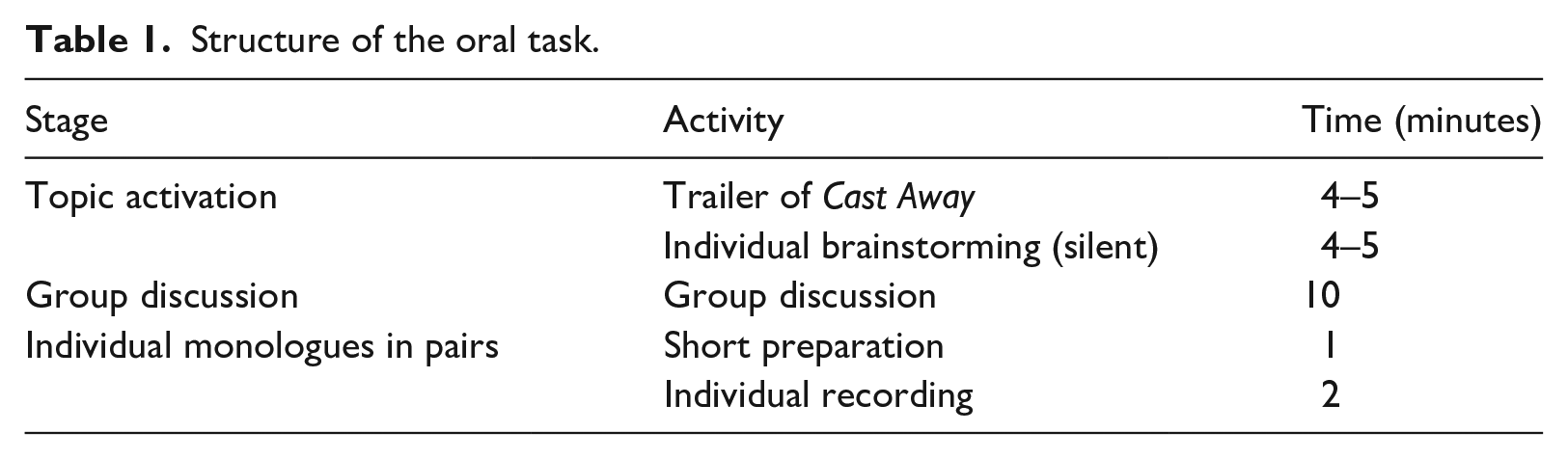
According to Wang (2019), the task stimulated four thinking skills associated with creativity (Guilford, 1967; Kaufman, Plucker & Baer, 2008), that is, fluency (‘the more ideas you come up with, the better’), flexibility (‘the more different types of items you come up with, the better’), originality (‘the more creative the ideas, the better’), and elaboration (‘explain why you are going to take these items’). This was important because FLE is hypothesized to stimulate creativity, so its experience should improve task performance.
3 Instruments
a FLA and FLE measures
The two emotion measures were adapted from two standard instruments used in L2A research, which were first translated into Polish. The Foreign Language Activity Anxiety scale included 16 5-point Likert items adapted from the Foreign Language Classroom Anxiety Scale (Horwitz et al., 1986) to measure FLA experienced during task completion. Example items (in English) are: ‘I didn’t worry about making mistakes’, and ‘I felt anxious about the activity.’ The Foreign Language Activity Enjoyment scale included 20 5-point Likert items adapted from the FLE scale (Dewaele & MacIntyre, 2014) to measure FLE experienced during task completion. Example items are ‘I enjoyed it’ and ‘the teacher was supportive.’ The experience of the emotions during collaborative decision-making (FLA/FLE-group) and during the individual expository monologues (FLA/FLE-mon) was measured, so there are two Cronbach alpha reliabilities for every scale: .87, .84 (FLA), .85, .84. (FLE).
b Proficiency measure
The English EIT (Ortega et al., 1999, 2002) was used to measure L2 English speaking proficiency. It includes 30 sentences of differing length and complexity, which are audio stimuli heard and repeated to the best of learners’ ability. The stimuli recorded by Park (2015), and the instructions (translated into Polish) and the original scoring rubric (maximum score: 120) downloaded from IRIS (Marsden, Mackey & Plonsky, 2016) were used. The EIT is a standardized measure of oral proficiency, which taps largely into implicit and/or automatized linguistic knowledge (Erlam, 2006). It is therefore particularly suitable in a study focusing on fluency. This is also why it was used in Pérez Castillejo (2019, 2021), rare studies of the FLA-fluency link, the results of which can thus be a convenient reference for this study.
c Fluency measures
Beginning with the first syllable uttered, exactly 75 seconds of each participant’s recorded monologue were transcribed and subjected to fluency coding. This exact duration was chosen because many participants finished their monologues after this time. The kinds of speed and breakdown utterance fluency analysis were applied which index both conceptualization and formulation/encoding aspects of cognitive fluency. The same fluency indices as those applied by Pérez Castillejo (2019) were used to facilitate direct comparisons concerning the FLA-fluency links:
Speed fluency MLR: the number of pruned syllables (i.e. total syllables excluding repeated and replaces ones) divided by the number of filled and unfilled pauses AR: pruned syllables divided by speaking time (excluding pauses) PTR: total speaking time (excluding pauses) divided by total performance time
Breakdown fluency, for which Pérez Castillejo’s (2019) 250-millisecond threshold for pauses was adopted (shorter breaks were considered hesitations, not pauses; following Pérez Castillejo [2019], the breaks were manually marked in Audacity 2.4.2 through aural and visual examination, with the software automatically calculating their length) Ratio of AS-unit (analysis of speech unit; Foster, Tonkyn & Wigglesworth, 2000) boundary pauses (end-AS ratio): filled (ah, uhm, etc.) and unfilled (silent) pauses between AS-units divided by pruned syllables. An AS-unit, which is mostly syntactic in nature, consists of ‘an independent clause, or sub-clausal unit, together with any subordinate clause(s) associated with either’ (Foster et al., 2000, p. 365). Ratio of mid-AS-unit pauses (mid-AS ratio): filled and unfilled pauses within AS-units divided by pruned syllables Length of AS-unit boundary pauses (end-AS length): mean length of filled and unfilled pauses between AS-units Length of mid-AS-unit pauses (mid-AS length): mean length of filled and unfilled pauses within AS-units
4 Procedure
The oral task was conducted in several university EFL speaking classes, one aim of which is the development of students’ oral fluency, taught by the present author and three more university teachers to different student groups. Most students present volunteered to participate in the study and signed informed consent. They performed the activity with those who preferred not to participate, but the last part, the recorded monologue, was done only by participants. After the first activity part culminating in small-group collaborative discussions, participants completed the task-specific FLA and FLE surveys retrospectively (but immediately), reporting the emotions they just experienced during the joint (group) decision-making (FLA-group, FLE-group). Some marked the surveys (and later the recording) with their names, and some remained anonymous by using pseudonyms. Next, the monologues were delivered and recorded in pairs by means of portable voice recorders, with each pair, locked in a small room, imagining that they were two survivors making the recording for the rescuers one after another. The only interaction they sometimes engaged in while recording was nodding. Immediately on finishing the recording participants again completed the FLA and FLE surveys, this time with reference to their emotions when delivering the monologues (FLA-mon, FLE-mon). Several weeks later, also in their EFL class, participants took the English EIT, with the recordings made simultaneously by several students seated in distant corners of a large classroom.
5 Data analysis
For purposes of power analysis, on the basis of the relationships between FLA and proficiency, and between FLA and aspects of fluency reported in Pérez Castillejo (2019), and taking into account higher proficiency of this study’s participants, predicted size of relationships between the variables investigated was set at r = .35. Power analysis aiming at the power of .8 (Larson-Hall, 2015) conducted by means of the pwr function in R (3.6.0) predicted that to obtain statistically significant results (p < .05) for the predicted effect size, the sample needed 61 participants. Given that adequate statistical power was missing (N = 43), an alternative was using robust correlations rather than parametric or non-parametric tests (Larson-Hall, 2012). Another reason for this was that score distribution for some variables diverged slightly from normality. The cov.rob function in R was used to calculate pairwise robust correlations between variables, and an online calculator (https://www2.ccrb.cuhk.edu.hk/stat/confidence%20interval/CI%20for%20correlation.htm) was used to render 95% confidence intervals (CIs). Reporting these rather than (just) significance levels is recommended (Larson-Hall, 2015; Plonsky, 2014) because CIs are more informative and express significance anyway. Nevertheless, following Plonsky (2014), and, especially, Larson-Hall (2012, 2015), it was assumed that significance testing should not be overestimated. Therefore, correlation effect sizes were given much more weight in this study. They were interpreted following Plonsky and Oswald’s (2014) benchmarks for small (.25), medium (.40) and large (.60) effect sizes.
Even though power was not optimal and some data were slightly non-normal, to address Research question 3 standard multiple regressions were conducted in SPSS 27. Parallel alternative robust regressions employing the lmRob function were also run in R (4.1.0), but as they yielded very similar results, a decision was made to report standard regressions because R’s robust regression output is less comprehensive (robust regression results are available from the author).
V Results
Descriptive statistics for all measures are presented in Table 2. Participants’ mean EIT score fell between mid- (61) and upper-intermediate (85) thresholds (established for the parallel Spanish EIT by Bowden, 2016), but some scores were in the mid- (99) and high-advanced (116) range and some were in the high-novice (13) mid-intermediate (61) range. Both FLA scores were much lower than the FLE scores, showing that anxiety was much lower than enjoyment both during group decision-making and monologues. However, mean FLA associated with the recorded monologue was noticeably higher than the mean FLA score for the collaborative task part. Conversely, mean FLE for group work was higher than for the monologue. Concerning fluency, pauses within AS-units were more than twice as frequent as those between AS-units, but simultaneously they were much shorter. Pause lengths show that on average participants did not take long to either think what to say (end-AS length: M = 1.62 seconds, SD = 1.23) or formulate/encode the message (mid-AS length: M = 0.93 seconds, SD = 0.28). Concerning speed, their fluency involved pausing after almost seven syllables (MLR), uttering almost three meaningful syllables per one second (AR), and speaking for 71% of total performance time (PTR).
Descriptive statistics for all variables (N = 43).
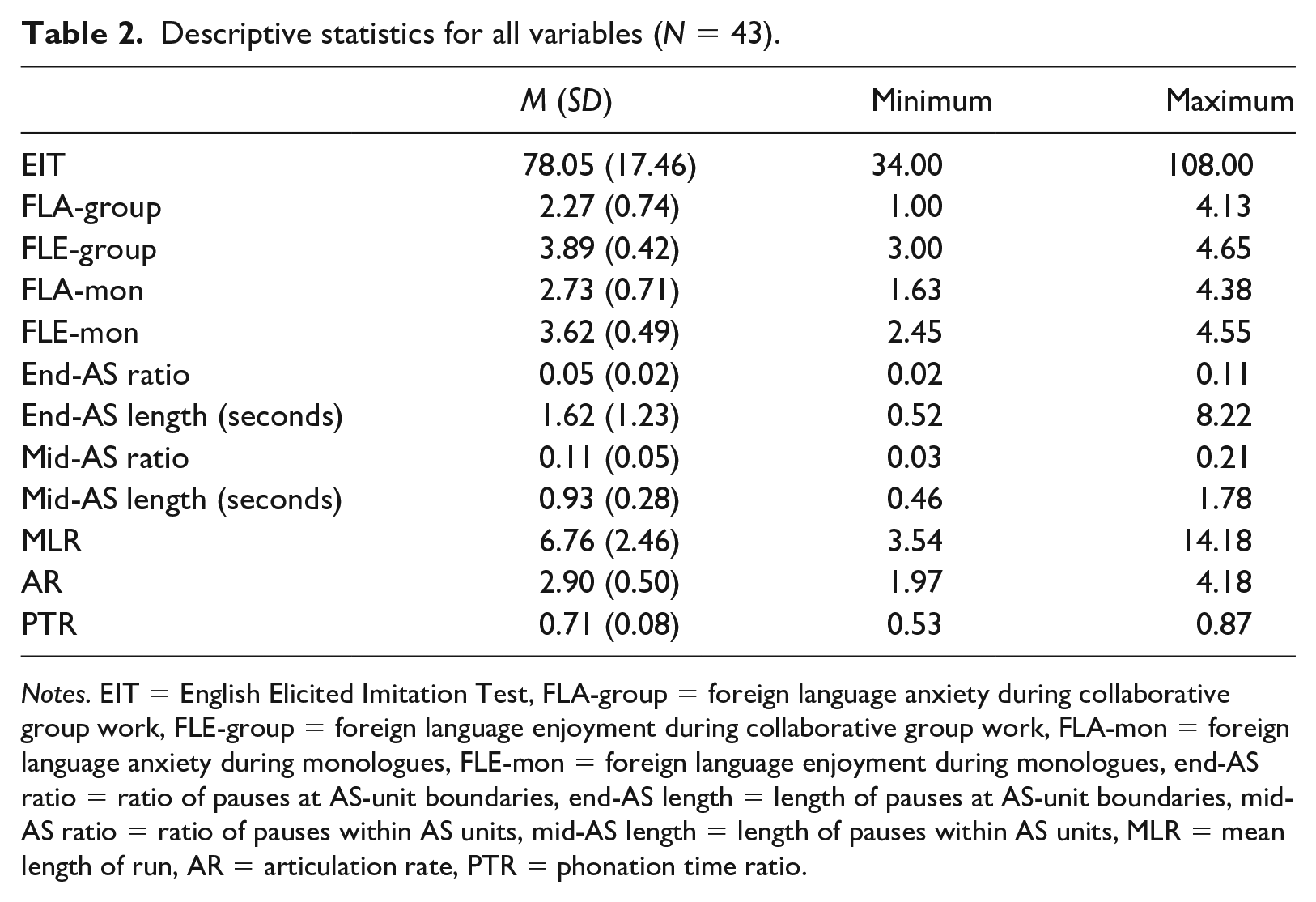
Notes. EIT = English Elicited Imitation Test, FLA-group = foreign language anxiety during collaborative group work, FLE-group = foreign language enjoyment during collaborative group work, FLA-mon = foreign language anxiety during monologues, FLE-mon = foreign language enjoyment during monologues, end-AS ratio = ratio of pauses at AS-unit boundaries, end-AS length = length of pauses at AS-unit boundaries, mid-AS ratio = ratio of pauses within AS units, mid-AS length = length of pauses within AS units, MLR = mean length of run, AR = articulation rate, PTR = phonation time ratio.
Table 3 includes robust correlations among the variables, excluding the ones between different fluency measures. The two correlations between FLA and FLE measured at the two points during task performance were very different. While the correlation regarding the emotions during collaborative decision-making was very weak (r = –.07, CI = –.36, .23), the negative correlation concerning the emotions during the monologue was of medium strength (r = –.41, CI = –.63, –.12). EIT proficiency was medium-strongly negatively related to the ratios of both end-AS (r = –.47, CI = –.67, –.20) and mid-AS pauses (r = –.41, CI = –.63, –.12), and positively related to two indices of speed fluency: MLR (medium-strong correlation, r = .41, CI = .20, .67) and AR (strong correlation, r = .65, CI = .43, .79). There was also a weak negative relationship between proficiency and mid-AS length (r = –.25, CI = –.51, .05). These correlations meant that higher proficiency was associated with better fluency. It is also worth noting that proficiency was moderately negatively related to FLA-group (r = –.53, CI = –.72, –.23) and FLA-mon (r = –.44, CI = –.65, –.16), but the positive correlations with FLE-group and FLE-mon were much weaker. A pattern of correlations very similar to that between proficiency and fluency existed between FLA-group and fluency, pointing to the association of high anxiety and low fluency. Exactly the same aspects of fluency which were linked to proficiency correlated medium-strongly and strongly with FLA-group (end-AS ratio: r = .59, CI = .35, .76; MLR: r = –.50, CI = –.69, –.23; AR: r = –.67, CI = –.81, –.46), except for the FLA-group-mid-AS-ratio link, which was weaker. FLE-group was strongly negatively related to mid-AS ratio (r = –.64, CI = –.79, –.42), weakly negatively related to end-AS length (r = –.29, CI = –.54, .01) and moderately positively related to AR (r = .51, CI = .25, .70), which means that higher enjoyment was associated with better fluency, although fewer fluency indices were linked with FLE than with FLA.
Robust correlations (r [CI]) among FLA-group, FLE-group (emotions during collaborative decision-making), FLA-mon, FLE-mon (emotions during monologues), proficiency (EIT scores), and fluency measures (excluding correlations among the fluency measures) (N = 43).
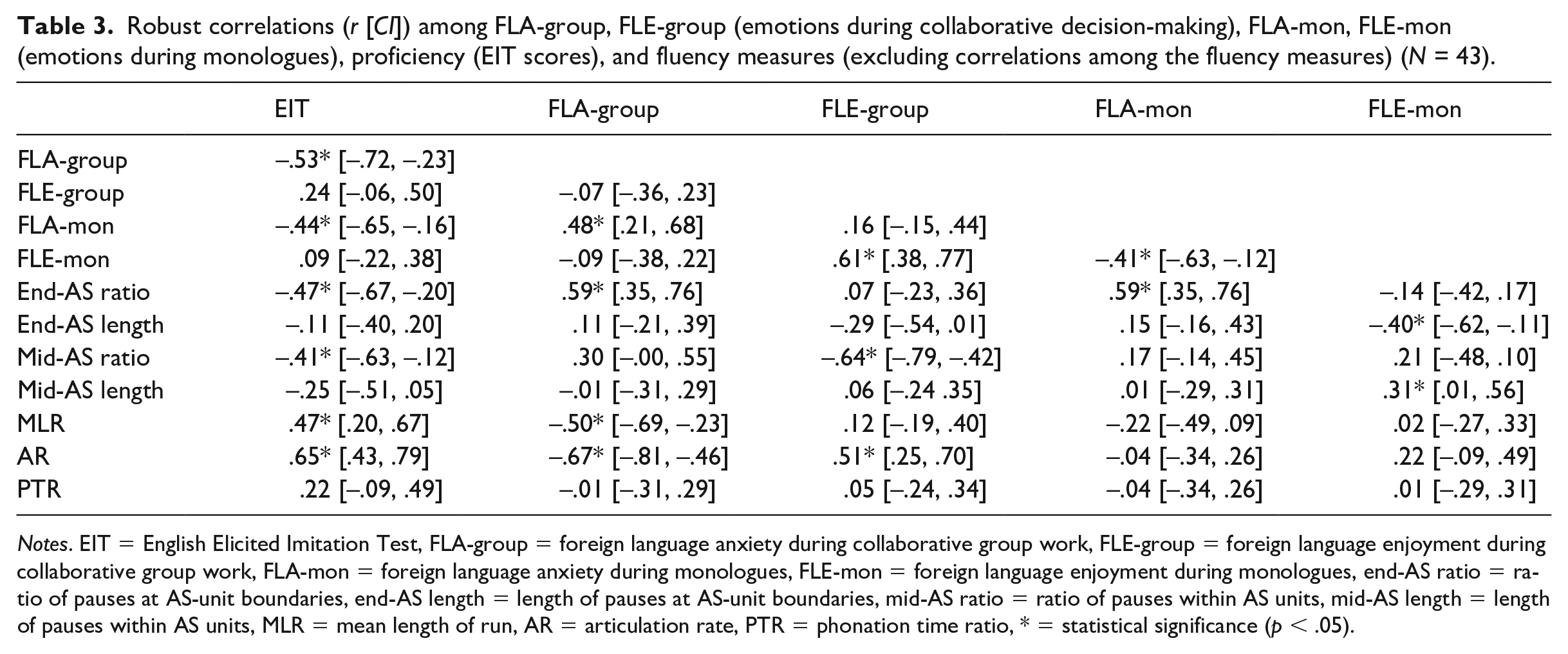
Notes. EIT = English Elicited Imitation Test, FLA-group = foreign language anxiety during collaborative group work, FLE-group = foreign language enjoyment during collaborative group work, FLA-mon = foreign language anxiety during monologues, FLE-mon = foreign language enjoyment during monologues, end-AS ratio = ratio of pauses at AS-unit boundaries, end-AS length = length of pauses at AS-unit boundaries, mid-AS ratio = ratio of pauses within AS units, mid-AS length = length of pauses within AS units, MLR = mean length of run, AR = articulation rate, PTR = phonation time ratio, * = statistical significance (p < .05).
Definitely fewer non-negligible links existed between FLA and FLE experienced when delivering the monologue and fluency, compared to the emotions during decision-making. FLA-mon was moderately (almost strongly) positively related to the ratio of end-AS pauses (r = .59, CI = .35, .76). FLE-mon, by contrast, was moderately negatively related to the length of end-AS pauses (r = –.40, CI = –.62, –.11) and weakly positively related to mid-AS length (r = .31, CI = .01, .56), showing that, to a certain extent, the larger the degree to which the monologue part of the task was enjoyable, the better breakdown fluency was.
Additionally, to explore the combined effect of FLA, FLE and proficiency on fluency, a series of standard multiple regressions was run with fluency indices as dependent variables and those emotion and proficiency variables which correlated at least weakly with fluency as predictor variables. The regressions were possible because there was no multicollinearity (no correlations stronger than r = .70). The results are presented in Tables 4–9. These analyses showed that between 6.5% and 42.2% of variance in the fluency scores was predicted by the combined proficiency and/or emotion variables. Particularly, relatively large percentages of variance (effect sizes were medium and strong) were predicted for the fluency indices reflecting formulation/encoding aspects of cognitive fluency (mid-AS ratio: R2 = 381, p < .001; MLR: R2 = 310, p < .001; AR: R2 = 422, p < .001). However, the variance of one such fluency index (mid-AS length: R2 = 145, p = .047) and the variance of the indices reflective of the conceptualization aspect of cognitive fluency (end-AS ratio: R2 = 187, p = .046; end-AS length: R2 = 065, p = .270) were explained by the combined emotion and/or proficiency variables to a noticeably smaller extent (effect sizes were small and low-range medium). Also, as is clear from all the unstandardized regression coefficients (Betas) for the regressions where EIT proficiency was one of the predictors (all regressions except from the one for end-AS length), this variable was by far the strongest predictor in comparison to FLA and FLE measured during both group collaboration and monologues. Betas were also higher for FLA than FLE when both were predictors (regressions for mid-AS ratio and AR). This points to the relatively weak predictive role of FLE, which is confirmed by the regression predicting end-AS length, where only FLE variables (FLE-group and FLE-mon) were predictors and which indicated that only 6.5% of variance in the fluency scores was predicted.
Regression with end-AS ratio as dependent variable (N = 43).
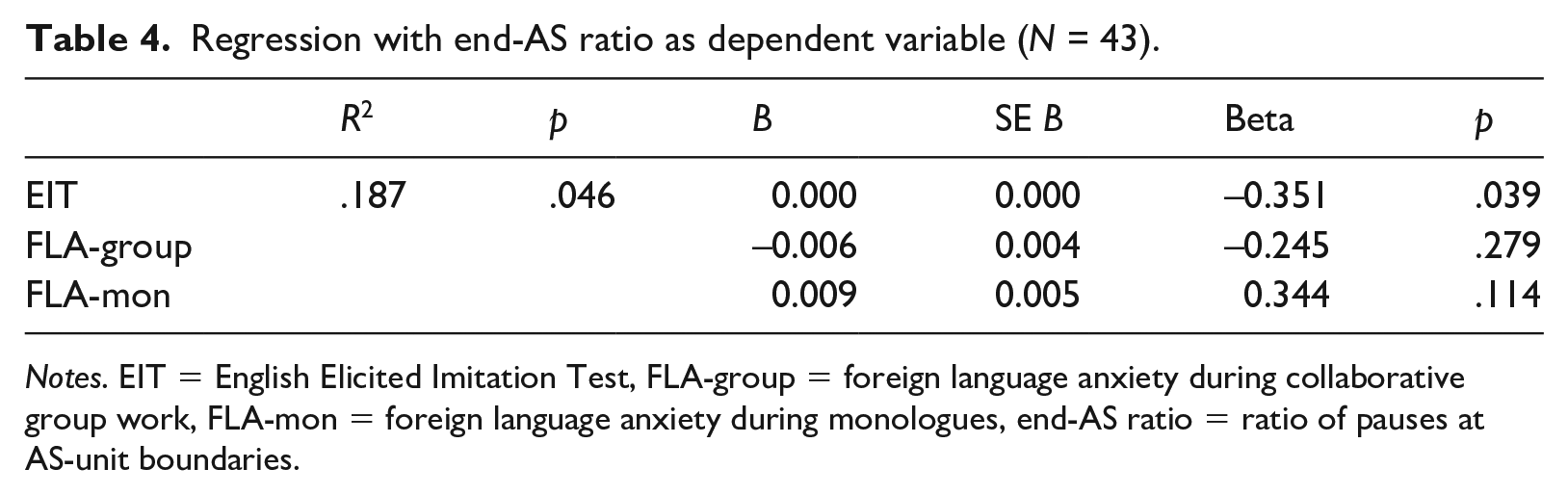
Notes. EIT = English Elicited Imitation Test, FLA-group = foreign language anxiety during collaborative group work, FLA-mon = foreign language anxiety during monologues, end-AS ratio = ratio of pauses at AS-unit boundaries.
Regression with mid-AS ratio as dependent variable (N = 43).
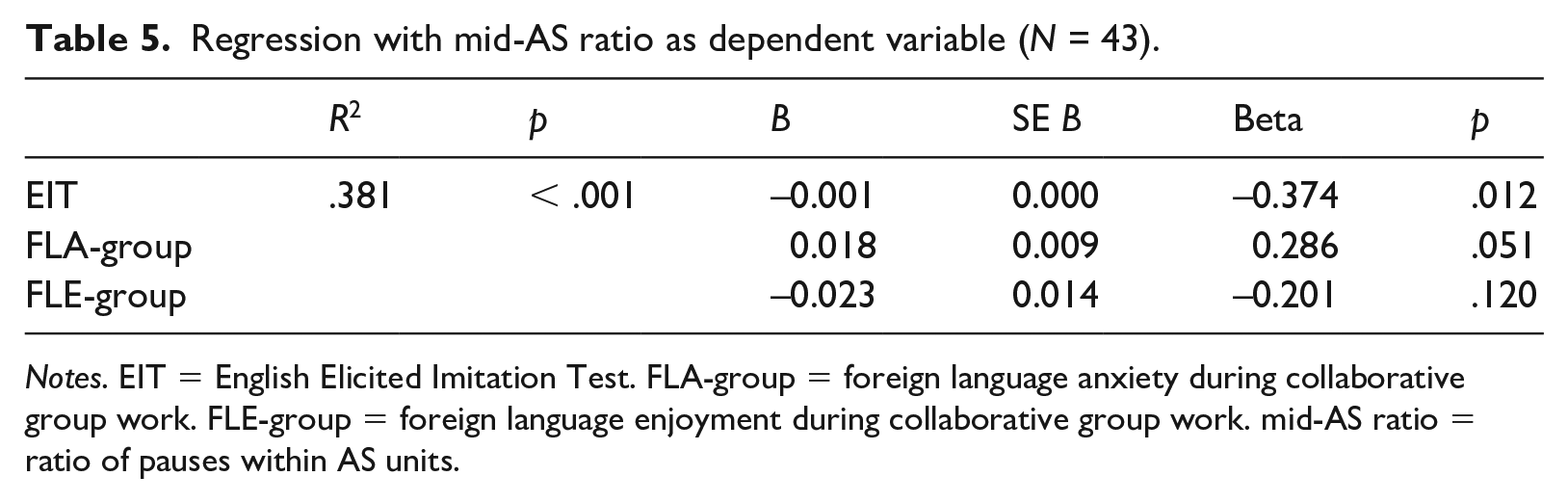
Notes. EIT = English Elicited Imitation Test. FLA-group = foreign language anxiety during collaborative group work. FLE-group = foreign language enjoyment during collaborative group work. mid-AS ratio = ratio of pauses within AS units.
Regression with end-AS length as dependent variable (N = 43).
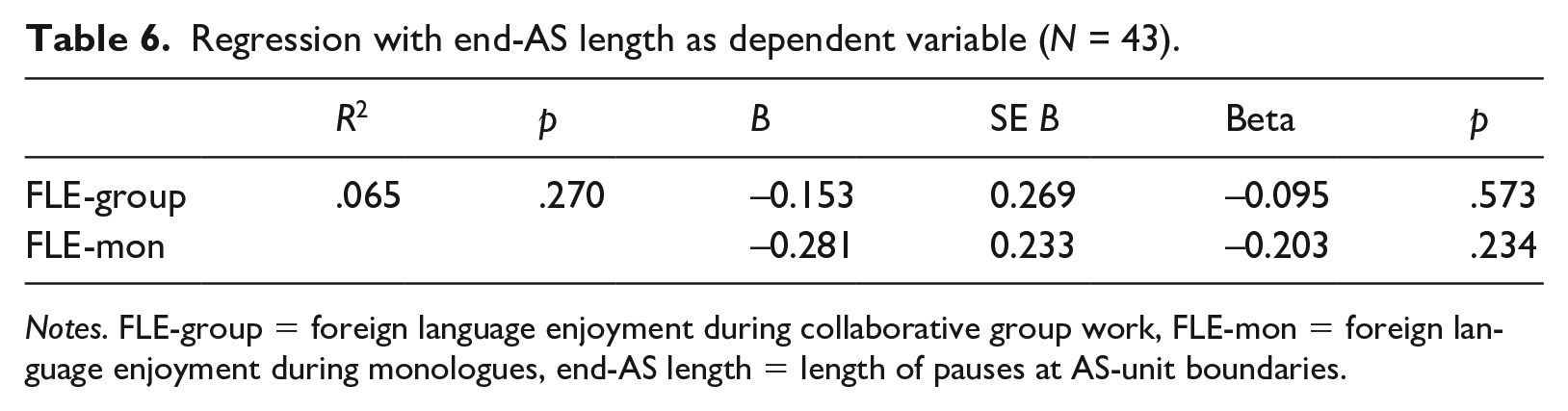
Notes. FLE-group = foreign language enjoyment during collaborative group work, FLE-mon = foreign language enjoyment during monologues, end-AS length = length of pauses at AS-unit boundaries.
Regression with mid-AS length as dependent variable (N = 43).
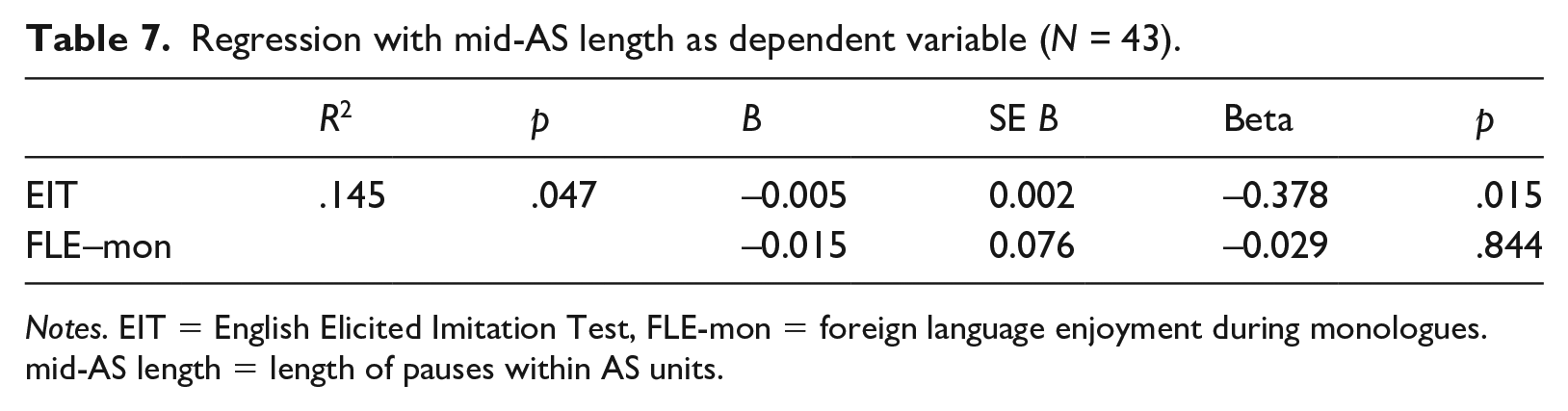
Notes. EIT = English Elicited Imitation Test, FLE-mon = foreign language enjoyment during monologues. mid-AS length = length of pauses within AS units.
Regression with MLR as dependent variable (N = 43).
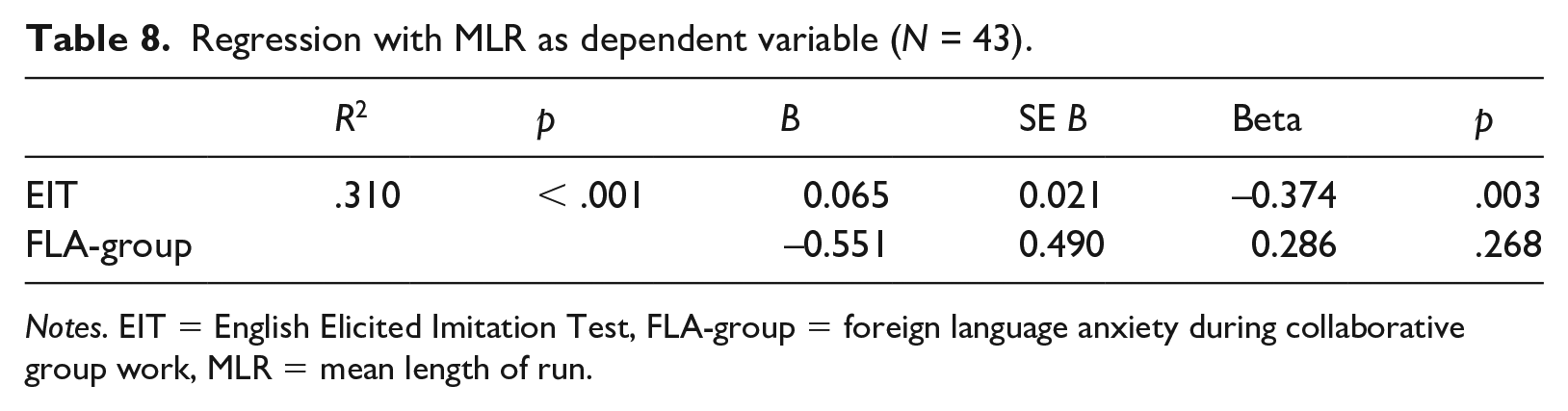
Notes. EIT = English Elicited Imitation Test, FLA-group = foreign language anxiety during collaborative group work, MLR = mean length of run.
Regression with AR as dependent variable (N = 43).
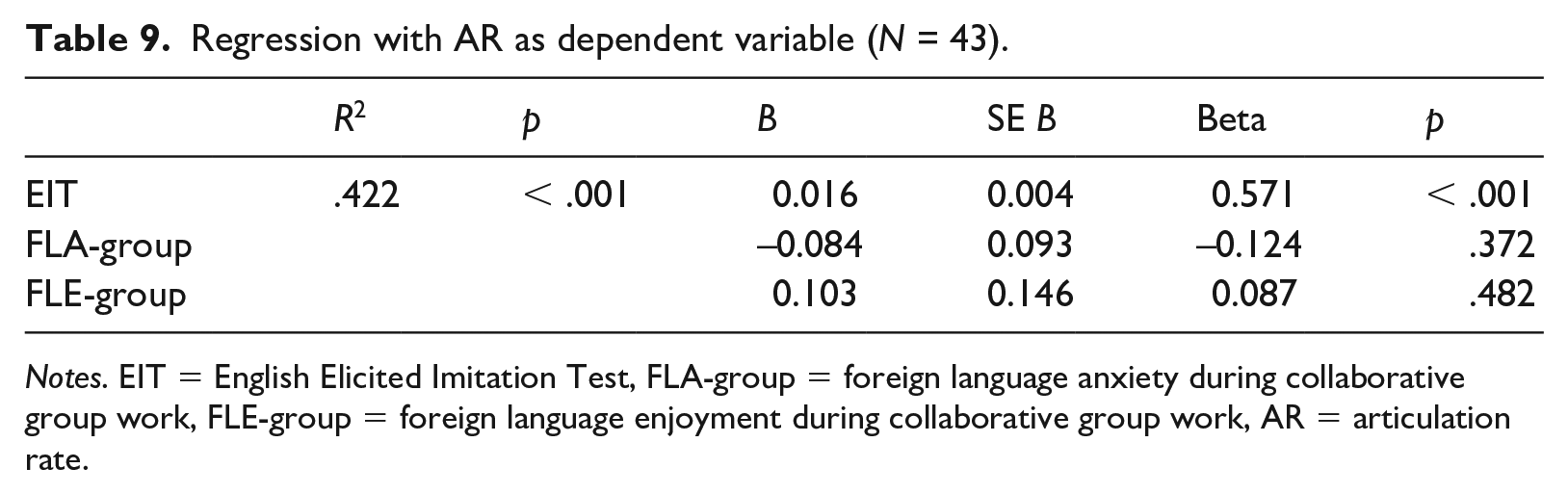
Notes. EIT = English Elicited Imitation Test, FLA-group = foreign language anxiety during collaborative group work, FLE-group = foreign language enjoyment during collaborative group work, AR = articulation rate.
VI Discussion
Task-specific FLA levels measured in this study, particularly those during collaborative decision-making, were noticeably lower than the levels of FLA measured as a more general experience revealed in earlier research (e.g. Dewaele & MacIntyre, 2014; Jiang & Dewaele, 2019; Pérez Castillejo, 2019; Saito et al., 2018), which may have to do with participants’ proficiency (higher than in most previous research; e.g. Pérez Castillejo, 2019; Saito et al., 2018) and the stimulating, non-exam nature of the task used. Also, the absence of such sources of FLA as harsh error correction (Young, 1991) and excessive creativity demands (Kormos & Préfontaine, 2017) may have kept FLA low at the group work stage. In fact, contrary to earlier claims that FLA is more trait-like than FLE (Dewaele & Dewaele, 2020; Dewaele et al., 2019a; Li et al., 2021), in this study mean FLA levels rose noticeably between collaborative group work (M = 2.27, SD = 0.74) and individual monologues (M = 2.73, SD = 0.71). This shows that also this emotion is susceptible to changes brought about by contextual influences. Voice recorder use and time pressure during monologue delivery resembled a highly-evaluative situation and were probably responsible for the noticeable FLA increase.
By contrast, FLE levels, which also fluctuated (FLE-group: M = 3.89, SD = 0.42; FLE-mon: M = 3.62, SD = 0.49), although less, were comparable to those found earlier (e.g. Dewaele & MacIntyre, 2014, 2019; Jiang & Dewaele, 2019). The steadiness in FLE levels may be associated with the fact that the teacher factors influencing FL, such as openness to experience (Ahmadi-Azad et al., 2020) and friendliness (Dewaele et al., 2019a), remained constant between the two task parts.
The frequency of both pause types was approximately half of that in (Pérez Castillejo, 2019, 2021), and the length was also considerably shorter than in these similar-design studies. Speed fluency was approximately twice that revealed in the two studies. These comparisons confirm that this study’s participants were more proficient, particularly considering the more challenging nature of the task used here.
Concerning Research question 1, the relationship between FLA and FLE was negligible during collaborative work, but, like in earlier research focusing on the more generalized experience of these emotions, it was negative and medium-strong during the monologue. This confirms the dynamic nature of the relationship noted in earlier research (Boudreau et al., 2018; Shirvan & Taherian, 2021). Because of the non-threatening nature of this part of the task, in group work FLA was lower than the usual trait-like, generalized level, at least for other populations, which may have been responsible for the lack of a non-negligible relationship between FLA and FLE at this time. Although Boudreau et al. (2018) investigated the relationship between anxiety and enjoyment measured on a per-second timescale at the intra-individual rather than group level, they found that this relationship is itself subject to considerable fluctuation depending on the exigencies of communicative situations and on individual difference variables such as beliefs concerning the language learning process. This study further confirms that FLA and FLE are not always in a reverse relationship but may instead be experienced in various constellations (Shirvan & Taherian, 2021), even when considered at the group level.
Regarding Research question 2, the results generally support the theoretical claims regarding the role of negative and positive emotions in (language) learning inherent in broaden-and-build theory (Fredrickson, 2001, 2013), as well as previous empirical research (e.g. Dewaele & Alfawzan, 2018; Jin & Zhang, 2021; Pérez Castillejo, 2019; Phillips, 1992). In this study, the links between task-specific FLA/FLE (rather than more trait-like emotions) and fluency (rather than some other aspect of performance/achievement) were shown to exist with reference to a unique combination of sample (roughly upper-intermediate L1 Polish English majors) and task (non-exam, creative oral task culminating in an expository monologue) characteristics. There were numerous negative correlations between FLA and fluency and less numerous positive ones between FLE and fluency, particularly with regard to the emotions experienced in the first task part, that is, during collaborative decision-making. These correlations were more numerous and generally stronger than the ones involving the emotions during actual speaking performance (recorded monologues) when fluency was measured. The decision-making was this part in which participants were likely to learn/practice linguistic items such as vocabulary and grammar items occurring in the task materials and, primarily, from one another. This was when prior L2 processing in general, and also prior processing of many linguistic elements that were actually used later in the monologues, must have occurred. If FLA was experienced at this stage, it may have narrowed and tied up attention and cognition, and restricted creative exploration of the linguistic input. If FLE was experienced, it may have prompted creative experimentation and play with linguistic material, including its deeper processing (Ryan et al., 1990) and eager rather than vigilant L2 use (Papi & Khajavy, 2021), which may have translated into improved remembering of linguistic material and, later, fluency at the output (monologue) stage. The study has also demonstrated that specifically FLE, rather than more general enjoyment types such as enjoyment of reading (Brantmeier, 2005) or e-learning enjoyment (Ebrahimzadeh & Alavi, 2017), may be associated with improved L2 performance.
More numerous and stronger links between fluency and FLA in the first task stage imply that the possible influence of FLA on language learning/performance (Botes et al., 2020; Teimouri et al., 2019; Zhang, 2019) may be particularly strong at the linguistic input and processing stages compared to output production, although this was not found by MacIntyre and Gardner (1994). A possible reason for this discrepancy is that this study’s participants were more proficient, so they may be less vulnerable to the interference of FLA while speaking because they may rely on a wider range of compensatory strategies and linguistic devices.
The relationships between FLE and fluency were definitely less numerous compared to the FLA-fluency links. It seems that FLE is less consistently linked to fluency as an aspect of L2 performance than FLA. An explanation based on what Kormos and Préfontaine (2017) hypothesized with respect to task motivation is that very high enjoyment of task content resulted in so much focus on producing very precise and accurate linguistic output which engaged cognitive and attentional resources so much that fluency suffered. This demonstrates the uniqueness of language learning (including output production), to which enjoyment and other emotions may be linked in idiosyncratic ways. Enjoyment of learning content other than language (e.g. maths or economics) will usually not result in so much focus on the language through which this content is expressed/discussed. However, we know from broaden-and-build theory that enjoyment differs from negative emotions in that it does not restrict attention to its focal objects, which calls this explanation into question. Another possibility why the links between FLE and fluency were not more consistent is that enjoyment was to a certain extent experienced just because the task was too fun- rather than learning-oriented (cf. Clark, 1982), but this is not likely because teachers acted professionally and a dedicated FLE scale was used which measured specifically enjoyment related to L2A. Another possibility is that, as demonstrated for FLA by Pérez Castillejo (2021), also FLE is linked to fluency less strongly when fluency is measured following a chance at prior L2 processing, including the processing of specific linguistic items to be used. Of course, the possibility remains that FLA is simply more strongly related to fluency than FLE just because the processing interference it may cause is stronger than the attentional and learning benefits fostered by FLE.
The majority of the weak, medium and strong relationships between FLA and fluency and between FLE and fluency involved these fluency indices (mid-AS ratio, mid-AS length, MLR, AR) which reflect the formulation/encoding aspect of cognitive fluency. However, twice (out of five non-negligible correlations) did FLA correlate quite strongly with an index of breakdown fluency reflective of message conceptualization (FLA-group and FLA-mon with end-AS ratio), and this was true of one non-negligible correlation (out of five) involving FLE (FLE-mon with end-AS length). Similar results, that is, more numerous links of FLA with formulation/encoding fluency than with conceptualization fluency were obtained by Pérez Castillejo (2019), and, especially, by Pérez Castillejo (2021), who found no FLA links with conceptualization fluency. Pérez Castillejo (2019) concluded that by tying up attention, FLA may impact formulation/encoding much more than conceptualization, and this conclusion might be repeated given the present results, with the additional claim that FLE conversely frees attentional and cognitive resources used mostly for message formulation. However, in both Pérez Castillejo (2019) and this study the number of conceptualization-fluency indices considered was just two, compared to five formulation-fluency indices, so the proportions of indices reflexive of the two cognitive fluency aspects which correlated non-negligibly with FLA (and also FLE in this study) were comparable. Therefore, the question whether FLA and FLE are related to L2 speaking conceptualization remains unresolved.
Considering Research question 3, the results suggest that proficiency, FLA and FLE were together, in various constellations, weak, medium-strong and strong predictors of several kinds of fluency. Oral proficiency measured by EIT emerged as by far the strongest predictor, contrary to the earlier research by Pérez Castillejo (2019), who found that FLA was a stronger predictor. However, the present study included more proficient participants, so the tentative conclusion is that at their proficiency level (roughly high-intermediate/low-advanced) emotions affect fluency to a much smaller degree than for less advanced learners, presumably thanks to more automatized L2 use. Complicating matters further, in this study, contrary to Pérez Castillejo’s (2019), participants had a chance to process the L2 linguistic material before the performance the fluency of which was measured, which may have inhibited the impact of emotions. This is exactly what Pérez Castillejo’s (2021) found regarding FLA.
When the combined impact of FLA and FLE on fluency is considered, FLA turned out to be a stronger (although quite weak) predictor, with FLE’s impact being negligible. Perhaps, as already mentioned, its interference with language processing, especially prior to output production, overshadows the processing and learning benefits afforded by positive emotions such as FLE, which would explain why educational psychology and L2A researchers first focused on FLA for tens of years before turning to positive emotions. However, other possibilities should not be discounted. Besides the other potential explanations which were already mentioned when discussing the greater frequency of non-negligible relationships of fluency with FLA rather than FLE, one more should be considered. While Li et al. (2018) mentioned the possible upper and lower predictive limits of respectively FLA and FLE for low-proficiency learners, converse limits may operate in high-achievement groups such as this study’s sample. Their low FLA and relatively high FLE levels may have substantially lowered the emotions’ predictive potential concerning fluency.
The study’s major limitations, which prompt cautious interpretation of the results, are as follows. First, the sample was relatively small, which limited the statistical power, and it included only volunteers. Consequently, as they admitted, several very-high-FLA students opted not to participate. Second, participants’ emotions and fluency were considered in relation to only one oral task type, and their fluency was not evaluated by raters. Inclusion of more task types and perceived fluency, and using measures of FLA and FLE as more generalized experiences in addition to the task-specific measures, would have enriched the results and allowed more nuanced analyses. Finally, the study did not control for participants’ L1 fluency, which may have been a confounding variable (Segalowitz, 2010).
VII Pedagogical implications
Concerning the fluctuating relations between FLA and FLE depending on what happens in the language classroom, it is recommended that L2 teachers predict the emotional impact of teaching activities and try to align teaching objectives with this impact. For example, knowing that some task parts (such as the monologues in this study, which still did not generate a lot of FLA) are likely to be more FLA-provoking than others, they could use them to teach aspects of language such as morphosyntax, the teaching of which has been shown to benefit from negative emotions (Liu et al., 2018) as they are associated with deduction and analysis. More research is needed to determine whether FLE can directly support the learning of specific linguistic items, systems or skills, but given the positive links between FLE and fluency, it is advisable that classroom activities predicted to be enjoyable should aim at the development of this aspect of L2 oral proficiency. An additional argument for this is that the state of heightened attention and intense task motivation known as flow, which is quite closely related to enjoyment (Dewaele & MacIntyre, in press), intuitively seems to lead to better fluency. Because infrequent negative links between FLA-mon and fluency were found, it seems that FLA is not so much a problem (a confounding variable) when it is experienced during concurrent performance, at least during speaking which is not part of formal assessment/testing and which follows prior processing of the linguistic material used. This may be good news to teachers, who might consider basing their assessment and grading to a larger extent on their continuous observations of learners’ classroom oral task performance rather than on summative formal tests/exams. That FLA experienced in the course of every-day learning reciprocally interacts with performance/achievement is to a certain extent unavoidable (Alamer & Lee, 2021), but of course teachers should minimize the germs of FLA and sew the grains of FLE (which is supposed to reduce the impact of FLA) by, for example, employing oral tasks such as the creative one used in this study, which seems to have evoked high FLE and low FLA, especially in the collaborative part. What may have been responsible for this is a stimulating topic and an enjoyable challenge the task posed through eliciting autonomous ideas concerning the items that may be taken to a desert island. As put forward by Dewaele and Macintyre (2014) and Boudreau et al. (2018), FLA and FLE do not behave in a see-saw manner, with both experienced by some learners at high levels simultaneously. Given that FLA is less malleable because of its stronger links to personality traits, teachers are advised to put more effort into fostering FLE than eradicating FLA. They can also convey to learners that they should learn to live with FLA and that FLE may sweeten the L2 learning pill and even overcome the bitterness of FLA. Besides, numerous interpersonal learner-oriented emotion-regulation strategies are available to teachers, many of which are considered by L2 students as desirable and effective (Bielak & Mystkowska-Wiertelak, 2020b).
VIII Conclusions and research directions
Enjoyment has made its way to educational policy documents, in which it is often not only pronounced to be a vehicle of learning but also an end in itself (an educational outcome; Lumby, 2011). It is thus timely that this study has contributed to its exploration in relation to L2A. To provide a link with rich previous L2 emotion research, FLE was considered together with FLA.
Adding to previous research, the study has further demonstrated the dynamically changing relationship between FLA and FLE. It has also revealed numerous links between task-specific FLA and FLE, and L2 fluency in a creative oral task, particularly regarding the emotions experienced by fairly advanced English learners in the first task stage when initial processing of L2 items took place, before the actual performance the fluency of which was measured. This contributes to the growing knowledge concerning the links between FLA and L2 performance/achievement, and, particularly, it offers highly original insights on the links between positive emotions and L2 performance. Specifically, for the first time, FLE and L2 fluency have been showed to be related. Although this should be interpreted cautiously because of the study’s limitations, this investigation has also revealed that at least at this level of advancement and with quite low FLA and high FLE, the combined effects of proficiency, FLA and FLE on L2 fluency may be quite substantial, with proficiency being the major predictor of fluency, followed by FLA and then the rather negligible impact of FLE.
Obviously, there is still much to be learned in future research. Concerning the relationship between FLA and FLE, future research should examine the individual and contextual factors that result in different concurrent configurations of the two, as initially investigated by Boudreau et al. (2018) with the use of the idiodynamic method. More research should be done on the links between FLA/FLE and L2 performance (including fluency) among intermediate learners, as opposed to low-proficiency and high-proficiency learners. Additionally, research concerning the possible impact of FLA/FLE on the aspects of utterance fluency reflective of conceptualization (rather than formulation/encoding) is needed because the joint results of this and previous studies (Pérez Castillejo, 2019, 2021) are inconclusive. Additionally, the links between the emotions and fluency should be investigated in relation to different task types, including those that may be less interesting/enjoyable to at least some participants so that FLE/FLA levels investigated are more varied. Instruments measuring more generalized (trait-like) experience of the emotions should be employed along state measures to get a fuller emotional portrait of participants and learning situations, and allow more nuanced analyses. Finally, given the relationships between FLE and fluency found here, links between this construct (and also FLA) and other L2 performance aspects such as syntactic complexity and accuracy or vocabulary range should be investigated. The designs of such studies and the tasks used should be carefully chosen so that there is room for hypothesized influence of FLA and FLE, which may impinge on the processing of L2 input, output and knowledge.
Footnotes
Appendix 1
Acknowledgements
I would like to warmly thank the following friends and colleagues currently and formerly affiliated with the Department of English Studies, Adam Mickiewicz University at Kalisz: Ania Mystkowska-Wiertelak for copious assistance with data collection and inspiring discussions and advice, Jagoda Mikołajewska for assistance with data coding, and Tomek Kulka, Ania Matysiak and Żaneta Telega for using the oral task and welcoming the study in their speaking classes. I also thank all the participating students.
Declaration of conflicting interests
The author declared no potential conflicts of interest with respect to the research, authorship, and/or publication of this article.
Funding
The author received no financial support for the research, authorship, and/or publication of this article.
