



Abstract
Studies on teachers’ beliefs about vocabulary learning and teaching have focused, so far, on English as a second language (L2), or foreign language (FL), in different contexts but little attention has been given to other L2s and FLs. In this study, 15 Spanish L2 instructors at large universities were interviewed in order to better understand where they stand when it comes to (1) the importance they give to vocabulary, as compared to grammar, in their classes, (2) how they decide which words to teach, and (3) how they assess students’ word knowledge. These interviews were subsequently analysed following Grounded Theory. Most instructors declared favoring grammar over vocabulary in their courses because the former is seen as more challenging and useful than the latter and because institutional practices and materials also present such a preference. When it comes to vocabulary selection, most of them declared feeling insecure in their decisions due to lack of access to useful resources and to vocabulary goals not being stated clearly anywhere in the syllabi. This lack of clarity when it comes to vocabulary learning goals also results in doubts about the usefulness of even evaluating word learning at all and an overreliance on informal assessments.
I Introduction
In 1980, Meara declared that vocabulary research was a neglected area of second language acquisition (SLA). While this is no longer the case, as evidenced by the numerous articles published in recent years on second language vocabulary teaching and learning (Barcroft, 2016; Boers and Lindstromberg, 2008, 2009; Fichtner and Barcroft, 2019), its impact on teachers’ professional development seems to be lagging (Horst, 2013; Rankin, 2019), especially when it comes to second languages (L2), or foreign languages (FL) other than English. For example, the 2019 Annual Conference of the American Association of Teachers of Spanish and Portuguese (AATSP) programmed over 250 sessions, workshops, and papers, but only three of them focused exclusively on vocabulary teaching, assessment, or learning.
In the context of L2 Spanish programs in US postsecondary institutions, instructors tend to receive no pre-service training, other than a short one-day long orientation (Lord, 2013), and a maximum of one (if any) SLA or language teaching methodology course during their graduate education (Allen & Negueruela-Azarola, 2010; Lacorte & Suárez-García, 2014; Maxim, 2005). Most programs also include classroom observations at some point during, or after, the methodology course (Enkin, 2015; Gómez-Soler & Tecedor, 2018; Lord, 2013). According to Lord (2013), the short orientation that is offered right before the new academic courses starts mainly focuses on providing information on the structure and goals of the language program. Concerning the methodology course, Gómez-Soler and Tecedor (2018) recently pointed to the fact that this training is not only limited in time but also in scope and objectives, with a main focus on traditional grammar and immediate classroom problems rather than providing more complex views of what language teaching and learning is.
If pre- and in-service pedagogical training for college/university Spanish language teachers in the US is scant, as evidenced in the abovementioned literature, and professional associations, such as the AATSP, do not compensate for those limitations in certain areas such as vocabulary teaching, instructors mostly fall back on their own beliefs and experiences. The present article aims to explore those beliefs through semi-structured interviews with the hope that this information may influence the design and development of future teacher training programs. After all, as Korthagen (2017) states, ‘people who wish to try and influence teacher behaviour may themselves have to learn more about what actually guides teacher behaviour and teacher learning and could often take the affective and motivational dimensions more seriously’ (p. 391). In this case, the goal is to better understand how Spanish language instructors conceptualize and feel about vocabulary learning and teaching in their classes, with a particular focus on three aspects:
What importance is given to teaching vocabulary compared to other contents, such as grammar?
How do teachers conceptualize words’ usefulness? And how does that conceptualization affect their choices when it comes to selecting which words to teach?
How do teachers determine that a word is known by their students?
II Literature Review
1 The importance of vocabulary teaching and learning
Hilton (2008) wrote that language teaching practices were greatly influenced by the old ‘tradition of grammar-centered language teaching’ (p. 156), maintaining grammar teaching as the center of L2 courses (Horst, 2013). More recently, Baleghizadeh, Goldouz, and Yousefpoori-Naeim (2016) found that 73% of the activities included in three EFL textbooks focused on decontextualized grammar, which indicates that the predominance of grammar over all other aspects of language learning/teaching is still far from being a practice of the past. However, this focus on grammar has been questioned by researchers who repeatedly find that lexical knowledge is just as important, if not more, for language development (Grabe, 2009; Hilton, 2008; Horst, 2013; Laufer, 1992; Nation & Hunston, 2013; Qian & Lin, 2020; Qian & Schedl, 2004; Saville-Troike, 1984; Schmitt, Jiang & Grabe, 2011; Stæhr, 2008). In a now classical study, Saville-Troike (1984) found that lexical diversity presented a high correlation with the scores of the Comprehensive Test of Basic Skills (CTBS), a standardized test that aims at assessing primary school students’ science, mathematics, social sciences and reading skills. Interestingly, this same correlation was not found between grammatical complexity and any of the parts of the test, which indicates that a broad vocabulary seems to play a greater role in developing other academic skills than grammatical skills do. Furthermore, Hilton (2008) showed that L2 students with a greater vocabulary breadth were more fluent orally than those with a small lexical repertoire. Furthermore, the speech of disfluent learners was characterized by clause-internal hesitations (i.e. pauses interfering with the speech stream), and such hesitations were mostly caused by a lack of vocabulary knowledge, not grammatical searches and reformulations. These two studies demonstrate that a broad lexicon, more than grammatical complexity, offers benefits both for native speakers and L2 learners when it comes to developing oral fluency and academic achievements. In short, ‘while without grammar little can be conveyed, without vocabulary nothing can be conveyed’ (Wilkins, 1972, p. 111).
Given the importance of vocabulary, it may seem obvious that lexical skills should be developed and trained at least to the same extent, and as explicitly, as grammatical ones in L2 courses. However, a significant amount of the literature on L2 vocabulary learning has focused on how to learn words incidentally, rather than intentionally, through reading (Godfroid et al., 2018; Nassaji, 2003a, 2003b; Pellicer-Sánchez, 2016; Pellicer-Sánchez & Schmitt, 2010; Sánchez Gutiérrez, Pérez Serrano & Robles García, 2019; Uchihara, Webb & Yanagisawa, 2019) or listening/viewing (Feng & Webb, 2020; Pavia, Webb & Faez, 2019; Pérez-Serrano, Nogueroles-López & Duñabeitia, 2021; Rodgers & Webb, 2020). Incidental vocabulary learning depends greatly on repeated exposure to words, with as many as 20 repetitions of a word being necessary to learn it from context (Pigada & Schmitt, 2006; Webb, 2007). As evidenced in Horst (2010), teacher talk does not offer sufficient exposure to useful words for learners to learn them incidentally in the classroom alone. The same problem arises with textbooks, where words are not repeated enough times to promote incidental learning (López Bastidas & Sánchez-Gutiérrez, 2020; Matsuoka & Hirsh, 2010).
In this context, calls for more intentional approaches to vocabulary learning/teaching have been made (Barcroft, 2004, 2020; Laufer, 2006, 2008; Laufer & Girsai, 2008). As Laufer (2005) pointed out when defending the need for explicit vocabulary teaching, form focused vocabulary instruction (1) speeds up the elaboration of the complex construct of what is implied in knowing a word, (2) enhances the learning and development of productive knowledge of low frequency words (Moon, 1997), and (3) avoids the fossilization of lexical errors, particularly in words that are hard to learn. For a more detailed review of the benefits of intentional vocabulary learning approaches, see Boers & Lindstromberg (2008).
When it comes to educators’ beliefs about the importance of vocabulary teaching, studies with EFL/ESL teachers in Sweden (Bergström, Norberg & Nordlund, 2021), Cambodia (Lim, 2016), and Malaysia (Macalister, 2012) all report that teacher-participants tend to consider vocabulary learning as an incidental process that results from other learning activities. In Gao and Ma (2011), teachers in Hong Kong believed that intentional approaches to vocabulary teaching, such as memorizing lists, were most appropriate, whereas teachers in mainland China tended to favor contextualized communicative activities where vocabulary was not the explicit focus. The differences in beliefs observed between these teachers indicate the importance of the teaching context in developing a certain set of beliefs (Borg, 2003, 2006). In the present study, beliefs about vocabulary learning and teaching are explored in another target language – Spanish – and another setting: large US universities.
2 Vocabulary selection
Language instructors need to make daily decisions about the words that are to be taught in their classes. This vocabulary selection task requires a deep reflection on what makes a word more relevant than another for a specific class. In the literature about vocabulary teaching, researchers have mostly focused on how highly frequent words should be prioritized over less frequent ones, advocating for frequency-based vocabulary selection criteria (Horst, 2013; Meara, 1980; Nation & Hunston, 2013; Schmitt & Schmitt, 2014; Stæhr, 2008; Rankin, 2019; Vilkaitė-Lozdienė & Schmitt, 2020). The rationale behind this proposal is that the most frequent words in a language offer a significantly greater amount of text coverage than lower frequency words. For instance, learning the 1,000 most frequent word families in the English language allows you to understand over 80% of the words encountered in most oral and written texts. The next 1,000 words only add another 5%–9% of lexical coverage, and these percentages decrease substantially as word frequency drops (Schmitt & Schmitt, 2014).
However, an approach to vocabulary selection fully based on lexical frequency does not correspond with current practices in published textbooks. Indeed, L2/FL textbooks tend to include a large number of low-frequency words and lack a systematic representation of high-frequency ones (Davies & Face, 2006; Lipinski, 2010; López Bastidas & Sánchez-Gutiérrez, 2020; Sánchez-Gutiérrez, Marcos Miguel & Olsen, 2019). This situation is explained by the fact that textbooks select vocabulary that corresponds to chapter themes, which sometimes necessarily include lower frequency words. López Bastidas & Sánchez-Gutiérrez (2020) shows that, while lexical frequency can be the guiding principle in vocabulary selection, it may not be adequate in certain thematic units. For example, it is almost impossible to restrict vocabulary selection to the 3,000 most frequent words when communicating about food, since most words that refer to ingredients are far beyond that frequency threshold.
Neither textbooks nor corpus-based frequency lists alone seem to provide the ultimate solution to adequate vocabulary selection, but a combination of both could offer a useful middle-ground. Indeed, teachers could rely on textbook glossaries as a basis but also select the most frequent words from those glossaries to consider them as the most relevant, which students are expected to learn to use productively. However, this mixed approach does not seem to be broadly used in language programs. For instance, Dang and Webb (2020) found that corpus-based word lists were considered as the least useful sources of information for vocabulary selection by the 16 Vietnamese teachers they surveyed. Instead, they reported relying mostly on textbooks and on their own intuition to make decisions about what words to teach.
Since intuition, and not corpus-based frequency lists, is used as either the only resource or in combination with textbooks, McCrostie (2007) assessed English as a second language (ESL) teachers’ accuracy in determining words’ frequencies and observed that they were reasonably accurate with words that were at the extremes of the frequency continuum but struggled considerably with words that were neither extremely frequent nor extremely infrequent. This suggests that teachers’ intuitions should not be the only resource for frequency-based vocabulary selection.
Nonetheless, it was recently pointed out that teachers may be key in developing an alternative view of how words should be chosen for class. Indeed, some authors have argued that, while frequency is an important indicator of a word’s usefulness, it should not be the only one (Dang, Webb, & Coxhead, 2020; Garnier & Schmitt, 2015; He & Godfroid, 2019; Stein, 2017). For instance, a teacher may find that the low-frequency word blackboard is extremely useful when asking students to write something on the blackboard, or when calling their attention to what the teacher is writing on it. Efforts are currently being made to take teachers’ ratings of usefulness into account when establishing the lists of words that should be taught at different proficiency levels. However, these studies simply ask teachers to evaluate words on a scale of usefulness, but little is known about the rationale behind those ratings.
3 Aspects of word knowledge
While selecting adequate vocabulary for a particular context or proficiency level is an important task, instructors also need to ask themselves what to teach about each of those selected words. Concretely, what do students need to know about a word in order to consider it known? Nation (2001) proposed that lexical knowledge involves nine different aspects: spoken form, written form, word parts, form and meaning, concept and references, associations, grammatical functions, collocations and constraints of use; and for each of those aspects, learners need to develop receptive and productive knowledge. These aspects are not expected to be acquired all at once, but learners tend to gradually discover them as they receive more exposure to, and instruction about, words in their L2/FL (Nation, 2020). Therefore, teachers’ conceptualizations of what knowing a word means and how that knowledge develops may be key in deciding which of these aspects need more, and less, attention in the classroom.
Neary-Sundquist (2015) explored how the activities included in five German FL textbooks addressed each word knowledge aspect and showed that most activities focused on form-meaning associations and grammatical functions with virtually no treatment of the seven remaining aspects. This data replicated Brown’s (2011) results with ESL/EFL textbooks, where form-meaning associations were also emphasized the most. Similar views of vocabulary learning as a process of associating forms with meanings were also found in Bergström et al.’s (2021) interviews of EFL teachers in Sweden. Indeed, participants in the study generally considered that knowing a word was a matter of knowing its meaning. However, many of them emphasized the importance of developing an in-depth knowledge of that meaning through the learning of synonyms and cases of polysemy. In Gao and Ma (2011), alternatively, teachers from both Hong Kong and Mainland China believed that a variety of aspects needed to be taught in the class, such as pronunciation or word parts.
4 Teachers’ beliefs
Research on language teachers’ beliefs has mostly focused on grammar while vocabulary has been less studied (Bergström et al., 2021; Phipps & Borg, 2009; Sanchez, 2014). The few exceptions to this trend were articles that studied the beliefs about vocabulary learning and teaching of ESL/EFL teachers in different contexts, ranging from Cambodia to Sweden. Through these studies, it has been demonstrated that beliefs can vary from one educational setting to another, thus calling for more research in different countries and with different L2s/FLs. The goal of the present study is to provide insights into the beliefs about vocabulary teaching and learning of L2 Spanish language instructors at large US universities.
III Methods
1 Participants and context
Fifteen Spanish instructors participated in this study. All of them were teaching Spanish language courses at large universities in the US at the time of the interview; eight had a permanent position (i.e. 4 professors and 4 lecturers) and seven were graduate Teaching Assistants (TAs). As can be observed in Table 1, they had an average age of 39, with a maximum of 63 and a minimum of 30. Nine of them identified as female and six as male. Seven were from the US, seven from Spain, and one from Mexico. The four professors and two of the lecturers had a PhD, the seven TAs, as well as one of the lecturers, were enrolled in a PhD program, and one of the lecturers held an M.A. degree. Nine of them specialized in literature, five in linguistics and one in journalism. Eight of them had between five and 10 years of experience teaching Spanish as a Second Language, four of them had over 10 years of experience and two had taught for one to five years. Six had not received any formal training in SLA, seven had taken one single training course in SLA or language teaching pedagogy and two had enrolled in more than one of those courses. When asked about any specific training related to vocabulary teaching, only one stated that they had taken one such course, which was optional, during their PhD.
Demographic and professional information of the participants.
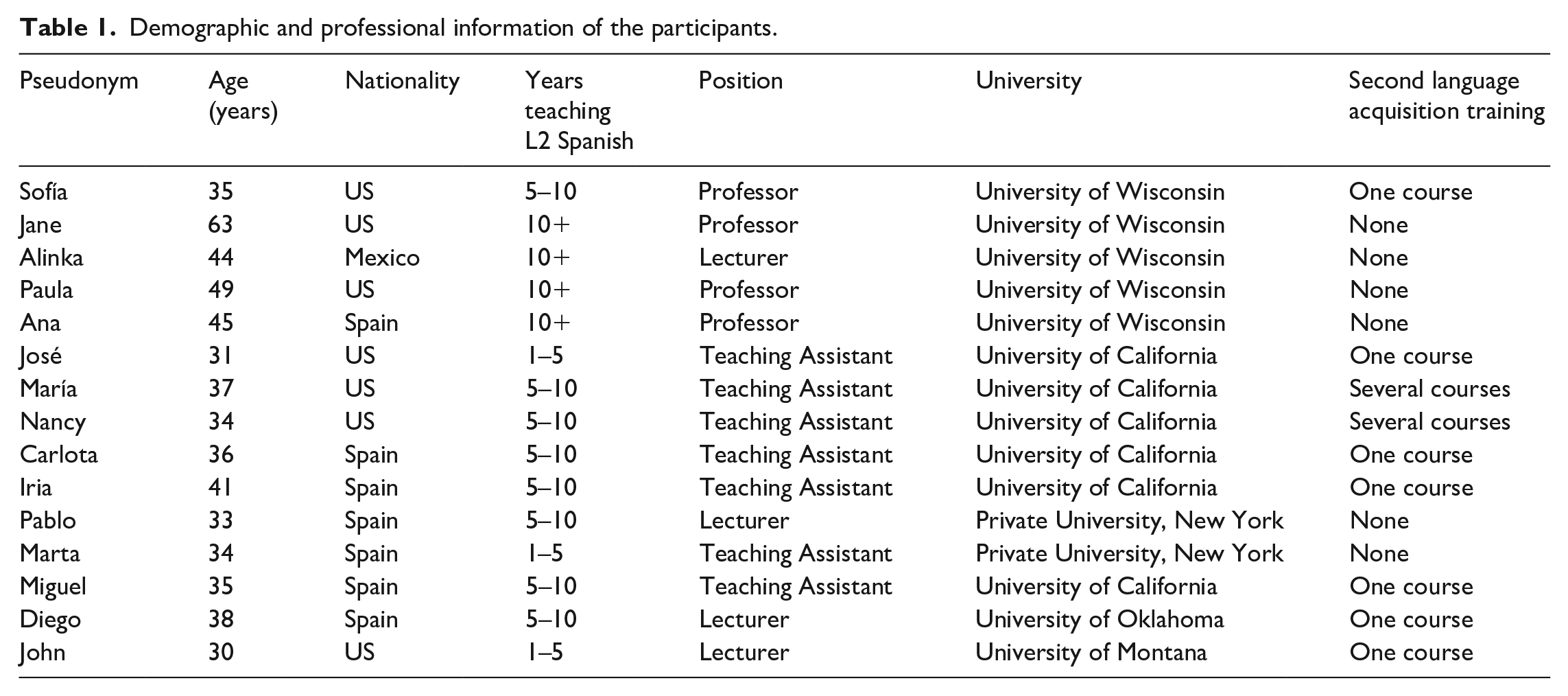
The four professors, as well as one of the lecturers, were working at one of the campuses of the University of Wisconsin. The other three lecturers worked at a private university in New York City, at the University of Montana, and at the University of Oklahoma. The TAs were mostly (n = 6) from a campus of the University of California, and one was working at another private university in New York City.
All the universities were large (i.e. over 10,000 students) and the language courses with the greater enrollment in the Spanish departments were those that satisfy a general education language requirement for students at that university. This context entails that each language course offered had multiple sections, taught by various instructors, who share a syllabus, generally created by a language coordinator or a departmental committee. Instructors cannot deviate a lot from the syllabus, given that exams in these courses are identical across sections and students need to receive a very similar training to follow the sequence of language courses offered by the department. These types of language programs also typically follow a textbook, which is used as the basis of both classroom activities and homework assignments.
2 Procedure and data structure
The professors, lecturers and one of the TAs were recruited through email invitations at Spanish departments across the US. Six of the TAs were recruited at the department of one of the researchers through a call for participation made on the listserv of the department. The interviews took place during the 2019–20 academic year and were done in person, or through Zoom when a participant was living too far from the research team. The interviews were semi-structured and included questions about the place that vocabulary teaching occupied in the instructors’ language courses, the compared difficulty of vocabulary vs. grammar learning, their overall theories of how vocabulary is acquired, the aspects of lexical knowledge that they emphasized the most in their classes, as well as criteria used to determine that a word is known by the students. At the end of the interview, some questions were asked about demographic information, previous teaching experiences and instructors’ training in SLA and vocabulary learning/teaching.
Interviews lasted 40–45 minutes on average, for a total of 641 minutes of audio-recordings. Before each interview, participants were asked to select a pseudonym. In addition to the interviews, the researchers gathered exams, assignments, syllabi, and other teaching materials from the institutions that were willing to share those with them. These additional sources of data served triangulation purposes while the interviews were the centerpiece of the study.
3 Data analysis
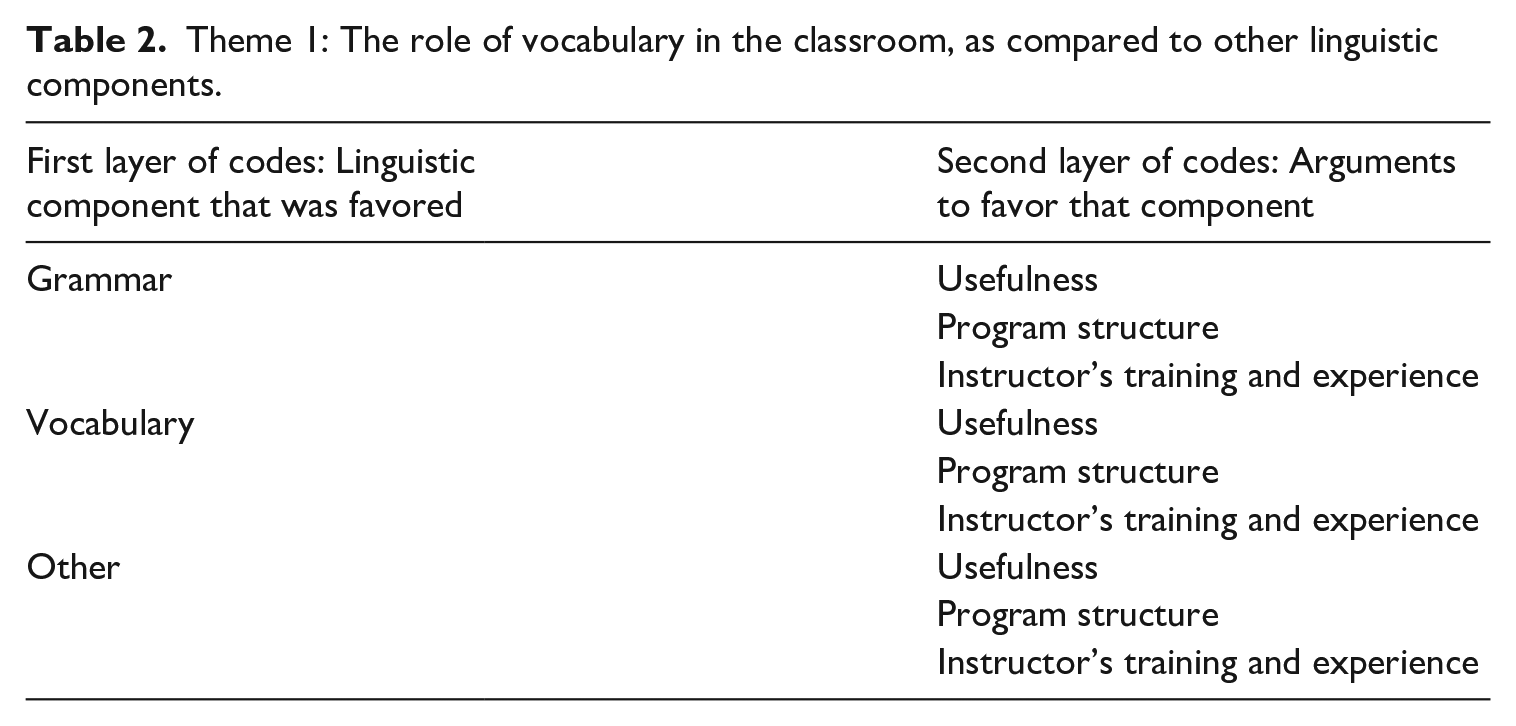
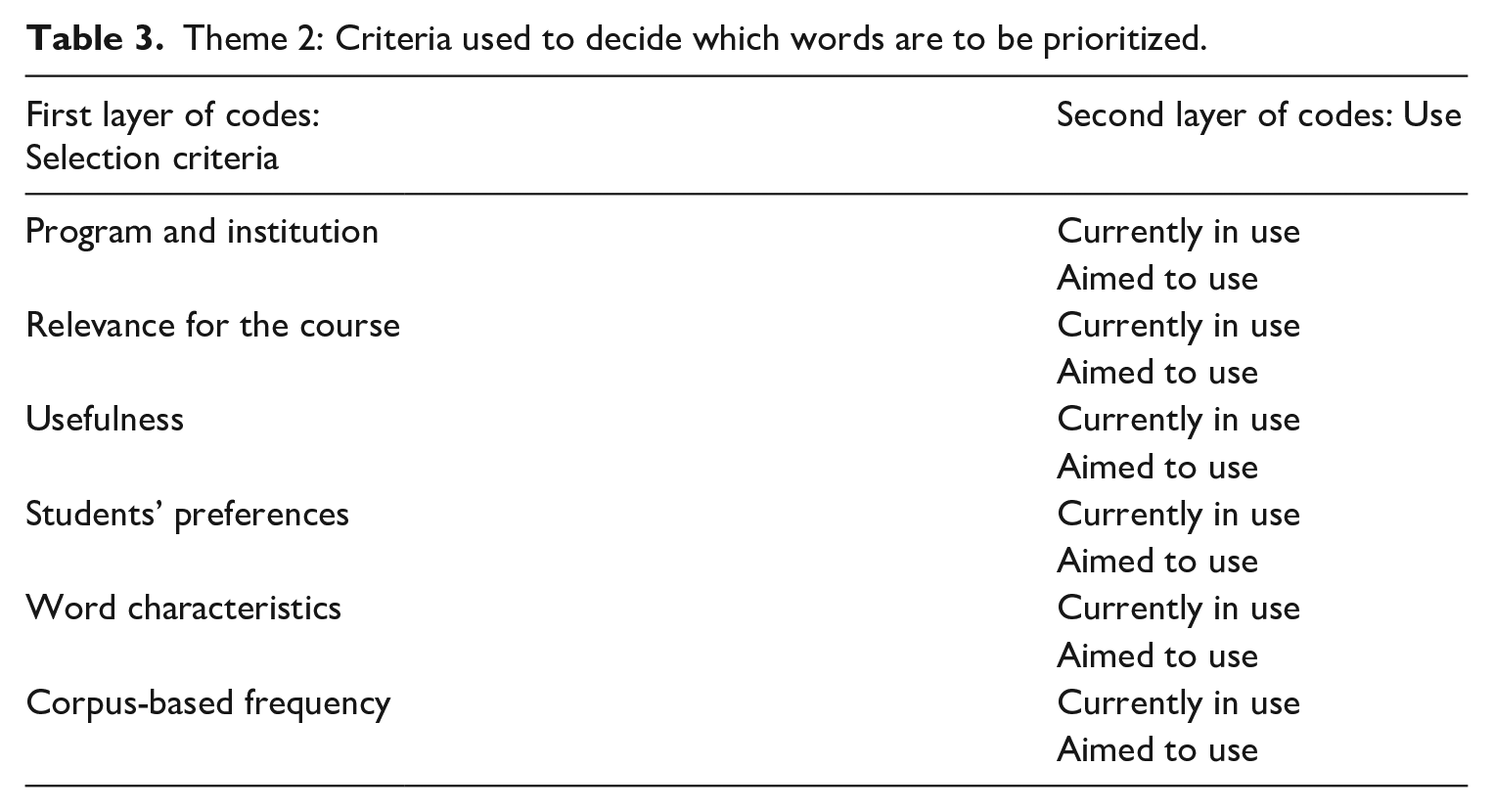
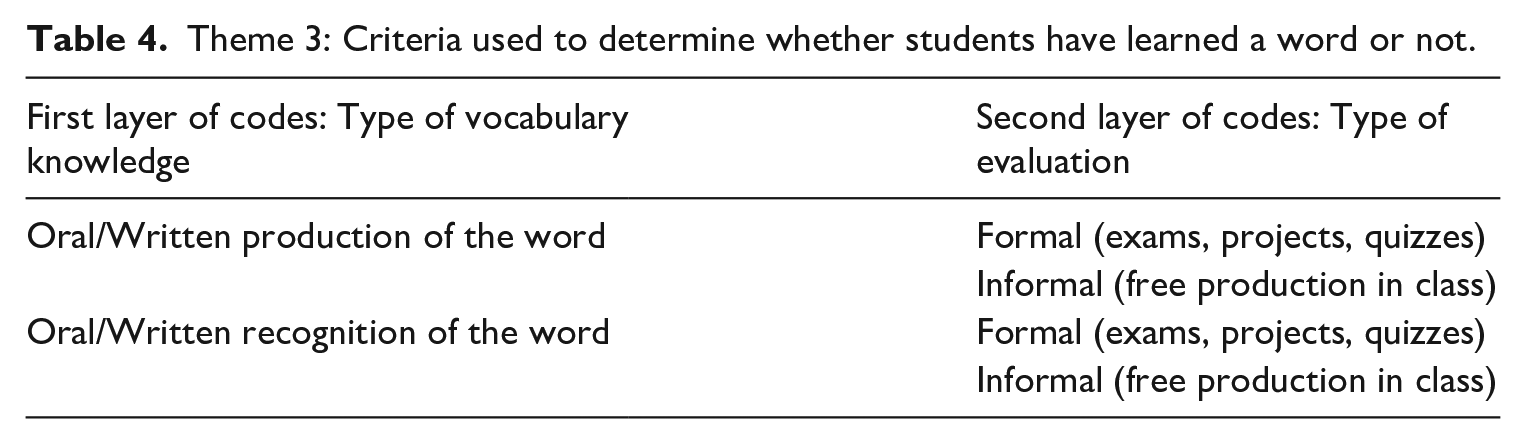
Audio recordings of the interviews were transcribed verbatim. Then, they were analysed following Grounded Theory (Corbin & Strauss, 2014). The three researchers read the transcribed interviews individually and proposed a list of main themes that emerged from their reading. After agreeing on the main themes, the team discussed additional layers of codes for each main theme based on their independent empirical reading of the data. At the end of the meeting, the three researchers agreed on the structure of codes presented in Tables 2, 3 and 4.
Theme 1: The role of vocabulary in the classroom, as compared to other linguistic components.
Theme 2: Criteria used to decide which words are to be prioritized.
Theme 3: Criteria used to determine whether students have learned a word or not.
Once the codes were established, each member of the team analysed the same set of three interviews (i.e. 20% of the data) independently, creating a tab in an excel file for each one of the themes. Then, additional layers of codes were added in subsequent columns in the excel file next to each one of the interview extracts included in the tab. An inter-rater analysis was carried out in Excel at each step of the coding, reaching an average of 91% across codes, with a maximum of 95% for Theme 1 and a minimum of 88% for Theme 3. Any code that did not reach 90% was discussed thoroughly and each researcher had to re-code the interview extracts corresponding to that code until 100% inter-rater reliability was reached. Once the inter-rater reliability process was completed, each researcher was in charge of coding one of the themes for all interviews. A final interpretative step was carried out when further analysing each of the codes. Finally, the additional sources of data (i.e. syllabi, PowerPoints, exams) were explored through a phenomenological approach (Creswell & Creswell, 2018) with the goal of informing the interpretation of the primary data from the interviews, thus adding a triangular scope.
IV Results
Theme 1: The role of vocabulary in the classroom
As evidenced in Figure 1, 11 instructors declared that grammar was the main focus of their teaching in the L2 Spanish classroom, three selected vocabulary as the content that they spent most time on in the class, and only one chose another content area (i.e. pronunciation). As to the arguments used to justify their preferences, these are further explored in the next paragraphs.
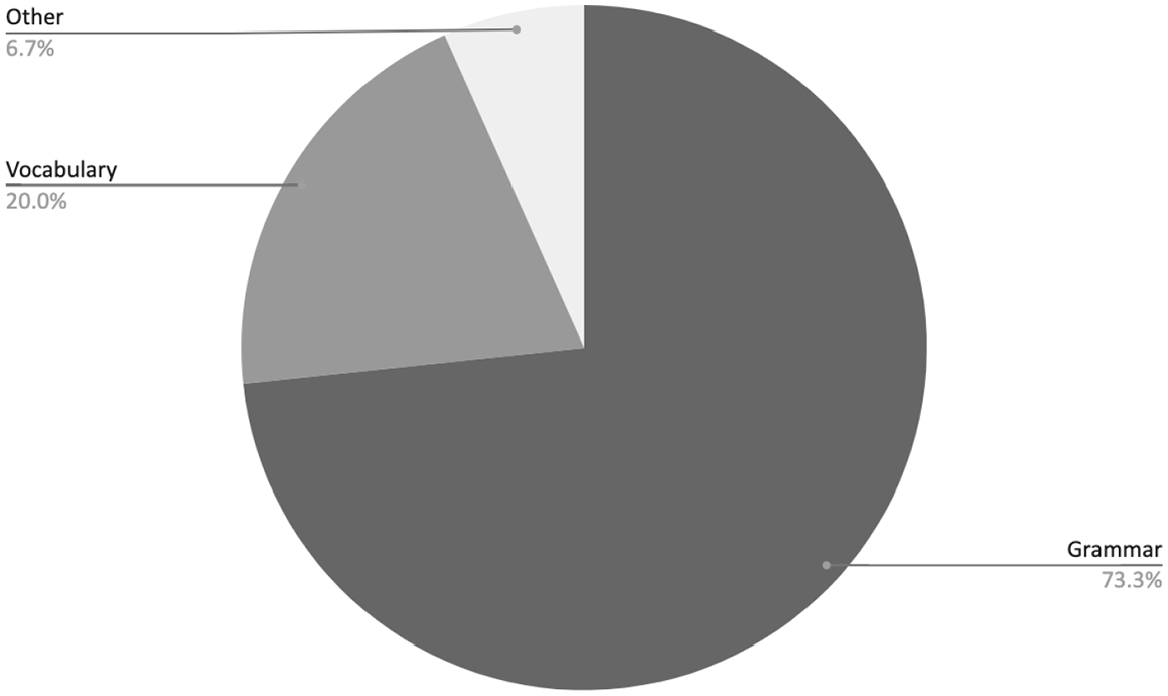
Percentages of linguistics aspects reported to be most taught by instructors.
a Arguments related to the usefulness of grammar/vocabulary
Five instructors mentioned that vocabulary learning was particularly useful, since developing lexical skills is key in being able to communicate in a second language. However, other instructors disagreed with this opinion and clearly expressed how they thought it was grammar, not vocabulary, that was the central component of fluid communication. Jane illustrated this view when she stated that ‘students cannot be understood without the structures of the language, right? And I want them to communicate well with others’. In addition to its contributions to fluent communication, Paula also mentioned how grammar is necessary for accurate reading and oral comprehension. While the idea of vocabulary being key for oral communication was shared by some instructors, none of them mentioned the role of vocabulary in the development of receptive skills.
Grammar was not only seen as most useful due to its relevance for the development of specific language skills. It was also considered by many as the most challenging aspect of language learning, which granted it a unique and central role in the classroom. As Pablo explained, ‘[students’] questions are generally about grammar, not about vocabulary’, an experience that was shared by many, as evidenced in José’s comment about how ‘when it comes to vocabulary [students] feel, at least in their mind, that they can always search for the term, the word, right? But with grammar, students feel more helpless.’ This idea that students struggle more with grammar than vocabulary thus played a role in determining that the former requires more attention in class than the latter.
Whereas grammar was generally considered as more useful than vocabulary due to its contribution to receptive and productive skills, as well as its relevance to remedy students’ difficulties, vocabulary was rarely considered useful in its own right. Indeed, out of 10 instructors who somehow acknowledged that vocabulary was useful (although less than grammar, in most cases) five considered that its main contribution was complementing grammar teaching. For example, Iria explained that she uses vocabulary as a way to practice the grammar: ‘It is through grammar that I work on vocabulary . . . When we study the family, we are going to study the possessives and, through the study of the possessives, we are going to learn the vocabulary.’
b Arguments related to the structure of the language program
Out of the eight instructors who argued that grammar teaching was prioritized in their classes due to the structure of their language program, three mentioned that they focused on grammar teaching to adhere to the syllabus, while two specifically mentioned that they spent most of their time teaching grammar because grammatical contents compose the majority of the exams that students are evaluated on. Two other instructors saw the textbook as the main reason for favoring grammar over vocabulary, as most syllabi are based on a textbook and instructors in multi-section programs cannot really deviate much from the book’s activities. Finally, Sofia also mentioned the fact that, as an instructor in a broader program, she just followed the trends established by her colleagues and did not want to diverge from what other people in her program were doing.
An examination of the syllabi and exams that were shared with us was carried out to triangulate the data from the interviews. At the Californian university, exams from the three course levels taught by the TAs interviewed were analysed. Out of 10 questions per midterm exam, no more than two were related to vocabulary in any of the courses. In the final exam, three questions out of 18 asked learners to recall specific words. Upon inquiring with the coordinator of the courses about student preparation for those questions, they shared that no specific list of target words was given to the students in advance. Students were expected to have ‘picked up’ the important words from their attendance and participation in class. At both universities in New York city, final exams consisted of 40 questions, with 10 questions that assessed students’ vocabulary knowledge. Upon asking a former instructor how students were asked to prepare for those lexical questions, they mentioned that although the glossary included at the end of each chapter in the textbook was perceived as the core vocabulary that could be assessed in the exams, not all the words were given explicit attention in classroom and homework exercises. This situation entailed that, as was the case at the Californian institution, students did not have specific guidance on (1) which words from the long end-of-unit glossary were to be given more attention to, and (2) how to study them.
In line with this general lack of attention to the lexical aspects of the language, when looking at the syllabus of the language courses at the Californian institution where TAs were interviewed, out of 50 days of class per academic quarter, only three were devoted to a clearly delineated group of words or expressions. The rest of sessions were focused on a specific grammar content and did not specifically establish a list of words to be learned. As for the institution in New York, the syllabus only specified the thematic content of each unit (i.e. leisure, health, etc.) and the grammatical contents covered in each of the units (i.e. subjunctive, commands, etc.), thus not even providing explicit information about lexical items needed to cover such thematic content.
c Arguments related to the instructor’s previous experience and training
Interestingly, while all the previously mentioned arguments for favoring grammar over vocabulary in the classroom were related to experiential and contextual factors, some participants mentioned affective reasons for this preference. For instance, three participants shared that they did not feel self-confident when teaching vocabulary and/or that they felt that they lacked the knowledge to teach it adequately. This is clearly illustrated when Sofia states that ‘I am not good at teaching vocabulary. I know it perfectly. I am not creative, I don’t even know the techniques, the theory. I know nothing.’ Such insecurities, while not pervasive among the instructors, were mentioned by two other participants, indicating that a lack of training in vocabulary teaching could potentially be triggering self-doubt when introducing and practicing lexical contents in class. This reliance on teacher training as a means to explain one’s preferences in the class was explicitly mentioned by Jane, who wondered: ‘I guess it depends on the training that a teacher received, right? We will focus more on the grammar, or the culture or the vocabulary, right?’
Pablo, alternatively, explained that it was not so much his training but rather his own experience as a language learner that influenced his decision making in introducing grammatical contents in the classroom while leaving vocabulary learning as a responsibility of the students, not necessarily included in classroom activities. Concretely, he stated that ‘I mostly studied vocabulary at home, so grammar was the content that we covered in class rather than the one that was studied independently at home.’ Finally, José was the only instructor who said that his own academic interests, and his love of Spanish syntax in particular, were the reason why he always preferred teaching grammar over vocabulary.
Theme 2: Lexical selection
When asked about their selection criteria for the vocabulary to be introduced in their classes, instructors offered a wide range of answers. As evidenced in Figure 2, eight of them focused on word characteristics, explaining how certain words should be prioritized over others (e.g. all non-cognate words over cognates, general over specific words). Program characteristics, relevance for the course, as well as usefulness, were each mentioned by six instructors, and four participants recognized that they let students’ preferences lead their lexical selection. Interestingly, the eight instructors who talked about corpus-based frequency, specified that they would be interested in using such data but that they were not currently doing so due to lack of access or limited familiarity with available resources.
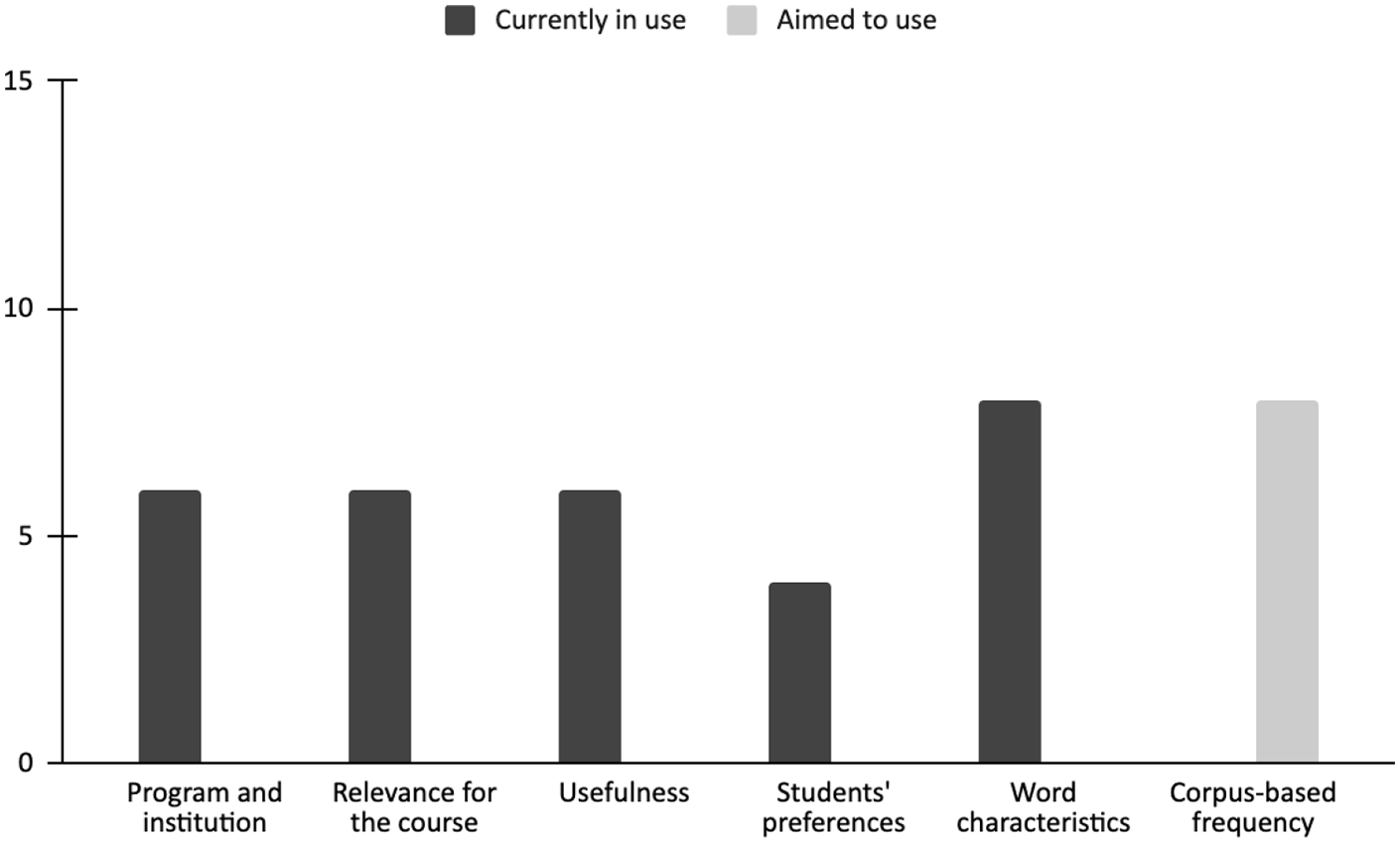
Methods of vocabulary selection criteria reported by instructors.
Out of the eight instructors who mentioned word characteristics in their lexical selection choices, six explained that they believed the words that should be prioritized in the classroom are those that are general, over those that are more specific. Concretely, they referred to teaching hyperonyms, such as fruit, before teaching hyponyms, such as apple or pear. These ideas are illustrated in Diego’s example of his own class: ‘if I say meat, it seems more useful to me than steak, which is more specific.’ John also mentioned how he would not teach cognate words, which he considers to be easier for the students to learn incidentally, and María specified that she made sure to teach content words while giving very little attention to what she called ‘grammar words’ (e.g. articles, pronouns).
As was the case when it came to deciding what linguistic contents (i.e. grammar or vocabulary) were to be prioritized in the classroom, the language program and its components also impacted instructors’ decisions about which specific words to teach. The syllabus, the textbook, and the exams were seen as the main sources of information to decide which words should be taught and which should not. This overreliance on the textbook contents was sometimes met with a touch of cynicism, as expressed by Miguel: Lots of them [program coordinators] just say ‘this is the book we are going to use’, because of some contract they have. So, let’s divide the book in semesters and then the chapters that end up in each semester, well, that’s the vocabulary. Thus, many times, there is no real logic behind it.
In addition to selecting words that were part of the textbook’s vocabulary lists, several instructors referred to how some words were more relevant than others to understand the texts from the book or to complete activities from that same book. However, as was previously mentioned, no specific list of target words was provided in preparation for the exams in any of the universities where the participants worked at the time.
Therefore, almost all instructors (n = 12) also mentioned that, when confronted with choices in deciding which words to teach (or not) from a long list such as the ones at the end of each textbook chapter, they based their selection on a subjective consideration of usefulness. Specifically, five instructors stated that they tried to figure out if a word was more or less useful for everyday life before deciding whether to teach it or not. Five other instructors shared that they relied mostly on intuition but that this lack of objective data about a word’s actual usefulness made them feel insecure about their choices. This point was made mostly by instructors who were L2 learners of Spanish themselves, as was the case with María: ‘I always use my intuition, like these words are more important than these. And maybe my intuition, I don’t know, could be wrong because it is only my second language.’
Finally, four instructors mentioned how they would count on students’ input in order to decide which words should be taught more explicitly and which should not be prioritized. For example, José explained how he tried to figure out which words students already knew and which ones they did not. Based on their previous knowledge, he would decide to focus on the words that were generally unknown.
Theme 3: Criteria used to determine whether students have learned a word or not
As evidenced in Figure 3, a vast majority of participants (n = 9) viewed knowing a word as a matter of using it in free production, preferably in informal settings. For instance, Alinka considered a word as known ‘when I ask a question and they are capable of using it in their answer’, while Paula recognized lexical knowledge ‘when they use the word when they talk to me’. John specifically mentioned that he liked hearing his students use new words when he saw them ‘somewhere outside the classroom, like on campus or something like that’, as this would be the ultimate proof of word knowledge: using it without any academic constraint. This prevalent idea of informal production as the only real evidence of knowledge was also supported by the clear preference of some instructors for oral, rather than written, production. Indeed, Maria explained how learners may look up words during writing activities but not when they are talking, which makes the latter type of production much more indicative of real mastery.
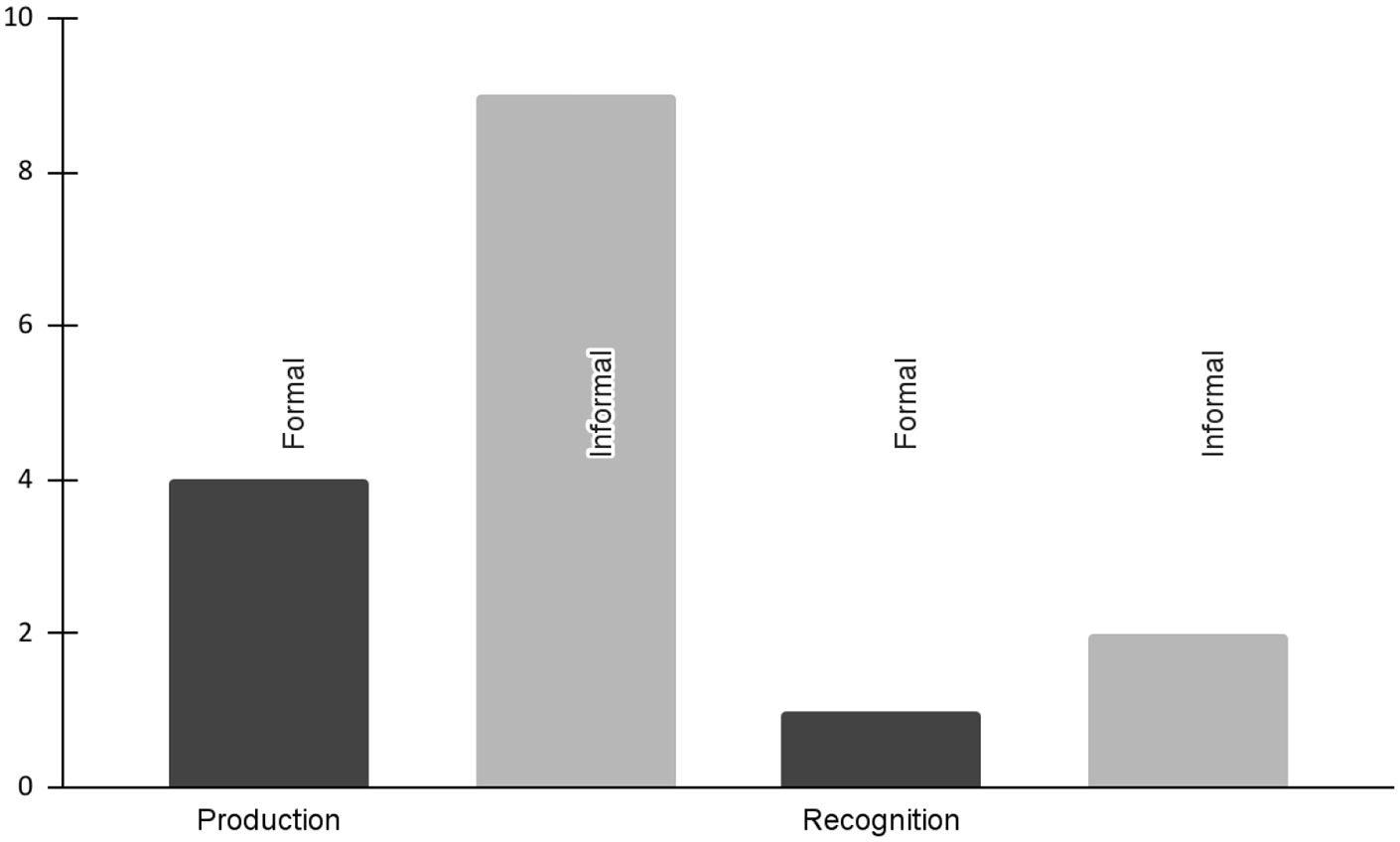
Methods of determining students’ word knowledge reported by instructors.
Several instructors did mention the importance of exams or final projects in evaluating word learning. However, only one instructor (Miguel) mentioned specific vocabulary questions in exams. Most of them considered that lexical knowledge is evidenced in formal assessments when students are able to use the words in questions that are not about vocabulary. Once again, even in more formal settings, the way to determine whether a word is known or not is to see it used when it is not necessarily expected or, at least, when the use of the word was not the goal in the first place. Interestingly, Sofía mentioned this same idea with respect to word recognition when stating that ‘they need to understand the word in order to answer the question. But I do not include fill-in-the-blank or matching exercises, though.’
Marta did say that she would evaluate word knowledge, seen as word recognition, through in-class informal games or activities that students could complete in groups. Ana also considered reading comprehension activities as key in determining whether learners have learned a word. She thus suggested including comprehension checks during those activities, which would include specific vocabulary exercises, such as multiple-choice questions, true or false statements or word translation activities. Ana concluded that ‘That would be, certainly, one way of knowing if they have learnt it or not: recognizing the word and knowing its meaning, not only producing it.’ This statement also summarizes the shared idea that lexical knowledge is a matter of associating a word form with a meaning. Indeed, out of 15 instructors, only two (Alinka and John) ever mentioned an aspect of word knowledge other than form-meaning association, and both focused on constraints of use. Indeed, they both emphasized the importance of knowing not only the meaning of the word but also when and with whom it is most appropriate to use.
Finally, it is worth mentioning that one participant even questioned the usefulness of word knowledge assessment, as he admitted the difficulty of taking any sort of meaningful action based on the information from said assessment. Specifically, Miguel stated that ‘if you realize that they do not know a word, you cannot come back to it, you move forward’, because the syllabus needs to be followed and vocabulary recycling from previous chapters/days is rarely seen as an option. Again, such a view of vocabulary assessment as being essentially worthless may also explain why most instructors preferred informal evaluations based on out-of-class or non-vocabulary focused interactions. If real assessment does not provide information that can be used, then it is better to just do what Doña Ángela suggested: ‘get excited’ when hearing a student use a new word in unexpected contexts.
V Discussion
This study aims to offer insights into the beliefs and reported practices about vocabulary learning and teaching of Spanish language teachers at large US universities. Results indicate that most teacher-participants report devoting more in-class time to grammar than to any other linguistic aspect or skill. Many teachers believe that grammar is simply more useful than vocabulary when it comes to the development of productive and receptive skills, a view that does not concur with findings in SLA about the importance of vocabulary in forming those skills (Hilton, 2008; Horst, 2013; Nation & Hunston, 2013; Qian & Lin, 2020; Schmitt, Jiang & Grabe, 2011; Stæhr, 2008). Alternatively, vocabulary was often seen as a complement of grammar rather than a course content in its own right, which, again, does not align with previous research that emphasizes the need for intentional and explicit vocabulary teaching/learning (Barcroft, 2004, 2020; Laufer, 2006, 2008; Laufer & Girsai, 2008). Overall, these findings confirm those from previous literature that focused on EFL/ESL teachers in different contexts, such as Sweden (Bergström et al., 2021) and Cambodia (Lim, 2016). Indeed, teachers in those studies also considered vocabulary knowledge as a by-product of grammatical development in the sense that they expected word knowledge to develop incidentally through exposure to relevant words during explicit explanations and practice of grammatical contents.
While the belief that grammar is the centerpiece of a language course was shared by the vast majority of instructors, as was also documented in previous studies, the reasons that underlie this belief varied across participants. Many agreed that grammar needs more attention because it is simply more difficult and that it presents more challenges for the students, but others also acknowledged that the teaching materials, exams, and overall institutional practices at their universities were behind the greater focus on grammar than on other elements of the language. Upon reviewing the exams and syllabi that we had access to, it was confirmed that few days of the academic terms were devoted to specific vocabulary learning goals and few questions in the exams evaluated lexical knowledge. In certain cases, the limited attention to vocabulary in the curricular, pedagogical, and assessment materials provided to the teachers, as well as the reported lack of specialized training in language teaching in general and vocabulary teaching in particular, not only resulted in a superficial treatment of lexical matters but also in a feeling of self-doubt when making vocabulary teaching decisions.
One of the aspects of vocabulary teaching that triggered those insecurities is the selection of the specific words that are to be taught in a particular class, since instructors do not feel that they have access to the necessary tools to make informed decisions about a word’s real usefulness for their students. For instance, most instructors reported that they would be interested in using corpus-based word lists to select adequate vocabulary for their classes but do not even know where to find such lists. In Dang and Webb (2020), the Vietnamese EFL teachers ranked corpus-based word lists as the least useful sources of information when deciding which words to teach. In this study, the instructors did not complain about those lists not being useful but rather about not having access to them easily. Where the teachers in both studies did agree was on the fact that they mostly rely on textbook contents and on their own sense of what constitutes a word’s usefulness.
A current trend in the field of vocabulary selection for L2 teaching/learning is to consider that words that are extremely frequent in corpus-based word lists may not necessarily be useful in the classroom context where instructed SLA takes place. As was mentioned earlier, blackboard may be quite infrequent but also extremely useful when so much of the action in the L2/FL class happens on an actual blackboard. Therefore, teachers’ rankings of words’ usefulness have been increasingly taken into account in recent projects (Dang et al., 2020; Garnier & Schmitt, 2015; He & Godfroid, 2019; Stein, 2017). Nonetheless, no study, to the best of our knowledge, had previously dug deeper into the underlying arguments for those rankings.
In this study, some teachers mentioned that more general words should be taught first. Thus, meat should be taught before steak, since all steaks are meat but not all meat is steak. Others also argued that cognates do not require as much attention as non-cognates since the former are seen as easy to learn. A lot of participants, though, mainly reported centering their decision making around the contents of the exam and the textbook. This aligns with Dang and Webb’s (2020) findings, as the instructors in their study also mentioned basing many of their lexical selection decisions on textbooks. In that study, teachers also recognized that they frequently had to use their own intuitions, a practice that is similar to those reported by our interviewees. In the present study, those intuitions were mainly based on either the perceived immediate relevance of a word for particular classroom activities, or its expected relevance in real life, that is, outside the classroom. Finally, a few instructors reported trying to figure out which words were already known by their students, and which were not, in order to devote more time to the unknown ones. While this idea coincides with the recent efforts made by Brysbaert, Keuleers and Mandera (2020) to create word lists based on actual learners’ knowledge, it should be pointed out that teachers are not necessarily the best judges of the words their students do and do not know (Sánchez Gutiérrez & Robles García, in press).
Interestingly, the difficulties in determining which words are mastered and which are not may come from the overreliance on informal assessments of lexical knowledge. As was mentioned before, exams focus mostly on grammatical questions, and the coordinator of the courses at one university recognized that no specific set of target words was established for those exams. Therefore, when it comes to vocabulary teaching/learning, no clear learning objectives seem to be included in the syllabus and the same can be said of unclear vocabulary assessment criteria in exams. As a result, teachers appear unsure about what exactly they are supposed to teach and evaluate. Some teachers even question the usefulness of vocabulary evaluation, since they state that the syllabus prevents the systematic recycling of vocabulary from previous units/chapters. In this context, it does not come as a surprise that teachers consider that learners’ lexical knowledge should mostly be assessed informally, when a student uses a word in a context that did not require the use of that particular word. Some instructors even mentioned that the only way they would consider a word as really known would be by hearing their students using it in spontaneous speech, outside of the classroom.
VI Conclusions
While research on the beliefs of L2/FL instructors has seen a surge in the last 20 years, due to an increased interest for teacher cognition (Borg, 2003, 2006), these efforts have mainly focused on grammar rather than vocabulary or other aspects of language learning/teaching. So far, the few studies that have been carried out on L2/FL teachers’ beliefs about vocabulary learning and teaching have looked exclusively at EFL/ESL instructors (Bergström et al., 2021; Gerami & Noordin, 2013; Gao & Ma, 2011; Lim, 2016; Macalister, 2012). This study aims to shift the focus onto another group of L2/FL practitioners: L2 Spanish instructors at large US universities, with the ultimate goal of paving the way towards better teacher training programs in Spanish doctoral programs in the US by better understanding where current instructors stand when it comes to vocabulary teaching. Indeed, as was proposed by Korthagen (2017), an important step in developing a teacher training program is to know what teachers believe, what they do, and where those behaviors come from, to develop programs that address those beliefs and use them as stepping stones for growth.
Results indicate that participants give significantly more attention to grammar than to vocabulary in their classes, due to teachers’ (1) view of grammar as more challenging and useful, (2) need to follow institutional practices and materials and (3) tendency to reproduce their own previous language learning experiences. Instructors also expressed insecurities when it came to selecting the specific word targets for their classes and attributed those insecurities to underspecified vocabulary learning goals at the institutional level but also to lack of access to relevant resources such as corpus-based word lists and to their limited pedagogical training. The lack of clarity about what exactly needs to be taught contributes to seeing vocabulary learning as a second-class content which is so difficult to evaluate that only informal assessments ‘in the hallways’ could actually demonstrate real word knowledge.
Overall, our data indicate that Spanish teachers at US colleges and universities may need additional training when it comes to vocabulary teaching. In this context, we propose that TAs and language instructors be presented with useful tools that are available, such as corpus-based vocabulary lists, and be taught how to use them to complement textbook glossaries. Teacher training programs also need to emphasize that words can be learned to different levels. For example, students may recognize the meaning of some words in reading while not being able to produce them in speech. Even though teachers believe that the ultimate goal of vocabulary learning is to use words in fluent speech, achieving such intermediate levels of knowledge is a necessary step and may sometimes be enough to achieve the communicative goals of students at lower levels of proficiency. Therefore, these intermediate stages of learning should also be acknowledged and tested systematically. Additionally, during the teacher training sessions, instructors could work on the design of teaching activities that explore aspects of lexical knowledge that are not limited to form-meaning associations, such as recognizing multi-word expressions, using productive derivational morphemes to find additional members of a word family, etc. These different strategies aim at multiplying the tools that language instructors have when it comes to vocabulary teaching and at recognizing the complexity of lexical knowledge and the amount of explicit attention that is needed for words’ long-term retention and fluent use.
In addition to enhanced training on vocabulary teaching for instructors, language programs should devote more time to establishing explicit vocabulary learning goals and connecting those with formal word knowledge assessment. Indeed, providing learners with a subset of the most important words from the textbook glossary and identifying them as the lexical targets for a particular unit/chapter would provide clarity to both instructors and students about their shared lexical learning objectives, while still leaving some space to use other vocabulary, when necessary. For instance, students could consult the textbook glossary to find the meaning of some low frequency words in an in-class written comprehension exercise, but would not be requested to learn these by heart to use them productively in any assessment, if these are not in the list of target words for the unit. Making clear distinctions between words whose meaning is searched for immediate comprehension (or to complete a single activity), and words that are expected to be learned in the long term because they are among the most frequent and useful ones would be a great starting point for organized lexical learning and teaching (Horst, 2013; Rankin, 2019). Ideally, the creation of such targeted vocabulary lists would be carried out through a collaboration between teachers and program directors to make sure that, while lexical frequency remains a central argument in vocabulary selection, instructors also get to comment on their experience of which words are more useful, or challenging, for learners. This approach, which combines objective corpus-based frequency data with more teacher-based and knowledge-based views of words’ usefulness, would be in line with current recommendations on lexical selection (Rankin, 2019).
Finally, while this study does contribute to the literature by providing the first insights into how Spanish language teachers at large US universities approach vocabulary teaching/learning, the data shared here are limited to self-reports in interviews. Future research needs to add classroom observations to provide more reliable data about what is actually happening in real classes and thus complement the present findings.
Footnotes
Funding
The author(s) disclosed receipt of the following financial support for the research, authorship, and/or publication of this article: The first author received a Small Grant in Aid of Research from the Academic Senate of the University of California, Davis.
