




Abstract
World language teachers have historically relied on the notion of teaching methods to inform elements of design and procedure in their instructional practice. Teacher beliefs about teaching methods, however, have been shown to be significantly influenced by their context, including their institution and their learners. This phenomenon has led some scholars to identify a postmethod condition, where teachers prioritize making responsive, principled decisions about instruction based on their context. This qualitative study investigated the patterns and realities of the postmethod condition in practice through the lens of teacher beliefs about teaching methods, focusing on ten secondary-level world language teachers of French and Spanish in the USA. Data sources included a survey about teaching methods, in-depth interviews, and classroom observations. Data analysis included descriptive statistics, multiple phases of coding, and integrating analysis of the three sources. Findings indicated that teachers in this group largely identified as adhering to one main teaching approach, with eight of the ten self-identifying as using primarily comprehensible input and/or TPRS (Teaching Proficiency through Reading and Storytelling) methods. However, through investigating their beliefs about grammar and accuracy; the four skills of reading, writing, listening, and speaking; the importance of input and output; and instructional flow, we found that the teachers examined and reexamined their teaching methods regularly, largely due to the influences of their learners and their institution. The relationship between the teachers’ beliefs and practices was mediated by context-driven instructional decision-making, indicating the presence of a postmethod condition.
Keywords
I Introduction
Scholars have long identified the practical value of teaching methods for world language (WL) teachers, who rely on them to inform elements of design and procedure in their instructional practice (D.M. Bell, 2003; Larsen-Freeman & Anderson, 2011). Richards and Rodgers (2014) stated ‘a [teaching] method is theoretically related to an approach, is organizationally determined by a design, and is practically realized in procedure’ (Richards & Rodgers, 2014, p. 22). While some contemporary language teacher education textbooks have explicitly rejected the idea or pursuit of one perfect method (see for example Shrum & Glisan, 2016), empirical research has demonstrated that classroom teachers still may use and describe methods as tools from which they select to accomplish various instructional goals (D.M. Bell, 2003; Richard & Rodgers, 2014). To describe this current usage of methods, some scholars have suggested the existence of a ‘postmethod condition’ in the field, which emphasizes the unique roles and influences of the teacher and their context on language instruction (Akbari, 2008; Brown, 2002; Kumaravadivelu, 2001; Prabhu, 1990). The heart of postmethod pedagogy lies in teachers’ responsive, principled decision-making within their own sociocultural settings (Kumaravadivelu, 2001). Kumaravadivelu (2006) identified three pedagogic parameters for the postmethod condition: particularity (emphasizing local exigencies and lived experiences); practicality (renavigating the relationship between theory and practice by focusing on teachers’ reflection and action, based on their insights and intuition); and possibility (taking into account the larger social, economic, and political environment, as well as language ideology and learner identity).
Instruction that conforms to postmethod thinking is said to remain more open to change and responsive, with instructional decisions being determined by teachers’ personal ‘sense of plausibility’ about the effectiveness of teaching practices for student learning rather than seeking methods as such (Prabhu, 1990, p. 172; Larsen-Freeman & Anderson, 2011). Kumaravadivelu (2001) asserted that postmethod is a new ‘organizing principle’ (p. 557) in which teachers and learners together define their own instructional aims and approaches, with an ongoing interplay of theory and practice within the daily classroom setting.
The postmethod condition has been critiqued, however, as missing a ‘proper understanding of the limits within which teachers perform’ (Akbari, 2008, p. 645). Language teachers have many demands placed upon them, and developing and carrying out their own unique, theoretical stance is not necessarily feasible due to the circumstances in which they teach. Although some have seen this as an inherent flaw in the notion of postmethod pedagogy (Akbari, 2008; Al-Kadi, 2020), an alternate perspective is that that the complexity and interplay of teaching and learning scenarios merits further inquiry in varied contexts (Aboulalaei et al., 2016). Indeed, few empirical works have traced the patterns and realities of the postmethod condition in practice, as many researchers have noted (e.g. Al-Kadi, 2020; Soomro & Almalki, 2017). This qualitative study attempts to investigate this critique of the postmethod condition by interrogating the postmethod condition in a specific context, primarily through the lens of teacher beliefs. This interrogation is related to the study of the relationship between teacher cognition and practices, which has been shown to be inconsistent in some analyses (e.g. Allen, 2002; Gatbonton, 1999; Farrell & Bennis, 2013) and highly context-dependent in others (e.g. Borg, 2006; Breen et al., 2001; Farrell & Guz, 2019; Pan & Block, 2011). In our focus on the postmethod condition, we are centering our analysis on how and why a shift might occur between teacher beliefs (especially beliefs about teaching methods) and practices, particularly insofar as that shift represents conscious decision-making on the part of the teacher. Our qualitative descriptive study (Sandelowski, 2010), with data from teacher surveys, interviews, and classroom observations, will focus on staying close to the data in our representation and interpretations of how teachers talk about their methods. In this, we will investigate how a postmethod condition might exist for modern secondary WL teachers, that is, teachers who teach languages other than English in the USA at the high school or junior high levels.
II Literature review
1 Teacher beliefs about teaching and learning
Research has indicated that language teacher beliefs address a range of topics and include a variety of frameworks for looking at their work. Teacher beliefs are judgments people make about assertions or opinions, and which are inferred from their speech, actions, and intentions (Pajares, 1992). Empirical studies of language teacher beliefs and their teaching methods have shed some light on how teachers think about and implement instruction. Some findings and themes differ based on the teaching context, language taught, and levels of the students, but there are strong trends in language teacher beliefs that are shared across many contexts of language learning, including both foreign/world and second language teaching. The three main contexts of this research have been ESL (English as a second language) in the USA, WL in the USA (sometimes called foreign language or FL), and EFL (English as a foreign language) outside of the USA. For instance, Borg (2003), in looking at studies conducted in ESL, WL, and EFL teaching contexts, noted that language teacher beliefs tended to be most firm in the areas of focus on form and error correction, both of which are closely related to how grammar is taught (Basturkmen et al., 2004; T.R. Bell, 2005; Borg, 2006; Farrell & Bennis, 2013; Gatbonton, 1999; Phipps & Borg, 2009). However, most studies examining language teacher beliefs about teaching methods have suggested that teacher beliefs are ‘far from simple’, containing inherent complexities and contradictions (Farrell & Bennis, 2013, p. 174). For instance, Allen (2002) found that WL teachers believed instruction should be standards-based and delivered in the target language; however, those teachers also expressed belief in the coverage model, where textbooks guide the curriculum. The contrast was echoed in a study by Gatbonton (1999), who found that ESL teachers expressed concern about developing students’ communicative skills while still supporting the promotion of specific language elements. The contradictory and context-specific beliefs expressed by the participant teachers in both of these studies belied their adherence to one specific method, instead suggesting that their teaching was guided by principled decision-making, a hallmark of the postmethod condition.
Phipps and Borg (2009) suggested the concept of core and peripheral beliefs as one way of articulating the tensions within one teacher’s set of beliefs. Where the core beliefs identified in their study were generic, central, and firmly grounded in real-life experience, the peripheral beliefs were more theoretically embraced but not necessarily reflected in practice. Similarly, Woods and Çakır (2011) focused on how six newly-graduated English teachers in Turkey conceptualized communicative language teaching (CLT). They found that theoretical and non-personal knowledge was valued and considered correct by the teachers, but it was isolated from their experience. In cases where that theoretical knowledge could be connected to actual experience, it was often deconstructed, personalized, and reinterpreted. Other studies have also suggested that teacher beliefs did not conform to the theories from the research in the field, or at least had a complex relationship with them (Basturkmen et al., 2004; Borg, 2003; Farrell & Guz, 2019). Furthermore, Breen et al. (2001) argued in their study about ESL instructors in Australia that beliefs or principles are not always directly connected to specific practices, and indeed, that a single belief might be ‘realized in action through several different practices’, while a single practice might be an expression of more than one principle (Breen et al., 2001, p. 495).
Although these studies about teacher beliefs do not explicitly reference the postmethod condition in their analyses, several clear connections with postmethod thinking can be inferred in their depiction of the relationship between teacher beliefs and practice. Many of these researchers concluded that language teachers went through a process of principled decision-making in order to determine how their beliefs would be reflected in their practice. Additionally, many studies suggested that teachers relied on their own instincts and insights about teaching in order to decide what to do in their classrooms. This finding echoes the idea of practicality (renavigating the relationship between theory and practice by focusing on teachers’ reflection and action, based on their insights and intuition) in the postmethod pedagogy (Kumaravadivelu, 2006). Thus, a closer consideration of the postmethod condition in examining teacher beliefs about teaching and learning is clearly warranted in order to identify if these suggested connections also emerge in a more targeted analysis.
2 Teacher beliefs in context
Another major area of research on language teacher beliefs about teaching and learning involves the interplay between language teaching and teacher context. Language teacher beliefs have been shown to be influenced by two major components of the teaching context: the learner interactional context (Borg, 2006; Breen et al., 2001), and the supervisory and institutional context (Borg, 2003). In this section, we will examine how the research has reflected the importance of these contexts in teacher belief research, and we will further connect those findings to major components of the postmethod condition.
a Learner interactional context
Studies have shown that the learners have exerted as much of an influence on teachers’ instructional decisions as the teachers’ beliefs and their programs’ expectations (Breen et al., 2001; Farrell & Guz, 2019). Borg (2006) concluded based on a number of studies that experienced teachers’ departure from lesson plans was often based on the instructional context of the students and their needs. For example, Farrell and Bennis (2013) studied a novice teacher, Troy, who prioritized maintaining a good rapport with his students. When he abandoned approaches associated with his other beliefs, the researchers attributed his decision to the lack of enthusiasm shown by his students for the task. Here we distinctly see a teacher engaging in principled decision-making about his teaching, a hallmark of the postmethod condition. Wassell et al. (2019) similarly found that students’ perspectives and contributions about social justice topics in the WL classroom led their instructors to question and reconsider their own social justice stances. Students’ learning was found to be shaped by teaching in that study, but it was equally found to shape teaching. In Phipps and Borg’s (2009) study, beliefs and practices about grammar instruction were compared. Several times teachers said they preferred contextual, discovery-based treatment of grammar, but they believed that students expected grammar to be presented in rule and practice formats instead (Phipps & Borg, 2009).
Breen et al. (2001) identified a common shared principle in their study of 18 experienced ESL teachers: ‘taking account of individual differences between students and/or the specific characteristics of individual students’ (p. 489). Although most of this study identified a distinct diversity in teachers’ principles across the 18 teachers, this principle was widely shared. This finding conforms to the idea of core beliefs (good rapport with students) dominating over peripheral beliefs (the best teaching approach) (Farrell & Bennis, 2013; Phipps & Borg, 2009). It also suggests the presence of postmethod thinking with the teachers in that study, where their classroom practice was based on a more improvisatory, context-based understanding of teaching rather than one governed by methods-based principles.
b Supervisory and institutional context
Research has shown that teachers may do things in class to satisfy expectations from supervisors or institutions, even if their own beliefs about language instruction conflict with those expectations. In some cases, these tensions or negotiations have been framed or articulated with references to established teaching methods. For instance, Pan and Block (2011) found that Chinese teachers of English held powerful beliefs about the importance of CLT, but felt strong pressure from the testing culture and expectations in China to modify their practice accordingly. Other studies have similarly identified pressures on CLT-focused teachers as a result of the high-stakes testing in their contexts (Li, 1998; Littlewood, 2007; Phipps & Borg, 2009). Studies have also addressed how teacher behavior has been influenced by course components other than assessment. For instance, Farrell and Guz (2019), in a study of the relationship between stated beliefs and practice for one university-level ESL teacher, Luiza, found that she rarely diverged from her stated beliefs, except when the program’s expectations or syllabus dictated that she must do so. Luiza primarily used textbook readings and included extensive reading in her class, two things that she stated clearly were not in line with her beliefs. Childs (2011) found in her case study of one university-level German teacher that the teacher, Mark, felt obligated to teach according to his department-mandated standards-driven textbook, even when it did not fit with his original ideas about the importance of CLT.
Thus, institutionally-determined course components like assessments, textbooks, syllabi, and standardized expectations, often framed in terms of specific teaching methods, have been shown in a variety of contexts to be important influences on teacher behavior. Even when the teachers’ stated beliefs ran counter to institutional expectations, they tended to adhere to those constraints. The beliefs literature thus mirrors what Kumaravadivelu (2006) identified as an inherent tension in modern language teaching: ‘teachers find themselves in an unenviable position where they have to straddle two pedagogic worlds: a method-based one that is imposed on them, and a methodological one that is improvised by them’ (p. 170). The question remains of how to resolve this discontinuity or discrepancy in how teachers think and talk about their teaching methods in theory and in practice.
Language teacher beliefs about teaching methods have been therefore shown in some research to be mediated by interactions with learners as well as by supervisory and institutional factors. The postmethod condition explains this phenomenon through adopting a perspective of situational understanding, key to the pedagogic parameter of particularity, which emphasizes teachers’ local exigencies and lived experiences (Kumaravadivelu, 2006). The postmethod condition, thus, assumes that teachers’ methods encompass what they experience and how they live their teaching lives, avoiding the idea that they have somehow violated their principles by adapting and changing to the particularity of their environment. This connection between the previous scholarship on teacher beliefs and the postmethod condition will be explored further in this article, again attempting to identify if these connections persist in a more targeted analysis.
3 Research gap
The presence of a postmethod condition is therefore suggested by teacher belief studies across the field of language education. However, very few of these studies engage with the notion of teaching methods as they are related to teacher cognition. In those cases, the methods are studied as something that was imposed or violated, rather than as something that was negotiated or reformulated as a postmethod. In addition, most research on language teacher beliefs and practices has generally taken place in ESL or EFL classrooms with adult learners. Scholars have long called for research about language teacher beliefs in ‘more representative’ classrooms (Borg, 2003, p. 98; Phipps & Borg, 2009). Thus far, settings such as US K-12 public school WL classrooms have not been the main focus of scholarly attention about teachers, beliefs, and methods. This study fills part of the need to understand how teachers think about and subsequently enact their instruction while synthesizing many contextual factors.
III Research questions
This study examines teacher beliefs about instructional practices as framed by the notion of the postmethod condition. The research questions guiding this study are:
What beliefs about language teaching and learning do WL teachers in this study express in their description of their teaching methods?
How are their methods and beliefs influenced and/or altered by their teaching context?
IV Methods
This qualitative descriptive study is designed to produce findings that are close to the data as given (Sandelowski, 2009, p. 78). This type of qualitative study relies on systematic data analysis of a variety of qualitative data sources and does not identify with a specific classification of qualitative method (e.g. grounded theory, ethnography, phenomenology). In carrying out this qualitative work, we draw from the general qualitative analysis procedures outlined by Miles and Huberman (1994). This study leveraged teacher surveys and interviews to elicit WL teachers’ beliefs about language instruction and language teaching methods. In these data sources, the teachers also reported on their instructional practices. Our other major data source was direct observation of the teachers’ classrooms and teaching. Because of this study’s constructivist foundations, we do not make claims regarding its generalizability to other teachers and contexts. Instead, we seek to identify patterns that may reflect or expand on studies done in other contexts, and to describe the teachers’ beliefs and practices in sufficient detail so as to guide the reader in considering the transferability of our findings to contexts with which they are familiar.
1 Context
The setting for this study was a large public school district in the USA with an average Free and Reduced Lunch population of 65%. Within this urban K-12 district, languages were offered primarily as an elective subject in middle schools and high schools, and teachers were granted autonomy to teach according to their individually held beliefs about language teaching and learning. One member of the research team previously worked in the district for several years and so was familiar with the context and the professional procedures and discourse used in the district. Before participants were recruited for the study, it was known that the district leadership consistently supported teachers’ use of CI (Comprehensible Input) 1 and TPRS (Teaching Proficiency through Reading and Storytelling) 2 teaching methods. These methods, largely stemming from a grassroots movement led by teachers, independent consultants, and authors in the USA, are less commonly taught in formal teacher education programs and are primarily found in US K-12 WL educational settings (Lanier, 2019). The WL department had an internally developed Scope and Sequence that aligned with state standards and the World-Readiness Standards for Learning Languages (National Standards Collaborative Board, 2015). This comprehensive planning document was created in collaboration by veteran WL teachers, and it included guidelines and samples of linguistic and cultural content and materials to be addressed at each level of French and Spanish. A performance assessment that measured students’ functional ability in the language was also implemented biannually. Students’ yearlong growth was used in conjunction with other data as a means by which to evaluate teachers’ performance (see also Vyn, Wesely, & Neubauer, 2019).
2 Participants
Ten teachers of French and Spanish volunteered to take part in the study (Table 1). Of these, five were native speakers of the language, and eight reported having earned a master’s degree or higher. Collectively, their average years of language teaching experience was nine, with only one teacher that had been teaching for fewer than five years. Although they all taught in the same district, their teaching contexts were not demographically identical. As Table 1 illustrates, the majority of the teachers self-identified as teaching with either CI or CI/TPRS; in the interviews, all of those teachers explained that they were introduced to these methods after their initial teacher training, through professional development workshops in the district, or independently. This approach to language instruction is important to consider insofar as it figures into the teachers’ definitions of and discourse about their teaching methods and the possible existence of a postmethod condition in this context.
Participant details (as of Spring 2016).
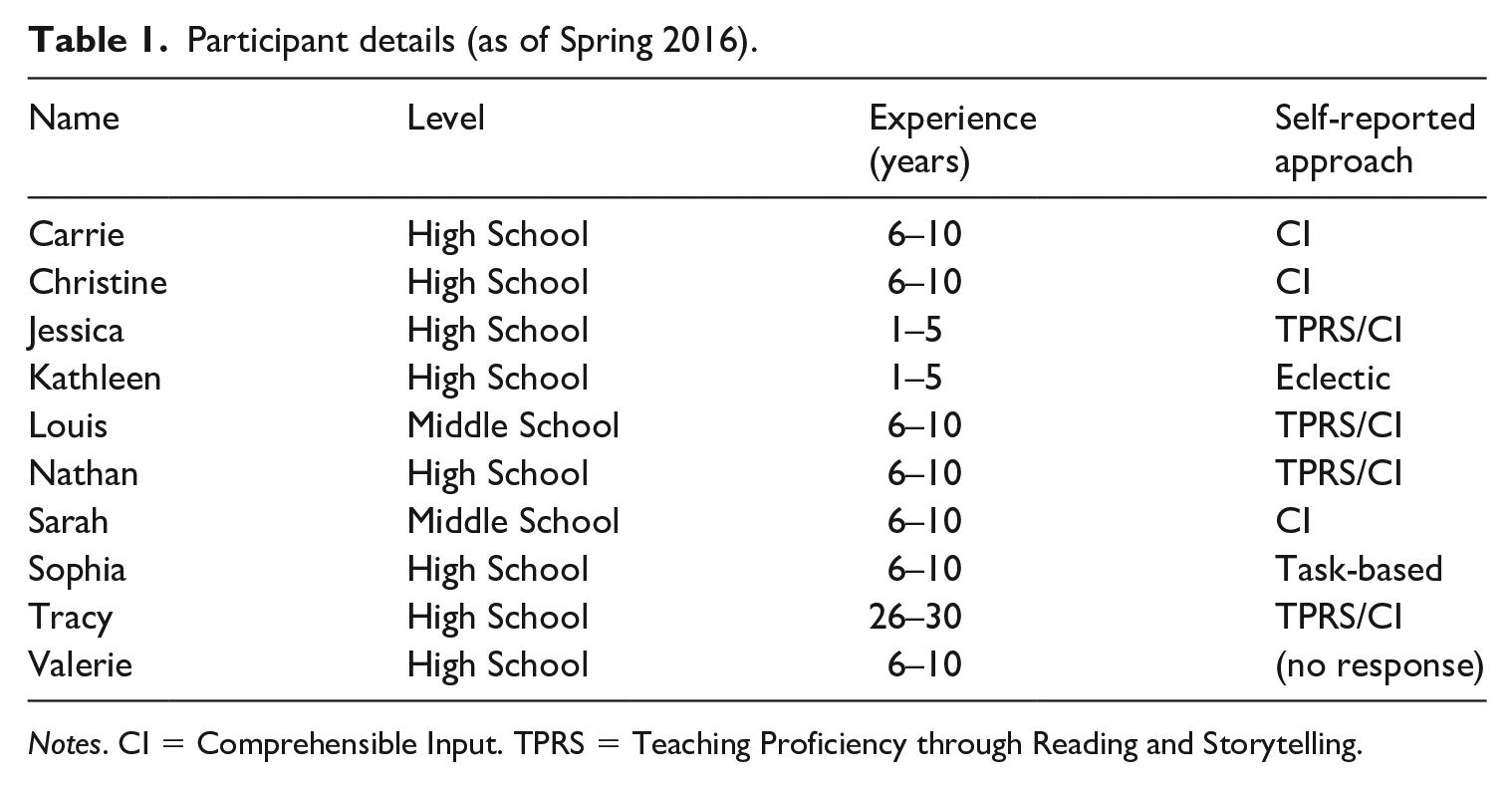
Notes. CI = Comprehensible Input. TPRS = Teaching Proficiency through Reading and Storytelling.
3 Instruments and procedures
a Teacher survey
A researcher-designed online survey was emailed to eligible teachers in January 2016 (see Appendix 1). In it, participants rated their level of agreement with Likert-type statements addressing common practices and beliefs related to WL teaching and learning as identified in the scholarship and through author familiarity with the district. Some questions also asked teachers to identify their primary teaching method(s). Therefore, this survey was reflective of empirical evidence about teacher practices, beliefs, and methods, while also being responsive to the specific context of this study. Questions were not asked explicitly about the postmethod condition, as the concept is not widely known in WL teaching, and the researchers judged that it would require too much explanation to be worth inclusion. In total, there were six subscale themes developed through consultation with key studies on language teacher beliefs (e.g. Allen, 2002; Basturkmen et al., 2004; Borg, 2003, 2006; Gatbonton, 1999): explicit grammar (about prioritizing students’ knowledge of grammar; items 8.1, 8.4, 8.11), comprehensible input (about emphasizing providing input to students and avoiding making them produce language; items 8.7, 8.13, 8.15, 8.19), student-to-student communication (about giving students opportunities to communicate with one another; items 8.6, 8.9, 8.18), target language usage (about staying in the target language in class; items 8.2, 8.12, 8.16), textbook (about using materials from a textbook; items 8.3, 8.8, 8.14), and eclecticism (about embracing a variety of approaches in the classroom; items 8.5, 8.10, 8.17). Participants were also asked to self-report certain classroom practices including the extent of their target language use and how much instructional time they devoted to each of the four skills on average: listening, reading, writing, and speaking. These four skills reflected the categories assessed in the district’s summative assessments as well as the common vocabulary used among the teachers.
b Teacher observations
For the second data source, each of the ten teachers was observed for two to three hours in their classroom by one or two members of the research team. The observation protocol used in this phase of the study was adapted from the Communicative Orientation of Language Teaching (COLT) observation scheme (Spada & Fröhlich, 1995). Although our observation protocol did not share the emphasis on communicative language teaching featured in the COLT, the research team did borrow some of its structural elements. For each distinct classroom activity within the observed lessons, the protocol prompted the observer(s) to record the following information: a qualitative description of the activity, the organization of the activity (e.g. whole-class, small group), amount of target language usage by teacher and students, the focus on form or meaning, as well as the communicative mode being targeted (interpretive, interpersonal, or presentational). Immediately following each classroom observation, the observer(s) wrote qualitative summaries pertaining to the teacher’s practices and teaching methods as they related to the same six subscales that were identified in the online survey. This documentation offered an important analytical connection between the teacher beliefs about instructional practices and their observed practices, allowing us to comment in more detail about how their decision-making occurred in the classroom, a vital element of the postmethod condition.
c Teacher interviews
Following the completion of the classroom observations, the teachers participated in a semi-structured interview with a member of the research team. The interview protocol was developed by the researchers to provide a framework for eliciting participants’ description of their language teaching beliefs and practices. In formulating these broad questions, we were informed by Borg’s (2003) analysis of the literature on teacher cognition and classroom practice. The use of the term ‘beliefs’ in the questioning was avoided, as we agree with Pajares (1992) that ‘beliefs must be inferred’ and are not best examined through elicited belief statements (p. 326). As with the survey, we avoided the term ‘postmethod’ due to our assumption that it would be unfamiliar to the teachers and would require excessive explanation. Questions centered around teachers’ description of how they taught and why, the types of activities they tended to use at different levels of instruction, and what they felt was most important for promoting students’ language acquisition or learning. The questions also provided an opportunity to clarify or expand on information that participants shared in their survey, or to further explain or reflect on classroom activities that were observed during the lessons.
4 Data analysis
a Teacher survey
Participants’ responses to each of the 19 statements about various teaching approaches or methods were converted to numerical scores ranging from −2 (strongly disagree) to 2 (strongly agree). The average of their scores for the items within each unique subscale were then displayed graphically in a scatterplot, illustrating the differences among participants, as well as trends among the group as a whole, with respect to the strength and direction of their beliefs about a given theme. The survey analysis in this study thus produced general descriptive statistics that offered an initial overview of how teachers perceived their own instruction. In concert with the self-reported classroom practices, these data served as a baseline to understand the teachers’ approach to instruction and complemented their in-depth responses during the interviews.
b Teacher observations
Descriptive statistics were calculated for each observation regarding classroom organization, use of target language by teacher and students, total amount of time devoted to each communicative mode, and whether the activities focused on form or meaning. Next, a brief overall narrative summary of the teacher’s classroom practices was produced based on the synthesis of the activity descriptions from the protocol and post-observation write-up. After these two analyses, the observational data were considered in relation to the six survey subscales, and brief commentaries on how each of the subscale themes was reflected in the observational data were recorded. For instance, for ‘explicit grammar’, the researchers recorded whether explicit grammar instruction was observed during the lesson; for ‘textbook’, the researchers recorded whether the teacher was observed using textbook materials.
c Teacher interviews
Each teacher interview was analysed in two ways by a member of the research team who did not conduct the interview. In order to avoid the influence of the survey or observation data on the codes or themes generated by this analysis, the interview transcripts were analysed as standalone data sources. First, the researcher listened to the interview, outlined the main topics addressed in the interview, and summarized the teacher’s responses. Then, the researcher listened several additional times, transcribing any segments of the teacher participant’s words which identified specific approaches or important beliefs related to instructional approaches. The research team reviewed these lists of quotes together and determined a starter set of descriptive codes to provide a means to initially code the data (Bazeley, 2013; Miles & Huberman, 1994). One researcher then used this set of codes to categorize the transcribed participant quotes into tables where all quotes with the same code were grouped together to facilitate a comparison across the participants. The researcher then used the data to describe each code in the context of analytical writing, specifying their ‘relevance, variations, dimensions, and parameters’ (Bazeley, 2013, p. 229). Then, the researcher eliminated more minor codes, combined and separated multipart codes, and otherwise refined the codes into more higher-order, focused codes (Bazeley, 2013). These second phase codes were connected to concepts in the field related to teacher beliefs about teaching methods.
d Integrated analysis across data sources
Once all data (the teacher surveys, observations, and interviews) had been collected and had undergone a full analysis, the research team examined each teacher’s case, considering all three data sources for each teacher, to identify trends and contradictions in the data. For instance, the research team examined discrepancies and parallels in how each teacher expressed their beliefs about teaching methods in the survey and the interviews. The observation notes were subsequently considered to see how the teachers’ beliefs as expressed in the survey and the interview were reflected in their behavior and choices in the classroom. Using an iterative process, the research team then considered patterns in each teacher’s data as they reflected the overall themes identified across all teachers.
V Findings
1 Defining a method
On the teacher survey, the participants clearly indicated that they thought in terms of specific teaching methods to describe their teaching, reinforcing many findings in other contexts the field (D.M. Bell, 2003, 2007; Richards & Rogers, 2014; Waters, 2012). Among the ten teachers in this study, most (N = 8) indicated using CI (Comprehensible Input), TPRS (Teaching Proficiency through Reading and Storytelling), or both as their main teaching approach(es). During the interviews, those eight teachers also often referred to CI and/or TPRS as their teaching approach(es). These related approaches are understudied in the field, and yet they have been increasingly developed and promoted by a robust US K-12 teaching community based outside of mainstream publishers and universities (Lanier, 2019). This common identification of one main teaching approach by a substantial group of teachers in this district is notable, and it provides a unique opportunity to investigate the existence of postmethod thinking. The other two teachers labeled their approaches as either eclectic or as task-based teaching.
However, other parts of the participant responses to the survey and the interviews revealed that this identification of teaching methods was more complex than the straightforward definitions offered on the survey, echoing other research about teacher cognition about teaching (Allen, 2002; Farrell & Bennis, 2013; Gatbonton, 1999). For instance, Carrie, who self-identified as teaching with CI on her survey, and who said in her interview that she ‘really wanted to make [her] practice CI’, also said in her interview: ‘I don’t even have an approach’ and, later, ‘I would put myself in the eclectic mode, I might change from lesson to lesson’, basing her instructional decisions on her ‘intuition of what good teaching would be’. Similarly, Christine, who on the survey indicated ‘CI’ as her teaching method, stated in the interview, ‘I don’t want to put a label on my teaching style.’ These statements indicate that some teachers, although willing to identify one method on a survey, were unwilling to commit categorically to that method when probed. Again, this phenomenon echoes findings in the field from other language learning contexts. It suggests that language teacher cognition about teaching is complex regardless of language or age of students taught. It also indicates that the methods of inquiry (i.e. survey versus interview) are important to consider in collecting data from teachers about their teaching methods. Studies that rely solely on one form of data might not reflect the complexity and nuance of teachers’ consideration of their methods.
Furthermore, although eight of the ten participants identified themselves as teaching with CI or TPRS, their survey responses about their instructional practices varied widely.
Figure 1 summarizes how the teachers responded to the Likert-scale items about specific classroom practices. Positive scores indicate more agreement/usage of that practice, while subscale scores situated near zero indicate neutrality or ambiguity about the topics, and negative scores denote less agreement/usage of that practice. We can observe a notable variation particularly in how the respondents prioritized student-to-student communication in the classroom (SD = 2.573), and in how they viewed the importance of explicit grammar instruction (SD = 2.452). Mild contrasts in beliefs about instructional practices could also be seen in the other four subscales among the teachers. Few participants’ responses were neutral for the different subscales. These findings build upon the idea that specific teaching principles are not always connected to specific practices, and that teacher cognitions might actually be realized in many different ways in practice (Breen et al., 2001). Teachers who identify as teaching with the same method might associate that method with very different practices, or they might make decisions in their classrooms in very different ways. In order to identify the role of postmethod thinking in these teachers’ cognitions, further investigation into the teachers’ beliefs and their connections to their practice is necessary.
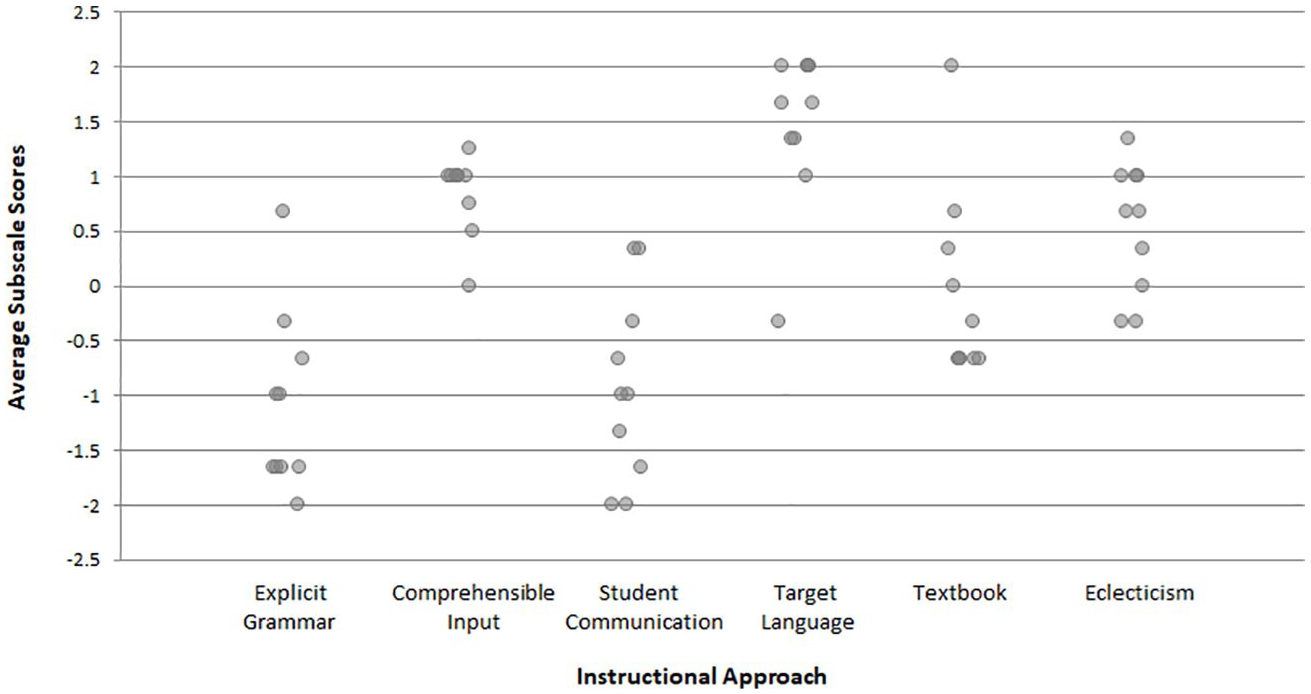
Survey responses on instructional approaches.
2 Beliefs in context
In this section, we will examine selected beliefs expressed by the teacher participants (RQ1), and how those beliefs were influenced by the contexts in which they worked and taught (RQ2). This analysis will be organized thematically according to three sets of teacher beliefs that emerged from the data: teacher beliefs about grammar and accuracy; teacher beliefs about input, output, and the four skills; and teacher beliefs about instructional flow.
a Teacher beliefs about grammar and accuracy (RQ1)
Grammar has been shown in many prior studies about teacher beliefs to be central to teacher cognition about instruction (Basturkmen et al., 2004; T.R. Bell, 2005; Borg, 2006; Farrell & Bennis, 2013; Gatbonton, 1999; Phipps & Borg, 2009), and those findings were echoed in this study. Although no questions were asked about the participants’ attitudes toward grammar instruction in the interview, nearly every participant discussed it at length. Christine, for instance, spoke strongly against having students explicitly study grammar, which she characterized as ‘verb conjugation’, ‘language structure’, and ‘drill after drill after drill and memorization’, in favor of helping students develop ‘the love for the language’ and ‘[the desire] to speak and to learn more’. Tracy stated: ‘I don’t teach [grammar] at all.’ Other teachers explained that they avoided explicit grammar instruction but acknowledged that it did have a place in their program ‘as needed’ (Sarah) or ‘not as the focus of lessons, but some extra homework’ (Kathleen). The small minority of teachers who expressed that students needed explicit grammar instruction in their lessons did so in a way that indicated some reluctance and even defensiveness. For instance, Louis stated: ‘I know that grammar cannot be explicit, it must be implicit, and I know that through reading they might get those differences. Sometimes they need explicit things.’ Similarly, Sophia stated: So if I get to choose the way to teach, I teach in context. . . and I do add some structuralism, to teach them grammar, because I believe you need to learn some grammar, not as the main lesson, but like a helper.
The teachers all carefully considered how much grammar instruction that they believed students needed, and the role that this grammar instruction should play in the classroom.
Teachers also explained their beliefs about how teaching related to encouraging accuracy, echoing Farrell and Bennis (2013). Nathan offered the observation that his job was to ‘spend a lot of time on’ topics in order to help students practice to be more accurate. Tracy, on the other hand, simply stated that she puts ‘almost zero emphasis on accuracy. If a native speaker can understand them, then I think it’s fine.’ Tracy’s focus was to ‘get them to the next level’ on the ACTFL Proficiency Guidelines (ACTFL, 2012), which indicated a focus on fluency over accuracy. This consideration mirrored the teachers’ conversations about the importance of grammar in language learning. Teachers who focused on accuracy in their teaching also expressed that understanding grammar was key to learning language.
b Adapting grammar and accuracy beliefs to context (RQ2)
The local exigencies of the classroom, specifically the interaction with learners, influenced how teachers’ stated beliefs about grammar were transformed in practice, a clear reflection of postmethod thinking (Kumaravadivelu, 2006). Several teachers told stories of students who, regardless of the teacher’s disinclination to teach explicit grammar, requested that more grammar be included in the instruction. Christine described her students as individuals ‘who want and need it! They’re very mathematical, and they want to see that conjugation table.’ Louis, similarly, said: We have a teaching approach in the classroom, but there are some students that are in a level [where] they need more concrete things, more explicit things, for instance a grammar chart or a video they can watch on their iPads, so most differentiation is very important. (Louis)
This assessment of ‘some students’ as individuals who ‘need’ certain types of instruction, even when that type of instruction is not the teacher’s preferred approach, was a clear instance of the context influencing teacher cognition about methods. In this, the teachers were prioritizing their students’ needs (core belief, grounded in experience) over their own beliefs about grammar instruction (peripheral belief, theoretically grounded) (Phipps & Borg, 2009). During the classroom observations, neither Christine nor Louis taught lessons that were organized around grammar themes or practicing certain grammatical forms. Importantly, Christine did spend a brief amount of time answering grammar questions from students, in a way that was clearly more ad hoc and based on the specific texts being used during the observed lesson. These data suggest that the teachers did not use grammar topics as part of instructional design, yet based on their interviews, it is possible that observations simply did not capture any more systematic grammar instruction which may occur in their classes.
Teaching grammar was also in some cases strongly influenced by the institutional context. For instance, Valerie stated: ‘[My previous job] was great, but it was very hard for me to teach using CI, because I was always in departments with grammar teachers and going head-to-head.’ The use of the term ‘head-to-head’ suggests conflict and opposition. Sophia addressed this conflict from the other perspective, that of a teacher who was attempting to work within a primarily CI community of teachers, but who did not ascribe to that approach. Her emotion was apparent in stating, ‘You don’t know how many nights I was awake at the beginning of the year, thinking, “Oh my god, what can I do . . .?” ’ Another teacher, Tracy, similarly narrated her own transformation from a textbook-based teacher to one more focused on teaching using CI, saying, ‘so it was sort of sink or swim, and it was, I cried every day. And then, after the first year, I got better at it, and it was not so tough, you know, change is good.’ These teachers clearly felt strong emotions when their ideas about their teaching methods were out of step with or under transformation as compared to the surrounding teaching community. The concept of teaching methods was still central to how they considered their own instruction.
Interestingly, these three teachers (Valerie, Sophia, and Tracy) shared similar characteristics in their classroom practices. Although they did not provide a decontextualized review of specific grammar patterns, name the parts of speech that they were practicing, or otherwise draw explicit attention to grammar, their curriculum showed some underlying organizational dependence on grammar structures. For instance, one of Tracy’s observed Spanish classes focused on a review of reflexive verbs and daily routines. She asked students about picture flashcards where daily routines were displayed and played a song featuring reflexive verbs, activities which were centered on meaning yet were clearly intended to address a specific grammar pattern. In Valerie’s class, the students engaged in informal conversation led by the teacher that was designed to evoke a specific form of the verb in their responses to her questions. This phenomenon, wherein teachers articulated an opposition to teaching grammar, yet still used it as a guiding principle in making decisions about their instruction, suggests that the teachers were making their own connections between theory and action, a hallmark of postmethod thinking (Kumaravadivelu, 2006).
c Teacher beliefs about input, output, and the four skills (RQ1)
When discussing the role of input and output in language learning, several of the teachers in the study expressed the strong belief that learning a second language was analogous to learning a first language. For instance, Jessica explained that her job was to replicate how young children learned their first language, ‘but just in a faster, more age-appropriate form’. Some teachers focused on the fact that children learning their first language learned primarily through repeated, simplified input. They stated that their French/Spanish students would ‘learn through input’ and ‘answer me with very short, one-word answers’, (Tracy) or take advantage of ‘very understandable short ways for [them] to speak’ and ‘repetition’ of spoken input from the teacher (Louis). Other teachers focused on how they worked to make learning a second language as natural or automatic as learning a first language. Valerie described that, in her classroom, like in first-language learning contexts, ‘there’s no rehearsing of the language, there’s no memorizing of the language, there’s no studying of the language.’ Similarly, Christine stated that learning a language, especially in the lower levels, was just ‘experience’ and ’immersion’. A few dissenting beliefs were also expressed, notably by the two teachers who did not self-identify as CI or TPRS/CI teachers. For instance, Sophia stated that students need to know grammar to learn language, which entails ‘recognizing structure, or understanding the structure’. Similarly, Kathleen stated: ‘when I look at my students, I can’t compare them to a blank canvas because they’re not like young children.’ These two teachers clearly conceptualized language learning in a different way than their colleagues.
Another area of beliefs expressed by teachers had to do with how much their students needed to engage with each of the four skills (reading, writing, listening, and speaking) in order to successfully learn or acquire language, often expressed in terms of the primacy of input or output. There was very little agreement among the teachers in this respect, even among those who self-identified as CI or TPRS/CI teachers. Some teachers expressed the belief that students should balance and work on all four skills every day (Sophia), while others advocated the importance of first offering students opportunities to listen and read before asking them to write or speak (Sarah). Valerie stated: ‘I respect the silent period with first-year language learners, and then they start producing a little bit of the language little by little.’ This teacher also indicated that students needed to ‘read, read, read, and then read again’ before they should be expected to write. On the other hand, Louis expressed the belief that ‘students can produce the language from the very beginning’, as long as teachers give them models and patterns to follow. Sophia agreed, arguing that what helped students to learn was: ‘Practice. Output.’ Kathleen similarly stated that ‘waiting for [output] to come naturally’ was not ideal, and instead thought that students required a ‘need for output’ in order to ‘realize little by little that they can do it’, and that it was ok to ‘force some output’ in some cases. The teacher participants clearly reflected extensively about these topics as they made principled decisions about their teaching, suggesting a departure from solely adhering to one method, thus embracing a measure of postmethod thinking.
d Adapting beliefs about input, output, and the four skills to context (RQ2)
WL leadership in the district had a strong influence on how the teachers established their pedagogy in light of their beliefs about the four skills and input and output (see also Childs, 2011; Farrell & Guz, 2019). Recall here the tension identified by Kumaravadivelu (2006) where teachers have been shown to be straddling two pedagogic worlds: ‘a method-based one that is imposed on them, and a methodological one that is improvised by them’ (Kumaravadivelu, 2006, p. 170). The teacher participants agreed that the WL leadership staff in their district strongly supported the use of techniques associated with teaching with CI, notably the focus on input over output. Sarah stated: ‘We’re all kind of minions under [the WL district leadership] learning about comprehensible input.’ This strong encouragement to teach with one approach often influenced their decisions about the balance of reading, writing, listening, and speaking in their classrooms. For instance, Louis said, ‘We do not allow students to have paired conversations from the very beginning [with this approach in the district] . . . I miss that part of the communication.’ Indeed, during the observation of Louis’s classes, no pair or small-group work was observed, and about 80% of the class time was focused on the teacher providing comprehensible input through telling an interactive story with comprehension checks.
Similarly, Kathleen mentioned that she found it ‘perplexing’ that the approach of TPRS/CI ‘says that you’re not supposed to force any output’. In her classes, we observed that the majority of the time was spent in activities that did involve some output on the part of the students, including a significant amount of time spent in asking and answering personal questions of the students on a specific theme. This technique is widely used and accepted by teachers who identify as using a CI approach in the classroom. Therefore, she was able to find ways to incorporate some of what she believed (her ‘improvised methodological’ techniques; Kumaravadivelu, 2006, p. 170) while still making a strong effort as a novice teacher to align her instruction with the framework and resources offered by the district. Additionally, Louis mentioned that he felt permitted to go ‘beyond the curriculum’ in combining methods or bringing in new techniques. For many of the participants, having WL district leadership who strongly encouraged the use of CI-based techniques served to reinforce their beliefs and support their classroom teaching practices. However, when the teachers’ beliefs, intuitions, and ‘sense of plausibility’ (Prabhu, 1990, p. 172) conflicted with this approach, they experienced a certain degree of tension, and navigated that tension through reflecting and making principled decisions about their teaching, adopting a postmethod stance.
Another local exigency existed for the teachers in the form of the district’s mandatory yearly assessments. The influence of high-stakes testing on teaching methods in this context is similar to that found in EFL contexts across the globe (Li, 1998; Littlewood, 2007; Phipps & Borg, 2009). In this context, these tests conveyed a complex and sometimes contradictory message to the broader CI, input-focused message put forth by the WL leadership. The internally developed assessments in this study primarily evaluated the receptive skills of listening and reading, but also evaluated output in the form of writing. Valerie, consistent with her beliefs, stated, ‘If it was up to me, we’d do no writing the first year, zero’, but then said that, due to the assessment, ‘we can’t.’ Louis, who had argued that ‘students need to write’, often found himself at odds with the WL district leadership and the principles of CI, but also expressed his confusion that ‘the district assessment [includes] writing’. He indicated that this seemed to support his beliefs regarding the importance of writing. Although neither teacher was observed assigning or guiding writing activities during their classes, both Valerie and Louis included substantial interpersonal activities during class as described above, including frequent comprehension checks that entailed student-teacher interpersonal communication. Louis in fact did have one student writing down a summary in Spanish of the interactive story he was telling, although that was an isolated activity. The contradiction between the WL leadership’s message about writing versus the mandatory assessment’s inclusion of writing was an area that the teachers were forced to navigate. They resolved this conflict through relying on their own intuitions and principled decision-making whenever possible (Kumaravadivelu, 2006).
e Teacher beliefs about instructional flow (RQ1)
The participant teachers frequently expressed strong beliefs about the best ways to facilitate the instructional flow of the classroom, addressing the sequencing of skills or topics for the students (Gatbonton, 1999). For instance, Jessica reportedly decided what to teach by determining ‘what is the most important thing you need to learn first’, what is the ‘high-interest thing’, what is the ‘necessary thing’. This process often ended with her identifying which ‘high-frequency structures’ to address first. Some teachers explicitly sheltered certain parts of the language, for instance, only starting with verbs that are in the third person in Spanish (Sarah). Alternatively, teachers at more advanced levels, like Sophia, focused on introducing or intentionally utilizing all of the forms of the Spanish verbs. Other teachers addressed how they made curricular decisions based on what type of communication to focus on first, which connects back to the beliefs surrounding the use of input and output. For example, Carrie suggested that oral communication came before written communication, and Valerie stated that receptive skills like listening and reading had to come before the productive skills of writing and speaking.
The teachers also expressed beliefs about the best ways to structure individual learning segments like units and lessons. Kathleen described how she introduced new vocabulary through connecting with students about their lives and asking personal questions, then repeating that vocabulary through signs and gestures, then ending with the ‘regular storybuilding type activity’ with the students. Indeed, some teacher participants wanted to deemphasize the importance of structuring or sequencing a lesson altogether, as with Carrie, who stated: ‘I’m trying to get away from the more obvious sequencing [of grammar] . . . just trying to keep it more holistic.’ Nathan agreed, stating: ‘I don’t want my students to spend their time stressing about some skill they should be working on building, [I want them to have] that skill and others around it, more of a holistic view.’ These teachers put ‘holistic’ teaching in contrast with explicit grammar-based sequencing of lessons and preparing students for grammar testing, expressing that sequencing itself was not a goal in their planning.
f Adapting beliefs about instructional flow to context (RQ2)
The data echoed findings from other studies that demonstrated the importance of both learners and institutional/supervisory contexts in influencing the gap between beliefs and practice (Breen et al., 2001; Farrell & Guz, 2019). Many teacher participants agreed that adaptation to student needs and interests was a necessary and central part of their teaching. This philosophy was illustrated by statements like, ‘[Teaching is] about being really, really adaptable and in tune with your students’ (Christine) and ‘We try really hard to meet students where they’re at’ (Nathan). Carrie explained that she would make changes from class to class if things ‘didn’t work last time’. This idea was echoed by Sarah, who taught 90-minute classes to large groups of middle school students. She stated, ‘with CI, if [the students] come in bouncing off the walls and are having the hardest time listening to you, then it’s not gonna work and you’re gonna have to switch to something else.’ During the observations, Sarah incorporated frequent brain breaks involving writing and drawing, and even throwing balls around the classroom. This quote offers a notable example of a way that she, a self-identified CI teacher, had to adapt her practice based on her context, even when her CI approach suggested that the students should first and foremost be actively listening to the teacher. The local exigencies of her learners encouraged her to redefine her instructional aims and approaches, resulting in the interplay of theory and practice that is a hallmark of postmethod thinking (Kumaravadivelu, 2001).
The teachers’ instructional aims also shifted based on their intuitions and insights into their students’ interests, reflecting one of the pedagogic parameters of the postmethod condition (Kumaravadivelu, 2006). As Christine stated, ‘I want it to be about them, and so whatever is going on in the world enters into what the class is . . . that’s what gets them talking and that’s what gets them listening and reading.’ Nathan agreed, ‘You build so much of your curriculum based off of their needs and interests.’ Valerie noted that her students’ interests aligned with global themes, as well as Advanced Placement (AP) themes, so she was able to have her topics ‘usually be driven by [her students]’. Accordingly, the best measure of the success of a lesson was how much ‘the kids are engaged, how much they give back to me, the level of enthusiasm’ (Valerie). In some observed classes, the teachers talked about specific things relevant about that day, like it being St. Patrick’s Day (Tracy), having a guest in the class (Nathan), or the weather (multiple teachers). As Tracy argued, ‘Because it’s so hard to engage teenagers’, the best indicator of a ‘home-run’ lesson was their level of engagement, even if it was not a good lesson ‘from a teacher perspective’. The principle of compromising between the ‘teacher perspective’ and the students’ needs is a clear reflection of the interplay of theory and practice endemic to the postmethod condition.
Finally, the teachers’ beliefs related to instructional flow were often influenced and mediated by the district’s Scope and Sequence. Some teachers, like Valerie and Christine, stated that they never or rarely used the Scope and Sequence, or only looked at it after the fact to be sure that they were addressing all suggested material. Others, like Kathleen and Jessica, stated that they did use it, but that they ‘changed’ it or used it alongside curricula from other teachers in the district. Sarah explained that she and a colleague ‘took the Level 1 list [from the Scope and Sequence], and. . . broke it, reordered it, and broke it into units that we thought were appropriate for middle school kids in Level 1.’ Subsequently, she structured the units by introducing new vocabulary at the beginning of the unit, followed by planned activities using that vocabulary. Tracy explained her process of using the Scope and Sequence in more detail: I use the [Scope and Sequence] as a huge vocab list, and I check off when I have taught these structures, and I try to hit them all, and I may or may not hit them every year. And in fact, me and another teacher just wrote the scope and sequence and put it in a more logical order, so next year’s teachers will have a slightly more logical sequence. But I also use novels, the second half of the school year, and so I base what I teach on the vocab in the novel.
This navigation of the requirements of the job, as represented in the Scope and Sequence, clearly suggests postmethod thinking, wherein the teacher makes responsive and principled decisions about what to teach, given the interplay between their beliefs and their context (Kumaravadivelu, 2001).
VI Conclusions
In describing their teaching methods, teachers in this study expressed strong beliefs about topics like grammar and accuracy; input, output, and the four skills; and how the instructional flow in the classroom should take place, echoing other research on teacher beliefs in the field (e.g. Farrell & Bennis, 2013; Gatbonton, 1999; Phipps & Borg, 2009). Through the interview and observation data, it became clear that participants were strongly influenced by contextual factors including their students, the district leaders, the district curriculum, and the mandatory yearly assessments (see also Childs, 2011; Farrell & Guz, 2019; Li, 1998; Littlewood, 2007). These factors played a role in the ways and extent to which the teachers’ beliefs aligned with their actions, reflecting principled decision-making on the part of the teacher participants. There is thus ample evidence of the existence of a postmethod condition among the teachers participating in this study. It is clear from the data that the interplay between the teachers’ beliefs and practices can be understood as a relationship mediated by context-driven instructional decision-making (Akbari, 2008; Brown, 2002; Kumaravadivelu, 2001; Prabhu, 1990).
Importantly, not all aspects of the postmethod condition were observed in this study. Two of Kumaravadivelu’s (2006) three pedagogic parameters for method, including particularity (local exigencies and lived experiences) and possibility (the teacher’s connection of theory and action, as well as the importance of teacher reflections, insights, and intuition) clearly appeared in our data. The third possibility (awareness of the larger social, economic, and political environment) was not observed to the same extent, perhaps due in part to the nature of the questions asked and the data collection procedures. This area might be important to investigate in future work on the examination of the postmethod condition. Additionally, conducting more extensive observations of practice, perhaps just with one teacher instead of multiple teachers, could offer an examination of other dimensions of this topic.
Ultimately, this study offers important evidence of the continued presence and importance of postmethod thinking among some of today’s secondary-level WL teachers, even among those who identify as adhering to one main instructional approach. Expanding the awareness of the postmethod condition in this context can lead to enhanced teacher development opportunities that deemphasize the identification of distinct teaching methods. Instead, teachers can focus on reflecting on their beliefs, their contextual factors, and the principled decision-making that they undertake in determining their instructional practices. Aligning the scholarly discussion of language teaching methods with actual teacher cognition and instructional practice in the field may offer new avenues for improving language teaching in the future.
