




Abstract
This article examines mono- and bi/multilingual practices on the University of Cambridge CELTA (Certificate in Teaching English to Speakers of Other Languages) course. This course is generally considered to be one of the most popular and widely-recognized initial teacher education programmes in English language teaching worldwide. The article describes a small research project which explored the views of 77 CELTA trainers in relation to the use of the first language (L1) in English language teaching and centred on how this issue is addressed on the teacher training courses they worked on. The study included trainers who use English either as an L1 or as a second language (L2) and both monolingual and bi/multilingual participants. Respondents worked in shared-L1 (where learners share a common language other than English) and in multilingual teaching and training contexts. The need to develop a theoretical framework in relation to L1 use in English language teaching and for a more explicit and considered focus on this issue on the CELTA course was identified, so that both trainers and trainee-teachers can make informed pedagogic decisions around L1 use in their teaching and professional practices. Findings also point to the need for wider discussion within the CELTA community on issues relating to the traditionally monolingual and one-size-fits-all orientation of the course and to the potential added-value of language teachers and educators who bring bilingual skills and perspectives to the classroom, particularly non-native English speakers.
Keywords
I Introduction
The ‘monolingual principle’ (Howatt, 1984, p. 135), long considered a basic tenet of second language teaching, involves the belief that the use of the first language (L1) of the learner has no place in the second language (L2) classroom and in fact interferes with the successful acquisition of the new language. This belief became almost axiomatic during the 20th century, to the extent that teaching manuals rarely mentioned the use of the L1 at all except in terms of ways to avoid using it in class (Cummins, 2009; Ellis & Shintani, 2014). In more recent years, this premise has been challenged, and approaches which exploit the L1 of the learners have been encouraged (Shin, 2018; Lee & Lo, 2017). However, TESOL (Teaching English to Speakers of Other Languages) remains largely monolingual in orientation (Jenkins, 2017; Leung, 2014), and until very recently the ‘multilingual turn’ (May, 2014) in applied linguistics has not featured strongly in mainstream research and practices in TESOL (Cenoz and Gorter, 2020). According to Ortega (2018, pp. 433–434), ‘a pending disciplinary challenge is to overcome the monolingual bias and nativespeakerism [sic] that inadvertently have seeped into much SLA [second language acquisition] research,’ notwithstanding that ‘some progress seems to be on the horizon’. Many scholars have called for more research into classroom practices and teacher beliefs in this area (García, Johnson & Seltzer, 2017; Molway, Arcos & Macaro, 2020).
The study described below focuses on the extent to which this multilingual turn has permeated into the University of Cambridge CELTA (Certificate in Teaching English to Speakers of Other Languages) course, which is one of the most widely-taken and recognized initial teacher education programmes in TESOL worldwide. In particular, it sought to explore the views and practices of teacher-trainers on the course regarding the use of the L1 in language learning and teaching and how this issue is addressed on CELTA programmes. The study included trainers who use English either as an L1 or as an L21 and both monolingual and bi/multilingual participants. The research is important because, although there have been inconsistent findings in relation to the influence of teacher training programmes on teacher beliefs and cognitions (Anderson, 2020; Borg, 2011), it seems likely that the views of trainers working on CELTA programmes may have considerable bearing in terms of raising awareness and influencing practices in this area. Johnson and Golombek (2020) have highlighted both the lack of research in relation to the views and beliefs of teacher-trainers themselves and the importance of this, given the potential influence of teacher educators on future teachers and learners. It is hoped that this article will contribute to the debate around the use of the L1 in TESOL and highlight important considerations for the design and delivery of teacher training programmes.
II Background literature
1 Move towards bi/multilingual perspectives
A profound paradigm shift has taken place in the fields of applied linguistics and SLA which has challenged the monolingual orientation of much of the research in the field and changed our perceptions of how people acquire additional languages (Conboy, 2010; Li, 2016; Ortega, 2018). This has profound implications for language teaching and TESOL (Cenoz & Gorter, 2020; Saville-Troike & Barto, 2017; Swain & Lapkin, 2013). Until the beginning of the 21st century, the view that total avoidance of the L1 in language teaching led to a superior form of learning remained relatively unchallenged in TESOL (Cummins, 2009; Cook, 2001; Ellis & Shintani, 2014). However, in more recent years, this view has been questioned (Canagarajah, 2017; Cenoz & Gorter, 2013; Cook, 2016a). There is in fact little evidence to support the monolingual principle as the most effective way to learn additional languages, and it is now associated with how monolinguals learn their L1 and not grounded in how most bilingual speakers in the world acquire their languages (Cook, 2016b; Creese & Blackledge, 2010; McMillan & Turnbull, 2009). According to Shin (2018, p. 127), ‘[i]nstructional assumptions that insist on a strict separation of two languages simply do not reflect the linguistic realities of bilingual students.’ Research has demonstrated that bilinguals do not separate their different languages in their brain (Hoshino & and Thierry, 2011; Kharkhurin & Li, 2015; Lewis, Jones & Baker, 2012), or de-activate one language while using the other (Garcia, 2009; Schmitt, 2008; Shin, 2018). For so long seen as an inferior form of language practice, codeswitching, defined here as ‘the alternate use of two languages, that is, the speaker makes a complete shift to another language for a word, phrase, or sentence and then reverts back to the base language’ (Grosjean, 2010, pp. 51–55), is now regarded as a highly sophisticated form of language use (Deuchar, Muysken & Wang, 2007; Grosjean, 2010; Reyes & Ervin-Tripp, 2010) and a normal part of the natural discourses of skilled bi/multilinguals (Hornberger & Link, 2012; Lin & Li, 2012; Turnbull & Dailey-O’Cain, 2009). Just as all proficient language users can adjust their tone, syntactic and lexical choices according to the appropriate context, audience and genre, bilingual users have an additional way of doing this if they are with other bilinguals who share their languages, utilizing a highly sophisticated language skillset which is unavailable to monolinguals (Blackledge et al., 2014; Block, 2014; García & Li, 2014). Disparaging terms such as Singlish, Tex-Mex, Spanglish or Franglais reflect the negative ways in which many monolingual English speakers view bilingual speech, seeing it as an inferior, lazy form of language use. These pejorative terms have been replaced in more recent years by other terms such as ‘translanguaging’ (García, 2009), ‘translingual practices’ (Canagarajah, 2014), ‘metrolingualism’ (Makoni and Pennycook, 2012) and ‘flexible bilingualism’ (Creese and Blackledge, 2010), which celebrate the highly developed, flexible and complex language practices of fluent bi/multilinguals.
The ability to shuttle between languages has become more and more important when navigating the increasingly complex linguistic spaces of the modern world (Blackledge and Creese, 2018; Horner & Weber, 2018; Kramsch, 2014) where bi- and multilingual practices have intensified in many social, professional and educational interactions (Laing, 2019; Martin-Jones, Blackledge & Creese, 2012; Saville-Troike & Barto, 2017). Canagarajah (2015, p. 47) describes the ‘translingual competence’ of skilled multilinguals as a complex language awareness that includes ‘intercultural competence, sociolingual sensitivity, pragmatic understanding and critical thinking’ and which is used ‘to negotiate the unpredictable mix of language resources in any given context’. The benefits of such ‘multi-competence’ (Cook, 2016a) are demonstrated in the workplace and in the provision of services (Duchene & Heller, 2012; Hewitt, 2012; Li, 2016) as well as in popular culture and in increasingly diverse neighbourhoods and urban spaces (García & Li, 2014; Martin-Jones et al., 2012). Increasingly, written codeswitching and switching between different orthographies for various effects are found in multilingual practices on social media and on the Internet (Horner & Weber, 2018; Leppänen & Peuronen, 2012; Shin, 2018).
2 Implications for English language teaching
Many suggest that the foreign language classroom is an ideal space in which to develop multi-competence and bi/multilingual skills (Bruen & Kelly, 2016; Hall & Cook, 2012; Turnbull, 2018). In particular, classroom activities involving codeswitching, translation and other translanguaging practices have been identified as a way to promote these skills (Anderson, 2018; Cenoz & Gorter, 2013; Pintado-Gutiérrez, 2018), even in contexts where the teacher is monolingual or does not share all the languages of the learners (García et al., 2017; Wang, 2019). Within foreign-language teaching contexts where meaningful input and communicative interaction and practice in the target language remains a central tenet, many point to the ways in which the judicious, systematic and targeted use of the L1 may be exploited as a linguistic tool to enhance L2 learning (Lee & Lo, 2017; Scott, 2016; Swain & Lapkin, 2013). For example, Gallagher and Colohan (2017) describe a dual-language ‘twisted dictation’ technique, used with a group of Italian secondary school students, which provided a framework for ‘noticing’ the typical word order of English adverbials. Several of the students who participated in this study also commented positively on the real-life interpreting element of the activity. However, the monolingual orientation of much English language teaching materials, such as textbooks and teaching manuals, has been raised by several researchers (Ellis & Shintani, 2014; Hall & Cook, 2012; Kiczkowiak, Baines & Krummenacher, 2016), particularly in reference to mainstream publishing houses of English language teaching (ELT) (Anderson, 2020; Freeman, 2020; Leung, 2014). As Cook (2016b, p. 181) puts it: ‘Looking at most EFL [English as a foreign language] and modern language coursebooks, you get the distinct impression that all of them are written by monolinguals who have no idea of the lives lived by L2 users.’
The multilingual turn in SLA has profound implications for English language teaching, challenging not just the bias towards monolingual practices of most English language classrooms (Cook, 2016a; Leung, 2014; Ortega, 2018), but also what many regard as unachievable native-speaker-like learning goals (Freeman, 2020; Ortega, 2016; Scott, 2016). Competent L2 use and multi-competence are seen as more realistic goals for language learners and users (Cook, 2016b; Freeman, 2020; Scott, 2016).
In addition, the successful language learning experiences and bilingual skills which bilingual and non-native-English-speaker teachers (NNESTs 2 ) may have in their teaching toolkit have begun to be validated in a more powerful way and seen as an asset in teaching (Anderson, 2018; Cook, 2016a; Hall & Cook, 2012). Many scholars (e.g. Cooke & Simpson, 2012; May, 2014; Scott, 2016) question the use of terms such as ‘native-speaker’ and ‘non-native-speaker’ teachers, reflecting as they do the monolingual orientation of TESOL and the power structures inherent in native-speakerism (Ilieva & Ravindran, 2018; Kiczkowiak et al., 2016; Ortega, 2016). Freeman (2020, p. 9) describes the concept of the ‘native-speaker’ as ‘arguably ELT’s version of whiteness’.
However, this multilingual turn has not been readily adopted among many language teaching practitioners and policy makers on the ground (Hawkins & Cannon, 2017; Dailey-O’Cain & Liebscher, 2015; Vallejo & Dooly, 2020) and in particular in foreign language teaching contexts (Anderson, 2018; Kramsch, 2014; Turnbull, 2018). The monolingual principle is a deeply embedded one, generating strong resistance to change (Li, 2016; Vallejo & Dooly, 2020; Cooke & Simpson, 2012), even among NNESTs (Hall & Cook, 2012; Kiczkowiak et al., 2016). Nevertheless, the most recent CELTA syllabus suggests that change is happening, albeit very slowly. It includes a topic sub-heading: ‘Multilingualism and the role of first languages’ (2018, p. 4, section 1.6), which is clarified as understanding ‘the kinds of language backgrounds that learners may come from (e.g. multilingual/monolingual; different varieties of English), and how a learner’s language background might influence the learning of English’ (2018, p. 6, section 1.6). While this is far from an endorsement of the judicious use of the L1 in the classroom or advocacy for the adoption of a bi/multilingual stance by the teacher, it is a welcome addition to the syllabus and points to the possibility of real change ahead in relation to the monolingual orientation of EFL.
Researchers have found considerable variation in the practices of teachers in relation to the use of the L1 in the classroom (Ellis & Shintani, 2014; Macaro, 2009, 2014; Wach & Monroy, 2019), although a consistent finding has been that using the L1 in class is often accompanied by feelings of guilt among teachers (Cook, 2016b; Kirkpatrick, 2014). Gallagher (2020) found the particular teaching context to be an important factor in terms of teachers’ views on the use of the L1 in class, particularly whether teaching took place in shared-L13 (i.e. learners sharing the same L1) or multilingual EFL contexts. The need for a theoretical framework against which teachers could apply pedagogic choices in relation to the use of the L1 in the classroom has been identified as important (Dailey-O’Cain & Liebscher, 2015; Macaro, 2014; Lee & Lo, 2017).
3 The CELTA course
Teacher training may be an important way to address some of these issues. The CELTA is one of the most popular pre-service English teaching courses in the world (Anderson, 2020; Harrison, 2018; King, 2016). Each year, approximately 12,000 candidates take the course in 370 approved centres in over 80 countries (Cambridge English CELTA website, 2020; Cambridge English CELTA brochure, n.d.). It is typically a short (4–5 week), intensive course, designed to provide novice teachers with an essential starter-pack for any future EFL teaching context (Hobbs, 2013; Mackenzie, 2019). Although initially intended as a pre-service course mainly for native-English-speakers working in the private sector (Anderson, 2020; Hobbs, 2013; King, 2016), over the years the profile of candidates has changed. The percentage of NNEST candidates on the CELTA has risen from 26% in 2005 to 46% in 2018 (Anderson, 2020); increasingly, many candidates are already experienced teachers (Harrison, 2018); and the contexts where they teach after the course have become extremely varied (Hobbs, 2013; King, 2016). Therefore, what many perceive as the one-size-fits-all approach to teaching which is associated with the course may no longer be valid for many local teaching contexts (King, 2016; Laing, 2019; Mackenzie, 2019). However, Harrison (2018) reports little appetite for change given the popularity and high satisfaction rates among both trainers and candidates on courses and the high regard in which it is held by the ELT community.
There have been inconsistent findings on the impact of teacher training courses on the beliefs and practices of teachers (Borg, 2011; Horii, 2015; Molway et al., 2020), but many researchers have associated change in this area with courses which foster critical reflection and the articulation of beliefs which can promote agency, challenge native-speakerism and explore teacher identity (Ilieva, 2010; Scott, 2016), particularly among NNEST trainees (Ilieva & Ravindran, 2018; Kiczkowiak et al., 2016). Although designed as a teacher preparation course, for many English language teachers, the CELTA remains their only teaching qualification (Hobbs, 2013), which makes a focus on developing techniques to cultivate critical examination of beliefs and practices all the more important on the course. Given the short and intensive nature of the CELTA, several researchers have suggested including an explicit focus on adapting to different teaching contexts as a way to include a deeper element of critical reflection in the later stages of the course (Anderson, 2020; Mackenzie, 2019). Laing (2019) and King (2016) posit that this reflection and a certain amount of ‘unlearning’ may also be required on the part of CELTA trainers themselves, not least in relation to the paradigm shift away from what many scholars (e.g. Anderson, 2020, Hobbs, 2013; Kiczkowiak et al., 2016) have identified as the native-speaker bias and monolingual orientation of courses such as the CELTA. According to Johnson and Golombek (2020, p. 117), although there has been extensive research into teacher education and training in general, more focus is needed on the beliefs and practices of the teacher educators themselves, who often exert a powerful influence on and shape the practices of ‘the teachers with whom they work and the students their teachers eventually teach’. The study described below attempts to bring such a focus to the views and attitudes of CELTA trainers in relation to the use of the L1 in English language teaching and on CELTA courses.
III Methodology
The study is based on a small-scale qualitative research project which centred on the mono- and bi/multilingual practices of trainers on the CELTA course. The research questions were:
To what extent and in what ways is the use of the language learners’ L1 addressed on CELTA training courses? 4
What are the views of CELTA trainers towards the use of the L1 in English language teaching?
To what extent and in what ways are the views of trainers for whom English is an L1 different to those for whom English is an L2?
Recruitment was through a Facebook forum for freelance CELTA trainers and through the Cambridge English Teaching Qualification mailing list for CELTA practitioners (permission granted by the Cambridge English list moderator). Ethical approval was granted by Dublin City University Research Ethics Committee. Seventy-seven trainers who use English either as an L1 (55 participants) or as an L2 (22 participants) completed an anonymous online questionnaire via Google Forms, which elicited their practices around and attitudes to the use of the L1 on the CELTA courses they taught on and in English language teaching more generally [see Appendix 1]. The survey consisted of two sets of questions. A set of closed questions concerned the background of the participants in relation to language(s) they use and know and the contexts they teach / have taught in. The second set of open-ended questions elicited the views and practices of the participants in relation to the use of the L1 in language teaching and on CELTA courses. Table 1 provides a profile of the respondents.
Profile of respondents.
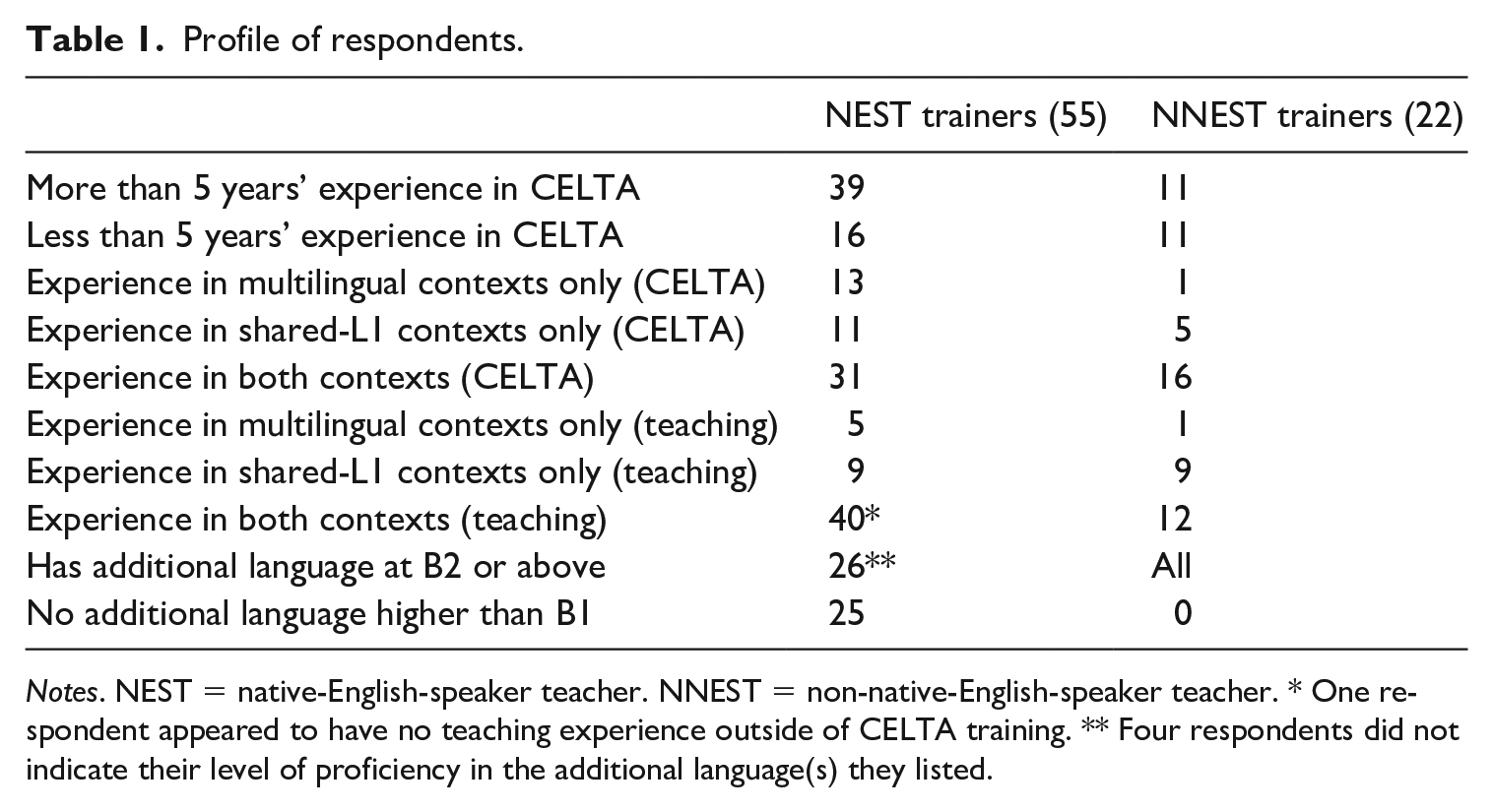
Notes. NEST = native-English-speaker teacher. NNEST = non-native-English-speaker teacher. * One respondent appeared to have no teaching experience outside of CELTA training. ** Four respondents did not indicate their level of proficiency in the additional language(s) they listed.
The data was qualitatively coded and analysed using thematic analysis procedures (Braun & Clarke, 2006). First, the responses were read closely. Each item in the data was manually tagged in order to generate initial descriptive codes for the data. These were then organized to identify broad patterns and groupings across the data. Using NVivo software, the entire data set was then systematically collated and categorized according to these ‘parent’ codes. An NVivo interrater comparison test based on 10 of the 77 questionnaires was conducted, resulting in an IRC score of .83. The completed questionnaires were then re-read to ensure the codes accurately reflected what the respondents had written. The data within each code was then analysed in order to identify overarching themes in the data in relation to the research questions. See Appendix 2 for the set of thematic codes and sub-codes used in the analysis. Braun and Clarke’s 15-point checklist of criteria for good thematic analysis (Braun and Clarke, 2013, p. 287) was adhered to in order to ensure the trustworthiness and dependability of the research.
It is important to note that it is common practice on CELTA programmes for trainers themselves to teach ‘live’ lessons which are observed by trainee-teachers as part of the course. Respondents refer to their roles as teacher-trainer and ‘model’ teacher in their responses. The respondents frequently used the acronyms TP (Teaching Practice) or TL (Target Language) in their responses. Each respondent has been allocated a number (e.g. R2, R49) and an asterisk has been added to denote NNEST respondents. (e.g. R5*, R33*).
IV Results
A large majority of trainers either strongly discourage or discourage the use of the L1 in teaching during CELTA courses. Discouragement of the L1 was more prevalent with NNEST trainers. Of the 22 NNEST respondents, nine said they strongly discouraged and eight said that they discouraged the use of the L1 in teaching. Of the 55 NEST trainers who responded, 11 indicated that they strongly discouraged and 22 said that they discouraged the use of the L1 in teaching. Only one NNEST trainer indicated that they would encourage the use of the L1 in teaching. This rose to eight of the 55 NEST trainers, of which six said that they encouraged and two said that they strongly encouraged the use of the L1. The remaining trainers (four out of 22 NNEST trainers and 14 out of 55 NEST trainers) indicated that they were tolerant towards the use of the L1, without encouraging it. See Figure 1:
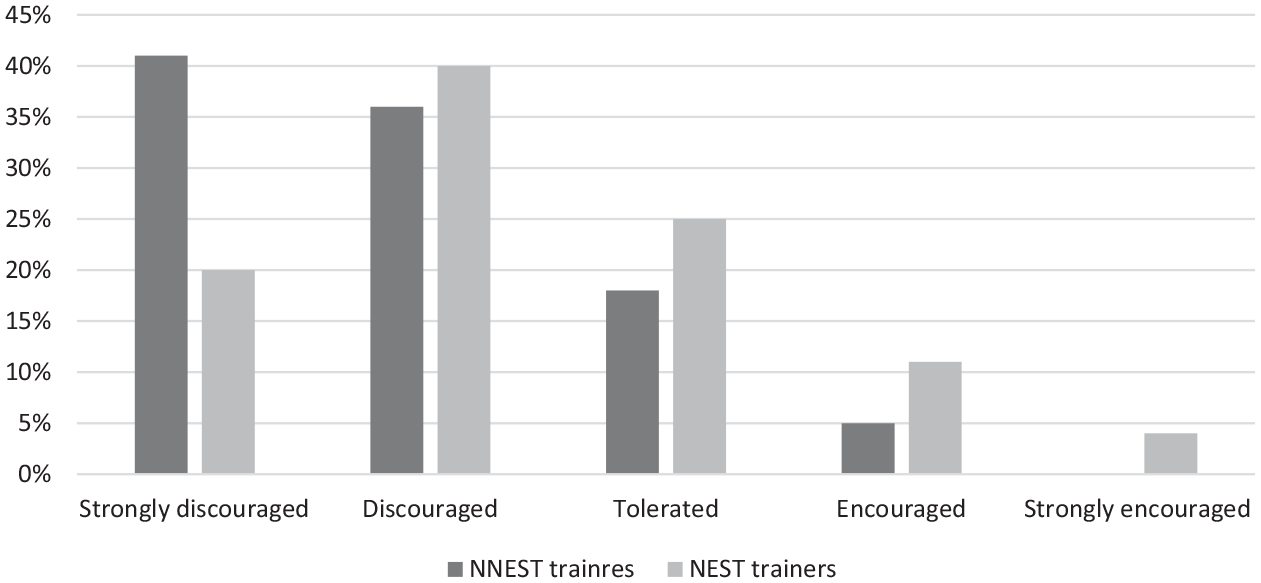
Overall approach to using L1 on CELTA: NNEST and NEST trainers.
1 How L1 use is addressed on the CELTA
Trainees generally are expected to use English at all times on the CELTA course and in their teaching practice. This is often explained to trainees at interview, at orientation or in the course handbook, where trainees are explicitly informed that they must use English only on the course. Most trainers added that it rarely needs to be mentioned again.
R32: I have never had to address translation in feedback or tutorials. I find it is hardly used at all.
R18: Never had an issue.
A very common approach is to deal with the use of the L1 in a more implicit way. Many respondents explained that the use of the L1 was not addressed explicitly on the CELTA course at all.
R66*: I think it’s not overtly stated but it’s implicit.
R64*: We normally do not say this explicitly, but they ‘get’ it somehow because the course is delivered fully in English, the tutors only speak English to the trainees, the demos are in English, etc.
This idea of the trainees just ‘getting it’ came up frequently.
R70: I never need to [explicitly tell them]. They seem to know this.
One respondent found this to be especially the case with NNEST trainee-teachers:
R53*: Usually native English candidates ask [about using the L1] if they know the local language; the non-native English candidates don’t tend to ask, they just don’t use L1. So yeah, I guess it’s just understood mostly?
Some respondents mentioned that trainees often worried that they would be penalized for inadvertently using the L1 during practice lessons:
R64*: Sometimes trainees are even afraid of using L1 during teaching practice, and if it accidentally happens, they are worried that they will be penalized for that.
R32: Some trainees are dead against use of L1, as they fear being dragged into it by their students.
When the L1 is addressed, the focus tends to be on ways to avoid it. Many trainers mentioned ‘the foreign language lesson’, delivered to trainees in an unfamiliar language, as the central way the issue was addressed on the course:
R37: We do one Foreign Language Lesson to show them how to teach exclusively in L2 [. . .].
R32: I do a foreign language lesson in early week 4. [. . .] they get the point about the possibility of teaching absolute beginners without using L1 at all, TL only.
One respondent referred to this as the CELTA way:
R39: I include a foreign language session to expose trainees to techniques and also to help them see the ‘CELTA way’ can be very effective.
Some trainers also mentioned particular input sessions (such as sessions on classroom management, vocabulary teaching and concept checking) where issues around the use of the L1 sometimes came up and where teaching techniques which focused on how to avoid the L1 were highlighted. Again, this was usually done using an unfamiliar foreign language.
R53*: I use Slovenian to show them how difficult excessive TTT [teacher-talking-time] can be, and why it’s better to model and demonstrate activities rather than explain instructions.
In the main, the focus on L1 use in the classroom appears to entail a rather ad hoc approach, whereby the issue is dealt with only if it arises, especially in Teaching-Practice feedback:
R14: It often comes up naturally in TP FB [Feedback] and usually because trainees are ‘complaining’ about L1 use in the class and so we look at why they’re using it, rather than simply banning it.
R43: More experienced trainees may naturally bring in their existing knowledge of students’ L1s. This may or may not be addressed in feedback depending on the reason for doing so / effect it had.
Only a small number of respondents said they designated a particular time on the course to an explicit focus on L1 use, where beliefs and practices around the issue were explored in a considered way. This usually involves discussion of criteria for/against using the L1 in class and how choices might be affected by different factors and contexts.
R39: There is a designated session asking candidates to consider the role of L1 in their practice [. . .] trainees are asked to reflect on whether the use of L1 helped or hindered their students’ learning if used, and whether it would have helped if not used.
R10: I encourage participants to build a set of criteria about when and why we might choose to use or encourage learners to use L1.
Three respondents explained that they demonstrated how to use the L1 effectively in teaching on the course. For example:
R28: We have L1 times when they are encouraged to use L1, e.g. to discuss difficult lexis or grammar between themselves or to do some contrastive analysis if a monolingual class. If multilingual, I hope to find pairs or groups that speak the same language for these discussions [. . .] I divide teaching times in only L1 or only L2 moments and encourage trainees to do the same. Obviously there will be more English in the classroom overall.
R38: There’s no time on a CELTA to go into details, but by demonstrating [. . .] how my plurilingual resources can be called upon to help convey certain ideas, candidates may have a chance to be exposed to potential beneficial effects, hopefully!
Some felt this should be done more:
R14: I think it has a place alongside other tools and techniques. Just today I found myself ‘defending’ its use with a trainee who couldn’t see a place for any translation in class and I was giving a few simple techniques for exploiting it in classes. It made me think that I should be more up front about its use, rather than just dealing with it when trainees complain about TP students using it.
A minority of trainers talked about judicious use of the L1; one identified this as ‘principled’ [R42] use of the L1. These trainers spoke about identifying when, how much and in what ways the L1 might be used, and usually stressed the need to find a balance in order to encourage communication in English:
R64*: I think at lower levels discouraging L1 may create unnecessary tension [. . .] Also, it is often much faster to explain a word in L1 [. . .] so if translation is economical, I translate. But I tell my students that only I can do it [. . .] Otherwise, they tend to switch to Russian, and the English environment in the classroom is ‘gone’. In general, I think we should try to find the right balance because I do find that using L1 in explanations may lead to better learning and save time.
R50: L1 can be an extremely useful tool. I encourage trainees to implement contrastive analysis or translation activities, or provide support for learners who are struggling to keep up with the classroom instructions in English. I also encourage them to understand when it’s useful for learners to use L1 in pair and group work. However, I also make it very clear to them when L1 use is not productive, and see one of my main roles as a trainer as raising trainees’ awareness of when it is useful to use/allow it and when not.
Such responses point to a perceived need among a number of trainers for further discussion on this issue within the CELTA community so that informed choices in relation to the use of the L1 in teaching can be made:
R79*: I think it is the most important tool learners have and we haven’t figured out how to best use it to their benefit.
R39: Discussion and being informed about the role L1 can play in supporting and or hindering learner development is of vital importance so that that both learners and teachers can make informed choices about their use/non-use of it. Plus, as a teacher, it gives me an opportunity justify my own use/non-use of learners’ L1 in the classroom.
2 Shared L1 and multilingual contexts
A recurring theme was the distinction between multilingual and shared-L1 teaching contexts. Most respondents who mentioned this identified a potential role for the L1 in shared-L1 contexts (with provisos often given such as not to overuse it or use it as a crutch). However, in general, it was felt that use of the L1 was not relevant to multilingual settings. This was often presented as a given; adjectives such as ‘not possible’ [R24, R48], ‘inappropriate’ [R63] or ‘illogical’ [R12] were used to describe using the L1 in multilingual contexts. One trainer saw it as a form of bullying when the L1 was used in multilingual contexts.
R15: I’d discourage it in multilingual classes for fear of excluding others who don’t speak the other language. It can be considered a form of bullying if a group excludes other(s) by speaking a different language from the common language of communication.
Although emerging as an important factor in relation to many trainers’ beliefs and practices around L1 use in the classroom, it is interesting that most respondents do not appear to differentiate between different teaching contexts when dealing with the issue of L1 use in teaching during the CELTA course itself. It was felt that by introducing and developing monolingual skills and techniques which involve the teacher avoiding the L1, trainee-teachers could go on to teach in any context:
R57*: I believe the L1 can be useful in a monolingual environment, but that if we are preparing teachers to teach in any part of the world, they should learn not to rely on it as a teaching tool.
R54*: I always say that CELTA is an international qualification and they can find themselves teaching English in a country where they won’t have the same L1 with their students, so it would be helpful to practise how to manage a class using their L2. That’s why during their TPs they are expected to use L2.
3 Knowledge of learners’ L1
The overwhelming response to the question regarding whether trainers themselves used the L1 on CELTA courses was ‘No’ or ‘Never’. Sometimes respondents used all upper-case letters for ‘NO’ or added an exclamation mark ‘No!’ for emphasis. However, despite rarely using the L1 themselves, almost all feel that knowing the L1 of the learners could be useful when teaching; many referred to it as a valuable part of a teacher’s tool-kit. By far the most commonly mentioned reason for this by both NEST and NNEST trainers related to anticipating errors and identifying strategies for dealing with them.
R50: Without doubt. If you have a knowledge of their language, then it is a lot easier to anticipate problems they might experience when learning English and provide practical solutions for them.
Many trainers also referred to useful efficiencies in terms of quick translations and checking of vocabulary and instructions, especially for students who might be struggling. This was sometimes prefaced by ‘as a last resort’ or ‘resorting to’ the L1. Trainers also mentioned comparative analysis techniques to highlight linguistic differences for learners. Some trainers also mentioned using the L1 for rapport building and to show respect for the cultural and linguistic backgrounds of learners.
R32: It is useful, for sure. It helps anticipate problems. You will recognise false friends. You will recognise L1 interference. You will be able to translate for the class when needed, and through contrastive analysis you can explore similarities and differences between languages. There is also the issue of showing respect for learners’ L1.
A distinction between the teacher and learners using the L1 in class came up several times. Several respondents allowed L1 use in lessons if for example they heard one learner translating a word for another learner. One respondent said the teacher could nod confirmation without resorting to the L1 him/herself:
R3*: Yes, for example – while teaching, Students might come up with good translation or while microteaching they might use translation of TL and with the approval by nodding from a teacher they would know that they are right.
4 Trainers’ language learning skills
Several respondents, both NEST and NNEST, spoke about their own language learning. Perhaps here it is more useful to explore the views of respondents in terms of the monolingual or bilingual skills of teachers rather than in terms of NEST or NNEST trainers. All NNESTs are bi/multilingual; some NESTs are. Some bi/multilingual respondents mentioned that having learnt another language themselves gave them insights into and empathy for their learners’ language learning processes. Several felt that teachers did not need to be proficient themselves in a particular language in order to be able to focus on the learners’ L1 in a constructive way, that linguistic knowledge of language per se was what was useful.
R79*: I think knowledge of the learners’ L1 is an absolutely useful skill; proficiency would be an additional plus but not necessary, in my opinion. Those of us who came to this profession from a linguistic background are well equipped [. . .] to unpack the mechanics of a language. This cannot but inform us positively when planning and teaching a lesson.
A small number of respondents mentioned their own monolingualism. Of these, several hinted at this as a deficit:
R36: [not using the L1] may be because of my embarrassing lack of ability to do so.
R29: since I cannot understand it, it might be a problem with assessing how effective teaching is.
A more typical view was that knowing the learners’ L1 was not essential or necessary at all:
R2: However, I have taught for over 15 years with only English in my toolkit of language and it’s been fine!!
R35: a class can progress equally well with some teachers who lack L1 but compensate with further resources.
Indeed, a number of respondents, both NEST and NNEST, highlighted potential disadvantages when the teacher knows the L1 of the learners and suggested that it was in fact more advantageous if the teacher did not know the L1. For example:
R14: Sometimes teachers not knowing students’ L1 can encourage real communication as students really try to use English.
R68: It can also be a hindrance as learners depend on you and don’t use English as much as they could.
R3*: I think it is good that the trainees are discouraged to use L1 during the course. If they are not discouraged, they might know students’ native language and use their L1 while conveying meaning especially if the learners are stuck.
The implication is conveyed that L1 use can obstruct effective learning and that monolingual techniques which involve creative ‘thinking on your feet’ are superior.
R9: we [. . .] encourage them to think on their feet from the outset about how to deal with language breakdowns and not rely too heavily on their own language.
5 The L1 as a language learning resource for learners
A number of respondents identified clear benefits for the learners of using their L1, seeing it as an important and natural part of the language learning process and as a resource for learners to exploit and build on. The point was made that not allowing learners to use or refer to their L1 was doing them a disservice.
R51: It is part of learners’ linguistic resources, and as such can facilitate learning and communication.
R75: Students’ L1s can be used effectively in classrooms to connect their L1 to English [. . .] connect their ‘background knowledge’ of language (their ability to speak one or more other languages). If the teacher knows the L1 of the students and the classroom primarily comprises students with common languages, avoiding their L1 is doing them a disservice.
A very small number of trainers mentioned how the L1 could be used as a way to develop the bi/plurilingual skills of language learners.
R10: A highly valuable tool to help raise awareness of language similarity and difference. An increasingly important skill in terms of the contexts learners will be using English and their other languages in.
R24: during speaking activities, students may feel very passionate about a discussion point and be unable to express it in English – hence the human element of allowing them to express their thoughts [. . .].
However, a far more common theme among respondents was the strong sense that English-only classroom practices provide the most effective way to learn.
R72: in order to truly grasp meaning, monolingual teaching and learning is essential.
R56*: in my experience, once you turn to L1, it’s very difficult to encourage students to try and use L2 in class. Also, I’m not convinced translating everything is in fact helpful.
R47: If TP students are multilingual then [using the L1] really is a ‘no’ but in a monolingual setting, it could be acceptable to slip in the occasional L1 translation of an obscure item of vocabulary.
It is interesting that the views on the role played by the L1 in language learning do not tend to correlate strongly with the bilingual skills and language learning success of the respondents. For example, this monolingual trainer had strong views on the best way to learn a language:
R72: If you are bilingual you understand the difference in connotations but otherwise translation will always lose some meaning, therefore I don’t encourage the use of L1 at any point.
Similar views were shared by bilingual trainers:
R76*: I don’t use L1 in my classroom. My students are happy because they start ‘thinking in English’.
R62 [bilingual English and Hindi]: It is more useful to teach English in English.
Other respondents, both bilingual and monolingual trainers, had very different views on the language learning process.
R73*: When learning, our brain compares a foreign language to mother tongue, it is a fact. So we should ask Students to compare/contrast L1 and English. Teachers can use L1 in class as it sometimes aids learning.
R55[B1 highest level for another language]: It’s an essential and natural part of a language learning process that learners use anyway and so should be encouraged as a tool on the CELTA where appropriate. Avoiding L1 is a throwback to when native English speakers could barely speak or learn foreign languages.
R36[B1 highest level for another language]: I think it is natural that English language learning passes through the filter of L1. As an English teacher, I try to encourage the use of English in lessons but, at the same time, recall needing to translate when I was trying to learn another language.
Similarly, no firm correlation emerged between bilingual trainers and their views in relation to the use of the L1 on the CELTA, although bilingual NEST trainers tended to be more tolerant and encouraging of this than either monolingual NESTs or NNESTs. It is also interesting to note that some of those who expressed the view that the L1 played a role in language learning were often the same respondents who discouraged or strongly discouraged the use of the L1 on CELTA courses. For a small number, there appeared to be a degree of tension between their beliefs about the language learning process and the approach to the L1 taken on the CELTA courses they taught on. This was true of both NEST and NNEST trainers, but appeared to be the case more often with NNEST trainers.
For example, the following NNEST respondents chose ‘Discouraged’ or ‘Strongly discouraged’ L1 use in the questionnaire:
R8*: L1 has a role to play in English teaching: it has been shown to help both with the cognitive and emotional developments of the learners.
R74*: It plays its role anyway, even if teachers prohibit students to use it. Human brain makes automatic comparisons anyway.
R64*: I used to believe that it is better to keep your classroom an ‘English only zone’, but I have been re-evaluating this view over the last few years based on my observation of what actually happens in the classroom when it is an ‘English only zone’.
This tension was rarely articulated. However, one NNEST trainer explained that when he had first trained as an EFL teacher, he had aligned his teaching and later his training to what he considered to be the CELTA way, but was coming to the belief that this was not necessarily in tune with his own beliefs and language learning experiences:
R79*: I will shamelessly admit that when I learned English [. . .], we used to learn it in conjunction to Greek – very Grammar translation, I know. However, coming from a grammar heavy language (and a learning background where grammar is taught in a very explicit and rule-based manner), this really helped me understand the language in depth. So, when I trained up as a CELTA tutor, of course (!), I started training teachers against grammar translation methods. I tried to make them focus on the learners’ communicative skills in a manner that really ignored any of the merits of the methods used by my own teachers when I was a learner. However, as I get more experienced and confident as a trainer, I have started re-examining the role of L1 in the classroom and I now encourage my trainees to use it.
This is the voice of the only NNEST who answered ‘Encouraged L1 use’ in teaching on the questionnaire.
In response to the question on whether knowledge of and proficiency in the learners’ L1 was useful in English language teaching (question 17), another NNEST trainer, who had answered ‘Strongly Discouraged L1 use’ in the questionnaire, responded:
R60*: I had never thought of that. However, knowing L1 always helps.
Responses such as these suggest that the bilingual skills and experiences of many trainers are being under-valued and under-utilized on CELTA courses and in ELT more generally, not least by bilingual and NNEST trainers themselves, and point all the more to the need for further reflection on the issue and the development of guidelines for trainers to base their practice on.
V Discussion
The study identified four important findings. These should be considered both in light of the limitations of the online questionnaire format as a research instrument, which does not allow for further clarification or exploration of responses, and in light of the self-reported nature of the data.
First, findings point clearly to a continuing monolingual orientation on the CELTA course. Although there are signs of changing attitudes among a small number of CELTA trainers and in the CELTA syllabus (2018) itself, research which has focused on the linguistic practices of bilinguals (e.g. Hornberger & Link, 2012; Shin, 2018) and the development of multi-competence in learners (e.g. Canagarajah, 2014; Cook, 2016a) does not appear to have made strong inroads into the CELTA course in any real way. The use of the L1 continues to be discouraged and the dominance of traditional monolingual practices persists. When addressed, the focus remains on techniques to avoid using the L1.
A second finding relates to the way the use of the L1 is addressed on CELTA courses. On some courses, the English-only policy is made explicit to trainees. However, on many courses, the issue is not explicitly raised at all, although trainee-teachers clearly understand that L1 use is discouraged. In general, the issue of L1 use does not arise frequently on courses and is often handled in a rather ad hoc fashion, usually in response to a question or during Teaching-Practice-feedback. A designated slot to consider the issue of L1 use in teaching is rarely provided. The need expressed by some trainers to develop clear guidelines around using the L1 in certain circumstances while at the same time ensuring that the practice of and exposure to English remains a key goal and emphasis of their teaching aligns with the findings of Macaro (2014) and Lee and Lo (2017).
Similarly to the findings of Gallagher (2020), many CELTA trainers in this study feel L1 use may sometimes be justified and even beneficial in shared-L1 teaching contexts, but generally see it as irrelevant to multilingual contexts. Despite this distinction, adapting L1 classroom practices to different contexts does not appear to be addressed on the CELTA course itself. As found by Hobbs (2013) and King (2016), most trainers see the CELTA as a basic training skill, a one-size-fits-all toolkit. Therefore, because using the L1 is seen as inappropriate in multilingual teaching contexts, most trainers believe it is best to focus on monolingual teaching and learning practices only during the course. Contrary to the conclusions of scholars such as García and Li (2014) and Wang (2019) who identified ways in which the L1 can be exploited in multilingual teaching settings, most trainers who participated in this study do not question the assumption that the use of the L1 is not applicable to these contexts.
Finally, the bi/multilingual skills and background of trainers seems to be an untapped resource in TESOL training and remains largely unexplored within the CELTA community. Although trainers identify certain benefits to knowing the L1 of the learners, particularly in relation to predicting errors and difficulties for learners, in general they rarely use the L1 of learners or trainees themselves on the CELTA course or in their teaching. The fact that many trainers are monolingual and therefore unable to use the learners’ L1 or tap into their own multilingual skills as a teaching resource was rarely mentioned and does not appear to be something which is explored much within the CELTA community. Indeed, similarly to what was found by Hall and Cook (2012) and Kiczkowiak et al. (2016), the strong discouragement of L1 use as a tenet of language teaching appears to be more pronounced among the bi/multilingual NNEST trainers. At times there seems to be a, perhaps unconscious, tension between what a number of trainers believe about the role of the L1 in language learning and the monolingual focus of the CELTA course. Again, this appears to be particularly but not exclusively the case for NNEST trainers, a number of whom articulated ways in which the L1 plays a part in second language acquisition while at the same time strongly recommending monolingual approaches as best practice. However, overall a strong correlation between trainers’ beliefs in relation to the role of the L1 in successful second language acquisition and their own language learning experiences was not found in this study. There are many reasons why this may be the case and is an interesting area for further research.
VI Implications for CELTA and TESOL
These findings point to a number of considerations which have implications for TESOL and for the CELTA in particular. First, given the challenges to the monolingual principle in SLA research (Freeman, 2020; Ortega, 2018), it appears clear that wider discussion must now take place within the CELTA community in relation to the goals and processes of language learning and the nature of emerging bilingualism and multi-competence in the intensified globalization of the modern world. This calls for awareness-raising and exploration of long-held assumptions around monolingual practices and L1 use in the classroom. In particular, beliefs around the inappropriateness of L1 use in multilingual teaching contexts could be re-examined, especially in light of the assessment by several scholars (e.g. Anderson, 2018; Shin, 2018) that the emerging bilingual skills of learners can be exploited and built on in multilingual as well as in shared-L1 settings.
This reflection within the CELTA community could also include a stronger focus on the added-value which bilingual trainers and teachers, especially NNESTs, can bring to the ELT profession and pose the question as to why NNEST trainers might discourage the use of the L1 on the CELTA more than NEST trainers. Discussion around developing the bi/multilingual skills of learners, skills which many ELT practitioners do not themselves have, could be used to consider the relative skillsets of NNEST, bilingual and monolingual educators and to address the underlying tension which sometimes exists between what some bilingual trainers, particularly NNESTs, believe about the role of the L1 in their own language learning experiences and the monolingual focus of the CELTA course. As suggested by Ilieva and Ravindran (2018) and Scott (2016), the language-teacher-identity and multi-competence of NNESTs needs to be considered more in teacher development programmes.
Second, in terms of the CELTA course itself, it is perhaps time to find space on the course to address L1 use in language teaching in a more considered and explicit way. There is a clear need to develop a theoretical framework and find consensus around a set of criteria for use on CELTA programmes which will allow both trainers and trainee-teachers to make informed and considered pedagogic decisions about L1 use in their professional practices, without compromising beliefs in relation to communicative and task-based approaches to language teaching and learning. As suggested by Anderson (2020) and Mackenzie (2019), a focus on adapting to different teaching contexts could be used as a way to promote critical reflective practices on the part of trainee-teachers. Focus on the use of the L1 in different contexts is one such way this could be done.
Finally, there are implications for the development of techniques and resources designed to exploit and enhance the bi/multilingual skills of learners. Respondents with positive views towards the use of the L1 in teaching who participated in this study articulated ways in which this could be demonstrated on CELTA programmes, even in multilingual contexts and in cases where the teacher is monolingual. Suggestions for classroom practice provided by scholars such as Cenoz and Gorter (2013) and García et al. (2017) can be built on to provide resources for teachers and learners to draw from which exploit the L1 and emerging multi-competence of learners and which utilize the English language classroom as a bi/multilingual space. Such harnessing of the emerging bilingual skills of language learners in the classroom is surely a future direction for materials designers and writers in this field. At present, there is a strong monolingual focus to much of the commercially published ELT materials (Ellis & Shintani, 2014; Leung, 2014). However, the ELT profession has an excellent track record in terms of creative and innovative materials, and approaches for language learning and teaching and the CELTA community is very well placed to bring practitioners and particularly publishing houses which specialize in ELT on board.
