



Abstract
Emerging from the growing body of work on English medium instruction (EMI) in higher education are challenges to policy implementation, particularly when it is implemented top-down without a careful needs analysis or when it fails to address problems associated with ‘English-only’ implementation and so-called ‘native speaker’ norms. Our study responds to this need by exploring the role of English in EMI classrooms. We draw on data collected from 17 universities in Thailand and Vietnam using questionnaires with 1,377 students, 83 teachers of English for academic purposes (EAP), and 148 content teachers, as well as interviews with 35 students, 31 EAP teachers, and 28 content teachers. We also draw on data from 14 focus groups with teachers and students at seven universities in Vietnam. Findings reveal differences in attitudes amongst stakeholders and highlight that the L1 in EMI classrooms in Thailand and Vietnam, albeit used sparingly, is a useful pedagogical tool. Overall, however, participants preferred native-accented teachers with experience abroad, and English-only instruction. This study calls for more research into raising awareness of Global Englishes and translanguaging practices to challenge such attitudes, university language policies, and teacher recruitment practices that seem to reflect native-speakerism and discourage bilingual instruction or L1 use in EMI classes.
I Introduction
With internationalization high on the agenda for universities around the world (see Tight, 2021), we have witnessed an unprecedented growth in the teaching of academic subjects through English. While English Medium Instruction (EMI) is only one part of the overall internationalization agenda (for a discussion of neoliberalism and English as a global industry, see Gray et al., 2018), it has become a key priority in many contexts, often fueled by government policies. There are numerous driving forces behind the global spread of EMI (Galloway, Kriukow & Numajiri, 2017; Rose et al., 2020), but in many contexts such as Vietnam and Thailand, EMI is closely linked with top-down policy to improve the English proficiency of university graduates in line with a neoliberalist agenda to (theoretically) meet modernization and economic development goals. Of course, teaching academic content through English or combining English and academic content learning is not new, but what is particularly concerning about the global spread of EMI is the promotion of native-speakerism, a monolingual mindset, and English-only policies. Discussions surrounding the irrelevance of ELT curricula and the dominance of ‘native speaker’ ideology continue to gather momentum in the growing field of Global Englishes (Rose, McKinley & Galloway, 2021), yet ‘national education systems across the world not only excessively valorize English, but also . . . the nations of the Anglophone core excessively valorize monolingual instrumentalism’ (Gray et al., 2018, p. 475).
In some contexts, EMI policy appears to be promoted as a monolingual endeavor despite the growing body of research on the valuable use of multilingual and translanguaging practices (for an overview of work in EMI higher education contexts, see Curle et al., 2021). Previous studies on translanguaging practices in higher education have found that translanguaging is common in student interactions (Kuteeva, 2020), is used by teachers for a variety of pedagogical purposes (Mazak & Herbas-Donoso, 2015), and offers an alternative to English-only approaches to EMI (Sahan & Rose, 2021b). Moreover, scholars in the field of Global Englishes have argued that EMI does not and should not be expected to follow ‘native speaker’ norms, including expectations of monolingual ‘English-only’ language use. As with ELT in general, EMI does not need to be a monolingual form of education, and it is concerning that the EMI boom seems to go ‘largely unmonitored in terms of the language used in these courses’ (Rose & Galloway, 2019). Indeed, in a systematic review of EMI research, Macaro et al. (2018, p. 38) highlighted this as a key area in need of examination, yet it has scarcely been explored within the field of EMI.
Thus, in line with calls in the field of ELT for a more globally orientated approach that acknowledges the use of English as a lingua franca, it is also essential to explore how EMI curricula and policy can reflect current sociolinguistic uses of English and the dominant use of multilingualism. This study responds to this with a partial replication of Rose and Galloway’s (2019) study conducted in East Asian contexts exploring the role of English in EMI. Our study focuses on Thailand and Vietnam, where neoliberalist internationalization agendas have resulted in wide expansion of EMI provision without developing context-appropriate quality assurance systems (Mohamad Uri & Abd Aziz, 2018; Tran & Nguyen, 2018), and native-speakerism continues to dominate (Boonsuk, Ambele & McKinley, 2021). While our study does not attempt to ‘unpack the nuances and intricacies surrounding what English is used in such contexts’ (Rose & Galloway, 2019), it was designed to provide further insights on the perceptions of key stakeholders towards language use and policy in EMI settings by examining teachers’ and students’ beliefs concerning language use and norms. Specifically, this study aimed to examine stakeholders’ norms, practices, and beliefs about the use of English and the L1 in EMI classrooms in Thailand and Vietnam. As such, it addresses the need for more research to inform bottom-up policy implementation, consultation with key stakeholders on EMI policy implementation, and the need to explore the appropriateness of ‘English-only’ approaches to EMI and translanguaging practice.
II Literature review
Different driving forces are behind the EMI trend in different contexts. In emerging contexts such as Thailand and Vietnam, EMI, as part of broad internationalization agendas, is more closely linked to goals to improve English proficiency (for Thailand, see Lavankura, 2013; for Vietnam, see Hamid, Nguyen & Baldauf, 2013; for both contexts, see Galloway & Sahan, 2021). The language learning goals associated with EMI policy are noteworthy in that they are often implicit or assumed. By definition, EMI has no explicit language learning objectives (Macaro, 2018), nor do academic content teachers tend to focus on language instruction (Block & Moncada-Comas, 2019), making it different, at the outset at least, from other approaches to teach academic content and language such as Content and Language Integrated Learning (CLIL) and content-based learning (for an overview, see Galloway & Rose, 2021). Issues with definitions of EMI, as well as the lack of clear program goals and learning outcomes, feature heavily in the growing body of literature on EMI (see Curle et al., 2021), yet we need a more critical discussion of the use of language in these programs, and to understand the role that EMI may be playing in perpetuating stereotypes that so-called ‘native-speaker English’ is best, exacerbating consequences for Global Englishes language ecology.
1 Global Englishes and norms in the EMI classroom
With the phenomenal growth in teaching in English in universities around the world, concerns have been raised as to whether EMI should be English-only, raising questions over the ‘E’ in EMI (Kirkpatrick, 2017; Rose & Galloway, 2019; Sahan & Rose, 2021a). This stems from concerns over the perpetuation of native-speakerism and standard language ideology, pervasive ideologies that dominate in the field of ELT. With increased research on translanguaging in general, and in light of the fact that multilingualism is the norm in most classrooms worldwide, it would seem that EMI is only just catching up with developments in the field of Applied Linguistics (with some notable earlier exceptions in work on biliteracy by Nancy Hornberger; e.g. Hornberger, 2003). In many contexts, EMI continues to be promoted as monolingual instruction, bolstered by assumptions that English is best learnt through English (see Galloway & Rose, 2021), assumptions which Block and Moncada-Comas (2019, p. 14) criticize as a ‘naïve notion of learning by osmosis’.
There is a large body of work challenging native-speaker hegemony, particularly within the flourishing field of Global Englishes and long-standing concerns over the need to make ELT curricula more reflective of how the language functions as a global lingua franca (Rose & Galloway, 2019). While challenges to the dominance of native-speakerism are not new, Global Englishes research highlights the importance of micro-level investigations (e.g. Farrell & Kun, 2008). We see increased calls for more locally sensitive materials, multilingual English teachers, and changes to standardized language tests (Galloway, 2017a; Jenkins & Leung, 2019; Rose & Galloway, 2019; Schissel et al., 2018). Yet, with the growth in EMI, we see an increased use of foreign material and often the adoption of western curricula, job recruitment advertisements for native speakers, preferences for those who have obtained their doctorate in a ‘native’ speaker country and the promotion of a monolingual mindset (Fang, 2018; Galloway & Sahan, 2021). This is concerning given the multilingual turn in SLA, translanguaging, and Global Englishes for Language Teaching (Rose & Galloway, 2019). Thus, while EMI provision has been criticized for the lack of consultation with ELT specialists (Galloway & Rose, 2021), it is also evident that it is rejecting multilingual practices in Global Englishes and SLA. In short, while Global Englishes is challenging a monolingual mindset, EMI in many contexts appears to be promoting it.
2 Norms of language use: Does EMI have to be a monolingual endeavor?
Criticisms of EMI research to date suggest that investigations assume English and its global dominance is inevitable, resulting in ill-informed ‘English-only’ EMI implementation policies. However, several scholars highlight that EMI can be implemented in a manner that embraces multilingualism and enables students on these programs to make use of their valuable multilingual resources (e.g. Dafouz & Smit, 2020). Some work has been conducted on codeswitching in EMI settings, including an entire edited volume in the East Asian context (Barnard & McLellan, 2014). In addition, in recent years, there has been growing interest in translanguaging and EMI (see, for example, Paulsrud, Tian, & Toth, 2021) and multilingualism in higher education (see, for example, Baker & Hüttner, 2019).
Studies of L1 use in EMI have largely involved attitudinal research (for an overview, see Curle et al., 2021), mostly concluding that translanguaging – or the fluid use of linguistic resources across language boundaries – is a natural behavior (e.g. Kuteeva et al., 2015 – ‘It’s so natural to mix languages’). In EMI settings, as in general when English is used as a global lingua franca, speakers tend to make use of their multilingual repertoire. Just as this is in stark contrast to the outdated static native norms promoted in ‘traditional’ ELT curricula (Rose & Galloway, 2019), it also contrasts top-down EMI policies that promote a monolingual ideology. Studies conducted across university contexts indicate that content lecturers (i.e. those teaching academic subjects through English rather than the English language) and students on EMI programs generally view the L1 as a useful resource to facilitate content teaching and learning (in South Korea, see Kim et al., 2017; in Puerto Rico, see Mazak & Herbas-Donoso, 2015; in Ukraine, see Tarnopolsky & Goodman, 2014), although Galloway et al.’s (2017) study in China and Japan revealed differing attitudes among teachers and students. Indeed, much has been written on students’ language-related challenges in EMI settings, including debates over entrance requirements and the ability of students to conduct their academic studies in English, often with little or no support programs in place (Galloway & Rose, 2021). Studies of L1 use in EMI universities suggest that content lecturers and students codeswitch to compensate for low or insufficient levels of English proficiency (Kim et al., 2017; Lei & Hu, 2014; Rose, McKinley, Xu & Zhou, 2020).
Other studies have, however, revealed content lecturers and students oppose the use of L1 (or languages other than English). This opposition to L1 use generally relates to English-only policies and a reluctance to use the L1 when international students are present (e.g. Roothooft, 2019) as well as conceptualizations on the purpose of the program to improve students’ English. In Galloway et al.’s (2017) study, students saw their content lecturers use of their L1 as a sign of limited English proficiency, while the teachers reported it to be a useful and necessary pedagogic resource. Rose and Galloway (2019) further explored this data concluding that students had a preference for English-only use, thus supporting a monolingual orientation in EMI, linked to their belief that this would help them develop their English language proficiency. Here, we note the importance of raising students’ awareness of Global Englishes and the fact that English is neither used monolingually, nor does it have to be acquired monolingually.
3 EMI research gaps: Language norms in Vietnam and Thailand
Work from the field of Global Englishes has argued that, for the vast majority of L2 speakers, English is neither used nor acquired monolingually, and as such EMI does not need to be conducted monolingually. However, in many contexts, including Vietnam and Thailand, EMI is closely linked with policies or assumptions of language learning that promote native-speakerism, a monolingual mindset, and an English-only implementation of EMI. Indeed, scholars have raised concerns as to whether the global spread of EMI leads to the Englishisation of HE (Dimova et al., 2015; Galloway, Numajiri & Rees, 2020; Kirkpatrick, 2011), fears which are pertinent to the Southeast Asian context where concerns have been raised over the Westernization of the curricula (Galloway & Ruegg, 2020). Research investigating stakeholders’ perceptions of EMI in Southeast Asia is limited, although a few studies have endeavored to examine the norms of language use.
In Vietnam, research has highlighted EMI teachers’ and students’ English language proficiency as the primary obstacle to implementing EMI programs (Tran & Nguyen, 2018; Vu & Burns, 2014; Nguyen, Walkinshaw & Pham, 2017). Hamid et al. (2018) note that EMI policies in Vietnam often include aims to improve English proficiency, although policy aims are not clearly communicated to EMI lecturers, who implement EMI differently according to their language abilities and understanding of policy. In their case study, Tran and Nguyen (2018) report that students enrolled in EMI programs to improve their English skills but did not experience English proficiency gains through EMI courses. Vu and Burn (2014) reported in their study, which collected data through interviews with 16 EMI lecturers, that the L1 was used as a teaching strategy to overcome language challenges. While these studies have highlighted the aspirational link between English learning and EMI in Vietnam – along with difficulties related to English proficiency – the question remains as to how language is used in EMI classes in Vietnam and to what extent stakeholders embrace an English-only orientation toward EMI.
EMI policies in Thailand are similarly linked to the internationalization of higher education through the goal of helping to improve students’ English proficiency (Lavankura, 2013). A recent PhD study conducted at a Thai university reported that EMI lecturers were expected to support students’ English learning through content teaching in EMI courses (Sameephet, 2020), although the degree to which such language learning aims are achieved remains unknown. In a study exploring the beliefs and practices about EMI in Austrian, English, and Thai universities, Baker and Hüttner (2019) found through interviews and questionnaires with students and lecturers that lecturers in Thailand prioritized intelligibility over ‘standard’ or ‘native-speaker’ norms of English and that the L1 was often used to improve students’ understanding of content. These findings suggest a tension between top-down policy aims to improve English through EMI and lecturers’ emphasis on content teaching over language instruction.
In emergent EMI contexts such as Thailand and Vietnam, where EMI is closely linked to goals to improve English proficiency (e.g. Tran & Nguyen, 2018), research is needed to explore how stakeholders approach EMI in practice and to evaluate ‘whether approaching EMI monolingually is the best way forward’ (Galloway et al., 2020). Such research is vital given the Global Englishes research that highlights the irrelevance of ‘native’ English norms in curricula that aim to prepare students to use English as a global language. With the global transition to teach in English at the higher education level, particularly in contexts such as Vietnam and Thailand where it is linked to goals to improve English proficiency, research is needed into language use and language policy to examine whether EMI curricula and policy reflect the dominant use of multilingualism.
III Methods
This mixed-methods study aims to address the need for research into language use and policy in Vietnam and Thailand, where policy initiatives have resulted in a top-down implementation of EMI. With a focus on stakeholder beliefs, we conducted a partial replication of a previous study conducted on language use in EMI at universities China and Japan (Rose & Galloway, 2019), drawing on data from a larger study investigating EMI implementation in Southeast Asia (Galloway & Sahan, 2021). In this study, we re-analyse the data from that study to investigate norms and attitudes concerning language use in EMI classrooms. Our study also responds to the need for more replication studies in the field.
1 Research questions
As in Rose and Galloway (2019), our research questions are:
Research question 1: What are the norms of language use in EMI classrooms in Thailand and Vietnam in terms of proportion of English, L1 and other language used? Is there a difference between practices reported by students and teachers?
Research question 2: What are stakeholders’ (students and teachers) beliefs on the use of other languages, including the L1, in these EMI contexts? If multiple languages are used, what functions do they serve in these settings?
2 Data collection and participants
The data for this study were collected as part of a larger study on EMI implementation in Southeast Asia, with a focus on Thailand and Vietnam (Galloway & Sahan, 2021). Questionnaires, interviews and focus groups (FGs) were used to collect data from students, teachers of English for academic purposes (EAP), and content teachers regarding approaches to, driving forces behind, and attitudes toward EMI. A student and teacher questionnaire based on instruments used in Galloway et al. (2017) were administered online and elicited anonymous responses from students (n = 1,377), EAP teachers (n = 83), and content teachers (n = 148) studying or teaching on undergraduate programs across a variety of disciplines. The questionnaire included four sections on approaches to EMI, language use in EMI, motivation for EMI, and attitudes toward EMI. Four items concerning staff support and student motivation were revised following the findings from Galloway et al. (2017).
The questionnaire was distributed to multiple countries across Southeast Asia, but the qualitative data were collected in Thailand and Vietnam to provide an in-depth examination of local EMI practices in context. Qualitative data were collected at 17 universities using interviews and focus groups (Table 1). Interviews were carried out with 35 students, 31 EAP teachers, and 28 content teachers at 15 of the universities. 14 focus groups were conducted at 7 universities in Vietnam; due to limitations of access, focus groups were not conducted in Thailand. Focus groups included 6 with students, 2 with content teachers, 4 with EAP teachers, and 2 with both EAP and content teachers. Interviews and focus groups were conducted in English by the second author, Nicola Galloway, and instruments followed the model used in Galloway et al. (2017). The participant students were primarily undergraduates, with one master’s student interviewed from a university in Thailand, and the participant teachers were teaching undergraduate courses to EMI students. EMI teaching experience ranged from 1 to 20 years for both EAP and content teachers. Entry requirements, including English proficiency requirements, varied by university, but corresponded to a B1/B2 level of English proficiency on the CEFR (Common European Framework of Reference for Languages), generally an overall IELTS (International English language testing system) score of 5.5–6.5. The participant teachers had limited or no teacher training specific to EMI pedagogy and limited support was provided by their institutions (see Galloway & Sahan, 2021).
Qualitative data from participant universities.
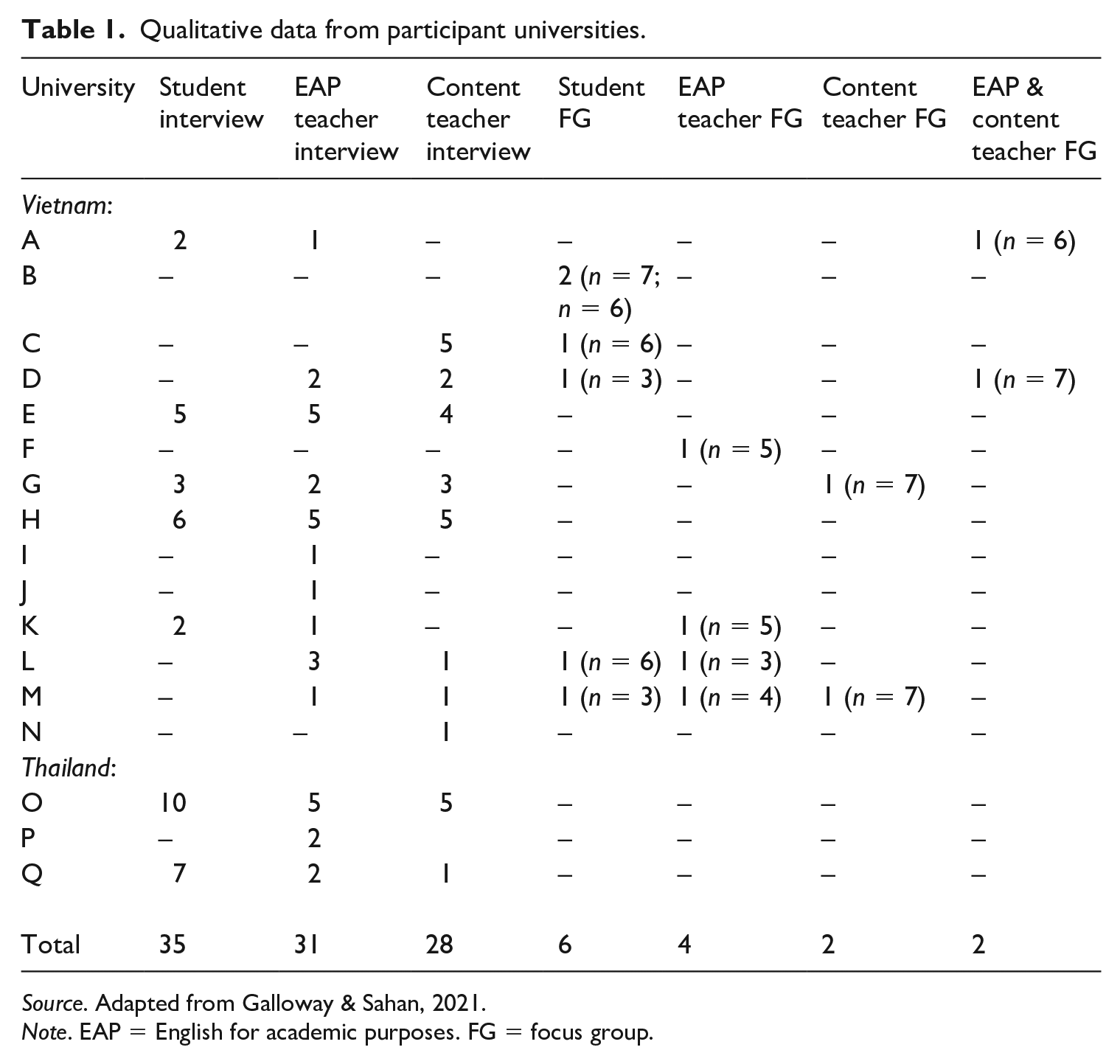
Source. Adapted from Galloway & Sahan, 2021.
Note. EAP = English for academic purposes. FG = focus group.
3 Data analysis procedures
Quantitative data were analysed in SPSS using descriptive and inferential statistics. Because the data were unevenly distributed, non-parametric Kruskal–Wallis H-tests were conducted to compare differences between the three stakeholder groups: students, EAP teachers, and content teachers.
Qualitative data were analysed in NVivo, following procedures for qualitative content analysis (Selvi, 2020) and replicating the analysis of Rose and Galloway (2019). Data sets were analysed separately in order compare findings between students, EAP teachers, and content teachers. Thematic frameworks were created during an initial round of coding, and these were then revised in line with the research questions before a second round of coding. Themes were generated both deductively and inductively, building off the initial thematic analysis conducted in (Galloway & Sahan, 2021). Deductive themes were created from the research questions (e.g. language use and stakeholder beliefs about language use in EMI), and sub-themes emerged from the data. The same procedures were followed for both interviews and focus groups. However, the focus group analysis centered on groups dynamics and social interaction, including how agreement was reached and on the group overall, rather than individual comments (Galloway, 2020).
IV Findings
1 Language use in EMI classrooms
In the questionnaire, EAP teachers reported more English use for each aspect of their teaching than students and content teachers (Table 2). Content teachers reported more English use on average than students, except for exams, for which students reported slightly higher levels of English use. A Kruskal–Wallis H-test revealed statistically significant differences between the three groups in the amount of English use reported for lectures, course materials, classes, and exams. Pairwise comparisons were then conducted using the adjusted Bonferroni correction for multiple tests. These findings suggest that while English may be used often in EMI classrooms, it is not always used. In other words, EMI classrooms in Southeast Asia do not appear to be English-only settings, a finding supported by the analysis of focus group and interview data (see Section IV.2.b).
Analysis comparing English used in English medium instruction (EMI) reported by students, content teachers, and teachers of English for academic purposes (EAP).
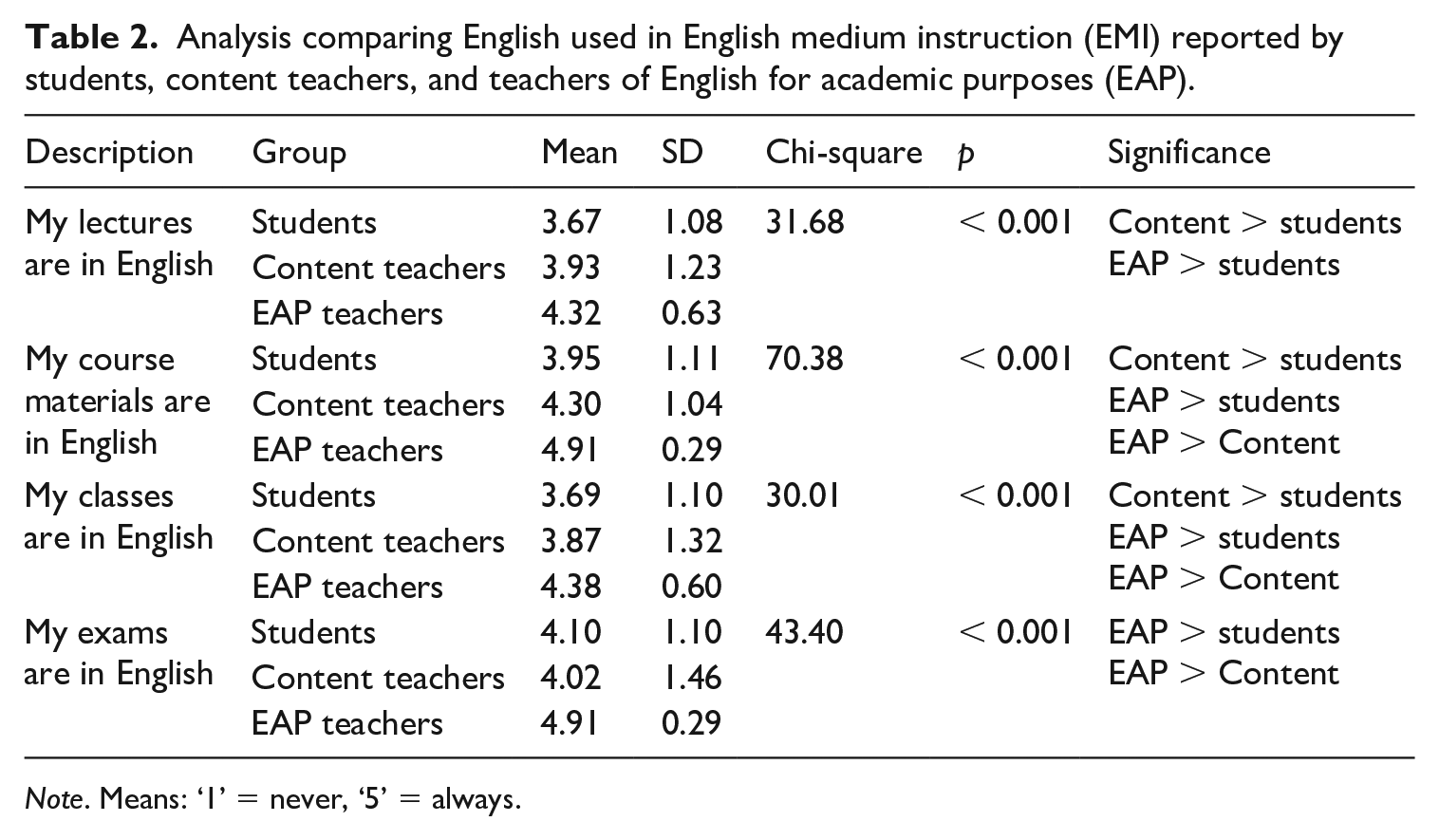
Note. Means: ‘1’ = never, ‘5’ = always.
Although the quantitative findings suggested that EAP teachers were more oriented toward an English-only approach than content teachers, evidence of this division was less apparent in the qualitative data. Interview and focus group data revealed that both EAP and content teachers used the local L1 in class – a noted theme identified through our qualitative content analysis. One content teacher in Vietnam stated, ‘We try to use English all the time but sometime for the many key words, many concept is very difficult to express in English [so] we must use Vietnamese’ (Content Teacher, University C, Vietnam; participant’s original emphasis). Similar comments were made by EAP teachers, including one teacher who noted the importance of the L1 as a pedagogical tool in ESP classes: For my program, for example, teacher[s] try to get the student[s] to speak English as much as possible and also they try to deliver the lessons in English as much as possible; however, there are cases when first language is still used to make sure that all the student[s] understand the content. Especially when we are teaching ESP subjects . . . Some of the content might not be very easy to understand or familiar to the student, then we use both languages. (EAP Teacher, University H, Vietnam; participant’s original emphasis)
The content and EAP teachers in these examples reported English as the dominant, official language of instruction but noted that the local L1 was used to clarify meaning when necessary.
Similar comments were made by EAP and content teachers in Thailand, who noted that teachers ‘use Thai to make the student understand easily’ (EAP Teacher, University O, Thailand). One content teacher made an ‘agreement with the students, like this: okay, I will speak in Thai but I will write my lecture notes while I’m talking or while I was speaking in English’ (Content Teacher, University O, Thailand). This practice of speaking in one language but writing in another resembles translanguaging, or the fluid practice of moving freely between named languages. Such practices were described by other teachers, including a content teacher who summarized the variety of translanguaging practices used in EMI classrooms: ‘In Vietnam I know the three styles of [teaching], so we are teaching English and talking English, maybe writing English and talking Vietnamese, [or] maybe writing Vietnamese and talking English’ (Content Teacher, University M, Vietnam; participant’s original emphasis). However, L1 use was often framed as the result of low student or teacher proficiency and a preference for English-only instruction was expressed by participants across datasets. The following section explores students’ and teachers’ attitudes toward language use in more detail.
2 Stakeholder beliefs on language use
To answer the second research question, students’ and teachers’ beliefs on the use of language, including the use of L1, in EMI classrooms were examined around three themes: (1) a monolingual orientation to EMI, or the belief that only English should be used in EMI classrooms; (2) beliefs about the use of L1 in EMI classrooms; and (3) beliefs about ‘what English’ should be used in EMI classrooms, including beliefs about ‘native-like’ varieties of English.
a Monolingual orientation in EMI classrooms
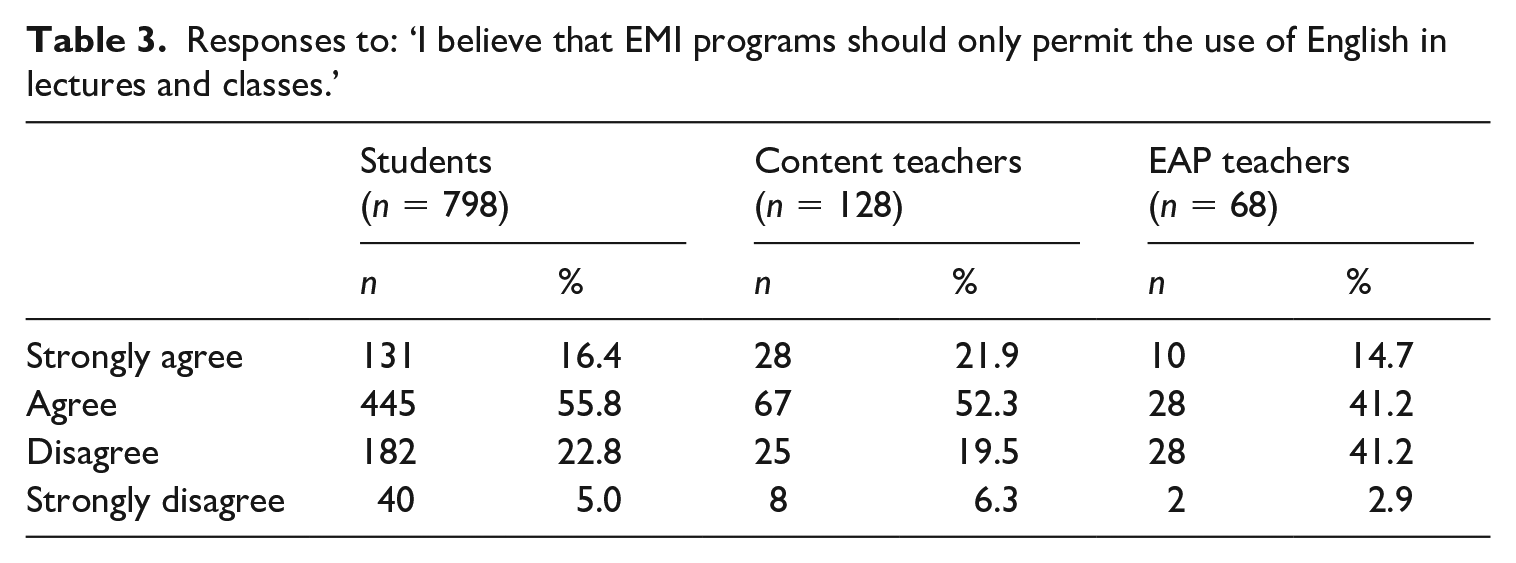
In response to questionnaire item 16 (Table 3), content teachers (M = 2.90; SD = 0.812) and students (M = 2.84; SD = 0.753) were more likely than EAP teachers (M = 2.68; SD = 0.762) to agree that EMI lectures and classes should be English-only, although a majority of EAP teachers agreed with the statement. The results of a Kruskal–Wallis H-test revealed no significant differences between the three groups.
Responses to: ‘I believe that EMI programs should only permit the use of English in lectures and classes.’
In interviews, students (n = 12, out of 35) who supported an English-only approach to EMI did so because they believed it would improve their English skills. One student stated that, if the L1 were used in class, ‘student[s] cannot improve and make progress for their English language’ (Student, University E, Vietnam). Another expressed her preference for English-only instruction: ‘I’d prefer the teacher to use English even when we have something difficult to understand because that’s when we, the students, learn how to comprehend and understand the subject in English’ (Student, University E, Vietnam). This idea was also expressed by EAP and content teachers, who stated that English-only instruction would create a ‘good environment’ for language learning (EAP Teacher, University G, Vietnam) because ‘when [students] go out from the class to the canteen, to shopping, or to everywhere, they are still talking in Thai [the L1]’ (Content Teacher, University O, Thailand). Since students received little exposure to English outside of class, English-only instruction was seen as necessary for creating an immersion environment.
In addition to the belief that an English-only environment would improve students’ English skills, many participants stated English-only instruction was in line with official university policy. This view was most commonly expressed by content teachers, who stated in interviews that it would be unfair to international students who did not speak the local language, and to local students who were paying more for EMI programs, if they did not adhere to the university’s English-only policy. One content teacher described his understanding of English-only instruction as a promise made to students: ‘I have to teach, I have to speak entirely in English because that’s a requirement, because the university promises to the students that they will be taught entirely in English. So that’s why, that’s a promise and commitment’ (Content Teacher, University L, Vietnam). Another teacher in Thailand suggested that, even when students did not expect to be taught entirely in English, it was important to adhere to the university’s English-only policy due to the high cost of EMI programs compared to Thai-medium programs. He recalled an incident in which the student asked, ‘Why do we have to do this in English? And I said, well, you pay to learn in English, I [am] paid to teach in English. Why else?’ (Content Teacher, University O, Thailand). These comments reveal a monolingual orientation not only in terms of participants’ attitudes toward language learning but also in terms of university policies discouraging bilingual instruction or L1 use in EMI classes.
b L1 use in EMI classrooms
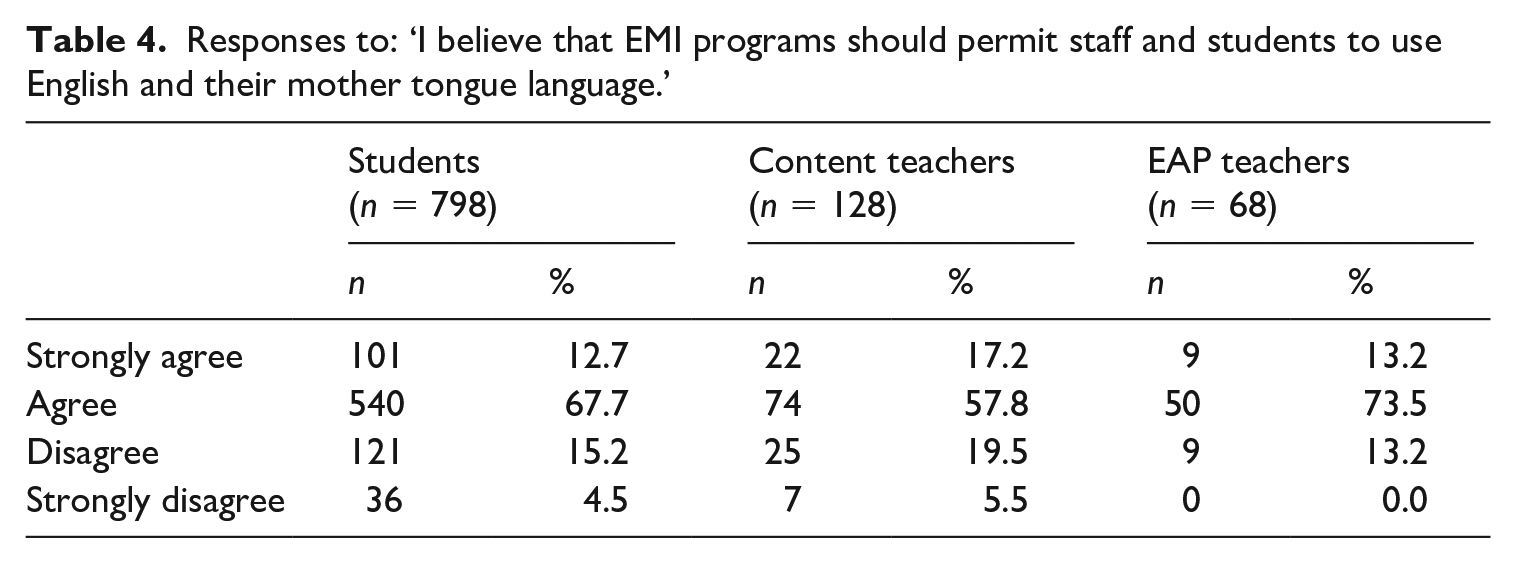
Building on the findings presented above with respect to a monolingual orientation in EMI, we also sought to explore the extent to which students and teachers believed that the L1 should be used in EMI programs. Questionnaire item 17 asked participants whether they agreed that staff and students should be permitted to use English and their L1 in EMI programs (Table 4). Overall, students (M = 2.88; SD = 0.668), content teachers (M = 2.87; SD = 0.757), and EAP teachers (M = 3.00; SD = 0.518) tended to agree with the statement. No significant differences were found between groups.
Responses to: ‘I believe that EMI programs should permit staff and students to use English and their mother tongue language.’
While on the surface these findings appear to contradict the results reported above with respect to a monolingual orientation in EMI, an analysis of the qualitative data suggests that teachers and students favored L1 use in moderation and when necessary, but generally opposed excessive use of the L1. In interviews, students (n = 22), EAP teachers (n = 18), and content teachers (n = 16) reported that the L1 was commonly used in EMI classes to support content learning; similar practices were reported across focus groups, with participants in six out of eight teacher focus groups and five out of six student focus groups unanimously agreeing that both English and the L1 were used in EMI classes.
While these participants believed that L1 use could support content learning, they qualified their support for L1 use by stating that it should only be used when students do not understand English explanations. In an interview, one student explained: Sometimes the teacher express the speech in English that the student also don’t understand well, so they can explain again in Vietnamese, but in my class it is a very, it’s a very little bit of time because most of them can understand what teacher said [in English]. (Student, University H, Vietnam)
Evident from this student’s explanation is the assumption that teachers should use Vietnamese (only) when students have not understood an English explanation, but that English should remain the primary medium of instruction. In this student’s framing, the L1 serves as a pedagogical tool to support content learning in English. Another student described the pedagogical functions of L1 use with respect to clarifying the meaning of technical terminology: Sometime when we [are] in the technical class, there’s some term we have a trouble with, the technical lecture because sometime it’s very difficult to understand all in the lecture. So in this time, the lecturer will explain in Vietnamese to help us to understand more or deeper. (Student, University H, Vietnam)
As with the previous students’ explanation, this student described the L1 as a resource to be used when students ‘have trouble with’ technical terminology in English. While this student reported that L1 use helps the students ‘understand more or deeper’, he does not appear to support L1 use in place of English instruction. Rather, he describes English as the default language of instruction and L1 as necessary for ‘very difficult’ aspects of the lessons. This was a common theme among participants in interviews and FGs who supported L1 use as supplementary to English explanations of academic content.
Aside from the pedagogical benefits of L1 use, a few participants (two students, two EAP teachers, and one content teacher) stated that the L1 helped to establish rapport and create a comfortable learning environment. One student stated, ‘It’s nice to use Thai because, basically, I’ve felt more connected to the teacher if they speak Thai’ (Student, University Q, Thailand). Although the importance of L1 use for building rapport was expressed by only a few participants in interviews, this finding nonetheless suggests that the functions of L1 use in EMI classrooms extend beyond pedagogical purposes. However, as with participants describing the pedagogical functions of the L1, these participants believed that L1 use should be limited, and that English should serve as the primary language of communication in class.
c ‘What English?’ in EMI classrooms
Next, to investigate attitudes toward native-speakerism in EMI, we focused on two teacher characteristics: having a ‘native-like accent’ and ‘experience abroad.’ Table 5 illustrates the results across groups. The results indicated a stronger preference for native-like accents among students (M = 2.91; SD = 0.695) and content teachers (M = 2.67; SD = 0.633) compared to EAP teachers (M = 2.39; SD = 0.607). The majority of students and content teachers agreed that it was an important characteristic of a successful EMI teacher. The results of a Kruskal–Wallis H-test revealed significant differences between groups with respect to attitudes regarding the importance of a native-like accent (H(2) = 55.30, p < .001), and pairwise comparisons using the adjusted Bonferroni correction revealed significant differences between all three groups. In other words, students agreed more strongly than content teachers and EAP teachers that a native-like accent was important, and content teachers agreed more strongly than EAP teachers.
Responses to: ‘In my context (the country you are currently studying in), the following characteristics are important for teachers who teach and work using English as a medium of instruction in EMI programs.’
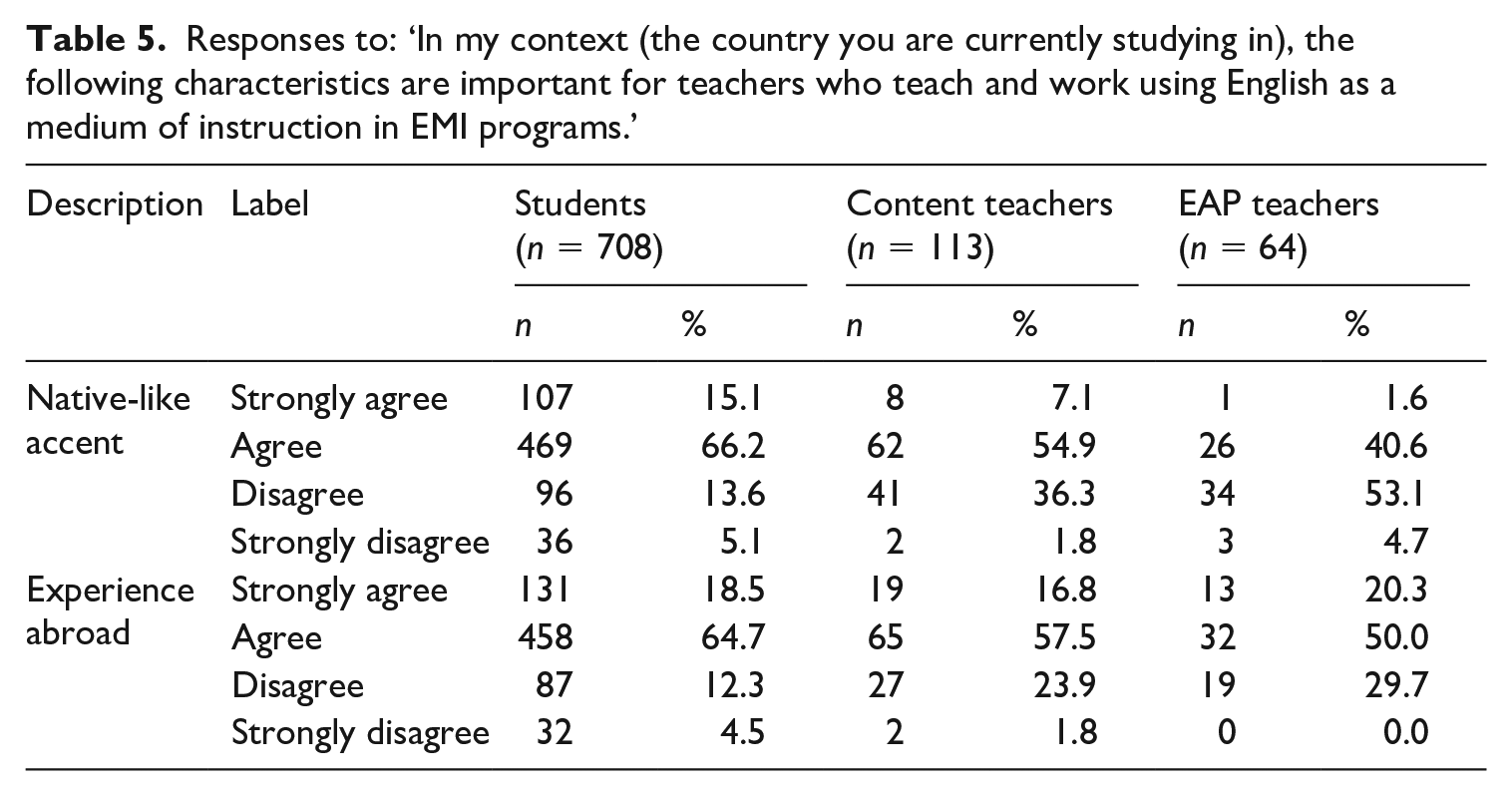
The result also indicated that the majority of students (M = 2.97; SD = 0.699), content teachers (M = 2.89; SD = 0.686), and EAP teachers (M = 2.91; SD = 0.706) believed that experience abroad was important for teachers on EMI programs. A Kruskal–Wallis H-test indicated no significant differences between groups.
The analysis of interview and focus group data revealed a preference for ‘native-speaker’ teachers among many participants, as well as an assumption that experience abroad – particularly in ‘native English-speaking’ countries – qualified teachers to lecture on EMI programs. In interviews, eight students expressed a preference for ‘native-speaking’ or ‘foreign’ teachers because they believed these teachers would have higher levels of English proficiency, which in turn would help the students improve their English. One student stated, ‘I prefer a foreign teacher because they are native and English is their first language’ (Student, University H, Vietnam). A preference for ‘native-speaking’ English teachers was also found in Thailand, although the conflation of ‘native’ with ‘foreign’ or ‘Western’ appeared less common. An EAP teacher originally from France stated that he was rejected from teaching positions because English was not his first language: ‘I tried to get a job in an international school as an English language teacher because that was my background and my qualification but they wouldn’t even reply because they have to employ native speakers’ (EAP Teacher, University Q, Thailand; participant’s original emphasis). These statements suggest that native-speaker ideology persists in the recruitment and hiring practices of EMI universities, particularly with respect to EAP teachers.
Native-speaker ideology was also reported in university hiring practices favoring applicants with degrees from ‘English-speaking’ countries. An EAP teacher in Vietnam noted that, when recruiting staff to teach EMI courses, the university gave ‘more priority for those who graduated from English-speaking countries’ than graduates from Vietnamese universities (EAP Teacher, University A, Vietnam). The teacher explained that these policies were connected to the assumption that graduates from ‘English-speaking countries’ would have higher levels of English proficiency than graduates from local universities. A similar recruitment policy was described by a content teacher at another university who added that ‘we think we get a better result’ from ‘lecturer[s] who graduated in England, in US or in Australia’ (Content Teacher, University C, Vietnam). Thus, a native-speaker ideology appears to exist in the hiring practices for local staff, since universities were reported to prefer local staff members with degrees from ‘native-speaking’ countries. Combined with the questionnaire results indicating that a majority of participants considered experience abroad an important criterion for EMI teachers, these findings raise concerns about fair and equitable recruitment practices in EMI programs, particularly in contexts where EMI programs offer hiring salaries than programs taught in the local language (Galloway & Sahan, 2021).
V Discussion
This partial replication study of Rose and Galloway (2019) provides insights into language use and stakeholder beliefs regarding EMI implementation in higher education in Vietnam and Thailand. The findings on norms of language use (research question 1) illustrate how English and local languages are used in EMI contexts and statistically significant differences in attitudes amongst the three groups of participants. English is used more in EAP classrooms supporting EMI programs than in the content classes and content teachers reported more use of English in lectures, materials, and classes than students, although students reported slightly higher use of English in their exams. However, the qualitative data also revealed that both types of teachers used the local L1 in class. These results confirm the findings of studies conducted in China and Japan (Galloway et al., 2017; Rose & Galloway, 2019) suggesting discrepancies between the amount of English use reported by teachers and students in EMI classes.
In addition to discrepancies in reports of language use, the questionnaire, interview and focus group findings also highlight that EMI classrooms in Thailand and Vietnam do not appear to be English-only settings. The L1 was reported to be a useful pedagogical tool, particularly to clarify meaning of difficult concepts (Galloway & Sahan, 2021). One teacher in Thailand made his own class policy in agreement with the students; he would speak in Thai, but his lecture slides would be in English. This translanguaging approach was also reported by other teachers. Notably, in Vietnam, a teacher reported three teaching styles: teach in English and speak in English, or write in English and speak in Vietnamese, or write in Vietnamese and speak in English. It appears some teachers are flexible depending on students’ needs and such flexible language use is consistent with Global Englishes approaches to flexible norms, reflective of how English is used today (Rose & Galloway, 2019). These descriptions of flexible language use appear to resemble translanguaging practices similar to those reported by contributors to Paulsrud, Tian, and Toth’s (2021) edited volume, as well as multilingual practices reported by Baker and Hüttner (2019).
However, although participants reported translanguaging practices, they did not appear to embrace a translanguaging ideology (Chang, 2019). English-only was desired by students to create ‘immersion’ (see Sahan & Rose, 2021), and by teachers because it is what they are ‘paid’ to do (see Kirkpatrick, 2014). Neither of these desires reflect needs. Further evidence to the idea that teachers and students ‘resort’ to using other languages in EMI, as in Galloway et al. (2017) and Galloway and Ruegg (2020), L1 use was often framed as the result of low student or teacher proficiency and an overall preference for English-only instruction and a monolingual orientation were found.
The study also reveals insights into students’ and teachers’ beliefs on the use of language, including the use of L1, in EMI classrooms (research question 2). As in Rose and Galloway (2019), three themes were confirmed: (1) a monolingual orientation to EMI, (2) beliefs about the use of L1 in EMI classrooms, and (3) beliefs about ‘what English’ should be used in EMI classrooms, including beliefs about ‘native-like’ varieties of English. But, beliefs around these themes varied according to our three groups.
Content teachers and students had a more monolingual orientation to EMI, feeling more strongly in the questionnaire that only English should be permitted in EMI lectures and classes, although there were no significant differences between groups. Most EAP teachers also agreed, however, with the statement. Interviews revealed that students felt this would improve their English skills, which was a primary motivation for enrolling in EMI programs (Galloway & Ruegg, 2020; see also Galloway et al., 2017; Kirkpatrick, 2014) and the L1 was seen to hinder the development of English. Even when concepts are difficult, they prefer to be fully immersed in English reflecting a belief that EMI students improve their English skills through an immersive environment and high exposure to the language (Sahan & Rose, 2021a). Although researchers have questioned the assumptions behind this view of language learning in EMI – with Block and Moncada-Comas (2019, p. 3) calling it ‘a naïve theory of language learning’ – many of our participants in Vietnam and Thailand nonetheless believed that students’ English skills would improve through an English-only environment. This view was also shared by EAP and content teachers. Thus, English-only is seen to be conducive to learning English by providing a ‘good environment’ for language learning. This view that students in Vietnam and Thailand (and other contexts) receive little exposure to English has been used to support communicative language teaching and native norms in contexts of English as a foreign language (EFL), yet with growing discourse on Global Englishes, we see that exposure to translanguaging practices is more reflective of multilingualism.
The study also revealed that these beliefs about the benefits of an English-only environment also relate to official top-down university policy. While we note a significant limitation to our study is that we did not conduct an analysis of policy, we did discover important concerns some EMI teachers have about ensuring their teaching meets policy requirements. There is a feeling that students are ‘promised’ that the course will be in English, and some references were made to the university’s ‘English-only’ policy, which warrants further research. The issues of fees are clearly an issue, and teachers feel compelled to give students what they are paying for (see Kirkpatrick, 2014). While this study did not conduct a policy analysis, it does provide insights into policy. Further, comments regarding the inclusion of international students who may not understand Thai or Vietnamese is a controversial one – an argument also used to defend the use of English-only. We call for more research into university policies that may be discouraging bilingual instruction or L1 use in EMI classes (Sahan & Rose, 2021a).
VI Conclusions and implications
Just as calls have been made within the field of Global Englishes for ELT curricula to reflect the current sociolinguistic uses of the English language, it is also essential that we examine whether EMI curricula and top-down policy with neoliberalist internationalization agendas reflect the dominant use of multilingualism in our globalized world. In Vietnam and Thailand, previous reports indicate EMI provision lacks context-appropriate quality assurance systems (Mohamad Uri & Abd Aziz, 2018; Tran & Nguyen, 2018), and native-speakerism continues to dominate (Boonsuk et al., 2021).
In our study, students, EAP and content teachers all agreed that EMI programs should permit staff and students to use English and their L1. At first, this appears contradictory, yet the qualitative data revealed that this was to be used in moderation and on the whole participants were against excessive L1 use. Qualitative data revealed that it was used as a pedagogic tool to support content learning (Galloway et al., 2017; Rose & Galloway, 2019; Sahan & Rose, 2021), but only when students do not understand the English explanation. So rather than translanguaging, the participants seem to see L1 use as supplementary to English explanations of academic content. However, some participants also reported that the L1 was useful to establish rapport and create a comfortable learning environment in which they can feel ‘connected’ to their teachers. Although this was only a few participants, it calls for further research on the usefulness, or perhaps on awareness raising for staff and students on the value of translanguaging. Just as we raise awareness of Global Englishes, we need to raise awareness of incorporating multilingual repertoires in EMI, challenging an English-only EMI monolingual ideology.
Our study also explored students’ and staff’s attitudes toward native-speaker hegemony in EMI (Kirkpatrick, 2017) in Thailand and Vietnam. Rose and Galloway (2019, p. 215) argue that native-speaker hegemony ‘needs to be challenged in order for EMI to be successful’. This is a real concern regarding EMI teacher recruitment, especially with emphasis being placed on PhDs obtained in western countries. Our questionnaire data revealed stronger preferences for native-like accents among students and content teachers compared to EAP teachers. Thus, although Galloway and Rose (2021) reported that ‘native-like’ accent was ranked as the least important characteristic among the 11 sub-items on the questionnaire in the East Asian context, these results suggest that most students and content teachers agreed that it was an important characteristic of a successful EMI teacher. As noted above, there is much emphasis on obtaining a PhD abroad. Notably, our study also revealed that all groups placed emphasis on experience abroad. This is concerning, as positive attitudes towards ‘native’ English were often used to justify ‘native’ models in ELT to give students what they want. Yet Galloway (2017b) highlighted that there has been little exploration into why they thought this way and its relation to the dominance of native-speakerism and standard language ideology. Thus, we call for more exploration into the factors influencing these attitudes in this context.
Our study reveals an overall preference for ‘native’ English-speaking teachers, and it seems experience abroad, particularly in ‘native’ English speaking countries, makes someone a legitimate and credible EMI teacher. As the NNEST movement has gained ground in the field of ELT, we are now revisiting old ELT arguments with the global growth in EMI. The study puts forward similar arguments to previous studies in ELT, particularly due to the links between EMI in emerging contexts and language learning: it is the so-called ‘native’ English speaker that is seen as being best for EMI. This calls for awareness raising to address the ‘native’ speaker fallacy. Participants are aware of prejudices that need to be challenged, including prejudices in placing emphasis on PhDs in native countries, which, although has been challenged in field of Global Englishes, calls for more research on the promotion of fair and equitable recruitment practices in EMI programs.
The absence of observations and an investigation of institutional policies to compare with teachers’ and students’ responses are noted as limitations to this study. Nonetheless, the findings from this study highlight a contradiction between research in the field of ELT and on-the-ground EMI practices: while Global Englishes is challenging linguistic imperialism, monolingual interpretations of EMI favoring English-only instruction and the ‘native-speaker’ teacher may be promoting it. This finding underscores the need for research not only to investigate EMI in practice but also to address how to combat the dominant constraints and attitudes, such as through teacher training programs, new support systems, and practical implementation guidelines.
Footnotes
Acknowledgements
We would like to thank the participants of this study for their contribution.
Author’s Note
Kari Sahan is now affiliated to University of Reading, UK.
Declaration of conflicting interests
The author(s) declared the following potential conflicts of interest with respect to the research, authorship, and/or publication of this article: The data for this study were collected as part of a larger study, as noted in the manuscript. However, the analysis and findings presented here have not been published elsewhere and are unique to this article. The data, findings, and arguments put forth in this article are different from the (largely descriptive) data and findings which appear in the report from the original study.
Funding
The author(s) disclosed receipt of the following financial support for the research, authorship, and/or publication of this article: The data collection for this study was funded by a British Council English Langauge Teaching award.
Geolocation information
This study was conducted at universities in Vietnam and Thailand.
