




Abstract
This study explores whether English-dominant (ED) speakers and speakers of English as a foreign language (EFL) perceive the same degrees of formality in combinations of (in)formal greetings (Hi/Dear) and address forms (informal First Name/Ms. Last Name) with (in)formal nouns, verbs, and adjectives (Latinate/Germanic). It also explores which of these variants the two groups perceive as salient in communicating formality. Twenty-five ED undergraduates in Canada and 27 EFL undergraduates in Slovakia rated the formality of 20 sentence-length examples of business email correspondence and identified features that were the primary basis for their formality rating. Distributions of 11 of the formality ratings were statistically significantly different in the two groups (with most effect sizes ranging from small to medium), and trends in the reports of salient features suggested that the EFL speakers focused on the formality of address forms more frequently than did the ED speakers. The findings are discussed in relation to infelicitous interlingual transfer and strategies for developing pragmatic competence.
I Introduction
Communicative competence consists of many competences beyond linguistic (e.g. Bachman, 1990; Canale & Swain, 1980; Hymes, 2001), such as sociolinguistic and pragmatic competence, and includes sociopragmatic and pragmalinguistic knowledge (e.g. Leech, 1983; Thomas, 1983). Concerning stylistic variation along the continuum of formality, sociopragmatic knowledge translates into knowing which social situations are likely to be considered (in)formal by speakers of a language. Pragmalinguistic knowledge translates into knowing which (in)formal stylistic variants are available in a language and how they may be combined to create styles with specific degrees of formality. Differences that exist among languages in this regard may involve categories of stylistic variants at various linguistic levels (i.e. phonological, lexical, morphosyntactic, and orthographic) and salience of these categories in communicating formality. For example, personal pronouns (often accompanied by corresponding verb forms) are some of the most salient (in)formal stylistic variants in many modern European languages, such as German (du, Sie), Russian (ty, vy), or French (tu, vous), without obvious equivalents in English (you).
Compared to those who learn to speak a language as their first or dominant language (L1), those who learn to speak it as their second language (L2) typically have less exposure and, importantly, restricted access to a full range of stylistic variation in the language (e.g. Regan, 2010). The target language (TL) input is particularly limited in foreign-language (FL) acquisition contexts because in these learning environments the TL enjoys no importance at the official, cultural, or social level, and the opportunities to acquire and practice the language rarely extend beyond time spent in the classroom. Research has found that without being addressed the limited TL input may lead to unintended and unfortunate consequences in communication (e.g. Economidou-Kogetsidis, 2016; Lewin-Jones & Mason, 2014). For example, in Savić’s (2018) study of teachers’ perceptions of politeness and appropriateness in English L2 students’ email requests at a university in Norway, whether they spoke English as their mother tongue or not, some of the teachers found the email opening ‘Hey’ absolutely inappropriate and impolite. Findings of these studies suggest that mastering stylistic variation along the continuum of formality (both the ability to perceive and the ability to express degrees of formality) is essential to acquiring well-balanced L2 communicative competence.
Considering the perceptive ability as a prerequisite to the expressive ability, this exploratory study focuses on (1) the ability of speakers of English as a foreign language (EFL) to perceive degrees of formality in sentence-length combinations of (in)formal greetings, (in)formal address forms, and (in)formal nouns, verbs, and adjectives and (2) the salience of these categories of variants in EFL speakers’ perceptions of formality in English.
II Theoretical framework
1 Formality of style as a continuum
Style formality can be defined as a sequence of degrees ranging from extremely informal to extremely formal (e.g. Heylighen & Dewaele, 1999; Moreno, 2006; Pearce, 2005). Stylistic variants may be considered relatively informal, neutral (i.e. stylistically unmarked), or formal individually, but they are typically combined to create linguistic units longer than a word, phrase, or expression, and any of these units may also be placed on the continuum of formality. Formality of a linguistic unit depends on (1) the degree of formality inherent in each stylistic variant, (2) the proportion of (in)formal stylistic variants, and (3) the salience of the stylistic variants in the unit. With regard to the formality of each stylistic variant, a word is considered more formal the more it is precise (i.e. context-independent), the more it is explicit (i.e. not depending on the message receiver’s prior knowledge of the subject matter), and the more it is autonomous (i.e. not requiring the use of other communication channels or knowledge of a specific language for the meaning of the message to be understood), such as nouns in contrast to pronouns or standard in contrast to slang words (e.g. Bernstein, 1964; Heylighen & Dewaele, 1999; Kay, 1977). Concerning the proportion of (in)formal stylistic variants, a linguistic unit is considered more formal when formal variants are used consistently and in higher proportion in comparison to other stylistic variants. In contrast, in informal styles a variety of (in)formal stylistic variants may be combined more freely to create specific stylistic effects (e.g. Agha, 1998; Irvine, 1979). Finally, with regard to salience, the more stylistically salient variants exercise a stronger pull on the perceived degree of formality in a linguistic unit, either toward the informal or the formal end of the continuum. Salience of stylistic variants depends on their noticeability, which can be the result of the frequency of their use, their incongruence in a particular context (Podesva, 2011; Rácz, 2013), and their role in conventional expressions of politeness, such as the use of certain address forms.
2 Formality of style and social context
Style formality and social context influence each other. The degree of formality in people’s verbal expression co-creates the nature of their social role, the setting, and the purpose of an interaction (e.g. Eckert, 2008, 2012; Trudgill, 1999; van Compernolle, 2014). At the same time, people’s social roles, the setting, and the purpose of an interaction influence the degree of formality in their use of language and other areas of social behavior, such as personal appearance (e.g. grooming and clothes). Public, transactional, and impersonal social contexts (e.g. discussing the next step in a visa application with a lawyer in an office) are typically associated with formal social behavior, including the use of formal language, whereas private, interactional, and personal social contexts (e.g. talking to a friend at home about plans for the weekend) are typically associated with the use of informal language.
3 Formality of style in a foreign language
Several studies have shown that acquiring stylistic variation in a L2 is challenging for learners whose TL instruction occurs predominantly in the classroom (e.g. Blondeau & Lemée, 2020; Geeslin et al., 2013; Regan et al., 2009). This is typically the case in FL acquisition contexts where the TL input, including exposure to a variety of styles in authentic examples of the TL, is restricted. Without targeted instructional intervention, this can affect FL learners’ acquisition of sociopragmatic and pragmalinguistic knowledge and has implications for their development of communicative competence in general. For example, discussing the effectiveness of a Core French program (i.e. typically 30 to 40 minutes of classroom instruction per day) in the predominantly English-speaking Canadian province of Ontario akin to a FL acquisition context, Cummins (2014) reported the program’s ‘persistent failure. . .to develop even minimal communicative proficiency in French among a large proportion of participating students’ (p. 2). The results of some studies have suggested that in case a speaker’s TL proficiency has not yet been sufficiently developed, (potentially inappropriate) L1-to-TL interlingual pragmatic transfer is more likely to occur (e.g. Bu, 2012; Han & Burgucu-Tazegül, 2016; Taguchi, 2011; Wannaruk, 2008).
III Literature review
1 (In)formal stylistic variants in written English
Research focused on stylistic variation along the continuum of formality in English has examined numerous stylistic variants that can be used in writing. At the lexical level, researchers have examined word origin and frequency of use of discrete lexical units (e.g. Levin & Novak, 1991; Levin et al., 1994). They found that in sentence-length linguistic units English-dominant (ED) speakers perceive infrequently used words of Latin and Greek origin as more formal than frequently used words of Germanic origin. More recently, in a corpus study, Fang & Cao (2010) found that words of Latin and Greek origin occur in formal academic writing more frequently than they do in speech and writing for social purposes (which are less formal). Phrasal verbs, which are typically considered less formal than their one-word synonyms of Romance origin (e.g. Gvishiani, 2020), have been found to occur in formal texts such as academic writing in a specific fashion. For example, the meanings that phrasal verbs convey in formal academic writing have been found to be much less common than the meanings that the same phrasal verbs convey in informal spoken contexts and in English generally. This means that the use of phrasal verbs in academic writing is typically stylistically unmarked or neutral (e.g. Alangari et al., 2020; Liu & Myers, 2020).
At the morphosyntactic level, researchers have investigated the use of nominalizations (e.g. Jalilifar et al., 2017; Lee et al., 2018; Sarani & Talati, 2015), relative pronouns (e.g. Levey & Hill, 2013; Tai, 2020), contractions (e.g. Ebibi et al., 2018; Lorenzo-Dus & Bou-Franch, 2013), verb voice (e.g. García, 2015; Horbowicz et al., 2019), subject–verb agreement (e.g. Al-Shawashreh & Al-Omari, 2019), and syntactical branching (e.g. Levin & Garrett, 1990). This research has found that the following stylistic variants are more commonly (expected to be) found in formal linguistic units as examples of increased syntactic precision or complexity: nominalizations (e.g. ‘to be of the opinion’ rather than ‘think’ or ‘believe’), ‘wh-’ relative pronouns, full forms (instead of contractions, such as ‘I have’ rather than ‘I’ve’), passive voice, strict grammatical noun–verb agreement (e.g. ‘There are’ rather than ‘There’s two of us’), and right-branching (e.g. ‘Because I was hungry, I had a meal’). More recently, to explore the connection between syntactic complexity and style formality, researchers have examined the use of several syntactic features at the same time, including sentence length, amount and distribution of subordination and coordination as measures of clause complexity, and phrasal complexity. For example, Biber et al. (2016) found an association between non-finite relative clauses and phrasal noun modifiers and formal informational domains in contrast to an association between adverbial and complement clauses and the less formal personal and spoken domains of language use. Other researchers found that complex noun phrases (i.e. nouns used with adjectives, possessives, prepositional phrases, relative clauses, participles, appositives, nominal clauses, and subject gerunds and infinitives) were more likely to appear in formal academic writing (e.g. Larsson & Kaatari, 2020; Qin & Uccelli, 2020). Finally, at the orthographic level, researchers have investigated the use of informal non-standard spelling, such as ‘wuz’ for ‘was’ or ‘u’ for ‘you’ (e.g. Jaffe & Walton, 2000), and punctuation, including the use of emojis, emoticons, and abbreviations, among many other informal features (e.g. Christopherson, 2011; Pavalanathan & Eisenstein, 2016; Thayer et al., 2010; Westbrook, 2007).
2 (In)formal stylistic variants in written English specific to email
Although email has become a standard form of computer-mediated communication, some uncertainty remains about how to approach its composition, including the formality of its style, which is to a large extent caused by the fact that email users typically approach the genre either as closer to speech: informal and spontaneous; or, as closer to writing: formal and edited. This has implications for how email senders are perceived by email recipients, in case the views of the genre held by the senders do not match those of the recipients (e.g. Lewin-Jones & Mason, 2014). In pragmatics research, email has largely been used to investigate the performance of speech acts (e.g. type and number of moves), especially requests, including the performance of these speech acts by language learners (e.g. Burgucu-Tazegül et al., 2016; Winans, 2020). In some of this research the focus has included the use of (in)formal stylistic variants specific to the genre, namely the use of (in)formal greetings, address forms, and signoffs in email openings and closings (e.g. Bjorge, 2007; Chen, 2006; Dittrich et al., 2011; Savić, 2018; Waldvogel, 2007; Wei-Hong Ko et al., 2015). In these studies, several distinctions between formal versus informal stylistic variants were assumed or emerged. For example, as part of email openings, ‘Hi’ and ‘Hello’ were considered to be examples of greetings that are less formal than ‘Dear Mr./Ms.’ or ‘Dear Sir/Madam’. Nicknames and first names were considered to be less formal address forms than kinship and professional titles combined with last names. Finally, signoffs such as ‘Regards’ and ‘Cheers’ were considered to be less formal email closings than, for example, ‘Best Regards’ and ‘Yours faithfully’. Within pragmatics, the use of these (in)formal stylistic variants has been interpreted within the framework of the face-saving view of politeness (e.g. Brown and Levinson, 1987), specifically in relation to positive and negative politeness strategies that may be employed to counteract threats to face (e.g. Bou-Franch, 2011; Felix-Brasdefer, 2012). Within this framework, depending on the distance between the interlocutors and the degree of imposition, informal greetings and address forms can be used to establish solidarity as a positive politeness strategy to address threats to positive face (i.e. desire to be liked). In contrast, formal greetings, address forms, and signoffs can be used to express deference as a negative politeness strategy to address threats to negative face (i.e. desire to do as one likes).
3 EFL speakers’ ability to perceive formality
Most research focused on lexical stylistic variants along the continuum of formality in English (the focus of this study) appears to have examined the production of such variants or to have provided a description of their use by ED speakers, with a few studies focused on the acquisition and production of such variation by EFL speakers (e.g. a study of the informal discourse marker ‘like’ by Truesdale & Meyerhoff, 2015; a study of various elements of lexical formality in academic writing by Bui, 2018). In contrast, research focused on the perception of lexical stylistic variants along the continuum of formality by EFL speakers appears to be lacking. Perception studies focused on EFL speakers appear to have mostly investigated their sociolinguistic attitudes, awareness, and evaluations of regional phonological variation (e.g. Alford & Strother, 1990; Clark & Schleef, 2010). The present exploratory study attempts to fill this gap by focusing on FL speakers’ perceptions of lexical variants that are primarily defined by their position on the continuum of formality. Specifically, it seeks to provide preliminary answers to two questions, namely: (1) whether EFL and ED speakers perceive the same degrees of formality in examples of English writing that combine (in)formal greetings and (in)formal address forms with (in)formal nouns, verbs, and adjectives, and (2) which of these categories of stylistic variants the two groups of English speakers find salient.
IV Methods
1 Participants
Data for the present study were collected from 25 ED speakers (11 male, 14 female) and 27 EFL speakers (11 male, 16 female). Participants in both groups completed a linguistic background questionnaire (see Appendix 1), which was used to create the following group portraits. All ED speakers were undergraduate students enrolled in two different English courses at a major English-medium Canadian university who identified English as their first or dominant language. The average age in the group was 21 years (SD = 0.73) and ranged from 20 to 23 years. Twenty (80%) of the ED speakers reported speaking one additional language. For the majority (90%) of the speakers this language was French, which they reported most frequently using in their free time and in which they reported most frequently having achieved the beginner level, selecting from five descriptors (i.e. elementary, beginner, intermediate, advanced, master/fluent).
All EFL speakers were undergraduate students enrolled in an EFL teacher-trainee program course delivered in English at a major university in Slovakia. The average age in the group was 20 years (SD = 0.91) and ranged from 19 to 22 years. To be admitted into the teacher-trainee program, all participants must have passed a state secondary-school English exam at the minimum proficiency level B1 (independent user) of the Common European Framework for Languages. Selecting from 5 descriptors (the same as described above), 22 (82%) of the EFL speakers self-reported their English-language proficiency as ‘advanced’, 3 (11%) as ‘master/fluent’, and 2 (7%) as ‘intermediate’. Seventeen (63%) of the EFL speakers reported using English primarily at school or work. The rest reported using English both at school/work and in their free time equally frequently, except for one student who reported using English primarily in their free time. Finally, selecting from five descriptors (i.e. never, rarely, sometimes, often, very often), the EFL speakers indicated the frequency with which they engaged in several activities in English. Based on the group average frequencies, which ranged from rarely to very often, the following is a list of the activities ordered from most to least frequent: browsing the Internet, listening to music, reading books for study purposes, reading for fun, watching TV, listening to the radio, and playing computer games.
2 Instruments
Inspired by the instrument used in Rehner’s (2010–2015) project, a questionnaire was created to record participants’ perceptions of formality and the stylistic variants they considered salient in communicating formality. To ensure validity of the questionnaire (i.e. that the items allowed for a variety of formality ratings and clearly distinguished between items designated as exclusively formal versus exclusively informal), it was created in a collaboration of the researcher with a group of ED graduate faculty and students who were considered to be peer professionals with expertise in the area. Based on feedback from the peer professionals, items in the initial set were changed to remove several inconsistencies. For example, the length (i.e. the same sentence type), syntax (i.e. exclusively active voice), and subject matter (i.e. exclusively professional and regarding a third party) of the sentences were standardized, and the use of personal pronouns was avoided in favor of the exclusive use of definite articles. Additionally, upon recommendation from the peer professionals, the final selection of greetings and address forms was consulted with an employee at a major Canadian bank, and the final selection of nouns, verbs, and adjectives was made taking into account both their etymology and frequency of use.
The following is a presentation of the final version of the questionnaire, which consisted of 20 sentence-length (e.g. Lahiri, Mitra, & Lu, 2011; Levin & Garrett, 1990; Levin et al., 1981; Levin & Novak, 1991) examples of business email communications between two female colleagues who share the same age and position at a bank. Eight of the examples were created to include all three categories of stylistic variants: (1) greeting, (2) address form, and (3) nouns, verbs, and adjectives (considered together as vocabulary). Two additional examples of business email communications were created to consist only of the vocabulary. Each of the three categories of stylistic variants had its formal and informal version, presented in Table 1.
Categories of stylistic variants and their formal and informal versions.
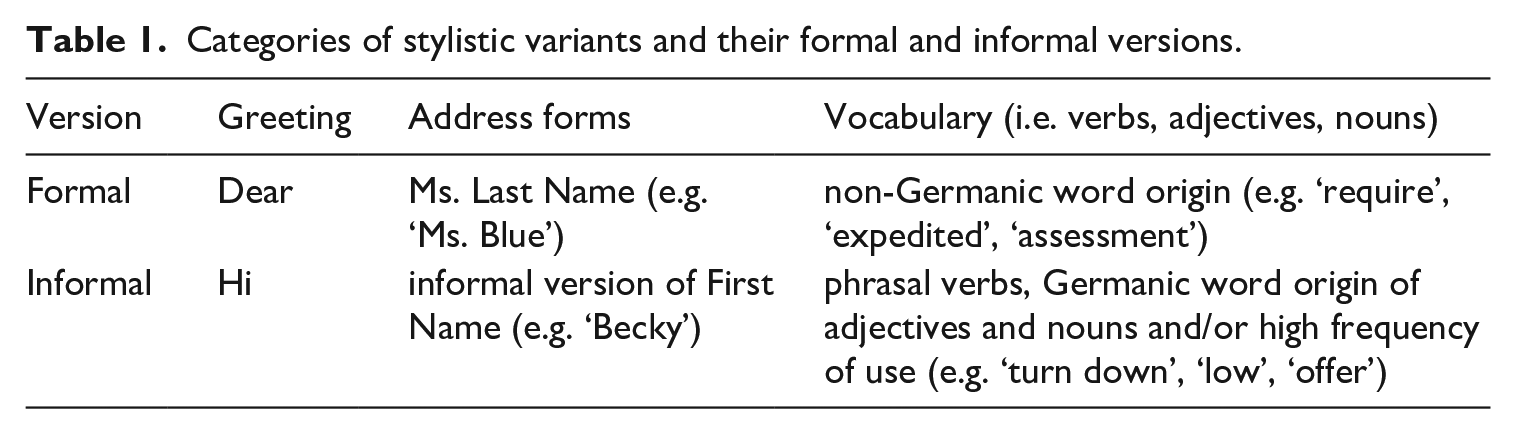
As Table 1 shows, greetings were included in two versions, the formal ‘Dear’ and the informal ‘Hi’. Formal address forms consisted of the title ‘Ms.’ and last names, all of which were adjectives denoting colors (e.g. Ms. Blue). Informal address forms consisted of informal versions of first names, all of which had two syllables and ended in ‘y’ (e.g. Becky). All verbs, nouns, and adjectives included as formal vocabulary were lexical items of non-Germanic origin. All informal verbs were identified as phrasal verbs either in the New Oxford American Dictionary (2005) or Canadian Oxford Dictionary (2005). All informal adjectives and nouns were lexical items of Germanic origin, except for the following words whose etymology includes French and/or Latin: ‘easy’, ‘money’, ‘rule’, ‘number’, ‘form’, ‘paper’, ‘offer’, and ‘change’. However, according to the New Oxford American Dictionary (2005) these words have been in use since the Middle English period, and according to the list of 5,000 most-frequently-used words in contemporary American English in Davies’s (2008) Word Frequency Data from the Corpus of Contemporary American English (COCA), these words are all used with high frequency, and their frequencies of use are similar to those reported in the Strathy Corpus of Canadian English (SCCE) (Strathy Language Unit at Queen’s University, n.d.).
Table 2 lists all 10 combinations of the formal and informal variants. Based on the proportion of formal versus informal stylistic variants and taking into consideration that the category of vocabulary is more prominent because it consists of a noun, verb, and adjective, the 10 combinations may be divided into those that represent exclusively or mostly formal degrees, mixed degrees, and mostly or exclusively informal degrees on the continuum of stylistic formality. However, one must bear in mind that this categorization does not take into account the salience of the stylistic variants.
Combinations of formal and informal versions of stylistic variants.
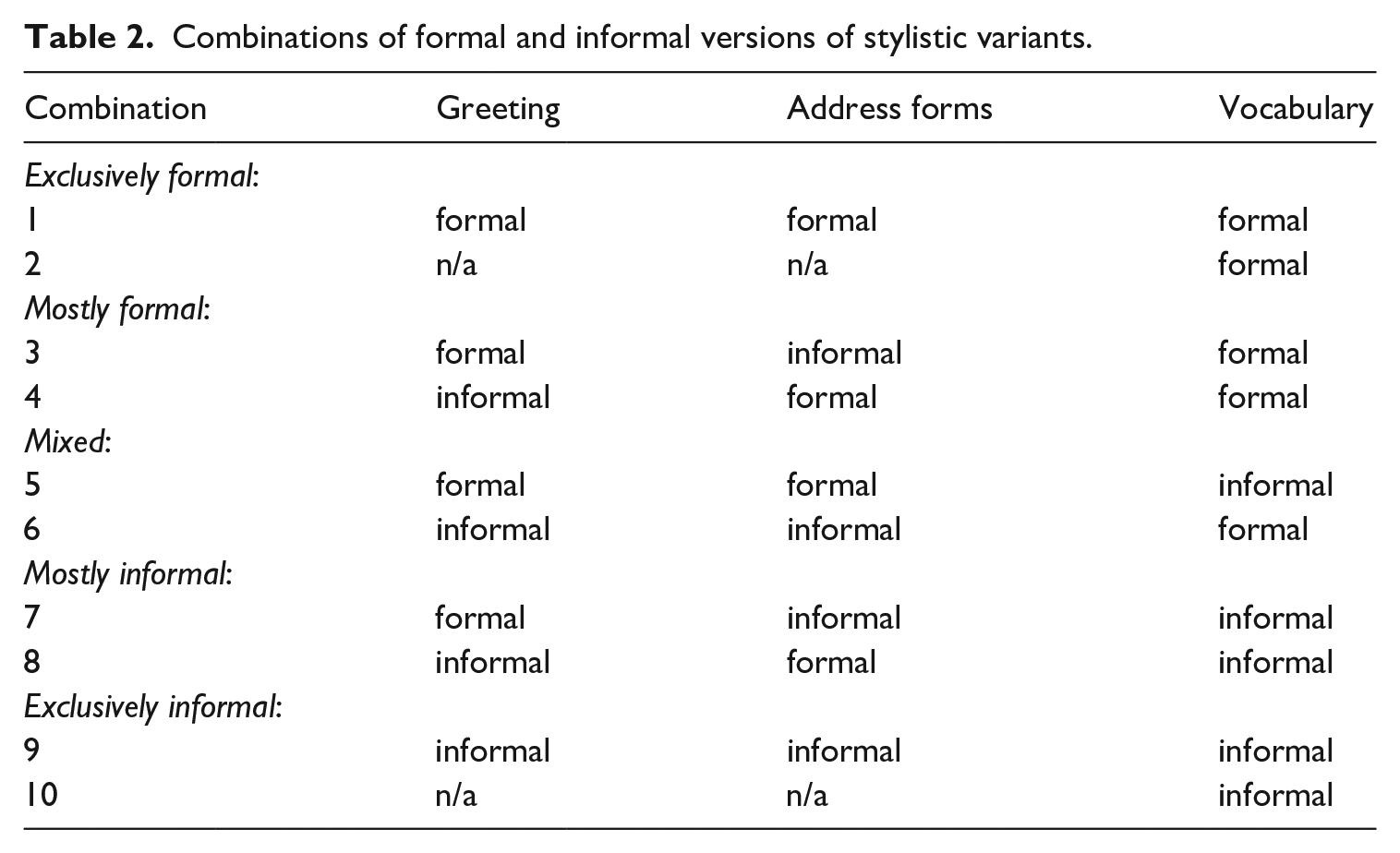
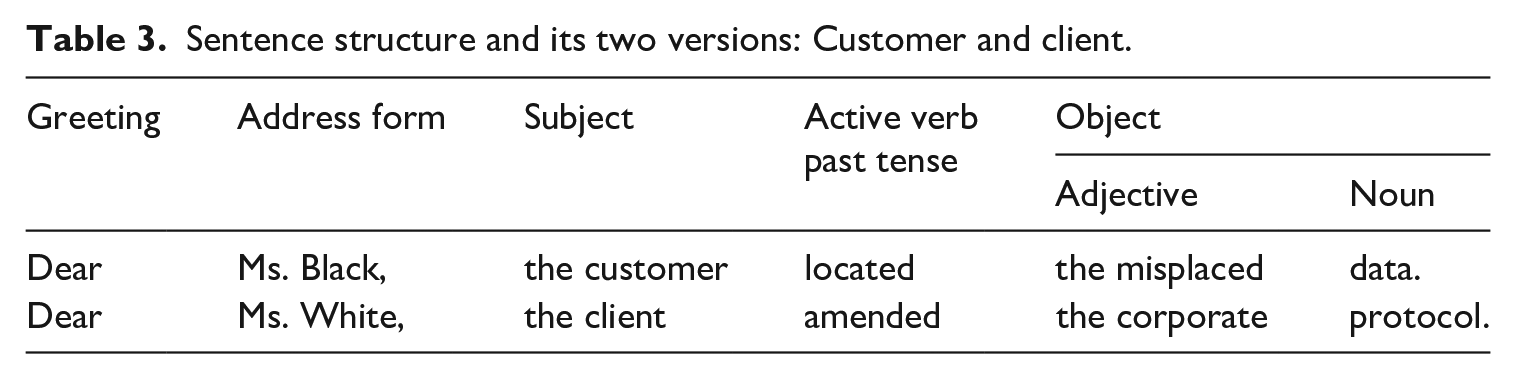
Table 3 shows the sentence structure that was used for each of the 10 combinations, except for combinations 2 and 10 in which the greeting and address form are omitted. To increase validity of the formality ratings obtained in the study, each of the 10 combinations was included in the questionnaire in two versions for a total of 20 items (for the full list, see Appendix 1), one with the word ‘customer’ and one with the word ‘client’ as the subject of the sentence. Both words are of non-Germanic word origin and share similar frequencies of use according to Davies’s (2008) Word Frequency Data. In all 20 items the verb is active, in the past tense, and both the subject and the object of the verb are noun phrases that include the definite article as a determiner. To counterbalance ordering effects, the questionnaire was administered in three versions, each with a unique random order of the 20 items.
Sentence structure and its two versions: Customer and client.
Instructions presented at the beginning of the questionnaire asked participants to consider as ‘formal’ the kind of language they would use with a professor or employer in a professional setting, and as ‘informal’ the kind of language they would use with a friend, close classmate, or colleague in a relaxed setting. To report the degree of formality they perceived in each item, participants were provided with a 5-point scale (e.g. Lahiri et al., 2011) with the following descriptors: (1) very informal, (2) informal, (3) neutral, (4) formal, and (5) very formal. To report the stylistic variants that the participants perceived as salient in communicating formality, participants were asked to answer the following open-ended question: ‘What in the sentence helped you in your judgment of the sentence formality?’
With a different purpose in each group, which was reflected in specific additional questions, the questionnaire was piloted with 3 ED peer professionals in Canada and 3 EFL speakers in Slovakia. The 3 EFL speakers in Slovakia were enrolled in a course delivered in English in the same EFL teacher-trainee program at the major university in Slovakia where participants for the group of EFL speakers were subsequently recruited for the main study. Data obtained from the ED peer professionals confirmed that all items in the questionnaire received similar formality ratings and that these ratings were consistent with the proportion of (in)formal stylistic variants (i.e. that the items consisting of exclusively formal versus exclusively informal stylistic variants received corresponding ratings). Data obtained from the EFL speakers confirmed that the questionnaire instructions were worded clearly and that none of the vocabulary items were likely to be unfamiliar to the speakers or too difficult to understand.
3 Data collection
In both Canada and Slovakia, to recruit participants for the study the researcher first approached and requested assistance from consenting professors. In Canada, the researcher approached the students in the professors’ courses himself, while in Slovakia, the professor approached students in his course on the researcher’s behalf. In both cases, students were presented with an information letter about the study, an invitation to participate, and a consent form. If students agreed to participate, they were given hard copies of the linguistic background questionnaire and the formality questionnaire, which they were instructed to complete in their free time outside of class and submit both documents to the researcher (Canada) or to their professor (Slovakia) during the earliest upcoming class of their course.
4 Data analysis and statistical procedure
Data obtained from the formality questionnaire were analysed in two ways. First, in relation to formality ratings, because the magnitude of the difference between a formality rating of 1 versus 2 is not necessarily the same as, for example, between 2 and 3 or 3 and 4, for the purposes of statistical analysis, the data obtained from the 5-point scale in the formality questionnaire were considered as primarily measuring direction. For this reason, the non-parametric Mann-Whitney U test was run for each of the 20 items in the questionnaire to discover whether the distributions of formality degrees perceived by the EFL speakers were statistically significantly different from those of the ED speakers. The test assigned a rank to each rating in the two groups, calculated a mean rank for each group, and then determined whether the difference between the mean ranks was statistically significant at the level of p < .05. For items where the test confirmed a statistically significant difference, the effect size estimate r was calculated as the standardized Z-score divided by the square root of the number of pairs (e.g. Tomczak M., & Tomczak E., 2014), and the results were interpreted as Pearson’s r according to Plonsky and Oswald’s (2014) guidelines for L2 research.
Second, in relation to salience, participants’ reports of the features that they found helpful in their perceptions of formality in each of the 20 sentences were divided into four major categories: (1) greeting, (2) address form, (3) vocabulary (i.e. noun, verb, or adjective), and (4) other, in case the answers did not fit any of the other three major categories. For each of the 20 sentences, the number of times participants in each group identified a stylistic variant in one of the three major categories were converted into percentages. If participants identified more than one salient stylistic variant, each one was included in the frequency counts of the appropriate category. Treated as qualitative data, no analysis was performed to determine statistical significance of these results.
V Results
1 Perceptions of formality
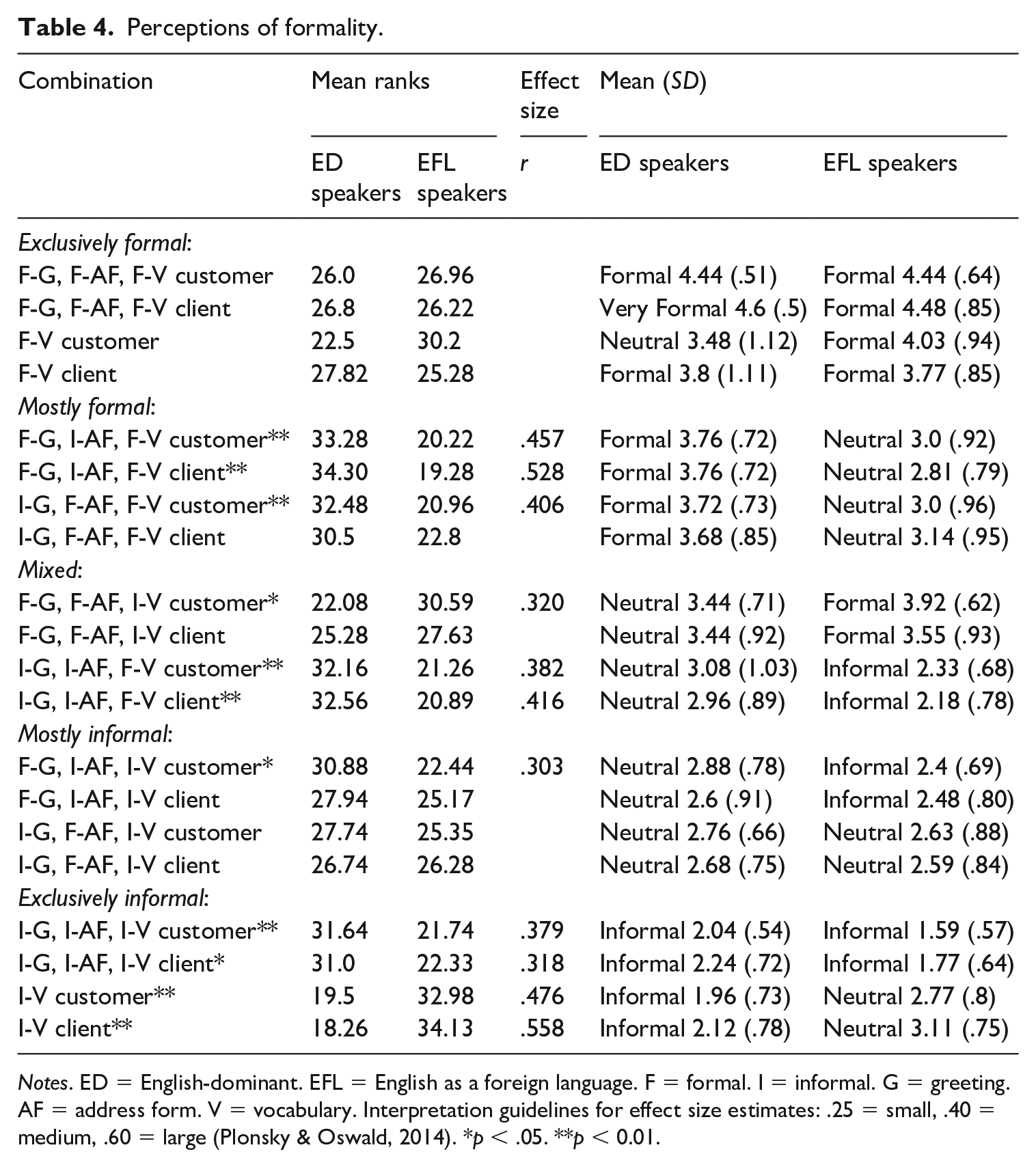
For each item in the formality questionnaire, Table 4 lists the mean ranks, the effect size estimates for items where differences between the groups were found to be statistically significant, the group means, and standard deviations.
Perceptions of formality.
Notes. ED = English-dominant. EFL = English as a foreign language. F = formal. I = informal. G = greeting. AF = address form. V = vocabulary. Interpretation guidelines for effect size estimates: .25 = small, .40 = medium, .60 = large (Plonsky & Oswald, 2014). *p < .05. **p < 0.01.
The descriptors accompanying group means were assigned in the following manner. Means of x.4 or less were rounded down to the x numerical level and means of x.5 or greater were rounded up to the next numerical level of the 5-point scale. For example, a mean of 4.44 is reported as ‘formal’ and a mean of 4.6 is reported as ‘very formal’.
Table 4 shows that the distributions of perceived degrees of formality were statistically significantly different in the two groups in the case of 11 out of the total 20 sentences. According to Plonsky & Oswald’s (2014) interpretation guidelines for L2 research, the effect size estimates (r) for these 11 sentences ranged from small to large (.303 to .558), with the majority being in the small to medium range, suggesting that when it comes to perception of formality the difference between being an EFL versus an ED speaker is meaningful. The 11 sentences included either both the ‘customer’ and the ‘client’ or only the ‘customer’ version of a combination. (It is possible that some participants perceived the word ‘client’ as more formal than the word ‘customer’, which likely affected the overall degree of formality perceived in the sentences. However, in all three cases, the degree of formality that the groups perceived in the ‘customer’ versions match the degree that the groups perceived in the ‘client’ versions.) Therefore, to answer the first research question: the EFL and the ED speakers did not always perceive the same degrees of formality in sentence-length combinations consisting of (in)formal greetings, (in)formal address forms, and (in)formal nouns, verbs, and adjectives.
2 Salience of stylistic variants
As a summary of the responses, Table 5 shows frequency counts and percentages of the EFL and the ED speakers who identified greetings, address forms, and vocabulary (i.e. nouns, verbs, or adjectives) as salient in their perception of formality for each of the 20 sentences.
Salience of greetings, address forms, and vocabulary in perceptions of formality.
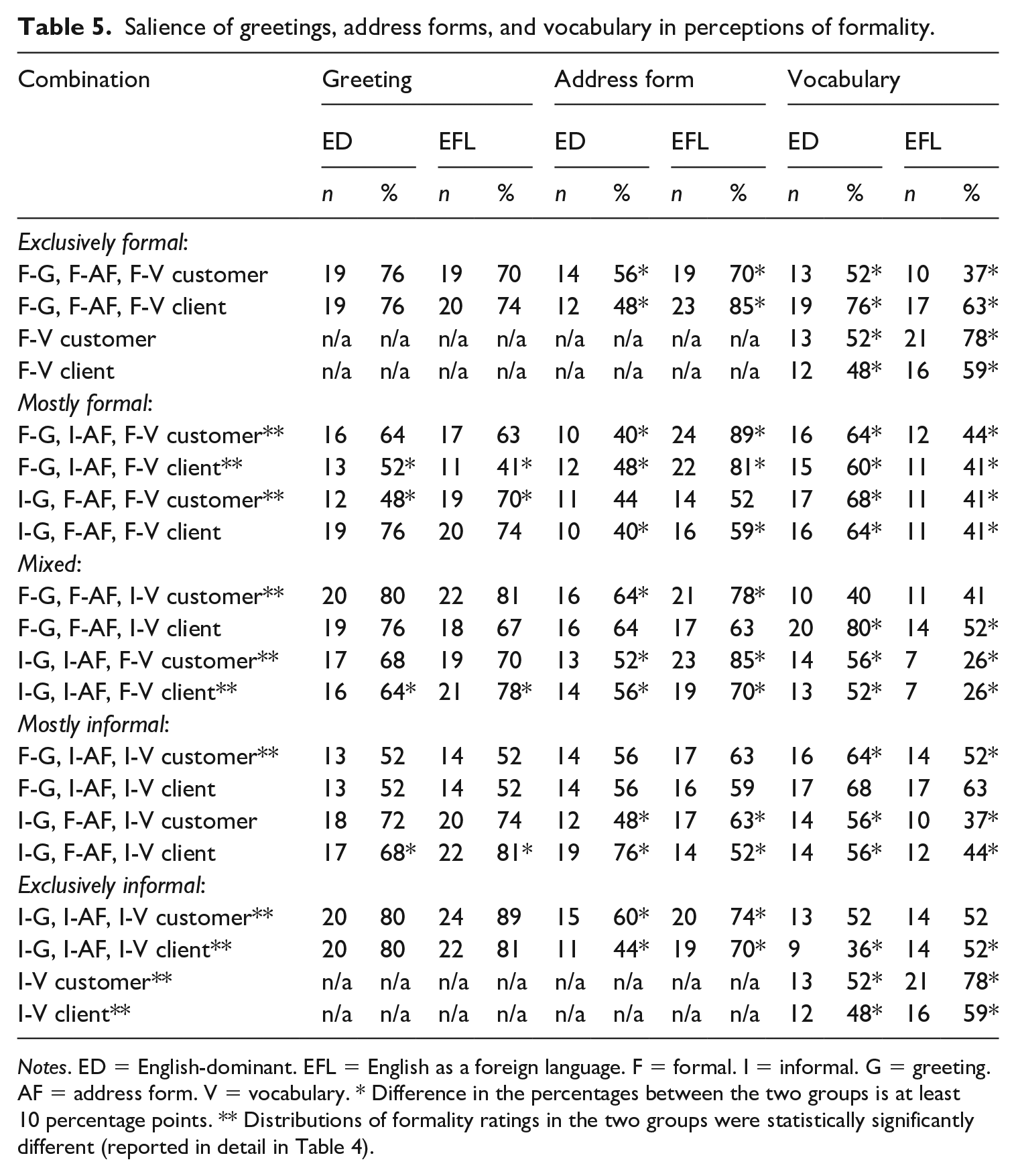
Notes. ED = English-dominant. EFL = English as a foreign language. F = formal. I = informal. G = greeting. AF = address form. V = vocabulary. * Difference in the percentages between the two groups is at least 10 percentage points. ** Distributions of formality ratings in the two groups were statistically significantly different (reported in detail in Table 4).
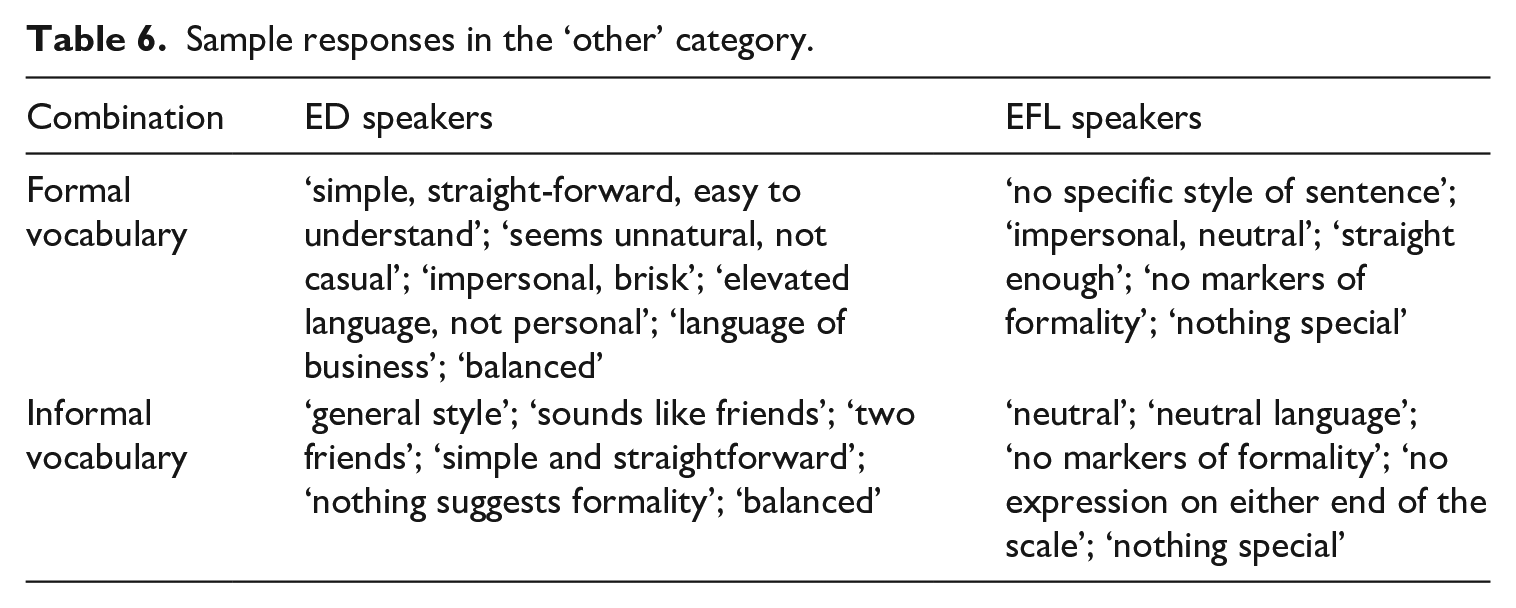
Regarding the 16 sentences that represented combinations in which all three categories of stylistic variants are included, a few trends may be observed. Concerning the category of greeting, in 8 of the 16 sentences a higher percentage of the ED speakers and in 6 of the 16 sentences a higher percentage of the EFL speakers found the greeting to be a salient (in)formal stylistic variant. In the two remaining sentences, the percentage of the ED and the EFL speakers who reported the greeting as a salient feature was roughly equal. With regard to the categories of address form and vocabulary, in 14 of the 16 sentences in each case, a higher percentage of the EFL speakers found the address form to be a salient (in)formal stylistic variant and a higher percentage of the ED speakers reported the vocabulary as a salient feature. These two trends may be observed simultaneously in 11 of the 16 sentences, and these sentences include 6 of the 11 sentences whose degree of formality the two groups perceived differently. A very small number of responses obtained in the ‘other’ category may be divided into two subcategories. One subcategory consists of responses that addressed the content of the sentence, such as ‘description, instruction’ and ‘declarative sentence’ in the group of EFL speakers, and ‘sounds like a formal summary’ and ‘addresses a serious concern’ in the group of ED speakers. The other subcategory consists of responses that described a general impression of the sentences, such as ‘professional language’ and ‘neutral’ in the group of EFL speakers, and ‘balanced’ and ‘the language is neither formal or informal’ in the group of ED speakers. Neither the EFL nor the ED speakers mentioned consistency in the use of formal stylistic variants in their comments.
Regarding the four sentences which represented combinations in which the greeting and the address form are omitted, a higher percentage of the EFL speakers reported vocabulary as salient. As Table 6 shows, most responses in both groups in the ‘other’ category reflected participants’ general impressions of the sentences. A few participants in both groups commented explicitly on the lack of greetings and address forms. In both groups, these comments co-occurred roughly equally with the perceptions of ‘neutral’ and ‘informal’ degrees of formality.
Sample responses in the ‘other’ category.
Based on the observed trends (unsubstantiated by any statistical analysis), to answer the second research question: both groups appear to have found greetings to be salient in communicating formality. However, whereas the ED speakers appear to have found vocabulary (i.e. nouns, verbs, or adjectives) more salient than address forms, the EFL speakers appear to have found address forms more salient than vocabulary.
VI Discussion
The EFL and the ED speakers did not perceive the same degrees of formality for several possible reasons. First, it is possible that the EFL speakers focused their attention on greetings and address forms and less so on the nouns, verbs, and adjectives, whereas the ED speakers distributed their focus more evenly across all three categories of stylistic variants (i.e. greetings, address forms, and vocabulary). For example, the EFL speakers perceived sentences that represented the mixed combination as ‘formal’ when both the greeting and the address form were formal. In contrast, they perceived the sentences as ‘informal’ when both the greeting and the address form were informal (whereas the ED speakers, likely equally taking into account the nouns, verbs, and adjectives, perceived these sentences as ‘neutral’). Second, it is possible that the EFL speakers were less able to assess the formality of the nouns, verbs, and adjectives. For example, the EFL speakers perceived combinations in which all three categories of stylistic variants are informal as statistically significantly more informal than did the ED speakers. It is possible that they were less aware of even more informal stylistic variants that could have been used in the sentences than were the phrasal verbs and the frequently used nouns and adjectives of Germanic origin.
Such limited knowledge of informal stylistic variants would be in keeping with research findings that suggest that L2 learners often first acquire one neutral, all-purpose style (e.g. Dewaele, 2004) and is likely the result of the EFL speakers’ exposure to a limited variety of authentic (in)formal stylistic input. Teaching materials often fail to counterbalance the lack of authentic TL input, particularly its stylistic variety along the continuum of formality. For example, studies of EFL textbooks (e.g. O’Loughlin, 2012; Matsuoka & Hirsh, 2010; Norberg & Nordlund, 2018; Yang & Coxhead, 2020) have shown that with utility and frequency as the primary principles of selection, the vocabulary of EFL textbooks often consists of high-frequency, standard, and formal lexical items: ‘words not frequently used in common everyday language’ (Norberg & Nordlund, 2018, p. 469). In contrast, stylistic variants specific to email, such as greetings, address forms, and signoffs used in email openings and closings are typically well represented (e.g. Hasund, 2019). Although the EFL speakers’ limited knowledge of informal stylistic variants could be related to their proficiency level in general, it could also be attributed more specifically to a gap in their pragmalinguistic knowledge. It is possible that the EFL speakers were familiar with the meaning of the nouns, verbs, and adjectives included in the questionnaire (as the results of the pilot study suggested) but were not necessarily sufficiently aware of the relative degrees of (in)formality inherent in the words and their combinations.
Third, another reason for differences in the perceived degrees of formality in the two groups is that the EFL speakers possibly interpreted the greeting ‘Dear’ as standard and therefore perceived it as less salient or stylistically marked. In contrast, the ED speakers likely perceived it as a quite formal greeting in the context of email communication, consistent with previous research (e.g. Bjorge, 2007; Chen, 2006; Gains, 1999; Waldvogel, 2007). For example, the ED speakers perceived the combination in which the greeting ‘Dear’ appears as the only formal stylistic variant as ‘neutral’, whereas the EFL speakers perceived the combination as ‘informal’. Finally, with regard to combinations in which the greeting and the address form are omitted, it is possible that in the absence of these two stylistic variants, the EFL speakers experienced difficulties in assessing the formality of the vocabulary because they lacked the requisite awareness of the stylistic value of these variants, as was suggested above. The ‘neutral’ degree of formality that they perceived in these sentences reflects their comments that explicitly address the lack of salient (in)formal stylistic variants, such as ‘no markers of formality’ and ‘no expression on either end of the scale’.
Combinations in which the EFL and the ED speakers perceived the same degree of formality included all sentences that were composed of exclusively formal stylistic variants. With regard to combinations composed of all three categories of stylistic variants (i.e. greetings, address forms, and vocabulary), it is possible that consistency in the use of stylistic variants was a factor in the perception of formality by both groups. As suggested by previous research (e.g. Agha, 1998; Irvine, 1979; Moreno, 2011), more consistent use of formal stylistic variants is required to create formal styles and makes formal styles easier to identify or perceive as such. In the case of the EFL speakers, it also possible that the salience of greetings and address forms was a factor. In that case, the speakers perceived these combinations as formal because the greeting and the address form were formal. Regarding combinations in which the greeting and the address form are omitted, it is also possible that consistency in the use of formal nouns, verbs, and adjectives was a factor in the perception of formality. In the case of the ED speakers, perception of less frequently used words of non-Germanic origin as formal would be consistent with previous research (e.g. Fang & Cao, 2010; Levin et al., 1981; Levin & Novak, 1991). By comparison, the EFL speakers could have perceived the words as formal because in their L1 (Slovak) similar words of Latin and Greek origin are perceived and referred to as ‘foreign’ and are used predominantly in formal technical and academic contexts (e.g. Mistrík, 1993).
Regarding the trends observed in the reports of salient stylistic variants (which need to be substantiated by further research), one possible reason that the EFL speakers reported address forms as salient stylistic variants more often than they reported the nouns, verbs, and adjectives is that personal pronouns (a category of address forms) in their L1, Slovak, (i.e. informal, singular ty versus formal, plural vy for a single addressee, combined with appropriate verb forms) are salient (in)formal stylistic variants (e.g. Mistrík, 1983). In other words, the EFL speakers looked for expressions of formality in English in those parts of the questionnaire items where they are used to expressing and perceiving formality in their L1. This would be consistent with research that has shown that interlingual (pragmatic) transfer is likely to occur if speakers’ L2 proficiency has not reached sufficiently high levels (e.g. Bu, 2012; Han & Burgucu-Tazegül, 2016; Taguchi, 2011; Wannaruk, 2008). Another possible reason is that the EFL speakers had not yet acquired awareness of the full stylistic range of vocabulary in English, and focusing on the formality of address forms was a strategy that they used consciously to compensate for this gap in their knowledge.
Several limitations of this study need to be borne in mind. First, rather than measuring the EFL speakers’ level of proficiency by any standardized method, it was determined based on the EFL speakers’ self-reports and was assumed to be sufficient for the purposes of this study based on the fact that all the EFL speakers who were recruited for the study had been admitted and were currently enrolled in a university program delivered in English. In future research, it would be useful to use a standardized test to determine EFL speakers’ level of proficiency or general communicative competence so that meaningful comparisons across levels would be possible. Second, the sentence-length items that were used to record the participants’ ratings of formality were not extracted from naturally occurring, authentic business email communications. In addition, despite providing the participants with a description of the social context within which the sentence-length items were exchanged, the items were removed rather than embedded in email messages. In future research, the items could be selected from authentic email correspondence and presented as they naturally appeared in the email messages so that the raters would be provided with meaningful context to facilitate their perception of formality. Finally, the sentence-length items were examples of business email communications. This is likely a communication domain with which the participants in both groups as undergraduate students have only had limited experience. In future research it would be better if the items were examples of email exchanges within communication domains that undergraduate students are familiar with, such as student-to-student or student-to-teacher emails. However, some recent studies (e.g. Albers et al., 2020; Bremner & Costley, 2018) indicate that business email communication is an area worthy of exploration with pre-work-experience EFL speakers because they will be increasingly faced with the expectation of having mastered the genre when they enter the workforce.
VII Conclusions
The EFL and the ED speakers in this study did not always perceive the same degrees of formality in sentence-length examples of business email communications that combine (in)formal greetings, (in)formal address forms, and (in)formal nouns, verbs, and adjectives. Based on trends observed in the reports of salient stylistic variants in the two groups (which need to be substantiated by further research), it appears that the EFL and the ED speakers did not find the same categories of stylistic variants similarly salient in communicating formality. Findings of this exploratory study suggest that apart from salience, factors that influence perception of formality include consistency in the writer’s use of (in)formal stylistic variants and each reader’s knowledge and awareness of (in)formal stylistic variants. It appears that especially consistent use of formal stylistic variants facilitates the perception of a style as formal. Regarding knowledge and awareness of stylistic variants, it appears that such knowledge and awareness need to be sufficient to enable speakers to assess the relative formality of stylistic variants both individually and in combinations with other stylistic variants. Findings of this exploratory study further suggest that the EFL speakers focused their attention on greetings and address forms rather than the nouns, verbs, and adjectives in the questionnaire items because of their limited ability to assess the relative formality of these words in English. To compensate for this gap in their pragmalinguistic knowledge, the EFL speakers interpreted the use of (in)formal titles and names in English as a category of address forms equivalent to (in)formal personal pronouns in their L1.
In sum, it appears that language learners in FL acquisition contexts with limited amount and limited stylistic variety of authentic TL input would benefit from targeted TL instruction that increases their knowledge and raises their awareness of (in)formal stylistic variants, their combinations, and their salience in communicating formality. Research has shown that instruction designed to help language learners acquire various aspects of sociopragmatic and pragmalinguistic knowledge is effective when it is explicit (e.g. Zhang, 2020), relies on the use of contextualized authentic TL materials, (e.g. Bedri & Ali, 2017), and provides language learners with opportunities for reflection and discussion of any differences between a learner’s L1 and the TL (e.g. Alsuhaibani, 2020). For example, the use of films and scriptwriting (e.g. Etienne & Sax, 2006; Saugera, 2011) or the use of authentic samples of the TL extracted from a corpus or other available TL media (e.g. Alsuhaibani, 2020) allows for comparisons of various social contexts with people, places, and communication purposes as interactional variables. These authentic samples of the TL could also be used to inform activities that invite language learners to practice using the (in)formal stylistic variants they are acquiring in contrasting context-embedded role-plays. In relation to the focus of this study specifically – greetings and address forms combined with nouns, verbs, and adjectives – this type of approach has also been found to be effective in helping language learners master style formality of lexical items specific to email, such as greetings and address forms as part of email openings (e.g. Bedri & Ali, 2017) and beyond, such as learning to identify vocabulary that is suitable in academic writing (e.g. Bui, 2018).
Importantly, it has also been proposed that language learners should be allowed to develop a personal stance toward the use of (in)formal stylistic variants in their L2. For example, van Compernolle (2014) suggested that students should be encouraged to personalize the concepts they are acquiring, such as social distance as a factor in the use of (in)formal French personal pronouns (i.e. tu versus vous). In some of the activities that he proposed, such as verbalized reflections and dynamically administered appropriateness judgment tasks, teachers need to continuously diagnose their students’ knowledge but intervene in the students’ acquisition of stylistic variants only when and as is necessary, providing them with guidelines rather than enforcing rigid rules. This means that rather than evaluating the use of (in)formal stylistic variants dichotomously as right versus wrong, students should receive feedback that explains which stylistic variants are more versus less appropriate in any given context and that raises their awareness of the potential consequences of using these variants in authentic TL communication.
Finally, regarding variants whose stylistic, pragmatic, and sociolinguistic meanings overlap, it has also been proposed that language learners could benefit from instruction that invites them to become skilled observers, akin to ethnographers (Eslami-Rasekh, 2005). This means that rather than only learning what is appropriate within any one specific TL speaker group, language learners could develop the ability to observe, analyse, and adjust their use of the TL language according to the current sociolinguistic and pragmatic TL context.
