



Abstract
This study explores whether middle-school students can exploit explicitly addressed crosslinguistic lexical similarities between German and English to learn vocabulary more efficiently. Across six weeks, 260 Swiss German learners of English as a foreign language (17 classes) completed three vocabulary learning tests (T1, T2 and T3). Additionally, 7 of these 17 classes attended a 90-minute intervention between the first and second test: During a 45-minute introductory lesson students discovered four systematic orthographic correspondence rules (e.g. <p> to <f> as in ship and Schiff), followed by three 15-minute sessions to consolidate their knowledge. The intervention group’s improvement in cognate learning was significantly larger in comparison to the control group. The difference was observed across both test modes and all rules introduced. While learners’ initial English vocabulary size correlated with their overall performance, it did not affect intervention uptake. This suggests that these younger learners benefitted from form-focused instruction, independent of proficiency and type of correspondence.
Keywords
I Introduction
Crosslinguistic lexical similarities are a unique linguistic resource available to language learners in a variety of language combinations, regardless of whether these originated in etymological shifts, loanwords, or coincidentally (Helms-Park & Dronjic, 2016; Jarvis, 2009). In the case of German and English, several thousand similar or identical words have been documented (Braun, 1990; Schepens et al., 2012), with a particularly high ratio among more frequent words (Bird, 1987) – a vast basis on which learners could build up. In the context of foreign language education in Switzerland, this objective advantage is reflected in the local 1 curriculum claiming beneficial effects of ‘parallel words’ for intercomprehension and vocabulary learning (Bertschy et al., 2015). However, studies have revealed large individual differences among learners’ perceptions, with especially younger pupils struggling to recognize similarities both within a sentence (e.g. Spanish–English bilinguals in García & Nagy, 1993) and out of context (e.g. Swiss German learners of Swedish in Vanhove & Berthele, 2015). Based on the assumption that educators can increase learners’ crosslinguistic awareness and thereby foster the ability to detect similarities, pluralistic approaches have seen a rise in interest (Candelier et al., 2012). As a result, educational programs have been developed, supported by the European Union (EuroCom, e.g. for Germanic languages in Marx & Hufeisen, 2007) or the US Department of Education (EVoCA, Center for Applied Linguistics, 2016). But only a few studies have so far explored effects of such awareness-raising interventions among children and teenagers, yielding inconclusive results on intercomprehension (e.g. Dutch–Frisian in Bergsma et al., 2014; Polish–English in Otwinowska, 2015; English–French in White & Horst, 2012). It has been suggested that, instead, a guided approach targeting only a small set of systematic orthographic similarities might enhance vocabulary learning (Berthele et al., 2011). For example, while knowledge about the correspondence <b> to <v> might lead to an erroneous inference from English live to German lieben (‘love’), it could help a learner to more easily memorize the word pairs love and lieben versus live and leben once the correct translation has been provided. However, this hypothesis has yet to be empirically tested. The current study aims at addressing this gap by exploring whether Swiss German middle-school learners of English can measurably benefit from explicit crosslinguistic awareness-raising activities for decontextualized short-term vocabulary learning.
1 Crosslinguistic lexical similarities and vocabulary knowledge
Vocabulary knowledge includes a wide range of information regarding a word’s form, meaning, and use (Nation, 2001). However, vocabulary learning is an incremental process wherein we usually only possess partial knowledge about each item, expanding on an initial form-meaning connection (Schmitt, 2000). Building on this distinction between lexeme and lemma (see Levelt, 1989), word pairs from two languages can be categorized according to three types of overlap (Carroll, 1992; Jarvis, 2009; though with fuzzy boundaries as observed in Berthele, 2011): (1) cognates such as English water and German Wasser, which converge on both a form and meaning level; (2) deceptive cognates or false friends such as English bald and German bald (‘soon’), which only share formal features, and (3) non-cognates or profile words such as English tree and German Baum (‘tree’), which only refer to the same meaning.
Current psycholinguistic models conceptualize the mental lexicon as a network in which entries are interconnected across different levels of representation of word knowledge (see Nation, 2001), both within and across languages (e.g. Dijkstra et al., 2018; Grainger et al., 2010; Kroll & de Groot, 1997). As a result, what we know about a word in one language can affect our knowledge and use of a word in another language, whether due to the formation of learned crosslinguistic associations, processing interference, or strategic and intentional uses of language (Jarvis, 2009).
This view is supported by results from various psycholinguistic experiments, wherein cognates were recognized faster and more accurately (referred to as the ‘cognate facilitation effect’, for an overview see Helms-Park & Dronjic, 2016). Psycholinguistic word-learning experiments have also found that cognates were easier to remember (Ellis & Beaton, 1993; Lotto & de Groot, 1998) and more resistant to forgetting (de Groot & Keijzer, 2000) than other word types. These findings are in line with adult language learners’ performance on vocabulary tests, which tends to be better for cognates in comparison to other word types (Otwinowska & Szewczyk, 2019). Similarly, school-aged children translated cognates faster and more accurately when learning words in an unknown language (Comesaña et al., 2012; Tonzar et al., 2009), though Tonzar et al. (2009) also observed that in a familiar language (i.e. English for the Italian 8th graders), the cognate advantage lessened with increasing proficiency. Cognateness has also emerged as a major factor in incidental learning even prior to formal instruction as shown among Flemish teenagers’ English vocabulary (Puimège & Peters, 2019).
Overall, the special status of cognates in the mental lexicon has been highlighted in a variety of studies. However, as discussed in recent work by Otwinowska and colleagues (Otwinowska & Szewczyk, 2019; Otwinowska et al., 2020), the majority of psycholinguistic studies were conducted with highly proficient bilinguals and/or adults (de Groot, 2011; van Hell & Tanner, 2012), which might differ from school settings (Tonzar et al., 2009). Furthermore, facilitative effects were much stronger for identical cognates (such as German and English wild) than word pairs with less orthographic overlap (Comesaña et al., 2012). While such insights therefore allow for a better understanding of how different word types are recognized, stored, and retrieved, it remains to be examined whether and if possible how the cognate advantage can be enhanced during initial encoding stages for cognates with less orthographic overlap.
2 Individual factors and crosslinguistic awareness
Both the influence of crosslinguistic lexical similarities on the learning process overall (Jarvis & Pavlenko, 2007; Otwinowska, 2015) as well as the difficulty of learning a word (Laufer, 1997; Peters, 2020) depend on a variety of contextual, learner- and word-related factors. The context includes social, situational and task-related aspects. Learner characteristics refer to cognitive abilities as well as linguistic knowledge and experience, both of which are influenced by age (Vanhove & Berthele, 2015). Finally, while the properties of a word such as part of speech or markedness play an important role, the extent of crosslinguistic similarity between two languages has been shown to influence the rate of acquisition (Odlin, 1989), proficiency (Schepens et al., 2020), and intercomprehension (Gooskens & van Heuven, 2020).
However, ‘[t]he actual similarity or dissimilarity of forms and meanings is only one factor at work in transfer; the judgment of each individual learner matters as much’ (Odlin, 2002, p. 260; original emphasis). Emphasizing the role of this subjective perception, many scholars have argued for a shift in educational practice towards explicitly raising students’ awareness (Jarvis & Pavlenko, 2007; Jessner, 2008; Otwinowska, 2015; Ringbom, 2007; Swan, 1997). Jessner (2006) views linguistic awareness as an emergent property of the plurilingual learner, consisting of at least two components: meta- and crosslinguistic awareness. While the former refers to abstract thinking about language as an object, the latter can be defined as an ‘awareness of pattern, contrast, system, units, categories, rules of language in use and the ability to reflect upon them’ (Donmall, 1985, p. 7). This presupposes that learners are explicitly and tacitly aware of the links between the languages in their repertoire and can deliberately utilize them (Jessner, 2008). Thus, as noted by Otwinowska et al. (2020), awareness in this definition refers not only to the ability to notice cognates, but extends to a capability of reflecting upon systematic similarities, generalizing rules based on observations, and strategically transferring knowledge to new examples. In extension, encouraging learners to compare and contrast languages is believed to considerably boost students’ vocabulary knowledge (e.g. Banta, 1981; Marx & Hufeisen, 2007). However, studies are necessary to determine which relationships the attention should be drawn to and whether this actually results in a measurable increase.
3 Crosslinguistic lexical similarities in interventional studies
Effects of programs were first examined among Spanish–English school-aged bilinguals in the United States where cognate awareness-raising was one component of a more extensive intervention. Positive effects were reported in regards to reading comprehension (Proctor & Mo, 2009), the ability to infer the meaning of unknown words in a text (Dressler et al., 2011), as well as students’ academic vocabulary knowledge (Arteagoitia & Howard, 2015). However, since no pre-tests were conducted, the observed differences in performance could stem from pre-existing correlations between cognate awareness and language learning (Cunningham & Graham, 2000; García & Nagy, 1993; Kelley & Kohnert, 2012). Conversely, White and Horst’s (2012) experimental group did not show greater improvement than their controls on a cognate recognition task after five sessions. They worked with Canadian French middle-schoolers in an English immersive setting. The authors claimed that students of the intervention group exhibited a higher cognate awareness, though based on limited empirical evidence.
Regarding foreign language learning, in two studies with Polish secondary school learners of English, the experimental groups progressed significantly more on cognate recognition than their controls (Otwinowska, 2015). Contrarily, Molnár’s (2010) Hungarian high school learners of English did not measurably benefit from instruction on orthographic and suffix correspondences on a vocabulary test. Finally, two longitudinal quasi-experiments focused on Polish teenagers’ vocabulary learning (Otwinowska et al., 2020). Across six weeks, the lower-intermediate learners of English completed tasks which drew their attention to the form and meaning of 90 words (30 of each word type) embedded in texts, and were additionally trained in a variety of vocabulary learning strategies. Each of the workshop sessions lasted 45 minutes overall, with a 10-15 minute emphasis on cognate awareness. While participants translated cognates more often correctly than other word types in both pre- and post-tests, neither a single nor four workshop sessions measurably boosted the experimental groups’ performance on cognates in comparison to their controls. Furthermore, performance on a cognate recognition task did not predict learning words of any type.
To the best of the author’s knowledge, only two studies explored the effects of cognate awareness-raising by explicitly targeting only a small set of systematic correspondences, reporting contrasting results. In Vanhove’s (2016) experiment, Swiss German young adults were able to detect a systematic similarity among Dutch–German word pairs presented on a computer screen and to subsequently translate corresponding cognates more successfully compared to their respective controls, though most participants were unable to verbalize the rule. Conversely, Dutch middle-schoolers’ listening skills of Frisian did not measurably improve at the word nor text level after a 50-minute discussion of the eight most common crosslinguistic sound correspondences (Bergsma et al., 2014). Based on the results of these two studies, open questions remain in regards to the necessary extent of awareness, the age-appropriateness due to possible metalinguistic constraints, the influence of a classroom versus an experimental setting, as well as the feasible amount and fruitful types of correspondences that should be addressed. More importantly, they both analysed effects on intercomprehension, although vocabulary learning might be a more suitable task (Berthele et al., 2011).
4 The present study
In sum, it is assumed that heightened crosslinguistic awareness can facilitate the learning process. Yet the question of whether particularly younger students can measurably benefit from instruction on systematic similarities for vocabulary learning has yet to be empirically tested. This project therefore explores the effects of explicit, comparative, and form-focused activities on the uptake of decontextualized words. The following research questions will be addressed:
Can Swiss German middle-school learners of English exploit an explicitly targeted set of systematic crosslinguistic lexical similarities as a means to learn new vocabulary exhibiting these correspondences more efficiently?
Does the intervention uptake vary based on students’ initial foreign language vocabulary knowledge, test mode, type of correspondence, and/or their attitude towards the intervention?
II Method
Middle-school students from 17 classes participated in this quasi-experimental study. Their uptake of new German–English word pairs was assessed three times across six weeks (T1 in Week 1, T2 in Week 3, and T3 in Week 6), with different items used for each vocabulary learning test. Between the first and second test, the intervention group (7 classes) participated in a 90-minute intervention to explore four orthographic correspondences.
1 Participants
The project was carried out in Grade 5 and 6 classes in the Canton of Berne, Switzerland, where German is the main language of instruction. The pupils in these classes had started learning French in third grade (3 lessons per week in Grades 3 and 4, thereafter 2), followed by English as their second foreign language in fifth grade (2 lessons per week). Students are expected to reach level A1.2 (Council of Europe, 2001) by the end of Grade 6. 2 While the curriculum claims beneficial effects of pluralistic approaches (Bertschy et al., 2015), systematic similarities are not addressed until secondary school, even though initial stages of language learning are deemed particularly fruitful for crosslinguistic awareness-raising activities (Neuner, 2003).
The principals of every Bernese primary school were contacted and presented with a general research proposal. Overall, 17 certified English primary school teachers volunteered to participate in the study with their classes. Based on the number of lessons teachers were able to dedicate to the project, 10 classes were assigned to the control group and 7 classes to the intervention group. Overall, 299 students received their parents’ approval to participate in the project. Due to absences and technical difficulties, complete data was obtained from 260 participants.
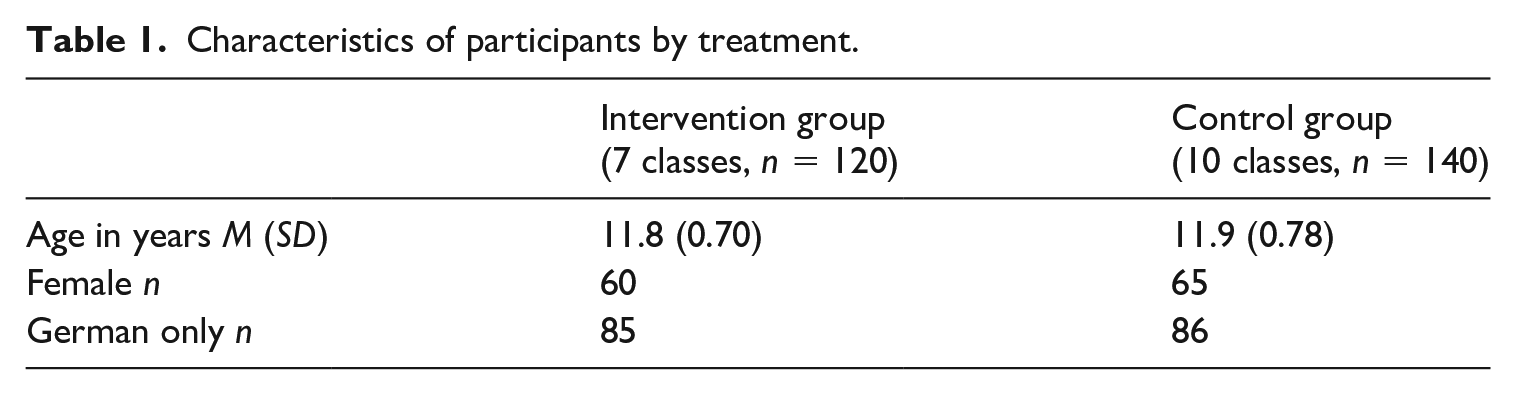
The two groups were comparable in regards to age, grade level, gender, and languages spoken at home (Table 1). In line with national data (Bundesamt für Statistik, 2018), about a third of pupils reported speaking at least one additional language at home, including Albanian, Arabian, French, Kurdish, Portuguese, Tamil, and Turkish. Since these students’ performance did not significantly differ from students who indicated conversing exclusively in German at home, their data was included in the analysis.
Characteristics of participants by treatment.
2 Materials 3
a Cognate list and selection of rules
In order to determine frequent systematic crosslinguistic similarities, a list of German–English cognates was compiled. This list contains pairs of words with similar or identical meaning as well as some formal overlap due to the Germanic consonant shifts or interlingual phoneme-grapheme correspondences. By counting the number of examples for each correspondence, four rules were selected to be taught in the intervention based on the frequency of occurrence. The chosen correspondences were <c> to <k> (e.g. music–Musik), <th> to <d> and to <t> (e.g. thing–Ding and word–Wort), <t> to <s> or <z> (e.g. water–Wasser or salt–Salz), and <p> to <f> (e.g. open–offen). In addition, items exhibiting a <k> to <ch> shift (e.g. stork–Storch) were included in the tests based on the hypothesis that participants would not only be able to apply taught rules but also detect a new pattern due to their heightened crosslinguistic awareness. Out of the 801 word pairs on the list, these correspondences appear 274 (<c>–<k>), 164 (<th>–<d>–<t>), 115 (<t>–<s>/<z>), 60 (<p>–<f>), and 45 (<k>–<ch>) times.
b Test battery
The test battery consisted of four parts: the vocabulary learning tests, a background questionnaire, a general vocabulary knowledge test, and for the intervention group a feedback form. The three tests were designed using jsPsych for Javascript (de Leeuw, 2015).
In the vocabulary learning test, participants learned new English words by watching a presentation of German–English word pairs. After a distraction task, they were asked to provide the correct translations. While direct translation as a means of vocabulary learning is sometimes criticized for its limited focus on a single form-meaning link as only one part of various aspects of vocabulary knowledge, deliberate vocabulary learning and the use of the L1 to convey and assess word meaning has proven efficient (Schmitt, 2008). The written word form has also been shown to support the learning process of a new word (i.e. ‘orthographic facilitation effect’), especially in the case of cognates (Comesaña et al., 2012; Tonzar et al., 2009).
Since the study investigated whether raising awareness would increase the uptake of new words, three different vocabulary lists were compiled, one for each of the three vocabulary learning tests (T1, T2 and T3). This encouraged students to apply their learnt knowledge about correspondences to new examples each time and avoided the influence of repeated encounters. Furthermore, it prevented teachers from particularly preparing their students since they did not know which words were going to be tested in advance. The conditions remained the same for both groups, therefore allowing the key comparison of whether the intervention group made greater gains (or regressed less) relative to baseline than the control group did (Bonate, 2000; Campbell & Stanley, 1963). Each test contained 24 cognates, ensuring that for each rule there would be at least two pairs assessed to allow for receptive and productive translation modes. Additionally, four profile words and two deceptive cognates were included to reflect more closely a typical learning burden for students, bringing the list of stimuli to a total of 30 pairs per test. None of the test items featured in the pupils’ English course books (Arnet-Clark et al., 2013; Frank Schmid et al., 2014) to avoid assessing words they had previously encountered. To account for the possibly varying difficulty of these three lists, they were balanced for type of correspondence, additional changes (e.g. endings or vowels), degree of interlingual orthographic similarity based on the normalized Levenshtein distance 4 (Schepens et al., 2012), word length, part of speech, and frequency in German (based on DeReWo, Perkuhn et al., 2012) and English (based on BNC/COCA, Nation, 2017). Following Nation & Meara’s (2002) guidelines for efficient vocabulary learning, additional attention was paid to avoid interference by assigning similar word pairs to different tests.
A passive word recognition test was included as a measure of students’ general vocabulary knowledge and overall language proficiency since these often correlate (Qian & Lin, 2020) and might affect learners’ potential benefit from crosslinguistic awareness (Otwinowska & Szewczyk, 2019). The Test 1 Level 1 from the Yes/No test as developed by Meara (1992) was selected since it was appropriate for students’ level as well as easy and quick to administer.
Finally, the feedback form requested information on which worksheets and games students had completed during the intervention. The program was also evaluated regarding perceived pleasantness, necessity, novelty, and usefulness for future vocabulary learning.
3 Procedure
The project was implemented in May and June of 2019 during regular school hours. In addition to pupils’ level being particularly suitable (Neuner, 2003), based on personal experience, this last quarter between spring and summer break was deemed ideal from an organizational perspective, since the paramount selection process for the imminent transition into secondary school in Grade 6 is complete, allowing more time for such a project.
The tests as well as intervention were administered during regular class hours by the participants’ teachers who received detailed written instructions which were meticulously discussed in one-on-one meetings with the author. Overall, the project spanned 6 weeks, starting with a battery of background measures as well as an initial vocabulary learning test (T1). It was followed by 2 weeks during which the intervention group explored systematic crosslinguistic similarities and regular English classes were held in the control group. The second vocabulary learning test (T2) followed immediately after the intervention in Week 3. The third vocabulary learning test (T3) took place three weeks after the intervention at the end of Week 6.
a Tests
The test battery was administered online. Before the test, the teachers explained the steps of the test procedure. Students were informed that they would have to translate the presented words and instructed to pay close attention to spelling but not capitalization, rendering the activity intentional (Hulstijn, 2001). Furthermore, they were encouraged to try to memorize as many words as possible despite a large number of items, and to guess even if unsure. 5 Then, each participant received an anonymized ID and worked individually on a computer. The initial testing at T1 consisted of five parts, starting with the background questionnaire.
Afterwards, the 30 German–English word pairs were presented, each appearing for 8 seconds with a 0.8 second gap. The presentation was shown twice, changing the language order: In the first round the German term was shown first, whereas the second round started with the English term. This was exemplified in the instruction using the set Apfel–apple and apple–Apfel. The items were randomized across participants and presentations to avoid serial effects (Nation & Meara, 2002). Following the double presentation of all word pairs, participants had to solve math problems for 5 minutes as a distraction task. Then, as had been announced, students were asked to translate the words previously presented – half of them productively (German to English) and the other half receptively (English to German) to assess both strengths of vocabulary knowledge (Laufer & Goldstein, 2004).
The final part of the test battery at the first data collection was the Yes/No test consisting of 40 words and 20 pseudowords. Students looked at each item individually in randomized order and had to indicate whether they knew the word. It had been pointed out in advance that some words were made up.
T2 and T3 followed the same pattern, though using different word lists and skipping the questionnaire and Yes/No test. At the end of T2, students from the intervention group additionally provided feedback on the intervention.
b Intervention
The teachers completed the intervention independently in their respective classes based on detailed instructions. 6 The intervention consisted of two parts: an initial 45-minute period to introduce the correspondence rules and three 15-minute sessions to consolidate the knowledge. As suggested by Laufer (2005) for early stages in foreign language vocabulary learning, a discovery learning approach mixed with explicit form-focused instruction was chosen for the intervention.
The first lesson started with a whole-class discussion on cognates, touching upon the form and meaning aspects of words and the way these can overlap interlingually. Cooperating in small groups, pupils then translated 20 previously taught English words to German and marked the change(s) between the word pairs. Finally, they grouped word pairs exhibiting similar shifts and generated rules based on their observations. Students were advised to start with word pairs that only differ by one character (e.g. <c>–<k> in music and Musik) and use these as a foundation to find other cognates with the same pattern. Additionally, they were instructed to pay attention to consonants as opposed to vowels. After collecting the groups’ hypotheses in class to ensure that the rules that students had inferred were correct, each group created a poster with the rules and examples.
During each of the following three English lessons, 15 to 20 minutes were devoted to recap the rules and consolidate the learners’ knowledge. Seven tasks were created, including both worksheets and games, and offering a variety of social settings. For example, students had to connect the English word with its German equivalent and the corresponding consonant shifts (e.g. cat–Katze, <c>–<k> and <t>–<tz>), or collectively write down as many cognates for a given rule as possible. It was recommended that teachers start with more limiting, explicit exercises before expanding to more demanding, open, and implicit tasks. To account for the possible influence of the tasks selected, a specific query asked about how many and which types of activities students had worked on as part of the evaluation questionnaire.
4 Scoring and analysis
For the vocabulary learning tests, the lexical items were checked and graded as correct or incorrect. Since the scoring was carried out by one person (the author), no inter-rated agreement could be calculated. To account for partial knowledge, a sensitive scoring was performed since it has been argued that this form of scoring provides a more accurate picture of the effects of learning, particularly with cognates (Webb, 2008). As announced to participants, capitalization was not taken into account. Misspellings were accepted as long as they did not imply another existing word, and the correspondence rule was visible. To exemplify this, for the stimulus Kultur (‘culture’), the response cultur was also accepted but neither cult nor kulture. There was no hard rule for determining spelling errors; cases were judged individually by collecting the various responses in a separate list before determining their acceptability.
The Yes/No vocabulary test was graded according to the most recent recommendations by its developer (Huibregtse et al., 2002, p. 238). Yes-responses to real words were counted as hits, whereas yes-responses to pseudowords were counted as false alarms. On the basis of these counts, the Index of Signal Detection 7 was calculated, which yields values between 0 and 1, where 1 represents perfect discrimination and 0 pure guessing.
Finally, the evaluation of the intervention was rated on a 4-point Likert scale. The ratings were averaged for each student. The number and type of tasks completed as reported by students was registered accordingly.
The data were analysed with R (R Core Team, 2017; RStudio Team, 2015). The packages tidyverse (Wickham, 2016, 2017) and lme4 (Bates et al., 2015) were used to create plots and perform statistical analyses.
III Results
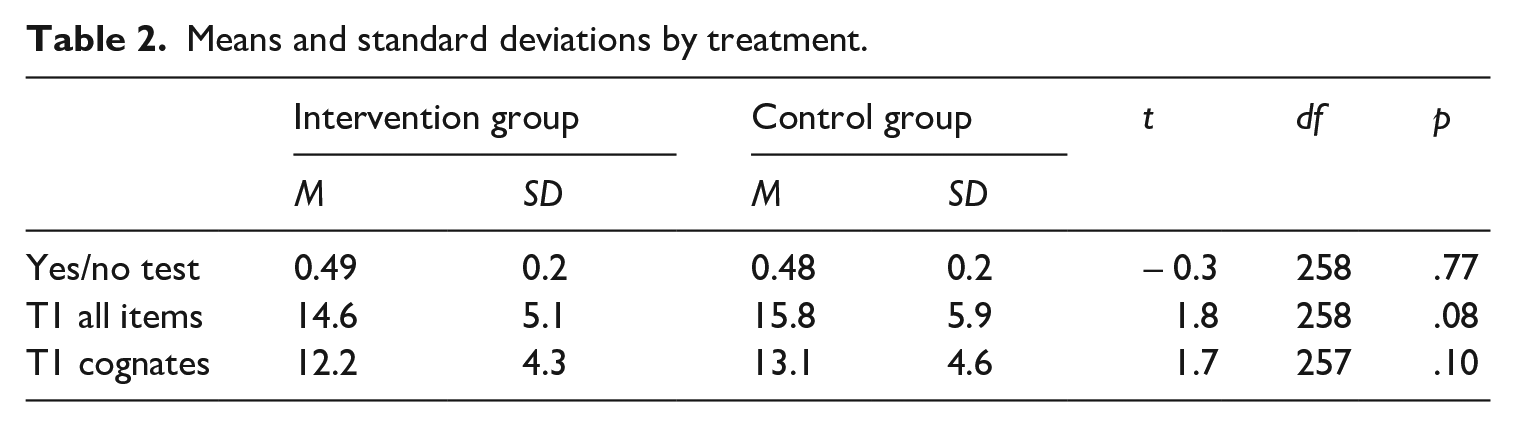
As evidenced by the lack of ceiling or floor effects, the vocabulary learning test appears to have generally been of appropriate difficulty. Participants were able to memorize roughly half of the overall 30 tested items, with means ranging from 14.1 to 15.2 words across the three tests. Individual performances varied greatly at all test times, ranging from none to all correct answers given. Each item was translated correctly at least once, and none were translated correctly by every student. The two treatment groups were on par in terms of initial vocabulary knowledge and performance at T1 (Table 2).
Means and standard deviations by treatment.
1 Improvement by treatment and proficiency
For each learner, the difference in their performance on the vocabulary learning test between T2 and T1 as well as between T3 and T1 was computed. Figures 1 and 2 show that the pupils in the intervention classes tended to progress more than did the pupils in the control classes from T1 to both T2 and T3. Five of the seven experimental classes surpassed the control classes in T2, and only one intervention class was outperformed by control classes in T3.
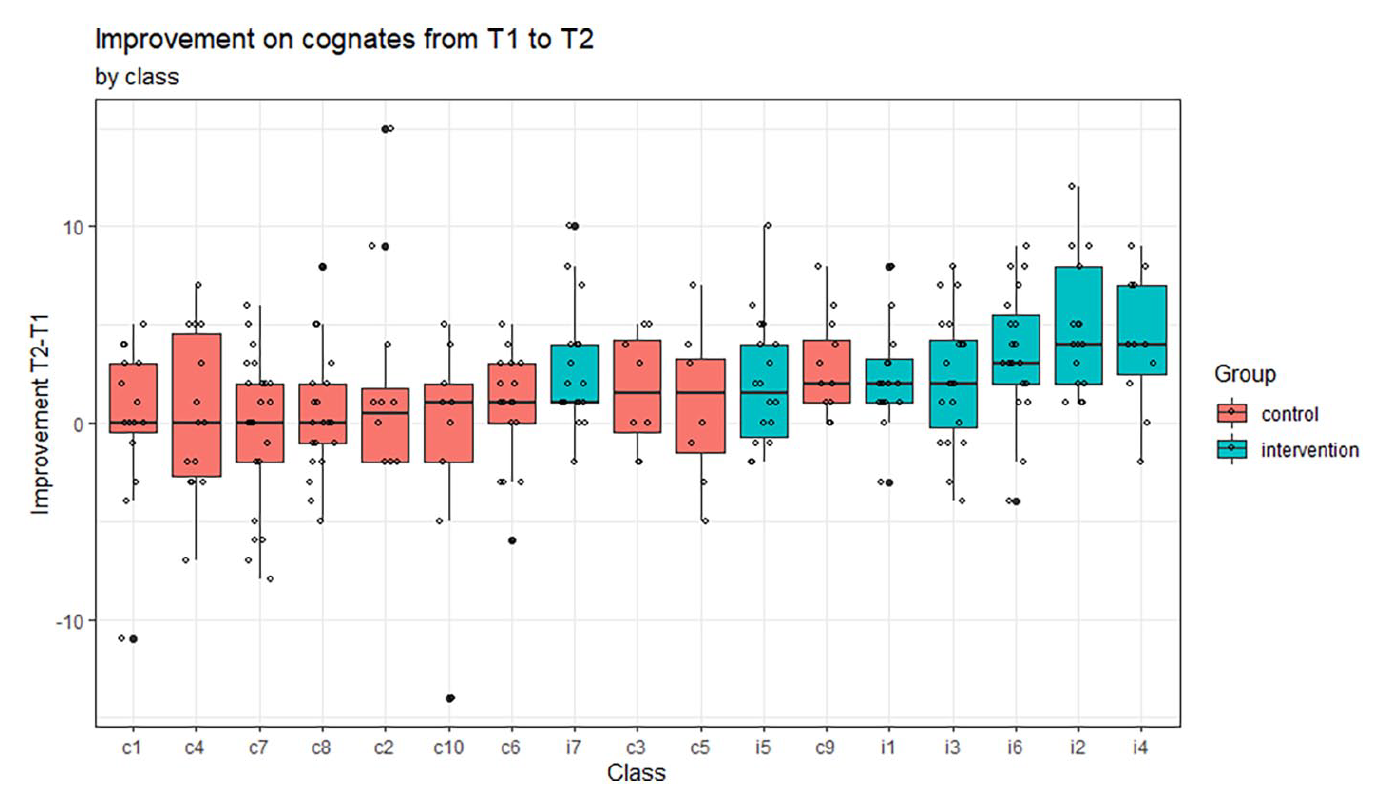
Improvement in cognate retention by class from T1 to T2, sorted by median progression.
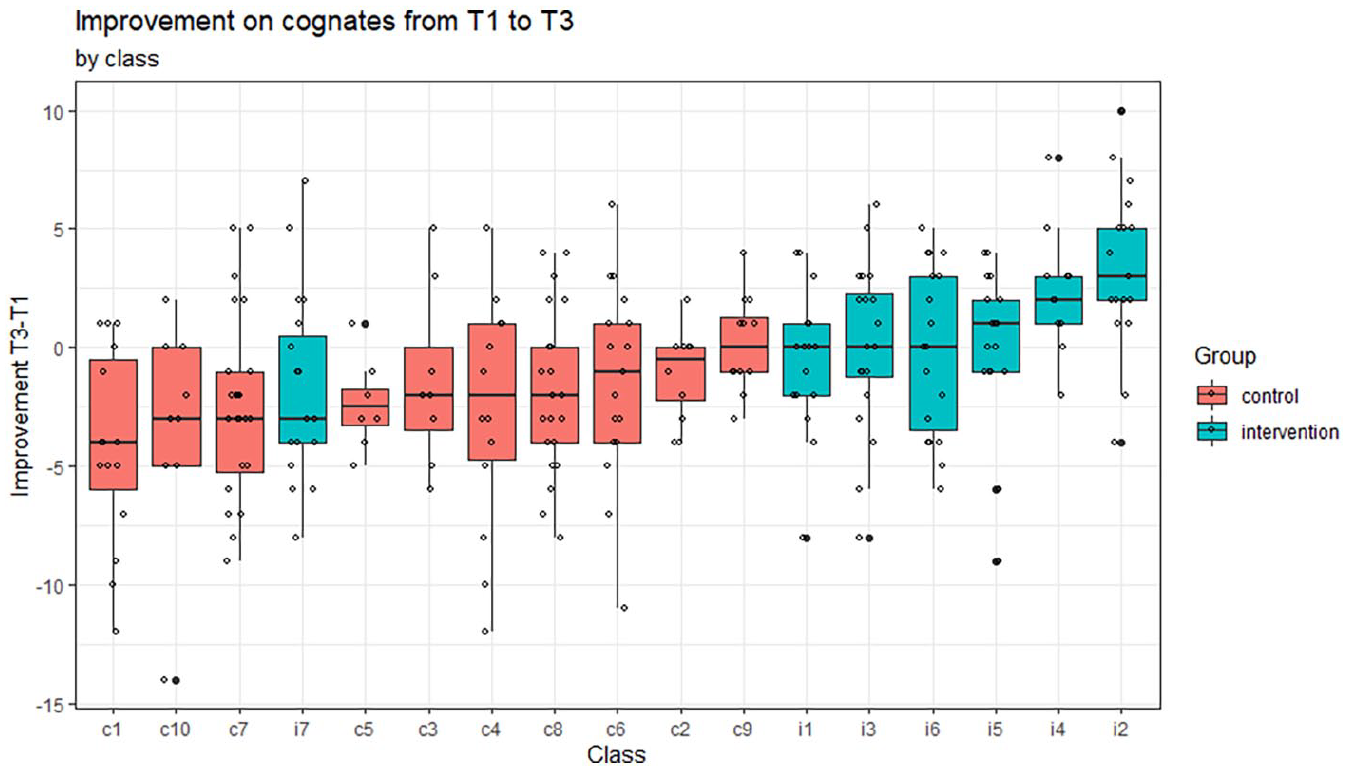
Improvement in cognate retention by class from T1 to T3, sorted by median progression.
The results of the linear mixed-effect models on these data are summarized in Table 3. The progression from T1 to T2 (for one model) and from T1 to T3 (for the other) served as the dependent variable. The fixed effects were treatment group, the participants’ scores on the Yes/No vocabulary test, as well as the interaction between them. The Yes/No test was centered at its mean, and the treatment group sum-coded (intervention = 1, control = 0). To account for the clustering effect (pupils in classes), by-class random intercepts were included in the models as well (Vanhove, 2019). Furthermore, p-values were obtained through Satterthwaite approximations (Kuznetsova et al., 2017).
Linear mixed-effect regression modeling improvement on cognate retention.
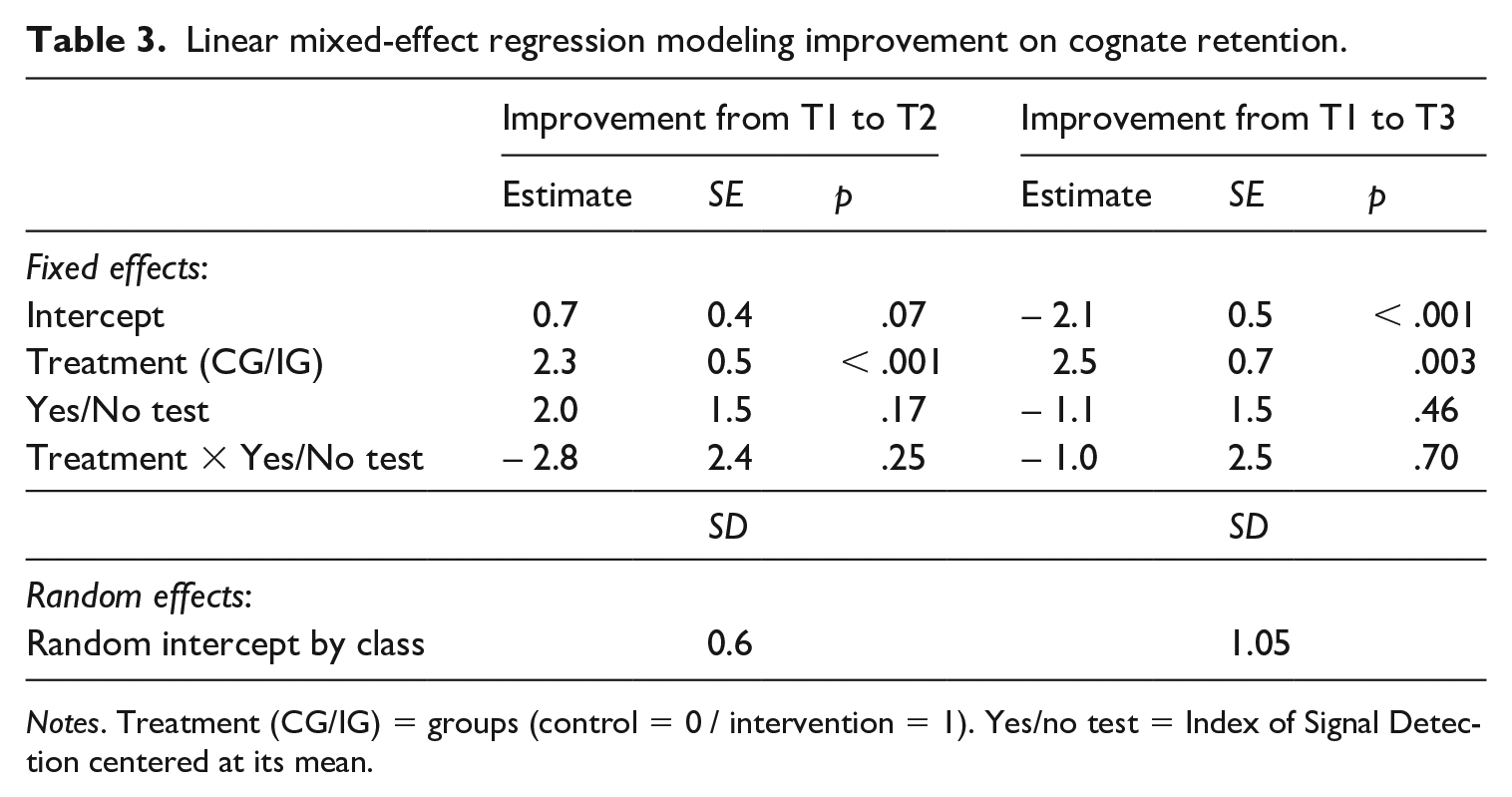
Notes. Treatment (CG/IG) = groups (control = 0 / intervention = 1). Yes/no test = Index of Signal Detection centered at its mean.
The intervention affected the improvement on cognates significantly from T1 to T2, t(13) = 4.4, p < .001, increasing the number of items remembered by the intervention group by 2.3 ± 0.5 (SE) in comparison to the control group. A similar result was obtained comparing the outcome from T1 to T3, t(14) = 3.6, p = .003, with an increase in cognate retention of 2.5 ± 0.7 (SE). In other words, the intervention had a significant impact on students’ progress in terms of how many new items they were able to memorize within a short amount of time and emerged as a main predictor of learners’ improvement.
Initial vocabulary size as measured by the Yes/No vocabulary test did not have a statistically significant influence on the progress from T1 to either post-test. Neither was the interaction between treatment and vocabulary knowledge significant at either test time. Thus, there is no evidence that students with initially larger vocabulary sizes showed greater improvement or were able to benefit more from the intervention in comparison to their peers with smaller vocabularies.
2 Improvement by test mode and type of correspondence
The data was also examined at a finer level to measure the variance of improvement with respect to test mode and type of correspondence. For each participant, the difference in correct responses from T2 to T1 and from T3 to T1 was calculated for each variable. Then, a linear mixed-effect regression analysis of the relationship between treatment and improvement on each variable was performed, 8 following the same procedure as for the overall improvement described above.
In regards to test mode, participants were assessed on 12 items each productively and receptively at each testing point. In both post-tests, the intervention group showed significantly larger gains in comparison to the control group (Figure 3).
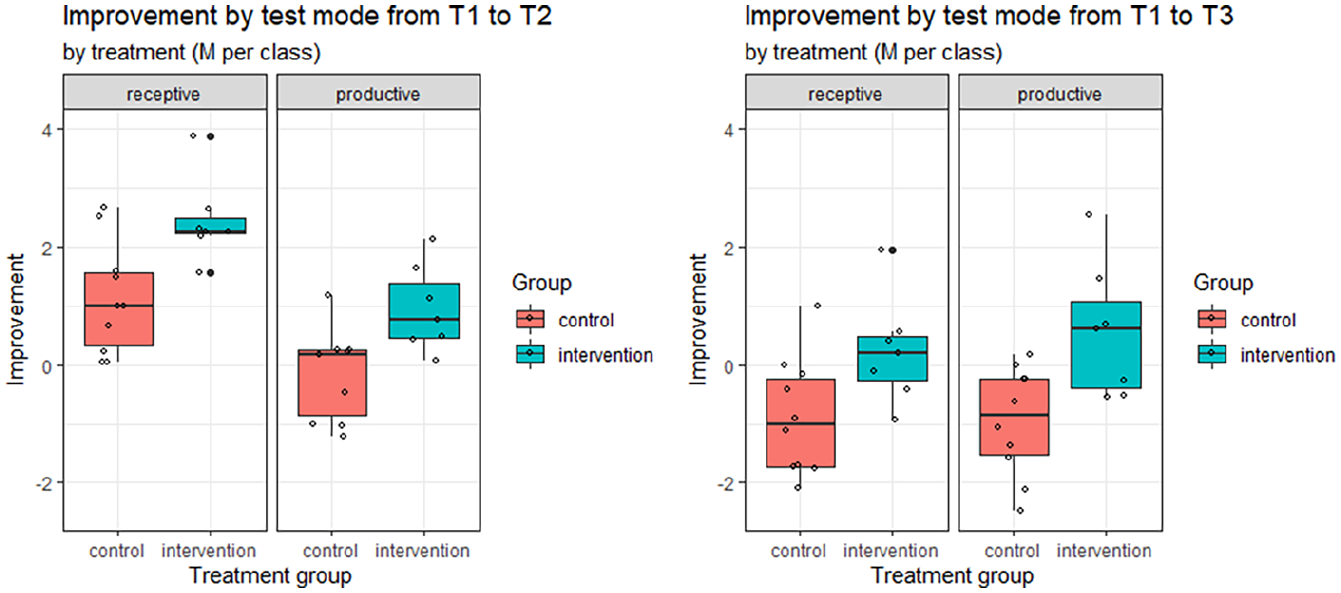
Improvement in cognate retention by test mode (receptive/productive), test time, and treatment (M per class).
In terms of type of correspondence, the number of word pairs tested per category varied: two <k>–<ch>, four <p>–<f>, five <c>–<k>, six <t>–<s>/<z>, and seven <th>–<d>–<t>. Therefore, the analysis was based on the proportion of correct answers per type (Figure 4). The results show that the intervention group significantly outperformed their peers on all four correspondence rules that had been addressed in the programme at either post-test, with the exception of <th>–<d>–<t> at T3 and of <c>–<k> only approaching significance at T2 (p = 0.06). In contrast, the performance on <k>–<ch> word pairs remained similar across both groups and thus did not show a statistically significant difference at either post-test.
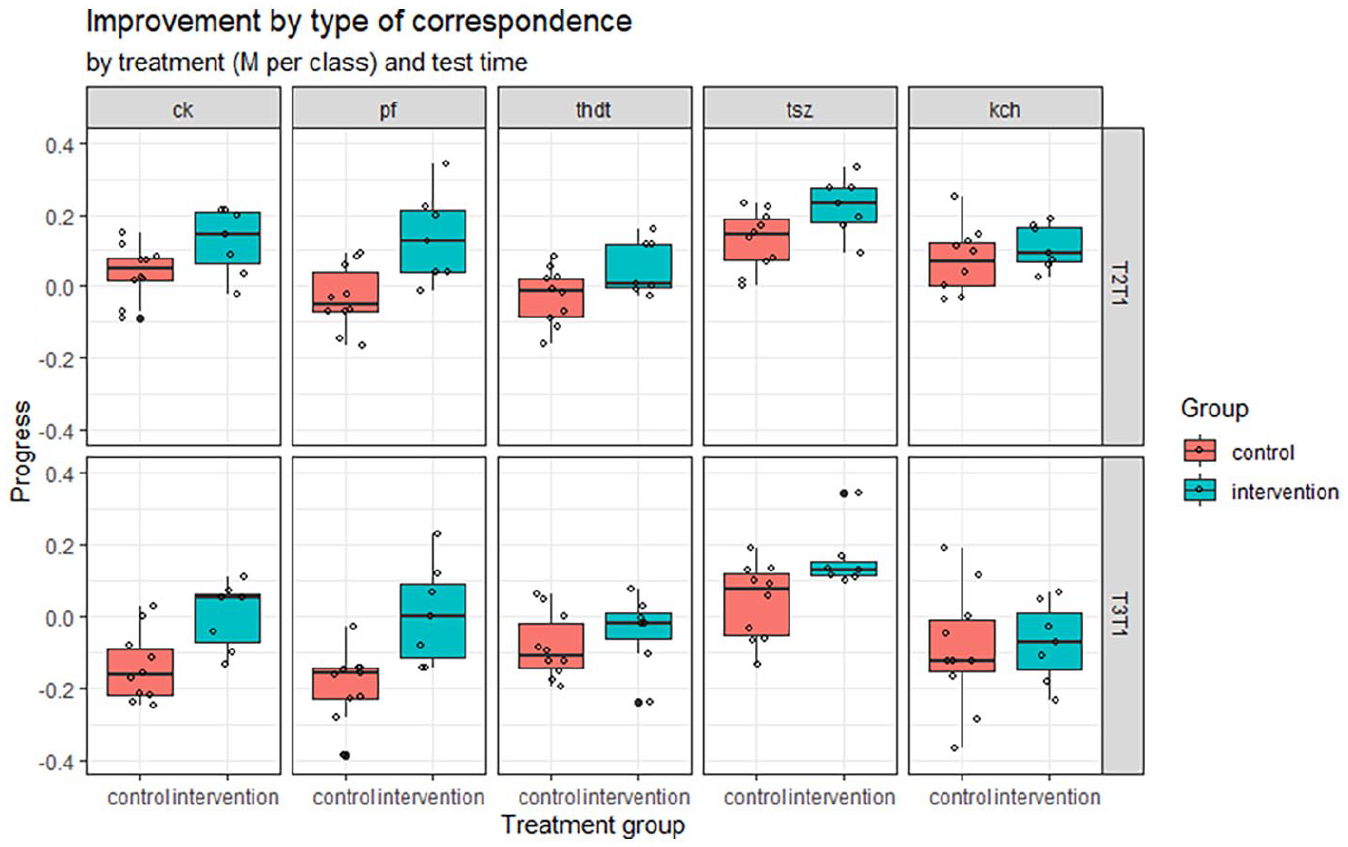
Improvement in cognate retention by type of correspondence, test time, and treatment (M per class).
3 Attitudes towards the intervention
The majority of participants in the intervention group evaluated the program positively. Four out of five pupils stated that they enjoyed exploring systematic similarities, and thought it was important for their learning process. On average, learners completed three worksheets and games. However, neither the attitude towards the intervention nor the number or type of tasks completed correlated with participants’ progress at either post-test as determined by Pearson’s product-moment correlation.
IV Discussion
1 Effects of crosslinguistic awareness-raising on vocabulary learning
The main goal of this study was to explore whether middle-school students could exploit explicitly addressed, systematic crosslinguistic orthographic similarities between German and English as a means to learn new vocabulary exhibiting these correspondences more efficiently. On average, the intervention group’s improvement was 2.4 (T2-T1) and 2.5 (T3-T1) items larger than among the control group on the vocabulary learning tests. Considering that roughly half of the 24 presented cognates were correctly translated at T1, students of the intervention group outperformed their peers significantly both at T2 (10 percentage points more) and T3 (11 percentage points more). Most of the 7 intervention classes outperformed the 10 control classes at either post-test. This progress was visible after 90 minutes of instruction over the course of 2 weeks.
These results support recommendations for a form-focused component in vocabulary learning (Laufer, 2005) and confirm that language learners can benefit from comparative awareness-raising activities (Marx & Hufeisen, 2007; Neuner, 2003).
The outcome of this study also corroborates positive effects found in previous interventional studies with Spanish–English bilinguals focusing on crosslinguistic similarities (Arteagoitia & Howard, 2015; Dressler et al., 2011; Proctor & Mo, 2009). In comparison to these projects, a test before the intervention was additionally included in the current study as a baseline, allowing the difference between the intervention and control group to be more reliably attributed to the intervention. The results also support White and Horst’s (2012) claim of heightened metalinguistic awareness based on their analysis of French–English bilingual students’ diaries, which their numerical data on the cognate recognition task had failed to back up. The decisive factor could be the intensity of teaching: White and Horst’s 160-minute program was spread across 15 weeks, whereas the 90-minute intervention presented in this article was completed within 2 weeks. Moreover, the task differed (word recognition as opposed to vocabulary learning). Overall, the results of this study show that not only bilinguals – with presumably larger L2 vocabularies – but also learners in early stages of foreign language instructional settings can benefit from crosslinguistic awareness-raising activities.
Compared to other studies concerned with more traditional foreign language classes, the results are in line with Otwinowska’s (2015) findings with secondary school Polish learners of English, expanding the group of students who can benefit from crosslinguistic awareness-raising activities to middle-schoolers. Contrary to Molnár’s (2010) nonsignificant results for transfer from the first to the second foreign language (i.e. Romanian to English), the current intervention was much longer and more intensive, encouraged transfer from a native language that was additionally more closely related, and tested only newly introduced words. The current study also contrasts with Otwinowska et al.’s (2020) most recent study, where participants’ cognate learning did not measurably benefit from awareness-raising workshops. However, there are several differences: First, as opposed to the learning of words embedded in tasks that were completed over the course of six weeks in Otwinowska et al., the current study assessed items both productively and receptively, and these were presented and tested explicitly and decontextualized. The current intervention also targeted only a small set of systematic correspondences. Moreover, the Swiss middle-schoolers were younger and less proficient than the Polish lower-intermediate teenagers, and the language combinations differed. Finally, no additional attention was devoted to general vocabulary learning strategies, which could have diverted the intervention group’s focus away from similarities and/or affected the control group’s performance in Otwinowska et al.’s study.
Interventional studies explicitly addressing consonant shifts are scarce, and the only two studies summarized earlier reported contradicting results. While both targeted intercomprehension, Vanhove’s (2016) young adults benefitted measurably from immediate feedback on a straightforward correspondence rule among decontextualized written German–Dutch word pairs, whereas Bergsma et al.’s (2014) Dutch middle-schoolers’ contextualized oral comprehension of Frisian did not measurably increase. Expanding on positive evidence found in Vanhove’s (2016) experimental study, the current study was able to show positive short- and long-term effects in a classroom setting with younger participants while also addressing several and more complex consonant shifts. Despite working with students of the same age, the current study’s results contrast Bergsma et al.’s (2014) findings. However, the number of correspondences was reduced from eight in Bergsma et al. to four in this study. Additionally, the intervention of the current project was twice as long, spread across 2 weeks as opposed to a single day, and included an additional review to consolidate the aspects introduced earlier. Moreover, the assessment differed; oral contextualized intercomprehension as opposed to written decontextualized vocabulary learning. This supports Berthele et al.’s (2011) conjecture that the teaching of consonant shifts might be more advantageous for vocabulary learning.
2 Factors influencing the intervention uptake
The study also examined whether other factors influenced the intervention uptake, in particular the initial vocabulary size, test mode, type of correspondence, and attitude towards the intervention.
First, it was assumed that the initial size of the foreign language vocabulary knowledge would have an impact on students’ progress (Otwinowska & Szewczyk, 2019). While the Yes/No test score indeed correlated with the performance on the vocabulary learning tests, it did not emerge as a predictor for the improvement. Hence, students with initially larger vocabularies were generally able to memorize a higher number of previously unknown lexical items, but there is no evidence that they progressed and/or benefitted more from the instruction than their peers with smaller vocabulary sizes. Conversely, weaker students were not able to compensate for an initially smaller mental lexicon due to explicit teaching, which is in contrast to previous results obtained with Polish secondary pupils (Otwinowska, 2015). However, Otwinowska’s study differs in terms of task and the extent of explicitness in the rules: Whereas the Polish secondary students circled cognates in a text and thus had to recognize them, the Swiss middle-schoolers had to memorize new items exhibiting specific shifts, which is likely to be constrained more by cognitive capacities.
Second, in terms of test mode, the intervention group’s gain was larger both among receptive and productive test modes. This is surprising considering that the rules were introduced from an English to German (receptive) perspective (e.g. <t>–<s> as in water and Wasser). However, it is in line with Kelley and Kohnert (2012) who reported that the cognate awareness was similarly present or absent for each Spanish–English bilingual participant. This suggests that the introduction of systematic correspondences can facilitate vocabulary learning in either direction.
Third, students were expected to benefit more from instruction on more complex and less frequent rules such as <t>–<s>/<z> as opposed to <c>–<k>. While the young adults in Vanhove’s (2016) study benefitted from feedback on a single straightforward correspondence, Bergsma et al. (2014) attributed the lack of their middle-school students’ improvement among others to the correspondence rules having been too obvious and numerous. The instruction boosted participants’ retention in the current study significantly across all four taught correspondences, although the increase varied per type. This suggests that students benefitted from instruction independently of the complexity of the rule. However, the number of items assessed per category differed, the overall compilation of the tests was likely of varying difficulty, and the example provided in the instruction was always the same, which could have affected the results.
Furthermore, it was hypothesized that due to heightened crosslinguistic awareness, students of the intervention group would be better at detecting the <k>–<ch> correspondence rule which was not taught during the intervention. The data did not support this claim. However, only two items were tested for this shift, out of which the learners already correctly translated one or both items at T1 (M = 1.20, SD = 0.60), leaving little room for improvement. Additionally, the participants of this study could be more sensitive to this particular correspondence because it can be observed between standard and Bernese Swiss German, as for the term cat in [kat͡sə] and [χat͡s].
Finally, as predicted, the attitude towards the intervention did not impact the progress. In line with previous research (Molnár, 2010; Otwinowska, 2015), the majority of students provided positive feedback. Thus, pupils enjoyed contrastive activities independent of the impact these had on their performance.
3 Limitations and future directions
This study is limited to a certain set of written words exhibiting systematic crosslinguistic correspondences. The instructional setting is form-focused and not embedded in a larger communicative frame. Hence, the intervention is not supposed to reflect the scope of a general language course or even the vocabulary learning portion. It was designed to provide an additional, different approach to complement the existing course material in the hope of providing students with a new insight. The instruction aimed at triggering an explicit learning process, though the vocabulary learning tests assessed the knowledge implicitly.
The ecological validity could be increased through a more child-friendly testing approach, since vocabulary instruction at this level is usually contextualized and includes guidance on pronunciation. Acknowledging the fact that pronunciation has been shown to affect word recognition (Dijkstra et al., 1999) and taking into consideration the difficulty of the English spelling, future studies could include phonological information during the presentation phase.
In addition to the considerations in regards to the test items mentioned in the discussion section, it should be kept in mind that students learned a different set of words at every time point. Although several steps were taken to select items students had not yet been familiar with, the initial knowledge of these words was not assessed directly, and the scoring did not include certainty ratings to account for guessing (Otwinowska & Szewczyk, 2019). Furthermore, while students thus proved that they could still apply the acquired principles to increase the uptake of new words during the post-tests, they were not tested on whether the strategies helped them retain the words presented over a longer period of time. Finally, the time between T2 and T3 could be prolonged to more reliably evaluate long-term retention of the rules. These aspects could be addressed in future studies.
V Conclusions
Supporting language learners in taking advantage of their linguistic repertoire by incorporating comparative and contrastive activities has been recommended, in particular since students have been observed to vary considerably in their ability to recognize and exploit crosslinguistic similarities (García & Nagy, 1993; Vanhove & Berthele, 2015). As a core aspect of language learning and proficiency, vocabulary promises a particularly fruitful area to exploit such similarities among closely related languages such as German and English, which share several thousand similar words due to their common root and the influence of loanwords (Marx & Hufeisen, 2007).
This interventional study presents evidence that explicit crosslinguistic awareness-raising through deliberately focusing on a small set of systematic orthographic similarities between German and English can be exploited to increase the efficiency of foreign language vocabulary learning. Students of the intervention group progressed significantly more in comparison to the control group at either post-test. The difference was found across both test modes and all four correspondences introduced, suggesting that even younger students can measurably benefit from form-focused instruction. While pupils with initially larger vocabulary sizes retained more items overall, they did not progress more in comparison to their peers with smaller vocabularies, indicating that participants benefitted from instruction independent of proficiency. However, due to the similar performance on items exhibiting the unfamiliar <k>–<ch> correspondence, it remains to be investigated how and whether students can be supported in transferring their heightened awareness to new phenomena in their language learning process.
Footnotes
Acknowledgements
I would like to thank Raphael Berthele and Jan Vanhove, University of Fribourg, Switzerland, for their guidance and support throughout my MA thesis upon which this article is based, as well as the participating middle-school teachers and students for devoting their time and energy. I would also like to thank two anonymous reviewers as well as Jan Vanhove and Katharina Karges for their insightful comments on previous versions of this article.
Funding
The author received no financial support for the research, authorship, and/or publication of this article.
