



Abstract
Because most real-life foreign language speech is naturally unpredictable, spontaneous speech should be practiced in the foreign language classroom. Student teachers of English as a foreign language (EFL) may benefit from practising methodology for spontaneous speech practice. This article reports the findings for a study into EFL student teachers’ experiences with using improvisation activities, exploring the relevance of improvisation activities for spontaneous speech practice. The data include semi-guided texts and reluctant speakers’ interviews. The findings showed that improvisation activities facilitated spontaneous speech practice and strengthened speaking confidence through enjoyment. The ‘spontaneous speech mindset’ enabled participants to explore linguistic and creative boundaries. The study showed that application of improvisation activities is an excellent method for spontaneous speech practice in EFL teacher education.
Keywords
I Introduction
Drama as an overarching discipline has been established as beneficial for foreign language learning (FLL). Within education, improvisational practices have been mainly applied and studied in drama lessons (Holdhus et al., 2016); more empirical research into how drama and theatre techniques may stimulate the development of oral communication is necessary (Galante & Thomson, 2017). Although FLL textbooks describe drama-based activities like (semi-)scripted role play and simulations as popular communicative activities, not many textbooks have integrated activities for non-scripted drama activities yet (Becker & Roos, 2016).
This discrepancy can be addressed in foreign language (FL) teacher education (TEd) by integrating improvisation methodology in spontaneous speech practice which may benefit student teachers and their future learners. In the present study spontaneous speech is defined as unplanned, immediate oral communication; improvisation activities refer to drama-based approaches where participants do not follow scripts or predetermined scenarios, but experiment with language by making up words and/or actions (Galante & Thomson, 2017; Stinson, 2008).
This article shares findings for a study into spontaneous speech practice in English as a foreign language (EFL) 1 TEd. Student teachers’ experiences with doing improvisation activities for spontaneous speech practice in English were examined, with special regard for reluctant speakers. Through analysing retrospective texts (n = 41) and interviews (n = 6) new insights were gained and concepts such as ‘spontaneous speech mindset’, ‘vicious circle of stress’ and ‘victorious circle of enjoyment’ were coined. It is argued that the application of improvisation activities is a relevant method for spontaneous speech practice in EFL Ted.
II Conceptual framework
1 Theatre improvisation
Since the 1950s, theatre improvisation has grown extensively as a training and performance method, whereby improvisers collaborate to create most of the dialogue, story, and characters during performances (Holdhus et al., 2016; Sawyer, 2015). The present study focused on improvisation methodology by Spolin and Johnstone, who independently developed improvisation theories and remain central in theatre improvisation (Seppänen et al., 2019). Spolin developed improvisation games for children based on problem solving, whereas Johnstone focused on storytelling and relationships (Johnstone, 1981, 1999; Spolin, 1983, 1986). Although these approaches vary, they contain similar concepts for facilitation of improvisation training and performance. The central improvisation principles (CIPs) formulated for the present study are:
Acceptance and elaboration (‘Yes, and’ rule): accepting whatever happens, including mistakes. Verbal and non-verbal cues are called offers (Johnstone, 1981). Offers must be accepted without judgment and elaborated upon to establish communicative interaction and move stories forward (Johnstone, 1981; Spolin, 1983). This principle is central to storytelling aspects of improvisation.
Risk-taking and spontaneity: reacting to any situation without planning or censoring one’s ideas to allow spontaneity to arise (Johnstone, 1981). Spontaneity is the moment of personal freedom when improvisers are faced with a fictional reality, explore it and react without self-judgment (Spolin, 1983). This principle is central to dramatic aspects of improvisation.
Relations and status: verbal and non-verbal communication expressing the relation or social position of an improviser towards other improvisers in scenes (Johnstone, 1981). All sounds and movements (such as posture) signal the type of relationship to others. This principle is central to collaborative aspects of improvisation.
Attentive listening: listening actively by being present in scenes, supporting other improvisers and attending to everything in the moment (Johnstone, 1981; Spolin, 1983; Vera & Crossan, 2005). This mode is a separate CIP and supports other CIPs.
2 Application of improvisation in educational contexts
a The role of drama and improvisation in FL education
Since the prevalence of communicative language teaching (CLT), drama-based methodology has been an inherent part of FL teaching (Giebert, 2014). Savignon (2018) emphasizes learners’ needs to experience communication through participation in the interpretation, expression, and negotiation of meaning. Role-play provides such a context for FL practice, for taking risks with new vocabulary and constructions in an enjoyable and non-threatening situation (Clipson-Boyles, 2012). Nevertheless, some caution that scripted role- play should be applied sparingly because its controlled language practice can reduce linguistic creativity and actual interaction (Heathfield, 2007). A comparative study of adolescent EFL learners (Galante & Thomson, 2017) indicated that techniques adapted from drama and theatre can result in significantly greater improvements in English oral fluency compared to more traditional communicative teaching.
The benefits of applying drama in language teaching have been studied thoroughly (Lee et al., 2015). An overview of such benefits is, for instance, given by Boudreault (2010) who presents drama as a powerful teaching tool for developing self-awareness and an improved sense of confidence in students’ FLL abilities. Whereas controlled language exercises may dominate classrooms, Almond (2004) emphasizes that drama gives learners a genuine need for communication as well as the intricacy of unpredictable language. Modern FL teachers agree that ‘drama fosters engagement, and engagement fosters language acquisition’ (Koushki, 2019). In summary, drama supports the focus of modern FL methodology on meaning.
b The role of drama and improvisation in tertiary education
Several empirical studies have demonstrated positive effects of drama-based FL pedagogy in tertiary education (cf. for example Abenoja & DeCoursey, 2019; Celik, 2019; Miccoli, 2003; Piazzoli, 2011; Stern, 1980). Stern hypothesized that drama positively influences FLL because it stimulates the use of certain psychological factors that facilitate oral communication: ‘heightened self-esteem, motivation, and spontaneity; increased capacity for empathy; and lowered sensitivity to rejection’ (1980, p. 95). Drama activities helped participants to gain self-confidence in speaking English and develop their spontaneity (Stern, 1980). Role-playing encourages participants to become more flexible by developing a sense of mastery in various language situations (Stern, 1980). Piazzoli (2011) applied process drama pedagogy in second language (L2) university classrooms and found that participants developed a degree of trust which replaced an earlier judgmental group dynamic. A more collaborative, supportive learning environment arose, where participants took risks and discarded earlier self-conscious attitudes towards the FL. In turn, this development enabled some highly anxious participants to reduce their language anxiety and gain more self-confidence which increased their spontaneous FL communication. The improvisational character of drama was limited because language structures and idioms were introduced and revised.
In a recent study (Baykal et al., 2019), ELT pre-service teachers felt enjoyed (highest occurrence), confident, motivated, creative and interested during drama activities. The participants were, however, taking an elective course for Drama in ELT, which weakens the findings. Interestingly, these participants expressed some concern for classroom management and suitability for all types of learners. The authors conclude that the drama course should be offered to all student teachers of English.
Evidently, unpredictability and creativity are important features of authentic FL dialogue (Sawyer, 2003; Winston & Stinson, 2011) as well as improvisation with its evanescent nature (Davies, 1990; Winston & Stinson, 2011). According to Bygate (2001), speaking FLs spontaneously requires the development of a specific type of communication skill, which must be practised using suitable methods. The ephemeral nature of improvisation simulates real-life events (Winston & Stinson, 2011) and challenges the basic skills of listening and communication (Crossan, 1998). Improvisation involves spontaneous interactions in semi-authentic learning environments. This creates windows of opportunity for flexible and creative learner-centred EFL practice (Kurtz, 2015). Piccoli (2018) discusses improvisational theatrical techniques as creative, flexible teaching resources which can be applied to expand students’ language competencies, particularly oral proficiency skills.
In a general tertiary context, Berk and Trieber (2009) state that improvisation can be a powerful teaching method in university, and support their view with four main didactic arguments (DAs):
Improvisation corresponds to modern students’ expectations towards active, collaborative, social, and learner-centred classroom experiences.
Improvisation uses students’ multiple and emotional intelligences for problem-solving and active discovery, especially verbal/linguistic, visual/spatial, bodily/kinaesthetic, interpersonal, and intrapersonal.
Improvisation encourages collaborative learning by helping to build trust, respect, listening, verbal and nonverbal communication, role-playing, and risk-taking through spontaneous storytelling.
Improvisation stimulates deep learning through student active engagement, as learner activity and interaction are inherent to improvisation activities.
These DAs can be related to other studies. Gallagher (2010) emphasizes that in learning contexts, improvisation returns the body to its rightful state (body and mind) through its holistic approach (DAs 2 and 4). Crossan (1998) discusses psychological risks (DA3) caused by the nature of improvisation containing spontaneity and dependence on others. Crossan explains that the spontaneous nature of improvisation relies on fundamental communication skills, thereby expecting students to dedicate their complete attention to the moment (DA4). Collaborative language production (DA3) is considered a central characteristic of spontaneous speech (Christie, 2016). With its focus on collaborative learning, the present study could be placed within sociocultural theory, given its central idea that people are essentially communicatively-formed beings (Lantolf, 2007). Canale and Swain (1980) also regard communication as grounded in sociocultural interpersonal interaction involving creativity and unpredictability.
c Anxiety and speaking reluctance in FLL TEd: the role of improvisation
Anxiety has been widely studied in FLL research because of its debilitating effect on FLL performance (Dewaele, 2013; Horwitz, 2001, 2010). Such communicative anxiety refers to FLL students who ‘freeze and block when having to start a conversation, are very sensitive to error correction, avoid participating and generally adopt passive language learning attitudes’ (Rubio-Alcalá, 2017, p. 207). Horwitz, Horwitz, and Cope (1986) state that foreign language classroom anxiety (FLCA) is a situation-specific anxiety, whereas Dewaele (2013) found a significant link between anxiety as a personality trait and FLCA. Horwitz et al. (1986) suggest teachers can either help anxious students to cope with stressful situations or make learning contexts less stressful, while Dewaele and his colleagues (Dewaele & MacIntyre, 2016; Dewaele et al., 2017) advocate teachers to focus on FLL enjoyment. When inhibited students do not engage actively in EFL speaking activities, their speaking reluctance becomes self-enforcing because they should be more orally productive to develop their speaking skills (Savaşçı, 2014). Matsuda and Gobel (2004) emphasize the importance of furthering students’ self-confidence in EFL classrooms. They conclude self-confidence could be developed by encouraging student involvement in classroom activities, and by creating a comfortable atmosphere through games and role-plays (for example). Research on affective variables has been preoccupied with FL learners’ negative emotions excessively long (Dewaele et al., 2017).
In an intervention study, Seppänen et al. (2019) found that improvisation methods increased interpersonal confidence of initially inhibited student teachers. Including improvisation methodology in TEd curricula can improve student teachers’ social interaction abilities and their teaching responses (Seppänen et al., 2019). Comedy improvisation has been successfully applied by mental health professionals to treat psychological conditions such as social anxiety disorder (Phillips Sheesley et al., 2016). Participants in an improvisational theatre intervention demonstrated positive outcomes in terms of verbal productive creativity, self-esteem, and self-efficacy (Schwenke et al., 2020). According to these studies, improvisation activities may help reluctant speakers (defined as learners who regularly and consciously avoid speaking English spontaneously) practise spontaneous speech. To experience language learning progress and to become really communicatively competent, learners must manage using FL spontaneously and creatively (Becker & Roos, 2016). Nevertheless, there has been little academic research into improvisation as a didactic approach for EFL student teachers. Therefore, the present study addresses the following research questions:
How have student teachers experienced participating in improvisation activities for spontaneous speech practice in English?
How have reluctant speakers experienced participating in these improvisation activities?
III Methods and data
1 Methodology
The research site was a TEd faculty at a Norwegian university and the study was conducted during regular teaching EFL (TEFL) courses. Through writing retrospective texts, participants reflected on their experience with the spontaneous speech practice as a whole. This process highlights the value of accessing and developing professional and practical knowledge through reflection. The discussion draws on findings from retrospective texts from a larger group (n = 41) and interviews with (very) reluctant speakers (n = 6). The qualitative study applies Interpretative Phenomenological Analysis (IPA) as the central perspective for examining the data (Smith et al., 2009) which facilitated a sensitivity to student teachers’ experiences.
The study satisfies most of the characteristics Creswell (2013) identifies for qualitative research: it takes place in a natural setting (i.e. classroom in a regular course), the researcher is the key instrument gathering data using multiple methods, focusing on participants’ meanings through an emergent design. The last element refers to the implementation of interviews after analysis of retrospective texts.
2 Participants
Over two years, 41 student teachers of English for grades 5–10 participated in the research. Of these, 28 were pre-service primary education student teachers and 13 were primary and lower secondary education teachers with an average of 11 years’ teaching experience. The participants were anonymized and are all referred to as student teachers. Each course was randomly given a number (e.g. 100, 500) and the participants were randomly assigned a number within that course (e.g. P101, P513). These participant numbers have been included when referring to participants’ reflections. Because female students represent the majority in TEFL courses, participants are referred to by female pronouns (she/her) as the unbiased pronoun. In the second year, six participants were interviewed.
3 Teaching procedures
The teacher educator adapted and taught improvisation activities in TEFL courses. The hour-long sessions contained increasingly more challenging activities in language and creativity. Although nearly every improvisation activity can teach listening and speaking (McKnight & Scruggs, 2008), the following activities were selected:
a Session 1: Storytelling (CIP1, CIP2, CIP4)
During the warming up Zip, Zap, Zop, participants stood in a circle and physically sent a pulse clockwise or anti-clockwise saying zip-zap-zop. In this activity, they made mistakes when they lost focus, a practice for accepting failure. Subsequently, participants performed collaborative storytelling activities of One Word Story and Three Sentence Story. Finally, a collaborative story (Dice Based Story) was told using Rory’s story cubes.
b Session 2: Conversations (CIP1, CIP2, CIP3, CIP4)
The activities challenged participants to play roles, and status was implicitly practised through characters’ relations. In Man on the Street, participants initially shaped ‘reporter’ and ‘stranger’ roles themselves. Afterwards, reporters defined strangers through a greeting such as ‘Hello, little girl . . .’ or ‘Good afternoon, Prime Minister’. Strangers accepted reporters’ offers and reacted in character. Other activities included Customer Service (with a mystery object) and Noah’s Ark (formal speech).
c Session 3: Status expressions (CIP1, CIP2, CIP3, CIP4)
To create an understanding of the physical concept of status, participants warmed up with a Status Walk, in which they embodied imaginary high and low statuses. Here, social relations and characters’ status were used as an accessible introduction to the theatrical concept of status. The first activity was Downton Abbey, inspired by Johnstone’s master–servant game (Johnstone, 1981) and the television series for setting. In Meeting, participants were given a secret social order, then performed a planning meeting with subtle hints about their status. The final activity (Park Bench) was a meeting between strangers.
4 Data collection
Immediately after each improvisation session, participants wrote a learning diary in English. One week after the final session, participants wrote a retrospective text based on these diaries under semi-structured guidance (see Appendix 1). Texts were collected through learning management systems (LMS).
Some relevant perspectives from reluctant speakers did not meet the 33% threshold for recurrent themes. To gain a deeper understanding of reluctant speakers’ experiences, interviews were added in the second year of the study. Participants were also provided with tablets to film improvisation activities in university classrooms. Retrospective texts were then examined closely regarding reluctant speakers. Two participants emerged as very reluctant speakers and four as reluctant speakers. Semi-structured individual interviews (length 44-59 minutes) encouraged participants to share experiences in more detail in an interactive, dialogic reflection (see Appendix 2). To prompt their memory, footage of their improvisation activities was shown during interviews. Participants initiated comments and the interviewer stopped the footage at natural intervals, e.g. when an activity was finished. This approach is based on stimulated recall, an effective tool to create an understanding for students’ cognitive and affective processes (Piazzoli, 2011). Each interview was audio-taped and written down in a verbal protocol.
5 Analysis of retrospective texts
The 41 retrospective texts were analysed manually using NVivo by creating nodes. A thematic IPA analysis of participants’ experiences was conducted (Smith et al., 2009). To enhance validity and compensate for possible instruction influence on the texts, the recurrence threshold for theme recurrence was reduced from Smith et al.’s recommendation of 50% to 33%, i.e. a theme recurring in 14 of 41 texts.
6 Analysis of interviews
Each interview was analysed holistically. Following an iterative inductive cycle, notes were developed into descriptive comments, then into interpretative notes and emergent themes (Smith et al., 2009). Finally, individual themes were compared, and super-ordinate themes were established.
7 Ethical considerations and limitations
The study aims to contribute to the understanding of this teacher educator’s practice (Ellis, 2012). The study was conducted in accordance with the guidelines from Norwegian Data Protection Services (NSD). The teacher educator had not met participants before. They were informed about the purpose of the study and provided their written consent which was registered after improvisation sessions ended to minimize influencing the teacher educator’s practice.
The brevity of the study could be regarded as a limitation but was intended to reduce other influences on findings. Nevertheless, one cannot completely exclude any possibility that confounding variables influenced participant experiences. Another possible limitation is that the data collection requires self-reporting. This study is based on the premise that participant reflections are a valuable knowledge base for TEd research.
Qualitative analysis investigated which themes were discussed by participants relating to their shared experience (Smith et al., 2009). This study holds with Cochran-Smith and Lytle (2009) who regard practitioners as knowledge facilitators for deeper insights into practice. A sensitivity to subjective experiences of participants was enabled by being both teacher educator and researcher. Reluctant speakers were interviewed in Norwegian, thus lowering the teacher educator’s authority because she was the FL speaker during interviews. The findings are representative of this teacher educator’s practice, yet generalization is limited to similar practices.
IV Findings
1 Participant perspectives in retrospective texts
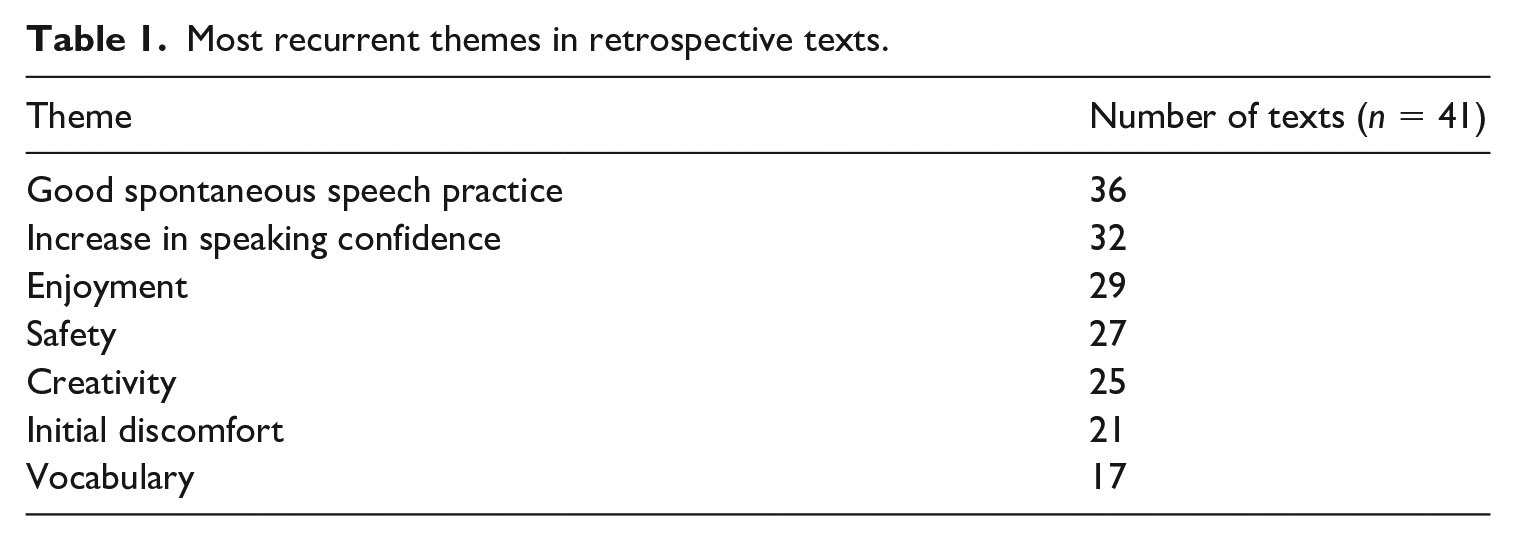
Findings for experiences for all participants (n = 41) are presented through the most recurrent themes per number of retrospective texts, as shown in Table 1.
Most recurrent themes in retrospective texts.
a Good spontaneous speech practice
Overall (in 88% of the texts) participants agreed that improvisation activities facilitate spontaneous speech practice. In most texts (61%), this approach was described as good to very good spontaneous speech practice for the following reasons:
The activities had easy rules with varied degrees of direction.
The activities had a good listening and speaking ratio.
We talked about many different things in different situations.
We increased efforts to vary words and sentences.
The activities encouraged us to talk.
The activities enabled everybody to participate, regardless of proficiency.
b Increase in speaking confidence
Most participants (78%) reported their speaking confidence clearly increased due to improvisation activities, for example, because ‘it’s been a long time since I spoke that much English, so to have these informal games boost my self-confidence and my fluency as well’ (P202). Participants described essential factors as enjoyment, familiarization with each other in various situations, and production of extensive spontaneous speech. They emphasized how increased speaking confidence produced a positive effect on their fluency: The activities have made me less afraid of making mistakes when I speak English, because most the activities have been very casual and funny, which has made me relaxed, and I have therefore gradually gained more confidence in speaking English. (P101) I would absolutely say that these activities have influenced both my fluency and self-confidence in spontaneous speech in a good way. I felt much more confident during the last activity compared to the first activity. (P310) I also think that you can forget a bit that you are in class, and just be focused on that you are doing a game or a fun activity with your friends. And by this you may feel freer to talk, you relax more and also I think you will become a better speaker in general by this. (P411)
Particularly in-service student teachers felt increasingly relaxed throughout sessions: When I learnt English at school, grammar was very important. You had to read, write and talk grammatical correct. It was also nothing, or a very small part we had to put away the book and talk spontaneous. I think it is from that time I am very afraid of saying something wrong and I have to think for a long time how to say it in the right way. To be a little bit shy is either not an advantage to do spontaneous speech in the class. Throughout this exercises I have learnt that it isn’t dangerous to do mistakes. Everybody does mistakes sometimes, and in oral communication you can find some other words to use or you can use the body language together with the words to be understood. (P208)
Although some participants stated they did not become more competent in oral proficiency, most participants reported that improvisation activities encouraged them to engage in talking.
c Enjoyment
Enjoyment was a common theme (71%) and the word fun was used 94 times. Some mention they were initially quite uncomfortable but became more confident because they enjoyed themselves. Misunderstandings caused participants to laugh collectively, making them more relaxed again. Another finding was the joy experienced through playful engagement of making stories together and playing a character, with enjoyment as reward: Usually I can get nervous if I am to speak on behalf of myself about something about myself, but when we were forced to ‘play’ characters we were both forced to speak about another topic, and once the laughter were out, we pretty much just wanted to keep talking because we wanted to have another laugh, and it didn’t feel uncomfortable or scary at all once we had started talking and once we had started to have fun with the activity. (P401)
d Safety
Two-thirds of participants reported safety as an important element of their positive experience. This atmosphere of safety was due to several features, such as working in small groups. Participant 415 explained that her favourite exercise was Dice Based Story because ‘we were in smaller groups which made me more comfortable to talk in front of students.’
Another benefit of this form of collaborative EFL learning was that all participants were engaged simultaneously either as speakers or listeners. Hence, when participants made a mistake, it is ‘only your partner that hears the mistake, not the whole class’ (P208). The teacher educator’s dual competence played a major role in creating the safe learning environment.
All these improvisations games worked fantastic for me. I felt that I became better in English after each gathering. Yes, all these exercises was useful for me, but attitude of my teacher was crucial. She made me feel safe and comfortable. These improvisations games will be not so effective if we not manage to make our pupils relaxed and feel comfortable. (P211)
A large proportion of the texts (41%) also mentioned mutual language support as a benefit of collaborative activities because they could give or receive help with FLL. Lastly, participants described they had reduced their fear of making mistakes, for example, P116 expressing ‘I do not feel like the other students are laughing at me when I’m talking, and I actually feel a bit mastery in that I participated’.
e Creativity
Participants mentioned creativity in connection with collaborative storytelling and dramatic creativity. They described how being creative makes room for imagination and fantasy. Participant 310 felt that she had increased her imagination to come up with a story. Creativity can lead to (re)discovering vocabulary: I feel like the exercises helped to develop my creative skills as well as my speaking skills. I had to come up with sentences that would contribute in the context to help the story and/or the game to move forwards. (P206)
Besides narrative creativity, many participants (37%) experienced taking on roles as both enjoyable and interesting. Embodying a higher or lower status enabled them to realize how feelings influenced characters’ language: I like this game (meeting) allot because I could talk freely about the subject that was chosen, but had a determent role. This game help me use my imagination to be someone else, that didn’t really talk about thing I usually do. This made it so that I use or say different things that had to do with the subject, but that the character says rather than me. It challenged my vocabulary allot, and made me be more comfortable talking about other things that I usually talk about. (P114)
Being in character engaged them and facilitated conversations: The Park bench was quite interesting because we got completely lost in character. I figured out his interest at once, but we kept talking in character. The conversation continued, and we sat there talking about his suspicion that his wife was cheating on him and so on. It was a natural flow to the conversation and we talked easily. It was an interesting turn and when we ended the conversation, we both sat there not completely understanding what happened. (P310)
Playing characters positively influenced their spontaneous speech, as mentioned regularly: Improvising and ‘playing characters’ makes speaking a little less dangerous, because all of the students has to do it, and all of the students has to participate in an unfamiliar role. This could for some people sound even scarier, but it seemed to be working well for making the environment in the classroom less ‘dangerous’. (P401)
f Initial discomfort
Despite overall enjoyable experiences, many participants (51%) began with some discomfort with in-service participants being overrepresented. Participants reported various explanations for the discomfort, from excitement of starting a new course to feeling uncomfortable about improvisation activities: I can admit to myself that when the class got informed of the things we were going to go through in TEFL, that I got a little scared. There was allot of talking about improvisation exercises, and acting. Something that quickly could be childish and become boring. Beside from that to also know that all these people in the classroom were strangers did not help that much either. So, before the day came I already didn’t like the idea of these improvisation exercises. (P114)
Most participants reported that initial nervousness disappeared once activities started, and improvisation activities helped them feel more relaxed as the same participant reports: It didn’t turn out to be that scary after all and it became fun to participate in these exercises. And because it felt like a safe place to practice, I started to try using different words and different ways of expressing myself. (P114)
Participants also emphasized that the timing (start of the semester) was beneficial to their speech practice: That week I was a little nervous, but at the same time it was very funny and I learned that I don’t have to be afraid to make a fool of myself. I eventually loosened up and I enjoyed myself. We had around an hour of the day with the activities and it made quite a difference for me. I feel safer in the classroom, I do not feel like the other students are laughing at me when I’m talking, and I actually feel a bit mastery in that I participated. I know this sounds a bit odd, but I have never liked unpredictable activities, as I have previously needed predictability in the classroom. (P116)
Although participants mostly described the sessions as good experiences, they felt they had been challenged. Challenges ranged from social issues (self-consciousness) to the challenges of unpredictability and risk-taking. Around 25% of participants expressed the challenge of spontaneous speech being to respond immediately after listening attentively: What I enjoyed most about it was the fact that I was able to do everything that the games asked for. I didn’t skip anything or not do anything. I’m actually quite surprised by myself at this point, because I did not fail. I was expecting to fail these exercises. Therefore, I’m quite happy with myself, and I have learned that I can do things like improvisation like I didn’t think I could do. (P312) So we had to respond to things as we were going. This made it impossible to plan ahead what we were going to say, because we always needed to think of a response as we were talking with the customer serviceman. (P401) Participants described how improvisation activities encouraged them to think and react quickly. Participants mentioned that activities prepare them for speaking in the real world because ‘in everyday life you have to listen and formulate a response on the spot’. (P113).
g Vocabulary
Improvisation activities challenged participants to apply a large range of vocabulary. For example, Customer Service extensively challenged participant vocabulary by having to describe the mystery object or problem: You had to talk around the item, describe it in a maybe unusual way and not even the easiest one either. I feel that my group was relaxed at this activity; we managed to use words we had not used before, and to come up with (as a service man/woman) good enough questions to guess in the end and help the poor customer. (P411) When we did the ‘man on the street’ and ‘customer service’ activities I felt like I got to explore and even expand a little on my vocabulary since we were put in scenarios and discussions where we usually wouldn’t find ourselves in on a regular day. So, we had to pick from a different vocabulary and use some rarely used words. (P412)
The need for a wide scope could present challenges, because participants had little time to find words in some activities, such as One Word Story, where they were forced ‘to come up with a reasonable response with very little time to prepare’ (P305).
2 Reluctant speakers’ views on improvisation activities
Some student teacher perspectives did not meet the 33% threshold for the recurrent themes despite their experiences as reluctant speakers being relevant for spontaneous speech practice and speaking confidence. This led to adding a research question and interviewing some participants during the second year of the study to explore reluctant speakers’ perspectives. The interview findings are presented per perceived degree of speaking reluctance, starting with very reluctant speakers:
a Very reluctant speakers
Two participants (P406 and P413) reacted very negatively to initial information about upcoming improvisation activities. They had been highly anxious about public speaking from an early age. Both participants feared being judged because of previously experiencing heavy criticism for making (foreign) language mistakes. Participant 406 visualizes conversations in advance, so she knows exactly what to say in daily life. Participant 413 described her speaking anxiety as a severe mental block, which becomes a physical manifestation such as brain freeze and stomach knots. This occurred when she was informed about improvisation: And that I have been, every time, like we talked about here too, criticized negatively, that there is no constructive criticism, just pure disapproval, almost bordering on bullying [yes] um, . . . in such activities in which you are roasted because you say something wrong – do something wrong; regardless whether the purpose of the activity is to make a fool of yourself or make mistakes or whether it is an activity in which you have a roleplay with dialogue [yes] so . . . my first thought was NO (laughs and breathes out heavily), simply NO! (calls out and laughs again) (P413)
Participant 413 used a first-person narrative when describing the current learning environment but regularly switched to the second person pronoun to describe past experiences.
Participants expressed that improvisation activities provided a complex, negative experience. Whilst improvisation activities provided both enjoyable and awkward experiences, they did not suit these very reluctant speakers. They completed some activities as quickly as possible to end their discomfort or volunteered to film instead of playing, described as a coping mechanism. Participant 413 expressed that Downton Abbey was extremely uncomfortable because she played a character who only received negative reactions. This triggered bad memories that made her feel so uncomfortable she could not think. Interestingly, playing the authoritative lady herself was also a bad experience which she could not remember until shown footage. Even though she knew all student teachers concentrated on their own activities, P413 believed everybody was only watching her. Sensations of scrutiny are a regular form of discomfort for both participants and align with the description of social anxiety disorder (American Psychiatric Association, 2008).
The improvisation activities caused some mental and physical stress for these very reluctant speakers. Participant 406 explained that her nervous laughter in the footage originated from being unable to express herself spontaneously, resulting in silly awkwardness. The laughter worsened the experience through a spiral of noticing discomfort, overthinking, and physically sensing discomfort, which again reinforced mental stress. In Customer Service, overthinking hindered P406 from expressing her interpretation through not trusting her own judgment. Having not experienced any mastery or enjoyment when the mystery was finally solved, P406 rather wanted to move on quickly to relieve stress symptoms. She acknowledged projecting failure and being laughed at. She realized these expectations are based on earlier experiences and not valid for the present context.
Both participants expressed a need for control. The dice pictures in Dice Based Story facilitated acceptance and elaboration: I: You said it became a bit easier, but then I wonder why? P406: For example, when I saw a picture of a bee I would think of a bee, then think of what the last person said and then I can kind of combine it. And while the others were talking, I would sit and look at the pictures to see which I can take when it is my turn [yes] which can fit into what has already been said.
This strategy of planning ahead proved challenging when other group members took the dice she had selected. When unable to continue the story well enough because of sudden changes (self-judgment), P406 lowered her voice because of dissatisfaction with her elaboration. She regularly experienced great discomfort, increased by observing her physical stress reactions. Similarly, P413 experienced great discomfort during Dice Based Story and One Word Story because the immediacy of storytelling increased their tension. When turn-taking altered from fixed order to random, P413 picked up two die consecutively and added two story elements to continue the storyline she imagined. Both participants preferred random storytelling turns which may be related to control issues.
Improvisation activities helped these very reluctant speakers feel more socially included, for example by being more daring within their small groups. While P406 stated that improvisation activities helped her social interactions, similar activities in a new group would negate these improvements due to a lack of established social safety. She strives to be liked and approved by others. Consequently, she fears saying something that may cause people to dislike her; hence, keeping silent is her defence mechanism. She had never conducted a conversation in English because of a lack of oral practice in and out of school. Although improvisation activities created some challenges, she concluded they provided good spontaneous speech practice. In her opinion, the social aspect was a core condition, because the group safety enabled her to engage in spontaneous speech. Her passive vocabulary was activated, and she improved her pronunciation skills through self-correction. Despite wishing to improve her public speaking, she cannot imagine enjoying spontaneous speech practice because the discomfort of the experience still outweighs its learning potential.
Participant 413 found it easier to talk to the other participants because the experience made her feel accepted. Her rumination was reduced which made it easier to speak. She believed that improvisation activities helped her because the playful approach enabled her to laugh at herself when making a mistake, and she then continued conversations without negative tension. She explained that speaking was still very uncomfortable because it entailed showing her vulnerability. However, she concluded that participation had been ‘alright’.
b Reluctant speakers
Four participants (301, 302, 312, and 415) described themselves as inhibited and shy. They had initial negative reactions because they felt improvisation was beyond their comfort zones. Two of them were also excited because of the teacher educator’s enthusiasm during the TEFL course introduction. During the first session, these participants experienced a sense of mastery in an initially uncomfortable situation. They explained that it was liberating to manage improvisation activities despite tensions, and mastery encouraged them to continue. Participants ultimately realized there was nothing to fear. For example, they experienced mastery in Man on the Street (session 2) because it forced them to speak with everybody in the classroom, a task they had believed impossible. Their need for preparation gradually decreased as they became increasingly comfortable with speaking spontaneously.
Overall experiences were described as intense, engaging, playful speech practice that changed their initial reluctance to speak spontaneously. Improvisation activities pushed them beyond their comfort zones. Participant P302 abandoned the previous need for pre-planned sentences before speaking, while P312 described the change as stretching a language muscle. Others mentioned taking more risks in language production, while P312 felt that repeated exposure to improvisation was essential for speaking more freely after sessions as well. This newfound freedom of speaking spontaneously provided more speaking confidence. In the last session, she experienced a desire to improvise without any worry, because she was committed to completing the improvisation activities. She considered this change an adaptation of self-perception, having assumed herself unable to improvise. However, when encouraged in a safe setting, she managed the activity and experienced mastery. Another participant described how she felt more able to open up: Well, I see a little bit of impro, activities like these, with a different perspective. It is like you almost become a totally different person. [yes] or you become somewhat like another person, trying to be a little funny, a bit, yeah, you play different roles. So I feel like um . . . how can I say this . . . you show your funny side, or I don’t know what to say, if you . . . [yes, I understand] yeah, that they see you as, not being serious all the time, that you are a nice person and you open a bit up, manage to open yourself up a bit. (P415)
Participants were so intensely engaged and immersed in the fictional world of the activities they forgot they had practised EFL. The reluctant speakers described the activities as very enjoyable and emphasized that humour was an important part of their positive experience.
Furthermore, safety and trust were important premises for these collaborative improvisation activities. Taking part in improvisation activities simultaneously in small groups reduced prior negative associations with spontaneous speech practice. Small groups enabled risk-taking and facilitated joint storytelling because the reluctant speakers felt less observed and trusted their group members. One group supported each other by choosing a mystery object with which P301 was familiar, another by passing on their turn to participants who had ideas for the ending of the story (P312).
These reluctant speakers experienced a sense of flow or being ‘in synch’ (P301) in the storytelling session. The flow was described as almost telepathic by P312, who illustrated how she developed attentive listening skills by projecting the story, acknowledging the actual offer (acceptance), and then contributing along the same storyline (elaboration): Well, when you listen to what she has to say, you understand like, oh okay, so thát is where you want to go. Then you must facilitate or adapt accordingly . . . maybe play the ball over to them as well. Then they get what they ask for and then you must say that in a way, enabling . . . that you have something to say that is related to what they just said. (P312)
When P312 was caught by a surprise contribution, she managed to continue the collaborative story, which again strengthened her speaking confidence. Together with other participants, she took responsibility for the content. The reluctant speakers experienced that an important element of improvisation activities was being forced to speak spontaneously without waiting or preparation time: It is like when there is no space for being shy, because there is none in such activities where you just have to speak, you have to speak to keep the activity going, and for me that helped me realize that it perhaps is not so dangerous to talk. (P301)
The time pressure of improvisation activities decreased their speaking reluctance.
Improvisation activities were excellent spontaneous speech practice for diverse everyday situations. Their speaking skills improved because they tried to search for the right words and language register when in character, for example in Man on the Street and Downton Abbey. P312 became more secure in speaking English, daring to speak without rehearsing, and has become more active in both English and Norwegian unprepared speech. In her opinion, regular oral speech practice would not have provided the challenges or resulted in the changed mindset that she experienced. She concluded the approach was more essential than the content, and the improvisation methodology should be part of the TEd courses: And I think improvisation should be -maybe not last year- because it would not fit in with tree diagrams and such, but it should be included in this education (. . .). Because it may happen that everybody sees the light like I did. And that is a possibility we cannot miss, I think. So it was very useful for me. And I don’t know if others are of the same opinion but it helped me very much and it is very good if it can help people to become more confident. (P312)
The overall findings support the concept that in this article is coined as the spontaneous speech mindset. Although participants were unsure of the long-term effect of the changes they have experienced, some plan to initiate more spontaneous speech themselves.
V Discussion
First, the findings are discussed in light of Berk and Trieber’s (2009) didactic arguments before discussing the concept of spontaneous speech mindset and its emergence in the reluctant speakers’ experiences.
1 Didactic arguments revisited
The improvisation activities were relatively learner-centred because participants were responsible for completing the actual content together. Such an approach suits modern language teaching methodology with its focus on empowerment of the learner and communicative competences. For example, Customer Service and Park Bench contained an information gap so participants had to paraphrase to close the gap, thereby practising attentive listening (CIP4) and negotiating meaning (Savignon, 2018) which is important in communicative competence (Richards, 2006).
The findings confirm improvisation activities are attuned with several intelligences and related to Gallagher’s point of embodiment (2010). Any interpersonal communication displays relations and status (CIP3) (Coppens, 2002), which is partly expressed through paralinguistic cues. Practising FL speaking includes the use of paralinguistic cues such as facial expressions, gestures, and other forms of nonverbal communication (Stinson, 2008). In addition, participants were stimulated to apply a variety of language registers naturally through embodiment of the role, such as polite language required from servants. Participants described how playing characters provided space for practising diverse spontaneous speech through creativity (Sawyer, 2003; Winston & Stinson, 2011).
Finally, the findings support the notion of collaborative learning as supported by acceptance and elaboration (CIP1). One common explanation for decreasing the fear of making mistakes was enjoyment. Enjoyment appears to reduce psychological risk and support spontaneity (CIP2). Participants described enjoyment, improved interpersonal relationships, and copious spontaneous speech as essential factors in improvisation sessions, which contributed to increased speaking confidence.
2 Spontaneous speech mindset
In essence, the overall findings could be described as an enjoyable spontaneous speech experience that enabled an increase in EFL speaking confidence. The findings confirmed Stern’s hypothesis (1980) that certain psychological factors were triggered, rendering participants more flexible and empowered. Improvisation activities created safe environments for spontaneous speech practice, which has been described as a positive atmosphere of openness and trust encouraged by mutual support (Schwenke et al., 2020). Improvisation activities challenged participants’ oral proficiency in diverse situations. This resulted in exploration of their linguistic and creative boundaries, hereby coined a ‘spontaneous speech mindset’, as illustrated in Figure 2 below.
Participant experiences can be interpreted as a continuous circular process, with enjoyment as the main facilitating component for reaching the spontaneous speech mindset. When their language contributions were accepted without judgment (CIP1), participants relaxed in the safety of the spontaneous speech practice (CIP2). As they became more comfortable, their speaking confidence could develop. This led to more risk-taking (CIP2) in speech, an expression of empowerment. Consequently, their speech became more fluent and varied. They experienced mastery, increasing their enjoyment of improvisation activities. If participants failed to communicate spontaneously, most still enjoyed themselves because improvisation activities were non-judgmental and playful with room for failure. The circle would be repeated and every time a speaker experienced enjoyment, their spontaneous speech mindset could increase, creating a window of opportunity (Kurtz, 2015). The narrative creativity of improvisation activities (CIP1) stimulated participant imagination. This challenged their language beyond everyday speech and inspired the rediscovery of imaginative response (Johnstone, 1981). Participants explored their creativity (CIP3) when in character, surprising themselves by applying different language styles in their adapted roles. They were absorbed by making meaning in collaborative stories (CIP4), with some reaching a level of ‘flow’ (Csikszentmihalyi, 2008), enhancing their unselfconsciousness. Improvisation activities supported and contextualized their spontaneous speech, as participants were expected to attempt new behaviour and stretch their competency base (Crossan, 1998). Participants accessed their different sides, coped with unpredictable situations, and (re)discovered more words and phrases by accessing their playful imagination.
3 Reluctant speaker experiences
Reluctant speaker experiences varied and laughter turned out to express both stress and enjoyment (Figure 1). Very reluctant speakers experienced a rather vicious circle of stress due to the unpredictability of improvisation activities. The immediacy of spontaneous storytelling and its inherent lack of control was experienced as a threat that hindered acceptance and elaboration (CIP1). Consequently, very reluctant speakers preferred random turn-taking in storytelling which provided more creative freedom to contribute immediately when an idea arose and re-established some control of the storyline. Discomfort was also expressed by switching pronouns during the interview, possibly indicating a need to distance herself from emotions. Despite factual knowledge about the present situation being safe, their anxious thoughts from earlier experiences overpowered them.
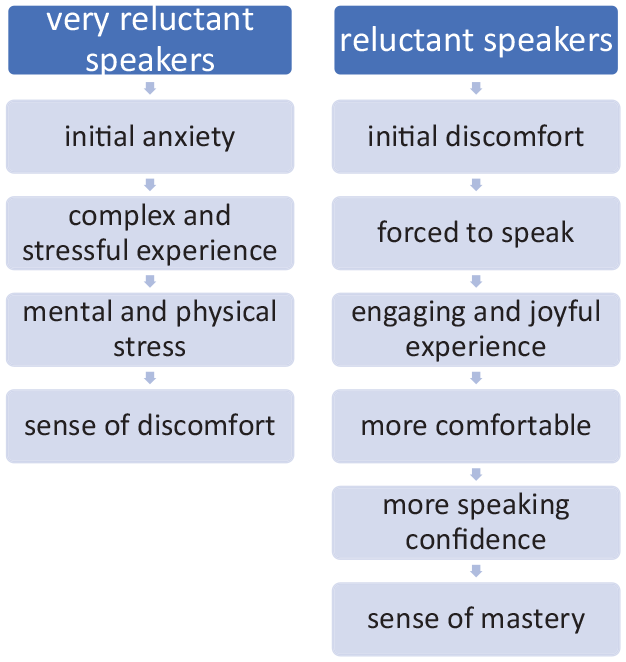
Interview findings.
Undeniably, the improvisation experiences were influenced by projections of former judgment. This sense of discomfort may have prevented the enjoyment required for relaxing into a spontaneous speech mindset. The short time frame of the sessions may have been a limitation for very reluctant speakers. They might benefit from improvisation exposure over a longer time (Seppänen et al., 2019) or when provided as part of professional group therapy (Phillips Sheesley et al., 2016).
Conversely, other reluctant speakers experienced a victorious circle of enjoyment because they reached the spontaneous speech mindset (Figure 2). Repeated exposure to the enjoyment of improvisation activities decreased their need for preparation and increased their spontaneous speech mindset. Being forced to speak unprepared overruled their discomfort because they wanted to contribute to the content of the improvisation activities. The increasing difficulty of sessions was beneficial for developing their speaking confidence. Reluctant speakers realized they had mastered something beyond their learner belief, which strengthened their speaking confidence. They redefined spontaneous speech tension as excitement which enabled them to reappraise assumed negative expectations and reduce their stress response, leading to reduced speaking anxiety (Piazzoli, 2011; Seppänen et al., 2019).
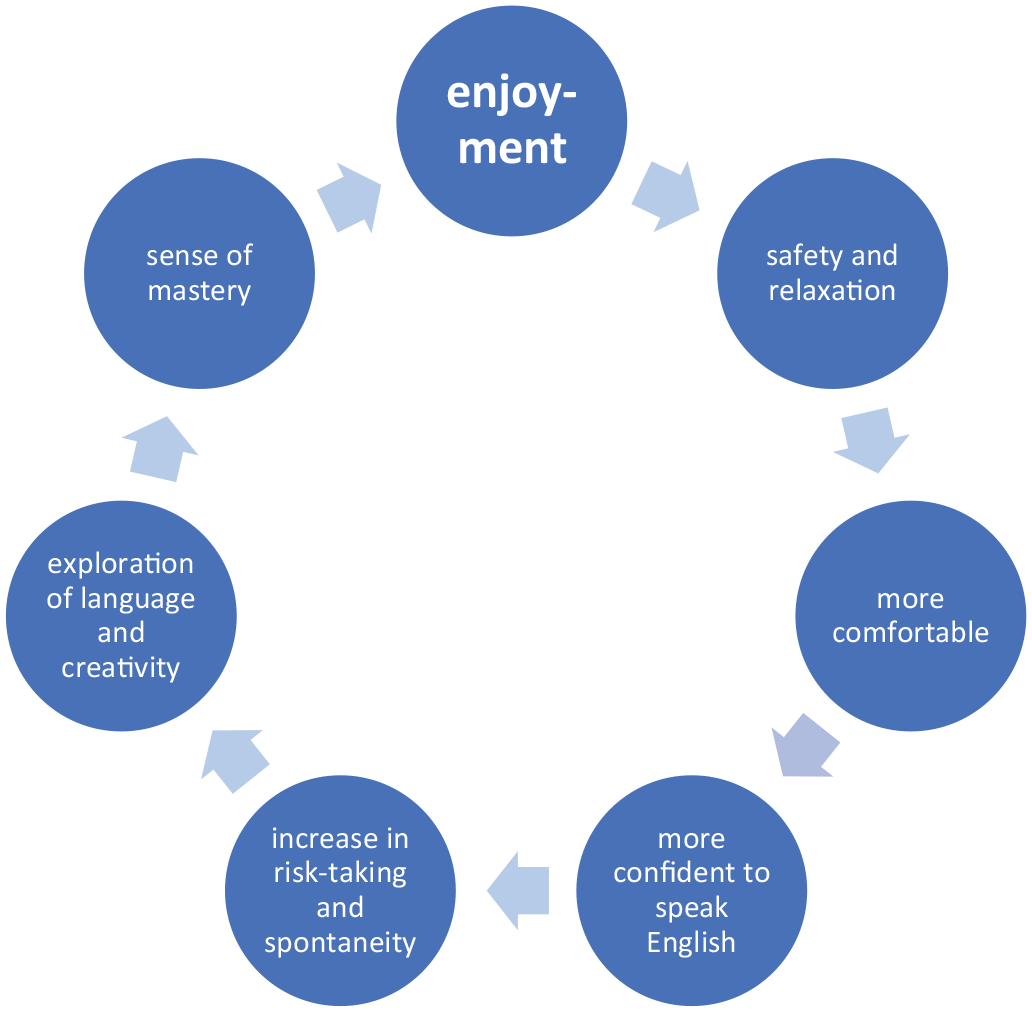
Spontaneous speech mindset.
4 Pedagogical reflections
Creating an atmosphere of safety is vital for improvisation and FLL methodology. Participants pointed at safety and trust as essential conditions for their positive experience. Sessions were deliberately held at the beginning of courses, ensuring participants could benefit most from the improvisation activities. Naturally, many participants were insecure, especially in-service student teachers whose transition from teacher to student may have created additional insecurity. As in any method, one cannot assume improvisation activities are enjoyable for all EFL learners. Seppänen et al. (2019) point out that incorporating improvisation methodology in TEd curricula could enhance student teachers’ social interaction skills. One may wonder whether the level of speaking anxiety from very reluctant speakers may be so debilitative that it is beyond EFL teachers’ professional competence and responsibility to manage in a natural classroom setting. The reluctant speakers indicated, however, that inclusion in playful collaborative activities is more beneficial than exclusion from social contexts through individual tasks. The reluctant speakers emphasized the importance of regularly leaving their comfort zones in EFL.
Improvisation activities facilitated excellent spontaneous speech practice in EFL TEd, enabled by the unpredictable characteristics of authentic speech. Attentive listening attuned participants to collaborative storylines and enjoyment supported taking risks in small groups. The improvisation activities attended to the process (spontaneous speech practice) rather than the end product (linguistic gain). This spontaneous speech mindset could be regarded as a facilitative mindset for speaking spontaneously (Mercer & Dörnyei, 2020). TEd should provide student teachers with methodological approaches for supporting EFL speakers in an inclusive spontaneous speech practice.
Due to the teacher educator’s dual competence as improviser and teacher, improvisation activities contributed to creating a safe learning environment, facilitating spontaneous speech practice. The playful atmosphere enabled participants to further explore their oral proficiency. Ultimately, the study relied on a combination of professional knowledge as an improvisation instructor and an EFL teacher educator.
VI Conclusions
In this study, application of improvisation activities in TEd was investigated and found to provide excellent practice for EFL spontaneous speech. Enjoyment through improvisation activities facilitated non-judgmental spontaneous speech, enabling participants to explore linguistic and creative boundaries, contributing to their speaking confidence. While FLL research has mainly focused on negative emotions (Dewaele & MacIntyre, 2014), FL speech practice has both shadow (speaking anxiety or reluctance) and light (speaking confidence) sides. The spontaneous speech mindset can be regarded as a manifestation of the light side and enables learners to further develop their spontaneous speech proficiency. Spontaneity liberates people (Spolin, 1983).
While the study cannot predict how long the effects will last, an interesting finding was that some reluctant speakers indicated changes in learner belief. They enjoyed improvisation activities which decreased their need for preparation and increased their spontaneous speech mindset. The greater the enjoyment, the greater the engagement, and the easier it was to speak English. They reappraised their sense of discomfort as excitement and achieved mastery. Through improvisation, learners experiment with language rather than reproduce scripted speech (Galante & Thomson, 2017), which suits FLL risk-taking encouraged by Dörnyei (1995). Improvisation activities based on central improvisation principles (CIPs) are highly recommended as a suitable method for spontaneous speech practice in EFL TEd, provided teacher educators have adequate improvisation competence to create a safe practice.
