




Abstract
While interest in the learning of a language other than English (LOTE) has increased, research on how to foster learners’ motivation towards learning a LOTE is still scarce. With a specific focus on learners’ ideal LOTE and multilingual selves, this article reports on an intervention study which employed near peer role model (NPRM) to construct Chinese undergraduates’ LOTE learning motivation. The research aim was to explore the role of the near peer role modeling in nurturing the development of the LOTE-related facets of learners’ ideal selves. Open questionnaires, interviews and written journals were used to collect data at one Chinese university over the course of one academic term. Findings provide context-dependent evidence that the presentation of NPRMs in class may strengthen both of learners’ ideal LOTE and their multilingual selves, mainly because it demonstrates approachable examples which manifest the value of learning a LOTE in a particular social context. With the help of the NPRMs, learners may not only alleviate their ambiguity about the availability of LOTE-using opportunities in their situated contexts but also deepen their understanding of how ‘being multilingual’ could benefit their future development. Pedagogical implications emphasize the effectiveness of near peer role modeling in developing learners’ self-identification with being a LOTE user or a multilingual in the future.
Keywords
I Introduction
Motivation towards learning languages other than English (LOTE) has emerged as a subject of much attention in the field of language learning and teaching (e.g. Busse, 2013; Henry, 2010, 2011, 2017; Lanvers, 2016; Ushioda, 2017). Concerns have been raised with respect to LOTE learners’ ambiguity about the value of learning a LOTE and the decline of their LOTE learning motivation, in particular, the LOTE-related facets of their ideal selves (Gabrys-Barker, 2011; Henry, 2011; Ushioda, 2017). Specifically, while ideal language self (learners’ aspirations of using the target language in the future) has been revealed to be an essential constituent of language motivation (Dörnyei, 2009; Dörnyei et al., 2006), studies on LOTE learning have suggested learners’ tendency to lose interest in their ideal LOTE selves in the course of learning (Henry, 2011; Wang & Liu, 2020). Moreover, apart from focusing on learners’ desire to speak a specific language in the future, researchers (Henry, 2017; Ushioda, 2017) have also identified ideal multilingual self (individuals’ eagerness to expand their holistic linguistic repertoire) as another important part of LOTE learning motivation. Empirical studies (Wang & Zheng, 2019; Zheng, et al., 2019), however, suggested that this motivational construct was not widely entertained by LOTE learners.
Despite these motivational challenges for LOTE learners, research on how to support them to develop ideal LOTE and multilingual selves is still limited. In order to address this research gap, this article reports on a motivational intervention which aimed to cultivate undergraduate LOTE learners’ aspirations of being a LOTE user or a multilingual in the future. Specifically, to strengthen learners’ positive attitudes towards LOTE learning, this study integrated the presentation of near peer role model (NPRM) (Murphey, 1996, 1998) into the intervention as an attempt to help learners contextualize the value of learning a LOTE. Notably, although the influence of role models on shaping individuals’ beliefs and values has been widely explored in the literature, how they affect language learners is relatively under-researched (Muir et al., 2019). Hence, a study on the role of NPRMs in constructing learners’ ideal language selves can also address the paucity of research in this respect.
This study was situated in China. While English occupies a predominant role in its foreign language education, this country has witnessed increasing efforts to promote the learning of other foreign languages (FL) in recent years (Gao & Zheng, 2019). It is noted that as a small-scale qualitative study, this research was exploratory in nature. The focus of the research was to explore to what extent and in what way near peer modeling might facilitate the construction of learners’ ideal LOTE and multilingual selves.
II Literature review
1 The underdevelopment of LOTE learners’ ideal LOTE and multilingual selves
A review of the literature revealed that one major barrier to the development of individuals’ LOTE learning motivation is the weakening or even disappearance of their ideal LOTE and multilingual selves in the course of learning (Henry, 2011; Wang & Liu, 2020). The underlying reasons can be twofold, namely, learners’ narrow focus on the instrumentality of language learning and their limited exposure to the LOTE in their situated context. First, as Ushioda argued (2017), the surging instrumental value of learning English during the past decades prompts individuals to perceive language learning as an investment in social and economic mobility. Empirical studies also showed that learners’ LOTE learning motivation is primarily associated with their desire to attain competitive advantages in the global market (Siridetkoon & Dewaele, 2018). The perceived economic potential of a LOTE, nevertheless, seems to be less obvious than that of English. In China, for example, the employment environment for students attaining non-English language degrees can be worrying. As Han et al.’s (2019) study revealed, only half of them could sign confirmed employment contracts upon graduation. This situation easily leads to learners’ failure to recognize the relevance of learning a LOTE and to their disillusion with their ideal LOTE selves (Wang & Liu, 2020). In addition, the overemphasis on the pragmatic benefits of LOTE learning may also render learners blind to the role of language learning in expanding their holistic linguistic repertoire, which undermines the development of their multilingual selves (Ushioda, 2017). Admittedly, a few empirical studies (Oakes, 2013) found that some learners appreciated the role of LOTE learning in consolidating their multilingual competence. Other research (Wang & Zheng, 2019), nevertheless, demonstrated that this multilingual orientation has not been widely shared among LOTE learners.
Another reason that restricts learners’ potential from fully exploring the value of LOTE learning is their limited contact with this language during the process of learning. In Wang and Liu’ (2020) study, for example, Chinese learners of German were found to have little exposure to the LOTE beyond institutional learning contexts, which exacerbated their difficulty in developing their ideal German selves. Notably, although the lack of language experiences has also been found to be an obstacle to the construction of learners’ ideal English selves (Lamb, 2013), this issue may be more obtrusive in the case of LOTE learning. Unlike the prevalent influence of English around the globe (Graddol, 2006), the perceived value of LOTEs varies significantly in different contexts (Dörnyei & Al-Hoorie, 2017). Therefore, without enough LOTE experiences in the course of learning, learners are likely to undervalue the learning of this language in their situated contexts. The crux of developing learners’ ideal LOTE and multilingual selves, hence, may reside in enriching their imaginative experiences of context-specific scenarios in which the LOTE plays an important role.
2 Existing classroom interventions on constructing learners’ ideal language selves
Given the importance of ideal language selves in shaping language learning motivation, efforts have been made to explore how classroom interventions can expand learners’ imaginations of using the target language in the future (Chan, 2014; Dörnyei & Kubanyiova, 2014; Fukada et al., 2011; Hadfield & Dörnyei, 2013; Mackay, 2014; Magid, 2014; Safdari, 2019; Sampson, 2012). In these interventions, learners were guided by teachers or researchers to recognize the benefits of visualizing their future selves, construct realistic visions of a language-related future, and increase confidence in their ability to realize these ideal selves. However, although these innovations were found to strengthen learners’ ideal language selves, the majority of them were located in the English-learning contexts (Chan, 2014; Fukada et al., 2011; Mackay, 2014; Magid, 2014; Safdari, 2019; Sampson, 2012). In light of the differences between English and LOTE motivation, these interventions might not be easily transferred to a LOTE class.
One significant difference between English and LOTE learning, as mentioned above, is individuals’ ambiguous attitudes towards the importance of learning LOTEs compared to those associated with English learning. Therefore, while English-oriented motivational interventions mainly focused on constructing concrete ideal English selves (Chan, 2014; Mackay, 2014; Magid, 2014; Sampson, 2012), the LOTE-oriented interventions need to dispel learners’ doubt about the availability of LOTE-related opportunities in their situated contexts. Hence, to construct learners’ ideal LOTE and multilingual selves, affordances which provide contextualized evidence of the value of learning a LOTE can be essential. Admittedly, previous studies also adopted imagery scripts, which were designed by researchers and depicted vivid English-using scenarios, to expand learners’ imagination of English-using situations (Chan, 2014; Mackay, 2014). However, these scripts, though rich in detail, were not real-life examples which could manifest the influence of the language in a specific social context. Therefore, how to develop LOTE-related motivational intervention awaits further research.
3 Using NPRMs to construct learners’ ideal LOTE and multilingual selves
In this study, ‘near peer role model’ was employed as a potentially effective affordance to nurture the development of learners’ ideal LOTE and multilingual selves. This concept was proposed by Murphey (1996, 1998) and refers to ‘peers who are close to our social, professional and/or age level who for some reason we may respect and admire’ (Murphey, 1998, p. 201). The motivating power of NPRMs, according to Murphey and Arao (2001), is situated in that they provide individuals with approachable real-life models and increase their willingness and confidence to perform in a similar way. Since LOTE learners need context-specific examples to recognize the value of learning a LOTE, these models can be especially useful in the construction of ideal LOTE and multilingual selves.
First, the LOTE-using experiences of NPRMs can contribute to the development learners’ ideal LOTE selves. Specifically, the NPRMs may increase learners’ awareness of how being a LOTE user can benefit their future. As Yashima (2009) argued, compared to native speakers who are far-removed from learners’ situated contexts, NPRMs show more accessible examples of how language learning may improve their future lives. In particular, as the LOTE-related opportunities differ significantly across regions (Dörnyei & Al-Hoorie, 2017), the NPRMs can be essential in exemplifying the influence of a LOTE in learners’ situated contexts. Moreover, the NPRMs’ achievements may also boost LOTE learners’ confidence pertaining to realizing their ideal LOTE selves. As Bandura (1997) suggests, individuals can strengthen their self-efficacy beliefs when they observe people who resemble them achieve success. Busse’s (2013) study also showed that the success of near peers, such as siblings, could enhance LOTE learners’ confidence towards using the LOTE in the future.
Moreover, near peer modeling may also be conducive to constructing learners’ ideal multilingual selves. According to Henry (2017), ideal multilingual selves are positioned at a higher cognitive level than ideal language-specific selves. Such high-level construals, based on construal-level theory (Trope & Liberman, 2010), is highly abstract, as it only embodies ‘the essential, core (i.e. gist) aspects of the objects or events’ and ignores situation-specific details (Fujita et al., 2015, p. 405). Therefore, when strengthening learners’ desire to be multilingual, the difficulty resides in how to help them capture the ‘abstractness’ and identify with the value of multilingualism. One important step can be shifting learners’ focus from the instrumentality of a specific LOTE to the role of language learning in expanding their holistic linguistic repertoire. Such mulitlingual awareness, according to Fisher et al. (2018), needs to be nurtured by explicit guidances in the classroom. The NPRMs, in this respect, may provide LOTE learners with real-life examples of how multiple languages are positively interrelated to benefit individuals’ linguistic and cultural development. Moreover, as previous research (Liddicoat & Curnow, 2014; Stavans & Hoffmann, 2015) revealed, LOTE learners may associate multilingualism with elitism. The exemplary near peer multilingual experiences, from this perspective, can also help learners reject the myth of ‘elite multilingualism’ (Stavans & Hoffmann, 2015, p. 113) and recognize the relation between being multilingual and their personal development.
Notably, although the potential effect of role models on influencing language learning motivation has been underscored in previous literature (Muir et al., 2019), research in this aspect remains largely in the periphery. A study which explores the influence of near peer modeling on LOTE learning can therefore be necessary. Being exploratory in nature, this study aimed to examine whether the presentation of NPRMs could facilitate learners’ construction of ideal LOTE and multilingual selves. Two research questions were raised accordingly:
To what extent did the presentation of NPRMs facilitate the development of learners’ ideal LOTE and multilingual selves?
In what ways did this activity impact on the construction of learners’ ideal and multilingual selves?
III Methodology
1 Research context and participants
This intervention study explored the role that near peer role modeling played in constructing Chinese learners’ ideal LOTE and multilingual selves. In China, English is widely learnt as the dominant FL, but the government is also working to improve the status of other FLs. Specifically, in China, English has been listed as a compulsory course in the secondary and tertiary education since 1980s (Gao & Zheng, 2019), and among all the Chinese FL learners, 93.8% learnt it as the only FL (Wei & Su, 2012). Despite the predominance of English in the FL education, however, China is also endeavored to promote the learning of non-English FLs in recent years. For example, more universities began to provide LOTE degree programs and undergraduates are encouraged to learn a LOTE (Gao & Zheng, 2019). This study was conducted in a state university in eastern China and specifically focused on English major students who were required to learn a LOTE.
French was selected as the target language, as it is a popular LOTE in China (Wei & Su, 2012), and was widely chosen by English majors in the target university. Notably, although French is also a global language, it is still a much lesser-learnt FL in China, compared to English. It is until 2018 that French has been officially added to secondary school curriculum (Ministry of Education, 2017), and the amount of French learners in China is far smaller than that of English learners (Wei & Su, 2012). Empirical studies also suggested that the instrumentality of French is perceived as lower than that of English in Asia (Huang, 2019). Therefore, a look at French could to some extent reflect individuals’ motivation towards learning a LOTE in China.
The whole French class (17 learners in total) agreed to participate in the study, including joining in the intervention activities and filling out three rounds of open questionnaires. Notably, this study was part of a larger PhD project which investigated the motivational trajectories of Chinese undergraduate learners of a LOTE. In a round of questionnaires administered before the implementation of this intervention study, these participants were asked to describe their LOTE motivation in detail. Data from the questionnaires revealed that while all the participants regarded the necessity to meet course requirements as a part of their motivation, eleven of them reported a desire to integrate French into their future lives. However, only three of them could clearly describe their ideal LOTE or multilingual selves, whereas the others showed doubt over whether and how French could benefit their future development. This finding underscored the necessity to help these learners construct their ideal LOTE-related selves.
Moreover, seven learners showed willingness to take part in the follow-up interviews and journal writing, so all of them were selected. The motivational profiles of these seven participants covered a wide spectrum. Based on the questionnaires administered before the intervention, two of them developed both ideal LOTE and multilingual selves, three aspired to become a LOTE user but were unsure about how to realize their ambitions, and two showed little interest in speaking French in the future. All the participants were at the beginning stage of their French learning when the intervention started, as they had learnt French for less than ten months.
2 The motivational intervention
The intervention was intended to integrate near peer modeling into the construction of learners’ ideal LOTE and multilingual selves and was divided into three parts which spread over one academic term. First, learners were given instructions to visualize themselves as a LOTE user or a multilingual. Subsequently, the LOTE learning and using experiences of ten NPRMs were displayed in class. In the last part, participants were encouraged to re-imagine the possible roles of the LOTE in their future.
Part I: Visualizing ideal LOTE and multilingual selves
The first part of the intervention focused on stimulating learners to visualize their ideal LOTE or multilingual selves. The aim of this session was to help learners envision and reflect on the LOTE-related facets of their ideal selves before the presentation of the NPRMs. Specifically, participants were, first, introduced to the concept of ideal language self and how it could increase their learning motivation. As revealed in Chan’s (2014) study, this activity can be essential in optimizing the effect of the interventions that construct learners’ ideal selves. Subsequently, participants were asked to close their eyes and visualize the situations in which the LOTE would positively influence their future lives, for example, in the domains of work, family, community or lifestyles (approximately 15 minutes). Learners were then given another 15 minutes to discuss their thoughts with their classmates. Lastly, to help learners articulate their ideal language selves and gather relevant data, open questionnaires (the Pre-NPRM Questionnaire) were administered, in which participants were asked to answer the following question: Please take some time to imagine your ideal future after learning French. What are you doing, how do you feel, and what role does French play in your life?
The completed questionnaires were collected at the end of this session for further analysis.
Part II: Introducing NPRMs into the LOTE class
In this part, the stories of ten already graduated students who had learnt a LOTE and used it in their lives were introduced in class. The teacher was consulted during the selection of the ten NPRMs. Specifically, all of them were non-LOTE major students and had begun to learn the LOTE from their undergraduate years. They had received their education in China and graduated from the college within six years. In other words, the NPRMs were situated in similar learning contexts to that of the participants. Before the intervention, the researcher had interviewed all of them about their past LOTE-learning and using experiences. The interview was guided by three overarching questions, namely, ‘What role does the LOTE play in your life?’, ‘Could you say something about your past LOTE-learning and using experiences’, and ‘Could you reflect on these experiences?’ The NPRMs were also asked to select 4-5 photos which exemplified their LOTE using experiences (e.g. communicating with French native speakers). Their stories were later presented in the form of a PowerPoint presentation. In the PowerPoint, each NPRM’s story was summarized in 5-7 slides. The first two slides introduced the NPRM’s general background (i.e. educational and career background) and LOTE learning trajectory (e.g. the length of learning and perceived proficiency level). The rest of slides focused on the NPRM’s descriptions of and reflections on the LOTE learning and using experiences, in which the NPRM’s own words from the interviews were used. Photos collected from the NPRMs were also inserted into the slides to enhance the vividness and credibility of their stories.
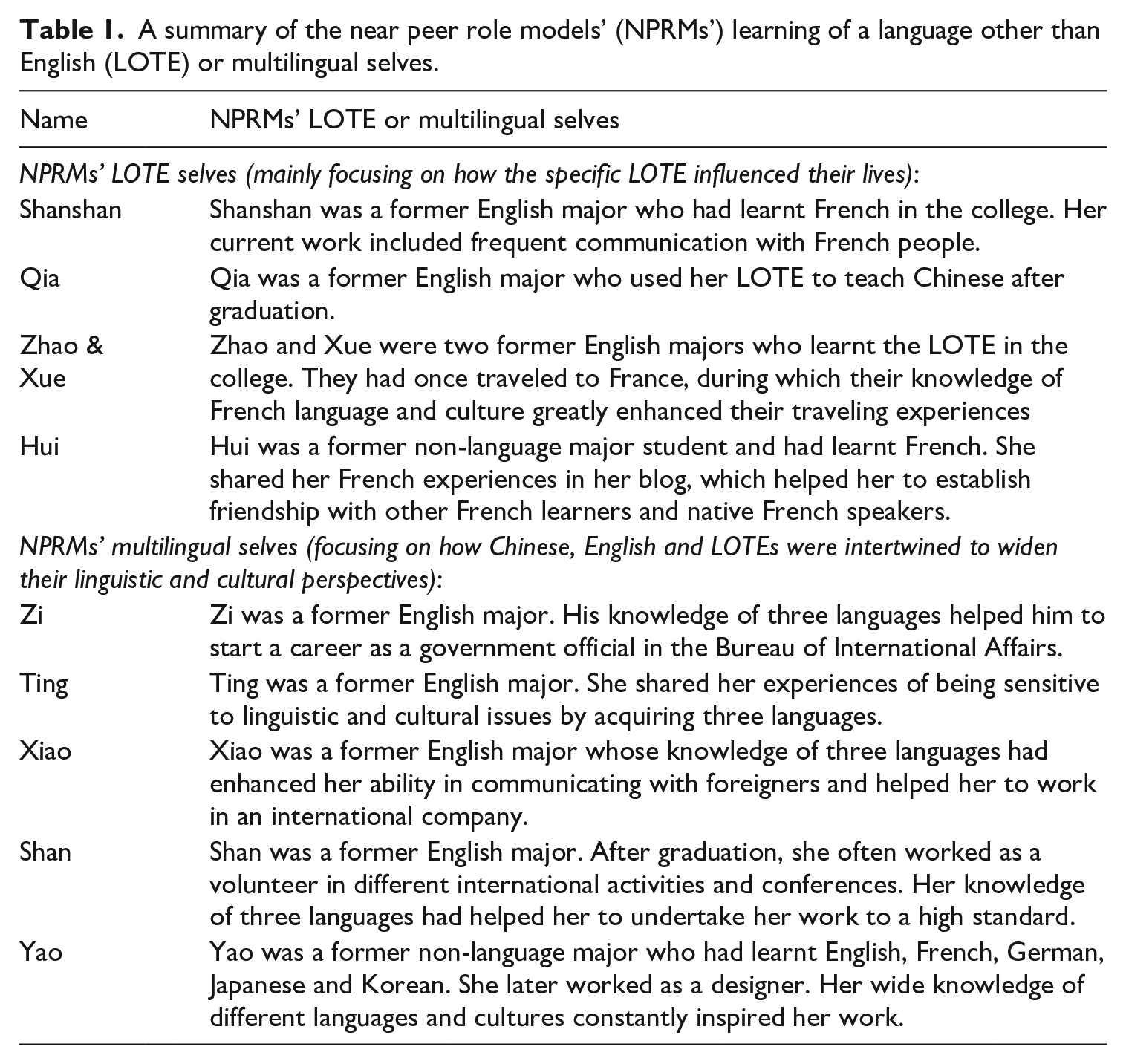
Notably, to help learners fully explore the value of learning a LOTE, the researcher looked not only for NPRMs who developed LOTE-specific selves but also for those who accumulated multilingual experiences. Specifically, five of the NPRMs addressed how the specific LOTE influenced their personal trajectories, while the others reported how their knowledge of three, or even more, languages (Chinese, English and LOTEs) enriched their lives. Table 1 summarizes these NPRMs’ experiences.
A summary of the near peer role models’ (NPRMs’) learning of a language other than English (LOTE) or multilingual selves.
With respect to the organization of this session, learners were, first, asked to reflect on how the LOTE might change their future for roughly five minutes. Subsequently, the NPRMs’ LOTE learning and using experiences were introduced by the researcher, with the help of the PowerPoint slides (approximately 50 minutes). After being introduced to these examples, participants were encouraged to think about the inspirations they gained from this session and discussed with their classmates.
Part III: Consolidating learners’ ideal LOTE and multilingual selves
In the last session, participants were again asked to imagine in what way the LOTE could influence their future lives. It should be mentioned that this session was organized one month after the second session in order to give participants enough time to internalize what they had learnt from the NPRMs. Open questionnaires (the Post-NPRM Questionnaire), which were the same as those used in the first session, were administered again, and learners were given time to rewrite their ideal language selves. The questionnaires were again collected for analysis.
3 Research methods
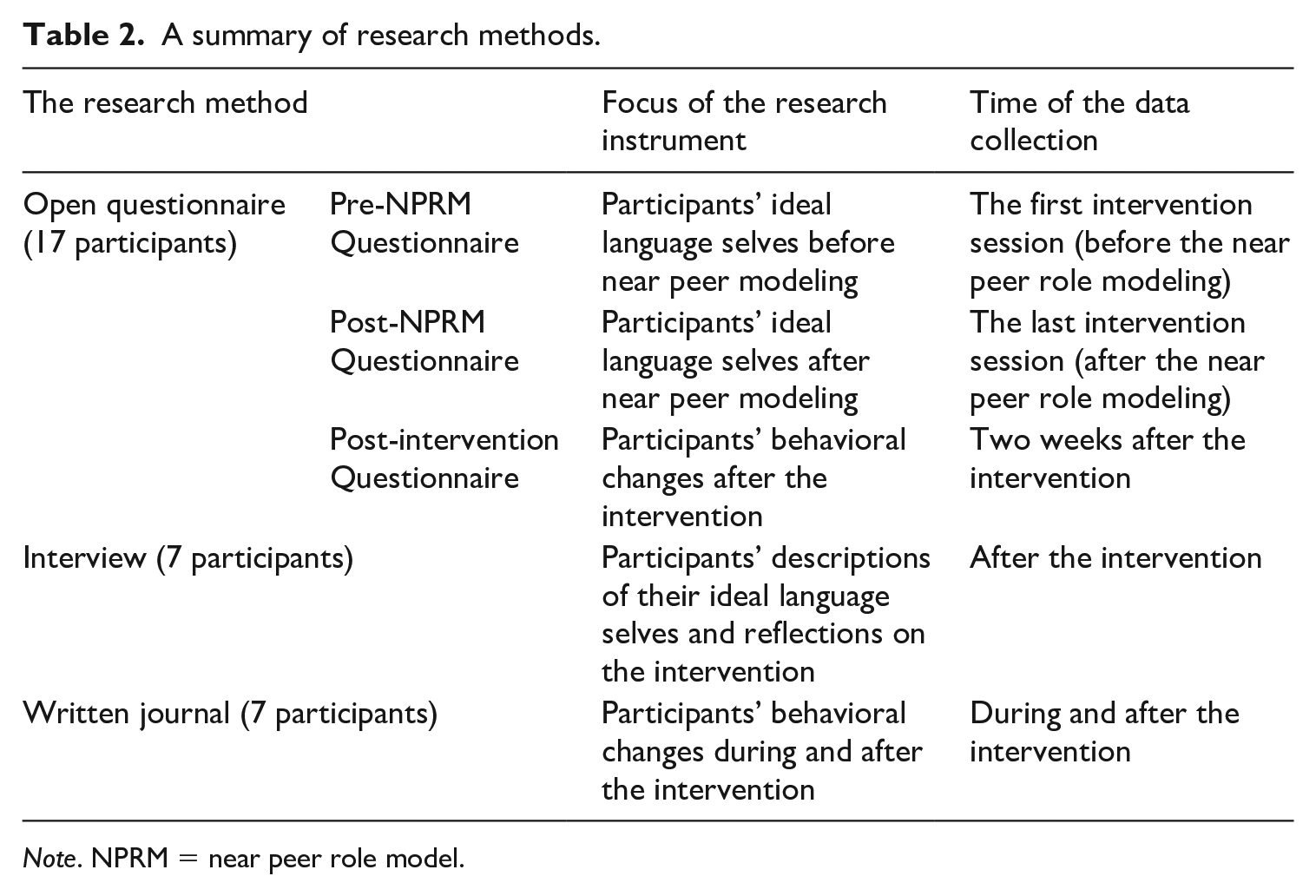
Open questionnaires, interviews and written journals were adopted to explore the effect of near peer modeling on the construction of learners’ ideal LOTE and multilingual selves. First, as mentioned before, two rounds of open questionnaires (the Pre-NPRM and Post-NPRM Questionnaire) were delivered to participants (17 in total) in the first and last session (before and after the near peer modeling respectively) of the intervention. Learners were asked to describe their imaginations of how the LOTE would influence their future lives. Data collected from the two rounds of questionnaires were compared to investigate the extent to which participants’ ideal LOTE and multilingual selves changed after the introduction of NPRMs. Another round of open questionnaires (the Post-intervention Questionnaire) were administered to participants two weeks after all the intervention sessions, in which participants were asked to report their recent French learning behaviors and whether any changes took place. Since motivated behaviors constitute an integral part of motivation (Dörnyei & Ushioda, 2011), the records of learners’ learning behaviors could be an important indicator of their possible motivational changes after the intervention.
This method was selected because it gave participants room to describe their idiosyncratic thoughts, which could help to reveal the complexity of their ideal language selves and motivated behaviors. Data collected from the open questionnaires were transcribed and coded with the assistance of NVivo 11. Open coding was conducted at the beginning stage, followed by grouping and categorization of initial codes. The codes were then compared with existing research to generate major themes which guided further analysis. As for data collected from the Pre-NPRM and Post-NPRM Questionnaire, three overarching themes emerged, namely, the content of learners’ ideal LOTE and multilingual selves, the elaborateness of their ideal LOTE or multilingual selves and the emotionality embedded in their descriptions. With regards to the Post-intervention Questionnaire, themes were related to learners’ behavioral changes after the intervention and reasons behind these changes.
At the individual level, semi-structured interviews (average length 45 minutes) were employed to collect data from the seven focal participants. The aim was to investigate why the intervention could, or could not, influence the construction of learners’ ideal LOTE and multilingual selves. Three leading questions were used to guide the interview, namely, ‘Could you describe the possible role of French in your future life?’, ‘Has such an imagination changed after the intervention, and why?’, and ‘What part of the intervention impressed you most?’. Moreover, three pieces of written journals were collected from each focal participant at the beginning, middle and end of the intervention, with the aim to trace their possible behavioral changes. In the journal, participants were asked to record their LOTE learning behaviors in and outside the class, and to explain the rationale behind their behavioral choices. The data gathered from interviews and journals were later transcribed and analysed in a similar way to that used on data from open questionnaires. A summary of research methods is presented in Table 2.
A summary of research methods.
Note. NPRM = near peer role model.
IV Findings
Data analysis suggested that both learners’ ideal LOTE-specific and their multilingual selves became stronger after the near peer modeling. Specifically, data collected from Pre-NPRM and Post-NPRM Questionnaire (administered before and after the presentation of NPRMs) showed that the LOTE-related facets of learners’ ideal selves were transformed from vague imaginations into more concrete ambitions after the activity. This development, based on interview data, could be mainly attributed to the modeling power of the NPRMs as to contextualizing the value of being a LOTE user or a multilingual in China. Moreover, data from the Post-intervention Questionnaire and written journals suggested that participants increased their efforts on LOTE learning after the intervention, which again indicated an increase in their learning motivation.
1 Data from Pre-NPRM and Post-NPRM Questionnaire: To what extent did learners’ ideal LOTE and multilingual selves change after the near peer role modeling?
In both rounds of open questionnaires, all the 17 participants were willing to describe their imaginations of how French could enhance their future. However, in the Pre-NPRM Questionnaire, participants’ descriptions of imagined French-using scenarios were found to be short and ambiguous. This suggested that although learners had contemplated and discussed about using French in the future in the first intervention session, their ideal French and multilingual selves remained underdeveloped at this stage. It is after the presentation of NPRMs that participants’ visualization of a French-related future became much broader in scope and more elaborate in detail, indicating the strengthening of their ideal LOTE and multilingual selves.
a The strengthening of learners’ ideal LOTE selves
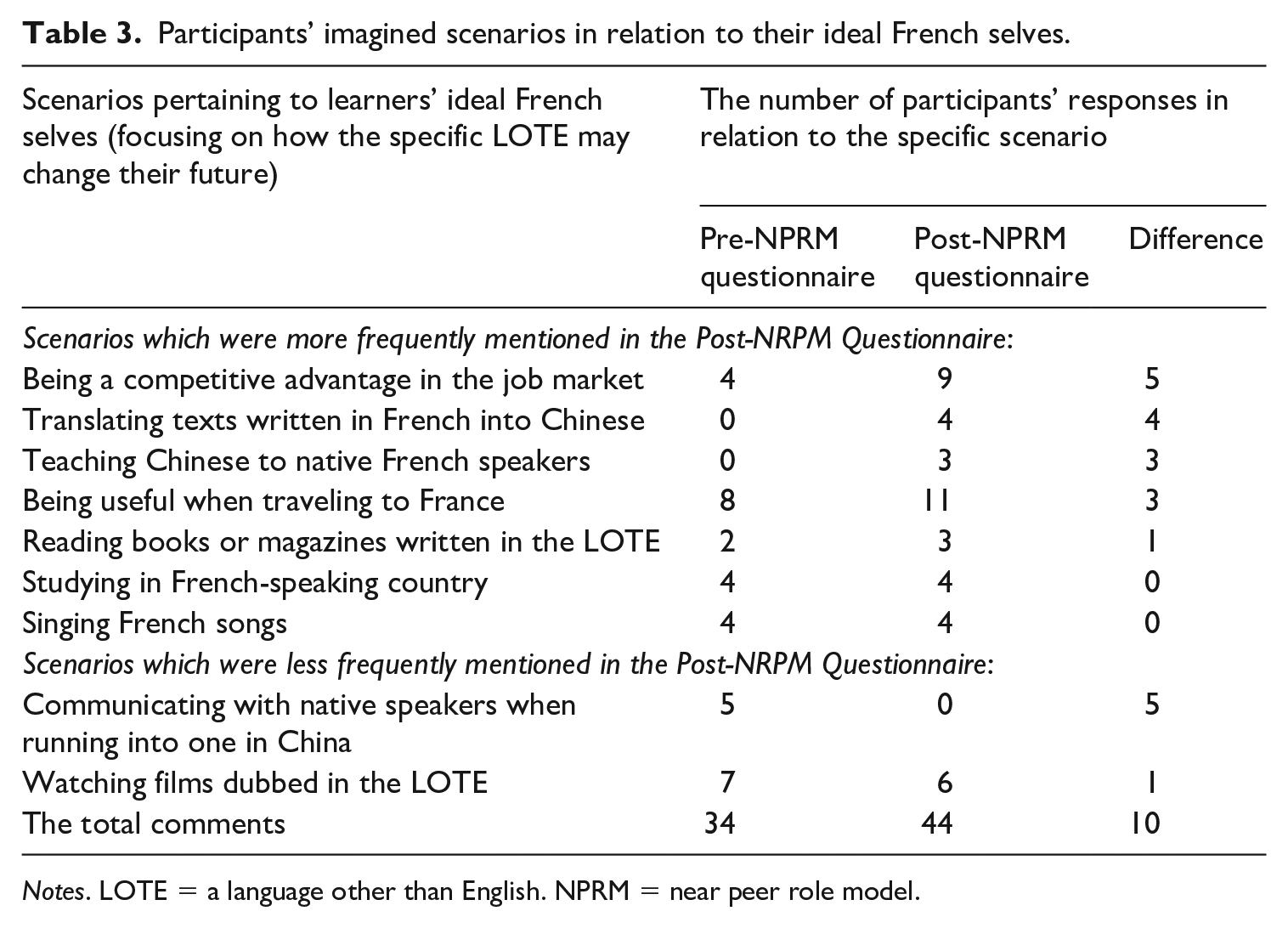
The first change emerged from a comparison of Pre-NPRM and Post-NRPM Questionnaire was the development of learners’ ideal French selves after the presentation of NPRMs. First, learners’ perspectives as to how French would influence their future were found to be wider after the near peer modeling, as they on average depicted more possible French-using scenarios in the Post-NPRM Questionnaire. The details are illustrated in Table 3.
Participants’ imagined scenarios in relation to their ideal French selves.
Notes. LOTE = a language other than English. NPRM = near peer role model.
A look at the table shows an obvious increase in the number of participants who could imagine themselves using French to do translation, to teach Chinese, to find a better job or to travel in France in the Post-NRPM Questionnaire. As mentioned above, these LOTE experiences had been mentioned by the NPRMs in the intervention, suggesting that the NPRMs could have inspired learners of more French-using possibilities in the future and accordingly helped them visualize an ideal French self. This change may also explain the sharp decrease in the number of participants (from 5 to 0) who perceived encountering native French speakers as ideal selves in the Post-NRPM Questionnaire. The excerpt below, which was cited from the follow-up interview with one of the five participants, explicated this situation:
When I was first asked to imagine a French-using scenario, I could only think of bumping into a French guy by luck and say ‘Hello’ to him. But the NPRMs made me realize that French could make some real differences to my life.
Evidently, this learner had difficulty in envisioning French-using scenarios before the role modeling and could only think of running into a native speaker by luck. The NPRMs, however, informed her of more LOTE-using possibilities and reduced her interest in the French-using possibilities that relied on pure luck.
Moreover, the NPRMs might have also assisted participants to develop more elaborate ideal French selves. Specifically, in the Pre-NPRM Questionnaire, 12 out of the 17 participants only described their vision with one or two brief sentences, for example, ‘I can use French when traveling to France’, indicating that their ideal LOTE selves remained vague at this stage. In the Post-NPRM Questionnaire, however, ten participants depicted their ideal French selves in greater detail, as shown in Table 4.
Descriptions of more elaborated ideal French selves.
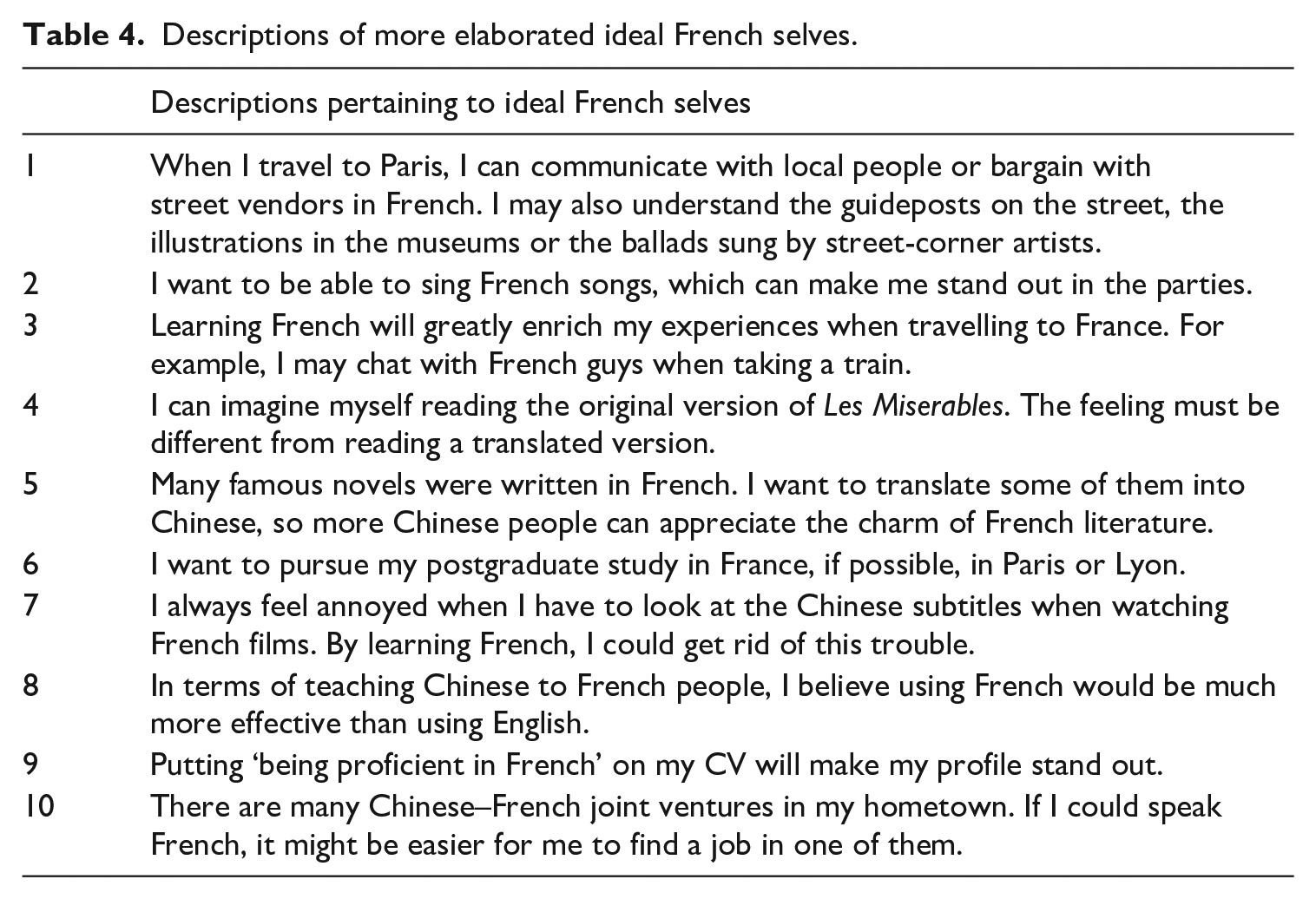
Compared to the responses in the Pre-NPRM Questionnaire, these examples contained much more detailed personal experiences, which indicated the development of their ideal French selves.
Lastly, learners seemed to be more emotionally attached to their ideal French selves after the demonstration of NPRMs. In the Pre-NPRM Questionnaire, 12 out of the 17 participants did not specify how they felt when imagining speaking French in the future, as seven of them briefly depicted their ideal future (e.g. ‘Learning French can bring me a better job’) and another five participants only used verbal phrases (e.g. ‘earning more money’). After the role modeling, however, 11 participants incorporated personal feelings into the descriptions of their ideal LOTE future. The excerpts are cited in Table 5.
Descriptions of more emotionally-constructed ideal French selves.
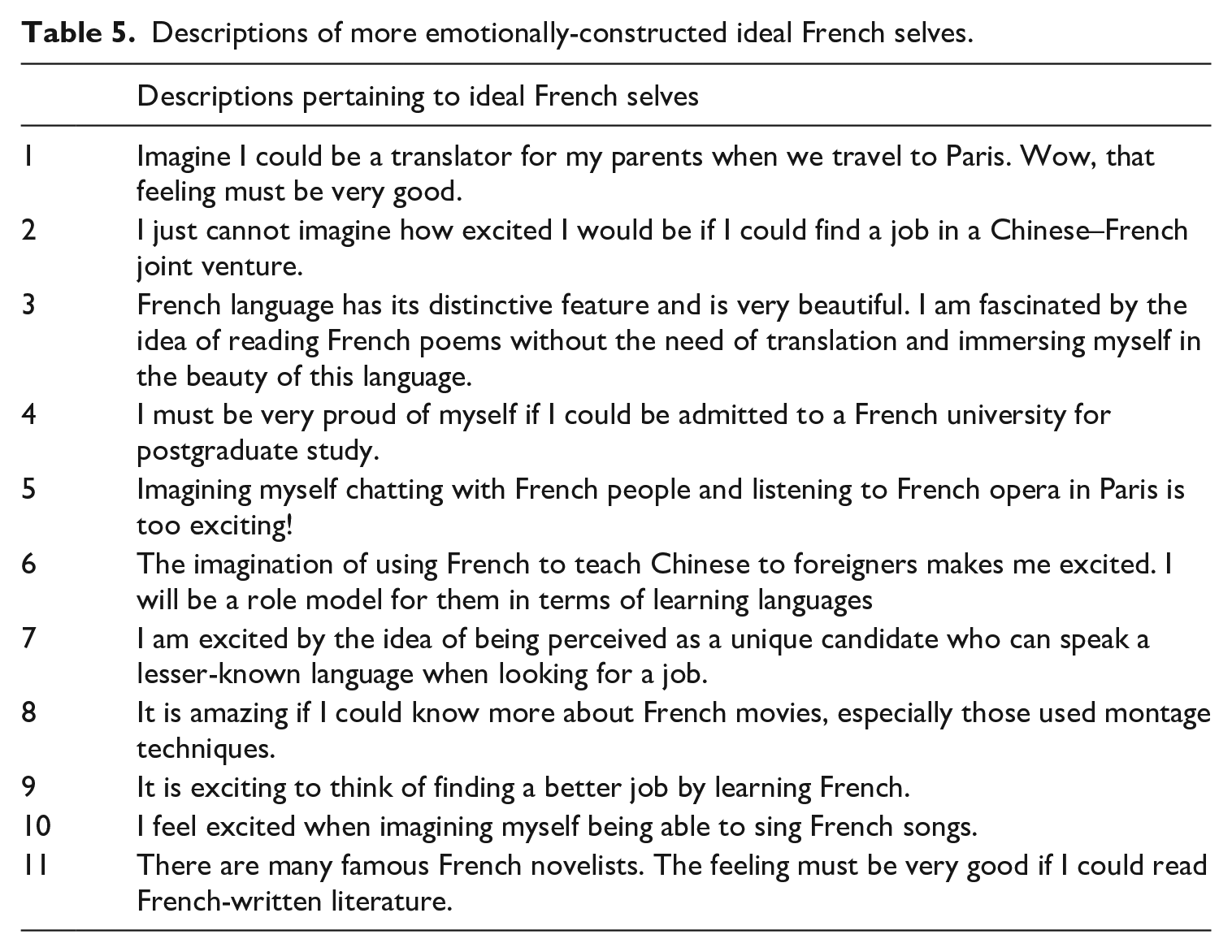
Therefore, learners’ ideal French selves became more emotionally constructed, which again reflected their strengthened desire to be a French user in the future. It is also interesting to note that six of the participants (Excerpt 3, 4, 5, 8, 10, 11) showed a strong affinity for French culture (e.g. French songs or literature) and community (e.g. chatting with local people). Admittedly, five students also indicated the curiosity towards French culture in the Pre-NPRM Questionnaire. However, only two of them specifically described how knowledge in French music or literature could increase their happiness, while the others only suggested a vague interest in this culture, for example, ‘Speaking a language of love seems to be cool’. The role modeling activity, therefore, seemed to concretize some participants’ intrinsic interest in the LOTE community.
b The strengthening of learners’ ideal multilingual selves
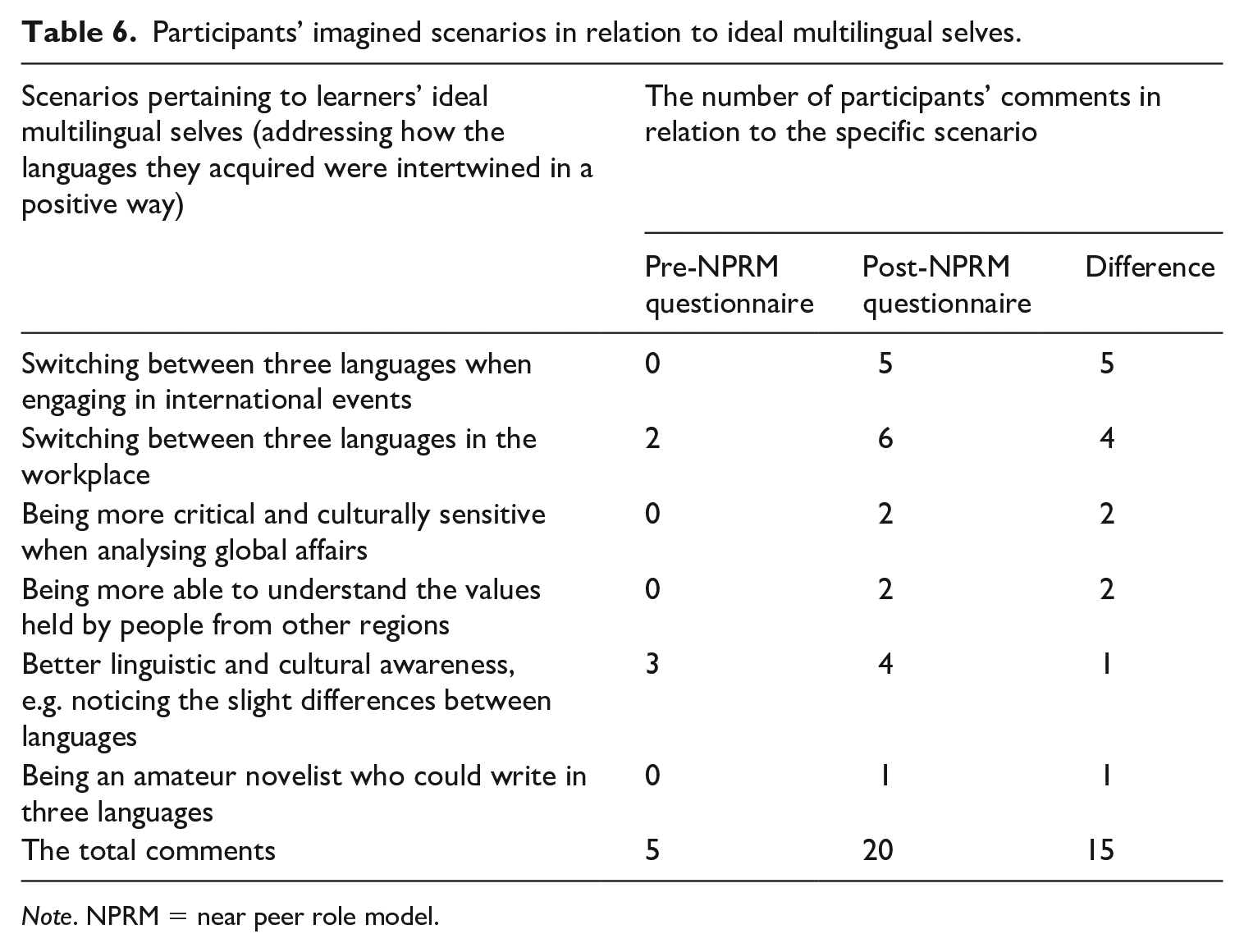
Apart from ideal LOTE-specific selves, learners’ aspirations of becoming multilingual also appeared to be strengthened after the presentation of NPRMs. While only four participants wrote responses relating to ideal multilingual selves in the Pre-NPRM Questionnaire, this number increased to 12 in the Post-NPRM Questionnaire. In other words, more learners began to appreciate the role of French in expanding their holistic linguistic repertoire. The responses addressing learners’ ideal multilingual selves are summarized in Table 6.
Participants’ imagined scenarios in relation to ideal multilingual selves.
Note. NPRM = near peer role model.
As shown in the Table 6, there was an evident increase in the number of responses relating to learners’ ideal multilingual selves after the presentation of NPRMs, which suggested learners’ broadened scope of a multilingual future. Notably, the effect of near peer modeling on expanding learners’ perspectives of ideal multilingual selves might be even stronger than that on their ideal French selves. While the number of responses pertaining to ideal French selves increased from 34 to 44 after the role modeling activity (as shown in Table 3), responses quadrupled (from 5 to 20) in the case of ideal multilingual selves. This contrast is a revealing indicator of the extent to which learners’ aspirations of being multilingual were raised.
It is also noticeable that when developing ideal multilingual selves, participants not only followed the examples of the NPRMs (e.g. switching between languages in the workplace), but also identified new multilingual opportunities. For example, while none of the NPRMs had experience of writing in three languages or employing their linguistic advantage to understand global affairs, these possibilities were broached in the Post-NPRM Questionnaire.
Moreover, similar to the case of ideal LOTE selves, participants’ ideal multilingual selves were also found to be imbued with more elaborated details and personal feelings after the role modeling. In the Pre-NPRM Questionnaire, all the responses addressing learners’ multilingual selves were composed of verbal phrases or short sentences, for example, ‘Learning French can expand my cultural repertoire.’ In the Post-NPRM Questionnaire, however, 11 out of the 20 responses specified how multiple languages would be used in an interrelated way to brighten up learners’ future, as exemplified in Table 7.
Participants’ descriptions of developed ideal multilingual selves.

These intriguing descriptions vividly show learners’ increased capability of visualizing how the languages they learnt could constitute an intertwined system and broaden their linguistic repertoire, which indicated the strengthening of their ideal multilingual selves.
2 Data collected from interviews: Why could the near peer modeling strengthen learners’ ideal LOTE and multilingual selves?
While data from open questionnaires suggested that learners’ ideal LOTE and multilingual selves were strengthened after the near peer modeling, interviews with the selected participants revealed why this activity could be conducive to transforming their ideal language selves. Specifically, all the interviewees regarded the presentation of NPRMs as the most inspiring part of the intervention. According to them, despite their uncertainty about a LOTE-related future in the first intervention session, the NPRMs demonstrated contextualized examples which manifested the value of learning a LOTE in China.
a Developing learners’ ideal LOTE selves
Upon the analysis of interview, the reason that the NPRMs could have strengthened learners’ ideal French selves may reside in the effect of this activity on dispelling participants’ doubt about the value of learning a LOTE. According to five out of the seven interviewees, the major barrier to their visualization of French-using scenarios in the first session was their uncertainty about the availability of LOTE-using opportunities in China. The NPRMs’ experiences, however, alleviated their concerns in this aspect. Two interviewees reported, for example: I used to be confused about why I should learn French in China, as I would only think of this language when I was in French class. However, the NPRMs made me realize that French could have a profound impact on my life. I had been discouraged by my friends’ warning of the rarity of French-using opportunities in China. But the NPRMs made me realize that the future is not so dire.
As these excerpts displays, participants’ limited exposure to French or discouraging comments from friends had led them to undervalue the LOTE learning. The NPRMs, however, adjusted their attitudes and motivated them to develop ideal French selves.
Moreover, the NPRMs’ achievements also released learners’ worries about not being able to realize their ideal French selves in the future. As non-French major students, four interviewees perceived themselves as incapable of seizing French-related opportunities before the intervention. The NPRMs, nevertheless, increased their confidence, as encapsulated in the following excerpts: I began to learn French from the age of 20 and only as a minor subject, but I have been dedicated to learning English for over ten years. This contrast made me doubt my ability to become a capable French speaker. However, the NPRMs helped me realize that my knowledge in French, though limited, could still change my future. Previously I did not believe that I could use French in the future. Yet the existence of NPRMs boosted my confidence with respect to enhancing my future by learning French.
Therefore, before the intervention, the interviewees held low expectations of their French learning achievement and the feasibility of their ideal French selves, possibly based on a comparison with their English learning trajectory. However, the NPRMs made them realize that it was not necessary to use their English experiences as a framework to appraise the learning of French, which helped them regain confidence about their ideal French selves.
In addition, four interviewees reported that the NPRMs had enriched their imaginative experiences of using French in the future, which not only helped them elaborate their ideal French selves but also raised their excitement towards this ambition. Two examples are cited below: I knew that French might be of use in my future. But that ambition remained vague before the intervention. The NPRMs, however, helped me ‘see’ the exciting future of using French in different domains of my life. I did not really know how French could change my future before the intervention. The successful stories of those NPRMs, however, showed me a blueprint. I have an impulse to follow in their footsteps.
As the excerpts shows, although learners’ ideal French selves were vague before the intervention, the NPRMs exemplified the accessibility to this ambition. This helped to transform participants’ vauge imagination of a LOTE-related future into an exciting dedication to being a French user.
Interestingly, three interviewees also mentioned that the existence of the NPRMs enhanced their interest in French culture, which again ignited their excitement towards using French in the future, for example: Despite my curiosity towards French culture, I used to find it far away from my life, just like the distance between France and China. But the observation of NPRMs who obtained joy from reading French poems or talking with French people made me feel much closer to this community and realize how charming its culture is. Therefore, I begin to believe that learning French can add to my future happiness.
Therefore, NPRMs’ personalized experiences seemed to have shortened learners’ perceived gap between French culture and their lives, which developed their affiliation toward this country and strengthened their ideal French selves.
b Developing learners’ ideal multilingual selves
As mentioned above, more participants appeared to develop ideal multilingual selves after the near peer modeling. Interview data revealed that this change might also be attributed to the context-specific examples shown by NPRMs. While learners had difficulty in comprehending the concept of being multilingual and its influences on their lives, the NPRMs helped them to unravel these complexities. First, the near peer multilingual models assisted learners to conceptualize the abstruse idea of ‘being multilingual’. One interviewee reported, for example: Though it is said that being multilingual expands our cosmopolitan outlook, I did not really understand how multilingualism manifested itself. The NPRM who had learnt five languages, however, showed me a vivid example. I was impressed by her perceptive explanation of how Chinese differed from French and Japanese as to describing the feeling of ‘softness’, and realized how language learning deepens individuals’ understanding of the shared values around the globe and the uniqueness of individual cultures.
Therefore, by the help of NPRMs, this learner recognized the value of individual languages in expanding her entire linguistic and cultural system, which laid a foundation for the development of her ideal multilingual selves.
Second, the NPRMs also helped learners recognize the tie between multilingualism and their future. According to four interviewees, situated in China, they had rarely regarded speaking multiple languages as important for them, except for giving them competitive advantages in the job market. The NPRMs, nevertheless, changed their attitudes, as one of them reported: Although I always understand the role of multilingualism in intercultural communication, I used to think that only social elites needed to be multilingual. But the NPRMs made me realize that cross-cultural communication is closer to my life than I had expected.
Therefore, although this participant had equated multilingualism with social elitism before the intervention, she recognized the value of being multilingual for her development under the influence of NPRMs. Moreover, two interviewees reported that the NPRMs reminded them of their own multilingual experiences, which again shortened the distance between multilingualism and their lives. One example is cited as below: Similar to NPRMs, I also like comparing different languages. But I did it only for fun, not for anything ambitious. Anyway, I am not a proficient French speaker who can easily switch between languages. But looking back, I did learn something from those experiences. So being a multilingual is not so unrealistic.
Hence, this learner’s low expectation of her French proficiency had hindered her from relating her cross-linguistic experiences to her future development. The NPRMs, nevertheless, encouraged her to reinterpret her multilingual experiences, which contributed to the emergence of her ideal multilingual self.
The strengthened connection between multilingualism and learners’ future selves might have further motivated them to explore how this linguistic advantage could enhance their future and create multilingual scenarios that had not been mentioned by the NPRMs. For example, inspired by the NPRMs, one interviewee, who hoped to become a news analyst, built the ambition to read in three languages. This, according to her, could enhance her ability of analysing the intricacies of world affairs. Interestingly, when exploring new multilingual possibilities, two interviewees also perceived the group discussion organized after the role modeling as beneficial. One example is shown as below: My desk-mate said that if we were as culturally sensitive as those NPRMs, we could be more open-minded towards different cultures and values. This may reduce conflicts in our future work and life. I am inspired by her comments.
As indicated in the excerpt, the NPRMs manifested the value of being multilingual, which paved the way for learners to co-construct their ideal multilingual selves.
3 Data from Post-intervention Questionnaire and written journals: Learners’ behavioral changes after the intervention
The development of learners’ ideal LOTE and multilingual selves might also be reflected by learners’ strengthened motivated behaviors after the intervention. First, in the Post-intervention Questionnaire, which focused on learners’ changes after the intervention, 11 suggested positive behavioral changes in their French learning practices. Notably, most of them attributed the changes to their increased identification with the value of learning a LOTE after the near peer modeling, as shown in Table 8.
Learners’ reported changes in the Post-intervention Questionnaire.
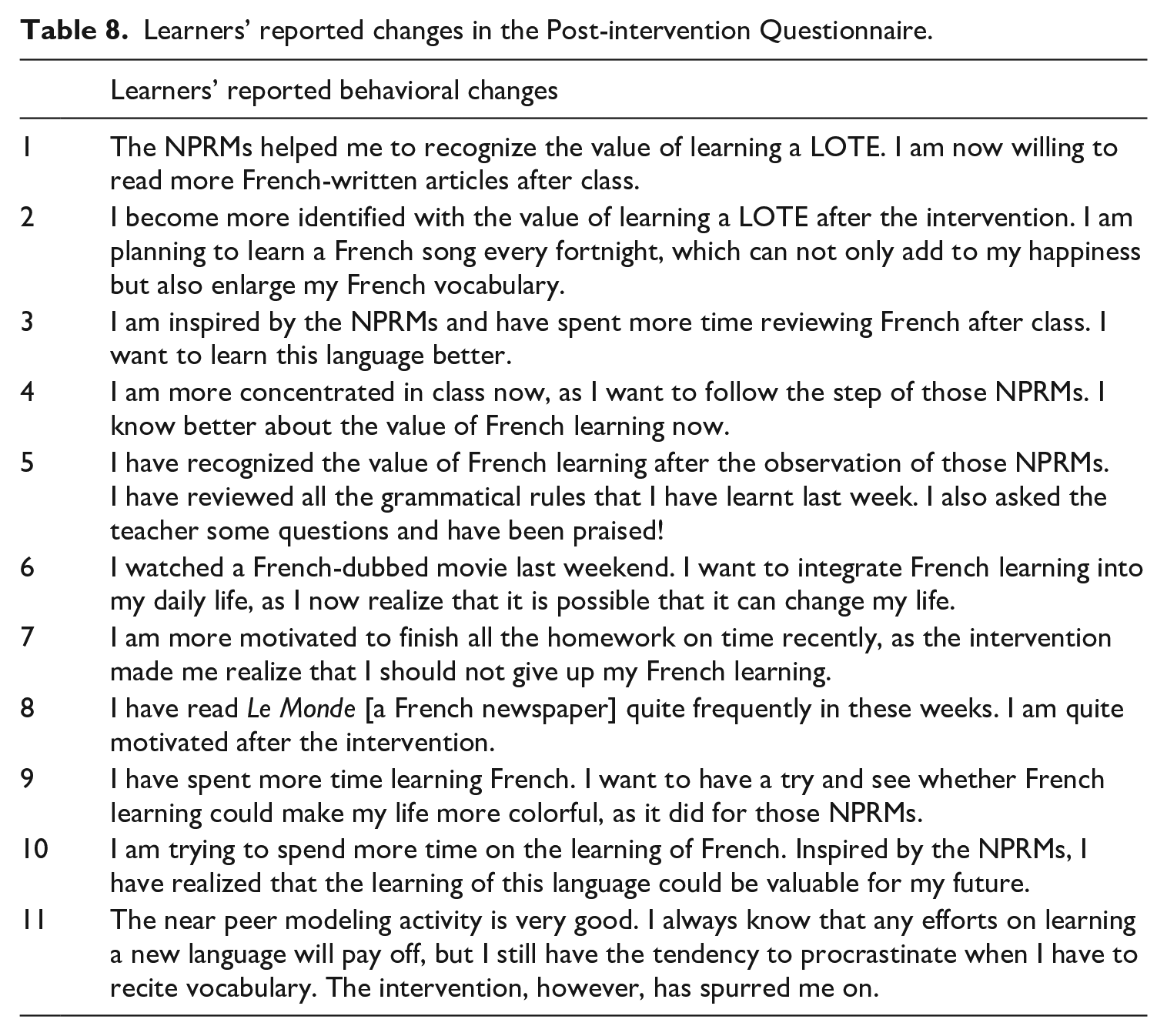
Apart from these learners, another two participants also reported to recognize the value of the LOTE learning and ‘intended to’ spend more efforts in this respect, which again suggested the positive effect of the intervention on learners’ LOTE motivation.
Moreover, the journals collected from the seven interviewees suggested that six of them increased their efforts on LOTE learning after the near peer modeling, possibly due to their deepened understanding of the connection between the LOTE learning and their future. Specifically, two interviewees, though focused only on completing teachers’ assignments at the beginning of the intervention, reviewed the textbook more frequently after the role modeling. One of them also signed up for the National Standardized French Examination, which, according to her, could push her to learn French harder and enhance the possibility for her to use it in the future. The other four interviewees reported to become more concentrated in French class and completed homework to a higher standard. One of them also became more interested in reading French news reports, as she pointed out, ‘The NPRMs helped me understand the value of French learning for my future development, so I feel more motivated now.’ All of these behavioral changes suggested that the NPRMs enhanced learners’ learning motivation, probably due to the strengthening of their ideal LOTE or multilingual selves.
V Discussion
Findings of this study showed that participants’ ideal LOTE and multilingual selves became stronger after the near peer role modeling, possibly due to the modeling effect of the NPRMs as to contextualizing the importance of learning a LOTE in China. It needs to be mentioned that this result differed from Sampson’s (2012) research which revealed that role modeling was not significantly effective on strengthening learners’ ideal English selves. One possible explanation might reside in the different contexts (English and LOTE class respectively) in which these two studies were situated. As noted before, the instrumentality of a LOTE could be perceived as more limited than that of English. Therefore, while learners can develop ideal English selves by reflecting on past experiences and discussing with classmates (Sampson, 2012), they might have needed additional affordances to recognize the role that a LOTE would play in their future.
1 The construction of learners’ ideal LOTE selves
The near peer modeling was, first, found to support the development of learners’ ideal LOTE selves, probably because it had intensified participants’ identification with the value of learning French for their future development. As shown in the findings, participants were uncertain about the availability of LOTE-using opportunities in China before the intervention. The NPRMs, however, helped to counteract such an uncertainty by exemplifying how learning a LOTE could add to individuals’ future success and happiness. This result echoed Yashima’s (2009) argument that NPRMs can strengthen learners’ ideal language selves, as they demonstrate how influential this language can be in a particular context.
Moreover, learners’ confidence pertaining to realizing their ideal LOTE selves also appeared to be strengthened after the role modeling activity. Specifically, before the intervention, many participants perceived their future French competence as limited, especially when in comparison with their English proficiency, which undermined their confidence in their ability to become a LOTE user in the future. The NPRMs’ success, however, raised these learners’ awareness that it was not necessary to appraise their French learning achievements based on how they evaluated their English learning. Notably, other studies (Gabrys-Barker, 2011; Henry, 2011) also revealed that LOTE learners had the tendency to compare their LOTE and English learning, which sometimes dampened their ambition of being a LOTE user. From this perspective, NPRMs might be particularly useful in a LOTE-learning setting, as it may contribute to offsetting the negative influences of individuals’ English experiences on their LOTE learning.
In addition, evidence also showed that the NPRMs’ experiences might have helped learners develop more elaborated and emotionally constructed ideal LOTE selves. As findings revealed, before the near peer modeling, most participants’ ideal French selves remained obscure. The NPRMs, nevertheless, enriched learners’ imaginations of how French would shed light on their future and raised their excitement towards such a future. These detailed and emotionally-embedded visions, according to Dörnyei (2009), suggested the development of ideal language selves.
Another interesting point worth noticing is that some participants became more interested in French culture and community after the intervention, which again enhanced their willingness to integrate French into their future. According to them, although they had held favorable attitudes towards France before the intervention, the NPRMs’ interesting encounters with French culture made them feel the target country more approachable. In other words, the NPRMs seemed to shorten the gap between participants’ lives and French community and concretize their interest its language and culture. Therefore, learners’ integrativeness (Gardner, 1985) associated with the LOTE community was strengthened. Such an increased emotional attachment to French culture, in turn, was found to enhance learners’ desire to use French in the future. This result was concurrent with Sugita McEown et al.’s (2017) study that learners’ favorable attitudes towards the LOTE community can be conducive to the development of their ideal LOTE selves.
2 The construction of learners’ multilingual selves
Apart from ideal LOTE selves, the demonstration of NPRMs could have also been instrumental in constructing learners’ ideal multilingual selves. As mentioned before, only four participants showed aspirations to become multilingual at the start of the intervention. The underlying reason, according to the interviewees, was their difficulty in comprehending the concept and appreciating the value of ‘being multilingual’ in China. However, after observing the NPRMs, these learners seemed to broaden their scope of how multilingualism manifested itself in their situated contexts.
First, although most participants regarded the concept of ‘being multilingual’ as abstract before the intervention, many of them agreed that the NPRMs’ cross-linguistic experiences were conducive to deepening their understanding in this respect. According to them, the NPRMs vividly displayed how languages could be interrelated in a positive way to deepen individuals’ linguistic and cultural insights. Therefore, rather than focusing only on using a specific LOTE in the future, participants realized the benefits of learning a LOTE with respect to augmenting their entire linguistic reservoir. Based on current research (Thompson & Erdil-Moody, 2016; Thompson & Liu, 2018), the recognition of the interactions between languages is the prerequisite for the development of individuals’ multilingual selves.
Second, probably due to the similarities in terms of situated contexts, many participants reported that the NPRMs had raised their awareness of the close tie between multilingualism and their future. As findings revealed, one barrier to the development of learners’ ideal multilingual selves before the intervention resided in their undervaluing of being multilingual in China. Even if they admitted the role of multilingualism in cultivating individuals’ cosmopolitan outlook, they associated multilinguistic talents with social elitism, aligned with the findings of Stavans and Hoffmann’ (2015) research. The NPRMs, however, made these participants realize that cross-cultural communications were more closely related to their future than they had expected.
Finally, some participants also appeared to be more confident in their capacity to become multilingual in the future. Specifically, before the intervention, despite their accumulated cross-linguistic experiences, these participants had not developed the self-identification as a multilingual. According to them, only proficient speakers of different languages could become multilingual, a myth also identified by Thompson (2013) as an obstacle to multilingual education. The NPRMs, nevertheless, exemplified the possibility for individuals who resembled the participants to become a multilingual. Encouraged by these examples, participants were found to re-interpret their past cross-linguistic experiences and regarded them as a part of the journey towards realizing their ideal multilingual selves.
In short, the role of the NPRMs in constructing learners’ ideal multilingual selves may not only be enriching participants’ imaginative multilingual experiences but also changing their attitudes towards multilingualism by contextualizing the value of being multilingual in China. Such attitudinal changes can be essential in the development of ideal multilingual selves, as these selves may be situated at a higher construal level and represented individuals’ internalized values (Henry, 2017). From this perspective, the near peer modeling might be particularly important for the development of ideal multilingual selves.
VI Conclusions
This study aimed to advance the field of language learning motivation by researching the role that near peer role modeling played in constructing learners’ ideal LOTE and multilingual selves. Findings revealed that the strength of this strategy resided in providing participants with approachable examples to understand the importance of learning a LOTE in a specific context. The NPRMs was, first, found to support the development of learners’ ideal LOTE selves, as they provided context-specific examples that reduced participants’ uncertainty about the sufficiency of LOTE-using opportunities and their ability to seize those chances. Moreover, by revealing how multilingualism manifested contextually, the near peer modeling also helped learners capture the ‘abstractness’ of ideal multilingual selves and intensified their identification with such a future. In short, this study shed light on how to construct the LOTE-related facets of learners’ ideal selves through classroom intervention, which is of both theoretical and pedagogical significance.
Admittedly, based on a qualitative research design, the study was exploratory in nature, which aimed to look at a relatively under-researched domain, namely how the NPRMs might influence the development of learners’ ideal LOTE and multilingual selves. Moreover, as a small-scale classroom intervention, the results from this study are not intended to be generalizable to other LOTE learning contexts. It is nevertheless hoped that this study could move forward the discussion of how to construct learners’ LOTE and multilingual selves in the language classroom, and, in particular, the possible role that near peer modeling might play in this respect.
Footnotes
Acknowledgements
I would like to thank the editors and anonymous Language Teaching Research reviewers for their constructive and detailed comments. I also want to thank the teachers and students who actively participated in this study. I am grateful to my supervisor, Dr. Linda Fisher, for her valuable guidance for this research project. My gratitude also goes to Dr. Shi Pu, Meng Liu and Janet Ramdeo for their insightful suggestions for the earlier versions of the manuscript.
Funding
The author received no financial support for the research, authorship, and/or publication of this article.
