




Abstract
Paid care work persists as a site of low pay, insecurity, and exploitation globally, with ‘decent work’ elusive. In England, the adult social care (ASC) workforce is fragmented, contributing to a lack of sectoral-level organising and collective bargaining. Consequently, industrial disputes in the sector are uncommon; however, they do occur. Based on a case study of an independent trade union, United Voices of the World, involving interviews with union staff and paid care workers, the article uses the lens of care to understand successful elements of a campaign to improve conditions at a London nursing home. Alongside this care focus, the article draws on sociological conceptualisations of ‘community’ to theorise what worked well in this case. This literature strengthens analysis of the union’s successful engagement with this group of workers, and how it sustained the campaign. The article presents one of few studies of paid ASC worker organising in England. It includes important insights on sociological notions of care, community, agency, and work orientations. These pertain to the ways they shape worker organising. The article augments the growing independent union literature through examining an employment sector not previously discussed in that context. In addition, it strengthens sociological understanding of the consequences of, and worker resistance to, societal undervaluation of care work. It concludes by summarising the implications and key learning from the case, including the prospects for wider organising of paid ASC workers.
Keywords
Introduction
Pay and conditions in adult social care (ASC) in England have been poor for decades, and the Low Pay Commission has designated the sector low paid since 1998 (Skills for Care (SFC), 2023: 128). Sick pay is often at the insubstantial statutory rate, and rewards for promotions, gaining qualifications, or length of service, are meagre. Zero-hours contracts are also more prevalent in ASC than across the labour market overall (Cominetti, 2023: 13–15). These problematic characteristics impact disproportionately on over-represented groups, including women (who account for 81% of workers (SFC, 2023: 88–90), and workers of a non-UK identity (SFC, 2023: 99–103). Unsurprisingly, ASC faces an ongoing sustainability challenge: turnover stands at 28% (SFC, 2023: 70), and there are around 152,000 vacancies (SFC, 2023: 58). ASC’s quasi-market, where local authorities commission provision, sees most care delivered by ‘independent’ providers. The central government’s legislative powers include around funding and structure, regulation of care quality and the workforce, and the Department of Health and Social Care holds responsibility for ASC workforce development. Government policy in other areas, including migration and employment rights, significantly shapes this work.
The degradations of care work are not confined to England, and care work and care workers remain marginalised and subordinate across the global economy. Although care is ubiquitous and fundamental to the workings of societies and economies, its structural positioning and resulting lack of value penalises those who do this work. Hochschild’s (2001) ‘global care chain’ thesis shows how wealthy women (and men) in the Global North rely on the labour of migrants from the Global South to retain their affluence and status. The lives of care workers and their families are shaped by national-level policy and situated within global inequalities relating to complex interconnections of geopolitics, the gendered order, and histories of imperialism and colonialism (Williams, 2018).
ASC’s challenging environment lends significance to organising for change. However, the ASC workforce in England lacks a unified voice or sectoral collective bargaining to establish better pay and conditions (Fisher and Foster, 2025). A mere 15% of private sector-employed ASC workers are unionised (Cominetti, 2023), in contrast with 21% of all employees (Department for Business and Trade, 2023: 21). This low union membership is shaped by key barriers, including the fragmentation that disperses workers (Murphy and O’Sullivan, 2021) and impedes collective action (Duffy, 2010). For instance, outsourcing has led to there being some 18,000 ASC providers (SFC, 2023: 31), presenting a challenge to unions or other actors seeking to organise ‘invisible’ workers (Boris and Klein, 2006: 83).
Employer hostility to organising further complicates access (Simms, 2007). ASC’s high turnover has implications for organising continuity, and low pay is a barrier to meeting the costs of union membership. The sector’s over-reliance on women is crucial too, as they perform the bulk of unpaid care work, which further limits time for organising. Paid ASC workers’ consistently strong work attachments (Daly, 2023) can influence decisions regarding whether to engage in organising (Boris and Klein, 2006; Duffy, 2010). Strike action can result in shortages of support (Whitfield, 2022), and Mareschal and Ciorici (2021) highlight paid care worker fears that gains for them may curb services.
Despite these barriers, there have been notable recent examples of ASC worker organising, and this article considers factors associated with successful elements of a particular campaign. Based on a qualitative case study of an independent trade union, United Voices of the World (UVW), the article draws on sociological conceptualisations of ‘community’ to explore its role in UVW successfully engaging with these workers and maintaining the campaign. Factors contributing to successful organising in ASC have rarely been studied in England (Whitfield, 2022), and this article is one of few solely focused on paid ASC worker organising in England. Alongside ‘community’, a care lens is utilised, focusing on care as a form of paid work, including its practices, nature, and structuring. This includes consideration of how paid ASC work’s nature and worker orientations towards it influence their attitudes towards, and engagement in, organising, and thus their agency. Accordingly, the article contributes to sociological understanding of the consequences of ongoing societal undervaluation of care work. The article extends the fledgling independent trade union literature (Però, 2020; Smith, 2022; Weghmann, 2022, 2023) via the focus on ASC, hitherto unexamined in independent union research in sociology. It does this through considering work practices (including paid ASC work’s relational nature) and the working environment, and how these are connected to, and shape, organising within the study. Although the independent union literature catalogues the sectors organising has occurred in, pinpointing material conditions and structural elements, consideration of work practices is scant.
The article’s next sections focus on independent unions, then introduce UVW and the London nursing home dispute. Subsequently, it introduces sociological literature on care worker organising, with a focus on concepts of ‘community’ and ‘care’. The methodology is then presented, before the findings, which identify four important elements of community and care associated with the engagement and maintenance of this campaign: access, communication, relationships, and space and scale. Finally, the discussion and conclusion summarise the analysis, and note implications from this case, including the prospects for wider paid care worker organising.
Independent unions and UVW
Independent unions arose in the 2010s largely due to differences with established unions and included groups of workers – overwhelmingly of migrant backgrounds – breaking away to form and/or join other workers in independent unions (Però, 2020; Weghmann, 2022). The differences with established unions varied, but Però (2020: 906) neatly summarises these when arguing that independent union’s ‘gestation, emergence and growth are directly linked to firsthand, negative experiences with mainstream unions, especially on issues of representation, autonomy, co-optation, bureaucracy and the development of policy and collective initiatives’. Representation is central to the question of who independent unions are for. Migrant workers in low-paid sectors drove the formation of these unions, whose central focus often remains on representing and supporting these groups. Therefore, workers in these types of employment are not marginal to independent unions’ remit. Their engagement with workers in community settings, including through word of mouth (Weghmann, 2022, 2023) and in a range of languages (Bertolini and Dukes, 2021), attests to that.
It is important to note the alignment of paid ASC workers’ issues with those independent unions have organised around. In low-paid employment, pay and conditions are a core focus for action, and Però and Downey (2024) identify independent unions’ framing of these demands in moral terms as fundamental to their effective communication. Challenging outsourcing is central to independent unions’ moral argument as they confront fragmented structures. Drawing on Ness (2014), Weghmann (2022: 133–134) identifies hallmarks characterising independent unions’ approach: ‘direct action’; ‘class struggle unionism’ to ‘defend the workers’ power against the bosses’; ‘workplace and community’ rooted ‘class solidarity’; and ‘self-activity and rank-and-file participation’. Note the term ‘community’ features here. Independent unions vary tactics, including legal action alongside the use of social media and more creative, social movement strategies (Però and Downey, 2024). Their effectiveness relies less on large-scale recruitment; they regard union recognition agreements as ‘preferable but not necessary’ (Però, 2020: 910) and often adopt adversarial approaches (Bertolini and Dukes, 2021).
Independent unions criticise established unions, including around representation, but scholars also highlight independent unions’ influence on established unions: ‘as well as devising successful mobilising strategies against outsourced work [independent unions] are also – consciously and unconsciously – transmitting the knowledge of how to do this to other labour movement activists’ (Smith, 2022: 1370). Weghmann (2023) notes connections between the two union types, and emphasises the need for collaboration and mutual learning.
UVW and the London nursing home dispute
UVW, the union involved in the London nursing home dispute, was established in London in 2014 by a group of Latin American cleaners, and is a member-led, direct action, anti-racist, campaigning trade union and we exist to support and empower the most vulnerable groups of precarious, low-paid and predominantly BAME and migrant workers in the UK. (UVW, 2024)
At the time of interviews in late 2023/early 2024, UVW had 10 paid staff and around 4,000 members (UVW, 2023). Worker members were employed in various sectors, with cleaning having the highest concentration. Some of the unions’ key campaigns and successes have included those at the London School of Economics, and at two London hospitals (Weghmann, 2022). The union is overwhelmingly member funded and seeks external support for strike funds (Però, 2020). Key elements of UVW’s approach include centring workers’ views (Weghmann, 2022), taking direct action (Weghmann, 2023), and being bold (Però, 2020).
The nursing home campaign began in spring 2020, in the COVID-19 pandemic’s early days, when Cynthia, a care worker employed in the home, met Silvia, a UVW worker, in a community setting. Both Latin American migrants, they were able to communicate in Spanish, which was important to Cynthia. Cynthia worked in a London nursing home run by a charitable care provider, which accommodates up to 60 residents and has approximately 100 staff (Peart, 2021). Cynthia discussed the difficult working conditions, and Silvia spoke about the union, and they began developing a campaign and encouraging more workers in the home to join UVW. This led to a rapid expansion in the nursing home, where UVW’s membership went from zero to over 30 (overwhelmingly care workers) in 3 months in the spring of 2020.
The newly unionised workers engaged in a wide-ranging campaign on union recognition, individual and collective grievances, and pay and conditions (Greig, 2021). For the remainder of 2020, the workers were unable to gain concessions from management on union recognition, basic pay, sick pay, or annual leave. The union then balloted for strike action, which led to walkouts in January, February, and October 2021 (Peart, 2021). Soon after the third round, which included a letter to one of the employer’s wealthy trustees, nursing home staff’s pay was raised in line with the London Living Wage (UVW, 2021). Despite this, the employer did not voluntarily recognise the union, so members applied to the Central Arbitration Committee in August 2020 (UVW, 2020). This application was accepted; however, the subsequent employee ballot missed the required threshold, therefore UVW was not recognised by the employers. Another element of the dispute was a collective trade union victimisation claim by 14 UVW worker members, which reached a settlement in August 2022, with the terms not revealed (UVW, 2022).
Sociological accounts of organising and the ‘care’ context
This section introduces the concepts ‘community’ and ‘care’, which anchor the article’s approach to better understanding the nursing home dispute and UVW’s organising. Across the sociological literature on organising among care workers, ‘community’ is a recurring concept. For instance, Tungohan (2023: 4) argues that creating and sustaining ‘communities of care’ through organising ‘is an extension of caregiving work and acts as a unifying force for care workers’. In doing so, she emphasises the relational in both care work and organising (see also Glaser, 2023). Specifically regarding UVW, Weghmann (2022) draws on Sivanandan’s concept of ‘communities of resistance’ to highlight the union’s supportive and solidaristic approach to generating community. Care can also act as a focal point for worker solidarity in forming ‘communities of interest’ (Duffy, 2010).
Alliances between unions and communities, including with care recipients and their advocates, are central to ‘community unionism’, which has been conceptualised in various ways (Weghmann, 2022). These include Cranford’s (2020) ‘intimate community unionism’, where care’s intimate relational work is pivotal. This scholarship emphasises the need for organising to be aligned with the interests of workers and supported people, and cognisant of the layered inequalities those relationships are situated within. While there is not space here to provide extended detail on each concept, we contend that the frequent mentions of ‘community’ in this field is of note. We understand community as a vehicle for establishing solidaristic connections (Morgan and Pulignano, 2020).
The notion of community features regularly in independent union literature, including Smith’s (2022) ‘communities of practice’, and Però’s (2020) ‘communities of struggle’. Developed through ethnographic research with independent unions, including UVW, Però’s (2020: 907) community of struggle conceptualisation highlights the sensitivity to and centrality of low-paid migrant workers within independent unions’ agendas. Smith’s (2022) ‘communities of practice’ interpretation focuses on the contribution independent unions are making to unionism overall.
Mobilising workers through grassroots organising is characteristic of successful care worker organising (Mareschal and Ciorici, 2021), as are alliances formed to compliment activities, including with disability rights organisations (Boris and Klein, 2006) and groups campaigning around migrant worker issues (Tungohan, 2023). These alliances are important within the broader care context. Lynch (2022) posits care as antithetical to capitalism, while Tronto (2017) argues that care’s core ontology of interdependence and relationality counters that of contemporary capitalism. Paid and unpaid care work are central to ‘social reproduction’, a concept that highlights the often hidden work of renewing social life (Bhattacharya, 2017). This is fundamental as social reproduction scholarship seeks to enhance recognition of this work (International Labour Organization (ILO), 2018).
Enhancing recognition is also a key organising aim, and Tungohan’s (2023) ‘communities of care’ concept effectively combines cognisance of care’s structural position at a global level with understanding of organising and what drives it in care contexts. The Filipina migrant care and domestic workers in her study formed communities through solidaristic caring and a range of organising activities. They seek greater recognition for what they do and resist care’s structural disadvantage and continued demotion. Their fight is about justice, and here Fraser’s (2013) social justice, with its three dimensions of recognition, redistribution, and representation, is relevant to the context of care and worker organising. Once recognition has been established, this should be followed by redistribution, with this process addressing care’s role in perpetuating intersecting social inequalities. Fraser’s final dimension of justice, representation, is also highly pertinent to care and organising, due to paid care workers’ ongoing struggles in this regard. Representation has further relevance in the care context as it denotes an important form of inclusion, which participation in care work inhibits (Skeggs, 1997).
Methodology and methods
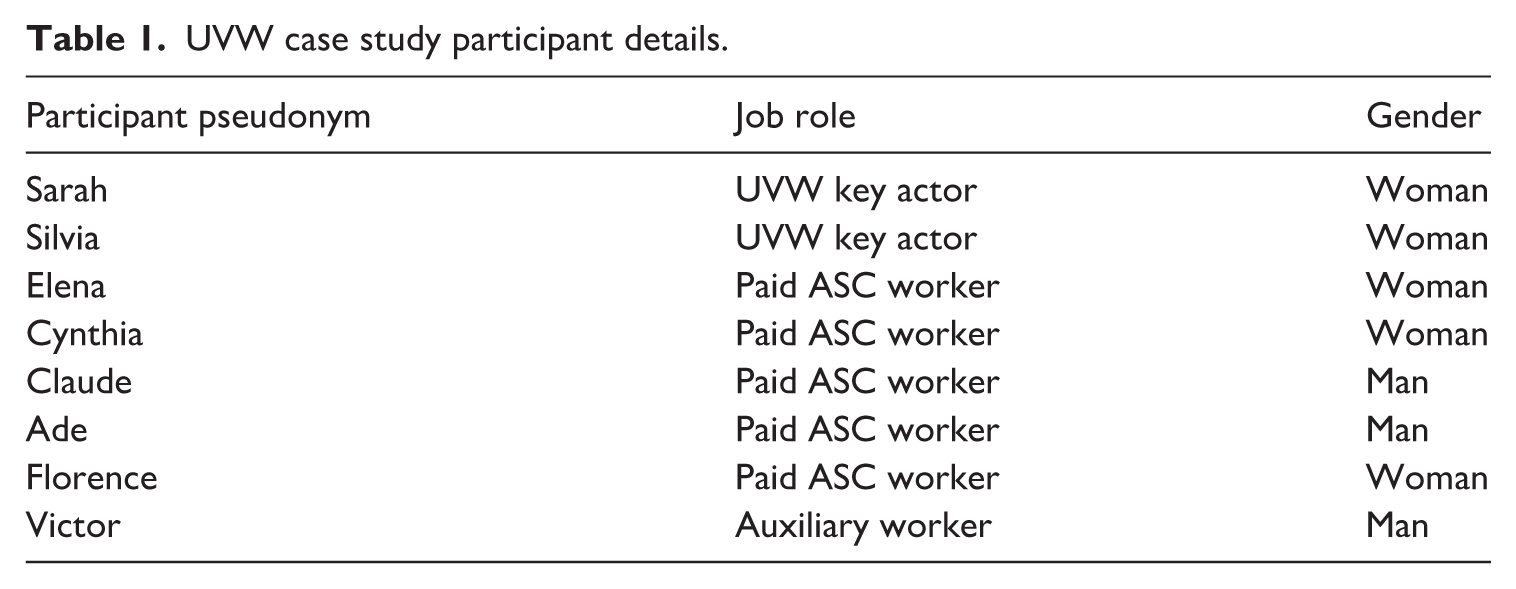
Using community and care as conceptual tools, the qualitative case study of UVW sought to enhance understanding of the nursing home workers’ campaign to improve their conditions. The case study consists of 10 interviews across two key UVW employees and six union members employed in the home. One of the latter was an auxiliary worker. Two of the prominent paid ASC workers were each interviewed twice (see Table 1). Although these numbers are relatively small, they represent a significant minority of those involved. Furthermore, they include the campaign instigator and others who played leading roles. The interviews were conducted in person at UVW’s office in London, and online, and took place between December 2023 and July 2024. The case is part of a larger study of paid care worker organising, which comprises 46 interviews overall with key actors (for example, organisers or administrators) and paid ASC workers across different unions and community organising and campaign groups. The core findings presented here come from the UVW interviews, however quotations from the extended sample pertaining to the wider interest in, and influence of UVW’s campaign, are also included.
UVW case study participant details.
Adopting semi-structured interviews enabled the participants to express their own views in detail regarding organising (James, 2021). This approach is useful in providing a contextual and multi-layered interpretation of developments (Mason, 2002). The sample was recruited through an academic colleague who had strong connections with UVW. All the paid ASC workers were migrants, and ages ranged from 39 to 70. These workers’ length of service in the home varied, but included workers employed there significantly longer than the ASC average of 5 years in current role (SFC, 2023: 80–82).
The interviews explored organising as a way workers demonstrate agency towards improving their work situation. They examined their motivations and attachments to paid ASC work, and their reasons for engaging in organising activities. Key actor interviews probed organisational-level factors, including barriers to accessing and engaging with paid ASC workers, and to sustaining organising. The questions were predominantly open in nature, in accordance with a constructivist-interpretivist epistemological foundation (Foster, 2024). The interviews lasted approximately one hour, apart from extended interviews over two sittings with two paid care workers (in total each of these lasted two hours). The interviews were recorded, transcribed and pseudonyms given to participants (although permission was granted to name UVW). The interview findings are supplemented with brief ethnographic observations from additional meetings with UVW, as well as media coverage of the campaign and UVW’s communications. The interview data were analysed thematically, closely following the method of Braun and Clarke (2023), by building from data familiarisation through to coding and the generation of themes through analysis. Ethical approval to conduct the study was granted through the Department of Sociological Studies at The University of Sheffield.
Findings
This section identifies themes associated with ‘community’ and ‘care’ that are integral to workers’ and UVW’s engagement within, and maintenance of, this campaign. These themes are presented below: access, communication, relationships, and space and scale.
Access
Across the sample, it was acknowledged that pandemic working conditions, and the employer’s response to the crisis, were key to sparking this campaign. Cynthia expressed her anger at the working conditions in the home during the COVID-19 pandemic. She recalled when the employer wanted to thank the workers for their hard work, by giving them pizza: During the pandemic we worked very hard. They didn’t give us extra money. But what they gave us was a pizza. And I said, ‘Pizza?’ And they said, ‘The boss is going to come to say thank you’. Come? No, we went to a room, it’s a screen, they protect themselves, but we are putting our lives on risk, protecting others. And I said, ‘Pizza? What does pizza mean?’ And then instead of pizza why are you not giving me a pay rise?
Cynthia shared the problems with Silvia which, in addition to basic pay, included sick pay inadequacies and conflicts over infection controls. The union did not seek out the worker, but made contact through their community ties, and thus this was the community setting where the worker accessed the union. They met at a Latin American migrant community group, illustrating the union’s embeddedness within such community settings (Weghmann, 2022). The campaign then developed as the union began to support Cynthia and encourage other workers in the home to join. Another UVW worker, Sarah, saw the pandemic circumstances as a crucial spark: ‘I think that anger and fear kind of stirred something at the time’.
Decisions about joining the campaign were taken in grave circumstances, as a worker, Florence, who played a sustained role in the UVW campaign recalled: At the beginning when the pandemic was going on and then we were in the talks, I had reservations to say, do we need to do this at this time when people are losing loved ones? I said, am I doing the right thing at this time? Because what happened, when the pandemic was going on, I had my little one . . . he was premature, so he was shielding as well. And then as a mum, going into work, COVID, coming home, just say ‘hi’ to your kids and run in the shower, it was so hard. I had to work, then shielding my little one and then you go in on a day-to-day, you see people, residents dying . . . but I think after, when I spoke to UVW and we had so many meetings . . . I think then after they reassured me, looking back now, it was the right thing to do then.
With the union’s reassurances, the potential barrier of concern for impact on the home’s residents precluding worker campaigning was addressed. Florence’s account highlights features of paid care employment that workers regularly – not just during pandemics – contend with, including the deaths of people they support. This is further complicated by the work’s relational nature and the attachments of caring relationships (Daly, 2023). Florence’s circumstances with her prematurely born son complicated the challenging environment, and this intimate work’s relational risks (and dangers of transmitting infection to those in workers’ personal lives). This impacted on elements of the nursing home campaign with Silvia pointing out that, at times, workers ‘couldn’t come on the picket line because they were . . . looking after the other people that they look after’. She referred to numerous meetings with the union, demonstrating its presence and commitment to grassroots organising (Mareschal and Ciorici, 2021). The union’s reassurances were important to developing trust, and to the campaign moving from an individual to a collective ‘community’ struggle (Weghmann, 2023) once community access had occurred.
Communication
Various elements of UVW’s communication stimulated the campaign’s development. Workers responded positively to being listened to. Claude attributed his involvement in part to UVW ‘hearing’ him, and thus showing care, in marked contrast with the employer. Cynthia’s negative reaction to the pizza offer was partly about it exemplifying how the employer was not listening to workers. She gave another example of when a staff meeting was called, again expressing frustration at the management not listening. The meeting was before the union’s involvement, but the episode was important in challenging the employer’s failure to listen: ‘Why you invite me to a meeting, and I can’t speak? You’re always talking-talking-talking, what about the others? You don’t want to listen’. . . . Anyway, it was horrible that situation. But I feel empowerment. I feel the power in me, I said, ‘No’. I think that day was very important because at that time I even not started anything about the fight. I just start to discover how powerful I was at that time. (Cynthia)
Relatedly, Claude said that this was also about not being seen: When you say to somebody, ‘I’m a care worker’, they think that it’s not a job because what people see is that someone comes who gives personal care to somebody will clean the number twos. That’s all they see . . . so people don’t give you respect. People don’t know what we do . . . especially people in higher positions, they don’t see it. They just see, ‘Oh, it’s just a job’.
The fact that paid care work is undervalued by some, including people in senior positions, means workers are less likely to be communicated with and influence how things are done. This quote also points to these workers’ wider lack of status and societal recognition, and to care work’s stigma.
In this context of awareness and respect, UVW’s listening, showing care, and recognising care work’s value, were fundamental building blocks of this campaign. That UVW does this aligns with their self-definition, and contrasts with some of these workers’ views of established unions. When the campaign started, Claude was an established union member, but quickly switched to UVW: We had the working conditions at [nursing home] starting. Our annual leave, it was not good. We got no sick pay . . . imagine, during COVID, you are sick, you go to work because, if you stay home, you don’t eat. Your family doesn’t eat. So, literally, you are sick. You hide it. You go to work. The annual leave was not good. Not bank holiday pay. So [established union] doesn’t do anything . . . and then, we got this union, UVW, they come. Oh, they are good. They teach. They don’t even just come to fight for you. They teach you your rights. They teach you how to stand up by yourself and represent yourself. And then, I left straightaway. I didn’t think twice.
The importance of listening is one of several ways this organising resembles the practices of caring labour (Sass, 2000). Listening to, observing, and being conscious of supported people are central to what care workers do (Sass, 2000). In addition, UVW communicated its valuing of these workers and their work through investment in them, and this showed care in action, as a verb and active process. As Claude stated, this was through ‘fighting’ for them, through building a campaign, to advising and representing them individually and collectively. This internal communication incorporated teaching about planning and strategy, including power dynamics and escalating actions.
Investment in workers characterises UVW’s worker-led approach, so although union workers advise on strategy, workers’ views are prioritised: When I come off those meetings, then I would say to Claude, ‘Claude, I don’t like this route, let’s go this route’, then we’ll phone up the union, then we arrange a meeting between us and the union and then I could . . . say that, ‘I don’t like this way, let’s do it in this manner’, or sometimes if they send a letter to us to say okay, we’re going to do one day . . . sometimes some of the wording of the letter, if I think it’s too strong . . . we were able to say to them. So, they always listen to us. (Florence)
This example illustrates UVW’s approach with these worker leaders influencing direction and messaging, being listened to, and working in partnership with union staff. The campaign also relied on varied external communications. This involved raising awareness of the campaign in the local community, with local union branches, religious leaders, and politicians. It was also done through communication via social media, and local and national media (Però and Downey, 2024), emphasising the importance of a varied approach (Murphy and O’Sullivan, 2021). A broader ‘community of interest’ (Duffy, 2010) was cultivated around the campaign including with other campaign groups, and national- and international-level union figures and politicians. Political engagement included an Early Day Motion in parliament, and these platforms and figures helped publicise the campaign. This was demonstrated through workers making national TV appearances, a campaign petition gaining over 70,000 signatures, and the strike fund receiving around £25,000 to support the workers’ 2021 industrial action.
Relationships
When UVW worker Sarah was asked about the union’s approach, her first emphasis was on relationships: With organising, it feels both like brain science and the most simple thing in the world. At the end of the day, it’s building relationships and trust and fighting together around an issue and finding a way that you can fight and win. And using that as a starting point. (Sarah)
The union saw this as a workplace where they could make a difference, and the numbers grew through meetings to encourage joining, and from workers seeing the union was supporting individual grievances through casework.
The union placed great emphasis on developing relationships. The workplace had several long-serving employees, so there was a pre-existing community; however, Florence described how the campaign strengthened bonds and fostered solidarity built on relationships: We’ve been like a family, it brought us so much closer together as a group, you know, you get to learn about someone . . . people that during the day you only say ‘hi’ to. But hearing their story, that they’re actually going through at work, you never know that this person is going through that until when they join you with double up, together, and then you start building a bond together. It’s like we all have a bond together because anything goes wrong . . . in the workplace, you are the first set of people they look for because they know that okay then, Florence will support me. So, I think it brought us as a group of workers closer together.
Florence’s invocation of family is of note, as this is something heard when paid care workers talk about the people they support. The familial bonds that can develop highlight paid care work’s normative links to unpaid care (Glucksmann and Lyon, 2006). Elements of this relational support mirrored the way workers – and those from the union – supported each other. The union’s commitment and presence were important in forming community, as Claude noted: ‘They’re always there for you’. This presence signifies continuity, which is valued in caring relationships. The union workers acknowledged the campaign’s intensity, which brought depth to relationships, thus benefitting the campaign.
Space and scale
The campaign’s scale, in one small workplace, was conducive to bringing workers together in a tight community group where relationships could be developed, and workers educated in running a campaign. It meant a depth of care was possible in ways that may not have been if the numbers involved were larger. This scale also allowed for adapting quickly (Però, 2020) and trying new approaches (Murphy and O’Sullivan, 2021), which were especially important during the pandemic. The union took to working online where large numbers can be accommodated, however, that worker numbers were not vast aided their ability to meet and do campaign work. Other adaptation to pandemic rules included holding in-person meetings when restrictions allowed. The campaign benefitted from Cynthia living near the nursing home: Because I was living close to the home, what I was doing was having meetings in my house, according with the rules. One group was in the dining room and the other group waiting in another room, so special. And everyone was together. (Cynthia)
The importance of meeting close to the nursing home should not be underestimated at a time of restricted travel, and more generally for time-poor care workers (Mareschal and Ciorici, 2021). Cynthia found these in-person meetings meaningful for the group and campaign, and this was further strengthened by having social meals together when restrictions allowed. This social community was felt by one of the authors when visiting the union’s premises to interview participants, including attending a welcoming party characterised by an inclusive, solidaristic ethos.
Another important element of scale was that due to the small numbers, individuals held significant organising responsibility. This can, of course, be challenging, and Cynthia bore much of this early on. When we interviewed her – by which point she had moved on to a different ASC workplace (remaining a UVW member) – she acknowledged that the situation’s intensity, including the campaign and treatment by her employer, had taken its toll: I left [the nursing home] because I felt too much pressure on me. I was unhappy and my mental health was affected and literally I was fed up with many things and I said no, I can’t continue . . . it’s too much for me and I just left.
That said, reflecting on the campaign overall, she accentuated the positives of what it had done for her personally (Però, 2020): I feel really happy because I learn how to fight for good things, and I teach the others, my colleagues. And I support them. I tell them, even if I feel really down, I said, ‘No, everything is going to be all right’. (Cynthia)
The campaign also had wider impact. Another participating group in this study, Care and Support Workers Organise (CaSWO), is a campaign group that started – like the UVW dispute – at the pandemic’s height. A CaSWO member was involved in a dispute with her care provider employer, and CaSWO key actor Ruth felt that UVW’s nursing home campaign and the workers’ struggle there were instrumental in inspiring other workers to strike: It gave confidence, getting those networks in, and advice. Watching the struggles of people going out on strike is really revealing. Like, a lot of care workers, it’s just not in their experience.
There were some close connections between UVW and CaSWO, and Ruth mentioned further inspiration resulting from the nursing home campaign when she invited Claude to speak to her colleagues: When Claude came into my workplace, there were a hundred people on that call, and they were all there to see [him]. And senior management turned up, and so you had to be really careful. And he was still inspiring.
The influence of UVW’s nursing home campaign is difficult to measure, but these examples – allied with the reach of the campaign’s publicity – suggest a notable wider significance and community.
Discussion
The UVW case study highlights the challenges of ASC organising, but also shows how the union and workers developed and maintained their campaign. This discussion explicates further how ‘community’ and ‘care’ can aid understanding of what worked. This is done through relating the themes from the findings to the conceptualisations of ‘community’ and ‘care’.
There was an element of chance to Cynthia having community contact with UVW worker Silvia, however, UVW had community presence and access, and once contact was made, they recruited other workers (Weghmann, 2022). They listened to the workers when their employer and other unions did not. The union showed it valued the care work they do, which was particularly important for workers accustomed to being ignored (Boris and Klein, 2006). The way the union engaged with these workers and built trust substantiates the ‘communities of struggle’ (Però, 2020) thesis, particularly through UVW’s attentiveness to, and history of, working alongside low-paid migrant workers.
UVW’s communication represents opposition to societal undervaluation of care work, and its conscious listening to and valuing of these worker’s stories was an important campaign element. Another way the union communicated its valuing of these workers was its insistence on the campaign being worker-led (Weghmann, 2023). This was key to sustaining the campaign, chiming with other studies (Mareschal and Ciorici, 2021) that highlight the importance of grassroots, worker-led organising. There are lessons here for wider organising in ASC. For instance, Florence’s account is illuminating as she initially feared the negative impact her union activity might have on the people she cared for. However, she pointed to the union’s reassurances, suggesting that in the context of paid care worker organising, framing is crucial. This is a delicate issue in ASC where the spectre of exploitation pervades, both via working conditions, and through the tacit reliance on goodwill that is key to retaining workers. The decision to get involved, particularly to strike, is a complex one, suggesting significant resources are necessary to communicate the benefits for paid ASC workers.
The valuing of, and investment in, these workers – who held weak positions within occupational hierarchies – through building relationships was significant in another way. Both workers and union staff invoked ‘dignity’ and ‘respect’ as things they were fighting for (Simms, 2007), and there was an element of workers uniting to strive for them in the face of stigma and societal-level undervaluation (Skeggs, 1997). This links to Morgan and Pulignano’s (2020) solidarity theorisation, with its emphasis on inclusive and exclusive dimensions. In the UVW case, an inclusive community was generated, but it was buffering against and oppositional to elements in society that undermine these workers’ care. Across the sample workers spoke of ‘fighting’, and in this sense they were creating and recreating a ‘community of resistance’ (see Weghmann, 2022) through sustained challenge of their situation. They sought to counter their work’s invisibility and gain recognition (Fraser, 2013), and their solidarity had a moral basis (Morgan and Pulignano, 2020). The relationships these workers had with the people they cared for loomed large, and that intimacy (Cranford, 2020) also spurred action. A CaSWO member, Ruth, argued that not acting to challenge circumstances would lead to more significant longer-term harms and degradations of care provision. UVW’s Silvia highlighted that workers’ attachments to their work represented a barrier to action until they understood more about organising’s potential, and how its aims aligned with improving both care and work quality. As one of the workers noted at the time: We are care workers, we have empathy for the residents we care for. They [employers] have taken advantage of this fact for a very long time. Going on strike is a horrible decision, and it’s tough to do it during lockdown, but if we don’t do it, nothing will change. (Peart, 2021)
This tension highlights paid ASC workers’ and supported people’s shared marginalisation (Hayes, 2017), and their shared interests. Shared interests are central to ‘communities of practice’ (Smith, 2022), and this concept is helpful in recognising the learning UVW undertook. This included internal, campaign-specific learning about paid care work, and about how to engage other actors, locally, through media, and in politics.
The campaign’s reach including support from other unions, and its wider recognition and visibility, point to broader communities of practice whereby UVW’s work has led to wider influence and inspiration within union – and activist – spaces. Therefore, it is possible to point to various successes throughout this campaign. Morgan’s (2020: 1138) challenge to ‘narrow empiricism that confines its attention only to successful strategic outcomes’ is useful in recognising incremental or small-scale successes that are not merely a distraction from more ambitious, wide-ranging organising goals.
Despite this success, UVW has not expanded into other ASC workplaces, nor has it sought to: its care worker membership is almost exclusively employees from this nursing home (UVW, 2023). The union does not have the resources for extensive expansion, despite its employees and members stating they would like to see the union expand its reach in ASC. The action’s scale was undoubtedly beneficial, and aided the depth of relationships cultivated between the union and members (Weghmann, 2023). There are definite echoes here of ‘communities of care’ (Tungohan, 2023) and of Sivanandan’s ‘communities of resistance’ as discussed by Weghmann (2022). A community already existed among these workers, some of whom were long serving, but activism developed these further and sustained care and solidarity (Tungohan, 2023). This represents ‘solidarity in action’, whereby solidarity grows ‘during and as a result of’ action (Della Porta et al., 2022: 215). Florence’s quote regarding colleagues being like family within the union context exemplifies this. In addition, the solidaristic care community development, along with the empowerment of workers such as Cynthia and Claude, represent forms of success in themselves, and result from independent unions’ particular organising approach (Però, 2020). This core of long-serving workers sustained this campaign with the intimacy of their work at its root. The solidarity generated through community represented care for each other, including the union caring for the workers, and a depth of care for the people these workers care for in their employment. Cranford’s (2020: 163–173) broader call for an ‘intimate community unionism’ incorporates ‘democratic union-community alliances’, which UVW built around this campaign. This broad coalition, with local communities, other unions, businesses, politicians, and religious figures, and national-level groups such as CaSWO and figures from politics and unions, typified a ‘community of interest’ (Duffy, 2010).
We contend that both ‘care’ and ‘community’ were key to successful elements of this campaign. Care’s structural position explains its continued character as degraded and often carried out by poorly treated migrant workers (as in the UVW case). The lack of recognition of care – highlighted in literature from the ethics of care to social reproduction – spurred these workers’ resistance, and their opposition to care’s ongoing, systematic devaluation within the social order. Tungohan’s (2023: 167) ‘communities of care’ thesis resonates here: ‘individual moments of resistance show the combined power of migrant care workers’ conviction that they – and their work and their lives – are important (emphasis in original)’. Care as a verb was crucial, in these workers’ labour practices, but also to sustaining solidaristic and resistive care through their organising (and their collective, ‘combined power’). Union staff showed care qualities in listening, observing, and learning about these workers and their situation. Community was cultivated among the workers and within the union, and then beyond as the campaign gained wider resonance. In this sense community was generated through care, and care was generated through community; they were intertwined.
Conclusion
The London nursing home case holds significance due to the continued scarcity of industrial action among paid ASC workers. While it is important to recognise that the scope of organising is likely to differ depending on the scale, resources, and leadership structures in place, with implications for associated outcomes (Weghmann, 2023), more work is needed to further explore these trends within the wider ASC context. This research provides an important step in understanding factors associated with the role of sociological constructions of community and care in engaging workers and sustaining organising in an independent union in ASC. Smaller, less bureaucratic structures may make it easier to action strategies, although lack of size also affects resources and scalability (Weghmann, 2022). It is apparent that unions and other organisations representing paid ASC workers have much to do to successfully address the many challenges these workers face (Fisher and Foster, 2025), and that community and care can play important parts in this.
The independent union literature is growing (see Però, 2020; Smith, 2022; Weghmann, 2022, 2023) and this article augments it, presenting a unique opportunity to bring a sociological care lens to examine this as a sector-specific case. It has brought a greater focus than the existing literature on how work practices shape workers’ decisions to engage with independent unions. It has also added to a fledgling discussion about how the practices of, and ASC workers’ orientations towards, caring labour shape workers’ propensities to engage in organising (Boris and Klein, 2006; Duffy, 2010; Whitfield, 2022). In doing so, it identifies key factors associated with sociological notions of community and care that were central to organising in this dispute. UVW’s campaign shows what can be achieved, albeit on a small scale, when deeply engaged and caring, community-focused organising is employed. If organising is to play a more pronounced role in driving positive change, unions and other organisations need to find ways to counter barriers, including around paid ASC workers’ fragmentation. There is opportunity for organising to play a greater role in shaping developments at a time when the wait for meaningful, comprehensive state-level reform continues.
Footnotes
Acknowledgements
The authors thank all the workers we spoke to as part of this study, and thank United Voices of the World for being open to the research. We would also like to thank Dr Vera Weghmann for her support, and Dr Grace Whitfield, Dr Will Mason, and Dr Ethel Tungohan for reading drafts of this article.
Funding
The authors disclosed receipt of the following financial support for the research, authorship, and/or publication of this article: This research was carried out as part of the work of The Centre for Care. The Centre for Care was funded by the Economic and Social Research Council (ESRC, award ES/W002302/1), with contributions from the Department of Health and Social Care’s National Institute for Health and Care Research (NIHR) and partner universities. The views expressed are those of the authors and are not necessarily those of the ESRC, UKRI, NHS, or NIHR.
