




Abstract
This article addresses the question of what strategic litigation means for workers and trade unions. Drawing on the existing literature and on a series of semi-structured interviews with union officials, lawyers with experience in representing them and other actors from across the labour movement, it explores how U.K. trade unions and actors within them understand and experience strategic litigation and legal mobilisation, what they seek to achieve, and what has been effective and ineffective for them. Uncovering both differences and commonalities between different unions, it suggests that the decision to devote union resources to – usually very costly – litigation is never taken lightly. Trade union approaches to strategic litigation involve neither a straightforward embrace of it nor an outright scepticism regarding its potential.
Keywords
Introduction
Interest in strategic litigation has recently been sparked by a number of high-profile ‘wins’ for trade unions and workers. 1 Several of these have involved platform workers and claims concerning the workers’ employment status and entitlement to employment rights (Bertolini and Dukes, 2021; Moyer-Lee and Kountouris, 2021), most prominently, the ‘landmark’ decision of the U.K. Supreme Court in Uber v Aslam ([2021] UKSC 5). Some cases have not only been a landmark in a legal sense, they have also prompted employers to reach voluntary and not-so-voluntary recognition agreements with the unions (Bertolini and Dukes, 2021; Blackburn, 2022), or have inspired or galvanised organising efforts (Kirk, 2020; Marshall and Woodcock, 2022). For some authors, landmark victories chart a road that could be more travelled by trade unions seeking to achieve concrete improvements in members’ terms and conditions (Cefaliello and Countouris, 2020). For others, suspicions remain concerning the propensity of litigation to depoliticise industrial disputes (Adams, 2023). The concern, in short, is that legal form only ever poorly captures the nature of the class conflict at stake (Fraenkel, 1930). If litigation is the tool, only formal legal rules (usually individual rather than collective in form) and contractual terms figure as relevant, even when it is underlying socio-structural matters that are actually at issue (Fischer-Lescano et al., 2021).
In the field of labour law and work relations, strategic litigation may be broadly understood to encompass any legal action that is taken, defended or supported by a trade union acting in furtherance of aims that are broader than the dispute in question. Beyond this basic definition, a review of the literature reveals that rather different meanings have been ascribed to it by legal scholars and scholars of industrial relations (IR). Whereas the former have tended to focus on identifying legal rules and contractual terms that disadvantage workers in some way and might be vulnerable to challenge in the courts, the latter consider strategic litigation to be a specific kind of ‘legal mobilisation’, involving the use of the law by unions to achieve a variety of aims, of which legal change is only one (Colling, 2009; McCann, 1994). Unions may aim primarily at stimulating recruitment, for example, at pressuring an employer to negotiate a recognition agreement, or at garnering support in the ‘court’ of public opinion.
Together with a growing interest in strategic litigation, it seems that there is also growing recognition of the desirability of inter- or multidisciplinary research that takes account not only of the substance of landmark decisions and their implications for the development of legal doctrine but of how these cases emerge from the bottom-up, rooted in experiences of work and life (e.g. Bogg, 2022; Kirk, 2020). In a recent volume on strategic litigation in platform work, for example, several contributions by legal scholars alluded to the need to begin the analysis from an ‘IR’ perspective and to consider the purposes of workers and their trade unions, and the role of litigation within broader strategies (Senatori and Spinelli, 2022). Elsewhere, strategic litigation was described as only ‘one tool in the box’ available to unions who would also want to consider combining litigation with recruitment and publicity drives (Moyer-Lee and Kountouris, 2021). Taking the existing literature as a whole, however, we find that only little can be learned about union thinking and decision-making with respect to strategic litigation: how unions select cases to pursue or support, what the ‘division of labour’ is between unions and their legal advisers, and how litigation is coordinated with wider campaigns of legal, and other, mobilisation.
Seeking to address this gap in the literature, we bring the legal and the IR literature together in parts 1 and 2 of this article, to compare and ultimately synthesise different understandings of the term ‘strategic litigation’. In particular, we address the specific questions of what makes litigation ‘strategic,’ and what role it has to play within wider union activities. In Part 3, we focus on the United Kingdom, and on particular aspects of the legal and political system that may have shaped union thinking with respect to litigation. Building on our review and critique of the existing literature, we then outline, in Part 4, the design of an empirical study aimed at exploring how trade unions and activist lawyers understand strategic litigation and its place in the work they do: why trade unions engage in strategic litigation, what it means to do so, and how they judge the success or lack of success of the litigation after the event. We focus on three unions and a selection of prominent lawyers and other actors from across the labour movement. Drawing in Part 5 on our interview data, we suggest that the decision to devote union resources to – usually very costly – litigation is never taken lightly. Contrary to the impression given in some of the legal literature, litigating in furtherance of strategic objectives is beset by uncertainties and landmark victories can owe almost as much to luck as to careful planning. In Part 6, we conclude that trade union approaches to strategic litigation involve neither a straightforward embrace of litigation as a route to improving workers’ terms and conditions nor an outright scepticism regarding its potential. Union decision-making is shaped by a variety of factors including the accountability of the democratically elected leadership to vote-carrying, dues-paying members.
A Lawyers’ Perspective: Litigating for Landmark Decisions?
In a systematic review of scholarly articles citing ‘strategic litigation’ and NGO websites purporting to practice it, Kris van der Pas finds that the attention of legal scholars has been drawn to strategic litigation across a variety of contexts and fields of law: not only employment relations and labour rights but also gender and sexuality, reproductive and women's rights, animal welfare and environmental issues (van der Pas, 2021). By practitioners and academics alike, however, the term is used in a variety of ways, with authors remaining rather vague on the question of what makes litigation ‘strategic’ (van der Pas, 2021). This definitional deficit is currently obstructing ‘useful academic discussions on the concept’, concludes van der Pas (ibid: 5), and is ultimately likely to limit knowledge exchange between activist scholars and social movements.
The meaning of litigation – any legal action in a court or other judicial mechanism initiated with the intention of securing an outcome – is simple enough. The ‘strategic’ dimension is, admittedly, rather more difficult to pin down. At the very least the term would seem to denote that ‘specific choices’ are being made ‘within litigation,’ which might include the ‘different determinants or tactics that are used in court proceedings’ (van der Pas, 2021: 8). Careful choices are made within any course of litigation, however, including the choice of how to frame the dispute legally and of which court to submit the claim to, in order to have the best chance of success (Guillaume, 2018). All such choices may be described as strategic insofar as they involve a considered weighing of associated costs, risks and potential benefits (Fischer-Lescano et al., 2021). Might we then understand the ‘strategic’ of strategic litigation to denote, instead, a ‘strategy within a range of other strategies’ (van der Pas, 2021: 8)? A course of litigation is accordingly strategic if it is closely integrated within an overall organisational or movement project or campaign which aims at achieving some ‘overarching objective’ (van der Pas, 2021: 9).
The idea of strategy implies a measure of foresight in identifying opportunities for, and planning, litigation. In practice, however, the framing of litigation often involves a non-linear or iterative process. Indeed, a case may only become recognisably ‘strategic’ in the course of litigating or after a decision has been handed down. A matter that initially appears routine and uninteresting can assume strategic importance following a turn of events, such as a judicial decision at first instance or in a lower court of appeal, that was not and could not have been foreseen by the litigants (Bogg, 2022). Proponents of strategic litigation tend grossly to underestimate the fact that ‘unpredictability is a central element of the legal process’ (Fischer-Lescano et al., 2021: 300). Retrofitting outcomes to strategy, litigation strategists may simply: measure their ‘success’ against their strategy concept, which they adjust over the course of the process. This way, of course, even the most brutal judicial defeats can be glossed over as successfully implemented strategies to expose a class of law or force moments of public awareness of legal loopholes. Regardless of a court case's outcome, these ‘legal miracles’ confirm all parties’ legal opinions (ibid.).
Legal scholarship on strategic litigation often proceeds by reviewing ‘landmark’ cases that have been evaluated after the event as strategically important in terms, for example, of safeguarding particular trade union rights or otherwise securing a significant development in the law (Adams-Prassl, Bogg, and Davies, 2022). From here it is a short step to advocating for more strategic litigation and for the identification of ‘windows of opportunity’ to embark upon such endeavours (Cefaliello and Countouris, 2020). From a legal point of view, this means the identification not only of contractual and legal rules that might be successfully challenged before the courts but, additionally, of a suitable dispute, involving the rule in question, and, finally, of a worker, or group of workers, willing to take that dispute to court or have it taken to court on their behalf. Of course, disputes and willing litigants that fit with broader strategic objectives may not always be forthcoming and even if they are, the likely success of any course of litigation, as measured against those objectives, will depend on many additional, and possibly unpredictable, factors (Bogg, 2022). Just as an initially uninteresting case may ‘turn’ strategic along the way, so a potentially important legal suit might be rendered quotidian and routine. It is therefore vital to learn more about both the legal and social processes through which ‘strategic’ cases come to be regarded as such.
Strategic Litigation or Legal Mobilisation? The View From Industrial Relations
By IR scholars and those working at the more sociological end of socio-legal studies, strategic litigation is usually considered to fall under the umbrella term ‘legal mobilisation,’ which encompasses the ambit of ways in which law can be used or drawn upon by trade unions and other groups (Dias-Abey, 2022; Kirk, 2020; 2021; Meakin, 2022a; van der Pas, 2021: 4). The legal mobilisation literature originates largely from North America, from social scientists engaged in the study of social movements and political science. 2 An important example is Michael McCann's study of Rights at Work (1994), in which he forensically examines the movement for equal pay in North America, tracing legal battles and their profile in the media, alongside union recruitment figures and membership densities. More generally, the legal mobilisation literature is concerned with a range of strategies and tactics that include but go beyond the courtroom, legislature and formal law. Legal mobilisation figures as something that can occur even without the involvement of legal professionals, including ‘when a desire or want is translated into a demand as an assertion of one's rights’ (Zemans, 1983: 700). The ‘politics of rights,’ can be a key component of campaigning and ‘consciousness raising’ that invokes rights discourses or legal language. In the field of employment relations, it is often aimed primarily at organising workers by ‘inspiring’ and ‘radiating’ a sense of injustice, thereby encouraging further action (Colling, 2009; McCann, 1994). Strategic litigation therefore ‘flows from legal mobilisation’, as ‘one of the ways in which the law can be mobilised’, but it can also serve to ‘mobilise’ more widely, crystallising a sense of injustice within an individual's mind, or radiating it to a nascent collective (Colling, 2009). In the latter usage, ‘mobilisation’ refers to workers as much as to the law.
A longstanding, if arguably somewhat reductive, critique of strategic litigation suggests that ‘focusing on litigation as an answer’ to social crises and ‘using courts as forums for protest entails the danger of underestimating non-legal forums’ importance for the legal process and, at the same time, overestimating state institutions and courts’ roles in legal battles’ (Fischer-Lescano et al., 2021). Strategic litigation often ‘begins too late, addresses ineffective forums and reduces critical legal policy disputes to court battles’ (ibid: 300). In their enthusiasm for using the legal system, litigation strategists ‘risk losing sight of potential allies outside of state forums, who also articulate very clear criticisms of the law’ (ibid: 300). It is with these possibilities in mind, that Moyer-Lee and Kountouris (2021) emphasise the importance of combining litigation with other forms of trade union action, including recruitment and publicity drives. Scholars also emphasise the contribution that legal discourse and especially the language of (human) rights can make to the ‘communicative’ or ‘discursive’ power of trade unions (Ioannou, 2020; Kahraman, 2018; Però and Downey, 2022), allowing them to frame demands in a way that resonates with more widely held notions of fairness. In practice, trade unions seem to be increasingly aware of these various facets of legal mobilisation and of the benefits both of using legal language in the framing of disputes and combining litigation with other forms of action (e.g. Kirk, 2020; Marshall and Woodcock, 2022; Però and Downey, 2022).
Both in their involvement in and analyses of strategic litigation, it seems to us that legal scholars and practitioners have much to learn from widening their focus to situate litigation within social processes of mobilisation. Both calls upon trade unions to identify and grasp strategic legal ‘opportunities’ and scholarly analyses of landmark cases should be informed by the insights of legal mobilisation and legal consciousness research. An example of what we have in mind here is hinted at in Alan Bogg's recent ‘biographical portrait’ of the case of Wilson and Palmer (2022). There, the European Court of Human Rights recognised the right of workers to be represented by their trade union – and, accordingly, to enjoy legal protection from employer inducements to sign themselves out of the scope of existing collective agreements (Ewing, 2000). Drawing on interviews with key players as well as careful legal analysis and historical contextualising, Bogg (2022) emphasises the contingent nature of social processes of legal mobilisation that require careful, interdisciplinary analysis: Landmark cases are fashioned by the hands of many people. Nor was there a single ‘eureka’ moment. The development of the law was a story of victories, defeats, and (sometimes) unintended consequences, and it has spanned decades. Indeed, it is still being written today.
From Collective Laissez-Faire to Labour Rights as Human Rights
For much of the 20th century, the attitudes of British trade unions towards litigation were shaped by a deeply held scepticism regarding the transformative potential of the law (Kahn-Freund, 1954) and the possibilities of a fair hearing before a judiciary that had been drawn from the upper classes and trained in the common law (Wedderburn, 1987). Right up until the 1980s, as Sarah Veale (2005) of the TUC recalled: The strongly held view was that relations between employers and unions should be conducted on a voluntary basis. Our slogan was ‘keep the law out of industrial relations’… [V]oluntary collective bargaining backed by a wide ranging immunity from the civil law was all that we needed for a powerful trade union movement.
If the risk of ‘definition’ was reason for unions to think carefully before becoming involved in litigation – having limited resources and being answerable to a dues-paying membership – the meagreness of U.K. employment legislation was simultaneously understood by some as a reason to turn to the courts (Colling, 2009: 8–9). When even a (New) Labour Government declared itself unwilling to restore the ‘wide ranging immunity from the civil law’ (Veale, 2005) that unions had enjoyed until the 1980s (Blair, 1998), a de facto strategy emerged involving union engagement with the International Labour Organisation's Committee of Experts and the Council of Europe's Social Rights Committee in a bid to secure authoritative rulings that U.K. legislation was in breach of international standards (Ewing and Hendy, 2017). Such rulings would then constitute ‘good jurisprudence’ that could later be referred to whenever the opportunity arose to bring an appeal to the European Court of Human Rights. By reason of the Human Rights Act 1998, a finding of the Strasbourg Court that U.K. legislation breached the human right to freedom of association as protected by Article 11 of the European Convention (ECHR), could require U.K. legislation to be amended to bring it into line with international law. For Keith Ewing, this strategy was qualitatively different to litigation that aimed in one way or another to enforce or ensure compliance with individual workers’ rights (Ewing, 2021). Where unions litigated in a bid to secure the removal of limitations on freedom of association, they did so with the aim of improving their own capacity to participate in the regulation of working relations via collective bargaining. Where they litigated to enforce or encourage compliance with statutory rights, they channelled resources into fulfilling a service rather than a regulatory function – dispensing legal advice and representing members in legal proceedings that could only ever secure basic, minimum protections for the members in question (Ewing, 2021, 2005).
In the second decade of this century, the tactic of taking cases to Strasbourg was embraced by the National Union of Rail, Maritime and Transport (RMT), the Prison Officers Association and Unite (Ewing and Hendy, 2017). Following the excitement caused by the authoritative ruling of the Court in the Turkish case of Demir and Baykara, however, that the right to collective bargaining, and by implication the right to strike, were protected by Article 11 (Ewing and Hendy, 2010), all five cases brought to Strasbourg by U.K. trade unions were ultimately unsuccessful from a union perspective. In essence, the Court used a wide ‘margin of appreciation’ as reason to defer to the U.K. legislature (Ewing and Hendy, 2017). Most recently, in the context of inflation, a ‘cost of living’ crisis and ‘fuel poverty’ on an unprecedented scale, the general secretary of RMT has indicated a renewed scepticism regarding the potential benefits of bringing cases to court and a preference, instead, for ‘[putting up] the industrial flag’ (Williams, 2022, citing Lynch). Is this scepticism shared by other general secretaries and trade union officers or is there still a greater readiness, in other corners of the labour movement, to devote resources to strategic litigation? If different unions make different uses of strategic litigation, bringing proportionally more or fewer cases to court in furtherance of contrasting objectives, how can the variance in approaches be explained?
Research Design: Three Case Studies
To examine trade union involvement in strategic litigation, we supplemented our review of the IR literature, labour law literature and law reports with 20 semi-structured interviews with employees and officials from three trade unions: Unison, Unite and the IWGB. Our choice of union was informed by publicly available records of union involvement in strategic litigation and by our wish to survey a range of opinion and practice. We also interviewed solicitors and barristers involved in landmark decisions and representatives from the TUC and STUC (see participant table in appendix). All interviews were carried out between April 2022 and February 2023. Discussions centred around the questions of how U.K. trade unions and actors within them understand and experience ‘strategic litigation’ and ‘legal mobilisation,’ what they seek to achieve, and what has been effective and ineffective for them. With the idea of ‘bottom-up jurisprudence’ in mind, referring to the body, or bodies of case law built up by trade unions, as well as to their working theories of law, legal consciousness and mobilisation tactics (McCann, 1994), we focused on the unions’ bottom-up and top-down perspectives on law and legal strategy as embedded within their wider activities and campaigning. As such, we were interested in both shared understandings and aims across the movement and the distinctive ambitions and tactics rooted in particular organisations, their cultures and constituencies.
Unison is the largest union in the United Kingdom, with almost 1.5 million members employed predominantly in public services, including local government, education and health. 3 Its highest-profile courtroom victory of recent years was the successful challenge of employment tribunal fees in 2017 mentioned above (see also Ford, 2018). Other high-profile cases include Vining v London Borough of Wandsworth ([2017] EWCA Civ 1092), involving the consultation rights of parks police as protected by Article 11 ECHR; Royal Mencap Society v Tomlinson-Blake ([2021] UKSC 8), in which Unison supported a member in her ultimately unsuccessful attempt to establish that the national minimum wage was owed to home care workers during sleep-in shifts (Hayes, 2022); and a series of cases brought during a long running equal pay dispute between thousands of women workers and Glasgow City Council (Beirne, Hurrell, and Wilson, 2019). In 2002, counsel for Unison argued that the right to strike was protected by Article 11 ECHR; an argument which the Strasbourg Court accepted though it then went on to find that the rule at issue could be justified under Article 11, paragraph 2, as a proportionate measure (UNISON v United Kingdom [2002] I.R.L.R. 497). In Mercer ([2022] EWCA Civ 379), now on appeal to the Supreme Court, Unison supported one of its workplace representatives in claiming that she had suffered detriment by reason of her planning, organising and taking part in industrial action. Most recently, the union sought judicial review of the Government's 2022 amendments to the agency workers’ regulations, which allowed employers to replace striking workers with temporary agency labour. 4
Unite is the United Kingdom's second largest trade union, with over 1.2 million members across construction, manufacturing, transport, logistics, and other sectors. It is best known to legal scholars in connection with several landmark cases relating to freedom of association. These include a trilogy of appeals against strike injunctions before the Court of Appeal in 2009 and 2010 (Countouris and Freedland, 2010), an application to the European Court of Human Rights in 2013 (Unite the Union v United Kingdom App No 65397/13, 3 May 2016) and the recent Supreme Court decision of Kostal v Dunkley ([2021] UKSC 47). Whereas the 2009 and 2010 appeals against injunctions were defensive actions, at least initially, the 2013 case involved an ultimately unsuccessful attempt to prevent the abolition of the agricultural wages board for England and Wales (Arabadjieva, 2017). Kostal v Dunkley was a proactive attempt by the union to safeguard members’ rights to collective bargaining and, in particular, their right not to be made offers by employers which, if accepted, would have the result that one or more terms of their employment would no longer be determined by collective bargaining. In 2020, the union applied for judicial review of a lockdown prohibition of peaceful picketing but withdrew its application when the government conceded that the rights of pickets, such as they are, must be upheld. 5
The IWGB was formed in 2012 as a breakaway from Unite and UNISON, following a disagreement over how to secure better working conditions for cleaners at the University of London, and, more broadly, how to run a trade union (Però, 2020). Today, it comprises twelve branches with members in traditionally non-unionised sectors of the ‘gig economy’, including cleaners, couriers and drivers, foster carers, the video games industry, and yoga teachers. Each branch has its own officials and is responsible for its own campaigns. As of December 2020, the union had 6324 members and an annual income of only £931,416 (compared with £172 million for Unison and £117 million for Unite). Especially for a union of its tiny stature, the IWGB has been highly successful when it comes to securing minimum legal protections for members, either by persuading employers to bring services in-house, or by litigating to establish that members are ‘limb b’ workers, rather than independent contractors, who fall within the scope of minimum wage and working time legislation (Bertolini and Dukes, 2021; Weghmann, 2022). During the early stages of the Covid pandemic, it brought two applications for judicial review, arguing successfully that certain health and safety rights must apply to limb workers as well as employees (R (IWGB) v Secretary of State for Work and Pensions [2020] EWHC 3050 (Admin)), and unsuccessfully that the right to statutory sick pay and the Coronavirus Job Retention Scheme ought, too, to apply to all workers (R (Adiatu) v HM Treasury [2020] EWHC 1554 (Admin)).
Differences in approach to strategic litigation between our three unions are suggested by the literature, by the unions’ own websites and communications, and by their record of involvement in landmark cases, taking into account both the relative volume and nature of those cases. With a high proportion of public sector, female and low-paid members, Unison frequently channels resources into litigation that aims to enforce or ensure compliance, in one way or another, with workers’ statutory employment rights. It has been especially proactive in taking equal pay claims to court (Branney, Howes, and Hegewisch, 1999), and has won important victories in that field (Guillaume, 2015), as well as, famously, in respect of employment tribunal fees. As outlined above, Unite has often been involved in litigation that aims to secure the removal of limitations on freedom of association. If there are differences between the two unions in this respect, however, they should not be overstated: Unite also litigates in furtherance of members’ individual employment rights (Guillaume, 2015) and Unison also acts to defend workers’ freedom of association. A clearer contrast can be drawn, it seems, between the two established unions, on the one hand, and the relative newcomer, IWGB, on the other. Since its creation in 2012, the IWGB has gained prominence as an enthusiastic strategic litigator, responsible for bringing a disproportionate number of landmark cases to court, and skilled in its use of social and mainstream media to publicise and capitalise on defeats as well as victories (Però, 2020; Bertolini and Dukes, 2021). From the outset, the union's leadership has considered strategic litigation to be a key aspect of union representation, typically combining this with wider campaigning and organising. In supporting workers to bring legal claims, and in bringing claims in its own name, the IWGB has been able to mitigate economic constraints with innovative funding strategies, including crowdfunding and pro-bono representation by sympathetic lawyers (Kirk, 2020), and by making extensive use of protective cost orders. 6
Findings: Strategic Litigation at Work
What Is Strategic Litigation?
When asked to explain what they understood by the term ‘strategic litigation’, respondents mostly confirmed our broad definition of legal action taken, defended or supported by a trade union acting in furtherance of aims that are wider than winning the dispute in question. There were some interesting differences of detail or nuance, with practicing lawyers tending, as we might have expected, to be more courtroom-focused. ‘I always imagine it to be something ground-breaking where … you’re testing some legal theory or going beyond what anybody has done in the past’ (Barrister1). With ‘higher appeal level cases … they’re not really about the facts, the real issue is getting the law in a particular direction’ (Barrister2). The European Court of Human Rights decision in Wilson and Palmer was cited by some as an archetypal example (TUC1, Barrister1, Unison4), and as one that had ‘paved the way’ (Unison4) for more concerted strategizing by trade unions and activist lawyers (TUC, 2022).
In contrast to this lawyerly definition, one of Unison's officers appeared to de-emphasise the requirement for breaking new legal ground, pointing to the employment fees case and to the Supreme Court's decision in Uber v Aslam. [A]ctually the big moments in the law are just when we managed to get the rules applied to the people who they were intended to benefit in the way they were intended to benefit (Unison1).
In some of the interviews, the distinction between strategic litigation and more routine, ‘servicing’ of members became a little blurred. IWGB's former-general secretary described an important strategy, or form of protest, for example, which involved the IWGB bringing successive, routine cases against employers – ‘getting court decisions against them and making them rack up lawyers’ fees’ – with the clear message that if the union's demands were met, the litigation would stop. More generally, he emphasised that routine case work could be strategically important for the union because it reinforced its ‘credibility’ with members and potential members (see also Weghmann, 2022). Finally, he explained that engagement in routine case work and high-profile litigation could be mutually facilitative, the former justifying the employment of a sizable legal team, for example, and the latter allowing for the development of good working relationships with external solicitors and counsel: ‘if we give you [the high-profile litigation] then you're more likely to take my phone call when I’m trying to ask how to handle this boring unfair dismissal case’. For Unite, strategic engagement in leverage activities has resulted in recent years in a significant increase in more routine litigation, in this case, defending claims brought by employers: You'll be able to see the mess that's on my floor, it's covered in red files … I seem to get more and more of these as we become more aggressive in our social media and other tactics (Unite3).
In a lot of cases, you’ve got no option but to fight: you’re the defendant, so you run with any idea you come up with that might save the day … [I]t can be quite innovative. You think as widely as you possibly can (Barrister1).
More generally, trade unions faced a huge case load, with demand from members for legal support far outstripping what they could afford to supply (Barrister2). It followed that ‘[e]verything we do around litigation is strategic. We have to be. We are overwhelmed’ (Unite4).
Identifying ‘Windows of Opportunity’?
With respect to the planning of strategic litigation, many of our interviewees stressed the difficulties involved, doubting that these were always fully recognised. ‘I think there's some naivety as well about “oh, we need to go and find some strategic litigation” … We haven’t got the networks or the habits and structures in place to do that’ (TUC1). It's ‘painstaking … it's the waking up at the weekend and thinking about strategy and gaps in the law that need addressing’; ‘cases can take years from a germ of an idea to a successful conclusion’ (Unison4). Depending on the nature of the legal issue at stake, suitable disputes and willing litigants could be difficult indeed to come by. Because the volume of routine cases was high, even for the smaller IWGB, it might feel a bit like searching for a needle in a haystack. It was nonetheless important to wait until a dispute came along that was adequately well-tailored to testing the issue in question: If you want to try and win a big point on a test case that's got some kind of structural weakness in the facts, not only do you lose, but you close the whole area down for everybody else. You’ve got to wait until you get the kind of silver bullet of a case … bad cases make bad law (Unison1).
Reference was made by most of our interviewees to the involvement in the planning of litigation of broad networks of actors: not only the workers involved directly and indirectly in the dispute but also lay-representatives, legal officers and in-house lawyers as well as external counsel and panel firms. Reference was made, too, to the importance of the vision and direction provided by general secretaries and executive committees. Frequent use was made of sporting analogies, for example, the setting up of goals, or the passing of the ball to the centre-forwards and strikers, or the attribution of success to team efforts.
Participants also emphasised that there can be as much happenstance as foresight in the emergence of strategic cases. ‘[T]here is maybe a presumption, possibly by academics and all those outside, that everything is planned and there's a whole strategy in place, whereas sometimes these things tend to just fall into your lap rather than you actually going to find them…’ (Unite3). Even after a potential case had been identified, success remained far from certain because so much was out of the litigant's and the lawyers’ control (Barrister2). In potentially important cases, for example, the employer might prefer to settle rather than let the issue go to court (Unite3) and if a generous offer was made to the worker in whose name the claim had been brought, the worker might quite understandably prefer to accept (IWGB4). Where cases made it to court, unions had to contend with the fact that the employers were likely to have much greater resources at their disposal. The openness of courts and individual judges to particular lines of argument could not be predicted with any certainty and it was not unusual for cases that looked likely to result in victory to end in defeat and vice versa (Barrister2). Conscious of the many uncertainties of litigation, a leading barrister went so far as to consider ‘all this stuff about strategic litigation … a bit of a misnomer because the whole process is a bit more random than that … I can see the ideal type but I just don't think it corresponds with reality … [It] really doesn't match what happens’ (Barrister2).
That landmark decisions might sometimes result from happenstance rather than careful planning was well-illustrated when the former general secretary of IWGB narrated how he first began to view litigation as a potential tool: I didn't know anything about … the law. But I found all these things – this worker went to tribunal and they won £50,000. I quoted the law in my kind of uneducated, amateurish form … this is what we're going to do to you, blah blah [clicks fingers] Reinstated! Right?!
When we brought the first series of worker status cases for the couriers, we didn't come across it because I sat down and thought, oh let's come up with a strategic litigation. It was more like, Oh well, this might help get the rights that we're trying to get.
High profile courtroom victories made it easier for the union to acquire pro bono legal advice and representation and to increase crowdfunding donations.
[S]ome lawyers are more comfortable admitting this than others, but they all want to argue cases that have lasting effect and set precedents …. They all want to be involved in the sexy legal point.
With better legal advice and representation, the union's ability to win cases increased, these in turn attracted more offers of support, and a kind of virtuous circle developed.
All that said, it was also emphasised by interviewees that unions can create structures which improve their ability to spot potential cases and to integrate litigation with organising, mobilising and recruitment and with wider industrial strategies. Legal officers from Unison and Unite explained that it was important that they be kept abreast of industrial strategy, through inclusion in relevant meetings (Unison2) or good, personal relations with other office-holders (Unison4). Where legal work was contracted out to panel firms, vigilant management of the firms’ solicitors became important (Unison1; Unite3) and good communication, and ‘connections’, between the solicitors and union officers (Unison4): ‘unless someone comes to me personally … and says, this is, or this could become a really important piece of litigation, we wouldn't necessarily have sight of it’ (Unite3). A leading barrister underscored the importance of close relationships when he reflected on his personal friendship with Bob Crow, former general secretary of RMT: Over a beer I said, ‘If we can find a case to challenge the ban on secondary action let's have a go’ …. Months later, he gave me a ring to say, ‘I think we’ve got one here,’ and so I said, ‘Right. Let's run through it together …. Get the local officials in and let's see what we can do’ (Barrister1).
To the Courtroom or the Picket Line?
Regarding decisions to engage – or not – in strategic litigation, the importance of the unions’ accountability to their membership was highlighted by several of our interviewees. ‘Democratic structure is a crucial thing, the re-election of officials, that sort of thing’ (Barrister1). Democratic accountability meant that union decision-makers were likely to weigh up the potential costs and benefits to the membership. Costs could be ‘astronomical’ (Barrister2), and a courtroom win would only truly amount to a significant victory if it translated into ‘something meaningful’ for the members (Unison6). If you change some esoteric piece of the law through some strategic litigation, your members are saying what discernible effect is this going to have on me though? Does it mean that I get more holidays, does it mean I get more, do I get more pay? And the vast majority of the time you've got to say, well, not really (Unite3).
Even where the substance of members’ interests was uncontested, actors could disagree about how best to further them (Barrister2). Some participants spoke of an enduring scepticism regarding the efficacy of litigation in industrial disputes and a wariness of legal experts who would always advocate ‘legal solutions’ (TUC2). ‘There is the phrase, “it's the last refuge of the rogue” when you try to defend or to, to pursue a case on, on human rights grounds’ (Unison3). There was also a suggestion that such scepticism might have waned over the decades as many unions became industrially weaker and political lobbying seemed less likely to be effective. ‘[I]ndustrial and political action is shut down … So people start thinking about whether there's a legal way forward’ (Barrister1). Opportunities for strategic litigation had been closed down and opened up over the years as a result of constitutional change – the passing of the Human Rights Act, devolution, Brexit – and the waxing and waning receptiveness of particular courts to particular kinds of argument. There had been a period, for example, when U.K. courts had been particularly sympathetic to claims that workers characterised as self-employed were, in fact, dependent contractors with employment rights: ‘[IWGB] were hitting the courts at the right time’ (Barrister2). In contrast, ‘I’d be very sceptical now about taking cases to the European Court of Human Rights in view of the defeats that we’ve had there’ (Barrister1).
Consideration of the costs and benefits of litigation often proceeded on the basis that legal action would be combined with other forms of action. If the aim was to force an employer to concede to the union's demands, explained the former general secretary of IWGB, there's a bunch of different ways you can do that, you can pressure their reputation, you can do strikes, you can make things, you know, make it hard for them to operate …. So the law, using the law is quite similar to a protest …. I’m not saying use the law and not collective action, but you want to use all the tools you have at your disposal.
Assessing the success of litigation after the event was not always easy, interviewees reported, partly because of a perennial strain on resources. ‘[E]ven in the bigger unions … you're always responding to day-to-day and the ability to step back and commission someone to look at things and see, how much did this case or that case produce in terms of membership benefits’ (Unite3). For that reason, perhaps, legal officers sometimes placed weight on the responses of actors external to the unions: The point at which you realize that a case is taking on a strategic importance is when [prominent scholars] start commenting on Twitter about it. That's when you actually know that you’ve done something or are doing something which may actually be more important than your run-of-the-mill …. It's a small community; you’re speaking to barristers, and to solicitors …. And people talk about cases, you know the Industrial Law Society,
10
that's another community which decides whether your case is a big case or not (Unite3).
Reflecting on differences between the three unions and the reasons for them, legal officers for Unison confirmed that gender equality had been a priority for the union in recent years (Unison1) and highlighted the importance of strong leadership in this regard: of general secretaries leading strategic priorities for the union and lending support to legal departments (Unison4). An officer from Unite commented on the union's perception of itself as an organisation that ‘resolves things industrially’, considering that this might have been a barrier, at times, to greater involvement in strategic litigation (Unite3). In comparison to Unison, which tended to focus very much on ‘the issues that are important to their members, sleep-ins and all the rest of it’, Unite had litigated in defence of workers’ freedom of association, understanding the ‘legal stuff’ to work ‘hand in hand’ with collective bargaining, union recognition and so on (Unite3). Even where litigation had involved individual rights, Unite tended to be keen to find ‘industrial solutions’, using court victories as leverage to secure collective agreements, for example (Unite3). Different unions had different capacities to mount effective industrial action and this could be an important factor in deciding whether to litigate or not: ‘If you're the RMT and you have the industrial muscle to shut a country down … yeah, you don't need the law, you know, just go on strike’ (former general secretary of IWGB). The more established unions might hesitate to litigate where they had long-standing relationships with the employers in question: ‘industrial relations is a lot about relationships and building them. They’re not often very cosy but they are at least trustworthy’ (Unison3).
Officials from the older unions were well aware of the IWGB's greater involvement in strategic litigation, expressing some admiration for its ‘nimbleness’ and ability to act fast and admitting that they had been prompted, by observing the IWGB in action, to reflect on whether they should increase their own use of strategic litigation (Unite3). At the same time, these officials also pointed out that the IWGB might have been constrained in its strategizing in ways that the more established unions were not: ‘they don't have the collective bargaining, so they’ve got little option but to go down the legal route’ (Unison3). In addition to the union's success in crowdfunding and securing pro-bono representation from lawyers, protective cost orders granted by the courts had clearly facilitated its comparatively frequent recourse to litigation (Barrister2). ‘[Y]ou’re never going to get that for a big union’ (Barrister2).
The former general secretary of IWGB considered that their size and lack of bureaucracy had aided quick decision-making and action-taking. He also suggested that the relative lack of bureaucratic structures could be problematic, rather than facilitative, if it meant a lack of established rules and procedures concerning union decision-making. This had sometimes been the cause of internal disagreements with significant consequences for the union. The former general secretary identified the nature of the union membership as relevant to its litigation strategies, largely comprising atypical workers, who may be characterised by employers as independent contractors with no employment rights. If the workers contest that characterisation, courts and tribunals are the only place to get an authoritative ruling to the contrary: When it came to worker status … it's trying to establish that the problem here isn't about the law being arcane or confusing or unclear or whatever. It's about companies not obeying the law and we established by proving over and over and over and over again that they are disobeying the law. Right?
Discussion and Conclusion
Our research findings suggest that both the call to identify ‘windows of opportunity’ for litigating strategically and the caution to beware of de-politicising effects may be based on somewhat narrow understandings of strategic litigation and its potential costs and benefits to workers and trade unions. According to our interview data, union legal officers and other officials understand strategic litigation to encompass a wide range of activities: landmark legal decisions that effect a change or clarification in the law but also more modest, routine litigation if it is instigated or defended for strategic reasons. Strategic litigation might aim to ensure compliance with existing law, in other words, rather than the kind of twist in the tale of precedent that legal scholars find exciting. The approach of each union to strategic litigation is shaped by many factors, including its history and traditions, current leadership, internal structures and procedures, external relations with employers and others, and the personal characteristics and preferences of key actors, including appetite for risk or risk aversion. The size and nature of the union membership are important insofar as they impact directly on the union's income and on its capacity to organise effective collective bargaining and industrial action – these being the most obvious alternatives to litigation, but also potentially something to be combined with litigation as part of broader campaigns. Above all, perhaps, each union's approach is shaped by the priorities of its membership. Trade unions exist, first and foremost, to further their members’ interests; they are democratic organisations, directly answerable to the membership in the form of periodic elections of general secretaries and other officials.
It follows that decision-making regarding litigation involves weighing up the likely costs and benefits of going to court as against, or in combination with, other kinds of action – though this may be difficult to do with any confidence, given the inherently unpredictable nature of litigation. General secretaries and union officials tend to be quite sober in their assessment of the transformative potential of even landmark courtroom victories when it comes to the terms and conditions of members; however, they also recognise that law can be used in a variety of ways and to a variety of ends with courtroom victories – and even defeats – figuring, potentially, as important communicative resources. In our interviews, union officials and lawyers alike acknowledged the limitations of strategic litigation and emphasised the importance of aligning litigation strategies with wider industrial, political and social strategies. Through their narration of past involvement in litigation, they demonstrated a capacity to hold multiple uses of the law in dynamic tension and to alter their chosen courses of action flexibly as circumstances demanded.
Where a union is open to the use of strategic litigation as ‘one tool in the box’, it may take steps to improve its ability to identify suitable ‘test’ cases, to synthesise litigation strategies with rights-based organising and, potentially, to communicate and coordinate more effectively with other unions. More research could be useful here, helping trade unions and practitioners to identify the kinds of procedures and networks best suited to facilitating strategic litigation. Research might help, too, with the difficult task of predicting the likely success of litigation, though significant uncertainties will always remain.
Footnotes
Acknowledgements
We are very grateful to Keith Ewing for providing valuable advice and suggestions from the outset of the research project; to Keith, Emily Rose and Melanie Simms for commenting on a draft; and to all of our interviewees for so generously giving up their time.
Declaration of Conflicting Interests
The authors declared no potential conflicts of interest with respect to the research, authorship, and/or publication of this article.
Funding
The authors disclosed receipt of the following financial support for the research, authorship, and/or publication of this article: This work was supported by the H2020 European Research Council (grant number 757395).

Notes
Appendix
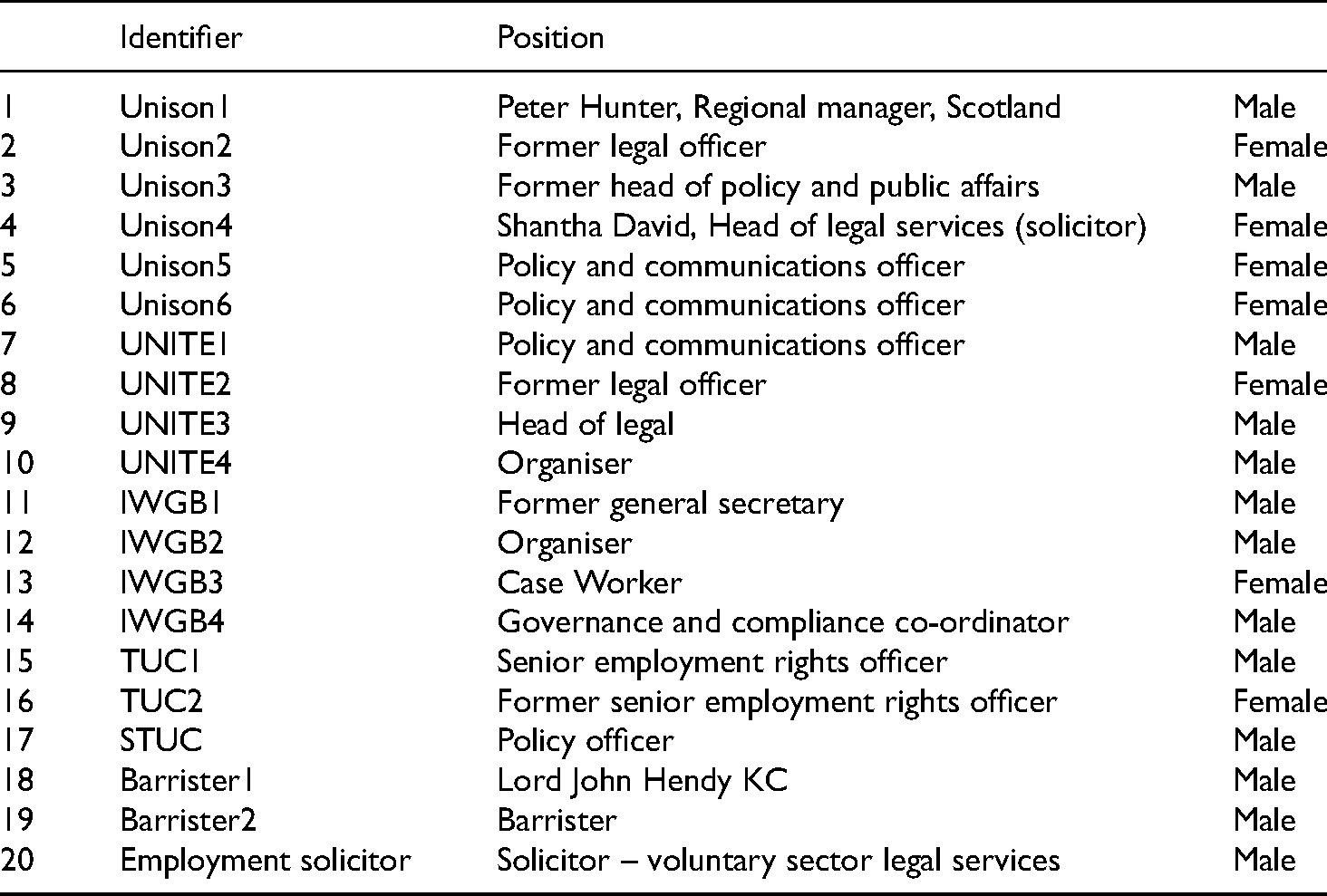
| Identifier | Position | ||
|---|---|---|---|
| 1 | Unison1 | Peter Hunter, Regional manager, Scotland | Male |
| 2 | Unison2 | Former legal officer | Female |
| 3 | Unison3 | Former head of policy and public affairs | Male |
| 4 | Unison4 | Shantha David, Head of legal services (solicitor) | Female |
| 5 | Unison5 | Policy and communications officer | Female |
| 6 | Unison6 | Policy and communications officer | Female |
| 7 | UNITE1 | Policy and communications officer | Male |
| 8 | UNITE2 | Former legal officer | Female |
| 9 | UNITE3 | Head of legal | Male |
| 10 | UNITE4 | Organiser | Male |
| 11 | IWGB1 | Former general secretary | Male |
| 12 | IWGB2 | Organiser | Male |
| 13 | IWGB3 | Case Worker | Female |
| 14 | IWGB4 | Governance and compliance co-ordinator | Male |
| 15 | TUC1 | Senior employment rights officer | Male |
| 16 | TUC2 | Former senior employment rights officer | Female |
| 17 | STUC | Policy officer | Male |
| 18 | Barrister1 | Lord John Hendy KC | Male |
| 19 | Barrister2 | Barrister | Male |
| 20 | Employment solicitor | Solicitor – voluntary sector legal services | Male |