




Abstract
Urbanisation, lifestyles and environmental degradation are associated with negative health and environmental outcomes through reducing greenspace access. These risks are not experienced equally across society. While useful concepts like ‘extinction of experience’ exist, sociological writing on these important themes remains underdeveloped. Using regression and analysis of variance with survey data representative of England’s population, this gap was addressed. This Sociology in Action article presents initial findings revealing inequalities according to ethnicity, sex, education and health. It stresses intersectionality’s importance while highlighting insightful avenues for sociological research as a discipline with much to contribute to existing debates. Concluding remarks strongly suggest mixed-method projects foregrounding intersectionality to investigate greenspace access inequalities, posing important questions with policy relevance.
Introduction
Access to greenspaces like parks and forests improves health, wellbeing and environmental concern. However, increasing urbanisation, sedentary lifestyles and environmental degradation pose access challenges. Negative outcomes for human health and environment values can result, well captured by the ‘extinction of experience’ (EOE) concept as a key literature suggesting important associations between access and a range of impacts on people’s health, wellbeing and care for the environment. Although EOE and greenspace literatures emphasise ethnicity, sex, age and similar as influencing access and associated risks, this Sociology in Action article stresses the importance of intersectionally approaching these challenges which has not yet been meaningfully undertaken. It suggests that sociology can fruitfully contribute to uncovering more complex societal inequalities regarding greenspace access, with intersectionality a critical social approach seeking to both understand and then challenge inequality’s sources and outcomes through uniquely centring on how an individual’s characteristics, like ethnicity and sex, interact to produce specific needs and unequal experiences. This article highlights the importance of adopting intersectional analyses with larger, generalisable samples. Only through this could existing access inequalities and associated negative outcome risks captured by EOE be identified and, through informing policy-makers about those at greater risk, challenged.
The questions addressed ask, what are the inequalities existing around greenspace access? What are existing studies’ current limitations around which sociology can make an important contribution? How far can intersectionality facilitate the identification and challenging of these inequalities? Using a Natural England survey of England’s population and a statistical approach involving regression and analysis of variance, the importance of intersecting identities was found. Collected between 2020 and 2023, these data centre on the accessibility, usage and opinion of greenspaces across England through a demographically representative sample of around 24,000 individuals annually.
Greenspace access outcome inequalities were found to be mostly associated with individuals’ ethnicity, sex, education and health in combination. Black females with lower educational attainment and health experienced the highest inequalities. University-educated White males in good health presented the highest greenspace access and thus lowest health outcome risks. Equally important differences existed among those sharing certain characteristics but differing in others, with consistently greater access by males than females across all ethnicity, education or health categories.
This exploratory analysis begins to address gaps within literature concerned with greenspace access and associated human and environmental value outcomes. This phenomenon is well captured by the EOE concept as a potentially useful frame for future research. However, existing analyses are found wanting both theoretically and methodologically through limited consideration of demographic factors’ interweaving that can produce diverse outcomes, alongside sample sizes that restrict generalisability. The greater detail these can provide about inequalities, their outcomes and means of responding will be of importance for policy-makers and civil society actors seeking to improve health and environmental values within society. Adopting intersectionality and advancing on the statistical analysis presented here would represent positive steps in this direction. The article concludes by outlining key questions and avenues through which sociology can make strong contributions to understanding and responding to these challenges. Greenspace, EOE and intersectionality are first discussed, followed by the methods and results addressing the above questions.
Greenspaces
Greenspace access importance is commonly stressed for improving people’s physical and mental health while supporting social connections, childhood development and pro-environmental values and behaviours (Buckland and Pojani, 2023; Das et al., 2017; Ferenchak and Barney, 2024). However, challenges emerge where access possibilities reduce through urbanisation, lifestyles and similar. The resulting lower access creates negative health and wellbeing risks and a disconnect with the environment. The ‘extinction of experience’ concept centrally used in natural science-leaning accounts of this phenomenon well captures this (Dean et al., 2019; Schuttler et al., 2018; Soga et al., 2019; Soga and Gaston, 2016). Yet, sociological understandings of these processes and resulting inequalities are lacking.
Literature suggests that older or female individuals have more access and less negative outcome risks, while non-White individuals have less access and thus higher risk (Schuttler et al., 2018; Soga et al., 2019). However, mixed accounts arise around the role of income (Buckland and Pojani, 2023; Robinson et al., 2023), or age (Dean et al., 2019; Kim et al., 2023), for instance. Greater detail is, therefore, required to develop targeted programmes addressing inequalities and associated risks, and reviewing the methods and data used so far indicates how this may be achieved.
Ferenchak and Barney (2024) used census data with GIS, emphasising income and transport network availability importance behind greenspace access. While noting ethnicity, this was absent from the analyses. Kim et al. (2023) found access differed most by age, with the elderly having less, but ethnicity was not associated with inequalities. While based on neighbourhood-specific models using community mobility datasets, age, ethnicity, income and education were discussed as separate, and not intersecting, perhaps accounting for ethnicity’s non-association. Knowing more about experiences of people with different ages, incomes and ethnicities simultaneously would have provided more detailed and insightful analyses. With linear models and representative survey data (n = 1147), Soga et al.’s (2019) EOE inequality research found females and elderly respondents had more greenspace encounters and less EOE risk in Japan. They again treated age, sex, income and other indicators separately, not in combination, with this unacknowledged within author-identified study limitations.
Qualitative insights also fall short in considering how intersecting identity markers could produce unequal outcomes. This includes studies identifying crime-related concerns around greenspace access that were unable to reflect possibly key ethnicity-related experiences through focus groups and interviews, with other demographic features notably absent (Fernandez et al., 2019; Gidlow and Ellis, 2011).
It becomes apparent that a strong sociological voice remains limited in this arena. This should be corrected given the insights that sociology could bring to greenspace inequality discussions, including from the sociology of space (Halford, 2004; Lewis et al., 2015; Strangleman, 2012). Intersectionality could also be key within these contributions.
Emerging from feminist studies, intersectionality has become widely adopted as both an epistemological and empirical approach to social stratification issues related to identity and inequality (Cho et al., 2013; Colombo and Rebughini, 2022; Tola, 2022; Yekani et al., 2022). It examines how historically and socially-constructed identity markers combine, producing specific subjectivities informing varying experiences of marginalisation (Cho et al., 2013; Collins, 2019; Colombo and Rebughini, 2022). Crenshaw (1989, 1991) – a foundational intersectionality writer – centred on Black women’s unique experiences, and this has been a central theme among intersectionality research that has placed emphasis on ethnicity-gender intersections. Others have nonetheless applied intersectionality to study Hispanic wage discrimination and LGBTQ+ concerns (Terriquez et al., 2018; White, 2023), addressing critiques of intersectionality as an approach that predominantly foregrounds Black women to others’ exclusion (Carbado, 2013; Yekani et al., 2022). Nash (2008) highlighted how risks to treat all Black women’s experiences as the same also exists here, emphasising instead an understanding that their subjectivity, like others’, can also differ according to intersections with additional identity markers like class or age (Colombo and Rebughini, 2022; McCall, 2005).
Intersectionality poses ongoing methodological questions concerning how to capture the complexity it theorises, with authors acknowledging the importance of the insights a range of different methods can bring, including quantitative studies (Colombo and Rebughini, 2022; McCall, 2005). This leads onto another important dimension through how intersectionality as action stresses creating social change by calling for practical responses to identified inequalities and their drivers. It can thereby explore the opportunities for resistance and change-creation that the subjectivities stemming from intersections produce (Collins, 2019; Collins and Bilge, 2016; Colombo and Rebughini, 2022; Hopkins, 2019; Nash, 2008; Terriquez et al., 2018; Tola, 2022).This article highlights this deeper consideration of identity and its importance, absent from EOE literature, with orientation towards understanding linkages between societal and environmental inequalities (Tola, 2022).
Data and methods
Natural England’s People and Nature 2020–2023 dataset was used (Natural England, 2022, 2023). The sample, representative of England’s population, was notably larger (n = 74,968) and more generalisable than common greenspace and EOE study samples of 500–6000 respondents from single years (Colléony et al., 2020; Dean et al., 2019; Soga et al., 2019). This generalisability, therefore, enables greater understandings of greenspace experiences and inequalities across the country, always with specific focus on England as a unique geographic area.
The survey covers greenspace perceptions and engagement, defined to include forests, urban parks, beaches and allotments, including access frequencies. Demographic data benefitting intersectional approaches was also available. This formed a strong basis for addressing questions regarding inequality identification, existing study limitations and how sociology can make important contributions, including through intersectionality.
The analysis involved two steps. First, an analysis of variance (ANOVA) to understand how different identity markers individually relate to greenspace access frequencies (the dependent variable), and thus associated health or environmental (EOE) risks. ANOVA results that provide estimations of variance from the mean were regressed. This provided coefficients indicating associations between every category of each individual demographic variable and access frequency, with comparison to a reference category under each variable. For example, frequency difference where respondents were Black compared to White, or on a higher income than the lowest that served as the reference. This remained similar to prevailing approaches within existing literature.
Building towards a more complex intersectional account, this was followed by a linear regression identifying demographic features demonstrating the strongest association with greenspace access. This model included controls based on literature findings, including greenspace walkability or quality. Predicted access probabilities were calculated for combinations of those variables found with the strongest and statistically significant associations.
This permitted an analysis of whether individual demographic variables are associated with greenspace access frequency alongside controls, and how these demographics begin to intersect to produce unique outcomes based on predicted margins. For intersectionality, such additive models have been noted as potentially insightful and important for identifying inequalities and reflection upon how to address them (Collins, 2019).
Variables are presented in the Supplementary Material (Table 1), including their categories and sample sizes. Control variables included region, year and whether Covid restrictions had increased greenspace access. They also included walkability, greenspace quality and improvement in the past 5 years, alongside the extent respondents feel happy in or connected to nature. The final sample using these variables was n = 63,510.
Findings
Supplementary Material Table 2 presents the regressed ANOVA, indicating how different demographic variables’ categories were associated with greenspace access frequencies. Higher educational attainment or income were associated with more frequent access, akin to previous studies (Buckland and Pojani, 2023; Gao et al., 2023; Robinson et al., 2023). Similar results were found regarding ethnicity with Black and non-White individuals having least access (Gao et al., 2023; Kim et al., 2023). Age-related findings somewhat differed from the literature that suggested older individuals enjoy greater access (Dean et al., 2019; Soga et al., 2019), but here had least access. Mixed support for common greenspace literature claims resulted. However, emphasis will be placed on the controlled linear regression through which demographic intersections were considered in ways currently absent from greenspace research. Supplementary Material Table 3 presents the full results.
The next section discusses what the model reveals intersectionally through predicted access across demographic variable combinations. Beforehand, the regression suggested employment status and long-term health lacked strong and statistically significant associations. Self-reported health status had the strongest association. This could reflect a double relationship whereby better health results in more greenspace access, and more access in better health (Das et al., 2017; Gidlow and Ellis, 2011). Clearer was female and older individuals’ lower access than males and younger people. This runs counter to numerous studies finding more frequent access for older people and females (Dean et al., 2019; Soga et al., 2019). Although others have questioned its relevance (Das et al., 2017; Kim et al., 2023), higher incomes were associated with more frequent access, supporting recent studies (Ferenchak and Barney, 2024; Robinson et al., 2023). Other notable results were for ethnicity, indicating that Black individuals had less access than Asian and, ultimately, White individuals. This was again congruent with common findings, similarly to how university education could increase access (Dean et al., 2019; Schuttler et al., 2018). Finding mixed support for literature assertions, this model began to underscore the need to reflect greater complexity in greenspace access and inequality analyses. Intersectionality can facilitate this.
Regarding controls, greenspace walkability was not significant unlike some suggest (Ferenchak and Barney, 2024), but support was found for the space quality and access relationship (Fernandez et al., 2019). Feeling connections to and happiness within natural spaces held strong and significant associations to access, speaking well to EOE-specific literature’s ideas of ‘orientation’ (Colléony et al., 2020; Soga and Gaston, 2016). Covid restrictions were associated with increased access and this could be investigated through later research.
Like greenspace literature, these analyses suggest possible areas of access inequality with potential consequences for health and environmental values. However, alone this approach misses potentially important ways in which individuals’ identity markers interact to produce different outcomes and sites of inequality. Building towards an intersectional agenda is consequently suggested and the following discussion indicates the importance of this.
Discussion
Figure 1 shows the predicted outcomes for different demographic combinations from variables with the strongest greenspace access associations from the controlled regression: ethnicity, sex, health and education. Clear inequalities are immediately noticeable in ways absent from previous studies. These are important to understand and redress to avert EOE’s negative consequences, namely, poor health and wellbeing with ambivalence or even dislike towards the environment.
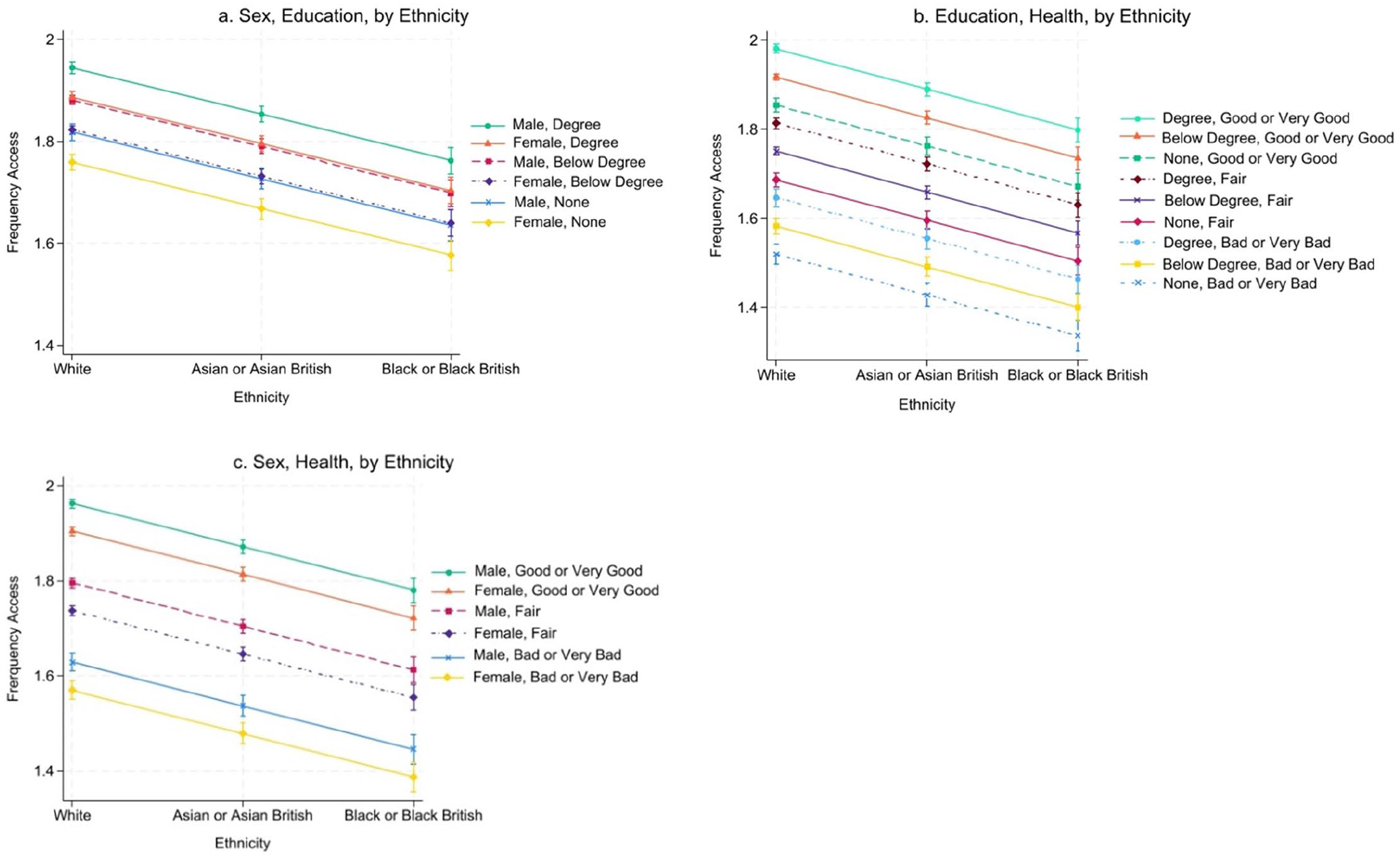
Frequency greenspace access: ethnicity, sex, education, health, linear regression, n = 63,510.
Specifically, females experience greater access inequality than males across education and health categories, especially for Black, then Asian, individuals. Across all demographic combinations, Black individuals had the lowest access and thus higher risks of negative outcomes. Education’s strong role for increasing access frequency was notable. However, clear and persistent sex-based inequalities remained regardless of education, with university-educated females of any ethnicity having similar access to males with lower educational backgrounds. This was true concerning health, with male-female inequalities observed among those with the same health status. This greater detail and complexity has been lacking in analyses despite clear advantages to considering how intersectionality could influence access. Sociological studies could importantly contribute to this line of enquiry by improving understandings of inequalities and informing targeted programmes or policies in response.
The questions posed earlier were the following: what are the inequalities existing around greenspace access? What are existing studies’ current limitations around which sociology can make an important contribution? How far can intersectionality facilitate the identification and challenging of these inequalities? The first was revealed through the predicted margins from the controlled regression, highlighting important differences based at ethnicity-sex-health-education intersections. At the extremes it suggested greater greenspace access for White, male, university-educated individuals in good health. Black females with bad health and no formal qualifications represented the opposite situation. Following the literature, this could have negative consequences for these individuals’ health, wellbeing and environmental values. They should, therefore, be prioritised in efforts to increase access and reduce negative outcome risks.
This chimes with recent reports into greenspace access inequalities in England which highlight how Black and other non-White individuals, and those from lower income households, experience greater access challenges with consequences for their wellbeing (House of Commons (HoC), 2024; Marmot Review, 2010). Observed among Black and poorer communities in London boroughs like Bromley, they are around two times more likely than White individuals to live in greenspace-deprived areas (FoE, 2020), and lower access rates were found to be pronounced for Black children (LGSC, 2020). Although age was not strongly associated with access through the above analysis, targeted interventions for older individuals with health challenges have been developed in England. This includes schemes in Merseyside and Dorset aiming to improve health outcomes through guided walks and gardening in greenspaces, focused on people with specific age and health profiles and promoted as examples of successful targeted interventions that could be replicated for those with EOE risks through greenspace-related inequalities (PHE, 2020).
This article’s results highlighted existing literature’s chief limitation as the absence of an approach striving to consider intersectional experiences behind access by focussing instead on single demographic characteristics. Intersectionality can build on these analyses by introducing greater depth and complexity that could hold important policy relevance for redressing societal inequalities.
Conclusion
Greenspace access is linked to better health and environmental care yet limited access poses risks to this through an ‘extinction of experience’. This article presented a nascent greenspace study using recent and generalisable data. Through regression and ANOVA, access inequalities were found that indicated EOE-related risks spread unevenly across society. Black females of different educational attainment and health had the lowest access frequency probabilities, followed by Asian females, including compared to Black males with equivalent education and health. White individuals of any sex, education and health consistently presented the highest levels. Clear inequalities exist, warranting increased attention within sociology, including greater engagement with concepts like EOE that helpfully foreground greenspace access inequality risks. An intersectional approach was also beneficial for revealing these inequalities and could inform targeted policy and programme development centred on addressing different communities’ unequal experiences. Doing so could address calls within recent greenspace reports in England that highlighted the need for further data (PHE, 2020), funding (FoE, 2020), and community engagement (HoC, 2024).
Sociological studies should further develop this, including through comparative cases, while expanding the methods and data used beyond the analyses conducted here. This could incorporate statistical analyses employing interaction terms comprising different demographic characteristic combinations like ethnicity and sex, or explore qualitative comparative analysis as possibly insightful ways to reveal intersectional identity and greenspace access inequality associations, including related health and environmental consequences, more clearly (Colombo and Rebughini, 2022; Schindler et al., 2022). Qualitatively exploring these associations to reflect on everyday lived experiences, including through focus groups, would be welcome to inform targeted policies and programmes by local and national authorities, alongside community-based organisations.
While the present analyses centred on England-specific data generalisable only within the country, additional studies could extend attention to different contexts, including through cross-country studies, to identify shared challenges and spaces for lesson-learning to redress greenspace inequalities. Research could reflect on wider contexts influencing greenspace access, including events like Covid-19, or regional histories of development reflected in population density and diversity, alongside related challenges such as housing quality, public greenspace investment and community engagement. Policies guiding greenspace prioritisation and funding opportunities may additionally be considered for possible associations with access and related inequalities.
Important questions going forward are the following: what greenspace and community health policies or programmes exist? To what extent are these sensitive to intersectional dynamics within communities? Could EOE be combined with intersectionality as a useful frame for evaluating and challenging current inequalities? What are individuals’ everyday lived experiences of greenspace access and engagement with natural entities? How could mixed-method approaches support this? What other sociological knowledges can be engaged with to enhance research in this arena? Where are the avenues for interdisciplinary collaboration to address these inequalities, including with urban planning, feminist and queer studies, health, psychology and/or ecology? Answering these questions while rooted firmly in sociological enquiry would be important to identifying observable inequalities, supporting efforts to tackle these in the communities in which we live.
Supplemental Material
sj-docx-1-sro-10.1177_13607804251355071 – Supplemental material for Uncovering Inequalities in Greenspace Access: An Intersectional Agenda for New Sociological Enquiry
Supplemental material, sj-docx-1-sro-10.1177_13607804251355071 for Uncovering Inequalities in Greenspace Access: An Intersectional Agenda for New Sociological Enquiry by Joshua Garland in Sociological Research Online
Footnotes
Funding
The author(s) disclosed receipt of the following financial support for the research, authorship, and/or publication of this article: This work was part-supported by the Swedish Research Council (Formas) through the project ICARUS: Illuminating power dynamics in Cross-scale Adaptation for more Resilient and jUst futureS [grant number 2022-01835].

Supplemental material
Supplemental material for this article is available online.
Author biography
References
Supplementary Material
Please find the following supplemental material available below.
For Open Access articles published under a Creative Commons License, all supplemental material carries the same license as the article it is associated with.
For non-Open Access articles published, all supplemental material carries a non-exclusive license, and permission requests for re-use of supplemental material or any part of supplemental material shall be sent directly to the copyright owner as specified in the copyright notice associated with the article.
