




Abstract
This short film is an artistic response to the collected observations and narratives from an intergenerational walking activity with residents in Woolwich, and for which Ms Tennison and Dr Markowski received pilot funding from the University of Greenwich. This artistic response, using authentic contributions by participants’ theatre, artistically augmented by Ms Tennison, a theatre maker, aims to be considered as ‘a celebration of Woolwich’, that is, a place that participants cherished to be part of, despite a lack of green spaces and nature and ailing infrastructure. The original voice recordings in the film reflect the strong ‘sense of belonging’ that this project captured from the participants who did not know each other before the project. The project’s outputs (including this video) show that Woolwich is a place where sustainability is treasured because participants felt safe and connected to Woolwich, and even more so after this participatory project. This film has been shared with local community organisations, so it could be used to strengthen discussions on and subsequent actions for sustainability.
Background
Achieving ‘sustainable cities and communities to make cities and human settlements inclusive, safe, resilient and sustainable’ is one of the 17 global goals by the United Nation with 10 specific targets to make cities and communities sustainable (Globalgoals.org, n.d.). The 10 specific targets range from safe and affordable housing, transport systems, inclusive urbanisation, environmental impact of cities (e.g. air pollution), access to green and accessible public spaces, development planning on national and regional levels, disaster risks reduction, as well as sustainable and resilient buildings to support least-developed countries (Globalgoals.org, n.d.).
However, do these targets match the understanding of ‘sustainability’ by local residents, who live in a multi-cultural and socio-economically diverse part of London? What is their meaning-making of sustainability when observing the urban and built environment while walking along a specified route in the area portraying the variety of borough? Are there differences in the observations by younger, middle-aged, and older residents?
We, Dr Marianne Markowski, a researcher with interests in intergenerational engagement and participatory design, and Helen Tennison, an experienced theatre maker with interests in developing community theatre and filmmaking, applied for funding within the Practice as Research & Knowledge Exchange (PARKE) framework from the University of Greenwich for a pilot project. The aim of our pilot ‘Sustainable City Stories’ was to collect narratives on place-based observations on opportunities for sustainability from an intergenerational group of local participants in Woolwich, London. We further wished to explore novel techniques for reflections and discussions on sustainability by involving a group of participants of different ages and to achieve a create output. Situated in the constructivist paradigm, we chose a participatory approach (Simonsen and Robertson, 2013; Urbaniak and Wanka, 2024) which involved photos, voice recordings, and narratives captured by the participants and ‘walking’ – alone as well as alongside each other – as a method to reduce power imbalances and to prompt ad hoc conversations and observations (Kowalewski and Bartłomiejski, 2020; Pitt, 2015; Ramsden, 2017). Using the material provided by the participants and the collected discussion points inspired us to create the short film ‘Sustainable City Stories – building connections through walking and creativity’. This short film portrays the stories of interpersonal connections with places and arbitrary routes, explored in the urban environment of Woolwich using a ‘psychogeographical style’. The film offers a snapshot of the understanding of ‘sustainability’ as local participants interpreted it and illustrates feelings of belonging to Woolwich and its communities, which was the overarching theme that came out in this project.
We, the project initiators, were unfamiliar with Woolwich at the time, yet we considered Woolwich as an ideal starting point to explore participants’ observations of sustainability due to its socio-economic and historical diversity. We understand the concept of sustainability as social sustainability (Lara-Hernandez and Melis, 2018; Washington et al., 2019), which is an umbrella term and considers economic, social, and environmental realms of cities to address social needs, the cultural life, and well-being for current and future generations.
Thinking of current and future generations, there is also a need to nurture intergenerational engagement to improve understanding between generations and to support community cohesion, which in turn improves societal cohesion (All Party Parliamentary Group (APPG), 2017; Kaplan et al., 2017; Krzeczkowska et al., 2021).
We therefore composed an intergenerational group of residents, who did not know each other prior to this project. We chose ‘walking’ on a specified route: first by the participants themselves to allow space for personal reflections, and second as a group to reduce power imbalances when walking alongside in the group (Figure 1) and to encourage spontaneous conversations inspired by the surroundings (Kinney, 2017). We decided to produce a short film with the original voice recordings by the participants to create an output, which portrays authenticity and serves as a starting point for discussions on the meaning of sustainability for local community members.
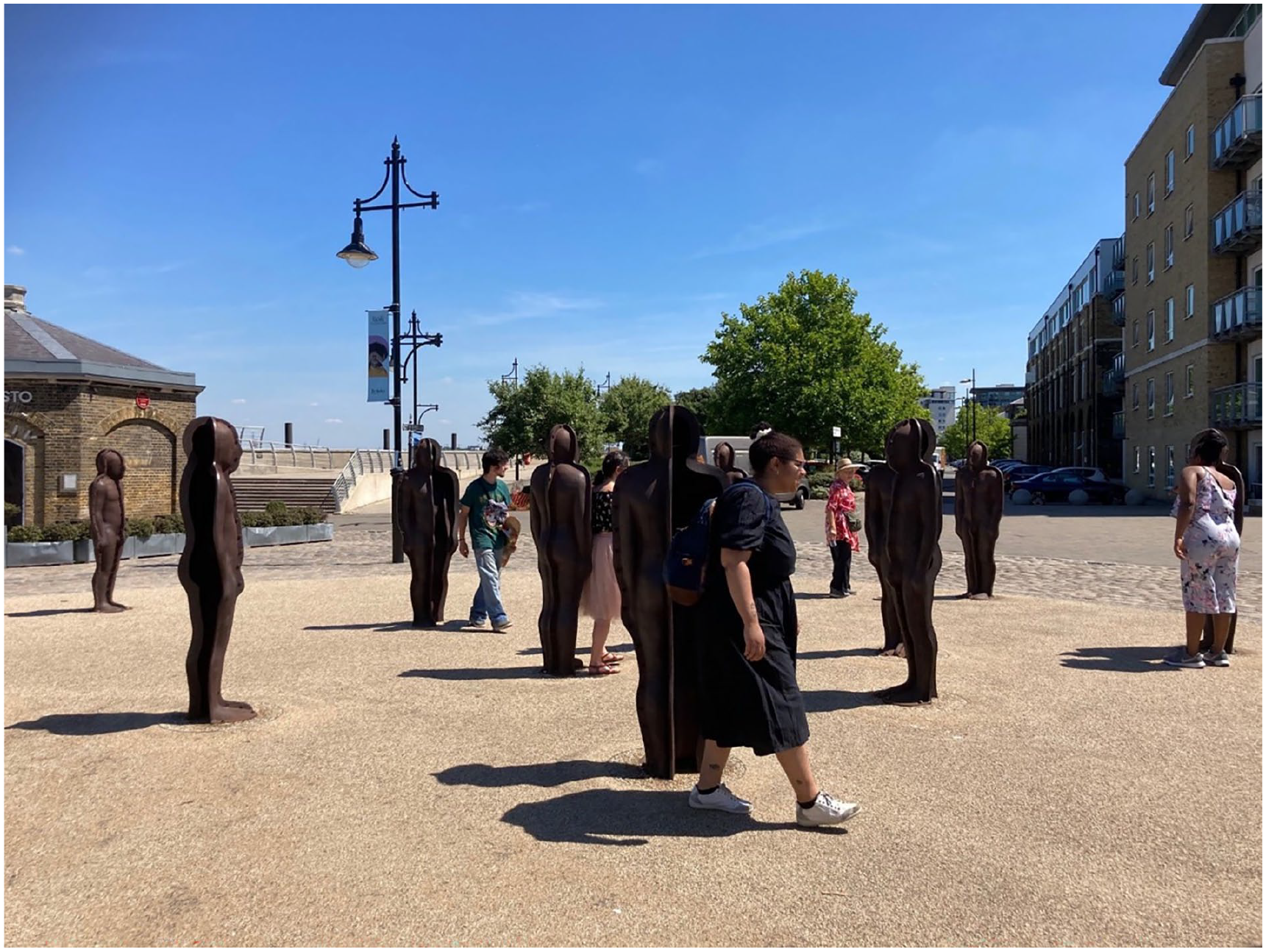
Picture taken during the group walk in Woolwich by Dr Markowski.
Our short film is a unique and original contribution to urban sociology because published research around sustainability from an intergenerational engagement perspective using a participatory approach including walking and creative practice is limited. For example, Wyness, 2015 carried out a small intergenerational social learning project, which explored sustainability-focused citizenship (Wyness, 2015). Kreutz explored views on a sustainably designed park by younger and older people and how this could support intergenerational connection (Kreutz, 2024). Kreutz found differences, but also many shared views, regarding the bio-diverse restoration of the lake, native wetland vegetation, and associated wildlife. This echoes the core tenet of the book by Kaplan et al. (2017), which states that the intergenerational vision is strikingly congruent in the quest to establish a sustainable way of life, yet multigenerational engagement (rather than simply involvement) is needed to positively impact quality of life, healthy human and community development, and the preservation of the natural environment.
Project setup and participants
The pilot project took place in Woolwich in summer 2022.
In June 2022, we, the project initiators, met to scope the route through Woolwich with the aim to choose a walk no longer than 1 hour long at a comfortable walking pace and to include variation in built environment. The route also needed to be accessible because we needed to be inclusive, which meant that we had to cater for possible participants with mobility issues or wheelchair use.
We decided to start the route (Figure 2) from the Bathway theatre (as we met there at the internal funding event and had access to rooms) and to go from there to the main shopping street, then across the A206 to the new housing developments towards the Thames (where large investments took place, and the area was gentrified), and back past the General Gordon Square, then past the Townhall before returning to the theatre.
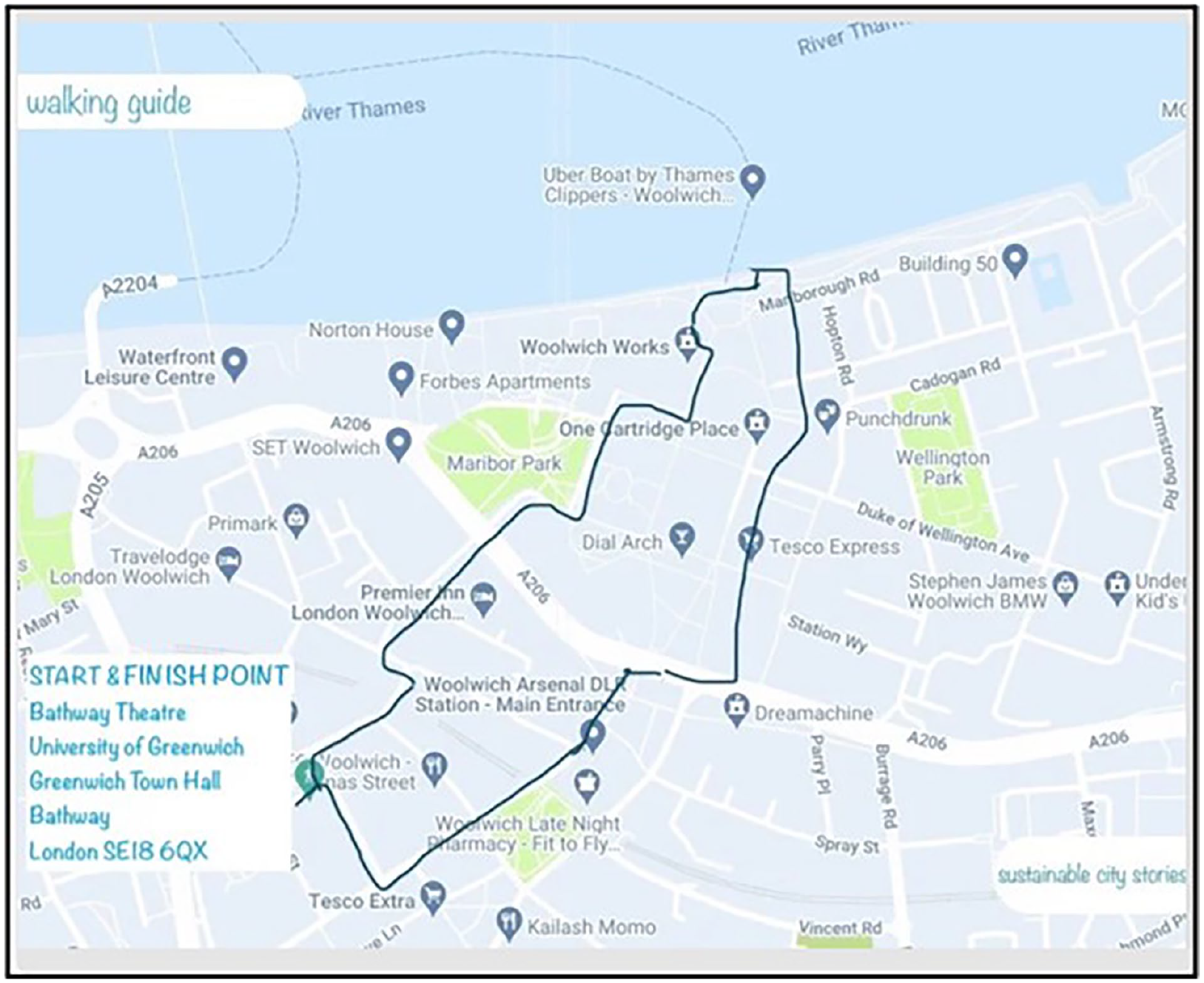
Screenshot of the map for the specified route in Woolwich.
Participants were recruited through local organisations, who sent out electronic and physical flyers. The participant selection process had two stages: first, potential participants had to express an interest by a certain date, and second, the project team selected the participants to ensure an intergenerational and diverse mix of backgrounds. However, due to short project lead times (2 weeks to express interest), only a limited number of participants responded. The selected participants’ ages ranged from 18 to 72 years, with the ages roughly evenly spread in between. There were four female and two male participants. Four participants were white British, and two had African and Caribbean backgrounds. The term sustainability was intentionally not defined, but the following questions were provided as prompts for their personal walk. We devised these prompts based on our notion of social sustainability:
Which places encountered on your walk make you feel welcome, safe, or good?
Which places make you feel uncomfortable, unwelcome, or otherwise bad?
Where do you see sustainability in action or opportunity for more sustainable interventions?
Is there anything that particularly interests or inspires you and prompts opinions, feelings, or memories?
We reviewed the material sent by each participant and composed a slideshow of the images taken and a selection of voice recordings as discussion points for the group walk.
Two weeks after participants carried out their own walk, we met with the six participants to walk the route together, stopping at certain points to listen to recordings and reflect on the observations made and discuss the meaning-making in the group. It was surprising how much knowledge, particularly local history knowledge, was shared by the participants with everybody contributing equally. The group walk was not recorded as this was technically impractical (e.g. outside noises) and might have stilted the spontaneous contributions. Our walk ended with a concluding group discussion at the Bathway Theatre on the experience of this project.
Collected themes and feedback
From the group discussion, five themes were developed: (1) the difference in interpretation of ‘sustainability’, (2) the need for more ‘green’ (plants, trees) in Woolwich, (3) the action by individuals versus the lack of action by the government, (4) the feeling of safety in Woolwich, and (5) local history as conduit to sustainability.
Overall, we found that the sense of belonging (Hurtado and Carter, 1997; Strayhorn, 2012) and the wish to act sustainably (e.g. maintaining existing ‘old’ buildings, reusing abandoned spaces, and making spaces green and accessible for anyone) appeared to be deeply intertwined. We found that there were no differences in the sentiments for sustainable action between the different age groups with our participants.
Inspired by the participant’s contributions, Ms Tennison instigated the production and editing of the short film in a ‘psychogeographical style’ as this allowed us to emphasise the interpersonal connection to places and arbitrary routes. This meant we added visuals from a different perspective (e.g. walking backwards, street-level filming) with photos provided by the participants. We were inspired for this style by Hardman’s work around the Dundee Dice Walk (Hardman, 2019). Yet, we employed the original voice recordings as the soundscape to bring out a sense of authenticity for the observations.
The film epitomises this sense of belonging by our participants while bringing out the array of stories, the beautiful and the neglected views and areas, since it all formed part of what the participants cared for when they looked for ‘sustainability’ in Woolwich.
Feedback on the film by the participants showed that it achieved its purpose of capturing this sense.
One participant wrote: I’m very pleased with the end product. I have definitely learned a lot about Woolwich recently from this project. We saw some disused spaces which were filling with litter in an unsustainable way, however these could be opportunities for sustainable new areas to be built in.
Another participant wrote: The movie, it’s really nice to watch and how you have merged our thoughts together, it’s very collaborative. My feelings for Woolwich’s sustainability have changed because since the project I have become aware of how more important sustainability is within the community. The benefits and impact of taking part in projects like this is the awareness it encourages, as a part of the community we need the be self-aware of our environment and how our activities affect the growth or undergrowth of the community.
We shared our short film with local community organisations and the sustainability network in our university, with the aim of strengthening discussions on and subsequent actions for sustainability by our residents and activists. Although we have not formally collected feedback, one idea fed back to us was to organise a sustainability festival to inform residents about sustainable behaviours and offer a clothes swap and item exchange between residents for re-use.
The short film has also been shared at two conferences to date to further the discourse and research opportunities around intergenerational engagement, participatory approaches, and sustainability.
Footnotes
Acknowledgements
We would like to thank all our participants for being a part of this pilot project: Kevin Godby, Hannah Harris, Illona Linthwaite, Raolat Olamitoye, Amos Wilson, Kirsty Wyatt. We extend our thanks to the technical team Matt Eaten – sound engineer; Andy Barker – videographer; Ed Curry – technical support at the Bathway Theatre. And finally, a thanks to Dave Hockham and the staff at the Bathway theatre for supporting our project.

Funding
The author(s) disclosed receipt of the following financial support for the research, authorship, and/or publication of this article: This project was funded (£3000) as part of the University of Greenwich’s Innovation Fund and as part of the Practice as Research and Knowledge Exchange (PARKE) initiative. The PARKE Framework was developed by David Hockham, Ghislaine Boddington, and Jorge Ramos Zisels, co-directors of the research group CLEI – Co-Creating Liveness in Embodied Immersion.
Ethical considerations
This pilot project was considered a knowledge-exchange activity with the participants and community groups, and therefore, no ethical approval was sought, yet good practice standards were adhered to. We followed the university’s procedures in gaining written consent before recording participants’ voices, storing their audio and visual contributions, and by storing personal data in line with General Data Protection Regulation regulations. We also have consent by the participants to display their names at the end of the film. It was important to them because they found it rewarding to be part of the project. Permission by the council to film public places was sought by Ms Tennison. Participants were paid £100 for participation and for their audio and visual contributions.
Accreditations
Intergenerational researcher and project lead: Dr Marianne Markowski
Artistic producer and project lead: Helen Tennison; Instagram @helentennisontheatre
Our technical team:
Matt Eaton – Sound engineer
Andy Barker – Videographer
Ed Curry – Technical support at the Bathway Theatre
Supplemental material
Supplemental material for this article is available online.