



Abstract
The rise of ‘imposter participants’ in research – individuals who misrepresent their identities or experiences to gain access to studies1 – has become a contentious issue, particularly as online research methods have expanded since the COVID-19 pandemic. While existing literature suggests indicators and strategies for identifying such participants, current approaches may risk excluding marginalized groups. This article reframes the discussion, arguing that the current focus on detection and exclusion requires broader epistemological debate. We propose that, rather than focusing on better screening tools, social sciences should use imposter participants to reflect on authenticity in research and authority in knowledge production. These reflections are a crucial first step in addressing broader questions of inclusion, exclusion, and research integrity. Rather than offering solutions, this article seeks to provoke a conversation about the evolving challenges of participant verification in an increasingly digital and diverse research landscape.
Introduction
In recent years, the term ‘imposter participants’ has gained significant traction in the social sciences, particularly in health research, to refer to participants who misrepresent their identity and/or experiences to take part in research, potentially for monetary compensation. There is a wide variety of terminology to describe suspected participants such as ‘imposter participants’ (Ridge et al., 2023; Roehl and Harland, 2022; Santinele Martino et al., 2024), ‘fraudulent participants’ (Davies et al., 2024; Lawrence et al., 2023; Sefcik et al., 2023), or ‘fraudulent survey takers’ (Salinas, 2023). Other authors, instead, focus on the acts, using terms such as ‘participant dishonesty’ (Hydock, 2018) or ‘suspicious participation’ (Lawlor et al., 2021). The data produced are also sometimes referred as ‘fraudulent entries’ (Guest et al., 2021), or ‘suspicious data’ (Salinas, 2023).
Imposter participants are described as a growing threat to research rigour and validity (Drysdale et al., 2023; Ridge et al., 2023: 941). The rise of online research, accelerated by the COVID-19 pandemic, has brought this issue into sharper focus. As researchers increasingly rely on digital methods for data collection, the risk of encountering imposter participants has grown. In response, there has been a surge in literature aimed at detecting and excluding these participants to protect the validity of research data.
As Santinele Martino et al. (2024) explain, most discussions around imposter participants have focused on quantitative research, with efforts directed at identifying them through ‘red flags’ and developing strategies to exclude them from participation. Recently, this discourse has expanded to qualitative research, particularly interviews, where imposter participants may offer misleading narratives (Sefcik et al., 2023). Nonetheless, the ethical complexities and challenges unique to qualitative research remain understudied (Jones et al., 2021), particularly with respect to the implications for inclusion, justice, and equity in research.
The prevailing focus on identifying and excluding imposter participants may inadvertently reinforce exclusionary practices, particularly for marginalized groups: stringent screening methods designed to verify participant authenticity, such as identity checks or biometric verification, can have the unintended consequence of excluding vulnerable populations. This raises fundamental questions about the ethical balance between maintaining research rigour and ensuring inclusivity.
This article provides a scoping review of the emerging literature on imposter participants, summarizing indicators and recommendations for screening them out. We then critically analyze this literature questioning it from three axes of exclusion: socio-economic exclusion, cultural barriers, and privacy concerns. We suggest that existing literature has, to date, not fully engaged with the epistemological implications of imposter participants in relation to rigour, inclusivity, trust and authenticity. We propose that, rather than focusing on better screening tools, social sciences should use imposter participants to reflect on authenticity in research and authority in knowledge production. These reflections are a crucial first step in addressing broader questions of inclusion, exclusion, and research integrity.
Methodology
For this study, we conducted a preliminary scoping review (Munn et al., 2018) on imposter participants in health-related research. We chose to focus on health-related research because it often seeks to have an impact on policy and practice, such as informing regulatory reform. Our search terms included ‘imposter participants’, ‘fraudulent participants’, ‘healthcare’, ‘solutions’, and ‘red flags’. We searched PubMed and EMBASE, covering various disciplines and methodologies. We also reviewed references. Articles focusing solely on bots were excluded. Selected articles were classified by discipline, journal, research method, indicators of imposter participants, and screening strategies.
Results
The review identified 14 articles, of which 12 were included. In this section, we provide an overview of key findings from the literature on imposter participants, highlighting gaps and the need for further exploration. We summarize the evidence, focusing on the main themes related to exclusion and its impact. This will be followed by a critical discussion on the role of social sciences in addressing these challenges and offering interdisciplinary solutions for enhancing research integrity and inclusivity.
Perceived indicators of imposter participation
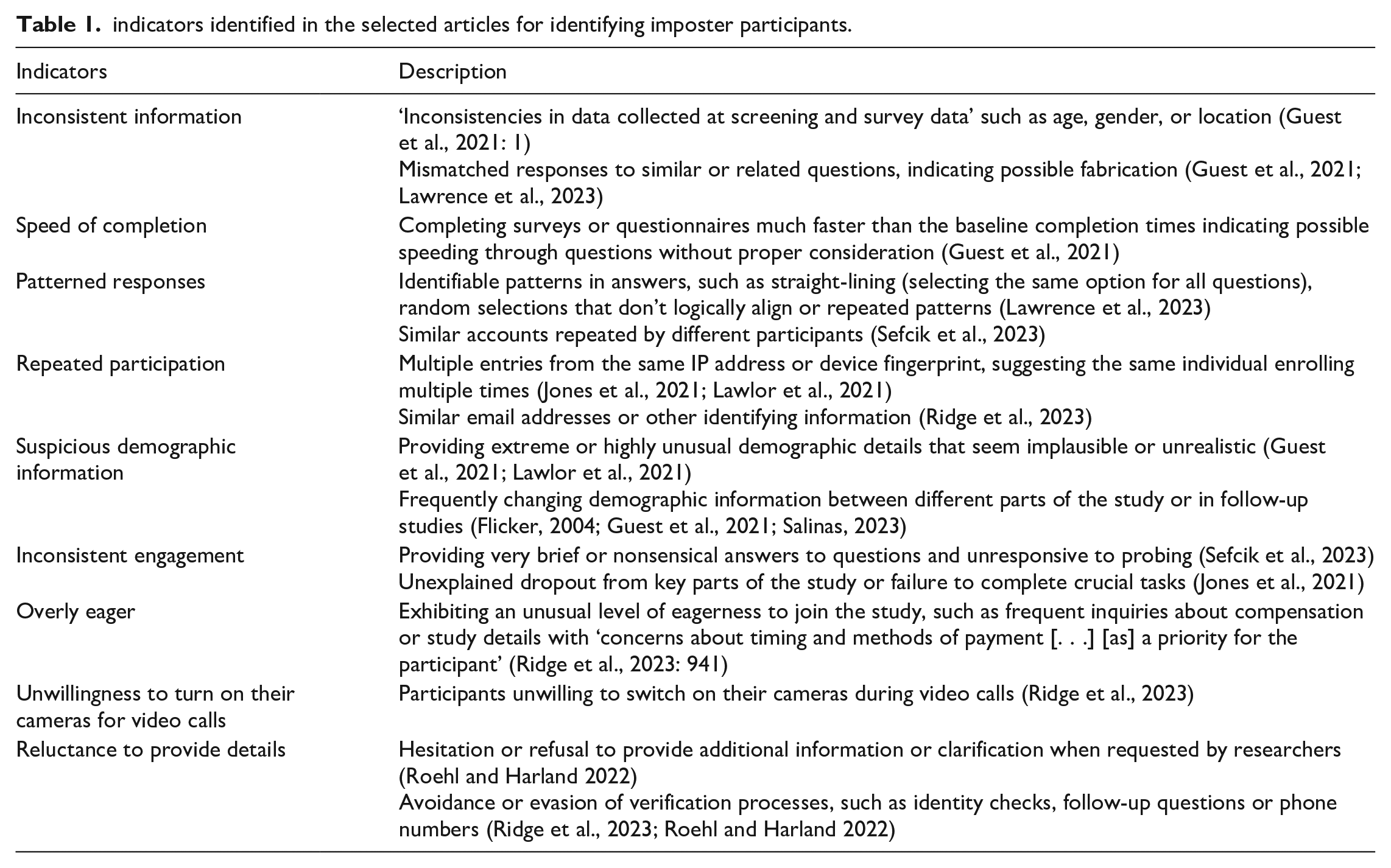
The existing literature provides a wide array of indicators of potential imposter participants (Table 1). It is worth noting that, in some articles, indicators are referred to as ‘red flags’ (Santinele et al., 2024: 1293), which could be argued to imply negative and antagonistic connotations.
indicators identified in the selected articles for identifying imposter participants.
Strategies to screen out imposter participants
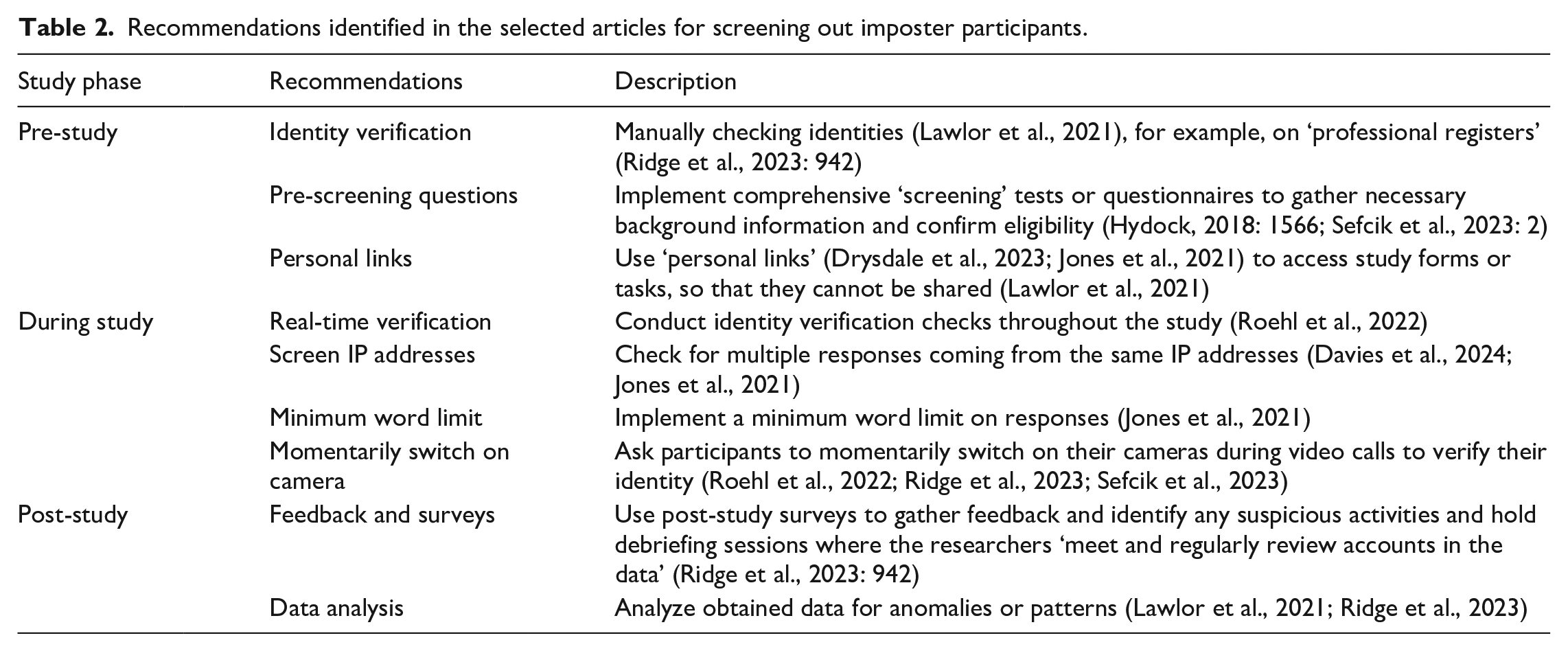
The reviewed articles also offered recommendations to screen out imposter participants at different stages of the research. These are summarized in Table 2 according to study phase: pre-study, during the study, and post-study.
Recommendations identified in the selected articles for screening out imposter participants.
Discussion
The literature on imposter participants predominantly focuses on methods for identifying and excluding individuals who do not meet study eligibility criteria. These methods often rely on ‘red flags’ – indicators such as inconsistent demographic information, mismatched responses, or unusually fast completion times – that suggest potential fraud meriting exclusion. While these approaches are valuable for maintaining the validity of research data, they raise significant ethical concerns about the exclusion of legitimate participants, particularly those from marginalized communities. In this section, we explore three key areas where more debate is urgently needed: socio-economic inequality, cultural diversity, and privacy concerns.
Before doing so, there are three characteristics of the reviewed work worth highlighting. First, much of the literature emerges from medical, and psychological fields, which are often concerned with positivistic notions of validity. Second, and related, there is little work that considers the particularities of qualitative research, despite the fact that there is a growing recognition of ‘the unique challenges and experiences of facing fraudulent participants in the context of qualitative research methods involving interviews’ (Santinele et al., 2024: 1293). And, third, the vast majority of work is anecdotal (based on a team’s particular experiences) and/or reactive (discussing experiences of imposter participants after encountering them). Exceptions to this are the work of Lawlor et al. (2021).
Socio-economic inequalities: a risk of exclusion
One of the most pressing concerns surrounding the exclusion of imposter participants is the potential for socio-economic inequality to play a role in who is excluded. Many of the current strategies for verifying participant authenticity – such as requiring government-issued identification or the use of digital verification tools – place significant barriers in the way of socio-economically disadvantaged individuals (Alonso-Curbelo, 2022; Patel and Baptist, 2012; Robinson et al., 2015; Selwyn, 2004). For example, refugees, undocumented immigrants, or those experiencing homelessness may lack access to the necessary identification or technological infrastructure to participate in research. As a result of these barriers, the very populations that are often most in need of representation in research – those who experience socio-economic disadvantage – are at risk of being excluded.
This issue is particularly concerning in health research, where the underrepresentation of marginalized groups can skew research findings and perpetuate health disparities. Exclusion from research not only limits the generalizability of findings but also reinforces the marginalization of already vulnerable populations. For example, research on health outcomes in socio-economically disadvantaged communities may fail to capture the full extent of health inequities if large segments of these populations are excluded due to stringent participant verification practices.
Rather than viewing imposter participants solely as a threat to research integrity, we argue that this issue should be reframed as a question of epistemology and methodology as a first step to discussing how we can ensure that research is both rigorous and inclusive, and how to strike a balance between verifying participant authenticity and ensuring that vulnerable populations are not excluded from research.
Cultural barriers: rethinking ‘red flags’
The use of ‘red flags’ to identify imposter participants – such as inconsistencies in demographic information, overly eager participation, or refusal to provide personal details – raises important questions about cultural diversity and researchers’ underlying assumptions about participant behaviour. Many of the behaviours that are flagged as suspicious by researchers may be indicative not of fraud but of cultural differences in engagement with research (Flores, 2006; Kennedy and Sun, 2021).
For example, the assumption that participants who are overly eager to join a study are likely imposters may disproportionately affect individuals from low-income or minority communities who are motivated by the financial compensation offered by research studies, or who have different cultural norms around trust and authority. These behaviours, which are often flagged as signs of imposter participation, may in fact be reflective of the diverse ways in which individuals engage with research.
The use of ‘red flags’ also reflects broader assumptions about participant authenticity. What does it mean to be an ‘authentic’ participant? How do we define authenticity in the context of research, and who gets to decide what constitutes legitimate participation or data? This is particularly relevant in research contexts where there already often exists a significant power imbalance between the researchers and the researched, such as when exploring the experiences of marginalized or underserved communities, where participant narratives are often shaped by personal and cultural experiences that may not align with the expectations or experiences of researchers.
Privacy concerns: balancing integrity and trust
The use of stringent verification processes, such as biometric authentication or requiring participants to turn on their cameras during interviews, raises significant privacy concerns. These measures, while aimed at ensuring participant authenticity (and, in the case of using cameras, even increasing inclusion by allowing participants to take part who would not do so face-to-face), may deter legitimate participants from engaging in research, particularly those from marginalized communities who have a history of mistrust in institutions and for whom the collection of personal data – such as biometric information or video recordings – represents a significant invasion of privacy.
This creates a tension between maintaining rigour and building trust with participants. On the one hand, researchers have a responsibility to ensure that the data they collect are rigorous. On the other hand, they must also ensure that their research practices do not further marginalize or exclude vulnerable populations (Pratap et al., 2020 and Seh et al., 2020). This issue is particularly acute in research on sensitive topics, such as health, sexuality, or mental health, where participants may be especially concerned about the confidentiality of their personal information (Kang and Hwang, 2023). In these contexts, the imposition of stringent verification measures may deter individuals from participating, leading to underrepresentation of certain groups in research findings.
A call for a social science intervention
The issue of imposter participants presents a unique challenge for the social sciences, one that requires a broader, more critical engagement with the epistemological questions surrounding imposter participants and participation more broadly.
On the one hand, researchers should maximize inclusivity, building trust with participants and removing barriers to research to ensure that legitimate participants are not excluded even if their responses seem unusual (Jones et al., 2021). In this sense, Santinele Martino et al. (2024) ask: ‘are we excluding eligible participants due to our suspicions and creating barriers for participants who are so often questioned and silenced?’ On the other hand, however, there is a need to exclude imposter participants given that their ‘inclusion [. . .] diminishes the value of legitimate responses’ (Lawlor et al., 2021: 7). This puts researchers between a rock and a hard place – balancing the need for inclusivity with the need to protect the integrity of research from imposter responses.
As evidenced earlier, while some research has addressed this issue, it has done so within a framework that considers imposter participants as a technical problem to be solved: a ‘problem’ of balance between rigour and inclusivity to be fixed.
Instead, we argue, social sciences should seek to reframe imposter participants as an opportunity to engage in broader, epistemic conversations about ways of knowing, authority, inclusivity, and rigour. We believe that such conversations should start by reflecting on the notion of ‘authentic participants’.
The current focus on identifying and excluding imposter participants is rooted in unquestioned assumptions about authenticity that may not fully capture the complexity of human experience: it portrays imposter participants and ‘authentic participants’ as distinct categories that can be separated and classified if only better screening methods are developed.
We believe this underlying approach does not align well with the epistemology of social sciences. Unlike positivistic approaches that seek an objective ‘truth’, social science researchers focus on ‘describing, interpreting, and understanding the meanings which people attribute to their existence in the world’ (Cutcliffe and McKenna, 1999: 375). This requires acknowledging that lived experience is often messy, contradictory, and fluid (Heaphy, 2018; Pope and Mays, 1995). Rather than striving for fixed, objective data, qualitative research emphasizes trustworthiness and authenticity (Lincoln and Guba, 1985), embracing the fact that participants’ responses are shaped by context.
In this way, we argue that social sciences should intervene in discussions about imposter participants not to suggest ‘better’ or more precise screening tools but to reflect on what and how imposter participants tell us about what we deem to be ‘authentic’ in research and who holds the authority to do so: how can we use imposter participants to reflect on our knowledge-making practices.
We believe that such conversations about the epistemology of authenticity in relation to imposter participants are a necessary first step to tackle the necessary conversations about inclusion and exclusion that this literature review has identified. Discussions about authenticity and imposter participants should inform subsequent questions: How can we ensure that research is inclusive and representative of diverse populations? How do we balance the need for research integrity with the ethical imperative to include marginalized voices? And how can we develop research practices that are both rigorous and equitable?
We believe that social sciences are uniquely positioned to lead this conversation. As disciplines grounded in critical reflection, the social sciences have the tools to engage with the complex ethical and epistemological questions posed by imposter participants. By reframing the issue as a call for debate and reflection, we can ensure that our research practices are not only rigorous but also inclusive, equitable, and just.
Conclusion
The rise of imposter participants in research presents a unique and urgent challenge, one that cannot be resolved through discussing technical fixes alone. This article has sought to provoke a broader debate within the social sciences about the epistemological implications of imposter participants.
Rather than treating imposter participants as a technical problem to be solved, we argue that this issue should be framed as an opportunity to re-examine our assumptions about participant authenticity as a first step to reflecting on how we can ensure that our research practices are both rigorous and inclusive.
Footnotes
Funding
The author(s) disclosed receipt of the following financial support for the research, authorship, and/or publication of this article: This work has been funded by the Medical Research Scotland Summer Vacation Studentship (VAC-1957-2024) and the Economic and Social Research Council (ES/X003604/1 and ES/W002426/1).
