




Abstract
The article examines different articulations of solidarity discourse in Germany and in Italy during the COVID-19 crisis, demonstrating how its meanings varied between the two countries in conjunction with national contingencies influencing how the crisis was experienced. Text analysis with Twitter\X data is used to compare how the term was framed during the crisis. The two countries were selected based on their differing socio-economic, cultural, and institutional conditions before the pandemic and varying consequences, with Germany’s stronger welfare regime performing relatively better. Results show how solidarity is framed differently in both countries, with a commitment to public health and civic engagement in Germany and to social solidarity and local practices of assistance in Italy. The contribution underlines the value of reconstructing the varying meanings of solidarity under different societal conditions to understand its role as a catalyst for social resilience.
Introduction
Emile Durkheim (1997 [1893]) proposed that solidarity is fundamental to the integration of societies. Especially in times of crisis, societies need to publicly make sense of ruptures in their social bonds as necessary for the mutual interdependence of citizens (Fonseca et al., 2019). The COVID-19 pandemic posed a profound challenge to social cohesion. Putting the resilience of societies and the agency of policymakers to the test (Boin and ‘T Hart, 2022), the crisis has prompted massive calls for solidarity. The rapid diffusion of the virus and its cascade effects on various sectors, from healthcare to the economy to daily life (Capano et al., 2020), generated an immense demand for mutual support, ranging from local volunteering (Bertogg and Koos, 2021) to transnational financial solidarity (Kyriazi et al., 2023).
However, as the crisis proceeded, differing vulnerabilities to infections or unequal economic consequences of lockdowns along socio-economic or ethnic lines were exposed (Morante-García et al., 2022; Nolan, 2021; Stok et al., 2021), threatening social unity as shown by the varying levels of public support for solidarity depending on socio-economic status and crisis perceptions (Bauhr and Charron, 2021; Bobzien and Kalleitner, 2021; Schröder et al., 2022). The Durkheimian point becomes crucial here: How do societies negotiate priorities, weigh the vulnerabilities of various social groups, and judge their deservingness of solidarity? And how is this affected by economic, political, or institutional conditions and contexts?
Following Kneuer et al. (2022), we regard solidarity as a multilevel and dynamic concept continuously negotiated by actors with different needs and goals. In this view, the meanings of solidarity are established discursively, as the public engages in an ongoing dialogue to shape and redefine its scope and applications. We argue that, for the call for solidarity to effectively address the uncertainties caused by COVID-19, it is necessary to first deconstruct this discursive dimension, mapping out the meanings of solidarity in relation to the challenges and conditions of the context they emerge from. We propose a comparative approach through computational text analysis in the reconstruction of solidarity in Italy and Germany, as two countries that differed for such contingencies during COVID-19. The implications of our contribution are twofold: theoretically, to comparatively map out the semantic associations of the term solidarity in diverse contexts over time; methodologically, to foster the application of new computational methods of text analysis for comparative research.
The case of Italy and Germany
We compare Germany and Italy as two countries differing in their antecedent conditions and institutional resilience to the crisis. As Figure 1 shows, Italy experienced more fragile economic conditions before the crisis compared to Germany. The figure also shows how the peak of new cases and deaths was higher for Italy, especially in the early stage of the pandemic. As one of the first European countries from which the disease spread, Italy was left with very little time to adjust. Scholars argue that Italy was also ill-equipped to handle a pandemic like COVID-19 due to the absence of emergency protocols and an underfunded public welfare system (Capano, 2020). Poor coordination between regions and slow parliamentary legislation failed to limit the cascade effects of the crisis on various sectors of public life (Pianta et al., 2021). Germany, in contrast, implemented tried and tested recovery procedures (e.g. emergency relief payments or short-term work schemes) supported by higher coordination between federal states and high levels of compliance by the population (Schröder et al., 2022). Germany’s greater financial stability before the crisis resulted in a more stable recovery (OECD, 2020, 2021), as shown in Figure 1, for gross domestic debt and unemployment from Eurostat data. We argue that these contextual differences influence how citizens perceived the crisis and the extent to which they felt protected or threatened (Sachweh, 2019), thereby also shaping the semantic construction of solidarity and surrounding ideas of deservingness.
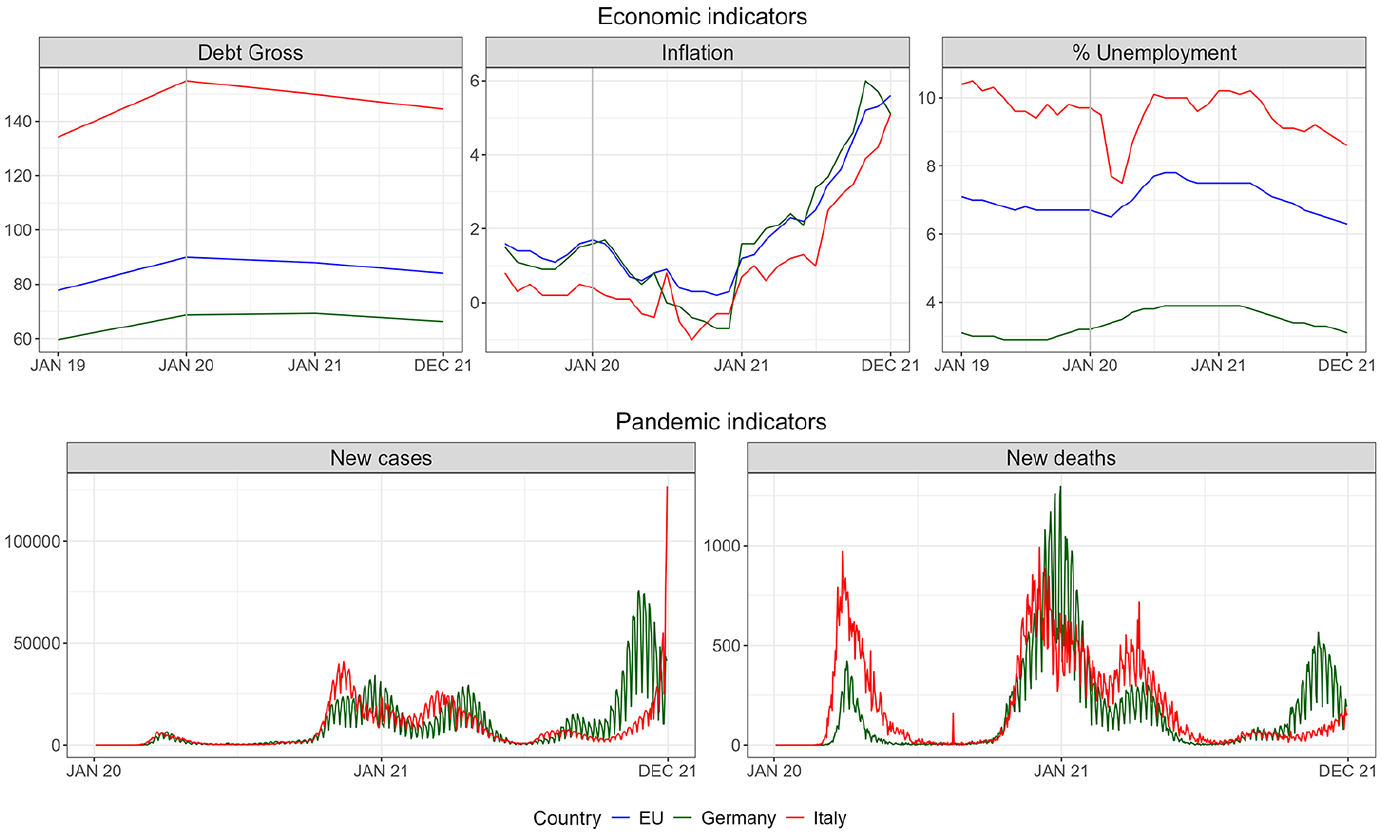
Economic (source: Eurostat) and pandemic indicators (source: World Health Organization).
Computational text analysis: a tool for comparative research
Computational methods for text analysis can be valuable for social research. Closely related to tools for computer-assisted qualitative data analysis (CAQDAS), they add the application of statistical techniques to qualitative inquiry applied to large amounts of data (Grimmer et al., 2022; Nelson, 2020) integrating sources from online and offline communication. We use a series of unsupervised techniques (Boumans and Trilling, 2018) that best fit our goal to detect semantic patterns of solidarity in the text-as-data based on frequencies and association between words.
While the application of computational methods in the social sciences is on the rise (Edelmann et al., 2020; special issue by Bonikowski and Nelson, 2022), there is still a scarcity in comparative research (Baden et al., 2022; Lind et al., 2022) despite promising applications. First, social media platforms offer large amounts of anonymized longitudinal data from around the world (Wiedemann, 2013), which can be collected in real time during the unfolding of major political or economic events. Moreover, understanding the qualitative forms of cultural meanings and sociological imagination better relies on approaches that examine the semantic structures of words (Stoltz and Taylor, 2021). We utilized data from Twitter\X, a widely used source for social research nowadays (Weller et al., 2013), and used to investigate social movements such as Black Lives Matter and debates on COVID-19 (Shugars et al., 2021).
Data collection
We collected a sample of tweets (corpus) from each country via Twitter\X’s API interface upon contract with the provider, looking for tweets containing the hashtag #solidarity in the original language 1 from 1 January 2019 to 31 December 2021, that is, from before the start of the pandemic to its peak and containment. We excluded retweets and duplicates, and used the cosine similarity equal to .90 as threshold for tweets too similar, which would have affected results. We identified compounds and translated tweets into English. We checked for tweets associated with accounts located in either of the countries. 2 Our final corpus comprised 27,213 tweets for Germany and 13,228 for Italy.
Results: #solidarity in COVID-19 discourse in Italy and Germany
We first investigate if COVID-19 impacted the usage of the term #solidarity in the two countries. In Figure 2, we plot both the raw frequency of mentions to #solidarity and the term frequency-inverse document frequency (tf-idf), that is, a measure that distinguishes what words are more specifically associated with one month compared to others. The figure shows how the term #solidarity peaked in Italy and Germany during the early months of the pandemic, with the most distinctive terms being related to COVID-19.
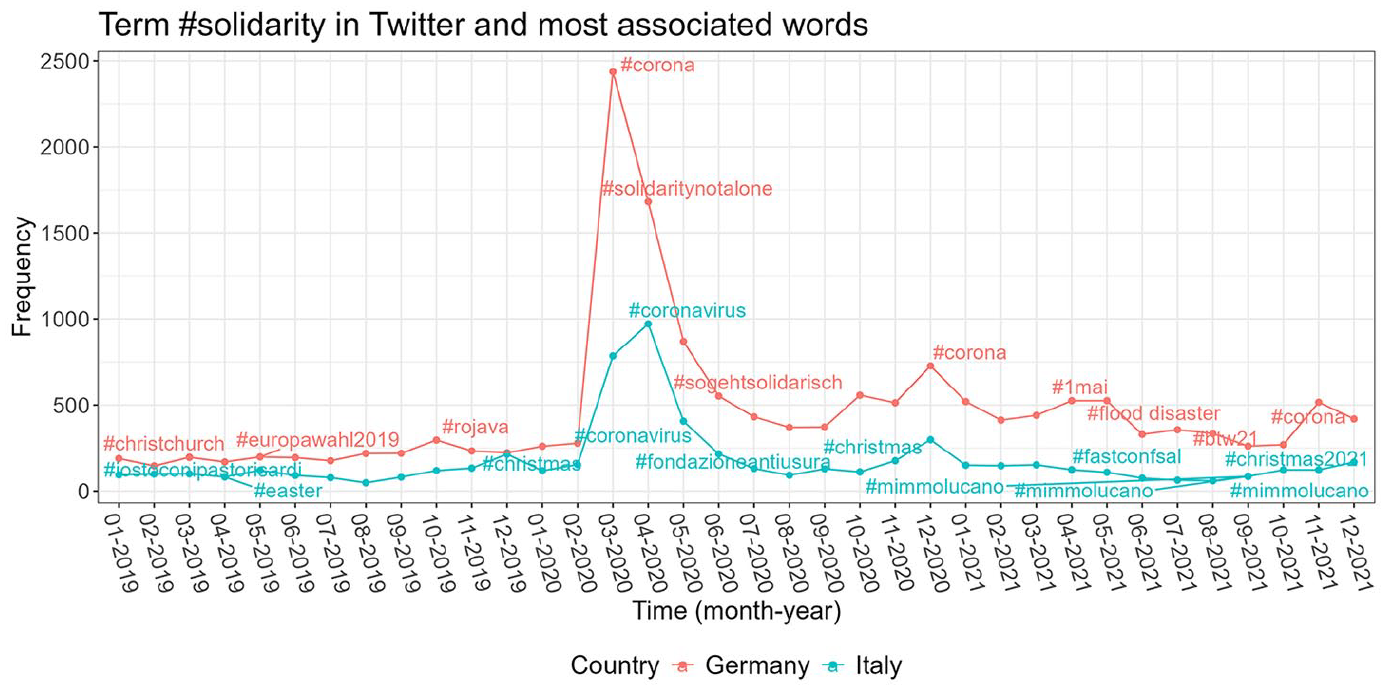
Frequency term #solidarity. Labels are terms most specific to that month.
We next focus on those tweets dealing specifically with solidarity in the context of COVID-19. To do so, we made a list of regex, that is, words having roots corona*, covid*, sars*, and pandemic*, and used it to filter tweets. The final corpus consisted of 6,247 tweets for Germany and 2,305 tweets for Italy. To first detect cultural differences between the two countries, we report a keyness plot in Figure 3, which shows words more distinct to the conversation in one country over the other. We calculated the probability of each word occurring in either Germany or Italy and then computed the log-odds ratio of the two probabilities. A higher log-odds ratio indicates a greater likelihood of the word being mentioned in Germany, while a log-odds ratio below 0 indicates a greater likelihood of the word being mentioned in Italy. We limit our analysis to words appearing more than 20 times and plot results for the 14 more distant words. We excluded COVID-19 terms for the sake of clarity. The plot shows a higher interest in civic engagement against the diffusion of the pandemic in Germany and forms of social solidarity through donations in Italy. Terms related to public health such as compliance with lockdown measures (stayathome) and vaccination are more likely to be mentioned in Germany. On the other hand, terms associated with social solidarity, such as groceries and fundraising, are more prominent in the Italian discourse. In addition, the plot shows that political actors are more likely to be cited in Germany, whereas local municipalities in Italy are more likely to be cited, along with distinct terms such as digital solidarity.
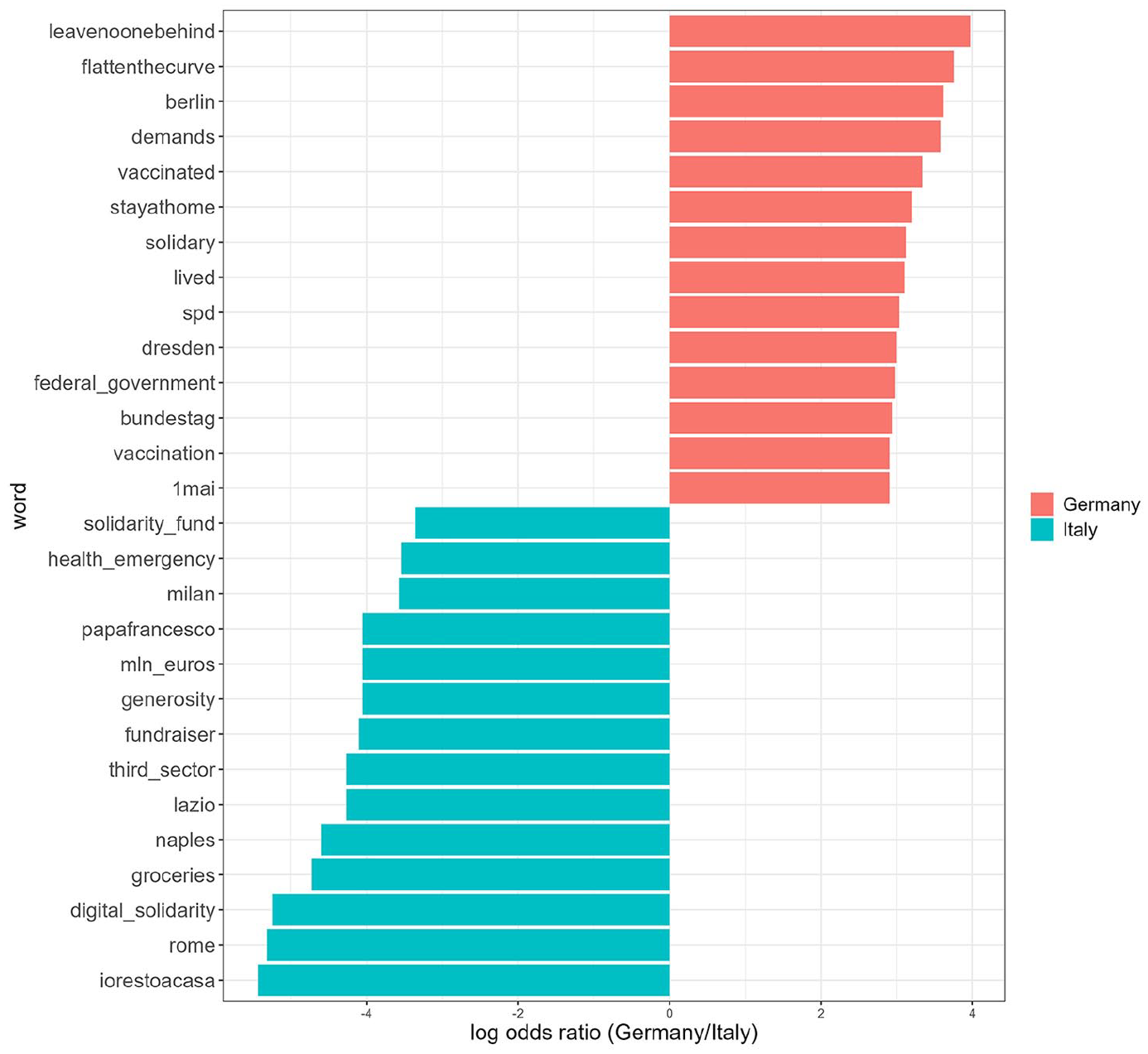
Keyness plot for #solidarity discourse during COVID-19 in Germany and Italy.
Comparative topic modelling
Next, we use topic modelling to contextualize and understand the differences in Figure 3 and investigate further meanings of the #solidarity discourse during COVID-19. The technique detects latent dimensions (topics) of co-occurring words that underlie discourses by computing the probability of words and documents associated with such dimensions. Specifically, we employ structural topic modelling, which allows for the inclusion of document covariates influencing these distributions (Roberts et al., 2019), used to identify how the salience of topics varies over time and how the content of each topic (terms used) differ by users’ categories.
For our comparative strategy, there is an open debate on how to address multilingual and often independent samples (see Lind et al., 2022). We follow the strategy ‘one topic model per case/language’ identified by Lind et al. (2022: 99), running separate topic models for each country, first understanding the cultural construction of solidarity during COVID-19 within each country (emic approach identified by Livingstone (2003)), and then stressing similarities and differences between countries (etic approach).
We identified 20 topics for Germany and 25 for Italy. 3 In Figure 4, we compare the empirical proportion of topics across the corpus in each country. We identified overarching categories that distinguish different forms and targets of solidarity. In Figure 5, we plot the estimated effect of time on topic prevalence as a measure of expected change in topic engagement as the pandemic progresses, parallel to the longitudinal economic and pandemic indicators shown in Figure 1 as contingencies of the crisis. We use the term contingencies to stress that we do not claim to observe a causal relation between the pandemic measures and the salience of topics.
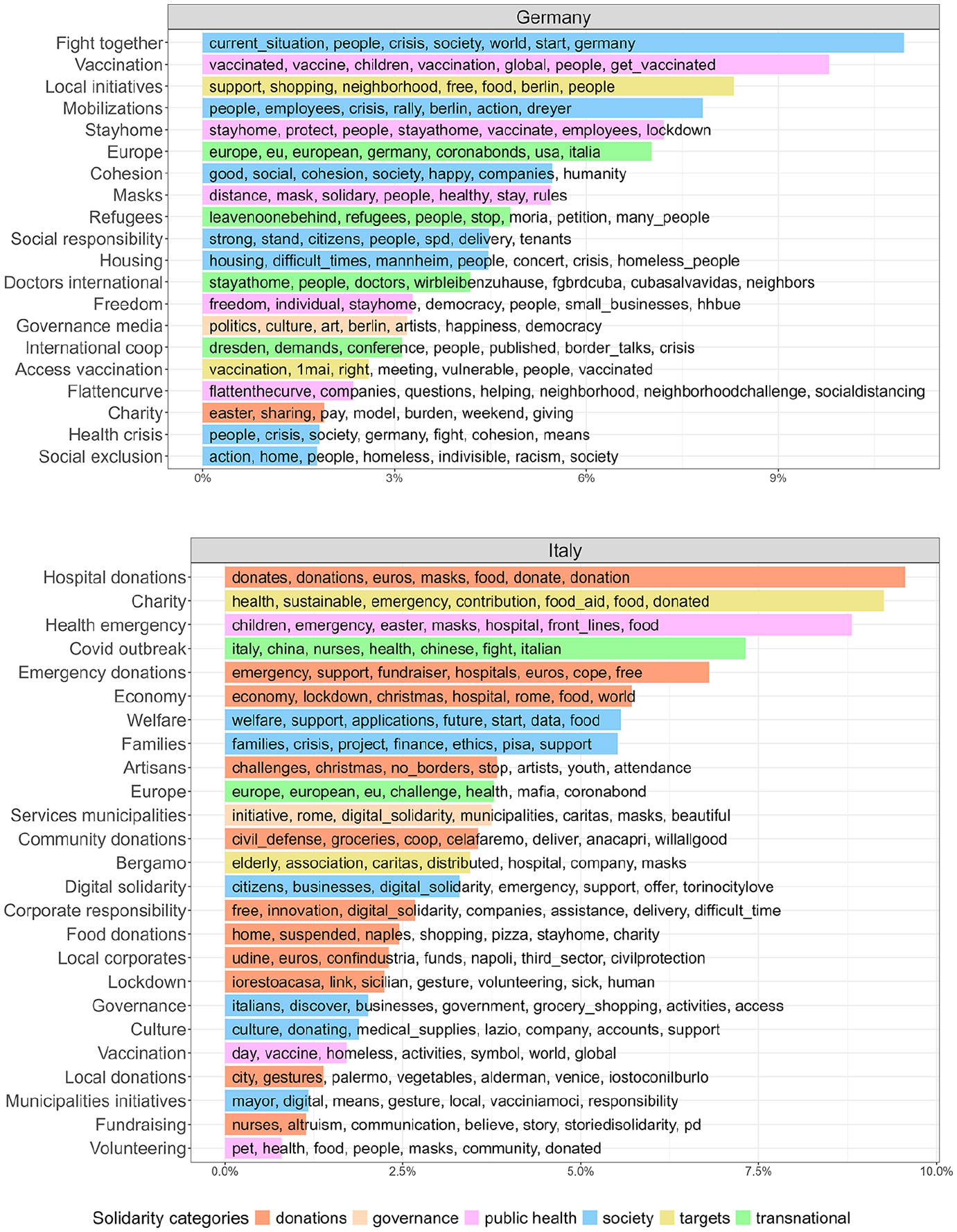
Topic modelling proportion. For each topic, we report words associated with the highest probability.
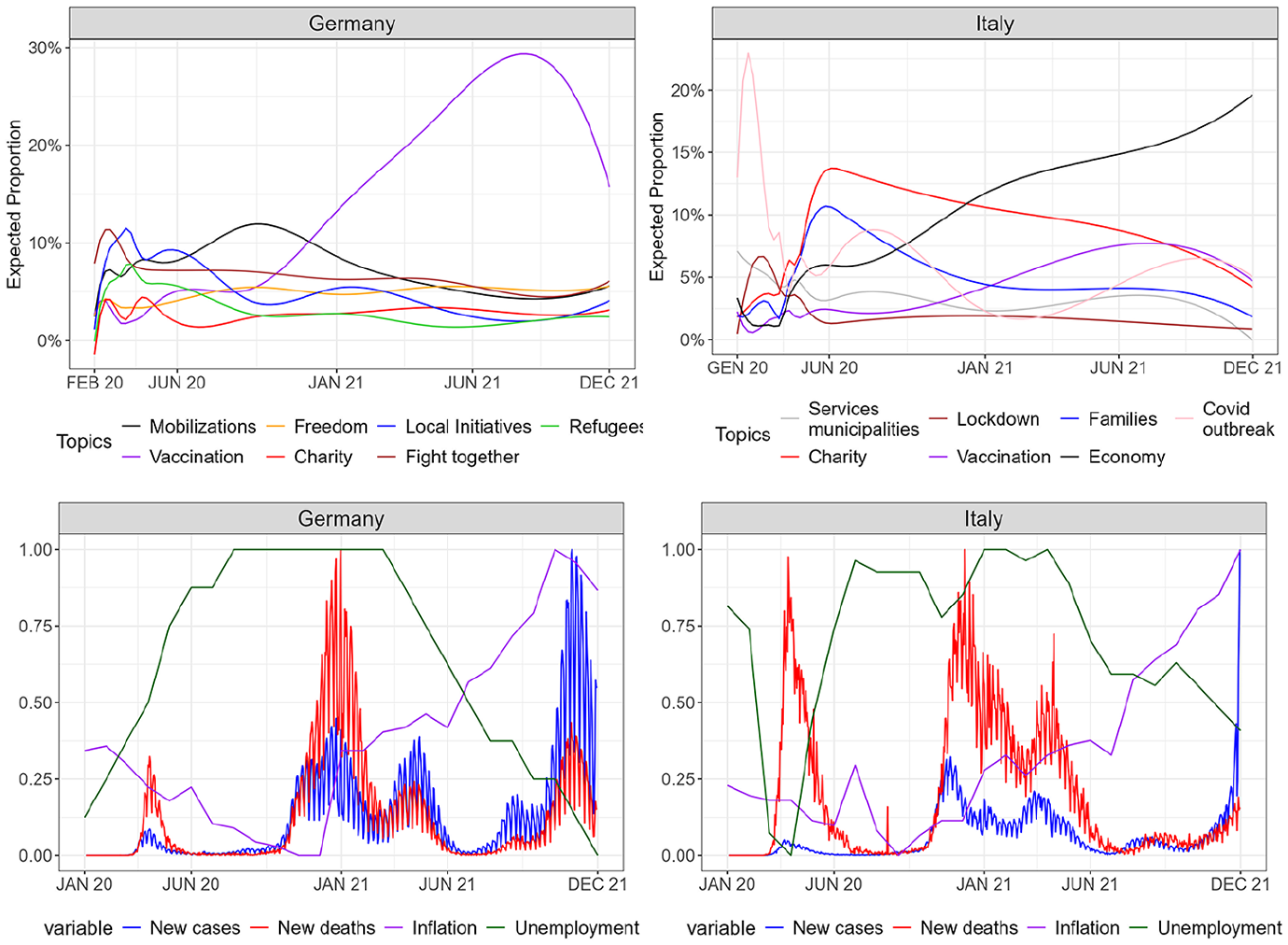
Comparison of topic prevalence with economic and pandemic indicators.
Figure 4 details how in Germany the discussion on solidarity revolves more around compliance with public health policies, whereas in Italy the focus is more on various forms of social solidarity, such as donations, which may point to more fragmented welfare provisions and fragile basic income security. Moreover, topics related to transnational solidarity emerged in Germany, especially ‘Refugees’ focused on their condition in refugee camps during COVID-19 and risks of contagion, related to the term ‘leavenoonebehind’ in Figure 3. While the topic has a relatively high rank in the country, Figure 5 shows how the attention towards refugees decreases as the pandemic advances and national issues of public health rise. In particular, ‘Vaccination’ emerges as the most discussed topic concerning solidarity, with a trend similar to Italy but with higher topic prevalence. As the pandemic progresses, there is an increase in the salience of the topic ‘Freedom’, concerned with the individual responsibility of citizens to comply with or refuse safety policies, which seems completely absent in Italy. Here, contingent on a situation of lower economic stability before and after the pandemic, forms of social solidarity such as local assistance and donations are more prevalent. This result explains the higher likelihood for Italy of terms such as groceries, generosity, or fundraiser in Figure 3. Topics of donations primarily fall into two categories, medical donations and food donations, which exhibit initially similar levels of prevalence. This can be observed when comparing the ‘Charity’ topic, focused mainly on donations to hospitals and medical supplies, to the ‘Families’ topic, which revolves around food donations to impoverished families. As the unemployment rate and inflation increase, there is a corresponding increase in the prominence of the ‘Economy’ topic, referring to the adverse effects of lockdown policies, together with initiatives of neighborhood-level organizations and donations. The trend is similar to the German topic ‘Mobilizations’, focusing on protests against economic or lockdown restrictions, but that decreases as time progresses. These insights show that the economic consequences of the pandemic, although affecting both countries, seem to have a greater influence on solidarity claims in Italy, which already had a more fragile economy. Looking at the governance-related topic of ‘Services municipalities’ and donations in ‘Corporate Responsibility’, digital solidarity stands out predominantly in Italy, as Figure 3 anticipated. As a transformative effect of the crisis originating from the sudden imposition of the lockdown, it refers to digitalization processes and tools to guarantee participation in work activities and education.
Figure 6 shows how the solidarity discourse differs among the different categories of Twitter\X users, which highlights the symbolic boundaries unraveled by the crisis and the reciprocal accusations or moral instances between social groups during the pandemic (Camorrino, 2023). We identified five categories in both countries: associations, media, market sector, governance and politics, and private accounts. The plot shows the top 4 topics for each category, showing their empirical proportion and frex terms, which are terms uniquely prevalent in that category within the country, stressing the different interests and concerns in framing solidarity. 4 Confirming the insights at the national level, German actors are more prone to discuss the topics of ‘Vaccination’ and the call to ‘Fight together’, while in Italy, forms of social solidarity such as ‘Charity’, ‘Hospital donations’, and material support to ‘Health emergency’ receive more attention. In Germany, ‘Local initiatives’ predominantly refer to neighbourhood-level solidarity campaigns, although the market sector actors focus on access to social protections as subsidies for freelancers and the self-employed. In the ‘Charity’ topic, Italian associations call for the social responsibility of citizens, while actors from the governance sector focus on welfare recovery interventions such as food-aid or support to families. Users within the ‘governance and politics’ category engage with transnational issues in both countries; however, German actors focus on European recovery funding (e.g. coronabonds), whereas the Italian counterpart on received forms of international aid, like support from Cuban doctors during the pandemic. German media focuses on vaccination campaigns, the economic consequences of lockdown, and the social ruptures associated, such as the ‘Hygienedemo’ movement. Italian media focus instead mainly on initiatives of local support such as donation campaigns and local initiatives. Private citizens in both countries discuss vaccination campaigns, with Germany supporting the commitment to the ‘Stayhome’ policy, and Italy the involvement in charity initiatives. Yet, Italian private accounts show broader topics of discussion, including the international impact of COVID-19 and other health emergencies and solidarity initiatives beyond COVID-19.
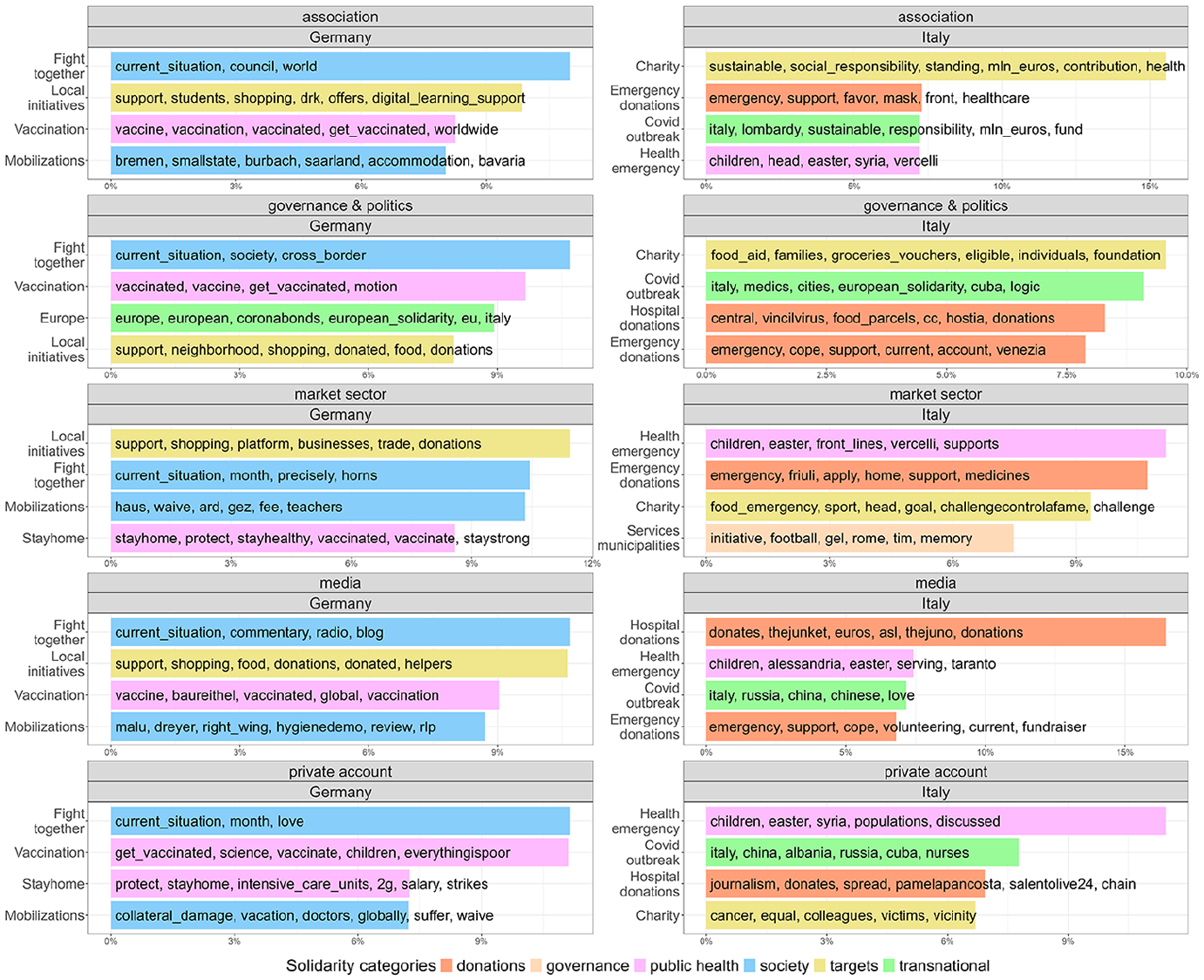
Comparison of topic prevalence and frex words between actors in Germany and Italy.
Discussion and conclusion
The COVID-19 crisis has profoundly upended many aspects of social and political life, leading to a significant demand for solidarity both among social groups and among countries. Comparing results from computational text analysis in Italy and Germany, we have demonstrated how different contingencies in the experience of the crisis seem associated with different meanings attributed to solidarity and how its salience evolved over time with different interests of social groups. Drawing on Emile Durkheim, we can ascribe these insights to the societal process of identifying relevant threats to social bonds, which is crucial for social repair (see Alexander, 2006). The salience of some topics signals the moral urgency of specific issues, aligning with Durkheim’s (1997 [1893]) concept of collective consciousness. For instance, the spectre of the economic recession has become a national symbol in Italy since the post-2008 decline, which could account for the interest in different forms of material support during the pandemic, either as family recovery plans by governance representatives or local grassroots donation campaigns. In Germany, the emphasis is on the role of civil society to uphold social unity, also across national boundaries, as the support for refugees at the early stage of the pandemic shows. This aligns with a recognition of solidarity in Durkheim not as a conservative, nationalist idea (Pendenza, 2017) but as evolving towards a sense of shared humanity and cosmopolitan ideals (Verderame, 2017).
Since the ‘computational turn’ of digital humanities (Berry, 2011), computer-assisted methods for qualitative inquiry have flourished with different specifications (Wiedemann, 2013). Today’s computational text analysis can leverage the Internet as a communication space alongside the offline society (Bryda and Costa, 2023). We hope to have demonstrated the potential of comparing public online discourses between countries in the digital era. By engaging in the public discourse with their tweets, people not only shape the meaning of solidarity during a crisis such as COVID-19 but also contribute to the collective process of finding a common language, enacting and invigorating those values that constitute society and reassuring its potential to stay together during a crisis, as described by Durkheim (Rosati, 2017). This approach can prove valuable to understand the role of solidarity as a dynamic social force supporting the recovery from crises and inform reconstruction plans.
Supplemental Material
sj-doc-1-sro-10.1177_13607804241306383 – Supplemental material for Contingencies of Solidarity: Comparing Twitter\X Discourses in Italy and Germany during the COVID-19 Crisis
Supplemental material, sj-doc-1-sro-10.1177_13607804241306383 for Contingencies of Solidarity: Comparing Twitter\X Discourses in Italy and Germany during the COVID-19 Crisis by Rocco Paolillo, Till Hilmar and Patrick Sachweh in Sociological Research Online
Footnotes
Author’s note
Rocco Paolillo is also affiliated with the National Research Council, Italy.
Funding
The author(s) disclosed receipt of the following financial support for the research, authorship, and/or publication of this article: The project was funded by the Volkswagen Foundation (VolkswagenStiftung), project Corona Crisis Narratives - Framing Economic Imaginaries post-2020 (CoroNarrate), number 99272. Rocco Paolillo was an employee at SOCIUM Research Center on Inequality and Social Policy during the time of the grant. His work also benefitted from the programme EU COFUND BIGSSS-departs, Marie Skłodowska-Curie grant agreement no. 713639.

Supplemental material
Supplemental material for this article is available online.
Notes
Author biographies
References
Supplementary Material
Please find the following supplemental material available below.
For Open Access articles published under a Creative Commons License, all supplemental material carries the same license as the article it is associated with.
For non-Open Access articles published, all supplemental material carries a non-exclusive license, and permission requests for re-use of supplemental material or any part of supplemental material shall be sent directly to the copyright owner as specified in the copyright notice associated with the article.
