



Abstract
This article analyses how the pandemic reshapes young adults’ relationships with time and the future. While youth sociology has already highlighted the significant disruption of young adults’ daily temporalities, we emphasize the need to further explore young adults’ relationship with the « future » and its evolution in times of crisis. Using a life course perspective, we explore how the health crisis has affected not only the immediate time experiences of young adults but also their aspirations and their future outlook. Drawing on 48 life stories of young adults from various social backgrounds in Canada (Quebec and Ontario), we show that the pandemic represents a « shock of uncertainty » for all, necessitating rapid readjustments in one’s trajectory. Depending on living conditions and unequal capacities to « bounce back », life stories become divided into three main pandemic narratives: the fall or « stolen » time, the respite or « recovered » time, and the parenthesis or « suspended » time. Each of these narratives corresponds to a specific experience of the future, whether lost, reclaimed, or just on hold. We highlight how past vulnerabilities influence the very experience of the pandemic, and thus lead to different abilities to project into the future. The discussion identifies key lessons to take better account of time and the future in research on youth in a crisis context.
Keywords
Introduction
What does it mean to « become an adult » in times of pandemic? We already know that young people have been particularly impacted by the economic and social consequences of the pandemic: at the global level, they have been the most affected age group in terms of employment, mental health, and trust (Lundström, 2022). This disruptive effect appears particularly pronounced among young people who are less qualified and those from minority communities (Barford et al., 2021; Jauffret-Roustide et al., 2021; Organisation for Economic Co-operation and Development (OECD), 2020). However, beyond short-term indicators, we still do not have a clear picture of how the pandemic has affected the long trajectories toward « becoming an adult » and reshaped aspirations for the future. As noted by year Elder (1998) in reference to the « children of Great Depression », the imprint that a crisis leaves on a cohort of young adults can be multidimensional and cumulative; it can also function as a set of filters through which later social experiences will be interpreted. The pandemic and its repercussions reactualize the generational question formulated by Karl Mannheim in the early 1930s: periods of social destabilization can, according to Mannheim, create a common « generational condition » conducive to the emergence of generational movements and the acceleration of social change (Aboim and Vasconcelos, 2014; Mannheim, 1970; Pilcher, 1994; Van de Velde, 2024). Affecting not just their present situation but also, potentially, their future prospects, the pandemic may lead to shifts in certain social aspirations, who are already dealing with serious economic and environmental concerns (Pickard, 2019; Van de Velde, 2023). Of course, it is still too early to measure the « scarring effect » of the pandemic on young generations – that is, the long-term impact on their life path – as this will also depend on economic developments and political choices made in the years to come. However, it is important to look at the multiple effects that the pandemic is already having on the life path of young adults, both to understand the generational dynamics underway in our societies and to better guide public youth policies.
To better understand this impact, this article will explore how the pandemic reshapes young adults’ relationship with time and the future: Using a life course perspective, we propose to better situate the pandemic experience within the overall trajectories of youth, in the Canadian context. We aim to analyse how the health crisis has affected not only the immediate temporality of young adults’ daily lives but also their aspirations and their relationship to the future. The life course perspective enables us to respond to two research challenges: On the one hand, its temporal approach enables us to take into account past vulnerabilities, present living conditions, and future prospects and therefore to better understand the dynamics of time inequalities in the face of the pandemic; on the other hand, its multidimensional approach enables us to better link certain concrete socioeconomic dimensions to more subjective dimensions such as time experiences and representations of the future. Our findings are based on a qualitative survey of interviews conducted in 2020 and 2021 with 48 young adults (aged 18-30) from diverse backgrounds – including students, young employees, and young adults in precarious situations – in Toronto, Montreal, and Sainte-Anne-des-Monts in Gaspesie. The research is therefore situated in the Canadian context: Compared to the OECD average (2021), the pandemic had a relatively significant impact on young people’s employment status and mental health in Canada. We will show that, for all these young adults, the pandemic represents a « shock of uncertainty » that calls into question not only the present but also the future, and that depending on living conditions and unequal capacities to « bounce back », life stories become divided into three main pandemic narratives: the fall or « stolen » time, the respite or « recovered » time, and the parenthesis or « suspended » time. The discussion identifies key lessons for research on youth, time, and inequalities.
Young people and the pandemic: a global disruptive effect
From the outset, the pandemic has had a particularly disruptive effect on the family and social trajectories of young adults: Initial research focused on statistical indicators to measure this short-term impact on the daily lives of young adults. Research efforts are now continuing in the sociology of youth to understand this disruptive effect of the pandemic from a longer-term perspective.
Employment, mental health, trust: three short-term impacts of the pandemic on youth
Since the start of the pandemic, a number of national and international large-scale studies have made it possible to measure the pandemic’s short-term direct effects on young adults’ life trajectories in different parts of the world. Although conducted in different countries, these first studies have successively drawn out three sites of international correlation regarding the impact of the crisis on young people’s life courses. Initially, employment conditions were identified as a primary site of disruption: overrepresented in internships, service jobs, and part-time positions, young adults have been the most directly affected by the closure of certain sectors as well as being directly affected by income losses (Cook et al., 2021; OECD, 2020). Young adults have seen not only their study conditions jeopardized but also their ability to self-finance. In 2020, according to data from the International Labour Organization, more than half of young adults overall reported that their households were affected by disrupted employment; this was even more the case for those with fewer qualifications (Barford et al., 2021). Interdependently, studies have pointed to a second visible effect of the pandemic on young adults: a particularly marked increase in mental health problems and loneliness. In many countries, young adults have been the age group most affected by symptoms of depression, anxiety disorders, and feelings of isolation and loneliness (Vacchiano, 2022) to the point that some studies have suggested a « mental health crisis » and a « loneliness pandemic » among young people (Palgi et al., 2020). Again, disadvantaged and minority youth have been found to be the most affected (El-Gabalawy and Sommer, 2021; Kishchuk, 2020; Palgi et al., 2020; Wickens et al., 2021). In Canada for example, the 15-34 age group appears to have been most affected by anxiety disorders compared to other generations, a phenomenon that is even more pronounced among young women (El-Gabalawy and Sommer, 2021). At the same time, the pandemic has also led to a particularly significant increase in political distrust among young adults: this growing uncertainty is linked with dissatisfaction with the government handling of the crisis. Indeed, in most OECD (2020) countries, young people now have less trust in their government than during the 2008 crisis. Again, this increase in distrust is particularly noticeable among less qualified, less privileged, and minority youth (Jauffret-Roustide et al., 2021; Kishchuk, 2020; Maudet and Spire, 2021).
« Precarious hopes »: a longer-term perspective on youth and the pandemic
Subsequently, several works in the sociology of youth argue for the need for a longer-term analysis of young people’s experiences of the pandemic, in order to take into account the preexisting social conditions that were already shaping young adults’ transitions and their relationship with the future. By studying more specifically the effects of Covid among young people from Manchester, Caitlinn Nunn shows in this respect that the pandemic has given rise to « precarious hopes » (Nunn et al., 2021) which reconfigure certain preexisting challenges, including the gig economy, mental and physical ill health, and transnational family networks. Robert MacDonald and his co-authors also invite us to place these effects of the pandemic in a historical perspective: Drawing on a large-scale study on young adults in the UK, they stress that the multiple « pressures » induced by the pandemic cannot be understood without taking into account the already hostile conditions that marked the condition of young people in the UK beforehand, and the strong temporal and social precariousness that already weighed on their life course (MacDonald et al., 2023). In the same vein, Rodolfo Martinic, Paula Gonzalez, and Alvaro Sato point out that, within Chilean society, the pandemic has accentuated the « positional inconsistency » and uncertainty that were already weighing on the experiences of youth, putting the experiences of everyday life to the test -particularly among those who have lost their jobs (Martinic et al., 2021).
Becoming an adult during a pandemic: a life course approach
In this article, we aim to continue these research efforts by placing the impact of the pandemic in the context of youth trajectories as a whole, including their relationship to the past, present, and future. In a context of increasing uncertainty, we underscore the need for youth sociology to take a more systematic approach to what Bazzani (2023) calls the « latent futures » and how they evolve in times of crisis. Using a life course perspective, we aim to understand how the pandemic has reshaped not only the relationship to daily time but also their future outlook and aspirations. We are particularly interested in how past vulnerabilities may influence the very experience of the pandemic, and thus lead to a different « capacity to aspire » (Appadurai, 2004): Evelyne Baillergeau and Jan Duyvendak remind us that this ability to project oneself into the future is not « given » to young people, and that it depends both on social situations and on certain interactions within life courses (Baillergeau and Duyvendak, 2019).
Time experiences and narratives of the future
Time is thus a central element of our approach – both the short time of everyday life and the long time of life. Research has already highlighted the strong rupture of temporal experiences caused by the lockdown period in the general population, or among teenagers (Palmgren, 2022). The historian François Hartog argues, for example, that the pandemic has led to a disturbance in the « presentism » that marks our era (Hartog, 2020). In other sociological studies, it has been analysed more as a « temporal breach » – taking up Hannah Arendt’s concept – leading to a profound testing of the experiences of daily time, in very unequal and polarized forms (Chauvin et al., 2021). While this work has focused primarily on the disruption of everyday temporal experiences compared to the past, we want to introduce the relationship with the future more directly into the analysis, in the three dimensions identified by Giacomo Bazzani (2023): expectations, imaginaries, and concrete narratives. Indeed, in the wake of emerging research (Cuzzocrea and Mandich, 2016; Ravn, 2022), we believe that these representations of the future are a particularly important dimension to analyse at an age already characterized by multiple transitions determining the course of adulthood (Van de Velde, 2015) as well as by a strong temporal acceleration (Leccardi, 2012; Rosa, 2010; Woodman, 2011). One of the contributions of the current sociology of the future is to show how the relationship with the future has an effective impact on the present (Halford and Southerton, 2023), and we are in fact hypothesizing that the pandemic may constitute a particularly strong « break with the future » among the younger generations and that in a context of crisis, the way in which « latent futures » (Bazzani, 2023) evolve must be a central dimension of the analysis.
Life course and the dynamics of time inequalities
From this perspective, this article mobilizes a life-course perspective with young adults in a Canadian context, to better understand the impact of the pandemic on the longer timeframe of life and construction of « adult » status: as initially conceptualized by Elder (1998; Bengtson et al., 2012), this perspective invites us to take account of the dynamic and multidimensionality of life courses, while linking the micro and macro sociological levels in the analysis of trajectories, and therefore paying close attention to the local and historical context (Van de Velde, 2015). In the context of this study, this approach presents several research interests. When applied on a large scale, this temporal perspective allows us to better understand the dynamics of infra-generational inequalities in relation to time and the future: by taking into account all the trajectories, it becomes possible to identify the common hardships that the pandemic poses in the current conditions and in the future prospects of these young people while identifying the main points of divergence. In addition, by placing the life stories at the heart of the analysis, this approach makes it possible to link socio-economic and subjective dimensions that have previously been studied separately. The impact of crises on young people has so far been analysed mainly from the perspective of the « scarring effect », a concept that emphasizes their negative socio-economic impact on life courses (Chauvel, 2010; Van de Velde, 2024); the life-course perspective links these socioeconomic dimensions to the multiplicity of affect – both positive and negative – that the temporal experience of the pandemic can have elicited among young people, such as loneliness, anger, anxiety or hope.
Methodology: a multisite approach
We based our investigation on a qualitative study of 48 interviews conducted between fall 2020 and spring 2021 with young people, aged 18 to 30, from different social backgrounds in Montreal (16), Gaspésie (16) and Toronto (16).
Context
This study is therefore taking place in a Canadian context: in Canada, disruption to young adults’ employment conditions was particularly pronounced, surpassing the OECD average (2020), although these conditions subsequently improved significantly during the post-pandemic recovery period. In Quebec, for example, the 2020 lockdown resulted in many job losses among young people, particularly those with fewer qualifications, young women, and part-time workers (Bourdon et al., 2020; Longo et al., 2020). Social distancing measures were relatively similar between Ontario and Quebec, with strict lockdown from March to April 2020, online study until summer 2021, and social distancing measures in place until mid-2021. Both regions have also benefitted from the same federal income support policy, in the form of the Canada Emergency Response Benefit (CERB) of $2000 per month, which was made available at the beginning of the lockdown for employees over 18 years of age and whose jobs have been eliminated because of COVID-19, and then to working students who were also unable to work, starting in May 2020. We will see in this article that this federal aid will have a significant impact on the trajectories of some young people.
Participants: a social and territorial opening
The broadening of the age range (18–30) means that different social and family situations can be taken into account in the process of « becoming an adult », and the experiences of younger people can be compared with those of slightly older people. We aimed to broaden both the geographical and the social scope of our sample in the following ways. On the one hand, this study took place in both urban and remote areas: it included 16 interviews conducted in Montreal, 16 in the region of Sainte-Anne-des-Monts in the Gaspesie region of Quebec, and 16 in Toronto. While Toronto and Montreal are largely urban and cosmopolitan centers with a high proportion of international students, Sainte-Anne-des-Monts is a small community in a more disadvantaged region, far from major urban centers and with an overrepresentation of young people in precarious situations. For this research, our goal was not to establish a strict multi-site comparison, but rather to better understand the potential role of urban or rural context, while also highlighting traits common to all young adults, regardless of their place of residence.
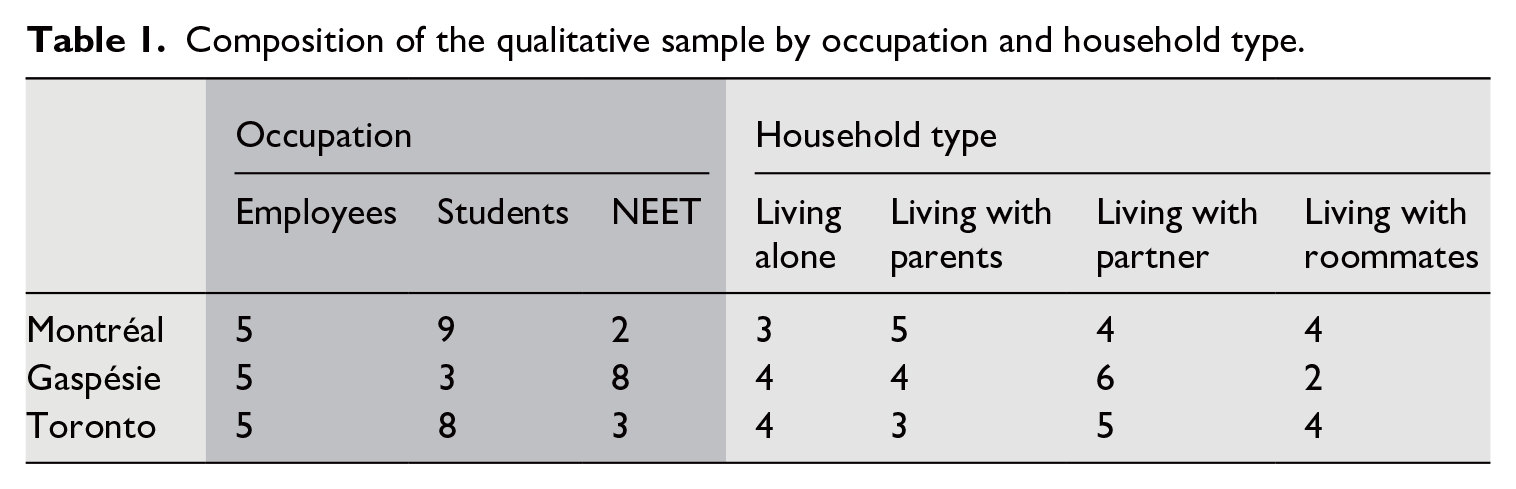
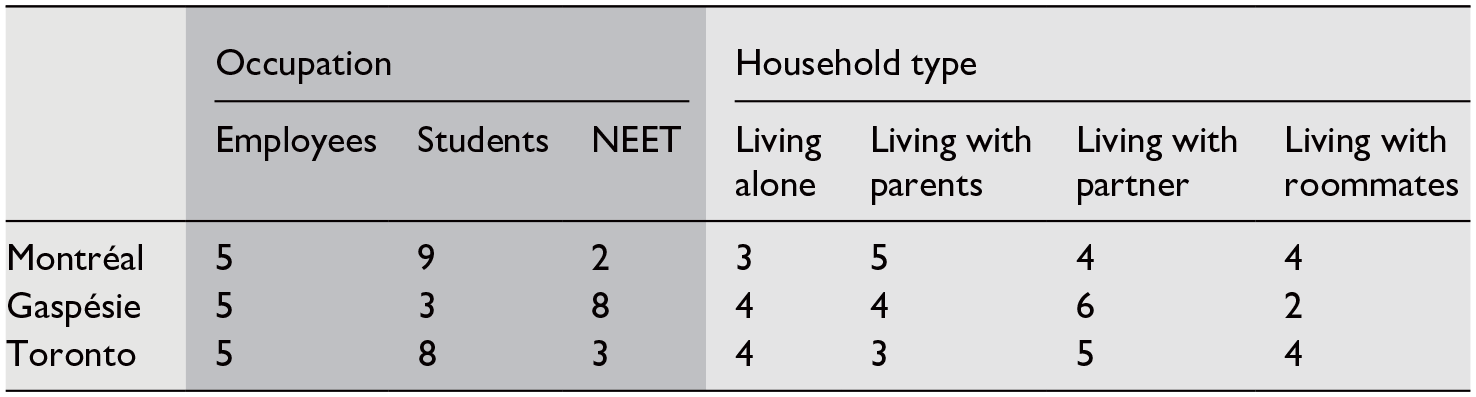
On the other hand, we also made sure to take into account a variety of social situations: the sample includes students (20), young employees (15), and young adults neither in education or training (NEET) (14). As Table 1 shows, relatively more young people interviewed in Saint-Anne-des-Monts are in a NEET situation, while relatively more students or individuals in training are in Montreal and Toronto. This social and territorial openness has also led to a strong diversity in terms of household composition, with young people living alone (11), with parents (12), a partner (15), or roommates (10). Of these 48 individuals, 25 identify as female, 21 as male, and 2 as non-binary. It should also be noted that among them, 9 identify as visible minorities and 11 as first-generation migrants.
Composition of the qualitative sample by occupation and household type.
Recruitment and data collection
This broad social scope was enabled by our multi-source approach to the recruitment process, which drew on social media, acquaintance networks, contacts with social workers, and public posters. Due to health measures, the interviews were conducted by videocall or outdoors when it was possible, especially in Gaspesie. Rather than hindering trust, the use of video seems instead to have introduced a distance that was conducive to a trusting relationship, an effect that has already been identified in work on the subject, stressing that « there is no place like home » for ensuring interviewees comfort and that this form of collection could give rise to some very rich interviews (Oliffe et al., 2021). In line with our theoretical perspectives, the interviews took a discursive approach based on respondents’ accounts of their experiences, with a clear retrospective dimension. The interview began by exploring the respondent’s previous life course, before moving on to address the pandemic experience, with a focus on the effects and emotions experienced as well as on the relationship to the future. In particular, we asked them how the pandemic had affected their current projects and their projections into the future, and whether it had induced any new aspirations or life choices. We were also interested in how their representation of the collective future had evolved, particularly at the level of their generation. The interviews were analysed in two stages: first, we identified the common rhetoric that marked all young people’s relationship with time and the future during the pandemic; then we analysed the different ways in which these experiences played out within their life trajectories, depending on the social properties of the individuals concerned. In the end, analysis of these accounts has allowed us to identify common threads in the pandemic experience of these young adults (part I) as well as points of divergence in their life paths (part II).
Rebuilding a future? The pandemic as a « shock of uncertainty »
Although they later diverge, all the pandemic narratives shared a common thread: that of an initial shock, marking a sudden shift into a new space-time. More precisely, accounts point to the experience of a double shock: the shock of loneliness is compounded by that of uncertainty, as young adults were unable to anticipate the future. The entry into containment marks a « shock of uncertainty », not only because it changes the present but also and above all because it calls into question the future, and obliges one to rapidly readjust one’s trajectory.
Acceleration and slowing down: paradoxical time
« I feel like I’ve aged all of a sudden, I don’t know where life went »: as one 21-year-old communications student from Montreal, who stayed home with his partner, points out, regardless of previous life experiences, the pandemic has marked a sudden shift to a new temporality. Following this brutal interruption of life, the majority of respondents reported feeling completely stunned. On analysis, this experience of time can be qualified as « paradoxical », because it brings together two contradictory and simultaneous dynamics: accelerated time and slowed-down time. On the one hand, this new temporal rhythm comes with a certain social acceleration, in the sense described by Hartmut Rosa (2010). This experience is characterized by compression, within a limited time period, of several profound life changes – both individual and collective – and of the rapid adaptations that they demand of young adults. For most of the young adults interviewed, the pandemic had interrupted the momentum of building a future, whether through the suspension of studies or internships, the loss of one or more jobs, or the threat to the economic sector they were involved in. « My whole life has been turned upside down », says a 22-year-old restaurant worker from Toronto, who lost his job and has returned to live with his parents. This feeling comes for him with a degree of gravity: « it’s pretty heavy ». These imposed detours often sharpen feelings of loneliness or existential anguish because they force the individual to over-mobilize in response to the sudden need to adjust to new perspectives. As such, a 25-year-old law student in Montreal, who has lost her part-time job as a waitress and lives alone, admitted to facing « the biggest questions of my life », while a 25-year-old Toronto employee spoke of needing to « find herself again » in order to make a new life plan, despite the fact that « everything is moving ». But, on the other hand, the pandemic experience also saw day-to-day time freeze and slow down: health measures, such as reduced contact, remote working, or reduced mobility, meant that daily life shifted into a more continuous, linear, and introspective time. The narratives associated this experience with what Carmen Leccardi (2005) calls a « continuous present », in which the lack of any change of scenery from day to day is paired with a range of idleness. This kind of linear time creates the ideal conditions for addictions to develop, as frequently mentioned in our interviews, with examples including soft drugs and video games: « If I smoke, my brain shuts down, and I don’t feel sad or lonely anymore », said one 22-year-old psychology student in Montreal who is now living on her own following the departure of her roommates, and who has decided to stop studying online. It should be noted that this slowed-down time is far from being a neutral time, marked by emptiness or indifference: It may be experienced negatively or positively depending on the situation, but, in all cases, it is accompanied by a multiplicity of sometimes contradictory social emotions, such as anxiety, hope, revolt or empathy.
How do we bounce back? The polarization of life paths
An imposed shift of this order naturally requires the individual to undertake real « work » to adapt, to appropriate the new constraints, and to reposition themselves as a « subject » in their own life. However, our analyses show that this ability to bounce back reveals profound inequalities among the young adults interviewed since it depends heavily on their social and financial living conditions. Over the course of the pandemic, trajectories diverged sharply according to individuals’ previous vulnerabilities and chances of obtaining greater security. Our analysis thus highlights a process of social polarization of life courses. Three main types of pandemic experience have been identified among young adults: the « fall », the « respite », and the « parenthesis ».
The fall: « stolen » time
In the first type of narrative, the pandemic was experienced as a « fall » and as a fundamentally destructive experience. It has led to multiple losses – at the family, professional, and social levels – which, like a game of dominoes, affect all spheres of life, right down to the basic survival needs of young adults and their ability to anticipate the future. These accounts were particularly common among young adults who had been made precarious by the pandemic and who lacked a safety net; this includes migrants, those who have recently started a business, new students, whether in Montreal or Toronto, as well as disadvantaged young people from the Gaspesie who could not access the CERB. What these young adults have in common is that their plans have been threatened, with the pandemic putting them in a difficult situation, associated with a feeling of loss of control over their lives. We can see an age effect here, as this situation had a greater impact on the youngest members of our sample, who were more often placed in situations of transition.
The loss of a future
Conflicting directly with existing commitments, the pandemic has been experienced by these young adults as « stolen », « empty », or « dead » time, in which their power of choice and ability to anticipate the future have been taken from them. One 22-year-old immigrant in Montreal, from Marseille in France living with his girlfriend, shared his feeling of an uncontrolled descent: as a result of the crisis, he had lost his job as a delivery person, his health, and his papers. « No work, no income, my income is decreasing, decreasing a lot, so I’m starting to freak out, I’m not in my own country, I can’t get CERB. It’s been really difficult. Incredibly difficult. » He described the pandemic as a « catastrophe » in his life: « And now I’m stuck in my apartment, I’m stuck in this country. I’m stuck in my job, I’m stuck on every level. Stuck. With everything. » The pandemic brought to light vulnerabilities in these young people that were previously less visible, such as a lack of family and social support, difficulty in accessing certain information, or an uncertain migratory status. Unlike other young adults, they were not able to benefit from active support from family or the state that would have helped them bounce back. This lack of a safety net led to processes of cumulative loss at the professional, family, and social levels, often associated with a rhetoric of « collapse ». « I have no control anymore. Like, none at all, » said a 21-year-old social work student of Moroccan origin living alone in Montreal who had lost her job as a hostess and her prospects of an internship while simultaneously facing a relationship breakup and estrangement from her family. Stopped short in their construction of adulthood, these young people experienced the pandemic as a major « derailment » and an enforced detour in their trajectory.
« Do not sink »: an all-encompassing experience
This negative acceleration creates deep existential and financial insecurity, preventing any positive appropriation of this period of life. Instead, the fundamental challenge is « not to sink » under the weight of lost opportunities while dealing with connected physical and mental health problems. Loneliness is present in these accounts, in the form of an acute lack of essential connections, but anxiety, stress, and exhaustion are also foregrounded in perceptions of the pandemic. « The hardest part is the desperation, the fatigue, and the loneliness. . . the fact that I have no choice.. I feel like I’m breaking down psychologically », one 22-year-old political science student living alone in Toronto, confides. This experience also went hand in hand with a feeling of extreme loss of grip on life: « The future is not up to me. University is not up to me. Nothing is up to me. » While this situation is certainly conducive to long-term addictions, physical problems, psychological distress, and suicidal thoughts, paradoxically, it is precisely these young adults who have had the least access to mental health services or to help from their family and friends. One 22-year-old female immigrant psychology student in severe distress in Montreal described her thoughts: « It was like, when I was walking down the street, I’d look at my feet and think, ‘I hope a car hits me’. »
Abandonment and revolt
These feelings of anguish and frustration encourage feelings of injustice and revolt: Our results point to an increased distrust of power or of certain institutions, associated with the affects of social anger. This distrust is rooted in the feeling of being misunderstood, forgotten, or mistreated by society, for example, among some young adults who asked for support and instead received a total lack of response, or a degree of indifference. Although these young adults were not very politically minded, to begin with, this confrontation made visible a certain injustice, leading to a distrust of power – even if this power is not necessarily named: « They don’t give a damn about us! » says a young employee of 18 who lost his job in the hotel industry in Gaspé region. Depending on individual contexts, this distrust could relate to medical, police, administrative, or political powers. For example, some respondents in Gaspésie expressed the feeling that, as young people, they had been « completely forgotten » by the state, as a young 21-year-old immigrant who had to stop his training in Matane put; young immigrants in Montreal and Toronto spoke of their frustration with administrative silence regarding their immigration status; and some young people in cities were faced with fines that they considered excessive, leading them to blame the government for « anti-youth » measures.
Respite: « recovered » time
Conversely, a second type of experience casts the pandemic as a « respite » and a welcome break within the trajectory of life. In this view, it has been a transformative experience, allowing individuals to reformulate their life choices. It is interesting to note that those who gave this type of account were, at the beginning of the pandemic, in a social situation almost similar to those experiencing the « fall »: whether they were students or employees -mostly in Montreal or Toronto-, the trajectory of their studies, work or process of migration was brutally interrupted by the pandemic. But unlike their counterparts, the group experiencing « respite » benefitted from active support from their family or the state (through the CERB), in turn allowing them to break free from the survival mindset and enabling a positive shift in their life course.
Reclaiming a future
In these trajectories, the pandemic phase was more akin to « recovered » time, associated with the rhetoric of freedom and « finding yourself », as one 20-year-old computer science student living with flatmates in Montreal recalled, appreciating this « honeymoon » with himself. This was the case for one 27-year-old woman living alone in Toronto who received the CERB and described the pandemic as a « blessing » offering « much needed rest time » and an escape from the « robotic » pace of precarious part-time jobs that she had been used to. She stressed that the pandemic had allowed her to regain her humanity, « because we’re not robots, we’re humans meant to live ». Her experience resonates with the « well-deserved break » evoked by another student living with his parents and whose studies had been suspended. Those who experienced the pandemic in this way were not the most socially privileged in our sample; instead, they were young people who had previously been in precarious employment or who were dissatisfied with their educational pathway. The pandemic period created a critical distance from these choices that were often characterized by strong social, family, or temporal pressure. As a result, these respondents were able to regain control over their lives, with the pandemic thus experienced as a release, opening the possibility of a transition.
« Finding yourself »: a positive shift
For these respondents, the pandemic removed external pressures and brought a welcome chance to slow down and a breather from social life. Ultimately, the experience was one of introspection, a period conducive to reflection on the « meaning » of their life path, and even to the formulation of new projects. « Now I know why I get up in the morning, » said a 19-year-old who continued to live with his parents in Montreal and who had stepped away from the studies he wasn’t enjoying – a choice initially taken « to please his parents. » For him, this period had allowed him to reconnect with his « true passions » and to make the shift into a career in music. Of course, the negative aspects of the pandemic were mentioned in these accounts, whether this was the tough nature of prolonged lockdown or the tensions of close proximity with others; however, these difficulties were largely counterbalanced by what the pandemic period had enabled on the existential level: the opportunity for a shift or a bounce-back within the life course. It was precisely this long period of solitude that allowed these individuals to take more « care of themselves » than before, to reconnect with their essential needs, and to rediscover their own « motivation », away from social pressure.
Hope and trust
« COVID gave me hope. It’s like I could have a reset, a restart », says the 27-year-old woman from Toronto mentioned earlier. The hope regained at the individual level tended to extend to a form of social optimism, and for some, to a renewed confidence in society. Many respondents mentioned the feeling of being « all in the same boat », and trusting the collective « resilience ». While some had little interest in politics before the pandemic, this period introduced a new dynamic of politicization – visible not as a rise in partisan beliefs, but rather as a reinforced feeling of citizen interdependence. Most of those reporting this type of narrative had received the CERB or some form of social support, while others had returned to live with their parents. As a result, there was an awareness of a direct connection to the state or their community, itself tied to a sense of privilege in a time of adversity. In their case, this unexpected support allowed for a form of critical distance within the foregoing period, with this feeling of disalienation attenuating the previous frustration or social anger.
The parenthesis: « suspended » time
Finally, a third type of narrative associated the pandemic with an experience of temporary frustration that, while requiring solid coping strategies, was fundamentally considered to be transitory. This type of experience mainly affected the oldest young adults in our sample who were more « settled » and already secure and whose trajectories were not interrupted by the pandemic -whether students midway through their studies or employees already in a stable situation-, allowing them to retain some control over their lives and to put their individual experience into perspective. For them, the pandemic was experienced more as a momentary hindrance that jeopardized the balance of their daily lives. The main challenge was to « keep going ».
A future on hold
For these young adults, the pandemic experience was associated with a parenthesis: while not fundamentally challenging their major life choices, it instead gave rise to adjustment. These young people were generally some way into an established trajectory, giving them the sense of time being « suspended » before life could resume its « normal » course. The frustration evoked was more of a daily frustration, associated with a lot of « inconveniences » to manage, requiring certain efforts of adaptation. In particular, these respondents described relying on essential connections – often partners or friends – in order to maintain their grip on daily life. « Frustration at not being able to do what you normally do » is how one 28-year-old insurance executive in Toronto, living in a shared flat, summarized his experience, citing reduced opportunities to play sports, see friends, and go to restaurants as well as remote working. Many saw almost all aspects of their lives move online. While some were able to find a degree of balance, carving out a « bubble » of aloneness, the new relational balance remained delicate, as this young 23 year-old lawyer living with a partner in Montreal pointed out: « I feel my motivation drop. I find working from home hard. It’s dehumanizing. . . It’s kind of a solitary journey, you know? »
« Holding on »: the risk of being worn down
In this context, the pandemic experience boils down to one central challenge: « holding on » or « staying the course » against the risk of being worn down by isolation. The period was often presented as a « rollercoaster » with several « ups and downs » as expressed by a young worker aged 25 who has kept his job in management and lives as a couple in the Gaspé region, and is characterized by fluctuating emotions. These young adults had the most explicit and proactive strategies for coping with isolation and decreased motivation, such as taking up sports to maintain some sense of control or adopting a pet. Their narratives also reflect clear strategies for relativizing their own experience of the pandemic, compared to that of harder-hit young adults: « It could always be worse », or « I’m one of the privileged ones, for sure » says, for example, a 25-year-old doctoral student in psychology living with a partner in Montreal. As a result, negative emotions were often associated with guilt: « I’m really lucky: I’ve got people around me, I’ve got my dog, my partner. I’m comfortable financially, I really can’t complain, » she says, even though she was very much affected by loneliness.
Empathy
While reinforcing their awareness of their own privilege in relation to others, the pandemic also developed their social consciousness in relation to certain social, racial, and gender injustices. For these (often well-informed) young adults, the pandemic confirmed an existing shift towards politicization: it further highlighted differences in experiences, leading to an increased sense of empathy and sensitivity to inequalities in people’s future prospects. In particular, many referred to the Black Lives Matter movement and recalled how the pandemic may further exacerbate racial inequalities; others expressed concern about how the pandemic will affect the poorest; still, others referred to the unfortunate repercussion of environmental issues being forgotten. At the same time, while certain frustrations or criticisms were expressed regarding government measures, these measures were generally upheld: respondents’ anger was directed instead towards what they saw as the ignorance, carelessness or lack of understanding of others, including their own friends or family.
Conclusion
A future suspended, lost, or reclaimed: ultimately, by deploying a life course approach, this research sheds new light on the different experiences of « becoming an adult » during the pandemic, in a Canadian context. To broaden the scope of these results, it would be worthwhile bringing in international comparisons in order to understand whether these types of narratives are found in other contexts. In the discussion that follows, we return to key lessons for youth, time, and inequalities research.
Youth, the pandemic, and the « latent futures »
Our study show suggests that to understand the disproportionate impact of the pandemic on young people, we must not only take into account conjunctural factors such as isolation or online studies but also the structural preexisting characteristics of contemporary transitions onto « adulthood »: for all the young adults in our study, the pandemic was experienced not only as a « shock of loneliness » with consequent changes to daily life but primarily as a « shock of uncertainty » potentially throwing future plans into doubt. It has caused not only economic but also social and existential tension for those who must quickly readjust their trajectory in a context of extreme uncertainty. What makes young people’s pandemic experience unique is that it is part of a period of projection; today, the process of « becoming an adult » is characterized by a clear norm of
Bouncing back: a growing question of time inequalities
At the same time, our analysis shows how this common ordeal has given rise to a phenomenon of social polarization between life courses, based on unequal capacities to « bounce back ». Existential security and the ability to project oneself into the future are increasingly considered one of the essential dimensions of well-being (McAll, 2020), and in a context of uncertainty, this securitization of the future becomes a major factor of inequality (Duvoux, 2023): this is what fundamentally determines the young people’s agency and capacity for social « resilience ». We therefore underscore the need for youth sociology to take a more systematic approach to young people’s ability to anticipate the future as major sites of social inequality within their life course (Bryant and Ellard, 2015; Leccardi, 2012; Ravn, 2022). The pandemic has sharpened the divide between those who benefit from the temporal, financial, and existential resources necessary to stabilize their trajectory, and those without a safety net who find themselves trapped in the present, having to focus on survival and facing the loss of a future. More precisely, we have identified a profile of young people for whom the pandemic was ultimately associated with a positive experience, in that it offered the time for a chosen bifurcation: this result echoes the analyses of Ann-Charlotte Palmgren (2022) on young Finnish teenagers, who shows that some found themselves « anchored » by the pandemic’s deceleration. In our study, this positive experience of a « respite » was experienced primarily by young adults who had previously faced strong temporal or financial pressure on their lives, but who could be supported by the state or family during the pandemic. In the Canadian context, the opportunity for some precarious workers to receive CERB was crucial to their positive experience of the pandemic. For those who could not access it, family solidarity also proved to be a determining factor, as has already been shown in Australia (Cook et al., 2021). The pandemic « refamiliarized » a large proportion of young people (Van de Velde, 2024) while making young people without this safety net particularly fragilized: for them, the pandemic was conversely associated with a « fall ».
Rebuilding hope: the role of public policies
Ultimately, by showing the unequal capacities of young people to aspire in the face of the pandemic crisis, this survey highlights the importance of hope in the development of public policies for young people. We have shown that the pandemic has induced a process of accumulating insecurity for young people in the most precarious situations – whether at the existential, social, or political level – putting to the test their ability to bounce back and to rebuild a future. Overall, the young adults most affected by the pandemic were those who saw their conditions of survival threatened, and who were cut off from family or state support. This notably included young adults in precarious circumstances, those in situations of immigration, and those living in remote regions. In terms of youth policies, this study underlines the crucial importance of structural and state levers in securing the life courses of young adults: in a context of severe existential precarity, this is central to enabling young adults to bounce back and to make life changes. It also equips young adults to anticipate the future: all these perspectives are fundamental within young people’s life courses.
Footnotes
Funding
The author(s) disclosed receipt of the following financial support for the research, authorship, and/or publication of this article: This work was supported by the Canada Research Chair Programme.
