




Abstract
This article analyses leading international sociology journals regarding the global relations as observed within their aims and editorial boards. As such, it explores the geographies and power relations of knowledge production in the context of sociology as a discipline. First, it analyses the aims of journals as outlined via their respective websites, focusing on whether and how any global or international focus appears. Second, it explores the current country affiliation of journal editorial boards to provide an overview of the broader scholarly community. Third, it looks at the network of gatekeepers, exploring editorial board interlocking. The results show a discipline dominated by the global centre, where editorial board interlocking heightens the agenda-setting power of a few academics affiliated predominantly in western contexts.
Keywords
Introduction
A knowledge hierarchy has long existed within the academic community dominated by producers, publishers and journals from western countries (Demeter, 2022 [2020]; Heilbron, 2014: 687). Despite this, inequalities in editorial and authorial power have prompted calls for more inclusive and diverse scholarly publishing (Gomez et al., 2022; Liu et al., 2023a, 2023b; Royal Society of Chemistry (RSC), 2020). Shahjahan and Kezar (2013) highlight the importance of studying transnational corporations, such as the publishing industry, who are among the ‘major players within interconnected social processes impacting higher education’ (p. 27). This article explores sociology journals indexed in the Social Sciences Citation Index of the Web of Science, looking at the overall scope and mission, as well as stated and implied aims of internationality, and juxtaposes these with the make-up of their editorial board membership. Alongside a broader picture of the network of gatekeepers, the article also looks at editorial board interlocking in sociology journals, given the degree to which sitting on multiple journals could raise the agenda-setting power of individual academics. By providing an overview of the broader concentrations of gatekeeping power in both individuals and geographic locations involved in global sociological knowledge production, this analysis provides an important snapshot of the limited space for dialogue and who speaks the loudest in the discipline of sociology.
Literature review
Academic journals are key vehicles to disseminate scholarly work, and to build a body of knowledge and shared understanding in different disciplinary areas, fields and sub-fields. They allow for the academic community, stakeholders and the wider public to engage in discussion, providing policy and practice critique and recommendations. As such, journal editorial and review processes are a form of gatekeeping, delineating what knowledge is considered relevant and valuable by the academic community. Whether such a process is fair and equitable is crucial, given journal articles also often serve as the foundation on which an academic’s scholarly reputation is built, with positions in academia being predicated on an academic’s ability to publish what is assessed as high-quality work (Baccini et al., 2019; Bridges, 2011; Fejes and Nylander, 2014). Determining which academics have produced outstanding work has become increasingly ‘metricised’ (Kelly and Burrows, 2012), with research articles in prestigious journals being valorised by research assessment systems. This is potentially at the detriment of other forms of research communication and certain types of locally important research that do not fit the ‘internationally relevant’ criteria (Albuquerque et al., 2020).
Given the high concentration of power in the hands of a limited number of individuals, editorial board selection requires some degree of scrutiny. When considering adding new members, institutional affiliation, previous work for the journal and suggestions from other board members may be utilised – appointment can happen through invitation or open application process, with editor-in-chiefs or those at the top of the journal hierarchy holding considerable sway. Decisions on editorial board make-up mostly revolve around academic performance through metricised measurements, but may also reflect a preference for particular characteristics; for instance, Metz et al. (2016) use social identity and homosocial theory to explore the under-representation of women on editorial boards.
There are further risks and unintended consequences associated with relying too heavily on performance metrics. In Italy, performance metrics and the number of articles published in prestigious journals became a determining factor in how far one’s academic career would progress. With evaluations focusing on citations and publications, unethical procedures of research slicing and self-citation saw an increase (Baccini et al., 2019). Similarly, Mula-Falcón and Caballero (2023: 12–13) suggested that Andalusian university teachers felt the performance metrics ‘generate pressure to increase scientific production’ but it was not to ‘improve the quality or the rigor of their research, only the volume of their output’. In the UK, Kelly (2023) argued that successive iterations of the UK’s Research Assessment Exercise (RAE) and Research Excellence Framework (REF) created a zero-sum game regarding what areas and whose work universities return for assessment, as well as sparking a highly competitive environment within and between institutions. Indicating major systemic issues, MacDonald (2023) discussed the citation gaming in medicine, where ‘the author of an academic article is whoever buys the rights to the article’ (p. 471), while Brembs et al. (2013) suggested that the pressure to publish in high-impact science journals may be correlated with an inflation of research findings and higher rates of retraction.
To better understand the inequalities in the realm of academic sociology, this article explores global relationships within publishing. The centre is comprised of geographic regions, researchers and theoretical concepts with significant resources and prestige attached to them (Altbach et al., 2009; Hamann, 2016, 2018; Trahar et al., 2019). They tend to embody the features that define academic quality, for example, originating in an Anglophone nation, publishing in English, adhering to specific research paradigms and idiosyncrasies (Bridges, 2011; Hamann, 2016, 2018; Shahjahan and Kezar, 2013). Conversely, the periphery refers to regions, researchers and theoretical concepts that exist on the fringes of the rewarded understandings of research excellence. In this research, it is helpful to think of the centre and periphery as being comprised of three co-dependent parts: individuals, systems and concepts, as shown in Figure 1.
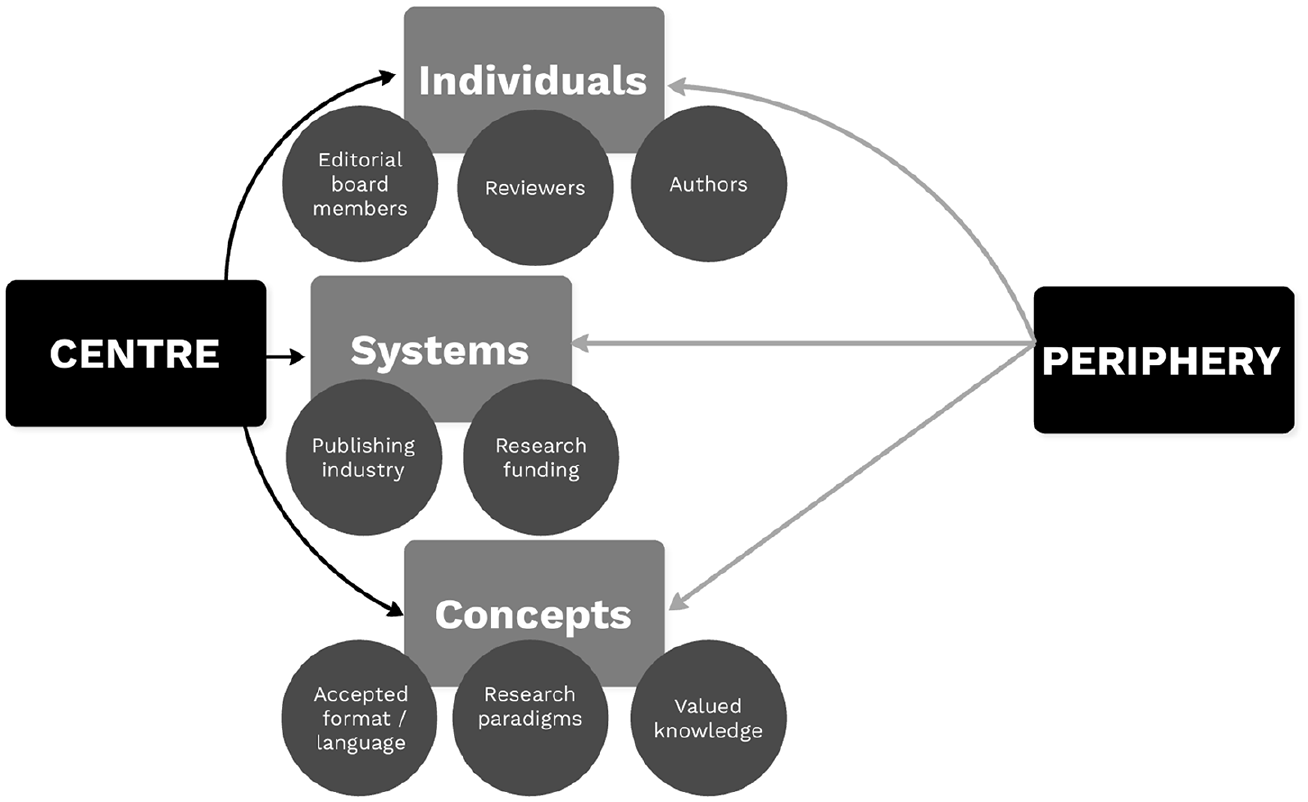
Conceptualisation of centre and periphery relationships in scholarly publishing.
Beginning with individuals, the gatekeeping potential produced by a standardised notion of excellence manifests most obviously in editorial boards, as they determine the broad publication trends in prestigious journals (Post, 2012), with Saurin (2016) noting a large power imbalance between authors and editors/publishers. Hamann (2018) applied Merton’s (1968) concept of the Matthew effect in science, arguing that research prestige attracts more funding and thus prestige, linking to the circular nomination of panel members who are likely to reward the version of excellence that most resembles their own. The two criteria used to select panel members are: they have measurable achievements and fit the mould of excellence understood by the recruiters (Goyanes et al., 2022; Liu et al., 2023a, 2023b; Nyúl et al., 2021). Consequently, journal editorial boards are often skewed by predictable inequalities visible throughout academia such as those of race, class and gender, with board members originating from, or located in the centre (Altman and Cohen, 2021). Goyanes et al. (2022) go on to explain the concept of editorial board interlocking, which suggests that these ‘excellent’ scholars may serve on multiple journals’ editorial boards, significantly increasing their agenda-setting power, but potentially decreasing the heterogeneity of research methods, paradigms and publications present in these journals (Goyanes et al., 2022; Zuccala, 2006). Once selected, these panel members will gate-keep the type of knowledge that is published in journals. Centre-based idiosyncrasies structure gatekeeper’s conceptualisations of excellence which are then coupled with the convention of anonymous review making reviewer bias difficult to detect and arduous to resolve (Belcher, 2007; Lee and Sugimoto, 2013). When examining the ‘publish or perish’ phenomenon, regional trends of publication are heavily imbalanced in favour of Western/Anglophone nations. The European Association of Social Psychology (EASP) conducted analyses of membership, engagement and distinction within their organisation over time which reflected the trend of ‘diversity [being] more attainable at lower levels of prestige’ and the structural foundation of journals that favour male/Western individuals and concepts requires dismantling in order to make meaningful changes in powerful organisations (Nyúl et al., 2021: 815).
Second, systemic issues, such as resource accessibility, is oftentimes the foundation of an ability to adhere to the expectations of gatekeepers. Better research funding and time allocation for certain academics located in centre countries and institutions allows for the production of research that better aligns with dominant paradigms. Hamann (2018) suggests that ‘departments that have few resources at their disposal and (have to) concentrate on teaching’ (p. 17) stand in contrast with ‘elite departments that exemplify a privileged academic lifestyle with sufficient grants and research staff’ – this of course points to diversification and inequalities within national contexts (Bridges, 2011; Hamann, 2018: 17). This demarcation of research and teaching across university sectors, but also in individual scholars’ roles, results in what Nyamapfene (2014) in the UK context called a ‘spoiled identity’ for those on teaching-only contracts with little or no research designation. Such roles are unequally distributed, with women and black and minority ethnic academics being over-represented in more precarious and teaching-only positions (Advance HE, 2018; Leathwood and Read, 2022; Myers, 2022). A further systemic concern over research allocation derives from the high subscription costs as well as price of Open Access routes. The differential access to scholarly articles due to the financial model of publishing has prompted open access movements and pirate websites, such as Sci-Hub (see also Himmelstein et al., 2018; Owens, 2022).
Differential access to resources, foundational cultural idiosyncrasies and engrained paradigms underpin these divergent conceptualisations across different global settings, as the third component of the relationship (Collyer, 2014). As Connell (2007, 2019) argues, mainstream social sciences often saw the majority world as solely a data mine, disregarding Southern theories, concepts, stories and problems. Prestige, then, accumulated by the centre allows it to develop assessment systems that privilege the centre’s conceptualisation of ‘excellent’ sociology. Lillis et al. (2010: 782) identified several exclusionary features of the centre’s conceptualisation:
Publishing in high status journals often means publishing in English – as opposed to the national language (Altbach et al., 2009);
The linguistic and rhetorical conventions of academic writing of the Anglophone centre journals can present significant obstacles (Canagarajah, 2002; Papaioannou et al., 2013; Trahar et al., 2019);
‘Relevance’ of a topic marked on the basis of location: ‘different’ and ‘exotic’ if beyond the centre context, indicating a bias in peer review (Flowerdew, 2001; Lee and Sugimoto, 2013; Lillis and Curry, 2010).
Publishing in high-ranking journals means adhering to the confines of what is considered valued knowledge as well as how research contributing to this knowledge should be conducted (Collyer, 2014; Trahar et al., 2019). Defining valued knowledge in the field of sociology has historically been the role of the authoritative western nations that populate the centre of sociological research. Lillis et al. (2010) and Patel (2014) explain this phenomenon as Eurocentric nations facilitating a prolonged misrecognition of the European experience as the universal. The historical entrenchment of western scholastic paradigms and methodological frameworks led to a homogenisation of what constitutes valued research in sociology and how to conduct it (Fejes and Nylander, 2014; Platt, 2007). Requiring an adherence to these conceptualisations of excellence further obscures the authoritative power of the centre behind the veneer of academic rigour and ability to adhere to conventional research practices (Patel, 2014). Veneration of such ‘conventional’ practices which are founded upon the marginalisation of other researchers, research traditions, paradigms, and so on enhances the risk of reproducing a status quo built upon colonial sentiments. This status quo changes only in feature rather than form and without a multidimensional restructuring will only serve to further embed colonial sentiments such as linear modernisation and methodological nationalism into the sociology discipline’s core (Bhambra, 2013).
Despite potent inequalities in publication, the sociological discipline performs relatively well when examining editorial board interlocking across disciplines, indicating that sociology establishes links with numerous other fields in a relatively even manner (Goyanes et al., 2022). Heilbron’s (2014) work on journal openness across two dimensions (disciplines and geographic boundaries) offers further insights into these patterns of collaboration. Heilbron (2014) examined journals’ openness on a scale, with disciplinary openness conceptualised alongside international receptiveness. According to data from sociology journals in France, the sociological discipline is receptive to a range of disciplines, yet relatively closed off in their frequency of receptivity to international contexts. This phenomenon may be due to the immersion of the sociology discipline in national contexts without ‘an understanding of the postcolonial global conditions’ (Bhambra, 2013: 300), meaning that the sociological orientation of one nation may be quite different from that in another (Crothers, 2011).
This article looks at how the ‘international’ or ‘global’ appears within the aims, scope and mission of sociology journals, and juxtaposes these with their editorial board membership. As such, it explores the geographies of knowledge in the context of sociology as a discipline (Calma and Davies, 2017), through the following means. First, it analyses the aims of journals as outlined via their respective websites. Second, it explores the current country affiliation of their editorial boards. Third, it provides an overview of the network of editors as gatekeepers, based on the following research questions:
Q1. What are the broad aims of these sociology journals, specifically:
Are they to focus on national sociologies?
Is there any reference to an international scope?
In what languages can authors submit their work?
Q2. Who are the leaders and gatekeepers, and where do they reside, specifically:
Who is in the leadership roles of these journals?
Who is on the editorial boards of these journals?
Who is on the subsidiary editorial boards of these journals?
Q3. Who are they key scholars within this network of gatekeepers to publishing in sociology journals?
Research methods
This section introduces the combination of data sources and analytical approaches used. We focus on journals that are indexed in the Web of Science (WoS, 2021) and are categorised only as ‘sociology’, as well as aligned with Jacobs’ (2016) work, arriving of a loss of 77 journals. The snapshot date for downloading WoS data, collecting journal website information and editorial board membership log is March 2021.
To explore the stated research questions, the project uses a diverse array of data collection and analytical techniques. First, the descriptions and aims sections of journal websites are subjected to content analysis using NVivo, regarding the representation of explicit and implicit references to their international or national scope, as well as the language requirements (Q1). Any communication on the journal website that resembled a mission statement was analysed.
Second, journal websites were searched for editorial board membership, and a dataset was created using Microsoft Excel. This included the institutional affiliation and geographical location of employment of editorial board members, as well as their respective editorial board roles. Given the substantive diversity in naming conventions and board structures, the roles were coded to fit the categories of (1) leadership, (2) editorial board, and (3) further editorial board. Subsequently, the data on geographical location of where editorial board members are employed was explored, to produce an overview of geographical spread of the leadership and gatekeeping positions (Q2).
To examine the network of gatekeepers (Q3), social network analysis was employed. Wasserman and Faust (1994) suggest that actors are interdependent entities instead of autonomous units. The relationships between actors serve as transmission lines for material or immaterial resources. These resource-sharing networks provide either opportunities or restrictions for individual actors as well as shape relationships among them. To proceed with an analysis of social network relationships, this study uses Wasserman and Faust’s (1994) term ‘relational tie’ to refer to the linkage between actors. These ties manifest as different types, specifically: evaluations of one person by another, transfer of resources, behavioural interaction and association or affiliation to a particular organisation. The analysis in this article explores affiliations as a tie, also called two-mode network.
This type of analysis considers one set of actors (first mode), and a set of events (second mode), to which the actors belong, such as organisations, boards, and so on. For example, in our analysis, we are considering one set of actors (editorial board members) and a set of events (journal affiliation). Each affiliation has a subset of actors as target (not all actors are affiliated to the same the journal, and some actors are affiliated to more than one journal) (Wasserman and Faust, 1994).
The main objective is to find out which actors are the most important across the different editorial boards. It is worth noting that this is not intended as a comprehensive social network analysis. The dataset includes 2930 unique cases, scholars as members of a specific journal editorial board. The package ‘Igraph’ from the software R was used to calculate the following measures:
Degree centrality: refers to ‘the extent to which a specific node is connected with other nodes in the network’ (p. 62, Knoke and Yang, 2020), in other words, the total of connections for a given node (Goyanes et al., 2022).
Betweenness: refers to the number of times a specific node is included in the shortest path connecting two other nodes. It is a measure of a node’s influence over the network’s resources and information flow. Which nodes serve as a link between various regions of the network are identified by betweenness (Goyanes et al., 2022).
The limitations to the current study need to be acknowledged. First, the methods used here cannot account for academic mobility, given they take into account current institutional affiliation and geographical location of scholars as their place of work, not their country of origin or biography. Second, the article focuses on the power relations of global academia with regard to geopolitical stratification and does not detail social stratification (Demeter, 2022 [2020]). Third, we took only a snapshot of editorial board membership and have not analysed changes prior or since this time point. Fourth, without further case-level data collection on practices, we cannot know the specific ways in which editorial boards operate, especially regarding recruitment. Fifth, it was not possible to verify whether a small number of editorial board members with the same name were the same people nor to identify institutional affiliation for a small number of journals.
Results
This article looks at, first, whether and how the global appears in the journal descriptions explicitly or implied. Second, it explores the make-up of editorial boards, focusing on the geographical location of institutional affiliation. Third, it provides an overview of the broader network of journal gatekeepers.
Tracing the ‘international’ in journal aims and descriptions
Despite blurry boundaries of sociology as a discipline (Holmwood, 2010), the ways of speaking about journal aims are surprisingly consistent, likely a result of journal acquisitions and publishers aiming to standardise how such information is presented (Kutz, 2018). The thematic examination of the aims, scope or descriptions sections on journal websites yielded results that contained substantive amounts of semantic overlap. Given the scope of the sociological sciences along with the range of scholars seeking to publish their research, being able to discern which of these journals label themselves as international is paramount. This section explores internationality of journals through (a) geography, (b) topical inclusivity, (c) audience/authorship, and (d) a mixture of these.
Geographic scope, the first indicator, is a key feature of journal inclusivity not just in principle but also through its direct association with internationality. Geography is most often explicitly articulated by journals in mission statements or purposes. However, journals will frequently signal an international orientation through more indirect means such as broadcasting a diverse range of topics, and/or through the international pool of authors who produce this scholarship. This practice is exemplified in the second indicator: international topics, which are indicated by journals through a geographically diverse, or globally relevant nature–be it the inclusion of a global condition within a list of topics, or a reference to an international perspective in the aims and scope. Third, internationality in terms of audience is referring either to a journal’s emphasis on an international community that engages with their product, be it readership, institutions or positions of power, or a journal’s encouragement of manuscript submissions from authors of various geographic origins. However, journals most often employ indicators in conjunction with others, signalling internationality through a mixture of these.
Geographic scope is the broadest indicator, encompassing any reference to an international focus. To explore geographic scope during initial coding, journals were divided into classifications of ‘international’, ‘regional’, and ‘national’ according to explicit wording in mission statements. For instance, Rationality and Society’s statement that they are an ‘international journal focusing on the latest social research and theory using rational choice as its foundation’, provides a broad statement, but does little to clarify whether there are boundaries to this internationality. Beyond a broad international orientation, specific geographic spaces such as countries (mentioned in 12 journals out of 77) or regions (mentioned in 8 journals 1 ) are referenced as significant to journals overlapping with their international scope rather than negating it. While these journals maintain a focus on specific regional/national contexts, they do not exclude outside scholarship either. This reflects a broader trend that journal limitation in terms of geographic scope is often negated through a topical focus that extends beyond this limitation. For example, the Canadian Journal of Sociology displays this positionality through their statement that they ‘[provide] insight into the issues facing Canadian society as well as social and cultural systems in other countries’. While they maintain a specialised interest in Canadian society, they actively welcome international scholarship beyond this border. On the other hand, Innovation: The European Journal of Social Sciences issues a caveat for authors seeking to publish on areas outside of Europe by asking them to include a paragraph or section on a European region.
‘National’ was redundant as a journal classification, as despite journals emphasising national concentrations, they would almost never refuse outside scholarship. Contributions to Indian Sociology which appears to have a singular geographic focus claim that their journal ‘presents a diversity of theoretical approaches to the study of society in India’. It is followed by a section stating, ‘CIS invites articles on all countries of South Asia, the South Asian diaspora as well as on comparative studies related to the region’, making it more regional in nature, distilling an exclusive geographic focus with inclusive topical exploration.
Beyond the explicit accounts of internationality, allusions to it are used in mission statements suggesting inclusivity, often through topical inclusivity. Journals that address a ‘diverse’ and ‘wide range’ of subjects tend to also imply a link to their international scope. For instance, Sociologia discloses that they hope to cover ‘as wide as possible [an] area of sociological thought and research. It provides a space for debates about current social issues in Slovak, European and world society’. This same inclusive sentiment is often echoed in simpler terms such as ‘all areas of sociology are welcome in Sociological Forum’. Meanwhile, some specialised journals’ emphasis is on a narrower field of enquiry, where journals may disclose the limits of their scholarship through phrasing such as Mobilization: An International Quarterly’s desire to ‘fill the need for a periodical scholarly review of research that focused exclusively on social movements, protest and collective action’. More generally though, these journals occupy a comprehensive topical realm with two-thirds of journals highlighting their broad topical relevance and 21 emphasising a specialist nature. Furthermore, an analysis of the decennial growth of journal issues and journal numbers (of those 78 included in the study) indicated significant growth in both areas with issue numbers increasing approximately fivefold alongside a fourfold increase in indexed journals since 1971, corresponding to the findings of Henriksen (2016). An analysis of multiple variables which may be correlated to spikes in issue numbers (including journal publishing affiliations, H-indexes, and international mission statements) revealed no definitive links. However, spikes in both numbers occurred largely between 2001 and 2011, suggesting an expansion of the field during this time frame.
For example, Journal for the Scientific Study of Religion addresses a specialised focus area through excluding certain types of scholarship, such as ‘theological treatments of religion’, or ‘articles geared toward clinical or other practitioner audiences’. However, these exclusionary statements sandwich a signal for broader disciplinary scope: ‘while many articles published in the journal are sociological, the journal also publishes the work of scholars in anthropology, economics, health sciences, religious studies, psychology, and political science’. Although multiple restrictive elements interact to narrow the area of expertise, an exposition of interdisciplinarity still headlines the journal.
Often journals will promote their internationality both topically and through their authorship/readership. For example, Acta Sociologica describes their editions as ‘provid[ing] sociologists all over the world with a valuable outlet for promoting and publicising the international relevance of sociological research and theory’, incorporating both the international authorship as well as topics. Alternatively, Men and Masculinities assert the same global orientation through claims that they ‘[publish] critical masculinities scholarship from around the world’, while also ‘[acting] as a collective of international and interdisciplinary scholars who engage current debates in gender and sexuality studies’. Of the 56 journals that accentuate their international scope through either topic or authorship/readership, 17 of these journals do so through both methods of signalling.
Distinguishing between international topics versus an international authorship is crucial, emphasising the former does not necessarily signal an internationally diverse authorship. For instance, Sociologisk Forskning adhere to the more common practice of highlighting their international scope only in reference to topics, stating ‘the journal reviews Swedish and international sociological and social science literature’, making no reference to international scholars or an international community of readers.
Multiple journals emphasise their international status purely through focusing on an international authorship/readership, without a topical element. Soziale Welt emphasises their scope beyond the national context through claiming that their journal ‘is aimed at scientific institutes at universities and research institutions at home [in Germany] and abroad’. Upon further reading, the international nature does not explicitly extend beyond these scholars or institutions. A refusal to exclude may be an homage to an international audience which serves to bolster not only a journal’s appeal but also its ranking. It is also important to contextualise this practice as it runs in contrast with the fact that only 10 of the 77 major sociological journals explicitly allow submissions and/or publications in a language other than English. This requirement limits the pool of potential authors to those capable of submitting academic work in this language. While their performance indicators might give them broad appeal, the accessibility of some of the higher-ranked journals to periphery researchers and scholars can impact readership/authorship (Himmelstein et al., 2018; Owens, 2022).
One method of promoting diversity of the potential audience is the assertion that the journal appeals to all readers ‘regardless of discipline’. Commonly, journals list disciplines that align with their field of expertise but refrain from explicitly excluding outsiders. This is in contrast with the 20 (out of 77) journals that limit their knowledge production to a national context or dedicate their publications to a sub-discipline within sociology. Such specialised journals explicitly state their field of expertise and disclose a concentrated focus to their readership. An example is Sexualities: it limits readership to a more expert demographic, stating ‘aims to present cutting-edge debate and review for an international readership of scholars, lecturers, postgraduate students and advanced undergraduates’. Similarly, Sociological Theory claims they are ‘aimed at a sociological readership’ – a limiting statement when compared to other journals that indicate numerous intersecting fields and occupations that may find their journal useful.
Overall, most journals included in this analysis signal explicitly or implicitly an international orientation either through the localities or topics they cover, or the potential authors or readers they aim to reach. The following section looks at the extent to which the gatekeepers’ decision-making on authorship suggests an international reach through an analysis of the make-up of editorial boards.
Journal gatekeepers: analysis of editorial boards
To understand the international nature of the editorial boards of these journals, the geographical location based on institutional affiliation was measured across the roles of leadership, editorial board, further editorial board and overall positions. Of course, this remains a crude measurement given we do not have information on international mobility and displacement, and we take current affiliation and geographical location as a descriptor of each academic operating as a gatekeeper to academic publishing. The significance of the hierarchical structure of editorial boards will differ between journals which can impact where power is concentrated.
Somewhat unsurprisingly as seen in other disciplinary areas (e.g. Cummings and Hoebink, 2017; Goyanes et al., 2022), for every role, the USA holds the greatest number of leaders, editorial board members, and further editorial board members with a total of 1366 individuals (out of a total of 3475). Furthermore, the UK holds the second largest number of positions across all fields with a total of 384 UK-based individuals. When examining the frequency of countries appearing in significant leadership positions, the same seven countries appear to be holding the greatest number of these roles. These countries are, in order: USA, UK, Spain, Germany, France, Canada, and Australia. However, it is important to note that Spain’s position is due in large part to the journal Revista Española de Investigaciones Sociologicas. This journal lists 109 individuals, all affiliated with a Spanish institution. Beyond this journal, Revista Internacional de Sociologia also lists 25 individuals from Spain, whereas no more than 5 individuals working in Spain in total appear on other journals’ boards. Furthermore, the average number of individuals that constitute an entire editorial board is 45, making boards of over 100 members outliers.
Significantly, the Anglophone nations of the USA and UK dominate the position-holders across all fields by a large margin. Several independent variables may be contributing to this. First, of the 77 sociology journals, 30 are based in the USA, while a further 24 are headquartered in the UK. Second, USA-based scholars are over-represented on the editorial boards of these 30 journals. Within these 30 journals, on average, USA-based individuals make up 76% of editorial positions, while international individuals make up only 23%. If we remove UK-based editors, this number is further reduced to 19%. When comparing the journal make-up of the other six major countries, 95% of Spanish editorial members are based in Spain, with only 5% from beyond their border. German editorial memberships are 87% Germany-based, French-based membership in French journals is 72%, and Canadian journal make-up is 78% Canada-based scholars. However, other variables are impacting these figures, as there are a total of 30 American journals providing data, in contrast with (at most) 3 journals from these other locations. For this reason, the comparison between 24 British journals and the 30 American journals may offer a more relevant insight. British editorial membership is approximately 29% UK-based, 26% USA-based, and 44% international.
Most significantly though, the geographical breakdown of the editorial boards of the 43 journals that incorporate an explicit international element in their descriptions/aims can be broken down as: 42% of scholars based in the USA, 13% in the UK, 4% in Australia, 4% in Germany, 4% in Canada, 4% in France, and 1% in Spain – the remaining 62% of editorial board memberships span a broad geographic scope, but are most heavily represented by Sweden (8%), Italy (8%), the Czech Republic (8%), and Poland (7%). This shows a somewhat more diverse editorial board make-up than in the case of journals not explicitly signalling their international orientation.
Figure 2 displays the number of national editorial board members along the X-axis, and the number of international editorial board members on the Y-axis. The line corresponds to the number of journals that are associated with each country. Therefore, the USA and UK have more journals in our research than France Germany, Spain, and Canada.
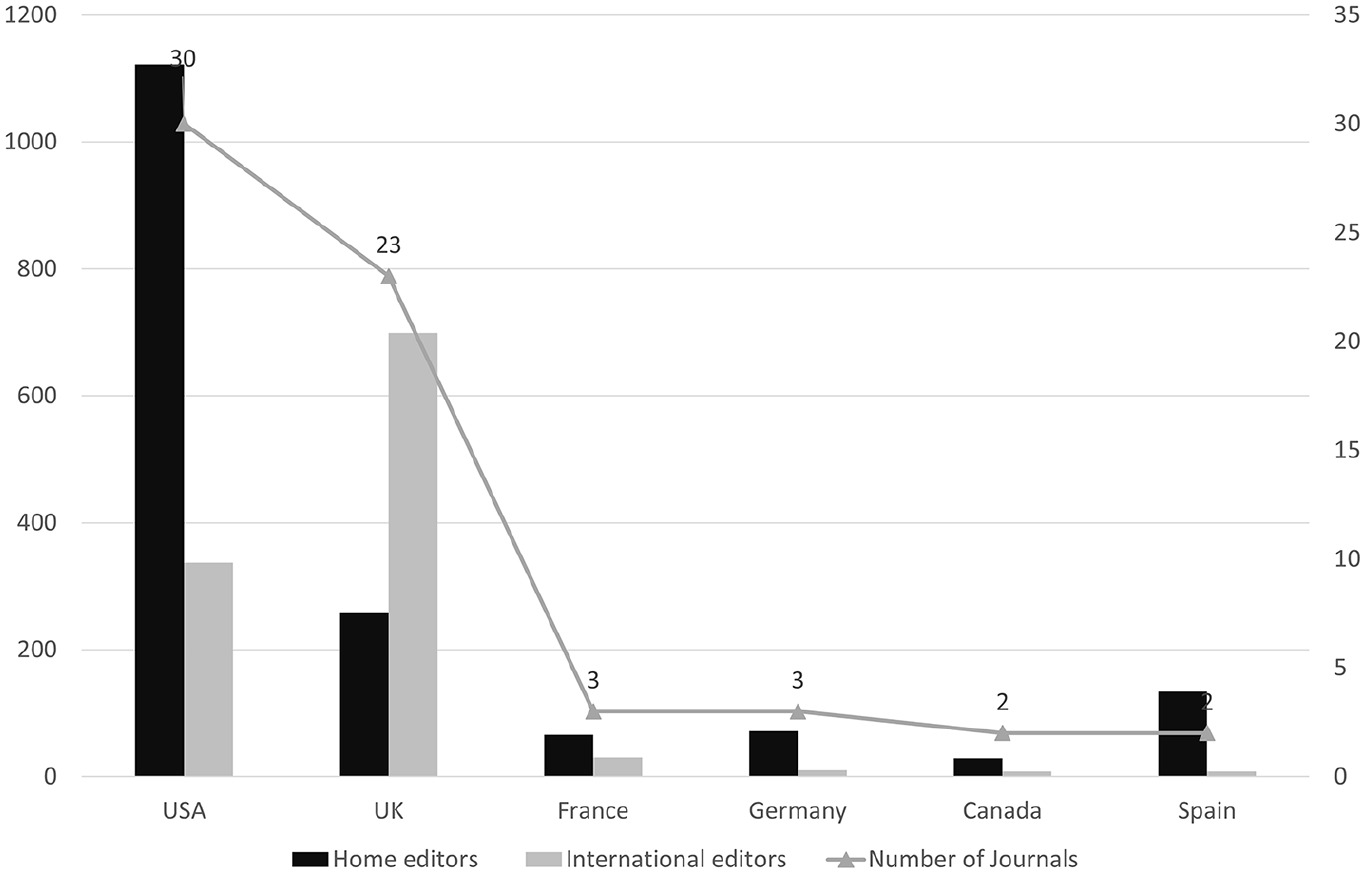
Comparing the number of international and ‘home’ editors on boards.
Editorial board networks
Looking into the network, several scholars are repeated across the editorial boards, consistent with the literature reviewed; this phenomenon is recognised as editorial board interlocking (Goyanes et al., 2022). As such, 14.7% of the scholars have presence in at least two different boards.
The network, our object of study, is fragmented. Each component corresponds to a sub-net, with its own interlocking of members with no ties to any other component. That means each sub-net needs to be analysed separately and have their own flow of resources and information. Component ‘1’ of the network includes 71 journals, meanwhile the other 6 components have their own sub-net with 1 journal in each one of them. The ‘isolated’ journals are Eastern European Countryside, Canadian Journal of Sociology, Rural Sociology, Social Compass, Sociologia, and Sociologie du Travail. Component ‘1’ is the most dense and wide sub-network (n1 = 2853), comprising the 97.3% of the entire network. The nationalities with major presence in the Component ‘1’ are the United States (1235 scholars), the United Kingdom (349 scholars), Spain (148 scholars), Germany (125 scholars), and Canada (90 scholars).
Component ‘1’ also comprises the most influential people in the entire network of the sociology journals considered for the present analysis. After a two-mode network analysis, where scholars are the set of actors and journals the set of events, Table 1 shows the top three most influential people in the field of sociology as gatekeepers of knowledge.
Centrality and betweenness for the three most influential editorial board members in component 1 of the network.
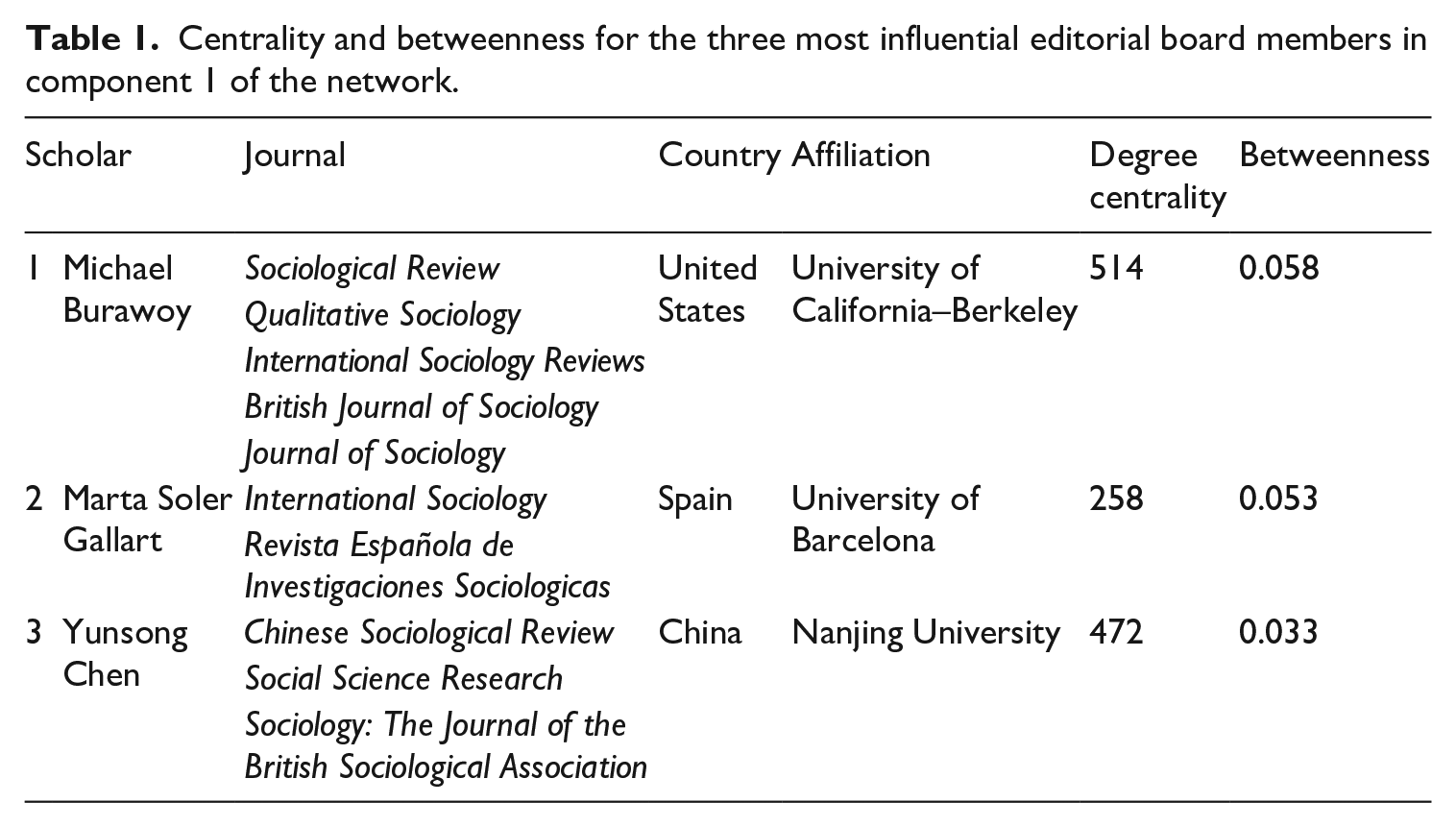
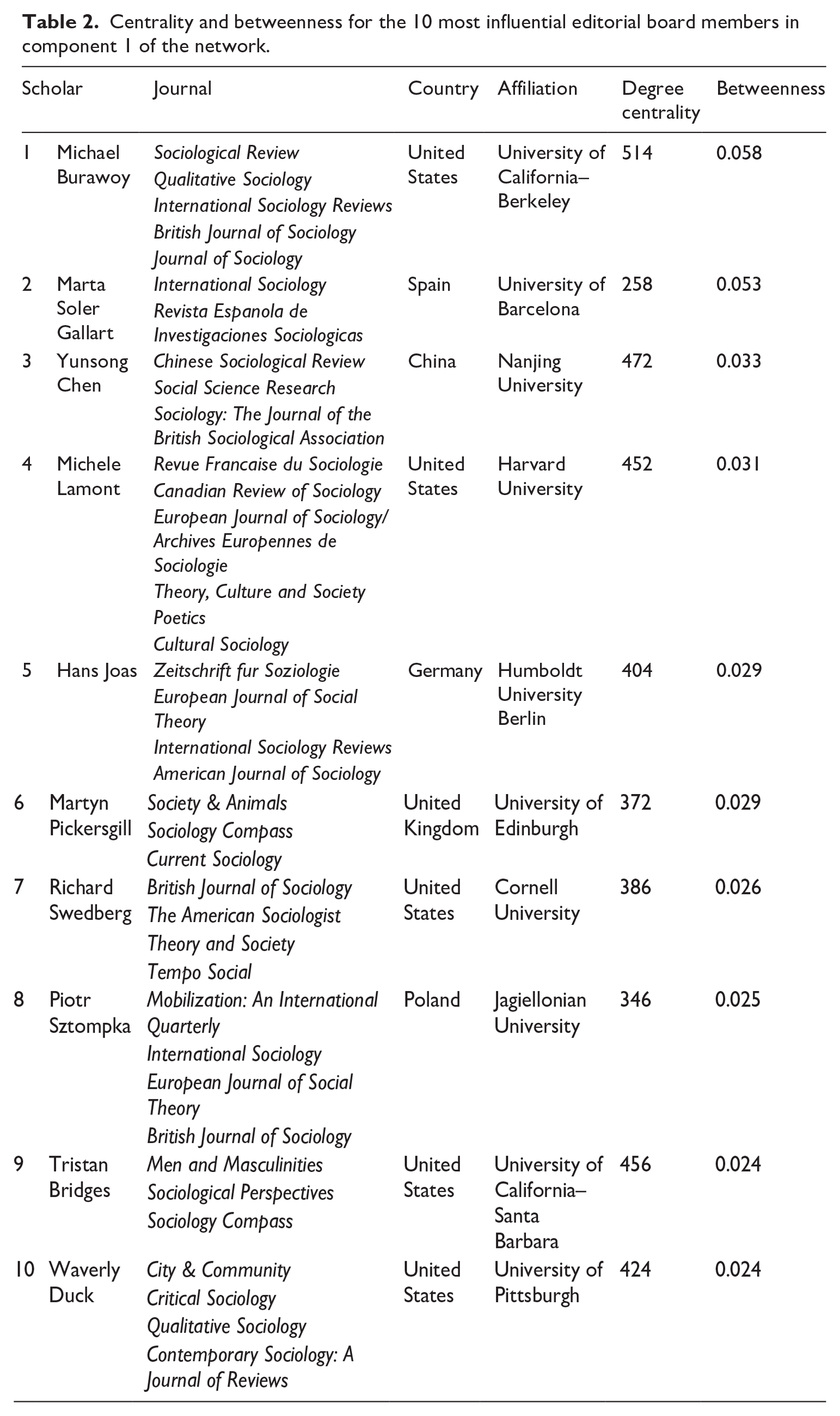
In Table 1, we can observe two indicators: degree centrality and betweenness. Regarding degree centrality, scholars Michael Burawoy and Yunsong Chen, have higher degree centrality, meaning they have more connections within the entire component ‘1’ of the network. However, our attention focuses on the betweenness measure which correspond to the most influential nodes, who control the flow of information and resources along the component. As a reference, the mean for betweenness in the component ‘1’ is 0.0007, the maximum corresponds to Michael Burawoy (0.058) and in second place Marta Soler Gallart (0.053). In the third place, with a lower rate, Yunsong Chen (0.033). While Burawoy is member of five editorial boards, Soler Gallart only is member of two editorial boards and comes in second place with a high punctuation. A possible explanation is that her position as gatekeeper is related to being on the board of the Revista Española de Investigaciones Sociologicas, serving as the shortest path to connect with boards from other journals (see Table 2 in the Appendix 1 for a top 10 table).
Burawoy is the network’s most powerful member, as was already mentioned, but that does not necessarily mean that he has the most affiliations. Michele Lamont, who has served on six different boards, is the scholar sitting on the most boards. Darren E. Sherkat, Herman G. van de Werfhorst, and Michael Burawoy were the next three, with five boards each. A total of 346 scholars are present on 2 editorial boards, 63 scholars on 3, while 18 scholars serve on 4 editorial boards.
It is worth noting that this is an undirected network, and our analysis focuses on the affiliation. One important property of the affiliation is ‘the duality in the relationship between actors and the events [. . .] Therefore, there are two complementary ways to view an affiliation network: either as actors linked by events, or as events linked by actors’ (pp. 294–295, Wasserman and Faust, 1994). This means that being part of one board automatically connects with other board members, generating structural relations, a key principle in network analysis (Knoke and Yang, 2020). The fact that individuals share an affiliation implies opportunities to meet and interact, and go further than a linkage. At the same time, the interlocking of members might allow flux of information among boards and coordinate different actions.
Further analysis is required to get a comprehensive analysis of all components of the network, for example, community detections. More data is required to analyse the bidirectional flow of information and resources among members, particularly how actor’s perceptions, beliefs, and actions could be influenced by being part of a specific board.
Discussion
This article provided a snapshot of the degree to which sociology journals as indexed in the Web of Science can be seen as international, through an exploration of their aims, editorial board membership, and broader networks among the key gatekeepers. The sociology journals included in the analysis often advertise their international scope alongside a diverse editorial board – which would theoretically provide access for researchers whose work has historically been side-lined (Cash-Gibson et al., 2018; Fejes and Nylander, 2014; Kwiek, 2021; Trahar et al., 2019).
Several key tensions remain in relation to the publishing industry, journal rankings and misrecognition of quality (Brembs et al., 2013; Cohen, 2019), editorial board and review practices, and what is seen as relevant sociology. In the pursuit of higher profits derived from higher-ranked journals being sold for more (Demeter, 2022 [2020]) and based on the billion-dollar donation from reviewers working for free (Aczél et al., 2021), publishing houses and by extension, journal editorial boards are incentivised to pursue higher cited papers – and as such, authors. Indeed, the financial model of global publishing houses excludes large parts of the world unable to finance subscription fees or golden routes to publishing – despite smaller-scale attempts to be more inclusive through, for instance, scrapping fees for low-income countries (Grove, 2023). Furthermore, review practices which take Western contexts and writing practices for granted can remain exclusionary.
Marginson (2022) provided a critique of global science viewed through competing narratives, arguing that a ‘centre-periphery model has been exploded by global system evolution’ (p. 1580) of rapid growth in scholarly production, international co-authorship, and the inclusion of a wider range of nation states. Although this article started from a centre-periphery viewpoint, the results indicated a discipline based on a global network of individuals, with some movement towards what Marginson (2022) termed a multi-polarity of global science. However, this snapshot also shows a discipline still dominated by an Anglophone/Western contexts. Demeter’s (2022 [2020]) remark about communication journals seems to ring true for sociology journals as well: ‘we see that in the world-system of global knowledge production, being “international” means being fully Western or including the West to a great extent, while it is not at all necessary to include non-Western regions of the world’ (p. 149). As such, ‘any serious contemporary re-thinking of the social sciences’ – a truly international approach if you like – ‘must work on a world scale’ (Connell, 2019). To create globally relevant sociological knowledge necessitates some reflection and action on both sociology’s colonial past and present, and the resultant inequalities of knowledge production within and between national contexts: a good start would be to look at the process and membership of gatekeeping in sociology (Nishikawa-Pacher et al., 2023).
Footnotes
Appendix 1
Centrality and betweenness for the 10 most influential editorial board members in component 1 of the network.
| Scholar | Journal | Country | Affiliation | Degree centrality | Betweenness | |
|---|---|---|---|---|---|---|
| 1 | Michael Burawoy | Sociological Review | United States | University of California–Berkeley | 514 | 0.058 |
| Qualitative Sociology | ||||||
| International Sociology Reviews | ||||||
| British Journal of Sociology | ||||||
| Journal of Sociology | ||||||
| 2 | Marta Soler Gallart | International Sociology | Spain | University of Barcelona | 258 | 0.053 |
| Revista Espanola de Investigaciones Sociologicas | ||||||
| 3 | Yunsong Chen | Chinese Sociological Review | China | Nanjing University | 472 | 0.033 |
| Social Science Research | ||||||
| Sociology: The Journal of the British Sociological Association | ||||||
| 4 | Michele Lamont | Revue Francaise du Sociologie | United States | Harvard University | 452 | 0.031 |
| Canadian Review of Sociology | ||||||
| European Journal of Sociology/Archives Europennes de Sociologie | ||||||
| Theory, Culture and Society | ||||||
| Poetics | ||||||
| Cultural Sociology | ||||||
| 5 | Hans Joas | Zeitschrift fur Soziologie | Germany | Humboldt University Berlin | 404 | 0.029 |
| European Journal of Social Theory | ||||||
| International Sociology Reviews | ||||||
| American Journal of Sociology | ||||||
| 6 | Martyn Pickersgill | Society & Animals | United Kingdom | University of Edinburgh | 372 | 0.029 |
| Sociology Compass | ||||||
| Current Sociology | ||||||
| 7 | Richard Swedberg | British Journal of Sociology | United States | Cornell University | 386 | 0.026 |
| The American Sociologist | ||||||
| Theory and Society | ||||||
| Tempo Social | ||||||
| 8 | Piotr Sztompka | Mobilization: An International Quarterly | Poland | Jagiellonian University | 346 | 0.025 |
| International Sociology | ||||||
| European Journal of Social Theory | ||||||
| British Journal of Sociology | ||||||
| 9 | Tristan Bridges | Men and Masculinities | United States | University of California–Santa Barbara | 456 | 0.024 |
| Sociological Perspectives | ||||||
| Sociology Compass | ||||||
| 10 | Waverly Duck | City & Community | United States | University of Pittsburgh | 424 | 0.024 |
| Critical Sociology | ||||||
| Qualitative Sociology | ||||||
| Contemporary Sociology: A Journal of Reviews | ||||||
Acknowledgements
The authors would like to thank Dr Pál Susánszky’s suggestions on the network analysis phase of this work and Dr Martin Myers for his detailed comments on the draft version of this article.
Declaration of conflicting interests
The author(s) declared no potential conflicts of interest with respect to the research, authorship and/or publication of this article.
Funding
The author(s) disclosed receipt of the following financial support for the research, authorship and/or publication of this article: This work was supported by the University of Nottingham (Nottingham Research Fellowship).