




Abstract
COVID-19 pandemic responses saw the large-scale return of quarantine, a once-common public health technology which, in modern society, had largely been replaced by infection control regimen combining immunisation, personal hygiene, and sanitation. While anchored in biomedicine, quarantine is a profoundly relational practice with immediate infringements upon personal liberties such as freedom of movement. The socio-cultural repercussions of targeting specific parts of the population for quarantine are likely long-lasting. Drawing on Alison Bashford’s understanding of quarantine as co-constituted by and co-constituting objects, people, and places, we conducted a narrative analysis of Australian online news published between January 2020 and December 2020. Comparing the reporting on maritime, residential and hotel quarantine in over 847 articles, we explore socio-cultural continuities and shifts in narrative plots as well as emergent subjectivities. We trace how some objects (i.e. cruise ships) become reimagined as ‘harbingers of death’; how in some places of quarantine (i.e. public housing estates) the approximation of class and race to danger is reiterated; and how a nuanced subject position is brought about in the ‘returned traveller’ quarantining in hotels. What objects, places, and people are associated with disease inflects whether and how far quarantine practices are deemed morally and socially viable.
Introduction
On Monday, 5 July 2020, acting Australian Chief Medical Officer Paul Kelly addressed the press to discuss the decision to place nine public housing estates in Melbourne in ‘hard lockdown’. Explaining the decision, he referenced experiences with the disembarkation of the cruise ship Ruby Princess on Sydney’s Circular Quay on the morning of 19 March 2020. Comparing the residential towers to ‘vertical cruise ships’, he highlighted the need to take swift action to minimise the spread of the virus (Murray-Atfield, 2020a, 2020b). Vertical cruise ships, however, is a curious figure of speech: What do the passengers on a maritime vessel during a leisure journey have in common with the residents in an urban public housing estate? To address this question, it is necessary to interrogate what quarantine is and what it does. While anchored in biomedical knowledge and practices, quarantine is embedded within broader social relations associated with distinct justifications and experiences of quarantine – and in turn the reproduction of social difference.
To trace processes of subjectification in and through quarantine, we explore Australian online news stories across various configurations. Specifically, we explore maritime, hotel, and residential quarantine narratives during the early stage of the pandemic. Maritime quarantine pertains to restrictions on vessels entering Australian waters and ports, as, for instance, the Ruby Princess cruise ship which is associated with the first major outbreak of COVID-19 in Australia (Walker, 2020). Residential quarantine pertains to the targeted and immediate lockdown of apartment blocks in nine public housing estates in Melbourne (Glass, 2020). Hotel quarantine pertains to the systematic setup of facilities for travellers returning to Australia, specifically the hotel quarantine scheme that is linked to the second wave of COVID-19 in the state of Victoria (Coate, 2020). We conduct a comparative narrative analysis of such media content to explore how objects, people, and places are co-constituted and differentiated within quarantine (see Bashford, 2004).
Drawing on Alision Bashford’s (2004) conceptual approach to quarantine as a ‘technology of government’ concerned with the ‘drawing and policing of boundaries’ (p. 123), we make sense of quarantine storytelling by teasing out the ramifications for subjectification. We begin by reviewing key moments in the early COVID-19 management in Australia as well as the historical antecedents of contemporary quarantine. We, then, analyse narrative representations of quarantine employed in the reporting on Australian strategies to curb the transmission of COVID-19. In conclusion, we demonstrate that quarantine narratives invoke and rely on classed and racialised subjectivities intertwining stories about people, objects, and places that challenge the notion of quarantine as a socially neutral health technology. We situate our interpretations within the sociological scholarship on the exacerbation of social inequalities in the wake of the pandemic.
Background
In the early months of 2020, the spread of the novel coronavirus causing COVID-19 triggered strict, swift, and far-reaching public health responses across the globe. Such measures affected every aspect of public life via the introduction of social distancing, face coverings, widespread testing, and hygiene protocols. COVID-19 pandemic responses saw the large-scale reintroduction of quarantine, a public health technology usually relegated to a few select settings in favour of infection control regimen combining immunisation, personal hygiene, and sanitation. Mobility became severely restricted to contain the geographical spread of the virus with measures ranging from the near cessation of international travel and the closing of jurisdictions within nations, to lockdowns imposing constraints on movement within localities. The speed with which such measures took hold, left little time for those in transit to negotiate passage, leaving many people stranded without the means to return to where they considered home. Immediate lockdowns had the potential to cause hardship for those who found themselves cut off from care networks or the means to provide for themselves (Kelaita et al., 2023), and have been shown to affect people differently depending on socioeconomic background, gender, location, and length of the lockdown (Liu and Gan, 2024; Plage et al., 2023; Price et al., 2023; Tomaszewski et al., 2023). In turn, pandemic responses actioned under the guise of protecting communities and saving lives have been exposed as enabling the continuation, escalation, and normalisation of lethal border violence targeting non-European migrants (Stierl and Dadusc, 2022).
Australia closed its borders first selectively to specific countries, and from 19 March 2020 onwards to all inbound non-citizens and non-residents (Campbell and Vines, 2021). Air travel restrictions virtually took hold over night, raising questions on how to provide safe passage home for those caught out overseas. Systematic government responses requiring mandatory stays in designated quarantine facilities were announced on 27 March 2020. Maritime mobility proved an equally complex issue for pandemic management. A blanket ban on all international cruise ship arrivals was declared on 15 March 2020, with the requirement for passengers to self-isolate for 14 days (Campbell and Vines, 2021). These measures proved difficult to action, given that many vessels affected by the ban were still at sea and self-isolation was poorly understood or endorsed.
Against this background, the arrival of the Ruby Princess with 2671 passengers and 1146 crew on board (Walker, 2020: 110) became a turning point in the governance of COVID-19 in Australia. A Special Commission Inquiry into the handling of the Ruby Princess when it came to port was set up to respond, ‘to the mishap that was the disembarkation of passengers from the cruise ship Ruby Princess’, which ‘brought about so many infected people departing relatively unrestrained [. . .] into the community’ (Walker, 2020: 15). In all, 663 Australian passengers and 191 crew contracted COVID-19 following this voyage; there are 28 confirmed deaths and at least 62 secondary and tertiary infections linked to the ship (Walker, 2020: 265–266). The Inquiry concludes: ‘It can only be hoped that this episode serves as a precautionary tale’ (Walker, 2020: 267). Proceedings of the Inquiry stimulated immense public interest, with many testimonies from passengers, crew, corporate players, and public health officials livestreamed or reproduced in online and offline media.
After an initial peak in late March, by May 2020 it appeared that the spread of the COVID-19 pandemic had been contained in Australia. The directive for the establishment of hotel quarantine programmes stipulating a 14-day period of mandatory quarantine at designated facilities for all international arrivals had been implemented with staggering speed by federal and state governments. The hotel quarantine scheme in Victoria opened its first facilities just 2 days after it was announced by the newly formed National Cabinet (Coate, 2020: 13). For its duration between 29 March and 30 June 2020, a total of 21,821 people went through the programme, in which 236 infections with the virus were detected. The experience of mandatory hotel quarantine was associated with uncertainty-induced anxieties and a sense of loss of agency in a carceral space (Williams et al., 2022). Yet, the state’s programme only came to an abrupt halt and eventual ‘reset’ after its connection to a devastating second wave of COVID-19 in Victoria became apparent. The final report of the COVID-19 Hotel Quarantine Inquiry dating from 21 December 2020 (Coate, 2020) found that hotel quarantine breaches were linked to poor governance. Yet, where exactly political accountability fell, remained unclear despite countless witness accounts from detainees, hotel quarantine workers, and high-profile public servants and politicians, including then-Victorian Premier Daniel Andrews. The inquiry also provided a space to reflect on the experiences of people subjected to hotel quarantine (see also Williams et al., 2022), sparking debate on balancing human rights with the governance of risk.
Hotel quarantine and the ensuing inquiry to some extent overlapped chronologically with the Melbourne lockdown of nine public housing towers (Robinson et al., 2021). Issued with detention directions on Saturday, 4 July 2020, residents were detained in their homes, effective immediately. A sizable police presence on site ostensibly enforced these directions, and initially, there were no exemptions for physical activity or ‘fresh air’ breaks. These conditions affected the health and wellbeing of residents. Furthermore, how expectations around testing, detainment, and the rationale for the directions were communicated failed to consider the cultural and linguistic backgrounds of the residents. Concerted community and civil society responses to provide care, supply food and medicines, and advocate for the rights of the detained residents followed (Robinson et al., 2021). Eventually, an inquiry of the Victorian Ombudsman (Glass, 2020), published on 17 December 2020, found that human rights violations had taken place – not because the residents had been quarantined – but due to how the lockdown had been implemented. It recommended the Victorian government to, ‘apologise publicly to residents of the Flemington and North Melbourne public housing estates for harm or distress caused’ (Glass, 2020: 19).
How the events surrounding the Ruby Princess were narrated provides meaningful insights into how later hotel and residential quarantine measures, and the people subjected to them, were socially positioned. Beyond sociological debates foregrounding the morality of placing the responsibility for pandemic risk on individuals (Ekberg et al., 2021) or governments (Giritli Nygren and Olofsson, 2020), the intensely mediated inquiry proceedings across all three cases provide an opportunity to reflect on the nature of information during crises. For instance, there is evidence that the COVID-19 pandemic was accompanied by the rise of conspiracy theories (Kużelewska and Tomaszuk, 2022) and gave right-wing populism a platform to upscale ingroup and outgroup narratives towards a European meta-populism (Lamour and Carls, 2022). To situate our interpretations within the Australian socio-historical context, we outline our conceptual approach to quarantine as we introduce the role of quarantine in delineating the Australian nation state.
Quarantine as a technology of governing objects, people, and places
Mobility is the primary focus of quarantine measures by restricting individual movement. Moreover, quarantine is both temporal and spatial in nature. Quarantined people do not only have to isolate in a certain space, but also for a certain time. As such, quarantine as a social practice has the capacity to draw boundaries around places and objects assigning subjectivities to designated spaces (Bashford, 1998, 2004; Bashford and Strange, 2003). With Nikolas Rose (1996), we approach subjectification as ‘the effects of the composition and recomposition of forces, practices, and relations that strive or operate to render human beings into diverse subject forms, capable of taking themselves as the subjects of their own and others practices upon them’ (p. 171).
In Australia, quarantine is historically a significant policy site for the formation as a modern nation, the delineation of the borders around this nation state, and a national identity (Bashford, 1998; Bashford and Strange, 2003). Bashford (2004: 116) maintains that, ‘maritime quarantine measures, enabled a particular geographic imagining of Australia’, making quarantine ‘culturally and imaginatively central to [. . .] the production of Australia as a “geo-body”’. Biomedical quarantine practices have been emulated in Australian social and welfare policies targeting Indigenous peoples in a way that furthered the construction of contemporary Australia as a White nation (Staines, 2022). As a technology of governance, quarantine collapses categories such as object, people, and place (Bashford 2004), contingent on and producing complex positions in a social order for those subjected to it. Who is likely to be put under quarantine directions, in what conditions, and for what reasons is socially embedded intersecting with experiences of privilege or disadvantage.
Method
Study design, data collection, and sample
We explore contemporary Australian quarantine narratives across maritime, residential, and hotel quarantine, affecting different demographics during the early stages of the pandemic, to trace the emergence of distinct subjectivities in the governance of COVID-19. This study was exempted from ethical review by the Human Research Ethics Committee of the university where the research was conducted. Data collection was carried out across two stages. First, we conducted a Factiva database keyword search with support from a research assistant to identify potential texts for analysis. Texts so identified were screened for salience to the objectives of this study to trace continuities and emergent subjectivities within quarantine narratives inflected by discursive constructions of Australia as a nation. Inclusion criteria were (1) published between 1 January 2020 and 31 December 2020, (2) in English language, (3) online in an Australian news media outlet, and (4) making reference to (i) the disembarkation of the Ruby Princess as well as the following inquiry and/or (ii) the introduction of hotel quarantine and the inquiry into the Victorian scheme, and/or (iii) the hard lockdown of the public housing towers in Melbourne, and the following Ombudsman investigation into its human rights violations. We collated articles from national, regional, and local online news sites that reported on maritime, residential, and hotel quarantine during the early stage of the pandemic to capture the emergence of COVID-19 as a socio-political phenomenon, early responses aimed at managing outbreaks as well as the gradual establishment of routinized processes and plots.
Overall, the combined searches yielded 847 articles after removing duplicates. The first news items included in the larger sample were published on 28 January 2020 and the last on 30 December 2020. In all, 253 articles focused primarily on maritime quarantine, 115 on residential quarantine, and 479 on hotel quarantine (see Figure 1). Some articles (n = 133) additionally mentioned another type of quarantine – four articles referred to all three types of quarantine.
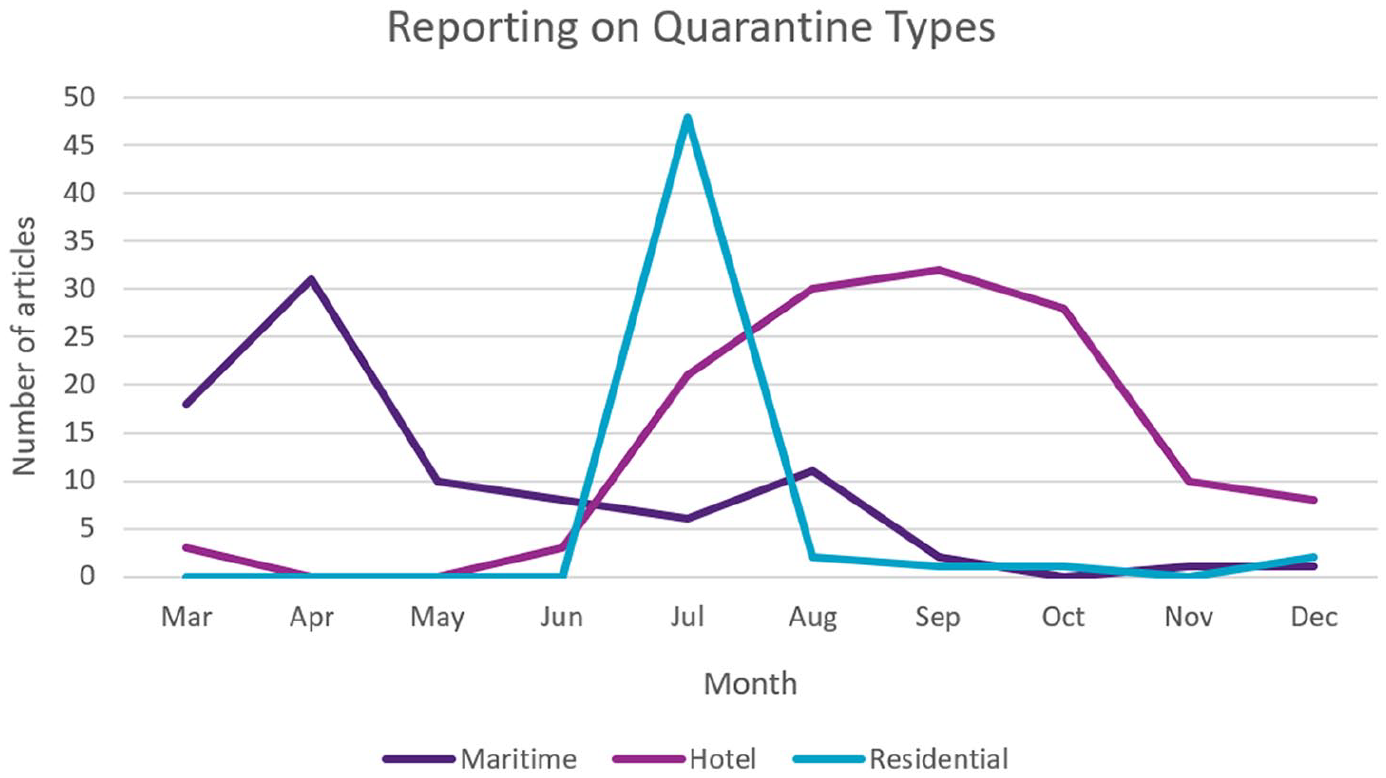
Number of articles across primary quarantine type March to December 2020.
For the second stage, we collated a subsample from the 847 identified articles for a narrative analysis. To do so, we first identified all articles pertaining to more than one form of quarantine (n = 133), then ordered the remaining articles chronologically and sampled every fifth text. This yielded another 144 articles. The final subsample (n = 277) includes articles from the ABC (ABC, n = 58), The Daily Telegraph (TDT, n = 17), The Guardian (G, n = 30), The Sydney Morning Herald (SMH, n = 71), The Australian (TA, n = 69), and others (n = 32). Although we made every effort to locate news stories meeting the inclusion criteria, we acknowledge that our final sample is likely incomplete. Nonetheless, we are confident that the size of the sample is sufficiently great to substantiate the findings reported below. Our assessment is based on the large degree of repetition and duplication across articles, as well as the breadth of included news sources and the diversity in experiences and perspectives we encountered in them.
Data analysis
Data were subjected to three types of narrative analysis: thematic, structural, and visual (Riessman, 2008). Thematic analysis is focussed on a narrative’s content; structural analysis explores the forms of storytelling (e.g. metaphors, formulas, and attributes); and visual analysis examines visual content alongside text. Data analysis began while screening for inclusion in the larger sample and continued as all 847 articles were read by the lead researcher using annotation and memoing to develop a thematic framework. During this stage, we also took note of key metaphors and formulas in which stories about quarantine were told. The thematic framework was then applied to the subsample (n = 277) with the support of NVivo12 software. The addition of selected photographs published as a part of news items provided opportunities for visual analysis. We use the photographs as a lens through which to interrogate and illustrate the identified themes. Finally, we revisited the extant literature on quarantine as a historically relevant subjectivising practice to interpret our findings.
Results
Harbingers of death
Maritime quarantine initially received the most journalistic attention in the analysed period. The fate of cruise ships and their passengers caught out at sea by the onset of the COVID-19 pandemic and the implications for the broader community generated a large volume of articles. The disembarkation of the Ruby Princess became the case against which other crises of containment would be measured. Attention to the ways in which the story of the Ruby Princess is told, reveals metaphors and attributes reinforcing the encroaching presence of COVID-19. Such metaphors liken cruise ships to a ‘breeding ground’ or ‘petri-dish’. Descriptors such as ‘ill-fated’, ‘virus-ridden’, or ‘disease-ridden’ elicit fear of contamination. Counter-narratives representing maritime vessels as ‘floating quarantine’ appear rarely; references to cruise ships as ‘death ship’, ‘sick ship’, or ‘Covid-ship’ are more common and conjure imagery of a modern-day plague. The association of maritime vessels with COVID-19, and in turn the proximity to disease and death was reinforced via the co-occurrence of these metaphors alongside articles reporting the growing body count linked to the Ruby Princess, for example: A woman in her 70s who contracted the virus on the ship became the seventh coronavirus-related death in NSW. (ABC, Unknown Author, 2020a)
The above excerpt demonstrates a formula of reporting that is characteristic of the early days of the pandemic, with relatively low incidence and fatalities. Over time this formula shifts towards a proportional accounting style, evident in the examples below: And of the 75 people who have died in Australia, 21 of those were connected to the ship’s disastrous journey to New Zealand. (ABC, Cockburn, 2020) The notorious Ruby Princess cruise ship – Australia’s biggest single source of infection linked to seven deaths. (TA, Ritchie and Kellett, 2020) He would be the first of many Australian cruise ship passengers to die after being diagnosed with COVID-19, including 22 who disembarked the Ruby Princess ship in Sydney. (SMH, Noyes and Ward, 2020)
As Abeysinghe and White (2010) noted in their analysis of narratives on Avian Influenza, the communication of risk happens via the use of statistics, estimated probabilities, infection rates, and death tolls. Such numbers can take on semi-magical qualities (Billig, 2021) and the symbolism with which they are imbued can be put to protecting, strengthening, or threatening social bonds (Camorrino, 2023). The last excerpt creates a sense of foreboding. This sense of foreboding owes to the mobility inscribed in maritime travel, made more salient in the coinciding of shorelines with national borders (Bashford, 1998).
This narrative structure positions cruise ships as bringing disease, suffering, and death to Australian shores. Cruise ships are identified with dangerous objects: they become harbingers of death. A photograph published alongside an article reporting on the fate of the Ruby Princess after disembarkation, visually encapsulates this point showing the vessel idling off the coast near Sydney with the Waverly Cemetery in the foreground (Figure 2).
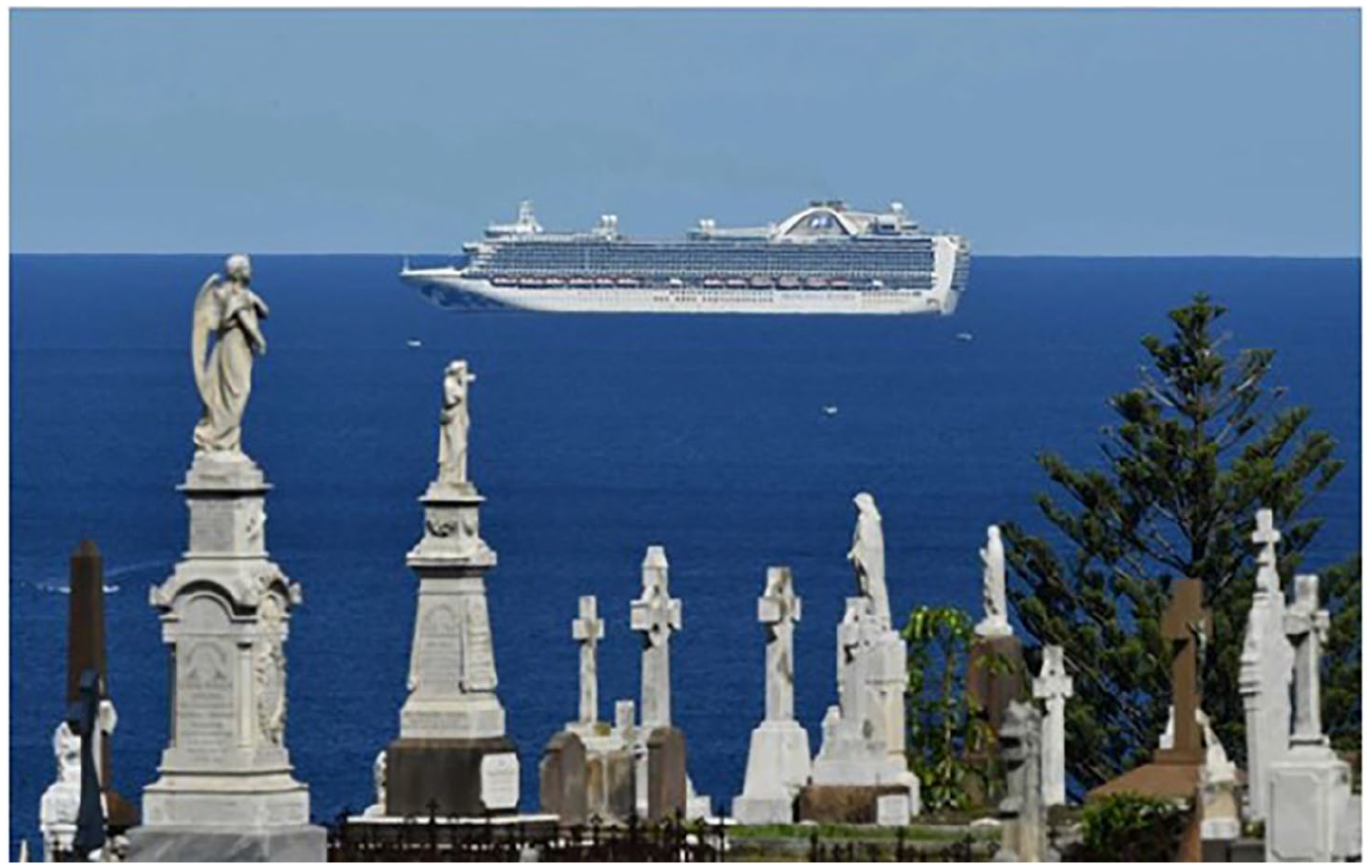
ABC, Probyn (2020); image credit AAP Joel Carrett.
The composition of the photograph emphasises the proximity with cultural symbolism of death, while employing the visual aesthetic language of a tourism catalogue: a bright day, calm seas, and a well-known landmark. However, here these visual ingredients combine to produce a sense of looming disaster. The focus on an iconic landmark is symbolically powerful in its capacity to invoke national jeopardy: the threat of COVID-19 closing in on the nation.
Importantly, the structure of the narrative centres vessels themselves as dangerous objects putting its passengers and the health of the national body at risk. There is a classed dimension to how these objects, people, and communities are represented. Passenger stories are told in a way that appeals to empathy, rather than danger: Imagine what it’s like for the passengers, back at home, hearing how their trip unleashed a creeping trail of disease through the broader community; hearing of friends and acquaintances made during the cruise falling ill or dying. And now homicide detectives are investigating the ship and will probably want to interview them. (TA, Middap, 2020)
In contrast, some stories reflect on the impasse regarding what to do with the Ruby Princess and the crew remaining on board after all passengers had disembarked. At the time of the photograph, hundreds of crew members remained onboard and were refused disembarkation, on the grounds of infection control, but also due to their status as foreign citizens. These foreign nationals, the vast majority from low-income countries, were quarantined off Australian shores, despite the rushed disembarkation of the ship’s (by and large wealthier) passengers. As an advocate for these crew noted: Australia had a legal and humanitarian obligation to help crew members, who are in quarantine in their cabins, by testing them, treating them and allowing them to return to their home countries. (G, Zhou, 2020)
The fate of the Diamond Princess quarantined for weeks in Japan’s Yokohama port presents an intriguing point of comparison. While the poor implementation of quarantine on that vessel was widely criticised and blamed for the spread of infection among its crew and passengers (see Pougnet et al., 2020), the deaths and human suffering ensuing after the unchecked disembarkation of Ruby Princess passengers, was regarded as a failure to impose quarantine. The handling of this situation set the tone for a later standoff in Western Australia when then-Premier Mark McGowan took a hard line towards crew on incoming vessels, reiterating the ‘disaster’ (Brown, 2020) of the Ruby Princess disembarkation. This early episode in the governance of COVID-19 foreshadows how social forces along representations of nation and class, inflect how quarantine practices are narrated to affect people differently. We interrogate these dynamics in greater depth below.
Bodies out of place
Reporting on quarantine facilities onshore leverages the ‘harbingers of death’ theme, but shifts focus from ‘dangerous objects’ (i.e. maritime vessels) towards ‘dangerous places’, located (initially) outside Australian national borders. Reporting of new incidences of COVID-19 infections inside Australia often traced back cases to a purported origin. For example: Fresh cases of exposure being reported on the Gold Coast and New South Wales over the weekend from people returning from Iran. (G, Martin and Henriques-Gomes, 2020)
Whereas in maritime quarantine, ‘dangerous objects’ were threatening to bring the virus to Australian shores, it is now people who travel from ‘dangerous places’ into Australian communities carrying the risk of infection with them. The governance response to these perceived risks was the imposition of travel bans, at first on selected countries, like China and Iran, followed by a comprehensive ban on all international arrivals. In this context, dedicated quarantine facilities are initially positioned as sites of containment, but also gateways facilitating the return of Australians stranded overseas. Attention turns towards the dangers brought home with ‘returning travellers’ – a subject position emergent in the stories about quarantine.
The returned traveller is a complex trope, implying that these people are of Australia (i.e. one can only return to somewhere to which one belongs) while simultaneously being separate from the national body. This liminal status of being of, while being separate situates ‘returning travelers’ as bodies out of place that need to be reintegrated. This triggers a bifurcated process of quarantine as public health technology and as a ritualistic process of subjectification, which manifested in a hotel-based system subject to strict eligibility criteria and caps on numbers.
The caption that accompanied Figure 3 reads: The first busloads of international arrivals have been taken to quarantine hotels across Sydney. (ABC, Unknown Author, 2020b)
The caps imposed on numbers allowed to enter the hotel quarantine system are significant, as international arrivals come in ‘busloads’ (Figure 3). This terminology continues a ‘swarm discourse’ that historically approximates contagion through immigration and threat to the national body (see Mendoza, 2018; Taylor and Kidgell, 2021). The preoccupation with numbers couched in a capacity narrative further justifies the governance of the returning traveller subject. Concerns with the rights of detainees and their conditions in quarantine only surface sporadically: being subjected to quarantine becomes an expression of social privilege, a means to accomplish the reabsorption into a national body, while preventing its contamination. Quarantine facilities present a spatio-temporal configuration – ‘safe zones’ in which biohazards brought back with ‘returning travelers’ from ‘dangerous places’ are contained and purged: [People in hotel quarantine were] separated by a fence from the first lot, but again, well away from anyone in the community . . . hundreds of metres away. (ABC, Heaney, 2020) The best way to prevent returning travellers spreading the virus amongst the wider Victorian community [. . .] hotel quarantine system was the nation’s ‘defence against importing cases from around the world’. (SMH, McCauley et al., 2020)
The plot here is one of hotel quarantine as a line of defence, at a distance from the broader community, in which ‘returning travelers’ are ritualistically purified from the threat of disease while they await their welcome back in the Australian national body. The positioning of quarantine facilities as sites of containment invoked a sense of spatial separation that permitted the governance of risk. However, the emergence of community cases linked to the Victorian hotel quarantine system posed a dramatic challenge to this plot and the ‘returned traveler’ entangled in it: Now that shield is under pressure and cracks are appearing. It appears that failures in the system have led to the virus spreading in the community. (SMH, Unknown Author, 2020c) The pathogen flew in with returned travellers who quarantined in the [. . .] hotels before it spread to more than 30 security guards, setting in a motion a wave that killed hundreds of people in Victoria. (SMH, Cunningham, 2020)
Notably, the Victorian hotel quarantine scheme and the inquiry into its implementation saw the proliferation of metaphors depicting boundaries as porous, using terms like ‘leakage’ or ‘cracks’. Subsequently, hotel quarantine and quarantine facilities’ representation in the news media shifted dramatically, with fewer occasions presenting the quarantine space as a ‘safe zone’ and increasingly shifting interest towards governance failures and their consequences: Ben Ihle went through the genomic sequencing and epidemiological investigations undertaken as part of the inquiry. These had shown the movement of the virus through the barriers of quarantine was responsible for 99 per cent of the recent COVID-19 infections in Victoria. ‘On 23 May, Victoria’s COVID-19 death toll was 19 people. There were no deaths attributable to COVID infections between that date and 4 June’, he said, when the [hotel] outbreaks were beginning to gather steam. ‘As of today, the total number of COVID related deaths in Victoria is 787’, he said. This meant ‘the failure by the Hotel Quarantine Program to contain this virus is, as at today’s date, responsible for the deaths of 768 people and the infection of some 18,418 others’. (SMH, Lucas and Mills, 2020; added italics for emphasis)
This statement attributed to counsel assisting the Coate Inquiry Ben Ihle was reproduced many times across all media outlets in the sample and indicates a massive narrative shift in the use of quarantine as the governance of danger. Where national boundaries in the case of maritime quarantine coincided with Australia’s shoreline, here the boundaries protecting the community are located well and truly within the nation. As a designated space within the national body, these quarantine hotels had turned from a means to mitigate danger into dangerous objects themselves. The reporting broaches the significance of the temporal governance of space, here raising the urgency with which hotel quarantine systems were implemented as a possible explanation for ensuing breaches: The quarantine program, dubbed Operation Soteria after the Greek goddess of rescue and safety, was initially set up in 48 hours. (SMH, Mills and Fowler, 2020)
The most common attribute with which the Hotel scheme is described is as ‘a bungled quarantine allowing the virus to run rife [posing] dangers for the nation if quarantine was botched’ (TDT, Young, 2020, emphasis added in italics). This expanded the spectrum of potential breaches beyond infectious disease control to include moral and legal transgressions. The reporting on the Hotel Quarantine Inquiry is ripe with stories about hotel detainees flouting rules, security guards asleep on the job, or political leaders uninvested in taking responsibility. In turn, the attention to breaching as a dangerous ‘doing’ that is not accidental but eventuates from acts that are narrated as incongruent with moral behaviours (Ekberg et al., 2021), set the stage for a greater emphasis on compliance. Breaches rely on the singling out of ‘dangerous people’ alongside ‘dangerous objects’, bringing into existence subjects amenable to the conduct of conduct. This is a crucial factor when considering the reporting on the lockdown of nine public housing estates in Melbourne during this second wave, as we elaborate below.
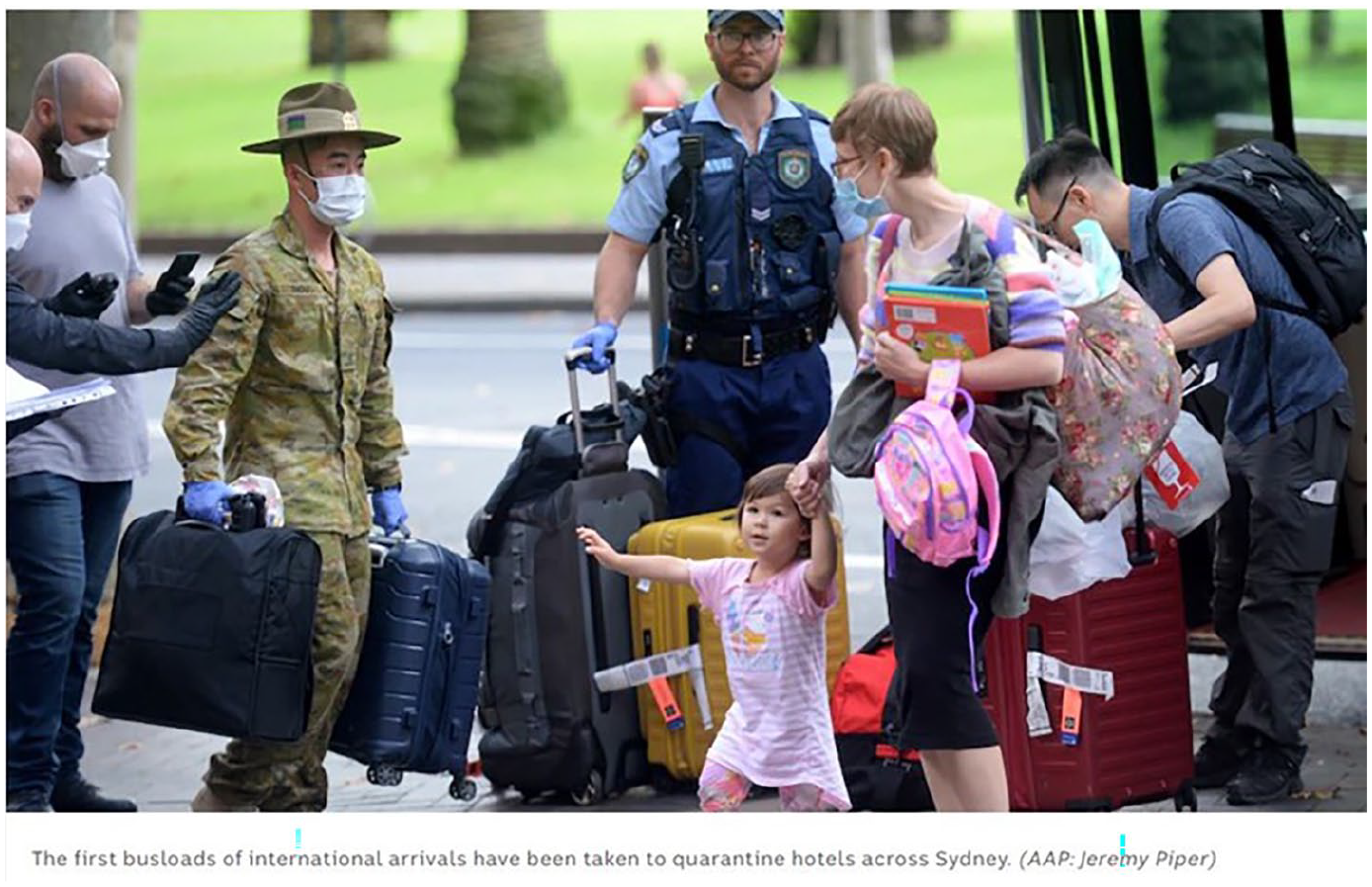
ABC, Unknown Author (2020b); image credit AAP Jeremy Piper.
Putting bodies in their (social) place
The lockdown of nine public housing estates in a deprived Melbourne neighbourhood combines elements we identified above in the context of maritime and hotel quarantine reporting. The lockdowns were described throughout all media outlets as ‘immediate’ and ‘hard’ imposing extremely strict conditions on residents with virtually no advance notice. This left some residents unable to enter their homes, for example, when returning from work, or to check on family members in need of care. First and foremost, residents affected by the measure are governed as dangerous people who in their numbers are positioned as a risk of unknown proportions: A matter of many hundreds [of public housing residents] who have already been exposed and who may already be incubating. (ABC, Murray-Atfield, 2020a)
This swarm rhetoric combines with their positioning as capable of breaching to call for strict enforcement of compliance with quarantine rules: Sending police rather than security guards or community workers [to locked down estates] indicated there were likely concerns of potential quarantine breaches. (ABC, Wibawa and Mann, 2020)
However, while public housing residents are also represented as capable of breaching there is an added dimension of vulnerability assigned to them: Residents living in the flats are among the most vulnerable and heavily policed people in the state of Victoria, with a high population of new migrants, Indigenous people, people experiencing severe mental illness and people who have experienced family violence or homelessness. [. . .] given the vulnerability of many people living in the towers, to do anything else [other than lockdown] would be contrary to public health advice [. . .] it would risk an ‘explosion’ of new cases among vulnerable people living in housing estates. (G, Wahlquist and Simons, 2020) The residents of the towers were particularly vulnerable, saying public health workers, nurses and others had been working ‘right throughout the night’ to provide food, essentials, drug and alcohol support, mental health support, family violence support, physical healthcare. (G, Visontay and Henriques-Gomes, 2020)
Public housing residents are here presented simultaneously as dangerous and in danger, leveraging vulnerability tropes percolating Australian welfare discourse (Peterie et al., 2022). As Robinson et al. (2021) noted, residents were seen as deficient by local authorities orchestrating the lockdown and were by and large excluded from the discussion of potential solutions to the problems arising from it, as they themselves were identified as part of the problem. Concurrently, there are a notable number of exceptions to the aggregated reporting of public housing residents as vulnerable and dangerous. Indeed, as the lockdown went on, stories centring individual tower residents’ community advocacy and human rights increased and added nuance to the overall media reporting. These include stories about the efforts to support testing, sharing culturally appropriate food, communication (e.g. by translating official pamphlets into various languages), and entitlements to fresh air and exercise. Concentrated in outlets such as The Guardian and ABC, these stories sit in contrast with the positioning as vulnerable: When the lockdown happened, [resident] took it upon himself to help translate public health messages from English to the local languages, Amharic and Tigrinya. He said the Government’s initial communications that provided crucial information about infection control were in English only. (ABC, Om, 2020) Many of the residents worked as health workers, for aid organisations, or in aged care either in Australia or other countries, [resident] said. Best practice would have been to work with them to find out what concerns people had and how residents were accessing information about the virus. They could then assist the government to target the response to the outbreaks. (G, Davey, 2020)
More so than in any other configuration of quarantine reporting, residents were interviewed and asked how they felt about the lockdown, offering relatable insights into lockdown living, challenging the deficit-heavy vulnerable subject position. However, stories of attempted breaches, violence, and frustration dominated reporting in other news sources. Here, individual residents appear as harder to contain than ‘busloads’ of returned travellers. Rather than acknowledging the immediacy of the lockdown and ensuing material and social deprivation, the trouble with quarantine is located in the purported vulnerability of the detainees and to the quarantine site. In this way, public housing residents become the weakness of the quarantine response as their vulnerability becomes synonymous with the capacity to breach, that is, to move the vulnerable/dangerous body out of its designated space. Quarantine as a practice of governance then is concerned with putting bodies in their socially allocated space (Figure 4).
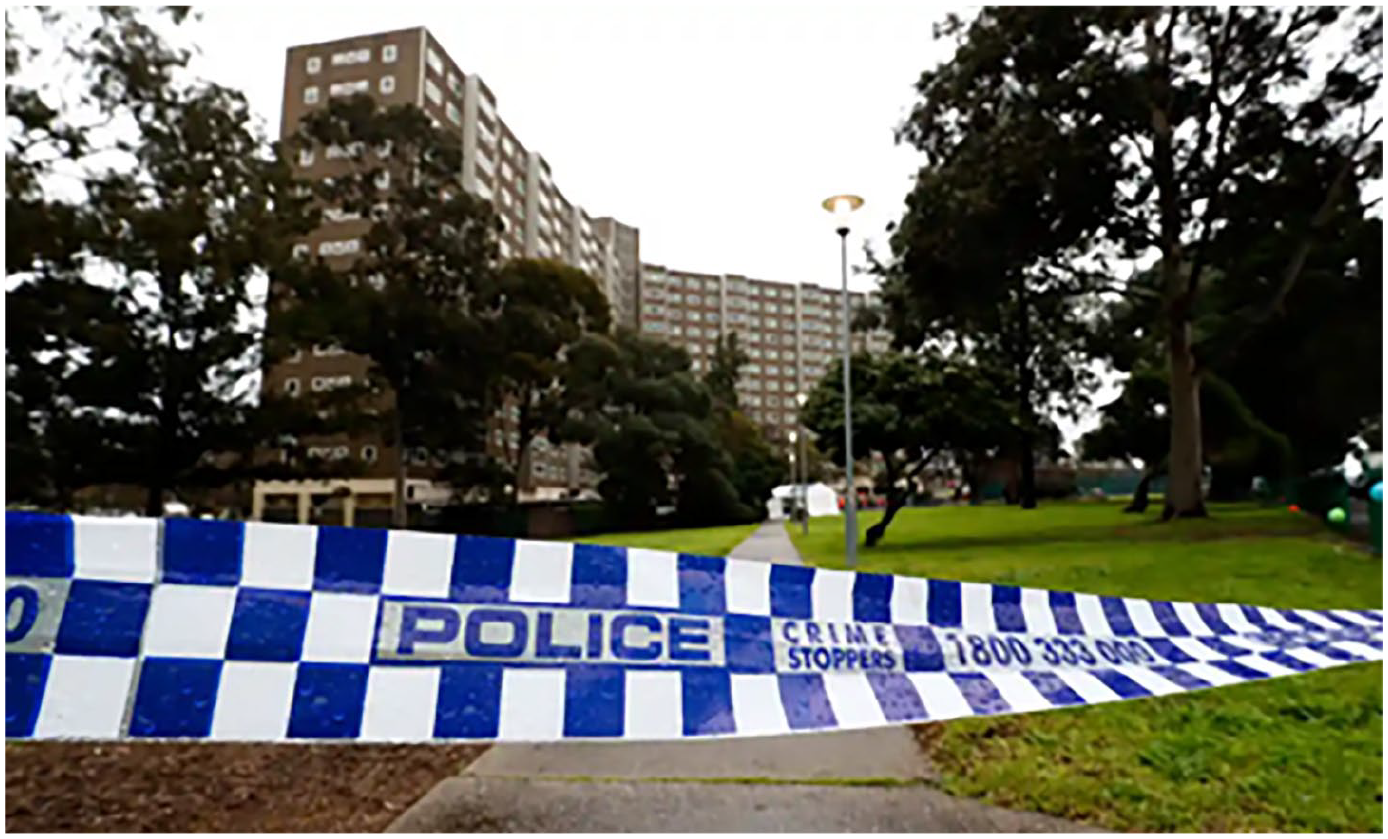
SMH, Hall (2020); image credit Getty Images.
We are reminded of the role of security guards in media reporting on hotel quarantine breaches: People at the other end of the income scale helping to spread the virus and being its greatest victims. Low-paid and poorly trained hotel-quarantine guards, with precarious job security, were the human channels from supposedly quarantined travellers to the guards’ families and friends. (SMH, Gittens, 2020) Victoria has been criticised for being too slow off the mark in drawing on ADF [Australian Defence Force] personnel, with some observers blaming the use of private contractors to manage the hotel quarantine scheme for allowing COVID-19 to spread back into the community. (ABC, Unknown Author, 2020d)
While the Coate Inquiry found no evidence for any individual security guards’ actions to have resulted in the breach of quarantine that led to COVID-19 spreading in the community, the (ultimately unresolved) question of which government official had decided to rely on private security rather than police or the ADF to enforce compliance with hotel quarantine occupied the inquiry a great deal. In media reports, security guards were depicted as a casualized and uneducated workforce often sharing living, travel, and working arrangements with little background in or appreciation for infection control. They were also described as prone to immoral practices (e.g. having sexual contact with hotel detainees, neglecting duties, or being uncooperative) that transgress quarantine boundaries: Reports have also emerged of contractors having sexual relations with guests and families being allowed to go between rooms. (ABC, Unknown Author, 2020e) The state’s contact tracing team had a hard job trying to track infected security guards because guards were not always ‘forthcoming’ with where they had been and second jobs they had worked. (ABC, Willingham, 2020)
The latter statement was attributed to Jenny Mikakos, then-Minister for Health in Victoria. We also see similarities in the representation of crew earlier in the pandemic as a lower socioeconomic cohort located away from the protections of the national body. These groups exemplify a proclivity to breach being associated with their standing in a classed, and more subtly also racialised, social order (see Horner and Rule, 2013 on the spatial politics of race). Dialectics of quarantine tapping into constructions of dangerous people brought into being, in turn, subject positions linked to the need for containment. The logic of the returned traveller who moves across boundaries as a staged re-entering into the healthy national body is reversed here: a space of containment has to be carved out in the midst of community. The boundaries leveraged for this are legal-jurisdictional (e.g. shorelines, borders around states), and social-relational (e.g. non-English speaking, migrant, poor, uneducated, delinquent) in nature.
Discussion and conclusion
We undertook a narrative analysis of reporting on COVID-19 quarantine measures in Australian news media in 2020 to trace emergent processes of subjectification. The study design allowed us to interrogate how boundaries around different social groups within the national body gain salience and how some parts of the population are constructed as dangerous to the health of the national body. We identify continuities with historical processes of quarantining in the emergence and securitization of the Australian nation (Bashford, 1998; Stephenson and Jamieson, 2009) and challenge the notion of COVID-19 acting as a levelling force eschewing pre-pandemic social divides (see e.g. Hafner and Sun, 2021; Jaworska, 2021). As such, we contribute to the growing scholarship tracing how the COVID-19 pandemic affected social inequalities (see e.g. Liu and Gan, 2024; Parsell et al., 2020; Plage et al., 2023; Price et al., 2023; Stierl and Dadusc, 2022; Tomaszewski et al., 2023).
While we described how a historically rooted Australian ‘importation fear’ was exacerbated by the unchecked disembarkation of COVID-19 infected passengers from the Ruby Princess in Sydney (Moloney and Moloney, 2020), we also analysed processes of subjectification in which a new subject trope was produced: ‘the returned traveller’ emerged along the unstable narrative lines of breach and containment. Returned traveller subjects carry relative privilege and only make sense as a (fleeting) spatio-temporal configuration that can be subjected to governance. This entails direct intervention through mandatory confinement, but also governing at a distance through the conduct of conduct. Here the potential for breaches encompasses moral and civil breaches alongside the transgression of spatial boundaries of confinement (see Ekberg et al., 2021). Such breaches, however, were less attributed to those being quarantined as returned travellers than to those charged with containing them. Here the intersection of quarantine and social class is particularly pertinent. We see commonalities with the representation of cruise ship crew members and public housing residents subjected to a hard lockdown in their homes.
Despite nuances in leveraging, reinforcing, and sometimes inventing subjectivities with differential standing in the social order, there are some commonalities in the stories on quarantine. Primarily, through quarantine defined as a technology configuring time and space boundaries are brought into being. This boundary-making is closely linked to genomics sequencing, testing, and contact tracing as adjacent technologies. Such technologies make movements across boundaries and breaches visible and in this way link back into policy logics of danger and its governance. As has been shown elsewhere, the use of statistics and estimated probabilities as well as infection rates and death tolls are means of communicating risk in media and policy narratives (Abeysinghe and White, 2010). Risk calculus allows integration of the inevitability of breach in governance discourse that sustains familiar patterns of accountability. Our analysis has shown nuances and shifts in communication in relation to quarantine over time, for example, what was considered worth reporting (e.g. new cases and whether they were located in quarantine or in the community) and the subjectivities at the centre in this reporting (e.g. ‘the returned traveller’ or the ‘vulnerable public housing resident’).
Although our interpretations do not support the proliferation of conspiracy theories (Kużelewska and Tomaszuk, 2022), this may be due to our focus on news media. Examining the reception of these news reports in social media commentary presents a promising site for further investigation. Likewise, while we did not identify links between quarantine narratives and right-wing populism (Lamour and Carls, 2022), we found considerable nuance in how narratives were structured, the protagonists featured in them, and how these protagonists were represented across diverse news outlets following a gradient in the political spectrum of their target audience. These dynamics similarly merit follow-up in a future study.
The subject positions we traced in this article become meaningful in the initial emphasis on ‘danger’ (i.e. the identification and containment of dangerous objects, people, and places) and the gradual return to risk logics (i.e. positioning quarantine within governance and accountability narratives) (see Hooker, 2007). Quarantine measures, their emergent and emergency status resulted in the reinforcement of classed and racialised boundaries. As these stories unfolded, dangerousness-risks and vulnerability narratives harboured the capacity to cause harm and distress to those subjected to quarantine. The implications for preparedness and future pandemic management relying on quarantining are twofold: first, quarantine measures need to acknowledge that these measures will affect people differently depending on their social status and second, consideration of quarantine ethics need to improve the protection of rights for those who are subject to them, including their representation in mediated storytelling.
Footnotes
Acknowledgements
The authors thank Alexis Dennehy for contributing as research assistant to the collation of the data corpus for analysis.
Funding
The author(s) disclosed receipt of the following financial support for the research, authorship, and/or publication of this article: This work was supported by the Australian Research Council through the Centre of Excellence for Children and Families over the Life Course (CE200100025).
