




Abstract
In this article, we seek to establish the importance of living together apart (LTA), where ex-partners continue to co-reside following relationship breakdown. Although LTA is commonplace, it has been almost completely overlooked by family sociology and social policy. Because LTA is conceptually unrecognised, there is little empirical information and because there is so little information, it remains conceptually unrecognised. In this article, we attempt to break out from this loop. First, we place LTA within the context of partnership change. Second, we estimate the quantitative magnitude and qualitative significance of LTA in Britain. We use a survey concerned with owner-occupier LTA to indicate population characteristics and aggregate behaviour. This is accompanied by qualitative analysis of Mumsnet forums on LTA, to develop insight into understandings and relationships. Drawing on these findings, we argue that LTA is both a significant household form and important relationship type.
Introduction: making living together apart visible
The monogamous couple reigns supreme as the core family unit in contemporary Western societies (Carter and Duncan, 2018; Gabb and Fink, 2017; Roseneil et al., 2020; van Hooff, 2013, 2017). Until recently, this meant heterosexual marriage. Since the 1970s, however, in Britain as elsewhere this understanding of coupledom has become socially, and increasingly legally, extended to include unmarried cohabiting couples and same-sex couples. Even many of those in a relationship who live apart (living apart together (LAT)) are included, at least socially if not legally or statistically (Duncan et al., 2013). Despite the rise in solo living, most people aspire to and enter into co-residential couple relationships at some point in their lifetimes.
But what happens when a co-residential couple relationship breaks down? Before the 1960s, marriage was ideally forever (‘till death do us part’); divorce was both difficult and expensive. For most, this meant a continuing, but unhappy, marriage – well documented in Mass Observation’s 1949 ‘Little Kinsey’ report (Duncan, 2011). Surprising numbers of the more daring or desperate entered bigamous marriage as the only way out, which in turn meant high illegitimacy rates (Probert, 2015). The 1969 Divorce Reform Act, which gave general access to divorce, was seen as a means of reducing bigamy. But it was also a landmark for the increasing legal liberalisation and social normalisation of divorce (Duncan and Phillips, 2008), and by 2021, fully 42% of marriages ended in divorce (Office for National Statistics (ONS), 2022). The 2022 implementation of the Divorce, Dissolution and Separation Act completes this trajectory – divorce becomes even more a matter of choice. Over the same period, unmarried cohabitation was transformed from stigmatised deviancy to normal, becoming almost socially indistinguishable from marriage (Duncan and Phillips, 2010). Separation rates are even higher than for marriage; for those entering cohabitation in the 2000s, 35% would split up within 5 years (Chao et al., 2020). Re-partnering and individual experience of multiple partnerships is increasingly common (Pelikh et al., 2022). Most adults in Britain enter co-residential partnerships, often more than once, and many leave, often more than once.
This churning of co-residential couple relationships also means the churning of where individuals live. Before starting co-residence, most adults in Britain will at some stage live apart from their partner. Few will move to live together instantaneously, without a prior romantic and intimate relationship (although some arranged marriages or marriages of convenience might be exceptions). For some, this becomes LAT in a socially substantive sense, notably those who prefer LAT or are constrained from establishing desired co-residence, and this is now well-researched. Others in this category may be the ‘dating LATs’ identified by Duncan and Phillips (2010) or those reporting that it was ‘too early’, or they were ‘not ready’, to move in together (Duncan et al., 2013).
Similarly, many adults will at some stage live in close domestic proximity with a former intimate partner. This is living together apart (LTA). LTA situations, like LAT, will remain unrecognised in official statistics based on marital status. Nonetheless, potential numbers are huge. Almost one in five (18%) married or cohabiting couples, or 2.87 million people, were in ‘distressed relationships’ in 2014 (Sserwanja and Marjoribanks, 2016). 1 These were relationships in which disagreements were so severe that they led to a clinically significant negative impact on wellbeing. People in distressed relationships reported that they regularly considered separation or divorce, quarrelled, regretted being in their relationship, and felt unhappy together.
Moving out of the co-residential couple home – just like moving in – is unlikely to be instantaneous. Escaping violence or abuse, or suddenly discovered infidelity, may provide exceptions. For one or both former partners must find somewhere else to live, and joint living arrangements and resources must be reallocated. Houses must be bought and sold, rental contracts changed, assets and belongings divided or abandoned, responsibility for children re-apportioned, and everyday living tasks taken on and dropped. Two thirds of couples in Britain are owner-occupiers, and over 60% live with dependent children (ONS, 2022). This re-allocation takes time and effort, and not all can be arranged outside the former family home. It is also costly – the average cost of divorce and separation was almost £15,000 in 2018 according to one estimate, while buying another house would on average add nearly £150,000 (Aviva, 2018).
The recent ‘cost of living crisis’, especially rising mortgage costs, will have exacerbated these barriers to selling and buying accommodation. The private rented sector has traditionally enabled greater and quicker freedom of movement. But this freedom has become more curtailed. Rising demand and dwindling supply has led to a dramatic rise in rents (Beveridge, 2023; ONS, 2023). Anecdotally, landlords increasingly use financial and social screening (large deposits, pre-payment of rent, rental curriculum vitaes) to cherry-pick tenants (Bryant, 2023). The net result is that LTA is now a common experience for renters as well as owners.
Many separating couples must perforce live together for some time, maybe just for a few days, maybe for several years. Using this broad definition, a 2009 YouGov survey found that nearly a quarter of British adults (24%), that is, 11.3 million people, had experienced LTA at some point, or known someone who had (Turffrey, 2010). All the evidence points to an increase in this figure since then.
Unlike the plethora of recent research on LAT, little attention has been paid to LTA. This may be because it is assumed that LTA is only short term and is a deficit state with little lasting effect. It is possible given the previous discussion, however, that some LTA arrangements endure for a relatively long time, and even short periods of LTA may have a significant impact on those involved. While duration is often used as an a priori proxy of social effect, this does not necessarily follow. Relationship adaptions and emotional reactions may take place quite quickly and may have long lasting effect. Separation and divorce provide just such a situation, which may often involve intense feelings and disagreements, volatile and unanticipated interactions, and uncertainty about the future (see Allen and Goldberg, 2022).
Nevertheless, despite – or perhaps because of – this ‘stress and pain’ (Allen and Goldberg, 2022: 4), families often emerge from this challenging time with a stronger sense of determination to complete this transition, and in a manner that is well-thought out for all family members involved. Similarly, Smart and Neale (1999), examining post-divorce parenting transitions in Britain, found that divorce was not inevitably harmful to co-parenting, and could be beneficial. Some fathers, for example, constructed stronger relationships and caring practices with their children after divorce. Smart and Neale speculate that the quality of parental relationships before divorce would be crucial to the relative success of ongoing parenting.
Divorce and separation are not instantaneous, however, but take time as an emotional, legal, and practical process. This process will often include a period of LTA. Although remaining invisible in most studies of divorce, LTA implies both temporal and spatial intensification of the separation process. Shared memories, family stories and relationalities, and the daily interaction between bodies are amplified by the spatiality of a particular domestic context (McDonnell et al., 2019). Some people in smaller houses, to take a graphic example, may have to share a bed separated – if at all – by only a line of pillows (McDonnell et al., 2019: 67). This amounts to ‘an intensity of experience’ for McDonnell and her three co-authors, who examine their own LTA histories as part of a ‘collaborative autoethnography’. Distancing themselves from the standard ‘deficit model’ of LTA, they claim that their collective experience as LTA mothers highlights ‘people’s capacity to remake bonds in new forms’ (McDonnell et al., 2019: 59). They conclude that LTA perpetuates as well as discards the habits, practices, and routines that hold families together. Using more conventional interviews, Allen and Goldberg (2022) followed the experiences of a small sample of US mothers forced to remain in LTA because of Covid-19 restrictions. They found that the mothers felt ‘stuck’ in an LTA limbo and were overloaded with stress and uncertainty. Nonetheless, the interviewees also found ‘creative strategies and solutions to navigating parenting and relational dissolution, while still living together’ (Allen and Goldberg, 2022: 856). Allen and Goldberg (2022) go on to speculate that LTA, although uncomfortable, ‘may also allow individuals to plan-fully and compassionately go through with the separation and divorce with thought and care, thereby setting up their families for healing and stronger post-dissolution relationships’ (p. 857). As Martin et al. (2011) quip in their earlier study, ‘You don’t divorce from your children’ (p. 276). LTA is not only intense and stressful but may be important as former couples attempt (or fail) to negotiate new ways of relating.
The three studies considered so far are pioneering in that they reveal a previously invisible social field. However, they remain exploratory – results are suggestive rather than conclusive and the questions raised remain open. Their value lies in the demonstration that some separating couples live together, and that this can have both positive and negative effects. Two sorts of information are required to go further in establishing the importance and nature of LTA. First, we need extensive information about the overall characteristics of the LTA population – data, for example, about magnitude, duration, social distribution, and reasons for LTA. However, this descriptive data only tangentially allow analysis of process and change. Second, therefore, we need intensive information about how people understand LTA, and how they act. These three studies cannot provide robust extensive data; all have very small samples (between 4 and 18 participants) taken from particular social groups, in some cases, self-selected. They do, nonetheless, support what we intuitively suspect – maintaining parenting and finding housing are major reasons for LTA. Intensively, these studies suggest that people may be able to change their relationships in a positive way while LTA, although how this happens and with what results, is unclear.
There is however, one ‘second generation’ study which provides extensive information for France (Rault and Régnier-Loilier, 2020). This uses representative survey information on separation for men and women aged between 26 and 65 years. This allows – for the first time – estimations of the national frequency of LTA, its duration, social associations, and ascribed causes. The authors find that LTA was surprisingly common – experienced by as many as one third of respondents who separated between 1984 and 2013. Often LTA was for a short period of days or weeks, but even taking the arbitrary threshold of 2 months after the relationship ended, 23% of former couples still lived together, and one fifth of these did so for a year or more. The large majority (70%) mentioned practical and logistical reasons for LTA, while children and finance were cited by around a quarter each (more than one reason could be given). The presence of children, especially younger children, was a major factor associated with the probability of LTA in general and longer durations in particular. Type of union (married or not), length of relationship, joint ownership of property and assets, and age were also important factors associated with the likelihood and duration of LTA.
If couples are not able to separate when their relationship breaks down, then it follows that some will live together apart. Researchers have substantiated this empirically in describing the experiences of LTA for small samples in France and the USA (Allen and Goldberg, 2022; Rault and Régnier-Loilier, 2020), and by generalising from their own personal experiences (McDonnell et al., 2019). Furthermore, at the population level, Rault and Régnier-Loilier show that in France, a significant minority of separating partners go on to live together apart for some time. Social policy, housing markets, cultural norms and expectations differ between France and Britain. However, social and demographic trends concerning couple formation and dissolution, such as marriage, cohabitation, and divorce rates, are broadly similar (Coleman, 2013). We expect the level and nature of LTA to be broadly similar in Britain.
In this article, we go on to examine this assumption empirically. Currently, there is no nationally representative data on LTA population characteristics in Britain, nor – excepting the pioneering collective autobiography of McDonnell and colleagues – any qualitative information on understandings and experiences. We can, however, make some indicative conclusions using new and recently available information. At the extensive level, a recent survey concerned with LTA in Britain (outlined below) allows some indication of population characteristics and aggregate behaviour. Moreover, qualitative information taken from Mumsnet on individual understandings and actions gives some insight into the intensive level. This combination allows us to examine further the statement posed in the title – the quantitative magnitude and qualitative significance of LTA in Britain. The next section describes our methods in finding and using this information.
Methods: sourcing scarce information
Survey information
In 2022, Zoopla, an online property website, commissioned a survey of people who lived together apart. The survey was undertaken by Good Relations and the Mortar Research Group (MRG). 2 It is based on panel responses and covered the UK, including Northern Ireland. This LTA sample was a subsample of the 505 panel respondents who were separated at the time of the interview. There are approximately equal numbers of men and women and, presumably reflecting population characteristics, the sample is concentrated in the 18- to 34-year age group. Around half were married before buying the property, a quarter married while living there, and the final quarter continued to cohabit unmarried. Similarly, around a half had lived together for 1–3 years, and another quarter 3–6 years. No direct socio-economic information is provided, but around half possessed a ‘secret fund’ independently of the former partner.
This survey is partial and limited in four major ways. First, it was restricted to owner-occupiers. While we might expect those with property ownership to be most affected financially by separation, the experiences of renters – also more likely to be unmarried cohabitants and younger – remain unknown. Second, the survey focusses on financial matters (14 out of 18 questions), although it does ask about behaviour and experience (4 questions). Third, it appears that these questions were pre-given by the survey and were framed by the ‘deficit view’ of LTA. For the behavioural questions in particular, this would guide respondents to emphasise the negative aspects of LTA. Finally, the sample is small, with just 171 LTA owner-occupiers (reduced to just 138 for the behavioural questions). The possible population range around the sample figures will be large, therefore. This survey would undoubtedly be ‘bad data’ (Sturge, 2022) if used to estimate overall population characteristics of LTA in Britain. In this article, however, we use the survey simply to indicate some of the features of LTA.
Forum data
We used an online methodology at the intensive level, in the form of an analysis of Internet forum discussions on the website Mumsnet. Internet forums have proved fertile ground for sociologists seeking to research issues that may be difficult to otherwise access (Aeby and van Hooff, 2019; Hall and van Hooff, 2013; Lahad and May, 2021; Mackenzie and Zhao, 2021). Mumsnet was established in 2000 to primarily address parenting issues, and currently has seven million unique visitors per month with 100 million page views (Mumsnet, 2021). As Orgad and Higgins (2022) state ‘Mumsnet is a lively communicative space where gendered subjectivities come into public visibility, and in this process are negotiated, contested, regulated, and shaped by hegemonic configurations of power and gendered narratives’ (p. 1955).
These data are limited, nevertheless, in three notable ways. First, demographic and socio-economic information about users is difficult to access, as personal information is not available and is not revealed in users’ profiles. This anonymity may provide an advantage, however, by facilitating the sharing of experiences that might be taboo in society generally (Pedersen and Burnett, 2021) or within individuals’ social circles, as may be true for LTA. Second, the sample provided by Mumsnet contributors is heavily skewed. According to the Mumsnet 2009 census, users (not surprisingly) self-identify overwhelmingly as women (98%) and mothers (95%) (Pedersen and Smithson, 2013). 3 The general ‘tone’ of the discussions is heteronormative (Mackenzie and Zhao, 2021), and the normative Mumsnet identity is middle class and female (Pedersen and Smithson, 2013). Fathers, men in general, women who are not mothers, and working-class mothers are hugely under-represented. Third, the Mumsnet sample is self-selected. Those middle-class mothers with particularly strong feelings or negative experiences may be more likely to comment and to set the tone of the debate. Conversely, those who are quietly working through LTA are unlikely to be represented on online forums such as Mumsnet. These problems mean that Mumsnet information could also be described as ‘bad data’, if used for an overall analysis of LTA. In this article, we use Mumsnet to give an indication of the cultural meanings around LTA, and how these are produced and challenged (Lahad and May, 2021).
We conducted a keyword search for ‘living together separated’, ‘living together divorced’, ‘cohabiting separated’, ‘cohabiting divorced’, and ‘living with ex’ on the Mumsnet forum. For Internet forums, keyword searches prove more useful and relevant than time periods as a sampling method. This approach found a number of ‘threads’ that were based around the themes of LTA. This enabled us to capture data from those on specialist boards, for example, ‘relationships’, ‘divorce/separation’, ‘lone parenting’, as well as more general forums such as ‘AIBU’ (Am I Being Unreasonable?). Opening posters start a thread and receive responses from other users in response. In total, 24 threads, with an average of 4.2 responses, were analysed. The data were selected in February 2023 and included threads dating from 2004 to 2023, with many of the threads still active. The authors carried out the analysis collaboratively using a thematic analysis approach.
Mumsnet is a public forum and as such can be accessed by anyone, and in our analysis, we adhered to the British Psychological Society’s (2021) ethical guidance to researching online forums. Posts are anonymous, and we have removed any further identifying information to further protect anonymity. The user interface was public and conversation threads were available for public viewing without membership.
Combining the data sets
The two sets of data are situated in different methodological paradigms and social contexts. The national data on owner-occupier LTA assumes the probability model of representative population sampling, using panel survey data. Thus, there are approximately equal numbers of men and women sampled from across the UK. However, representativeness is circumscribed by the small size of the survey and the bias introduced where the LTA sample is a subset of a larger sample. The Mumsnet information, in contrast, is greatly biased by gender, motherhood, and – we assume – by class and age. The postings are set within social norms around gender, care, partnering, and motherhood. In addition, poster self-selection is likely to be dominated by individuals with strong views and experiences.
Both sets of data, and our use of the data sets, are alike in two respects, however. First, the ‘deficit model’ of LTA predominates. And second, we have selected specific information appropriate to our purposes for this exploratory article. As discussed earlier, we take a mixed methods approach in which the survey provides information at an extensive statistical level, and Mumsnet postings give intensive personal-level information.
LTA in Britain
In this section, we bring together these new data to provide an indicative and provisional description of LTA in Britain.
Magnitude and duration
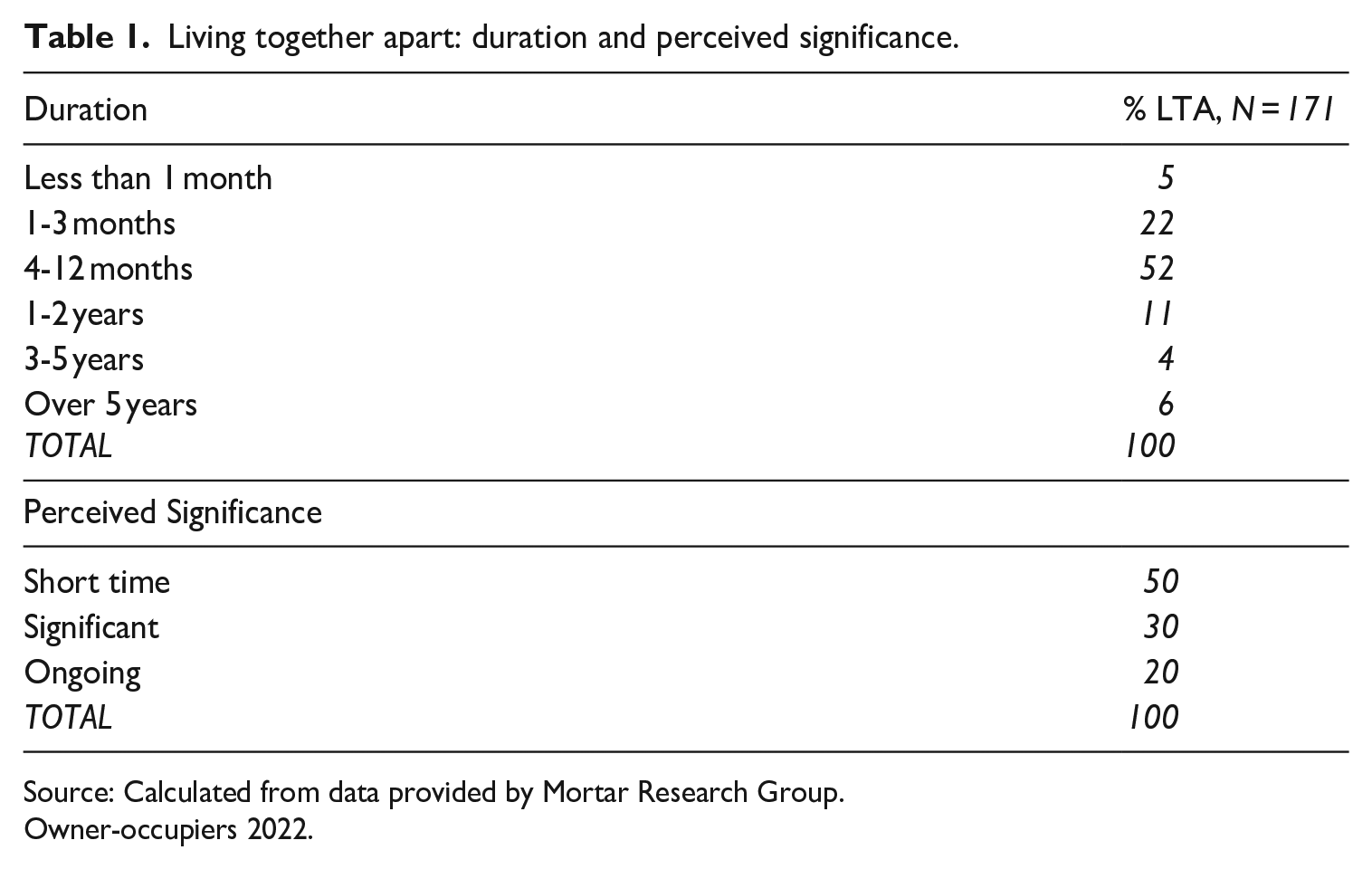
Of the 505 separated respondents in the 2022 MRG survey, 171 – that is 34% – had lived together apart, or were currently doing so. This is around the same proportion as those separated in France from 1984 to 2013, although we might expect the figure for owner-occupiers, and for more recent years, to be above this average. Almost a third of those living together judged this a ‘significant time’, and a fifth were still living together at the time of the survey. Only 5% of the LTA group lived together for less than a month. The majority (74%) lived together between 1 month and 1 year, but as many as 21% were still living together after a year of separation, some for 5 years or more. If we were to take 3 months as a ‘cut-off point’ for social significance, 4 then 73% of the sample are LTA at this point. See Table 1.
Living together apart: duration and perceived significance.
Source: Calculated from data provided by Mortar Research Group.
Owner-occupiers 2022.
Mumsnet forum postings support these findings. In those cases where posters detailed the length of time they had been LTA, it was usually around the 12-month mark. Two posters had lived together apart for over 3 years, although this was unusually long. For the majority of posters, LTA was seen as a short- or medium-term stage:
H and I have been living under the same roof since we separated in August. We have finally agreed our financial stuff and he will move out probably late January.
Given the data limitations noted in the last section, we cannot make definitive conclusions. Nonetheless, we can say that LTA is relatively common for separating owner-occupier couples in the UK, that it usually lasts months or years, and is often seen as significant by respondents.
Reasons
Why do people live together apart? The normative idea is that couples live together, and that adults who are not in a couple live separately. This is one example of what Gillis (1996) famously called families that we ‘live by’ – imagined and ideal families, as opposed to the actual fragmented and impermanent families that we actually ‘live with’. The general normative tone of the Mumsnet users was indeed that separation should be immediate and complete, and that LTA was unwanted and abnormal. The tensions between ideal and reality reached an extreme in those posters who were divorcing but were waiting for decree absolute to finally terminate the marriage. These posters were left in an enforced LTA:
still living together although separated for nearly a fucking year. I so fucking hate him and feel sick. He’s put me off countless times, dragged things out and generally stuck his head in the sand. He thinks I’m a bully and I’m underhand. I want him gone ASAP, he wants his money, but the solicitor I saw for my 30mins free advice says as it’s the marital home he is entitled to stay until the divorce is granted.
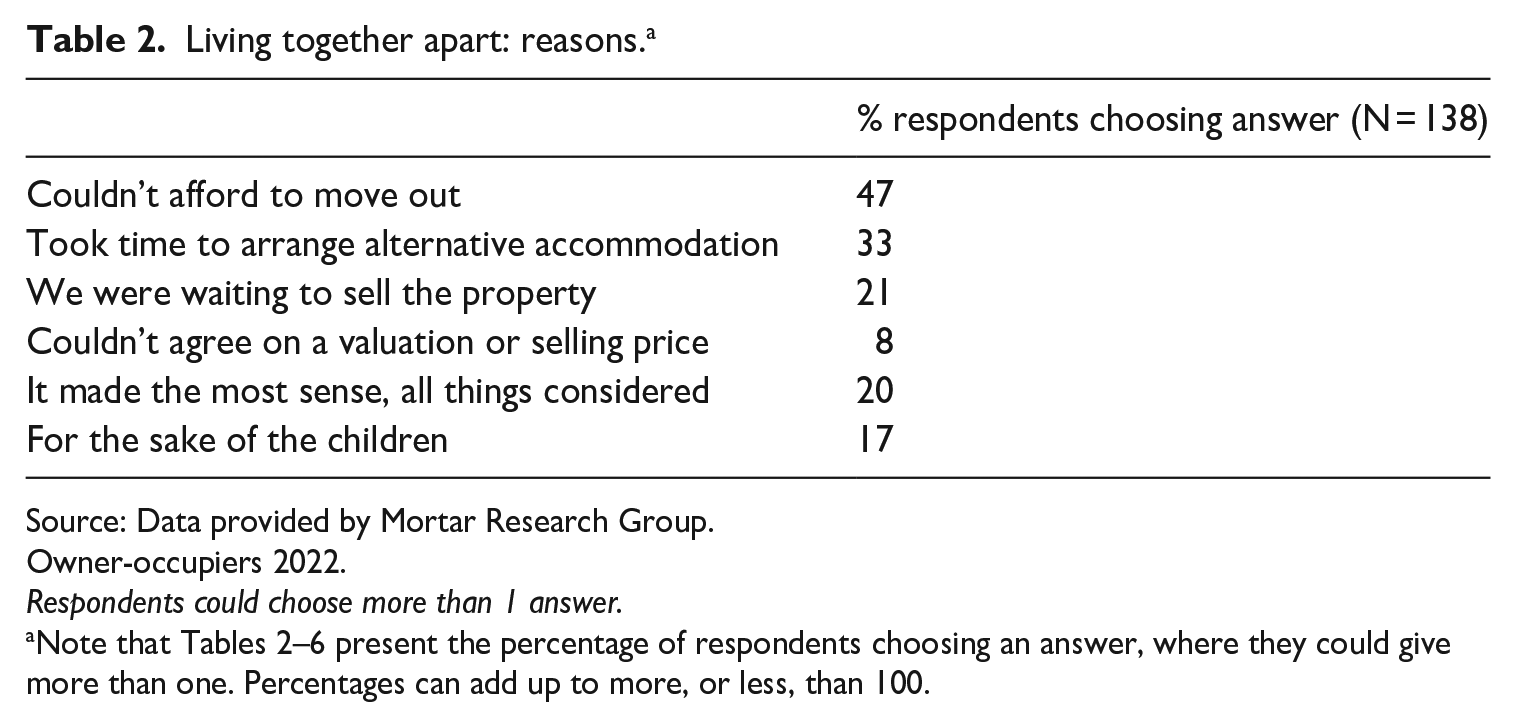
Table 2 shows that the most chosen reason for LTA in the MRG survey was affordability (47% of respondents). As discussed above, the 2018 Aviva data showed just how expensive the ideal of separate housing could be. Consequently, many separating couples would have to ‘live with’ LTA. Linked housing market problems of finding alternative accommodation (33%) and selling the former couple home (21%) were also important. Financial reasons for LTA were also commonly cited by Mumsnet users, sometimes with more detail over what the problem was. One poster, for example, blamed Brexit (the withdrawal of the United Kingdom from the European Union in January 2020 after a 2016 referendum):
Living together apart: reasons. a
Source: Data provided by Mortar Research Group.
Owner-occupiers 2022.
Respondents could choose more than 1 answer.
Note that Tables 2–6 present the percentage of respondents choosing an answer, where they could give more than one. Percentages can add up to more, or less, than 100.
House has been on the market since early November but Brexit has killed the market so lowering the price is not making any difference.
A crosscutting norm of how we should ‘live by’ or ‘ought’ to live gives moral priority to children (Duncan and Phillips, 2008). This is often taken to mean that children should live in one house with two parents, and 17% of survey respondents stayed LTA for the ‘sake of the children’. Contradicting this ideal, a considerable body of research shows that the actuality of living with conflictual parents is often deleterious for children (Musick and Meier, 2010). One Mumsnet poster succinctly described this contradiction:
As I see it overall staying here is better for dd [dear daughter] and leaving is better for me, and obviously her needs outweigh mine massively, but then I would need to be happy in order to make her happy – could I make this place feel like mine?
Another poster was planning to go to extraordinary lengths in pursuing this alternative child-focussed ideal:
I’ve taken legal advice and it is possible to separate while still living together. We would then divorce when they are grown up. Apparently we can separate without taking any legal steps – to gain a divorce, it would be enough to prove we had slept apart, had separate finances etc.
A further 20% of survey respondents chose the answer that LTA ‘made most sense’, although this could be interpreted in multiple ways. Mumsnet posts gave some indication of what this might mean:
We’ve decided that our relationship is no longer working but no bad feeling. I’m a student nurse and would have to move to a small flat with dd and be skint but ex suggested moving to a bigger house where we each have own room whilst I’m finishing my course (1.5yrs). This makes much more sense financially and means dd won’t have to go to a childminder full time as ex will look after her most of the time as he works from home.
In several cases, posters intended to live together apart to provide care for ex-partners:
My husband wants us to continue living together as friends. Including the same bed for the time being (the sex went ages ago so not a big deal). I can see the financial benefits but is it fair to expect this of me? He is two years into a Parkinson’s diagnosis so this has played a big part in our downfall. His condition will deteriorate and I will prob end up as his carer. I worry my ex won’t look after himself properly if he lives alone. Before we lived together he lived alone and he ate terribly, didn’t look after himself and got a severe addiction that nearly killed him (please don’t judge on me getting with him).
These examples of ‘making sense’ suggest that LTA can provide a platform for continuing cooperation and care, if outside an intimate partner relationship. Some posters, however, could not make sense of LTA:
My now-ex partner and I have split up but we are joint tenants at a council house that we have been living at since May. We have a 9 month old daughter who we both love so much. I’m 20 and he is 21 and I have no idea where to go with this.
Financial reasons for LTA may dominate, at least for owner-occupiers. But these are not the only reasons. We find considerations of care and cooperation as well as conflict and ambivalence.
Relations and behaviour with former partners
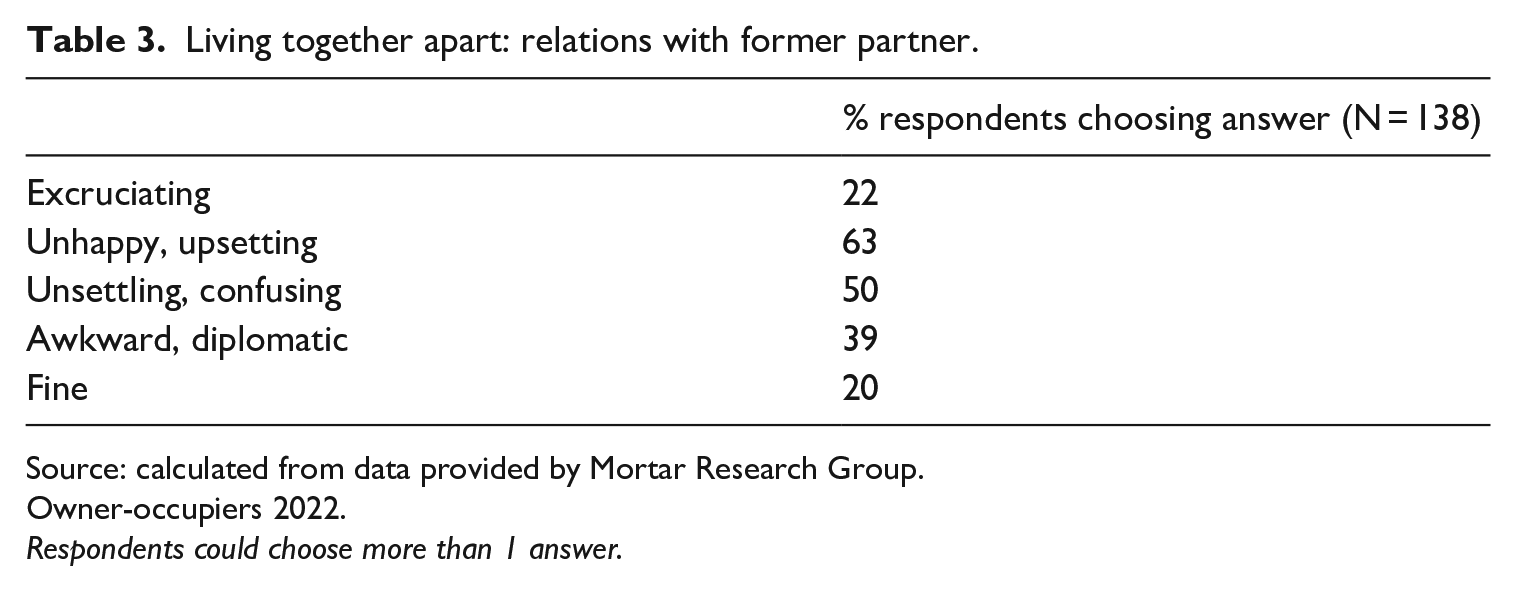
Tables 3–6 report on how former partners in the MRG survey conducted their new relationship while LTA. The prevailing tone of both the survey questions and the Mumsnet respondents’ answers position LTA as a negative experience. However, there is also ambiguity. Table 3, on the overall experience of LTA, shows this ambiguity well. Only 20% of respondents chose the answer ‘fine’, while 22% chose ‘excruciating’. This leaves a large middle ground with the most popular answers. This is not surprising; we would expect partner relations in LTA to be ‘unhappy / upsetting’ (chosen by 63% of respondents) or ‘unsettling / confusing’ (50%). Similarly, relations could well be ‘awkward’ and need ‘diplomatic’ handling (39%). At the same time, however, these relations might also have been ‘useful’ or ‘defining’ – categories that were not included in the survey.
Living together apart: relations with former partner.
Source: calculated from data provided by Mortar Research Group.
Owner-occupiers 2022.
Respondents could choose more than 1 answer.
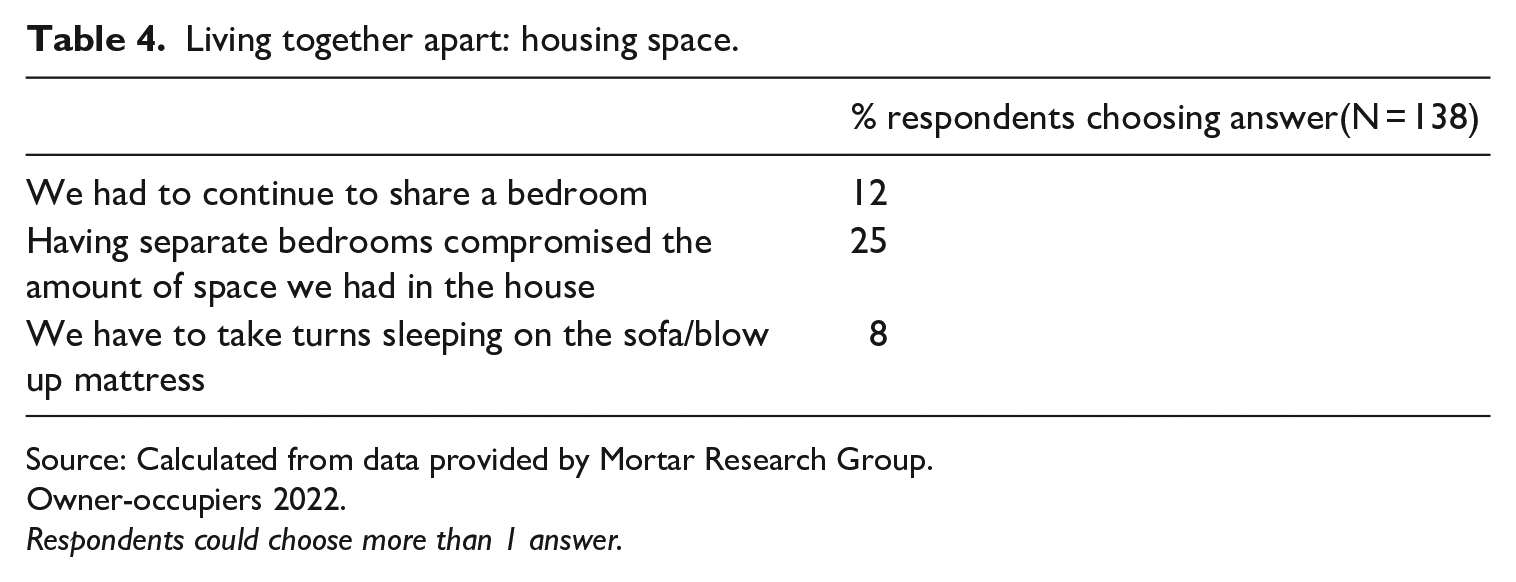
Living together apart: housing space.
Source: Calculated from data provided by Mortar Research Group.
Owner-occupiers 2022.
Respondents could choose more than 1 answer.
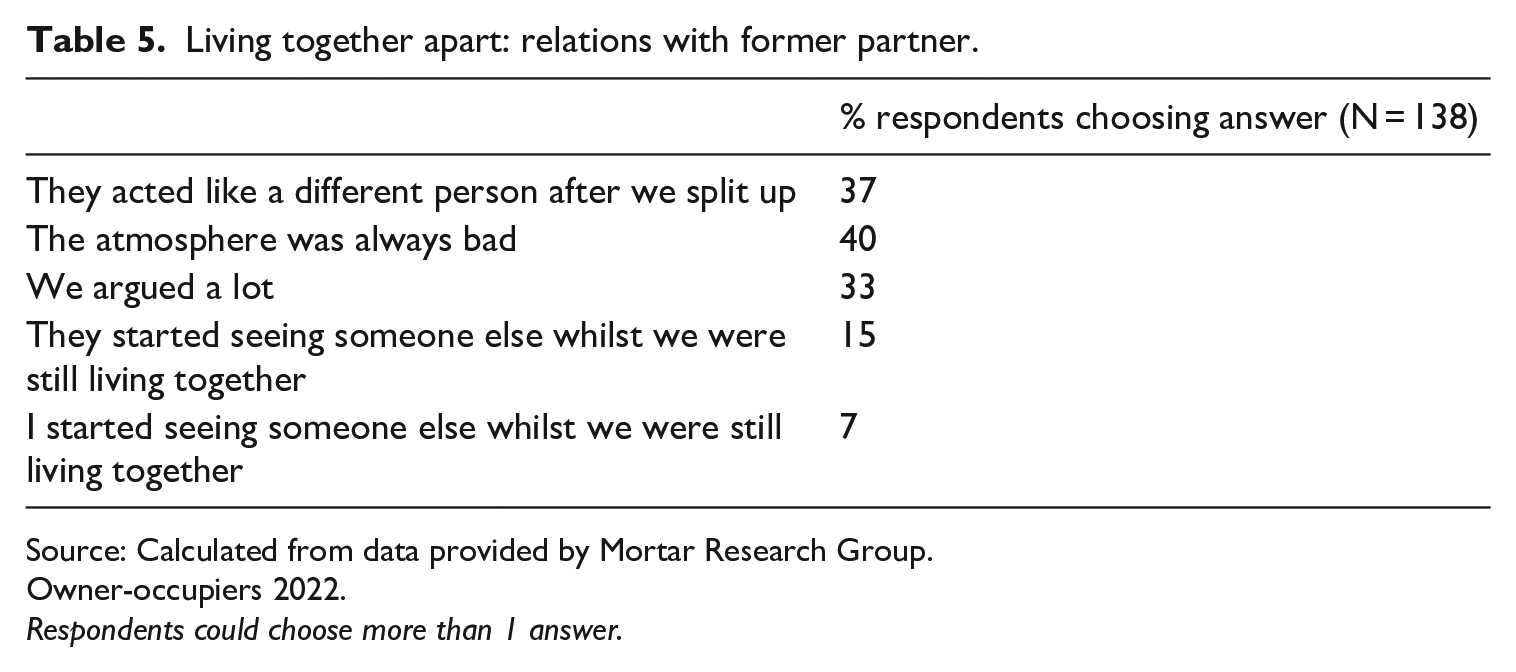
Living together apart: relations with former partner.
Source: Calculated from data provided by Mortar Research Group.
Owner-occupiers 2022.
Respondents could choose more than 1 answer.
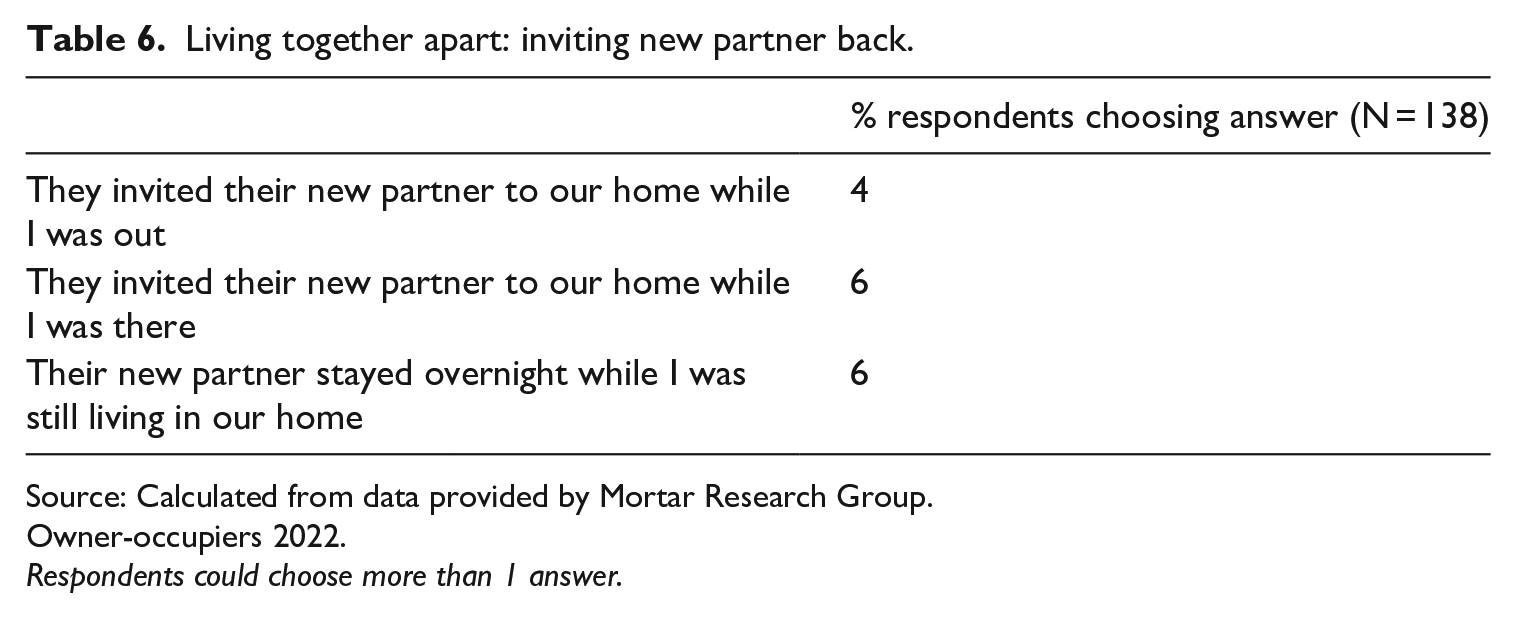
Living together apart: inviting new partner back.
Source: Calculated from data provided by Mortar Research Group.
Owner-occupiers 2022.
Respondents could choose more than 1 answer.
The impact of LTA on personal housing space may be one source of unsettling, confusing, and awkward relations, which may need diplomatic handling. A quarter of survey respondents chose ‘compromised space’ as one result of LTA. This is perhaps surprisingly low and suggests that personal lives often remained intermingled more than separate. However, 20% recorded the presumably most stressful space outcome – sharing a bedroom or rotating on a blow-up bed or sofa.
Mumsnet users were overwhelmingly negative about LTA. Of 47 posters who provided details about their own experiences of LTA, 36 were negative, 7 ‘neutral’, and just 4 were positive. (As discussed above, this distribution may reflect posting on Mumsnet more than any population distribution.)
Posters who viewed LTA negatively described it as ‘difficult’, ‘miserable’, or ‘really hard’. For one poster, LTA was ‘like hell’:
He still wants to be together and has not accepted the break up so living together is like hell.
Another poster recalled her frustration more diplomatically:
It took almost 7 months for him to move out. I felt like I was walking on eggshells the whole time, I couldn’t relax and be me. It really affected my mental health.
A particular concern was the need to ‘move on’ which some posters felt was curtailed by LTA:
the living together is a nightmare and giving me anxiety issues – I need to start to move on. I did it for about 3 months and it was awful – we were neither married nor separate, nobody could move on.
Not moving on was sometimes compounded by a partner’s reluctance to recognise that the relationship was over:
What’s really hard is psychologically moving on. DP [dear partner] every so often makes advances, which he’d do quite subtly and too well, me ending up rejecting him but feeling emotional and ultimately lonely.
Tables 5 and 6 give more detail on survey respondents’ relations with former partners. Again, the prevailing response is negative, and the most popular answer was that ‘the atmosphere was always bad’ (Table 5, 40%). However, we would not be surprised that former partners often ‘acted like a different person’ (37%), and that they ‘argued a lot’ (33%). Nor is it surprising that some former partners started seeing someone else (jointly 22%). These responses describe common reasons for splitting up in the first place.
Nevertheless, some Mumsnet posters found their ex-partner’s dating difficult to deal with:
So we’re separated but living together. Tonight he went on a date. It hurts. Where do I go? What do I do????? It really fucking hurts When we broke up she told me she was not interested in finding someone else and only wanted to be happy with the kids but within days of our breakup she joined Tinder, met someone and just over week later gone out with them. When I found out I told her how sad it made me feel. The next week she arranged to see him again, I expressed again that this hurt me and I thought it was too soon for her to get into another relationship especially whilst we were still living together.
A new partner visiting the former joint home would presumably present even more of a challenge, especially if they stayed overnight. Table 6, however, suggests that this was uncommon among survey respondents (16% of answers in total).
A second, smaller, sub-group of posters asked for advice, or examples, of whether other users had managed to achieve a working LTA relationship. We have categorised these as ‘neutral’. In all cases, multiple responses informed the users that this was not viable in the long term. The ideal of a ‘clean break’ once a relationship had ended was pervasive, despite failing to reflect the experiences of posters.
Was just wanting to plonk my thoughts somewhere to hear suggestions from others who have been in similar situations and what you did etc. Thinking of separating but still living together because of children–can this work?
Table 4 shows that a fifth of survey respondents chose ‘fine’ in summarising their experience of LTA. The ‘positive’ Mumsnet posts give some clues of what this might mean.
just wanted to say that we have lived like this for two years and it’s [sic] suits us both fine. I began hiding away in my room, however I’ve now decided to be more relaxed. I go out once or twice a week, I watch tv downstairs 3 evenings and up in my room 2 evenings. It seems to work okay. It is such a relief being separated as actually there is far less shouting and ranting at me, I’m finding it much easier to live. Just find him and his stuff still being around rather irritating. We agreed to see how this will go living together and just being kind to each other, while living our separate lives. I’m already seeing positives ie co-parenting, he and kids are doing are lot more together and my oldest has said she enjoys their new Sunday routine together for example. Therefore I get time to myself too which I am enjoying.
Relations with former partners were often described as unsettling, unhappy, and confusing, which manifested in resentment and arguments. For some Mumsnet users, LTA was intolerable, as domestic space had to be reconfigured and former partners changed and embarked on new relationships. None of this is particularly surprising, in the context of the relationship breakdown that led to LTA. For a minority of Mumsnet users, LTA relationships were experienced as neutral or even positive, affording gains in personal freedom, care, and parenting. What we do not know is how far, if at all, these negative relations led to more positive outcomes, as found in the pioneering qualitative studies discussed above (e.g. McDonnell et al., 2019).
Conclusion
LTA has remained almost invisible in academic literature and research on family forms. There have been a handful of exploratory studies set in the USA and France, which use small qualitative samples to examine how people experience LTA. Only Rault and Régnier-Loilier (2020) have provided comprehensive population data, in their case for France. With the exception of the ‘collaborative autoethnography’ of McDonnell et al. (2019), there is virtually nothing published on LTA in Britain. And, as far as we know, the data presented here, while partial, is the only data source currently existing about LTA in Britain.
Does this lack of research matter? Clearly, it does in quantitative terms. Around a quarter of British adults (i.e. 11.3 million) had experienced LTA in 2010. Given current trends in both the law and in social behaviour, this proportion is bound to increase, particularly in the context of the mortgage crisis and increasing cost of living in the UK. Even if we exclude short-term LTA, under 3 months, for example, this still leaves huge numbers forced to continue co-residence after a relationship breakdown. Almost three quarters of LTA owner-occupiers in the survey sample used here had lived together apart for over 3 months. This matters because it has implications not only for our understanding of relationships and family but also for housing policy, relationship support services, divorce law, and so on. This transitional period in couple relationships and families should be recognised in the development of such policy and law so that appropriate support and guidance can be developed and policy and law can reflect real lived experiences of relationship breakdown rather than idealised imaginings.
In terms of the social importance of LTA, our findings suggest a widespread expectation that separated former partners should ‘move on’, make a ‘clean break’, and arrange separate accommodation. Some can achieve this ideal relatively quickly. In these cases, LTA can be a short period of arranging practical issues. We should beware, however, of equating time with social effect. LTA is transformative by definition and may be emotionally intense, however brief. In other cases, financial or legal constraints prevent the realisation of this ideal for months or years. The actual family people live with is very different to the ideal family they live by, and this contradiction can lead to anxiety, confusion, anger, and conflict. Most of the survey owner-occupier sample reported such feelings, which were also vividly described by some Mumsnet posters. Both sources also record a minority who were LTA successfully; a fifth of the survey respondents thought LTA was fine. Our data do not allow us to estimate the size or characteristics of either group, however. In both these ‘constrained’ cases, LTA will predominantly be experienced as a negative, transitional state. Even so, earlier in-depth qualitative studies suggest that this very negativity can have positive results as former partners make new arrangements and transform relationships. While the Mumsnet posts give some indication of this outcome, unfortunately we are unable to comprehensively assess this claim with the data available to us.
There is also the crosscutting ideal that children should live in the family home with two parents. Realising this contradictory ideal, recorded in both data sets, would mean longer term LTA, which is more likely to apply to younger families with dependent children. Finally, our analysis of Mumsnet posts indicates that some separated couples see practical advantages in LTA, or see it is as a platform for care. Again, this presumably means longer term LTA, and would probably be most important for older people, although without the relevant data this is speculation. Similarly, we cannot say much about class, ethnicity or gender differences with the information available to us.
In this article, we have used ‘bad data’ to throw light on a previously almost completely under-researched issue, which may nevertheless be of considerable social importance. Research on LTA is currently limited by a negative feedback loop. LTA has been conceptually unrecognised; hence, there is little information. But, because there is so little information, it remains conceptually unrecognised. In this article, we try and break out from this loop, and establish LTA as both a significant household form and a relationship type. LTA demonstrates the creativity of individuals in navigating co-parenting, care work, and financial partnership following relationship breakdown, in the context of constraining housing, social, and legal frameworks.
Footnotes
Funding
The author(s) received no financial support for the research, authorship, and/or publication of this article.
