




Abstract
Protests against wind power have become increasingly common in Western countries and in Finland. This article explores various anti-wind farm frames and their emotional dynamics and content. The framing approach highlights cognitive and constructive rather than emotional aspects. However, social-psychological understanding of emotions enables us to recognise those types of emotions that give content to a specific frame and are essential to understanding individual motivations for building frames and joining protests. This article points out three anti-wind farm frames: Nimby (love, feelings of security, fear of disruption, and anger); populist (experience of helplessness, fear, grief and anger); and environmentalist (concern and respect). The frames reveal how online activisms oriented towards the same cause and goal arise from multiple emotional contents, indicating the actors’ concerns over the effects of wind turbines on their own well-being and reflecting their own different positions.
Introduction
Protests and opposition against wind power have intensified in many Western countries, and anti-wind farm activism has emerged (e.g. Bues, 2020). In countries such as the Netherlands and France, this activism has become radicalised, posing a possible physical threat to wind turbines (Waters, 2018); in Germany, growing criticism is slowing the implementation of new wind power projects (Wehrmann, 2019). This article explores various anti-wind farm protest frames in Finland. In general, wind power is a popular and widely accepted renewable energy source in Finland: research conducted by Finnish Energy has shown that 82% of Finnish people want more wind power in the future (Finnish Energy, 2022). Finland’s relatively late investment in wind power resulted in the rapid increase of wind power production in the 2010s. Energy policymakers, wind power companies, some municipal authorities and the media have highlighted the enormous growth potential of wind power, arguing that Finland is well suited for this because of its low population density and the possibility of building wind power turbines in remote locations. Wind power is seen as desirable because it attracts investment, but it has recently started to generate criticism: residents and summer residents often oppose wind farms, with the tourism industry seeing wind power as a threat, and complaints are filed to delay new projects (Yle News, 2022). It is also increasingly acknowledged that clean energy or low-carbon transition, despite being generally framed as ‘more equitable, egalitarian, and just’, may have negative economic, political, ecological, and social consequences on different individuals and groups (Sovacool, 2021).
This study analyses the emotional content of different anti-wind farm frames. These provide a backdrop for a social-psychological analysis of emotional content. Renewable energy is generally viewed positively in Finland, for example, but the emergence of wind power represents a complex relationship with new technology that does not always indicate easy coexistence or correspond with the thinking of policymakers, which tends to emphasise the economic opportunities of wind power. Wind turbines are viewed as intruding into the everyday environment. They can be seen as prominent and noisy, characteristics with the potential to evoke strong emotional reactions. When reflecting on wind power, people consider how it affects their well-being and the things they find important. The framing approach thus needs to consider that emotions emerge from individuals and groups in changing circumstances. Previous research into individual and group relationships to wind power has concentrated on acceptance of and attitudes towards it (Bauwens and Devine-Wright, 2018; Thøgersen and Noblet, 2012). Various reasons have been indicated for negative attitudes towards wind power. Public concerns are linked to ideas that wind turbines ruin the (cultural) landscape and local environment, infrasound and noise have negative effects on human health and well-being, turbines have harmful impacts on wildlife, wind power is too expensive for taxpayers or consumers, and that it lowers property prices, among others.
This article focuses on anti-wind farm frames and how different emotions are manifested in the framing process. It contributes an understanding of the emotional dynamics of the framing process. Emotions have not played a significant role in the framing approach, which sees actors as constructing cognitive and strategic meanings in order to mobilise support for a cause (Benford, 1997), thus emphasising cognitive rather than emotional aspects of activism. When the importance of emotions is acknowledged, it is often in terms of how emotions are exploited in recruitment, and how they can promote frame resonance (Cadena-Roa, 2002; Robnett, 2004). The question of emotional content in the frame-making of protests has been neglected.
This article argues that culturalist theories such as framing would benefit from more functional and socio-psychological analysis of emotions, where emotions are understood as emerging from individuals’ and groups’ capacity to adjust and cope under changing circumstances (e.g. Blumer, 1951; Stouffer et al., 1949). Earlier socio-psychological models of collective action acknowledged this but understood actors as irrational. The framing approach emphasises strategic actors but neglects the idea that frames can reveal the psychological processes crucial for analysing protest. This study argues that the emotional content of frames remains central to the analysis and that social-psychological models help us understand how emotions matter to the individuals and groups building frames. While, in the framing approach, emotions refer to conscious reflection that might be central in attracting an audience, the emotional content of frames draws attention to their emotional landscape, which is not calculated or consciously exploited. In addition, following Kleres (2011), the article suggests how emotions of the frame can be approached by analysing the configuration of actors, events, objects, circumstances, conditions, thoughts, and feelings within the frame.
Anti-wind farm frames
There are generally certain common frames found in resisting wind power. The Nimby frame draws attention to the ‘tension between general support for wind energy and local opposition to specific developments’ (Devine-Wright, 2005: 131). It reflects community groups’ protectionist attitudes and oppositional tactics, when encountering undesired building projects in their neighbourhood (Van Der Horst, 2007: 2706). In Finland, residents of areas where wind power is planned have begun criticising the projects as construction has accelerated and the size of the turbines has grown. Campaigns against wind power have been established in various places. In Petäjävesi, for example, known for the Petäjävesi Old Church on the UNESCO World Heritage List, hundreds of people oppose plans to build 11 wind turbines in the area (IL News, 2022). People have signed a petition and some founded an association, Advocate for a Natural Living Environment. Locals’ reasons for protesting wind farms resonate with the Nimby frame, which has four main aspects. This frame rejects wind turbines on the grounds of (1) health issues (stress, sleep, unknown effects of infrasound) and the general noise and disturbance they cause; (2) (cultural) landscape and environmental problems; (3) a feeling of exclusion from (democratic) decision-making processes (the unfairness of the process); and (4) lack of access to the economic benefits (profits being taken by foreign companies, for example).
The populist frame against wind power emerges from right-wing protests or clean energy conservatism (Hess and Pride Brown, 2017). These protests channel the disappointment and frustration of groups that have struggled with modernisation and the declining influence of the traditional industrial workforce. In Finland, clean energy conservatism mostly derives from the success in the 2010s of the Finns Party that, for instance, criticises emission charges and petrol prices. This has been linked to anti-environmentalist populist presentations of rural-populist traditions, concentrated on protecting and preserving the Finnish countryside (Hatakka and Välimäki, 2019). The right-wing populist Finns Party is the clearest example of populist wind power resistance in Finland, but right-wing protest against wind power is often a mixture of anti-environmentalism and environmentalism (see Afanasyeva et al., 2022; Forchtner, 2019). Forchtner (2019) points out that environmental and ecological aspects are significant to the right wing because the actors strongly emphasise land and landscape as the basis of their identity. In this sense, the populist frame has similarities with the Nimby frame.
The environmentalist frame and the movements’ criticism of wind farms touch on the possible unrecognised harmful effects of turbines on the environment. Environmental protection is key to this form of resistance, positing a lack of research into the effects of wind power and its infrastructure on animals and ecosystems. Environmentalism, in general, can involve many varied stances, such as deep ecology, and even the far-right position of eco-fascism. Deep ecology argues that human needs have no greater value than those of any other living thing in the ecosystem, so human action should not harm the environment (Rootes, 2007: 615). Environmentalists and environmental non-governmental organisations (ENGOs) are divided on wind power as part of ‘the green-on-green debate’ (Warren et al., 2005). Some environmentalists favour wind power as a form of clean energy (Delicado et al., 2014), with pro-environmental and everyday ‘green’ behaviour being linked to the acceptance of wind power (Thøgersen and Noblet, 2012). Other environmentalists and ENGOs; however, criticise wind power because of its impact on the landscape (Delicado et al., 2014). In Finland, environmentalist or ecological positions against wind power are rare. The Green Party, the largest and best known ENGO, tends to support wind power, viewing its environmental impact as mild (e.g. Suomen luonnonsuojeluliitto (SLL), 2022). The impact of wind power on the environment and nature can be significantly reduced by appropriately siting turbines, taking account of environmental values and land use issues such as biodiversity, ecosystem services, human well-being, important habitats, bird and bat areas, valuable forest areas, Natura 2000 sites, nature reserves, national parks, biotope reserves, and so on (SLL, 2022). In addition, Bird Life Finland gathers and provides information about the impact of wind power on birds in terms of migration routes, nesting, feeding, resting, and wetland sites.
Emotions of protest, framing, and emotional content of frames
Emotions of protest have become a central scholarly research interest in the last two decades, being seen in every aspect of protest (Jasper, 1997, 2011). Culturalist theories such as framing tend to emphasise the rhetorical and performative work of activists in mobilising participation. These theories are interested in how emotions influence strategies, how emotions are rhetorically built, and how they are central to the formation of collective action (Jasper, 2011). For instance, framing entails a mobilisation of ideas and meanings around the way grievances and experienced injustices are interpreted by actors and strategically constructed to arouse interest among potential supporters (Benford and Snow, 2000: 613). Cultural analysis of emotions and the framing approach have been more interested in how ideas are used for mobilising individuals to join protest than as emotions of frames. Jasper (1997) has been interested in the emergence of moral shocks (Jasper, 1997: 106), considering how emotions motivate people to join protests, but Jasper (2011) also finds it problematic if cultural models lack all reference to causal mechanisms.
Culturalist theories dealing with emotions and protest have criticised the early social-psychological models of protest, such as the strain and breakdown theories (e.g. Blumer, 1951), relative deprivation theory (e.g. Stouffer et al., 1949), and the ‘modernisation losers’ thesis (Betz, 1994), that had a broader tendency to view collective action as arising from the actors’ failure to deal with the future – actors reacting to unstable outside conditions and processes to resist change – thus potentially leading to collective efforts to solve painful features appearing in everyday life. Such formulations directly refer to the capacity of actors to cope with and adjust to changing circumstances, a point of view that does have value in social sciences. The problem has been that the theories viewed individuals as mechanical reactors, irrational, and overly emotional. By contrast, in the new social movement studies and the framing approach, actors are viewed as strategic and having agency.
Also, in more recent research linked to protestors against renewable energy projects, that is, the Nimbys and the populists, there is a tendency to individualise and psychologise these actors, seeing them as irrational, unreasonable, and overreacting (Cass and Walker, 2009; Perlaviciute et al., 2018; Wolsink and Devilee, 2008). Anti-wind farm protesters are labelled ‘deviant’, ‘ignorant’, ‘misinformed’ (see Aitken, 2010: 1836–1837) or ‘right wing’, since anti-wind farm resistance is often linked to right-wing populism (Fraune and Knodt, 2018). Individualised and psychologised emotions represent ideas that relate emotions to subjective states of mind rather than viewing emotions as arising from social relations (Emirbayer and Goldberg, 2005). Understanding the relationships and positions from which the emotions of protestors arise remains the critical issue for analysing protests against renewable energy. For instance, many have pointed out (e.g. Wolsink and Devilee, 2008: 217) that Nimbyism should be explained not in terms of individuals’ personality attributes but in terms of a sense of (environmental) injustice, unfairness in the planning process, and norms of commitment to others. Emotional content produced in the discourses, stances, and frames of the different actors reveals the winners or losers of sustainable transition and new technologies and how individuals and groups adjust and cope in new circumstances.
The framing approach also needs to consider more a functional perspective on emotions and the way they orient action and provide information about their objects (Cadena-Roa, 2002). There are two aspects to considering emotions in the framing approach. Emotions are central to the conscious efforts of activists to build a frame in order to persuade an audience by evoking emotional responses. Emotions are used to ‘shape opinion and agency in the present’ and aim to influence decision-making (Lantz, 2021: 604–605). Frame construction can thus be understood as ‘pushing for new ways of feeling’ (Kleres and Wettergren, 2017: 83) that lead to the transformation of individuals’ thoughts and feelings, making them politically aware and perceptive as well as encouraging new actions. Another approach considering emotions is to draw attention to the function of emotions in everyday life. They can be understood as adaptive responses that refer to actors’ needs, well-being, and values. They ‘are elicited as the individual continuously evaluates objects, events, and situations with respect to their relevance for his/her needs, goals, values, and general well-being’ (Brosch et al., 2013: 2).
Emotional content related to anti-wind power actions, for example, draws attention to (1) how wind power relates to the reference group; (2) how the consequences of wind power affect one’s well-being; (3) how one copes with or adjusts to wind power; and (4) whether wind power violates something one considers essential (cf. Brosch et al., 2013: 2). Perception of an event evokes adaptive emotional responses that lead to a mobilisation of resources to help the individual cope with the situation (Brosch et al., 2013: 2). A frame, on the contrary, can be understood as ‘a central organizing idea or story line that provides meaning to an unfolding strip of events, weaving a connection among them. The frame suggests what the controversy is about, the essence of the issue’ (Gamson and Modigliani, 1987: 143; see also Gross and D’Ambrosio, 2004: 2). Actors give information about the frame’s relationship with its objects and events (cf. Lamont and Molnár, 2002: 168). Thus emotions and cognitive meaning-making are intertwined, reflecting the needs and matters people consider central to themselves (Wettergren, 2019).
Data and method
This analysis focuses on Finnish anti-wind power websites. Scrutinising emotions on websites means that participants in anti-wind farm activities cannot be identified, reached, or interviewed. In some cases, it cannot be known who these actors are or their circumstances. I examined the website of the Wind Power Civil Association (WPCA), which – according to the WPCA itself – was established by citizens to promote unbiased information and research about the effects of wind power on the environment and personal health. The website emphasises that the WPCA aims to ensure wind power projects are implemented in ways that minimise their negative impact on local people, the environment and the cultural landscape. It provides information and education and organises events, meetings, and presentations. It also launches initiatives and provides statements to local people or regional and state authorities and can offer legal consultation for private citizens who encounter problems with wind power projects. WPCA members consider themselves ordinary citizens who have awoken to the realisation that their local environment – their homes, landscapes, and holiday homes – are being built over with massive wind farms.
The website, containing texts and blog posts, is an open forum for anyone to publish, anonymously if preferred. The website also reproduces wind farm-critical writings and comments from newspaper letters pages. I examined 135 blog posts between 2014 and February 2022, as well as tweets, retweets, and other newsfeeds on the WPCA website in my analysis. In addition, I have used 15 articles dealing with or mentioning wind power from the Finns Party newspaper, which represents criticisms of wind power in Finland. I have also used the website of BirdLife Suomi Ry (BirdLife Finland, a registered association), plus two blogs representing critical stances towards wind power: Avointa ajattelua (Open Thinking) and Kriittistä ajattelua (Critical Thinking). Although not exclusively about wind power, these blogs feature critical wind power-related content (see Table 1).
The appearance of the anti-wind farm frames in the data.
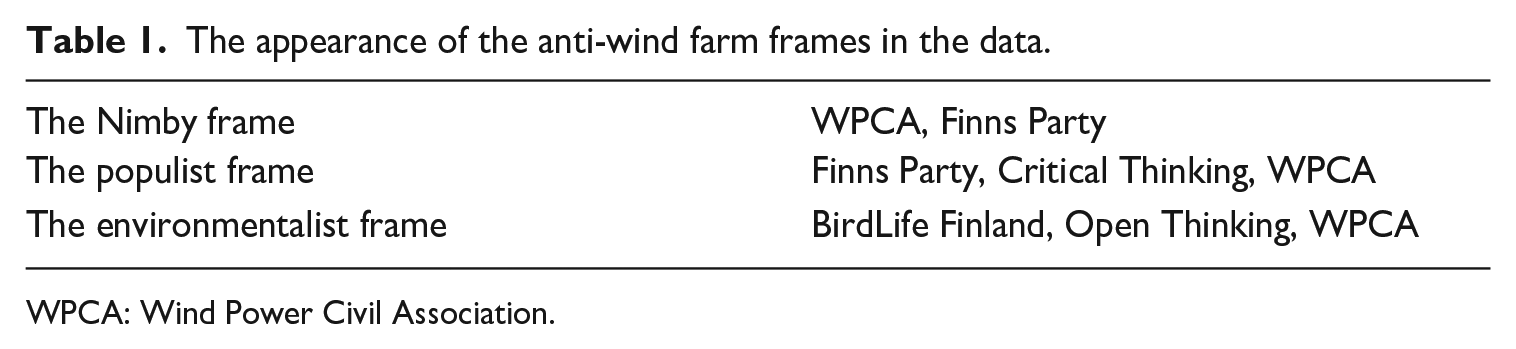
WPCA: Wind Power Civil Association.
To investigate the different frames that represented various concerns about the harmful effects of wind power, I asked what their typical features were. My research questions were (1) what are the central emotional characteristics of the anti-wind farm frames found on these websites and blogs? and (2) how do emotions in frames refer to emotional needs and motivations, that is, how do they matter to well-being? I used qualitative content analysis (Mayring, 2014). As shown in Table 2, I searched for aspects of the data that expressed concerns, made evaluations, and gave indications of how wind power matters to people’s well-being, which would reveal the frames’ emotional content and motivation. I then categorised the frames according to the specific elements within them. For example, if a text mentioned plans to construct wind power nearby or in certain area, I took this to represent the Nimby frame; if it was based on scientific argumentation, it represented the environmental frame; and if the text did not refer to specific wind power construction sites or plans but involved intense general criticism, I labelled it populist. All the extracts here have been translated from Finnish.
Emotional features of frames.
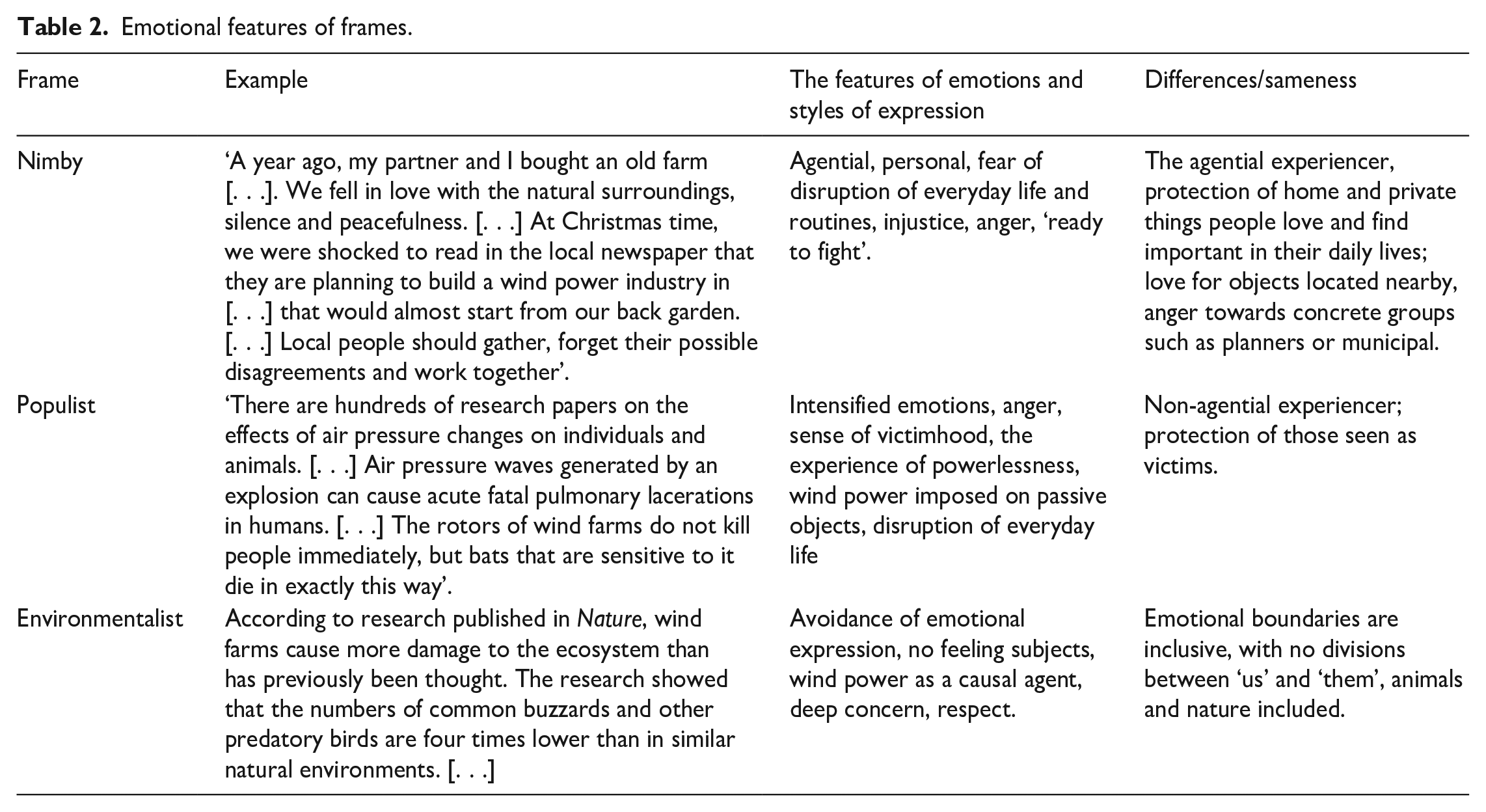
Following Kleres (2011: 185–186), my approach is based on analysing emotions in narratives by examining how actors, events, objects, circumstances, conditions, thoughts, feelings, and so on are configured in the narrative, and how these factors together constitute an emotion. To scrutinise emotions, first, I asked who acts, how, to whom, and what happens, that is, the principal perspective (Kleres, 2011: 189). Here I have drawn attention to the configurations of different elements, such as how objects (wind turbines), events, and actors are described and how they are related to each other. Second, I have (Kleres, 2011: 190) looked at the importance of narrative structure insofar as dramatic action, climax, and falling action (or the lack of these features) are central to the emotional experience of the specific frame. Third, I have looked for ‘the narrative construction of agency’ (Kleres, 2011: 191) whereby different emotions indicate different senses of agency. Fourth, I have explored linguistic manifestations of emotions, which reveal how emotions are constituted at the level of words and sentences, and thus how emotions provide information about the experiencer’s impressions or dispositions (Kleres, 2011: 193–194).
Anti-wind farm frames
The Nimby frame: the experience of injustice and anger
The Nimby frame represents place-based protest, and place is central to everyday experience (Wood et al., 2012). In this frame, the situation is defined as problematic on the grounds that wind turbines contravene the rights of local people. Locals have the right to live safe, undisturbed, and harmonious everyday lives in their homes.
The Nimby frame expresses often conscious and explicitly voiced emotional states. This frame typically has a clearly defined subject and agential experiencer: A year ago, my partner and I bought an old farm [. . .]. We fell in love with the natural surroundings, silence and peacefulness. These were the most important reasons why we chose this place for our home. At Christmas time, we were shocked to read in the local newspaper that they are planning to build a wind power industry [. . .] that would almost start from our back garden. (WPCA post, 7 January 2022)
The extract posits a subject who experiences feelings like love, a sense of home, and then shock when the wind power industry endangers a valued environment characterised by peace and silence. Such ideas about peace and harmony are common elsewhere, as the Nimby frame is descriptive of what is lost when wind turbines arrive: ‘Village roads, the peacefulness of the countryside, the river, the sea, environmental values, and natural resources as well as communality and safety are all attractive reasons why [. . .] people move here [. . .] and why people enjoy them here’ (WPCA post, 7 February 2020). The Nimby phenomenon in general emerges when homes and communities are threatened, with home representing peace and safety (Devine-Wright, 2009; Jasper, 1997: 124; Wood et al., 2012). The frame’s narrative structure often starts with descriptions of peace and harmony, sometimes specifying a time such as Christmas, or ‘Sunday morning [when] I went on social media and discovered [. . .]’ (Finns Party newspaper, January 2020). A dramatic event – the emergence of wind turbines – then disrupts the peace and harmony.
This disruption of peace and harmony, that is, ‘unexpected and sudden changes in one’s surroundings’ (Jasper, 1997: 107) causes anger. Home can be understood to represent a moral sentiment about a sacred object, and when the sacred object is violated, that positive sentiment is transformed into negative righteous anger against the violators (Collins, 2004: 104). In the Nimby frame, there is often a clearly stated target of anger, such as a municipality or specific company. When anger is turned on concrete targets, policies, and decision-makers, it creates possibilities for political action (Jasper, 1997: 107). The self is a subject who is willing and able to act: ‘Local people should gather, forget their possible disagreements and work together’ (WPCA post, 7 January 2022). This can be understood as a call to action. As Barbalet (1998: 27) points out, emotion ‘is provoked by circumstances and is experienced as transformation of dispositions to act’.
There are also examples where the self is an object, and in certain cases, this objectification of the self refers to the construction and perception of being wronged (Kleres, 2011: 187): ‘The municipality, due to its monopoly on structural planning, only listened to the wind power company, and not to the residents of the municipality living in the local environment of the wind farm’ (WPCA post, 12 March 2020). Individuals generally feel angry when they encounter outside threats they perceive as unfair and caused by others. Here, the central aspect of the Nimby frame derives its power from locals’ experience of being completely ignored and disregarded.
In general, the Nimby frame is agential. It is noteworthy that the agency of other actors is framed in concrete rather than vague terms, which is indicative of anger (see Kleres, 2011: 193). The Nimby frame represents ideas about concerned and active local groups, and entails a clear agent: a subjective self, or a concrete agent defined as the opponent, such as a wind power company whose actions endanger the harmony of everyday life. The Nimby frame is a matter of personal injustice and involvement that refers to a threat to security.
The populist frame: the experience of powerlessness and anger
In the populist frame, wind power is framed as an external threat that is dangerous and damaging to people, animals, or the economy, causing suffering and disruption to daily lives. Wind turbines are presented as giants compared with people, animals, nature, and objects. A common strategy for amplifying the disruption is to highlight their size and the waste of land and resources: No one cares about the thousands of hectares of forest that are being cut down [. . .]. The soil is ruined with enormous concrete areas. And, furthermore, no one considers that one wind turbine needs as much as a thousand kilos [. . .] of rare earth metals, approximately two thousand kilos of aluminium and five hundred tons of steel. These are not tiny weathervanes, but rough giants standing three hundred metres tall. (Finns Party newspaper, April 2021)
One of the populist frame’s most common strategies is its tendency to imply by the use of adjectives, modal words, and particles. We find, for example, phrases like: ‘Wind farm planning goes forward despite firm resistance’; ‘unbelievably valuable landscape’; ‘extremely rare species’; ‘one of the most incomprehensible projects’; ‘one of the most amazing World Heritage Sites’; ‘landscape that has been known for its beauty through the centuries’; and ‘height above sea level is as much as 420 metres’ (Critical Thinking, 17 October 2020). This use of adjectives and other words indicating extremes intensifies and dramatises the frame’s message.
The frame highlighting wind power’s negative implications for the environment suggests respect for the environment and place. The link between the ‘far right’, nationalism, and the natural environment and homeland has often been noted (e.g. Forchtner, 2019). In this frame, nature and landscape are seen as valuable. However, right-wing protests against wind power also encompass climate change denial and hostility towards environmentalism. The populist ideology appeals to groups who previously depended on industrial or fossil capitalism. The populist frame’s intense focus on disruption might also indicate loss and grief, which might be unacknowledged emotions within the populist protest. The frame describes what is gone, that is, involuntary loss. Lofland (1985: 182) notes that severing any relationship is likely to ‘trigger a grief-like response’. The loss also implies loss of identity (Jacoby, 2015: 111). Change and transition also evoke loss, as crisis means ‘the inability of humans to continue any longer in the accustomed way in the face of such an event’ (Jacoby, 2015: 111; Nisbet, 1970). In this sense, change such as the emergence of wind turbines resonates with a loss of control and the continuity of everyday life and the self (see Jacoby, 2015: 111). The aspects of grief and loss go unrecognised in the research of populist protest, suggesting there is a place for softer emotions in analysis of protest.
The frame involves emotions stemming from the meanings attached to intensified descriptions of the size of the wind turbines, which seem to demand sacrifices from those in their way, who, for their part, are described only vaguely. The lack of agency can be an indication of the experience of powerlessness, illustrating lack of confidence and potential for coping. The agency of the victims of these enormous wind turbines seems to be missing. For instance, blog writing refers to research that shows ‘the effects of air pressure changes on individuals and animals’, arguing that ‘[t]he rotors of wind farms do not kill people immediately, but bats that are sensitive to it die in exactly this way’ (Critical Thinking, 24 January 2020). Populist protest is most often linked to negative emotions such as fear and anger (Rico et al., 2017). Rico et al. (2017: 445) note that fear in populism implies ‘appraisals of uncertainty, situational control, and low efficacy’. Anger arises when actors perceive a frustrating event as being caused unfairly by others (Rico et al., 2017: 445). Kleres (2011: 192) suggests that a feeling of helplessness often implies a non-agential experiencer linked to certain grammatical features (e.g. modal auxiliaries, hypothetical past or future constructs, predicates, negation). However, anger generally is ‘a powerful source of energy for political action’ and a response to the injustice and perceived harm done to oneself or others, targeting attention on the perpetrators (Hobbes, 2020: 1, 7). Anger is, in this sense, distinctively an agential emotion.
The difference between the expression of anger in the Nimby and populist frames is that the populist frame’s indications of anger are directed towards categories rather than specific targets. The central feature of the populist anti-wind farm frame is that, in the data, it constructs oppositions. Its opponents are described in relatively vague terms as groups or actors understood as generally favouring renewable energy or wind power, but not necessarily responsible for the wind power projects themselves. This can be perceived in sentences such as: ‘Green left politics hits again’ (Finns Party newspaper, May 2021); ‘wind power lobbyists already keep a tight grip on Finland’ (Finns Party newspaper, April 2021); ‘Social Democrats throw money at wind power subsidies’ (Finns Party newspaper, February 2019); and ‘Germany’s green Utopianist energy transition leads to a dead end’ (Finns Party newspaper, May 2019). These opponents are not individualised: they seem to be general opponents of the populist frame, rather than individuals or groups responsible for the implementation of wind power. Thus, agency tends to be attributed to an ambiguous ‘them’ (Kleres, 2011: 193).
The environmentalist frame: a non-emotional techno-rational approach
The environmentalist anti-wind farm frame, which is not common in Finland, differs significantly from the Nimby and populist frames. In this sense, this also could be named a techno-rational anti-wind farm frame. The typical features of this frame are objectivity, neutrality, and scientific argumentation, that is, a lack of emotion. In this frame, the use of insinuation and strong expressions of emotions like anger would jeopardise the credibility of the message. The environmentalist frame omits expressions of emotion or personalised injustice in its attempts to persuade its audience of the unacknowledged problems of wind power. In any case, the frame calls into question the assumptions that anti-wind farm action stems from a failure to understand science and that acceptance of wind power will increase once the public is introduced to scientific knowledge (Aitken, 2010).
It is typical of the environmentalist frame to be informative, precise, and up-to-date, and to refer to scientific research. The WPCA, for instance, posted the following brief items concerning recent research: According to research at the University of Oulu, since the quantity of wind power has increased, the velocity of river flow has changed [link to the research and a newspaper article]. [. . .] It can be said that wind power changes rivers’ rhythms. ‘The rapid change in velocity is unnatural. Its increase changes the ecology of rivers, because water biomes have not adjusted to these rapid velocity changes’ [quoting the researcher]. (20 December 2018) According to research published in Nature, wind farms cause more damage to the ecosystem than previously thought. The research showed that the numbers of common buzzards and other predatory birds are four times lower than in similar natural environments. [. . .] As the number of predatory birds has dropped by seventy-five per cent due to the wind farms, the number of prey animals has increased, with a multiplying impact on the whole ecosystem. (7 November 2018)
These extracts illustrate the typical features of the neutral and objective environmentalist frame. The language and style are scientific and informative. The agents include research projects conducted at a university and published in Nature. The frame names agents with positive connotations in the sense of emotional attachments to respect, credibility, and legitimacy. Another agent in these extracts is wind power itself, which is a causative agent with negative consequences. Both extracts use the impact of wind farms on the ecosystem as the main argument to demonstrate why wind power is more harmful than generally acknowledged. The scientific environmentalist frame is generally meant to educate the public, so it needs to be careful that information is not distorted and facts are not manipulated (Nisbet and Myers, 2007; Zukas, 2017: 428).
It is also possible to use certain words that may evoke strong emotions in the audience, for example, ‘As rare earth metals exist in small quantities in soil, this leads to large amounts of waste, and as a side effect also radioactive waste’ (WPCA post, 2 November 2021). ‘Waste’ and ‘radioactive waste’ provide information to which the audience is likely to respond in an emotionally meaningful way. There are emotionally laden words evoking sorrow, anger, fear, horror, or even disgust. The environmentalist frame thus does sometimes use words that can be effective in terms of emotional reaction.
It would be misleading to claim the environmentalist frame does not entail any emotions. The frame is meant not only to inform actors but also to strategically promote the idea that wind power may be more problematic than is generally considered. Frame makers nevertheless need to clarify the harmfulness of wind power in one way or another, and this process reveals certain emotional tones. For instance, the Open Thinking blog post ‘Wind Power and the Environment’ introduces maps and photographs of areas where wind power projects are located (to demonstrate the large physical area wind farms usually need), emphasising their impact on surrounding nature through construction work, excavations, roads, and so forth: ‘Even a single [wind farm] project concerns a large area. The recommendation of wind power as a large-scale electricity producer involves extremely large areas’ (15 August 2015). As with the Nimby frame, which describes love of and commitment to one’s everyday physical surroundings, this extract shows how much environmentalists respect and care for pristine nature, wilderness, and a landscape worth protecting. This is threatened by chainsaws, bulldozers, lorries, and everything required for building wind turbines that do not belong there. The tone is scientific, but the writer adds at the end that ‘when you are reading posts by people who are critical of wind power, you can see the love for the environment. These are altruistic efforts to produce the reports that wind power consultants fail to do’. In contrast to the Nimby frame, which presents consultants and wind power companies as failing to protect local interests, the environmentalist frame sees them as failing to protect the richness of nature. The sense of responsibility becomes part of the frame.
Discussion and conclusion
This article suggests that the framing approach should consider origins and function of emotions in a way which acknowledges that emotions are central for the organism survival in terms of which social movements or protests can also be seen as collective adaptive coping efforts. Culturalist approaches such as framing (Benford and Snow, 2000) have glossed over the type of theorising which pays attention to the origin of emotions in protest action. Jasper (2011) has pointed out that cultural models are wrongly specified if they do not contain reference to causal mechanisms. Such an approach provides further insight into the issue of how emotions and protest are related.
Emotions can be perceived in the ways wind power is related to its consequences for the well-being of actors, as well as in ways which reveal different patterns of coping and adjustment. Social-psychological models allow us also to scrutinise those emotions that are not necessarily ‘easily identified or expressed through language’ (Wood et al., 2012: 573). This study has shown that activisms oriented towards the same cause and goal (anti-wind farm activism) can entail similar types of emotions but with varied expressions and framing, implying that protest against wind power arises from multiple motivations that reflect the actors’ position in relation to wind power. There are differences and similarities between the frames, suggesting they are drawn from the different interpretation, interests, motivations, identities, values, and goals on the part of different individuals (Gross and D’Ambrosio, 2004: 2). Differences can be perceived in features such as descriptions of agents (whether actors are concrete, vague, distanced or diluted, whether individuals are defined as subjects or objects or omitted completely, who or what is the causative agent), events and their sequences or plots (what happens, when, why, and how), and the specific words used in the frame construction.
For instance, the emotions of the Nimby frame include love, feelings of security, fear of disruption, and anger. In this frame, it is more common for the frame makers to position themselves as subjects in ways expressive of emotional stances such as fear (of the turbines’ noise, problems with business, depreciation of houses and so on). The Nimbys’ opponents are concrete rather than vague, unlike in the populist frame, where opponents are more likely to be caricatures, with the frame makers distancing themselves from figures like the green left and so on.
In the populist frame, the emotions include a sense of threat, an experience of helplessness, loss, fear, and anger. Frames are intensified and overtly dramatised, using intense adjectives for feeling, deliberate grammatical choices, exaggeration strategies, and a vagueness related to agency. The populist frame seems consistent with the argument that the process of modernisation has created a large section of individuals and groups who experience themselves as victims (e.g. McWright and Dunlap, 2010). Anshelm and Hultman (2014) claim that climate change – especially where renewable energy and wind power production are involved – is a target for right-wing protests in a similar way to issues of identity, sexuality, gender, and multiculturalism: it threatens the livelihoods, lifestyles, status, and identities of those who used to benefit from industrial society and hegemonic masculinity.
The environmental frame in Finland entails concern, loss, respect, and love for the environment. The environmentalist frame differs emotionally from the Nimby and populist frames in that it avoids subjective agents or words that reveal emotions and takes up positions in which the frame makers distance themselves from feeling subjects. It does not construct opponents: here wind power is a causative agent with a negative impact on the environment. There is an aspect of well-being in terms of more inclusive boundaries, as they consider nature, animals, and boundaries with them. There are no clear divisions between ‘us’ and ‘them’ in this frame. Using a neutral tone, the Finnish environmentalist sees wind power as harmful to the environment and animals. This frame is characterised by a techno-rational, scientific argumentation, and evidence. Its lack of overt emotionality can also be understood as a strategic choice. Distinction in the framing process is particularly important because the anti-wind farm issue is so polarised. Its distinctiveness from the populist frame is central to the environmentalist frame’s credibility and persuasiveness.
Footnotes
Funding
The author(s) received no financial support for the research, authorship, and/or publication of this article.