



Abstract
Autistic children’s voices are frequently overlooked, underestimated, and undermined in research and practice such that children are denied agency and their rights as capable knowers. Our digital storytelling work aims to challenge this status quo by co-creating ‘I am’ Digital Stories with and for autistic children and their families. ‘I am’ Digital Stories are short videos (c.3–5 minutes) that provide a strengths-based representation of a child or young person, incorporating their strengths, capabilities, likes, communication and interaction preferences, and how support can be provided. ‘I am’ Digital Stories enable children and young people to present their ‘best selves’ to people who may not know them, especially in transitions between education and other settings. This is Lil’s ‘I am’ Digital Story. Lil was making the move from special school to her adult life which included the possibility of volunteering at a community-based organisation. We worked with Lil to create an ‘I am’ Digital Story that she could share with the organisation. Lil worked closely with her father and the research team to plan, film, and create her Digital Story, which she described as a ‘cool project’. We think that anyone watching the video will get a strong sense of who Lil is, what she likes to do, her skills and interests, and happy personality. Lil is very proud of her Story and we are proud to be able to share her Story here.
Who developed the Digital Story and for what purpose?
This is Lil’s ‘I am’ Digital Story which she co-created with her father Martin, Asha the researcher, and school staff. An ‘I am’ Digital Story is a short video (c.3–5 mins) that is produced using a strengths-based framework and is designed for enabling autistic children and young people to have a voice in their transitions between schools or settings (Parsons et al., 2021). Lil was aged 17 years in March 2021 and was due to transition from her special school to a post-16 destination over the summer. The precise destination was not certain, but Friends of St James Park in Southampton, UK, was a possibility. They provide a community-based café alongside skills, networking, and volunteering opportunities (e.g. Community Club and Gardening Group).
How and why was the Digital Story developed?
Transitions can be challenging for many people but can be experienced as particularly difficult for autistic children and young people, often due to the uncertainty and unfamiliarity of new settings, people, routines, and expectations (e.g. Makin et al., 2017). The principles of the sociology of childhood have rarely been applied to autistic children, with their voices, capabilities, and agency often overlooked or underestimated due to deficit-focused assumptions made about them (Parsons et al., 2022). Consequently, autistic children have often been denied agency through being considered too ‘hard to reach’ (Franklin and Sloper, 2009: 4) and are rarely included in discussions, planning, or decisions about transitions (Crane et al., 2021).
An ‘I am’ Digital Story is intended to position an autistic young person as a capable knower about themselves. Lil’s Digital Story was developed to show her ‘best self’ to her new post-school setting through co-creating a strengths-based digital narrative about her, with her direct involvement and authorship. The main intended audiences for the ‘I am’ Digital Story were the personnel at Friends of St James Park, Lil’s family, and the staff at her school and college.
How does the ‘I am’ Digital Story achieve its intended purpose?
The main indication as to whether the Digital Story enabled Lil to have a voice in her transition comes from Lil’s feedback. Encouragingly, she said that she wanted to: Show it [the Story] off to people. And heck, I think it’s also a good indication of how bold I am as well ‘cause I was never really shy, I was more reserved than anything . . . it was very good and for all its ups and downs it was pretty fun to do and it was such a cool project.
When asked who she thought should see the Story, Lil said: ‘. . . big authorities definitely . . . Like I mean employers and . . . interviewers’. Lil’s father also commented that the structured conversation about what to put in Lil’s Story was a helpful part of the process because he learned new insights about Lil: I thought it was great having conversations with her about her Autism that I wouldn’t have had otherwise. And I’ve learnt a lot about her own understanding of herself.
Likewise, one of the team from Friends of St James’ Park commented that ‘it’s a very heart-warming story’, and they were able to gain a ‘well-rounded’ impression of Lil from her Digital Story.
Context of the research
The co-creation of Lil’s ‘I am’ Digital Story was part of the ‘Our Stories’ methods project funded by the Economic and Social Research Council in the UK (Parsons et al., 2023b). This project built on our previous work which had focused on creating Digital Stories for and with young autistic children and their families in the early years (Parsons et al., 2021, 2023a). The ‘Our Stories’ project piloted the ‘I am’ Digital Stories method with older autistic children and for supporting different kinds of transitions including everyday transitions at school (e.g. moving between classrooms and activities at mainstream secondary school). In all cases, the ‘I am’ Digital Stories used a strengths-based framework to construct a digital narrative, informed by the Froebelian principles of childhood which emphasise the holistic nature of the development of every child, respecting children and young people for who they are and valuing them for their efforts (Parsons et al., 2021). This framework is shown in Figure 1 which summarises the seven categories and the key question for each category.
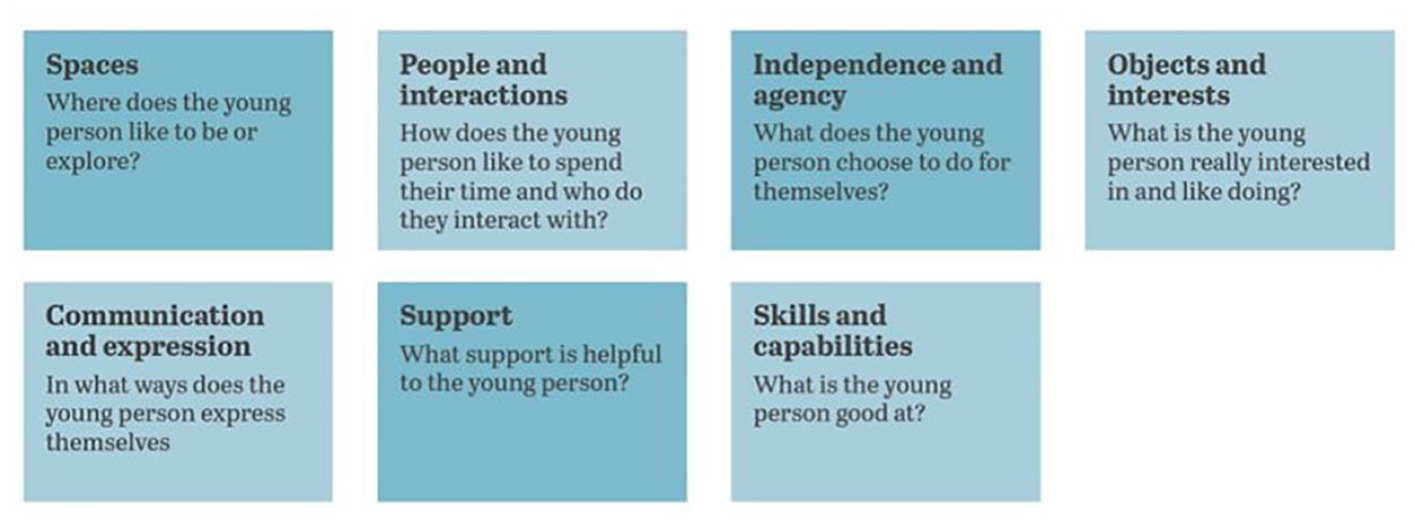
The strengths-based framework for supporting the creation of an ‘I am’ Digital Story.
Lil was closely involved in all aspects of the planning and creation of her Digital Story including the decision to share the Story more widely and for her name to be included. Figure 2 shows Lil’s outline for her Story using the framework, which was then used to plan what she wanted to film and how the Story should be edited together. Lil’s father worked closely with her to decide what to include and so the creation of the Story was valuable for encouraging discussion about things that may be taken for granted or generally not otherwise discussed. Lil’s Story is situated in the classroom, her home, around the streets near home, and includes pictures of other locations and wider interests. The Story is both a celebration of Lil, her hobbies, the sensory aspects that engage her, and the connections she has made leading her to where she is now. It was also a way to highlight the autistic traits that she wanted to make others aware of and how these might affect her at work.
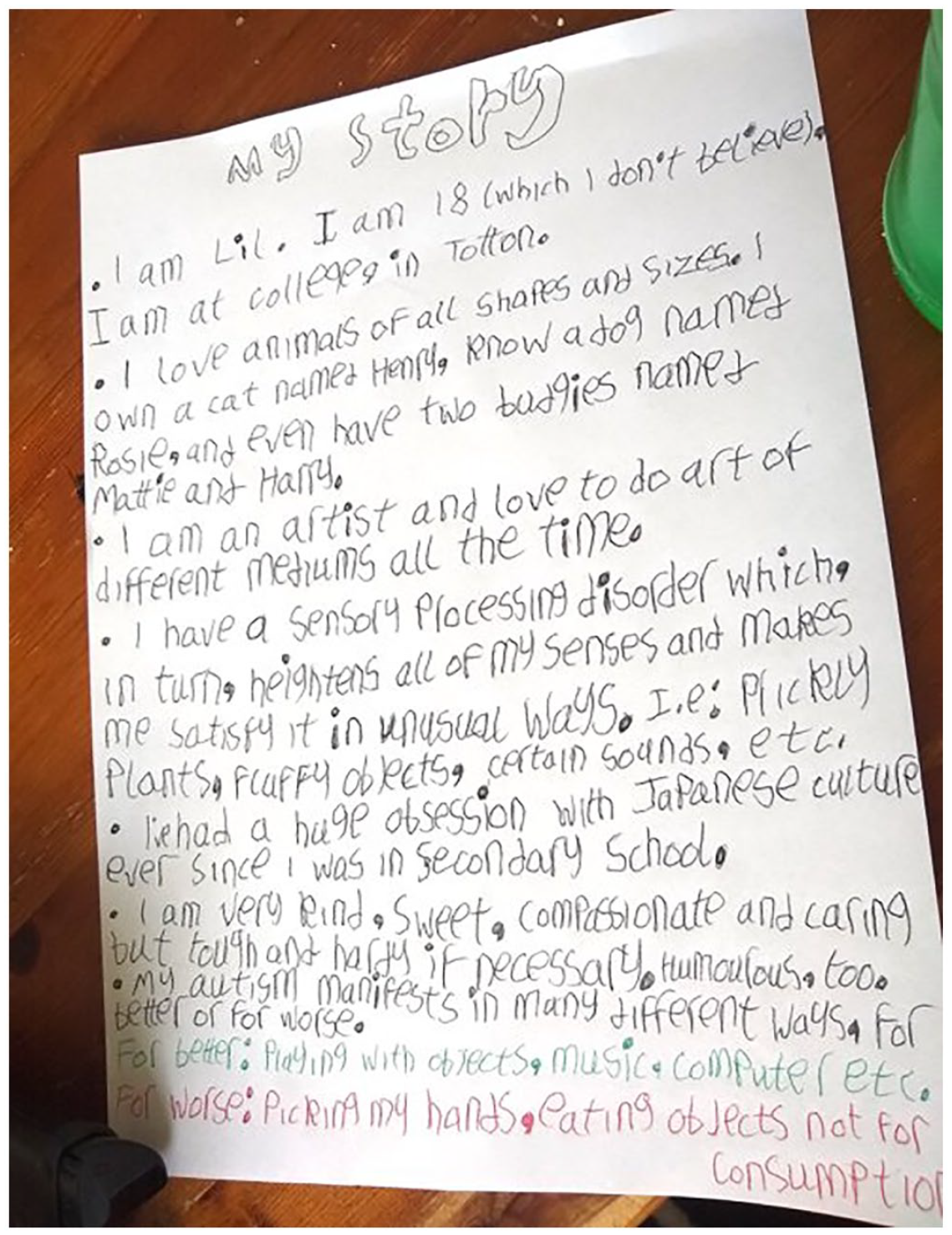
Lils’ Digital Story plan.
In addition to the ‘I am’ Digital Stories, we created ‘We are’ Virtual Tours with some settings to explain what the new environment was like. ‘We are’ Virtual tours use a range of media including videos and 360° panoramic photos to create an interactive tool that enables the young person and their family to understand and explore the environment before visiting. Based on feedback from Lil about what she wanted to see at Friends of St James Park, we worked with the team there to create a ‘We are’ Virtual Tour which can be viewed here: https://fosjp.org.uk/virtual-tour/. Publicly available, free to use resources for how to create ‘I am’ Digital Stores and ‘We are’ Virtual Tours can be found here: https://acorns-soton.org.uk/2022/12/our-stories-project-and-resources/.
Ethical procedures
The project was reviewed and approved by the Faculty of Social Science ethics committee at the University of Southampton (Ref # 62326.A5). Lil was aged 17 years, and an assent procedure was used to explain the project to Lil and gain her agreement to participate, and this was revisited regularly throughout. Lil’s father provided fully informed consent for Lil to take part and for himself to be interviewed about the project. The Friends of St James Park team provided their informed consent to be involved and for their ‘We are’ tour to be shared. We operated a two-step consent process: the first step is about consenting to participate in the project to create the Story and the second step, which comes later, is about whether the Story, and the name of the participants, can be shared publicly. This is because we strongly believe that someone cannot consent to whether and how their Story might be shared until they have created the Story and seen its content.
Accreditation
The star and creative force of the Digital Story is Lil, and we are so privileged to have been able to meet her and work with her on this project. Thanks too to Martin, Lil’s father for amazing support. Thank you to Church of the Cosmic Skull for allowing us to use ‘Cold Sweat’ in Lil’s Digital Story: https://cosmicskull.org/
Footnotes
Acknowledgements
The authors thank the ‘Our Stories’ team and their friends at New Forest School in Hampshire who made this research possible. They also thank for the kindness and generosity of the team at Friends of St James’ Park in Southampton in giving their time and support to Lil and the project.
Funding
The author disclosed receipt of the following financial support for the research, authorship, and/or publication of this article: Lil’s ‘I am’ Digital Story was made as part of the ‘Our Stories’ project funded by the Economic and Social Research Council (ES/V005286/1).