




Abstract
While political scientists have investigated political non-affiliation and religious scholars have investigated religious non-affiliation, no work has yet examined the correlates of those identifying as both religiously and politically non-affiliated. Across two separate studies, we investigate the personality, social network, and cultural engagement correlates of political and religious non-affiliates. Some statistically significant effects found in Study 1 fail to replicate in Study 2, though replicated findings provide interesting avenues for future work. Notably, compared to those who report being both politically and religiously affiliated, we find that dual non-affiliates are more socially liberal, more fiscally conservative, far less likely to vote, and less religious across several attitudinal and behavioral measures. Crucially, we find no consistent evidence that dual non-affiliates suffer from social isolation or a lack of social support.
Keywords
Introduction
The common refrain that one ought to avoid discussing religion and politics in polite company speaks to the cultural salience of both religious and political identities. Yet, religious and political affiliations, as markers of these identities, also generate strong affiliative emotions that potentially connect individuals to larger national discourses and forms of cultural engagement (Sundararajan, 2020). In this article, we turn this phenomenon around and ask: what are the correlates of individuals who do not affiliate with a religion or with a political party?
We focus here on religious and political affiliations for two reasons. First, these cultural identities often contain sharp, situationally salient scripts for morality, and, thus, religious and political affiliations may ‘function as normative cognition system[s] that govern beliefs and behaviors’ (Jensen, 2013: 48). Second, religious and political affiliations often link individuals to national institutions. While hiking or reading or school clubs might link individuals to others in their neighborhood or surrounding area, political and religious affiliations potentially connect individuals to a large swath of the public they will never meet directly, but with whom they share an abstract symbolic identity such as ‘Democrat’, ‘Republican’, ‘Christian’, or ‘Catholic’. Relative to more regional or community-based affiliations, we, therefore, regard political and religious affiliations as to some extent unique, at least in terms of their (1) trans-situational salience and tribal boundaries associated with moralistic scripts for belief and behavior, and (2) the degree to which such affiliations might symbolically link individuals to others (even if only loosely or superficially) in their society whom they might not know personally.
Rising non-affiliation: political and religious
Regardless of the origin of political and religious non-affiliation in the United States, scholars generally agree that the 1960s and early 1970s – the period of the Civil Rights Movement, the Vietnam War, and the Watergate scandal – were a time of widespread defection from mainstream political and religious institutions (Dalton, 2016). These period effects, along with increasingly widespread media coverage, are thought to have sparked the first measured decline of political affiliation in the United States, as well as, to that point in time, the largest measured decline in rates of religious affiliation. Data show, for example, that by 1975 just over 60% of Americans identified with a political party, down from 70% to 75% in the 1950s (Dalton, 2016). Furthermore, according to the American National Election Survey, since about 1996, the proportion of people identifying as political ‘independents’ has outnumbered those identifying as Republican or Democrat (Twenge et al., 2016). The Pew Research Center (2019), for example, recently found that about 38% of the American electorate identified as independent compared with 31% identifying as Democrat and 26% identifying as Republican.
Even larger declines have occurred regarding religious affiliation. Baby boomers doubled their rates of religious non-affiliation compared to their parents and attended religious services 25%–30% less often than their parents had. By 1978, only 52% of Americans regarded religion as ‘very important’, down from 75% in 1952 (Hout and Fischer, 2002, 2014). Today, the proportion of Americans claiming no religious affiliation ranges between 20% and 30% for millennials and may be even higher (~40%–50%) among the college-educated Gen Z cohort (Burge, 2021; Kosmin, 2013).
Rising rates of dual non-affiliation (i.e. individuals with neither a political or religious affiliation) may be resulting from an overlap of unpopular religious and political movements. Past work has speculated, for example, that the encroachment of fundamentalist religious social movements into national politics might serve to drive people away from both religious and political affiliations (Bruce, 2011). Additionally, societies implementing and maintaining an institutional separation between church and state may effectively motivate individuals to affiliate with a political or a religious affiliation (or neither, but not both), because many may find it simplifying and convenient to avoid politics at the pulpit and/or to avoid god on the voting ballot (Domke and Coe, 2008). Consider, for example, the relatively low public approval ratings of former president Donald Trump and the apparent relationship between belief in Biblical inerrancy and support for Trump (Sherkat, 2021). Or, regarding ‘Brexit’, past work has found that religiously affiliating as ‘Anglican’ was an independent predictor of voting in favor of the UK leaving the European Union (Smith and Woodhead, 2018). These studies and others appear to suggest that dual political and religious non-affiliation may be related, overlapping, phenomena in need of further study.
Political and religious non-affiliation as decreased social connectedness
From the outset, theorists expressed concern that non-affiliation (religious and political) was driven by some combination of social indifference and/or disconnectedness, and these theories remain prominent (e.g. Campbell et al., 1960; Putnam, 2000; Putnam and Campbell, 2010). Bainbridge’s (2005) influential analysis of data from the General Social Survey, for example, found that religiously non-affiliated people were less likely to be interested in social engagements with friends or family and more likely to be childless (but see Hunter, 2010). Subsequent work has suggested that political non-affiliates might be less interested in civic affairs (Bruter and Harrison, 2009), because they are hoping to avoid interpersonal conflicts arising from political disagreements (Dalton, 2016).
The view that political or religious non-affiliation might be a function of relative increases in social disconnectedness often hinges on the mechanism of rising material security (Inglehart, 2018; Paul, 2009). These theorists argue that tight-knit, dense, political, and/or church communities have traditionally served as sources of social and material support in times of need or uncertainty. However, post–World War II changes to social structure and culture – better-funded social welfare programs, more people in the workforce, rising GDP, greater options for in-home entertainment, and, more generally, rising quality of life – are thought to have rendered people less reliant on proximate others and, thus, less socially connected and civically engaged (McPherson et al., 2006; Putnam, 2000).
This assumption of social disconnectedness is important to investigate thoroughly given the potentially concerning implications as applied to dual non-affiliates, who might, for example, have even lower trust in people (Wiernik, 2021) and in institutions (Kasselstrand et al., 2017) than singular non-affiliates. Additionally, if dual non-affiliates are more likely to be socially isolated, they may suffer an even higher risk of early mortality (Holt-Lunstad et al., 2015; Smith et al., 2019).
Present study
In this article, we analyzed data from two separate studies to investigate the degree of social disconnection among dual non-affiliates, or what we will here call ‘Dual Nones’. In addition to assessing levels of social disconnectedness (with friends and family), we also account for their relative engagement in mainstream political or religious behaviors (Bruce, 2011; Dalton, 2016). We do this to fill an empirical gap in the existing literature, namely, that much existing work conflates mainstream cultural engagement with social connectedness, and no empirical work to our knowledge has distinguished between macro-national political and religious affiliations, institutional engagements, and social network connectedness. It is indeed possible, as some above have theorized, that involvement in mainstream organizations/institutions causes social connectedness and that such connection will dwindle absent such involvement. However, it is also possible that people who decide not to affiliate with religious and political institutions nevertheless maintain substantive bonds with friends, family, and others; in principle, social connectedness and institutional affiliation may be distinct phenomena.
Study 1
Data and methods
Data were collected in October 2019 via Qualtrics Survey Software and Qualtrics’ panel recruitment services, using quota sampling. Seven hundred thirty-one adults filled out a 15-minute survey; our initial collected sample was about evenly split regarding gender (49% male, 51% female), with 65% white respondents, 66% reporting ‘some college’ or greater educational attainment and a median household income between $50,000 and $99,999.
This study included one central dependent variable: dual non-affiliation. After splitting the data file to focus only on those respondents affiliated with both a religious and a political tradition as well as those affiliated with neither, the sample size available for analysis dropped to 464 (Mage = 47.30, SD = 16.12; 50.6% female). Because the goal of these studies was to analyze the probability of dual non-affiliation itself, and not any particular religious or political affiliation per se, all affiliation options were kept in the analysis regardless of sample size.
Measures
Our dependent variable, dual non-affiliation, was coded in the following way: those who affiliated with both a political party and a religion (n = 415) were coded as ‘0’, while those who affiliated with neither (n = 49; 10% of the sample) were coded as ‘1’. Our target independent variables were broken up into two general groups: (1) indicators of social connectedness and (2) indicators of mainstream cultural/institutional engagement. The purpose of the first group was to directly assess whether any differences in social connectedness existed between dually non-affiliated and dually affiliated respondents, net of demographic controls. The purpose of the second group was to assess whether dual non-affiliates differed in their interest in mainstream cultural engagement, net of social connectedness, and demographic controls.
Regarding demographic controls, Sex was dummy-coded (0 = male, 1 = female), and household income was measured from ‘$0 to $24,999’ (coded ‘1’) to ‘$200,000 or more’ (coded ‘8’). Educational attainment was measured from ‘Did not complete high school’ (coded ‘1’) to ‘Doctoral or professional degree’ (coded ‘8’). Race was measured across five categories (‘White’, n = 436; ‘Hispanic’, n = 60; ‘Black’, n = 74; ‘Asian’, n = 31; ‘Mixed’, n = 61).
Degree of social connectedness was assessed using indicators of time spent with family, time spent with friends, and network isolation. Time spent with family was measured with a single item: ‘How often do you spend a social evening with relatives?’ Time spent with friends was also measured with a single item: ‘How often do you spend a social evening with friends?’ For both items, responses ranged from ‘never’ (coded ‘1’) to ‘almost daily’ (coded ‘7’). Network isolation was dichotomized in accordance with past work (Cacioppo and Cacioppo, 2014; Smith et al., 2019). To construct this variable, participants were asked, ‘Looking back over the last six months – how many different people have you discussed important matters with face-to-face or over the phone?’ Those responding with one or more (n = 521) served as the baseline category (coded ‘0’) and those responding with none (n = 141) served as the target category (coded ‘1’).
We additionally measured peoples’ engagement in mainstream political and religious behaviors. Political activism was measured by averaging scores from a nine-item scale (α = .92) developed by Diemer et al. (2017). Items in this scale assessed the frequency of behaviors such as ‘participation in a civil rights group or organization’. Responses ranged from ‘never did this’ (coded as ‘0’) to ‘at least once a week’ (coded as ‘4’). As an indicator of religious engagement, attendance at religious events was measured with two 6-point Likert-type scale questions with answers ranging from ‘never’ (coded ‘1’) to ‘multiple times a week’ (coded ‘6’).
Results
We ran two logistic regression models: (1) one estimated the odds of a respondent being a Dual None given their degree of social connectedness, net of demographic controls, and (2) one estimated the odds of being a Dual None given their degree of mainstream cultural engagement, net of connectedness, and demographic controls.
Results from our first model (see Table 1) indicated that those reporting less time spent with friends were more likely to report being a Dual None. Time spent with family trended in the direction of reducing the probability of identification as a Dual None, but the coefficient effect size was statistically non-significant. We detected no effect of social isolation.
Dual Non-Affiliation and Social Connectedness (Study 1).
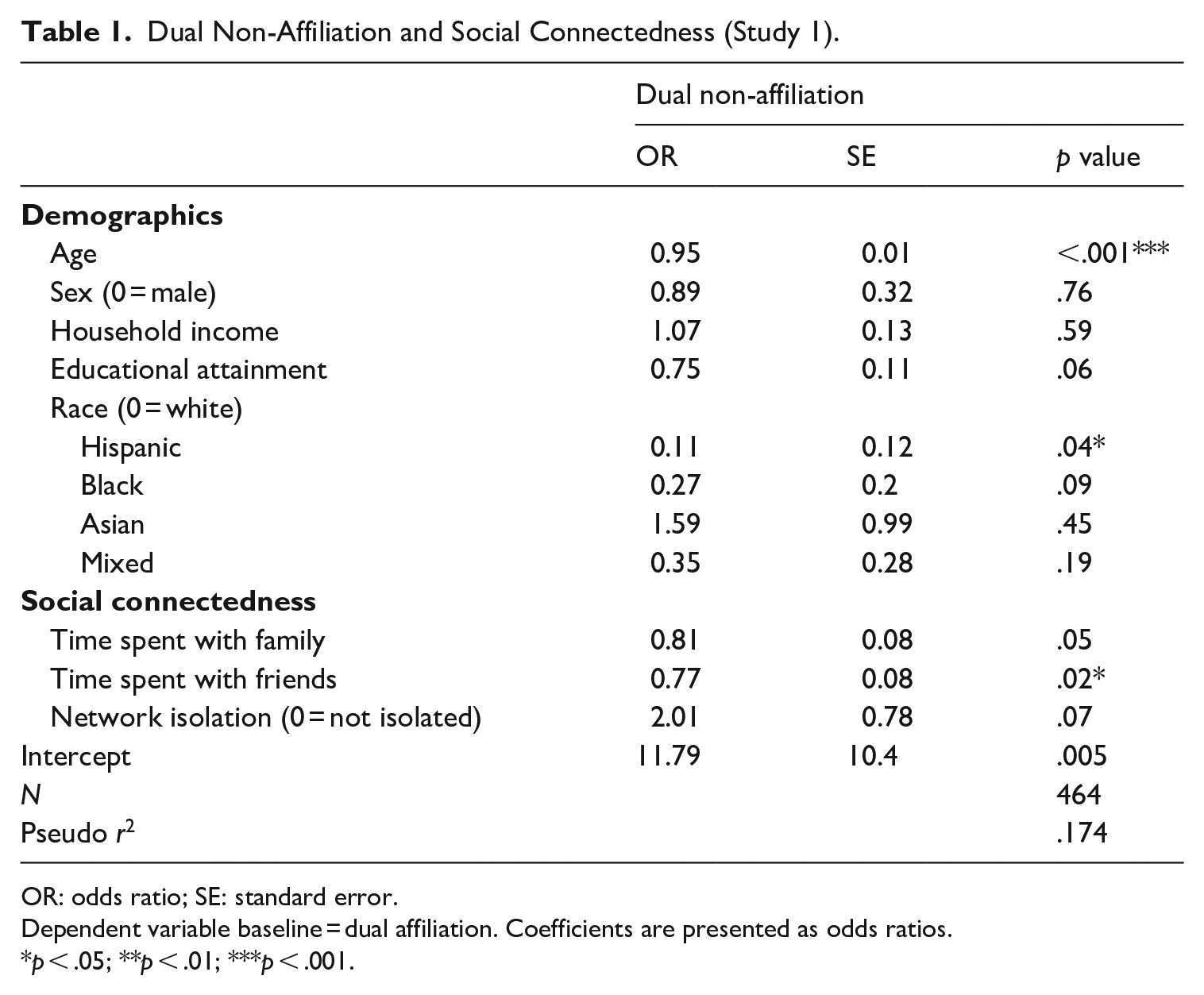
OR: odds ratio; SE: standard error.
Dependent variable baseline = dual affiliation. Coefficients are presented as odds ratios.
p < .05; **p < .01; ***p < .001.
Results from our second model (see Table 2) indicated that the effect of social connectedness found above (i.e. that identification as a Dual None is associated with less time spent with friends) does not hold in a model that includes indicators of mainstream cultural engagement. Specifically, the inclusion of our indicators of cultural engagement rendered the effect of time spent with friends (see Table 1) statistically non-significant. We also found that Dual Nones were less likely to attend religious events, though the effect of political activism was non-significant. This second model still accounted for a substantial amount of variation in the probability of identifying as a Dual None (R2 = .295).
Dual Non-Affiliation and Cultural Engagement (Study 1).
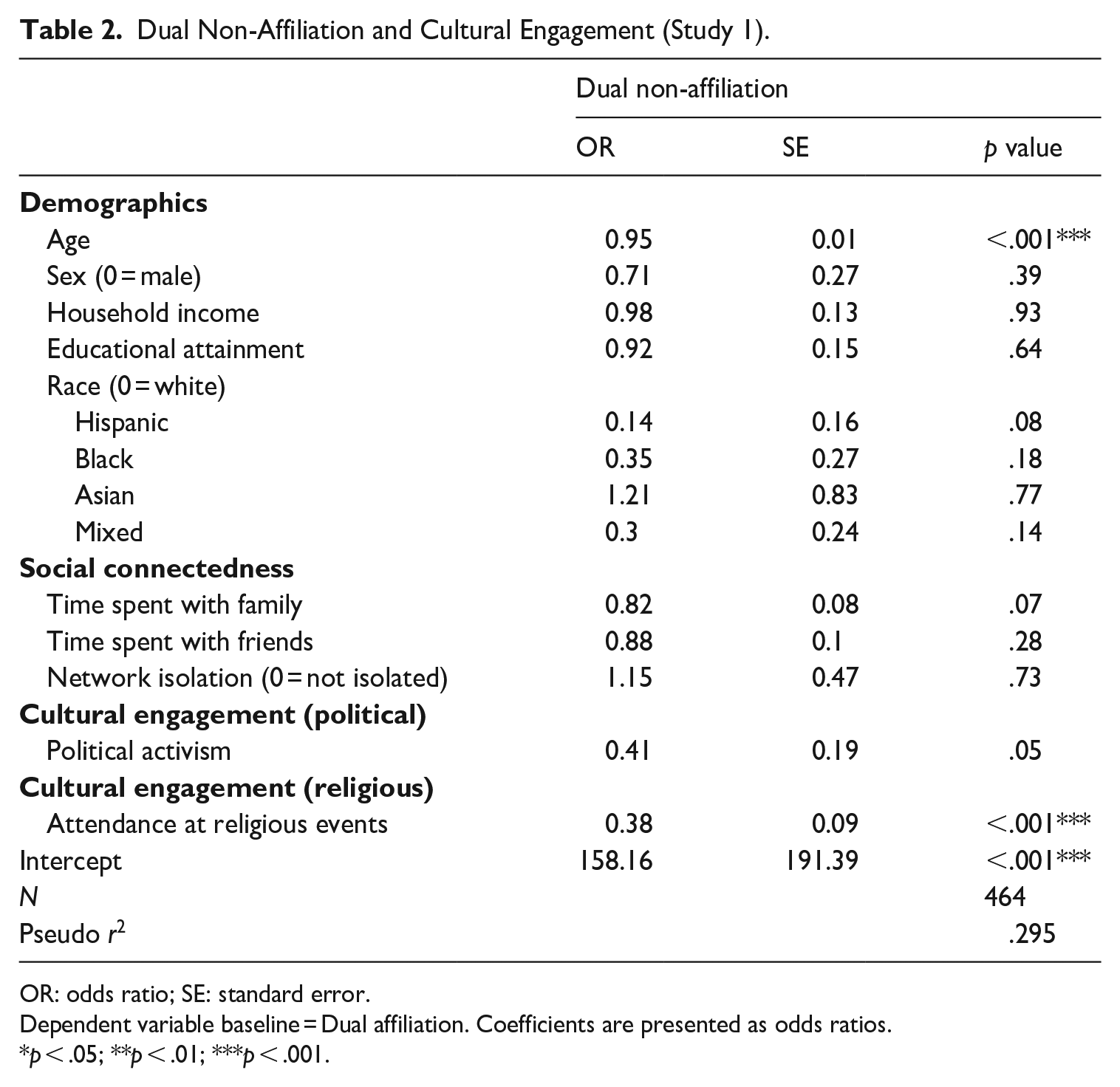
OR: odds ratio; SE: standard error.
Dependent variable baseline = Dual affiliation. Coefficients are presented as odds ratios.
p < .05; **p < .01; ***p < .001.
In summary, we found some initial evidence that Dual Nones might be more socially disconnected. However, in a model accounting for mainstream cultural engagement, our indicator of social disconnectedness became non-significant. To attempt a replication and extension of these findings, we next report the results of a second independent study. In Study 2, we attempted a direct replication of some of the findings discussed above using a new and larger sample collected during a period of societal unrest.
Study 2
Data and methods
The second sample was collected in September and October 2020 via Qualtrics Survey Software and Qualtrics’ sample recruitment services, using quota sampling. Crucially, however, this survey was collected about 7 months into the COVID-19 pandemic and about a week before the 2020 presidential election, a period of significant social isolation and unrest. This sample comprised 1401 adults who filled out a 15-minute survey. This initial collected sample was 54% female and 67% white, with a median educational attainment of ‘some college or associates degree’, along with a median household income of between $25,000 and $74,999.
As with Study 1, Study 2 focused on the dummy-coded dependent variable of dual affiliation/non-affiliation. Upon splitting the file into those affiliated with both a political and religious tradition and those affiliated with neither, the sample size available for analysis dropped to 1019 (Mage = 45.64, SD = 17.23; 51.6% female). Again, because the goal of this analysis was to study dual affiliation/non-affiliation as such, and not a particular religious or political affiliation, all affiliations were kept in the analysis regardless of sample size.
Measures
Dual non-affiliation was coded as it was in Study 1: those who affiliated with both a political party and a religion (n = 923) were coded as ‘0’, while those who affiliated with neither (n = 96; 9.4% of the sample) were coded as ‘1’. Our independent variables were broken up into the same two general groups as was used in Study 1: (1) indicators of social connectedness and (2) indicators of mainstream cultural/institutional engagement. Demographic controls included sex, household income, educational attainment, race, and age. These were coded as outlined in Study 1 with one exception: self-reported race was limited to three categories, ‘White/Caucasian’ (n = 715), ‘Hispanic/Latino’ (n = 192), and ‘Black/African American’ (n = 112).
Our indicators of social connectedness for Study 2 differed from Study 1 in some important ways. While the variables measuring time spent with family and friends remained the same, social isolation was measured across two different domains. The first, health, was measured with the question, ‘Think about your close friends and family. How many of them would you ask to take care of you if you were sick?’ The second, financial, was measured with the question, ‘Think about your close friends and family. How many of them would you ask for financial help?’ Response options for both questions ranged from ‘0’ to ‘20+’. This variable was then dummy-coded, with those answering ‘0’ treated as the target category and those answering ‘1’ or above serving as the baseline category. This allowed us to assess the relative impact of being isolated regarding health issues (n = 133) and of being isolated regarding financial issues (n = 259).
Finally, our indicators of cultural engagement differed somewhat from Study 1. Political cultural engagement was measured using the same activism index used in Study 1; however, this index (α = .95) was missing from the initial launch of Study 2, resulting in a loss of 24 respondents for which no activism data were collected (remaining sample n = 995). In addition to this activism index, we added a new variable to assess voting intentions, given that this survey was collected in the immediate weeks leading up to the 2020 presidential election. This item ‘Do you plan to vote in the 2020 presidential election?’ was measured using three response categories, ‘Yes’, ‘No’, and ‘I don’t know’. This variable was dummy-coded such that those responding ‘No’ or ‘I don’t know’ were treated as the target category (coded ‘1’; n = 115) and those responding ‘Yes’ were treated as the baseline (coded ‘0’; n = 904). Finally, religious cultural engagement was assessed with a question designed to capture the impact of COVID-19: ‘The coronavirus pandemic (COVID-19) has restricted my ability to engage in the religious practices I want to engage in’, with answers ranging from ‘Strongly Disagree’ (coded ‘-3’) to ‘Strongly Agree’ (coded ‘3’).
Results
As in Study 1, we ran two logistic regression models: (1) one modeling the odds of a respondent being a Dual None given their degree of social connectedness, net of demographic controls, and (2) one modeling the odds of being a Dual None given their degree of cultural engagement, net of social connectedness and demographic controls.
We were unable to replicate an intriguing finding from Study 1, namely, that time spent with friends reduced the probability of a person being a Dual None (see Table 3). Indeed, none of our indicators of social connectedness were significant. Additionally, while Dual Nones tended to be younger in age across both Study 1 and Study 2, the effect of race also did not replicate.
Dual Non-Affiliation and Social Connectedness (Study 2).
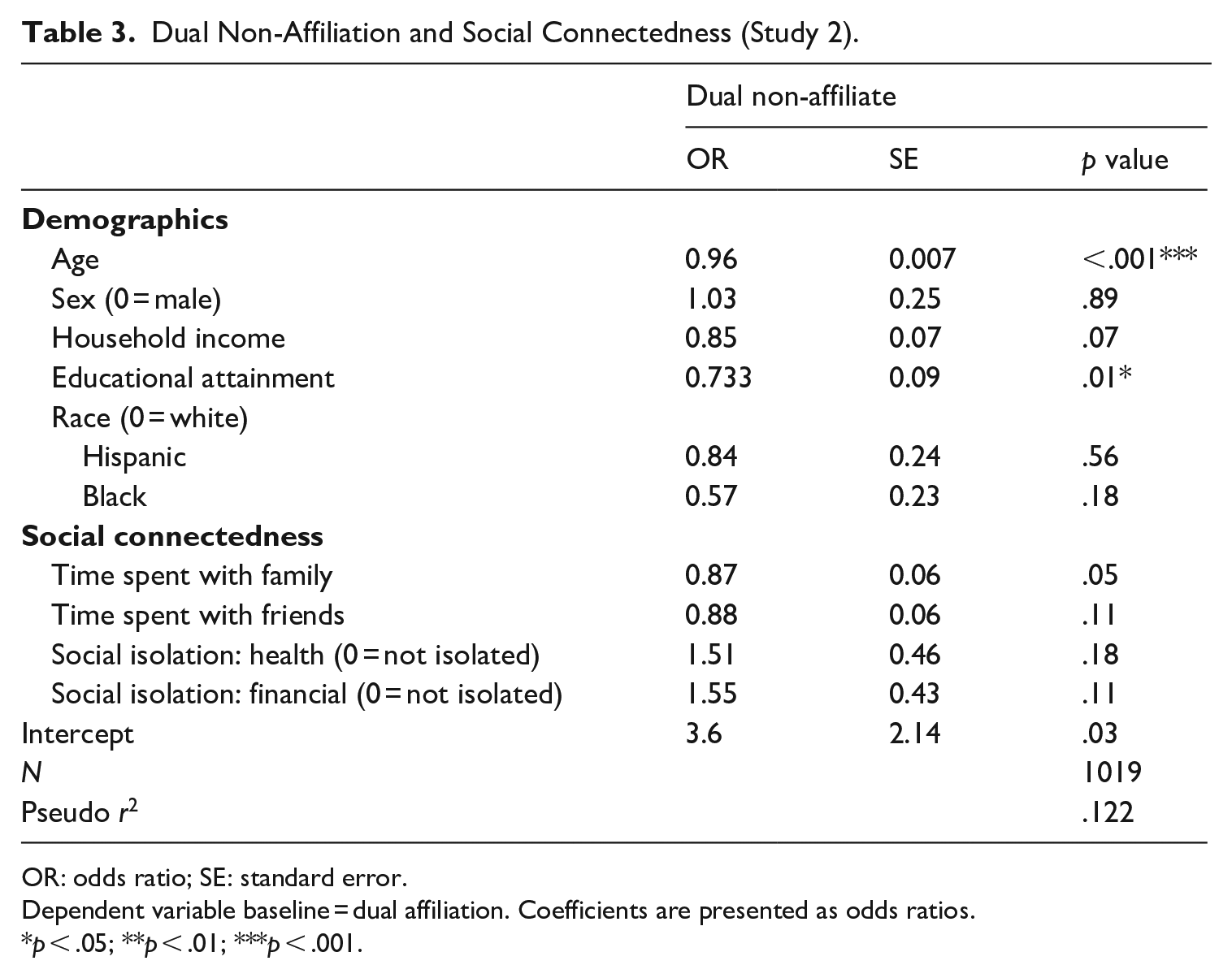
OR: odds ratio; SE: standard error.
Dependent variable baseline = dual affiliation. Coefficients are presented as odds ratios.
p < .05; **p < .01; ***p < .001.
Results from the second model of Study 2 (see Table 4) provided further confirmation that social connectedness was not a general correlate of dual non-affiliation. However, we did detect an effect of time spent with family, specifically, each unit increase in time spent with family reduced the probability of a person identifying as a Dual None by about 19% (OR = .81; p = .01). This model revealed a few other, very strong, significant effects. We detected a large effect for voting intentions – those reporting no intention to vote in the 2020 presidential election were over 7 times more likely to be a Dual None. We also found confirming evidence that Dual Nones are choosing not to engage in religious culture. In total, this second model for dual non-affiliation accounted for a substantial amount of the variation in the probability of identifying as a dual non-affiliate (R2 = .354).
Dual Non-Affiliation and Cultural Engagement (Study 2).
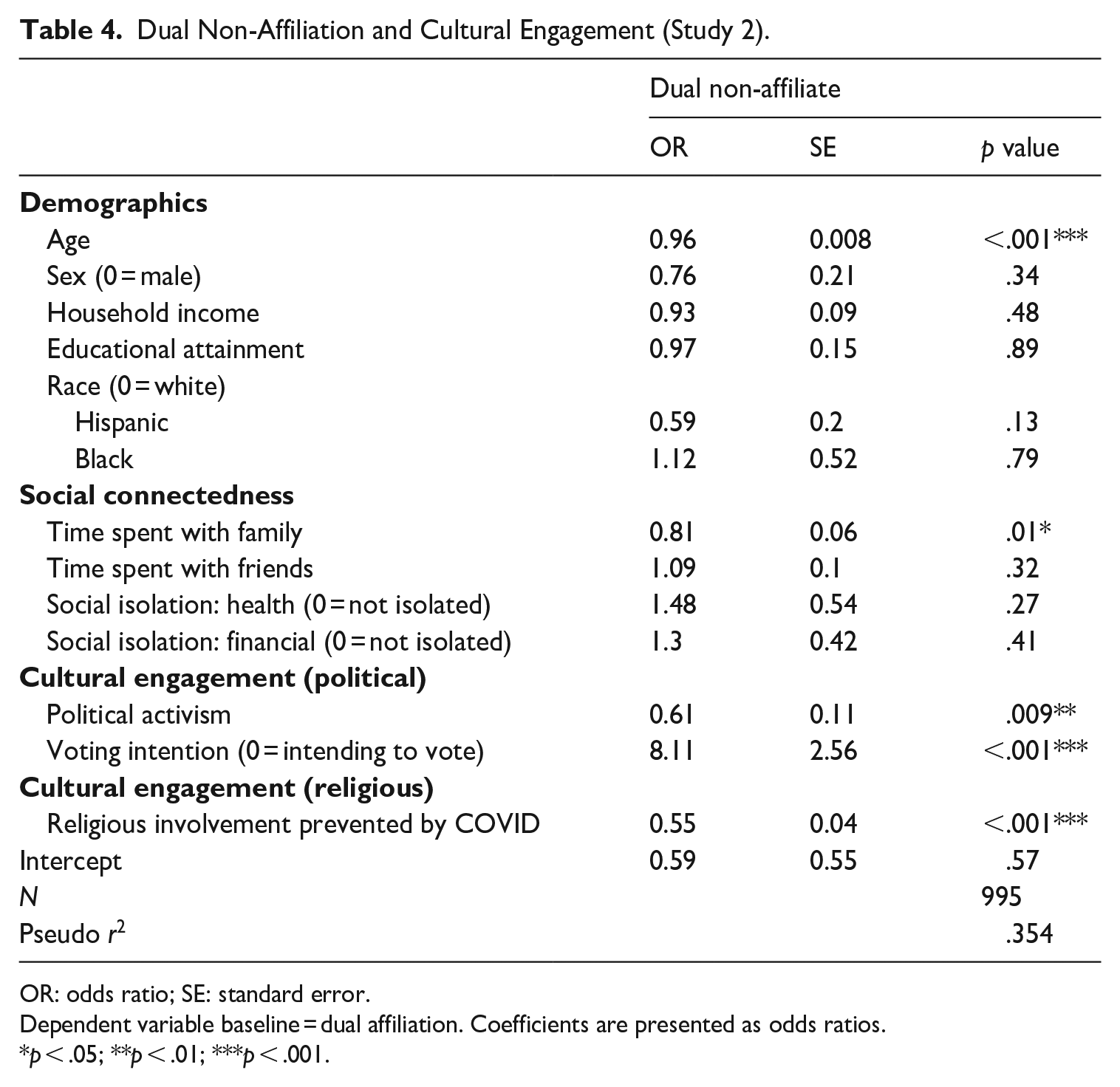
OR: odds ratio; SE: standard error.
Dependent variable baseline = dual affiliation. Coefficients are presented as odds ratios.
p < .05; **p < .01; ***p < .001.
Discussion
Across two studies composed of different samples of adults in the United States collected approximately 1 year apart, we find minimal evidence that dually non-affiliated people are socially disconnected relative to dually affiliated people, even when it comes to sensitive issues (e.g. health or financial concerns).
Though we found that Dual Nones spent less time with friends in Study 1, this effect disappeared in a model that included indicators of cultural engagement (see Tables 1 and 2) and did not replicate at all in Study 2. Similarly, though we found that Dual Nones spent less time with family in Study 2, this effect was not detected in Study 1, and the effect size was smaller than what we observed for our cultural engagement variables. Demographic findings were suggestive but failed to replicate across both studies. While younger and Hispanic respondents were more often Dual Nones in Study 1, only the effect of age replicated in Study 2. We also found some consistently null effects: across both studies, we found no statistically significant effects for sex or household income.
Our studies have limitations, both general and specific. One limitation is our reliance on quota sampling, which may limit the external validity of our findings. Another important limitation is that we focus on religious and political affiliations; yet, it is possible that individuals who decline to affiliate with such institutions nevertheless choose to affiliate with more local civic organizations such as 4H, American Society for the Prevention of Cruelty to Animals, local union groups. Thus, to be clear, this article is best read as a specific assessment of the relationship between national political (e.g. institutionally Democrat or Republican) and religious (e.g. institutionally Catholic or Christian) affiliations and social connectedness. Future work can and should disentangle large-scale national affiliations from affiliations with smaller-scale local civic organizations, as each relates to potential differences in social connectedness.
A related limitation is the overdetermination of political affiliation by Democrats and Republicans (in lieu of other possible national affiliations like Green Party) and overdetermination of religious affiliation by Protestants and Catholics (in lieu of other possible national affiliations like Muslim or Buddhist) in our sample(s). Granted, our goal in these studies was to assess the predictors of dual non-affiliation, as such, and not to assess (lack of) affiliation with a particular national political or religious group. Practically, however, we still ended up comparing non-affiliates to political and religious affiliates who were mostly Democrat, Republican, Protestant, and/or Catholic. Thus, our findings are most immediately relevant to the US context where most affiliated people identify with these groups.
We encourage researchers to build on these findings both empirically and theoretically. Empirically, we encourage researchers to replicate these findings in other countries, where mainstream political and religious affiliations exist, but where the culture these affiliations represent differs. We also encourage future work to take a longitudinal perspective – how might decisions to disaffiliate from mainstream institutions impact short-term versus long-term interpersonal connectedness? Or conversely, how might increases in social connectedness influence the probability of re-affiliating? Theoretically, we encourage scholarship that describes mechanisms facilitating social connectedness absent common forms of mainstream cultural engagement. Specifically, this area of research would benefit from theory specifying the conditions under which institutional non-engagement is associated with increases versus decreases in social connectedness, or when non-engagement is orthogonal to social connectedness, as we found here.
Footnotes
Acknowledgements
We thank several anonymous reviewers as well as the journal editor for their helpful feedback. We are grateful to anonymous reviewers for their comments and criticisms, which improved the detail and flow of the manuscript.
Declaration of conflicting interests
The author(s) declared no potential conflicts of interest with respect to the research, authorship, and/or publication of this article.
Funding
The author(s) received no financial support for the research, authorship, and/or publication of this article.
