



Abstract
In this article, we explore the narratives of young Quebec adults who currently claim no religious affiliation. We have identified four distinct types of narrative registers used to explain and legitimize their current nonreligious stance: the rational-humanistic, rational-scientific, individualistic, and relational registers. This analysis must be understood in light of the growing nonreligious population, as well as the rapid and recent changes in Quebec’s socioreligious and cultural landscape. The data presented in this article come from a qualitative study conducted among 38 nonreligious young adults aged from 20 to 32 years. Our typological analysis explores the narratives that support this claimed nonreligion. The arguments presented provide valuable insights into why religion is suffering from a ‘crisis of credibility’ among younger generations, and what nonreligious forms and identities might look like in contemporary Quebec.
Introduction
In 2021, Statistics Canada estimated that just over 27 percent of Quebecers reported no religious affiliation, an increase of over 15 percentage points in 10 years only. Meanwhile, the rate of Catholic affiliation has experienced a historic decline, decreasing from 74.7 percent to 53.8 percent over the same period (Statistics Canada, 2011, 2021). In the province of Quebec, this decade coincided with the implementation of various measures aimed at reducing the visibility of religion in the public sphere. 1 The effects of these social and political shifts on religious transmission are currently being felt by a growing proportion of young Quebecers. A rising number of emerging adults are choosing to distance themselves from an often-precarious religious heritage; for others, religion has simply never been part of their way of seeing or inhabiting the world (Thiessen and Wilkins-Laflamme, 2020). Quebec’s socioreligious landscape has undergone major transformations over the past decades, mostly as a result of decreasing religious transmission and society’s distancing from religion. Concomitantly, an increasing number of young adults of the sociological majority 2 – whether they were previously affiliated or not – are granting their children with more autonomy regarding religious matters (Manning, 2015; Malone, 2023). Data from the most recent national censuses leave little doubt as to the extent and speed with which this religious disaffiliation will occur in the coming years.
The current growth of religion cannot be entirely separated from the rapid and radical secularization that Quebec underwent from the 1960s onwards. The social representations of Catholicism, which had then become a cultural marker rather than a matter of faith, were generally associated with a retrograde and authoritarian past, during which the Church was seen as exerting a stranglehold on Quebec society (Lemieux, 1990; Bouchard, 2005). As religious transmission is weakening and Catholic affiliation is losing ground to nonreligion, it is worth asking what place these social representations derived from collective memory now hold in the social imaginary of young Quebecers, but also the ways in which they are at odds with the (non)religious imaginaries of the generations that preceded them. The goal of this article is to provide a better understanding of nonreligious ethe 3 through the narratives that nonaffiliated young Quebecers used as a mean of explaining their current nonreligion. To do so, we introduce a typology of the main explanatory registers that emerged through discursive analysis. The empirical data presented in this paper come from a qualitative study conducted among 38 young adults over the course of 2020. Emerging adulthood is all the more interesting to study as it constitutes something of a pivotal generation: in Quebec, they were among the last cohorts to benefit from confessional education and catechetical initiation in school. 4
About two-thirds of respondents interviewed report some form of religious socialization during childhood or adolescence, but their religious paths vary due to different life experiences. In more than half of these cases, disaffiliation from religion occurred due to factors like education, moral disagreements, exposure to diverse environments, life transitions, or disinterest in religion. However, many were raised in a religious environment. 5 In contrast, about one-third experienced ‘cradle’ nonreligion (Wilkins-Laflamme, 2022). The number of religious ‘nones’ in Quebec is expected to grow, as intergenerational religious transmission continues to decline (Wilkins-Laflamme, 2021b). Our data suggest that generational markers of emerging adulthood influence whether young adults identify religiously (Sirois, 2021). While nonreligion among Baby-boomers has already been studied (e.g. Burchardt, 2022; Mossière, 2020, 2024), the nonreligion of younger Quebecers remains underinvestigated. 6
Theoretical framework
Qualitative research on nonreligious populations has evolved rapidly over the last 10–15 years (Bullivant, 2020). Although there are numerous terms employed by sociologists or nonreligious individuals themselves to situate this group of people within the vast spectrum that is nonreligion, many researchers have noted the difficulties involved in grasping the complexity of a phenomenon fundamentally characterized by what it is not. Studies that account for the potentially positive aspects of nonreligion are becoming increasingly common, although our understanding of nonreligious worldviews, attitudes, and beliefs has long been reduced to the religious/secular dichotomy (Beaman, 2021b; Lee, 2015). The study of nonreligion as well as nonreligious populations, attitudes and discourses, has now become an autonomous and established academic subfield that has yet to emerge in Quebec. 7
A changing socioreligious landscape
The analysis presented in this article is situated within the secular transition, which describes the generational decline of religious affiliation, marked by a shift from religious to less religious cohorts (Voas, 2008; Wilkins-Laflamme, 2021a, 2021b). This aligns with Danièle Hervieu-Léger’s (2003) concept of ‘exculturation’. Sociologist Martin Meunier (2015) predicts the gradual loss of religious memory and references among younger generations due to the decline of Catholicism in Quebec. As secular transition and exculturation progress, more Quebecers are distancing from their religious heritage. Recent studies note that this shift is disrupting religious views tied to a French-Canadian identity, as younger generations align with a cosmopolitan, pluralist framework (Meunier et al., 2021). Second- and third-generation ‘nones’ are expected to become the majority in coming decades despite growing pluralism.
Recent studies have also highlighted a growing indifference toward certain spiritual, metaphysical, or ontological ‘big questions’ (Taves et al., 2018) generally associated with traditional religions. This phenomenon, which might be referred to as ‘existential indifference’ (Schnell, 2010) or ‘indifference to religiosity’ (Quack and Schuh, 2017) has had an impact the perceived necessity of religion in one’s life. Still, religion-related questions arise at different moments in life, prompting individuals to position themselves in relation to religion – most often by positioning themselves as either outside of or opposed to it. Yet, for many individuals remain largely indifferent to religious matters in day-to-day life outside of these sporadic episodes (Bréchon and Zwilling, 2020; Cotter, 2014). This observation must be analyzed in light of religious transformations – both in content and in form – in broader society, but also of the ways in which individuals are religious. This day-to-day indifference – periodically manifesting as religious opposition or rejection in the face of certain life events – could be partly explained by the idea that religious preferences are no longer considered as a determinant feature of overall identity. The coexistence of indifference to religion on the one hand, and openness toward religious difference and diversity on the other, has been observed in many secular societies (Quack and Schuh, 2017). Nevertheless, it is important to highlight that a critical view of religion can be accompanied by both religious indifference and acceptance of ethnocultural diversity in everyday life (Blankholm, 2022).
The positive content of nonreligion
We suggest, in line with recent literature, that nonreligious individuals fulfill the same needs as those who adhere to religious worldviews, with the key difference being that nones’ beliefs and values are not tied to a religious framework. As Zuckerman (2012) and our own findings suggest, existential challenges (family, health, career, community) are common to both religious and nonreligious people (see also Zuckerman et al., 2016). This has led scholars to seek a term that highlights the positive aspects of nonreligious identities, rather than defining them by what they lack (e.g. Cragun and McCaffree, 2021; Lee, 2015; Quack, 2014; Taves, 2020). Our current knowledge of the narrative mechanisms underlying nonreligious identities involves identifying how nonreligion is both legitimized and rationalized through speech. The nonreligious identity is not conceived as an identity marker per se (as religious identity might be) but rather corresponds to religion-related modes of self-understanding and self-definition that must be contextually ‘performed’ (Goffman, 1959). Our respondents’ knowledge of their current nonreligious identity has evolved over time and will continue to do so. We then suggest that (non)religious modes of identification are generally subject to a form of reflexive and situational instability. Following Shipley, we believe that by ‘asking more deeply about how young adults express the daily connections across multiple sites and spaces, we are able to uncover the considered and connected youthful expressions of nonreligious, religious, spiritual, and ethical identities’ (2018: 205–206). Such an endeavor requires a better understanding of the internal logics sustaining nonreligious ethe, which the present article will attempt to provide. While several scholars have focused their research on Quebec’s religious youth, particularly Catholics (e.g. Lefebvre, 2008; Perreault, 2012, 2015; Routhier, 2005), a significant gap remains in the literature regarding their nonreligious counterparts, especially in light of the secular transition that is underway.
Methodology
Data collection
Our analysis is based on semi-structured interviews with 38 young Quebecers aged 20–32 years, 8 primarily recruited from the Quebec City metropolitan area, with additional participants from Montreal and Gatineau through virtual interviews. This qualitative study focused on nonreligious young adults’ relationship with religion and meaning-making processes. 9 Recruitment targeted individuals aged 18–35 years, of French-Canadian descent, French-speaking, and religiously unaffiliated, using social media (Facebook and LinkedIn), followed by snowball sampling. The interviews lasted 90–120 minutes on average and were conducted in person or virtually in accordance with public health restrictions in effect at the time. The interview questionnaire consisted of three segments: biographical details, a recount of a significant life event, and short questions on themes such as worldview, future vision, religion, spirituality, values, ambitions, and so on. While we considered demographic factors like socio-professional category, gender identity, immigration experience, religion, and education in our selection criteria, individuals with higher education are overrepresented in our sample. Indeed, of the 38 participants, 27 hold an undergraduate or graduate degree. Over half were socialized in a Catholic environment, while most others come from nonreligious families. 10 One participant was an active member of a Baptist community until his early twenties.
Typological analysis
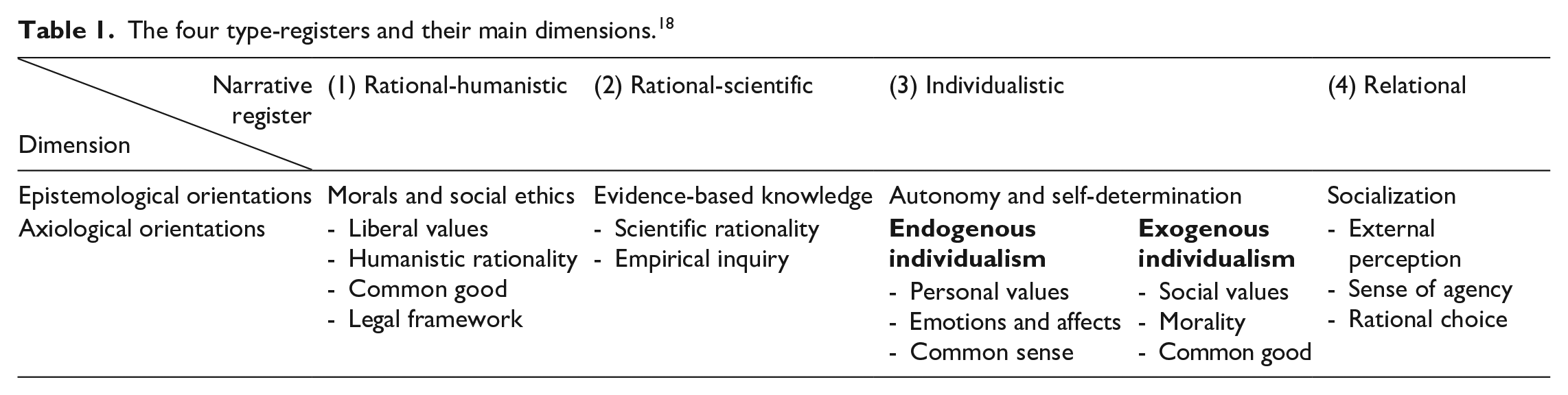
The results in this article are based on thematic and discursive analysis using a typological method, which is suitable given the narrative convergences and explanatory patterns in our dataset. This inductive approach is heuristic, allowing us to isolate common features across responses. The typology helps synthesize respondents’ discourse, making it intelligible outside its original context. We differentiated four narrative types – rational-scientific, rational-humanistic, individualistic, and relational – based on the epistemological and axiological orientations 11 used to express their nonreligious stance. These types, or ‘explanatory registers’, 12 emerged from analyzing the main narrative lines in responses, mostly related to participants’ relationship with religion. 13 This typological model is not exhaustive or totalizing but aims to explore values specific to each register. The types are not mutually exclusive, and affinities between multiple registers may coexist within a single discourse. The selected interview excerpts exemplify each type.
Limitations
As with any typology, the model we present is limited by our sample size and the relative sociodemographic homogeneity of among our participants. 14 Although we present it as an operational tool for reflection and analysis, our typology cannot claim exhaustiveness, as it accounts for the essential characteristics and patterns of each type. Moreover, our sample does not include any participants who identify with an affirmative or militant secularist nonreligious stance: this underrepresentation of a more critical, hostile, or even anti-religious profile is likely to have affected the nature of some of our results. Another limitation is that the prevalence of indifference as a general relationship with religion further highlights the performative aspect of our participants’ nonreligious identity. We acknowledge that the context of semi-directed interviews creates a somewhat artificial discursive space, which likely places disproportionate emphasis on certain issues that do not necessarily receive much attention from these individuals in everyday life. Therefore, we recognize that the respondents’ discourses on religion are situational, as they do not adequately reflect the prominence of religion-related questions in the lives of most nonreligious individuals.
Identifying the secular narratives of nonreligious young Quebecers
Exploring the rationales behind nonreligious narratives provides insight into the positive aspects and meaning-making processes used by nonreligious individuals to express their relationship with religion. This analysis focuses on how some young Quebecers articulate their nonaffiliation through discourse. We identified four distinct registers based on their internal reasoning: rational-humanistic, rational-scientific, individualistic, and relational. While not mutually exclusive, these registers are examined individually, as each is based on specific themes, patterns, and arguments. We explore each in turn.
The rational-humanistic register
The rational-humanistic explanatory register is characterized by a marked concern for the respect of individual freedoms and the centrality of themes related to equality, peaceful coexistence, and human rights, including the right to be nonreligious. While it is employed by various secular organizations and activist groups to indicate shared values and representations, we use the term ‘humanistic’ in the same way as Lee (2019: 178) defined it, that is, ‘a materialist outlook that places emphasis on humanity and, in particular, humans’ rational capacities as a source of existential meaning’. LeDrew’s (2012, 2019) distinction between scientific and humanistic atheism highlights the epistemological differences, with humanistic forms of non-belief taking a more ‘anthropological’ approach to religion’s social impact.
In our interviews, rational-humanistic narratives often emerged when discussing topics like religion in the public sphere, Quebec’s political secularism (laïcité) or the Ethics and Religious Culture course in schools. A large majority of participants supported keeping some form of sociohistorical, non-denominational education on religion in public schools, emphasizing the importance of understanding other religious cultures and embracing diversity. Guillaume, a 24-year-old political science student, expressed concern about the risks of marginalizing certain religious groups: ‘In a multicultural society (like Canada), I think that we must at least understand others, and if we don’t, it will lead to a lot of social problems, as we can see elsewhere in the world’. 15 He endorsed the values of freedom and openness, nevertheless stipulating that in his view, ‘freedom of religion means I also have the freedom not to have a religion’.
Rational-humanistic narratives often contrast religious morality, seen as discriminatory, with progressive values of inclusion and openness in secular societies. Béatrice, a 29-year-old graphic designer, says her generation ‘didn’t feel challenged, because religion hasn’t kept up with the world’, adding, ‘(religion is) super sexist too!’ Similarly, Émile, a 27-year-old factory worker disaffiliated from the evangelical community, identifies with a ‘very humanistic philosophy à la Maslow’ and supports collective human unity:
Our philosophical beliefs must be adapted to the world we want to see, and we must move towards a kind of degendered humanism that no longer takes into account questions of race, religion, and all that. We need to move towards a more united humanity, because if we continue to see ourselves as being one tribe against the other, it’s unfortunate, but we’re running to our doom.
The rational-humanistic narrative holds a generally positive view of religion – focused on freedom of choice and thought. Morality emphasizes equality, human dignity, and ethical universalism, rejecting views tied to faith-based interpretations. When asked why he is nonreligious, 25-year-old Simon said it was ‘a personal decision’ but noted that ‘religion can serve as a really nice life guide for a lot of people’, as long as it remains a personal choice. This aligns with the view that religion, if chosen freely, can offer community and values (Shipley, 2018). Simon’s shift from nonreligion to recognizing religion’s benefits highlights a connection between the rational-humanistic and individualistic registers, especially the exogenous subtype, that will be presented further on.
As for Alexandra, a 26-year-old federal government employee, she identifies as an ‘open atheist’; however, she claims that this identity marker has no impact on the fact that ‘others have religions and that others believe in what they believe in; I can’t do anything about it. Live your life as you want to’. Alexandra’s example offers a clear demonstration of ‘tolerant cosmopolitan universalism and sociability’ to describe the mind-set of many youths toward religious diversity (Meintel and Mossière, 2013). This particular dynamic constitutes a central dimension of the rational-humanistic explanatory register as it involves the negotiation between the affirmation of one’s nonreligious identity and the attitude of acceptance toward religious diversity, thus legitimizing the overall possibility of ‘indifferent openness’ (Blankholm, 2022).
The right not to believe or belong to any religion is central to participants’ strategies for positively framing their nonreligious identity. However, our data also suggest a relativistic view on the potential benefits of religion for those who choose religious affiliation. 16 Marc, a 30-year-old product designer, highlights this acceptance of religious diversity and the positive aspects of a chosen religious lifestyle:
(I stand for) the equality between all forms of spirituality. (People) need to learn to accept this difference which, apart from giving meaning to the lives of some people, does nothing else. (…) If you want to wear a veil because you define yourself as being part of such and such religion, or if it’s important to you and it’s meaningful, then go for it.
In the rational-humanistic narrative, religions tend to be depicted as organizations that have collectively provided themselves with answers to the ‘big questions’ of existence (Taves et al., 2018); for our respondents, however, it appears that these same questions can be addressed outside of a strictly religious context. The rational-humanistic type of reasoning thus tends to emphasize what primarily unites individuals over and above religious identification, while remaining aware and accepting of religious and cultural differences. For some of our interviewees, it is the humanistic and the communal ideals focused on social justice and interpersonal relationships that allow them to find meaning in their everyday lives, rather than the replication of prescribed practices and the fulfillment of doctrinal requirements. One of the central points of this register therefore lies in the value nonreligious individuals place on a ‘secular morality’ differing from what might be referred to as a prescribed religious morality (Sumerau and Cragun, 2016). A few of our participants reported that their initial contact with religion was imposed, meaning that their previous religious affiliation had been the result of a parental decision to which they felt unable to either consent or object.
In sum, one of the main aspects of the rational-humanistic register, as employed by our respondents, is the negotiation between perceiving (their) nonreligious identity as a full-on right on the one hand and expressing willingness to be open to and respectful of religious diversity on the other. Moreover, excerpts from some of our interviewees suggest an attempt to neutralize the religious symbolism and origins of certain humanistic values by invoking their universal and normative character (Beaman, 2020). The discursive context in which this strategy may be used or found however differs from those present in Beaman’s work. In our respondents’ cases, appealing to certain principles and values in the name of their universality and neutrality must be interpreted as a way of legitimizing their nonreligion within a narrative aligned with humanistic and rationalist views, rather than a defensive strategy aimed at preserving aspects of a specific religious tradition (Beaman, 2021a).
The rational-scientific register
The second explanatory register, the rational-scientific, is easily recognizable. Previous studies show that the science-religion opposition involves not only epistemic but also mythological and ideological dimensions (Lee, 2019: 174; see also Catto et al., 2023). Our data indicate that this opposition is largely based on a perceived incompatibility between religious and rational-scientific views. For example, 25-year-old Pauline states, ‘(Science) satisfies me because it is rational’, suggesting she sees religion as irrational or lacking ‘credibility’ (Berger, 1967). However, this binary may mask a more nuanced perspective, reflecting an internalized, empirical, and objective approach to knowledge (Edwards, 2021). Gingras (2016) further suggested that the existence of a duality between religion and science was centered around the subjective nature of religious beliefs and the objective character of scientific knowledge.
Our study highlights a perceived superiority of scientific knowledge over religious beliefs, with participants internalizing rational-scientific narratives in their nonreligion. For example, 27-year-old economics student Thierry argues that religion’s explanations are outdated and no longer acceptable: ‘We know too much scientifically to accept answers like “that’s the way it is because the guy up there said it”’. The dominance of science in explaining reality makes religious adherence seem unimaginable for many respondents, allowing them to ‘articulate the central role of science within a nonreligious existential philosophy’ (Lee, 2019: 180).
Our interviews reveal a close association between the ideas of science-based knowledge and truth. Indeed, numerous participants invoked statements consistent with a rational-scientific-type narrative when asked about their relationship with truth or what they consider to be true. This argument recalls LeDrew’s (2012) description of scientific atheism, which emphasizes the epistemological superiority of scientific knowledge over religious beliefs. Although only 11 of our 38 participants identified as ‘atheist’, scientific arguments are common and do not necessarily align with more assertive nonreligious views. The ‘conscious effort’ of atheist identification, as described by Catto and Eccles (2013), seems less demanding in our study, likely because none of our participants are affiliated with secular activist groups.
For Émile, the ex-evangelical, science and scientific authorities are sources of reliability and credibility: ‘For me, we have to take what can be scientifically proven for granted and start from there’. As for 30-year-old Delphine, her relationship with truth relates to the possibility of explaining certain beliefs using scientific evidence. She uses the example of her personal belief in life after death: ‘(If) someone tells me “I’m sure there’s nothing after death”, they’ll (reason) with the scientific side and everything. I’m going to be like: “no, I believe there’s something”, but at the same, time there’s no way to prove it. So, you can’t say it’s true if you can’t prove it’.
Magalie, a 24-year-old administrative assistant, believes religion has ‘gotten in the way of science’ and recalls seeing a graph suggesting we would be more advanced without religion. Pénélope, a 24-year-old chemistry master’s student, claims only scientific facts can be ‘universal truths’ and argues that ‘unproven beliefs’ should be relativized. However, our participants’ relationship with science is not entirely uncritical. Patrick, a programmer, views science’s openness to criticism as a sign of humility: ‘I don’t take (science) for absolute truth, but it has the humility to renew itself and allow questioning, something religion didn’t until recently’. Thierry, with a rational-scientific view, answers existential questions with a cynical realism: ‘Statistically, we’re not that special … we’re born and we die like everyone else’. Finally, for some participants, science’s superiority over religion is seen in religion being replaced by science. Nicolas, for example, suggests, ‘The new religion is science’, noting a decline in religion’s benefits. The data show that the credibility of evidence-based knowledge contributes to making exclusive allegiance to faith-based institutions, which fall outside science’s scope, seem obsolete.
The individualistic register
We labeled the third narrative type in our typology as ‘individualistic’ 17 , referring to nonaffiliation centered on autonomy, the need for personal meaning, and the perceived conflict between personal values and religious teachings. Explanatory strategies in this narrative focus on values as sources of meaning and identity (Perreault, 2015; Sirois, 2021), highlighting self-determination. When asked why she described herself as nonreligious, Anne-Sophie, a 25-year-old psychology student, admitted she was under
the impression that with time and experience, how I make sense of my life experiences, and also when I go to church, for example, sometimes I listen and (I realize) it’s not meaningful; it doesn’t fit in with my explanations, but there are things that sometimes make sense, but there are others that don’t. It just doesn’t fit in with my values or my ways of explaining certain events.
The predominance given to personal values in the individualistic narrative lies in the fact that they embody a determinant of belief that is far more malleable and meaningful than religious teachings, associated with a ‘ready-made thinking’ (prêt-à-penser) framework (Sirois, 2023). When asked the same question, our participant Alexandra says she believes in the ability to think – her own and that of all human beings – and make decisions without any religious influence:
I don’t think religion influences who I am, and I don’t think I make decisions in my life that are influenced by an outside force. I fundamentally believe in my rationality and in the fact that we’re all people capable of making personal decisions without giving importance to some invisible being. Because there are ways of living life that are influenced by morality, common sense, and general rationality that have nothing to do with religion.
The centrality of values in our participants’ comments suggests navigation between personal values and actions. When asked about the principles guiding her decisions, Chloé, a 21-year-old sexual health student, said, ‘I refer a lot to my values, my desire for social justice, my values of solidarity and openness’. This reflects a pattern consistent with the individualistic register, as she framed her nonreligious identity within a set of progressive values. Chloé’s example suggests a coexistence of two types of individualism: an ‘endogenous’ one focused on internal self-recognition, and an ‘exogenous’ one rooted in collective values that place individuality within a social context. While both are similar to rational-humanistic ideals, the endogenous narrative focuses on self-definition, and the exogenous narrative addresses the tension between universalism and relativism. These sub-narratives interact, as shown in Table 1, and differ mainly in their axiological dimensions. Marianne, a 23-year-old accounting student, seeks congruence between her personal values (endogenous individualism) and the social values she finds credible (exogenous individualism). The endogenous subtype focuses on self-knowledge, while the exogenous one aligns with a social ideal of the self based on shared principles.
The four type-registers and their main dimensions. 18
Delphine expresses a desire for congruence between her values and religious experiences. When asked about her openness to certain religious practices, she said, ‘Yes, from a cultural perspective, if it fits with my values. If someone says ‘we’re going to sacrifice a lamb’, that’s going to be a no’. She values living her spirituality personally, according to her own values, more than following a religion with imposed rituals. For her, the significance of personal values outweighs religious values in her search for meaning, and her openness to religious experiences depends on their alignment with those values. The theme of values in our respondents’ discourse reflects a desire to separate personal values from religiously connoted ones. For instance, Smith and Halligan (2021) observed that nonreligious individuals often neutralize religious ‘bias’ by framing values as normative and/or cultural principles.
Magalie shared, ‘Our Catholic values are good: forgiveness, helping others, not judging … one can continue to have those values without a religion’. Antoine, a 20-year-old philosophy student, says he does not adhere to the Catholic vision but may agree with some Catholic values. As for Béatrice, a 29-year-old graphic designer, she rejected Catholicism due to its homophobia and monogamy, instead adopting a ‘value system that aligned with (her) identity’. At last, a key feature of the individualistic narrative is the perceived role of religion in participants’ lives. Their reasons for rejecting religion often reflect views of it as impersonal and disconnected from realities of everyday life. In short, most statements in this register suggest that religion does not meet their needs for meaning and identity, nor does it embody a conceivable alternative.
The relational register
The fourth and final dimension of our typology is the relational narrative register. Statements in this register present religious nonaffiliation as a result of interactions with secular or religious environments. For some participants, this contact led to distancing from religion or deepened a pre-existing nonreligious stance. 19 The agency developed in childhood and adolescence shaped their process of negotiating, integrating, or rejecting religious or nonreligious forms (Strhan and Shillitoe, 2019). It is ‘relational’ because nonreligion arises from (non)religious socialization or experiences that create distance from religion.
Émile’s case offers a clear example of the relational narrative. His rejection of religion occurred between late adolescence and early adulthood, when he realized that happiness largely depends on socioeconomic factors. Questioning the idea of ‘divine will’, Émile came to see himself as ‘master of his own destiny’. As he interacted with diverse social environments, he increasingly noticed the gap between his values and the teachings he had received from his parents and community.
I started thinking this way, then I saw several things adding up, and the more it went on, the more I realized that within the dominant discourse of religious people around me, there was a kind of a (…) witch-hunt, where the progressive and humanist discourse, which I felt I adhered to, was something that was disapproved of.
This excerpt illustrates the overlap between rational-humanistic and relational registers, as the rejection of progressive values led him to distance himself from his religious community. Béatrice’s example also reflects elements from both registers but in a more critical way, expressing disdain for religion and a desire to distance herself from it due to her experiences with certain family members:
Some members of my family are really intense (about religion). Some of them are in cults. Religion destroyed my family. (Religious people) have a value system that’s like sharing, accepting others. But they act in such a fake way, and then when a situation arises where (their) true self comes out, (you see that) they’re not good people. That’s what my family taught me about religion.
Béatrice’s negative view of religion is linked to her perception of hypocrisy in her religious family, which influenced her nonaffiliation. Some respondents base their nonreligious identity on a lack of religious transmission or being raised in secular environments. Martel-Reny’s (2018) study found that anticlericalism and anti-Catholic views are often inherited, as seen in Pierre-Luc, a 28-year-old Education graduate, who became skeptical of religion due to his family’s hostility toward it. Similarly, Pauline, raised in a nonreligious family, never experienced religious socialization and feels nonreligion has always been ‘normal’ for her.
Our analysis also shed light on a preoccupation expressed by six interviewees that may be tied to the relational-type register. This type of discourse expresses a concern about how religious identification and expression are viewed by others. Charles, a 22-year-old restaurant worker, told us that his choice of not to be religiously affiliated was partly motivated by a concern about how others would perceive him:
If I were to say I was religious, I feel like I would be ‘reduced’ (to this identity). If I told someone I was religious, in their mind, there would be a (pejorative) image associated with it. Being ‘religious’ means something, and if I say I’m religious, I’m going to be put in a box, and (people) are going to change how they see me. Being religious is more and more frowned upon.
This excerpt seems to indicate that the reputation associated with being openly religious is at issue. In Charles’s case, this concern is one of the main reasons that led him to distance himself from religion. From this example, we understand that the often-pejorative image associated with religion (and its adherents) can play a role in some respondents’ nonaffiliation. Similarly, some of the comments made by our participant Catherine, a 26-year-old personal care worker, also expressed concerns about the suspicion that comes with being labeled as religious.
It is hard not to see in this the persistence of a totalizing vision of religious identity and the strengthening of certain representations – often stereotypical – of being religious (Guenther, 2014). 20 In conclusion of this section, in the relational-type register, narratives of nonreligion as generally associated with contacts with certain milieus and specific encounters with religious or nonreligious individuals that widened the perceived gap between our participants and religious forms. As we have shown, this distancing from religion does not always stem from an explicit break with an environment or social group; it may also be explained in terms of positive socialization in secular milieus in which the religious option was either non-existent or discouraged.
Conclusion
Findings
Our analysis identified four distinct but complementary findings. First, we found that our respondents’ discourses reflect a shared imaginary where collective representations of religion coexist and influence their nonreligious identity. Second, we argue that these individuals’ discussions of nonaffiliation reveal positive representations of secular life, challenging the assumption that nonreligion equals opposition to religion. Third, we suggest that religious indifference in many respondents may stem from positive perceptions of nonreligion, as their identity is not rooted in negative views of religion. Finally, we note that the frequent interaction between these explanatory registers highlights the evolving and diverse nature of nonreligious identities, shaped by various beliefs, values, and worldviews. However, the artificial nature of our interviews and the wide range of topics covered may explain the difficulty in identifying the prevalence of these registers in everyday ways of reasoning.
In summary, we examined how young Quebecers’ nonreligious identities are explained through various narratives. By identifying four narrative registers, we gain insight into the strategies for constructing meaning and the distinct features of nonreligious imaginaries, which are not solely defined by opposition to religion. This article explores how nonreligious identities are framed within secular studies and why more Quebecers, especially youth, are rejecting religious affiliation. Our analysis highlights the central role of nonaffiliation in the emerging ‘secular consciousness’ (Smith and Halligan, 2021), which sociologists are still trying to characterize. While our model is specific to Quebec, it may offer insights into nonreligious populations globally, although cultural, social, and political factors can create to narrative variations.
Contributions
Our final discussion must be accompanied by the observation that nonreligion is not necessarily experienced as an absence: nearly all of our interviewees appeared to be simply indifferent to religion in their everyday lives, while those who expressed spiritual or religious type of needs are very unlikely to turn to conventional forms of religiosity. The rational-humanistic perspective emphasizes secular morals and self-determination, with a critical stance toward religious beliefs seen as obstacles to humanist principles like freedom, equality, and peaceful coexistence. Debates on laïcité and the removal of ERC courses have consistently influenced many young Quebecers’ views on religion, especially those with progressive attitudes toward religious diversity. In the rational-scientific register, respondents question the credibility of religious institutions, emphasizing science and evidence-based knowledge as the standard for truth. The individualistic register highlights personal values as a guiding system, offering commonalities traditionally linked to religious beliefs. The identification of two subtypes – endogenous and exogenous – suggests distinct ways of situating individuality in a nonreligious context. We argue that scandals tarnishing the Church’s image in recent decades have reinforced negative views of Quebec’s religious past, rooted in the sociocultural revolution of the 1960s. 21
Our respondents’ desire to distance themselves from religious scandals reflects a broader dynamic where nonreligion has become the ‘default option’ (Taylor, 2007), with nonreligious individuals often facing less pressure to justify 22 their stance. Wilkins-Laflamme (2022) argues that the growing pull toward nonreligion, echoing assumptions from the religious-secular competition theory (Stolz, 2016). The explanatory patterns in our typology shed light on why nonreligion is increasingly preferred, particularly among younger individuals, and highlight the stigma associated with religious identity. The study presented in this study appears to be complementing findings from Mossière’s (2024) most recent book, in which she analyzes profiles of (non)religious Baby-boomers. This monograph sheds light on numerous narrative patterns and recurring themes chosen by some of her respondents in order to put their nonreligion into words. 23 Finally, even though the present article has highlighted elements specific to the Quebec context, it is worth asking if nonreligious forms – embodied through worldviews, attitudes and discourses – are becoming more qualitatively homogeneous, especially in the global trends that are currently impacting societies. The typology presented in this article might serve as a useful analytical tool for future transnational or transgenerational comparative inquiries.
Footnotes
Acknowledgements
I would like to thank Professor Lori Beaman for her invaluable insights on the very first draft of this article as well as my research supervisor E.-Martin Meunier and Jean-Philippe Perreault for their constant support.
Funding
The author received no financial support for the research, authorship, and/or publication of this article.

Notes
Author biography
Address: Desmarais Building, 10th Floor, 55 Laurier Ave. East, Ottawa ON Canada K1 N 6 N5
Email: