




Abstract
The porous and shifting boundaries within and between care and work concepts, and practices and their related measurement complexities call for innovative conceptual and methodological approaches to research on work and care. This article details how we reconfigured the Household Portrait – a qualitative, participatory, visual, creative method that engages couples in mapping and discussing their household and care tasks and responsibilities – into a Care/Work Portrait. Informed by conceptual shifts in care theories, the Care/Work Portrait offers theoretical and methodological advantages for studying gendered divisions and relations of household work and care. It attends to unpaid care work/paid work/paid care work intra-connections, moves outside the household to include community-based work, deepens distinctions between tasks and responsibilities, and considers wider forms and contexts of care. This method goes beyond who does what tallies to bring forth relational, temporal, spatial stories about people’s complex care/work configurations and the specific contexts, constraints, supports, and structuring conditions of their lives.
Keywords
Introduction
In numerous countries, the COVID-19 pandemic has sweepingly revealed and intensified existing gendered and racialized inequalities and differences in paid work and unpaid care work, especially for families with children. It has also highlighted the critical but still largely invisible connections between unpaid care work, paid work, and paid care work – connections long recognized by feminist social reproduction and care scholars. Research assessing the pandemic’s gendered impacts on the redistribution of unpaid care work has exploded since 2020, mainly in the form of quantitative online surveys (i.e. Carlson et al., 2022; Craig and Churchill, 2021; Shafer et al., 2020), but also through qualitative research (i.e. Smith, 2021). These studies confirm long-standing patterns of gendered differences and inequalities in both paid and unpaid work. While research on gender divisions of domestic labor continues to proliferate, less attention has been given to the methodological and epistemological complexities of measuring unpaid work in quantitative surveys, time use studies, and qualitative research studies (but see Doucet, 2022, 2023; Christopher, 2020; Folbre, 2018, 2021, 2022; Milkie, in press).
Recognizing the ongoing challenges of measuring and researching household work and unpaid care work, as well as the porous and shifting boundaries within and between care and work, this article contributes to the development of innovative visual, participatory, and digital qualitative research methods for studying unpaid care work and gender divisions and relations of domestic labor. Specifically, we detail how we developed the Care/Work Portrait, a research tool that offers theoretical and methodological advantages for studying gendered divisions and relations of household work and care work. It attends to unpaid care work/paid work/paid care work intra-connections, moves outside the household to include community-based work, deepens distinctions between tasks and responsibilities, and considers wider forms of care. This method goes beyond who does what tallies to bring forth relational, temporal, spatial stories about people’s complex care/work configurations, with a focus on how they negotiate and make decisions about care and work, and on the specific contexts, constraints, supports, and structuring conditions of their lives.
The Care/Work Portrait is the outcome of our work to further develop and reconfigure the Household Portrait, a qualitative, participatory, visual, creative method that engages individuals and couples in mapping and discussing their household and care tasks and responsibilities. First developed by Andrea Doucet in the mid-1990s (Doucet, 1996; see also Doucet, 2001, 2015), the Household Portrait method has been used and modified by other qualitative researchers (i.e. Christopher, 2020; Dunne, 1998; Gabb, 2008; Le and Aune, 2011; Sarre and Moran-Ellis, 2014; Twamley, 2021). Its most recent adaptation appears in Emily Christopher’s research with 25 heterosexual working parent couples in the West Midlands region of the United Kingdom. She quotes Doucet (1996: 160), making the case that ‘much of the information on how a household operates on a day to day basis is difficult to remember and conceptualise, much less to articulate’, adding that ‘creative methodologies can contribute to a more nuanced and textured picture of domestic life’ (Christopher, 2020: 466). She notes that her study reveals how ‘Each participating couple’s joint construction of their household portrait makes visible complex differences between partners in how domestic labour is conceptualised and measured’ (Christopher, 2020: 466) and argues that ‘quantitative surveys and time use studies may be papering over some of the difficulties of accurately recording domestic divisions of labour’ (p. 465; see also Daminger, 2019). Drawing on Oriel Sullivan’s (2004: 219) assertion that the Household Portrait method is ‘efficient in getting at the amount of change and the detailed processes involved’, Christopher (2020: 454) indicates that in research on domestic divisions of labour, ‘it has been surprisingly little used’.
We were developing a Canadian qualitative research study when we read these remarks; they compelled us to consider using the Household Portrait in our qualitative interviews on practices and approaches to paid and unpaid work in diverse families. At the same time, our attention to long-standing and new theoretical developments in care concepts led us to reconfigure the method into a Care/Work Portrait that is informed by care theories (mainly feminist care ethics and care economies) that attend to relational subjects, intersections between justice and care, and conceptual and practical relationalities of unpaid care work, paid work, and paid care work (see Doucet, 2023).
This article focuses on our process of theoretically and methodologically remaking the Household Portrait into a Care/Work method and app with a diverse team of Canadian researchers who have extensive experience working with varied populations. It is informed by the pilot phase of research. We detail our process of developing the method as a team, how it works, what it can offer to the field of gender divisions of domestic labor, our current use of it in a cross-national project, and our aims to share it with a wider community of researchers in the near future. This article is organized in three sections. First, we briefly summarize our reading of how the field of gendered divisions of household work and care arose in several Global North countries beginning in the 1970s and 80s. Second, we explicate how the Household Portrait developed in response to weaknesses in existing methodological and theoretical approaches to gendered divisions of household work and care. Finally, we discuss the practical, theoretical, and methodological processes of rethinking and remaking the Household Portrait into a Care/Work Portrait. This article provides an overview of our innovative method and its potential for deepening both qualitative and mixed methods studies on gendered divisions of household work and care and on paid and unpaid work.
Gendered divisions of household work and care: who does what?
The cross disciplinary field of household work and care has expanded steadily since the 1970s, when employment rates for mothers of young children were rising in the Global North and there were notable social and demographic shifts toward dual earner families and away from the hegemonic ideal of the ‘family wage’, which ‘valorize(d) the heteronormative, male-breadwinner, female-homemaker model of the gendered family’ (Fraser, 2016: 111). Despite considerable theoretical and conceptual diversity and some variation in the names given to the field – the division of domestic labor (Sullivan, 2000; Warren, 2021), gendered divisions of unpaid domestic work (Warren, 2011), and ‘the division of household labor and care’ (Sullivan, 2018: 377), among others – it remains that ‘research on the division of household labor typically poses several questions under the “who does what” heading’ (Berk, 1985: 15).
Studying who does what in families gained traction as a sub-field within various sociologies of families and work through several well-known, in-depth qualitative research studies, mainly about white mother/father families from varied social class locations in the United Kingdom and the United States (e.g., Berk, 1985; Hochschild and Machung, 2012 [1989]; Morris, 1990; Pahl, 1984), as well as large quantitative national panel studies (i.e., Jowell et al., 1988) and time use studies (or ‘time budget studies’ as they were initially called) (e.g. Gershuny et al., 1986). Across the globe, especially since the 1995 United Nations (UN) Fourth World Conference on Women and the Beijing Platform for Action, UN agencies, national and international non-governmental organizations, and researchers have increasingly and systematically pressured national governments to make visible and measure unpaid work. This is partly to understand the socio-economic value of unpaid work, its connections to existing or needed policy supports, and its links with a host of gendered social, economic, and health issues and inequalities. The urgency of this work has generated more and more studies, including many that rely on time use diary data, which is widely regarded as the ‘gold standard’ for calculating unpaid work (Altintas and Sullivan, 2016: 456).
The Household Portrait: a qualitative, visual, participatory method
It was during this slow and steady burgeoning of large-scale surveys and time use studies that Doucet (1996) developed the Household Portrait approach, partly in response to what she viewed as five key theoretical and empirical limitations in research on gender divisions of household work and care. These were: (1) the simplification of childcare and household work tasks in many studies and surveys as evidenced by the limited range of questions on childcare, little attention to how childcare tasks differ depending on the age and number of children in a household, and the omission of household tasks, such as household repairs and maintenance; (2) a conceptualization of ‘responsibilities’ for household work and care work was largely absent and tasks and responsibilities were often lapsed, implying that doing a task was equivalent to being responsible for a task; (3) time use studies and large-scale surveys typically ignored the community-based dimensions of household work and care tasks and responsibilities, including extended family work, inter-household work, and inter-institutional work related to medical, educational, and community institutions; (4) the important housework contributions of other family members, such as older children and grandparents, were invisible in most studies; and (5) there was a methodological assumption in most studies that research participants could easily and accurately remember what they did, and how and why they did it.
The Household Portrait aimed to move beyond these limitations and invited participants themselves to clarify the meanings (shared and contested), experiences, and understandings of how and why they organized and ran their household as they did. It explored a wide array of childcare and household tasks that fall into seven categories: (1) housework, (2) caring work, (3) community-based domestic work, including ‘household service work’ (Sharma, 1986) and ‘kin work’ (di Leonardo, 1987), (4) do-it-yourself (DIY) work, (5) financial management, (6) household subsistence activities (Pahl, 1984), and (7) overall responsibility for housework and childcare (i.e. emotional, community-based, and moral responsibilities). The Household Portrait works a little like a board game, with participating couples sorting color-coded cards correlated with the seven categories of tasks and responsibilities. Through discussion, the couple determines which cards belong in which of five columns that corresponds to who takes on particular household and care tasks or responsibilities: (a) All Participant A, (b) Mostly Participant A, (c) Shared Equally, (d) Mostly Participant B, and (e) All Participant B. There is also a space for tasks that rely on paid or unpaid support (including support from older children in the household).
The Household Portrait is a ‘graphic elicitation technique designed explicitly to capture interaction between research participants’ while also enabling ‘interviewees to reflect on taken-for-granted routine and normally invisible patterns of behaviour’ (Edwards and Holland, 2013: 61). Methodologically, instead of measuring who does what and tallying tasks to assess gender equality in domestic life, the Household Portrait shifts the focus onto the stories that people tell about their household practices – the negotiations, tensions, and changes in each partners’ household and parental responsibilities and activities across time. The data are
multi-dimensional and multi-layered: it includes noticing the way they had placed the papers (who led, who followed); how they spoke about the issues (where they laughed, where they were angry); the pauses and disruptions; the arguments; the shifting from difficult topics; their voices on tape and the resulting interview transcripts (Doucet, 1996: 162).
Remaking the Household Portrait into a Care/Work Portrait: how does it work in practice?
Our process of reconfiguring the Household Portrait into a Care/Work Portrait has been simultaneously a practical, theoretical, and methodological exercise. While we acknowledge that a virtual interview does not allow for the same sensory research experience as an in-person interview, we developed the Care/Work Portrait during successive waves of COVID-19 pandemic lockdowns, which meant shifting toward virtual interview venues and digital technologies. Working with two software developers over a year, we created a digital app and method that is easy to use across multiple platforms and can be shared for wider global use. The new Care/Work Portrait functions much like the Household Portrait; it has a grid appearance and a board game feel, with columns for sorting tasks and responsibilities into five categories: (1) children and childcare, (2) household work, (3) extended family and community care/work, (4) paid work, and (5) self-care/work.
We guide participants through the activity by introducing them to the app through a series of visuals with accompanying text, which provides an overview of the app and how it works (i.e. they use a drag and drop function to sort task and responsibility cards into either one of the five columns [e.g. (a) Participant A, (b) Mostly Participant A, (c) Shared, (d) Mostly Participant B, and (e) Participant B] or into a box for tasks that rely on paid/unpaid supports or services). We also explain the distinction between doing tasks and taking responsibility for them, reinforcing that it is not a scoreboard or a competition, and define the time period (see Figure 1). Participants are invited to choose a pseudonym and avatar (see Figure 2) and asked to refer to a list (made in a Canadian context) to describe the varied supports and services they rely on (see Figure 3). Finally, the app facilitates a discussion about participants’ individual and shared reflections throughout the activity and once it is completed (see Figure 4). Participants are encouraged to reflect on: what stands out or surprises them in looking at the overall portrait; shifts or changes in divisions and relations of work and care over time; their approaches to decision-making, care/work tasks and responsibilities; the role of formal supports (e.g. childcare, employment policies, and parental leave) and/or informal supports (e.g. extended family and community supports); how paid work or unpaid community or voluntary work shapes other areas of their lives; what tasks and responsibilities they do, or want to hold onto or let go of; what the Care/Work Portrait might look like in an ideal world; and how/whether this research activity has helped them visualize and reflect on their lives.

Introduction to the Care/Work Portrait.
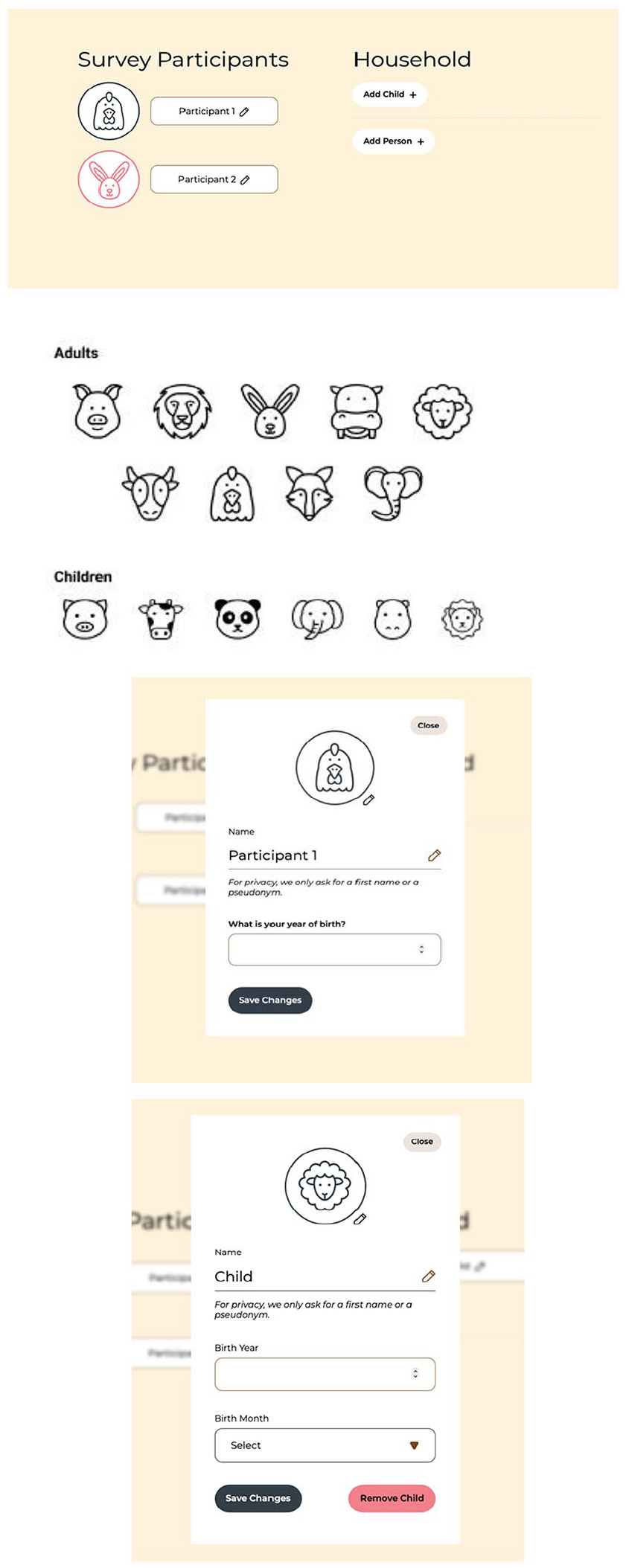
Participant page (and Choice of Avatars).
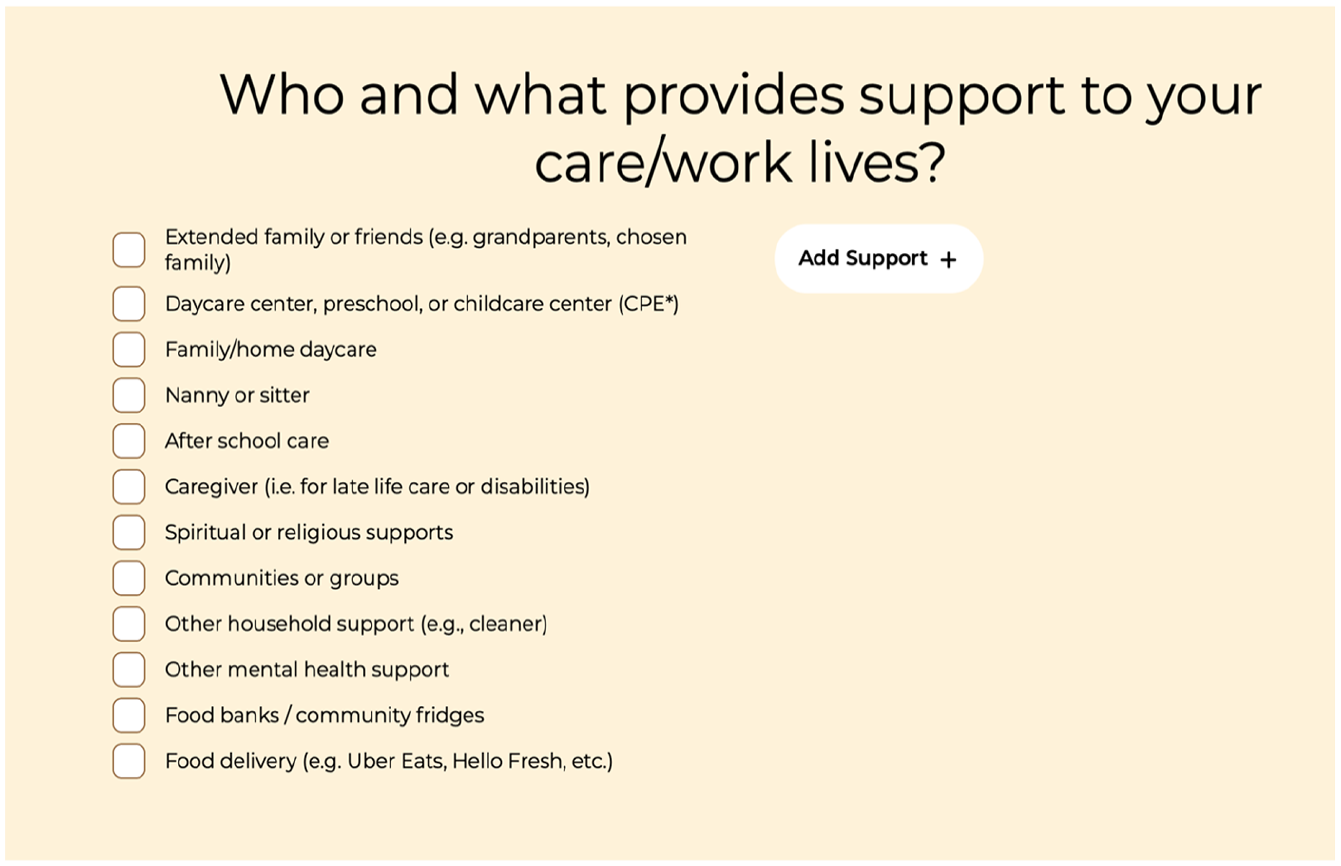
Additional supports and services.
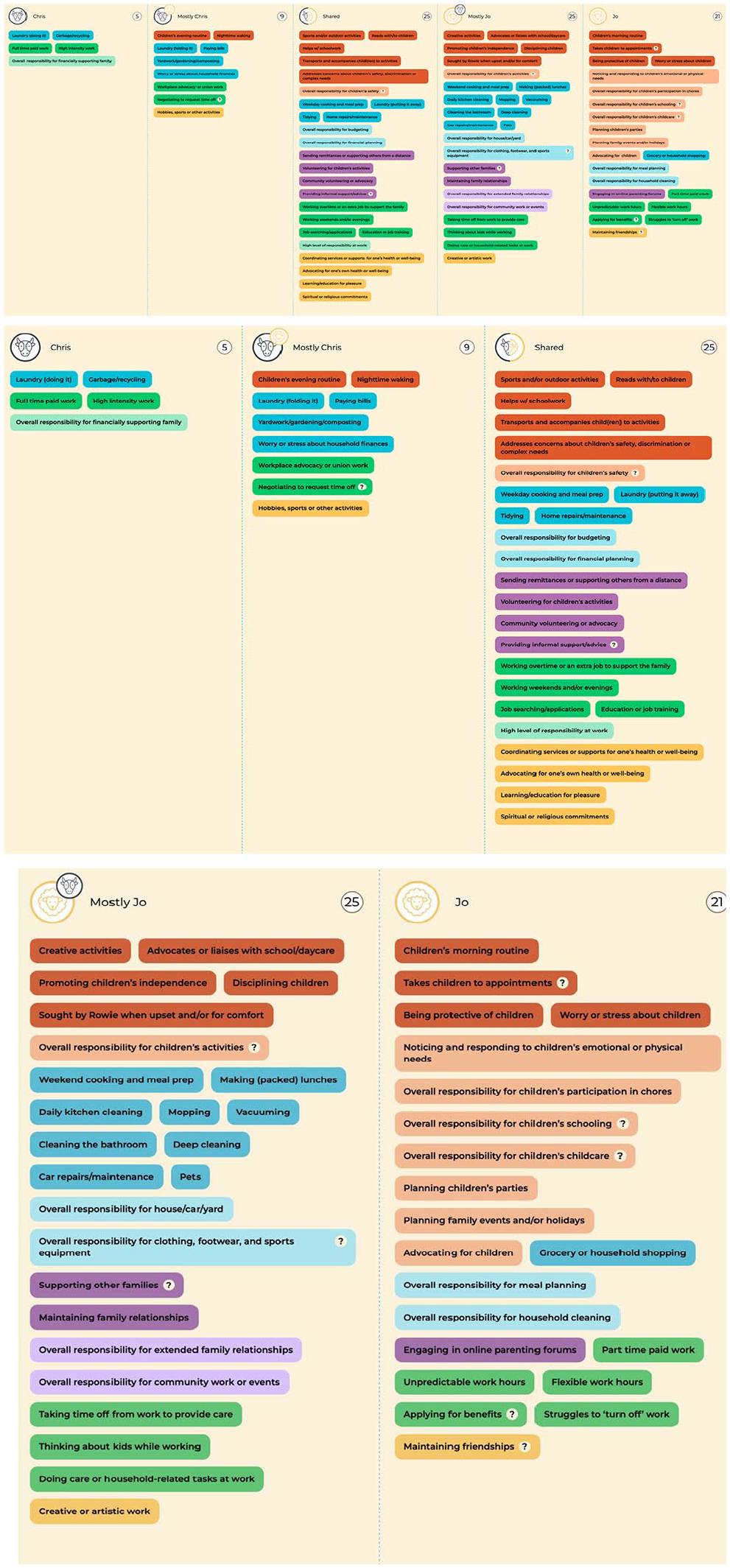
Example of a completed Care/Work Portrait (two versions – landscape and close up).
We tested and modified the overall care and work categories, and the specific tasks and responsibilities within each category in collaboration with our research team members who have experience working with a wide range of families, including Indigenous, new immigrant and racialized, lesbian, gay, bisexual, transgender, intersex, queer/questioning (LGBTQ), rural, low-income families, families with disabilities, and families with particular configurations of paid and unpaid work (i.e. one partner working in the care economy, and households where fathers took parenting leaves and/or flexible/remote work). We piloted the Care/Work Portrait with six members of our research team and their partners; we also had follow-up meetings after each interview and made critical adjustments to strengthen the app’s fit for intersectional contexts. Specifically, we added, deleted and modified particular tasks and responsibilities (see Table 1) and the questions we asked. For example, we added the task ‘addresses concerns about children’s safety, discrimination or complex needs’ in response to issues raised by team members who had research experience in racialized, indigenous, and LGBTQ households.
Care/Work Portrait – tasks/activities and responsibilities (a flexible list).
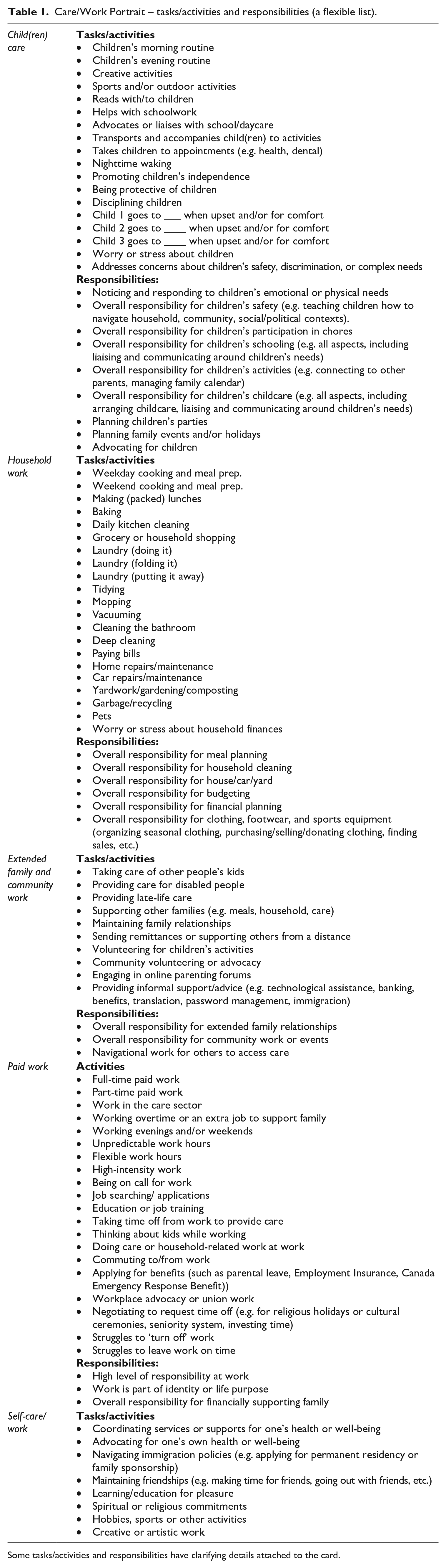
Some tasks/activities and responsibilities have clarifying details attached to the card.
We also tested the app for use with one person, rather than just with couples. Although we recognize that this takes away from the ability to observe couple negotiations, discussions, and potential contestations about who does what, how, and why, we also acknowledge that some participants may be more comfortable participating on their own for a variety of reasons, including constraints of time and household needs, and possible domestic conflict or intimate partner violence.
Unlike the Household Portrait, which is filled out on paper during in-person interviews, the Care/Work Portrait is a digital technique and app that is part of a longer virtual interview (via a secure Zoom link) recorded with each participant and their spouse/partner (including partners who live in other households), as well as with single participants. We are currently using it and further developing it in field work with our diverse team and populations. We also plan to build a DIY version (followed by a shorter interview) and a fully adaptable version, which we aim to share with other researchers. The Care/Work Portrait has been developed as a flexible method and app, guided by the view that methods are not recipes but need to be adapted to specific research questions, needs, and contexts and to invite ongoing conceptual, methodological, and functional revisions. Although we developed it as a digital method to facilitate research through on-going pandemic waves, we anticipate that it could be combined with in person follow-up interviews in the future.
Remaking the Household Portrait into a Care/Work Portrait: methodological and theoretical issues
We began remaking the Care/Work Portrait with the view that methods are not neutral; they are infused with theoretical, epistemological, and ontological moorings and with the recognition that different methods bring forth particular stories and data (Doucet, 2022). The Household Portrait’s theoretical underpinnings include both feminist care ethics with its focus on relational subjects; care as relational practices and identities; responsibilities as relational, interactive, and moral; connections between care and justice (i.e. Gilligan, 1982; Ruddick, 1995; Tronto, 1993); and symbolic interactionist writing on care work and moral identities (i.e. Finch and Mason, 1993). The Care/Work Portrait remains grounded in feminist care ethics and retains a focus on moral dimensions, which are ‘the ways in which [people] refer to what is expected within and between households, as well as between households and other social institutions’ (Doucet, 2001: 341). Yet, it also incorporates new and developing methodological and theoretical currents in the fields of gendered divisions of household work and care, feminist care theories, and related fields that rethink divisions and binaries between paid and unpaid work. We highlight five of these theoretical moorings and how they influenced the design process discussed above.
Care circles
The Care/Work Portrait is informed by ‘care circles’, a term recently used by the International Labor Organization (Addati et al., 2018) to describe the conceptual and practical inter-connections between unpaid care work, paid work, and paid care work, and the formal and informal supports and policies that affect how paid and unpaid work are done. The idea of care circles reflects both how care theories have widened and the need to attend to interactions of feminist theories of care, social reproduction, and care economies. In practical terms, the Care/Work Portrait includes a list of possible formal and informal supports (i.e. childcare services, parental leave policies, support from extended family, etc.) (see Figure 3). In the category of paid work, beyond simply asking about the tasks involved or about whether participants worked full or part time, we include prompts to invite reflection on the texture or natures of people’s paid work and working conditions. For instance, we added categories like ‘works in the care sector’, ‘struggles to “turn off” work’, and ‘struggles to leave work on time’, ‘unpredictable work hours’, ‘high level of responsibility at work’, and ‘work is part of identity or life purpose’.
Beyond binaries and divisions toward relations
In the fields of gendered divisions of household work and care, most methodological approaches, whether qualitative or quantitative, explore, and analyze paid and unpaid work separately. Yet there are long traditions that recognize unpaid work and paid work not as binary opposites, but as having degrees of relationality that vary across contexts. Examples of this perspective are found in research on the Total Organization of Social Labor (Glucksmann, 1995, 2009), concepts of provisioning (Neysmith et al., 2010; Power, 2004) and ‘household work strategies’ (Pahl, 1984; Wallace, 2002), studies on how volunteer work crosses both paid and unpaid work sites (Beneria, 1992, 2015; Charmes, 2019; Taylor, 2016), and research on how paid work can be a form of indirect care (Doucet, 2020). In studies on gendered divisions of household work and care, however, attention to boundary blurring and intra-connections between work and care has been more elusive.
In response to this oversight, the Care/Work Portrait includes a category to explore paid work tasks and responsibilities, and asks couples, at the end of their interview, to look at their Portrait and discuss specific ways that paid work and unpaid work commitments, time, and responsibilities intra-act. For households where people manage multiple paid jobs, we ask how provisioning responsibilities affect household and care work patterns, decisions, and practices.
Beyond the household
Although the Household Portrait acknowledges the community spaces and dimensions of household and care work, the Care/Work Portrait follows sociologists of work and care in placing a greater focus on the constituting social and structuring relations and the inter-household and inter-institutional contexts within which unpaid work and paid work practices, decision-making, and strategies are embedded (Braedley, 2015; Halpin and Smith, 2017; Hurl and Klostermann, 2019; Klostermann et al., 2022). It recognizes the significance of volunteer work and cross-household or community support (such as for older adults) not only in relation to children’s activities, but as contributions that are deeply important to local communities (see Overgaard, 2019; Taylor, 2016) and mediated by inadequate public sector supports or over-reliance on the unpaid work of individuals (Armstrong and Armstrong, 2019; Folbre, 2008). For instance, we added a range of tasks in relation to participants’ extended families and communities, such as ‘taking care of other people’s kids’, ‘providing late-life care’, or ‘sending remittances or supporting others from a distance’. Participants are asked to reflect on these activities and supports (see Figure 3).
Conceptualizing care responsibilities
The Care/Work Portrait expands the Household Portrait’s focus on emotional, community, and moral responsibilities (see Doucet, 2001, 2015), by acknowledging that the emotional, cognitive, moral, intra-household, inter-household, and inter-institutional work that these responsibilities entail can make assessing and measuring them very challenging. Theoretical innovations on ‘cognitive labour’ (Daminger, 2019) and the ‘mental load’ (Dean et al., 2021), that articulate the mental and management dimensions of household and care work, motivated us to expand our attention to responsibilities in three ways.
First, we deepen the distinction between household work responsibilities and care work responsibilities, recognizing that caring responsibilities for others involve relationships between people providing and ‘receiving’ care. We incorporate Tronto’s (2013) nested stages of care work: identifying and noticing unmet care needs; making decisions and putting plans in place to meet those needs; doing the care work or making sure it gets done; and monitoring the results of caregiving though observation and asking questions like ‘was the care given sufficient? Successful? complete?’ (Tronto, 2013: 22; see Doucet, 2015). In practical terms, the Care/Work Portrait uses written prompts to highlight how tasks and responsibilities are different; we also ask participants to reflect on how and why they take on and experience various responsibilities.
Second, challenging implicit or explicit perspectives in most research on gendered divisions of household work and care that care tasks and responsibilities are burdensome or should be lightened, we reinforce the Household Portrait’s view that care responsibilities can also be generative, complex, and difficult to shift or release (Doucet, 2022). The Care/Work Portrait deepens the idea that care work and household work are difficult to define and measure and that caring for others is infused with gendered and cultural moral ‘shoulds’ and ‘oughts’.
Finally, we consider what it means to approach responsibilities, for care work especially, using desire- or strength-based narratives rather than a focus on deficits (see Jewell et al., 2022; Tuck and Yang, 2014). This change of direction is especially important in research with culturally diverse populations whose family caregiving responsibilities have been shaped negatively by colonial and racist laws, policies, and ideologies. Canadian Indigenous populations, for example, have had parental responsibilities for children taken away through residential schooling laws or child welfare system apprehensions (Watts, 2022). Strength-based narratives can also expand our understanding of ‘gender equality’ in care responsibilities. With our Care/Work Portrait interviews with diverse populations, we aim to rethink and reconfigure the concept of ‘gender equality’ in care, especially for LGBTQ + households, new immigrant families, Indigenous families, and households along other intersectional axes.
Wider care concepts and histories
Building on our team’s research on Indigenous conceptions of care and work (Jewell et al., 2020, 2022), the Care/Work Portrait can be used to explore wider conceptualizations and practices of care. We acknowledge that for some populations, outdoor activities can be both self-care and childcare activities and spiritual commitments can include ecological or land-based practices. The Care/Work Portrait also acknowledges that people’s care and work lives are not limited to specific daily practices, tasks, and responsibilities, but are shaped through histories and relations of struggle, and can affect and be affected by our health, well-being, disabilities, and stresses. For instance, we include the prompts ‘coordinating services or supports for one’s own health or well-being’ and ‘advocating for one’s health or well-being’ to acknowledge people’s own care needs and the ways they address them.
Conclusions: from divisions of domestic labor to relationalities within and between unpaid work and paid work
In the field of gendered divisions of household work and care, scholars generally continue to study a narrow range of household and care tasks and give little attention to the inter-household, inter-institutional, and community-based dimensions of unpaid work. Time or tasks are tallied to gauge gender equality in household life, with research overlooking the blurring and overlapping of concepts and practices associated with unpaid and paid work. The Care/Work Portrait is a research method that moves beyond some of these limitations, by responding to innovative theoretical work on care and work concepts and practices, as well as insights from care economies research on care circles and intra-connections between unpaid work, paid work, and paid care work. It is a relational, visual, participatory, and digital method that moves beyond numerical calculations of who does what to generate relational, temporal, and spatial stories about how people navigate, negotiate, make decisions about, contest, or accept their particular care and work configurations, while also looking at what contexts, constraints, supports, and structuring conditions shape these configurations.
Building on earlier research and assessments of the strengths of the Household Portrait (see Christopher, 2020; Doucet, 1996, 2001, 2015; Edwards and Holland, 2013; Sullivan, 2004) and our piloting and current use of the Care/Work Portrait, we maintain that the Care/Work Portrait’s specific theoretical, methodological, and conceptual design offers several potential strengths for studying gendered divisions and relations of household work and care and unpaid work/paid work/paid care work relationalities. First, it challenges the idea that household and care tasks and responsibilities mean the same to all people across time and space or that they can be universally conceptualized and applied to research on diverse populations. Second, it embodies a shift from gendered divisions of domestic labor to gender and intersectional relations across contexts and across a wide array of paid and unpaid labor practices. Third, it recognizes the simultaneously generative and potentially oppressive qualities of caregiving experiences, and it taps into both experiential and structurally organized dimensions of different caregiving experiences and responsibilities. Fourth, it calls for clearer distinctions between tasks, which are usually time-bound, and responsibilities, which are temporally, spatially, and relationally complex. Finally, the Care/Work Portrait emphasizes that unpaid care practices, often centered around vulnerable ‘care receivers’, should not be approached as a competitive measurement exercise between partners, but as a window on wider social relations of care and work.
Footnotes
Acknowledgements
We are grateful to our Care/Work Portrait research team for piloting this app and digital method with us and for their critical inputs and revisions during our ongoing fieldwork. Thanks to: Kim de Laat, Karen Foster, Meg Gibson, Eva Jewell, Jennifer Turner, Bridget Livingstone, Jenna Cooper, Jessica Falk, Laura Fisher, Umay Kader, Henry Stine, and Brianna Urquhart.
Funding
The author(s) disclosed receipt of the following financial support for the research, authorship, and/or publication of this article: This work was supported by the Social Sciences and Humanities Research Council of Canada through the Canada Research Chairs Program (grant number 231901-2018) and the Partnership Program (grant number 895-2020-1011).