




Abstract
Time has become one of the most researched topics in the field of sociological, but especially psychological, research. While broad attention has been paid to the impact of chronological age on planning and the perception of time, much less is known about these processes in (advanced) old age. Drawing on 30 in-depth qualitative interviews with people aged above 70 years (half of which are conducted with people aged above 80 years), this article explores the type of plans people make in older age and how they relate to the idea of planning face-to-face the shortening time perspective. This research indicates the significant ambivalences in how older people relate to plans and the future. While making short-term plans represents an essential part of their lives, the participants problematise the idea of planning as unreasonable concerning their chronological age. Two dominant approaches to formulating plans are identified: (1) framing future plans referring to the future achievement of a loved one and (2) emphasising ‘living in the present’. The findings also indicate that the social imaginary of the fourth age plays a vital role in how older adults frame the time ahead of them. In conclusion, we summarise our findings and argue that mortality represents just one of the horizons accompanied by other possible milestones structuring the time remaining and redefining the meanings attached to such time.
Introduction
Individuals face increasing pressure to make reflexive choices regarding the course and conditions of their lives to create biographical projects, which expands the scope of individual responsibility to unrealistic proportions. People are not only expected but also obliged to make choices regarding their life courses (Beck, 1992). Simultaneously, new uncertainties arise due to the erosion of standard life course models. According to Giddens (1991), such uncertainties encourage an individual to undertake a ‘reflexive project of the self’ that requires constant reflection on individual choices and engagement in reflexive life planning. The process of individualisation thus creates the premise that our life biography is no longer simply given but reflects our decisions and the ability to plan. However, as Beck and Beck-Gernsheim (2018: 7) pointed out, our life course has been structured around the labour market, which transforms the freedom to choose into an obligation to ‘standardise your existence’, shaping our life biography into the following periods: preparation for participation in the labour market, ‘activity’, and finally retirement (Kohli, 2007).
The role of planning for later life has been addressed mainly in the context of retirement plans and preparations for retirement (e.g. Moffatt and Heaven, 2017; Nivalainen, 2022). On one hand, fears of ageing may encourage people to displace (at least symbolically) older age from their future time horizons. As indicated by Street and Desai (2011: 383), for many people, ‘old age is simply another experience that unfolds in its own way—old age is just something that happened to me’. Moreover, conceptions of later life are significantly influenced by the negative cultural representation of old age. For many people, thinking about later life is uncomfortable, and later life is generally considered a distinct and uncertain phase in one’s long-term future. As James et al. (2020: 6) argued, encouraging people to think about their later life could be detrimental to their well-being in the context of the prevailing negative images of old age. On the other hand, the responsibilities to prepare for retirement, especially in terms of planning for financial security, currently ‘colonise adulthood’ (Ekerdt, 2004), and the idea that people should constantly evaluate their decisions and lifestyle to minimise the risks of dependence in older age has become a significant pillar of the discourses of active, or successful, ageing (see Rowe and Kahn, 1998). The increasing focus on planning for older age contrasts with our lack of understanding regarding planning in later life. Therefore, the interviews conducted in our study were designed to explore the types of plans people make in older age and how older adults relate to the idea of planning in the context of the shortening time perspective.
The de-standardisation of the life course brings less predictability and makes people’s experiences of free time in later life more diverse (Brückner and Mayer, 2005). The discourses on active ageing emphasised the positive impact of activity and the heterogeneity of roles in older age. In a study by Hubatková (2018), 92% of Czech older adults reported performing at least one social role that they perceive as time-consuming (e.g. role of grandparent, worker, or spouse). The respondents occupied seven roles on average, suggesting that older age may, for some individuals, represent a period of role overload and limited time resources (Hubatková, 2018). However, the transition into retirement in the ‘second half of life’ still predominantly represents a life phase when free time increases, which can make structuring time more challenging, and individuals become more aware that there is less time left to live. Consequently, older age is characterised by certain paradoxes regarding time and planning. At the same time, there is still a lack of sociological research on how older adults relate to the idea of the future and planning in the context of a period that underscores life’s finitude. By analysing 30 in-depth interviews with people aged above 70 years (half of the interviews were conducted with people aged above 80 years), this study explores the following issues: first, what planning means for older people and how they conceptualise the idea of planning, and second, whether and how the notion of finitude and the social imaginary of the fourth age (Gilleard and Higgs, 2010, 2013, 2015) is incorporated in future planning.
Planning and time perception during the lifespan
Time provides individuals with a tool for orienting themselves in their lives, using which they can organise, construct, and understand the past, present, and expected future experiences (Kooij et al., 2018). Neugarten (1979) considered age as a major dimension of social organisation, arguing that by adolescence, most people internalise a set of normative expectations regarding the life cycle. This ‘social clock’ entails expectations regarding the timing of significant life events. It provides a basic structure for our thinking about what a human biography should look like and what to expect during specific life periods. The contents of such expectations may, of course, change over time, reflecting a particular social context. Simultaneously, the normative expectations regarding the timing and occurrence of certain life transitions and periods are eroded by the emphasis on individuals as autonomous architects of their biographies. Nevertheless, as Kohli (2007: 255) pointed out, ‘individualization need not lead to a loss of social order but relied on and even produced new institutional patterns’. For Kohli, the life course is a social institution. Due to individualisation, the individual becomes the basic unit of social life. However, according to the life course perspective, the relevance of the life course as a social institution has dramatically increased. Age has been transformed from a categorical status into a core structural feature of society, which has resulted in a chronologically standardised ‘normative life course’ structured around the system of work and the labour market (Kohli, 2007).
There is an ongoing debate regarding the deinstitutionalisation of the life course in contemporary society, as new opportunities to move between different life experiences throughout one’s life have emerged. However, this debate is beyond the scope of our article. The central theme of this article is to understand how older adults approach planning and thinking about their future plans. The ideas of planning, the ‘social clock’, and the life course as a social institution suggest the existence of established expectations regarding the course of our biography, despite the individual uncertainties that we face in our daily experiences. Such expectations may become particularly problematic in older age. As Bildtgård and Öberg (2015: 1510) argued: ‘time is a finite personal resource that we are all born with indifferent, albeit estimable, amounts and which can be put to use in different life projects’. In this article, we are interested in what kinds of life projects older adults find meaningful to invest in and how the meaning of time is constructed in later life. What are the plans for the time left, and how do people make sense of the very idea of planning in older age?
A theory of socioemotional selectivity (SST) developed by Carstensen et al. (1999: 166) suggests that a temporal emphasis on the present increases the value people place on life and emotion, which influences the decisions they make. Therefore, as older people are likely to feel that their remaining lifetime is limited, they care less about broadening their horizons and more about experiencing meaningful social ties (Lang and Carstensen, 2002). By contrast, pursuing goals related to career, knowledge, or new social contacts is common in earlier life stages when time is perceived as open-ended (Fung and Carstensen, 2006; Izal et al., 2018). Psychology research grounded in SST has shown that when time constraints are imposed and people age, they realise that ‘time is in some sense “running out”’ (Carstensen et al., 1999: 165) and begin to invest in short-term, emotionally rewarding goals. Old age is thus characterised by people’s ‘desire to derive meaning and satisfaction from life’ (Carstensen et al., 2003: 108). Negative experiences are avoided and forgotten. Instead, people focus on the present and the positive aspects of life, which enables them to savour the moment instead of constantly worrying about the end. As the authors further explain, the sense of finitude does not bring hedonism but, rather, leads to a complex mix of positive and negative feelings. Social endings are more salient in later life, as people often feel that each positive and enjoyable moment, such as a family reunion, may be the last (Carstensen et al., 2003: 112). Consequently, goals that can be satisfied immediately are prioritised in older age because they bring immediate benefits and, therefore, become a valuable commodity.
Future time perspective and the horizons of the third and fourth ages
While SST suggests that a limited future time perspective has positive socioemotional outcomes, a reduced future time perspective may also be related to lower well-being and negative consequences (e.g. Zimbardo and Boyd, 1999), including fear of growing health problems and dependency (Gilleard and Higgs, 2013). One’s sense of a limited future time perspective can result in a wish for longevity. However, Ekerdt et al. (2017) demonstrated that the remaining future time may not be perceived with a similar value and that more time to live may be desired only under certain conditions of one’s autonomy. Therefore, time remaining in older age may not be necessarily perceived as a continuum in terms of time left to some horizon of mortality but also as an unpredictable course of movement between adverse health events (cf. Ekerdt et al., 2017). These points can significantly redefine the meanings and values attributed to the time remaining.
We suggest that mortality can be neither the only or the primary horizon of the perceived future time perspective. As Higgs and Gilleard (2015) pointed out, the fourth age presents an event horizon that creates important symbolic spaces for articulating anxiety about old age. There is not just one old age not only because of different lifestyles, living conditions, and life experiences but also because of different meanings that are attributed to different social locations associated within old age. According to Laslett (1991), the growing life expectancy and relatively favourable economic conditions give rise to the third age as a new stage of life after retirement, which offers opportunities for older people to focus on their personal fulfilment without the constraint of their work and family responsibilities. Gilleard and Higgs (2010) conceptualised the third age as a cultural field that shapes the condition of consumer society, emphasising choice and pleasure in later life. However, the positive meaning of the third age is accompanied by the ‘othering’ of the fourth age as a terminal destination stripped of social and cultural capital, which is the most valued and facilitates the articulation of agency and self-expression. The fourth age represents a form of social imaginary that demarcates the boundary between positive and ‘valuable’ old age and the period of ‘real’ old age associated with disability and institutionalised long-term care (Gilleard and Higgs, 2013). Concerning future time perception, the fourth age represents an ‘event horizon’ beyond any chance of return. It embodies the fear of passing ‘beyond any possibility of agency, human intimacy, or social exchange, of becoming impacted within the death of the social’ (Gilleard and Higgs, 2010: 125).
The concepts of the third and fourth ages do not refer to a simple distinction between various phases of life (as, for example, in the case of young and late adulthood). They embody the different meanings associated with what old age means. The fourth age is not just a stage following the third age. Entering the fourth age does not come automatically at a certain age, and not all people may experience the third age. These concepts refer to different social positions and coexistent (yet in many ways contradicting) definitions of what old age means. The possibility of entering the fourth age represents ‘shadows in the mirror that those enjoying the third age half see and half turn away from’ (Gilleard and Higgs, 2010: 127). Much of the fear associated with the fourth age settles on the idea of social death associated with the loss of personhood and agency (Gilleard and Higgs, 2015).
The fourth age is always present in the imaginary of old age and may challenge the idea of planning in later life. It represents an always-present possibility that may definitely and irreversibly strip a person of the opportunity to choose and express agency. Therefore, the fourth age’s social imaginary has a profound impact on the perception of time and future in older age and may impact how people measure the time left and interpret its meaning. As suggested by Ekerdt et al. (2017: 51), ‘time-left and time-remaining are less countable quantities than possible states, one kind of which is wanted and one kind of which is not’.
Methodology
Our analysis was part of the second wave of the collaborative multidisciplinary project ‘Ageing as Future’, funded by the Volkswagen Stiftung and carried out in Germany, China, the United States, Taiwan, and the Czech Republic. 1 The project adopted an interdisciplinary perspective that combines different methodological approaches (in-depth interviews, questionnaires, online assessments, and experiments) to investigate how individuals perceive, construct, and prepare for old age and ageing. Three interrelated core topics were addressed: perspectives on ageing, preparation for old age, and time management in old age. Similar research strategies and methodological tools were employed in all countries involved. The analysis presented in this article is based on qualitative in-depth interviews conducted as a subproject in the Czech Republic.
The Czech Republic is a country with an increasingly ageing population. According to the latest data, people aged above 65 years make up more than one-fifth (20.2%) of the Czech population (Český statistický úřad (ČSÚ), 2021: 7). In 2020, the average life expectancy was approximately 75.3 years for men and 81.4 years for women. The age for exiting the labour market in the Czech Republic is significantly lower than the OECD average. In 2018, men retired at the age of 63.2 years on average, while women exited the labour market 2 years earlier (OECD, 2020). Moreover, the length of time that people spend in retirement is also gradually increasing in the Czech Republic: men live an average of 19.5 years as old-age pensioners, while women spend 28.5 years as pensioners (ČSÚ, 2021: 64). Although the number of people employed after the age of 65 years is increasing and has doubled in the past 10 years, the number of people entering early retirement is also slightly increasing, even though early retirement results in significantly lower pensions (ČSÚ, 2021: 65). Although the gross income of households consisting of individuals aged above 65 years mainly comes from pensions (e.g. in 2019, pensions accounted for more than 86% of income in such households), poverty rates among older people are relatively low compared to the European average. In 2020, the share of people aged above 65 years with an income below the poverty line was 14.7% (ČSÚ, 2021: 18). Access to health care is provided to every citizen based on a mandatory monthly fee that is proportional to monthly income. For people with pensions, health care is free. In 2020, 2.5% of all people aged above 66 years lived in residential care facilities (ČSÚ, 2021: 66).
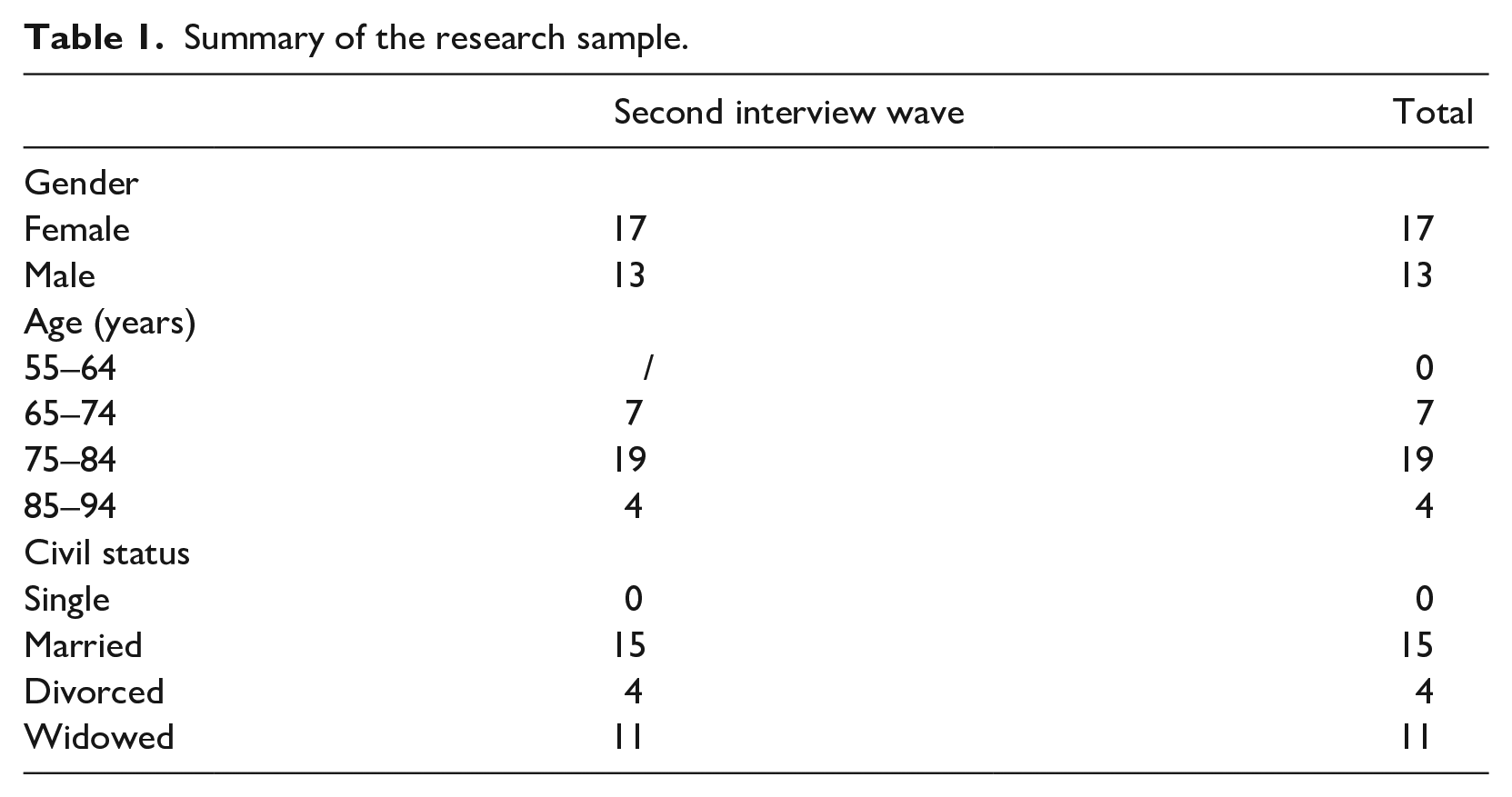
We conducted 30 in-depth interviews with people aged above 70 years living in the Czech Republic. The participants were recruited to represent as evenly as possible men (13) and women (17) and different age groups (we focused on the representation of people aged above 80 years, who represent half of our sample). The heterogeneity of the research sample is summarised in Table 1.
Summary of the research sample.
Most participants were recruited by a research agency that provided contact details for people from its survey network who met our criteria; our research team interviewed these participants. The primary goal of this research was to capture the heterogeneity of the ageing experience. The use of the research agency enabled us to exceed the horizon of our limited social networks and interview people with significant differences in their education level, income, or settlement type.
The interviews typically lasted between 50 and 90 minutes and were recorded and then transcribed with the participants’ consent. A similar interview guide was used in all countries involved in the ‘Ageing as Future’ project and encompassed three main domains: (1) biographical turning points; (2) norms, attitudes, and expectations regarding old age, and (3) plans and expectations regarding the future. Questions addressed include, for example, whether participants desire to change something in their lives; how they spend their free time; what they expect in the future; and to what age they would like to live. We focused on the analysis of the third domain. In the first phase, a detailed description of each interview’s content and the participant’s socio-demographical profile was prepared for each interview. The next phase of the analysis followed the principles of thematic analysis (Ezzy, 2013). Our codes were collated into three key themes: ‘expectation regarding the future’, ‘future plans’, and ‘change’. Reviewing those themes, we focus on two questions: (1) how older adults conceptualise the idea of planning (what planning means in advanced old age) and (2) how older adults talk about the expectation regarding their future and if/in what way is the idea of the limited future time perspective incorporated in these conceptions. Research presented ethical challenges, touching on sensitive topics, such as death, personal health, and dependency. We acknowledged the sensitivity of those topics and focused on the responses they may evoke. The interview structure was modified to reflect the specific contexts of the participants. All participants were informed in advance about the structure of the interviews and the topics addressed therein.
Idea of planning
The topic of planning with respect to older age focuses predominantly on planning for older age in terms of ‘activities individuals deliberately pursue with a goal of creating desired outcomes in later life’ (Street and Desai, 2011: 380). In this regard, retirement planning represents one of the primary focuses of interest (Goodwin and O’Connor, 2014; Moffatt and Heaven, 2017). The large amount of attention paid to factors influencing retirement planning contrasts with the visible absence of thematization of planning after retirement. The ambivalent position of planning in later life or even advanced old age was also reflected by participants interviewed in our study. All of them expressed considerable reluctance to address questions regarding their future plans. Some of the younger participants explicitly mentioned the need to plan their future, at least to some degree, as expressed in an interview conducted with Mr Špaček: One has to plan, otherwise one would get depressed, right, and in a hopeless situation, and I think it would kill a person if he has no perspective. Sure, it’s limited, of course, but that’s life. (Mr Špaček, 73 years old)
However, in most cases, the participants avoided answers that referred to the descriptions of particular future plans. While describing their plans, the participants did not refer to any form of goal achievement or to make a decision about what options to pursue. Their future plans were not formulated in the sense of the active pursuit of something but more in terms of desires. In their descriptions, they did not position themselves as those who actively pursued a goal. Their narratives regarding future plans were formulated as expressions of certain states of affairs: I wish I were healthy, could work for a while to help those grandchildren, and that’s it. I have no ambition. (Mrs Višňová, 76 years old)
Most of them perceived the idea of planning as absurd concerning their age. Most participants responded with a smile to the question regarding future plans and incorporated various forms of irony into their responses. They verbally and nonverbally communicated the idea of planning as meaningless in old age: ‘I really can’t plan anything at this age’ (Mrs Lišková, 80 years old), or ‘What can I plan at this age?’ (Mrs Maková, 75 years old). By wondering about the possibility of planning at their age, they made their awareness of the finiteness of one’s life constantly visible. Old age was constructed as a period in which future plans are much less present or where planning is not even possible or relevant: Do you have any plans for the future? No. (laughs) More or less not. More or less not? Come on, they say: if you want to make God laugh, tell him your plans for the future, right. (laughs) Such an aphorism. And it is true. And why don’t you have them anymore? I don’t know; I’m already reconciled to life like this and what suits me now is what suits me. I’m ok, well, I’m fine. (Mr Králík, 80 years old) Do you have any plans for the future? Plans for the future? Well, there would be plans. To win the lottery (laughs). It (the lottery) is not in favour of me. I bet once in, and still nothing. So that would be very nice. And then my property, what to give to whom. (Laughs) These are plans for the future. And I don’t know if I should do it (a division of property) prematurely, but they would maybe cough at me afterwards, right? So, I still keep them in the idea that they will inherit. And do you have any other plans? Well, I don’t have any other plans. What for? (Mrs Sýkorová, 77 years old)
Winning the lottery that Mrs Sýkorová mentioned as a response to our question regarding future plans embodies the ambivalence present in the participant’s responses regarding the idea of planning. The irony identified in her responses reflects her perception of the irony presented in the question itself. In her case, planning something at her age seemed as meaningless as the idea of planning to win the lottery.
Ways of thinking about plans
When it came to the perception of the future and the idea of planning, most participants usually positioned themselves towards their actual chronological age. While in most cases, they rejected the idea of planning as something pointless, as described above, we identified the ambivalence present in their responses regarding the concept of planning. For example, people in the youngest age group (70 years) acknowledged their limited ability to make plans but did not refuse the idea of planning. Instead, they pondered planning as being, to some extent, still part of their lives, although they were aware of their limited ability to make plans. More precisely, they balanced between the time they thought remained and the necessity of adjusting the plans or milestones they would like to achieve.
In contrast, older participants (75 years and above) varied significantly in their replies when asked about their future time perspective and the milestones they expected to achieve. Planning was approached not only as pointless but, in some cases, also as unnecessary because the participants were satisfied with their current lives.
We identified two main approaches to formulating future plans in advanced old age, as mentioned by the participants – formulating plans through others and centring their lives on living in the present. These approaches were not mutually exclusive, and some participants simultaneously mobilised both approaches to future plans. That is, they structured their time by the future or others’ achievements while framing their lives through the present time. What these approaches have in common is the horizon of finitude, which framed both the sense of planning and the meaningful focus of future plans.
‘The future beside and through the lives of others’: framing time perspective in older age
In their narratives, the participants mentioned specific milestones and markers that did not relate to their personal achievements or goals, but referred to other family members and events potentially generating well-being and positive emotions. Individuals across all ages expressed desires to have an opportunity to witness episodes they considered meaningful and emotionally rewarding in their lives, such as seeing children getting married or having children or being there when their grandchildren entered the university. In these cases, future milestones were defined by milestones in the lives of their close ones. Their future plans were formulated in terms of their desires to be present during important life events and transitions in the lives of their loved ones: I don’t think about it (future plans) at all, of course, I want to see the great-grandchildren when they go to school, but that’s what I want. Everyone wants to be here as long as possible to enjoy time with their offspring still, but not to specify it. (Mr Vydra, 85 years old) I have no plans as such. I want to live to see my grandchildren go to school, but I won’t live to see that because I have small grandchildren. I’m happy to see them now being so smart and healthy. (Mrs Březová, 73 years old)
Ageing is associated with a tendency to minimise emotional risk and a preference for emotionally meaningful goals. According to SST, older people tend to focus more on psychological well-being rather than new social contacts, career, or knowledge acquisition, as in the case of young people (Lang and Carstensen, 2002). The perception of limited time remaining may have impacted the participants of our research, who became more selective in their decisions and prioritised investing in emotionally valuable relationships.
Some participants framed their futures in terms of emotional goals but without reference to specific milestones. In those cases, future plans were articulated in the desire to maintain certain forms of relationships. Although the participants directly related those answers to our question related to their own future projections, their own presence was sometimes invisible in their responses regarding the plans. For example, Mrs Libečková’s plans were formulated as a wish to have ‘peace in the family’ (referring to the relationship among her grandchildren): Plans? So that we are fit. And in my case, it was such a terrible blow that my daughter died at the age of sixty-two. That’s terrible. And that my grandchildren, now that they were starting families and had children themselves, were terribly dependent on her. And now I just want the three of them (grandchildren) to stick together somehow, so that there’s no quarrel, right. Well, that’s my biggest wish for the future, to have peace in the family. (Mrs Libečková, 83 years old)
During her narrative, Mrs Libečková spontaneously transformed the question regarding plans to talk about her wishes for the future. This inconspicuous semantic change illustrates ambivalence in how the participants related to the idea of plans. First, it shows the (more or less implicit) refusal to engage in the formulation of specific plans (as an intention or decision about what one is going to do) and their replacement by the concept of wish (as a hope for something to happen). Second, it shifts the perspective from the idea of pursuing something that stresses the speaker’s active contribution to the notion of a wish as a vision for the future, which can occur without the active contribution of the participant and even in their absence.
‘Living in the present’: making sense of the expected future
Quantitative empirical studies focusing on age differences in time perspective are generally consistent in their findings, indicating that as individuals age, they are less future-oriented and more present-oriented (Isaacowitz and Fung, 2016). Our participants often described the future as uncertain and out of control and depicted the present as the main focus of their concerns. Mrs Malinová described such an attitude as ‘living in the present’, suggesting the necessity to concentrate on day-to-day activities while making visible that the future may not be just uncertain but even non-existent: ‘I just live in the present. The past has been. The future does not have to be. I live in the present. I thank very much for every day that I was allowed to live. And how many more will there be? I don’t know. None of us knows’. (Malinová, 75 years old)
The ‘living in the present’ approach was also reflected in the participants’ answers regarding future plans. These plans were formulated mainly in terms of short-term goals, such as taking care of participants’ health and well-being, planning vacations with family and friends, or referring to other personal concerns that were part of their daily routine: I don’t make any plans. Of course, I have to go to pick up my medication tonight or tomorrow morning if I want to, then I’m going to buy a ticket to Liberec because there was some land returned to me as an heir in restitution, but I won’t judge them, because the land is from the second grandfather, from mother’s side. (Ms Hruška, 82 years old)
As Anderson et al. (2002: 1.3) indicated, ‘relative stability and security have generally been seen to encourage planning and a longer time-vision, and vice versa’. This idea of stability has been investigated mainly with respect to economic (in)securities and their impact on planning in the young and middle ages. However, older age brings another dimension of instability in the form of a limited future time perspective and risks associated with the possibility of worsening health conditions. Both dimensions of instability materialised in the narratives of the participants. Reference to the parents’ lifespan also represented a way to bring certain predictability into their thoughts regarding their own future or the lack thereof: I think they (grandchildren) do well at school; they are receptive and smart. I think they will be successful in the future. Of course, I will not see that. We do not have longevity in the family. My father was seventy-two years old, and my mother was seventy-seven when they died. I can’t make any big plans for the future anymore. (Mrs Brezova, 73 years old)
Most participants spontaneously mentioned the age at which their parents died while talking about their futures. The horizon of the death of one’s parents allowed the participants to imagine how much time they were left with while also mobilising the feeling of already living ‘above the limit’. The participants thus positioned themselves in the lifespan of their own family, and this knowledge also reflected on their attitudes towards the idea of planning.
The participants’ narratives reflected two forms of uncertainty that problematise the idea of planning. First, as Mrs Malinová (age 75 years) pointed out, ‘The future does not have to be’, referring to the uncertainty of the existence of the future as such. The lack of the (even relative) certainty of the future undermines the perception of stability, which may represent an essential precondition of planning. References to the parents’ lifespans of the participants were used as a way of making sense of the expected future time perspective (not necessarily in a fatalistic way but more in terms of the last remaining guides for their expectation regarding the time remaining). Second, as we will outline in the next part of this article, the desire to avoid change represented a significant way to relate to the future in the case of our participants. The negative connotation associated with the idea of change reflects another connotation from uncertainty regarding the personal life condition that the (uncertain) future may bring. We suggest interpreting this desire to avoid change as an expression of anxiety regarding the ‘event horizon’ of the fourth age.
‘I wish that in the future it will last what I am experiencing now’: change and future horizons
The interviews conducted with the participants explicitly targeted questions regarding future plans (Do you have any plans for your future?) and the images of one’s own future (If you now think about your life as it is right now and about your life as you imagine it in the future, do you think it will be very different or not?). The concept of change played a crucial role in both cases. The absence of stability already discussed above materialises not only as a barrier to planning but also in an articulated wish for stability in the future. The notion of stability, or living life characterised by predictability, played a crucial role in their future time perspective. The participants favoured continuing to live the same way they currently did and consistently depicted change as problematic or even threatening: So, another granddaughter will be born to me; I’m really looking forward to it. But otherwise, I hope nothing happens (laughs). I’d rather be the way it is, because change is always a problem at this age. I wish it stayed the way it is and nothing much has changed because what can I expect? (Mrs Březová, 73 years old)
The participants spoke about plans in the form of a desire, specifically a desire and wish for the future, in which nothing changed. Any shifts or breaks from the current state of events were undesirable. The future plans were often articulated as wishes to keep their lifestyle and health quality in their current state. To not change anything was, paradoxically, formulated as a future plan. The ideal vision of the future is depicted as a presence: As for the plans, I would be very happy, and it is really hard to say that I should be at least in the state I am currently in. (Mr Vlk, 77 years old) I wish that in the future, it will last what I am experiencing now. I don’t want anything more. And most importantly, I wish for health. And self-reliance, self-reliance, self-reliance. (Mrs Malinová, 75 years old)
Hence, it is possible to distinguish positive emotions and aspects of time constraints, as suggested above (e.g. reconcile with family and friends and surround oneself with family). Yet, we also identified negative sentiments associated with the upcoming future, including fear, anxiety, or uncertainty about what can occur in the later phases of one’s life before death. Our data show that future and future plans are connected more with desires or aspirations to ‘keep things as they are’ in older ages. Rather than seeking to fulfil specific long- or short-term plans, the participants prioritised more present-oriented objectives or rejected plans. They emphasised that they wished to maintain their feeling of being well and relatively healthy, satisfaction with life ‘as it goes’, and valued their autonomy. The future in their description did not entail a change that could be characterised by positive events because change always means complications, trouble, or something perceived as only negative. As Mrs Březová (73 years old) pointed out, ‘change is always a problem’.
On one hand, this ‘change’ symbolises the finitude of one’s own life that becomes more present in advanced old age. However, worries regarding ‘change’ cannot be identified with concerns regarding the end of life. The participants clearly distinguished between worries regarding death and those regarding the period that may precede it. The negative connotations associated with change were not ascribed to death itself (we did not address the topic of dying explicitly, but most participants talked, at some point, about not being afraid of death itself and perceiving it as an integral and unavoidable part of life). ‘Change’ in their narrative refers to the transition associated with the fourth age. As indicated by Ekerdt et al. (2017: 51), many older adults conceptualise the future as ‘less as a continuum of time remaining to some horizon of mortality and more as a potential course of adverse health events that looms in the middle distance, whose occurrence is likely but whose timing is uncertain’. Uncertainty regarding the fourth age, rather than death, might play a crucial role in planning in older age and in developing attitudes towards longevity. Not all future time is equally welcomed and wanted; longevity is desired chiefly as long as it is spent in the ‘third age’ (Ekerdt et al., 2017).
The ambivalent role of ‘change’ in narratives regarding the future illustrates the need to rethink the concept of the future time perspective as a linear horizon framing older adults’ perception of the future. The limited future time perspective suggests that people use the end of life as an imagined horizon that structures their attitudes, behaviour, future goals, and social relationships (Lang and Carstensen, 2002). Perception of time as short and awareness that ‘endings’ are approaching play a motivational role as people set goals within a time context (Coudin and Lima, 2011). The future time perspective generally encompasses the prospect of death (either for the elderly or patients with illness) and the perception of time as finite (Demiray and Bluck, 2014). However, the end of life does not necessarily have to be the primary horizon of the limited future time perspective, but that older adults may relate to their future using different horizons. The future time perspective may also encompass subjective feelings about one’s future (Carstensen and Lang, 1996).
The milestone of ‘change’ and the anxiety associated with it did not refer to the end of life based, for example, on chronological age, but the participants referred to the subjective feelings of the future. In this context, the end of life was perceived as a point that could be preceded by a different stage – the fourth age – bringing significant changes to people’s living conditions (the loss of independence, self-reliance, and current quality of health). Gilleard and Higgs (2010) described the social imaginary of the fourth age as ‘a horizon of events’ where light disappears completely or as a ‘black hole’ that irreversibly sucks in everything, including our agency. For the participants in our research, the fourth age (symbolised by change) represented the horizon of events from which there is no return and to which, through their desire for things to remain as they are, they related in their conception of a limited time perspective in a much more pronounced manner than to the end of life.
Conclusion
Age has been identified in quantitative research as an essential factor influencing future plans and goal-setting. This evidence indicates that, compared to younger age groups, older adults make fewer future plans (Kotter-Grühn et al., 2011; Prenda and Lachman, 2001) and orientate to different goals (Charles and Carstensen, 2010; Lang, 2000). However, relatively little is known about the process of planning itself and the meaning of the future in (advanced) old age. Therefore, in our analysis, we explored the types of plans people make in older age and how older adults relate to the idea of planning in the context of the shortening time perspective.
The results indicate that ambivalence is present in the way older people relate to the idea of plans and the future. On one hand, making at least short-term plans represented an essential part of their daily lives. On the other hand, the idea of planning was problematised by the participants as unreasonable with respect to their chronological age. Old age was constructed as a life phase that did not allow meaningful planning. By questioning the possibility of planning and often framing their answers regarding future plans using irony and humour, our participants communicated their awareness of the finiteness of one’s life. The future plans were framed more in terms of wish (expressing hope for something to happen) than plans (expressing intention about what one is going to do), sidelining the speaker’s active contribution in the course of a future event. These findings correspond with SST (Carstensen, 1991). The participants in older age valued and preferred emotionally rewarding relationships, invested in their own well-being rather than long-term goals, and formulated plans through others while focusing on ‘living in the present’. According to this perspective, two dominant (but not mutually exclusive) approaches to formulating future plans in advanced old age were identified: (1) framing future plans and expectations referring to the future achievement of loved ones (especially children and grandchildren) and important events in their lives that the participants wished to witness and (2) emphasising ‘living in the present’, suggesting the necessity to concentrate on day-to-day activities and not formulate any future plan.
One of the most striking aspects of the way older adults in our research spoke about the future is the specific position of ‘change’ as an essential horizon structuring their vision of the future. Anxiety regarding ‘change’ and the efforts to avoid it were articulated as a specific form of future plans. Preserving the presence was often presented as their primary plan/wish for the future. This focus on presence as the most meaningful time perspective can be interpreted as a form of recognition of the finitude of one’s life and an awareness of the decreasing time left. However, we argue that the fears associated with the ‘change’ in the future refer not to the end of life itself but more to other horizons that may proceed with it. As pointed out by Ekerdt et al. (2017: 51), older people do not perceive future time as smooth but rather segmented. In addition, time remaining in older age may not necessarily be perceived as a continuum in terms of time left to some horizon of mortality. Mortality, in this respect, represents just one of the horizons accompanied by another possible milestone, structuring not just the time remaining but also redefining the meaning of such time.
The notion of ‘change’, whose contours remain unarticulated, refers more to what Gilleard and Higgs (2010: 126) termed the ‘event horizon’ of the ‘black hole’ of ageing. The emphasis on ‘keep things just as they are’ to ‘last what I am experiencing now’ embodies the negative association of change, which was presented as irreversible and problematic. The fourth age creates important symbolic spaces for articulating anxiety about old age (Higgs and Gilleard, 2015). The hope for nothing to happen, since change is always a problem at this age (as formulated by one of our participants), expresses the expectation presented by most participants in the interviews that any changes in older age may always be worse. In this context, we argue that ‘change’ does not represent the end of life as the recognised final horizon but rather a transition into the fourth age. The hope for no change was not a hope for longevity or avoidance of death. There was a very clearly articulated acceptance of finitude present in all interviews in an explicit narrative regarding one’s own preparedness for the end of life or reference to an age when their parents died as a symbolic reference for the expectation of how much time they are left with (or how long they are already living ‘above the limit’). The avoidance of change and the anxieties it evoked represented more of a fear of the transition into the fourth age. Our findings indicate the critical role the social imaginary of the fourth age plays in the way older adults express their expectations and hopes for the future, and how they perceive and frame the time ahead of them.
Footnotes
Funding
The author(s) disclosed receipt of the following financial support for the research, authorship, and/or publication of this article: This research was supported by a grant to the project ‘Ageing as Future’ from the Volkswagen Foundation in Germany. The sponsor took no role in the design or conduct of this project.
