




Abstract
Online communication tools are increasingly being used by qualitative researchers; hence it is timely to reflect on the differences when using a broad range of data collection methods. Using a case study with a potentially hard-to-reach substance-using population who are often distrustful of researchers, this article explores the use of a variety of different platforms for interviews. It highlights both the advantages and disadvantages of each method. Face-to-face interviews and online videos offer more opportunity to build rapport, but lack anonymity. Live Webchat and audio-only interviews offer a high level of anonymity, but both may incur a loss of non-verbal communication, and in the Webchat a potential loss of personal narrative. This article is intended for sociologists who wish to broaden their methods for conducting research interviews.
Keywords
Introduction
Undertaking qualitative research with hard-to-reach and often secretive populations, such as substance users, is challenging (Shaghaghi et al., 2011). This article shares the authors’ experiences of using a range of interviewing tools with people who use unprescribed anabolic androgenic steroids (AAS). AAS-users are deemed hard-to-reach (Richardson and Antonopoulos, 2019). This is due to AAS use being illegal in many countries and the stigma and stereotyping experienced by users, making them likely to be secretive about their use and keen to retain a level of anonymity (Sagoe, 2015; Settanni et al., 2018).
Hard-to-reach groups, or hidden populations, refer to people who are perceived as difficult to engage in research and practice (Brackertz, 2007), for example, rough sleepers, sex workers, and foster children (Marpsat and Razafindratsima, 2010). 1 As a significant proportion of the global population is digitally connected, it makes sense for researchers to use a wide range of online data collection strategies in addition to traditional methods to access a diverse as possible group of participants (Upadhyay and Lipkovich, 2020). Online methods have been utilised with young drug users (Barratt, 2012), and can overcome geographical and scheduling barriers (Menzies et al., 2020). Previous studies considered specific types of online communication tools, such as Skype (Lo Iacono et al., 2016) and Webchat (Barratt, 2012), and found advantages and disadvantages for each. The benefits of online interviews include diversity of recruitment, reduced time commitments from researchers and interviewees, the option for anonymity, convenience, choice of location, and even therapeutic value (Davies et al., 2020; Dayan and Yuksel-Kaptanoglu, 2021; Oliffe et al., 2021; Pearce et al., 2014). Disadvantages include technical issues, challenges with presentation, technology use, pacing, missing non-verbal cues, and data quality (Pearce et al., 2014; Dayan and Yuksel-Kaptanoglu, 2021; Oliffe et al., 2021).
Building rapport is vital for qualitative researchers (Reñosa et al., 2021) and is defined as ‘a sympathetic relationship or understanding’ (HarperCollins, 2019). It helps put participants at ease (Hinton and Ryan, 2020) and can help make the interview natural (Mishler, 1991). Building rapport can be challenging in online interviews (Reñosa et al., 2021), but has been achieved in video calls (Archibald et al., 2019). Davies et al. (2020) argue that online interviewing is not a ‘straightforward replacement’ for face-to-face interviewing as responses can be shorter, with less contextual data and lower relational satisfaction. However, Thunberg and Arnell (2021) found that online interviews were a good alternative to face-to-face interviews, particularly when dealing with sensitive groups, but noted that online interviews had their own rules and logic.
As a result of the COVID-19 pandemic, many are now comfortable with virtual meetings which is reflected in recent literature on the efficacy of online interview tools. There is an ethical imperative on researchers to advance virtual qualitative research methods (Pocock et al., 2021). Therefore, the authors share their experiences of undertaking qualitative research (pre-COVID-19) using face-to-face, virtual, audio, and typed ‘live’ Webchat interviews.
Background to our study
Our mixed-methods study addressed what types of support AAS-users would value and included motivations for, and experiences of, AAS use. Our study followed an explanatory sequential design, with a questionnaire on AAS which provided participants with the opportunity to consent to a follow-up interview and select from several options: in-person one-to-one interview, join a focus group, via Webchat, a video or online audio call, or a telephone call. Ethical approval was obtained from Bournemouth University. We used this interview process as a case study to examine various data collection methods.
In-person interviews can be more useful when the interviewee is seen ‘as the subject’ as they allow for observations of social cues, but at the same time a level of anonymity is lost (Opdenakker, 2014). For AAS research, anonymity is an important consideration as people may not agree to participate if there is a chance that anonymity might be broken (Shaghaghi et al., 2011). Studies with young people (Upadhyay and Lipkovich, 2020) suggest that offering a range of tools offers them a sense of anonymity and potential safety resulting in greater participation.
Audio-only calls and Webchat interviews allow for a level of anonymity (Opdenakker, 2014), and studies have taken advantage of Webchat interviewing (Barratt, 2012; Menzies et al., 2020). Live Webchat is not spoken but is a synchronous online text conversation which can result in a lesser volume of data when compared with spoken interviews (Namey et al., 2020). Use of such tools allows for wider participation, and online interviews and analogue telephone calls require less time or resources than in-person interviews. The potential downsides to any online option are Internet access and the quality of that access; however, since AAS users had a strong online presence and often sought information from the Internet (Harvey et al., 2019), this was not a limitation.
All three interview types (face-to-face, telephone, live Webchat) share common principles (Opdenakker, 2014). Therefore, despite the potential limitations, a range of communication channels was offered to participants, to encourage participation from across the globe. While participants could maintain complete anonymity through choosing tools such as a Webchat where they could use a pseudonym and not be seen or heard, or a phone call, or less anonymous tools such as virtual video calls or in-person interviews. Due to the need to be able to ask relevant follow-up questions, asynchronous techniques were not used.
Interview pilot
Pilot interviews were used to test the researchers’ connectivity, the quality of the recordings, the flow and structure of questions, and the researcher’s ability to build rapport. A pilot interview via a Skype video call was carried out with an AAS-user. The feedback from the interviewee was positive and that the interview was relaxed. This pilot interview allowed the researcher not only to test the usefulness of the semi-structured format and questions, but also to hone their ‘virtual’ interviewing skills and practise the nuances of observing non-verbal cues online. This was vital as interviewer skill may affect data accuracy when collecting self-reported data (Del Boca and Noll, 2000). Due to limited resources, it was impossible to pilot across all interview types.
Interviews
The first author contacted all potential interviewees enquiring which specific method and tool they preferred. No one chose focus groups. The semi-structured interviews (N = 23) asked open questions about participants’ experiences of using AAS. Field notes can give context and add to the rigour of the interview process (Phillippi and Lauderdale, 2018), therefore the researcher made field notes immediately after each interview.
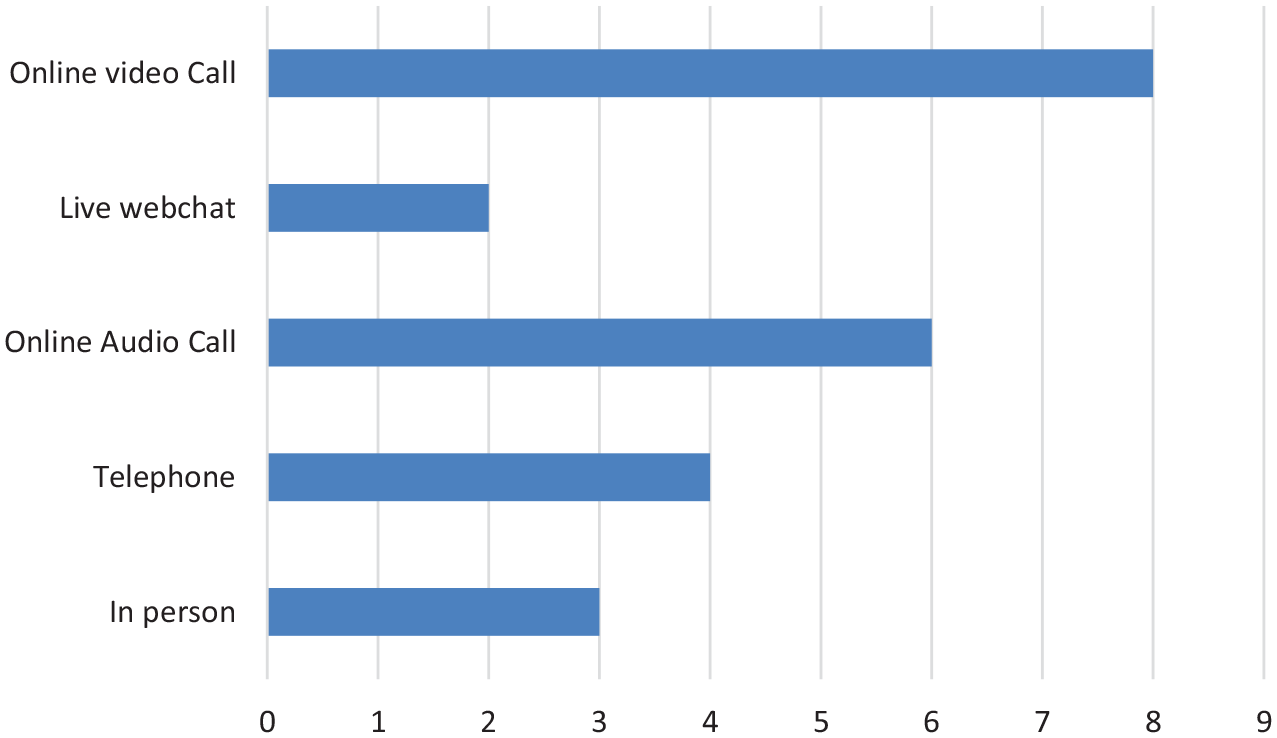
All interviews were audio-recorded and all data were obtained confidentially. Some participants chose methods which shared their identity with the researcher, for example, in-person interviews (UK only) or video calls, and some chose to retain a high level of anonymity opting for Webchat or an audio conversation (Figure 1). Interviews lasted 45–110 minutes. Participants were offered the opportunity to review their transcript.
Summary of interviews by method.
Findings
Interestingly, in the questionnaire some shared personal email addresses, whereas others chose to hide their identity with impersonal email addresses, for example, ‘onliner@.’, although some usernames and chosen domains were linked to their substance use/identity.
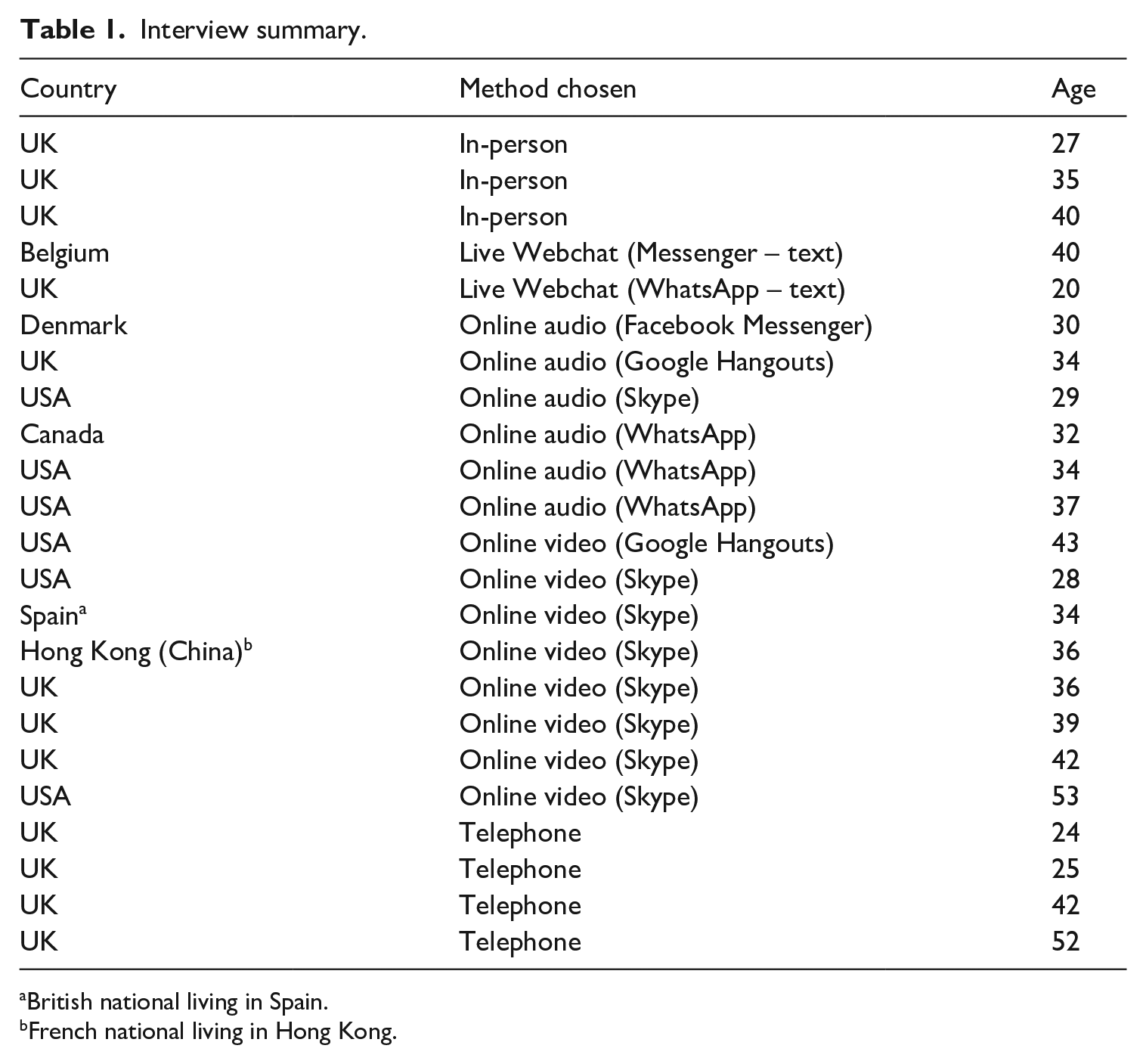
Of the 23 interviews, 12 lived in the UK. All were male. Table 1 shows the participants’ location, interview method choice, and age. With the limited number of interviewees, no differences could be found regarding age and preference of interview type.
Interview summary.
British national living in Spain.
French national living in Hong Kong.
Access
A key benefit from this broad approach was that people could take part virtually. Only three UK-based participants chose in-person interviews (all lived locally). Participants could be located wherever they were most comfortable, for example, one was in his car and two were at work. Online interviews could be arranged at a time which suited the participant, for example, one interview with a US participant was held at midnight, UK time.
Field notes
After the data analysis it was clear that for some, motivations to use substances were tied to their identity, and, where possible, the field notes included the participants’ physical descriptions. The field notes highlighted the pros and cons for using each method, and the most marked differences came from contrasting the Webchat with other interview types.
In-person interviews
Three interviews were in-person, allowing the researcher to observe non-verbal communication and physique. This proved useful relating to perceptions of muscularity considering how participants saw themselves in comparison with the view of the researcher. In the interviews a shared activity, such as drinking coffee, helped to build rapport allowing for a more ‘natural’ conversation. Another benefit was that one participant shared before and after images of himself stored on his phone, and this related to his motivation for use. The in-person setting ensured he had complete control over the images. One challenge, due to financial constraints, was to find a suitable location for the interview which would balance the privacy for the participant without impacting on the researcher’s safety. A further disadvantage was that this method relies on an external audio-recording device, and occasionally the clarity of the recording was poor/inaudible.
Live Webchat
Only two participants opted for Webchat, therefore any findings cannot necessarily be scaled-up, but we feel the differences are worth reporting. The key benefits to using synchronous written Webchat were that participants kept their anonymity and could be situated anywhere. They could access the interview on a range of electronic devices, creating an accurate and complete record of the conversation typed in real-time. The downside is that the researcher could not make field notes on physical appearances or tone of voice.
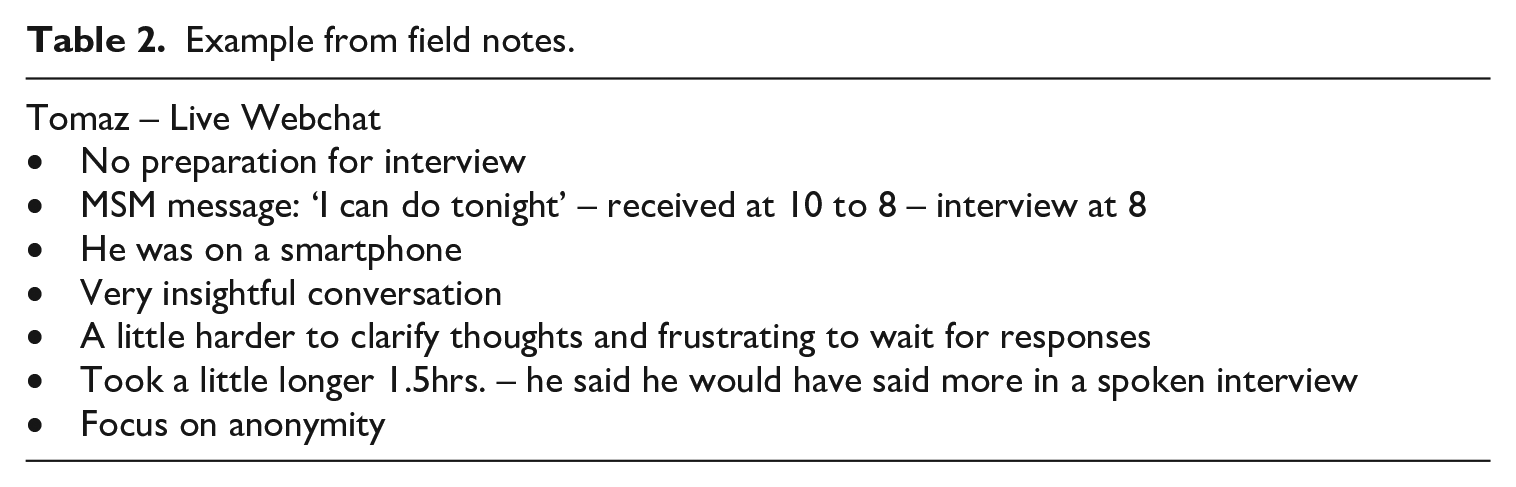
Using Webchat makes it more difficult to clarify points, and it is frustrating to wait for responses (Table 2). The conversation did not feel natural, it was hard to maintain a flow, and there were long pauses between written questions and answers. There were less detailed answers to questions; with no opportunity for observing non-verbal cues, there is less likelihood of follow-up questions. Moreover, one participant stated that he would have said more in a spoken interview. The researcher felt less comfortable asking sensitive personal questions via this method and felt that less rapport was built. Overall, the need to type each thought appears to require more effort from both the researcher and the participants.
Example from field notes.
Video interviews
All video calls were undertaken using a personal computer; none used a smartphone. The primary advantage of online video calls is the ability to see the interviewee, who could choose the location and background for the interview. The interviewer also has this option, and to create a sense of openness, and avoid the distortion that can come through use of a digital background which can be distracting; the researcher chose an informal home picture with a bookshelf. Participants could choose how to present themselves and an unexpected consequence of this was observing the Skype image of a ‘female avatar’ of the participant, while he chose to present in the video call in his male persona. This may not be relevant to all research topics, but it was key to the participant’s identity. As noted elsewhere (Dayan and Yuksel-Kaptanoglu, 2021; Oliffe et al., 2021), a clear disadvantage of this method is that although you can see the person on the video, it still limits the amount of observable non-verbal communication cues such as the whole-body language and some emotional responses. Another disadvantage is the need to find a private space for video interviews (Upadhyay and Lipkovich, 2020); this did not appear to be problematic in our study. However, one interview was interrupted, for example, from field notes: ‘Cat walked through and a lady’; however, the interviewee did not seem bothered by either interruption. The recordings captured both video and audio. This meant that any unclear audio could be checked on the video to help transcribing.
Online audio/telephone interviews
For the participants, this method offered anonymity (Opdenakker, 2014). One participant even went so far as to acknowledge halfway through the interview that he was using a pseudonym. The issues related to rapport building and being able to observe non-verbal cues were similar to those from the Webchat; however, there was a more natural feel to the conversations. There were challenges related to potentially misreading or missing non-verbal cues from both participant and researcher, for example, Tough interview, Theo just talked and talked and I hardly used any of my questions, however he did cover most of the subject areas. Good discussion. (from field notes)
One key benefit of online phone conversations (e.g. WhatsApp) over analogue calls was the ability to use the chat function in real-time (e.g. one participant shared links to websites with medical advice). Again, there was slight impact on data quality as the odd word was muffled in the audio-recording.
Discussion
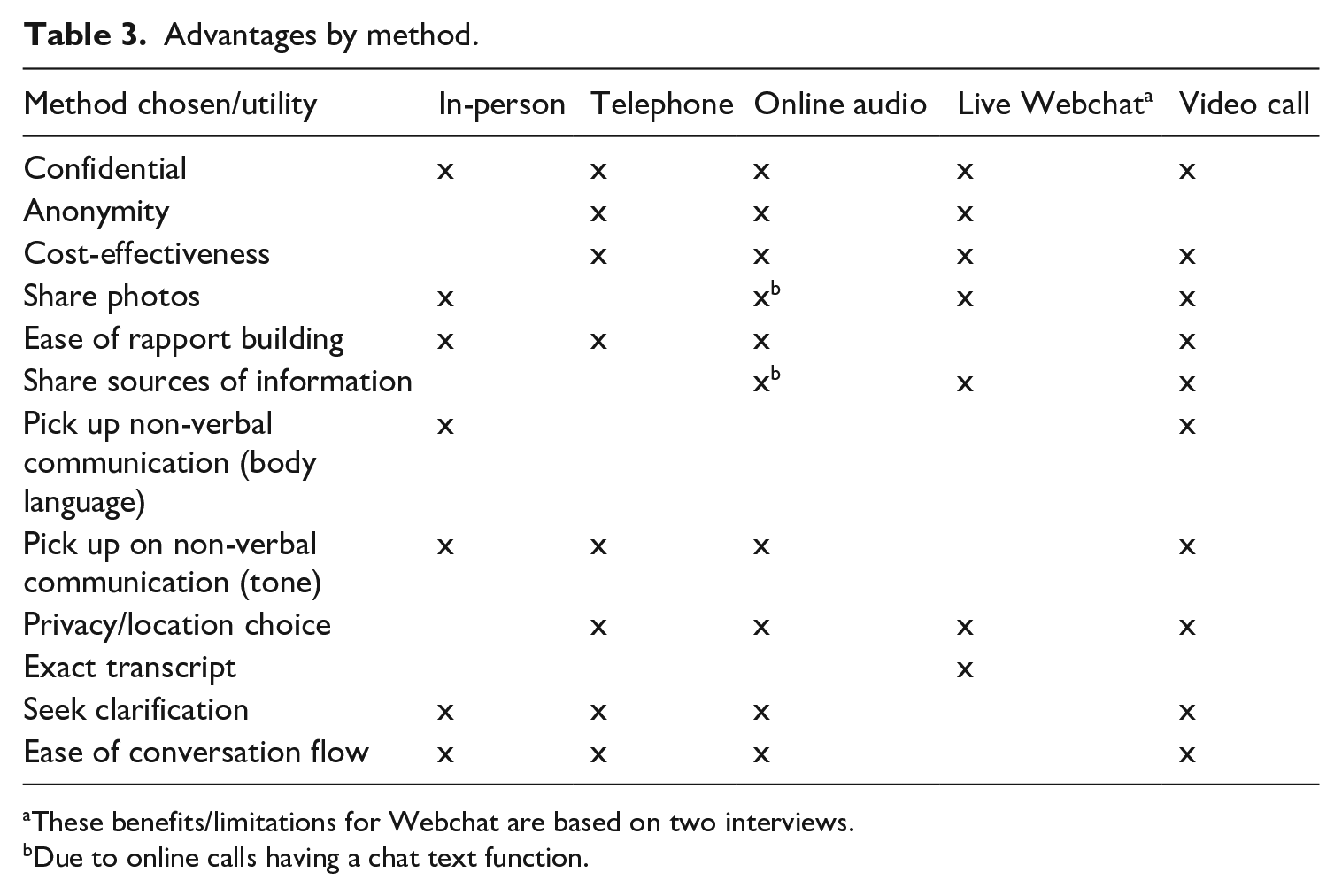
There were advantages across allformats of online interviews (Table 3). In online interviews participants may share photos/attachments (Lo Iacono et al., 2016), and in this study participants shared photos and websites via the chat in real-time. In the face-to-face interviews one participant also showed images on his phone. The online communication methods allowed participants to choose their own environment, level of anonymity, and interview times.
Advantages by method.
These benefits/limitations for Webchat are based on two interviews.
Due to online calls having a chat text function.
Building rapport is a key part of qualitative interviewing and this was challenging using online methods. Neequaye and Giolla (2021) found a range of definitions of rapport all centred around the interpersonal relationship between interviewee and interviewer noting six key attributes for building rapport: communication, mutuality, positivity, respect, successful outcomes, and trust. Weller (2017) suggested that when working with young people this can be developed in four ways: (1) legitimacy; (2) disclosure; (3) linguistic style; and (4) humour. Although our participants were not necessarily young, it proved a useful model to assist reflection on rapport building. Legitimacy was important to some participants as several had searched for the interviewer’s online profile. The researcher’s credibility was enhanced by a gatekeeper who had endorsed our study and this connection to someone respected within the AAS community helped to establish trust, as commented on by one participant. It was neither possible to share demographic details (disclosure) as a way of rapport building nor did the researcher have experience of AAS use; however, the researcher was able to share limited personal information. It can be important for the researcher to be cognisant of their choice of digital background to build rapport and reduce formalities (Oliffe et al., 2021). Using a home environment as virtual background enabled the researcher to share a part of their life, while ensuring that there was nothing personal in view to maintain their own level of privacy.
Rapport is fundamental to relationship building and a pitfall of not meeting in-person when dealing with sensitive topics could be a loss of intimacy and the personal connection, creating challenges to getting in-depth responses (Seitz, 2016). The interviewer was less comfortable broaching sensitive issues in the Webchat, as there was no way to read non-verbal responses or interpret a verbal tone. However, responses could differ depending on the personality, as introverts may prefer the distance provided by a virtual connection (Orchard, 2010) and some may not feel restricted by the lack of non-verbal cues. Therefore, participants could have opted for an interview technique that the interviewer felt limited their ability to build rapport (audio/virtual), but this may not have been an issue for them.
Although interviewing via video calls can impact rapport (Lo Iacono et al., 2016), in our study participants appeared to be quite comfortable and relaxed. The medium did not seem to impact on the rapport building as they were open about their AAS-use, some shared traumatic personal histories, and one cried during a video interview. The interviewer felt they built a rapport in the video calls and this could be due to their experience in rapport building or that participants may have felt more in control being in a virtual environment and therefore more open to speaking about potentially sensitive subjects.
Out of the 23 interviews, only 4 felt slightly stilted (2 were Webchats), with the participants giving short answers rather than engaging in a more conversational, story-telling narrative. The remaining 19 participants used the questions as a starting point to share their experiences, feelings, and opinions. Since the COVID-19 pandemic the use of online communication tools has become an integral part of how we communicate and connect, and therefore people may be much more comfortable and relaxed in this environment than in the pre-pandemic.
Table 3 shows the strengths and weaknesses of each interview type. In this study it did not appear to be the medium that necessarily impacted on the rapport building and the participants’ willingness to share experiences but more their own personalities. Namey et al. (2020) reported no difference in the data collected via Webchat related to themes identified; however, in this study both Webchat conversations elicited fewer data related to motivations for AAS-use. The two Webchat interviews took over an hour (longer than most interviews) and the data collected were less detailed, the story-telling aspect was missing, and the focus was on answering the questions rather than spontaneously explaining the background, life history, context, or emotions.
Limitations
There are some limitations. First, small numbers for each method made it impossible to identify preferences regarding age, while it was possible to evidence that Webchat interviews gather fewer data than other interview types. Our reflections aim to give researchers options to consider when undertaking research rather than concluding that one method is better than another. As interviewees were not asked to explain their interview choice, the interpretations are based on our reflections. Further limitations are that participants had to be fluent in English, and that the study occurred before the start of the COVID-19 pandemic in 2020.
Conclusion
This article outlines more flexible interview options when studying hard-to-reach populations that experience stigma. Offering a wide range of interview methods allowed a greater choice for participants and may encourage their engagement. There is a need to be aware of the benefits of using Webchat regarding anonymity and the downsides relating to loss of rapport, inability to observe non-verbal communication, the possibility of less disclosure, and loss of narrative. It was clear that those formats that benefitted the researcher were not necessarily congruent with those that met the needs of the participant, particularly relating to anonymity. We recognise that the COVID-19 pandemic forced many of us to get involved in online meetings, teaching, and examining. With greater familiarity in the research community as well as in the general population, it is likely that the way people build rapport in virtual environments will have evolved. Therefore, we stress the importance for participant choice over perhaps standardisation and convenience of interview methods.
Footnotes
Acknowledgements
David Harvey and Fiona Cusack for their proofreading.
Funding
The author(s) received no financial support for the research, authorship, and/or publication of this article.
