




Abstract
Two years after the first wave of coronavirus disease 2019 (COVID-19), one fact seems to be emerging clearly: lockdowns affect mental health differently across generations. This article uses data collected before and after the first wave of COVID-19 on a sample of 5,859 respondents, showing that the first lockdown worsened the mental health of the younger generations (Gen Y and Gen Z) in particular. Given that the older generations are considered the most vulnerable in this global pandemic, this may seem surprising. However, our data reveal that the pandemic outbreak raised very different concerns in different generations. While older people appear to be worried about the economy and their own health, younger people were more concerned about their lifestyles and, generally, their social relationships. This suggests that some of the mechanisms behind the exacerbation of younger people’s mental health may lie at the intersection of these two issues. On one hand, a life lived essentially online undermines all those processes of social capital activation that occur through leisure and face-to-face encounters, from which Gen Z may have suffered in particular. On the other hand, not only has the pandemic added further uncertainty to Generation Y’s career paths but working from home has also forced them to reorganize family routines and construct entirely new ones with colleagues using computers and smartphones. The article reflects on the upheavals of work and leisure to foster research on networks, social capital, and mental health in this period of a continuing pandemic.
Introduction
The impact of the coronavirus disease 2019 (COVID-19) pandemic on individual lives is unprecedented. Since January 2020, governments around the world have implemented measures of isolation and social distancing to prevent the further spread of infection. This has meant mandatory quarantine for those infected and those at risk of infection, restrictions on social activities, such as the closure of schools, bars, restaurants and entertainment events, and broader restrictions on freedom of movement and assembly (Brooks et al., 2020). Prolonged for weeks, and even for over 6 months (see Costabel, 2020 on the case of Argentina), these forms of containment have been associated with a deterioration in the population’s mental health, although not in all contexts, and with strong disparities between social groups by age, gender, and socio-economic status. In particular, it has been reported that some critical features increase in the most vulnerable groups, for example, those with pre-existing mental health conditions, as well as in women, the economically under-privileged and the youngest (Bellotti et al., 2021; Daly et al., 2020; Kuhn et al., 2021; Mohler-Kuo et al., 2021; Politi et al., 2021; Singh et al., 2020).
Younger people are known to have a propensity for mental health problems (Weinberger et al., 2018) and today the evidence seems to indicate their worsening psychological status during the first period of lockdowns (Mohler-Kuo et al., 2021; Pierce et al., 2020; Shanahan et al., 2020). In very different countries, such as Sweden, the United States, Switzerland, or the United Kingdom, older generations, such as ‘the Silent’ (+ 74) or the ‘Baby Boomers’ (73–54), appear to be responding better to the stress generated by restrictions and pandemic outbreaks than ‘Gen X’ (53–39), ‘Gen Y’ (38–25), and ‘Gen Z’ (24–14) (Daly et al., 2020; Kivi et al., 2020; Kuhn et al., 2021). Although it is the older generations who are at most risk of developing complications related to infections, it is they who have been least directly affected by the upheavals in the world of work, as well as lifestyle changes. The proliferation of this evidence indicates a need to think more broadly about the mechanisms behind this exacerbation of mental health among younger people as a result of the pandemic (Settersten et al., 2020).
This short article aims to provide insights into these mechanisms by reflecting on how, in this period, lockdowns affected the functioning of personal networks, which are known to be a fount of resources for maintaining mental health (Kawachi and Berkman, 2001; Santini et al., 2015). With this aim in view, I use data collected in Switzerland before and after the first lockdown. In order to limit the epidemiological curve, from February to May 2020 the Swiss authorities implemented a partial closure of public activities, limited freedom of assembly, closed schools, and closed social venues such as bars and restaurants (Sánchez-Mira et al., 2021; Kuhn et al., 2021). In this context, I first provide evidence that it is the younger generations who have suffered most psychologically since the first wave of COVID-19. Having provided this evidence, I consider a series of questions about the concerns that arose during the pandemic. The data show that there was more concern about lifestyle issues and social relationships among the most affected youth groups, namely, those in Gen Y and Gen Z. This helps us reflect on the intersection of these two aspects – lifestyle and social relationships – during the first lockdown and on the potential of network mechanisms to be determinants of this worsening of mental health among the young.
Exploratory findings
I used data from the Swiss Household Panel (SHP), an annual survey that analyzes a wide range of indicators in a representative sample of the Swiss population (Tillmann et al, 2016). The data include 5859 individual respondents aged 14–93 years divided into two waves of data collection. The first wave of data was collected between September 2019 and March 2020 (Wave 1). A second wave was collected after the peak of the first phase of the pandemic, between 12 May and 30 June 2020 (Wave 2). Wave 2, therefore, collects data on the same population as Wave 1, but after living under the semi-lockdown regime implemented by the Swiss government.
Following Sommet et al. (2018), I created a composite index of psychological distress by combining two indicators: a self-reported indicator of depression and anxiety and an indicator of the frequency of energy and optimism (see also Vacchiano and Bolano, 2021). The depression and anxiety indicator was measured on a scale ranging from 0, least problematic, to 10, most problematic, using the following question from the World Health Organization Quality of Life Survey (WHOQOL Group – Brief, The WHOQOL Group, 1998): ‘Do you often have negative feelings such as having the blues, being hopeless, or suffering from anxiety or depression?’ The question regarding indicators of the frequency of energy and optimism was: ‘Are you often full of strength, energy, and optimism if 0 means “never” and 10 means “always”’? After reverse-coding the indicator of energy and optimism, I averaged the two indicators to create one composite index of psychological distress before the first lockdown (M = 3.02, SD = 1.58) and one after (M = 3.24, SD = 1.77).
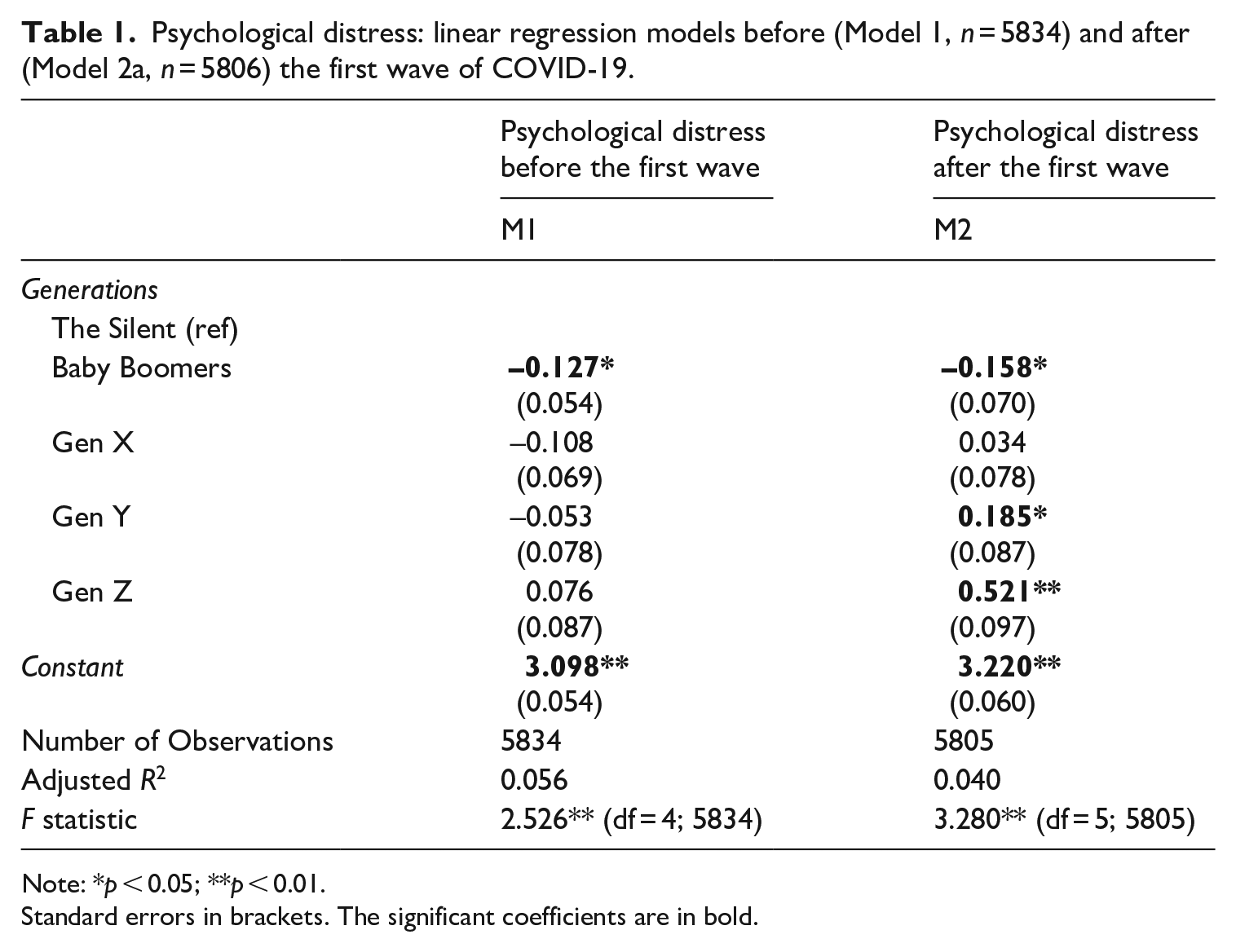
I categorized respondents by date of birth: those born between 1925 and 1945 were categorized as ‘The Silent’, those born between 1946 and 1965 as ‘Baby Boomers’, those born between 1966 and 1980 as ‘Gen X’, those born between 1981 and 1994 as ‘Gen Y’, and those born between 1995 and 2007 as ‘Gen Z’ see Lisittsa and Laor (2021). Thus, I performed a linear regression analysis using the lme4 package of the R software (Bates et al., 2015). The regression analysis assesses generation membership as a determinant of the composite indexes of psychological distress. The data in Table 1 show that belonging to Gen Z (ß = 0.521, p < .01) or Gen Y (ß = 0.185, p < .05) was positively associated with psychological distress after the period of lockdown (Model 2), whereas there was no significant association before the outbreak of the pandemic (Model 1). A significant association between Gen Z and psychological distress is also found by including in Model 2 socio-demographic indicators such as sex, social origin, and educational level (results upon request). Figure 1 provides a graphical visualization of the differences in estimates between Models 1 and 2 across generations. The figure highlights a stronger association with psychological distress among younger people after the first lockdown.
Psychological distress: linear regression models before (Model 1, n = 5834) and after (Model 2a, n = 5806) the first wave of COVID-19.
Note: *p < 0.05; **p < 0.01.
Standard errors in brackets. The significant coefficients are in bold.
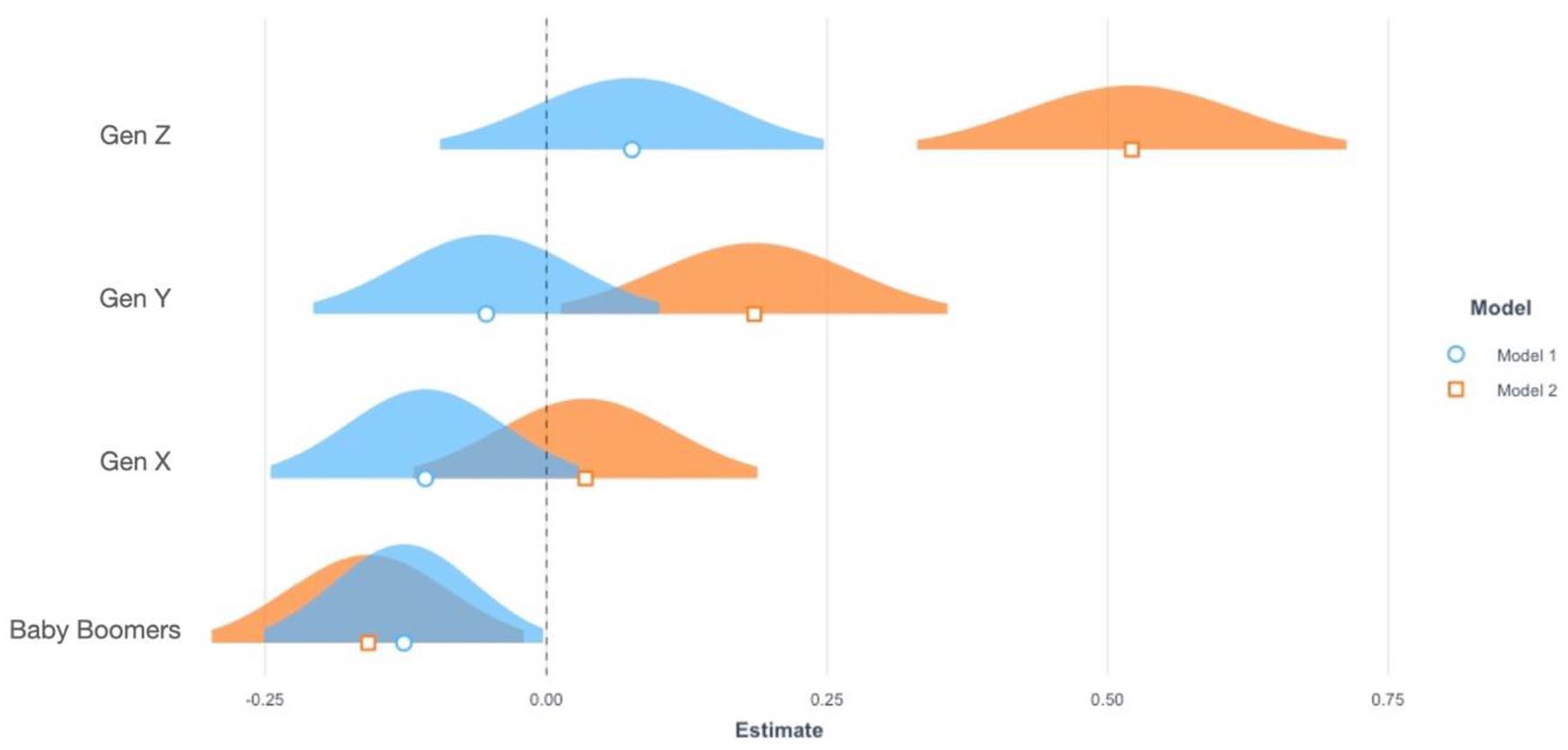
Effect plot of regression models: psychological distress across generations before (blue) and after (orange) the first wave of COVID-19.
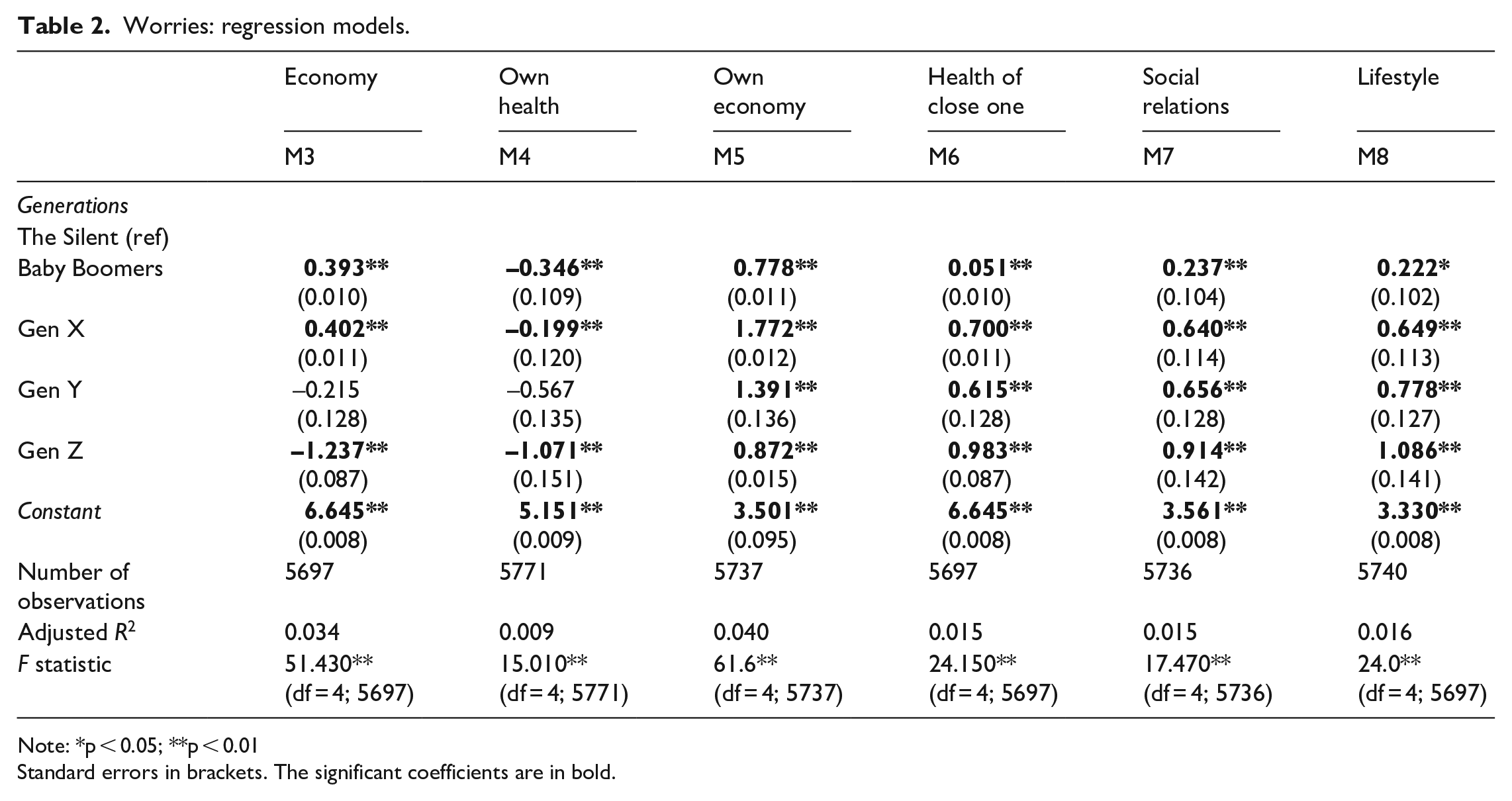
In addition, I analyzed a set of questions provided by Wave 2 of the SHP regarding six concerns that emerged among respondents during the first lockdowns. This set of responses answered the question ‘Are you worried about the following aspects?’ The indicator measured these concerns on a scale ranging from 0, ‘not at all’, to 10, ‘very much’. The six issues were: ‘general economics’, ‘one’s own economic situation’, ‘one’s own health’, ‘the health of close ones’, ‘lifestyle’, and ‘social relationships’. I performed a regression analysis evaluating the association between these concerns and generational membership. The data reported in Table 2 show that generations such as the Baby Boomers (ß = 0.393, p < .01) or Gen X (ß = 0.402, p < .01) were the most concerned about the state of the economy in general, which, however, seems to worry younger Gen Z (ß = –1.237, p < .01) the least. As age increases, generational affiliation also shows a greater concern about one’s own health status, whereas it is among younger people that concerns about the health of their loved ones emerge. This reflects well the higher perception of vulnerability to the COVID-19 infection among older people. Gen X (ß = 1.772, p < .01) and Gen Y (ß = 1.391, p < .01), are those who are most concerned about their personal economic situations. Gen Z, on the other hand, seems most concerned about their lifestyles (ß = 1.086, p < .01) and personal relationships (ß = 0.914, p < .01), which also seem to be of greater concern among the members of Gen Y than among older generations.
Worries: regression models.
Note: *p < 0.05; **p < 0.01
Standard errors in brackets. The significant coefficients are in bold.
Discussion and conclusions: how do networks matter?
As the evidence for the worsening of mental health among the young grows, there is an emerging need to think about explanatory mechanisms for this deterioration after the first lockdown (Bellotti et al., 2021; Daly et al., 2020; Kuhn et al., 2021; Mohler-Kuo et al., 2021; Singh et al., 2020). In this short article, I offer further evidence on this issue using data on 5859 respondents from the SHP. I showed how the first lockdown has exacerbated the gap between young and old. This means that the outbreak of the pandemic made the burden of psychological distress more prominent in Gen Z and Gen Y. My goal was to provide this evidence to open up a discussion of its possible mechanisms. To this end, I then analyzed a series of questions about respondents’ concerns after the first lockdown. While older adults, appear to be more concerned about the economy and their own health, younger adults’ concerns appear to meet at the intersection of two issues: lifestyle and social relationships. This does not offer an explanatory mechanism per se, something that certainly needs more complex models. However, what it does offer are indications of how to reflect on this worsening through a very well-established theory, that of networks and social capital (Bourdieu, 1986; Lin, 2001; Rostila, 2011).
Young people’s concerns during lockdown may reflect how the latter disrupted their access to resources embedded in personal networks – in essence, their social capital (Lin, 2001). For example, they point to the functioning of those regions of networks that are composed of strong ties, a well-known resource in maintaining mental health (Kawachi and Berkman, 2001). It is precisely close friends, partners, and family ties that are known to provide people with bonding social capital, such as instrumental and emotional support (Rostila, 2011). However, the pandemic prevented some of this capital from being activated through face-to-face interactions. In fact, we know that social capital must first be accessed and then mobilized to bring benefits (Lin, 2001). A lifestyle based largely on online interaction is, therefore, problematic for the activation of social capital. Computers and smartphones are extraordinary tools for transmitting resources, as they play an important role in fostering connections between people. However, the lockdown regime has made clear the irreplaceable value of face-to-face interaction alongside our digital lives. Many important social functions – meeting friends, attending school, maintaining romantic relationships – have been experienced exclusively digitally among Gen Z, a situation that is known to be potentially detrimental to mental health (Kim, 2017; Stefanone et al., 2012; Twenge et al., 2017; Vacchiano and Valente, 2021).
Moreover, strong ties have also been the subjects of new balances within the domestic space. The implementation of new family routines, which are particularly important for mental health (Lagomarsino et al., 2020), may create additional sources of stress in the households. Writing on this aspect, Twenge and Joiner (2021) point out that it is those in the early years of parenthood who are most susceptible to the psychological distress of lockdowns. Young parents, such as Gen Y, incur a need to play a multiplicity of roles due to school closures and remote working. Clearly, this is not exclusively a generational issue. On the contrary, the idea that women are disadvantaged by it is attracting support, and there is growing concern about how this has been experienced in family situations that are particularly vulnerable for women (Sánchez-Mira et al., 2021). Hence, this also emerges as an eminently relational problem, that of how young families have reorganised their routines in the unprecedented situation of lockdown, giving rise to new forms of inequality in the domestic and working spheres (Galvez et al., 2020).
There is an additional relational aspect that is rarely discussed as a determinant of mental health, and that relates to the functioning of weak ties (Pan and Chee, 2019). In the early months of the pandemic, the functioning of organizations was disrupted. Not only does the increase in professional uncertainty weigh on the younger generation, so does the need to find new routines with colleagues using computers and smartphones. While those with established careers have benefited from the increased flexibility of remote working (Klaas et al., 2021), for many teleworking has meant long working hours, continuous exposure to screens, and the loss of a space for informal interaction. In this sense, Sandstrom (2013) place emphasis on the fact that, in addition to strong contacts, having relationships that involve weak ties may also play a role in fostering well-being. Lockdowns have deprived work of a space of informality among colleagues, and have also given rise to new digital mechanisms of control over workers (Molina et al. 2021). Combined with other factors, this may have added additional sources of stress, for the younger and more vulnerable population in the labor market (Fana et al., 2020).
The pandemic and its aftermath, including the lockdowns, appear to have acted against the mental health of the most vulnerable, among them the youngest. In this short article, I have offered evidence for how the first lockdown worsened the age divide in the Swiss population. Many possible mechanisms can explain this worsening, but it seems that some of them may appear in the functioning of personal networks. The younger generations seem to care more about matters of lifestyle and social relationships. This calls for further reflection at the intersection of these two aspects: how the pandemic has changed leisure, professional routines, and home life, and how this has affected the many resources we acquire from our relationships for the sake of our mental health. In this short article, I have offered some insights highlighting the importance of face-to-face interactions to mobilize crucial resources, such as instrumental and emotional support. However, it seems that greater attention should also be paid to the renewed role being played by computers and smartphones for work and organization, family, and leisure. Hopefully, this brief reflection will foster research on the mental health of younger generations in this period of a continuing pandemic.
