




Abstract
Previous research has argued that occupational prestige is a social fact founded in the collective conscience and prestige perceptions morally grounded. Ideas of strong consensus in perceptions rest on comparisons of compressed mean values, and the similarity between what prestige an occupation has and what it ought to have has not previously been empirically explored. Drawing on survey data and a discrepancy index, the present study explores the resemblance between descriptive facts and normative values in perceptions of occupational prestige and consensus and discrepancies in prestige perceptions. The analysis showed discrepancies in descriptive and normative prestige perceptions for welfare and cultural occupations. The differences in perceptions can be explained by sex, beliefs about what factors give prestige to an occupation, and the prestige of one’s occupation.
Introduction
The present study explores the discrepancy between descriptive facts and normative values in perceptions of occupational prestige. The outbreak of the COVID-19 virus in 2020 highlighted an inconsistency between the prestige occupations have and the perception of what prestige they ought to have. The outbreak led to lockdowns of societies and many people went into home quarantine. An exception was employees in critical societal functions. In the Swedish context, these functions included public sector management, courts, and financial services; but also, production, distribution, and sale of groceries; care of the elderly, disabled, and children; waste disposal and cleaning; and public transportation (MSB, 2020). Critical functions were identified among occupations that can be ascribed to both high and low prestige.
It is interesting to mirror critical functions against research on occupational prestige and its predominant premises – not least since functional necessity has been a key argument for occupational stratification and differences in prestige. In their seminal article, Davis and Moore (1945: 243) emphasised ‘importance for society’ as a major aspect of prestige, and Barber (1978: 83) argued that ‘functional significance . . . is the sole determinant’ of occupational prestige. Accordingly, occupations perceived necessary for the survival of society receive greater recognition through the prestige attributed to them.
However, prestige studies have shown that this is only partially true, as many of the occupations described as critical in crises are not attributed particularly high prestige; this includes some lower-ranking health and care professions, occupations in the grocery trade, and garbage disposal and cleaning occupations (cf. Nakao and Treas, 1994; Treiman, 1977; Ulfsdotter Eriksson, 2006). Many of the occupations that were considered important during the COVID-19 crisis are also female-dominated and undervalued in both prestige and pay (Charles and Grusky, 2005; England et al., 1994).
The fact that occupations that are singled out as critical societal functions are not correspondingly attributed prestige reveals a social phenomenon of differences between what prestige an occupation has and what it should have; that is, a gap between descriptive and normative prestige.
Another central premise in occupational prestige research is that evaluations are based on shared normative values, and studies have repeatedly shown strong consensus in prestige perceptions (cf. Nakao and Treas, 1994; Svensson and Ulfsdotter Eriksson, 2008; Treiman, 1977). Treiman (1977: 59) described the occupational prestige hierarchy as a social fact that exists ‘independently of the particular values and attitudes of the raters’. Perceptions of occupational prestige were seen as reflections of societal norms and values – collective conscience – and not as expressions of individual or group-based thoughts, beliefs, and opinions. Treiman (1977: 20) argued that occupational prestige ratings were moral judgements and drew a rather strong link between the descriptive fact and the moral values underlying it; they are, so to say, on the same side of the coin: ‘The currency of moral worth is prestige’.
However, the strong association between descriptive facts and normative evaluation has been questioned. Even if ‘the factual order of stratification is, for the most parts, consistent with the dominant normative order’ (Villemez, 1977: 458), Coxon et al. (1986: 80) argued that while ‘“descriptive judgments” refers to what “is” the case’, ‘“normative” or evaluative judgements refers to what “ought” to be the case’ (Coxon et al., 1986: 80). Villemez (1977: 459) also noted that the resemblance between ‘the actual and normative occupational prestige’ has never been empirically studied and confirmed, so there may be undetected discrepancies between descriptive facts and normative values in occupational prestige perceptions.
Exploring the relationship between ‘is’ and ‘ought to’ can tell us more about the premises of prestige and whether (in)consistencies depend on the characteristics of occupations and/or raters. Thus, people may perceive that critical and functional necessary occupations should have higher prestige than they do. Related to the Covid-19 pandemic is the tribute directed to health and care workers during the spring of 2020. Care assistants and nurses, occupations that are not normally given especially high prestige, have been saluted throughout Europe by the social movement ‘Clap for Carers’. This movement may be interpreted as an expression of cognitive dissonance that arose from this crisis and exposed a gap between what prestige these important occupations have and what they ought to have. A gap that may also relate to the gendered structure of the labour market in which the feminised sectors and occupations are ascribed low prestige (Ulfsdotter Eriksson, 2006).
The present study explores the resemblance between descriptive facts and normative values in perceptions of occupational prestige, as it investigates the measure of association between what prestige occupations have and what they ought to have. It explores the extent to which these evaluations are similar and shared among the public or if there are gaps and discrepancies that can be explained by demographic data or individual beliefs of prestige. The study thus considers that a discrepancy between facts and norms may differ depending on the rater’s social context and individual reflections and assessments. The following questions are addressed: What is the relationship between descriptive facts and normative values in prestige perceptions? What value dimensions can be found in the gap between actual and normative prestige? What discrepancies in prestige perceptions are identified and how can it be explained?
The analysis was based on a survey study in which a random sample of the Swedish public rated both what prestige occupations have in society and what prestige they ought to have. The measure of association, a discrepancy index, shows that there is a gap between the descriptive and normative prestige and that welfare occupations of vital societal functions ought to have higher prestige than they have, while cultural occupations ought to have lower prestige. In prestige perceptions, descriptive facts, and normative values are partly aligned but not in full resemblance and, despite strong consensus, there are discrepancies. Discrepancies can partly be explained by occupational types, individual demographics, individual beliefs about what gives prestige to an occupation and the prestige of one’s occupation. The functional necessity of occupations seems to be less relevant for the actual prestige and it is only a variable of worth for some occupations (such as physicians) and not for others (such as child-minders and cleaners).
Occupational prestige and its premises in previous research
The present study’s primary area of interest is not the occupational prestige hierarchy per se, but the discrepancies between descriptive and normative prestige and of consensus and dissensus in perceptions.
Research on occupational prestige has a history of functionalistic explanations, drawing strongly on the vast consensus in prestige perceptions and the interconnectedness between actual and normative prestige (Davies, 1952; cf. Homans, 1964; Treiman, 1977). Perceptions of occupational prestige were described as expressions of a collective science and a social fact, existing outside of the individual and exerting pressure on thoughts, beliefs, and agency (Durkheim, 1938). Thus, prestige perceptions were seen as anchored in societal, and not individual- or group-level context or conditions, as thoughts ‘existing outside of the individual consciousnesses’ (Durkheim, 1978: 21).
In the seminal study by Treiman (1977), he compared 85 studies from 60 countries and concluded that ‘One of the most striking features of occupational prestige systems in almost all societies is the lack of subgroup variation in prestige ratings [. . .] With minor exceptions, there is extraordinary consensus throughout each society regarding the relative prestige of occupations’ (Treiman, 1977: 59). Treiman (1977) thus argued for strong consensus and that individual differences depending on educational level, age, sex, and social class did not influence prestige perceptions. The solid stability of occupational prestige hierarchies has also been thoroughly mapped and, as stated by Hout and DiPrete (2006: 3), the Treiman constant is perhaps ‘the only universal sociologists have discovered’.
Although macro-level stratification research, such as occupational prestige studies, focus on the aggregated level, they are still based on individual-level survey data (Treiman, 1977) and according to Coxon (1983), prestige studies need to bring the subject back in. Coxon et al. (1986: 47) questioned the lack of subgroup variances and claimed that the vast consensus resulted from ‘the crudest method of aggregating rating scale measures’. The prestige points, that lay the ground for occupational prestige hierarchies, are based on mean values that, by definition, emphasise the central tendencies and conceal variations in perceptions (Blakie, 1977). Coxon criticised prestige studies’ lack of interest for the raters and argued that ‘data cannot be interpreted without reference to subjects’ accounts and the cognitive context within they were generated’ (Coxon, 1983: 488).
However, previous studies have detected some variances. Alexander (1972: 172) showed that prestige perceptions varied with the status of the respondent and ‘The higher the judger’s status, the greater his judgment dispersion’. Variations in perceptions were lower in the judgement of high-status positions but increased progressively when ‘the status of the judged object decreases’ (Alexander, 1972: 170). Alexander referred to classic sociology, stressing that perceptions, attitudes, values, and lifestyles are strongly influenced by social position (cf. Bourdieu, 1984; Sayer, 2005a, 2005b).
Ulfsdotter Eriksson (2006) found that women ascribed higher prestige to some occupations (such as veterinarians, priests, midwives, dancers, and forest workers), while men favoured others (dentists, electricians, construction workers and farmers). Moreover, men tended to upgrade low-prestige occupations and young people upgraded cultural occupations, while the elderly favoured occupations such as police and teachers. In line with Wegener (1992), higher-educated people tended to upgrade white-collar occupations, whereas low-educated people upgraded blue- and pink-collar work. The study also showed that variations in perceptions were more salient of occupations in the middle of the prestige hierarchy and unusual or disputed occupations, such as parliamentarians, fashion models, actors, and musicians.
Research has shown that raters acknowledge different factors of importance when judging occupational prestige (Haller and Bills, 1979; Reiss, 1961; Ulfsdotter Eriksson, 2006; Wegener, 1992), which suggests some sort of reflection in the rating process and not just an uttering of the collective conscience.
The notion of prestige is vaguely defined (Turner, 1988). Prestige perceptions are anchored in multiple beliefs about which factors are important for an occupation’s prestige. The National Opinion Research Center (NORC) study showed that one of the most common criteria for ascribing high prestige was that the occupation was important to society (Reiss, 1961), which is in line with the functional necessity stressed by structural functionalists (Davis and Moore, 1945; Treiman, 1977). However, Thielbar and Feldman (1969: 66) found that ‘functional importance turned out to be the poorest predictor of prestige’. Ulfsdotter Eriksson (2006) found that the correlation between prestige and importance for society was low (rs = 0.42), suggesting that occupations that were ascribed importance were not always the same as those also ascribed high prestige. The most important occupations identified were physicians, police, nurses, and secondary school teachers; of these, only physicians were also ascribed high prestige.
These scattered results on ‘functional importance’ may be explained by points of departure. For structural functionalists, prestige is a reward granted to the most important professions in the labour market; that is, those ranked high in prestige hierarchies. The idea of functional significance is already in the assumption, contrary to those empirical studies that have investigated the correlation more unconditionally. In Ulfsdotter Eriksson’s (2006) study, respondents judged the importance of occupations independently, which allowed them to consider the occupations’ importance and something apart from the prestige hierarchy.
In addition, traditional prestige studies have been described as gender-blind by not acknowledging occupational gender segregation and its effects on prestige evaluations (Acker, 1980; Jacobs and Powell, 1985). Although the relation between gender and occupational prestige is not conclusive (Ulfsdotter Eriksson, 2013), it is difficult not to acknowledge differences in how female- and male-dominated occupations are valued (cf. Charles and Grusky, 2005). Women more often than men occupy important occupations within the welfare state, which are often also ascribed low prestige and have low wages. Thus, the gap between prestige and functional importance may also be explained by these gender structural aspects of the labour market, also mirroring the potential gap between what prestige occupations have and what they ought to have.
Alternative approaches and explanations of prestige perceptions
The idea of strong consensus in prestige perceptions, ignoring the social context of the perceiver, and the close link between the empirical reality and moral beliefs, stands in stark contrast to more culture-oriented research (cf. Bourdieu, 1984; Fuchs, 2003; Skeggs, 1997).
For instance, Sayer (2005a, 2005b) argued that normativity is contextual, and that class positions and other structural differences influence both behaviours and beliefs. People compete over resources (goods, money, respect, recognition) as well as over the ‘definition of what is valuable or worthwhile’ (Sayer, 2005a: 3). Sayer argued that social science has neglected people’s normative beliefs and ideals in the quest of separating positive (objective) knowledge from normative (subjective) evaluations. Moreover, that people’s normative beliefs are rational and that neglecting them suggests that social scientists are ignorant towards how reality is perceived, experienced, and rationalised by those under study.
Research on occupational prestige may be an exceptional case of ignoring normative and individual beliefs, not only by diminishing variances in opinion in the search for consensus and linearity but also in the interpretation of perceptions as moral statements, and not just descriptions of an empirical reality concerning what prestige occupations are perceived to have in society. As the present study aims to explore the relationship between facts and norms, and variances in prestige perceptions, the theoretical framework needs to allow for an analytical distinction between actual and normative prestige perceptions which opens for discrepancies.
Bourdieu (1977, 1990) offered a dialectic approach to understand the interconnectedness between the individual and society, the agency-structure dynamics, by the distinction of objectivistic and subjectivistic modes of knowledge (cf. Fuchs, 2003). Regarding perceptions of what prestige an occupation has or ought to have, it could be argued that the actual prestige relates to ‘objectivist mode of knowledge’ (Bourdieu, 1977: 3), whereas normative prestige perceptions are based on subjective modes of knowledge.
Habitus mediates the objective reality and objective forms of knowledge, and the subjective practices and beliefs (Bourdieu, 1977, 1990). Descriptive prestige (the actual and objective knowledge of occupational prestige) as a measure of social stratification is voiced when rating what prestige an occupation has. Normative prestige is thus interpreted as a voicing of ‘lay normativity’ (Sayer, 2005a, 2005b), which is locally and culturally affected perceptions of what prestige an occupation ought to have. It is within the normative values that the more subjective perceptions are held, which can then be taken as expressions of individual and more group-like values.
The concept of habitus allows for an alternative way to theoretically explain actual and normative prestige perceptions as well as consensus and dissensus. On the one hand, habitus harbours ‘the production of a common-sense world endowed with the objectivity secured by consensus of the meaning (sens) of the world, in other words, the harmonization of agents’ experiences’ (Bourdieu, 1977: 80, 1984, 1990). This explains consensus and the finding that ‘people in all walks of life’ view occupations’ actual prestige similarly (Treiman, 1977: 59). It covers ‘the structured disposition’ of habitus which corresponds to the premises of social facts and collective conscience stressed in structural-oriented frameworks.
On the other hand, habitus also harbours individualised orientations described as ‘the organic individuality that is immediately given to immediate perception . . . and socially designated and recognized’ (Bourdieu, 1990: 60), which enables explanations of variances in perceptions. The individual habitus is linked to group-habitus, suggesting similarities in ‘taste’, mirroring culturally and contextually shaped beliefs and perceptions (Bourdieu, 1984; cf. Skeggs, 1997; Svallfors, 2006). The most discussed group-habitus is social class, but individuals are united in relationships of homology grounded in other categories as well, such as gender, nationality, and age. As mentioned, previous studies on occupational prestige have shown some group-based variances in perceptions, which suggests the presence of opinions coloured by the affiliation of such belongings.
However, late modernity has been said to dissolve people’s identification with pre-created categories (cf. Beck, 1992; Giddens, 1991). Traditional belongings may no longer influence choices and perceptions as they once did, but the individual can, to a larger extent, make reflexive considerations beyond a pre-reflexive state of habitus (cf. Mouzelis, 2008; Sayer, 2005b; Stahl, 2013). Mouzelis (2008) argued that Bourdieu neglected the everyday reflexivity that individual engages in and that post-traditional societies force people into reflexivity on all kind of matters.
One argument in this study is that voicing normative prestige may be a matter of individual reflection – un-bound from collective conscience as well as group-based habitus. Flisbäck (2014: 56f) elaborated on the individual habitus from a micro-level perspective and argued that experiences and the social context formed unique sets of habitus. Moreover, individuals may share ‘the common belief system’ and, at the same time, have a ‘creative, and reflexive eye’. That is, the individual not only passively incorporates a ‘collective conscience’ but reflects upon collective norms and values it and may thus act in individually preferable ways.
Methods and materials
This study draws on a survey study about ‘Perceptions of Occupational Prestige’ administered by Sweden Statistics in 2018–2019. The survey was conducted by web and by post. The questionnaire was sent to 3375 potential respondents and had a response rate of 671 unique answers (20%).
The first question asked respondents to state, for 30 occupations, ‘how it is valued in society with regards to status’, on a scale from 1 to 9. This question is a measurement of actual, or descriptive, prestige, set apart from personal beliefs. In the second question, for the same occupations, respondents were asked to state ‘your perception of what status the occupation ought to have’ which was taken as expressions of normative prestige. The analysis in this study focused on a selection of 20 common and familiar occupations that have been thoroughly researched in previous prestige studies (Ulfsdotter Eriksson, 2006).
Analytical strategy
First, the correspondence of the two survey questions and correlations for both the mean values (Pearson’s r) and rank orders (Spearman’s r) were analysed (see Table 3). Second, discrepancy indexes were constructed to explore the resemblance between descriptive facts and normative values, and on variances in perceptions (Table 1). The index was constructed by subtracting the actual prestige from the normative prestige for each occupation to measure the discrepancy between what prestige an occupation has in relation to what it ought to have. In contrast to correlations that build on mean values and suppressed data, the index, drawing on individual-level data, allows for further analysis of variances in perceptions. Since the indexes are constructed from what prestige an occupation has minus the prestige it ought to, the index per occupation is summative of whether the occupation is perceived as over-, or undervalued. A positive value suggests that the occupation is ascribed higher prestige than it ought to, while a negative value indicates that the occupation is ascribed lower value than it ought to. For instance, as shown in Table 1, the raters think that lawyers ought to have, on average, 0.64 points lower prestige, while shop assistants on average ought to have 1.38 points higher prestige mean.
Discrepancy index for 20 occupations (has minus ought to have).
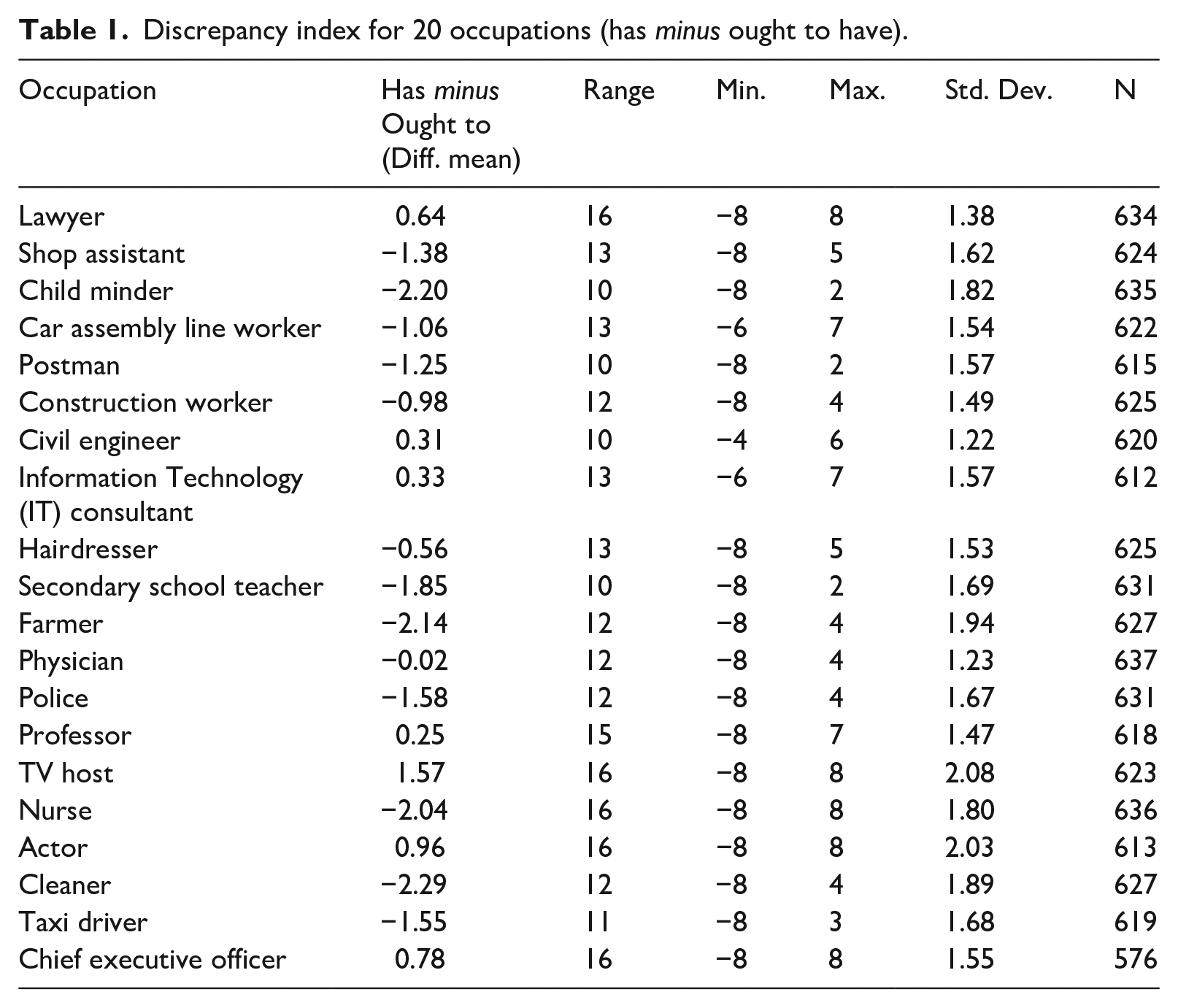
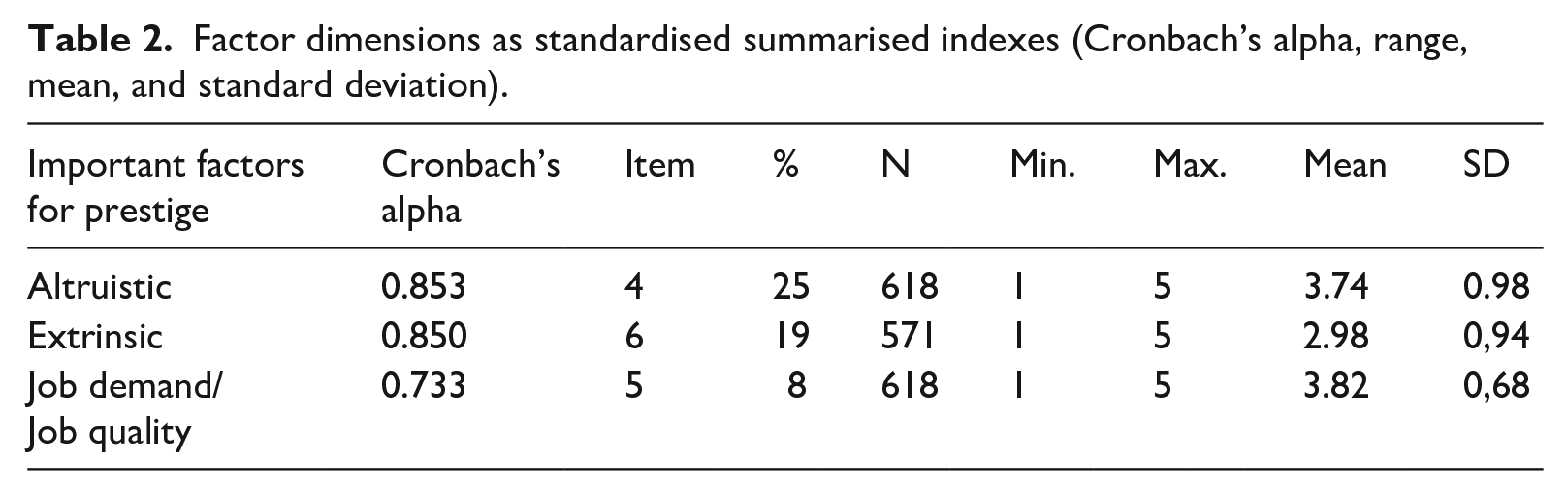
In theory, all occupations had the potential range of −8 to 8 (16). But as reported in Table 1, the range differs. A shorter range suggests that the raters did not use the whole scale, as for example childminder and taxi driver. The reliability of the index was high, with a Cronbach’s alpha of 0.822 for the 20 included occupations (Table 2).
Factor dimensions as standardised summarised indexes (Cronbach’s alpha, range, mean, and standard deviation).
The index is like the measure of association conducted by Wegener (1990: 60), who studied the relationship between the actual income and the respondents’ beliefs of what income would have been fair. Wegener argued that ‘A measure of association between the actual and the just income will be indicative of the extent of felt justice in a society’. Translated into the objective of the current study, the discrepancy index measures the association between the actual prestige of occupations (descriptive facts) and what would be the just prestige (normative values).
A Principal Component Analysis (PCA, Varimax rotation) was conducted to analyse underlying patterns of prestige perceptions and to reduce the number of occupations into dimensions of occupations (Kim and Mueller, 1978), or occupational families (cf. Coxon et al., 1986). The PCA analysis disclosed four distinct dimensions that explained 58.6% of the variations in the discrepancy of ‘has’ and ‘ought to’ in prestige perceptions.
The dimensions were used to explore what variables may explain the discrepancy in what occupational prestige an occupation has versus ought to have and variances in perceptions. Through regression analysis (OLS), several background variables were controlled for. The first model contained Sex (men, women); Age (categorical), Class position (categorical based on Standard för svensk yrkesklassifikation [SSYK12 (cf. the International Standard Classification of Occupations (ISCO-88)]: white-collar, groups 1–3; lower white-collar, groups 4–5; and blue-collar, groups 6–9); and Area of living (larger, medium, and rural municipalities). All demographics build on registry data provided by Statistics Sweden. In the analysis, we controlled for multicollinearity, especially regarding social class and education. Theoretically, these variables relate to group-based habitus (Bourdieu, 1984).
Respondents were also asked to rate, on a scale from 1 to 5, how important they considered 19 factors to be for an occupations’ prestige. In the second regression model, indexes of important factors for prestige were analysed (see Model 2, Tables 3–6, Supplemental Appendix).
A PCA (Varimax) disclosed three value dimensions of Important factors for prestige that may affect respondents’ prestige perceptions. The first factor, Altruistic, comprised four items relating to ‘inner values’: honest and moral, useful for society, gives help to others and demands empathy. The second factor, Extrinsic, captured factors of a more superficial character in that male domination, high wages, popularity, well-known incumbents, a nice title, and visibility in media were seen as important for occupational prestige. Finally, Job Demands/Job Quality consisted of factors that were important for occupational prestige: the need for skills, responsibility, long education, great work effort, and long experience. The three dimensions captured 15 of the 19 items, which together explained 52% of the variance. Four of the rated factors did not load properly in any dimensions and were excluded.
The last explanatory variable in the regression analyses was ‘the prestige of my occupation’ (see Model 3 in regressions). This variable indicated the respondent’s self-positioning in the prestige hierarchy, which has been shown to have an impact on prestige perceptions (Alexander, 1972). The respondents were asked to rate, on a scale from 1 to 9, what prestige they thought their occupation had: 26.6% thought that their occupational prestige had low prestige (1–3), 45.4% thought it was medium (reference), and 28% thought their occupation had high prestige.
The value dimensions of important factors for prestige and the prestige of one occupation are explanatory variables that capture a more reflective and individual habitus (Flisbäck, 2014; Mouzelis, 2008).
Critical reflections on data
The survey and the research project have been vetted by the Regional Ethical Board. The survey was conducted in Swedish, and questions and response alternatives were translated into English by the authors. The response rate was low at 22%; according to Statistics Sweden, there has been a great increase in non-response rates over recent years (Japec et al., 1997). The risk is that the data are non-representative. As the survey is a replication of a previous one that had a response rate of 60%, and as some findings are similar, we are confident that the data collected and presented in this article are representative. This is also confirmed when comparing the profile of the raters in the final selection from both studies.
Results
Actual and normative prestige: rank orders and dimensions
Research arguing for strong consensus in prestige perceptions compares mean values or prestige points (e.g. Nakao and Treas, 1994; Treiman, 1977; Ulfsdotter Eriksson, 2006) which aggregate perceptions and hide systematic variations (Coxon et al., 1986). Depending on the measures, the degree of consensus differs somewhat; this is illustrated in Table 3 where the correlations of both mean values and rank orders for occupational hierarchies of the actual and normative prestige are presented.
Correlations of descriptive and normative prestige perceptions (means, rank orders).
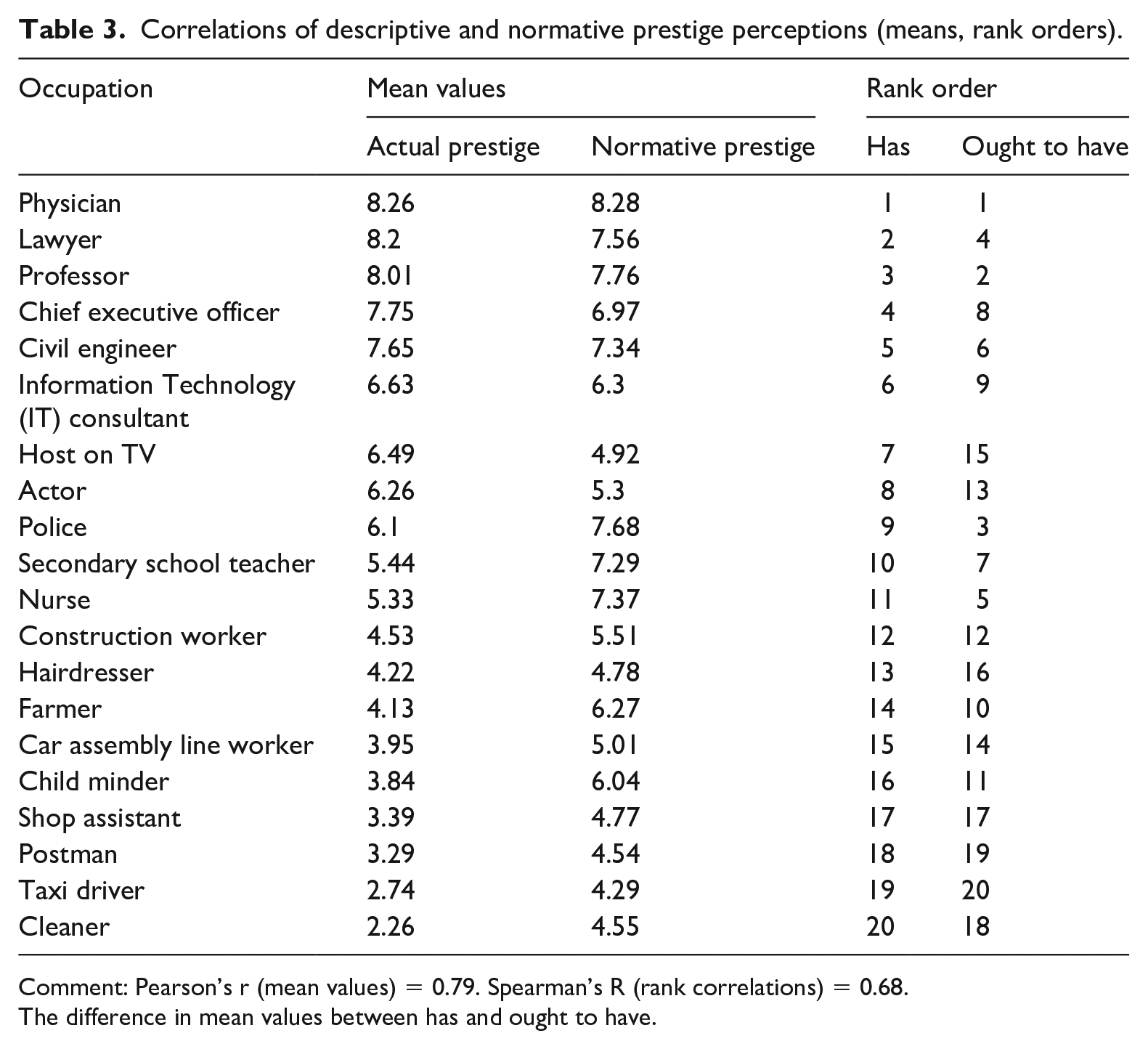
Comment: Pearson’s r (mean values) = 0.79. Spearman’s R (rank correlations) = 0.68.
The difference in mean values between has and ought to have.
The correlation between mean values reports a rather high correlation (r = 0.79, with 1 as a perfect correlation). Thus, when the judgements are reported as mean values, the difference between the descriptive and normative prestige is not that grand. The rather high correlation suggests an alignment between the prestige that occupations have and what they ought to have – that descriptive facts and normative values are on the same side of the coin.
Still, it is interesting to note that the end anchoring differs between the actual and normative hierarchies. The top-ranked occupation (physician) was ascribed a slightly higher mean value on normative prestige as compared with actual prestige (8.28 to 8.26), but the lowest-ranked occupation (cleaner) gained a much higher mean value in the normative prestige rating compared with actual prestige (4.55 and 2.26). Even if the rank order position did not change for these two occupations, the end anchoring did, as the endpoints for the actual prestige scale were 8.26–2.26 and for the normative prestige scale 8.28–4.55. Judging from the normative prestige perceptions, there was a tendency to level the social grading continuum and the prestige inequality.
The discrepancy between actual and normative prestige was more salient in the rank-order correlation. The Spearman’s r (rs) was 0.68, which suggests a greater gap than the correlation of the mean values (r) showed. This was also evident when looking at ratings of single occupations. According to the judgements, some of the more prestigious occupations ought to have lower prestige: CEO, TV host, and actor were the ones for which the valuations differed the most. Correspondingly, several medium prestigious occupations ought to have higher prestige, such as police officer, nurse, childminder, and secondary school teacher; that is, functional necessary occupations.
The descriptive analysis presented above showed that the ‘objective’ and ‘subjective’ evaluations of the social standing of occupations were not fully aligned, but were instead characterised by some sort of gap. This gap testifies to the occurrence of agency-structure dynamics and the presence of reflective, and perhaps cleft, habitus that not only report back on a social fact (Flisbäck, 2014). The question is whether the discrepancy between descriptive facts and normative values harbour systematic differences in evaluations referring to some group-based habitus or a more randomly scattered one.
Dimensions of occupational prestige perceptions
To enable a coherent analysis and explore the measure of association between actual and normative prestige, as well as variations in perceptions, factor analyses (PCA, Varimax) were conducted to reduce the number of items (that is, occupations). The analysis revealed that four distinct value dimensions explained nearly 59% of the discrepancy in perceptions (Table 4).
Occupational dimensions (standardised scale).
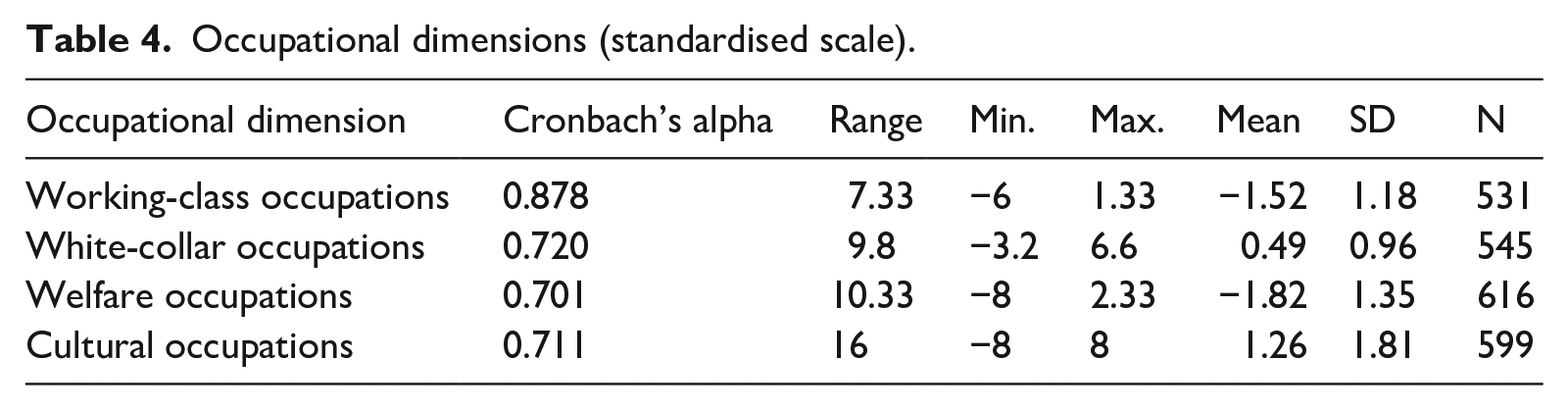
The first of these dimensions, working-class occupations, covered nine blue- and lower white-collar occupations (shop assistant, car assembly line worker, childminder, postal worker, construction worker, hairdresser, farmer, cleaner, and taxi driver). This dimension explained 27% of the variations of the discrepancy in descriptive and normative prestige evaluations. The second dimension collected five white-collar occupations (lawyer, civil engineer, ITC consultant, professor, and CEO), and explained 16% of the variation. The third dimension, which explained 9.5%, consisted of police, nurses, and secondary school teachers. In the Swedish context, these welfare occupations are mainly conducted within the public sector. The final dimension loaded the two cultural occupations of actor and TV host and explained 5.5% of the variation. The reliability in all constructed dimensions was high, with alpha values ranging from 0.878 (working-class occupations) to 0.701 (welfare occupations). The occupational families identified are not clearly gendered but rather mixed, except for the white-collar dimension that mainly consists of male-dominated occupations.
In the exploration of the discrepancy between ‘facts’ and ‘norms’ in prestige perceptions, both the range and the standard deviation of the measure of association of the occupational dimensions show that people tend to judge differently depending on whether they are rating actual or normative prestige (Table 4). The range shows to what extent the rater makes use of the whole scale (1–8) and the standard deviation of how the ratings differ in relation to the mean value of the discrepancy index. Both a longer range and a larger deviation indicate scattered perceptions of descriptive facts and normative values.
As described in Table 4, the greatest gap of the measure of association was found in perceptions of cultural occupations. This occupational index ranged from −8 to 8 and showed the largest standard deviation (1.81). The discrepancy between the prestige these occupations have and ought to have was also evident in the correlation analysis, which showed that they were perceived as highly overvalued. On the contrary, the welfare occupations were considered undervalued. These occupations have the second-largest gap, with a range of 10.33 (−8 to 2.33). The white-collar and the working-class occupations had the lowest standard deviation, as well as the shortest ranges, suggesting that the actual and normative evaluations of these kinds of occupations are more similar, suggesting stronger alignment between ‘has’ and ‘ought to’.
Exploring and explaining the discrepancy in occupational dimensions
The previous analysis disclosed underlying patterns in the measure of association between descriptive and normative prestige perceptions and distinguished four occupational dimensions. To explore the discrepancy further, these dimensions were analysed through regression analysis, in which the effects from the independent variables are used to explore and explain variances in perceptions.
The constant for the working-class occupations (−1.589; see column 2, Table 5) indicated that, on a general level, these occupations were undervalued and ought to have higher prestige. The independent variables explained approximately 12% of the discrepancy of perceptions. Men, to a lesser degree than women (reference category), thought that these occupations were undervalued, as the constant for men was lower (−1.589 + 0.485 = −1.104). 1 This was also the case among the oldest people and those who believed that Job demands/Job quality were important for occupational prestige.
Regressions of occupational dimensions (OLS, Model 4).
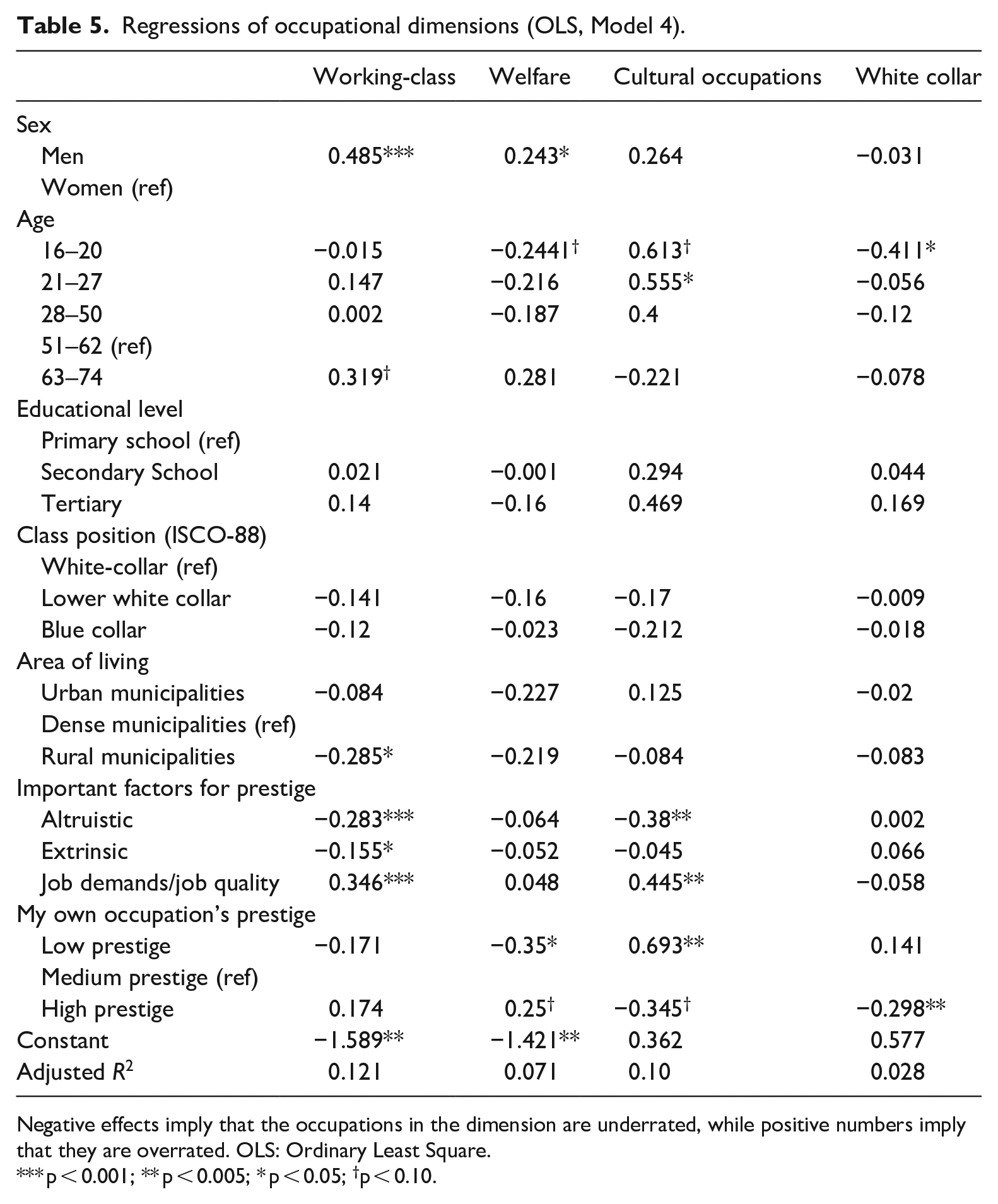
Negative effects imply that the occupations in the dimension are underrated, while positive numbers imply that they are overrated. OLS: Ordinary Least Square.
p < 0.001; ** p < 0.005; * p < 0.05; † p < 0.10.
On the other hand, those who believed that altruistic factors were important for prestige (-0.283) and those who stressed extrinsic values (-0.155) thought that the working-class occupations were underrated and should have higher prestige (the negative estimates give a higher negative intercept). This was also the case for respondents living in rural areas.
Concerning the welfare occupations, the independent variables explained approximately 7% of the variation of the discrepancy index. As with the working-class occupations, welfare occupations were perceived as deserving higher prestige (intercept −1.421). That welfare occupations are undervalued were especially perceived by the youngest respondents (16–20), those in urban areas, and those who had low-prestige occupations themselves. Men and those with high-prestige occupations thought, to a somewhat lesser degree, that the welfare occupations had higher prestige than they ought to.
On a general level, cultural occupations were perceived as somewhat overrated (intercept 0.362). The youngest cohorts (16–20 and 21–27) and those who favoured Job demands/Job quality as valuable for occupational prestige and had low-prestige occupations were among those who held actors and TV hosts as slightly more overvalued than the reference groups. Those with high-prestige occupations and those who think altruistic values are important for occupational prestige thought that the cultural occupations had about the prestige that they ought to have (−0.345 and −0.38). The model explained approximately 10% of the variances in discrepancy.
Finally, white-collar occupations had only statistically significant differences between the youngest respondents, compared with the reference group of middle-aged and those who think they have a high-prestige occupation in comparison with those who think their occupation are of medium prestige. These two groups perceive that lawyers, professors, CEOs, ITC consultants, and civil engineers are ascribed lower prestige than they should be. The model only explained about 3% of the variations, which is not surprising as these are the kind of occupations with the least variation in the measure of association between descriptive and normative prestige.
Concluding remarks
The introduction to this article highlighted two premises that have been at the core of traditional occupational prestige research: that functional necessity is important for occupational prestige and that, due to the collective conscience, actual and normative values are aligned, forming consensus in prestige perceptions (Barber, 1978; Davis and Moore, 1945; Treiman, 1977).
These premises were problematised by pointing out that some of the occupations that are defined as critical in times of crises, like in the COVID-19 pandemic, are generally not ascribed high prestige, but in fact quite low prestige. Also, as unconventional prestige studies have argued for and shown, a distinction exists between actual and normative prestige (Coxon et al., 1986; Ulfsdotter Eriksson, 2006).
Revolving around these premises, the aim of the present study was to explore the resemblance between descriptive facts and normative values in prestige perceptions; that is, in what prestige occupations have and what they ought to have. The discrepancy index was used to explore variations in perceptions and to what extent gaps are explained by categorical background data, social context, and more reflexive beliefs about what gives prestige to an occupation.
To enable interpretations that allow an agency-structure sensitive approach, this study used the concept of habitus (Bourdieu, 1977). Habitus, as a link between objectivist and subjectivist modes of knowledge, allows for explanations of both a collective conscience (cf. Durkheim, 1938; Treiman, 1977), group-related perceptions (Bourdieu, 1984; Sayer, 2005b), and more individual expressions and reflections (Flisbäck, 2014; Mouzelis, 2008). In the following sections, we first address each research question and discuss the theoretical implications, and then summarise with some general conclusions.
The relationship between descriptive facts and normative values
The first research question addressed the relationship between descriptive facts and normative values in prestige perceptions. Looking only at Pearson’s r, the correlation of mean values was rather high and, in line with Treiman (1977), the analysis showed some alignment between what prestige occupations have and what they ought to have. On the other hand, Spearman’s r, comparing the rank orders, showed a larger discrepancy. Also, the discrepancy index, taking individual variation into account, pointed in the direction of a gap. Therefore, we argue, the actual prestige of an occupation is not fully aligned with the normative beliefs of what it ought to have.
The fact that ‘objective’ and ‘subjective’ evaluations of the social standing of occupations were not consistent substantiates the argument that people do make distinctions between actual and normative prestige. This can be interpreted as a gap between objective and subjective modes of knowledge (Bourdieu, 1977). People harbour two different sets of valuation scales: one mirrors the collective conscience, while the other holds subjectively grounded values. The ‘clap for carers’ movement can be taken as an expression of a cleft habitus (cf. Flisbäck, 2014), where the ‘clappers’ gave voice to cognitive dissonance: on one hand, critically important occupations that worked hard to keep people alive and healthy, and on the other, an awareness that these are low-prestige occupations within the feminised side of the economy and not sufficiently recognised in society.
Thus, this movement serves as an example of ‘functional significance’ (cf. Barber, 1978) not being the only crucial factor of occupational prestige; rather, the movement points to the occurrence of two parallel evaluation systems – actual and normative prestige – that are not fully aligned, as argued by functionalistic prestige studies. The ‘clap for carers’ movement can be interpreted as giving public voice to subjective and reflective perceptions of prestige, saying ‘these occupations ought to have higher prestige’, which has also been shown in a previous study (Ulfsdotter Eriksson, 2006). Interestingly, in Sweden, caregivers reacted quite rapidly with a counter-campaign on social media with the message ‘Stop applauding – raise salaries instead’. The caregivers emphasised more prestigious and longer-lasting initiatives, such as improved wages and reduced workload, so that the value of their efforts is not forgotten after the crisis (Djupenström, 2020). Still, and to keep in mind, the evaluation gap may also be explained by the general devaluation of feminine work.
Value dimensions in prestige perceptions?
The second research question concerned what value dimensions a gap between actual and normative prestige disclose. This relates to the argument that raters do not have linear and hierarchical prestige rank orders in their minds, but rather approach occupations in terms of ‘occupational families’ (Coxon et al., 1986). The analysis disclosed four gender-mixed ‘families’ of occupational types, which implies underlying patterns in judgements of descriptive and normative prestige and that the alignment of facts and values differs depending on the type of occupations. That is, the discrepancy gap looks different depending on which ‘family’ is being evaluated.
Interestingly, there was a lower discrepancy in the class dimension – that is, for working-class and white-collar occupations. People seem to believe that these kinds of occupations, more or less, are ascribed the prestige that they ought to have. That was not the case for welfare and cultural occupations. The welfare occupations, nurses, physicians, and police were considered undervalued in society – they had lower objective prestige than that they ought to have, whereas the cultural occupations were ascribed higher prestige than they ought to have. This suggests, first, that critical important occupations do not necessarily entail high status as presumed by the functionalists (Barber, 1978; Davis and Moore, 1945; Treiman, 1977); and, second, the presence of two value systems – the actual and normative evaluation of occupational prestige.
Explaining consensus and dissensus in prestige perceptions
The occupational dimensions enabled an analysis of variations of perceptions. In earlier research, as in much sociological research, background demographic data are used as explanatory variables (cf. Svallfors, 2006). In line with a class-based habitus, it is presumed that different categorical belongings, such as sex and age, impact lived experiences, and thus also affect beliefs and perceptions (Flisbäck, 2014; cf. Fuchs, 2003; Sayer, 2005b; Skeggs, 1997; Stahl, 2013).
In this study, individual differences relating to classical explanatory variables, educational level, social class, and age, seemed to influence perceptions only to a low degree. From both empirical and theoretical standpoints, it is surprising that social class did not affect the perceptions (Bourdieu, 1984; Sayer, 2005; cf. Wright, 1997), and it did not seem as though raters viewed any ‘lay normativity’ (Sayer, 2005b). This was unexpected given that Sweden is a country that, in comparative studies, has shown great class differences in attitudes (Svallfors, 2006). The low effect from ‘the usual suspects’ suggests that there are other factors that impact and create variances in the prestige perceptions.
The most interesting effects came from the two belief-oriented variables: impact factors for prestige and the prestige of one’s occupation. These more qualitative independent variables also capture aspects of a more reflective habitus than the use of demographic data that rather disclose a pre-reflective state of habitus (Mouzelis, 2008; Sayer, 2005). Those who believed that altruistic aspects in occupations were important for prestige tended to perceive working-class and welfare occupations as undervalued, in contrast to those who thought that job demands/job quality was important as they perceived the same occupational families were ascribed higher prestige than they ought to have.
Alexander (1972) showed that the prestige of one’s occupation impacted judgements. The present study confirms that to a certain degree. Raters who believed that they had a low-prestige occupation themselves thought that welfare occupations were undervalued and that cultural occupations were overvalued. Those who thought that they had high-prestige occupations perceived white-collar occupations as undervalued and, to a less statistically significant degree, also cultural occupations. These findings are in line with previous studies in noting that people tend to favour occupations in the same prestige sphere as their occupation (cf. Wegener, 1992).
Regarding the variances and discrepancies in perceptions, the analysis thus showed that the individual reflective habitus affects more than the pre-reflexive and categorial based ones that give voice to common societal and/or group-based beliefs. Thus, this study has also evidenced a post-traditional society, giving more room to individually based opinions (cf. Beck, 1992; Giddens, 1991; Mouzelis, 2008). Still, the independent variables in the analysis explained between 12% and 3% of the variances for the different occupational dimensions, which suggests that there are other, as-yet-unidentified, aspects to control for.
Conclusions
To conclude, there are a few important notes to be made from this study. First, there are discrepancies in the descriptive facts and normative values in perceptions of occupational prestige. People comply with objective modes of knowledge about what prestige occupations have, but express subjective modes of knowledge regarding what prestige occupations ought to have (cf. Bourdieu, 1977).
Second, dispersions in perceptions tend to be less affected by categorical group differences but seem to be a result of individually held reflections, and habitus. Especially interesting is the absence of class effects, as neither social class nor education impacted the discrepancy index. As Pakulski and Waters (1996) argued, this could suggest ‘a mosaic of taste subcultures’, in which other belongings affect the subjective reflections. In the present study, we have seen that more general beliefs about factors that give prestige to an occupation and the prestige of the respondent’s occupation more clearly impacted the discrepancy index.
Third, the fact that occupations are valued differently, and that the descriptive and normative values differ may be interpreted as expressions of social inequality (cf. Wilkinson and Pickett, 2011). However, the discrepancy between what prestige an occupation has and what it ought to have is an expression of a desire for equality (Ulfsdotter Eriksson, 2006).
Finally, this article started with a brief discussion of functional necessity as an important aspect of occupational prestige. Findings from this study showed that several of the kind of occupations that were identified as critical in the coronavirus outbreak were not ascribed especially high prestige. Thus, in line with Thielbar and Feldman (1969), functional necessity cannot be argued to be such an important factor for occupational prestige as claimed in the functionalist-oriented research (Davis and Moore, 1945; Treiman, 1977). In terms of what ‘is’ and what ‘ought to be’, vital and critical occupations in a society ought to have prestige – but that is not really the case. Still, an additional explanation of the gap may relate to the occupational gender segregation and the undervaluation of female-dominated health and care work.
Supplemental Material
sj-pdf-1-sro-10.1177_13607804221075357 – Supplemental material for On the Discrepancy of Descriptive Facts and Normative Values in Perceptions of Occupational Prestige
Supplemental material, sj-pdf-1-sro-10.1177_13607804221075357 for On the Discrepancy of Descriptive Facts and Normative Values in Perceptions of Occupational Prestige by Ylva Ulfsdotter Eriksson and Erica Nordlander in Sociological Research Online
Footnotes
Funding
The author(s) disclosed receipt of the following financial support for the research, authorship, and/or publication of this article: This study was carried out within the project, ‘Perceptions of occupations and occupational prestige – mechanisms of the polarization of the occupational structure’, a work package in the research programme ‘The Challenges of Polarization on Swedish Labour Market’ financed by Forte, The Swedish Council for Health, Working Life and Welfare (Dnr 2016-07204).

Supplemental material
Supplemental material for this article is available online.
Notes
Author biographies
References
Supplementary Material
Please find the following supplemental material available below.
For Open Access articles published under a Creative Commons License, all supplemental material carries the same license as the article it is associated with.
For non-Open Access articles published, all supplemental material carries a non-exclusive license, and permission requests for re-use of supplemental material or any part of supplemental material shall be sent directly to the copyright owner as specified in the copyright notice associated with the article.
