



Abstract
Editing techniques used in Factual Welfare Television (FWT) in the UK undermine narratives of hardship and structural inequality in representations of the living places of welfare claimants. This research identifies the affects of a televisual syntax – or ‘visual grammar’ – of spatial stigma in FWT. Using original data generated in a study of Channel 5’s documentary series On Benefits (2015–2019), we conduct a visual grammar analysis to argue that cutaway editing, which inserts camera shots of toilets, canine excrement, and fly-tipping into programmes, undermines potentially sympathetic representations of poverty communicated via narrator voiceovers, and/or verbal testimonies of participants. Our findings show that cutaway editing is a significant feature in the production of On Benefits and is oppositional to the articulated narrative. The research concludes that cutaway editing in FWT generates disgust towards the living places of benefits claimants, which is productive of a powerful visual grammar of spatial stigma.
Introduction
There has been sustained concern across sociology and cultural studies around the role of popular culture, particularly reality TV, in producing poverty propaganda (Shildrick, 2018) and normalising ‘anti-welfare commonsense’ (Jensen and Tyler, 2015: 470). This concern has been particularly targeted at the proliferation of factual television programming that has welfare claimants as its focus. Tyler (2020) has argued that such programmes are examples of ‘stigmacraft’ (p. 193). Tyler (2020) conceptualises stigmacraft as the ideological work of ‘stigma power’, the ‘authoritarian teeth’ of the neoliberal state, which expands and remakes itself through increasing discriminatory practices that range though reconstructions of citizenship, policies on immigration and, she adds, ‘sanctions meted out to discipline welfare claimants’ (p. 19). It is in the context of increasingly punitive and authoritarian state-making that Tyler encourages us to examine cultural representations of welfare and poverty as part of a wider strategy to present those in receipt of welfare as both undeserving and a national burden. A key mechanism is disgust (Raisborough and Adams, 2008; Soldatic and Pini, 2009), inviting moral judgement, ‘ridicule and revulsion’, which are argued to inform public understandings of class inequality and of the welfare state more widely (Day, 2020: 101).
To date, analysis of this television programming has focussed on: (1) denigrating and ambivalent representations of the poor and welfare claimants, which deny personhood and citizenship (Allen et al., 2014; Barton and Davies, 2016); (2) audience reactions (Skeggs and Wood, 2012; Van der Bom et al., 2018); and (3) an emerging concern with the cultural industries that create, produce, and disseminate the programmes (De Benedictis et al., 2017). The importance of cinematography and editing remains under-researched in this genre. That these production techniques should be taken seriously is suggested by Skeggs and Wood’s (2012) conclusion that close-up shots of faces and ‘ironic music and juxtapositional editing’ (p. 25) produce ‘judgement shots’ (p. 127), which are defined as particular moments that may entice affective responses from viewers. Camera shots and editing techniques have been considered in relation to other television genres. For example, Johnson (2016) discusses ‘the disclosures of the camera’ in the output of British television screenwriter Paul Abbott, and how the camera works ‘to render visible that which dialogue fails to communicate’ in his fictional dramatisations of working-class communities. While such scholarship provides close analysis of televisual aesthetics in particular scenes in Abbott’s oeuvre, our research takes a systematic, data-driven approach to show quantitatively and qualitatively how editing functions methodically as a form of stigmacraft in the multi-series Factual Welfare Television (FWT) programme, On Benefits.
This research brings together a focus on editing with a consideration of how spaces – such as homes and localities – are represented in factual television programming. Our starting point is a recognition that representations of people in receipt of welfare rely heavily on specific geographical locations and accompanying footage of streets, buildings, and domestic interiors (Harrison et al., 2021). In doing so, we follow in the rich tradition of understanding space as a product of social relations (Massey, 1994), with specific attention to scholars, such as Crossley (2017), who link representation of space and place to stratified power, poverty, and inequality (also see Harrison et al., 2021). To understand how moral judgement is constructed, our work examines camera shots inserted into programmes via cutaway editing that shift the audience’s view from the human participants to disagreeable aspects of their residences or local areas, such as toilets, household detritus, littered streets, and waste ground. We argue that these are spatial ‘judgement shots’ that elicit moral condemnation. We conclude that a focus on cutaway editing provides granular detail of the function of stigmacraft in popular media forms.
Factual programming and editing
De Benedictis et al. (2017) coined the term FWT to refer to a ‘growing and fast-mutating genre of popular factual programming’ (p. 339) concerned with poverty and people in receipt of welfare. They argue that FWT is formed of various permutations of documentary, including ‘docu-soaps’, ‘conventional documentaries’, and ‘hybrid gamedocs’ (De Benedictis et al., 2017: 339). That FWT is not defined simply as ‘documentary’ is indicative of the continued hybridisation of documentaries within the genre of reality television (Becker, 2021). For Corner (2002), this hybrid is best understood as a ‘post- documentary’ (p. 259), a new ‘partial and revised’ media form (p. 257), that may have the ‘documentary look’ but exchanges ‘propagandist, expositional, or analytic goals’ for ‘modes of intensive or relaxed diversion’ (p. 260). The post-documentary is, then, driven by imperatives of entertainment and an appeal to large audiences. Despite the mutations, what the ‘documentary look’ contributes to FWT is the observation of actual events, people, and everyday lives in ways that convince audiences of their authenticity (Becker, 2021). There is scope to consider further how a ‘documentary look’ is achieved. In this article, we approach the ‘documentary look’ as contrived through editing techniques in FWT.
Editing is under-researched because it should go unnoticed (Becker, 2021), not least because audiences are skilled in visual storytelling, able to piece together a stable narrative over transitional frames and incongruent cutaways (Magliano and Zacks, 2011). Yet digitalisation has had ‘enormous impact’ on documentaries, bringing editing into critical light (Dux et al., 2020: 1). Bricca (2017) explains that, unlike the careful pre-planning of camerawork in films, which are often recorded on multiple cameras, documentaries may now be shot with a single lightweight camera by a sole operator who gathers material to be compiled later via digital editing software. The result is that most factual television content is produced in the editing room (Becker, 2021), in what Bricca (2017) describes as an ‘alchemical mix of ordering’ (p. xii). The same technological advances have enabled editors to make finer and more frequent cuts, resulting in faster shots, increasing the image velocity (Blackmore, 2007). Bordwell’s (2002) analysis of average shot length (ASL) found that Hollywood films in the 1930s were composed of shots that appeared on screen for between 8 and 11 seconds. Films released between 1999 and 2000 had an ASL of 3–6 seconds. Bordwell (2002) argues that a similar speeding up occurred in television content from the 1960s onwards. This is significant for our purposes because this is likely to increase the number and speed of cutaway shots.
‘Cutaway’ refers to an interruption to the main narrative: ‘shots that take the spectator away from the main action or scene’ (Haywood, 2006: 96). Cutaway is a key tool in editing, where programme-makers flesh out content by adding new shots to add tension or to create ideas for an audience: ‘Anytime you are not actually seeing the person who is speaking on camera it’s a fair bet that the cutaway is allowing a new sentence to be formed or two different ideas to be joined together’ (Bricca, 2017: 59). A series of cutaways can produce new or different perspectives: Morello’s (1992) analysis of the 1988 televised US presidential debates showed how cutaway shots to non-speakers’ faces and reactions exaggerated antagonism and hostility between the candidates. Cutaways are, then, more than a neutral editing technique. In the specific genre of factual television, Paul Watson, who is argued to be the leading innovator of reality documentaries, has described the cutaway as the ‘commentary’ (cited in the work of Baker, 2013: 59), which, for Bricca (2017), speaks to an audience ‘in a more visceral way’ because it provides stronger ‘evidence’ than any spoken narrative (p. 59).
Our research explored the use of cutaways in FWT. We were interested in how these may form a ‘commentary’ or provide ‘evidence’ for narratives, which may be counter to or incongruous with the explicitly articulated narrative communicated by the programme’s narrator and participants. To achieve this, we identified the number and duration of cutaways in a sample of episodes from the Channel 5 series, On Benefits (2015–2019), the visual images featured in each cutaway and their degree of congruence with the verbal information. To understand their contribution to, or their interruption of anti-welfare commonsense, we adapted Kress and Van Leeuwen’s (2006) method of visual grammar analysis (VGA).
Method
This research applied a VGA to a sample of FWT to examine how editing techniques produce a televisual syntax that generates spatial stigma in relation to the living places of benefits claimants. Kress and Van Leeuwen’s (2006) formulation of ‘visual grammar’ uses the principles of social semiotics to understand the ‘syntax’ of visual design – the way in which iconographic elements in, for example, magazine layouts, ‘combine into meaningful wholes’ (Kress and Van Leeuwen, 2006: 1) to produce a ‘dominant visual language’, which may exert a ‘“normalizing” . . . influence’ (Kress and Van Leeuwen, 2006: 5). More specifically, Kress and Van Leeuwen (2006) suggest a compositional trilogy of information value (position on the page, such as centre/margin), salience (sizing and foreground/background), and framing (continuity and discontinuity) to capture how visual elements are deployed in combination across a media text to cohere into meaning. As well as providing insights into visual design, VGA has been applied productively to moving images, such as in research by Dash et al. (2016) on TV commercials. Considering the production of visual grammar in films, Kress and Van Leeuwen focus on two aspects of camerawork – reverse-angle and point-of-view shots – noting that ‘camera-initiated’ changes in the text, such as combinations of types of shots that show different perspectives one after another, mean that the image-maker ‘overtly positions the viewers towards what is being represented’ (Kress and Van Leeuwen, 2006: 261–222 (original emphasis)). Kress and Van Leeuwen’s (2006) work highlights, but does not fully explore, the ‘spatial patterns of individual shots’ and ‘rhythmic patterns of editing’ in producing visual grammar (Kress and Van Leeuwen, 2006: 265 (original emphasis)). Our research has applied Kress and Van Leeuwen’s VGA method by identifying the number, speed, and relation to continuity of cutaways across our sample of FWT, before focussing on information value, salience, and framing of three cutaways to explore how these compositional elements help us to understand how visual grammar may produce a dominant reading of spatial stigma.
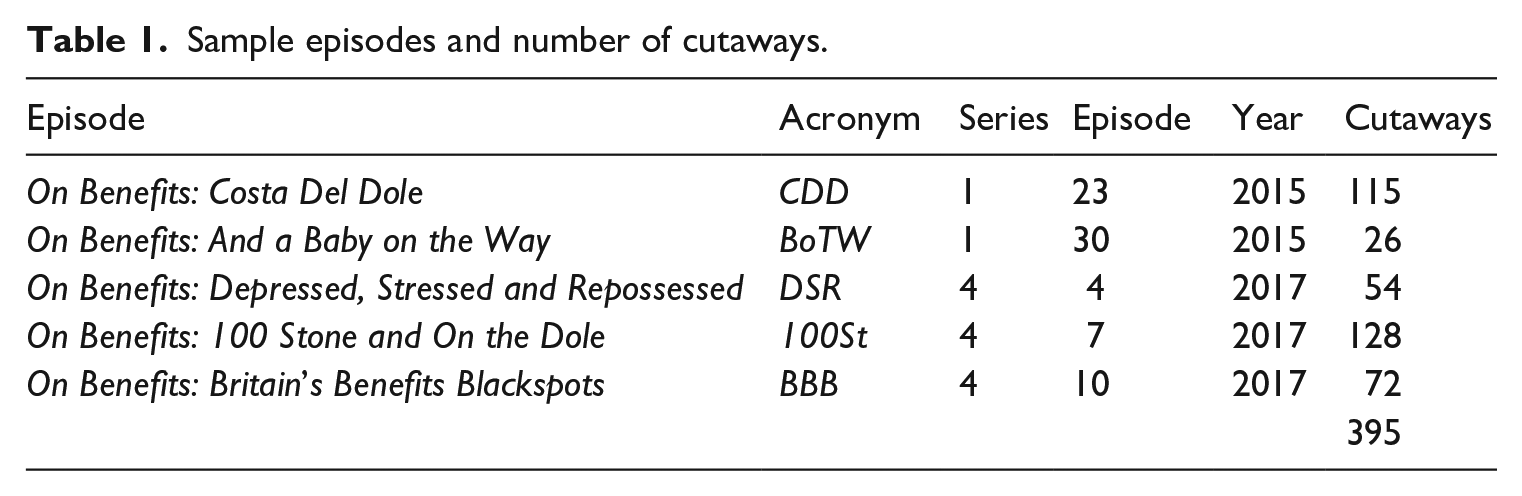
Our project ran from October 2018–2020, within which we applied VGA to a sample of episodes from Channel 5’s FWT series, On Benefits (2015–2019) to examine how cutaway editing constructs the living places of welfare recipients in ways that generate the moral response of disgust. Each episode was 60 minutes in duration, including commercial breaks. The broadcaster here is not irrelevant. The newest and smallest of the terrestrial broadcasters, Channel 5 first launched in 1997 and is now owned by Viacom International Media Networks, a division of Viacom Inc. Gaber et al. (2016: 638) argue that Channel 5 tends ‘to adopt a populist approach’. We first conducted a pilot study in relation to a single randomly selected episode, ‘Britain’s Benefit Blackspots’ (2017) (hereafter BBB), following Haywood’s definition of cutaways as those edited-in shots that ‘take the spectator away from the main action’ (Kress and Van Leeuwen, 2006: 96). We selected episodes via simple random sampling, using Google search engine’s random number generator to select series and episode numbers from On Benefits from a playlist of the series available from Box of Broadcasts. We then identified the number of cutaways used in each (Table 1).
Sample episodes and number of cutaways.
Quantitative data
We identified 395 cutaways across the five episodes, ranging from 26 in On Benefits: And a Baby on the Way (2015; BotW) to 128 in On Benefits: 100 Stone and On the Dole (2017; 100st; Table 1). The mean number of cutaways across the sample was 79. Of the 395 cutaways, 99 shots (25%) focussed primarily on the protagonists. Although we acknowledge that representations of people, bodies, and practices are fundamental to stigmacraft (Tyler, 2020), our argument in this article is that space has been neglected and this forms the rationale for our selection. We discounted close-ups of people’s bodies (mostly hands and feet) and of them smoking and eating. We also discounted ariel or panning shots of neighbouring cities and long-distanced views, of which there were 24 (6%), so that, we could focus on interior spaces and the protagonists’ immediate localities. This process left us with 272 shots (69% of the total) that predominantly featured an immediate location. This number indicates the spatially rich imagery of our sample episodes and demonstrates that the imagery is principally that of the protagonists’ homes and streets. We recorded the character of these images by devising a short, qualitative description of the main visual element in each cutaway, which helped us to compose collective categories; for example, a cutaway described briefly as ‘busted sofa turned on its side’ was included in the category of ‘Fly-tipping’. An overview of these qualitative descriptions is provided in Table 2.
Categorisation of screenshots.
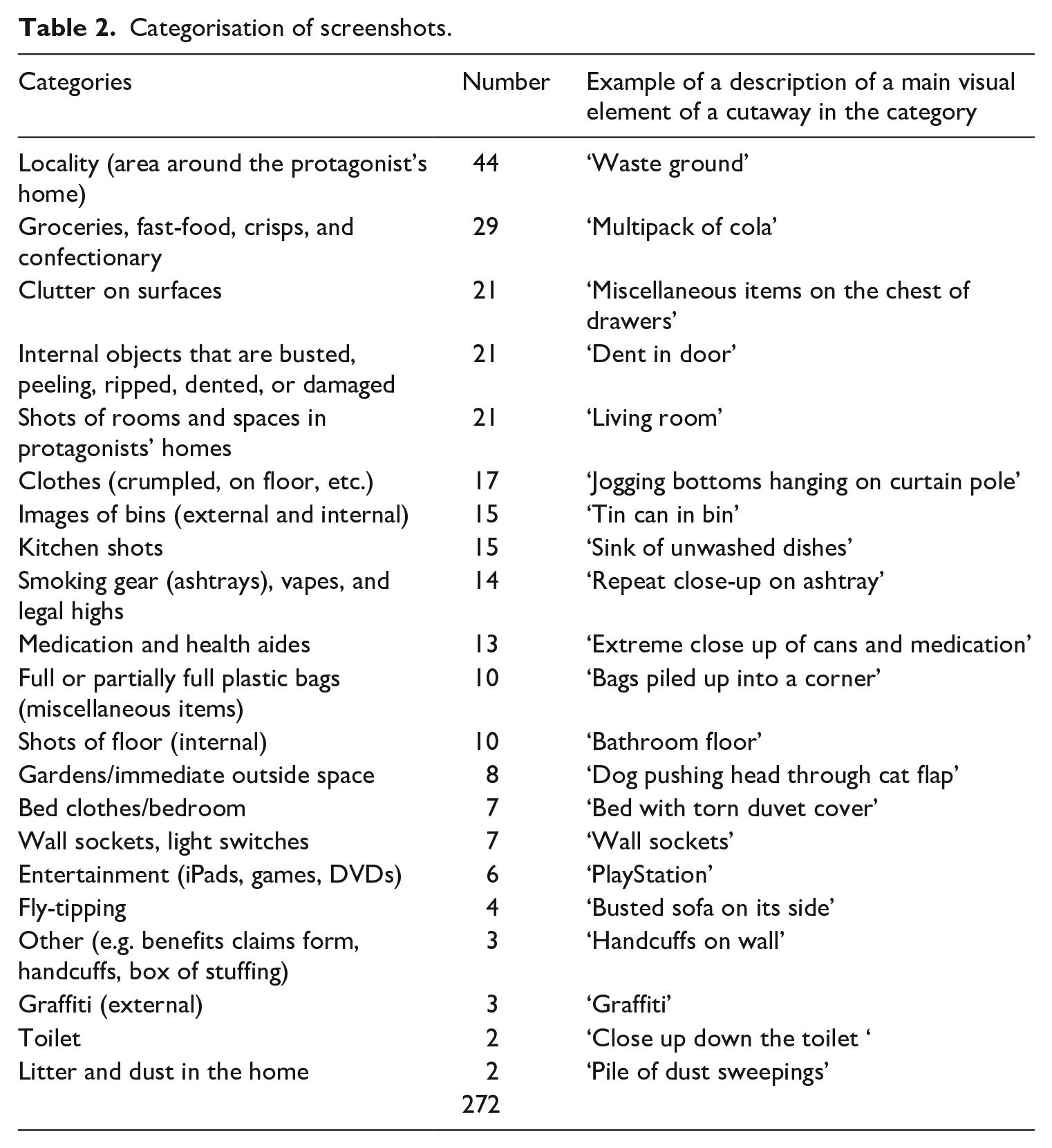
What was striking about these data was the relative lack of imagery of excess consumption that stereotypically forms the content of FWT to indicate the ‘inappropriate’ use of welfare payments by the (mainly) white working class (McEnhill and Byrne, 2014; Tyler, 2008). Only six cutaways moved the viewers’ attention to entertainment technologies (e.g. PlayStations, television sets, and DVDs). ‘Problematic’ consumption was instead suggested by images of fast-food, processed food, and those of clutter, messiness, and bags of miscellaneous items piled in corners, which produced a visual experience of indiscriminate ‘stuff’. This stands in stark contrast with a focus on order and the management of ‘stuff’ across mainstream media, which teaches ‘people how best to organize, categorize, sort, and discard their belongings’ (Brembeck, 2019: 48). It contrasts too, with programming that pathologises those who fail to adhere to cycles of accumulation and disposal that ensure a ‘natural’ flow of stuff as the home is remade according to the dictates of fashion (Brembeck, 2019). The lack of aesthetic finesse in our sample may be exemplified by seeming neutral, randomised shots of walls, floors, and electrical sockets. We may surmise here that these mundane shots are edited in to fill content time, but they may demonstrate that there is little of aesthetic note to film instead.
In line with Bordwell’s (2002) argument, above, that ASLs are shortening, it was significant that 68% of shots were under 2 seconds in duration (Table 3). The duration and speed of shots in documentaries, as with other media, remain under-researched (Kendall, 2016). Yet, research on film suggests that camerawork and editing are part of a structure of feeling, orientating viewers to a shared imagination of the world represented on screen (Purse, 2016). As such, there is scope here to suggest, in lieu of audience research, that quick cutaways may elicit affective responses in viewers (Blackmore, 2007), providing as Bricca (2017) states, stronger ‘visceral . . . evidence’ (p. 59) than any spoken narrative of certain perspectives on welfare and poverty. This is what brings us to disgust, usually understood as a relation to ‘the improper/unclean’ (Kristeva, 1982: 2). We argue that close-ups on litter, mess, crumpled bedclothes, dust and damaged walls, ripped wallpaper, and toilets suggest an attempt to produce dominant readings of disgust.
Congruity and duration.
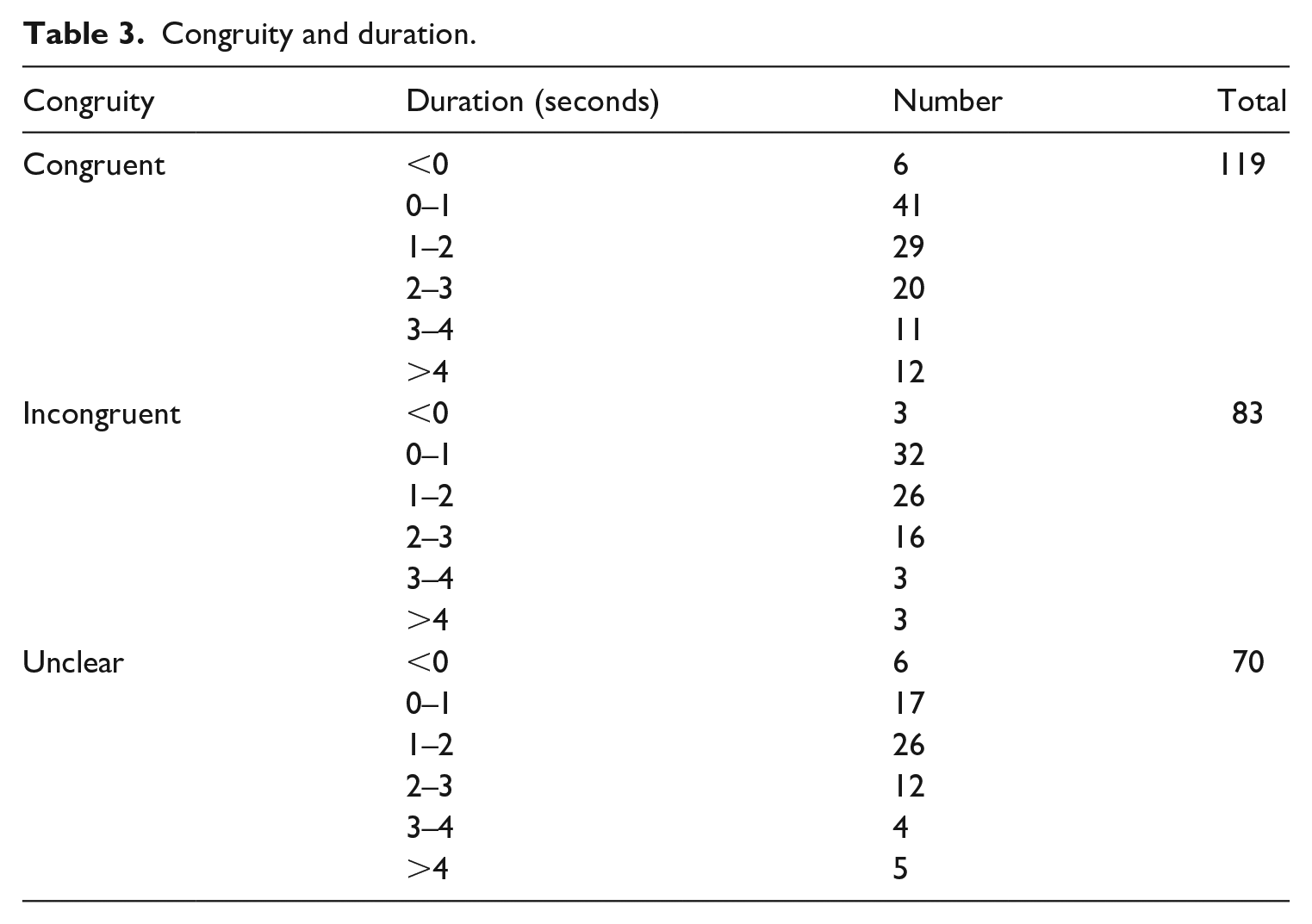
We found that 119 cutaways, just under half of the sample (43.75%), had clear congruity with the programmes’ explicitly articulated narratives. In these cases, the voiceover or dialogue related directly to the visual content of the shot. For example, a cutaway shot to a close-up image of an overflowing ashtray was accompanied by words about cigarette smoking. However, 153 cutaways, or just over half of the sample (56.25%) were either incongruous or their congruity was unclear. For example, a cutaway shot to an ashtray was accompanied by words about unemployment. This suggests that while cutaways may be used to provide visual data to complement a programme’s explicitly articulated narrative, more often than not, cutaways can contradict, undermine or add an element of ambivalence to the ostensible storyline, suggesting that the series’ visual grammar works surreptitiously to produce a counter-narrative operating at the level of plain sight. Moreover, even where cutaways were congruent with the explicit verbal narrative, they tended to focus on what we argue are disgust-inducing visual imagery. It is worth acknowledging that the narration in these programmes can be ambiguous: we are not suggesting that the narration is neutral (Harrison et al., 2021).
From our initial data analysis, we selected three shots from the final sample of spatial cutaways that best exemplified the trends we had identified (Table 4). We could have selected these at random because our dataset was rich in disgust-inducing imagery, but we wanted to analyse examples that were particularly pertinent to the existing scholarship on stigma (Tyler, 2020) to show how the visual grammar of FWT works against the explicitly articulated narrative to visually construct the living places of benefits claimants as morally lacking and undermine sympathetic accounts of hardship. Our attention to only three images is justified by the detailed and data-rich nature of VGA, which is usually associated with singular or small numbers of visual texts (e.g. Dash et al., 2016, focussed on two TV commercials; Gunarti, 2017, on a single televised public health campaign). To reiterate, our overall aim was to examine how carefully placed and framed images can produce syntactic relations between places, objects, and people within a given text. This relationality was important for our purposes because it focusses on how cutaways contribute to the ideological effect of spatial stigma. Below, we conduct VGA in relation to each of the three shots following Kress and Van Leeuwen’s (2006) compositional trilogy of information value, salience, and framing.
Visual grammar analysis.
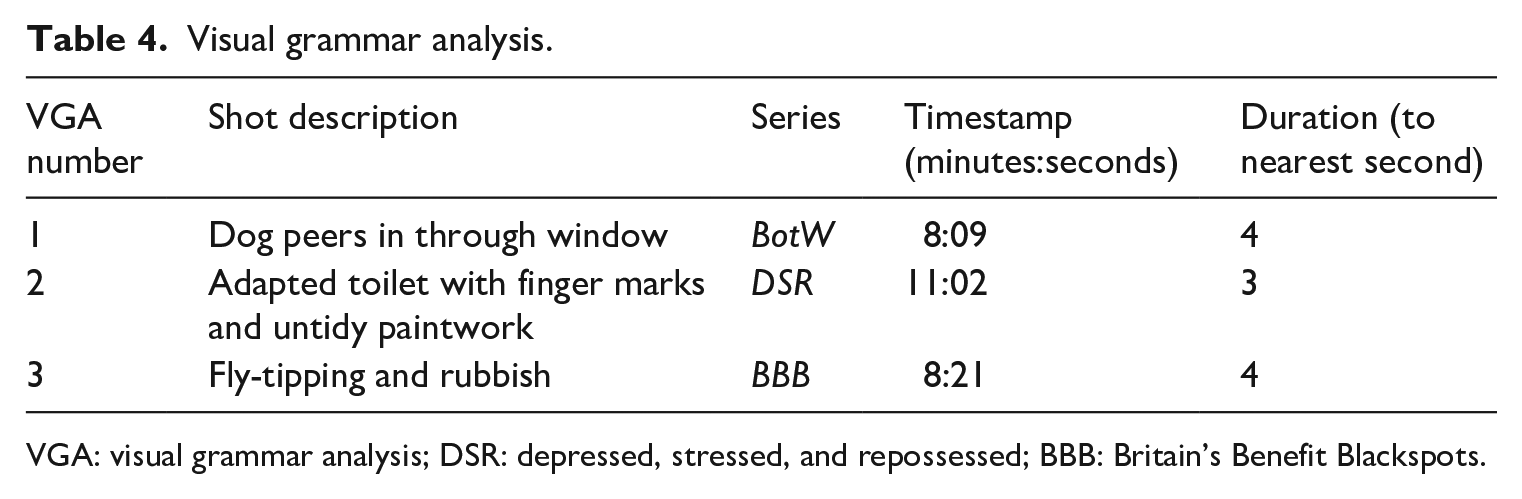
VGA: visual grammar analysis; DSR: depressed, stressed, and repossessed; BBB: Britain’s Benefit Blackspots.
Visual grammar analysis
Here, we utilise Kress and Van Leeuwen’s (2006) compositional trilogy of information value, salience, and framing, to three screenshots from On Benefits (Table 4). Information value refers to the ‘placement of elements’ in the visual composition, which endows them with the ‘specific information values’ attached to the various zones of the image; for example, centre or margin, left or right (Kress and Van Leeuwen, 2006: 177). This aspect of composition also sets up oppositional elements. Salience concerns the extent to which the visual elements ‘are made to attract the viewer’s attention to different degrees’ through factors, such as ‘placement’ (foreground/background), ‘relative size’, and ‘contrasts in tonal value (or colour)’ (Kress and Van Leeuwen, 2006: 177). Finally, framing is produced by framing devices realised by elements of the composition that create dividing lines or connections or disconnections, generated by continuities or discontinuities of, for example, visual shape, brightness, or separations of space. Framing devices within a visual composition signify that elements ‘belong or do not belong together in some sense’ (Kress and Van Leeuwen 2006: 177). Kress and Van Leeuwen (2006) do not factor sound into their analysis, so that: we add to their framework our consideration of the level of congruence between the visual grammar and the corresponding narration or dialogue in relation to each screenshot.
Visual grammar analysis 1
Our first analysis is of a cutaway shot from BotW, an episode that features three young mothers on benefits. Amy is a 20-year-old mother of two whose boyfriend has left her. Placed in her living room with her 1-year-old and 5-week-old baby, she lists all the benefits that she receives to camera. She picks up torn paper: ‘The dog’s ripped up the mail again as it’s come through the front door. It’s a nightmare’, Amy tells the crew. From here, the camera cuts away to 4-second shot of the dog in the yard as it waits at the boundary to the home by the window, close to a door with a dog flap (Figure 1). The camera sits at the boundary between the outdoor concrete yard and the window adjacent to the door. Situated a few inches from the pane of glass looking out to the yard, it captures inside objects in front of the window: an ‘in-use’ baby’s bottle showing milk residue and the spiky brown foliage of a dead potted plant. At the other side of the window is the large head of the dog positioned in close proximity to the door area. The side wall of the house and a concrete yard beyond compose the background of the image.
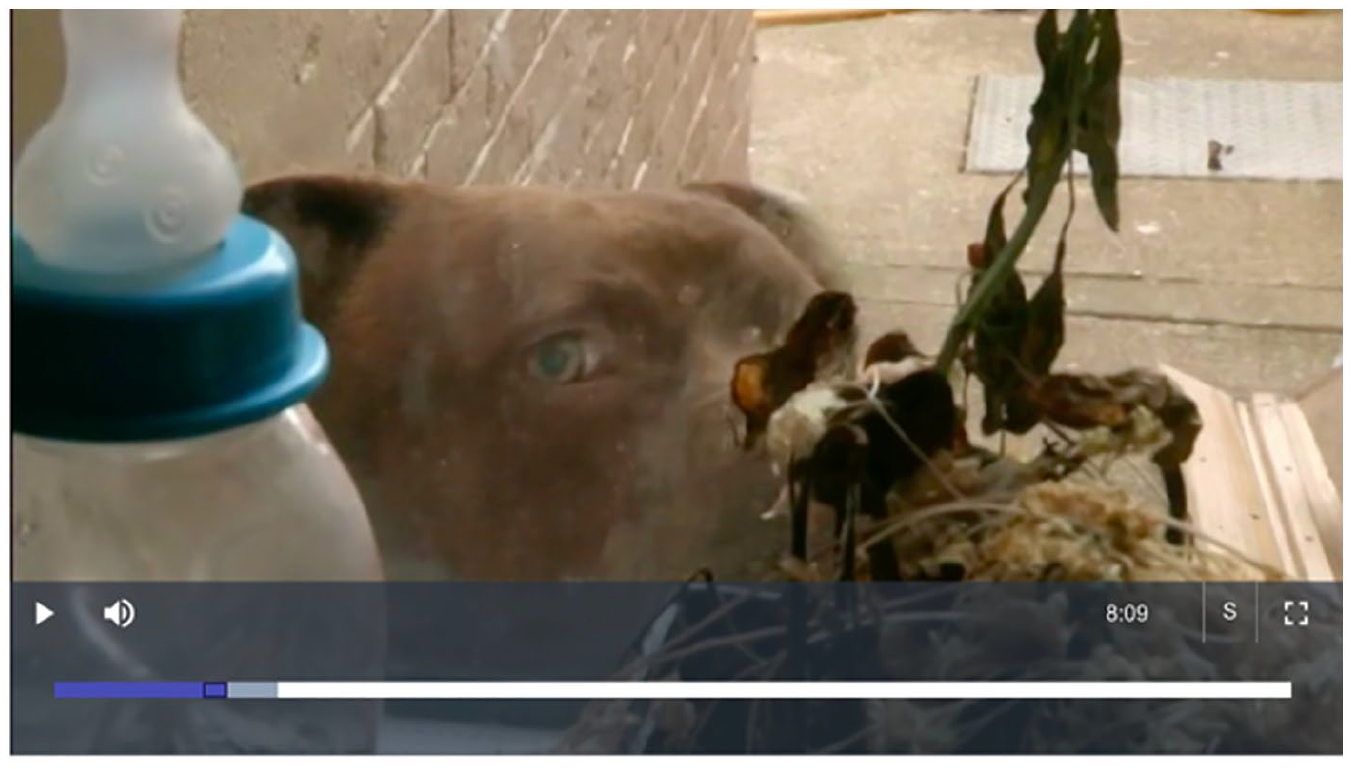
Dog peers in through the window (BotW).
The baby’s bottle is large and upright on the left of the image in the foreground and thus indicates high information value and salience. Structurally opposite in the upper right are pieces of dog faeces. Occupying the formal centre and middle-ground in terms of depth is the head of a dog. The dog’s head is accorded further significance via framing, in that, the baby’s bottle and stalk of the dead plant surround it in the shot. The blue seal and the whiteness of the teat, and main body of the bottle stand conspicuously as the brightest, most colourful elements in the image, while the smallness of the dark faecal matter is conspicuous in the dull grey concrete yard. The dog’s head looms large at the centre and the viewer is drawn to one hazel eye that stares into the house interior and seemingly straight to camera. Narrative connection is achieved to link the dog with the faeces, and these elements are connected through the salience of these features and their brown colour continuity. These elements remain spatially connected by being outside – beyond the ‘boundary’ of the window. The spatially close relationship between disconnected elements – the proximity of the baby’s bottle to the dog’s head – and the colour continuity – the brown of the dog and excrement outside and the dead plant inside – threaten to rupture the narrative of a mundane day to suggest an unfolding action where participants and objects will interact with each other. Gaze, as Friedman and Ron (2017) remind us, is relevant here. The dog’s level gaze denotes equality with the objects on the windowsill and the baby within. This produces the tension of the threat of narrative discontinuity: if the dog crosses the boundary to enter the home it brings bacteria to infant feeding equipment and threat to the infant(s) and adults within.
The sound that accompanies Figure 1 is composed of diegetic and non-diegetic elements melded together: Amy’s baby crying and whimsical background music. While the viewer looks at the menacing bull terrier-type dog at the window, the sound pulls the listening viewer to the vulnerable presence of the helpless baby. This breed of dog is considered to be a source of filth; unpredictable, it is a threat of violence to an infant. The ‘playful’ whimsical music which accompanies Amy’s crying 5-week-old implies that the connection between the dog and baby is not taken seriously and implies a lack of parental responsibility. The conjoined vision and sound in this sequence concretises the dog as a signifier of parental neglect: dog faeces in the yard signify the bacterial threat the dog poses; and the threat of bites, mauling, and infant death from one of the reputedly most aggressive dog breeds are viscerally amplified. While epidemiologists argue that ‘there is a lack of understanding as to how victim/owner behaviour and misunderstanding of dog signalling can provoke dog bites’ (Westgarth et al., 2018), the British tabloid press holds a more punitive view of who is to blame. Indeed, there is a history of tabloid reporting on dog ownership in the UK which shifts blame away from banning the breed of the dog, epitomised by the Dangerous Dogs Act (1991), to imposing ‘harsher jail terms on feckless owners’ (McKinstry, 2019). The editorial decision that Amy lists her benefits in this scene is not, then, ‘neutral’ – the following cutaway camera shot positions the viewer to dislodge any sympathy they might have for a single young mother by underscoring her ‘irresponsible’, filthy, dangerous dog.
In relation to congruence, the dialogue and sound here are clearly congruent with the shot’s visual content since Amy’s spoken words refer to the dog that has ‘ripped up the mail again’. Nevertheless, the visual grammar of the spatial shot and its syntactical relationship with the broader scene serve to insert a powerful supplementary meaning into the programme’s narrative: that Amy is a bad mother.
Visual grammar analysis 2
Our second VGA focusses on a cutaway shot from the episode depressed, stressed, and repossessed (DSR), which features three case studies of people claiming sickness benefits. Participant Caroline, introduced by the narrator as a ’58-year-old grandmother of eleven’, suffers from angina, arthritis, and asthma. She discusses her suite of sickness benefits while her body visibly shakes as she rolls a cigarette. She is also a victim of familial violence and, in this scene, the viewer hears her verbal account of her drug-addicted grandson’s actions when he trashed and robbed her flat to obtain money – ‘he came up here, meat cleaver up his sleeve’. As she speaks, the editing inserts a rapid series of short shots of the flat’s unkempt interior, including this 3-second shot of the toilet in the small bathroom close to the kitchen (Figure 2). Here, the camera is located in the corner of the bathroom, so that, the toilet, hallway, and part of the kitchen are visualised for the viewer in a single shot. The viewer gleans a sense of the available living space for the inhabitants. The toilet has been adapted with handrails so that disabled occupants can access the facilities. The bathroom wall shows evidence of being experimentally decorated, but has now fallen into disrepair. The other walls and floor spaces are grubby and run-down, and other decorative accessories – the rug in the hallway – are untidily positioned.
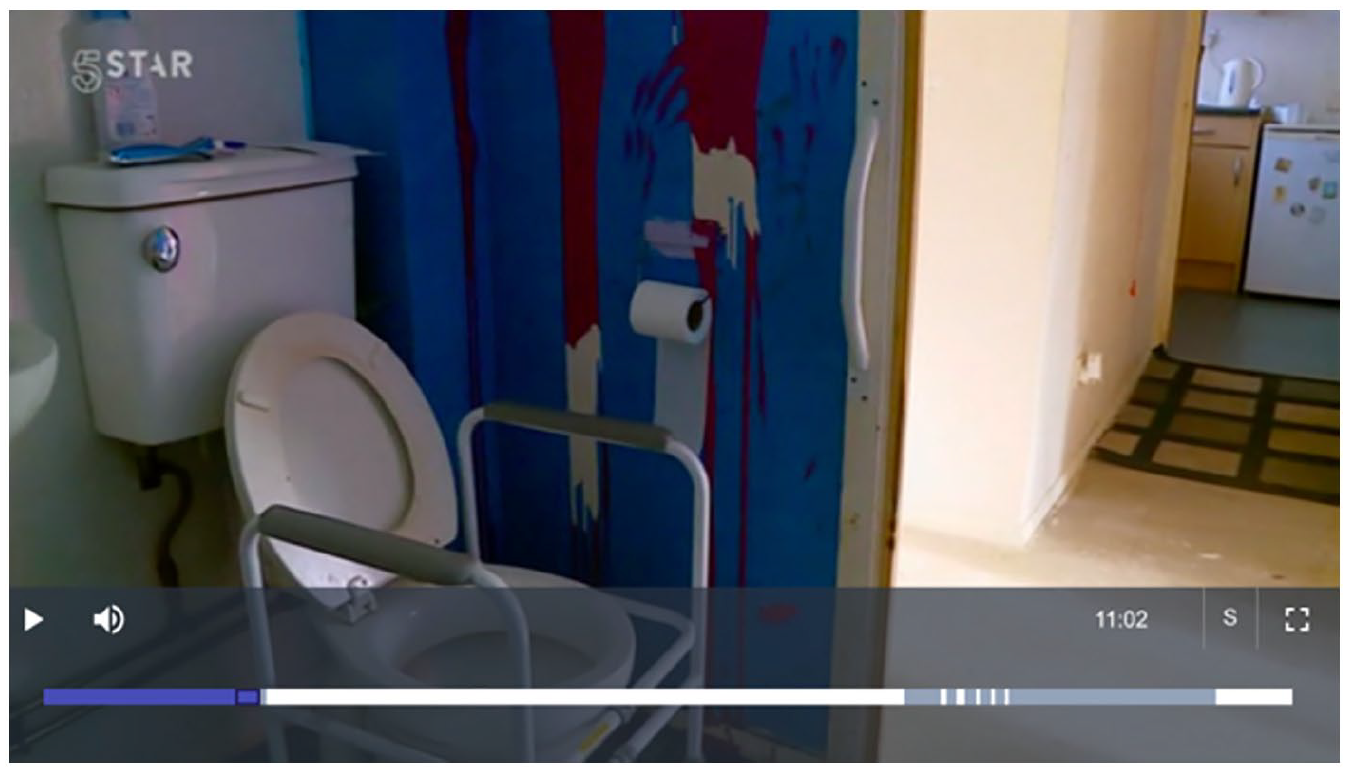
Adapted toilet with finger marks and untidy paintwork (DSR).
In terms of informational value, the shot informs the viewer that the hall is short so that the lavatory space in the bottom left of the image is spatially proximate to the top right of the image – the kitchen. In this way, the left and right corners of the image create a viewing rhythm between opposing elements: the human excretion in the bathroom at worryingly close proximity to the food preparation area of the home. Salience is generated by the white objects in the shot, which provide the brightest visual elements: the toilet bowl in the foreground, with its lifted seat, and the white goods in the kitchen in the background, comprising the fridge and the kettle, serve to underscore the link between defaecation followed by eating. The bright blue walls in the toilet – centrally placed in the image – also vie for viewer attention. Red streaked paint that runs down the wall has a bohemian art-student feel, but in this context, a more likely explanation is that this is an act of vandalism. Other salient features include the picked-off wallpaper and the unidentified ‘streak marks’ down the walls and woodwork next to the toilet. How these elements are framed is also important. The hallway, unified by the choice of cream paint provides connection, by a few steps, to the bathroom and kitchen. As a result, the hallway is a spatially stifling experience for the inhabitants – a short walkway between bathroom and kitchen. Elements of disconnection are the blue walls in the bathroom and the checked rug in the hallway, placed at an ill-fitting angle in the floor space.
Edensor (2005) argues that photographs can stir sensuous as well as visual responses for viewers. Still shots imply kinaesthetic responses. This shot is composed so the viewer can envisage the movement of bodies through the small living spaces where the most basic human functions take place. This shot brings these spaces into such close proximity as well as the implied movement from the toilet bowl with its bacteria – and its travel, by impregnated human hand – to the fridge and the food within it. Still shots also trigger synaesthesia: the visual can transport the viewer to other senses, including smell. The short space between these rooms means that noxious air containing human odours from the toilet could occupy this small landing. The bright white toilet bowl vies for salience serving as an underscoring canvas for the stains of human waste which accrete on the underside of the toilet seat. Similarly, the bright blue wall with its dark wiped finger marks prompts the viewer to question what is being wiped on the walls of the toilet. We suggest this shot creates visceral senses of bodily disgust in relation to inhabitants, who lack the required cleanliness to live hygienically within these confined living spaces.
The congruence of this cutaway is thus ambiguous: is Caroline’s ‘berserk’ grandson responsible for the vandalism to her bathroom or is there a different explanation for the dereliction and uncleanliness? Regardless, the cutaway editing used here aids in the provocation of disgust by juxtaposing the verbal testimony of victimhood with imagery of filth and contamination.
Visual grammar analysis 3
This 4-second shot from the episode BBB, which features three unemployed men, is edited into a longer scene, concerning participant Leon from Ashton-Under-Lyne, set in his kitchen. The narrator establishes that, ‘He’s in over £1000-worth of debt and finding it difficult pay his bills because he’s never had a regular wage’. Leon tells the camera: ‘I’ve been fighting to pay ’em off, which was very difficult for me’. As Leon testifies to his difficult battle to make good his large debt, the view shifts suddenly to a shot of fly-tipping in the streetscape (Figure 3). This startlingly incongruent cutaway works here to both join and cancel out Leon’s redemptive testimony – his willingness to take responsibility for his financial difficulties is undercut by a heap of unwanted rubbish in the street. In this shot, the camera captures a collection of dumped objects on a tract of land in front of a red-brick wall. There is evidence of churned up uneven soil and shrubbery beneath the waste. The miscellaneous objects – an old football, a recliner chair, pieces of discarded timber, plastic, and ply-board sheeting – have been fly-tipped on the land. A tortoiseshell cat negotiates the awkward shapes and angles of the left-over remnants of decorating or construction work.
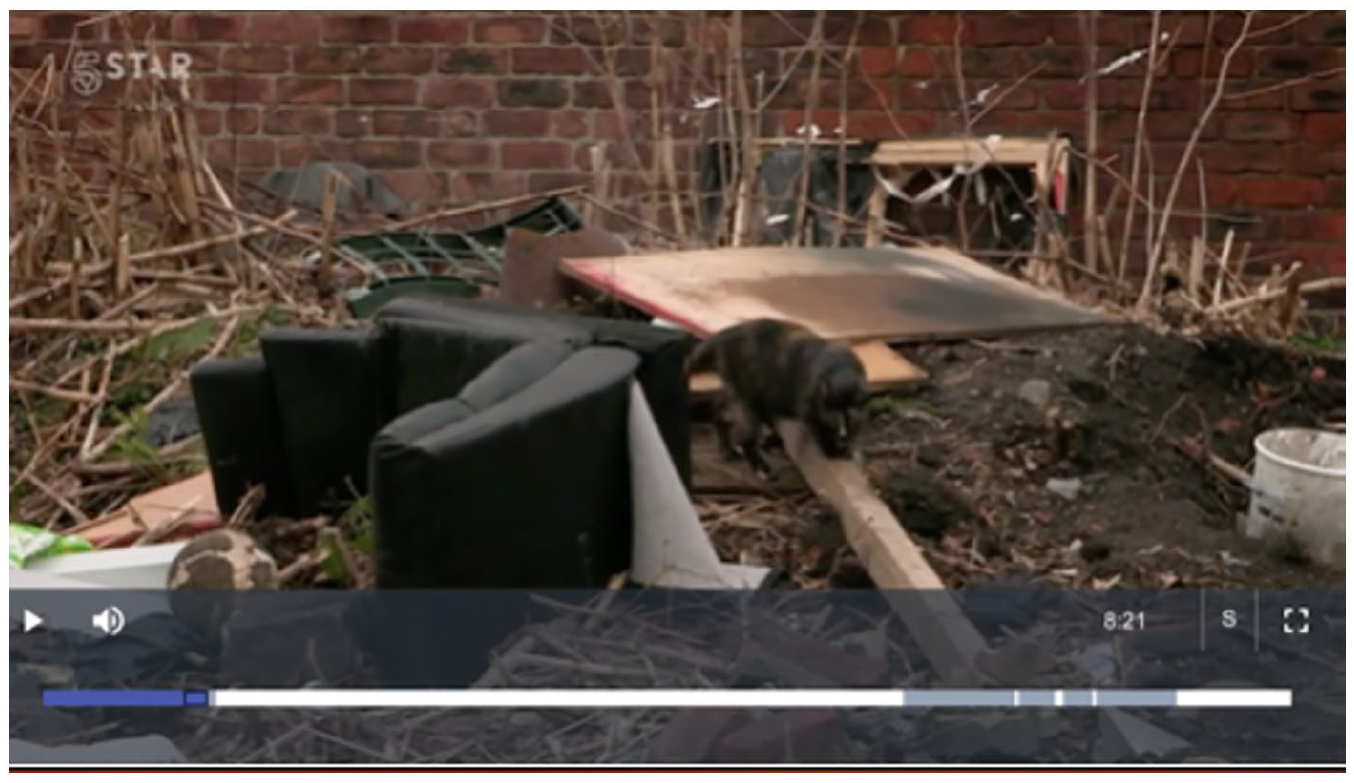
Fly-tipping and rubbish (BBB).
The discord of the unwanted objects discarded on a piece of land next to a built wall makes up the informational value of this image. The objects – a result of seemingly multiple acts of fly-tipping – act to defile the decorative potential of an area of shrubbery and soil. Pieces of litter speak of past activities now redundant – relaxing in the lounge, playing football, and home improvement. In terms of salience, these items are matter out-of-place in strange positions in the middle-ground. They pull the viewer’s attention: a sheet of ply-board in the centre of the image next to the black, cheap faux leather of the recliner chair tipped on its side towards the bottom left of the frame, and unfathomable pieces of plastic divorced from their original purpose. A cat – low yet central in the frame – brings movement to the image by carefully plotting a route through the rubbish on an awkwardly dropped piece of timber. Framing is achieved here through capturing an indigestible disconnected set of objects: what connects them is their status as waste, interior objects that should not be here. While earlier images say something about individual inhabitants’ morally questionable and disgust-inducing living practices, this outside image says that the community of people inhabiting this location has no collective conscience to sustain a respectable sense of place. It suggests that countless acts of dumping of unwanted items add up to a malign mind-set of people who do not care for their belongings, fail to respect the local area, and who are at home in streets paved with detritus. As we argue above, the urban visual language of this shot produces kinaesthetic effects. The movement of the cat – sniffing the animal smells and potentially defaecating in response in the churned soil in the cracks between the rubbish – bring visceral feelings of what is a common theme in these images: disgust. It is these shots where Wacquant’s (2007) urban ‘hell-holes’ are literally manifest: refuse in the streets signifies, ‘leprous badlands . . . where only the refuse of society would accept to dwell’ (p. 67).
Focussing on congruence, this cutaway is entirely incongruent with the scene into which it is inserted. In the shots that immediately precede the object of our third VGA, we see Leon in his kitchen discussing his debts. The sudden cutaway to the scene of fly-tipping takes the viewer to visual imagery that is incongruent with the sound to undermine Leon’s testimony of hardship and suggestive of a counter-narrative of carelessness, anti-social behaviour, and criminality in the town of Ashton-Under-Lyne.
Discussion
Our data were surprisingly rich: numerous cutaway shots appeared in each episode and the visual content of these shots was predominantly rich in unsavoury or condemnatory imagery which, when juxtaposed with the preceding scenes and/or simultaneous verbal information, served to undercut sympathetic testimonies of coping with poverty, single parenthood, indebtedness, illness, and violence. The rhythm of such shots produced by cutaway editing constructs a sustained counter-narrative to the explicitly articulated narrative and, moreover, instils a visual grammar of spatial stigma that orients viewers towards a visual literacy of disgust. Above, we discussed Kress and Van Leeuwen’s (2006) identification of the importance of the ‘spatial patterns of individual shots’ and ‘rhythmic patterns of editing’ in producing visual grammar (p. 265). Developing the approach of Kress and Van Leeuwen (2006) in our VGA of On Benefits, we have shown that cutaway editing is a predominant feature of the visual narrative and recurs frequently to constitute a televisual syntax that represents the life-worlds of benefits claimants with an incisive ‘documentary look’, and also reproves and undercuts participants’ personal testimonies. That editing is performed after filming has taken place, out of the view of participants, is incriminatory: participants are evidently encouraged to speak candidly and allow the camera operator access to their homes and locales, yet, subsequently, the visual information generated from the visit is deployed against them as affective evidence of their bad parenting, poor personal hygiene, out of control spending, irresponsibility, or untrustworthiness. We consider this editing in FWT to be a mechanism of ‘stigmacraft’.
Tyler (2020) argues that practices of stigmatisation are a productive form of power, ‘enmeshed in wider capitalist structures of expropriation, domination, discipline and social control’ (p. 17). Tracing historical instances from branding criminals with tattoos in ancient Greece to the use of ‘stigmatainments’ (Tyler, 2020: 26) to win consent for fiscal and social ‘reform’ in austerity Britain, tracking stigma enables an understanding of the ascendency of authoritarian governments. Tyler argues that the present juncture is characterised by, ‘a period of capitalist enclosure and extraction, of dispossession and displacement’ in which stigma has a key role. As part of the ‘political economy of stigma’, corporate policymakers and government strategists use ‘stigma-crafting’ to stimulate turmoil and make way for new cycles of accumulation. Acting as a ‘form of classificatory violence from above’ (Tyler, 2020: 27), stigma acts to dispossess people of land, wealth, and state-owned assets for the uses of privatisation, commodification and capital accrual. In the process, it seeks to worsen inequalities, shame individuals, scapegoat communities, and destabilise social bonds.
In Britain, these processes have been engineered by the stigma machine of austerity. Consequences for the vulnerable and poor in the age of austerity in the last decade are grave. A total of 17,000 people died awaiting assessment of their 2013 disability benefits claims (Wood and Skeggs, 2020). Homelessness in the fifth largest economy in the world stands at 280,000 people (Geraghty, 2021); 1.9 million people used a foodbank in 2019–2020 (Trussell Trust, n.d.). Public services have been impoverished: although much admirable work still takes place, the role of the social worker, for example, it is argued, has been forcibly shifted from one of offering services to ‘an agent of social control who manages and – where necessary – punishes the vulnerable’ in the wake of austerity cuts (Butler-Warke et al., 2019). Tyler (2020) argues for the notion of austerity as enclosure – public goods are being fracked in the interests of capital, reversing the social provision of public goods, services and land once held ‘in common’ to conclude that ‘austerity is nothing less than a government-orchestrated programme of theft’ (p. 171). The vast majority of homes for the elderly and sick are privately owned, conceived as assets for conglomerates seeking a return on their investments. No wonder Wood and Skeggs (2020) ask that while we clap in a show of appreciation for the National Health Service (NHS) during the Covid-19 pandemic, we look back in anger to ask how we have become a society in which human suffering as become, ‘a lucrative source of capital extraction?’ (p. 643).
This question brings us back to the continued function of FWT as ‘stigmatainment’ (Tyler, 2020: 17) after a decade of austerity in Britain. Tyler argues that factual welfare programming acted as an arm of ‘stigma-power’ that enabled the Conservative government to secure the public’s consent for austerity reform. In 2008, Chancellor of the Exchequer George Osborne (2008) attacked ‘dependency culture’ arguing a profligate welfare system supported millions languishing on state benefits. Undergirding his justification to cuts and punitive outsourced workforce measures was the strenuous inference that claimants were deliberately taking advantage of the benefits system. Ian Duncan Smith (2015) – former Work and Pensions Secretary – lauded the reforms in 2015 for creating a shift from ‘dependency’ to ‘resilience’. To win public acceptance of the government thesis on welfare dependency, Tyler (2020) argues that politics and media joined ranks in the production of a massive propaganda campaign, launched to make the ‘welfare stigma machine’. It churned out key figures of dependency – among them the profligate scrounger – which were rolled out across a regime of media and journalistic platforms, but which exploded in reality television. Indeed, as Tyler (2020) documents, programmes, such as Channel 4’s Benefits Street were recalled as evidence in parliamentary debate of the rewards secured by the immoral claimant. We should not be surprised by Hills’ (2017) contention that the public have become desensitised to the hardship of the poor, most especially in relation to working-age people, both in the street and on our television screens.
Our VGA of On Benefits has exposed stigmacraft in operation. Cutaway editing is an insidious technique of producing a visual language of poverty that is learned by television audiences by force of repetition. The cutaway shots we have examined above are strategically deployed moments of destabilisation inserted into sometimes relatively sympathetic surface narratives of victimhood and structural forms of inequality. This strategy of stigmacraft enables and sustains punitive discourses that stigmatise dependency in FWT and in other expressions of popular culture (Raisborough and Adams, 2008). In this research, we have offered an account of the visual grammar of spatial stigma in FWT and shown how, in this context, stigmacraft is a deliberate, considered product of editing techniques and visual composition.
Conclusion
In lieu of audience research, we cannot presume how diverse audiences may read On Benefits, but if we approach these episodes as cultural artefacts (Frith et al., 2010), our VGA suggests that editing techniques used in On Benefits are crucial to the production of spatial stigma and provide an insight into editing as one of the mechanisms of what Tyler calls ‘stigmacraft’; that is, a deliberate strategy to present the poor as undeserving and a national burden. In this research, we are concerned with how the residences and local areas of welfare claimants are constructed as defamed places or urban hell-holes generative of corrupt, irresponsible inhabitants who are deserving of their plight. VGA shows how compositional elements of cutaway shots, which are frequently inserted into the programmes’ narratives via digital editing, not only interrupt and undermine verbally articulated accounts of hardship, but also serve to produce a visual narrative of spatial stigma. Here, a careful consideration of information value, salience, and framing in cutaway shots of living places and locales has shown that representations of particular features of domestic spaces and local landscapes are carefully chosen to equate the participants with filth, disorder, and rubbish, even while the narrator’s voiceover or subjects’ dialogue explains otherwise.
In this article, we have responded to Tyler’s call for a more precise analysis of the efficacy of the mechanisms of welfare stigma to develop a sense of why such programmes have effectively hardened the public. We argue that, to date, research has focussed on the human figures of FWT at the expense of an examination of how people become ‘glued’ to abject space. Here, we focus in granular detail on how On Benefits’ televisual technologies of image and sound join together, through the cutaway (Bricca, 2017), the abject benefits claimant, and despoiled space. The bodies and voices of Amy, Caroline, and Leon are affixed to squalid, and dog-defiled interiors and townscapes paved with detritus; their claims to valid personhood are disqualified by camerawork, which syntactically equates them with rubbish, crime, and bad choices. Carefully positioned to tell, map, and precisely cost their multi-benefit claims, each programme works to dissolve the legitimacy of their positions by asking the viewer to calculate their economic stagnancy by tilting the mirror, so that the viewer can survey the space of the excrement in the yard, the defiled home interior, and the rubbish in the street.
Footnotes
Funding
The author(s) disclosed receipt of the following financial support for the research, authorship, and/or publication of this article: BA/Leverhulme Small Research Grant award SRG18R1\180914. ‘What function do representations of space and place perform in factual welfare programmes? Towards a visual grammar of benefits stigma’.
