



Abstract
This article comprises a critical reflection on our experiences of recruiting participants and organising focus groups through institutional gatekeepers for research about young people and changing gendered landscapes. We show how reflections on the research process can give (inadvertent) substantive insight into how gender is interpreted by gatekeepers in institutions – that is, gender as only about or for certain young people; gender as something to be contained by the institutional logics of equality and diversity; and how ‘right’ and ‘wrong’ views of gender diversity were understood through the nationalisation and racialisation of the student body. Crucially, we also trace how these institutional interpretations of gender diversity had epistemological consequences for the kinds of knowledge we were able to generate in the focus groups with young people, as meanings were re-framed and contested, and we were funnelled down particular routes. Furthermore, the article discusses how the act of research itself was leveraged by some institutions as institutional diversity capital and/or as part of classed enrichment agendas, highlighting new dimensions to both the co-option of research and the ‘doing’ of diversity work by institutions. Overall, the article provides empirical insight on gender and gender diversity in education and youth settings, and also key methodological insight into the social constitution of ‘Knowledge’ through gatekeeping, recruitment, and access.
Introduction
As mainstream visibility and legal protections for diverse gender identities increases, youth-oriented and educational institutions in the UK are recognising the need to engage with gender and gender diversity 1 (McNamara, 2018; NASUWT, 2017; National Education Union, 2019). Internationally, the creation, implementation, and contestation of gender diversity policies in educational settings are beginning to be discussed (see Martino and Cumming-Potvin, 2018). In this article, we expand on this literature on gender diversity, education, and youth in a unique way.
Our substantive research focus was not on gender diversity within educational settings – rather, it was a wider study on young people and how they are understanding rapidly changing gendered landscapes. As one arm of our research design, we made the pragmatic decision to organise focus groups with young people through educational and youth-oriented settings (sixth forms, further education colleges, youth groups, and universities) as spaces where we would find a concentration of 16- to 24-year-olds. The institutional context was – at the time – purely incidental. However, as we progressed in this endeavour, we found ourselves having many conversations about the interactions and negotiations we were having with the institutional gatekeepers who were facilitating our access, and how these ‘moments’ themselves were (inadvertently) generating rich insights. Substantively, these interactions were showing us how gender diversity was being interpreted on-the-ground by educational and youth organisations, which had not been an intended outcome of the research. Methodologically, we were realising that gatekeepers’ interpretations fed into our access to and recruitment of young people, which had epistemological implications for the kinds of ‘knowledge’ that we were able to generate about youth and gender. We also spent much time reflecting on how our interactions were revealing an underexplored dimension of the literature on ‘diversity work’ in institutions (Ahmed, 2012) by highlighting how participation in social research (e.g. hosting and facilitating focus groups) may be co-opted by institutions in the performative ‘doing’ of diversity – often in ways that we as researchers find objectionable. As Tarrant and Hughes (2020) have previously shown in this journal in relation to how ethical reflections and decision-making could inform substantive understanding, this article comprises a critical discussion of the above conversations as we show how ‘methodological moments’ have an epistemological significance beyond the methods chapter. Anthropologists and ethnographers have long rejected the artificial separation of ‘methods’ from ‘findings’ as the very process of conducting research itself (i.e. experiences in the ‘field’) are indeed findings (Emerson et al., 2011). However, across the wider social sciences, how research proceeds has typically been treated as a stage-setting for the ‘real’ results to emerge (Bondy, 2013; Brown-Saracino, 2014). This article considers the sociological fruits that might be borne from reflecting upon the process of research itself.
In what follows, we situate the analysis in this article through a discussion of equality and diversity regimes in UK educational contexts, and amid the literature on gender diversity in educational settings. We then give methodological details of our research, including a discussion of ‘gatekeepers’ and of the ethical parameters of this article, as well as our role as a research team in how we ourselves ‘framed’ the topic of gender and gender diversity. In the second half of the article, we go on to present our experiences and analytical reflections on how ‘gender diversity’ was interpreted by gatekeepers within organisations, and the effects of these. This is organised into three thematic areas: ‘Hearing gender/diversity’; ‘Policing gender/diversity’; and ‘Using gender/diversity’.
Equality and diversity in educational institutions
Prompted by successive legislation over the course of the 2000s (most notably, the Equality Act 2010 and Public Sector Equality Duty), equality and diversity have come to the fore in much organisational life in the UK. Public bodies, including educational institutions and youth groups, are now required to be proactive in promoting equality, diversity, and inclusion, and in eliminating discrimination (Ahmed, 2012). Significant amounts of resources have been mobilised in pursuit of this, such as the creation of dedicated Equality and Diversity Officers within schools, sixth form colleges, and universities. However, a wealth of critical literature interrogates the ways in which equality and diversity is ‘done’ – or, more accurately, ‘performed’ – within educational institutions. This scholarship criticises these equality and diversity regimes 2 for failing to enact meaningful structural change to tackle inequalities, such as racism, sexism, homophobia, and transphobia in favour of surface-level engagements (e.g. Ahmed, 2012; Taylor, 2012). Puwar (2004) sums much of this up when she says that diversity comes simply to mean ‘the inclusion of people who look different’ (p. 1). This leads to ‘diversity’ being mobilised in the branding of educational institutions as part of a politics of ‘good feeling’ wherein reminders of persisting inequalities become the problem rather than the inequalities themselves (Ahmed, 2012). Equality and diversity are also enfolded into the audit cultures of institutions (Swan and Fox, 2010), wherein the ‘documents’ of diversity are fetishised at the expenses of the ‘deeds’ (Ahmed, 2007). Much research on institutional performative diversity work has focussed on policies and initiatives within institutions, for example, Athena Swan and the Race Equality Charter (e.g. Bhopal and Pitkin, 2020; Tzanakou and Pearce, 2019). This article focusses on an underexplored aspect of how educational institutions may ‘do diversity’ – that is, through participating in or hosting external social research on (gender) diversity.
Gender in education has been the subject of much social scientific research, focussing on inequalities between boys and girls, sexism and misogyny, and ‘doings’ of masculinities and femininities (e.g. Phipps and Young, 2015; Renold, 2005; Thorne, 1993). However, until very recently, there has been a paucity of research on gender diversity in educational settings (Martino and Cumming-Potvin, 2018). Existing research largely focusses on the experiences of gender diverse (i.e. trans, non-binary, genderqueer) young people in compulsory and tertiary education outside the UK (e.g. Bartholomaeus and Riggs, 2017; Jones et al., 2016; Nicolazzo, 2016). 3 The experiences of gender diverse teachers, educators, and staff members in education have also been the focus of some limited research (e.g. Mckendry and Lawrence, 2017; Ullman, 2020; Wells, 2018). Overall, these studies paint a picture of persistent transphobic hostility faced by gender diverse people in educational settings, ranging from violence and harassment to everyday ‘microaggressions’, such as deliberate pronoun misuse, and inappropriate and invasive questioning. Furthermore, the above research also points to a rigid gender binarism that persists in education, with little practical room for expressions of gender beyond male or female (i.e. uniform policies, toilets, and changing rooms).
The perspectives of (cisgender) educators have also been the subject of some research, with studies highlighting a lack of confidence among educators in handling issues of gender diversity within institutions, related to limited training and a lack of resources (e.g. Bartholomaeus et al., 2017; Blair and Deckman, 2019). While affirmations of support and acceptance are often found in institutional policies and among individual educators, research has also pointed out the ways in which these are often scaffolded upon underlying problematic discourses, such as a focus on peer-bullying as ‘The Problem’, which works to obfuscate the role of institutions; framing gender diverse young people as in need of protection; and putting onus on young people themselves to demand recognition (Frohard-Dourlent, 2016; Marx et al., 2017). The policy landscapes of gender diversity in education are also beginning to be discussed, in which imbrications of the global, national, regional, and local are traced to explore how policies related to gender diversity are created, implemented, challenged, and contested in educational settings (e.g. Martino and Cumming-Potvin, 2018; Omercajic and Martino, 2020). In this article, we build on the above literature by showing how negotiations with gatekeepers over recruitment and access to young people gave us on-the-ground and situated insight into how the concept of gender diversity was often interpreted by institutions, and also how these interpretations impact on what knowledge we can generate about youth and gender.
Encountering gatekeepers: research context
Living Gender in Diverse Times is an ESRC-funded project which explores how young people (age 16–24) from diverse backgrounds in the UK understand, experience, and practice gender in the context of a recent discursive explosion surrounding gender diversity in popular culture, typified as The Transgender Tipping Point by Time Magazine in 2014, and also through wider conversations around gender, such as in debates over toxic masculinity and the #MeToo movement (Allen et al., 2021). Sitting alongside individual interviews and multi-media diaries, we used focus groups as a means of exploring this.
Overall, we conducted 19 focus groups (three in university settings, six in youth groups, three in sixth forms, and six in further education settings). These were across England, Scotland, and Wales, in both rural and urban areas. Focus groups lasted around 1 hour and contained an average of seven young people who were – in most cases – already known to one another. The focus group schedule contained different activities, such as encouraging young people to think about gender through material objects (e.g. beauty products, toys, cleaning products, alcohol, an Instagram frame) and introducing a series of question cards (e.g. ‘Do young people think about gender differently than older people?’ and ‘Is too much fuss made about gender?’) that reflect current debates and controversies.
Our focus groups were facilitated by institutional gatekeepers (typically senior management, and Equality and Diversity Officers), and it is the interactions and negotiations with these figures that form the subject of this article, rather than the substantive findings from the focus groups themselves. It should, however, be noted that in some instances, we made use of existing contacts to gain access, and we also did not always take up gatekeepers’ offers for facilitating focus groups when we found their interpretations of the research did not sit well with our own, as we go on to discuss. By gatekeepers, we refer specifically to individuals in an institution who were in positions that enabled them to grant or deny us access to participants – in this instance, young people (Corra and Willer, 2002). The use of gatekeepers – both formal and informal – is widespread in social research. There have been many useful methodological reflections on working with gatekeepers (e.g. Clark, 2011; Emmel et al., 2007; Wanat, 2008), as well as attempts to move from an instrumental or mechanical conceptualisation of gatekeeping towards understanding the epistemological and discursive power gatekeepers can wield in shaping research (e.g. Crowhurst et al., 2013; Eldridge, 2013). Our article contributes to an understanding of gatekeepers as something more than a ‘gate’ to be simply passed through on our way to ‘knowledge’, but constitutive and generative of knowledge in and of itself.
In this article, we are taking an expanded view of what ‘counts as data’ in turning the negotiations and interactions we had with gatekeepers into the subjects of analysis. However, what ethical implications might this have? The institutional gatekeepers in this article were never intended as research participants – no consent forms were signed, nor were there discussions about writing about our encounters for publication. This is not uncommon. For example, published work in methodological forums frequently delves into interactions and encounters with those not considered research participants, such as gatekeepers and third parties adjacent to the research. The ethics of doing so are very rarely acknowledged.
In what follows, we take all precautions in anonymising the identities of the organisations and individuals mentioned, and thus, endeavour to present the data as ethically as possible. As well as providing empirical insight, this article also gives an account of how our ‘knowledge’ about youth and gender diversity was constituted. For example, we discuss how gatekeepers’ understandings in some instances led us to particular participants and therefore to particular (permissible) understandings and experiences. In this sense, there may well be an ethical argument for the presentation of these methodological reflections if we are to understand ethics more widely in relation to how knowledge about the world comes to be. A long tradition of feminist methodological writing argues that rigorous ethical research must give an account of the conditions of its own production (Stanley, 1990). More recently, feminist new materialists have argued for the inseparability of ethics, ontology, and epistemology (see Allen, 2019). Overall, we feel that the value to be gained in presenting such reflections outweighs the potential ethical risks.
Framing gender/diversity
While the following empirical sections of this article discuss the ways in which gender and gender diversity were heard by gatekeepers, it is necessary to first discuss the ways in which we ourselves ‘framed’ our topic. ‘Writing ourselves in’ and being reflexive in our role as active participants in knowledge creation is also essential to ethical and rigorous feminist research (Lumsden, 2019). As a project team, we made a number of decisions which impacted on how the research was ‘framed’ and presented to others, influencing what could be heard or understood. One of the primary ways in which we quite literally ‘framed’ the research was through our recruitment posters. Our original poster can be seen in Figure 1. We used artwork of spattered paint on wooden boards, and displayed the name of the project prominently. The artwork was chosen to communicate an abstract idea of diversity and difference without relying on depictions of people. However, after much consideration and youth consultation, we developed a series of posters. We were concerned that the original poster may only speak to young people already interested in the idea of gender diversity. Yet, we were keen to include young people rarely engaged in research about gender, but who are – nevertheless – still part of, and privy to, the proliferating contemporary discursive landscape of gender.
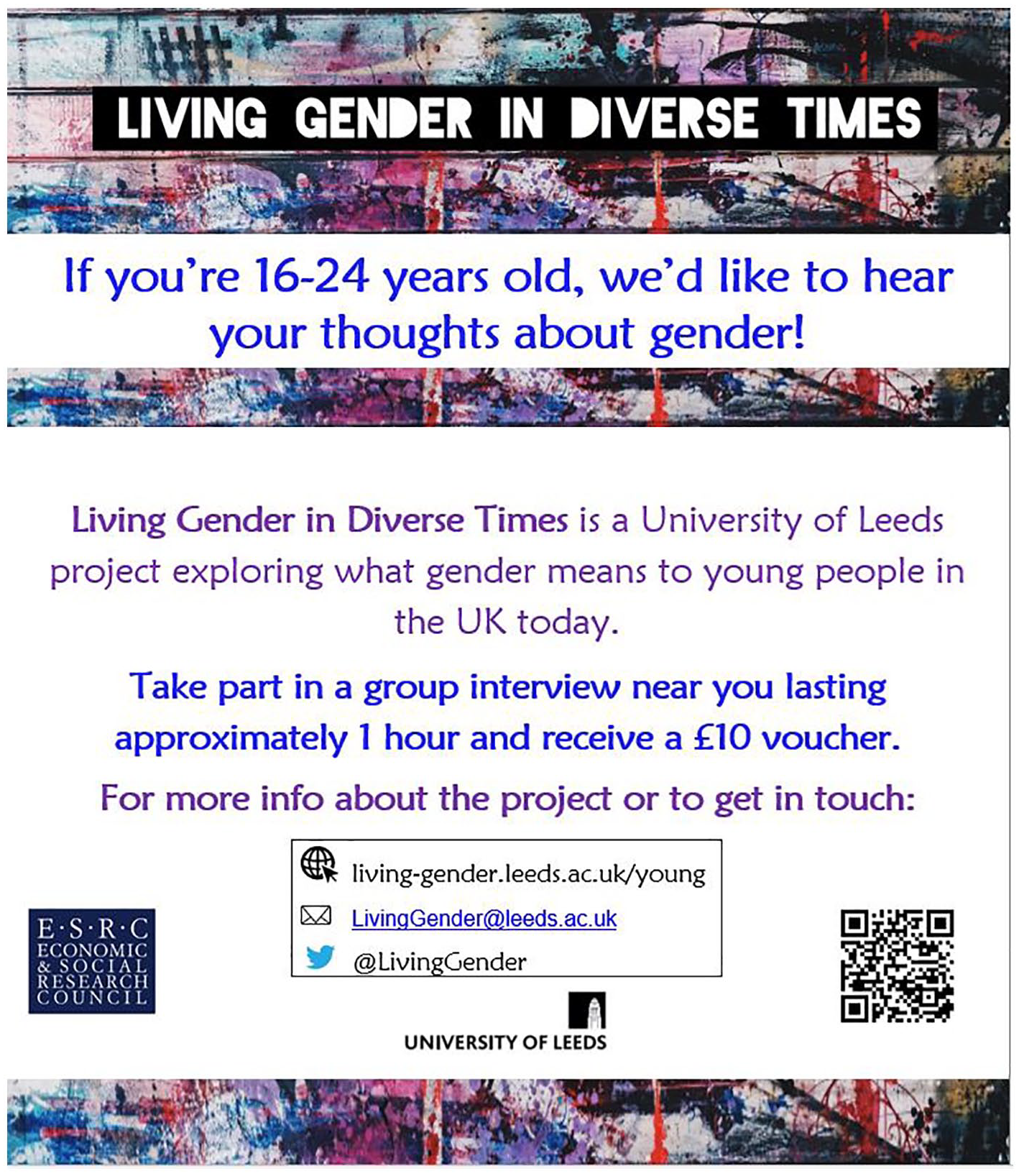
Original poster.
Figures 2 to 5 represent additional recruitment posters developed with ‘speaking to’ this population in mind. These posters attempt to interpellate the viewer as a ‘legitimate subject’ of the research. Rather than a vague call to get involved in research about ‘gender/diversity’, we provoke the viewer into reflecting on their own masculinity (Figure 2) or patterns they might see replicated around them (Figure 5). By asking ‘Is Gender Changing?’ (Figure 2) and ‘Does Gender Matter?’ (Figure 3), we attempt to widen the scope of the research and invite young people to insert themselves into the conversation. In Figure 4, we echo sentiment commonly seen in ‘debates’ about gender diversity – namely, gender diversity as a trend or a fad that has ‘gone too far’. This was intended to signify our openness to (if not our agreement with) these kinds of viewpoints when our project title and status as ‘gender researchers’ might suggest otherwise. Indeed, in all of these supplementary posters, we deliberately minimise our project title, making the assumption that foregrounding the words ‘Gender’ and ‘Diverse’ might work to exclude young people who might feel alienated from or be politically opposed to the sentiment that such words carry. Our ‘framing’ in Figures 2 to 5 is ultimately an attempt to communicate to potential participants that the research is ‘for’ them.
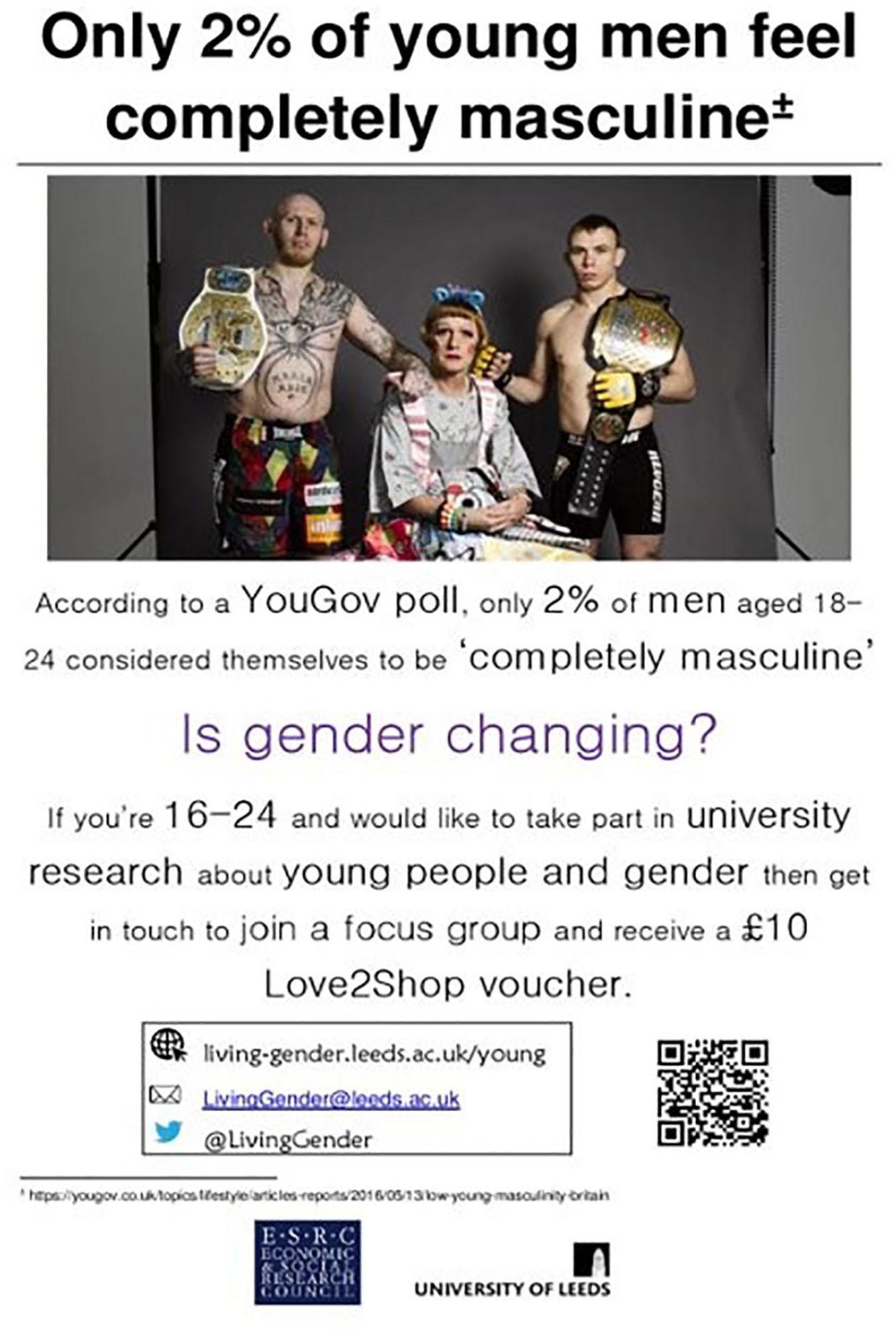
Is gender changing? Using a 2016 YouGov poll to encourage young men to reflect on their masculinity.
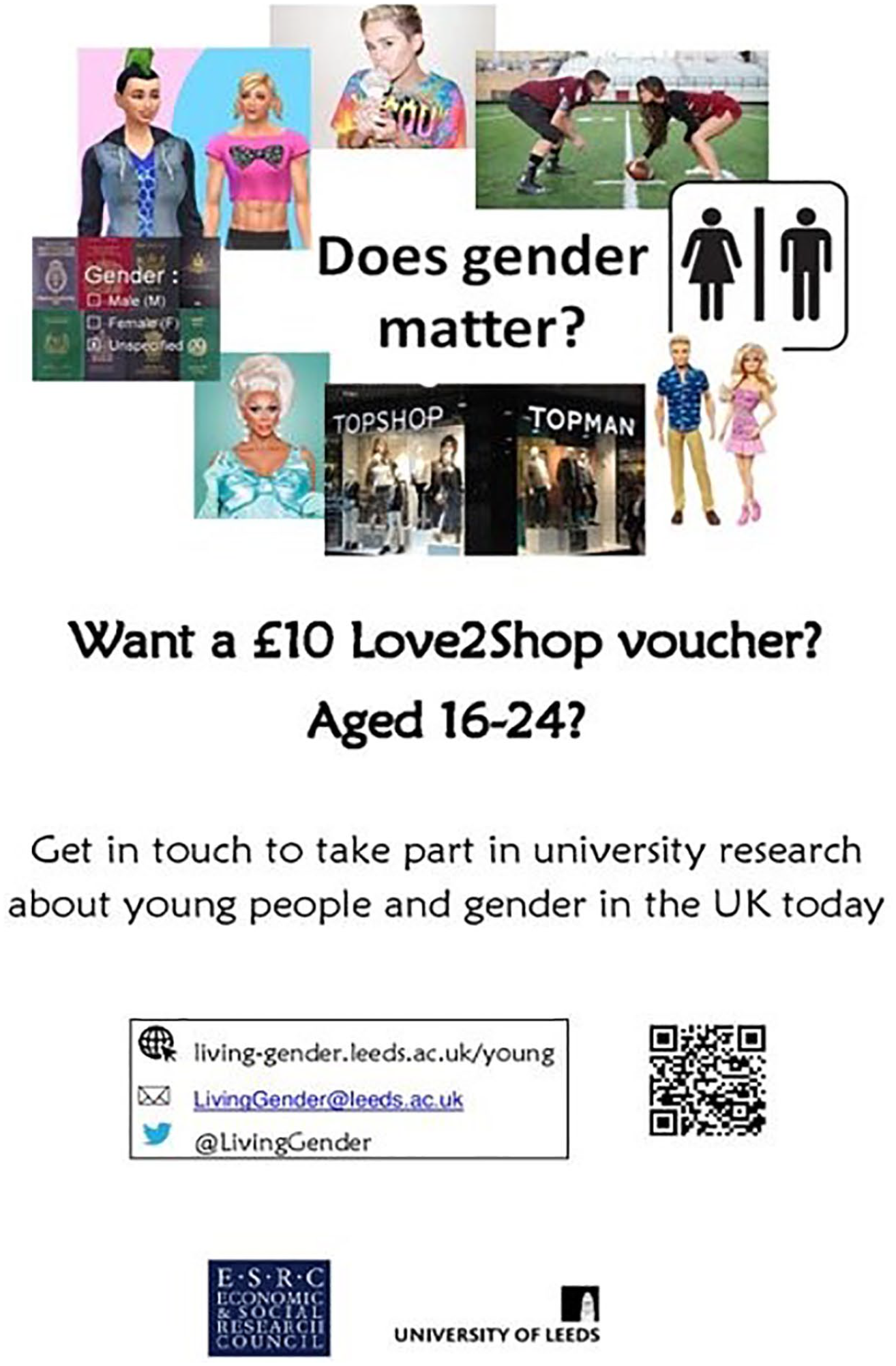
Does gender matter? Using consumer and popular culture to engage young people.
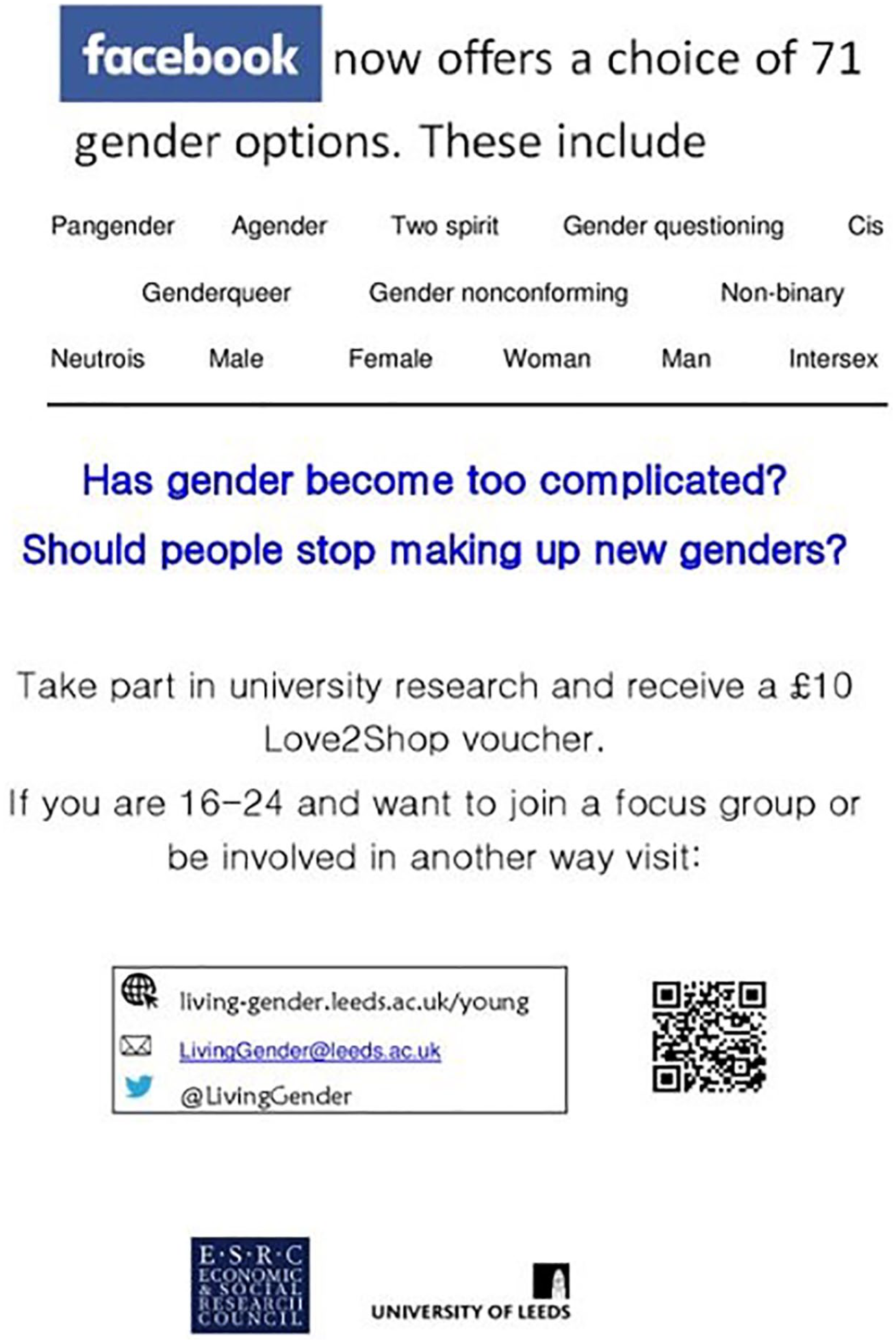
Has gender become too complicated? Using Facebook’s decision in 2014 to provide users with more extensive gender options to engage social media users.
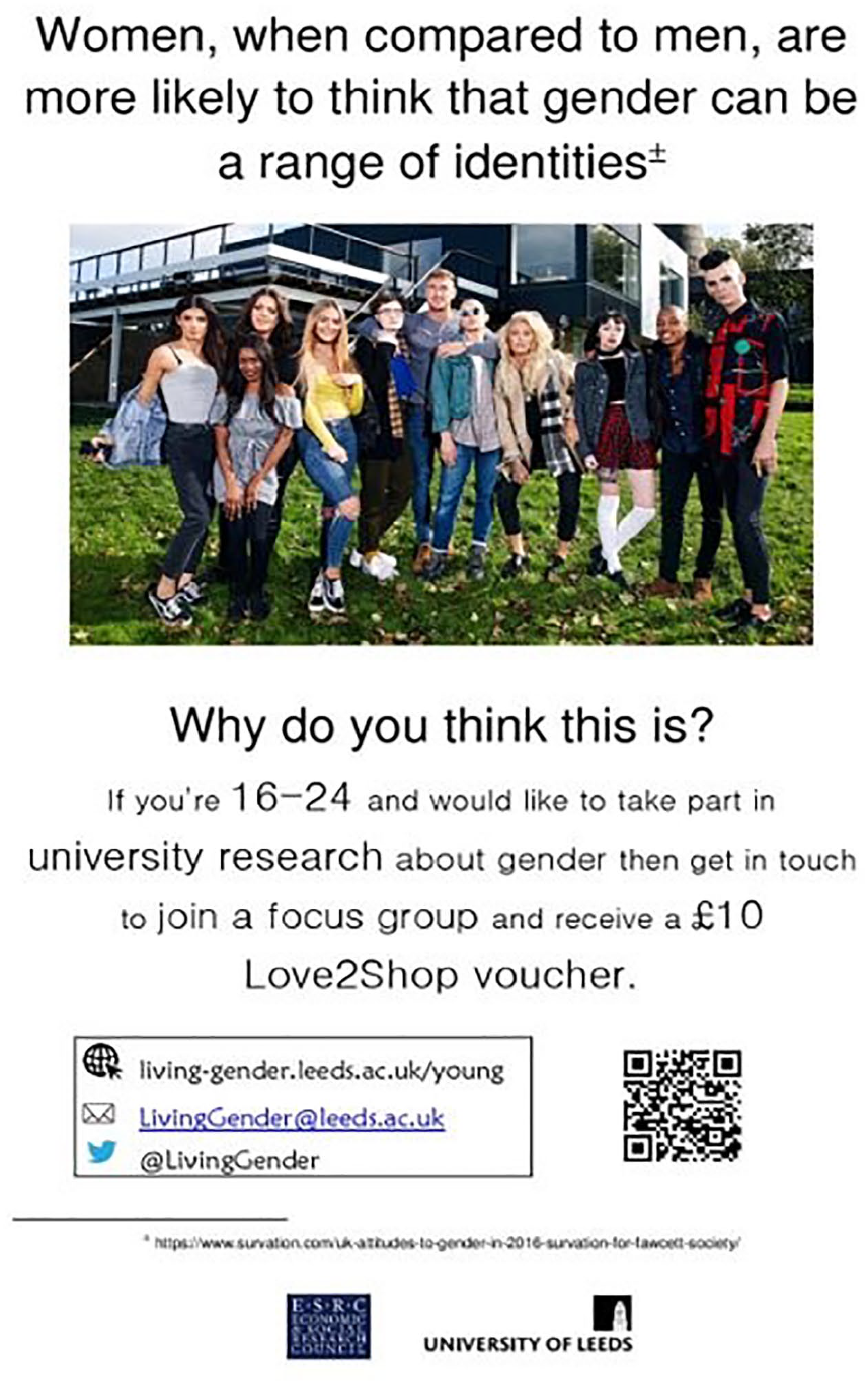
Why do you think this is? Using a 2016 Survation survey for the Fawcett Society on UK adults’ attitudes to gender issues to primarily engage young women.
Our intention was that all posters would be displayed throughout an institutional setting and we provided a ‘suite’ of posters to this end. However, this ‘pure’ dissemination of materials was only realised on university campuses where we could put posters up ourselves or through the help of colleagues, or in some educational and youth work settings where we had existing contacts. Elsewhere (i.e. when relying on senior management or Equality and Diversity Officers), we found that gatekeepers selectively engaged with our posters, if at all. Sometimes, this was due to space constraints on pastoral noticeboards or electronic screens. In many cases, we discovered that posters were discarded entirely in favour of messages and emails constructed by key gatekeepers, and often sent directly to particular young people. Regardless of how we framed the research in our posters, and in our communications with key gatekeepers where we also sought to emphasise that the research was about and for all young people, the research was ‘heard’ in very particular ways, as we now discuss.
Hearing gender/diversity
Depending on the setting and type of gatekeeper, ‘gender’ and ‘gender diversity’ were often heard and interpreted by institutional gatekeepers in one of the following ways: gender as being about lesbian, gay, bisexual, and transgender (LGBT), or gender as a matter to be dealt with by a person with an appropriate job title (typically related to ‘Equality’ and ‘Diversity’).
Gender as being ‘about’ LGBT was an interpretation often found in youth organisations. For example, a youth worker in an umbrella youth organisation informed us that they did not have any specific LGBT groups that we could connect with, despite our attempts to explain our interest in speaking to all young people. The following email chain with another umbrella youth project (receiving charity and government funding and serving a local area in Wales) is illustrative of how we were often directed to LGBT youth:
Dear [name of youth organisation], [introductions]
I’m part of a research project about young people and gender, and we’re trying to organise some focus groups with young folk aged 16–24 from a range of different backgrounds. There’s a lot of debate and conversation in the media at the moment about gender and things like gender identity and gender diversity, and we’re interested in hearing about how young people understand and make sense of this. We’re looking to speak to any and all young people – we think the topic will be relevant and of interest to all young people.
Given your work with young folk in [area], I’m emailing to ask if this is something you might be interested in helping us to facilitate. [practical details follow].
We were immediately directed to the lead of the LGBT youth project who becomes our main contact from there on. In our response, we attempted to reiterate our desire to speak to all young people, not just those participating in the LGBT group. However, the LGBT youth project lead responded with some ambiguity: they copied in their colleagues to the email chain, but expressed concern about the ‘risk’ of mixing different youth groups together:
This concern was understandable – for the young people attending the LGBT youth group, the group functioned as a ‘safe space’ where their subjectivities were respected in ways not necessarily experienced in the ‘outside’ world. Including other young people – some who may already be known from school or college – could have constituted a breach of that careful cultivation of space. However, despite our offers to run multiple sessions with different groups, and attempts to follow-up with leaders of the other youth groups, it became clear that we had been ‘appointed’ to the LGBT group. The session with the LGBT group went ahead successfully, but this gatekeeper’s early understanding of the research as a ‘LGBT issue’ had an impact on the knowledge that was ultimately generated as it served to give us access to some young people and not others. Here, we might reflect on how gender remains a ‘marked’ social category. As feminist and critical race scholars have shown, not everyone is equally seen to ‘have’ a gender or a race (Braidotti, 1994; Guess, 2006). Structures of hetero-patriarchy and white supremacy operate to ensure that whiteness, heterosexuality, and masculinity are the ‘default setting’, rendering these invisible as socially constituted categories. As such, ‘gender’, ‘race’, and ‘sexuality’ come to be understood as being properly about or for The Other – women, PoC (People of Colour), lesbians, and gays – whereas the white, male heterosexual body remains unmarked and unspecific as the ‘somatic norm’ (Puwar, 2001). In the above example, we can see how gender and gender diversity are read as not for the general youth population, but for the young people who are specifically marked as gender non-normative or non-heterosexual.
In sixth forms and further education colleges, gender and gender diversity were also marked as an issue for The Other, but via different means. Here, we were often obliged to engage with key gatekeepers, and particularly Equality and Diversity Officers as ‘the relevant person’, rather than a head of year or staff member responsible for student activities. Our direction along these lines to those associated with inclusion, equality and diversity says something about how gender and gender diversity is Othered – and not for the general student populace. These staff members tended to have access to particular groups of students – for example, those they had been working with in particular programmes or initiatives oriented around ‘inclusion’ – and it would be these students who would often be earmarked for the focus groups. While this did not foreclose possibilities as much as being directed to ‘LGBT young people’ in youth groups, there was still an uncomfortable sense that gender and gender diversity was relevant only to particular students, and that gender and gender diversity were seen as a ‘specialist capability’ to be dealt with by a designated person. This may well have reflected anxieties about gender as a contested discursive terrain, and lingering concerns about (not) getting it wrong, as, for example, highlighted in sensationalist media stories about educators losing their jobs or even being prosecuted for failing to handle issues of gender diversity ‘properly’ (see, for example, Turner, 2018). It appeared that the topic of our research and the type of gatekeeper we could engage with determined the path we were ushered along, rather than our request for young people to participate in research in and of itself (although we also did not simply accept this inevitability and would at times – but with limited success – attempt to renegotiate access). In directing us to Equalities and Diversities, gender effectively gets ‘contained’ in its ‘appropriate’ box, and sanitised as a result. The more radical idea that gender is threaded through the entire fabric of our social worlds becomes lost – as scholars writing critically on equality and diversity regimes have argued, these institutional ways of ‘doing diversity’ foreclose the possibility of wider structural understandings and change (Ahmed, 2012; Allen et al., 2012).
Our framing of the research and intended meaning was thus often (re)interpreted and given alternative meaning by some gatekeepers which influenced participation (Crowhurst et al., 2013). Our experiences affirm the necessity of understanding gatekeeping as a discursive encounter in and of itself in which meanings and knowledge can be set, established, and reproduced (Crowhurst, 2013; Eldridge, 2013).
Policing gender/diversity
Attempts were also made by some institutional gatekeepers to police or control young people’s engagement with the research in a way that produced ‘correct’ results, according to their understanding of what gender diversity should be. For example – although not the norm – at a further education college (England, urban, with multiple campuses and a diverse student cohort), a student support officer joined us for the focus group unexpectedly and without pre-negotiation. This staff member interjected at some key moments, as in the example below when participants discuss their views on the possibility of changing gender:
You can change it but I feel like you are still . . . Say I was a man and I wanted to change to a woman. I was born as a man so whether or not I’ve changed it . . .
What about your feelings inside you though?
You might be a feeling to be a woman. Obviously your hormones change so you’ll feel-
But your hormones change you as a person.
[later, discussing the idea of being gender fluid]
I just feel that’s silly. So you’re saying one day they’re going to wake up and put on a track suit on and go get a trim and the next day they’re going to wake up and be like, nah I need my long hair back. I’m going to put a dress on.
Why can’t they? If that’s how they feel.
Do what you do, but for me that’s just-
But why can’t they? If that’s how they feel, why can’t they?
In each of these exchanges, the staff member inserts themselves into the conversation whenever John A says something which is deemed ‘problematic’ – for example when John A expresses an opinion about the immutability of the sex one is ‘born with’ or the ‘silliness’ of gender fluidity. The staff member insists on the importance of self-identification and respecting people’s autonomy when it comes to determining their own gender. It was possible that as a staff member, he felt some kind of duty that the ‘right’ views were expressed – in this case, the view that diverse gender identities must be respected, and anything that could be interpreted as discriminatory had to be seen to be challenged. In this instance, the institutional actor’s way of ‘hearing gender’ as a particular discourse around respect and non-discrimination, according to legislative and policy responsibilities, were being translated directly into our exchanges with young people. Although we were leading the focus group, we felt we could not intervene to prevent this given the authority that this staff member had as well as our feelings of ‘indebtedness’ towards the efforts they had gone to arrange the focus group for us.
Elsewhere, we received the following email from a Head of a sixth form (England, rural, attached to a private school) when negotiating access to the entire student cohort:
We have students from all over the world.
It depends what you want the sample group to look like. We have over 24 nationalities in the sixth form.
We have a heavy male population from Eastern Europe and when we had [LGBT organisation] in there were shall we say . . . colourful responses.
What do you think? Do you want British Students or a wider range?
Here, gender diversity is constructed in particular racialised and nationalised ways: namely that we are likely to get ‘colourful’ (read: Problematic) views from the school’s Eastern European male population. The ‘British students’, mentioned as a distinct constituency, are being implicitly exempted from these problematic views. We suggest that gender diversity is being policed here through discourses of homonationalism (Puar, 2007) in which ‘backwards’ views towards gender and sexual diversity are projected onto racialised non-Western ‘Others’, allowing any contestation from unmarked ‘British students’ to go unnoticed with the (white) West once again reassuming their place as the bearers of civilisational morality (Browne et al., 2021). In this case, Eastern European masculinity is being constructed as The Problematic Other which accords with common narratives of Eastern European immigration into the UK – particularly in a post-Brexit context – as a threat to some kind of essential British Values (Virdee and McGeever, 2018). This was an example of a focus group which we decided not to pursue, as we felt extremely uncomfortable with the way the students here were being positioned, highlighting how our emotional responses also structure the recruitment and gatekeeping process in crucial ways.
Gatekeepers’ attempted control over who participates in research and what is ‘said’ has long been documented (Broadhead and Rist, 1976). Here, we illustrate how some institutional gatekeepers’ particular investments in gender diversity – reflecting institutional policy or in repetition of homonationalist discourses – led to a ‘policing’ of the permissibility of what could be said in focus groups, or who would be considered contentious data sources.
Using gender/diversity
In this final section, we reflect on how the very conduct of our research was ‘used’ by institutions. How results and research findings from academic research have been co-opted by third parties, including institutional actors in unexpected or objectionable ways have been documented (e.g. Hammersley and Scarth, 1993; Jordan, 2003; Lumsden and Goode, 2018). However, little has been said about the ways in which the very act of research (or, rather, hosting or facilitating research) itself might be utilised by others, including in ways that serve diversity agendas. In our experience, this occurred in two ways within educational institutions: (1) as institutional diversity capital and (2) as ‘enrichment’ for students.
It was clear in some cases that gatekeepers were engaging with our research because it served some kind of equality and diversity tickboxing purpose. In one FE college (Scotland, urban, with a diverse student cohort), we met the Equality and Diversity Officer before the focus group who mentioned other kinds of ‘gender diversity engagement’ they had done (e.g. hosting a trans talk for students) and how this had recently been identified as a priority for the college. The fact that we had come to the college and some students had engaged in the research was going to be included in their ongoing auditing of ‘progress’ in this area (cf. Swan and Fox, 2010). It seemed that hosting a focus group on this topic was ‘enough’ to ‘count’ and there was no further engagement or follow-up. In this way, our mere presence was used as a kind of institutional diversity capital – something to be mobilised by an institution as evidence of ‘progress’ or ‘inclusion’. This left us feeling uncomfortably complicit in institutional regimes we are critical of, and also powerless to prevent it. We understand that there is a necessity of a quid pro quo when engaging with gatekeepers in order to gain access (Corra and Willer, 2002), yet this was less a bargain being struck and more an ipso facto consequence of our presence.
The second way our research was co-opted was as a kind of ‘enrichment’ activity for students. In particular, the research was seen as beneficial to students’ future participation in higher education. In our communications with gatekeepers, we generally framed participation as something which would be a ‘favour’ to us and for which we would compensate students’ time with a £10 shopping voucher. However, gatekeepers often (re)framed what participation meant. For example, a Deputy Head at a sixth form college (England, urban, public, unattached to a school) emailed students the following ‘recruitment’ message:
A really exciting opportunity for all students: A researcher from [name of university] has asked if we can promote the following research. This research is not affiliated with [name of Sixth Form]. [Name of project] is a [name of university] project exploring what gender means to young people in the UK today.
The research is framed as an ‘opportunity’, and one which would be a ‘valuable engagement experience’ for students who might apply to university. The topic of the research becomes a secondary consideration in this re-framing of research as an opportunity to be taken up. Of course, this (re)framing may have been strategic to boost our participation rates but – at the same time – it appeared that our request for participation had to be translated into this kind of institutional logic. Students’ participation could not just be ‘for the sake of it’, but had to be directed towards some kind of productive futurity, reflecting the unintentional ‘transmission’ of particular understandings of education within recruitment materials (David et al., 2001).
This sentiment was heard and adopted by students. For example, we received this response from a student:
When I heard about the study I instantly wanted to take part! Looking to hopefully study at the [name of our university] in future, I saw an opportunity for someone of my age to get involved with the university and found out more straight away. Furthermore I am currently doing an EPQ (a graded research project) and thought it would be beneficial to my own project to find out what it means to carry out professional research. Finally, gender today is such a diverse and controversial topic – I think it’s really cool that people are finally doing some research about it in the UK!
We received several similar emails from students who positioned themselves in the institutional logic of participation. The student positions themselves as an ‘ideal candidate’ for participation in the research by highlighting their desire to study at university in future, their own disciplinary expertise (in taking a research module), and how the research would ‘benefit’ them. This chimes with discussion in the previous section about how our research becomes (re)framed as a ‘specialist’ topic, although here it is not because the topic is about gender, but because it is something academic and only for certain groups of students. The research is no longer framed as something for all ‘young people’, but something specifically for ‘students’ with particular investments in particular (valued) educational futures. Befittingly, students respond by almost ‘applying’ for candidacy. In another response, a student simply replied, ‘I’d be really interested in taking part in this enrichment!’ – the topic slipping out of focus entirely.
In a different sixth form (England, urban, attached to a private school), the way the research had been framed to students by the gatekeeper was revealed in the opening moments of the focus group:
Our first question is just asking you -what made you interested in coming to the focus group today?
How has it been pitched to you? We’ve circulated some posters, have you seen any of the posters . . . ?
Email.
Yeah, Sir sent us an email, he said, ‘Is anyone interested in joining in?’
Okay, so how was it described to you, the focus group?
Opportunity to participate in academic research.
Yeah.
Okay, that’s very efficient.
About gender, he mentioned that as well.
Okay.
But the subject was academic research, that’s what sort of piqued my interest.
So it’s the academic aspect that was quite important?
Multiple affirming voices.
The students had not seen our research posters, but had learned about the research from an email from the Deputy Head who had ‘pitched’ it as an ‘academic opportunity’. The emphasis on ‘academic opportunity’ in this institution may have been heightened by the fact that it was a private fee-paying sixth form; the gatekeeper mentioned how researchers and university staff frequently visited the school to give talks to students and engage with them in various ways. Here, we again felt complicity with institutional regimes – this time in inadvertently facilitating the private school to top university ‘pipeline’, and the compounding of (cultural and social) capital accumulation, which sits uneasy with us politically. However, as a discourse, ‘academic opportunity’ was also found in other (State) sixth forms – although in less pronounced ways. The focus group was also held in the weekly ‘enrichment’ slot, which was a pattern replicated across many of the sixth forms and further education colleges where students participated.
More broadly, our discomfort also comes from the way in which the conduct of our research compounds broader pressures on young people to cultivate their own human capital and future-oriented selves, which is are heavily classed (Taylor, 2012). We are concerned by our presence having slipped so easily into the idea of ‘enrichment’. Vincent and Maxwell (2016) discuss how ‘enrichment’ forms part of middle-class parenting cultures through which young people are seen as subjects for future investment. Via participation in enrichment activities, young people are inculcated with the right kind of dispositions and capitals, gaining competitive advantage in future educational and labour markets. Enrichment has encroached into the formal educational landscape, but as Holloway and Pimlott-Wilson (2012) show, even within education, middle-class young people have disproportionate access to enrichment activities. In our case, as our research was framed as a future-oriented opportunity for enrichment, particularly related to educational ambition, we were aware that only some young people were being encouraged to participate. This not only affected the ‘results’ that were generated, but also meant that any benefits (e.g. being able to discuss this in a university application or use the opportunity to ask us about particular universities after the focus group) would also go to those already marked – and encouraged to further mark themselves – as ‘properly’ aspirational subjects.
The above discussion adds a new dimension to the ways in which research might be ‘used’ in unintended ways. We have shown how the very conduct of research itself can be leveraged as a capital – either as institutional diversity capital, or as social and cultural capital offered to the brightest and most aspirational young people. In either case, we had little say in this ‘use’ of our research, leaving us with much unease. The methodological literature on access and gatekeeping has discussed the ‘benefits’ that might accrue to a host institution for engaging in research and how researchers generally have a weak hand in these negotiations (see Clark, 2011), but there is an assumption that there is some kind of negotiation. In our experiences with this research, the benefits occurred as a simple result of us being there in the first place. This may behove other researchers to consider the ways in which their presence might be leveraged in particular ways, not least when equalities and diversities are the focus of research in contexts where institutional surface-level engagements may be favoured over more meaningful, structural change.
Conclusion
Through reflecting on our experiences in organising focus groups with young people in educational and youth group settings, this article has traced the ways in which meanings around ‘gender’ and ‘gender diversity’ were framed and re-framed, as our intentions as a research team met with in situ understandings and interpretations of institutional gatekeepers. Despite our efforts to frame gender and gender diversity as relevant to all young people, many gatekeepers heard our call for participation in terms of dominant understandings of gender as something ‘about’ and ‘for’ only certain types of young people (i.e. those already marked as Othered). Institutional gatekeepers responded in ways reflecting their entanglements in institutional equality and diversity regimes. These regimes construct gender and gender diversity in individualised ways and preclude the possibility of more structural understandings of the social constitution of gender. These ways of hearing ultimately affected access and participation, which in turn impacted on the kinds of ‘knowledge’ created. Institutional gatekeepers’ understandings of the ‘right’ versus ‘wrong’ views on gender diversity – and the kinds of bodies that inhabit each – also travel down to the focus groups themselves and come to shape the meanings made in the focus groups. However, this is not to suggest that this was the case with all institutional gatekeepers – we often found that when we had an existing contact we could draw upon as a gatekeeper or to connect us to a gatekeeper, then our original intentions were more likely to be realised. This may have been because established relations allowed for less formality; in any case they point to the methodological importance of a multi-pronged recruitment strategy. Substantively, the findings from this article may provide an orienting point in understanding how gender diversity is made sense of on the ground by educators and youth workers, laying the way for more extensive and in-depth research on, for example, the implementation and reception of policies relating to gender diversity in youth-oriented settings.
The article has also discussed the ways in which our very presence was leveraged by institutions. In monitoring our presence in their institutions, we were enfolded into auditing techniques as part of equality and diversity ‘work’; we became ‘diversity capital’ to demonstrate that institutions were engaging with gender diversity, although not in ways that we considered meaningful. The conduct of our research was also used as a kind of ‘enriching’ human capital for young people, as institutional gatekeepers framed the research in terms of aspirational educational futures. As such, only certain young people were interpellated as suitable, and some young people themselves engaged with the research in terms of ‘candidacy’. While bargains may need to be struck in negotiating access to research settings, we remain deeply uncomfortable with our inadvertent complicity in both of these outcomes. We are resistant to institutional structures of ‘equality and diversity’ that congratulate themselves on work ‘done’, and we are also critical of enrichment agendas that have very classed resonances. In this article, we have drawn attention to the ways in which mere presence might be ‘co-opted’ in ways researchers have little say in, adding a new dimension to critical discussions of how research can be conceptualised as a ‘product’ over which a number of actors may struggle for control of meaning and usage (Hammersley and Scarth, 1993; Jordan, 2003; Lumsden and Goode, 2018). This is a particularly salient point for gender researchers, given that there currently exists within the UK and also internationally, a ‘tug-of-war [for] ontological and political control over the term “gender”’ (Correodor, 2019: 618), particularly around trans issues and gender diversity. Institutions – particularly educational institutions and those working with young people – are often flashpoints in these debates as political and philosophical tensions play out through controversies over particular policies and practices. Going forward, how institutions respond to research requests will be increasingly shaped by these national and international currents.
Overall, we seek to highlight the value to be gleaned in using ‘method-as-method’ – that is, in critically reflecting on ‘methodological grey areas’ to understand something about the social world, in this case, how a concept might be heard and how research might be co-opted. We have shown how, while we may wish for ‘pure dissemination’ of our own understandings of central research concepts, they are always socially-situated and contingently understood, subject to contestation and remaking. We have empirically demonstrated the ‘meaning-making’ power of gatekeepers, and traced an example of how they make meaning effects how we are then able to make meaning. We end by encouraging all social scientists not only to take methods more seriously, but also to take all the connective, enjoining grey moments and interactions that make research happen seriously (Allen, 2019). Not only can they give us empirical insight, but doing so, let us see how knowledge comes to be, leading to a more rigorous and ethical social science.
Footnotes
Declaration of conflicting interests
The author(s) declared no potential conflicts of interest with respect to the research, authorship, and/or publication of this article.
Funding
The author(s) disclosed receipt of the following financial support for the research, authorship, and/or publication of this article: This work was supported by the Economic and Social Research Council (grant number ES/P011772/1).
