



Abstract
Trans youths’ future orientations are important but seldom discussed within the literature. Compared to their cisgender peers, the developmental trajectories of this group are characterised by considerable change, and highly subject to prevailing political climates. Here, we explore trans youths’ future orientations as a product of present-day experiences of identity-affirming factors. Some 1679 trans youth aged 14–21 responded to two open-ended items asking them about their experiences of gender affirmation, as well as their future goals and aspirations. Data analysis adopted a procedure inspired by thematic analysis. The findings highlighted close links between future orientations and present-day experiences of affirmation. Where the latter were absent, participants appeared less able to envision positive future orientations beyond the fulfilment of the need for social and interpersonal acceptance. Gender-affirming experiences are not only integral to the well-being of trans youths in the present, but also facilitate their ability to envision a future to work towards.
Introduction
In many parts of the world, significant strides have been made towards the social recognition and inclusion of trans and gender diverse (hereafter ‘trans’) people within recent decades (Cannoot, 2019). More recently, a backlash against these gains has created a hostile socio-legal terrain wherein trans persons’ right to expression and access to gender-affirming care are curtailed and scrutinised (Ramos et al., 2023). Past research suggests that the uncertainty engendered by these paradoxical circumstances significantly impacts how futures are envisioned. Both the ways that (i) parents and caregivers of trans youth imagine the futures of their charges (Katz-Wise et al., 2017, 2022), and the ways that trans adults (Malatino, 2019) themselves imagine their futures are invariably shaped by these factors.
Within these discourses, the future orientations of trans youth themselves are often absent (Katz-Wise et al., 2017). The lived experiences of trans youth are sociologically important in and of themselves (Nordmarken, 2019; Schilt & Lagos, 2017), and their future orientations even more so. Future orientations pertain to anticipatory thoughts, emotions, plans and anticipations of the future, and often entail one's ideal or optimal social relationships, occupations, values and ways of living (Cui et al., 2020). In youth, future orientation is a core developmental task, and is informed by individual interests, expectations and goals (MacLeod & Conway, 2007). Positive future orientations are thought to motivate positive change in a youth's life and may even improve resilience among disadvantaged youth (Cui et al., 2020; Nyarko & Punamaki, 2019). Therefore, understanding and fostering positive future orientations among trans youth is likely to be one avenue through which processes of resilience among this group can be supported.
Youths’ future orientations are, however, fundamentally shaped by their present circumstances. These orientations therefore reflect the individual's judgements about their ability to overcome anticipated challenges like institutional and/or societal discrimination (Katz-Wise et al., 2017). This is in turn informed by perceived constraints on the individual’s personal agency and social capital (Sulimani-Aidan & Melkman, 2022). As this relates to trans youth, there is ample evidence regarding their experiences of marginality (Ramos et al., 2023), as well as the resulting constraints upon their bodily agency (Hillier et al., 2020). At the time of writing, there is little indication within the research about how the future orientations of trans youths are impacted by these challenges. The current study therefore pursues these research gaps.
Materials and methods
Recruitment and sample
The data presented here are drawn from Writing Themselves In 4 (Hill et al., 2020). a large Australian survey focused on LGBTQA + youth health aged 14–21. This survey was developed in consultation with a community advisory board including two youth advisory groups in Melbourne and Adelaide. The survey was advertised via a paid service on Facebook and Instagram, in addition to community organisations through their online networks and promotional posters on premises. Prospective participants had to be (i) between 14 and 21 years old (inclusive), (ii) currently residing in Australia or an Australian territory, and (iii) lesbian, gay, bi+, trans, intersex, queer and/or asexual. Responses were collected over a 2-month period in late 2019.
Materials and measures
Participant experiences were captured through a survey consisting of both closed-response multiple-choice and open-ended questions. Participants were asked about their sex assigned at birth, and their gender identity. The question relating to gender identity included 16 response options, as well as ‘prefer not to have a label’, ‘something different’ or selecting ‘prefer not to answer’. Participants were classified as trans and/or gender diverse if their chosen gender identity differed from their birth-registered sex.
Qualitative items were introduced for the fourth iteration of Writing Themselves In to gain insight into young LGBTQA +people's experiences, perspectives and aspirations. These questions were shown to participants at the very end of the survey. Responses to the questions “What are some of the things that have most helped or would help you feel that your gender identity is affirmed?” and “How do you imagine your future?” are the focus of this article. Both items were placed in the sequential order described above to subtly imply a thematic connection between the two, without priming participants to respond in ways that tied their responses too closely to present experiences of affirmation.
All participants were prompted to describe their imagined futures, but only trans participants were prompted to answer items regarding gender affirmation experiences. Using STATA (Version 17 SE; StataCorp, College Station, TX), we isolated these responses to establish a subsample consisting entirely of trans youth and cross-checked this variable with all participants’ gender identity labels to ensure the subsample captured everyone with an expansive gender identity. We then exported a .CSV file containing the data of 1679 trans youth who responded to either or both open-ended data items. This was uploaded onto NVivo 12.0 for further qualitative analysis.
Data analysis
As open-response questions are highly structured, a deductive, constructionist approach was deemed appropriate for data analysis (Elwin et al., 2007; Jansen, 2010). An analytical procedure informed by thematic analysis was chosen (Braun & Clarke, 2019). The authors familiarised themselves with the data by reading through both participant responses and engaged with existing literature on trans futurities and future orientations. Both first and second authors independently generated preliminary coding schedules, which were then collated into a unitary schedule that was subsequently referenced in line-by-line-coding. The coding process was jointly undertaken by the first and second authors and overseen by the fourth and last authors. Throughout this process, emergent themes were consistently cross-referenced with participant responses, and both authors were proactively engaged in a reiterative and ongoing process of code refinement.
When both the first and second authors had completed line-by-line coding, the first, second and third authors commenced a review of all code assignments to ensure appropriate code application and resolve disagreements in code assignments. Discrepancies in the first and second authors’ code assignments were discussed among all authors, with the third being responsible for resolving any such discrepancies. The first and second authors subsequently independently generated several themes and initial thematic linkages, which they cross-referenced with participants’ responses. The first, second and third authors then reconvened for the final step in the procedure, where they collated and consolidated these tentative thematic frameworks, arriving at a collective determination of the definitions, labels, and linkages between each theme.
Ethics
Institutional ethics approval was granted for this study by the Writing Themselves in 4 Human Research Ethics Committee Writing Themselves in 4. Participants are referred to henceforth using pseudonyms.
Results
Demographic characteristics
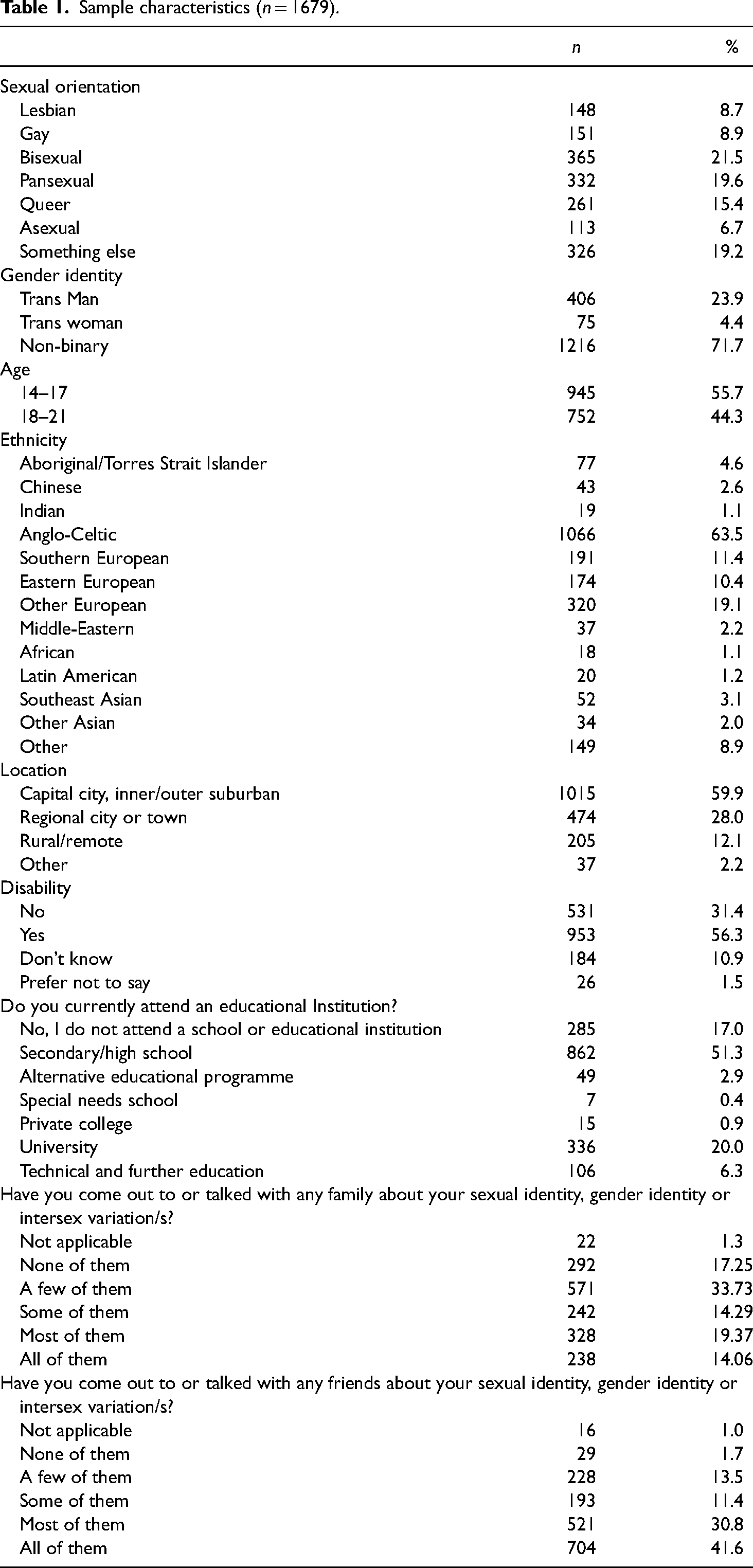
Participant demographics are presented in Table 1.
Sample characteristics (n = 1679).
Qualitative findings
That youth subjectivities are poised as inherently future-oriented within the minds of both parents and even youths themselves is self-evident (Wyn, 2020), and reflects the predominant understanding of adolescence as a transitional life-stage. This is perhaps truer still for trans youths, whose actualisation of their gender identities disrupts a previously charted life trajectory (Sánchez-Ferrer et al., 2023), and whose future possibilities fan out in departure from a prescribed set of cisnormative expectations (Van Asselt, 2019).
These possibilities are invariably anchored to present circumstance, and vistas of both possibility and potentiality are inseparable from experiences of marginality and disaffirmation (Katz-Wise et al., 2017). While constrained by these factors, potentialities are seldom entirely extinguished, insofar as they represent what is possible – and not necessarily what is probable (Muñoz, 2019). The gap between possibility and potentiality was consistently referenced by participants as a source of frustration and even pessimism. Participants who viewed this distance as unbridgeable tended not to venture positive future orientations. Likewise, for participants who failed to identify any sources of affirmation within their lives – or who described disaffirming experiences – future orientations were often either narrow, or focused on aspirations of basic tolerance or acceptance. Below, we discuss our findings in finer detail.
Overview
Nearly a third of the sample did not provide a response for the item capturing experiences of affirmation – despite providing a response to the item pertaining to future aspirations – or otherwise explicitly cited the lack of affirming experiences. Among the remaining two-thirds of our sample, prevalent themes noted were (i) the freedom to externally inhabit one's internal reality, (ii) access to gender-affirming medical procedures, (iii) support from family, peers and educators, and (iv) freedom from stigma and discrimination. Crucially, for over half of the sample, these factors were articulated as absent prerequisites for feelings of affirmation, as opposed to experiences that engendered feelings of affirmation. Comparatively, only a handful of participants (n = 50) who described experiences of affirmation also neglected to proffer their hopes for the future. Positive future orientations primarily related to (i) occupational aspirations, (ii) family formation, and (iii) undertaking gender- affirming medical procedures. Negative future orientations pertained to themes such as (i) having no future, (ii) deteriorated circumstances, and (iii) negative life outcomes. A further subsection of participant responses also related to anxieties surrounding the political climate; these responses will be explored in more granular detail in a future publication.
Adolescence as nascency
As a developmental window where identity development processes commence, adolescence is typically experienced as a state of nascency or becoming. As this pertains to trans youth, hegemonic narratives – such as those disseminated through social media (Malatino, 2019) – frame these states of nascency as universally untenable and interminable for trans youth. In reality, trans youths’ gender identity development trajectories comprise non-mutually exclusive, intrinsic and social processes, which are of varying salience to each individual youth’s identity development trajectory (Pullen Sansfaçon et al., 2020).
Unbearable nascency
Participants’ identity development projects were often only loosely scaffolded around gendered norms and expectations, though some responses indicated adherence to such norms – especially among participants who identified with a binary identity. Some of these norms prescribed an ‘ideal’ or ‘critical’ window during which the initiation of gender-affirming hormonal intervention is necessary for suppressing endogenous puberty and ensuring the timely development of the desired secondary sex characteristics (Salas-Humara et al., 2019). These expectations imparted a sense of urgency to these trajectories of becoming, which in turn, caused participants like Trent to perceive their ideal future self as being quickly foreclosed on. He stated: [I wish I was] able to access hormones and surgery's once I hit puberty. I have been denied testosterone, ‘til I am possibly 16 – and same with surgery. I will most likely have to go overseas to get top surgery under 18, which has worsened my mental health, despite being with a gender clinic for over 2 years. I am currently on puberty blockers which do nothing as I went through early puberty. – Trent, 14, trans man.
Accounts like Trent's demonstrate a fundamental paradox underpinning hegemonic developmental scripts about trans youth. While offering a framework of expectations, norms and scripts around which to organise their experiences, Malatino (2019) problematises the (trans)normative narratives emergent within these frameworks, drawing attention to their emphasis on timely hormonal and surgical transitions as a necessary undertaking to render ‘the rhythms and patterns of everyday life easier, more bearable, and less traumatic’ (p. 637) for trans individuals – who are otherwise condemned to the ‘bleak emotional surround’ of pre-transition life. The affective promises engender a kind of ‘cruel optimism’ (Berlant, 2011), wherein ‘a particular cluster of futural promises about what constitutes the good life’ (Malatino, 2019, p. 652) underpins an intense, anticipatory anxiety that leads adolescents like Trent to perceive themselves as ‘dwelling in lag’ (Malatino, 2019, p. 635).
From his responses, Trent's atypically early engagement with gender-affirming care has placed him on, and even ahead of the trajectory generally recommended by current medical guidance (see Mahfouda et al., 2019). Yet, the urgency that emanates from the kinds of expectations critiqued by Malatino (2019) creates a sense of desperation that has eroded Trent's socio-emotional well-being. Significant debate among healthcare professionals surrounds the initiation of hormone replacement therapies in trans youth (Block, 2022). Responses like Trent's showcase how this ‘cruel optimism’ is co-mingled with legitimate concerns and amplified by expectations of synchronicity between trans and cisgender developmental trajectories (Malatino, 2019).
Tolerable or ambivalent nascency
Contrasting Trent's response, those of older participants like Tim and Lee suggested less discomfort with non-adherence to prescribed or normative narratives and placed greater emphasis on self-affirmation. They stated: I’ve learnt that there is no right or wrong way to be trans, transition, or identify … it is important to just be yourself. – Tim, 17, trans man. I remind myself that I’m still growing and discovering my identity, and it's okay to change between labels, because I'm not going to get it right the first time and that's okay … I’m still a beautiful person inside and out and whatever gender I finally settle into, is not a prison to my expression or identity. – Lee, 16, prefers no gender labels.
These participants regarded trans-ness as an immutable aspect of their identity, irrespective of the specific expression of this internal reality. This category of responses largely demonstrated considerable flexibility in what they considered a ‘good’ transition. Individuals like Lee also articulated understandings of their gender identity that were grounded in the present, but optimistic about the future. This reflects Malatino's calls for the refocusing of transition discourses towards ‘trans lives in interregnum’, the ‘fluid, legible temporal between-places with no definite end, which are “not only liveable but also, sometimes, joyous”’ (2019, p. 13).
Other participant responses were characterised by trepidation, but markedly absent of the pessimistic urgency that characterised Trent's response. Responses from non-binary individuals like Rowan instead spoke to how recognition formed a crucial prerequisite for experiences of affirmation. I am questioning being non-binary, and it's so difficult to find information about people's experiences and the like to help me figure it out. – Rowan, 16, non-binary.
Non-binary participants largely did not discuss experiences of dis-affirmation. Rather, their responses evidenced how a limited awareness, and want of normative expectations surrounding non-binary identities, foreclosed any experiences of affirmation.
Hence, while social norms and stereotypes can contribute to feelings of dysphoria (Pullen Sansfaçon et al., 2020), they nevertheless also provide a rough scaffold for individuals to explore their gender identity or take action towards transition (Pullen Sansfaçon et al., 2020). The absence of this scaffolding left non-binary individuals who identified with trans experience questioning whether they were ‘authentically’ trans. As one participant described it, Having my girlfriend tell me that before I’d told her she suspected I might be non-binary […] The best advice I've been given is to practice thinking of myself as nonbinary just in my own head, which is really helpful because I have lot of trouble with impostor syndrome, and feeling like I don’t deserve to be part of the trans community/am not trans enough. – Nik, 19, prefers no gender labels.
Nik was able to access positive identity-affirming experience and displayed a rational awareness that their feelings of inauthenticity surrounding their gender identity stemmed from internalising transphobic narratives that contested the legitimacy of non-binary genders. Despite the optimistic tenor of Nik's brief account, they notably neglected to venture any future aspirations when prompted, suggesting that despite overcoming these challenges, they remained either cautious or uncertain about envisioning their future.
Optimistic nascency
The possibilities arising from the exploration of one's gender identity represented a consistent source of optimism for participants. Experimenting with gender roles, clothing or subtle alterations to one's body to more closely align it to one's gender identity breathed life into previously unimagined future selves. These ‘expeditions’ were conducted concurrently with, and in service of participants’ attempts to understand and affirm their identities. Participants like Prim describe how these forms of exploration could profoundly alter one's future orientations: I wore a dress for a friend in photography class. I’d never worn one before, but I’d always wanted to. Putting it on and having a physical photo of the moment made me realise that I’m not who I was born […] It felt even better and more affirming when I got to choose the title of it and went with female pronouns [and] ‘Ms’. – Prim, 17, trans woman.
For Prim, that the combination of affirmative responses from both peers and educators coincided with the momentary alignment of internal gender reality and external gender expression was a powerful event that appeared to pave a tenable route to a newly envisioned future. Hence, Prim was readily able to describe their hopes for a future where they were happily married, living in an idyllic rustic surround accompanied by numerous animal companions.
However, even participants whose responses described few affirming experiences, or who predominantly described experiences of disaffirmation, often remained hopeful of a future where their present circumstances were significantly improved upon. This was exemplified by one participant who described no affirming experiences aside from engaging with online content produced by trans creators. He was nevertheless able to provide a comprehensive, ambitious and attainable vision of his future self. I'll be the sexiest being on this planet. I'll have a flat chest, a penis, and everyone will support me. I will be a Geography/History/English teacher, and I will be the teacher that tries too hard to be cool on purpose. I'll also live in an apartment. – Charlie, 14, trans man.
Similarly, other participants often persisted in imagining and aspiring towards a thriving future self – rejecting the unfair conditions of their present circumstance. Identity-affirming experiences clearly predicated and likely even precipitated trans youths’ positive future orientations. Nevertheless, participants like Charlie were evidently able to envision a future self that has transcended their present difficulties, hinting at the especial importance of role models and inclusive representation for youths (see Austin et al., 2020; Selkie et al., 2020).
Em(body)ing a future self
Trans (and, to a lesser extent, non-binary) bodies are often perceived as straddling – but eventually settling on – either side of the divide between wrong/right and male/female (Daves, 2021). This notion was reflected in some binary trans participants’ characterisations of their experiences of gender incongruence and dysphoria. A typical response within this category implicitly referenced specific body parts (e.g. primary or secondary sexual characteristics) that constituted the chief object of prospective or previous gender-affirming interventions. One participant detailed how they felt affirmed by Cutting [my] hair, having hairy legs and armpit hair, lowering my voice slightly, wearing masculine clothing and underwear, and definitely my binder. – Avery, 17, Trans and non-binary.
On the one hand, for Avery and others like them, their bodies could impose significant limitations on both their present and future and were sometimes a source of disconnect and friction between one's internal reality and external expression. Simultaneously, these bodies – or rather, the projects of aligning these bodies to one's internal reality – were a tenable avenue to a brighter future. Conversely, other participants faced significant barriers to accessing even non-medical forms of gender affirmation, and were therefore stymied from significantly advancing these projects within the contemporary context. For these youth, their futures were not so much forestalled, but instead fixed upon scenarios where these barriers had been overcome. As the following participants noted: [I would feel affirmed if I did] not have to return to presenting as male when I am at home. – Rose, 20, trans woman. [I] cannot access [a binder], as they can only be bought online and family can see bank transactions, and there is risk of family seeing the package first. – Jake, 18, trans man.
Despite a lack of familial support, both participants described strategically navigating these restrictive and ‘disaffirming’ environments to live authentically – even if only temporarily. For instance, Jake's responses also described how they adopted specific forms of expression within their means: they spoke about adopting shorter hairstyles, as well as clothing that de-emphasised or concealed their chest. These were seen as small, surreptitious acts of resistance against the cisnormative expectations imposed upon these youths – that pushed against the boundaries of present possibility. For individuals like Jake, these glimmers of possibility illuminated a potential future where he would be ‘happier [and] more comfortable with myself and my identity’. Simultaneously, he exercised ample caution in curbing these expectations, tempering these aspirations with the likely reality that this future self would probably be alienated by their family of origin.
In contrast, other participants described scepticism about being able to access the kinds of surgical or hormonal interventions that they needed. In these instances, barriers to gender-affirming care constituted an insurmountable obstacle to gender affirmation within both present contexts and futural imaginings. [I’d feel affirmed if I could access] trans healthcare in the public system! Top surgery is going to cost me $12,000 AND I'M NOT ABLE TO AFFORD THAT [emphasis in original]. – Ari, 20, trans/genderqueer/non-binary/agender. [I’d feel affirmed in my gender if] the government financially supported trans people to get life changing surgeries … currently listed as ‘cosmetic surgery’. Instead of saving for a car or university like other kids, I am forced to save my money for a surgery that should be free. – Jeremy, 17, trans man/non-binary.
Responses like these superficially evoke Malatino’s (2019) application of Berlant's (2011) concept of cruel optimism to their critique of transmedicalism, wherein the fixation upon a romanticised ‘post-transition’ future interferes with one's flourishing in the ‘pre-transition’ present. In contrast, however, Ari's interpellations of the future are decidedly opaque; he tentatively states ‘idk’ (I don’t know), while Jeremy laments how pursing this imagined future would come at the cost of other opportunities.
Both participants’ complaints are perhaps more appropriately interpreted as expressing deep dissatisfaction with the political status quo – reflecting their awareness and frustration of the distance placed between potentiality and possibility. As Jeremy notes, a realistic mechanism presently exists through which otherwise costly gender-affirming surgical interventions can be made affordable to trans youths in Australia (e.g. socialised healthcare). However, this is potentiality curtailed by inadequacies in current government policy, which erroneously categorises most of these procedures as aesthetic surgeries and therefore, as non-essential and ineligible for subsidisation (Dalzell et al., 2023; Rosenberg et al., 2021).
Dissatisfaction with the present was likewise a core theme in non-binary participants’ responses. Notably, non-binary individuals often demonstrated complex aspirations centred around their wish for the normalisation of non-binary identities within broader society. A core component of these aspirations related to frustration about seemingly arbitrary connotations of gender tied to specific physical characteristics. As the following participants stated: [I would feel affirmed] if people would stop assuming I’m a female [just] because I have breasts and a vagina. – Harper, 20, non-binary. [I would feel affirmed] if people ceased to consider certain clothing and body types as indicative of one gender. I present reasonably feminine because I don’t dislike the aesthetic, but I am tired of being seen as a woman. – Finley, 20, non-binary.
These quotes typified this category of responses: both referencing and repudiating essentialist notions of gender that profess some innate gendered quality to specific bodily traits. Hence, these participants’ experiences of disaffirmation stemmed not from holding these traits per se, but from their perceptions of the arbitrary presumptions made about their gender identity, interpolated from their external physical characteristics. Other participants like Dallas called for more explicit attention to the socially constructed nature of gender, stating, It would be helpful if instead of gasping in horror, my parents could help me in choosing a binder rather than proffering I hate my body and ‘put up with’ having breasts that I don’t want. Stop. Referring. To me. As. A woman. I’m nonbinary, no matter how I’m expressing it. If I wear a dress, I’m non-binary. A skirt, I’m non-binary. Oversized hoodies and chinos, I’m non-binary. – Dallas, 17, non-binary.
Dallas was vehement in asserting the immutability of their gender identity, and rejected the notion that they were somehow dissatisfied with their body, or that the validity of their identity was contingent upon appropriate or acceptable forms of gender expression. The participants described above displayed a sense of assuredness in their own identities that eluded other youths. Largely differing from other participants whose responses denoted a lack of affirmative experiences in their present circumstances, participants like Dallas and Finley expressed optimism for their futures. In instances like these, it appeared that participants’ assuredness in their gender identity preserved their ability to envision a positive future, even in the absence of affirming factors. For individuals like Harper, the potentiality of a positive future was nevertheless still inflected with worry, as they stated: ‘I do hope it will get better – but I’m so scared it won’t’.
Acceptance as present-day affirmation and future aspiration
Themes of interpersonal and societal acceptance featured prominently in participants’ experiences of affirmation, as well as in their aspirations. The following quote offers a profound demonstration of the importance of affirmation to many participants. All I needed to get through high school was one friend who I reached out to, who had no idea what non-binary people were, [but] who did her research and used my pronouns. She saved my life. – Billie, 19, trans masculine.
Billie's quote demonstrated a palpable sense of gratitude towards participants’ cisgender counterparts’ attempts to understand and respect these individuals’ gender identities. These affirmations were not simply momentary validations of one's gender identity, but often potentiated far-reaching consequences. The acceptance extended by this one friend enabled Billie to weather what appeared to be an un-affirming educational environment. That Billie characterises this source of affirmation as lifesaving is likely not hyperbole, given the elevated incidence of suicide among trans youth, as well as the protective effect exerted by peer support (Kia et al., 2021). Hence, these forms of affirmation were directly integral to the future orientations – and indeed, the literal futures – of participants like Billie.
Other forms of gender affirmation related to institutional recognition of one's gender identity – this was typically discussed in relation to schooling environments, with a minority articulating their desire for such factors within work or sporting contexts. This subset of responses pertained to more literal forms of acceptance and comprised the largest proportion of participant responses. The kinds of institutional recognition desired by participants ranged from the use of correct names/pronouns, to unisex bathrooms, education on issues relating to gender identity and diversity, as well as support from one's teachers and school administrators. The prevalence of factors within the data seemed to denote a desire for acceptance within contexts that are often hostile or unwelcoming towards gender non-conformity – and which frequently constitute some of the first environments where trans individuals experience resistance to their chosen gender expression (Evans & Rawlings, 2021; Mackie et al., 2023).
Other participants described experiences or desires for acceptance in terms of membership and inclusion within a community of like-minded others, for example, either other trans or LGBTQ + individuals. Underpinning these desires was the perception of other LGBTQ + individuals were often less accepting of non-binary identities. Both Adam and Riley were participants who spoke about the invalidating response they encountered in coming out to their friends: I am constantly surrounded by people online and in real life who make jokes at the expense of non-binary people. I tried to come out to my friends as bigender a few years ago but I didn’t feel supported, so I went back into the closet. I now act as if it was a phase when in reality I never stopped identifying as [non-binary] and still struggle with dysphoria. – Adam, 17, non-binary, trans masculine. [It would help me feel affirmed to] have my friends not say, ‘well personally I don’t believe in that but –’. People say that a lot and it hurts from close friends. One of them was trans and they should know what it feels like most to be excluded, I don’t think that was right of him. – Riley, 14, genderqueer/non-binary.
These forms of affirmation were often markedly more complex than a just simple desire for acceptance among like-minded individuals, or for companionship. Rather, these participants desired the recognition and validation of their gender identities from peers whom they perceived as sharing experiences of exclusion and oppression. Likewise, other participants expressed a desire for broader societal acceptance and recognition of non-binary identities. These aforementioned needs were echoed by those participants whose responses similarly expressed a lack of and desire for these affirming experiences, as the following participant writes: [I’d want the ability] to figure out who I am and be allowed to express myself, [and] to be able to know. To not be judged, and to have support. – Xenn, 14, prefers no labels.
Participants’ responses also highlighted the importance of acceptance from a prospective or extant intimate partner. This observation was perhaps unsurprising, given that seeking and developing such relationships comprises a normative aspect of adolescent development (Ma et al., 2022). Many participants voiced this aspiration with some apprehension – likely aware that intimate prejudice against trans persons was commonplace (Blair & Hoskin, 2019). Participants like Drew (17, genderfluid/genderqueer) noted that they ‘sometimes [struggle] with the fear that [they] won’t find a partner’, demonstrating another instance of future orientations that was not rigidly anchored to present circumstances.
Desires to be ‘unremarkable’
A further subset of responses within this broader category were indicative of a preference for a more ‘mundane’ form of acceptance. These responses were characterised by a desire for one's gender identity and chosen forms of gender expression to be respected but to be regarded as unremarkable and unexceptional. Some responses seemed to convey a palpable sense of fatigue or weariness stemming from others’ inquisitiveness or intrusiveness regarding participants’ gender identities. [I feel affirmed by] people using my name and pronouns, and not asking so many questions. I want people to just accept I’m transgender and move on. – Joey, 17, trans man. [I feel affirmed by] having people ask for pronouns and not ask anything beyond that. – Neil, 16, non-binary/trans man. Ideally, I will have fully transitioned legally, medically, and socially, and be able to get on with living as the person I was always supposed to be. And no one will care that I was born wrong, that I had to change. No one will ever be made to feel less just for being who they are. – Yuria 19 non-binary/trans man.
Contrasting other participants, who generally expressed enthusiasm about others’ curiosity towards their gender identities, responses from individuals like Joey and Neil demonstrated how even genuine curiosity about something as private as one's gender identity can contribute to feelings of alienation and disaffirmation when repeatedly probed. A related subsection of comments related to participants’ desire for their ‘trans-ness’ to not be the object of constant focus. [I feel affirmed by] correct pronoun and name usage. Not constantly acknowledging that I’m trans. Rather just respecting my gender. – Callum, 18, non-binary/trans man. [I feel affirmed] having people speak to me and look at me without first addressing my identity. – Elspeth, 19, trans woman.
For both participants, the kinds of quiet, uneventful recognition typically reserved for cisgender individuals in relation to their gender identities appeared to constitute the most significant and desired form of affirmation. Other participants referenced similarly modest or humble aspirations that were paradoxically positioned as unrealistic or overly optimistic; this juxtaposition denoted these participants’ diffidence in their ability to achieve these goals. The following quotes typified this category of responses: In a dream scenario [I would be living with my girlfriend in a big city and just living, working and just presenting as myself. – Cassie, 20, trans woman.
Further, a minority of individuals like Kieran and Dorian spoke of similar aspirations, but articulated desires for more assimilatory forms of acceptance – hoping for a future where their ‘trans-ness’ would no longer bracket or qualify their ‘maleness’. For these participants, their desires appeared to stem from how their gender (and in some instances, sexual) identities comprised a source of anxiety: [I feel affirmed by] not having to worry about being trans anymore, just being able to exist as male with no question. – Kieran, 14, trans man. [My future will] hopefully [be] happy – without having to worry about too much trans/sexuality stuff. – Dorian, 15, non-binary/trans man.
These participants’ future orientations were distinct from the lofty aspirations held by many of their cohorts, seeming instead to convey humbler (and more tentative) hopes for the future.
No future
While most participants were able to express their vision of a hypothetical future in considerable detail, some responses indicated participants were unwilling or unable to envision a future self. Given the longstanding associations between queer and trans people's association with death, and with a lack of futurity (see Edelman et al., 2004), it is perhaps unsurprising that our participants’ responses often reflected similar themes of nihilism. Crucially, this section discusses responses wherein participants explicitly state themselves to have no future.
Adolescents frequently experience anxiety and worry in relation to their futures (see Wahlund et al., 2020) – and in this regard, these findings may not be regarded as notable. However, these participants’ dire prognostications frequently related to existing challenges that were perceived as insurmountable and existential threats to a tenable future. The following responses exemplified this theme: [My future is] non-existent, I’m probably not going to last that long. –Eric, 16, trans man. Good question … -Rose, 20, trans woman. To be honest, I’ve never really thought that I’d have a future. I’d either have killed myself, or just died doing something bad, such as drugs, after having completely given up on life. But I’d like to love myself more and be more comfortable in my own skin. And figure out my gender identity/sexuality. – Yuu, 14, prefers no gender labels. [My future is likely to be] Bleak, hard and sad. – Victoria, 18, trans woman.
In most such cases, participants both described a lack of affirming experiences or factors within their responses, and were often of younger age. In comparison, both older participants and those who described affirming experiences occasionally expressed similar sentiments, but seldom ventured the same catastrophic predictions. I try not to focus on my future as I’m a worry wort, if I had to imagine my future it’d be very dark, and I don’t imagine myself as very happy or successful as I want to be at that point. – Jaz, 20, prefers no gender labels. I can’t really picture it. But that's because I can still be suicidal. Hopefully, I can live a content life with a house and a dog. – Penn, 19, prefers no gender labels.
Hence, in comparison to their younger counterparts, these participants’ responses were most likely demonstrative of the disjoint between the possibilities extrapolated from their present circumstances and the potentiality presumably facilitated by the greater autonomy accompanying their initiation into young adulthood. Older participants like Jaz and Penn further demonstrated a degree of insight into their own cognitive processes, which was less commonly observed among younger participants. This enabled both participants to contextualise their negative emotions and to counterbalance these cognitions with more rational extrapolations.
Discussion
Future orientations are important predictors of future outcomes among youths and are additionally an integral component of youths’ resilience against adverse circumstances (Cui et al., 2020). Both are often extrapolated from present circumstances, reflecting the considerable degree of continuity between present and future selves (Sedikides et al., 2023). Adolescence or early adulthood is often conceptualised as a period of metamorphosis, given the range of physical, socio-emotional and socio-cognitive changes that occur. This is particularly salient to trans youths, who navigate even more radical forms of change during this juncture, oftentimes in hostile conditions.
The current study sought to explore connections between trans youths’ experience of identity-affirming experiences (or the lack thereof), and their future orientations. We observed a diverse range of affirming experiences, which related to a corresponding heterogeneity of gender identities and affirmation goals. The diversity of these responses supported the notion of gender affirmation as highly personal and specific to each trans youth. They further highlight the multitude of ways that caregivers and educators can affirm and support these youths in navigating gender identity development processes. Concurrently, we noted a significant number of participant responses where affirming experiences were generally absent, demonstrating considerable need in this regard among these cohorts.
Participants who reported experiencing affirmative factors articulated diverse goals relating to gendered embodiment, educational and occupational accomplishments, as well as interpersonal relationships. More crucially, these participants were confident of attaining these envisioned futures. Comparatively, individuals citing a lack of affirming experiences chiefly envisioned futures where their needs in relation to affirmation were being met – often to the exclusion of other aspirations. These findings suggest that affirming experiences within the present context form an important catalyst for trans individuals’ future orientations. Insofar as future orientation is strongly linked with positive life outcomes, our findings point to another avenue through which affirming experiences can facilitate the well-being of trans youths.
To the best of our knowledge, the present study comprises one of the first explorations of trans youths’ future orientations within the scholarship. Our findings further emphasised that identity-affirming experiences are not only crucial to trans youths’ well-being in the present context but potentiate enduring consequences for trans persons through shaping their future orientations. Simultaneously, trans youths’ future orientations are not rigidly tethered to their present circumstances. While the ways that the latter shape the former are undeniable, we noted numerous instances where participants’ envisioned futures were vibrant and hopeful despite less-than-ideal circumstances in the present.
Existing scholarship on future orientations often implies a continuity between present and future circumstances that is mediated by future orientations; that is, present circumstances inform one's future orientation, which in turn informs future outcomes, and so on (Van Asselt, 2019) . Responses from trans youths in our study complicated this notion of linear continuity, and their experiences often reflected the inherent malleability of these trajectories. This perspective adds a valuable dimension to the existing scholarship and highlights how trans youth orient themselves towards an envisioned future based not only on present conditions or past experiences, but also on their hopes and desires for change.
Implications
One notable implication is the role that educators and educational institutions can play in fostering positive future orientations for trans and non-binary youth. Throughout the data, participant responses consistently highlighted how both educators and peers within these institutions serve as powerful sources of either acceptance or rejection. By implementing institutional policies that promote inclusivity and affirmation for trans and non-binary students, and conveying a firm stance against stigma and prejudice, these institutions can function as much-needed refuges. Such a supportive environment could help counterbalance experiences of disaffirmation in other contexts, such as at home or in mainstream community settings. In doing so, these institutions could play a pivotal role in shaping the future outlook of trans and non-binary youth by modelling an environment where their authentic selves are not shunned, but normalised and treated with dignity.
Limitations
This study involved an exploratory analysis of responses to open-ended survey questions about trans youths’ future orientations and experiences of affirmation. While many responses cited above were comprehensive, others were brief and/or ambiguous. However, our findings suggest that more extensive qualitative research on this topic is likely to prove fruitful. Additionally, participant responses may have been informed by the specific context and focus of the survey. Moreover, the cross-sectional nature of this research provided only a momentary glimpse into participants’ future orientations and their experiences of affirmation. Nevertheless, our extensive and diverse sample, along with the comprehensive dataset presented here, provides valuable insights that can be parlayed into future investigations about trans futurities.
Conclusion
Like their peers, trans youths envision futures that are as diverse as the individuals holding them. However, these youths additionally navigate this formative period amidst a growing cacophony of hostile voices and forces that seem to object to their sheer existence. That these voices often cloud trans individuals’ ability to envision a positive future for themselves is evident from the data presented above. In direct juxtaposition, experiences of affirmation are strongly tied to trans individuals’ future orientation. These findings therefore reiterate the importance of affirming experiences to the general well-being of trans youths but are further indicative of the long-term impact that these experiences can have for these individuals’ life outcomes.
Footnotes
Declaration of conflicting interests
The authors declared no potential conflicts of interest with respect to the research, authorship, and/or publication of this article.
Funding
The authors declared the following potential conflicts of interest with respect to the research, authorship, and/or publication of this article: This research was funded by the Office of the Chief Psychiatrist in South Australia, New South Wales Department of Health, Australian Capital Territory Government Office for LGBTIQ+ Affairs, Victorian Department of Premier and Cabinet, and SHINE South Australia.
