




Abstract
We know that networked infrastructures enable forms of mobility, energy use, and flows of data, and we know that modern life depends on these arrangements. We also know that relations between infrastructures and social practices are recursive, extensive, and multiple. But what of the detail? How do infrastructures shape the many practices to which they relate, and vice versa? The research we describe was designed to address these questions head on. We discuss the arrival and normalisation of gas central heating with reference to householders’ experiences and practices and to the ambitions and decisions of utilities and city authorities. In the process, we identify forms of aggregation and of integration on which infrastructure – practice dynamics depend. In taking this approach, we demonstrate the relevance of practice theory for conceptualising and analysing ‘large’ social phenomena including transitions in energy systems and related patterns of demand.
Social theories of practice have as yet unrealised potential to make a distinctive contribution to the project of understanding how infrastructures, daily lives, and patterns of supply and demand intersect and shape each other at different scales. This is a bold claim to make. There are already many sophisticated and well-established accounts of the relation between infrastructures and the contours of modern society, including excellent studies of the politics of infrastructural design and use, and of the relation between these arrangements and their consequences for energy demand and climate change in particular. This is important work, but it is work that frequently skates over the recursive co-constitution of material arrangements and social practices within and also between settings, locally and on a global scale. Our central proposition is that social practice theory, as developed by Giddens (1984) and more recently by Schatzki (2016) and Shove et al. (2012) provides unique insight into these dynamics.
We develop and illustrate this potential with reference to an empirical study that allows us to show how infrastructures and practices evolve together. In what follows, we use the term ‘infrastructures’ to describe material arrangements that exist in the background of several practices at once. By this definition, things (networks, systems) have an infrastructural role in relation to practice when they enable the circulation of resources (things that are used up), and the operation of devices and appliances (things that are interacted with directly). In focusing on how infrastructures and practices develop together, our arguments apply to more than the case we describe. At the same time, it is the detail of the case – the introduction of gas central heating in Stocksbridge, a town in the UK just outside Sheffield – that allows us to identify the forms of aggregation and integration through which material arrangements and understandings of modern living interact.
Some of the features we discuss are unique to Stocksbridge but many are not. As we show, Stocksbridge was one among other sites in which national guidelines on clean air and heating standards were enacted. The archives we consulted 1 demonstrate that the policies and strategies of this one local authority reproduced and contributed to ideologies of modernity and interpretations of what it means to live well. Meanwhile, interviews with residents 2 provided new insight into how full central heating transformed and became part of a range of domestic practices, reconfiguring the use of space in the home, and the temporal rhythm of daily life. In bringing these sources together, we focus on two related processes through which household practices and infrastructures co-evolve.
In the case we describe, forms of aggregation are critical. We use this term to refer to the ways in which seemingly localised experiences and practices combine and, in combining, acquire a life of their own. To give a concrete example, the decision to extend the gas network in a particular geographical area supposes that when added together demand from multiple households will justify this investment. Other more subtle forms of aggregation include the combined impact of changing expectations of thermal comfort and convenience on the meaning of home and ideas about ‘normal’ provision.
Integration refers to a different dimension of the infrastructure–practice relation. In what follows, we pay attention to the ways in which artefacts, representations, knowledge, and norms are integrated, and brought together in the performance of practices enacted across multiple sites, including homes, council chambers, and the offices of utilities and related organisations. For householders, infrastructures exist in the background of such practices as cooking, reading, or watching TV. But for councils, and for utilities, they are objects of attention in their own right. Our analysis of the various forms of integration involved provides a more differentiated view of infrastructures as they are situated within and at the intersection of multiple practices, enacted at different sites and scales.
In our view, practice theory provides a means of conceptualising the interlinking of aggregation on one hand, and integration on the other. This is important in that it is this conjunction that explains the detail of infrastructural provision, and its embedding in the texture of daily life. In developing and working through the implications of these ideas, we build on recent work in social practice theory, including that which focuses on how practices extend and connect (Schatzki, 2016). In taking this approach, we shift agendas within infrastructure studies, moving away from debates about the role of users and the politics of provision and instead taking social practices, as these are distributed and enacted across space and time, as the entry point and as the central topic of analysis and conceptualisation. This shift of analytical focus has consequences not only for social theory, but also for efforts to reduce carbon emissions. In practical terms, the suggestion that notions of modernity rest on ultimately unsustainable levels of energy consumption is not especially encouraging. On the contrary, such a conclusion has clear and positive implications for policy and practice. If infrastructures and daily lives are as intertwined as we suggest, simply improving the efficiency of present ‘solutions’ is unlikely to have much effect. Instead, and as our analysis of the introduction of gas central heating demonstrates, the challenge is to imagine and embed forms of infrastructural provision and configurations of practice that are much less resource intensive than those with which we are familiar today.
In addition to pointing towards new options and strategies for policy making, a focus on social practices generates fresh lines of enquiry and extends existing agendas in infrastructure studies. In the next section, we take stock of what have become dominant debates, doing so as a means of positioning and articulating what we take to be practice theory’s distinctive contribution to this field, and of explaining the focus and purpose of our own empirical research.
Infrastructures and society
It is widely agreed that infrastructures, including electricity networks, transport, water and sewerage systems, or broadband connections are thoroughly social phenomena. There is much less agreement about exactly what this means. As one might expect, different approaches reflect long-standing preoccupations within such disciplines as geography (Amin, 2014; Furlong, 2010), urban studies (Coutard, 2008; Graham and Marvin, 2001; Hughes, 1983), cultural anthropology (Harvey, 2012; Larkin, 2013), architecture (Easterling, 2014), media studies (Andrejevic, 2013; Peters, 2015), or science and technology studies (Coutard, 2008; Graham and Marvin, 2001; Hughes, 1983).
Some of these writings make much of the fact that infrastructures, which are typically massive and extensive, frequently depend on deliberate planning and investment. Because of this, they represent sites in which competing interests are realised and enacted at different scales. These range from the details of bridge design (Winner, 1980) to the specification of bus doors (Ureta, 2014); and from the construction and contestation of a new highway (Harvey, 2012) to the building of nations and super-national regions (Misa and Schot, 2005). In geography, questions about the politics of infrastructural design and the implications for social justice are routinely foregrounded, as in Graham and Marvin’s (2001) account of unequal access to what come to be valued, even necessary, systems and networks. In response to that work (Coutard, 2008), and in more recent studies of urban political ecology (Bulkeley et al., 2014; Monstadt, 2009) and of metabolic flows (Gandy, 2004; Van der Vleuten, 2004), infrastructures figure as crossing points and traces of politics, urbanisation, modernity, and innovation.
Many of these accounts deal with difference and division. However, some authors emphasise the ongoing production of alliances and connections such as those that characterise the making of a section of road in Peru (Knox and Harvey, 2011) or the provision of water systems in Jakarta (Furlong and Kooy, 2017). Either way, the focus is on the politics of infrastructural provision, not on the social practices they enable.
Social and political histories often stop at the point when urban infrastructures are complete, that is, when they have been built, when their physical form is fixed and when they have been laid down across the fabric of the city. Within Science and Technology Studies, the conclusion that technologies-in-action are inherently unstable complicates the concept of completion. From this point of view, it is important to challenge ‘the often-static view of networked infrastructure, revealing it to be dynamic, contingent and interactive’ (Furlong and Kooy, 2017: 893). This signals a shift of emphasis. Rather than focusing on the politics of design, those who pursue this agenda analyse the reactions and responses of so-called users as these develop and change over time (Silvast et al., 2013). Van der Vleuten’s (2004) review of research on infrastructures identified a range of studies that consider ‘users and uses’, including Nye’s (1990) analysis of the unfolding roles and meanings of electricity when it was first introduced in the USA (Van der Vleuten, 2004). Fischer’s (1992) history of the telephone system in the US, and of the unexpected purposes to which early telephones were put, is another well-known investigation of how uses and technologies evolve together (see also the study by Bijker, 1997). Some of these studies position ‘users’ as active ‘agents of technological change’, and as sources of ingenuity, adaptation, disruption, and creative ‘bricolage’ (Kline and Pinch, 1996: 764). In expanding on this theme, Schot et al. (2016) catalogue the many parts that users play in shaping sociotechnical systems – not just as buyers or co-producers but also as legitimators, intermediaries, and citizens.
These enquiries point to parallel questions about how infrastructural arrangements configure the roles of consumers, producers, and providers (Jensen and Morita, 2017; Larkin, 2013). For example, Von Schnitzler (2008) suggests that in Soweto, water metres are part of instantiating ideals of the calculative citizen in ‘the contradictory juncture of political liberation and economic liberalisation’ (p. 916), enacted through householders’ embodied interactions with water and with the systems through which it is provided. Other sorts of politics are at play in the design of wheelchair-accessible ramps on public transport buses in Santiago. As Ureta (2014) points out, these arrangements are outcomes of complex interactions between technical standards and everyday practices, the dynamic conjunction of which reflects the material and practical implementation of transport policy. In this account, the social significance of infrastructural provision is folded into the ongoing ‘scripting’ of daily life in ways that extend beyond moments of investment and design.
Despite differences of emphasis, these traditions detail social and political considerations that matter for how infrastructures are designed and how users and consumers appropriate them. This is important work, but on framing the topic this way, commentators overlook what we take to be crucial aspects of the infrastructure–practice relation. What is hidden, but in plain sight, is the way in which infrastructures figure in the constitution and transformation of social practice and thus of consumption and demand. The strategy of conceptualising people as users of technologies plays down the extent to which they are the ‘carriers’ (Reckwitz, 2002) of social practices that develop and extend beyond them in space and time. As set out in the next section, different questions and different lines of enquiry arise if we turn our attention from the politics of design and use to the problem of understanding how infrastructures, practices, and conventions of daily life evolve together.
Practice theory and infrastructures
It is easy to overlook the distinctive features of practice theory, and easy to suppose that this is just another way of talking about user responses, consumer behavior, or the uptake of technology. In our view, interpretations of this kind miss the theoretical significance of treating social practices, and not people, as the central topics of conceptualisation and enquiry.
While there are different variants of ‘practice theory’, most suppose that practices represent socially shared patterns of activity. As such, the concept of a practice encompasses the social norms and routines, along with the competencies, meanings, and materials that practitioners bring together in performing and in reproducing and transforming one or more of these patterns. A critical feature of practice theory is that analysis does not focus on the lives and habits of individual practitioners, or on the materials (including devices, appliances, artefacts, resources, and infrastructures) that are integral to their conduct, but on practices, and on how they emerge, change, and connect (Shove et al., 2012). This is not a new approach. In 1984, Giddens concluded that in so far as practices constitute the site of the social, they could and should constitute the central topic of social analysis and enquiry (Nicolini, 2012; Reckwitz, 2002). As Giddens (1984) puts it: the basic domain of study of the social sciences, according to the theory of structuration, is neither the experience of the individual actor, nor the existence of any form of social totality, but social practices ordered across space and time. (p. 2)
What does this mean for infrastructure studies? A key part of answering that is to explain how infrastructures figure in the constitution of the practices that people enact, and how these practices are in turn enabled and sometimes transformed by the infrastructures on which they depend. Complementing this is the imperative to attend to the relations and processes through which practices reshape infrastructures. As already mentioned, this is not a matter of describing how sociotechnical systems are used nor is it a matter of identifying the interests and politics embedded in infrastructural design, as if both were independent of contemporary configurations of social practice. What is required is a method of detailing the recursive interaction between infrastructures and related complexes of social practice and of doing so at different social and spatial scales.
Shove et al. (2012) contend that materials are integral to the conduct of practice, but as is obvious, there are different types of material – practice interaction. In this article, we focus on what we describe as infrastructural relations (Shove, 2017). The material arrangements we discuss as infrastructures are not interacted with directly, other than in moments of construction, maintenance, and meddling. As such, they do not stand in the same relation to practices as things like walking sticks, showers, or stoves. Nor are they consumed or used up like electricity, water, or logs. Instead, the situations we describe reveal connections between networked systems that exist in the background of the many practices they enable, and on which they also depend. To go further, and to capture the processes involved, we need to show how the ‘need’ for infrastructures is made in practice, and how configurations and connections between practices develop and change over time. The next section introduces and describes a case study designed with just these questions in mind.
How do infrastructures and practices shape each other?
Infrastructural developments at city scale and within the home are relatively easy to spot. They are typically visible in material form and in archives that record institutional debate and decision-making. What Star (1999) describes as an ‘ethnography’ of infrastructure points to further possibilities and methods for detailing the complex sets of interests and organisations involved not only in ‘making’ infrastructural arrangements but in keeping them going through repair and management. The problem is that evidence of this kind does not reveal much about how such systems become embedded in daily life, how they come to have a role in enabling many practices, alongside and in relation to other existing and emerging infrastructures. If we are to reveal the connections through which infrastructures and daily life reshape each other, we need to work on several fronts at once.
The example we consider concerns the move from coal to gas central heating in council housing 3 in the 1950s and 1960s, in Stocksbridge, a town just outside Sheffield in the UK. We picked on heating for several reasons: it represents a significant proportion of energy demand and of household expenditure, it matters for many practices at once and for the use of space in the home. Linked to this, it is part of ongoing trends in the meanings of thermal comfort and escalating expectations of indoor climates – in the UK, indoor temperatures in the home are estimated to have risen on average by more than 5 °C in between 1970 and 2006 (Mavrogianni et al., 2013).
Our focus on council housing was similarly strategic. Decisions to modernise and improve council housing relate to changing forms of infrastructural provision and to ideas about what modern life is, or should be like. In addition, such decisions are recorded in municipal archives and are consequently more accessible than those relating to private house building and renovation. Since Stocksbridge has an excellent local history archive, we had access to local authority records of debates about infrastructural provision in relation to standardised forms of council housing.
These materials provide insight into aspects of provision but to ‘see’ how these emerge with and as part of related conventions and practices, we needed to match these data with accounts of changes in the routines, experiences, and expectations of people living in the houses in which heating systems were upgraded. For this reason, our two-pronged approach involved oral history interviews with residents (or ex-residents) who had first-hand experience of infrastructural interventions, made at specific points in time and in the same or similar housing estates.
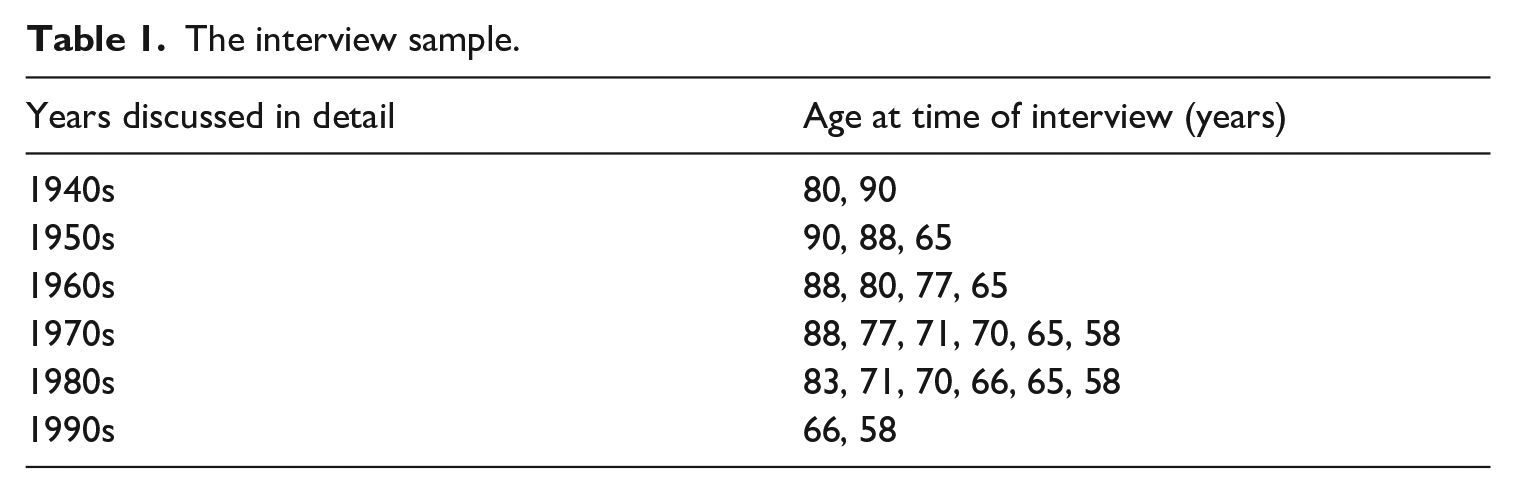
The practical consequences of a new heating system are likely to vary depending on household composition, occupancy patterns, and existing practices. We, therefore, conducted interviews with people who are now of different ages (from 58 to 90) but who had (a) lived in the selected house types/housing estates at a point when they were themselves setting up home and starting family life (typically between the ages of 25 and 35) and (b) had experience of some of the infrastructural changes recorded in the archives (Table 1). We identified 23 respondents who met these criteria by starting with people involved in local history societies, or from other contacts, and ‘snowballing’ out.
The interview sample.
While our focus on householders and their practices has clear parallels with recent anthropological and science studies–oriented analyses of heating (Ariztia et al., 2019; Rinkinen and Jalas, 2017), our distinctive move was to combine interview material with archival evidence of infrastructural change in the same properties and over the same period of time.
Data from both parts of the research were analysed using NVivo qualitative data analysis software. Interviews and archive materials were coded using a frame designed to identify and characterise changes in household practices and infrastructural provision. Interpretations and decisions about coding were discussed within the multidisciplinary research team. We also exploited the potential to follow infrastructural changes as they appeared in interview transcripts, observation notes, archival material including council minutes and records of communications, and in national reports and guidelines. Moving between these ‘sites’ allowed us to map the shifting relation between local authority investments, the ideas and rationales on which these were based, and their effect in practice. In the next section, we describe the Stocksbridge case study and what it revealed about how infrastructures and daily life (re)shape each other.
Infrastructures in practice: space, time, and central heating
In Stocksbridge, as elsewhere, the transition from coal fires to gas central heating took place at different rates and over a number of decades (1930s to 1960s). In the 1930s, some council houses were provided with locally produced ‘town gas’, mostly used for lighting. Town gas was subsequently included in new built developments, and used for water heating, as an alternative to coal for cooking, and/or to heat individual rooms. For much of this period, initial installations of central heating (designed to maintain 15.5 °C in the living room and 13 °C in bedrooms) were based on smokeless coke stoves and radiators. Spink Hall, started in 1947, was the first estate in Stocksbridge to include central heating of this kind. However, it did not meet with universal approval. In theory, central heating made it possible to heat more rooms, and to do so more continuously but in practice this did not always happen. Most of the houses in Spink Hall also had an open grate in the living room, recorded in the report as a ‘concession to tradition’. 4 As investigations into complaints about damp 5 showed, not all tenants used central heating, sometimes because of the cost, sometimes because they disliked the kind of heat produced.
Despite this mixed experience and despite dissent from some councillors, Stocksbridge Urban District Council (SUDC) made the case for providing solid fuel central heating as standard, at Stubbin Farm Estate. It seemed that the path was set but in 1950, the SUDC dropped its central heating policy, citing difficulties of securing the smokeless fuel and reportedly ‘lukewarm’ tenant responses to the system. 6 Later additions to the Stubbin Farm estate reverted to an open fire in the living room with a back boiler. The ‘stop-go’ pattern continued. Some of the houses on the East Whitwell Estate, built from 1955, were equipped with a grate and back boiler, some with electric underfloor heating and some with gas central heating. 7
As these histories show, the progress of gas and of ‘full’ central heating was uneven and erratic through the 1950s and into the 1960s. When tenants wanted to ‘upgrade’ from solid fuel, they were as likely to opt for electric as for gas heating. Some went so far as to ask for (town) gas to be taken out. This balance shifted in the late 1960s, when Stocksbridge switched to the national gas grid, when the cost of gas fell, and when boiler technologies improved (Hanmer and Abram, 2017).
When it was installed and used, fully automated gas central heating had multiple consequences for the details of everyday life and for reconfiguring practices in time and space (Kuijer and Watson, 2017). As our interviewees explained, one of the most striking changes was that it was possible to be warm upstairs in the winter. No longer only a place for sleeping, children’s bedrooms became ‘home’ to all manner of different practices, including homework, reading, entertainment, and as in this next example, entertaining friends.
Edward (born 1932) describes the experiences of his teenage son in the 1980s: if guests came he’d invite them upstairs and sit and talk to them up there. [ ] If they wanted to talk about their escapades from the night before or what they were going to do. [ ] he’d watch his own telly up there.
Everyday activity extended out from the kitchen into living rooms, previously reserved for special occasions, partly because of the time and cost of lighting another coal fire. In some households, the arrival of the TV, and the practice of watching it was enabled by a warm living room: in others, a new TV helped constitute the need for central heating. As we learned, these networks – one of broadcast TV, the other of gas central heating – supported each other and developed together as they were integrated into and through practices.
John, who was born in 1943, describes his childhood in Stocksbridge in the 1950s.
Well I mean everything happened in the kitchen in those days. You virtually lived in the kitchen. Rarely did you put a fire on in the living room, but there was an open fire in the living room as well. You really didn’t live in the living room because there were no tellies, well we didn’t get a telly until 1953 for the cup final . . . That’s when we got our first telly, so that’s when we started using the living room
Respondents also drew attention to the relation between infrastructural provision and the timing and scheduling of daily life. As described in this next extract, gas central heating released tenants from the temporal demands of managing and maintaining a coal fire.
Well [the gas fire] stopped the yellow carpet – which we were stupid enough to buy in the first place – getting dirty. Because we had to bring the coal through …. And then of course it was instant. Wonderful, you didn’t have to put the sticks in, the paper and the sticks, and the coal on top, then light everything and wait for it start, you know setting the coal going. It used to take ages to warm up when we came home from work. So having a gas fire, that was wonderful. (John, born 1943)
This is one example of how living with different heating systems is a matter of living with different temporal and spatial arrangements (Jalas and Rinkinen, 2013). As our respondents explained, heating systems are not simply about keeping warm: they are embedded in other practices including cooking, sleeping, eating, watching TV, and in the different temporalities of sourcing and storing fuel (with coal) or just turning the boiler on. Ariztia and colleagues explore very similar themes in their discussion of switching between wood fired and kerosene stoves in Chile, a move that also had far-reaching consequences for the ordering of daily life and for practices within the home and beyond (Ariztia et al., 2019). As in the Chilean study, interviews in Stocksbridge showed how the roll out of gas infrastructure, and the provision of central heating featured in the subtle but significant transformation of a whole range of different practices.
The fact that gas central heating ‘arrived’ in many households was itself an effect of a conjunction of practices including planning and urban design, and investment and construction on the part of gas and electricity utilities. As the minutes, reports, and correspondence from Stocksbridge Urban District Council demonstrate, for a decade or more gas central heating was one among other options, the perceived merits of which varied depending on spatially and temporally specific integrations of policy, ideology, and judgements about relative cost and performance. The result was a patchwork of provision. So what was it that prompted the move to replace coal fires and provide gas central heating as standard during the mid to late 1950s? From the council’s perspective, this was primarily a decision to substitute one fuel (heavy, dirty, time-consuming) for another (modern, clean, convenient, controllable).
The council archive shows that switching from coal and electricity to gas was controversial, not least because of its impact on regional and commercial strategies and on competing interests associated with ‘disappearing’ systems of provision, especially of coal. The documents we studied provide insight into contested processes including behind-the-scenes arguments about tenant choice and battles between gas and electricity utilities and negotiations between these organisations and the council (especially about responsibility for the costs of installing gas, of extending electricity supplies to existing houses and of providing connections to new housing estates) (Carlsson Hyslop, 2018). In Stocksbridge, council decisions about when and whether to provide gas central heating were tied up with utilities’ decisions about when and where to invest (or delay investment) in gas and/or electricity networks. For example, the division between electric and gas heating systems for different areas of Stubbin Farm Estate was, in part, due to the fact that there was no one dominant solution: different technologies and systems co-existed. It was also due to the politics of provision and to a series of negotiated settlements between the council and electricity and gas providers. 8 The fact that the council was a major player, building and owning large numbers of homes was critical for the financing of these schemes and for the kinds of deals that could be struck.
Householders were also involved either directly or indirectly as ‘active’ consumers. Along with letters of complaint many of which highlighted the inadequacies of the electricity supply and its inability to keep up with growing demand for appliances, Stocksbridge council received applications for permission to modify appliances and household infrastructures. Such communications provide revealing insight into the forms of aggregation at stake in shifting patterns of infrastructural provision. For example, in a letter dated March 1939, Stocksbridge resident Mr Luford asks about the possibility and consequences of having his house wired in to the power supply passing his door to the Spink Hall estate. This query, and similarly others, figured as one small part of the council’s ongoing negotiation with the utility (Trentmann and Carlsson-Hyslop, 2018). 9 The council also conducted surveys of its tenants, finding general approval for central heating alongside some dissent, and anxiety about the cost of keeping warm. Investigations into problematic behaviour represented another source of data, including evidence of one tenant overloading circuits, 10 and of another placing a 15 ampere socket on an outlet with only 5 ampere capacity. 11 Such fragments are indicative of often diffuse but cumulative pressure. Bit by bit, new demands are put on the council as expectations change, as households adapt, and as practices shift – not apart from, but along with the forms of infrastructural provision on which they depend.
In sum, relations across these multiple sites played out in the iterative processes of infrastructural change. As we learned, judgements about gas, electricity, and heating were also judgements about what a house is for, and about the many different and changing practices – from doing homework to watching TV – that it is expected to accommodate. Going full circle, infrastructural investment only made sense, and was only justified with reference to the actual or anticipated scale of aggregated demand. From this point of view, the council’s decisions have the double role of synthesising evidence of present and future expectations of normal provision. Across different sources of evidence, it is apparent the councils’ decisions to invest in heating and power supply responded to changing norms and expectations embedded in national guidance and regulation; and to real-life changes in household routines.
Aggregation and integration
The Stocksbridge case provides fresh insight into how ‘small’ and ‘large’ scale phenomena are co-constituted, and into the forms of aggregation and integration involved. In particular, it shows that aggregation is a necessary feature of how practices shape infrastructure. It is, for instance, clear that the single performance of a practice in the home is unlikely to have perceptible effect on infrastructure. Instead, in Stocksbridge as in other parts of the UK, the growing demand for gas central heating reflected a gradual accumulation of new interpretations of thermal comfort, linked to changing ideas about the home and what it means to live well, and about the systems and technologies that are ‘required’. The materials and sources discussed above – whether resident letters, or council responses to increasing demand – provide some insight into necessarily diffuse processes of aggregation. Our point is that these combine and interact, and that it is the conjunction of multiple conventions and expectations that generates the push for infrastructural change.
Most forms of aggregation have a spatial aspect. In the case of Stocksbridge, it matters that the council estates were located in densely populated areas and that they were of a sufficient scale to warrant infrastructural investment. This was key both to the council’s opportunity to act and to the constitution of the need to do so. In this case, as in others, previous infrastructural arrangements, including the layouts of estates and streets, resulted in forms of urban density that actively enabled the spread of gas central heating.
These types of aggregation matter for relatively ‘local’ circuits linking households, the council, and the heating infrastructure. These local relations contribute to and are themselves shaped by relations that extend beyond the boundaries of Stocksbridge and that involve the integration of ‘far flung’ events and ideas. For example, national planning guidance is, by definition, applied in other towns, all of which then share certain features in common. These commonalities constitute a collective shift in what counts as normal housing provision, and in the meaning of a normal comfortable environment. Going full circle, national and international representations of ‘the good life’, and ideas about what councils should offer and enable are reproduced and enacted through a multitude of localised instances of infrastructural renovation and renewal.
In Stocksbridge, notions of national interest and ideas about private or state ownership amplified each other not in the abstract, but as combined and instantiated in the actions of governments, utility companies, and councils. The archives showed how the Clean Air Act, and planning guidance like the Parker Morris report (Parker Morris Committee, 1961) were integrated into local authority procedures, eventually becoming embedded in council decisions and enacted in the plans and contracts issued (Kuijer and Watson, 2017). It is important to recognise that national guidance was not seamlessly adopted: instead, the records reveal an active and often contested process. As described, the council arrived at its own (always provisional) position on the topic of central heating by navigating between sometimes conflicting discourses and pressures and by interpreting national guidelines with reference to local conditions.
Taking a step back, the Stocksbridge case has allowed us to identify specific forms of integration and aggregation and to show how they combine across multiple spatial scales, from households and housing estates through to the local municipality and to national and international organisations. To reiterate, the size of the estates we studied proved to be crucial: it was this – and the prospect of significant demand – that prompted gas and electricity companies to invest. However, this would not have happened in the absence of other dynamic processes, including the emergence and embedding of shared ideas about what homes and daily lives should be like. In other locations, and at other periods, the details will be different. However, that does not diminish the importance or the value of foregrounding infrastructure–practice relations, and of paying attention to the types of aggregation and integration involved. In the final part of the paper, we reflect on the wider implications of these ideas.
Future infrastructure – practice relations
We began by defining infrastructures as material arrangements that exist in the background of multiple practices. To learn more about how infrastructures and practices shape each other, we designed a study of the introduction of gas central heating in council housing in Stocksbridge. By moving between evidence of local authority decision-making and household routines, we disentangled some of the recursive processes involved. In pursuing this analysis, we have built on the small but growing body of work that demonstrates the relevance and importance of practice theory for conceptualising and analysing large-scale trends in society (Shove et al., 2015; Shove and Trentmann, 2019). In developing a practice-theoretically informed approach, we started by suggesting that understanding how infrastructures develop and spread depends on understanding how they are entwined with complexes of practices (such as cooking, playing, eating, and television viewing), and in the Stocksbridge case, those of housing, local governing, planning, and national regulation as well.
In the process, we have shown how infrastructural provision has a bearing on the distributed performances of multiple practices, and vice versa. As Larkin suggests, we have examined infrastructures as ‘networks through which goods, ideas, waste, power, people, and finance are trafficked’ and as semiotic objects (Larkin, 2013: 329). This does not mean that we are confronted with an undifferentiated web of interconnections. As we have argued, it is possible and important to understand and to detail the forms of aggregation and of integration of which specific infrastructure–practice relations are made.
In bringing the article to a close, we comment on what such an analysis contributes to contemporary debates about the decarbonisation of heat and the future of comfort. Looking back, there is a sense in which the integration of central heating is part of a more extensive ‘rewiring’ of society. In the case we have described, seemingly local interpretations of the value of convenient, clean whole-house heating systems were entwined with a much more extended repertoire of ideas about modern life and the character of ‘normal’ provision. Edwards (2003) argues that infrastructures define ‘the condition of modernity’ (p. 186). Many would agree; in practical terms, reliable systems of electrical power, road networks, and broadband connectivity enable what are taken to be ‘normal’ practices in places like the UK. The complication is that these interpretations sustain and reproduce increasing problematic forms of energy demand, not only in Stocksbridge but in other parts of the world as well.
The Stocksbridge example shows that establishing gas central heating as standard and doing so at scale was a patchy and hesitant process. As such it shows that what are taken to be ‘normal’ systems and expectations are neither natural nor inevitable: they have quite specific histories, and they are expressions of historically specific forms of aggregation and integration. These are important insights for policy makers seeking to move towards a lower carbon future.
To date, there is a tendency for policy making to look for solutions that mimic current expectations, and that reproduce conditions enabled by full gas central heating, but this is not the only way to go. At a minimum, our analysis of the infrastructure–practice dynamic demonstrates that other configurations are possible. More subtly, our analysis shows that simple narratives of substitution – whether from coal to gas, or from gas to hydrogen, or decarbonised electricity – overlook the extent to which infrastructures and technologies are embedded in the detail of what people do, in discourses and judgements of value and well-being. This argues for more explicit consideration not just of heating and cooling, but of the practices and ways of life that different configurations of resources, infrastructures, and appliances enable.
In other words, decarbonisation is not a matter of increasing efficiency or of swapping one fuel for another. Engendering lower carbon combinations of infrastructures and practices will almost certainly involve the integration of new discourses, technologies, and practices within households, housing providers, utilities, and governments, and with that, the erosion of some of the conventions and expectations associated with gas central heating.
In working through one example from the past, and in writing about how transitions in practice come about, we have provided a means of conceptualising and studying infrastructures not as stand-alone systems, nor as technologies with which ‘users’ interact, and not as generic signifiers of modernity. Instead, and in keeping with the theoretical tradition on which we draw, we have shown how infrastructures (and energy demands) are defined by the interweaving of multiple practices across social and spatial scales, and by recursive and also dynamic processes of aggregation and integration.
Footnotes
Acknowledgements
We are grateful to fellow members of the project team–Lenneke Kuijer, Anna Carlsson-Hyslop, Nicola Spurling, and Frank Trentmann – for their contributions in developing this work, and also to interview participants, the Stocksbridge and District History Society, and the Sheffield Archives. We are also grateful to other members of the DEMAND centre and to different audiences who have commented on presentations of ideas in this article, or on earlier versions of the article.
Funding
The author(s) disclosed receipt of the following financial support for the research, authorship, and/or publication of this article: This work was supported by the Engineering and Physical Sciences Research Council [grant number EP/K011723/1] as part of the RCUK Energy Programme and by EDF as part of the R&D ECL-EER Programme.