




Abstract
The coronavirus 2019 (COVID-19) pandemic and associated public health measures continuously alter our everyday lives and routines. Here, we focus on social infrastructures of local provisions and the role they perform within cities under shutdown. Social infrastructures of local provisions such as supermarkets remained functional in Germany even during repeated shutdowns as they were perceived as essential for everyday life. Supermarkets hence turned from mundane sites of provision to sites where we could witness how infrastructures are deeply entangled with the microfoundations of urban social life. Based on auto-ethnographic accounts covering the period from March 2020 until May 2020, we explore how these spaces became primary sites through which to experience the changes caused by the pandemic. Writing from inner-city neighborhoods, we highlight the need to attend to the ambiguous role of design, objects, and materiality to adjust collective social practices and urban conviviality in the times of COVID-19.
Introduction
In late 2019, a new lung disease named COVID-19 was discovered in China and spread rapidly. By spring 2020, most countries in Europe, the United States, and Canada, as well as countries in Africa, the Middle East, Asia, Australia, and New Zealand were in a first (partial) lockdown, with many more sanitary measures to follow which changed social life in manifold ways: The cosmopolitics of COVID-19 collates the insecurities, precarities, vulnerabilities, inequalities, hopes, fears, and im/possibilities and dis/abilities of human life by dis- and reassembling relations of, and between, humans and nonhumans, the material and immaterial, the organic and inorganic, nano-, micro-, and macroscaled bodies, and the different temporalities and spatialities that make up the conduct of everyday life. (Schillmeier, 2020, p. 2).
The effect of the global COVID-19 pandemic was varied and far reaching and affected all aspects of social life. Within this article, we look back at the very beginning of public health measures to combat the spread of the COVID-19 virus in Germany and reflect on the ways these measures affected everyday life in urban quarters. Precisely, we take an approach where we focus on social infrastructures of local provision to reflect on the changes caused by the shutdown (for further publications from this project, see also Tuitjer et al., 2023). Attending to these changes through a focus on the few social infrastructures that remained operational despite the shutdown (i.e., supermarkets, cafés, and farmers’ markets) is useful here: Large-scale social transformations [. . .] are often experienced as changes in the material qualities of one’s everyday life: as reliable electricity, as commuting by subway, as coal- and smoke free air. [. . .] These encounters are opportunities to gather knowledge about the changing setting in which one finds oneself [. . .]. (Angelo & Hentschel, 2015, p. 308)
While the social role urban infrastructures perform and the kind of sociality they enable—or discourage—is taken for granted and is thus made invisible (Star, 1999), the COVID-19 pandemic affords us with a break of such routines, turning invisibilities of shared practices and sociality into spotlights on social negotiations, ambiguities, and ruptures.
In this article, we set out with briefly situating our work in the context of infrastructural research conducted within geography and sociology. We foreground three important aspects of social infrastructures: (1) social infrastructures afford urban sociality; (2) social infrastructures work because of shared social practices; and (3) these social practices are entangled in a web of urban materiality, design, and objects. We are then briefly outlining the research strategy for our ad hoc auto-ethnographies, before we share a vignette of one episode in a supermarket to illustrate what was happening around us. In the conclusion, we highlight how changing designs, objects, and materialities, that rearranged our interactions and encouraged new behaviors, make visible altered social practices in regard to infrastructures during the pandemic. However, we stress that there is nothing predetermined about such materialities, but rather that these new objects and spatial designs provoked ambiguities and moments of unease and ambivalence. As such, social infrastructures during pandemic times afford us with the chance to witness and reflect about wider questions of how social practices are entangled with—and at times probed by novel—designs and objects. Our article thus contributes to documenting and reflecting on the social consequences of the COVID-19 pandemic (Schillmeier, 2020; Vallee, 2020; van Eck et al., 2020) and, moreover, makes a contribution to literature on social infrastructures and urban everyday life that is interested in the specific ways in which sociality and materiality interact within these sites (Amin, 2008; Graham & McFarlane, 2014; Latham & Layton, 2019; Mickewicz, 2016).
Review: Social Infrastructures, the City and a Global Crisis
Research on urban infrastructures has been on the forefront of geographic inquiry for quite some time, so much so, that authors have deemed this the “infrastructural age” (Furlong, 2011; Steele & Legacy, 2017). Starting with built infrastructural networks (sewer and water systems, electricity networks, tracks, or roads), the focus has increasingly been broadened to how social infrastructures such as museums, galleries, libraries, child care facilities, coffee shops and restaurants (Latham & Layton, 2019; see also Sanul & van Heur, 2018) are connected to or even co-creating urban sociality.
While social infrastructures are predominantly perceived as critical for urban life itself and the functioning of a “good city” (Latham & Layton, 2019, p. 1), the corona crisis has made it quite clear that differences exist between types of social infrastructure within a city, and their roles and value to public life are variegated. Indeed, the urban infrastructures of arts and culture, entertainment, and hospitality were closed first in Germany, and everyday life had basically been reduced to work and grocery shopping. Due to the pandemic, many lively spaces of urban conviviality were closed down, leading some to speak about a temporal “death” of public space (van Eck et al., 2020). Thrown back to such limited types of social infrastructures in the city, urban sociality did not cease to exist, however. Rather, commercial spaces, like restaurants or coffee shops or grocery stores, that had been identified as steeped with affordances to foster urban sociality (Bell, 2007; Henriksen & Tjora, 2018; Latham, 2003) before, endured as sites of (limited) urban sociality, allowing us to use them as sites to witness “types of social practices associated with specific instances of urban change” (Latham, 2003, p. 1699). Henriksen and Tjora (2018) point out that it is within spaces such as cafés, clubs, or restaurants that some people are able to “produce collective identity and spontaneous, location-based communities” (p. 352). We thus follow a perspective where infrastructures are not just the “physical setting” (Hampton & Gupta, 2008, p. 842) for human action, but actively involved in enabling and restraining particular practices of co-existence (e.g., Hirschauer, 2016; Reuter & Berli, 2016).
It is through an attention to the everyday practices of social infrastructures that we can learn more about how people “go about building a world in the city” (Latham, 2003, p. 1703). Practices, here understood as “embodied, materially mediated arrays of human activity centrally organized around shared practical understanding” (Schatzki, 2001, p. 11), are key to living in, using, and, ultimately, knowing the city. Within such routinized, daily practices, we argue, lie an element of what scholars of infrastructural research have dubbed the invisibility or taken-for-grantedness of infrastructures (Star, 1999). Amin observed that social infrastructures entail an element of “collective repetition and endurance” (Amin, 2008, p. 9) to function. Within the current corona pandemic, we argue, our “patterned grounds” (Amin, 2008, p. 12), that is our collective and individual ways of organizing everyday life, were severely disrupted. Our routines and rhythms through which we make sense of urban space and find our ways through it were challenged.
Other than the physical breakdown of infrastructures and their disrupted materialities which have been addressed before in connection to, for example, natural disasters (e.g., Adey & Anderson, 2011; Bennett, 2005; Graham, 2010; Sims, 2007), however, the lockdown predominantly affected our practices of using social infrastructures rather than their physical existence. This article hence expands from previous research on infrastructures precisely because we attend to the disruptions of routinized social practices rather than physical breakdowns of infrastructure. While scholars of (urban) infrastructure foreground the routinized, materialized and thus stabilizing dimension of practices, practice theories equally help us to explore the tension between routinized repetition and spontaneous invention of practices (Reckwitz, 2002). The shutdown of our daily infrastructure and social distancing rules make this inherent tension of practices visible and feelable in the many adaptations and ad hoc solutions people find to navigate the city under social distancing rules.
Against this background, we explore in how far the current pandemic affects the urban sociality afforded by social infrastructures of local provision in our research sites.
Research in Times of Lockdown: (Auto-)Ethnographies as Coping Strategy
The quarantine is a pause, an event that affords us the possibility to write theory through reflexive story. A story with distant characters and a sole protagonist—the embodied self (Vannini, 2020, p. 270).
These articles draw on auto-ethnographies from the first lockdown in Germany. Between March and May 2020, public life came to a standstill. Cultural and social infrastructures such as theaters and museums, child care, and even playgrounds were closed down completely, with the exception of local provisions. Our research institutes closed, and all employees were sent into home office, together with 27% of the German working population (Hans-Böckler-Stiftung, 2020). It is these 2 months in 2020 that we focus on, as a phase of uncertainties and ambiguities when everyday life changed and the “new normality” of living with the virus had not yet been established. The observations, photography, and snippets from conversations that we share are part of a research that was triggered through our own very personal need to make sense of our changed everyday life by closely monitoring what is going on around us. Thus, turning to own experiences and various forms of ethnography (from collaborative auto-ethnography, to more traditional forms of ethnography to virtual ethnographies) to critically reflect on the uncertainties of the pandemic was a widely shared practice by many social scientists (e.g., Barry, 2020; Manzo & Minello, 2020; Roy & Uekusa, 2020; Vannini, 2020; Zuev & Hannam, 2021).
We understand an ethnography to be an umbrella method that entails various research activities such as conversations and chats, formal observations, chance encounters, and auto-ethnographic reflexivity within the selected community (Crang & Cook, 2007). The focus on social practices, human interactions with changing urban materiality, and objects further support an ethnographic approach that attends to the way in which people do particular things, more than how they narrate or reflect on things (Davies et al., 2002). Moreover, we follow Cohen’s (2012) insights about the value of auto-ethnographic elements within research on disastrous situations. In his article on the 2011 flood in Bangkok, he shows how the crisis estranges people (including himself, as a researcher and long-standing resident of the Southeast Asian metropolis) from the previous familiar surroundings and thus provoking a phase of deep reflection on the changes and disruptions around us.
Arguably, as any ethnographic work, this article reveals knowledge about the subject and about the subjectivity of the writer to equal part (Trigger et al., 2012). In this case, we were witnessing the changes in the neighborhoods in where we live and where most of our daily life took part under the lockdown, as most other places were simply closed. The vignette we present entails both observations of other people and reflections on our own doings within the city under social distancing rules. These auto-ethnographic elements are important to consider when using the empirical vignette as data. Furthermore, as we share certain demographic (age, female gender, white, born and raised in Germany) and sociostructural (education, career level, etc.) characteristics, our perspectives undeniably have their blind spots—and our observations and thoughts are thus always trapped in a particular framework.
Inner-Urban Quarters Under Lockdown
We conducted research in three inner-urban quarters in two different cities in Lower Saxony, German. The city of Hannover has about 500,000 inhabitants and the neighborhoods we observed are Linden-Mitte and Nordstadt. The third research site is a smaller town from the same federal state, called Verden. Verden has about 27,000 inhabitants, and is divided into several districts and incorporated former villages. The research was done in the district Innenstadt in the city’s center. Both cities can count as “ordinary” (Robinson, 2006), and thus under-researched, places. While Verden and Hannover are different in population size and economic structure, all quarters where we conducted our auto-ethnographies are inner-city neighborhoods with distinct urban infrastructures such as cafés and restaurants, small shops, clubs, and theaters and a vivid nightlife and outdoor lifestyle taking place at public spaces. From the impressions we collected during spring 2020, we decided to present the following vignette because it contains many aspects which we came across in various situations and localities. Thus, we present an episode at the supermarket as an example for the many alterations that everyday infrastructures have undergone during social distancing and lockdown health measures (Figure 1).
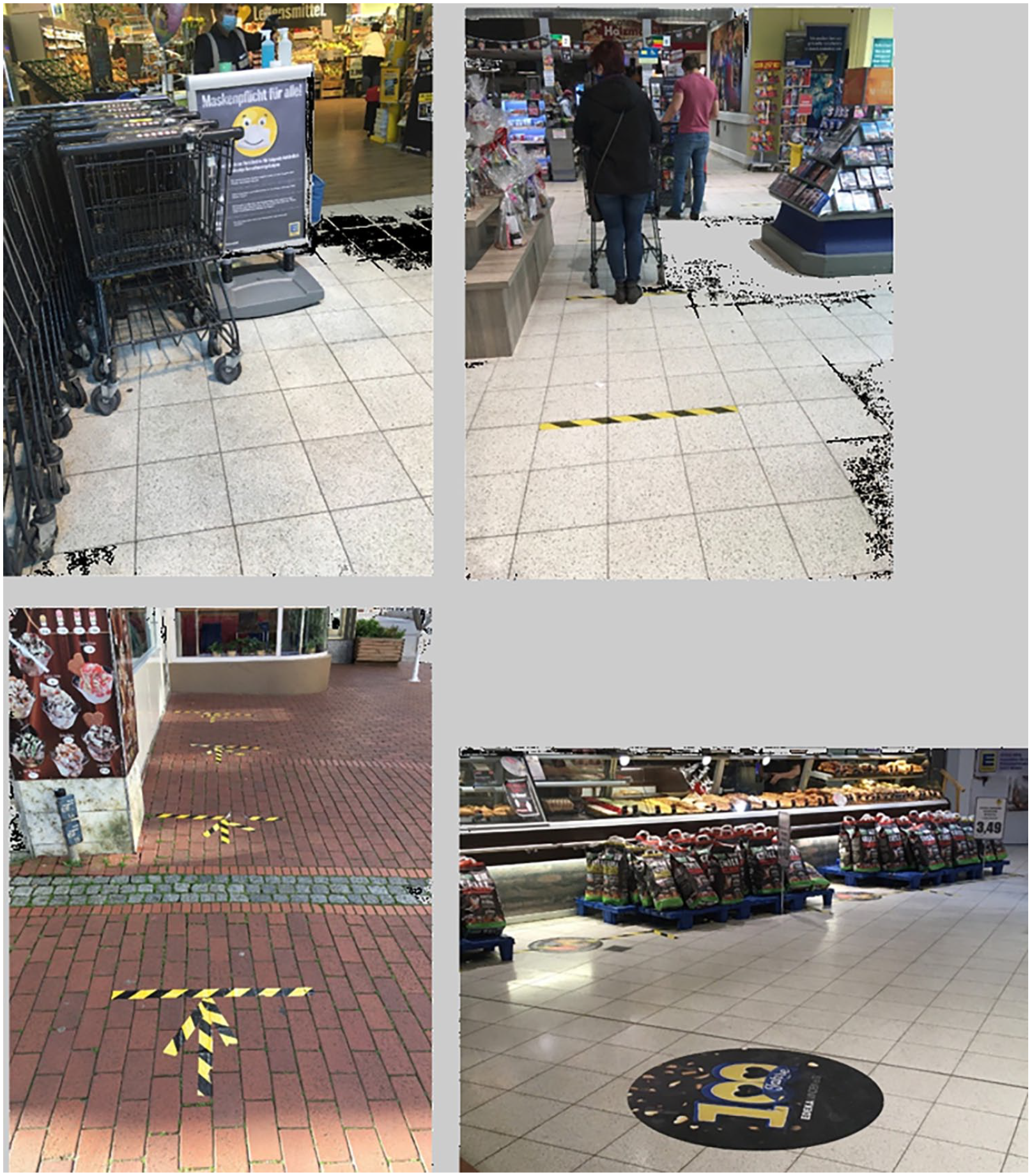
Images in Clockwise Direction From Top Left: No 1 to 3: Supermarket in Verden; No 4: Ice Cream Parlor in Verden’s Pedestrian Precinct. May 18, 2020 (c) Author c.
How to Use Social Infrastructure Under Social Distancing Rules
6th May 2020/ 18th May 2020: A quick stop at the grocery store
The grocery store I normally go to for the weekly shopping is within walking distance of my home. It is a big supermarket, located in a mall, which it shares with a bakery, a nail studio, and a laundry.
On that Monday, I realized that I needed vegetables and pasta for lunch and intended to quickly go there to buy the missing ingredients for my meal. By now, my mask hangs next to my jacket at the coat rack; this reduces the risk of forgetting it. But what I tend to forget over and over again is that I have to use a trolley in the supermarket. Normally—what was “normal” in precorona times—I take a basket and not a trolley. Trolleys are bulky, unnecessarily take up space, as I never buy more than I can carry myself, and are potentially unhygienic. Think of all the people who have touched it and coughed or sneezed on it before. Now, the sign tells me in German and with pictograms that I have to use a trolley to be allowed to enter the supermarket. When all trolleys are gone, you have to wait until one is returned. A guy is positioned at the entrance of the supermarket and checks whether everyone obeys to the supermarket’s rules: one trolley per person or, if several people go shopping together, maximum two persons per trolley; a woman in front of me with two little children was asked to sit one of her children in the trolley; otherwise, she would have needed to take a second trolley. She takes it with humor and jokes with her smallest daughter about how happy the girl obviously is to be officially allowed to sit in the trolley and not have to argue with mum about it. Another rule: Masks are obligatory for anyone older than 6 years, the two children in front of me look younger than that and indeed do not wear a mask. Disinfection spray is in front of the guard, but it is unclear to me whether it is for him or for me or for him to sanitize the trolleys. I decide to use it; he doesn’t react, and the bottle seems to be empty. No spray moistens my hand.
Making my way through the supermarket, I navigate around people with their trolleys and wonder how I can keep the distance when I pass by them on the supermarket corridors. No chance to keep a 2-m distance from a person when the corridor is just wide enough for two trolleys to pass each other. Thus, take a detour to find an empty corridor. This way, the distance from vegetable rack to pasta rack seems endless. At the checkout, black and yellow striped tape on the floor marks the required distance between customers. How would I make sense of them if I hadn’t the knowledge I have on the current discussion on modified behavioral codes in shops? Today, everyone adheres to the codes, no one complains. As I wait in line, I compare the masks people wear. Some are FFP2 masks and I wonder if we are now allowed to use them as ordinary citizens as they were initially reserved for clinics. Some wear self-made masks, again some just a scarf pulled up to cover even the nose. From first sight, you can see whether people are comfortable with the situation or not. Some constantly adjust their mask. I become aware of how often people touch their face with their fingers.
After having passed the checkout, I notice how the bakery has rearranged its site. Bags with charcoal, available at the supermarket as the barbecue season has just started, are compiled to mark both the distance between customer and counter and between the customers themselves. At least the first intention will most presumably not be fulfilled. How can you pay when the counter is about 2 m away from you? When I think of people folding paper aeroplanes from their banknotes to pay, I have to giggle and decide that I had better leave the mall. But before I am able to enter the mask-free world, I have to get rid of my trolley.
I then make my way out of the mall. Most of the customers leave for the underground parking. Similar to me, they continue wearing their mask. When I approach the doors, I wonder: Do the doors signal the border between inside and outside, between mask-on and mask-off? Or wouldn’t it rather be the entrance gate to the supermarket itself? I decide not to be too obsessed with detail, wear the mask until I am outside of any built structure and take it off. Phew. Warm underneath, but the current mask model I wear, version four of my mum’s private inner-family production, is the most comfortable so far. In addition, I have even been complimented because the color of the mask’s cloth apparently matches my clothing.
The vignette above documents the micro-disruptions and ambiguities within our uses of social infrastructures under rules of social distancing and thus captures the ordinary, not the “magical moments of research” (Hitchings & Latham, 2020) that are often found in ethnographic vignettes. While shopping for vegetables and pasta is a mundane activity, the social distancing rules insert moments of uncertainty, doubt, and an element of re-learning practices in such an ordinary setting. Amin observed that urban infrastructures entail an element of “collective repetition and endurance” (Amin, 2008, p. 9) to function. Amin continues to argue that The movement of humans and non-humans in public spaces is not random but guided by habit, purposeful orientation, and the instructions of objects and signs. The repetition of these rhythms results in the conversion of public space into a patterned ground that proves essential for actors to make sense of the space, their place within it and their way through it. (Amin, 2008, p. 12).
The tension between routinized repetition and spontaneous inventions (Reckwitz, 2002) become apparent here, as new signs, new instructions, and objects appear. The vignette shows the ambiguities that arise when our “patterned ground” becomes disturbed. The empty sanitizer bottle at the supermarket entrance, and its unclear use to begin with, signify the collective confusion on how to renegotiate conventions of shopping in pandemic times. What is more, the vignette reflects the knowledge base and practices of the early weeks and months of the pandemic in Germany. It documents an individual’s approach to contribute to what Schillmeier (2020) has termed a counter infection: “Addressing and resisting the pathological effects of viral infection require that we need to find modes of counter infections that deal with the crisis situation” (Schillmeier, 2020, p. 3). We will reflect on particular elements of the vignette below.
The Mask
Even before the trip to the supermarkets, a new routine needs to be established, carrying a facemask. The mask became a major object that altered our relation to the environment, to surrounding people and changed our own bodily practices and appearances (Vallee, 2020). The mask had to be included into the list of essential things to carry, before leaving the house and assumed the role of an “entrance card” to social infrastructures in the city. Star (1999, p. 381) has foregrounded that infrastructures entail conventions of practice that relief people of constantly thinking about specific infrastructural uses. In pandemic times, as the vignette shows, these conventions of practice are destabilized and new practices must be learned and actively remembered: for example, to bring a mask, to use a trolley, and to keep distance.
Another aspect of mask-wearing was an emerging practice of distinction, translated into the new mask dresscode, as the type of mask reveals information about the person who is wearing it. According to the general administrative recommendations from spring 2020 in Germany, FFP2 were only deemed necessary for professional medical staff. Surgical masks as normally worn in a doctor’s office or in nursing homes should also be reserved to certain professional groups. This recommendation, however, was contradicted by the fact that those masks were then still available for everyone in pharmacies, though at fivefold to 10-fold prices (personal communication with a local pharmacist in Verden, May 2020). This shows the inherent ambiguity in governmental recommendations relying on the thoughtful behavior of the citizens. The third version of masks, self-made masks, were those to be worn by the general public, even if the further course of the pandemic has shown that indeed FFP2 or surgical masks afford higher levels of protection. However, within the beginning of the pandemic, handmade masks were widely used in the public. They differed in the cloth used and the style in which they were designed as well as whether they were closed with ribbons or elastic straps 1 and became part of a newly emerging sense of mask fashion among the general public. Simultaneously, producing the mask as material object has led to new forms of a solidarity economy: Local clubs and associations started initiatives and raised money for people in need by sewing masks and selling them for a donation (Rotary Club, 2020; Stadt Essen, 2020). Within families and circles of friends, sewing masks for each other became a popular activity and way of expressing care for each other. Formerly loosely connected neighbors sew for each other, shared experiences and material, and online tutorials and sewing patterns proliferated via social networks. All of this confirms Morrow’s observation that “The appearance of solidarity and social partnership from afar reveals that society is not solely based on propinquity” (Morrow, 2020, p. 316). In the face of social distancing measures, care at a distance flourished in the first months.
As Vannini noted in the beginning of the pandemic: “Disease is a sickness, an ailment disrupting a human, animal, or plant body. Dis-ease is different. Dis-ease is an infection affecting a body public, a social malaise, a rupture, and a loss of ease and of comfort” (Vannini, 2020, p. 360). The vignette shows how the mask might have been affective in stopping the disease, yet is an object that generates dis-ease as it changes people’s appearances. As an opaque cloth now covers mouths and noses, the facial expression is significantly altered. Social interaction as we know it relies to a huge degree on interpreting bodily expressions (e.g., Goffman, 1959), including taking clues from other people’s facial expression. This has to be re-learned now, crinkles emerging at the eyes or sudden movements of the mask might indicate a smile under the mask. As the mask’s cloth damps the sound of the spoken word, we end up yelling at the clerk in the bakery or even dare to cross the black-and-yellow line to point at the desired pastries. Masks physically intervene in our communication with others, likely leaving already impaired people even more disadvantaged: People with impaired sight or hearing might have even more difficulties to interpret people’s communication as less of their face is visible and their voices are muffled. Wearing masks here reveals its ambiguity, as it both protects from disease and contributes to dis-ease within social interaction.
Tapes and Barriers
The new spatial set-up of the store alters the way people move through the supermarket, which in turn affects our social interactions with other customers. Research on urban infrastructures has attended to the importance of design forms and objects before. Mickiewicz (2016), for example, foregrounds the connection between myriad social practices and the built form of a new library, which functions as cultural hub, learning laboratory, and leisure spaces at the same time. Furthermore, Amin (2008) highlights the “entanglement between people and the material and visual culture of public space” (Amin, 2008, p. 8). Specifically, he writes, “technology, things, infrastructure, matter in general, should be seen as intrinsic elements of human being, part and parcel of the urban ‘social’” (Amin, 2008, original emphasis). Crucially, Amin insists on the formative role of urban built environment, materiality, and objects for the potential of sociality and conviviality to emerge.
This vignette thus points to the importance of materiality for adjusting our everyday lives and practices to the new situation.
It highlights how strongly learning new or modifying existing modes of using a city and its infrastructures depend on the physical setting of those infrastructures (Tuitjer & Müller, 2021). While tape and physical barriers act as learning devices here (McFarlane, 2011), shopping in a supermarket now also implies taking additional routes around shelves and monitoring the movements of fellow consumers and their trolleys. The new design also shows how the physical set-up conditions our use of the space and the limits the space gives us. The adjustments within the supermarket’s setting also speak of a form of malleability and constant change within social infrastructures that is often ignored within the literature on infrastructural systems (Furlong, 2011). It is precisely the continuous adaptation of the space that shows how materiality and social practices co-evolve within the market space. Every change within the layout of the place provokes a form of renewed attention of the shopper. As Barry (2020) noted that signs, diagrams, and representations of the COVID-19 virus and pictograms associated with new social distancing rules allow for a multiplicity of interpretation; this is somewhat different with particular objects and spatial designs. For example, physical barriers are less open to different interpretations than potentially ambiguous signs as their presence carries a greater authority as they close down options (Allen, 2003), for example, for trespassing or walking too closely toward a cashier. The new spatial design, however, not only affects how to walk through the aisle and in which order and with what speed and ease the shopping can be done, it also affects our interaction with other people. Anticipating movements and behaviors of others in a physical setting is a general element of social interaction (Leonardi et al., 2012), we routinely learn through socialization how people behave, act, and move in certain situations. We experience them as being accountable (e.g., Sacks, 1984)—not only as members of society with particular social roles, but also as citizen who we share a particular space with. Through the new designs and distancing rules, our anticipation of movements of others gets challenged as we collectively need to figure out how to use and interact with each other while maintaining distance.
Sociality Disrupted? Reacting to Dis-ease
Social distancing measures and mask mandates in public sites have remained a controversial and highly politicized topic throughout the pandemic. During the pandemic: “All direct or close embodied practices that cannot be avoided turn situations taken as unproblematic into ‘hot situations’ of suspicion, alert, and embodied risk” (Schillmeier, 2020, p. 2, original emphasis). Suspicion is introduced into the circulation and mingling of people. A bio-political reading of the disease and the circulation of the virus might propose to think about this new regulation as a way to govern the population through contingencies by anticipating and (trying) to reduce risk through preventive measures (O’Farrell, 2020). In addition, across the globe, “hot situations” have flared up in antigovernment protests of people opposing lockdown measures and mask mandates. While compliance was mostly given (by the end of March 2020, 60% of the population in Germany think measures are just and effective (Siegel, 2020, p. 2)), 2 the vignette reveals that adaptation of social distancing rules into practice had yet and again to be learned—incorporated into our movements across spaces such as grocery stores.
What the vignette displays, however, is the quick, unquestioned, and continuous adaptation of shopping practices to the new situation. The apparent missing of quarrels or “deviant” behavior might point to a locally shared knowledge about the importance of observing collective health measures. Within the first weeks and months of the pandemic, in particular, people shared an ethos of care at a distance and found a purpose in adjusting their behavior to protect vulnerable populations (Morrow, 2020). 3 Even if people might not believe in the efficacy of the measures taken, wearing a mask, standing in line and maintaining distance are viewed as a courtesy to others and the new responsible “normal.”
Within the vignette, moreover, two crucial moments are captured in which the physical distance rules provoked unexpected reactions of joy and humor. First, the mother with her two young children takes the new rules with humor. The younger child is even delighted to be seated in the trolley. Rather than turning into a scene of discontent and anger, the man in charge of observing the rules and the family make a snap decision, adapting the rules to their needs and reach a compromise. The city supermarket is thus not only a place of commercial activities but can also be perceived as a space that forces people into contact—however, banal, fleeting, or conflictual, with others (McFarlane, 2016). This short scene of negotiation points toward Amin’s (2008) insight that urban space simply offers a potential—rather than a guarantee—for interactions across difference. It is within the potential for sociality (here observed as a friendly way of negotiating entrance rules) to emerge that Latham and Layton (2019) then locate the social within social infrastructures.
A second moment of humor appears as physical distance is taken to absurdity when the idea of folding banknotes into paper planes emerges. Such moments connect well to work on emotions and feelings in the social science and geography that emphasizes how emotions can both link us to other people or isolate us from them (Anderson & Smith, 2001; Gammerl et al., 2017). From a feminist perspective, Anderson and Smith (2001, p. 9) argued for “recognizing the emotions as ways of knowing, being and doing in the broadest sense.” In this particular case, however, the emotional response of starting to giggle behind the mask arises from a not knowing (anymore) of how to be or do a routine thing like “shopping.” Reacting with humor, giggling in public behind the damp shield of the mask, then led to a feeling of inappropriateness and the wish to leave. The pandemic thus provokes emotional reactions, sometimes a giggle at the perceived wrong time and space, sometimes unexpected joy but also tiredness, frustration, and a sense of being overtaxed or confused with otherwise mundane situations. Among these diverse reactions, Morrow (2020) noted how humor is necessary to withstand dis-ease. In fact, it was a reaction found across social media memes or employed by comedians specifically to handle the uncertainties of the pandemic (Morrow, 2020).
Conclusion
In this article, we have investigated the impact of the corona pandemic and the subsequent shut down of urban social infrastructures on our urban practices like grocery shopping. Indeed, typical urban infrastructures such as theaters, museums, and discotheques were closed down first in 2020, and social distancing measures affected the use of the remaining social infrastructures of local supply such as markets, grocery stores, or cafés. We suggest that the crisis and the lockdown have stripped the city of its very urban infrastructures of arts and entertainment, and provoked an altered use of the remaining social infrastructures of local provisions. Using a vignette from an ordinary trip to a supermarket, we foregrounded three dimensions of social infrastructure within our analyses: sociality, social practices, and materiality. Applying a practice-theory perspective (Reckwitz, 2002; Schatzki, 2001), we are sensitized for the continuously changing balance between the routinization of practices and their disruption and emergence. Corona measures at least irritated us and thus reveal creativity and ambivalence within practices as well as the ambiguity inherent in new regulations and norms and our adherence to them. The auto-ethnographic vignette shed a light on our experiences with an estranged social infrastructure. The tempo with which pandemic regulation changes made constant adaption necessary and many times left us, although skilful food shoppers and inhabitants of our neighborhoods, with a feeling of uncertainty.
Most obviously, the health-related measures during shutdown brought to the forefront the oftentimes overlooked material dimension of altered social practices such as changing designs, objects, and materialities that rearranged our interactions and encouraged new behaviors. Within the arrangements of practices and materiality, materiality can help us to establish new routines—like a plaster cast is helping you to learn not to use your foot, the shopping carts were indeed intended to make physical contact with other customers less likely when you keep your hands firmly on the handlebar. Nevertheless, even the role of materiality in developing new practices is ambiguous as it is likewise thwarting our intentions—as every customer is touching the same disinfection spray to clean her shopping cart. Hence, there is nothing predetermined about such materialities and material rearrangements. Rather new objects and spatial designs provoked ambiguities and moments of unease and irritation. As such, a focus on social infrastructures during pandemic times affords us with the chance to witness and reflect about wider questions of how social practices are entangled with—and at times probed by novel—designs and objects.
Epilogue
As time has passed between the submission of the article and its publication, a short reflection on the aftermath of the crisis—which by May 2023 was declared to be no longer a global health emergency by the World Health Organization (WHO), as reported in the British newspaper Guardian (Gregory, 2023) seems necessary. Germany saw another nationwide lockdown at the end of 2020, stretching into the first period of 2021. In addition, again a round of severe restrictions on social contacts and activities occurred at the end of 2021 until beginning of 2022. Since then an easing of restrictions and a gradual organized forgetting of the pandemic seems to have commenced. Sporadically, we still find reminders of the COVID-19 pandemic in public space; for example, some forgotten stickers on the local subway that ask passengers to wear masks, even though the measure is no longer in effect. These material reminders of how we had to navigate and use public space just a few months ago serve as reminders of our collective dis-ease. What is more, these discarded and forgotten material reminders also cause a future-oriented dis-ease, warning us to remain cautious of further pandemics yet to come. In addition, yet, the last reminders of signs, stickers, or faded away tape on pavements, don’t seem to resonate with us for too long anymore, as we tend to choose to forget about them and the profound uncertainties of lockdown city life again soon and happily return to the practices and behavioral conventions from a prepandemic normal. However, given the ongoing deaths and endemic status of the disease, we see a lasting relevance of our research, especially as the disease is merely abated and not gone.
Footnotes
Declaration of Conflicting Interests
The author(s) declared no potential conflicts of interest with respect to the research, authorship, and/or publication of this article.
Funding
The author(s) received no financial support for the research, authorship, and/or publication of this article.
