




Abstract
This article explores the way people from different age cohorts and genders talk about home moves to contribute a rounded and nuanced relational understanding. We draw on a secondary analysis of qualitative longitudinal data from multiple archived studies, using a breadth-and-depth analytic approach. Conceptually, we apply a linked lives perspective that understands home moves as tied to sets of social relationships and involving the navigation of structural circumstances. We identify complex discrete and serial small stories where moving away from or returning to is interdependently linked to others staying put, and staying put to others’ home moves, at local, intra-national, and trans-national levels. Home moves are shaped structurally by gender and age cohort generation. Home and moving tend to be more salient in women’s accounts, articulating with familial generation as their own and others’ comings and goings accumulated over their lifetime. Structural issues are also evident in the material and social resources that enable and constrain home moves, with more micro-level identification of recurrent themes of anxieties in the accounts of men who are starting/have young families, in contrast to women’s anxieties concerning the relational implications of home moves.
Introduction
In this article, we consider the ways that people from different age cohorts and genders talk about home moves. The Office for National Statistics (ONS, 2016) figures show that in 2015 around 2.9 million people moved within England and Wales. This includes both shorter local and longer distances to and from the rest of the UK. A slightly higher proportion of women are more likely to move overall (52%), with young adults most likely to move, especially young women. The ONS commentary accounts for this as students starting and finishing university, and more women than men being enrolled in higher education. Levels of movement remain comparatively high for people in their 20s and 30s, but there is a gradual decline with age, as people may become more settled with employment, and intimate and family relationships. A slight rise in moves occurs for people in their late 70s. This is assumed to be down to older people moving to be close to their family, down-sizing, or to access support and care, and the majority being women reflecting gender differences in life expectancy (ONS, 2016). Jane Falkingham et al.’s (2016) temporal comparison of residential mobility in three birth cohorts in Britain born before 1950 confirms the gendered nature of continuity and change over time. Their analyses reveal the way that young women’s residential mobility increased in their younger cohorts along with social change in opportunities and expectations for women. We can glimpse people’s lifecourses in social and historical context mapped out in this information about moving residence – or at least we can for the ‘action’ of residential mobility. Scholars have considered inequalities in the capacity to be mobile (e.g. Kaufman et al., 2010) and the differential effects of the disruption of residential mobility (Viry, 2012). What is largely missing from the UK literature, though, is any sense of the meaning of moving for the people concerned, or indeed whether it is voluntary or forced.
Nonetheless, most people ‘stayed put’ internationally (International Organization for Migration (IOM), 2015) and internally within the UK: the 2.9 million movers of 2015 comprised just 5% of the population (ONS, 2016). Indeed, analysis of census data over 40 years paints a picture of people becoming progressively less mobile, with under half of individuals moving address across the course of a decade (Shuttleworth et al., 2018). This decline was seen across all age groups but particularly so in older age, was especially the case for short distance moves, and applied both to those who own and who rent their homes. Families in lower social classes are disproportionately more likely to be ‘stuck in place’, affecting their ability to manage negative life events (Morris, 2017: 1030). Possible reasons for the overall decline in moves are structural changes, including a slowdown in social mobility, and shifts towards higher property costs and rents in the housing market.
Even given the rise in young women’s residential mobility over time identified by Falkingham et al. (2016), they still note relatively low total levels of mobility for both genders across their cohorts and caution against overstating the significance or prevalence of mobility. This picture of a somewhat static population does not mean that those who stay put do not play an active role in their immobility, or do not have home moving experiences. Importantly, they may have family members or friends who moved away from or closer to them, and they may have played an active role in such moves. They may have views on such moves, or experience relief or anxieties about being left behind. Yet, as we note below, scholarship on residential mobility and ‘moving home’ tends to focus on those who are doing the moving (or being moved) rather than those staying put.
In this exploration of the way people of different age cohorts and genders talk about home moves, we focus on those who have not moved alongside those who have. We reveal the complexity of what moving home means as sets of linked relational experiences, including home as residence, people, and/or place. We draw on material from the Timescapes study, a set of archived qualitative longitudinal projects containing interviews with members of age cohorts from across the lifecourse. We begin with a brief review of relevant literature and concepts, outlining our approach to understanding home moves, before elaborating on a series of discrete and serial small stories about home moves. Throughout, we adopt a ‘linked lives’ approach, highlighting the articulation of relationality and adaptation to material and social conditions, juxtaposing accounts from different age cohorts.
Preoccupations and conceptualising moving home
Traditionally, studies of residential mobility are discrete, event chain–focused, or outcomes-based. Event chain research links moving home to certain life stages and events: notably young adulthood, starting a family, partnership/family dissolution, changing employment, retirement, and oldest age (e.g. Bonnet et al., 2010; Boyle et al., 2008; Gilmore, 2006; Kan, 2003; Smits et al., 2010). For example, Francesca Michielin and Clara Mulder (2008) state that residential moves are prevalent in the period preceding a wedding or during pregnancy, while Lynn Jamieson and Roona Simpson (2013) note it is typically as a result of the dissolution of co-residential relationships. Outcomes-based research examines the impact of moving place/s of residence on a range of psychological, behavioural, and educational outcomes, and physical and cognitive functions (e.g. Scanlon and Devine, 2001; Wu et al., 2015), as well as outcomes for relationships (e.g. Green and Canny, 2003; Tosi and Gähler, 2016). For instance, Glenna Spitze and Katherine Trent (2016) find that distance in geographical proximity lowers contact and support between siblings.
Such literature reveals wider influences on individuals’ residential moves. But as Caitlin Buckle (2017) points out, it also ties an understanding of moving to a discrete event, and ‘home’ to a fixed residential location. Work within the new mobilities paradigm seeks to overcome this lack of nuance by reconciling ideas about the lifecourse and broader societal factors, with narrative and biographical methods that explore agency and the linked lives, time, place, and culture that movement is enacted within (e.g. Holdsworth, 2013). Indeed, home itself has been conceived of as multidimensional, encompassing places, people and feeling, and ongoing encounters between those who stay, arrive, and leave (Ahmed, 1999; Mallett, 2014).
The notion of ‘linked lives’ alongside structural connections is drawn on by Rory Coulter et al. (2016) as part of their micro and meso/macro conceptual approach, which they used to address short and long distance residential mobility as active relational practices that unfold over time. The micro-level concept of linked lives captures the way that a person’s life is interdependently connected to the lifecourse of others. People are tied into kinship and social networks, which in turn connect and articulate with neighbourhood, welfare systems, housing, markets, class inequalities, and so on. Coulter et al. view moving home as a practice through which people use their linked lives to adapt to events and navigate structural conditions, with residential mobility in turn affecting linked lives. For example, in her discussion of families moving house, Clare Holdsworth (2013) identified several tensions, including between parents moving to improve their children’s life chances and experiences, and home moves being regarded as damaging for children’s social networks and education. Given the connection of micro linked lives and structural systems and inequalities, it is clear that, as Tim Morris (2017) concludes about social class and mobility, some people have more resources to negotiate life events by home moves than others.
By highlighting moving residence as fluid and temporal processes, new mobilities allow a view of moving home as a repeated or rhythmic set of occurrences rather than being a necessarily discrete event in time. Examples include ‘boomerang’ young adults who have left and return home, perhaps repeatedly (Sage et al., 2013), people in living apart together (LAT) relationships (Jamieson and Simpson, 2013; Stoilova et al., 2016), as well as shared care children and multi-local post-separation families (Gilmore, 2006; Schier, 2015). Nonetheless, the spotlight tends to be singular, on home as residence rather than a place or feeling, and on those who are moving rather those who stay put. Kerilyn Schewel (2019) refers to this as ‘mobility bias’ in relation to migration research, ignoring the active processes of immobility. Exceptions include strands of literature exploring households with a migrant elsewhere (e.g. Ivlevs et al., 2019) and what is often referred to as the ‘empty nest’ syndrome for mothers in the aftermath of their adult children leaving home (e.g. Green, 2010; Hobdy et al., 2007). These ‘left behind’ situations tend to be viewed from passive and reactive rather than proactive stances. The focus on the mobile also obscures the linked relational experiences of interdependent lives.
In what follows, we widen the analysis of moving home, to view linked lives through ‘small stories’ from different perspectives: those who stay put, are ‘left behind’ or returned to, those who move away and those who return, as well as those who experience both. The concept of small stories (see Bamberg and Georgakopoulou, 2008; Georgakopoulou, 2007, 2015) calls for attention to neglected, mundane, fragmented, and multi-linear short narratives that signal tensions and dilemmas, as against ‘fully fledged’ linear coherent accounts with a beginning, middle, and end: . . . the spirit of small stories research is all about recognising the pluralism, heterogeneity, and productive coexistence of narrative activities, big and small, in the same event, by the same teller, and so on. (Georgakopoulou, 2015: 256)
Such small stories fit with our linked lives approach. They enable a navigation between fine-grained analysis of fleeting, messy, and pluralistic aspects of lived experience in time and space, and the way that they are negotiated relationally.
Stories from Timescapes: our data
Our exploration of the way that people of different social generations and genders talk about and experience ‘moving home’ draws on inductive analysis of material from a methodological research project that aimed to develop secondary analytic practice for working across multiple sets of in-depth temporal qualitative data (see https://bigqlr.ncrm.ac.uk/). 1 We worked with six empirical qualitative longitudinal research projects that had been anonymised, archived, and made available digitally for reuse as part of the Timescapes Archive (Economic and Social Research Council (ESRC), 2007–2012, www.timescapes.leeds.ac.uk). Working with multiple merged qualitative data sets means that advantage can be taken of differences between studies to ask comparative research questions that could not be answered by individual projects and strengthens the basis of theoretical comparison and generalisation (Davidson et al., 2019; Tarrant, 2016; Tarrant and Hughes, 2018; Wright and Patrick, 2019).
The Timescapes projects all traced personal and family relationships over time, each emphasising a different lifecourse phase: from childhood and young personhood, through becoming parents and young family lives, to grandparenting and older age. The substantive focus for our methodological endeavour was shifts in vocabularies and practices of care and intimacy over time by gender and age cohort. We undertook a breadth-and-depth approach (see Davidson et al., 2019; Edwards et al., 2019), a method developed for dealing with large amounts of qualitative data while retaining the distinctive order of knowledge about social processes that is the hallmark of rigorous qualitative research. The approach involves four analytic steps: (1) constructing a corpus, (2) gaining an overview of the contents of the corpus using computational techniques, (3) a preliminary thematic examination of short data extracts, and (4) working with whole cases for in-depth analysis.
Thus, our first step was to combine the interviews with individuals across time from the archived Timescapes projects into one corpus. The samples for the projects are complex, with core longitudinal participants and one-off significant others, and individual and group interviews. The profiles for each project are distinct, ranging from one focusing on a White working-class community and another drawing on young people from diverse ethnic and social class locations. Moreover, the same background information was not always collected across the projects. Details for each project can be found at www.timescapes-archive.leeds.ac.uk/timescapes/research/.
The corpus was organised into four main age cohorts that represented social generational experiences of social change related to our substantive area of interest and in interaction with the individual participant’s position in various familial generations (child, parent, and grandparent; Hantrais et al., 2020). The age cohorts were defined using a combination of analytic drive and pragmatism. Our analytic drive reflects economic, welfare, and demographic trends and the implications of these trends for caring and intimacy. Pragmatically, given the extent of our combined data set, age cohort boundaries had to be constructed so as to create analytically workable categories (e.g. a pre-1924 category would include only eight individuals; see Table 1). 2 While this still resulted in an uneven age cohort sample, this was mitigated through the process of generating keyness and co-occurrence, which we describe below. The cohorts were cross-cut by gender as binary (given the binary baseline data collected for the archived data).
Age cohorts by birth year, social change, and sample by gender.
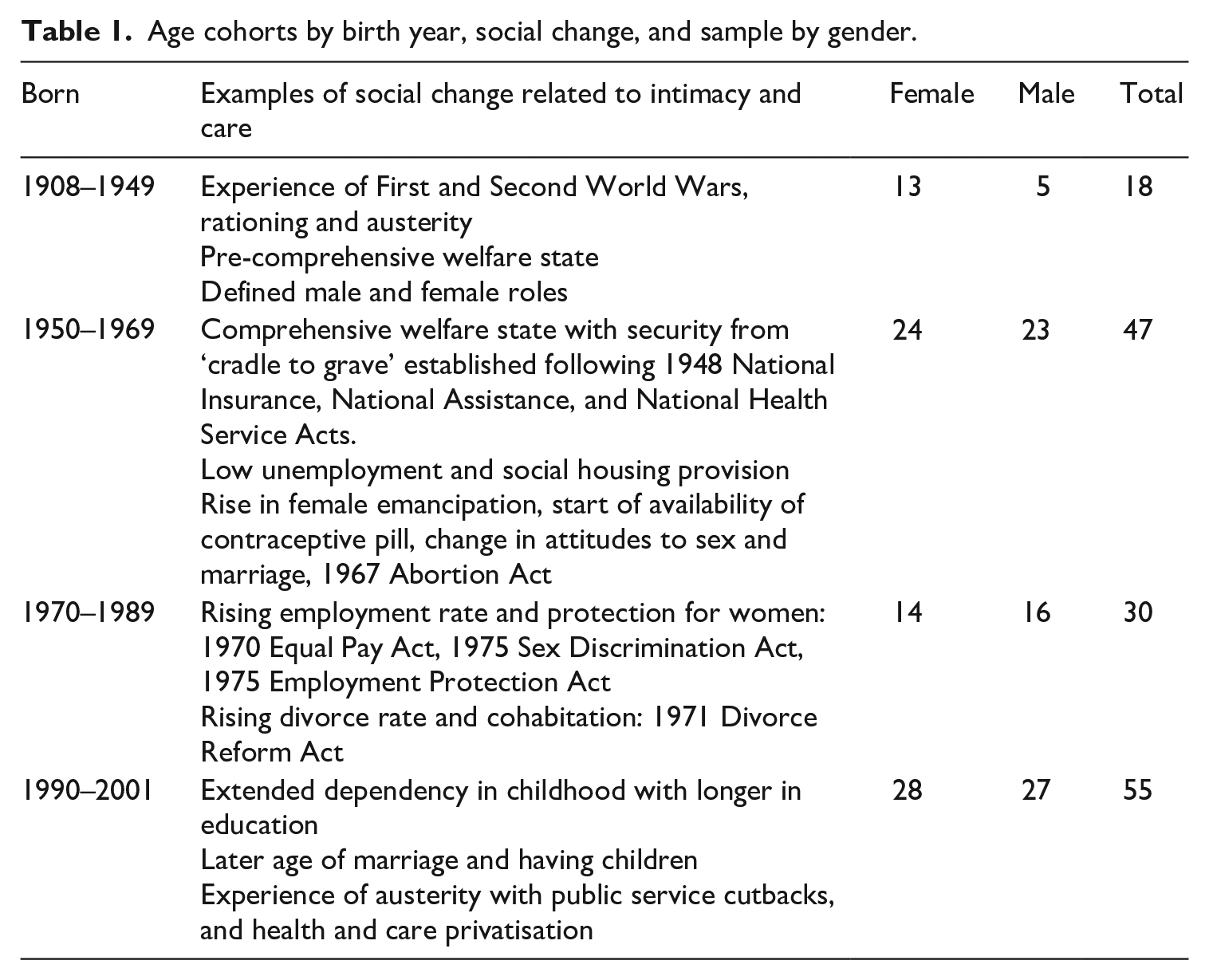
This organisation enabled a comparative approach to investigation, between age cohorts and gender. Our second step was to gain an overview of the contents of the corpus. We conducted a breadth keyword search across the combined Timescapes data set using Leximancer – text-mining software that scrutinises the relative frequency of words across individual participants for whom we had a date of birth. Leximancer uses statistics-based algorithms to automatically analyse text: to identify groups of related and co-occurring words that distinguish concepts and suggest themes or semantic information. This process allowed us to gain an overview of the corpus content, before proceeding towards depth thematic searches and deeper analysis of individual cases.
Text identified as salient by Leximancer included the concept ‘home’ and its significant co-occurrence with the term ‘moving/ed’. This arose in contexts where participants had moved home themselves and/or had stayed put, while others moved away from or closer to them. The interviews for the Timescapes studies did not ask specifically about moving home or staying put experiences; rather, accounts of home moves were provided by participants as part of wider narratives about personal and family relationships over time – that is, the interdependencies of their linked lives.
We followed the ‘breadth’ identification of ‘home’ and moved through a third analytic step. We conducted an initial thematic review and then an analysis of brief relevant sections of interviews where these words occurred together, amounting to 62 female and 43 male participants. Most of our selected home and moving keyness and co-occurrence sample were White British, with others from a range of ethnic minority groups (but race/ethnicity information was not provided for just under a quarter of our sample). Of the adults in our sample, the majority were owner-occupiers, with around a quarter living in rented accommodation. Around a quarter were in professional or managerial occupations, a tenth in routine or clerical work, and others were not in the labour force as retired, students, or unemployed. The resources available with which to negotiate life events by home moves were, then, variable across our keyness co-occurrence sample.
The final, fourth step was a deeper mini-narrative analysis of extended accounts in 13 cases, encompassing our concern with age cohorts and gender, and reflecting the profile of the keyness co-occurrence sample. These cases were selected based on our thematic analysis, illustrative of small stories about home moves from one or several perspectives: as home movers, as stay putters, or as both. They variously were brief or more extended extracts in an individual interview or a series of stories from across several interviews in which the individual participated. It is our further ‘depth’ of investigation of these elements and their interweaving, placed in the context of our ‘breadth’ analysis in relation to age cohorts cross-cut by binary gender, that we present here. We explore three main types of ‘small stories’ that participants told about moving home: staying put, return, and pendulum.
Overarching themes: age cohort/gender
The extent that home and moving featured together in the corpus varied by gender and age cohort. Our Leximancer breadth keyword analysis revealed that co-occurrence of ‘home’ and ‘moving’ was strongest among female participants (see Table 2), whether moving themselves or being moved away from or to. Within this, it is striking that all women in the oldest cohort referred to home and moving, albeit these issues were still highly important for their male counterparts born prior to 1950. Generally, the older the cohort, the more home and moving were salient, with co-occurrence of the terms decreasing down the age cohort. This is with one exception; men born between 1970 and 1989 made more reference to home and moving than men in the age cohort above them and also to their female 1970–1989 cohort counterparts. This is likely to be because the men in this age cohort were often discussing becoming a father and concerned about providing a suitable family home (e.g. David’s and Joe’s small stories below). It may seem unremarkable that, for the most part, the older cohorts talked more about home moves, but we need to understand this in the face of literature showing that discrete events of moving home are more prevalent among younger cohorts. From a linked lives perspective, taking account of being moved away from as well as doing the moving, the salience of home moves may be stronger when viewed as sets of relational processes accumulating and unfolding over time in people’s lifecourses.
Co-occurrence of ‘home’ and ‘moving’ by age cohort and gender.
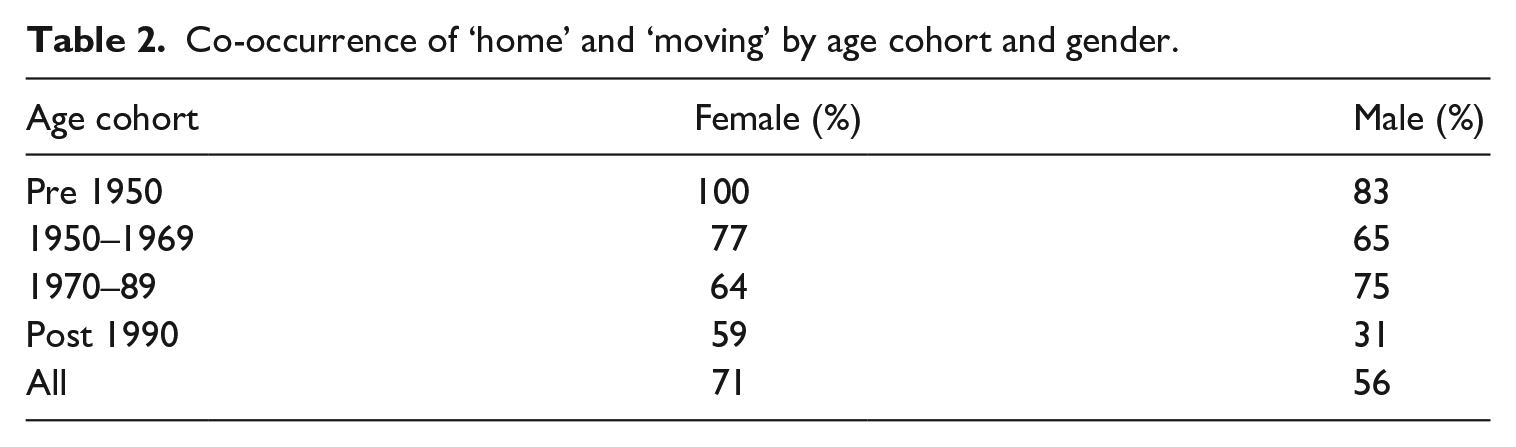
Our subsequent thematic analysis of brief extracts of the participants’ interview accounts where mention of home and moving occurred together generated key recurrent themes: of passivity or agency in home moves by self or others, of moral or taken-for-granted stances towards the nature of the home moves concerned, of home as place as well as people, and also of anxieties about home moves by self and/or others. Gender was an element in these understandings and experiences. The theme of anxiety about being left behind was not so prevalent in male accounts, and anxieties about the self or others’ move/s in question were voiced more by female participants. Our consequent deeper case analyses then identified forms of multi-linear discrete or serial small stories concerning staying put, return, and pendulum. Each small story relates to the linked lives keyword and thematic analyses, as we discuss below.
Staying put stories
Staying put stories were usually characterised by passivity, where participants described being and feeling left behind. In using the term ‘passive’ here and elsewhere, we are conveying a complex mix of often gendered acceptance and acquiescence, where the teller of the story is positioning themselves as experiencing and reacting to home moves that were instigated by others. These stories can also convey anxiety or ambivalence. Nonetheless it is important to note that staying put stories could also communicate – albeit less often – being proactive in others’ home moves. On the latter, two members of the oldest age cohort, respectively, provide an example of a proactive staying put small story. Alan, born in 1924 and now a retired manager who owned his own home, spoke of deciding to spend several years working away and commuting home every weekend so as not to unroot his children: ‘because the kids were at school and I didn’t want to mess their education about’. Marion, born in 1920 and an owner-occupier, told a proactive small staying put story where she moved her mother out of her own home and into a nursing home as her mother’s health deteriorated. Linked lives involving meeting the needs of others as morally the right thing to do were taken-for-granted in these staying put stories, with the structural resources to enable them.
Also rooted in the relationality of linked lives, but with some contrast in sense of agency (lack of) and the structural resources, is Shirley. Shirley was a lone mother to eight children, unemployed due to ill health, and living in local authority housing. Born in 1961, she was interviewed four times in a 2-year period when she was aged 46–48 years and her children ranged between their mid-teens and early 30s. Shirley’s staying put story was characterised by a gendered feature of our cases: ambivalence, anxiety, and passivity in the face of her children growing up and leaving home: I’m in two minds about it now that the kids are getting older. It’s really strange. I’m used to being surrounded by them and then one by one they’ve started leaving. And I know they’ve got to leave. I know they’ve got to make a life of their own. It’s just, I didn’t, I always thought they’d be there . . . I really, really found letting go hard. I mean Catherine was the first to leave home, but that weren’t too bad because she only moved two doors away. So that was it. And then Helen left, David left home, Bethany left home, Stephen left. And it’s going from eight and it was shrinking . . . I’ve still got three at home but like Patrick’s moving soon.
For the most part, with one exception, Shirley’s children did not move too far away, and even Patrick’s move another city was to stay with Shirley’s brother and his wife there. Furthermore, exemplifying home moves as a fluid temporal process, Shirley’s home remained the family hub with some of her older children moving back in with her for periods of time to get themselves back on their feet in the face of life difficulties. This was a taken-for-granted assumption about the right thing to do in Shirley’s mind: ‘Look, family’s family. You make room. I mean if something happened now between him and his missus, you know, he’d come here . . . we make room, which we did’. Staying put can be part of enabling others in interdependent linked lives to adapt to events and navigate structural conditions through home moves.
Marie is another case that demonstrates how home moves unfold over time in relational linked lives. She also demonstrates the value of a small stories approach that can recognise the nuances of co-existing multi-linear short narratives. In Marie’s case, these are of being moved away from and back to by others, as well as her own home moves, that were each conveyed as ‘staying put’. Part of the oldest cohort, born in 1931, Marie was interviewed twice in 2 years, aged between 76 and 78 years. Along with her husband, she was running a bed and breakfast in their home, and had a multi-generational family of children, grandchildren, and great-grandchildren. Her life story was organised around the ebb and flow of family members leaving and then returning again. Marie and her husband first stayed put in their city home, from where their children left home. They then sold that residence to return ‘home’ to her own parents’ island birthplace in mid-life. From this second staying put position, four of her five children had returned to live on the same island as her: Margery of course left, well got married at 18. Winnie left at 19 to go to do her [training]. Cos we moved to [the island] shortly after. Ingrid moved away to [the island] before we did and stayed with my mother. And Samuel, when he started at college we’d moved to [the island] and left him in [the city]. And Alice moved with us to [the island]. She still had two years of schooling and then she went off to [another city] . . . And Margery and John moved up with their two children, and then when Winnie had done her training she came up. And Alice came home on holiday and met Ted, they were both working in [a city] at the time and when they got married they moved back to [the island]. And so, you know, there’s been that sort of thing, you know, when they’ve been away and then come back and so on.
Marie saw these family leavings and reunitings as taken-for-granted elements of lifecourse trajectories. Her remark that ‘they’ve been away and then come back’ indicates that home in small stories can be people as much as a specific house or place, with her and her husband as the locational ‘home’ lynchpin.
Staying put stories are integrally linked relationally to others’ moving home stories in interdependent lifecourses and can also involve what might be return and pendulum stories – the other types of small stories we now elaborate.
Return stories
Small stories of return comprised accounts of revisiting or returning to people and/or places as ‘home’. Ken, from the second age cohort, born in 1965, was separating from his partner and children over the course of a series of three interviews held when he was 35 years. Ken was self-employed in a personal service, living in local authority housing, and contemplating a move back to his home city in another part of the country. He felt ambivalent about leaving his children but spoke of the draw of place and previous relationships: ‘I have just wanted to go back, but I don’t know. I will have to really think about it. And I am starting to think, you know, about the friends there’. Ken’s small story illustrates that even the parent–child relationship as the quintessential and morally charged ‘linked life’ may be set aside – a gendered account in that it is far more likely to be fathers who do this as compared with mother–child relationships (Haux and Platt, 2015). A sense of home as people and as place was shifting, or rekindling, for Ken. In this small story, he positioned himself as agentic, mulling over a decision to return.
In contrast, like many women in our sample, Beverley told more passive return stories. Beverley, also from the second age cohort and born in 1964, was interviewed twice at ages 42 and 46 years. She was married with children, living in a multiple family household, and working in the transport industry. Beverley told two return stories. One concerned a relatively forced move. She had been sent to live with family in the Caribbean as a teenager (a not uncommon strategy by concerned parents: Rasekoala, 1997), but later migrating home to the UK to get away from difficult relations with them. The other was a return story from when her children were younger, centred around the home of her UK-based siblings and reacting to encouragement by them: I worked at a rehabilitation eating disorders unit just between [one town] and [another town]. I worked there for a couple of years. And then I moved up to [a city]. Because I was too depressed. I was constantly crying and missing my family. And my brothers and sisters lived in [that city]. And my sister said for many a month, ‘come to [the city], come to [the city]’. And I’d ring up my sister, crying all the time. And then, um, came up to [the city].
Both of Beverley’s return stories are tied strongly into sets of linked lives, trans-nationally and intra-nationally, where her own ideas of home are linked to the residence of some family members but not others and to proactive interventions on the part of others.
From a younger cohort, born in 1977, and interviewed four times between the ages of 31 and 33 years, is David, who worked in the police force. David is an example of the 1970–1989 male cohort standing out in terms of being more likely to refer to home and moving than the cohorts above. He spoke of proactively moving ‘home’ to another region of the UK, prompted by lifecourse stage and linked lives: It’s always been planned to come home and have children . . . we came home to [region] to have kids, to have [my wife’s] mum and dad nearby and a bit snooty, but to have a [region] child as well. We lived in [English county] for ten years but we didn’t like the idea of having a baby [there].
David’s occupation and home ownership meant the structural resources were available to him to make the move. Interestingly, while David spoke of the region as ‘home’, he had in fact never lived there before. It was his wife’s home connection to place and people, as family, that he took on as his own.
As indicated in Ken’s and Beverley’s small stories above, return stories may also be an element of more multifaceted and sustained pendulum stories, moving backwards and forwards.
Pendulum stories
Pendulum short stories are characterised by repeated and/or rhythmic return to people and places of former residence, which may occur with high frequency over a short period or over a much longer timeframe. They reveal the way that home and moving are embedded in negotiating and accommodating shifting and sustained relationships that unfold over time, often involving constraining or supportive material resources. They also demonstrate elements of activity and passivity as part of linked lives. Pendulum stories occur across gender and to a certain extent age cohort, where they were not a strong feature of the post-1990s cohort.
Louise is a good example of a high-frequency pendulum story. Born in 1989, she fell within the younger end of the 1970–1989 cohort in our study. Louise was interviewed three times aged between 14 and 19 years. This period covered her leaving school to take up office work and proactively splitting her time between living with her parents and siblings in the home she had inhabited since she was a toddler and living with her boyfriend’s family: ‘I like to have my own space. That’s why even though I spend all my time at my boyfriend’s home when I come back here it’s like, “oh at least I have a home”’. Louise was navigating the expansion of her linked lives relationships through pendulum home moves in terms of residence, but with ‘home’ as a particular sort of place that provided her ‘own space’ and with parental structural home-owning resources that facilitated that.
While Louise’s pendulum story was a way of adapting to changing linked lives that enabled her to feel she was managing relational shifts, others’ pendulum accounts presented as far less agentic. Charlotte, from the youngest cohort, born in 1998, is an example of multi-local everyday family life post-separation (Schier, 2015). Interviewed at ages 10 and 12 years, both parents were professionals, divorced, and had their own homes – material resources that shaped her pendulum small story and relational accommodation in her linked life. Charlotte spoke of regularly moving between nearby parental households as ‘quite annoying’, saying of her father’s latest home at one point: ‘I’ve not quite got used to the feeling of that’s our house’. Charlotte took for granted that she would move between homes to be with each parent, but she experienced a lack of agency in this process. The pendulum story she recounts stands out against other members of the youngest age cohort.
Similarly, Nadia provides a sustained reactive pendulum small story, centred around her relationship with her partner. Nadia, born in 1969 at the tail end of the second age cohort, was interviewed on four occasions between the ages of 36 and 40 years. During that period, she shifted from self-employment in health services, to unemployment, to being a student. These shifts formed structural features that shaped her relational linked life, and which she navigated through pendulum home moves. Nadia’s small story concerned passive acceptance of moving back and forth between homes to accommodate employment and her relationship with her partner and child, before making a proactive conclusive home move: I suppose we were sort of living pretty much together [for about eight years] in [a city]. She got a job in [another city] and moved there and I still had a job in [first city]. So then I stayed in [that city] for a further year, [moving backwards and forwards] at weekends. Yeah, um, so that was a bit tiresome . . . [then after two years] we bought this house and moved then. So we’ve been in [this city] since.
A longer, slow burn, pendulum small story is provided by Joe, a member of the 1970–1989 cohort, born in 1978. He provides another example of the issue of fathering and home moves for this cohort. Joe worked as a manager in the business sector, and lived in his owner-occupied home with his wife and child. He was interviewed three times in a 2-year period, aged between 30 and 31 years. Joe conveyed a series of small stories in which he portrays a planned approach to moving home that centres on feeling ready for different lifecourse phases of his life course and family formation. This proactive presentation is gendered, showing more strongly in men’s accounts across the sample. Joe’s return story relates to moving away in his early 20s: I lived a few hours away from home in a different environment on my own and I’ve learned a lot from that as a person . . . That’s a big thing in my life to have said I’m going to leave home, go off on my own, and try and do something.
After meeting and marrying his wife, who came from the same home area that Joe had left, there followed a proactive return in response to having a child 9 years later: The idea is that we’ll be closer to [family] so that they can be involved with our children, our child, and have a relationship with them. And we can obviously continue, have a better relationship with them being closer . . . So the driving factor behind [the return move] was being closer to family and making it easier for work and getting a house so my daughter can have a garden.
Nonetheless, seeing himself as the family breadwinner, Joe did express some anxiety as part of his pendulum small story of moving home: I worry about not making the right decisions for us as a family in terms of moving house and what jobs to take, the financial risk . . . whatever decisions we make it affects our daughter’s life, where she’ll grow up, what accent she’ll have, silly things like that, what opportunities she’ll have.
The connection between relational linked lives and more structural issues associated with moving home is conjured up in Joe’s gendered concerns about decision-making as husband and father.
Tina, born in 1969 in the second age cohort, was living with her partner in their owner-occupied home in a new city. She worked as an accountant and the household income was well above average. Interviewed three times over a 4-year period, aged between 36 and 40 years, Tina told a series of pendulum stories. The motif of house moves shaped the way she conveyed family formation and reformation. Across the interviews, she relayed staying put and moving in relational terms, with home moves always implicating the interdependent lifecourses of herself and family members, and all of which took place in a relatively small geographical area.
My Mum moved to [a village] and then she moved in with her partner in [a nearby town], and my Dad stayed in the house. And then she moved back to the house with her partner, and my Dad bought his own house. She bought my Dad out and my Dad bought his own house in [a nearby town]. And we did have him living with us for three months, which was an interesting experience. Yeah, and then [my mother’s partner] and Mum sold the house in [in a nearby town] and they’ve moved up the road here . . . [My sister] was also having her house sort of extended so she’d been living at my Mum’s for a while, so she’s now moved back . . . My Nan always said she wasn’t going to move . . . [but] she decided that she would then do it now rather than leave it later, so we’ve had quite a trauma finding a flat for her but luckily this place is in [a nearby town].
Tina also recounted her own home move during the interview period, in readiness for starting her own family – a move made possible with financial resources provided by her mother.
Tina’s series of pendulum short stories contain taken-for-granted assumptions about home moves; about staying relatively close to family members, moving in with each other when required, and helping each other with home moves. In some ways, this echoes Shirley’s moral stance in her staying put small story. But Tina’s stories are of proactive decision-making underpinned by access to resources as her particular linked life enables her to navigate more structural issues. This forms some contrast with Shirley’s staying put in the face of others’ pendulum moves, resonating with anxiety and shaped by constrained resources. Tina’s stories also contrast with Charlotte’s obligatory pendulum moves framed by her parents’ housing resources. We pick up on these and other comparative insights gleaned from our breadth-and-depth approach and small stories analysis in our concluding discussion.
Conclusion
This article has considered the ways that people from different age cohorts and genders, with different sets of resources available to them, convey their experiences of home moves. In contrast to much scholarship on residential mobility, and indeed migration research, our discussion has contributed beyond the ‘mobility bias’. We have focused on staying put as well as moving home as active and interdependent practices that unfold over time. Reinforcing the new mobilities emphasis on moving residence as fluid and temporal process, we have presented an analysis that goes beyond an understanding of moving as a discrete event involving a fixed residential location. In particular, our ‘linked lives’ perspective reveals the complexities of what staying put and moving home mean in relation to home as residence, people, and/or place. The small stories analysis that we brought to new mobilities scholarship enabled recognition of the nuances of co-existing discrete and serial narratives of staying put while being moved away from and back to by others, and which might also involve the teller’s own return or pendulum home moves. Notably then, an important contribution emerging from our analysis is that the moving away from, returning to, and pendulum small stories we identified are integrally linked relationally to others’ staying put mini-narratives, and that staying put small stories are linked to others’ home move narratives, all as part of interdependent lifecourses at local, intra-national, and trans-national levels. A focus on discrete instances of moves of residence may obscure these linked lives.
Understanding of the micro linked lives complexity of the forms of small stories about home moves that we identified is deepened further when brought into engagement with the more structural features of linked lives shaped by gender and social and familial generation. Our breadth-and-depth corpus keyword, thematic analysis, and small story narrative analyses revealed a comparative element to staying put as being moved away from or closer to, and to moving home as return or involving short or longer term pendulum moves away from and back to. This contribution to our thinking about home moves highlighted gendered and generational articulations of interdependencies and adaptation to social and economic conditions that unfolded over time, and were enabled and constrained by material resources. Our analytic approach highlights not only the nuances of family and personal relational interdependencies in home moves revealed in our cases, but also how linked lives are shaped structurally by gender and age cohort.
Navigating home moves in linked lives at a micro level could raise moral tones of the right thing to do that were gendered. We saw this in concerns about adapting to family needs by staying put or returning, as mothers such as Shirley, daughters such as Tina, fathers such as David, and partners such as Nadia. Ken was an exception to this, a father moving away from his children. We also saw that home and moving are more salient for women’s accounts. For the most part, this saliency increased across the lifecourse, articulating with familial generation as women’s own and others’ comings and goings accumulate over their lifetime, as evident in Marie’s description. The passive or proactive nature of recurrent themes in accounts and the small stories they shaped were also gendered, as was any anxiety or ambivalence that was part of them. Shirley’s passive account of her worries about her children moving away, Joe’s concerns as family breadwinner making decisions about home moves were proactive, and Beverley’s final return move told as reaction to family anxieties about her misery provide good examples. The gendered experience and telling of home moves are significant features made apparent through our breadth-and-depth approach, which allows us to identify and compare themes across a large amount of qualitative data and then pursue them in-depth through case analysis.
This approach also revealed the undergirding structural issues of linked lives, with material and social resources enabling and constraining home moves. In particular, employment, finances, and residential tenure all provided conditions in navigating linked lives, shaping the ability to do the right thing, senses of passivity and proactivity, and feelings of anxiety. This was evident in the considerations around breadwinning and home moves by fathers, with the 1970–1989 cohort standing out in the co-occurrence of ‘home’ and ‘moving’ in the corpus of accounts, and it was illustrated in the gendered themes in David’s and Joe’s proactive but somewhat nervous small stories. Nadia’s self-employment and unemployment, and her partner’s employment, played a role in her pendulum home moves. Financial and home tenure resources implicitly constrained the navigation of interdependent ties that are part of Shirley’s and Nadia’s accounts, but are clear in supporting the means to manage shifting relationships through shifting homes for those with more material resources available to them, such as Louise, Charlotte, and Tina.
There may well be gendered and social and familial generational features of home moves that our keyword and thematic analyses did not pick up and other forms of home move small stories beyond the limitations of our analysis. These may take us further in relation to the interlocking of women, care, and moving home; the centring of others and self in home move considerations; and generational issues around residence tenure and the implications for linked lives. These are drawbacks to working with secondary data as against a bespoke primary data set. The secondary researchers’ ability to shape the size and characteristics of their sample, and the exploration of the substantive topic, is limited. Secondary researchers have to work with what the original researchers generated for their study and the background information they supply. But there are also strengths. Working with multiple merged data sets meant that we could conduct secondary data analysis across disparate qualitative studies, making use of possibilities of strategic comparisons that cannot be addressed in a discrete small-scale study. Importantly, we have contributed to knowledge about residential im/mobility in the UK, through the insertion of meaning-making and emphasis on the importance of linked lives and interdependencies. Our gendered and generational breadth-and-depth approach has supported a nuanced and rounded understanding of home moves, identifying trends in the salience of moving home, and pinpointing recurrent themes from a large corpus of qualitative data. In turn, the detailed processes of these larger comparative analyses have been explored in depth through a small stories analysis of cases. As a whole, these analyses reveal the intricacies of the articulation of structured and micro interdependent relational issues of linked lives and home moves.
Footnotes
Funding
The author(s) disclosed following financial support for the research, authorship, and/or publication of this article: This work was supported by a three-year grant from the Economic and Social Research Council National Centre for Research Methods, Grant ID: ES/L008351/1.
