Abstract
Population aging and widening disparities in healthy aging have increased attention to the social determinants of health and healthy aging. Unfortunately, our emphasis on the social determinants of health in adulthood has lacked the same intergenerational lens that is prominent in research focused earlier in the life course. Our research finds that having a college-educated adult child benefits parents’ health and well-being, particularly for disadvantaged parents. Although parental characteristics like education and family ties help to explain some of this effect, our and emerging work suggests that parents’ and children’s lives are inextricably linked, even after children have reached adulthood.
We tend to focus on how parents affect kids. But we haven’t focused enough on the effect that adult children might have on their aging parents, either for better or worse. And focusing on the influence of children on aging parents may help us explain how social determinants affect healthy aging.
We examine how having a college-educated adult child may benefit parents’ health and well-being. There are several reasons why a child’s degree may influence parents’ health. Compared with parents with college-educated children, parents whose children do not attain a college degree may worry more about their children’s employment prospects, financial security, and overall well-being. Adult children with lower levels of education may also provide less financial support to their aging parents, and the children may need more emotional and financial support themselves than their college-educated peers.
Measuring how children’s education affects their parents’ well-being is complicated. Take, for instance, social class. We know that making more money and having a college degree improves health later in life, and we also know that a parent holding a college degree or making more money affects whether their children complete college. Does a child’s educational attainment affect their parents’ health? Or, are parents with college-educated children healthier because of their own economic condition, which also helped their children get a college degree?
Answering these questions requires a strategy that accounts for both how a parent influences their children and how children influence their parents.
We studied the parents of participants in the National Longitudinal Study of Adolescent to Adult Health, also called Add Health. A special parent study that was conducted in 2015-2017 asked parents of the Add Health participants a series of questions about their physical and mental health and how much education each of their children attained (in addition to background characteristics like socio-economic status, race, and family characteristics).
We use a statistical method, called propensity score matching, to account for both directions of influences between parents and children. The method emulates what would happen if we randomly decided which children got a college degree and which did not. We compare parents with college-educated children to parents without college-educated children but who otherwise look the same statistically. We base the comparison on a long list of variables: their race, educational attainment, financial status, the family’s characteristics, past social-psychological and health conditions, neighborhood quality, what parents expect for their children, and involvement in their children’s school. By creating the statistical comparison, we isolate the effects of a parent having at least one college-educated child from all of the other characteristics parents were asked about that could affect their health in older age.
While many socioeconomic factors can influence health outcomes, this study reveals that the education level of one’s children can influence outcomes for parents later in life.
Andrea Piacuadido via Pexels

To show the utility of this approach, the figure illustrates the association between having no college-educated children and parent health before and after we account for all of the parent characteristics. We refer to our “before” comparison as parents who are unmatched because this part of the bar graph does not account for the differences in background characteristics between parents with and without college-educated children. In contrast, the matched comparison part of the bar graph only includes parents who have been matched based on their background characteristics.
The top graph examines the differences in parents’ self-rated health, which is based on a 5-point scale, with higher values reflecting better self-rated health. In the unmatched sample, parents with college-educated children report an average self-rated health score of 3.2, while parents with no college-educated children report an average of 2.9 on a 5-point scale. Taken together, this means that parents with college-educated children report, on average, self-rated health scores that are approximately 10% higher compared with parents with no college-educated children. When we make this same comparison in our matched sample—the sample where parents with and without college-educated kids are the same except for their kids’ edu-cation—we still see that parents with college-educated children report higher self-rated health, but the percentage difference between the two groups is less than half as large. Without accounting for the fact that parents with college-educated children are different in other ways from those whose children did not go to college, we might have assumed that the gap in self-rated health attributed to having college-educated children was twice as big.
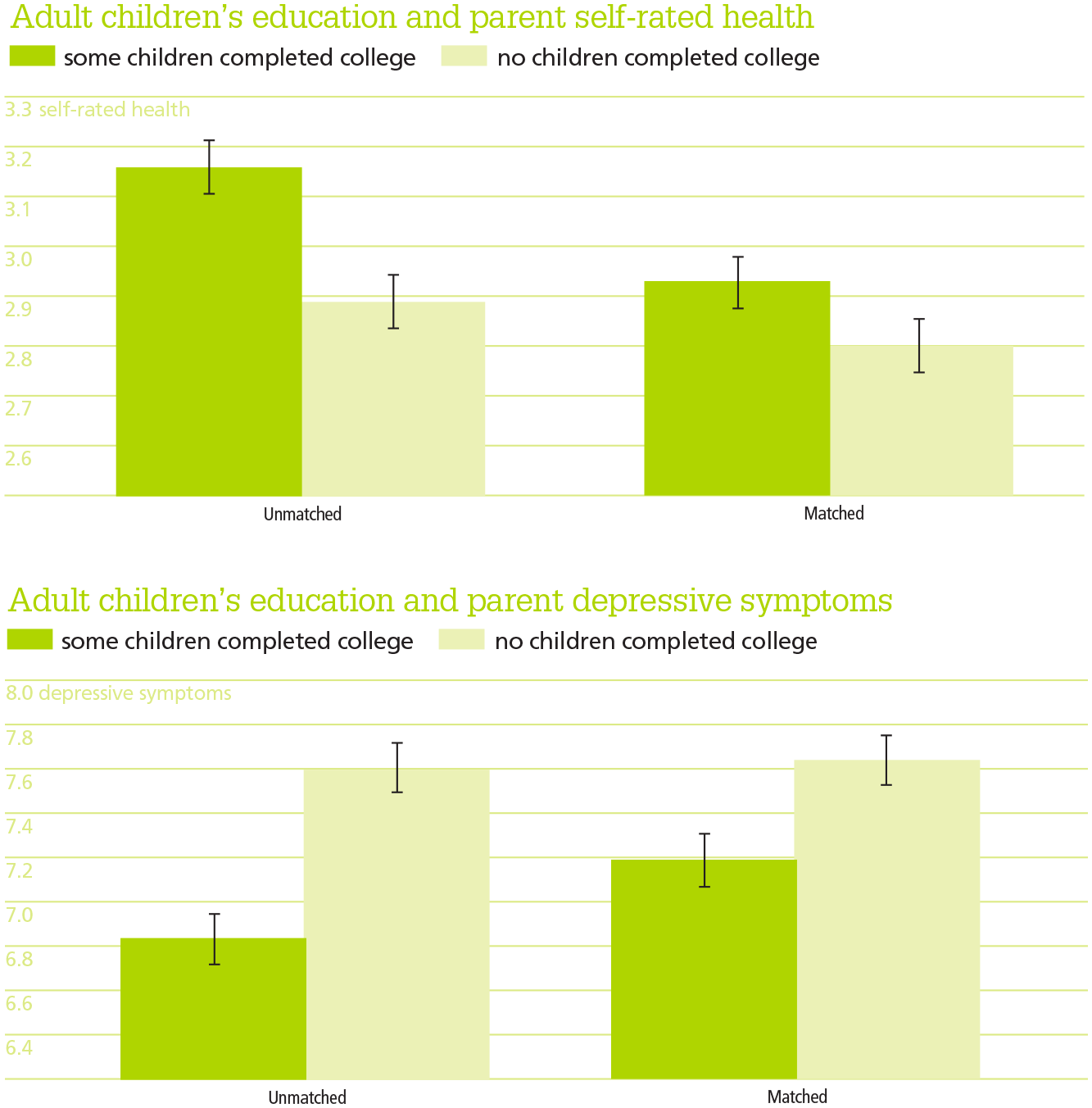
The association between having no adult children who have completed college or some adult children who have completed college and parents’ health (measured by self-rated health and depressive symptoms). The bars labeled “unmatched” are without controls for parent characteristics and the bars labeled “matched” are after parent characteristics have been accounted for.
This same overall pattern is observed in the bottom graph of the figure, which examines the differences in parents’ depressive symptoms. These symptoms included how often they felt could not shake off the blues, felt depressed, were unhappy, felt sad, or felt life was not worth living. In our unmatched sample, parents with college-educated children report an average score of 6.8 on a scale that ranged from 5, indicating no depressive symptoms, to 20, meaning parents experienced all symptoms severely. Parents with no college-educated children report an average of 7.6. This means that parents of college-educated children report, on average, depressive symptoms scores that are 10% lower than parents with no college-educated children.
In our matched sample, depressive symptoms scores are about 6% lower among parents with college-educated children, which again means that not accounting for the differences between parents with and without college-educated children would result in overestimating the effect of children’s education on their parents’ well-being. However, despite seeing a reduction in the overall effect of children’s educational attainment on their parents’ health and depressive symptoms, it is important to note that children’s education still affects parents’ health and well-being.
Parents’ and children’s lives are inextricably linked, even after children have reached adulthood.
This study examines how having a college-educated child can impact parental health and well-being.
Feedyourvision via Pexels

So, does a child’s educational attainment affect their parents’ health? Or, are parents with college-educated children healthier because of their own economic condition, which also helped their children get a college degree? The answer from our research is both: children’s education matters for parental health, but other differences between parents of college-educated children and those without, like parents’ own education, family, and community characteristics help to explain some of this effect.
Our understanding of adult health is incomplete without an attention to the interplay between parents’ socioeconomic resources and the role played by adult children. Here, we see that parents’ own social status has meaningful implications for their health later in life. Even after taking social status into account, we find that children’s educational attainments remain a modest, but important, predictor of parents’ self-rated health and depressive symptoms. Attempts to reduce adult health disparities must account for the inextricable linkage between parents and children’s lives, even after children have reached adulthood. Interventions to address adult health disparities will be unsuccessful if they focus only on one generation.
The answer from our research is both— children’s education matters for parental health, but other differences … explain some of this effect.
We need a better intergenerational model of adult health so that we can make sense of disparities in how Americans age. The influence may not come just through college education, either. Other challenges that children face as they transition to becoming adults like mental health crises and entanglements with the criminal legal system may afflict their parents. And children’s resilience may buoy parents. With young people facing an increasingly long, unstable, and unequal transition to adulthood, we will likely see difficulties experienced by young adult generations manifest in their parents’ health and well-being.
This study reveals that parents who have college-educated children are less likely to experience depressive symptoms.
Elina Fairytale via Pexels