




Abstract
Facebook has frequently been implicated in the 2016 ‘Brexit’ referendum result, and support for Leave has been linked to wider nativist and populist mobilisations online. However, close-up, qualitative sociological research has not been conducted into the relationship between Brexit and social media use. This is, in part, due to the computational turn in online research, which has led to a disproportionate focus on quantitative big data analysis. This article argues for the value of close-up, qualitative enquiry to facilitate situated understandings of the reality of social media use and what it means to individuals. It outlines one such methodology developed to investigate pro-Leave Facebook users, to demonstrate how challenges posed by such research can be overcome, and the opportunities such enquiry affords for studying the role of social media in contentious politics. Invaluable insights gained include the way Facebook provides an empowering tool for making claims to political knowledge in the context of growing transnational nativist and populist grievances.
Introduction
The 2019 European Elections and General Election results reinforced the continuing significance of ‘Brexit’ among the British public, a reminder that the divisive wounds inflicted and exposed by this issue are unlikely to heal in the foreseeable future. Since the referendum on the UK’s membership in the EU in 2016, there has been a torrent of theoretical and empirical work on Brexit, including its relationship to austerity and globalisation (e.g. Fetzer, 2019; Watson, 2018), class (e.g. Antonucci et al., 2017; Bhambra, 2017; McKenzie, 2017), hostility towards immigration (e.g. Goodwin and Milazzo, 2017; Tammes, 2017), or distrust of elites and populism (e.g. Freeden, 2017; Iakhnis et al., 2018). However, to understand the referendum result and, importantly, enduring and evolving support for Britain’s exit from the EU, we must consider it in the context of the role of social media in activating nativist and populist sentiments. To do so, I will argue, sociologists need to go beyond quantitative and observational analyses of online content and continue to develop new methods for conducting close-up and immersive qualitative research into social media use and its connection with political affect. While researchers have begun to innovate such methods for studying other phenomena such as relationships and identity (e.g. Beneito-Montagut, 2015; Duguay, 2016; Gangneux, 2019), in the absence of an appropriate existing method for studying engagement on Facebook with contentious political issues like Brexit, I developed a novel method to investigate this, to be outlined in the second half of this article. Although developing such methods presents practical and ethical challenges, it has the potential to yield fascinating insights into social media use and its role in the construction and performance of political subjectivity, including the way Facebook provides an empowering tool for making claims to political knowledge in the context of growing transnational nativist and populist grievances (Brubaker, 2017).
Brexit and Facebook
There is no doubt that social media have changed the way a significant proportion of people engage with politics (Bode et al., 2014), and the issue of Brexit is no exception. Facebook, in particular, has been implicated in the Leave campaign’s 2016 referendum success, with the firm Cambridge Analytica accused of using psychographic microtargeting to influence voters (Risso, 2018). Although not all Brexit supporters are engaged on Facebook, during the exit negotiations, in the context of intense grievance with the government’s inability to ‘get Brexit done’, Leave continued to boast an enormous following on the platform via dozens of unofficial pages and groups, circulating content evoking nativist, populist and Islamophobic sentiment.
Brexit is often cited alongside the election of Donald Trump in the US as evidence of a wave of net-born populism (e.g. Inglehart and Norris, 2016; Sayer, 2017). While support for Brexit is a complex phenomenon, undoubtedly many of the themes of the Leave campaign were hateful and divisive and have played a role in the emboldening of the populist and nativist right (Virdee and McGeever, 2018). This emboldening, it is argued, has been amplified by social media echo chambers and filter bubbles (Sunstein, 2018), as well as a ‘disinformation order’ emerging from the online environment (Bennett and Livingston, 2018). Social media platforms have been described as having an affinity with populism (Gerbaudo, 2018) and having an inherent ‘affective character [that] triggers and augments racist attitudes’ (Ekman, 2019: 607). However, as Davies (2018) argues, technologically deterministic accounts of phenomena like filter bubbles are insufficient; rather individuals should be understood as ‘situated at the intersection of technology, culture and class’ (p. 639), taking into account the role of social lives. In the case of pro-Leave sentiment online, this should be understood as part of a transnational mobilisation of conservative, authoritarian, and occasionally White supremacist nationalism, which links Britain with the US, Canada, Australia, South Africa, and continental European countries, and overlaps with, but is not equivalent to, the so-called ‘alt-right’ (Lee, 2019).
Yet, little sociological attention has been paid to the role of Facebook in (enduring) pro-Leave sentiment among the British public. Sociological accounts of the role of race or class in Brexit have tended to study this as an offline phenomenon, isolated from the effects of increasing social media use (e.g. Bhambra, 2017; McKenzie, 2017). Two compilations, which have purported to offer comprehensive social analyses of Brexit from a multitude of authors (Koller et al., 2019; Outhwaite, 2017) ignore the significance of Facebook altogether. As with the broader field of populism and hate online (see Jacobs et al., 2020), a disproportionate number of studies into the relationship between Brexit and social media have focused on Twitter. These include studies on the operation of ‘bots’ during the referendum campaign (Bastos and Mercea, 2019; Gorodnichenko et al., 2018; Howard and Kollanyi, 2016), the circulation of rumours, conspiracy theories and propaganda (Dobreva et al., 2019), and patterns of emotional expression and emotional appeals before and after the referendum (Bouko and Garcia, 2020; Rosa and Ruiz, 2020). This disproportionate reliance on Twitter is perhaps because of the relative ease of collection and analysis of data from this platform.
However, a focus on Twitter is problematic in the context of Brexit for several reasons. The first is that the number of active Twitter users in the UK is far fewer than that of Facebook, which is by far the most popular social networking site there (O’Dea, 2018). Second, Twitter use in the UK is more heavily concentrated among the young and highly educated (Mellon and Prosser, 2017; Sloan, 2017), meaning older and less-educated cohorts, who are most likely to have voted Leave in 2016 (Ashcroft, 2016), are in fact more likely to use Facebook than Twitter. Although celebrity ‘alt-right’ commentators (such as Katie Hopkins and Paul Joseph Watson) have tended to engage large audiences on Twitter, many pro-Leave accounts such as UKIP, For Britain, and Make Britain Great Again have enjoyed larger followings on Facebook (Lee, 2019). Britain First, which has shared many of its stances and supporters with UKIP (Davidson and Berezin, 2018), was also ‘liked’ by more than 2 million users on Facebook prior to incurring a permanent ban in March 2018 (Hern and Rawlinson, 2018), demonstrating the significance of the Facebook platform to this audience.
Since the Cambridge Analytica scandal, some research has begun to investigate Facebook in relation to Brexit. However, these studies focus primarily on behavioural traces observable there, meaning they have been limited in their ability to provide insights into the human phenomenon of social media use. For example, Bossetta et al. (2018) conducted a quantitative study during the referendum campaign investigating the relationship between engagement with political news on Facebook and interaction with political campaign posts, and Del Vicario et al. (2017) conducted a quantitative analysis of users’ information consumption patterns around Brexit. Zollo (2019) analysed users’ interactions with news stories around Brexit to conclude that echo chambers and polarisation existed on Facebook, then making the assumption that this ‘shapes communities’ there. However, as we shall see in the next section, such conclusions require close-up research that asks subjects themselves what social media and its content means to them. Unfortunately, thus far even those studies employing qualitative methodologies have generally been limited to discourse analyses of content on particular pages and do not speak to users directly (Bonacchi et al., 2018; Fuchs, 2018b; Lilleker and Bonacci, 2017; Spring and Webster, 2019). I argue that uncovering the human story behind Facebook posts and making the link between online content and social reality necessitates close-up enquiry.
The need for close-up, qualitative enquiry on Facebook
As a result of the increasing availability of big data analytics, and earlier calls for social scientists to become more adept at utilising the untapped potential of vast quantities of available social media data (e.g. Beer, 2012; Kirkwood et al., 2018), a ‘computational turn’ has occurred within social media research. A heavy focus is now placed on harvesting large amounts of content from these platforms and performing primarily quantitative analyses on them (Latzko-Toth et al., 2016). In fact, social media research is often understood by UK government bodies and research councils (including within the ‘Digital Humanities’ agenda) simply as big data analytics (Fuchs, 2017). This is arguably the reason for the above-described disproportionate focus on Twitter as a data source, as it has offered the most accessible way to conduct this form of analysis.
There is no doubt that large-scale quantitative approaches have much to offer the social sciences; they can identify networks and trends in terms of what is being communicated by whom on social media platforms. However, they are less suited to understanding experiences, intentions, and subjective meaning-making, or to investigating social phenomena in context (Fuchs, 2017; Latzko-Toth et al., 2016), all of which are crucial to understanding the role of social media and its consequences. Quantitative studies may help us understand what is being said about Brexit or other political issues on Facebook, but provide little insight into what motivates users to produce, consume, and circulate ideologies, and engage with political issues on such platforms. Furthermore, if we accept that social meaning cannot be understood solely through observation but must be interpreted with reference to the meanings attributed by actors themselves (Geertz, 1977), then close-up enquiry with live participants is indispensable to truly understanding how and why people use social media and the effects that this has on their lifeworld.
In addition, ‘big data’ research designs have been criticised for inherent positivist assumptions and for taking an administrative or decontextualised approach to social media data (Fuchs, 2017). They are accused of superficially highlighting trends, users, or relational networks while lacking theoretical grounding, of being reductive, and of ignoring ‘the embeddedness of the media into society’s power structures and social struggles’ (Fuchs, 2017: 40). Such studies have a tendency to presume that vastness of data in itself offers direct access to ‘social reality’ (Langlois and Elmer, 2013). However, discursive and other acts on social media are not windows into society, nor do they necessarily provide access to users’ ‘true’ sentiments (Hogan, 2010). These platforms are social environments in themselves carrying their own norms and behavioural expectations; we are aware of our audiences there and adjust our speech and behaviour accordingly (Marwick and boyd, 2011). Moreover, behavioural traces left on social media are constructed by the logic imposed by each platform (van Dijck, 2013). That is, data about the number of ‘likes’, ‘shares’, or ‘retweets’ are available for collection only because these are the functions afforded by the platforms and the corporations who create them. Thus, a paradigm shift is required from framing the results of social media research as research about social phenomena through social media, to treating this as research about social media as social phenomena or as one crucial part of a complex system, which constitutes those phenomena.
Based on this, scholars like Fuchs (2017) and Langlois and Elmer (2013) have argued for ‘critical social media studies’. They warn against undue focus on computational methods and the neglect of a long interpretivist tradition of qualitative and situated enquiry. In the same vein, Latzko-Toth et al. (2016) have advocated the ‘thickening’ of data in social media research, particularly through interviews with users regarding their activity, a challenge taken up by a handful of researchers including Schaffar and Thabchumpon (2019), Gangneux (2019) and Duguay (2016). However, social media research also needs ethnography-style enquiry that combines ‘prolonged immersive engagement’ with giving voice to research subjects, to understand ‘how those Facebook activities are produced and consumed, how they travel beyond the online location and are embedded in other forms of activity’ (Hine, 2015: 28). A serious attempt to understand the complex role of social media in political phenomena like Brexit cannot be achieved without directly engaging with users and producing rich insights into their social worlds.
Online ethnography gained popularity in the 2000s and early 2010s (Hine, 2000), but has received far less attention since the proliferation of social media and the resultant computational turn. Despite a recent resurgence in interest in online ethnography among qualitative social researchers due to the constraints placed on face-to-face data collection by the ongoing Covid-19 pandemic (Lupton, 2020), study of online political engagement remains particularly focused on observational rather than close-up methods. Social media researchers must not shy away from the challenge of designing tailored methods fit for immersive, close-up investigation of social phenomena on, between, and around these platforms, to identify some of the range of potential trajectories, contributing factors, and experiences that can inform our understanding of how social media are changing social and political lives. In the below sections, I outline the method that I developed and implemented for studying pro-Leave political engagement on Facebook, to demonstrate one of the many ways in which such research could be carried out, and its advantages.
Developing a close-up method for studying Brexit on Facebook
My project sought to understand how Facebook was used by Brexit supporters to engage with pro-Leave and other political content, and the significance of this engagement to their social and political lives. To provide the kind of situated insights advocated above and to understand Facebook use within lived experiences, I set out to develop a methodology that was both qualitative and immersive, and which gave a voice to the research subjects. This involved combining observations on Facebook with multiple interviews, focusing on a group of 15 consenting participants. This relatively small number enabled the in-depth, individual-level analysis sought by the project. The project received ethical approval from The University of Manchester Social Sciences School Panel on 4 June 2018, Reference number 2018-4113-6218, and was undertaken between July 2018 and May 2019.
The target group was Facebook users who did not grow up with the Internet, resided in England or Wales, and had shared at least one piece of pro-Leave content to Facebook in the past month. I visited pro-Leave Facebook pages, such as ‘Get Britain Out’, ‘Fight4Brexit’, ‘Leave.EU’, and ‘Leave Means Leave’ and identified potential participants from lists of those who had ‘publicly’ shared popular recent posts (by clicking ‘Shared’). These participants were then contacted via Facebook Messenger with an invitation to participate.
Limited details of the research context were given in this message to avoid engendering pre-conceptions (or misconceptions) about the purpose of the research, but I did state how the user had been identified. This was to promote transparency, acknowledging the degree of invasiveness of identifying and directly contacting users in this way. This method was selected over the use of recruitment adverts for several reasons. First, to ensure that potential participants fitted the above target criteria. Second, because posting on relevant groups could be considered by these already quite defensive communities as ‘lurking’ by an ‘outsider’ (or left-wing enemy) and expose myself and the project to public aggression, including by opinion leaders, which could promote refusal to participate. Finally, while paid recruitment adverts have been used on Facebook, such as in health research (see Whitaker et al., 2017), this conflicted with my own critical stance towards surveillance capitalism and its funding model (Zuboff, 2019).
A total of 287 users were contacted between July 2018 and January 2019, before the target of 15 participants was reached. Once a user agreed to participate, we became Facebook friends so I could see content they shared. The data collection began with an initial interview, in which participants were asked about how they used Facebook and other social media. I also asked about their experiences of conflict on social media, whether they discussed what they had seen on social media offline, and whether their social media activity had ever led them to establish or break connections with people offline. Finally, they were asked their views on things like the effect of social media on society, and censorship. In line with the inductive and interpretivist approach (Skinner, 2012) the interview format was semi-structured, allowing participants to speak freely about their experiences, the issues that mattered to them, and their own interpretations of these. The majority of these interviews were conducted through Facebook’s ‘video chat’ function, reducing participation barriers.
After the initial interview, I conducted a month-long observation of each participant’s Facebook ‘timeline’, during which they posted 40 to 500 pieces of content each. This period was long enough for multiple Brexit-related political news stories to break, be discussed and forgotten on Facebook, providing a rich variety of themes. Observations were deliberately not synchronised across the 15 participants, to allow my understanding of the field to iteratively inform my approach to the interviews and observations throughout the inductive project. Data about reactions to posts (e.g. likes or comments) were not collected. This was partly because such analysis would necessitate epistemological considerations around interactions and relationships that were outside the scope of this research. Furthermore, users reacting or commenting had not given consent for these data to be collected, so this would contradict the study’s consent-based approach (see below).
I wanted to retain a record of the posts I had observed for analysis. However, since Facebook restricted access to its Application Programming Interface (API), the automated collection of Facebook data has presented researchers with a host of challenges (Mancosu and Vegetti, 2020). Techniques of ‘screen scraping’ developed to mitigate this still carry the dilemma of potentially contravening the platform’s Terms of Service (Mancosu and Vegetti, 2020). I thus decided to collect data manually. While this was time-consuming compared with automated data collection, it had the advantage of facilitating my immersion in participants’ online ‘lifeworld’ and close situated engagement with the data; the decision was based on compatibility with the research objectives, rather than convenience. This method is also resilient to changes in the platform’s algorithm, in contrast with scraping techniques, which constantly require updating. Although Schaffar and Thabchumpon (2019) collected Facebook data in the form of screenshots, for this study, information about each post was logged in a spreadsheet. This not only allowed me to consider and make notes about each post as I collected the data, but also enabled later cross-sectional sorting and searching, using the ‘filter’ and ‘find’ functions. The enduring nature of content on the platform meant that there was still the possibility of viewing posts in their original form and context, if required, with the exception of content that might be removed.
The fields of data collected are shown in Figure 1. Images contained in the posts (except where these were personal photographs) were downloaded and stored, and the text included on images (e.g. in ‘meme’-style posts) was manually typed out. Following Hine’s (2015) holistic and adaptive approach to online ethnography, I followed links posted to other sites and read, watched, or otherwise examined the content there, deepening my understanding of the context in which participants were engaging with content.
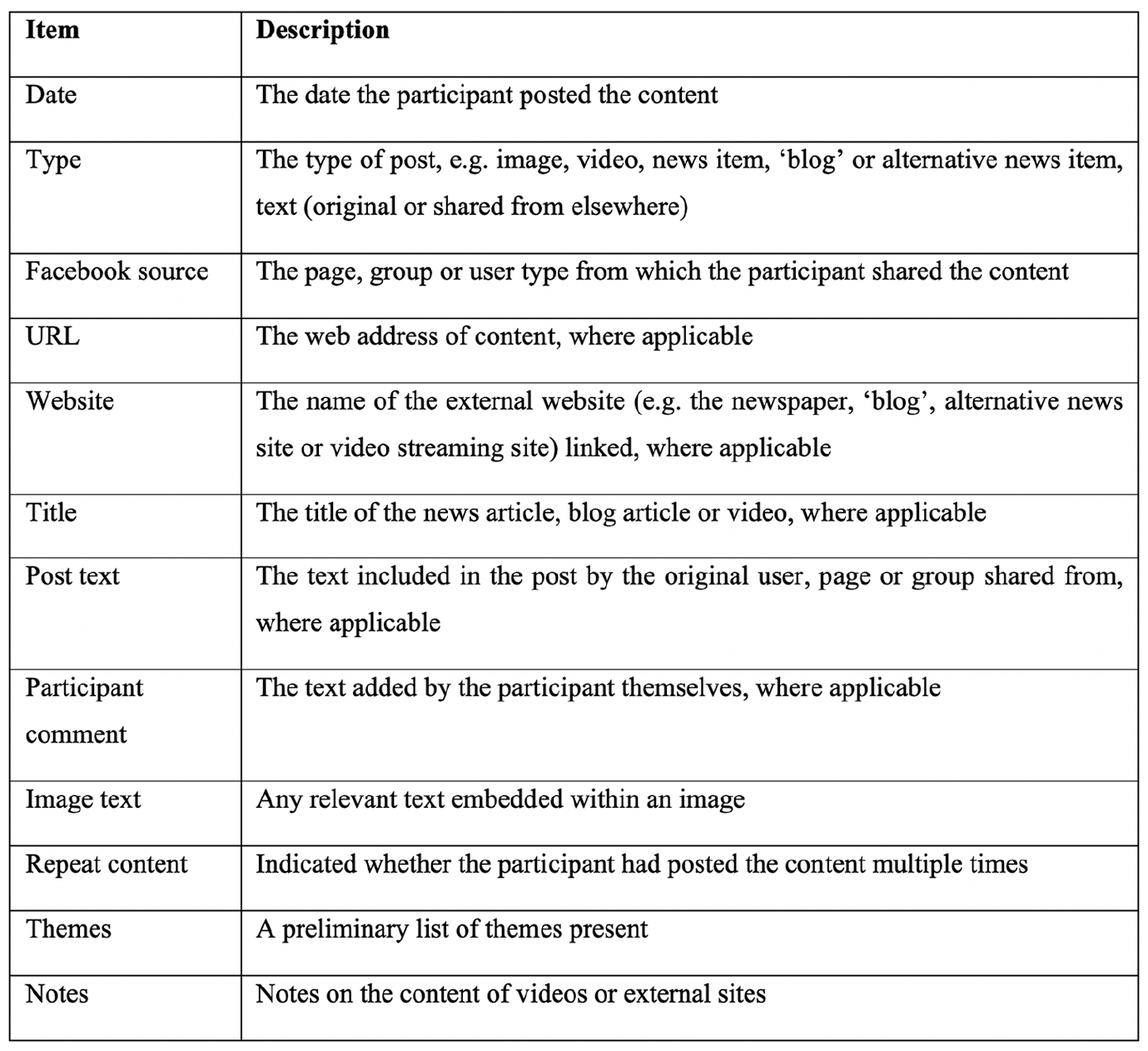
Items of data collected from Facebook posts.
During the observations, I adopted a ‘fly-on-the-wall’ approach whereby I did not intervene or participate in participants’ Facebook milieus in any way. As well as to avoid ethical issues of positionality (discussed below), my intention here was to mitigate any ‘Hawthorne effect’ that might arise from reminding participants that I was watching. Inevitably, as with any consent-based observational methods, participants could be expected at times to be aware that I was observing them. However, refraining from participating gives online researchers an opportunity to limit this awareness; in the follow-up interview, most participants confidently denied that they had adjusted their behaviour. Another reason this approach was taken was that as Facebook continued to update its ‘Community Standards’ to expand the range of prohibited content on the platform, engaging with certain content could have put the research account at risk of temporary ban or removal.
After the data collection period, I interviewed each participant again. This gave an opportunity to delve deeper into their use of Facebook, based on what I had seen them post. I began by giving participants an opportunity to freely identify memorable issues they had engaged with on Facebook since the last interview and discuss why these were important to them. I then asked participants specific questions about the kinds of content or sources I had observed. Next, participants were shown a handful of observed posts, to elicit discussion around why they had considered this content important enough to share. These posts were not selected systematically, nor were participants afforded the opportunity to explain each of the posts they had shared. Instead I selected posts for which participants’ posting motivation was less clear, on the basis that discussion might reveal new information about participants’ attitudes (particularly outside the issue of Brexit) or social media use. Similar to Gangneux (2019), I found that the use of social media ‘traces’ as prompts was rarely effective in eliciting specific recollections of behaviour or motivations. Rather, the tangible examples encouraged participants to talk around their views and behaviour. Follow-up interviews closed with asking participants more probing political questions, such as who they would like to see running the country, what they considered to be the outlook for Brexit going forward, and whether they considered themselves members of a ‘community’ of Brexiteers on Facebook. For this interview, I encouraged participants to meet me face-to-face to allow us to view and discuss Facebook content together, although a few still preferred to participate remotely.
Ethical considerations: consent and positionality
Online studies, particularly those investigating contentious or potentially harmful ideologies, inevitably present particular ethical challenges. This project took a consent-based approach, whereby participants were made explicitly aware which data would and would not be collected in the study. Written consent was collected electronically, and participants were assured anonymity and confidentiality. Researchers continue to debate whether consent is required to collect data online (Hennell et al., 2020). Large-scale studies using Twitter in particular (Chaudhry, 2016; Froio and Ganesh, 2019) have taken the position that information that is publicly available online does not require consent to use for research as authors have already relinquished their right to privacy by publishing it. Indeed, this is explicit in Twitter’s user agreement (Twitter, Inc., 2020).
However, I contend that the use of Facebook content is more problematic. Unlike Twitter, where users interact more with strangers or acquaintances (Chen, 2011), Facebook is often used to maintain existing relationships and share large amounts of personal information with ‘friends’ rather than ‘followers’ (Bonds-Raacke and Raacke, 2010). Furthermore, while Twitter is normally considered a forum for public announcements and discussion (Murthy, 2012) and, therefore, users can in many scenarios ‘reasonably expect to be observed by strangers’ (The British Psychological Society (BPS), 2007: 3; in British Sociological Association (BSA), 2017: 6), Facebook users are given the ability to ‘micro-manage’ the level of public visibility of each piece of content they post, making the boundary between private and public far more complicated for users to navigate (Hennell et al., 2020). Research has also found evidence of users’ misconceptions about the public visibility of their profiles (Acquisti and Gross, 2006), and even if social media users are deliberately posting content ‘publicly’, they may not be aware it could potentially be used for research.
Fuchs (2018a) has argued that in cases of ‘negative’ online social movements and ideologies, including nationalism or racism, it is neither possible nor safe to ask users to provide consent for their posts to be used in research, and he conducted his critical discourse analysis of Facebook comments around Trump and Brexit on this basis (Fuchs, 2018b). However, close-up consent-based research can and has been done with even the most radical and antagonistic groups, including the English Defence League in the UK (Pilkington, 2016) and White supremacists in the US (Blee, 2007). Furthermore, simply sharing ‘problematic’ content on social media involves little cost or risk and thus is not an absolute indication that an individual is strongly invested in hateful ideologies. An individual who posts, for example, nationalistic content, is not necessarily a committed nationalist as Fuchs implies. While I received a handful of hostile reactions to my recruitment message, overall my study demonstrated that obtaining consent from individuals engaged with antagonistic and exclusionary content is not infeasible, particularly, if we explain our intention to observe and report fairly, to understand sociologically rather than individually vilify.
However, close-up research with such groups does carry issues of positionality. It was evident from the early recruitment stages that some views expressed in the pro-Leave Facebook milieu were hateful, racist, and harmful. I thus deemed developing closeness with participants problematic, and made certain considerations when designing the method. In addition to contributing to the decision to take the fly-on-the-wall approach described above, these considerations also prompted my decision to use a Facebook account created solely for the research project. Although it used my real name, very few other personal details were provided. Given that many details of participants’ personal lives, opinions, and interests were visible, this approach could not only make gaining trust of potential participants more difficult, but also exacerbate the researcher–researched power differential (although this disparity in personal disclosure exists in most other forms of qualitative research). However, I decided to take advantage of the degree of control over self-presentation that social media profiles afford. While we can never fully separate ourselves from relationships of trust and amity during interactions with participants, this was an opportunity to foster a clearer separation between personal and professional personas. It also contributed to researcher safety, given the enduring nature of online content and the abuse that social media activity can attract, particularly in contentious political arenas (Duggan, 2017).
Analysis
While many studies have focused on analysing social media content, here interview data were the primary basis of analysis, which was conducted thematically. This was owing to the interpretivist approach, which gives primacy in social enquiry to the meaning attributed by actors to their own actions (Geertz, 1977). Indeed, the most intriguing findings concerned the way in which participants’ attitudes interacted with their social media use, and these insights could never have been obtained from observation alone. The study found that behind participants’ social media use was a desire to redefine claims to political knowledge while also reclaiming their own status as valued and empowered citizens. The logic of the Facebook platform combined with the crystallising issue of Brexit to mobilise existing grievances and encourage participants to become politically engaged in ways that made them feel valuable and in control.
The Facebook observations were largely used to complement interview data, providing crucial contextual insights to aid my understanding of participants’ online lives. The observations enabled me to tailor questions in follow-up interviews and probe deeper into views and behaviours that were particular to each participant. However, they also allowed me to consider where participants’ narratives in interviews overlapped with or contradicted the content I had seen, and the links between pro-Leave and other ideologies.
For example, participants frequently shared content about issues and events abroad, which led to the emergence of new lines of enquiry and the uncovering of a transnational White victimhood, made possible by the global nature of social media that reinforced participants’ sense of political marginalisation. Furthermore, asking participants about the content and sources on their timelines rather than taking the meaning of these for granted enabled me to uncover their relative lack of engagement with the external sites and pages from which they were often sharing. Many participants stated that the almost sole focus of their engagement was content on their ‘newsfeed’ or in their ‘notifications’; they spoke about feeling overwhelmed by information, and how this contributed to their passive behaviour. Similarly, if I had only conducted interviews without observing online behaviour, participants’ claims about verifying sources of information could have been taken for granted. In fact, some observed instances of misleading and erroneous content threw these claims into doubt. These insights around the privileging of passive information-seeking behaviour centred around Facebook’s ‘newsfeed’ outputs revealed the significance of social media logic and algorithmically determined content to users’ political engagement on Facebook. Finally, the content that participants shared was generally more hateful and violent than the views, concerns, and interpretations shared in interviews, meaning that had I focused analysis on online content, this would likely have drastically altered my findings. These examples demonstrate the value added by combining close-up enquiry and immersive online observations. Interview findings were ‘thickened’ by observations, and vice versa.
Another example of the benefits of this approach was seen when one participant was permanently banned from Facebook. The controversial nature of the research topic and changing regulatory environment meant that temporary or permanent restrictions on participants’ accounts were a constant risk during the fieldwork. When this participant’s Facebook account was removed, I was able to ask for permission to observe her posts on an alternative social media platform. More importantly, this event gave us a rich stimulus for discussion in her follow-up interview, of her views around Facebook’s Community Standards, as well as variations in her behaviour on different social media platforms. Here, because data collected from observations were not the subject of systematic analysis, comparability was not an issue. In fact, such events are highly compatible with immersive interpretive methodologies; in this case, the participant’s banning contributed to, rather than impeded, my understanding of what using Facebook and other social media meant to her.
Limitations
Although I have focused on the advantages of this method, like all methods, it carries certain limitations. First and foremost, like other close-up methods, it is time- and labour-intensive. In particular, recording Facebook observations manually for each participant, while offering immersion in the data, requires long periods of screen time, particularly when participants are very active posters as can be the case with those passionately engaged in contentious politics. It is also important to acknowledge the emotional toll that viewing large quantities of hateful material daily can take on the researcher, a problem shared with other methods of research into online hate and amplified by deeper immersion.
As noted above, a large number of users needed to be approached to reach the target of 15 participants. This was partly due to Facebook’s architecture whereby a message from a user outside one’s ‘friends’ list is stored in a separate ‘message requests’ inbox not immediately visible to the recipient. Furthermore, each recruitment message needed tailoring to acknowledge from which page the participant was identified and to avoid detection by Facebook’s automated ‘spam’ filters, adding labour to recruitment.
As public posts were the sole way to identify users who were engaging with pro-Leave material, the study was limited to vocally and ‘publicly’ engaged users, and could not capture those who engaged with content without sharing or who shared only among ‘friends’. However, this purposive sampling of ‘critical cases’ allowed the study to generate the richest possible insights into the phenomenon of political engagement on Facebook. Moreover, this limitation is not dissimilar to the way in which ‘offline’ researchers are unable to enter private arenas, and as the scandal around Cambridge Analytica has demonstrated, a situation in which some behaviours on social media are not accessible to researchers may, in fact, be preferable. Researchers must also, however, consider the ethical implications around invasion of privacy involved in identification of public posters for targeted research recruitment, and my justification for choosing this method is given above. I offer this brief outline of limitations in the hope that researchers will be able to take these into account when deciding to adopt a similar methodology, and as an invitation to devise mitigation strategies.
Conclusion
This article has outlined the argument for close-up, qualitative enquiry on Facebook, in particular, when it comes to improving sociological understandings of support for Brexit. Given the significance of Facebook to the success of the Leave campaign and its continuing role in the creation, circulation, and consumption of pro-Leave and related nativist and populist content, such research is crucial. Passions around Brexit, performed both online and at the ballot box, reveal far more than a nationalist desire to ‘take back control’ from Brussels or inherent racist attitudes. They must be understood in relation to similar nativist and populist mobilisations globally and new ways of engaging with political information online. In short, a holistic understanding of our contemporary political and technological conjuncture is urgently required. Furthermore, research to this end must transcend the novelty of new computational techniques and develop approaches that continue a long tradition of ‘thick’ data and interpretivist enquiry.
This is not just the case for Brexit and populist causes, but for contemporary political engagement as a whole. It is no longer sufficient simply to ask whether or not social media promote political participation, activism, or polarisation. We must ask how and why social media may be affecting our political subjectivities. To do so necessitates a broader understanding of political engagement than can be measured in hashtags, ‘likes’, or comments on particular pages; it needs to take into account the interactional, socially contingent, and performative aspects of our political identities. Critical social media studies needs not only to add qualitative enquiry to the agenda, but also to give voice to social media users to develop our understanding of the complex impact of the logic and affordances of these platforms on social and political life. This has become even more crucial as dis/misinformation has come to have not only electoral and social but also public health consequences within the ongoing Covid-19 pandemic (Depoux et al., 2020).
The findings of this study demonstrate the ways in which combining observations with close-up enquiry can offer unique insights needed to respond to these pressing contemporary issues. Speaking to political and social actors about their social media use and how this interacted with their political views provided new understandings of motivations and effects of online political engagements that undoubtedly could not have been garnered by analysis of online content alone. Close-up enquiry can interrogate assumptions made based on observational data around what social media content means to users. For instance, the fact that the severity of content shared by participants was not reflected in their narratives serves as a warning against taking conclusions drawn from discourse analyses of content on Facebook pages (e.g. Bonacchi et al., 2018; Fuchs, 2018b) for granted. Furthermore, Zollo’s (2019) assumption that echo chambers and polarisation on Facebook around Brexit shaped communities was challenged by the denial by some participants that they felt part of a ‘community’ of Brexiteers online. Moreover, while algorithmically derived content was indeed important to participants’ social media diets, this content alone was not sufficient to politicise them; extremely significant to participants’ online engagement was the context of long-held grievances around liberal social change, which were crystallised by the issue of Brexit.
Although such mixed-methods research on social media platforms presents unique challenges to researchers, ethical as well as practical, qualitative sociologists are no strangers to such dilemmas. In outlining the method developed here, I aimed to demonstrate the possibilities for conducting such research and prompt discussion and innovation. It is hoped that future studies will apply similar methods more broadly to continued sociological investigation into ‘post’-Brexit and ‘post’-Trump populism, Covid-19 denial, and anti-vaccination movements, and the changing condition of broader contemporary political engagement.
Footnotes
Acknowledgements
I would like to thank Dr James Rhodes and Dr Owen Abbott for their feedback on an earlier version of this article, and the anonymous reviewers for their helpful comments.
Declaration of conflicting interests
The author(s) declared no potential conflicts of interest with respect to the research, authorship, and/or publication of this article.
Funding
The author(s) disclosed receipt of the following financial support for the research, authorship, and/or publication of this article: This work was supported by a doctoral studentship from the Economic and Social Research Council North West Social Science Doctoral Training Partnership.
