



Abstract
The rising support for radical parties in Europe has triggered a new interest in the political sociology of voting and how voters with socio-economic insecurity are moving away from establishment politics. In this article, we apply Standing’s concept of ‘precarity’ to capture insecurity among ordinary voters and thereby expand the individual socio-economic explanations behind the vote for radical populist right (RPR) and radical left (RL) parties. We develop a multidimensional measure of precarity to capture subjective labour market insecurity in its different manifestations. The article examines the influence of precarity on voting in two countries – France and the Netherlands – that, in the 2017 elections, saw the culmination of a decline in support for establishment parties and a rise in support for both RPR and RL parties. We use panels of voters collected during these elections through online Voting Advice Applications, weighted against national census benchmarks. We identify and assess the role of two dimensions of precarity: ‘precarity of tenure’ and ‘precarity at work’. We find that in both France and the Netherlands precarity is, overall, negatively correlated with voting for established parties and positively correlated with voting for RPR and RL parties. Furthermore, our investigation shows that ‘precarity at work’ is more significant in explaining voting support than the more widely investigated ‘precarity of tenure’. Our results stress the importance of assessing how subjective work insecurity explains voting and support for RPR and RL parties.
Introduction
The unexpected rise of what has been loosely defined as populist voting and support for radical parties has attracted much recent speculation in sociological research and has raised the question of what role socio-economic factors, and precarity in particular, play in driving this political backlash. While ‘precarity’ is often mentioned as a plausible explanation for populist voting (see Gidron and Hall, 2017; Tammes, 2017), measures of subjective labour market insecurity are surprisingly overlooked in investigations of voting behaviours (Marx and Picot, 2020) and, even more importantly, a transposition of the sociological notion of precarity in voting is missing.
Our study responds to this existing gap by transposing the sociological concept of precarity (as in Standing, 2011) to the political realm of voting behaviours. The exploration of the political effects of socially constructed precarity constitutes one of the most pressing issues in contemporary sociological research. To this end, our contribution offers, for the first time, a multidimensional construction of precarity which includes several aspects of work-related precarity (e.g. work security, autonomy at work, cognitive employment insecurity, work–life balance) to explain voting.
The article focuses on two highly relevant case studies, namely parliamentary elections in France and the Netherlands in 2017, which represent the culmination of medium-term trends: high levels of electoral volatility away from established parties, in particular a steep decline in support for the centre-left, and, at the same time, the rise of both radical left (RL) and radical right electoral support. Using panels of voters collected during previous elections through online Voting Advice Applications (VAAs) and weighted to represent the total population, we are able to assess precarity among working voters, thus expanding the current way of assessing socio-economic insecurity in relation to voting patterns. We examine two dimensions of precarity: precarity of tenure (which refers to subjective insecurity in contract length) and precarity at work (which refers to subjective insecurity in work conditions).
Our findings show a positive association between electoral support for RPR parties (Front National in France and Partij voor de Vrijheid in the Netherlands) and RL parties (such as La France Insoumise in France and Socialistische Partij in the Netherlands) and precarity in the two countries. The findings also show that voting for traditional parties (Christian democrats/social democratic parties) is negatively associated with precarity in both France and the Netherlands. In addition, we identify the forms of precarity relevant in each case study (with precarity of tenure and precarity at work being significant in explaining voting in France, and precarity at work being more relevant in the Netherlands) and explain these variations using the existing literature.
In finding associations between precarity and voting, the study substantially expands on the investigation of the subjective socio-economic factors in relation to voting, with explanations for populist voting tending to be cultural (Norris and Inglehart, 2019). The study builds on the attempt to produce explanations of populist voting that capture socio-economic concerns among ordinary voters (Antonucci et al., 2017), instead of concentrating on measurements of disadvantage that focus only on marginalised segments (‘the left behind’). Our investigation of how diffused insecurity enters into voting is, however, limited to subjective measures and only looks at working voters.
The article is structured as follows. First, it discusses how precarity can expand the current theoretical understanding of voting shifts in sociology. Second, it proposes a framework to understand the link between precarity and voting. Third, it discusses how labour market insecurity is linked to the recent successes of RPR and RL parties in our case studies. Fourth, it presents our methodology and model of how precarity is linked to voting and our hypotheses. The main findings of the study are then presented, and the results are discussed by country, by type of party and by dimension of precarity. The conclusion situates our findings within the broader literature on the political sociology of radical voting.
The reasons for exploring precarity in relation to voting
‘Precarity’ is a term that has become increasingly significant in scholarly and popular debates since the 2010s crisis and whose conceptual and empirical implications remain highly debated (Parfitt and Barnes, 2020). Standing’s (2011) exploration of precarity has been a ‘key driver of the proliferation of precarity scholarship’ (Parfitt and Barnes, 2020: 488). We employ this concept for two main reasons. First, Standing’s (2011) ‘precarity-in-work’ expands the focus on precarious job contracts to include other elements of job insecurity, such as insecurity linked to career mobility and income insecurity. These are elements that have entered the job-quality literature at various junctures (see in particular Gallie, 2017). Compared to job quality, precarity looks at the effects of work beyond work, as it indicates ‘a generalised set of social conditions and an associated sense of insecurity’ (Arnold and Bongiovi, 2013: 299). Indeed, the concept of precarity constitutes an umbrella term to consider the overall effects of work insecurity and investigate its societal repercussions, such as for voting.
Second, the concept of ‘precarity’ is specifically concerned with the political repercussions of insecurity. Standing’s (2011: 147–153) forecast that precarity would have led to a politics of inferno is based on links between subjective labour market insecurity and populist voting that have been highlighted in political sciences (see Mughan et al., 2003). The most recent analysis of the insecurity behind populist voting by Gidron and Hall (2017) has a similar frame, supposing a link between subjective labour market insecurity and voting.
Our interest in exploring subjective labour market insecurity derives from our identification of two main limitations in the current conceptual tools to explain the recent surge in radical party support. First, we contend that considering the link between precarity and voting behaviour permits a deeper understanding of subjective socio-economic insecurity experienced by broader social groups than the ‘left behind’ (albeit one that is limited to those who work). Indeed, since the Brexit vote, a number of scholars have explained the rise in populist voting as a revolt of the left behind (Goodwin and Heath, 2016). Goodwin and Heath (2016: 330) define the left behind as ‘social groups that are united by a general sense of insecurity, pessimism and marginalization’. The terminology of the ‘left behind’ refers to small and marginalised segments of the population (Antonucci et al., 2017) and it is operationalised accordingly. Norris and Inglehart (2019) and Rooduijn (2018), for example, have both rejected the socio-economic explanation of the rise of right-wing populism by using the ‘left behind’ operationalisation and focusing exclusively on working-class individuals (following the classic occupational class scheme division), unemployed people and benefits recipients. Other scholars, however, have noted that populist voting is associated not with vulnerability per se, but with a sense of subjective insecurity and a loss of subjective economic position experienced not just by individuals living with extreme forms of disadvantage, but by broader segments of the population (Antonucci et al., 2017; Duvoux and Papuchon, 2018; Gidron and Hall, 2017; Kurer and Palier, 2019).
Second, our focus on precarity centres on the exploration of subjective labour market insecurity experienced by all working voters and therefore enables the insider/outsider division to be overcome. The ‘dualisation of the labour market’ framework postulates diverging voting behaviours between a minority of the labour market ‘outsiders’ (i.e. unemployed people, individuals with temporary/part-time contracts) and the vast majority of labour market ‘insiders’, that is, individuals in full-time permanent work (Emmenegger et al., 2015; Schwander, 2018). 1 While these studies focus on the ‘disadvantaged outsiders’ measured in objective terms, precarity involves subjective, and potentially majoritarian, forms of labour market insecurity. Subjective measures of precarity represent overlooked and robust operationalisations of labour market insecurity (Marx and Picot, 2020). Furthermore, the literature on job quality after the 2008 crisis shows limited evidence of an increase in diffused insecurity as an effect of precarious contracts, but clear signs of rising work intensity and declining quality of work affecting what would be considered ‘labour market insiders’ and that could be experienced subjectively. These trends are mediated by institutional arrangements and are not driven by technological changes per se (Gallie, 2017). This clashes with the focus on the effects of technology on the one side (Im et al., 2019; Kurer, 2020), and contractual-based insecurity of ‘outsiders’ on the other (Emmenegger et al., 2015), which dominate the current explorations of labour market insecurity in relation to voting.
A framework to understand the link between ‘precarity’ and the rise of radical electoral support
The mechanism transforming a higher level of subjective work insecurity into voting for RPR 2 and RL parties is both instrumental/direct and symbolic/indirect (Gidron and Hall, 2017). The direct/instrumental route presupposes that voting for certain party agendas potentially improves the labour market conditions of voters. The indirect route refers to how new radical party options offer a symbolic anti-establishment option for those who feel they have a declined status due to their subjective work position (ibid.).
In our framework, we can identify a direct and instrumental ‘pull-out’ factor away from Christian democratic and social democratic parties in Western Europe. The attack from radical parties now resonates more because social democrats, in order to achieve or maintain coalition potential, embraced much of the pro-capitalist, neoliberal agenda of the 1980s – which diluted their defence of welfare state provisions, trade unionism, social equality and justice, and redistribution of wealth and knowledge – and abandoned the protection of workers’ rights through policies that favoured flexible labour markets since the 1990s (see Bale et al., 2010; Mughan, 2003). To demonstrate this point, social democratic parties increasingly rely on electoral support from better-off middle-class voters (Gingrich and Häuserman, 2015). Similarly, the Christian democratic groups, particularly those in the continental countries analysed in this study, have a long-standing history of social capitalism that has progressively incorporated some market-liberal proposals since the 1990s, while keeping its social capitalist framework (van Kersbergen, 1995). The post-2008 crisis years, however, have fundamentally challenged the social capitalism basis of both centrist groups (Kalyvas and van Kersbergen, 2010; Karreth et al., 2014; Kriesi, 2012), leading to the convergence of centrist agendas anticipated by Kirchheimer (1966). Social democratic and Christian democratic parties, while governing in a majority of EU member states during the 2008 crisis, enacted a substantial number of reforms aimed at liberalising the labour market and reducing workers’ protection (Adascalitei and Pignatti-Morano, 2015).
There is also a more symbolic and indirect process of ‘pulling out’ from social democratic and centre-right parties. The liberalisation of the labour market has resulted in a ‘greater exposure of employees to market forces, the impact of the intensification of the labour process and a loss of status and control at work’ (Doogan, 2001: 436). The political and ideological construction of insecurity stemming from the changed circumstances at work (Doogan, 2001: 435) tends to lead voters towards anti-establishment electoral options (see Gidron and Hall, 2017) – although we suspect this to be mediated by labour market arrangements.
At the same time, a ‘pull-in’ process has occurred for support for RPR and RL parties. Labour market insecurity tends to play a prominent role in the political agendas of radical right parties rising in the polls. While RPR parties agree that the post-war welfare state should be dismantled to enhance individual autonomy and self-reliance, they also defend native workers against the threats of global cheap labour (Mughan et al., 2003). There has been an ‘interventionist-nationalist’ shift among RPR parties (a move towards social populism, see Ivaldi, 2015). RPR parties developed agendas oriented towards nativist welfare statism that were perceived to be popular among voters and that included elements of labour market protection. The support for RPR parties among workers who feel precarious reflects a ‘new winning formula’ by RPR parties, which are moving to the left on socio-economic issues, given that their supporters are no longer the ‘petit bourgeoisie’ but voters with lower socio-economic status (Harteveld, 2016). A similar trend towards the left on labour market issues emerges among the less explored parties of the radical left. The recent rising relevance of RL parties has been directly linked to the support they are getting due to post-austerity fatigue (March and Rommerskirchen, 2012). Ideologically, RL parties have been defined as ‘radical’ for their rejection of the contemporary structure of capitalism, in particular their desire to change its power structures vis-à-vis the existing political and economic elites (Azmanova, 2011; Bale and Dunphy, 2011; March, 2011). Regarding the symbolic/indirect process, the ‘pull-in’ to the two radical options, RPR and RL, suggests that, in the presence of heightened insecurity, voters move towards anti-establishment options (Gidron and Hall, 2017).
Labour market insecurity, the centre block and radical parties in France and the Netherlands
Our analysis focuses on the Netherlands and France, two ideal case studies for exploring the decline in support for established parties and the surge in support for radical parties. These countries have distinct political and institutional environments (a semi-presidential system in France and a unitary constitutional monarchy in the Netherlands), as well as different electoral systems. At the same time, we consider these two countries ‘ideal’ cases because they display three trends in their respective 2017 elections that are paradigmatic of the pull-out/pull-in dynamics occurring in Europe, as described in the previous section. In terms of case-study selection, this allows us to select two cases interested by a similar pattern, but with two distinct political systems.
First, for both countries the results of the 2017 elections evidenced the ongoing decline of the centre. Support for the centre-right (UMP/LR in France and CDA in the Netherlands) and the centre-left (PS in France and PvdA in the Netherlands) has dramatically declined during the past decade in both countries (Krouwel, 2012) (please see Table 2 below for the full party names). As noted by Kalyvas and van Kersbergen (2010), Christian democratic and social democratic parties have weakened labour market protection and promoted active labour market policies post-2008 (while the basis of social democracy had remained stable even during the 1980s, see van Kersbergen, 1995). These medium-term trends have been consolidated with the results of the 2017 elections. PvdA went from support of 24.7% (2012) to 5.7% (2017), which constituted its largest loss since WWII. Similarly, the French Socialist Party suffered a fall in support from 29.4% (2012) to 7.4% (2017).
Second, in both countries the 2017 elections evidenced the popularity of self-proclaimed anti-establishment/populist parties. The Dutch case study consists of a PR system without a threshold that allows voters to express support for radical party alternatives. Both the radical left (the Dutch Socialist Party (Socialistische Partij, SP)) and the radical right (the Dutch anti-immigrant Party for Freedom (Partij voor de Vrijheid, PVV)) are traditionally well represented in parliament, with PVV reaching 13% support in the latest elections in 2017; furthermore, new radical parties have gained support recently (Kutiyski et al., 2021). In the French 2017 elections, the Front National (now Rassemblement national) kept its prominent 13% share of the votes, with support for the radical left party La France Insoumise, which obtained an 11% share, increasing.
Third, in the 2017 elections, labour market protection featured heavily in the agendas of such radical parties and their electoral positioning. An analysis of the French legislative election in 2017 (Krouwel et al., 2019: 21–22) shows that La France Insoumise and the radical left Dutch SP were positioned on the left on labour market protection compared to established parties, but also that the Front National and PVV presented elements of welfare chauvinism that placed them (in part) on the left side of the left–right quadrant on socio-economic issues. While the 2012–2017 French socialist government promoted labour market reforms oriented towards deregulation (Milner, 2017), the 2017 elections saw a polarisation between En Marche’s pro-labour market reformism position and the radical camps of La France Insoumise and the Front National, which offered alternatives to Macron’s pro-liberalisation of the labour market (see also Vitiello et al., 2017). As shown by Michel (2017), between 2007 and 2012 the Front National (FN) substantially accelerated its programmatic shifts towards a leftist labour market agenda (e.g. an increase in the minimum wage), which spoke to the ‘lower-earning French citizens’ in a welfare chauvinist fashion. Similarly, the Dutch Labour (PvdA) proposals to address labour market insecurity were not well received and focused only on more extreme precarious workers (Krouwel et al., 2019). Voters supporting SP (RL) and PVV (RPR) in the Netherlands shared an opposition to neoliberal policies and were pro-redistribution (ibid.).
Suggesting a similar trend, ‘the PS [in France] and PvdA [in the Netherlands] lost voters to much more progressive parties (La France Insoumise and GroenLinks respectively)’ (Krouwel et al., 2019: 21, 22). To sum up, the 2017 elections in France and the Netherlands represent a snapshot of three relevant trends in European electoral politics, namely the decline of centrist parties after a decade of active labour market policies, the surge of anti-establishment parties reaching a peak point and the active use of labour market protection by such parties.
Measuring precarity and hypotheses
Measuring precarity
In line with our framework above, we have identified a list of indicators to explore precarity. Measures of subjective insecurity in relation to voting are surprisingly lacking in political sciences (Marx and Picot, 2020: 357), despite their use in sociology and psychology. Our study fills this gap, as we included a variety of subjective insecurity measures to capture precarity in a multidimensional way.
Item 1 is an operationalisation of Standing’s (2011: 11) employment security, which measures ‘protection against arbitrary dismissal’ as subjectively experienced by the respondent. Item 2 is a scale version of the first question of the Employment Precarity Index (PEPSO, 2015) and allows paid leave to be captured as a measure of work security. Item 3 is an operationalisation of autonomy at work that is linked to quality of work (Gallie et al., 2017). Item 4 is the classic ‘cognitive employment insecurity’ (see Kalleberg, 2014). Item 5 is an operationalisation of the fear of the worker vis-à-vis employers/managers, measured as a proxy of control and job tenure insecurity (Standing, 2011: 32). Item 6 is the classic way of operationalising labour market insecurity in the literature (Green, 2009), as job tenure insecurity. Item 7 represents a measure of satisfaction in opportunities of job advancement that is part of the job quality literature (Kalleberg, 2014). This item is a proxy of job security for Standing (2011: 10) because it captures the opportunities of career progress that influence workers’ current satisfaction at work. Item 8 is an indicator of work–life balance that features in Standing’s (2011: 82) discussion of precarity, as well as being key to operationalisations of job quality (Erhel et al., 2012; Leschke and Watt, 2014). Finally, item 9 captures the perceived level of wages, which features in both the precarity (Standing, 2011: 10) and the job quality literature. Altogether, these nine indicators capture some of the salient dimensions of precarity illustrated above (Standing, 2011): employment insecurity (item 1), work security (item 2), autonomy at work (item 3), cognitive employment insecurity (item 4), job tenure insecurity (items 5–6), job security through upwards mobility (item 7), work–life balance (item 8) and income insecurity (item 9).
Identifying the two dimensions
As there are no established indicators to measure precarity, we use exploratory factor analysis in a generative way (Haig, 2005) to rigorously explore latent theoretical constructs from a set of observables. From our variables, we obtained a matrix of tetrachoric correlations on which we ran a principal component factor analysis. In keeping with current practice, we selected the factors with an eigenvalue higher than one. As shown in Table A1 in the appendix, two main factors emerged, denoting the two distinct dimensions of precarity: factor 1 (which we call ‘precarity at work’) and factor 2 (which we call ‘precarity of tenure’) (see Table 1 for the full list of items in the two dimensions).
Items for each dimension of precarity.
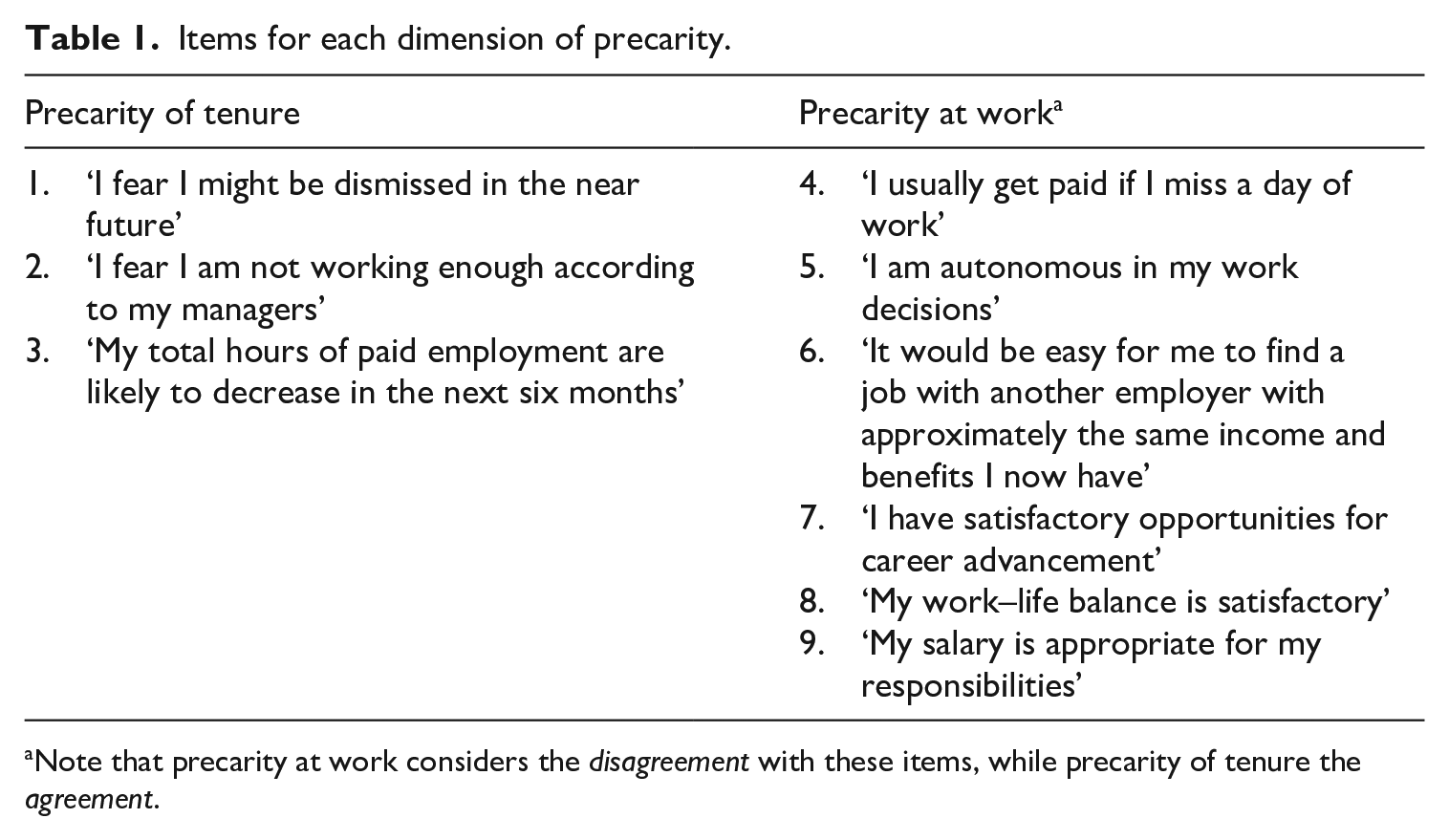
Note that precarity at work considers the disagreement with these items, while precarity of tenure the agreement.
We label factor 2 precarity of tenure because the items (1, 5 and 6) used to form this dimension are measures of subjective insecurity or precarity regarding the tenure of work. The remaining items (2, 3, 4, 7, 8 and 9) refer to the subjective insecurity in working conditions (work security, autonomy at work, cognitive employment insecurity, job security as upwards mobility, work–life balance and income insecurity), and therefore we call this second dimension ‘precarity at work’. Our labelling mirrors in part Gallie et al.’s (2017) distinction between subjective insecurity in job tenure and subjective insecurity in job status/work conditions (although their items refer to future threats and ours to present conditions).
Our hypotheses
We test two hypotheses regarding the relationship between precarity and voting.
Hypothesis 1: People who feel more precarious (in terms of precarity of tenure and/or precarity at work) are less likely to vote for established centrist parties of Christian democratic and social democratic origin.
This hypothesis reflects the changing position on socio-economic issues of both the social democrats, who have moved from a rhetoric of labour market protection and labour rights to one of flexicurity and choice (see Bale et al., 2010), and the centre-right, which has progressively abandoned socialist capitalism (Kalyvas and van Kersbergen, 2010). More broadly, our hypothesis reflects the fundamental shift within US and Western European politics, as predicted by Kirchheimer (1966). According to Kirchheimer, the main ideological divisions between the political left and right were rapidly disappearing, and all major parties (social democrats and Christian democrats) were transforming into ideologically bland, centrist ‘catch-all’ parties, appealing to the same broad swathe of middle-class working voters and increasingly detached from the interests they came into politics to represent (see Allern and Bale, 2012; Ignazi, 2017; Krouwel, 2012).
Hypothesis 2: People who feel more precarious (in terms of precarity of tenure and/or precarity at work) are more likely to vote for radical parties (parties of the radical left and radical populist right).
This hypothesis reflects our previously discussed ‘winning agendas’ formulated by RPR and RL parties that put the labour market at the centre. Following the shift by RPR parties towards workers’ rights and progressive policies (Michel, 2017), voters would move towards RPR parties, as they perceive that migration/closing borders is a potential solution to their labour market and personal insecurity (Hillje, 2018). Reflecting the enhanced interest in workers’ rights of the radical left post-austerity (March and Rommerskirchen, 2012), precarious voters would opt for RL parties when they believe that their precarity can be remedied/solved with redistribution. This also reflects a more symbolic shift away from ‘established parties’ that tend to alienate voters with higher levels of subjective insecurity (see section 2).
Given the overall trend of a decline in job quality in Europe, and in some respects in job tenure security (Gallie, 2017), we hypothesise that subjective labour market insecurity works in the same way in both countries. We suspect that the effect will be greater in France, as France has experienced the biggest job quality drop between 2005 and 2010 and shows a comparatively high level of tenure insecurity (Erhel et al., 2012; Leschke and Watt, 2014). The Netherlands features among the countries with less job quality loss in Europe, but we assume the effect of precarity to be present there too, given the reported issues in work–life balance (Leschke and Watt, 2014: 21). The Netherlands also shows a comparatively high level of tenure insecurity (Erhel et al., 2012), though this tends to be voluntary and so less likely to affect insecurity (Leschke and Watt, 2014).
Methodology
Recruitment
To collect data on voting behaviour along with assessments of respondents’ economic situation, we used email panels obtained via Voting Advice Applications (VAAs) (for a detailed description of the methodology used for the development of VAAs, see Krouwel and van Elfrinkhof, 2014). VAAs are essentially information tools that prospective voters can use to compare their own policy preferences with the official policy positions of political parties. A subset of respondents voluntarily provided their email addresses so that they could be contacted for future research.
To date, there is no comparative secondary dataset available to investigate multidimensional precarity (see above) or to test both precarity of tenure and precarity at work as determinants of voting choice. To collect original data, we used opt-in Internet panel surveys that recruited respondents via online VAAs. VAAs provide information for prospective voters that helps them to learn about the policy proposals of political parties during an election campaign. They generate vast amounts of data about the political preferences of their users. An emerging literature uses VAA-generated data to learn about representation and political behaviour (Garzia and Marschall, 2012; van der Linden and Vowles, 2017). The data collection was conducted before and/or during the legislative elections held in the two countries (February 2017 in the Netherlands for the May elections, and May 2017 in France for the June elections) and collected 31,800 observations in the Netherlands and 6,992 in France.
Selection
We used subsets of VAA respondents from France and the Netherlands who volunteered for future research to implement a comparative study of precarity. Like most online panels, VAA panels are non-probability samples. VAA-generated data are subject to a twofold self-selection bias (Pianzola, 2014) where users first opt into VAA usage (often younger and more educated citizens) and then opt into follow-up studies. Figure 1 displays the key demographics in terms of age, gender and education, and shows that our country samples deviate from the 2011 census figures. Crucially, our samples resemble the demographic make-up of likely voters more than that of the general population, in that participants in our surveys are older, more educated and more likely male.
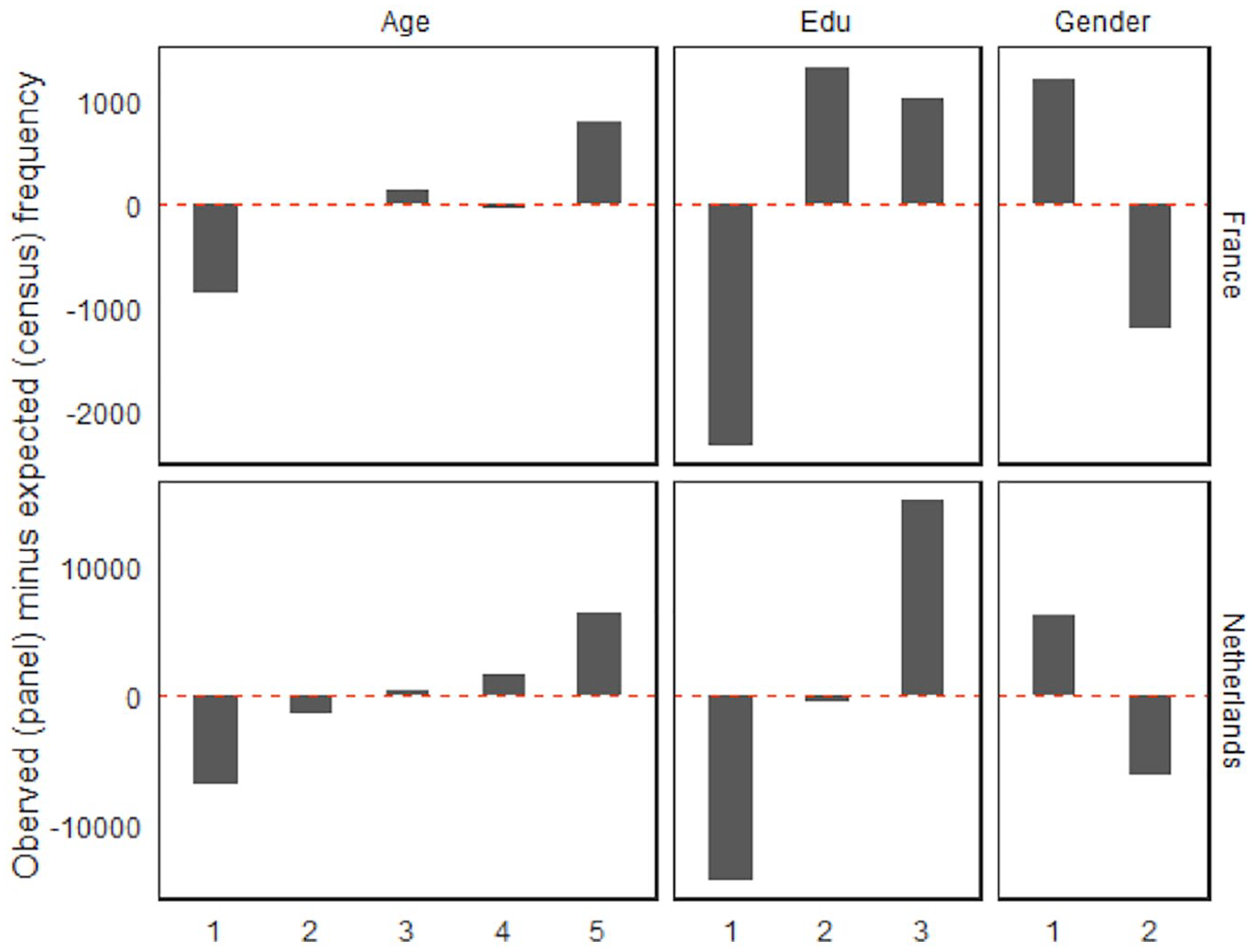
Sample imbalance and the census.
Weighting
In our analysis, we are looking at the specific vote choice in relation to precarity, thus non-voters will need to be discarded eventually. Nevertheless, we computed post-stratification weights so that the joint distribution of gender, age and education is matched exactly to what would be expected if the three samples mirrored the proportions in the census (fixed at the red dashed line in Figure 1).
To further evaluate our sample on an independent (i.e., non-demographic) measure, we show weighted and unweighted estimates of six key party vote shares in Figure 2 (below). The results show that our estimates were already within 5 to 10 percentage points in the unweighted figures and therefore came close to the official election results. Weighting improved the precision of all the figures in the Netherlands. Based on these figures, we take away two key points: that adjustment ‘back’ to the general population, rather than ‘likely voter’ demographics, slightly, but not substantially, decreased the accuracy of the vote share estimates except for in the Netherlands, and that, in general, we have a relatively accurate estimate of niche party support, whereas we may underestimate major party support. Our finding here is in line with a general consensus about VAA-generated data, which is that it is superior in studying the sources of fringe and radical party support (e.g. Hooghe and Teepe, 2007; Wall et al., 2009), an area where traditional surveys are likely to suffer from low statistical power due to smaller sample sizes.
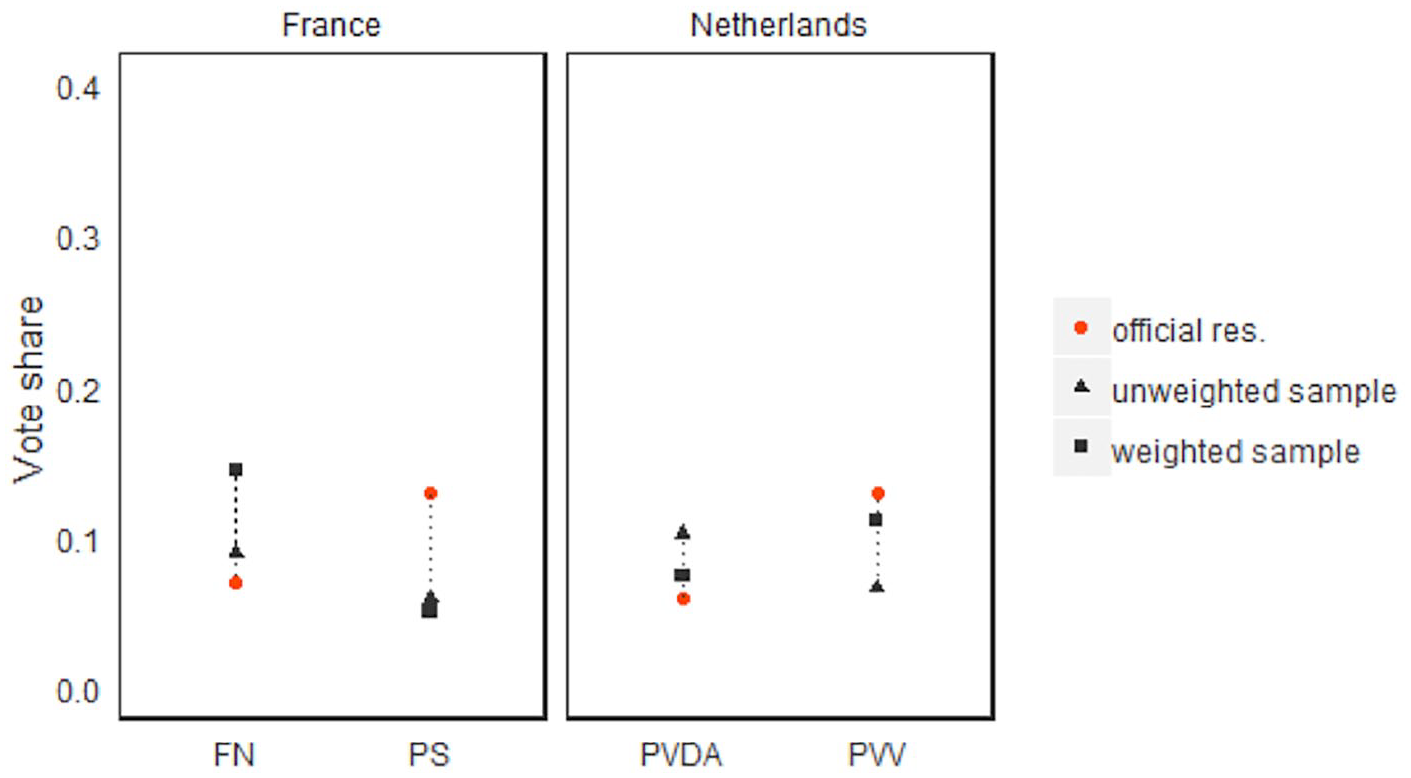
Weighting.
Operationalisation and instruments
Respondents were asked a number of questions related to their current employment. The questions were framed in terms of agreement with a statement, such as ‘I fear I might be dismissed in the near future’, to be expressed on a scale of 1 to 4. In order to consider the variation in the respondents’ use of scales, for each question we merged answers denoting full (answer 4) and fair (answer 3) agreement on the one hand, and full (1) and fair (2) disagreement on the other, thus obtaining a set of dichotomous variables that indicated broad agreement or not with each statement.
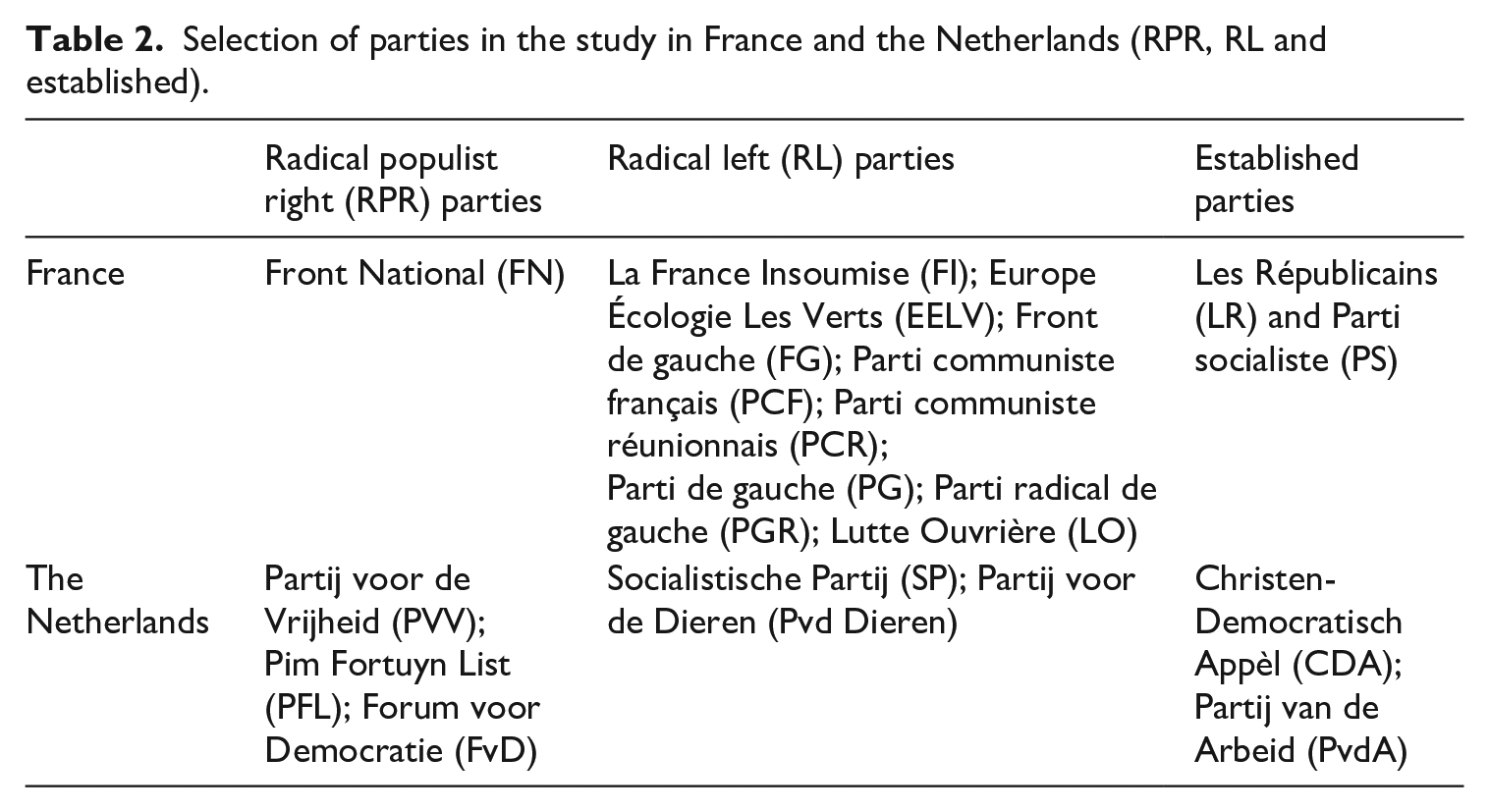
We selected radical right and left parties using a party family approach, which understands parties as grouped by ideological affinity (Mair and Mudde, 1998) – see Table 2 below. In line with earlier studies on party families, we used the categorisation from a longitudinal analysis of party change (Krouwel, 2012), which includes extensive descriptions of party histories and ideological affiliation.
Selection of parties in the study in France and the Netherlands (RPR, RL and established).
In Table 3, we report some descriptive statistics on the two indexes of precarity. As discussed above, precarity at work exhibits higher standardised scores in all countries than precarity of tenure, with the largest differences in France and the lowest in the Netherlands. Women exhibit slightly higher precarity at work than men on average, whereas precarity of tenure seems to affect both genders equally. Finally, age seems to be only very weakly correlated with precarity in general, except for older respondents (over 66 years), who report lower levels of precarity. The two indexes were normalised to take on values between 0 and 1 and were used as explanatory variables in a series of logistic regressions of the probability of voting for mainstream or radical parties. In each regression, we included a set of control variables related to demographic characteristics (gender, age and education) (see A2), so that our results are not dependent on those demographic differences.
Vote determinants for established and radical parties (odds ratio).
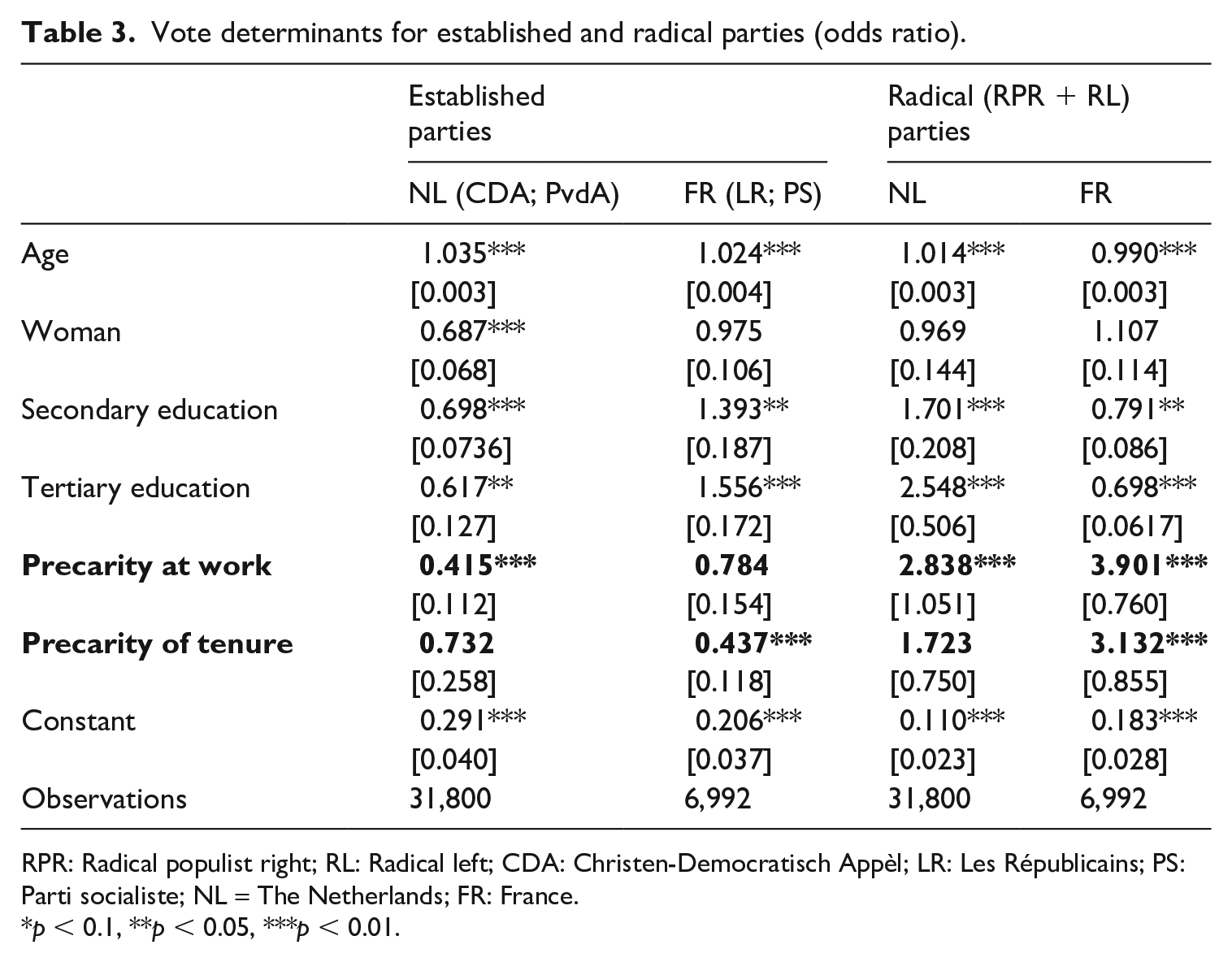
RPR: Radical populist right; RL: Radical left; CDA: Christen-Democratisch Appèl; LR: Les Républicains; PS: Parti socialiste; NL = The Netherlands; FR: France.
p < 0.1, **p < 0.05, ***p < 0.01.
Results: the association between precarity and voting in France and the Netherlands
Below, we test our three hypotheses, calculating odds ratios, as these indicate the likelihood that voters who feel precarious will vote for either established or radical parties. A score of 1 means that the odds of voting for either are equal; a score above 1 means a higher chance of voting for the party considered in each estimation; and a score below 1 indicates a lower chance (see Table 4).
Vote determinants for radical populist right (RPR) and radical left (RL) parties (odds ratios).
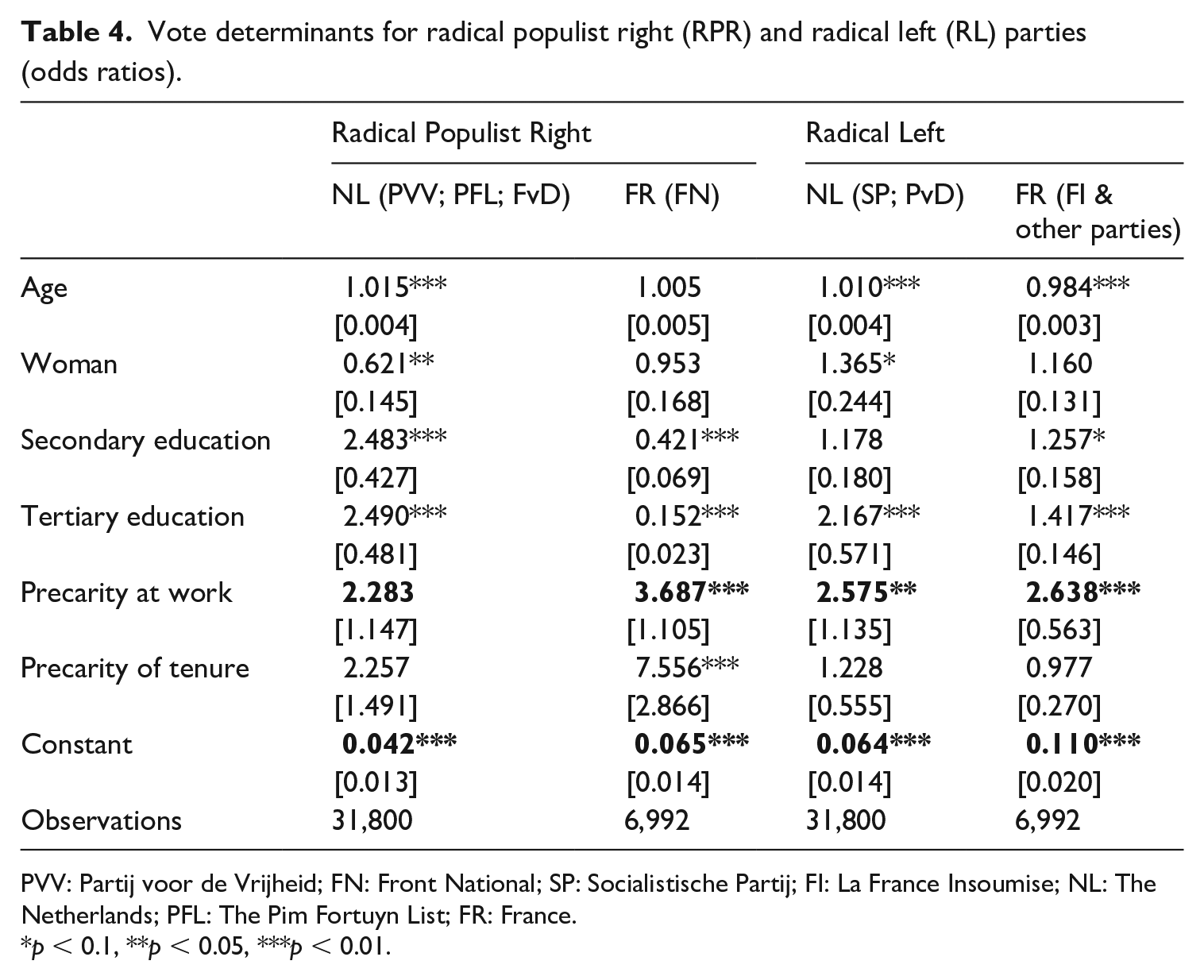
PVV: Partij voor de Vrijheid; FN: Front National; SP: Socialistische Partij; FI: La France Insoumise; NL: The Netherlands; PFL: The Pim Fortuyn List; FR: France.
p < 0.1, **p < 0.05, ***p < 0.01.
The first hypothesis posited that voting for established parties – social democrats and Christian democrats – is negatively associated with precarity of tenure and/or precarity at work in the two countries, which is confirmed in France and in the Netherlands. This expected effect of precarity on established party voting is specifically evidenced in that precarity at work significantly reduces the odds of voting for established parties in the Netherlands, while in France it is the precarity of tenure appears to be the significant factor in reducing the odds of voting for established parties (see Table 3). Both precarity of tenure and precarity at work are associated with voting for the political extremes in France and the Netherlands, evidencing that perceived precarity at least partly explains why people are less likely to vote for established parties in these countries.
Figure 3 is a graphic representation of the same results for the two countries. The estimated marginal impact of precarity at work on the probability of voting for established parties in the Netherlands ranges between -5 and -10 percentage points, with the confidence interval consistently below zero (which would denote no marginal impact). Broadly the same range of values is found for the marginal impact of precarity of tenure on the probability of voting for established parties in France. The results confirm that subjective insecurity, in general, pulls voters away from establishment parties (see also Gidron and Hall, 2017). In France, precarity of tenure is significant in this process, possibly as a result of the contextual rise in temporary employment reported in the literature (Erhel et al., 2012; Leschke and Watt, 2014). In the Netherlands, the significant association is with precarity at work, possibly as an effect of the decline in work–life balance in the country (Leschke and Watt, 2014: 21). Additional variables to account for the mediating role of institutional differences could clarify this puzzle.
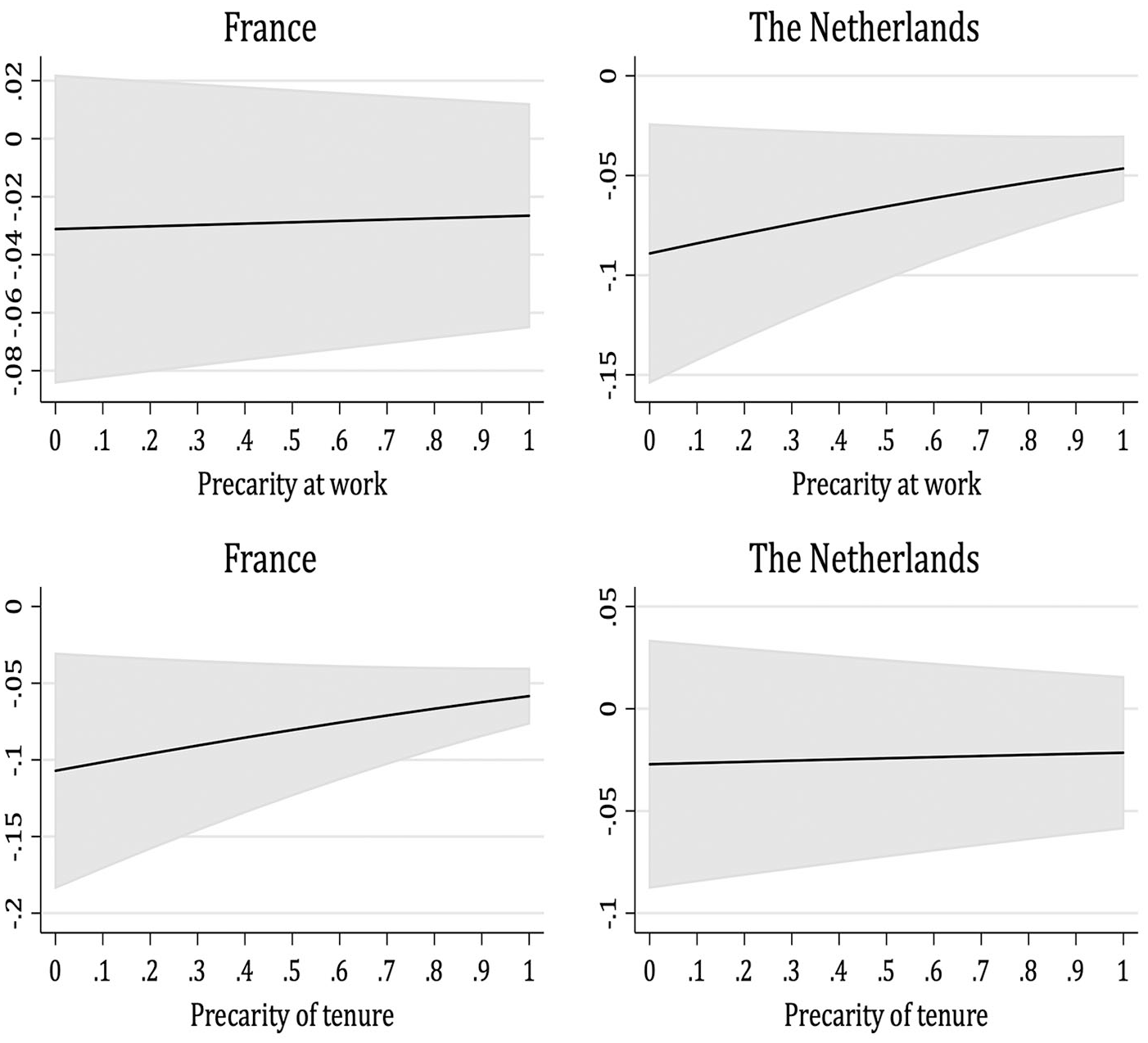
Estimated marginal impact of precarity at work and precarity of tenure on the probability of voting for established parties in the Netherlands and France.
Our second hypothesis delved deeper, assuming that precarity of tenure and/or precarity at work is positively associated with voting for both the radical populist right (RPR) and the radical left (RL) in France and the Netherlands.
Table 3 clearly shows that these precarity effects occur, although the ‘precarity effect’ varies across the two countries and depends on the specific dimension of precarity (tenure or precarity at work) and the type of radical support (radical right or radical left). Precarity at work seems to have similar effects on the odds of voting for either the radical right or the radical left: in both countries, the odds increase by a factor of 2 to 3.
Precarity of tenure, however, seems to increase the odds of voting for the radical right in particular. This effect is particularly pronounced in France, where precarity of tenure (or fear of job loss) increases the odds of voting for the radical right by a factor of 7.5. The findings are revealing of a relationship between precarity and voting for radical parties, in particular in France, where other parties aligned with flexible labour market agendas (Macron’s En Marche) appeared in the electoral system without attracting the votes of the precarious (voting for En Marche is negatively associated with both forms of precarity – see Table A4 in the appendix). The figures below give a graphic representation of the same results for radical right voters (Figure 4) and radical left voters (Figure 5) in the Netherlands and in France so that the reader can appreciate the intensity of the precarity effect.
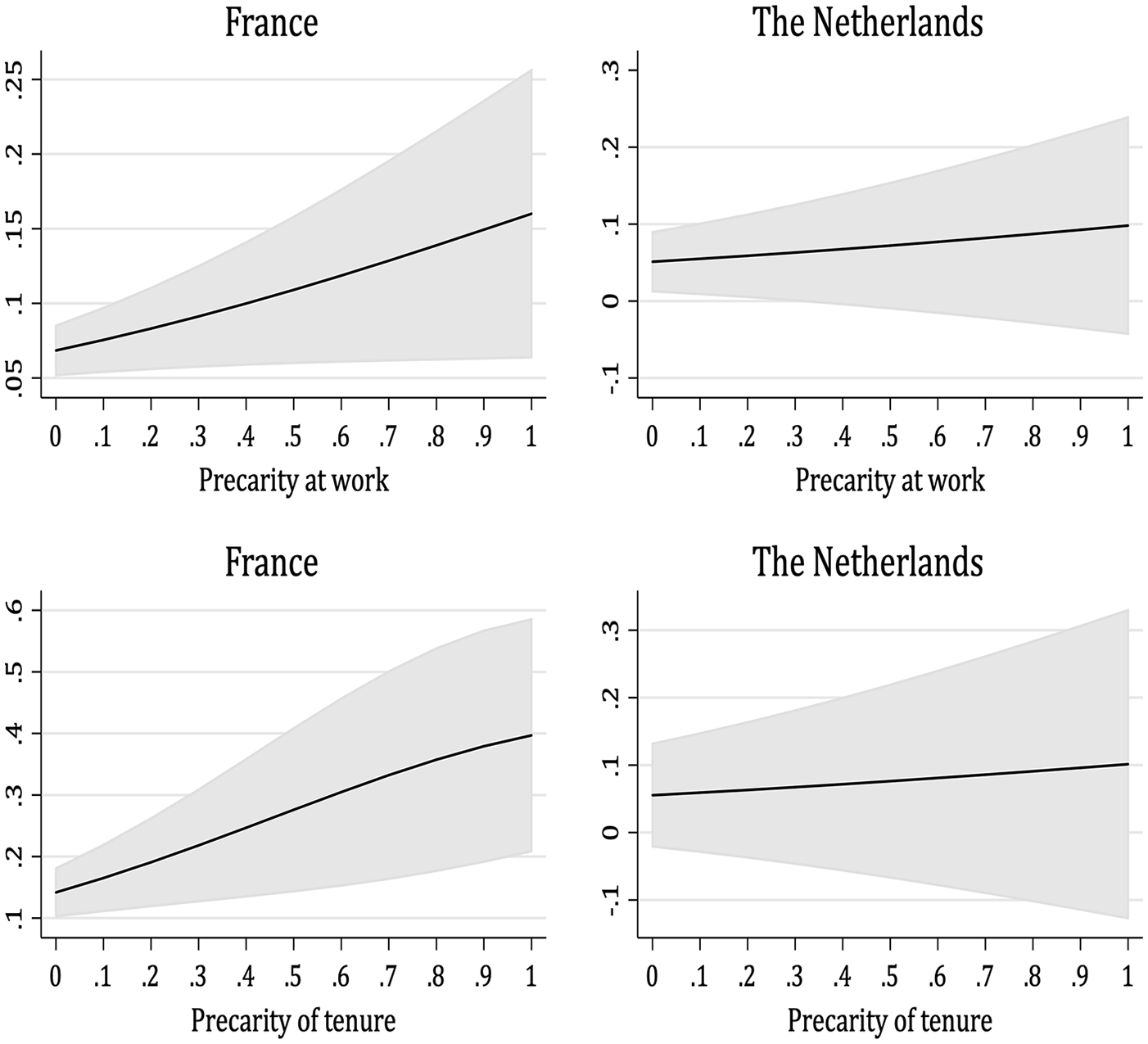
Estimated marginal impact of precarity at work and precarity of tenure on the probability of voting for radical populist right parties in the Netherlands and France.
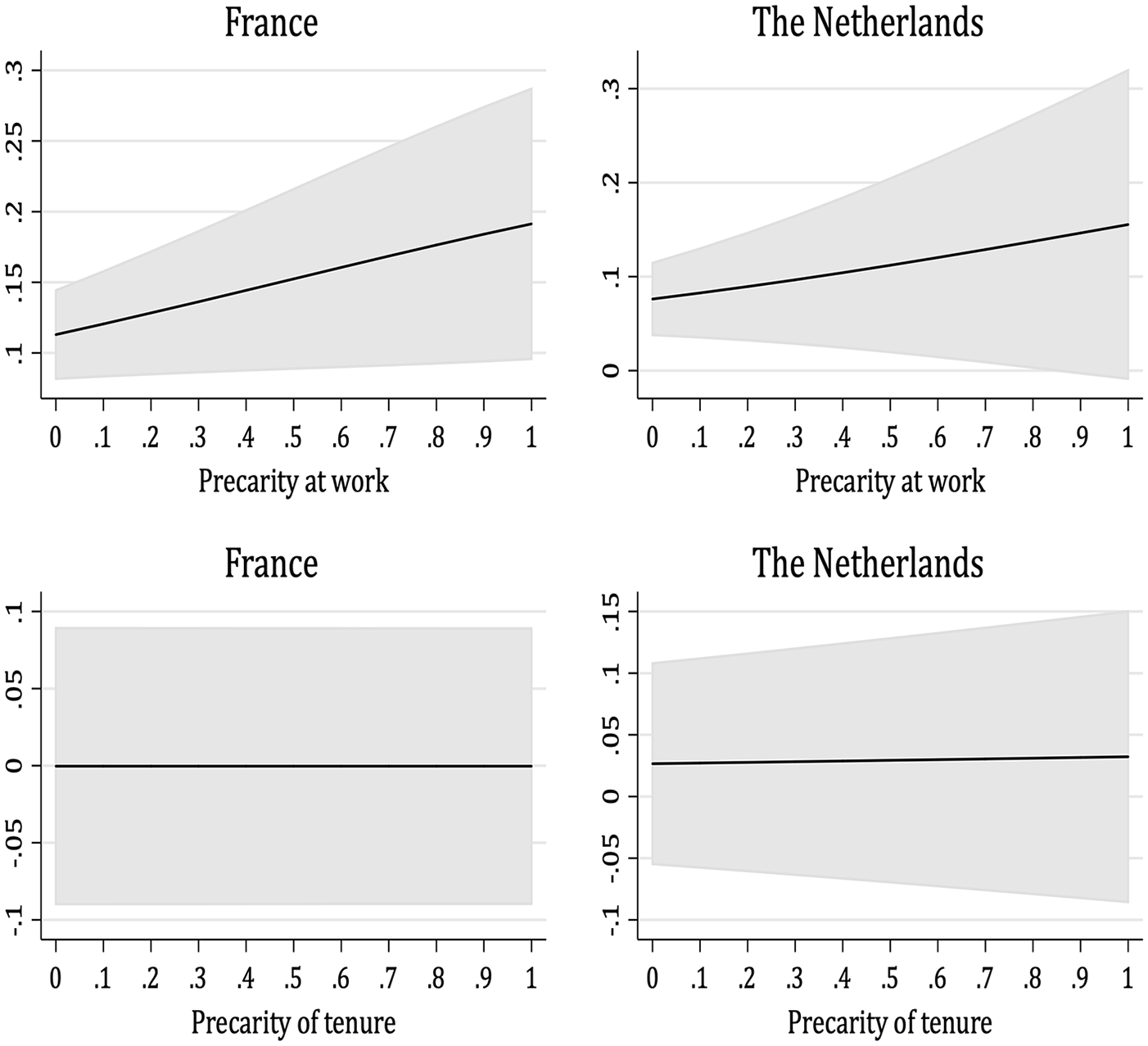
Estimated marginal impact of precarity at work and precarity of tenure on the probability of voting for radical left parties in the Netherlands and France.
The results also confirm that subjective insecurity, in general, pulls voters towards radical parties (see section 2; Gidron and Hall, 2017). The significant associations between forms of precarity and support for party types (RPR and RL) are also telling. Precarity of tenure remains significant in France, while precarity at work is significant in the Netherlands and in France, possibly because the ‘job quality’ criticalities identified in the two countries (Erhel et al., 2012; Leschke and Watt, 2014) reverberate through the political sphere. With the exception of the association between RPR support and precarity of tenure in France, the significant associations between different forms of precarity and RPR/RL voting relate to ‘precarity at work’. This might reflect how the main ‘issue’ in the current European labour market is the precarity of work conditions, with temporary contracts affecting a minority of workers (Gallie, 2017). However, this needs to be confirmed in studies that examine other countries.
Discussion and conclusion
The recent surge in support for radical populist right parties is often ascribed to ‘precarity’ (Gidron and Hall, 2017; Tammes, 2017), but subjective measures of labour market insecurity are surprisingly lacking in the literature (Marx and Picot, 2020). In this article, we combine the sociological research on precarity and its applications (Parfitt and Barnes, 2020; Standing, 2011) with the analysis of voting behaviours to explain voting patterns for radical right and left parties among working voters in the Netherlands and France.
Our study makes a number of significant contributions to the literature. First, we introduce and test a multidimensional operationalisation of precarity that builds on the sociological literature (Standing, 2011) and operationalises precarity in relation to voting. This fills a gap in the exploration of the link between insecurity and voting, where subjective indicators of precarity are missing (Marx and Picot, 2020). As part of our exploratory work of operationalising precarity in relation to voting, we identify through EFA two dimensions – precarity of tenure and precarity at work – that have significant associations with voting. This work is significant for the literature because while most studies exploring labour market insecurity focus on objective measures of labour insecurity (Emmenegger et al., 2015), the breadth of our items allows an examination of the elephant in the room in terms of understanding how European working voters experiencing insecurity are attracted to populist (RPR and RL) voting options, namely subjective labour market insecurity in their tenure and working conditions. Whereas other scholars have tested the hypothesis that populism is driven by ‘left behind’ segments of the population, and have turned it down in favour of cultural explanations (Norris and Inglehart, 2019), our study on precarity of tenure and of work understands populism to be associated with the insecure conditions subjectively experienced by ordinary citizens (Antonucci et al., 2017; Gidron and Hall, 2017). An important limitation of our study is that we are only exploring precarity in relation to work, focussing therefore on working voters. Further research is necessary to test the role of other diffused forms of precarity, such as financial precarity.
The second significant contribution of the article is finding that precarity partially explains the support for radical parties in the 2017 elections in the Netherlands and France – two countries that ideally represent the increased support for both RPR and RL parties in the rest of Europe, while having two distinct political systems. In our case-study selection, therefore, precarity intervenes in explaining similar patterns of moving away from traditional politics that cannot be explained by the political system itself. In both countries, the narrative of established parties, including the social democrats, not being supported by voters experiencing precarity (not just working-class voters, as stated by Gingrich and Häusermann, 2015) holds. The associations between type of precarity (of tenure or at work) and support for either RPR or RL parties were also significant. In France, both precarity of tenure and precarity at work are positively associated with voting for the National Front, and precarity at work is positively associated with voting for La France Insoumise. This confirms the idea that the National Front is able to co-opt support from a segment of the population affected by precarity of work conditions and precarity of tenure (Michel, 2017), while the radical left attracts support from voters with precarious work conditions (March and Rommerskirchen, 2012). In the Netherlands, we find that only precarity at work is negatively correlated with voting for mainstream parties and positively correlated with support for RPR and RL parties. We suspect that these cross-national differences might depend on the various ‘forms’ in which precarity features across the two countries: as insecurity in tenure and in work conditions in France, and mostly as insecurity in the work–life balance in the Netherlands (Leschke and Watt, 2014). This, of course, will need to be tested in future research that is also able to isolate the role of contextual and institutional factors in mediating the link between precarity and voting through multi-level analysis. Our online panel has allowed us to measure precarity in a multi-dimensional way, instead of relying on measures in large comparative surveys that do not cover precarity or include only a few items. This does, however, mean that our data is limited to two cases with particular welfare and political/electoral systems. We speculate that our findings can be generalised across other contexts as well, but future research needs to investigate this.
Finally, our study originally positions the rise of populist right support within the broader framework of voters moving away from establishment party support and towards radical party support, whether that is for a left-wing or a right-wing party. The literature on radical (populist) right support has been plentiful in the last few years, with much less attention being given to radical left parties. We understand the moves towards the radical parties to be part of the alienation from the centre. It is significant that in our study there is evidence of associations between precarity and voting in countries that feature at the bottom (France) and the top (the Netherlands) of the job quality levels found in Europe (ibid.). We interpret this as a consequence of the political effects of the lowering quality of work that Europeans have experienced since the 2008 crisis (Gallie, 2017) and of the fact that both RPR and RL parties offer a response to subjective insecurity, indirectly (framing themselves as anti-establishment) and directly (via the ‘redistribution’ solution to labour market insecurity of RL parties and the chauvinist labour market protection for citizens proposed by RPR parties).
Supplemental Material
sj-docx-1-sro-10.1177_13607804211020321 – Supplemental material for What’s Work Got to Do with It? How Precarity Influences Radical Party Support in France and the Netherlands
Supplemental material, sj-docx-1-sro-10.1177_13607804211020321 for What’s Work Got to Do with It? How Precarity Influences Radical Party Support in France and the Netherlands by Lorenza Antonucci, Carlo D’Ippoliti, Laszlo Horvath and André Krouwel in Sociological Research Online
Footnotes
Funding
The author(s) received no financial support for the research, authorship, and/or publication of this article.
Supplemental material
Supplemental material for this article is available online.
Notes
Author biographies
References
Supplementary Material
Please find the following supplemental material available below.
For Open Access articles published under a Creative Commons License, all supplemental material carries the same license as the article it is associated with.
For non-Open Access articles published, all supplemental material carries a non-exclusive license, and permission requests for re-use of supplemental material or any part of supplemental material shall be sent directly to the copyright owner as specified in the copyright notice associated with the article.
