




Abstract
This article contributes to the emerging sociology of mind-sport as a new area of research by showing how everyday interaction and life skills are sharpened and honed through strategic interaction at the bridge table. Using the example of the card game bridge, the article explores how elite players engage in time-consuming and repetitive performances that display their ongoing impression management and strategic interaction work. Through interviews with 52 elite bridge players, the article argues that preparation and practice are required to improve play, alongside the ability to combine deception with notions of skilfully supportive transparent play. These contradictions are played out through learning to read the impressions given off by other players as well as plan in a disciplined manner for mistakes made at the table and to support their partner through silence. Using an interactionist framework, this article illustrates how strategic interaction and impression management are skills continually worked on in high-pressured and competitive environments. The article demonstrates the ways that everyday interaction practices are enhanced by and through a competitive mind-sport.
Card games have had a long and (sometimes) chequered historical and personal appeal for many people. From learning to play snap and cheat as a child to more complex games of whist, rummy, canasta, poker, and bridge – card games have been a source of entertainment for the family, a way to entertain guests, a hobby, as well as a profession. Card games fall in and out fashion, with some games enduring better than others and nowhere is this clearer than with bridge. First mentioned in a sermon in 1529 (English Bridge Union, 2019), the fortunes of bridge have varied throughout the centuries, with certain time periods favouring bridge as the popular card game of choice. In particular, the 1930–1950s saw bridge established as the after-dinner party game, immortalised by the golden crime writers of the age where the playing of bridge equalled playing with murder and death (Christie, 1936; Heyer, 1951). By the 21st century, playing bridge had become associated with an older generation and a game that was struggling to compete with the array of digital and fast-paced games on the market (Shellenberger, 2015). As a result, bridge is seen by many as having an image problem. Bridge does not immediately attract younger players and in today’s popular imagination, if it is thought of at all, it is assumed to be a game largely played by retired women. Scott’s (1991) research revealed how younger people were disinclined to play bridge due to this ageist image. Another issue was the difference between those who played bridge for fun (social bridge players) and those who wanted to play competitively at tournament/elite level. This difference in ability put off many younger and less skilled players from playing in bridge clubs, thereby reinforcing bridge as a game for older players who already know how to play (Scott, 1991: 333).
Another challenge which hinders take-up is the format of the game. As a four-player card game, playing bridge demands commitment to and by four people, not seen in other games such as chess (where you can play against yourself) and poker. A further issue is that bridge can be associated with gambling although this form of the game, known as ‘rubber bridge’, is rarely played nowadays. While this image works well for poker, helped no doubt by the cultural presentation of James Bond – the gambling image combined with ageism and the aforementioned social constraints, all serve to place bridge as a game that is assumed to be neither interesting nor suitable for children and young people to learn and play. As a result, bridge is slowly and inevitably struggling to recruit younger players as well as being increasingly divided between those who play it socially (at home and with friends) and those who play it competitively (in clubs and at tournaments). However, at elite level, bridge is regarded by many as a sport (formally recognised as such by the International Olympic Committee) and has its own series of national and world championships, most recently in Wuhan, China (World Bridge Federation, 2019).
This article is part of a wider research project Bridge: A MindSport for All (BAMSA) that is contributing to the establishment of the sociology of mind-sport. The project aims to engage a younger generation of players about the positive and lifelong benefits found in a mind-sport such as bridge. To date, academic attention has reviewed chess as a mind-sport (e.g. Kobiela, 2018; Puddephatt, 2003) but bridge has been largely ignored. One of the project’s goals is to question and unpack the negative image of bridge by showing that it can be played by the very young to the very old and is therefore generationally inclusive. Given the increased social isolation of many younger and older people today (Ballard, 2019), participating in the four-player card game of bridge enables social interaction and a sense of belonging and enjoyment to develop. Bridge requires players to create and sustain a community of four with all the attendant drama and interpersonal socialising and solidarity such development and participation engenders (Punch et al., 2020).
This article uses the case study of bridge to examine the ways that a mind-sport can extend and enhance everyday interaction skills in a supportive gaming environment. By focusing on the strategic dynamics of the game, it shows how bridge can be critically theorised and understood from an interactionist perspective. It draws on data from 52 elite players to explore the bridge skills and strategies developed through competitive play. Using an interactionist framework, we argue that bridge lends itself well to unpacking ideas around the impressions we give off at play, notions of strategy at cards, and how the successful presentation of both can lead to skilful, winning outcomes. It begins by outlining the theoretical framework before discussing the context of bridge and the research methods. The interview data is presented in relation to Goffman’s concepts of strategic interaction and impression management, showing how elite players invest time and effort in developing everyday interaction skills and managing partnership dynamics at the bridge table.
Within the interactionist tradition, sporting activities have been looked at in a variety of ways such as little league baseball (Fine, 1987), ballet (Dietz, 1994), and rugby (Donnelly and Young, 1985). Puddephatt (2003) employed Goffman’s ideas of strategic interaction to the game of chess, while the following authors applied impression management to ethnic stereotypes and humour (Esholdt, 2019), vacation identities (Stein, 2011), and obituaries (Bonsu, 2007). Using Goffman’s dramaturgical theory, Scott (2009) demonstrates how the setting of the swimming pool is a microcosm of society: ‘a local social world with its own set of rules, norms and background knowledge’ (p. 141). Similarly, this article unpacks the ways in which elements of micro-social life are played out at the bridge table. An understanding of the sociology of everyday life (Neal and Murji, 2015; Scott, 2012) shows how everyday social relations and practices can be reflected in the social interactions of a card game. While the sociology of emotions is also relevant to this process, the intricacies of emotional management at and away from the bridge table are outwith the scope of this article and are explored elsewhere (Punch and Russell, 2019). This article extends the applicability of employing strategic interaction and impression management into the world of mind-sports, games, and leisure through the case study of bridge.
Bridging strategy, interactions, and impressions
Erving Goffman, a Canadian-American sociologist, is often regarded as one of the most ‘influential proponents of symbolic interaction thinking and methods’ (Inglis, 2012: 121). Goffman explored and theorised micro-social interactions in an increasingly impersonal world (Burns, 1992). Manning (2000: 284) suggests that Goffman has become known as a ‘theorist of the interaction order’. Such a perspective understands Goffman’s work as focussed on the learned, repetitive language and interaction conventions that govern everyday life. For example, we are all able to navigate a busy street without bumping into each other, queue for the bus in a (usually) orderly manner, and engage in appropriate small talk at the check-out counter. Such knowledge, Goffman (1963) argues, relies on a shared tacit agreement about the rules of behaviour in public places and a generally accepted definition of the situation. It also demands that we present the ‘right’ kind of role for the given situation and do so successfully so that others around us accept this role at face value while also helping to maintain it. An example of engaging in ‘repair work’ is when a child has a temper tantrum in a supermarket and other people ignore what is happening or make sympathetic faces or comments like ‘my child did the same/it will get better’ and so on. As a result, everyday life can be understood through the lens of a ‘dramaturgical performance’ (Goffman, 1959) where we are continually working to try and control the impressions others have of us – what Goffman termed impression management.
Accordingly, this notion of impression management relies on deception (Scott, 2012). Because of this strong element of deception running throughout Goffman’s work, Manning (2000: 287) suggests that Goffman is less a ‘theorist of the interaction order’ and rather a theorist who provided an excellent ‘textbook’ on how to deceive others in our day-to-day lives. Nowhere, Manning (2000) argues, is this everyday deception advice more noticeable than within The Presentation of Self in Everyday Life (1959). Goffman (1959: 40) illustrates this by giving the example of a baseball umpire who has to sustain . . . the impression that he is sure of his judgement. [To do so] he must forgo the moment of thought which might make him sure of his judgement . . . so that the audience will be sure that he is sure of his judgement.
Importantly this management of ‘sure’ impressions relies on an audience to respond to and validate the impression and the decision made. As a result, the audience ‘must all carry within ourselves something of the sweet guilt of conspirators’ (Goffman, 1959: 108). Goffman (1959: 203–230) then goes on to highlight the three key attributes of defensive impression management: (1) Dramaturgical Loyalty, (2) Dramaturgical Discipline, and (3) Dramaturgical Circumspection.
Dramaturgical loyalty is based on the aforementioned idea of an agreed definition of the situation. Goffman suggests that dramaturgical loyalty is apparent . . . if a team is to sustain the line it has taken, the team-mates must act as if they have accepted certain moral obligations. They must not betray the secrets of the team when between performances – whether from self-interest, principle or lack of discretion. (Goffman, 1959: 207)
At the bridge table, in order for dramaturgical loyalty to be carried out, it is vitally important that your bridge team-mates have dramaturgical discipline. This is evidenced through the performer appearing wholly immersed in their various activities (see Figure 1) in what appears a ‘spontaneous, uncalculating way’ (Goffman, 1959: 210). However, while one is engaged in this spontaneous performance, one must also retain sufficient intellectual and emotional distance from your performance so as not to be entirely carried away by it. This brings us to dramaturgical circumspection. Loyalty and discipline is something that your team-mates display performatively to you as well as to the surrounding audience. It is to the surrounding audience that circumspection is required. Too large an audience and you will not be able to control the reactions to your play. The smaller the audience, the easier it is to control for reactions and read your audience as well as your team-mates properly. Time also places constraints on you and your team-mates’ capacity for successful circumspection. The longer a show, the more likely it is for players to get tired, distracted, and therefore fail to maintain the appropriate level of loyalty and discipline (Goffman, 1959: 212–222).
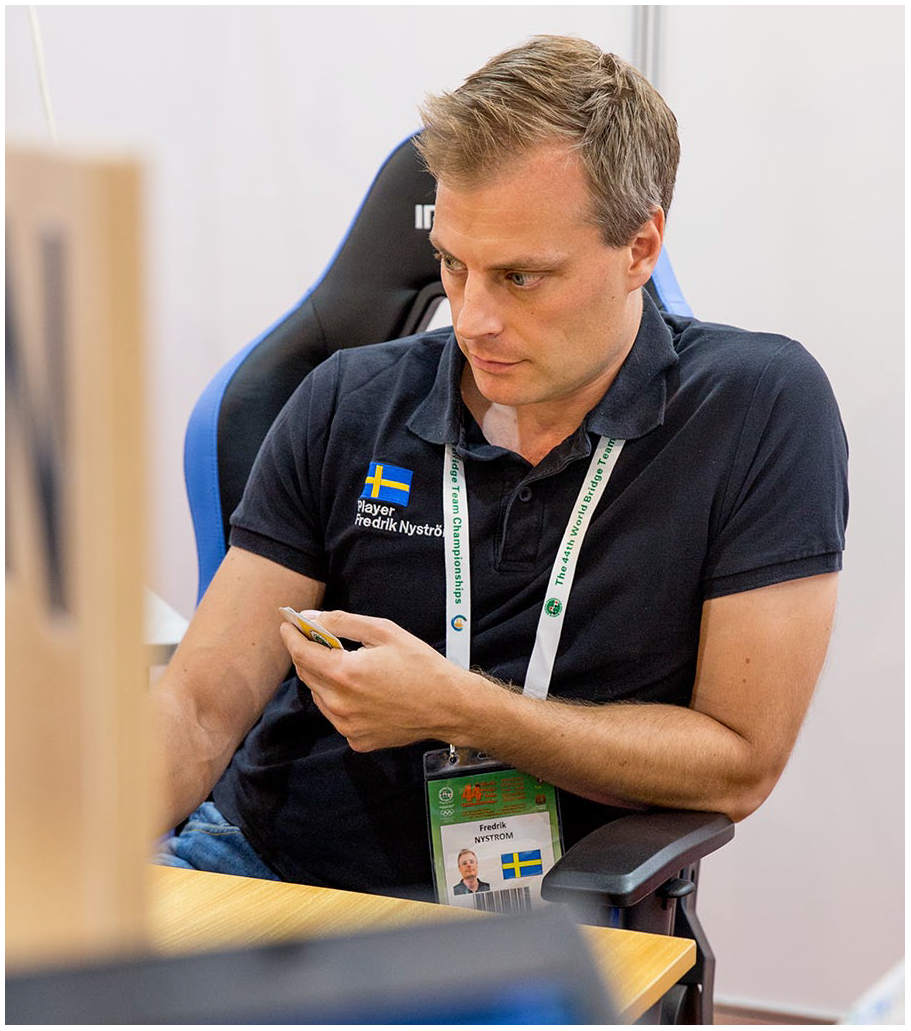
Top Swedish player and world champion, Fredrik Nyström, planning his next move. (Photo credit: Francesca Canali and the World Bridge Federation, taken at the World Championship in Wuhan, China.)
Despite this focus on the performative and presentational side of impression management, Goffman’s work has been critiqued for providing an understanding of ‘social relations without power relations’ (Tyler, 2018: 750). In particular, his work was criticised (notably Stigma) for not accounting for the racialised politics of the civil rights movement of the time and neglecting to account for state-sponsored acts of racism, while also assuming ‘the normal’ can be easily identified and understood separate from historical context and the ways in which ‘social relations are structured through power’ (Tyler, 2018). Tyler (2018) goes on to argue that there is a ‘general neglect’ in Goffman’s work to think through where these norms come from, who gets to produce them, and how. The a-historicity of Goffman’s work and the attempt to arguably construct universalist concepts, easy to apply due to their free-floating social nature, is an important critique.
However, we argue that Goffman’s ideas of impression management with the attendant notion of deception are further developed through his work on Strategic Interaction (1969). Indeed, strategic interaction is centred predominantly around the notion of calculation and Goffman’s attempt to combine game theory with symbolic interaction (1969: 85). Individuals, Goffman argues, are not free-floating a-historical beings, but rather people who are aware that their own and others’ impressions can be faked and that certain people may be regarded as ‘pawns’ to manipulate so as to meet your own desired outcomes (Goffman, 1969: 87). Power then resides in your capacity to successfully and strategically play the interaction order game to your satisfaction. Strategic interaction therefore is where people engage in a series of calculated ‘moves’ (1969: 11–28) designed to further their own goals through deception and counter deception. He extends this idea with the concept of gameworthiness: . . . the practice of setting aside all personal feeling and all impulsive inclinations in assembling the situation and in following a course of action; the ability to think and act under pressure without becoming either flustered or transparent. (Goffman, 1969: 96)
Gameworthiness arguably shares much in common with Goffman’s earlier idea of dramaturgical discipline but is more explicit about the notion of life being a game and the separation of personal feelings from the performance that is underway, in order to achieve your end goal. This is further explored through his ideas on strategic interaction where he uses the example of Harry being faced with a lion. In order not to be eaten, Harry has to engage in a variety of forms of strategic interaction that take into account whether there is a handy tree nearby for Harry to climb into, whether the lion will see Harry running to the tree, whether Harry can access a gun, and so on. All of these examples are used as ways to demonstrate that in order for Harry to not be eaten, he has to calculate the costs and benefits of each move and also assess the way his opponent (the lion in this case) might react. Harry is involved in a series of moves and counter-moves which is hoped will help Harry emerge the victor and not be eaten/mauled or starving (Goffman, 1969: 85–145). It is in these everyday, highly pressurised encounters that people learn to develop strategic interaction skills. However, Swedberg (2001: 309, 320) argues that games such as chess (and arguably bridge as another mind-sport) disrupt more conventional understandings of game theory due to the variable and fluctuating ability of players. In other words, moves made can appear strategic but often end up costing a player more than they could have foreseen. As Goffman (1969: 145) further articulates, ‘Harry [may] elect a course of action that . . . provides the other side [lion] with information they can use against him’. This is particularly true for bridge where mistakes are routinely made at the table and players have to operate with incomplete information in highly pressurised environments.
Within this article, the use of impression management (and its attendant attributes of dramaturgical loyalty, discipline, and circumspection) and strategic interaction are useful analytical tools for understanding how the game of bridge unfolds and the relationships that exist between team-mates and audience. It is important to stress that we are focussing on the ways that players continually work on and try to achieve the skills of loyalty, discipline, and circumspection and not when these skills have been broken or breached (see Punch et al., 2020). When we discuss the failure of these skills, it is to highlight how elite bridge players use their ‘mistakes’ as a mechanism for stressing what could and should be done better at the bridge table. By focussing on the development and maintenance of strategy, discipline, loyalty, and circumspection, we are demonstrating the ongoing highly skilled work elite bridge players engage in at the table. To aid the reader, a brief explanation of the game of bridge and how the language of bridge differs from that of Goffman will now be presented and discussed.
Understanding bridge
Bridge is a four-player card game that uses all 52 cards in a pack with each player dealt 13 cards. When each player plays one card, the four cards constitute a trick with the highest ranking card winning that trick. When all 13 tricks are completed, this is one bridge ‘deal’. Partners sit opposite each other against a pair of opponents (see Figure 3). Based on the cards held, players engage in a round of bidding where they estimate how many of the 13 tricks their partnership could commit to trying to win (known as the ‘contract’). One player wins the contract through bidding (see Figure 2) the highest on behalf of their partnership, then their partner becomes ‘dummy’ and lays their cards down openly on the table. This means that the other partnership must now play defensively against the pair to try to stop them making their contract.
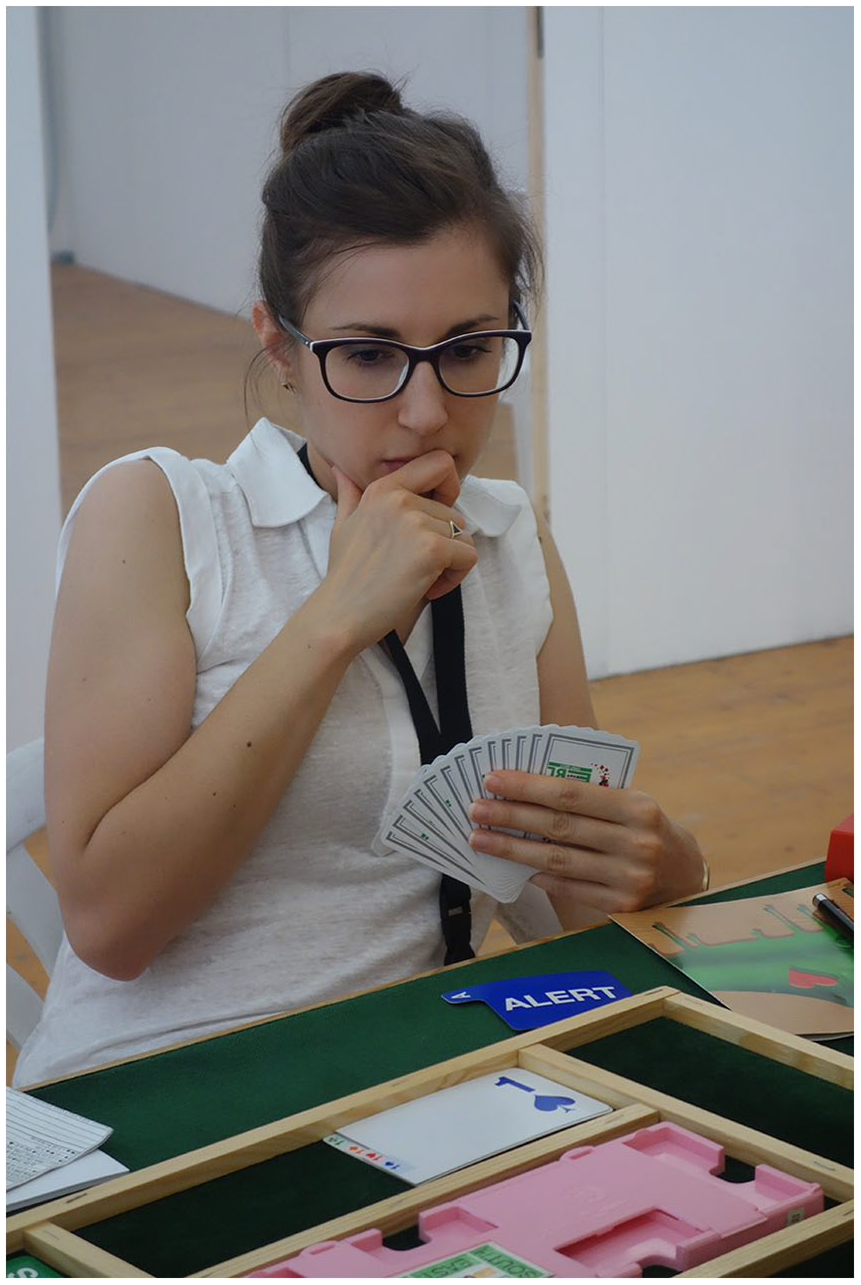
Top Polish player and European champion, Katarzyna Dufrat, contemplating her next bid. (Photo by Samantha Punch from the Open European Championship in Montecatini, Italy.)
The player who is dummy is now merely a bystander and does not contribute to game play. Dummy’s partner (referred to as ‘declarer’) now knows what their partner has, while also knowing what cards they have in their own hand. Based on this, declarer can engage in a series of deductions, working out what the remaining cards are and which of their opponents is likely to be holding those cards. The defending partnership is equally aware of what they have in their own hand and what dummy’s hand is and must try to deduct whether the remaining cards in the other half of the pack are with their partner or their opponent. This working out of who holds what cards and the strategies behind this are a central component of bridge play (see Figure 1). After all the cards have been laid, the score for that bridge deal is calculated, depending on the number of tricks won by each partnership. If a partnership commits to winning a certain number of tricks during the bidding, and then does so, it gains points; but loses points if it fails to meet its target.
Over time, partners develop known strategies to tell each other what a certain card can mean (beyond numeric and suit value). For example, laying a low card like the three of clubs can inform their partner that they like that suit and have a higher card in their hand. However, these strategies are not allowed to be hidden from the other partnership, so at the beginning of each round of bridge, each partnership informs the other, via a system card, of their signalling methods. This enables the opposing partnership to be aware and also read what those card moves mean. At the same time, players can bluff their partner and opponents, by laying a particular card that appears to tell the players one thing but really does not mean they have a higher card in that suit (as per the example above) in their hand. The player is then taking a calculated risk by potentially misleading their partner in the hope that their strategy will pay off and that the opponents will not guess that they are bluffing. Actual strategies of cheating where players lay a card on the table in a particular way or place three fingers against their chest to tell their partner how many cards they have in that suit is illegal and could result in players being banned for a number of years. To further limit cheating at elite level, a partition is placed diagonally across the table so players cannot visually see their partner (see Figure 3), but only one of their opponents. 1 This means players are solely limited to reading the cards their partner lays and the only visual reading going on is regarding their opponent.
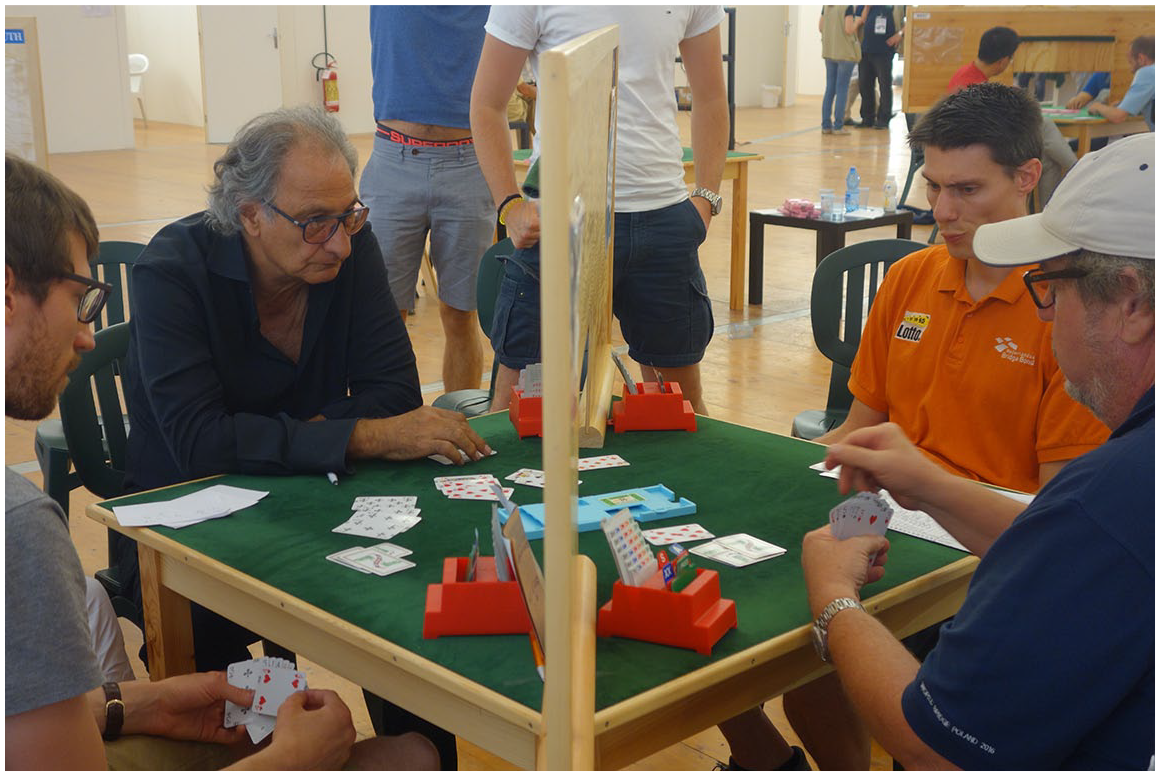
Two of the interviewees in partnership together: US players and world champions, Zia Mahmood and Jeff Meckstroth at the table. A partition or screen across the table is only used in high-level play to avoid facial expressions of partner being read. (Photo by Samantha Punch from the Open European Championship in Montecatini, Italy.)
Unlike chess, bridge is a partnership game of incomplete information where players are making logical deductions of where cards are, while also trying to mislead opponents, albeit at the risk of misleading their partner. Bridge partners may also be life partners, family members, or friends, or may come together via bridge lessons or through having a similar skill level. Given that each bridge deal is played in real time (approx. 7–8 minutes for the bidding and play combined), mistakes are frequently made in terms of miscalculating the best play in the light of what is known or assumed, missing a small but vital clue and misinterpreting the situation. Errors may also occur due to a momentary lapse in concentration, ineffective partnership communication, or a skilled opponent’s well-timed bluff. Thus, the ever-evolving and challenging nature of every bridge deal means there is an exciting opportunity to solve a new puzzle every 7–8 minutes, and a typical session involves 24 deals played over 3 hours.
Bridge uses very specific phrases such as partner, opponent, declarer, and dummy. When translating these categories to Goffman and the ideas of impression management and strategic interaction, the key thing to note is that when Goffman is referring to team-mates, in bridge this would be the equivalent of your partner. Team-mates in bridge refer to the other partnerships players may play with during simultaneous bridge tournaments where exactly the same cards are dealt to each partnership sitting in the same direction, thus enabling the different teams to compare their play and scores afterwards. Alongside this, when Goffman speaks about being aware of an audience and having the necessary circumspection to manage them, in bridge this would be the opposing partnership. For the sake of clarity and ease of understanding, we will be using the bridge terminology of partners, opponents, and team-mates throughout, as this is the language spoken by our participants within the data. As bridge and Goffman use the term team-mates, but with different meanings attached, using Goffman’s specific phrases here has the potential to cause analytical confusion for the reader, so for consistency we are using participant-led terminology (Briggs, 2002; Riach, 2009).
Overall, what is important for our purposes is that strategy is employed throughout the game of bridge. Furthermore, the reading of cards laid and the reading of the impressions that you, your partner, and opponents are giving off at the table reveals the ways in which Goffman’s ideas of strategic interaction and impression management are embedded in gameplay at the bridge table.
Methods
This article draws on data from 52 semi-structured interviews carried out with elite bridge players mainly from the UK or US. As well as their elite status, gender and age were the main factors for the purposive sample which consisted of 32 males and 20 females from 17 to 78 years of age. They are ‘elite’ players because they have represented their country (at open, women, senior, or junior level) or have won a major national championship. The junior category is up to 31 years in bridge, and there were 20 younger players in the sample. Most of the interviewees play professionally, which means their primary income comes from playing bridge on sponsored teams: 26 male and 11 female professionals from the sample of 52 players. The remaining interviewees play bridge alongside their other full-time jobs across education, media, and business, to name a few.
The minority of non-UK European interviewees play regularly in the US and those interviews took place in the US at major tournaments. The interviewees have given permission for their real names to be used in order to appeal to a bridge audience. They were sent their interview transcripts to enable them to indicate any extracts that they wanted to be anonymised, in which case identifying material was removed. The project was approved by the Faculty ethics committee at the University of Stirling.
Samantha Punch is an international bridge player herself (representing Scotland since 2008) and this involvement was crucial to enabling access and building rapport with elite players. Familiarity with a research field and participants offers many benefits but also presents some challenges, such as researcher-blindness (Davidson, 2011; Morriss, 2016). For example, a researcher may not ask questions that get at underlying assumptions as they are often too familiar with the topic themselves to see what needs to be asked/questioned. Whilst this ‘blindness’ has been acknowledged in research and the problems it raises regarding assumptions about ‘the way things are’ – it does also enable and provide a space to build quick and deep rapport due to the knowledge of the field (Taylor, 2011). In our study, the interviews were all undertaken by Punch and she engaged in a thematic analysis that sorted the data into 18 different themes relating to the mind-sport: why people play bridge, how they started, fitting bridge into their lives, likes, dislikes, characteristics of the game, partnerships, team-mates, self-development, emotions, strategies, mistakes, preparation, professionalisation, couples bridge, gender, coaching, and future ambitions.
The data from this article are taken from the thematic sections on characteristics of the game, partnerships, strategies, and mistakes. Questions within these sections explored ideas around the qualities and challenges of being a good player and partner. This data was seen as the most relevant to examine the ways in which bridge partnerships are instrumental to the game, but also how these partnerships enable/disable the capacity to engage in successful impression management and strategic interaction. Alongside this, Miriam Snellgrove has little to no knowledge about bridge and so approached the reading of the interview data from the position of novice and strangeness (De Jong et al., 2013). As a result, the combined analysis of one researcher who was and is very familiar with the bridge world and another who remains ignorant of the embodied experiences of gameplay enabled a meshing and unpacking of assumptions from both perspectives. In this way, we have ‘pulled the teeth’ of familiarity and tackled our assumptions of what is ‘there’ in the data (Becker, 1971: 10). We will now explore the different impression management skills and strategies that elite bridge players continually work on and develop before and during gameplay.
Reading opponents strategically
A key element of bridge play is the ability to read your opponents strategically. Many interviewees talked about the need to be able to read your opponent’s bodily mannerisms and card play in order to ‘know’ what card to lay and how to manage game play. In so doing, you knew that your opponents would also be reading you and your card play. This back and forth reading of your opponents and the situation is something that Goffman (1969: 85–145) identifies as crucial to strategic interaction. As Brian Senior articulates, it gives you an advantage when it comes to knowing the right cards to lay and which cards to withhold: You need to be able to try and put yourself inside the head of your opponent . . . just to see what problems he might have. For example, if you’re playing a hand, it may be obvious to you what your weakness is, but it doesn’t necessarily follow that the defender will be in a position to know what your problem is. And you can play on that and if you do things confidently and smoothly enough then they have a difficult guess and can get it wrong.
This idea of being able to read your opponent to potentially deceive them while also imagining what things are going through their head is a classic example of strategic interaction: Two or more parties must find themselves in a well-structured situation of mutual impingements where each party must make a move and where every possible move carries fateful implications for all of the parties. In this situation, each player must influence his own decision by his knowing that the other players are likely to try and dope out his decision in advance and may even appreciate that he knows this is likely. Courses of action or moves will then be made in the light of one’s thoughts about the others’ thoughts about oneself. (Goffman, 1969: 100–101)
What is important here is the notion that you are being read by your opponent as much as you are reading your opponent. This reading of the situation and assessing the best course of action is therefore a mutually constitutive one that requires guessing and double guessing based on the information at hand. True mastery of this kind of strategic interaction is making it impossible for your opponents to actually read your bodily mannerisms and therefore for them to have to rely solely on the reading of the cards you are laying. As Zach Grossack states, ‘all the good players I know are . . . tough to play against, they’re fast, they’re moving, they’re unreadable’. This is in marked contrast to players who reveal the cards in their hand by being unable to successfully display the right kind of strategic interaction: Nerves are a thing and if you look at players you can see some get very nervous. [My opponent] could barely hold his cards in his hands he was shaking so much and I could see that . . . it doesn’t matter if you have those nerves as long as you can control them and it doesn’t affect you. [But] someone who just expects to lose, loses the plot and that’s a disaster. So you want the opposite of that. (David Gold)
In this way, successful reading of your opponents is not just about the cards, but also about the impressions you give off, or in the case of elite players – that you try not to give off any impressions at all about your card play or your strategy. However, in order to engage in successful strategic interaction and reading of opponents, players need to plan and strive to be disciplined at the table and in so doing they need to be able to manage their impressions.
Disciplined planning
Alongside reading opponents strategically, players also have to be able to plan as they go and respond to the changing nature of the game without giving away how difficult or thrown they might be by their partner’s or opponents’ gameplay. As Nevena Senior suggests, The ability to switch from one plan to another relatively quickly, because when you start playing the hand you make a plan and you . . . take advantage of the bidding and whatever and then suddenly something unusual happens, like a suit breaks badly and you should be immediately capable of switching your plan and making a completely new [one].
This ties into Goffman’s (1959: 210–211) notion of dramaturgical disciplined impression management that you are able to cover these changes without anyone being the wiser. As Goffman (1959: 212) explains, someone with dramaturgical discipline has presence of mind and self-control and can respond appropriately regardless of the situation or context, thus showing others that they can be trusted to manage a range of different social interactions. For bridge players, this assessing of the information at hand is not just about reading the cards on the table, but also to imagine the various actions and combinations that the opposing pair might present you with: . . . you have to have the ability to put clues together . . . you have to go forward, thinking what’s going to happen, sometimes you have to go backwards, what happened . . . it’s just putting things together, having a mind that is able to do that. Almost showing pictures in your head about what’s going to happen, what can happen. (Jenny Wolpert)
The need to be flexible and keep an open mind alongside the reading of people and cards extends beyond what one can immediately see to what one cannot see and all the possible and different outcomes of playing a particular card. Many players referred to the multiple aspects of bridge as being one of the major appeals of the mind-sport which can also enhance the development of problem-solving skills: It has so many different facets and it’s not just one way of thinking, it’s putting things together. To me it’s a little bit like detective work. Where there are some clues out there, you don’t know what they are and where they are, so you have to go and find them, once you have found them you have to put them together like in a puzzle and then draw the right conclusions so it’s really manifold. So to me that’s fascinating. (Sabine Auken)
This is very similar to Harry in Goffman’s (1969) example and his need to be able to strategically assess all the different likelihoods of the lion eating him or not. In our example, this reading requires the ability to be able to change your game plan often instantaneously and not to reveal this through the impressions you are giving off (as mentioned above) through disciplined play. Zia Mahmood explains that problem-solving under time pressure is not necessarily straightforward: . . . the ability to adjust and improvise when the circumstances change is a big ask . . . at the table, circumstances aren’t exactly black and white and you have to work out what should I do to solve this particular problem?
In this way, dramaturgical discipline helps players read the cards and their opponents strategically, as well as planning and managing for difficult card play before and during the game. This disciplined, strategic impression management is further tested by mistakes made at the table.
Supportive silence
Managing of mistakes was a fundamental issue that was repeatedly discussed by participants. A number of participants highlighted the following: You have to . . . work extremely hard at your game. Particularly since the internet, everybody is watching great players . . . because it is a game of mistakes, you have to be able to handle mistakes well and that is extremely difficult to explain in an interview . . . about how to overcome feeling a sense of humiliation. (Simon Gillis)
This is as much about managing your own mistakes during the game, as also needing to manage when your partner makes a mistake and to try and not to reveal this to the other players. One of the central components of strategic interaction is the idea of gameworthiness and being able to ‘set aside all personal feelings’ (Goffman, 1969: 96) and to keep your emotions in check. As Jason Hackett explains, ‘I remember Bob Hamman
2
on television once said if your partner’s made a mistake, just shut up! . . . You don’t want to give the opponents a boost’. Alongside trying to avoid boosting your opponents’ confidence, this ability to manage mistakes in a game worthy fashion can further improve your play. Heather Dhondy says, ‘I don’t think you play at your best if you get too nervous or upset or angry’ and goes on to suggest that controlling your emotions in this game worthy fashion means you are able to play your best and also to ‘get the best out of your partners’. This also requires an ability to remain focused and not let distractions (from the bridge environment or from wider life) affect your concentration: . . . doing things that are analytical and skills of evaluation, both of those are very important for bridge . . . Then, I think the most important factor is the ability to focus, and concentration. Because you see that all the time – some players who are just real wizards, but don’t necessarily do the best with their abilities as a result of that. (Roy Welland)
Along with the ability to stay focused, all of these attributes (reading opponents strategically, disciplined planning, and managing mistakes) were exemplified by being silent at the table. Indeed, maintaining your composure and not ‘huffing and puffing’ (Anam Tebha) at your partner in front of others was seen as the most ‘supportive’ (Jeff Meckstroth) way to play. This was often very difficult to do and there are countless examples within the interview data of partners becoming verbally aggressive, shouting and arguing with each other at the table, as well as going into exhaustive post-game analyses, sometimes in order to confirm that they had played well and their partner badly. However, participants also recognised that these displays of emotion hindered successful gameplay and potentially damaged partnerships in the long run (Punch and Russell, 2019).
Jill Meyers develops this further when she states, ‘What are the key characteristics of a good partner? Keeping your mouth shut when something bad happens at the table and being able to take your ego out and discuss differences’. Here Jill is displaying loyalty to her partner by not reacting to the error or revealing to the other players that mistakes have been made. Even when mistakes are realised by all, the partner should try and not react negatively. It also reveals what Hofstetter and Robles (2018: 302) call the ‘moral dimension to gameplay’. In this way, players are negotiating through these interactions what counts as legitimate, accountable, and acceptable behaviour at the table. Through her performative display, Jill is also showing her partner dramaturgical discipline by covering the mistake through her silence. In combination then, Jill has displayed strong strategic interaction and gameworthiness skills as she is aware that by verbalising any mistakes her partner made or publicly reprimanding them would give the other partnership a competitive advantage. The use of supportive silence in this way enables her partner to maintain their focus while under pressure. She is aware of the role she is playing and the impressions she is giving off and has calculated that silence will give them the best possible advantage while also not disrupting her partner’s own impression management strategies. In this way, Jill hopes that her successful reading of the situation and management of her own impressions will result in a favourable outcome at the bridge table. This form of supportive silence, challenging as it is, can and is developed during preparatory gameplay with your partner over months and years of repetitive practice.
Preparation and partnership
In order to be able to read people strategically, plan, and react to cards in play at the table in a disciplined, gameworthy, and strategic manner, elite players need to prepare in advance as well as work on specific types of strategies with their partner away from the bridge table. This is so they are better equipped and can manage their impressions and engage in the most disciplined strategic play. It is where they work on and plan for dramaturgical circumspection. As previously mentioned, a ‘circumspect performer’ will try to select the kind of audience that will be most supportive of and manageable for the given performance. The smaller the audience, the fewer mistakes are made and can be controlled for. Furthermore, the longer a game continues, the higher the likelihood for mistakes to occur and thus require ‘repair work’ from the player and/or their partner. As a result, it is always best to try to ‘select [partners] who are disciplined and will not perform their parts in a clumsy, gauche, or self-conscious fashion. Another method is to prepare in advance for all possible expressive contingencies’ (Goffman, 1959: 221). As bridge players engage in very structured rounds of play, the audience in this setting are their opponents and the aim is for both player and their partner to practice dramaturgical circumspection when their opponents will be doing the same to them. Brian Senior confirms that . . . although I don’t often exhibit it, tolerance and patience are vital if you’re playing with a weaker partner. Obviously you, as an expert, never make errors, you occasionally take a wrong view, but partners, well, they’re the bane of your life.
This reveals the need for careful preparation and practice to develop partnership understanding before sitting down at a bridge table against your opponents. In this way, a player is trying to learn and read the partnership carding signals as well as develop their bidding system communications, so that a player’s defensive card play can develop and build on their partners, rather than cause the partnership problems at the table. This is especially crucial given that, at many elite matches, screens prevent players from seeing their partners and so the only information they can ‘read’ are the cards. Throughout the interviews, participants spoke about the need for intense practice and preparation before a game in order for the partnership card language to develop successfully. As Jason Hackett explains, ‘most of the bidding is basically like learning a language correctly and expressing yourself to your partner. I mean choosing which . . . bid to make is often like choosing the correct word to say’. Developing this card gaming language was gained by playing ‘fun games’ (not internationally competitive) as well as more competitive games.
In contrast to the everyday taken-for-granted nature of social interaction that we all learn and are part of, elite bridge players engage in repetitive gameplay and practice in order to hone and perfect their impression management and strategic interaction performances. Despite the time and effort needed to develop this, Simon Cope points out that all of the practice and preparation can (and does) lead to moments when ‘I just feel a bit out of form. I feel like every time I have a guess to make I’m going to get it wrong and there are other times when it feels the complete reverse’. What is important for us here is the idea that practise with your partner can (and often does) lead to you being able to read your partner’s card laying strategically, plan in a disciplined manner and when mistakes can and do happen, to support your partner through silence. Several players commented that the skills they developed through bridge, such as the ability to strategically plan, read people, be disciplined and focus on what is important at the bridge table, while also behaving in a way to get the best out of their partner, could translate to other areas of life: I’m quite sure that the lessons I’ve learned at bridge have helped at business and lessons I’ve learned at business have helped at bridge. A lot of what you learn isn’t applicable to the other but some of it is the same stuff. Being good team-mates, being a good partner or co-worker. If you’re nice to them, they’ll do better. In business, learning what is important and what isn’t is very helpful. (Nick Nickell)
Playing your life: conclusion
Within the interviews, players repeatedly laid out and listed the learned behaviours and deliberate practices that were honed in order to become an elite bridge player. These qualities of reading opponents strategically, disciplined planning, supportive silence, and partnership preparation can be best understood as falling under Goffman’s (1959: 207–222) three categories of defensive impression management: dramaturgical loyalty, dramaturgical discipline, and dramaturgical circumspection. As well as these three attributes of impression management, the need for ‘gameworthiness’ and ‘strategic interaction’ (Goffman, 1969: 96–145) were also present in the accounts. In combination, these strategic interaction and impression management skills were presented as attributes of the best kind of bridge player. However, these skills and qualities of a top bridge player were often contrasted with experiences and opinions on their own personal failings as well as what a ‘less disciplined’ bridge partner might say or not say. To counteract some of the mistakes and challenges present at the bridge table, players recognised the need to practice with their partner so that one could communicate effectively by recognising the cues given by both the cards during play and the bids during the auction.
This article has shown that impression management and strategic interaction are states of self-presentation that are continually worked at, sometimes achieved and most often not fully managed and realised. This is not to place impression management, strategic interaction, and elite bridge players on a binary of either managing or not, successful or not, but rather seeing the game of bridge and the application of impression management and strategic interaction as operating on a continuum. Through the lens of bridge as a mind-sport, Goffman’s concepts of impression management and strategic interaction are seen to be intertwined and continuous, ongoing performative acts rather than static, achieved, and always successfully performed. The article has shown how the everyday world of interaction can be evidenced through elite bridge play and is, like the everyday world, ongoing social interaction work. The difference at elite level is that these interaction skills happen in an intense and competitive environment unlike most everyday social encounters. Elite bridge players are displaying the capacity to make crucial gameplay decisions based on incomplete information while judging their partner’s card play and opponents’ impressions correctly (and incorrectly). At the same time, they need to be able to control their irritation with their own failings or those of their partner so as not to give their opponents an advantage through a verbal outburst, while also changing game plans based on the ever-evolving card game.
These skills arguably build resilience as players learn to engage with opponents and cope with losing or try to recover when game plans do not go well. Through partnership interaction, bridge players develop coping strategies as well as cultivate skills of empathy and cooperation. Arguably in contemporary society where there is an increase in digital communication and online interaction (Ballard, 2019), there are perhaps fewer face-to-face opportunities to work on such skills in-depth. This article has shown that elite bridge players develop very explicit interaction skills to plan and calculate based on the incomplete information of the cards in their hands and on the table. Furthermore, they learn to accept and cope with their own and their partner’s mistakes based on calculations which are made under time pressure. As a result, playing bridge enables the taken-for-granted nature of social interaction to be fully teased apart and the skills present in those interactions to be properly accounted for through closely analysing interaction at the bridge table. In this way, we have argued that the elite game of bridge requires an engagement in reading people and cards strategically and performing a disciplined impression management and gameworthiness through preparation and planning, managing mistakes, and supportive silence. Although these interaction skills are learned during the course of everyday life, we have shown and argue that it is by becoming an elite bridge player that these interaction skills are fully tested, practiced, and negotiated.
While this article has focused on a competitive, elite sporting context, it paves the way for further research on mind-sports which could explore the wider benefits and importance of the non-physical skills that mind-sports offer. For example, Fine (2014) discussed the transferable skills chess players develop including skills in calculation and evaluation. The ability to calculate what is likely to happen in a chess game was found to help improve players’ cognitive abilities, tactical strategy, and recognition skills. This article has touched on skills required at bridge which can be beneficial to other areas of business, family, and social life, such as strategic planning, flexibility in problem-solving, focus, and concentration. However, further research in this area is needed to see the extent to which bridge, like chess (Puddephatt, 2003), can enhance a variety of life skills. The article has demonstrated that a traditional, face-to-face card game can demand the ability to simultaneously deceive your opponents while also presenting and interacting as a morally good player through attributes such as supportive silence and managing mistakes. Indeed, at elite level, the ability to separate your personal life from your gaming life and to do so in the most disciplined and strategic manner is a key, if not always realised aim. As Artur Malinowski says, My favourite story is when I was a young player and had a guy who was champion and he has this saying which is funny I think. He said the real bridge player was the guy whose wife just left him, the dog ran away and the flat was flooded and he goes to the tournament and plays, he plays his best, but forgetting. Sitting playing, knowing how to play your life.
Footnotes
Acknowledgements
We appreciate being able to use the photo by Francesca Canali and the World Bridge Federation. The authors also wish to acknowledge Elizabeth Graham for coding and preliminary data analysis and the two anonymous reviewers for their helpful comments. They thank all the participants for the time and effort given to share and discuss their love of bridge. Further information about the bridge research can be found at: bridgemindsport.org
Funding
The authors disclosed receipt of the following financial support for the research, authorship, and/or publication of this article: The authors would like to thank Bridge: A MindSport for All (BAMSA), English Bridge Education & Development (EBED), the European Bridge League (EBL), and the World Bridge Federation (WBF) whose generous contributions enabled the analysis and write up to take place.
