




Abstract
Mind-sports are a relatively under-explored area within the sociology of sport, especially the internationally played game of bridge. In this qualitative sociological study of tournament bridge, we examine the formation and performance of elite bridge player identities through interviews with 52 US and European players. Drawing on symbolic interactionism and Goffman specifically, the paper explores elite players’ social interaction across frontstage and backstage contexts, considering the performativity of self, impression management and values of character. The paper advances the sociology of mind-sport, contributing new insights into how identity is (per)formed by elite players as embodied social interaction within the bridge interaction order. We propose a recursive and layered model of identities across the self, partnership and community. The partnership element is particularly unique to the bridge sports world, which represents an interesting case for the sociological study of international mind-sports.
Bridge is a partnership mind-sport, a trick-taking card game with players globally. Elite bridge partnerships co-operate to win matches and tournaments by competing against opponents, indicative of the ‘coexistence of co-operation and confrontation’ that are of interest to sociologists of sport (Maguire, 2011b: 861). Each partnership is unique as individual players have distinct playing styles with skillsets that lend themselves to different elements of the game, namely bidding and card-play. Alongside intellect, endurance, technical and communication skills, social interaction is central to the bridge match and wider international community, where national teams compete for titles. Bridge thus has many features that make it an exciting and unique sphere for the sociological study of sports, and specifically the formation of identity in elite sporting contexts (Maguire, 2001).
We adopt a symbolic interactionist approach, using Goffman to explore how identities in elite bridge are formed and performed. This is based in interpretative sociology, which emphasises how people in everyday human interaction are continuously interpreting, negotiating and shaping their social relations and environments (Giulianotti, 2015). From this perspective we examine how identity is (per)formed through players’ social interactions contextualised within the bridge world. We begin by theorising identities for mind-sports and outlining the methodology underpinning the research. The findings are presented as a journey through the formation and performance of individual, partnership and collective identity and we discuss these findings in connection to existing literature and the sociology of (mind)sport.
Theorising identities in a mind-sport
The term ‘mind-sport’ has been in use for more than a decade (Kobiela, 2018) and refers to a game primarily based on intellectual rather than physical skill. Adopting an inclusionist perspective on defining sports, Raphael (2011) positions the category of mind-sports in relation to motor sports, each of which has redefined the parameters of physicality within sport. Debates regarding the status of certain kinds of sports such as mind-sports and e-sports are ongoing (see Klein, 2017; Kobiela, 2018; Parry, 2018) and there remains work to be done to interrogate this further. Whilst outwith the scope of this paper, we argue as Kobiela (2018) does for chess, that in order to advance the acceptance of ‘mind-sports’ there needs to be more consideration of the ‘thought, stamina, emotional investment and practice’ that is involved in playing a competitive mind-sport. We contribute to these debates by researching how bridge functions as a mind-sport conceptualised within an inclusive definition of sports whilst focusing specifically on identity formation and performativity.
Bridge is a card game with ancient roots, recognised as a mind-sport by the International Olympic Committee through the World Bridge Federation founded in 1958, formerly the International Bridge League of 1932 (WBF, 2020). As a pair, players develop ‘system’ agreements as a specific form of partnership communication and strategy which shapes decisions that are made during the game involving bidding and card-play. At top level, players can have several partners and may play different bidding systems for different international tournaments. At the start of each bridge deal, the ‘bidding’ requires each player to exchange information about their hand type and strength to their partner through coded bids. The partnership is then able to estimate the number of tricks they might win based on their combined strength, and the player who makes the highest ‘bid’ sets out to reach their estimated target during the subsequent card-play. At this point their partner’s hand is placed face up on the table so the other three players can try to work out where the other players’ cards are, based on the information gleaned from the bidding. Meanwhile the opposing pair try to prevent them from obtaining a certain number of tricks, gaining points if they succeed and losing points if they do not. The winning partnership is the one that scores the most points during a specified number of deals that make up a match.
The social world of bridge was explored in the 1990s from the perspective of leisure theory and recreation specialisation highlighting differentiation between social and serious bridge clubs and types of players, with tournament players the most specialised (Scott, 1991; Scott and Godbey, 1992, 1994). More recently researchers have explored the link between bridge and players’ well-being (Brkljačić et al., 2017; McDonnell et al., 2017), but beyond this, there has been little research of bridge, especially of international tournaments and elite players from a sociology of sport perspective. However, there has been sociological attention to the mind-sport chess.
Fine’s (2008, 2015) work demonstrates the embeddedness of self in community, and the hierarchical nature of identities within the social world of chess, which combines mind and body. This echoes Goffman’s (1959) concept of strategic interaction in everyday activities, where different social processes play out within the game (Puddephatt, 2003). This interactionist approach found the skills developed to play chess enhance players’ abilities to co-operate with and respond to others socially, during the game and in everyday interactions. Whilst similar to chess, bridge differs as a game of incomplete information (Ginsberg, 2001) and players are thus engaged especially in Goffman’s (1959) ‘information game’, trying to conceal, reveal and discover as part of their strategic interactions with partner and opponents (see Punch and Snellgrove, forthcoming). Herein we use symbolic interactionism through Goffman’s concepts of frontstage, backstage and impression management to discuss identity formation and performance in tournament bridge, which comprises a diverse group of players, partnerships, national teams and international community.
Symbolic interactionism (SI) offers a strong perspective on identity and has a history of utilisation in sports studies, including the performance and consumption of sport (Armstrong, 2007; Weiss, 2001). Identity theory itself stems from SI and ‘emphasizes the relationships between self, society (social structure) and role performance’ (Weiss, 2001: 396). SI theorises that identity formation is performative and produced through interaction with others (Jenkins, 2008). Goffman’s (1959) theory of the interaction order proposes that the construction of meaning and the self occurs through face-to-face interaction and the presentation of self which develops in social spaces (Rawls, 1987). The practical performance and the associated actions and interactions are the producers and reproducers of the self, routines and structures (Rawls, 1987). This reflects ideas of the social self, which is not innate or fixed but develops through social interactions with others over time (Goffman, 1959; Mead, 1934).
Selves are also managed in relation to the roles actors must perform and ‘are deftly assembled from recognizable identities in some place, at some time, for some purpose’ (Gubrium and Holstein, 2000: 101). This involves controlling information about who we are, what we do and what others can expect from us in certain circumstances (Gubrium and Holstein, 2000). Goffman (1959) called this impression management, reflecting how performativity of self is tailored towards appearing credible to others when performing in a role. Thus, identities are situated and performative, and actors can construct multiple selves as they move between situations and interact with different audiences (Scott, 2015). For Sartre, the self is produced by the passions we hold and the actions we make, which highlights the potential of mind-sports for the epistemological exploration of identity (Rawls, 1984).
Jenkins (2008), drawing on Goffman and other SI theorists, argues the practical accomplishment of identity is a simultaneous entanglement of individual and collective. This refers to the sense in which the self is always constructed in relation to specific and general ‘others’, whether through actual or imagined standpoints and interactions. Additionally, where interactions possess a jointness, this is the basis of collective identity (Lawler, 2003), thus group membership as a practical accomplishment requires some behavioural conformity and consistent similarity in what members do (Jenkins, 2008). Individual and collective identities can also be mediated through other layers of identity such as national identity, which is constructed symbolically through lines of similarity and difference (Jenkins, 2008).
Participation in games and sports is central to identity narratives (Perinbanayagam, 2016) and as social forms position players individually and as part of a community which is both co-operative and competitive and key to self-definition (Fine, 2008). Membership of a sporting community forms through social interaction, creating the spaces in which individuals achieve success and recognition from said community, which validates their sense of self and individual identity (Green and Jones, 2005). Hence, the ‘identity-formation potential of sport’ (Weiss, 2001: 401) denotes the production of meaning and the presentation of self (Maguire, 2001) alongside collective solidarity and a positive sense of social identity (Jones, 2017). In global and international sports, this collectivism is extended through the formation of national identities through cultural practice and thus cultural identity formation (Porter, 2017). In sport, multiple identities can be negotiated (Huang and Brittain, 2006) with varied implications for self-identities and the possibility for identity conflicts (Probert et al., 2007). The complex and fluid treatment of identity also reflects national identities in sport (Kyeremeh, 2020) which link individual and collective experiences (Seippel, 2017) and are formed and transformed through symbolic representations (Maguire, 2011a). Collective identities in sport therefore denote a ‘shared sense of belonging through interactions in common locations where identities are constructed, staged and performed’ (Wise, 2015: 146), alongside imagined communities (Anderson, 1991) bringing people together within and across nations. Nations and nationalism are at the heart of international sport and Bairner (2015) argued that sociologists of sport should try to access data pertaining to elite performers in relation to national identity.
Overall, identity development and athletic identities are shaped by social interaction, thus making symbolic interactionism a pertinent approach for understanding these processes (Anderson, 2009). Goffman in particular has influenced the sociology of sport since its inception, and his dramaturgical metaphor is relevant to the understanding of sport as a performance and competition which takes place across frontstage and backstage contexts (Birrell and Donnelly, 2004). Maguire (2011b: 858) argued that sociologists of sport reject notions of athletic performance as rooted in individualistic, biomedical or genetic uniqueness because these tell us little about ‘the stage on which the “act” is performed, or the theatre in which the “play” takes place’. Instead athletic performances are rooted in long-term socialisation processes and habitual practices that transcend individuals (Maguire, 2011b). Additionally, Peterson (2015) proposes using Goffman’s (1967) themes of character in future sociological sports research, and so in theorising identities in mind-sports, we have drawn on these conceptual approaches.
Methodology: a sociology of bridge
Bridge is played socially and competitively at different levels across the world. This paper is part of a broader research project Bridge: A MindSport for All to develop a ‘sociology of bridge’ that offers new contributions to academic knowledge and provides useful insights of, and for, the bridge community. This arose out of Punch’s deep involvement in the international community of elite bridge players, and interest in developing sociological knowledge of this partnership mind-sport. Little is known about elite players of bridge, namely those who have committed significant time and effort to develop specialised skills, won major championships and represented their country in international tournaments. As an international player herself, Punch was well placed to access this group through insider interviewing (Kitchen, 2019) to explore social interactions and the backstage of tournament bridge.
Elite players were chosen through purposive and convenience sampling for the project to gain in-depth qualitative accounts of playing bridge at the highest level. Players were approached verbally and through email to arrange interviews, which were conducted at the North American Bridge Championships, the European Bridge Championships, the World Bridge Series and at the UK Camrose event. All the 52 in-depth interviews were conducted in English, with UK, US and some European players, of which there were 20 females and 32 males, ranging from 17 to 78 years of age. Interviews lasted on average two hours, covering themes set out in a semi-structured guide to encourage players to share their experiences of bridge across their career. This yielded detailed accounts of individual, partnership and team dynamics within tournament bridge, including player career trajectories and social interactions at the bridge table and beyond. Interviews thus provided the basis to explore a range of themes supporting the development of the sociology of bridge and offering insights to the global bridge community. All names used are of real players who agreed to be named so outputs would be of greater interest to the bridge community. Consent was secured before and after interviews, with the option to view transcripts and identify sensitive sections for anonymisation.
Transcripts were coded according to a semi-structured coding framework based on the interview themes which drew on the bridge knowledge of Punch. This generated 18 code sections and a total of 69 codes. Code sections, for example ‘self-development’, were compiled as separate Word documents to enable a closer thematic analysis of data and comparison across the sample. Despite diversity within the sample, the findings herein characterise elite players collectively rather than focusing on differences across social categories, which is for future papers. Thematic analysis is useful for interpreting the experiences, meanings and realities of particular groups and individuals (Braun and Clarke, 2006), and in this paper we combined it with the SI theoretical lens and Goffman’s concepts to interpret how identities are (per)formed through social interaction.
(Per)forming an elite bridge player identity
Forming an elite bridge player identity begins with the development of attributes, skills and behaviours necessary to play tournament bridge. This individual development cultivates a sense of self through a ‘backstage’ identity (Goffman, 1959), which is not publicly performed and is necessary for role performance on ‘stage’. For many players, the process of identity formation begins at a young age, where a passion for bridge develops whilst learning and playing the game:
I became obsessed with bridge, instead of school, I cared about bridge . . . And you know the reason I worked really hard is because I loved it and I was obsessed and addicted. You know that’s why people work really hard and stuff when they’re 11. (Justin Lall, US)
This passion for the game translates into significant investment of time and energy at the beginning of a career, which includes hours of practising:
I’m sure I did play bridge for ten thousand hours . . . particularly when I was at university . . . I was typically up all night, two nights a week playing bridge and playing cards. And you’ve got to be that kind of obsessed with it and . . . it’s massively important to you. (Alan Mould, UK)
This is not only an essential part of reaching the elite level, but continues throughout one’s career, for example with practice key to preparing for tournaments:
We do some bidding practice [and] a lot of discussion. (Michael Rosenberg, US) I review my system with my partner . . . That’s the most important thing that I do – to make sure that our system’s up to date and that we have our agreements right. And studying my agreements, so that I know them, is the other important thing that I do. (Joel Wooldridge, US)
Hence, elite players’ tournament performances are rooted in less visible preparations, including practising online, reflecting how the backstage allows actors to prepare for their performance on stage (Serpa and Ferreira, 2018). Alongside practice, the majority of player responses (21 of 38) regarding how to deliver their best game referred to physical fitness and readiness. Players engage in preparations for tournaments, such as sleeping and eating well, maintaining fitness and minimising alcohol to achieve optimal performance. Bob Hamman (US) said ‘fatigue is the enemy’ and players felt that ‘if you really want to play at your absolute best, then you do need proper sleep’ (Michael Rosenberg, US). This is challenging given the long-distance travel needed for international tournaments, where jetlag can negatively affect performance and create ‘a bad frame of mind’ (Tony Forrester, UK). Likewise, performance is affected by the amount of time a player has to prepare and practise, which differs markedly depending on individuals’ work and family situations. Overall, forming an elite bridge identity involves backstage processes of socialisation and ongoing preparations that shape individuals’ performance in tournament bridge.
For an elite player identity, the presentation of self concerns the ‘frontstage’ identity, which is performative and social (Goffman, 1959) at the bridge table and beyond. For example, players manage impressions of themselves for others within the tournament bridge community:
Once I moved to New York, especially, once I knew I was going to be a professional bridge player, I knew that image matters. You never know if you’re rude to someone, perhaps that is the best friend of a client, you just don’t know, so it all matters. (Justin Lall, US)
Bridge is professionalising, leading to increased opportunities to be paid to play as a professional by clients who sponsor their partner or team. This means players’ presentation of self involves impression management to create a desirable identity for others in order to be offered employment. Additionally, elite players compete in tournaments that are ‘emotionally charged’ environments, requiring impression management through front- and backstage performances of emotion. An ideal frontstage performance at the bridge table denotes presenting oneself as composed and in control, because being emotional and having conflict at the table threatens one’s elite player identity:
. . .when your partner says something at the table it’s embarrassing. (Anonymous) . . .[being] upset at the table doesn’t improve your game [or] your partner’s game. (Sabine Auken, US)
Managing emotions is less necessary backstage where players are ‘to some extent . . . free of the anxieties of presentation [in] the domain of self-image rather than public image’ (Jenkins, 2008: 93). For example, as Sabine continued, ‘I can get upset later and have discussions . . . but while the playing is going on I think it’s important to carry on.’
Focusing on the frontstage impression management further, we can identify Goffman’s (1967) four themes of character: courage, integrity, composure and gameness. Courage refers to how individuals pursue a course of action in the face of ‘danger’ or risk (Peterson, 2015), which Andrew Robson (UK) describes as crucial in bridge:
If you think you know the right thing to do, you’ve got to do it. Often you know that if you make a particular bid, you might very well look pretty absurd from the outside, but if you know that it’s going to work three times out of four, you’re going to look like a fool one time out of four, you’ve got to bid it. You’ve got to make that decision. You’ve got to be prepared to look like a prat and you’ve got to have the confidence in yourself and your team . . . you’ve got to have courage and you mustn’t be in fear of failure.
Courage refers to how players must have confidence in their own decisions and thinking, which is fundamentally shaped in relation to perceiving oneself through the eyes of general others and one’s team-mates:
It’s really important to have self-confidence when I play bridge [. . .] when you don’t have the self-confidence, you’re like ‘well I don’t know, I don’t dare to bid four hearts’, so I pass . . . I think you need some kind of trust in yourself that something is right and also, I think it’s important that you can focus on how you want to play bridge and not how your team-mates are going to react to this. Because then I think you’re also going to avoid risks . . . yeah important that you feel like they have your back. (Marion Michelson, The Netherlands)
This extends beyond individuals through courage to trust one’s partner during gameplay scenarios frontstage and talking openly with a partner backstage, putting one’s ego aside to admit mistakes if necessary. Whilst admitting errors is potentially threatening to one’s identity as an elite player, this is important for improving game performance. Next, integrity is resisting ‘the temptation to depart from moral standards’ and composure is about self-control (Peterson, 2015: 380). Players’ accounts of integrity and composure relate foremost to the desire to maintain emotional control during bridge, adhering to the standards expected of elite players (Punch and Russell, 2019). Players may, however, lose integrity, failing in practice to maintain self-control:
In the heat of the battle I certainly sometimes fall from grace. I think that away from the table I’m pretty good in that I’m not at all a black and white person and I can usually see that there were reasons for a losing decision even if it wasn’t the one I would have made. But certainly, that’s one of the areas where I am still working at improving. [. . .] If something goes wrong I certainly, at times, will say critical things that I would wish I hadn’t. (Chip Martel, US)
Finally, gameness refers to ‘individuals who continue to expend considerable effort even in the face of setbacks’ (Peterson, 2015: 380). This is especially important to how elite bridge players cope with mistakes by trying not to let this impact the game or their emotional state:
Just say to yourself you’ve got to be calm. Whatever happens at the end of this set, we’ll still have something, something to be fighting for. We’re not going to be more than 20 down or something, so we’ll know where we are and just take it from there and try and do what we can in the next set. (Heather Dhondy, UK)
Hence, gameness denotes both technical and identity performance as players continually take decisions about possible lines of action in different playing contexts and whilst managing emotions. These features of character reflect the contextually-specific identity performance of players embedded in social interaction, striving to manage their frontstage performance as part of creating a successful elite player identity. Birrell (1981) argued that athletes embodying these values are admired and respected, and those failing to demonstrate character are the opposite, with social and emotional consequences tied to failure (Peterson, 2015).
(Per)forming an elite bridge partnership identity
Partnerships are the primary form of social interaction in bridge and partnership identities are diverse. Players form different partnerships over the years with different players, and for many this includes family, spouses and friends, which highlights how elite identities are shaped by backstage social interaction and identity. Family relationships can shape partnership identity in contrasting ways that are more or less challenging:
I was always a good partner, except with my parents. It’s the same with spouses, the same thing, I don’t know what it is, but I still yell at my dad. I don’t know why, he’s such a nice partner, a great guy. I’m a really nice partner to everyone except him and my mum. (Anonymous)
No. I loved him as a teenager, he’s loads of fun and he’s great to share a room with and actually be there with. Which is why I play with him because I know I can tolerate him for long periods of time. If the rest of the team is getting stressful, then I’ve always got him there. (Yvonne Wiseman, UK)
Friendships within a partnership were viewed positively, although not necessary for success at elite level. Friendship shapes partnership identity through social interactions as it becomes increasingly important to manage impressions strategically:
I had to be extremely careful with what I said to her and this was really hard for me also, seeing as I have quite strong body language. We were very good friends so she knew me very well, so even if I didn’t say something but . . . she could see from like my hands or my nose, or my mouth that I was upset. (Anonymous)
Bridge partnerships can comprise spouses, but even where this is not the case, they are viewed as analogous to marriages. Whilst there are downsides to marriages, including the issues of ‘divorce’, there were positive perceptions of long-term partnerships:
Look at the people at the top of their game and show me anybody who’s doing well who chops and changes. It’s all named partnerships who have played together for a long time. (Jason Hackett, UK)
The idea of marriage reflects how stronger partnership identities can form over time as players establish a social connection with their partner. This is considered to make your bridge game better because you can more easily ‘pick up on [your partner’s] tendencies, how they think’ (Anam Tebha, US). Rodwell and Meckstroth, who have played together for over 40 years (known as ‘Meckwell’), are one example of a long-term partnership, but generally partnerships are always forming and reforming over time and sometimes for different types of event. The formation of a partnership identity is influenced by factors including age, gender and level of ability, and partnerships can be inter-generational, mixed gender, same gender, and mixed ability. Although there are divisions of age, skill and locale, which are also found in chess (Fine, 2015), that shape the backstage formation of partnerships, elite bridge partnerships perform identity in similar ways.
The performance of partnership identity happens within the context of frontstage and backstage settings, namely interactions at, and away from, the bridge table. These performances are based on notions of ‘an idealised self that fits appropriately into the requirements of the context’ (Metts and Cupach, 2008: 204). For elite players, this is primarily performing the role of an effective bridge partner, defined through shared perceptions as someone who: discusses issues and communicates well; understands their partner’s playing style and way of thinking; works hard on the partnership; and is not egotistical. Through trying to perform this role, players actively attempt to take the role of their partner within partnership interaction:
I think it’s very important also to analyse that you can think like, what was my partner thinking? You know just . . . take yourself in your partner’s position. (Marion Michielson, The Netherlands)
This is important for gameplay but also as part of the relationship between partners as they co-operate frontstage to deal with mistakes and try to win:
A good partner watches their partner’s cards, takes into account what their partner plays especially and bidding wise, a good partner tries to reveal to their partner, in an auction where it’s just you and your partner bidding, tries to tell their partner what they have. A good partner, when something bad happens doesn’t get upset necessarily but is willing to discuss the hand, you know? (Joel Wooldridge, US)
Likewise, backstage, players invest time in scrutinising their performance as a partnership and those willing to work hard on improving performance are valued as partners:
I scrutinise hands, all hands, I love doing that. I think about them. That’s why I like playing with Robson, we go through hands days afterwards and I like that. (Zia Mahmood, US)
A partnership identity is built through time invested in it backstage; this is especially important when forming a new partnership, which requires much work and preparation to learn how to play the same system, practise bridge scenarios and form a co-operative identity. Co-operative partnership identities are shaped by expectations of effort and commitment, and if either is one-sided in a partnership, it can lead to conflict and breakdown.
The performance of the role of a good partner, however, cannot be defined in abstraction from situated partnership interaction:
Some partners need space, some partners need some nice words and some partners need bollocking, being nasty. This is a human relationship. A good partner should know what his partner needs and see it. (Artur Malinowski, UK)
Hence, performing as a ‘good’ partner depends on the nature of partnership identity, with social interaction shaped towards a specific partner’s needs because ‘what works for somebody doesn’t work for somebody else. It’s part of one’s personality really’ (Sabine Auken, Germany). Whilst some players have the reputation of being difficult partners, they can still be someone’s ideal partner:
I love playing with Zia. I know he has a reputation of being a bad partner, and he probably is to a lot of people, but when I play with Zia we just have a great time. We have a lot fun at the table while we play. He is of the same mindset as me. We want to joke around and still do as good as possible. (Dennis Bilde, Denmark)
Hence, the performance of idealised self through the role as a good bridge partner is contextually-dependent, specific to a player’s unique interactions with their current partner. This means partnership identities are fluid and emerge through social interaction, changing over time and across partners. Players described the differences in partnership identity related to interactions with previous partners and thus any future partnership identity also depends upon context-specific impression management. This reiterates Goffman’s (1961) distinction between a role and role performance, in that whilst there is a standard idea of what is entailed in a role (a good bridge partner), there are many possible ways to perform and interpret it (Scott, 2015). Goffman used a card game analogy to describe this part of identity, with the role denoting the value of cards dealt and the performance referring to the skill or capacity of the person to play the hand (Metts and Cupach, 2008). Skill or capacity to play the hand brings us back to how partnership identity frontstage is fundamentally shaped by social interaction and identities backstage.
Collective identity in the elite bridge community
Our findings in the previous two sections indicate the potential for the creation of a collective identity in the elite bridge community emerging through social interactions within formal tournament and informal social settings. Collective identities create a tenuous and impermanent ‘we-ness’ that, when formed, orients social interaction among those sharing in it (Lawler, 2003). Participation in international tournaments is viewed as an exciting and enjoyable experience, offering players a chance to travel and meet other players. Thus, a sense of community occurs in the extended contact with other participants of the subculture (Green and Jones, 2005), involving social ties and friendships (Dilley and Scraton, 2010) within a distinctive sporting culture. Hence a collective identity is underpinned by ideas of similarity and ‘an ongoing connection with the activity and its participants’ (Fine, 2015: 136), which occurs in both frontstage and backstage settings of international bridge. However, as an international mind-sport, the formation of a collective identity as an elite bridge community is mediated through constructions of national identity, as it is performed within different cultural contexts and competitions (Weiss, 2001). National identity is tied to the bridge team and notions of wanting one’s country to succeed:
If you are a bridge player, to be at a European Championship or World Championship whether or not you’ve got something to do, it’s a tremendous experience anyway. And having something to do, you know, being involved and part of it is that, you want your team, not necessarily, but yes, I mean you do want your country to win. I mean, maybe it’s not a good thing to be patriotic these days, jingoistic they call it. (David Burn, UK)
Elite bridge has the same potential as other ritualised sports to ‘activate national sentiments and feelings’, symbolic of nationalism by producing and ‘activating the stories about who we are as members of countries’ (Seippel, 2017: 45). Players referred often to differences in the style of play across nationalities and cultural characteristics shaping elite bridge identities:
. . .the game at the top level is quite cut-throat and these young, you know these Eastern Europeans and Russians, they’re tough, I mean, they’re tough, they don’t yield at all. (Andrew Robson, UK)
For elite players, playing for national teams can evoke a range of sentiments, complicated by the fact that you can represent another country under residency rules. Players describe the nuances of how nationality informs part of one’s bridge playing identity:
If I start playing with a new partner for a new country I have to like start over again. Also, I like playing with Meike and I like my Dutch team. It would also feel really weird to like . . . play for a different flag and different national anthem. Like it doesn’t mean the same thing for me but . . . yeah I do think I will do it at some point. (Marion Michielson, The Netherlands)
Players differed in their opinions of playing for a national team other than their own. For some, playing for their country is less important than achieving success and they were happy to switch national teams. Others were critical of the idea of players changing, especially if specifically, for bridge:
There has to be sufficient flexibility to permit people who genuinely move country . . . to play for a country other than the country of their birth. [. . .] I don’t like at all people moving specifically to play bridge professionally for a new country. (Brian Senior, UK)
However, there was a perception that bridge could transcend national boundaries:
It’s very difficult – national boundaries in bridge. I think bridge has been moving away from national boundaries now for years with the transnational type of events [. . .] It feels like bridge rises above these sorts of things like boundaries . . . It’s one of the only two common languages that we have in the world. The other one is music. I mean, you can play bridge with and against anyone from China. We have no language in common at all and you can have a great night’s game of bridge with or against them. It feels in a way a bit vulgar to get too wound up about, you know, national boundaries. (Andrew Robson, UK)
Players’ accounts of national identity in bridge highlight ideas of similarity, difference and the movement of people. The findings reflect how globalisation processes create situations in which national identities can be strengthened, weakened and pluralised at various points, with sports playing a contradictory role in identity formation (Maguire, 2011a). Thus, elite player identities in international bridge are formed and performed through similarity and difference (mediated through ideas of nation and community), an entanglement of individual and collective that denotes dynamic processes of identification (Jenkins, 2008).
Discussion
Bridge is an interesting and unique case study to explore identity and the interaction order. Interaction orders are the cumulative effect of ‘how social actors perform and strategically manage different versions of themselves in different situations’ (Scott, 2015: 11), and those present in elite bridge are demonstrated in Figures 1 and 2.
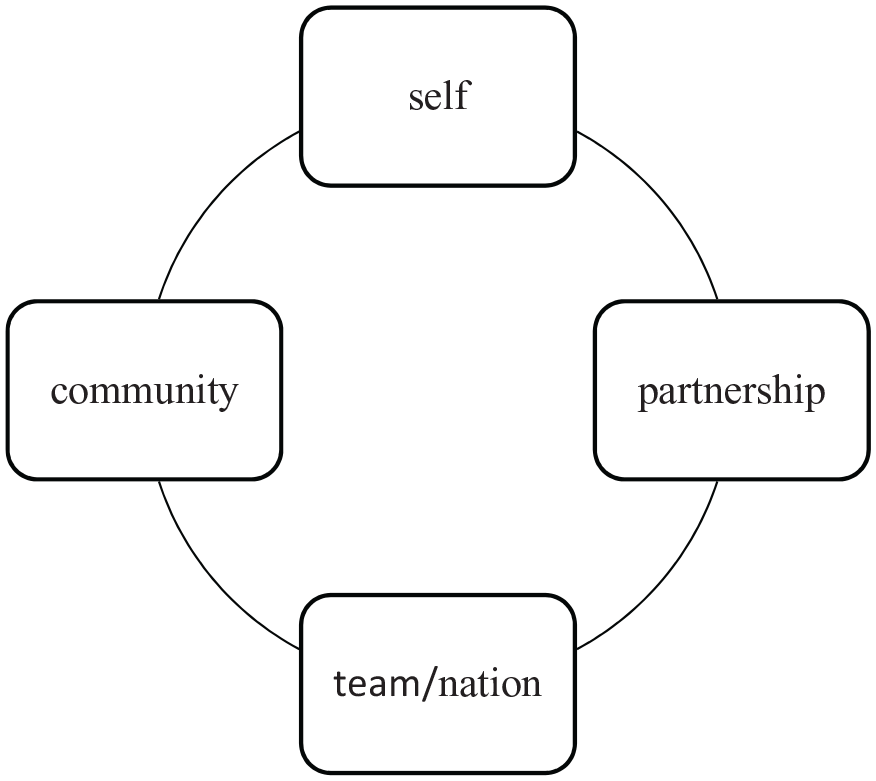
Recursive identities of elite bridge players.
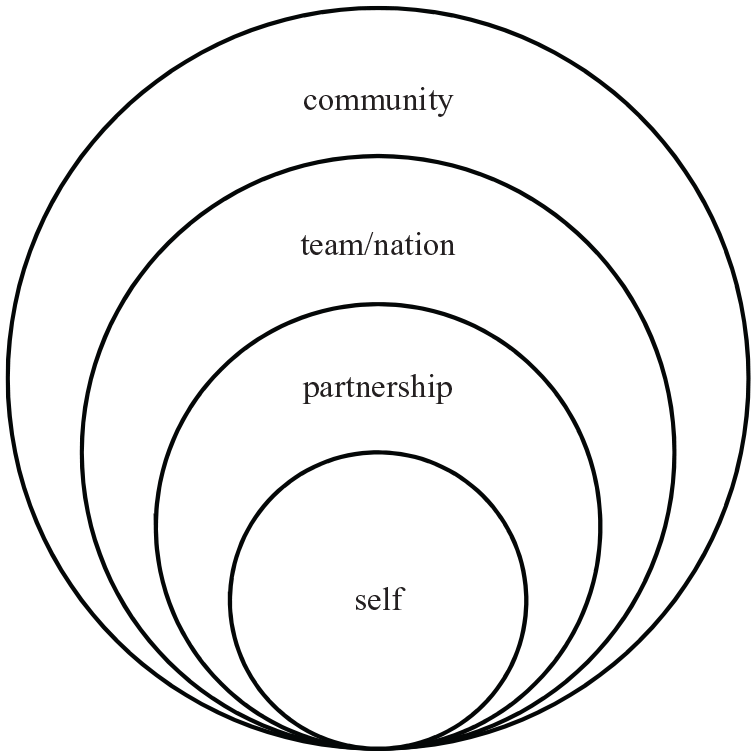
Concentric, layered identities of elite bridge players.
Elite bridge players develop both layered concentric and recursive identities and selves. Within tournament bridge, elite players’ frontstage and backstage performances occur within each layer, however each must be understood in relation to the others and in the specific context of players’ situated social interactions. So too is each layer of identity informed by and reproduced by the next, creating a recursive identity, where one holds a sense of self within bridge whilst simultaneously performing as a partner, a team member and a community member, each of which reproduces the next. These layers give an indication of how elite players form and perform identity through social interaction in tournament bridge. However, other aspects of identity, including age, ethnicity, class and gender, need further exploration, as do team dynamics and the national contexts shaping elite bridge at community and international level. We could not explore these in this paper, due to space limitations, but this could be considered in future work.
The findings present an insight into how elite player identities are performed both at and away from the bridge table, on the front- and backstage. In the context of a mind-sport, they reinforce ideas about the multiple and performative nature of identities and the centrality of social interaction seen in other sports. Bridge, as with other sports, offers participants a valued social identity (Jones, 2017) that forms through the four phases of becoming an athlete: knowledge acquisition; social interaction through participation; learning expectations of each other and participation; and gaining recognition and acceptance in the sport culture (Donnelly and Young, 1999). This continues throughout one’s career (Donnelly and Young, 1999), which, whilst true for bridge, is likely to differ from physical sports given the length of a bridge career at elite level can be much longer. The youngest player in the sample was 17, and the oldest – at age 78 – is still regarded as one of the best in the world. Age dynamics in bridge could be further explored, especially in relation to becoming and forming an athlete identity which is dependent on acceptance within the sport culture, availability of social support and the development of social connections (Donnelly and Young, 1999). Finally, as in other forms of high-level sport, achievement in bridge is shaped by standards known to participants, and the ability to meet these standards shapes identity and reputation (Weiss, 2001). Specifically, elite players’ performance reflects Goffman’s values of character; however, the extent to which these are gendered, as in other sports (Birrell and Donnelly, 2004), needs to be examined.
Elite bridge player identities are multi-dimensional and the individual and collective are entangled, coming together through performative interaction (Jenkins, 2008), especially through the partnership layer. In (per)forming elite bridge partnership identities, we have highlighted the nuances of the frontstage and backstage interactions. Whilst the frontstage performance of a partnership is vital to success in the bridge match, the backstage is where many of the informal social interactions take place between partners that shape the formation of partnership identity. Bridge partnerships are social relationships in themselves, but unlike many other sports can also be rooted in pre-existing social relationships denoted by families, friendships and ‘marriages’ between players. This is a unique context for a mind-sport where identities are shaped equally by the desire to present a specific elite sporting identity, conforming to an expected role as a bridge partner, and by more informal social interactions backstage. Punch (2008) argued siblings predominantly engage in backstage presentation of self, as there is less fear of the consequences of an unpolished performance. This could be similar for many bridge partnerships wherein social relationships represent a complex interaction of formal and informal presentation of self within a co-operative and competitive environment. The dynamics of partnership are worthy of further attention, including whether mind-sports, like bridge, are similar to partnerships in physical sports such as doubles tennis.
Our findings show that participation in the mind-sport bridge at elite level also relates to ideas of community and nation. For elite players of bridge, formal tournament culture and informal socialising creates extended contact with an international network of elite players, and thus similar to chess, ‘tournament culture provides the glue . . . for passionate involvement’ (Fine, 2015: 136−137). Players thus form a collective identity through a shared commitment and passion for the game. In advancing a sociological study of mind-sport, we argue that collective identity is mediated through the construction of national identities which can be understood in relation to existing sports research on nationalism and globalisation. From the perspective of sport as collective action, we can consider bridge a ‘sports world’ involving ‘a host of different people, connected in particular networks, and creating particular forms of sport products and performances’ (Maguire, 2011b: 860). Taking this further, we could explore the wider political and economic context (Maguire, 2011b) of the bridge sports world, including the national and international settings in which elite bridge teams compete.
Regarding the relationship between mind-sports and sports more broadly, we show through the focus on (per)forming individual and partnership identity, the extent of preparation, work and skill that is required as an elite bridge player. Taking bridge seriously as a sporting form, we show players engage in deliberate, sustained practice over time to develop identities necessary to perform as an elite player. In terms of bridge as a ‘mind’ sport, this concerns the debates surrounding defining sports more broadly (see Klein, 2017). Our findings demonstrate that whilst elite players of the ‘mind’ sport bridge are predominantly engaged in using intellectual skills competitively, they do in fact require physical skills to improve their performance, which is acknowledged as part of their elite identities. Matches are not won on physical skill, but players’ bodies are inextricably linked to their mental performances; concentration at the table, the ability to deploy skill and think strategically is an embodied experience shaped by sleep, food and travel. As with Fine’s (2015) explanation of chess, in bridge, minds and bodies ‘intersect’, they are ‘shaped by the social’ and situated within the interaction order. Likewise, physical sports require mental skills (Kobiela, 2018), both during gameplay and in terms of mental and physical preparations before and after. As such, dichotomous approaches to mind-body in sport could give way to a more holistic approach that emphasises embodiment, and the predominance, rather than absence, of mental or physical skillsets within distinct sporting contexts.
This would also speak to the broader call for a more diverse, inclusive and international definition of sport to accommodate differing cultural contexts and the need to move beyond definitions of sport as an ‘able-bodied’ domain (Anderson, 2009; Kobiela, 2018; Nixon, 2007). Further work is needed, however, to interrogate notions of mind-sports and whether bridge, chess and other activities actually constitute a distinct category for comparison with or incorporation within a broader definition of sports. Additionally, given the characterisation of sports as total institution and notions of the normalisation of violence and injury (Anderson and White, 2018), more work is needed to understand the wider context of participating in mind-sports as a comparison. For instance, what do mind-sports offer participants and how might they reproduce similar or different problems to those found in physical sports? Moreover, mind-sports like bridge have their own complex institutional contexts and more analysis is needed of this internationally. Whilst bridge is recognised as a sport internationally, it is not recognised as such in all countries, suggesting that the prevalence of and support for mind-sports will differ across contexts.
Conclusion
Social interaction is at the heart of the mind-sport bridge. Using a symbolic interactionist lens and Goffman’s dramaturgy, we explored how elite players (per)form identities. The findings highlight the recursive and concentrically layered nature of elite bridge identities which are formed and performed individually, in partnership and collectively. This occurs across both front- and backstage, involving impression management within formal tournament settings and informal social relationships within the bridge community. Whilst similar to other sports in the sense of frontstage performances and the values of character, bridge appears more unique in the sense of the backstage interactions, especially within partnerships, which are complex social relationships.
As a distinct sports world, partnerships are key to player identities through role performance as an elite bridge player and partner. Successful players must build co-operative partnership identities whilst competing against opponents and creating shared collective identity through participation in this international mind-sport. We have begun to unpack the social dynamics of the tournament bridge world and what is involved when participating in a mind-sport at elite level, to contribute to the sociology of sport and debates surrounding defining sports. Further research of mind-sports such as bridge is needed to enable critical discussion of the mind–body nexus and a better understanding of sports worlds as complex embodied social worlds.
Footnotes
Acknowledgements
We would like to thank the editor and reviewers, whose detailed comments enabled us to strengthen this paper, and Jessica Cleary, whose literature review on chess helped inform our discussion of mind-sports. We are indebted to the players who shared their experiences and insights of elite-level bridge.
Declaration of Conflicting Interests
The author(s) declared no potential conflicts of interest with respect to the research, authorship, and/or publication of this article.
Funding
The author(s) disclosed receipt of the following financial support for the research, authorship and/or publication of this article: The research project Bridge: A MindSport for All (BAMSA) is grateful for the generous support of the global bridge community, including funding from the World Bridge Federation (WBF), the European Bridge League (EBL), the American Contract Bridge League Educational Foundation (ACBLEF), the American Contract Bridge League (ACBL) and the International Mind Sports Association (IMSA).
