




Abstract
This article examines how higher education (HE) students are conceptualised in Spain, drawing on an analysis of policy and institutional narratives about such students, as well as on the perspectives of university staff and students themselves. More specifically, it will explore an interesting paradox that we encountered in our data: on one hand, marketisation is less firmly established in the HE system of Spain than in many other European countries, and policy and institutional narratives in Spain present the HE system as being relatively unmarketised. On the other hand, the staff and students we interviewed presented the Spanish HE system and the student experience as having been dramatically transformed by marketisation. In analysing this paradox, the article highlights the importance of not viewing countries as coherent educational entities. In addition – while broadly supporting scholarship that has pointed to a growing market orientation of national HE systems across Europe – the article draws attention to how the manner in which the marketisation of HE is experienced on the ground can be very different in different national contexts, and may be mediated by a number of factors, including perceptions about the quality of educational provision and the labour market rewards of a degree; the manner in which the private cost of education (if any) is borne by students and their families; and the extent to which marketisation may have become entrenched and normalised in the HE system of a country.
Introduction
This article investigates how higher education (HE) students are conceptualised in Spain, through an exploration of policy and institutional narratives about HE students as well as the perspectives of university staff and students themselves.
Sociological analyses of European HE often tend to stress the similarities of trends across the continent. A number of these studies have argued that neoliberal imperatives and policies such as the Bologna Process – an HE reform process aimed at improving the quality of European HE systems and ensuring comparability between these systems – have led to the increased marketisation and homogenisation of HE systems and student experiences across Europe (Voegtle et al., 2011; Wright and Shore, 2017). Some scholars have even suggested that such policy reforms are attempting to ‘reverse engineer’ an Anglo-American model of HE across the continent (Slaughter and Cantwell, 2012). It is often assumed that, under such conditions, students come to be viewed – and behave and see themselves as – consumers (Molesworth et al., 2009; Moutsios, 2013; Naidoo and Williams, 2015).
However, such assumptions about students have not been adequately investigated empirically. The small number of studies that have carried out such an empirical investigation of what it means to be a student in the context of the rising marketisation of HE has tended to focus on England (Brooks and Abrahams, 2018; Nixon et al., 2018; Tomlinson, 2017). This is unsurprising given that, of all European countries, HE in England has been most significantly and explicitly restructured in accordance with neoliberal market principles. Some of these studies have argued that marketised HE policies in England have not transformed student identity in a straightforward manner, illustrating instead that students exhibit varying levels of identification with a customer identity, with many rejecting the idea that they are customers (Tomlinson, 2017). However, other empirical studies have contended that marketised HE policies in England have produced consumerist orientations and behaviours among the student population. For example, Nixon et al. (2010) and Nixon et al. (2018) found that students viewed themselves as consumers and treated HE as a path to jobs and material wealth. As a result of their consumer identities, students were described as seeking the path of least resistance to obtain a degree, expecting to be ‘spoon-fed’ by staff, and demonstrating marked disinterest in learning anything that would not be assessed (Nixon et al., 2010, 2018).
With respect to European countries other than England, particularly those with less marketised HE systems, there has been a relative dearth of research empirically examining the impact of HE policy reforms, and neoliberalisation more generally, on the experience of being a student. Our article will contribute to addressing this gap by exploring understandings of the HE student in Spain. The Spanish HE system can be viewed as being relatively less marketised than many other European countries (cf. Lažetić, 2019). For instance, compared to HE systems in countries like England and Ireland, which demonstrate many features of new public management such as ‘boards of trustees’ playing a significant role in university governance, and substantial competition between higher education institutions (HEIs) for students, staff, and resources (De Boer and File, 2009), universities in Spain continue to exhibit more participatory and collegial forms of self-governance (De Boer and File, 2009; Kwiek and Maassen, 2012).
We will focus on two research questions:
In doing so, we will explore an interesting paradox that we encountered in our data: on one hand, policy and institutional narratives in Spain present the HE system as being relatively unmarketised. On the other hand, the staff and students we interviewed presented the Spanish HE system and the student experience as having been dramatically transformed by marketisation.
Through exploring this paradox, our research will contribute to scholarship which has argued that understanding how policy is enacted requires a focus on not just the perspectives and actions of policymakers, but also on how policy is understood and engaged with by the populations at which these policies are directed (Ball, 2007; Nielsen, 2011; Wright and Reinhold, 2011). This work has critiqued an assumption common in the literature on governmentality that the rationality or stated objectives underpinning policy translate in a straightforward and linear manner into ‘technologies’ or tools to govern the target population, which in turn transform the subjectivities of this population (Nielsen, 2011). For instance, Nielsen (2011) found that the introduction of fees for international students in Denmark did not mean that these students were transformed into passive consumers. Similarly, Brooks and Abrahams (2018) have illustrated how, despite the fact that national HE policy in England constructed students as customers and HE as a market, students at English universities did not necessarily identify as customers. Following these scholars, we will bring together an analysis of policy and institutional narratives with an exploration of the perspectives of staff and students, to critique the view that the subjectivities of the intended recipients of policies are determined by – and therefore can be read off – policy constructions. We will demonstrate instead how and why different social actors within the same country may hold very different understandings and experiences regarding the extent to which the country’s HE system has been impacted by marketisation.
In addition, we will challenge the view that processes of marketisation and neoliberalisation enacted through various HE policies have brought about a significant degree of homogenisation of HE systems and student experiences across Europe (Voegtle et al., 2011). We will illustrate, instead, how the manner in which marketisation is experienced on the ground can be very different in different national contexts, and may be mediated by a number of factors, some not directly linked to HE policies, including perceptions about the quality of educational provision and the labour market rewards of a degree; the manner in which the private cost of education (if any) is borne by students and their families; and the extent to which marketisation may have become entrenched and normalised in the HE system of a country.
The structure of the remainder of the article will be as follows: after outlining our research methods, we will illustrate the paradox we have described above through offering an analysis of policy, institutional, staff, and student narratives of what it means to be an HE student in Spain. Following this, we will attempt to explain why we might have encountered such a strong narrative of the marketisation of HE among staff and students, despite the fact that policy and institutional narratives about HE in Spain present a picture of a relatively unmarketised HE landscape.
Methods
The article draws on data collected as part of the Eurostudents project, a 5-year-long European Research Council–funded project aimed at examining constructions of HE students in six European countries – Spain, Poland, England, Ireland, Denmark, and Germany. The primary focus, however, will be on the following data collected in Spain, by members of the Eurostudents team, between 2017 and 2018: interviews with five ‘policy influencers’ 1 and an analysis of 16 relevant policy documents; interviews with 12 staff members; and nine focus groups with a total of 55 students. Staff and students were sampled from the same three HEIs, which were chosen to represent some of the diversity of the country’s HE sector: two public universities and one private university in different parts of the country. The staff and students also represented a range of disciplinary affiliations, from sociology to medicine. We sought to include as far as logistically possible students who were broadly representative of the demographics of the wider institution in terms of disciplinary mix, gender balance, and age.
In our interviews with HE staff and policy influencers, and in focus groups with students, we first used an open-ended approach to data collection, asking respondents in a very general way about what it means to be an HE student in contemporary Spain. In the student focus groups, this was preceded by an activity in which we asked participants to make plasticine models of how they thought about their own identity as students, and how they believed others saw them. This creative method, as discussed by Ingram (2011), can be a useful tool for eliciting rich data on a subject such as identity, as it enables participants to make tangible relatively abstract ideas, and allows greater time for reflection. In the second part of the interviews and focus groups, we then moved on to ask respondents about four specific understandings of students discussed frequently in the extant literature – students as consumers or customers, as political actors, as future workers, and as dedicated learners – and the extent to which they also saw students in this way.
Interviews with policy influencers and staff members were conducted in English, while the student focus groups were conducted in Spanish (by a local research assistant with the support of a Eurostudents team member) and translated into English. Informed consent was obtained in writing. Data analysis was conducted using NVivo, drawing on both inductive and deductive approaches.
Although our article focuses primarily on the data described above, our analysis benefits from the fact that we also collected the same categories of data from five other European countries – Poland, Denmark, Germany, England, and Ireland. These countries were selected to provide variety in terms of – among other things – the level of HE tuition fees and the provision of student support (see Table 1). At public HEIs in Spain, which constitute the majority of the country’s education provision, during the 2018–2019 academic year, tuition fees of approximately 1080 euros a year were paid by roughly 70% of students. No student loans were available, but 28% of students received merit-cum-need-based grants of 2155 Euros on average. In terms of the private cost of education, Spain fell between England and Ireland, on one hand (where the fees/student contribution was higher than that in Spain), and Denmark, Poland, and Germany, on the other hand (which offered free or practically free HE). Where relevant, we will draw brief comparisons between Spain and these other countries, to better explain our findings for Spain.
Characteristics of the countries involved in the research.
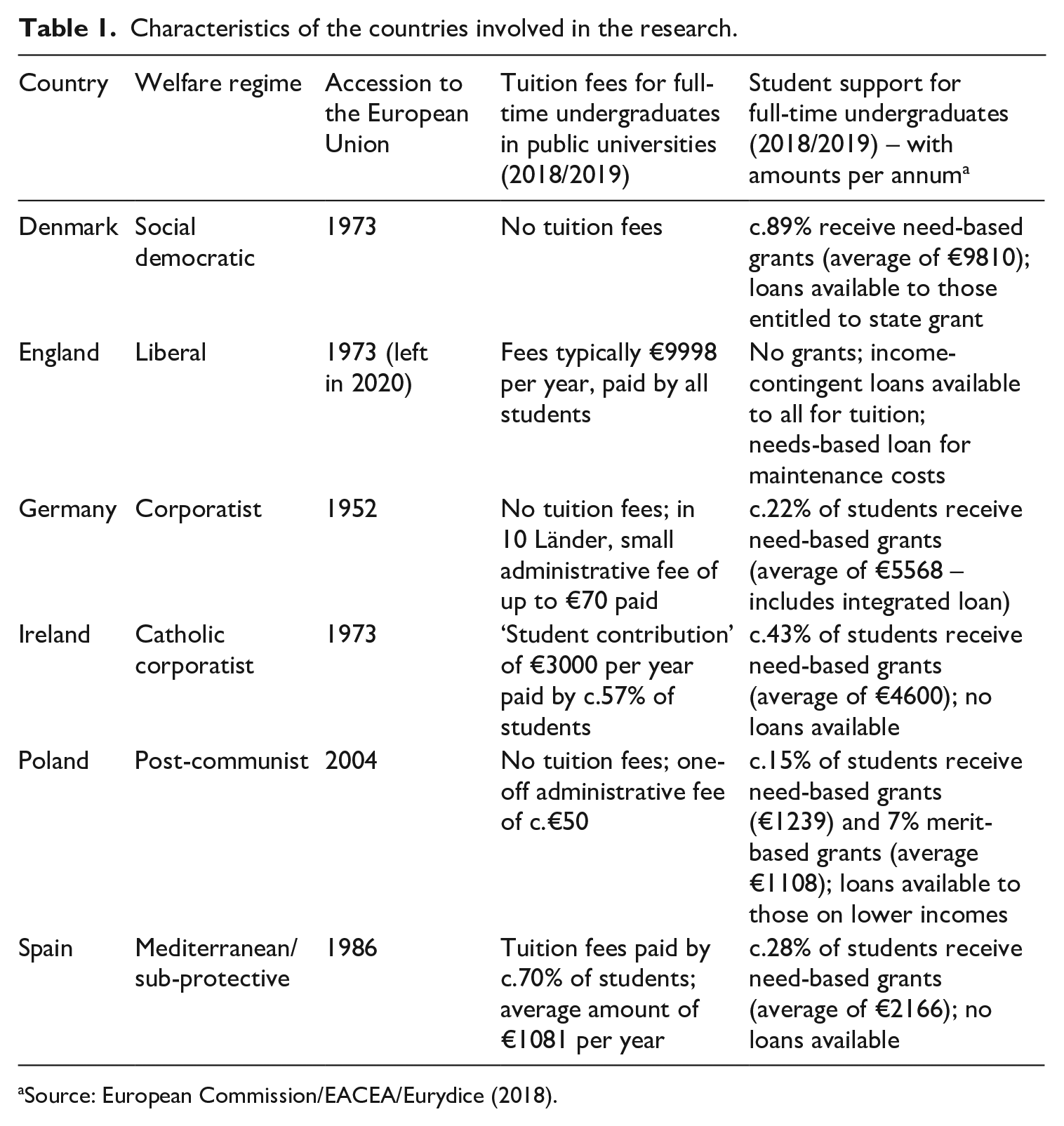
Source: European Commission/EACEA/Eurydice (2018).
Outlining the paradox
Spanish students are not customers: policy and institutional perspectives
In this section, we will illustrate how, in policy and institutional narratives, the Spanish HE landscape was presented as largely unmarketised.
The policymakers we interviewed included representatives of the central government, a national union, a national employers’ organisation, and an organisation representing university leaders. With the exception of one policymaker (from an organisation that represented employers), the view we encountered repeatedly was that, in Spain, students were not customers. For instance, one of the two interviewees from the organisation that represents university leaders thought the term ‘consumer’ was inappropriate to use with respect to students as universities are mostly public, fees are low compared with other countries, and education is a right of all Spanish citizens. She thought that students were not seen as consumers in either public or private universities and that there was a general consensus that education was not a service like any other. Similarly, the second interviewee from this organisation added that education is not perceived as a market in Spain and the fee paid is not seen as a transaction or method of consumption – and thus, education is still viewed as a common good. Both made strong claims that students were citizens not consumers (seemingly understanding these terms as polar opposites). Similar sentiments were expressed by the union interviewee, who said that while private universities might see their students as customers, public universities do not, given that their students pay less than the cost of their education. The interviewee from the government claimed that the concept of consumerism diverted the focus away from the process of learning and generating knowledge, which he believed was central to HE, and that the Spanish system was not shaped by consumerism.
Our analysis of Spanish policy documents also showed that students were less likely to be constructed as customers in Spain compared with the other countries in our study. For instance, the Spanish policy documents we analysed were not underpinned by explicit marketisation rationality of the kind that we encountered in England and Denmark. While there were discussions of students’ rights (in, e.g., the Organic Law), the focus was on rights such as ‘freedom of expression’ rather than access to a degree as akin to a consumer product (as was evident in the English documents). Similarly, although labour market destinations were discussed in the Spanish policy documents we analysed, the alignment between HE and the labour market was much less stark than what we observed in the Danish policy documents, in which the government funding for a study programme was directly linked to its labour market outcomes.
Our analysis of institutional websites in Spain also reflected an absence of consumerist discourse (Lažetić, 2019). Web features associated with a strongly marketised HE system such as direct forms of address (using the word ‘you’), student testimonials, and a heavy emphasis on institutional rankings were much less evident in the Spanish university websites, particularly those located within the public sector, than in those of other countries in our sample. For example, instead of text such as ‘10 reasons to study at University X’ (very common in English HEIs), student-focused sections of Spanish university websites tended to focus on rules for admission and enrolment, the obligations of students, and relevant deadlines and procedures. As such, students were typically positioned as novices within the academic community rather than consumers of corporate brands (Lažetić, 2019).
We do not suggest that these policy and institutional narratives of HE in Spain did not exhibit any signs of a marketisation logic. As some scholars have argued, HE policies such as those associated with the Bologna reforms – which have been embraced in Spain – are underpinned by neoliberal ideals (Lorenz, 2012). In both policy documents and interviews with policy influencers, we encountered the explicit and sometimes implicit view that HE should prepare people for the labour market. In addition, a number of our interviewees discussed students’ contribution to the country’s future mainly in terms of the labour market (i.e. the students of today will be the working professionals of tomorrow). Nevertheless, to a large extent, these narratives either did not construct students as customers or explicitly rejected the view that the Spanish HE system was marketised.
Marketisation has changed the student experience: the perspectives of staff and students
In this section, we will turn to the perspectives of staff and students. We will illustrate how – in contrast to the policy and institutional constructions described above – the staff and students we interviewed tended to view marketisation of the Spanish HE system as having essentially transformed what it means to be a student today. This transformation was typically discussed in terms of specific roles that – in their view – contemporary students were being forced to play: financial investors in their education; student workers; and ‘customers’, ‘consumers’, or ‘clients’ (these terms were used interchangeably). In staff accounts, this transformation was at least partially presented as being a temporal one, with references being made to austerity-related budget cuts following the financial crisis. However, both staff and students also discussed this transformation as a move away from an ideal or from the roles they felt students ought to be playing, that is, citizens making use of their right to free HE and dedicated learners.
In the rest of this section, we will examine each of these three roles that Spanish HE students were commonly described by staff and students as playing and briefly highlight the manner in which Spain differed from the other countries in our sample. Explanations for these national differences will be explored in the next section of the article, ‘Explaining the paradox’.
Financial investors
Of the countries in our sample, the fall in state funding of HE was a particularly prominent theme in staff interviews and student focus groups in Spain. This was despite the fact that both England and Ireland have faced greater cuts to the public funding of HE than Spain – between 2008 and 2017, the cut to public funding of universities was 31% in Ireland and 60% in England, compared to 22% in Spain (EUA, 2019).
Although staff members in Spain felt that there had always been insufficient financial support available to students in the form of grants, they viewed the situation as having significantly worsened since the financial crisis; not only had tuition fees risen, the number of grants available had been reduced. Moreover, rather than grants being need-based as they used to be, they were now merit-cum-need-based, which meant that apart from demonstrating economic need, students also needed to achieve higher grades than those previously achieved to get the same level of grants (Ross et al., 2016).
Staff and students both lamented that as a result of these funding cuts, rather than being viewed as citizens with a right to a public service, students were being forced to become financial investors in their education. Indeed, some students made plasticine models of coins to portray how they felt they were seen as a source of income by universities and the government (see Figure 1 below). Students were indignant at having to take on this role. As one student exclaimed, ‘I don’t have to pay for this, I don’t know why I’m paying, I should have the right to be educated!’ Another reason for which staff and students found it problematic that students were required to play the role of financial investors in their education was that they believed this made HE a privilege accessible only to a minority. In student focus groups, comments like this were typical: If you do not have a minimum level of income you cannot go to university, not for all the stories they try to sell you along with promises of grants [ . . . ] we know that the people who are here are here because their economic situation allows it.
The inability to pay fees and support oneself during one’s studies was also described by staff as being responsible for some students dropping out of their courses.

Plasticine model of a coin.
Furthermore, being a financial investor in one’s education was discussed as having led to two other problematic transformations to the student role. First, many students had been forced to become student workers who divided their time between studies and paid work, at the cost of their academic performance and overall student experience. Second, as a key source of income for universities, students had been transformed into customers. The next two sub-sections of the article will discuss these two transformations in detail.
Student workers
The staff and students we interviewed presented working alongside studying as being a typical situation in public HEIs – which constitute the majority of the education provision at the tertiary level – and particularly among working-class students. The need to engage in paid work was described as being directly linked to the cost of HE and changes to HE funding.
At the public HEIs in our sample, staff told us that roughly half of the students worked alongside studying, and some students even worked for 6–8 hours a day. According to staff, most students did not do jobs related to their field of study, which could further their careers, but rather took whatever paid work they could find. The phenomenon of students working was described as being so prevalent that universities made efforts to accommodate students’ schedules by, for example, keeping administrative offices open in the afternoon so that those students who worked in the morning could still access them. One staff member wryly mused that he did not know whether he should see the students at his institution as ‘students who work or workers who study’.
Staff members were largely sympathetic towards the plight of students, and very critical of the government for putting them in this situation (‘a real student should not work’, ‘it is a tragedy’). In broader discussions of the experience of being an HE student in contemporary Spain, a theme that regularly emerged was that students’ academic performance was adversely impacted by the fact that they had to work. Working alongside studying was discussed by staff as having become particularly challenging because of the Bologna reforms, which were discussed as having brought about several changes to the way that courses were taught. The two most common changes referred to were to patterns of evaluation (e.g. continuous evaluation) and pedagogical practices (e.g. more projects involving team work and practical exercises). While staff varied in how they assessed the merit of these changes on the learning experience and on learning outcomes, they were united in their belief that they had placed considerable demands on students’ time, making it especially challenging for them to juggle work and studies. Students were described as the ones who had to pay the price for the conflict between how Bologna reforms constructed them (full-time students completely dedicated to their studies) and the roles they were forced to assume as a result of the funding situation (financial investors and student workers): their academic performance was negatively impacted, which reduced their chances of accessing grants (which were merit-cum-means-based), which in turn made it even more necessary for them to take on paid work. Students from low-income families who had to work the most were described as being thrown into a cycle of disadvantage.
Students too discussed working alongside studying as highly problematic, and an infringement of the student experience. Sentiments like this were commonly expressed: ‘I wish I could dedicate my time solely and exclusively to my degree and nothing else’. Although the Bologna reforms were not directly referenced, some students highlighted how the way that classes were organised – for instance, involving a lot of team projects (in many cases, an outcome of the Bologna reforms) – made it very difficult to work alongside studies. The manner in which the expectations of the university were divorced from the realities of many students’ lives was also the focus of some of the plasticine models that students made to represent how they were viewed by others. For instance, one student made a model of a cube (see Figure 2 below) to illustrate that students had different sides or roles they had to play, including that of workers. However, as she went on to explain, only one of their roles was recognised by the university and its staff, namely that of ‘people who must focus solely on getting a degree’. Some students even said that they had chosen less demanding courses – and ‘postponed superior academic life to another time’, as one student put it – because they had known that they would not have enough time to focus on their studies because of the need to do paid work.

Plasticine model of a cube.
While students being transformed into student workers was a major theme in the interviews and focus groups we conducted in Spain, we did not encounter this theme as strongly in any of the other countries in our sample. Although students in the other nations did discuss doing paid work, this was not commonly presented as problematic. Similarly, with the exception of Germany, staff members in none of the other countries in our sample problematised students’ engagements in paid work in the manner and to the extent that they did in Spain. This is especially interesting because quantitative data available on the amount that students in different European countries work suggest that, in fact, only about 35% of Spanish HE students work alongside studying (Organisation for Economic Co-operation and Development (OECD), 2015). This is significantly less than many other OECD countries, including the other countries in our sample (e.g. close to 60% in Denmark and England, over 55% in Germany, around 45% in Poland, and over 40% in Ireland; OECD, 2015). There is also a striking discrepancy between how much the OECD data suggest that Spanish students work and staff perceptions of levels of student work. This discrepancy and the fact that it was especially in Spain, of all the countries in our sample, that the figure of the student worker emerged so strongly suggests that students needing to work alongside their studies was perceived and experienced as particularly problematic in this particular nation.
Customers
Staff complained that the government was forcing public universities to adopt the model of private universities and that, even though university leaders might view students as citizens and education as a public service, they were being forced to accept the ‘marketisation of the university’. According to staff, the manner in which universities operated had been significantly impacted by the fact that they were forced to view students as an income source: universities invested substantial effort to promote themselves at education fairs and in high schools, and competed with each other for students; if enough students were not enrolled on a course, it would have to be shut down; and study programmes which were profitable were strongly encouraged.
While some staff members discussed what they perceived to be the marketisation of universities only in this manner, roughly half of our respondents – mainly those from public HEIs – additionally complained that the fact that students were an important source of funding for universities had led to the emergence of a ‘customer-service culture’ within HEIs. According to these staff members, universities were ‘inviting’ students to see themselves as customers because of all the systems that had been put in place to protect students’ rights, to allow them to evaluate their education and their lecturers, and to enable them to make complaints. Universities were quick to respond to students’ feedback and complaints because, as one staff member put it, ‘consumers talk with other consumers about the goods they buy’. Indeed, some staff members reflected that while universities had once been authoritarian environments within which students had had to fight for their rights, they were now afraid to penalise students and the focus was instead on ensuring customer satisfaction. For instance, one staff member observed the following: the rector and her team [ . . . ] are building a lot of this customer/client relationship. [ . . . ] So I see a lot of demands [from students] that are being heard, which is fine, but the university or the rectorate feels that they have really to respond positively to some of these demands otherwise they would be in trouble.
Another staff member said that she had faced resistance when she tried to fail a student who had plagiarised because the university was worried it would acquire a bad reputation. Others expressed similar concerns that universities’ focus on keeping their customers happy could threaten academic integrity and the quality of education.
According to staff members, paying tuition fees and being treated as customers, in the manner described above – rather than as citizens who were users of a public service – had directly impacted how students engaged with universities. As one staff member put it, when you are a user of a public service, you are not a client, you are a user, and . . . and then you should also contribute to the [ . . . ] quality of the system, not just to be served. [But here] it’s more an attitude of being served.
Similarly, many other staff members described how Spanish students engaged with HEIs in a demanding and entitled manner, and possessed a ‘client mindset’. Staff members said that they felt under pressure to go beyond the roles they ought to be playing as teaching staff because students seemed to expect them to do so. One staff member complained the following: [You] feel [ . . . ] pressure to give something that probably you don’t have to [ . . . ] if a student sends you an e-mail on Saturday or Sunday, what do you do? [ . . . ] they expect you answer it[ . . . ] these are client mind, I am here, the client [ . . . ] I need this help as soon as possible, I don’t mind if it’s Saturday, Sunday, you are my teacher twenty-four hours a day.
Thus, for many of the staff members interviewed, tuition fees and the various systems and procedures in place to collect student feedback and protect student rights were technologies of marketisation that impacted student subjectivity (transforming students into demanding customers) as well as staff subjectivity (making staff feel that they needed to cater to students’ demands).
In our focus groups with students, a large number of our participants – including almost all of those studying at the two public HEIs in our sample – readily (albeit indignantly) identified as being customers or clients because they were paying tuition fees. Comments like this were typical: I consider myself as a client. When you’re paying 1,700 Euros a year, it’s no longer a right. In reality, you’re a client. It [ . . . ] shouldn’t be like this.
Strikingly, however, while students at the two public HEIs in our sample felt they were customers because they had to ‘purchase’ their education, they did not describe feeling that they were being served and catered for through a ‘customer-service culture’ of the kind that had been discussed in staff interviews. Indeed, except among the students at the private university in our sample, there was a strong sense of dissatisfaction with the quality of education, the pedagogical practices used in the classroom, and the relevance of the material being taught in class for getting a job after graduating. This dissatisfaction emerged powerfully through the plasticine models that students made to depict how they viewed themselves. While in the other countries in our sample, students’ models were largely positive representations of the student role, many of the models made by the Spanish students conjured up images of hopelessness and frustration. For example, one of the students made a model of a figure with a bowed head (see Figure 3 below) and explained it as follows: Well, mine is like a sad and frustrated doll, because I believe they have to change the teaching methodology that they use in class. It has to be more dynamic, different, not the typical one of coming here, sitting down . . . and listening to all they tell you.
Among both sets of plasticine models that students made (depicting how they saw themselves and how others viewed them), there were no portrayals of students as powerful and entitled consumers. Indeed, some students made models to represent how they were viewed as consumer products, which would be used by other social actors for their own purposes, rather than as powerful customers of the university.

Plasticine model of ‘a sad and frustrated doll’.
Related to this, a final criticism of the purported transformation of students into customers that we encountered in both the staff and student data – and which was articulated in largely similar ways – was that the links between having a degree and social mobility were seen as tenuous. This was discussed as being a product of the poor quality of Spanish HE (as outlined previously) and the Spanish economy and labour market. A regular theme in staff interviews and student focus groups was that given that students have been forced to pay for their education, they should reasonably expect to receive returns on their financial investment in the form of jobs. However, both categories of research participants highlighted how such returns to HE were by no means guaranteed. In the student focus groups, alongside discussions of how degrees could – and hopefully would – lead to ‘quality employment’ and social mobility were deep concerns and anxieties about whether the knowledge and skills students acquired during their education were in fact valued by employers and whether there were enough jobs for all the graduates being produced. As one student put it, I see myself as one of the thousands of young Spanish people who work, who study, who get good results, but in the end we are all inside the same circle and there is only a narrow exit, so it is a competition, more, more, and more, always more, it’s never enough.
Some students felt that getting a good-quality job might necessitate moving to another European country. In response to a question in our interview schedule about whether students were seen as ‘future workers’, it was only in Spain that staff members regularly joked that students were in fact the future unemployed. Several staff members reflected on how the link between having a degree and social mobility was no longer as strong as it used to be. For instance, one staff member mused, ‘the thing that our parents said, that if you go to university you’re going to get a good employment, is not right [correct] now’.
In sum, when staff and students complained about students having become customers, this complaint related to their belief that students – as citizens – had a right to free public education, and treating them as customers was a corruption of the education process and the student role. However, it was also related to the feeling that students were being forced to become customers, without the possibility of becoming proper customers. Molesworth argued that, in the UK, marketisation of education had had an adverse impact on student identity because it had transformed students from active learners into passive customers who were more focused on their rights than their responsibilities. In Spain, in contrast, we see that students and staff viewed students as having the responsibilities of a customer without all the accompanying rights.
Strikingly, we did not encounter as strong a narrative of students being customers in any of the other countries in our study. Despite the fact that in England – in contrast to Spain – policy explicitly constructs HE as a market, we found that students in England were much less likely to straightforwardly identify as customers. While some English students did indeed view themselves as customers, others expressed more ambivalent views, and still others had never considered that they might be customers. In Ireland too, where the student contribution was higher than the tuition fees in Spain (see Table 1), students were more mixed in their views about whether they were customers.
Explaining the paradox
In this section, we will examine why the staff and students we interviewed in Spain might have experienced HE in the country to have been transformed to such a great extent by marketisation. We will also explore why their understandings of what it meant to be a Spanish HE student were in stark contrast to how students were presented in policy and institutional narratives.
Our findings support studies which have argued that, in reality, the link between policy rationality, technologies, and subjectivity is not linear or predictable (Nielsen, 2011). As we have described, when staff and students in Spain spoke about the marketisation of HE, they were typically making reference to what they perceived to be the impact of the underfunding of universities by the state. They viewed increased tuition fees as a technology of marketisation that universities had been forced to embrace to cope with cuts in state funding. A large number of staff members also discussed systems introduced by the university to enable students to make complaints and provide feedback as being technologies of marketisation. However, the policy influencers we interviewed and the policy documents we analysed did not present the budget restriction plan of the government, introduced after the financial crisis, as being underpinned by market rationality. From the policy perspective, cuts to public funding of universities were austerity-related and therefore did not conflict with what was presented as the essentially unmarketised nature of the Spanish HE system. Similarly, the various technologies, referenced by staff, which universities have introduced to enable students to give feedback, were constructed, in the policy documents we analysed, as aimed at improving the ‘low quality’ of HE in Spain. Although perceptions of the ‘low quality’ of Spanish education are derived mainly from Spain’s position in international league tables, in policy narratives, these technologies were not framed in a language of customer satisfaction in the way that many staff members had discussed them. Our findings thus demonstrate that the rationality underpinning technologies cannot predict the manner in which they are experienced on the ground. Different actors may recognise the same policies and technologies in divergent ways, meaning that policies that do not have explicit marketisation rationality and are not framed in a language of consumerism may still be perceived and experienced as having powerful marketisation effects.
Our data suggest that a combination of several factors amplifies the manner in which staff and students experienced what they perceived to be the underfunding of HE in Spain and the related increased private cost of education. First, the ways in which the private cost of education is paid for by students and the financial support structures available to them appear to play an important role. Of the countries in our sample, tuition fees or another form of payment was charged by HEIs in three countries: England, Ireland, and Spain. As shown in Table 1 above, while the tuition fees charged by Spanish universities are much lower than those charged by English universities, in Spain, unlike in England, there are not established systems of student loans which allow for deferred payment of fees. As a result, Spanish students must pay their fees upfront, which means that they and their families experience a more immediate and palpable financial burden. This financial burden and its impact on the student experience emerged as a major theme in staff interviews and student focus groups through, for instance, discussions of students being transformed into student workers. While Ireland – where the ‘student contribution’ charged by universities is higher than the tuition fees charged in Spain – does not have a system of student loans, need-based grants are available to a greater proportion of the student population than in Spain. It could also be argued that Spanish students and their families experienced the payment of fees as a greater financial burden than in Ireland because the long-term impact of the financial crisis has been worse in Spain than in Ireland, with Spain’s GDP per capita being significantly lower than Ireland’s, and Spain’s unemployment rate being well above Ireland’s (Norris and Byrne, 2015).
Second, in Spain, more than any other country in our sample, we encountered a strong sense of dissatisfaction among public HEI students with the quality of education they were receiving, and substantial pessimism from both students and staff about the labour market outcomes associated with having a degree. At the time of data collection (2017–2018), the youth unemployment rate in Spain was 34.3% – more than double the European Union average of 15.2% and the highest of all the countries in our study (Eurostat, 2019a). Moreover, Spain was also one of the four EU Member States with the highest rate of graduate unemployment, while all the other countries in our study had a graduate unemployment rate below the EU average (Eurostat, 2019b). Unhappiness with the quality of education and very real concerns about unemployment and underemployment likely contributed to staff and students problematising the private cost of HE and foregrounding how students had been transformed into (not proper) customers. For instance, an important reason why staff and students expressed anger at the tenuous link between having a degree and social mobility was because students were being forced to make a substantial financial investment in their education. In England and Ireland, although students paid higher fees than in Spain, we did not encounter complaints about the quality of education, and while in both countries there were concerns that a degree no longer ensured upwards social mobility in the way it did in the past, there was not a sense of despair about unemployment and underemployment in the manner seen in the Spanish case.
Finally, precisely the fact that marketisation is relatively less firmly established in the Spanish HE system might have also contributed to staff and students’ perceptions of it defining how the education system operated. In England, where market reforms impacting the functioning of the education system are entrenched (Molesworth et al., 2009), policy documents are marked by consumer discourse and a market logic (Brooks, 2019), and HEIs construct and address students as customers (Lažetić, 2019), ideas associated with marketisation may have become so normalised that they are not worthy of comment. In Spain, in contrast, where marketisation has not been normalised in this way, the staff and students we interviewed appeared to be very sensitive to what they perceived to be moves towards marketisation. Related to this, there was a strong feeling that purported moves towards marketisation were moves away from how HE ought to operate. For instance, a regular theme in interviews and focus groups was that all citizens of Spain should be able to access HE free of cost. In contrast, among staff and students in Ireland and England – where the private cost of education was higher than that in Spain – we encountered less criticism and less challenging of the status quo. Our findings support Klemenčič’s argument (2014: 408) that a country’s cultural norms and prevailing cultural attitudes about questions such as who should pay for HE and what the purpose of HE ought to be can impact what is seen as ‘acceptable’ education policy as well as what is contested and how successfully. Following Klemenčič, we see the Spanish staff and students’ foregrounding of the impact of marketisation on the HE system as a form of contestation and rejection of the functioning of this system.
Conclusion
Through exploring the extent to which staff and student understandings of what it means to be an HE student in Spain correlate with policy and institutional understandings, our findings underscore the importance of not viewing countries as ‘coherent educational entities’ (Philips and Schweisfurth, 2014), and the danger of assuming that a country’s official narratives are representative of the perspectives of those on the ground. In doing so, our research joins scholarship that has challenged the view that policies are translated in a straightforward manner into student subjectivities (Nielsen, 2011). Our findings contribute to this scholarship through illustrating how policies may have multiple realities and therefore multiple effects simultaneously. While the HE policies of Spain might not have explicit marketisation rationality and policy narratives do not portray Spanish students as customers, for the staff members we interviewed, budget cuts had been translated into marketisation technologies which had converted students into customers and staff into people providing customer service. Likewise, students viewed themselves as customers primarily because of what they perceived as marketisation technologies which had been imposed on them. For both staff and students, marketisation had problematically transformed HE and the student experience.
While our findings broadly support scholarship that has pointed to a growing market orientation of national HE systems across Europe (Wright and Shore, 2017), through comparing Spain with the other countries in our study, we illustrate how the manner in which marketisation is seen as impacting student roles and HE might be articulated and experienced, very differently in different national contexts. We show how apparently similar technologies of marketisation (for instance, increased tuition fees) might not be perceived and experienced in the same way on the ground and may not produce the same subjectivities, so to speak. For instance, while the tuition fees charged by Spanish universities are only marginally less than the ‘student contribution’ payable by Irish students, in the interviews and focus groups we conducted with Irish staff and students, the private cost of education was not discussed as having fundamentally altered the student experience and transformed students into customers.
In sum, through foregrounding the perspectives of staff and students, our article addresses a major gap in the scholarship on the marketisation of HE in Europe. While there is a large and growing body of literature on this topic, most of it has focused on similarities and differences between European countries at the level of policy. Our article contributes to this literature a much-needed understanding of the ‘lived experience’ of HE and marketisation, through focussing on Spain, a country which has received limited scholarly attention in this regard.
Footnotes
Acknowledgements
We would like to thank all those who kindly gave up their time to be interviewed or take part in a focus group. We are also very grateful to the European Research Council for funding the research upon which this article is based (through the award of a Consolidator Grant to Rachel Brooks).
Author contributions
The contributions of the authors of the article are as follows: Sazana Jayadeva (first author) played the lead role in conceptualising and writing the article, and additionally analysed the staff data and some sections of the student data. Rachel Brooks (second author) contributed to the conceptualisation of the article and provided the analysis of the policy perspectives. Achala Gupta (third author) and Jessie Abrahams (fourth author) contributed analyses pertaining to the student perspectives. The data on which the article draws were collected by Rachel Brooks, Jessie Abrahams, Predrag Lažetić (fourth author), and Anu Lainio (fifth author).
Funding
The author(s) disclosed receipt of the financial support for the research, authorship, and/or publication of this article: The European Research Council awarded a Consolidator Grant to Rachel Brooks (681018_EUROSTUDENTS).
