




Abstract
Drawing upon 62 participant-produced visual diaries and accompanying interview narratives, this article explores the significance of everyday body work for people in mid- to later life. Departing from previous work that has explored the intersections of gender and age in relation to a single embodied practice, this article highlights the salience of a myriad of bodily practices for the everyday ways that gender and ageing identities are constituted, specifically hair styling, beauty work, clothing, and dieting. We argue that women negotiate a gendered pressure to age well, which results in an in/visibility paradox, in which they are at one and the same time seen, but not seen. Consequently, we question whether women are thus forever ‘becoming’ – attempting to become embodied subjects, alongside subjecting to ‘becoming’ – aligning with normative discourses. The article examines the competing ways that ageing and gendered bodies are constructed, together with participants’ embodied resistance to negative normalising discourses.
Introduction
Arguing that the everyday is central to how we can understand people’s embodied experiences of ageism and sexism, this article explores everyday bodily practices relating to hair styling, ‘beauty work’, clothing, and dieting. The article diverges from previous work that has explored the intersections of gender and age in relation to just one of these bodily practices, by revealing the salience of a myriad of embodied practices to the everyday ways that gendered and ageing identities are constituted. The importance of this venture has been underscored by the methodological underpinnings of the research itself – as a participatory visual project the research sought to reveal people’s experiences of everyday life in a broad sense, rather than focusing on specific bodily practices per se (as previous research has done, for example, see Hurd Clarke and Bundon, 2009, regarding beauty work; Ward and Holland, 2011 concerning hair care). Within an empirical study ‘Photographing Everyday Life: Ageing, Lived Experiences, Time and Space’ (funded by the ESRC) with 62 people (42 women and 20 men) aged between 52 and 85 years old in the UK, participatory visual methods were employed to highlight the rhythms, patterns, and meanings that underlie everyday worlds. Participants were asked to photograph their daily lives over a week to create a visual diary, which was explored within photo-elicitation interviews. We did not stipulate to participants what they ‘should’ photograph, this was left open to them. Our analysis revealed that the act of picturing itself represented a way for participants to highlight the significance of a range of embodied work that they undertake, often daily, on their own bodies. The data indicates the very everyday ways that participants ‘perform’ (Butler, 1990) gendered and ageing identities through attention to the body’s surface. Participants’ images prompted them to speak about ‘body work’ (Gimlin, 2007b) within photographs that displayed their own bodies and in those that depicted objects for facilitating body work.
Through a feminist poststructuralist lens, this article highlights how participants negotiate dominant discourses regarding gendered embodiment and the social pressure to age well, and what this means for their sense of identity. It is argued that older women negotiate an in/visibility paradox, in which they are at one and the same time seen, but not seen, and we explore how women navigate gendered ageism in their attempts to be afforded embodied subjectivity. We thus consider what it means for women in mid- to later life to be seen, to be rendered visible. Within this analysis, we engage with the concept of ‘becoming’, questioning whether older women are caught in a cycle of forever – or necessarily ‘becoming’ – a state of impermanence in which they are waiting and indeed working (upon themselves) to ‘become’. We argue that there is a paradoxical power relation in play with this sense of ‘becoming’, in that while women’s body work represents an attempt to become embodied subjects, at the same time women also may subject to becoming (through engaging with body work which strives to adhere to normative gendered and ageing discourses). However, we also reveal important moments of embodied resistance that women engage in, demonstrating the work that the women do to ‘undo’ (Butler, 1990) problematic discourses of older people. Overall, we examine the competing ways that ageing and gendered bodies are understood, and constituted, through women’s attempts to ‘become’ visible, highlighting that body work is about discipline and resistance at the same time (Foucault, 1977).
Ageing, gender and the body in everyday life
As Howson (2013) maintains, ‘we do not simply have bodies . . . but we are bodies’, our sense of self is inseparable from our bodies (p. 13). The body is central to everyday life. To ‘write about the body is to write about the mundane and the everyday, for that is what the body is: something that is with us always and everywhere – both our constant companion and our essence’ (Twigg, 2003: 143). It is through analysing everyday bodily practices that we can consider how macro-discourses surrounding gender, age, and the body impact upon micro-experiences. As Neal and Murji (2015) argue, ‘micro social life, the banal and the familiar are co-constitutive of the wider complexities, structures and processes’ of social worlds (p. 812). Everyday experiences of ageism and sexism that are written on and lived through bodies tell us much about how social inequalities manifest in broader terms. Thus, ‘to neglect the mundane and routine aspects of day-to-day living is to risk overlooking crucial insights into the social experience of ageing’ (Ward and Holland, 2011: 304).
A focus on everyday life entails attention to the ‘seemingly unimportant’ (Back, 2015: 820). The bodily practices analysed in this article – hair care, ‘beauty work’, clothing, and dieting – could be considered relatively unimportant daily occurrences, trivial almost. Yet it is precisely their perceived triviality, particularly the gendered connotations of this, which render them important for examining how people negotiate discrimination. While the everyday is characterised by routine and habitual activity, this does not render it fixed. For everyday life is ‘dynamic, surprising and even enchanting; characterized by ambivalences, perils, puzzles, contradictions, accommodations and transformative possibilities’ (Neal and Murji, 2015: 811). The body is the site upon which everyday inequalities operate, yet it is much more than an ‘object’. Rather it is an active place where transformations, and resistance to everyday oppressions, are made possible.
Bodies are thus ‘unfinished’, ‘projects’ of the self (Gill et al., 2005: 40). We are all engaged in bodily projects as a means of aligning our bodies with our sense of identity. We may undertake work on our own bodies (Gimlin, 2007b), or we might employ the ‘body work’ of others (Wolkowitz, 2012), such as hairdressers, beauticians, and personal trainers. The bodily practices discussed in this article involve degrees of aesthetic work. This is not to argue that identity is simply ‘read off’ the body’s surface, but to highlight how attention to embodied practices can indicate how people navigate their bodies in relation to ageist and sexist discourses. Meanings of ageing and gendered bodies are thus not fixed but are constructed, worked on/with, and maintained as a continual process. In this sense we can think of the body as something that is changeable or as a series of ‘events that are continually in the process of becoming – as multiplicities that are never just found but are made and remade’ (Budgeon, 2003: 50).
Bodies age, and with age the materiality of the body changes. While we are ‘aged by culture’, we are also aged by our bodies (Twigg, 2004). Hair may turn grey, skin can become wrinkled, and people might experience reduced physical capacities in later life. Yet it is the sociocultural meanings attached to these changes that are significant, particularly stereotypical assumptions of ageing embodiment. As Hurd Clarke et al. (2009) point out, ‘[v]isible signs of ageing are used as a means of assigning social value, resources and opportunities based on actual and perceived chronological age’ (p. 710). Visual imagery and consumer culture portray ways to age ‘gracefully’, which is set against portrayals of being old in film and television in which older people are characterised as senile, decrepit, infantilised, and reduced to a childlike status – in need of care, guidance, and dependent upon others (Howson, 2013: 199).
People respond to bodily changes as they age and the social assumptions that accompany them in a multiplicity of ways. An array of technologies and ‘anti-ageing’ products are available to purportedly ‘postpone’ visible effects of ageing. Yet there may exist a conflict between the body’s surface and the subjectivity of older people. This is usefully articulated within Featherstone and Hepworth’s (1991) notion of the ‘mask of ageing’, which they argue is the tension between ‘external appearance . . . and the internal or subjective sense or experience of personal identity’ (p. 382). People may thus feel younger than they are perceived to look. Yet in contemporary society, people have a ‘duty’ to age ‘successfully’ and to engage in bodily work that will not only allegedly enhance their appearance but their life span and quality. As Marshall and Katz (2002) argue, ‘[w]hether through preventative bodily discipline or remedial therapy, the onus is on the responsibly ageing individual to remain ‘forever functional’ (p. 59).
Negative connotations of ageing are especially pernicious as they intersect with gender. Older women ‘are particularly subject to ageism and the devaluation of their bodies, since their physical attractiveness is judged in terms of youthful standards’ (Hurd, 1999: 423). Women face a ‘double standard’ of ageing as they are seen to visually age quicker than men (Arber and Ginn, 1991). For Woodward (1999), women have to negotiate how their older bodies are both invisible, as the body is no longer seen, and hypervisible, in that the body is all that is seen. It is thus interesting to consider how women navigate these assumptions. Of particular interest in this project is that while participants were not instructed on which aspects of their daily lives to photograph, they utilised the opportunity to visualise their body work. This has resulted to some extent in the generation of images which counteract the wider visual and discursive onslaught about what it means to age well.
Methodology
Participants were asked to photograph any aspects of their daily lives across one week, to create a visual diary, and to then discuss their images in a photo-elicitation interview. The researcher uploaded images onto a laptop, and participants clicked through and discussed them. This enabled participants to guide the interview pace, to discuss their own meanings of their images, as well as enabling the researcher to probe for further detail and the context of image production. We did not stipulate what to photograph (aside from documenting everyday life) or how many photographs to take. We considered that this participant-led element was important given the proliferation of visual imagery that circulates of, rather than for or by, older people.
Conventions for photography are constantly shifting. One notable shift in recent years has been the advent of smartphones which have enhanced opportunities for self-directed photography. Given the abundance of negative imagery of older people, one might assume that participants would not photograph themselves. Yet many participants did, or asked others to photograph them undertaking daily activities. While we have not included full images of people here to preserve participant anonymity, our analysis has been attentive to how participants speak about and visually depict their bodies, and why this might be. We argue that the visual dimension of this project has enabled us to draw out bodily practices, and the depth of this bodily work, that might otherwise have been considered unimportant to speak about in a purely verbal research exchange (Pilcher et al., 2016).
The participant-generated visual diaries and accompanying photo-elicitation interviews were largely viewed by participants as an engaging and novel method, as something less ‘boring’ (as one participant framed it) than undertaking a written diary. In some instances, the method facilitated a greater understanding of participants’ lives, as it prompted them to seek out objects or further photographs to show us to expand a substantive point. Yet, as we explore in another paper (Pilcher et al., 2016), there are complexities around capturing the ‘everydayness’ of daily routines, for example, where participants might feel uncomfortable visualising elements of their lives that are not considered aesthetically pleasing. Image production also involves a particular representation and presentation of ‘self’ by participants, and, further, visualising daily life can be an incredibly personal process. Interviews can thus be very emotive encounters and researchers need to be mindful of these sensitivities when designing research (Pilcher et al., 2016).
Participants were recruited in the South of England through a number of places and networks including community centres, libraries, a variety of workplaces and businesses, social and exercise clubs (including those that were specifically marketed towards people in mid- to later life), and places of worship. Snowball sampling was also employed in some instances. Recruitment took place within a large city as well as in suburban and more rural areas. Of the 62 participants, the majority were retired; some were employed (working in a variety of roles including educational sectors, administration, health, and sales); many were undertaking voluntary work or a combination of both voluntary and paid roles . Many participants, but by no means all, could be conceived as conventionally middle class. Participants self-identified their ethnicities as the following: White British (46), White English (4), White Irish (2), Caucasian (1), East African (1), African Caribbean British (2), British Indian (2), British Pakistani (1), British Sikh (1), White European (1), and Undisclosed (1). 1 Participants produced 4471 images in total, and interviews lasted on average for 46 minutes.
Ethical concerns are particularly acute within visual research. 2 Participants were told of our research intentions, verbally and in a participant information sheet, and gave their written consent to participate. They were given the right to consent to their images being used for publication, and were briefed to obtain consent, wherever possible, where other persons were present in a photograph. Participants signed photograph reproduction rights forms for us to obtain copyright. The privacy of participants was respected, and we deleted photographs people took that they later decided to omit. Participants were also able to specify which photographs they wished us to utilise for analysis purposes only (as opposed to publication/dissemination).
Our analytical strategy accounted for multiple interpretations, as the meanings of photographs are not fixed but rather ‘are contingent upon who is viewing them and in what context they are received’ (Pilcher et al., 2016: 684). We began by ordering each participant’s photographs in a word document by day and time taken (morning, lunchtime, afternoon, and evening) as we envisaged that this might show routines for each participant, and across participants. While the visual itself could act as an ‘ethnographic document’, it needs to be considered ‘in dialogue with knowledges produced in other ways’ (Lyon, 2016: 1.5). Interview text and visual data were initially coded separately using ATLAS.ti software, and then analysed concurrently to ensure that images were analysed within the context of the interviews and in order to not take the images at ‘face’ value. Analysis is an ‘ongoing’ process (Pink, 2013: 71). We thus kept a reflexive analysis diary to document our initial interpretations of photographs and to reflect upon how the interview narratives confirmed or troubled these initial analytical ideas. We were attentive to how participants negotiated, and in some instances resisted, dominant discourses, both in what they photographed and their narrative discussions surrounding image production and interpretation. This multi-stage analytical process led to the generation of overarching themes relating to body and health, public and private space, relationships and connectivities, time and routines, and work and leisure. Within the theme of body and health, subthemes were generated surrounding hair care, clothing, exercise, weight management, beauty work, engaging with healthcare, tensions with the body ‘not being able to do things’ that it once could, feet, and taking medication and supplements. We noticed quite striking links between issues of (in)visible identity and gendered ageing within the subthemes of hair care, clothing practices, weight management, and beauty work, and it is to these dimensions that this article now turns.
Cut and colour: gendered and ageing meanings of hair
One bodily practice which particularly brings to the fore the ways in which gender and ageing intersect is that of styling, dyeing, and cutting bodily hair. While visible signs of ageing such as grey hair are read culturally as signs of ‘maturity and authority’ for men, women’s signs of ageing do not afford them the same social power (Twigg, 2004: 62). In the cultural construction of the ‘silver fox’ for instance, there is no comparable positive construction of grey hair for women. Similarly, for women there are social meanings attached to the cut, as well as the colour of hair. Ward and Holland (2011) argue that ‘[l]ong hair suggests a (perhaps sexual) potency that is incompatible with old age’ (p. 301). Cultural judgements about the body thus ‘bear particularly harshly on women’, who are ‘traditionally prized for their sexual attractiveness seen to reside in youth’ (Twigg, 2004: 62). Hair is ‘integral to our sense of self . . . hairdressing is associated with self-esteem, especially for women, and . . . this association increases with age’ (Ward and Holland, 2011: 289). It is thus significant that almost half of the women participants in our study (18 out of 42) spoke of the importance of hair within their daily routines. Women photographed hairdryers, straighteners, and curlers, discussing in detail the work they do to style their hair, as well as recounting experiences of trips to the hairdressers. Francesca,
3
for instance, discussed the ‘palaver’, as she phrased it, of her morning hair routine:
‘I put it up in curlers and then . . . I sort of put the hairdryer on it and then depends how much time, sometimes I leave it for a while, but if not I just take the curlers out and then I blow dry it’.
Women also visually depicted ‘having their hair done’ within salons or by a hairdresser at home. They discussed how these were regular routines (weekly or fortnightly), with some of the women having specifically demarcated ‘hair wash days’ (Mary, Naomi). Some women took photographs to represent the ‘end product’, to show ‘how nice my hair looked’ (Beverley). Hair care was a habitual part of their daily routines. This was particularly encapsulated in Samantha’s discussion of an image she had taken of a shopping list, in which she notices a ‘hair bobble’. She says ‘a hair bobble thing which I’ve always got, usually got one tucked up my arm’. Hairstyling was bound up in a particular self-presentation for some women in which they only styled their hair if they would be in public. For instance, Annabel says: ‘doing my hair, ready to go out. I’m going on the bus’, and Beatrice said: ‘If I’m not going out and I’m not for public consumption, I don’t bother’ (to curl her hair).
Women’s discussions also reveal how they negotiate cultural constructs surrounding gender, ageing, and hair. As Gilleard and Higgs (2000) argue, from the 1950s onwards, ‘hair established itself as a social text’ in which, for women, ‘grey hair became as much a sign of personal neglect . . . as an intrinsic feature of ageing’ (p. 68–69). Some women discussed feelings of guilt for having grey hair, even to the point of being seen in public, or of letting a hairdresser see the grey hair. Discussing Figure 1, Francesca says, ‘I have to make an appointment with the hairdresser to have it cut after I’ve coloured it, because there’s no way I’m going to the hairdresser with about an inch of white roots’.
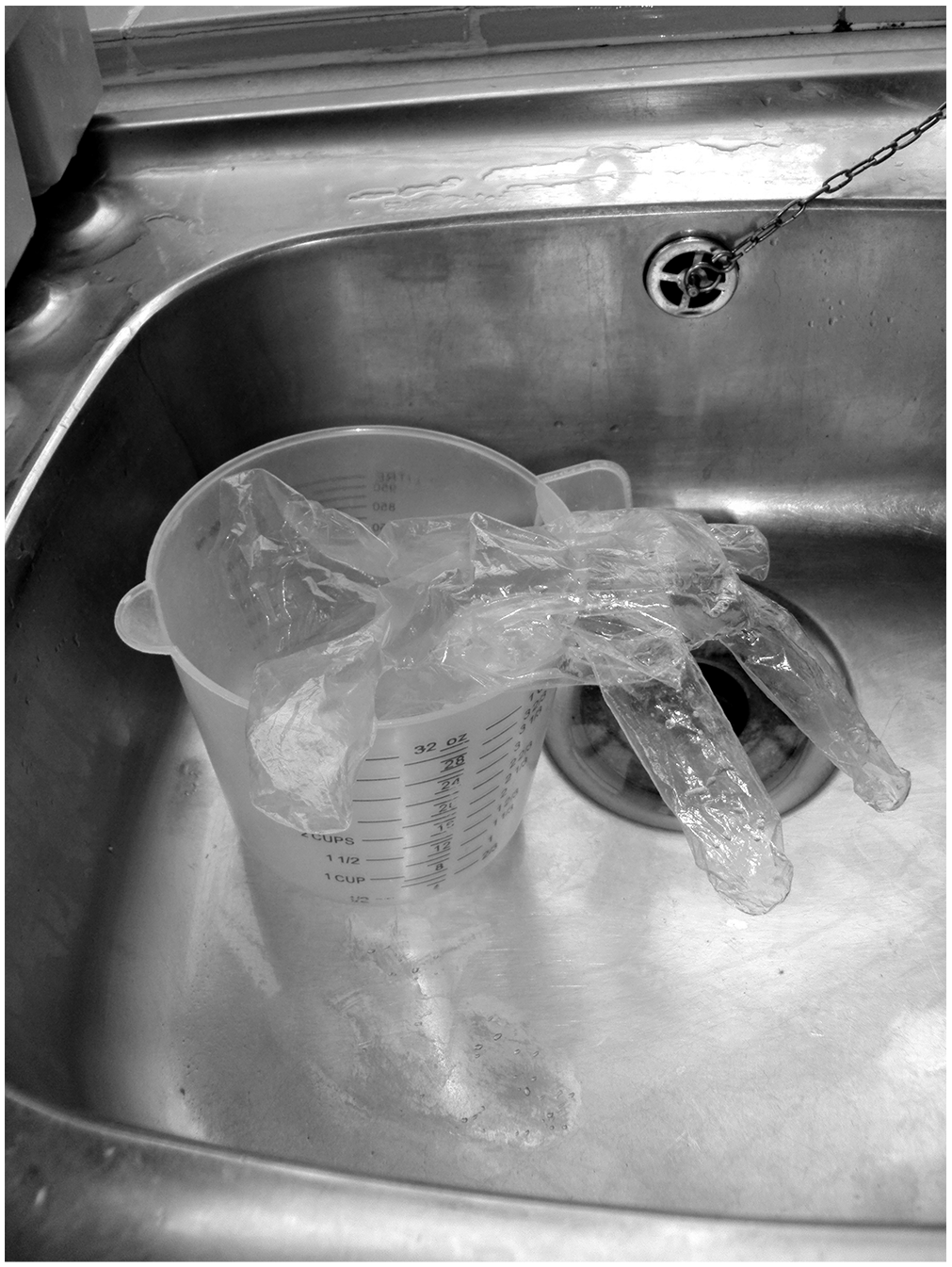
Hair dyeing.
Victoria linked her account of her trip to the hairdressers with experiences of ageing in a very emotive way. Victoria said that she thinks the hairdresser is ‘lying’ as she tells her she looks ‘young’, yet as she leaves the hairdressers she feels relatively pleased, thinking to herself that ‘yes, that’s not a bad colour’. Upon returning home, however, she is presented with a painful ‘reminder’ of her age:
‘I got home and thought “yes, you don’t look bad for an old girl” and on the doormat was a letter from the Pensions Service, and it gets worse, telling me because I was elderly I qualified for a £200 winter heating payment. So I sat down and cried . . . I thought this is really unfair . . . I just thought “how dare you tell me that”’.
Ward and Holland (2011) found that older women experience ‘physically-enforced invisibility’ including being ‘barged out the way on busy streets’, due to perceptions of them as old and thus invisible/insignificant because of grey hair (p. 299). Yet Victoria’s account alludes to a more subtle, inner battle between feelings of visibility and invisibility – at the same time that she allows herself to move towards visibility through her appearance she is struck down by the impact of the letter. Further, Hannah discusses the tensions she experiences with grey hair:
‘I did come out as grey but I thought no, the world treats you in a different way when you’re grey. I really noticed it. You’re pigeon holed. So I thought stuff this, I’m going to go back . . . They tend to, “oh this is a grey haired lady and she probably doesn’t understand these things” and there was a slight patron . . . So after a couple of years I sort of went back to colour, and . . . I feel better’.
It seems that ageing, for women, presents somewhat of an in/visibility paradox. Hannah wishes to make her grey hair invisible, in order to constitute herself as visible as a fully competent being. Similarly, a woman participant in Ward and Holland’s (2011) research comments, ‘if I look old, I will be treated old’ (p. 296). This in/visibility paradox is also evident in Hannah’s metaphor of ‘coming out’ as grey. She wishes to claim her greyness as part of her identity, to visibly ‘come out’ as grey, yet she documents how this was not possible. Murray (2005) has drawn comparisons between the notion of ‘coming out’ vis-à-vis sexuality and with claiming a fat identity. Her ideas are quite interesting for what this can tell us about Hannah’s narrative. Murray (2005: 157) argues that ‘[u]nlike the gay body, the fat body is always already out. The fat body is of course hypervisible in terms of its mass in relation to the thinner bodies that surround it’. Similarly, in terms of visibility, Hannah’s grey hair is also ‘already out’ because it is visible and contrasted against the hair of younger women or those who dye their hair. Yet the tension is that this visibility, or hypervisibility as Murray (2005) suggests, does not enable Hannah to actively claim her appearance as an acceptable one in a society which privileges female hair that is not grey. It is of course not easy to re-code dominant meanings, to ‘come out’ and embrace the physical changes that ageing entails and the gendered meanings that accompany those changes. As Hannah’s grappling with ‘coming out’ as grey indicates, we cannot underestimate the power of normalising discourses and the impact they have upon whether someone can construct a viable identity. Or as Murray (2005) powerfully puts it: ‘[h]ow can you completely remove yourself from the discourses that constitute us as subjects?’ (p. 159).
While Ward and Holland (2011) have documented the difficulty of facilitating men talking about bodily practices such as hair care, some of the men in our research did speak about hair care. Of the 11 men who spoke about hair care, 5 spoke about shaving beards, and only a few spoke of trips to a hairdressers/barbers, with the majority speaking about their own work on their hair. For example, Zuberi spoke about how he ‘crops’ his hair, and Ravindar took photographs to depict drying his beard. While men’s discussions of their hair care were very brief, perhaps because hair care is not coded within hegemonic masculinity as ‘men’s talk’ (Ward and Holland, 2011: 296), they still include insights into men’s negotiation of ageing discourses. George photographed his shampoo bottle designed for ‘fine hair’, which he says is ‘a sign of my age and my thinning hair’. Elliot spoke of getting a ‘pensioner’s special’ haircut, and Martin said his hair practices have changed as he ages – he had a beard in his twenties, but now he shaves his beard daily as ‘it’s all gone white’. While men’s engagement with anti-ageing products and ‘pensioner’s deals’ could be interpreted as a potential sign of weakness within dominant constructions of manhood as invulnerable, Calasanti and King (2007: 367) have argued that capitalism works in particular ways to reify consumption as a means of facilitating hegemonic masculinity ideals. In their analysis of advertisements aimed at older men, they argue that men are framed not as ‘mindless pawns of capitalist manipulation but empowered agents . . . in control of their spending, and thus enjoying a sense of control over their fates’ (Calasanti and King, 2007: 367). The men’s engagement with hair products and services could be linked, at least in part, to attempts to perform, and perhaps regain, a sense of masculinity as they age.
Performing femininity through ‘beauty work’
Women have long been ‘accustomed to cosmetics as an intrinsic part of their public persona’, they are used to ‘putting on their face’ (Gilleard and Higgs, 2000: 68). Such beauty practices have, however, been heavily critiqued by feminists such as Wolf (1990), who argues that images of beauty are used ‘strictly’, ‘heavily’, and ‘cruelly’ ‘against women’, to denote ideal standards (p. 10). Some of the comments made by women participants could, on the face of it, be interpreted as them passively following feminine beauty ideals. For example, Mina depicts herself in a beauty parlour, ‘getting her eyebrows done’. She faces a mirror, surrounded by a wealth of beauty products. This could be interpreted as Mina conforming to societal expectations that women will shape their eyebrows. Yet, her account reveals the performativity of gender – that gender is not a natural phenomenon but a ‘doing’ (Butler, 1990), a repeated performance over time. Mina says she photographed herself having her eyebrows ‘done’ because ‘I thought you would like to know that’. Thus she overtly performs gender, by showing a woman researcher (whom she might assume also has her eyebrows ‘done’) that she is undertaking beauty work. Her comment exposes the unnaturalness of gender, the active work that is undertaken to accomplish a ‘feminine’ appearance.
There is something poignant in Beatrice’s depiction of her make-up on the window ledge (Figure 2), as it creates a metaphor for her accompanying narrative of ‘looking out’ at the world outside. She describes her make-up application as putting on ‘her face’ for the outside world. In a similar vein to Hannah’s discussion of negative responses to her grey hair, Beatrice describes reactions if she does not wear make-up:
If I don’t put my blusher on, people keep saying, ‘oh you do look pale’ . . . I’ve got a splodge on my nose, so I put my concealer on, and put my blue eyeliner on and then, you know, I can face the world, you know, whether they want to face me or not!
Do you use this regime every day?
Yes, yes. [laughs] That’s me. When I’m feeling really, really racy I put some mascara on.
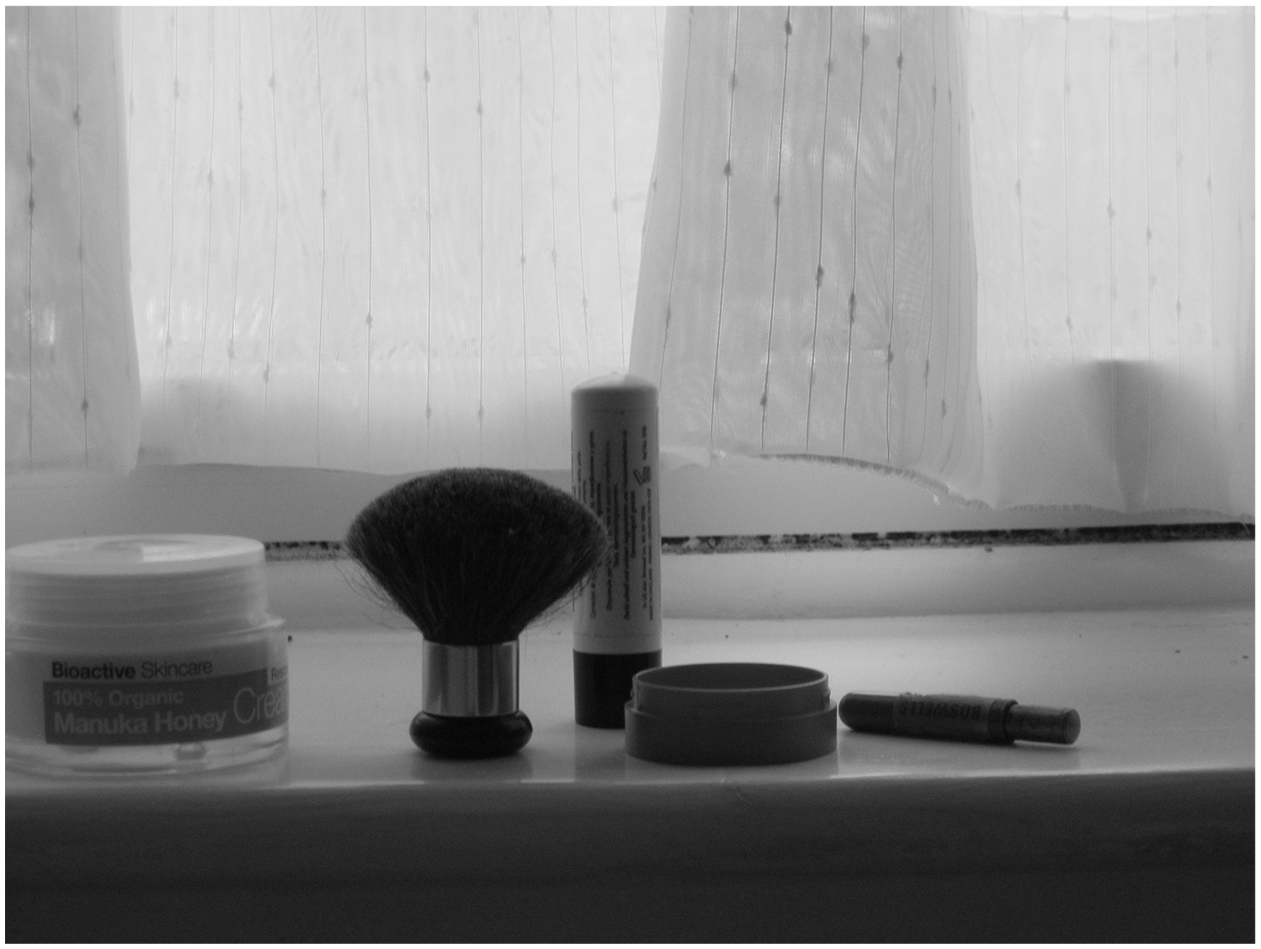
Make-up application.
Beatrice’s use of a ‘cheeky’ expression in her language, of wearing mascara when she is feeling ‘racy’, again exposes femininity as a performative act. She is at one and the same time engaging in powerful normalising discourses for how women’s bodies should look, while there is also something rebellious in her playful characterisation, her knowingness, that she is performing femininity for the world.
This complex engagement with beauty practices, which is more than an uncompromising following of beauty ideals, was echoed in Samantha and Francesca’s narratives. Francesca says, ‘sometimes I don’t bother to put make-up on . . . Not much you know, just a little bit’. Her ‘just a little bit’ comment suggests she is hinting at an underlying notion of appropriateness – of how much make-up is appropriate to apply. There are fine lines surrounding when women are considered to be ‘too concerned’ with appearance and cast as ‘vain’ (Hurd Clarke, 2002: 770). There could also be an undertone in Francesca’s comment of what amount of make-up is considered appropriate for women to adorn as they age. These links between ageing and beauty work are further intertwined in Samantha’s discussion of a photograph of Style magazine:
‘It was going on about “Botox in a bottle” . . . It said laughter lines significantly reduced in two weeks, and then I thought these eyelashes were fantastic . . . not bad for £15.50 . . . so that’s a little page of blingy things . . . I’m quite into sort of my beauty treatment, make-up and girly girly things so again there’s usually something I’ve got going on when I should be reading The Economist’.
There are some complex and seemingly contradictory discourses at work here. Samantha characterises her behaviour as ‘girly’. Not only is this a means through which she overtly genders her bodily practices, but there is a contrast and sometimes a slippage between her use of ‘girly’ – implying youth and ‘girlhood’ alongside reminders of her age through discussion of anti-ageing products – the ‘Botox in a bottle’. In a similar vein to Barrett and Naiman-Sessions’ (2016) interpretation of women who participate in the ‘Red Hat Society’, Samantha’s invoking of girlhood could be construed as reproducing ‘inequality by valuing youth over old age and depicting older women as girls engaging in frivolous activities’ (p. 764). However, there is more to her actions than this interpretation allows for. As beauty work is constructed as a frivolous and unimportant activity, there is a resistance in how she derives pleasure from it and rejects an activity that she feels she ‘should’ be doing (reading The Economist). There is also a subversive essence to her sourcing cheaper products, yet at the same time she is still complicit in normative understandings of ageing well for a woman. While all of us are implicated through biopower in the ‘duty to be well’ (Lupton, 1995), this ‘duty’ extends through the lifecourse. Ideas of ‘wellbeing’ in mid- to later life are bound up in ‘ageing as a moral enterprise’ (Howson, 2013: 199), whereby people have a ‘duty’ to work on their bodies to resist the material onset of older age. What is striking is that women exhibited a subtle recognition of their complex complicity in this ‘duty’, recognising the competing cultural discourses surrounding their bodies, at the same time as they take pleasure in engaging with gendered and anti-ageing products.
Clothing practices
Clothing practices are similarly imbued with cultural meanings surrounding gender and the ageing body (Twigg, 2007). They are both ‘central to the ways older bodies are experienced, presented and understood within culture’, and they are ‘an arena for the expression of identity’ (Twigg, 2007: 285). Like other cultural signifiers of ageing, people are more ‘harshly’ judged if they do not adapt their clothing as their bodies age (Twigg, 2007: 295). This judging process is gendered, whereby judgements about appropriate dress for an older woman manifest in everyday offensive phrases such as ‘mutton dressed as lamb’.
Gendered meanings of clothing can shift, however. As Twigg (2007) notes, with the advent of the subject position of the ‘metrosexual’ man, men are less likely to be deemed ‘effeminate’ for a pre-occupation with dress (p. 289). However, we found that men rarely spoke about clothing. While Ravindar spoke for some time about how he presses his trousers every night, on the whole, men’s discussions about clothes were brief. For example, George says, ‘they’re just trainers’ in quite a dismissive and short tone. Paul photographed coats in a hallway, yet becomes ‘embarrassed’ as he discusses them: ‘just trying to decide which coat to put on . . . I’m getting embarrassed. It’s terrible isn’t it?’ Moreover, Andrew says, ‘I always take slippers away with me. Why should I be uncomfortable when I’m away?’ The setting up of his response as a question is almost a defensive justification for why he wears the slippers, as if he needs to assert his ‘right’ to wear the slippers or that it is something unusual (perhaps within constructs of masculinity) that he needs to therefore defend.
By contrast, many women discussed clothing but also how their clothing choices were constrained by material experiences of ageing. Maria discusses how she wanted to wear a variety of women’s shoes, yet she mainly wears sandals because ‘I’ve got very, very, very broad feet so I have to have G fitting, probably from all the nursing’ and that ‘I’ve sometimes gone for a couple of years when I couldn’t get a pair’ of shoes. This illustrates Hockey et al.’s (2013) argument that while people can ‘feel’ agency from wearing certain shoes, the ‘materiality’ of ‘foot problems’ indicate ‘how footwear operates within the mundane ‘transformations’ of everyday life that nonetheless constitute identity’ (p. 2.3).
Some participants discussed their frustration with notions of ‘appropriate’ dress for a woman in mid- to later life:
‘Well there’s a sort of Dorothy Perkins . . . they’re too young for me and they’re too short for me on the whole these days . . . and then there’s Eileen’s . . . which is a bit too expensive . . . So there’s nothing really in the middle’. (Jessica)
Being seen as not dressing ‘appropriately’ for one’s age and gender can result in others perceiving a ‘lapse’ of dress (Twigg, 2007: 295). Indeed, a male participant made reference to a woman whom he perceived to not have ‘dressed her age’. The impact of these ageist and sexist assumptions is overtly articulated in Victoria’s comment:
‘I know I look old and haggard there, but . . . I got him to take a photograph of . . . my really bad taste jumper. I never say anything about . . . but they all say you can’t miss [Victoria], she’s the one wearing the socks and trousers’.
Victoria reflects upon her perception of herself as looking ‘old and haggard’, alongside how others perceive her as ‘lapsing’ in her attire. There is perhaps something further happening in that it is the act of looking at an image of herself that has made her vocalise this negative depiction of her own embodiment. As Featherstone (2010: 206) argues with regard to looking in a mirror, looking at a reflection, or looking at an image of oneself is not just about us seeing with our eyes but ‘feeling’ with them also – the response to the self-image is affective. Taken together, these examples demonstrate the policing and self-policing of older women’s bodies and the impact that this can have upon a woman’s sense of self.
Despite these acutely harsh cultural judgements, there were moments of resistance to ageing and gendered hegemonic discourses. While Hurd Clarke et al.’s (2009: 712) research found that ‘the colours of older women’s clothing choices are often muted, dull or soft . . . there is a retreat from any style or colour that may garner attention’, Samantha’s discussion of an image of her wardrobe brought to light her resistance to this ‘norm’ for older women. With age she has been able to ‘revolt’ against clothing conventions:
‘I thought god I hate black trousers suits. I’m not doing this anymore . . . At my age now, I’ve decided I’m not . . . this whole power dressing stuff . . . I’m tired of that person really. I don’t want to play that game anymore. So I revolted into hot pink’.
A pertinent example of a participant utilising clothing to resist normalising discourses arose in Beverley’s discussion of an incident at her golf club. Beverley gave a lengthy critique of how she had left a golf club because of its conservativeness towards women and as her complaints against racist remarks were not investigated. When her complaint against racism was dismissed, she changed tactics and used the club’s clothing rule to attempt to demonstrate the outdatedness of the club’s policies more widely. The rule meant that members had to change into smart clothes before entering the club. Beverley told the club,
‘We’re not in the 1950s, you’ve got colour TV, you’ve got a mobile phone . . . can you think of anything else that’s the same . . . and the club rules are exactly the same’.
Beverley uses the clothing rule to emphasise how surface rules, particularly the club’s justification that the existing clothing rule to change to enter the clubhouse is ‘about standards of behaviour’, do little to challenge offensive underlying discourses within the club. Her resistance manifests most acutely within her (apt) phrase that ‘changing into a Marks and Spencer twinset does not make people behave well’. Therefore, while other studies upon older women’s clothing practices found that women ‘uncritically identified, internalised and reinforced today’s restrictive clothing norms for older women’ (Hurd Clarke et al., 2009: 723), our research has demonstrated moments when women actively resist clothing norms. As Beverley’s example reveals, clothes can be invoked as a political tool to leverage social change.
Weight watching
The final bodily practice that we focus on here is the integration of weightloss practices into participants’ daily lives. Feminists have long documented that dieting is a gendered practice of bodily self-surveillance, and this is also reflected in our data (Heyes, 2006). Only two men spoke about their bodies in relation to weight, yet eleven women spoke of dieting. We found that women offered ‘unsolicited accounts’ for their body sizes (Hurd Clarke, 2002: 751). It is perhaps unsurprising that research into everyday life has uncovered women speaking about body size, for as Wolf (1990) argues, ‘dieting is the essence of contemporary femininity’ (p. 200). Women become accustomed throughout their lives to engaging in, and speaking about, weightloss processes. Through ‘fat talk’ (Nichter, 2000), it becomes almost ritualistic for women to comment that they are ‘fat’ in peer discussions. Slimness is what it means to be feminine.
However, there is some evidence that the pressure upon women to be slim declines with age. Tunaley et al. (1999) found that while older women were ‘dissatisfied’ with their bodies, they ‘adopted a laissez-faire attitude . . . rejecting the pressures surrounding size and food’, because of ‘their beliefs about the inevitability of weight-gain as they grew older’ (p. 741). The only participant in our research who exhibited this attitude in part was Hannah:
‘It’s kind of a time of life when you, it’s probable all the damage has been done anyway . . . we need to lose weight, but . . . I just love cream cakes and stuff like that, but we are aware of it, although we don’t always do it’.
Hannah questions the point of losing weight when the ‘damage’ may already be ‘done’, yet still notes her concern about losing weight and how this operates in tension with her love of cream cakes.
Furthermore, what was interesting within women participants’ narratives was how weight featured almost as an offhand comment, whereby women would speak about food but then exhibit shame and make a comment about their body size. It was common for women to adopt a confessional style in their weightloss narratives or to include a justification for their food consumption. For instance, Catherine spoke about making scones, and justifies this as ‘ok . . . because they’re not too fattening’. Similarly to Hannah speaking about hairstyling as a luxury, Maria spoke in a confessional tone about food as luxury:
‘That’s my shopping . . . probably a naughty luxury . . . it would be a cake I should think . . . But really I shouldn’t have . . . a lot fatter than I used to be’.
There are some interesting similarities between Maria’s confessional narrative and those of Julia’s and Verity’s as given below:
‘I can’t eat butter so I can never eat sandwiches but I could do with losing the weight, so’. (Julia) ‘I don’t buy anything there . . . they’re for young folk . . . I think the maximum size is about sort of 14 or 16 and I’m well past that. Unless they’ve got an expandable waist’. (Verity)
Notice that in these accounts the women comment about their body size at the end of their sentences. The positioning of the comments as the last thing said about the issue and the content of what is being said are striking in conveying the admission of their guilt. In a Foucauldian sense, it displays their ‘knowledge’ of the disciplinary work that they ‘know’ they ‘should’ be engaging in, highlighting knowledge of their ‘need’ to recommit to exercising discipline over their food choices (Foucault, 1977).
Losing weight is thus very much part of these women’s everyday lives. Women ‘police’ their bodies, self-regulating their food intake to lose weight. Nikhita spoke of having a healthier lunch as she had ‘indulged’ on cakes. Similarly, Harriet regulates her food intake: ‘I need fish tomorrow because I might have had something a bit fatty today’. Samantha belongs to a ‘WeightWatchers’ slimming group (Figure 3) and spoke about dieting over a number of years, saying that she is ‘constantly up and down with my weight’. In a confessional tone she said, ‘I know most of the guys from the pizza shop, which isn’t consistent with weight loss, but hardly a daily treat’. Both the confession and the justification in the same sentence illustrate the constant battle that weightloss represents for her.

WeightWatchers.
Picking up our earlier argument that beauty ‘work’ is not straightforwardly oppressive to women, Samantha also derived pleasure from maintaining control of her body through weightloss. She keeps little stones to symbolise the stones in weight that she has lost. She also finds the collective element to attending a weightloss group to be positive: ‘we have quite a laugh and pick up tips and offer moral support’. Dieting, for Samantha, is thus enabling. As Heyes (2006) argues, ‘to understand dieting as enabling is also to understand that we have reason to embrace the increases in capacities it permits without acceding to the intensification of disciplinary power it currently requires’ (p. 127). Dieting is therefore an example of disciplinary power operating but also forges a sense of self transformation.
Men only occasionally mentioned disciplining their bodies through dieting. Jonathan made a fleeting reference, saying he is able to ‘eat my way through one of those big bags of crisps in an evening’, and confessing that ‘it’s not great dietary stuff is it?’ Thomas was the only male participant who mentioned feeling ‘overweight’. Thomas took pictures of weighing himself (Figure 4), and relates his experiences of weightloss to ageing discourses, saying there is ‘more pressure’ in later life to ‘lose weight’. Yet Thomas also compares his experiences to those of his wife, setting his eating practices up as tantamount to hers: ‘That’s lunch. My wife seems to have, she has a SlimFast, one of these diet drinks sort of thing, but I, I tend to have a sandwich, and I’m very good at making sandwiches’. His privileging of his food choices over hers and his comment on his sandwich-making abilities could be a means of reasserting his masculinity, particularly as ‘fat talk’ is coded as a feminine activity (Nichter, 2000). Fred’s discussion of weight did not focus on his own embodiment but he policed the bodies of others. Fred photographed friends whom he said were ‘fat’ and ‘storing up trouble for themselves’, self-inflicting their own ‘deaths’. This policing positions them as ‘matter out of place’. There is an added policing dimension, as Fred has both criticised and photographed their embodiment. In this sense, as Murray (2004) argues of one of her participants, the people in Fred’s images are situated as ‘ridiculous by [their] seeming refusal to bear witness to the offensiveness of [their] own bod[ies]’ (p. 243).
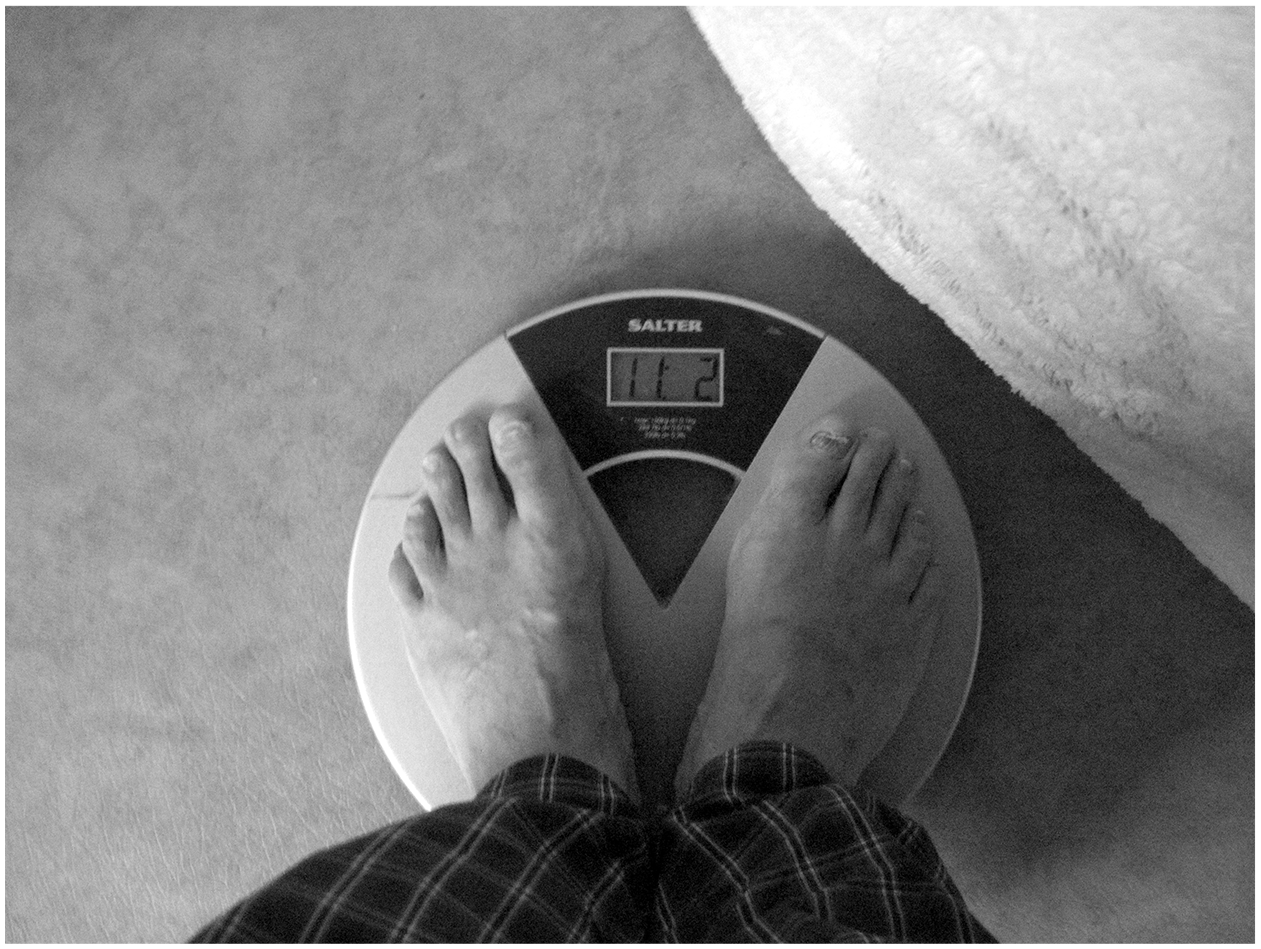
Scales.
Conclusion
This article has explored people’s body work that is utilised to negotiate conflicting meanings of ageing and gendered embodiment in everyday life. While a limitation of our discussion may be that less male participants spoke about bodily practices, a strength of the participatory methodology is that it enables participants to reveal what they consider to be significant in their daily experiences. Thus, the lack of discussion from men around bodily practices in itself has revealed gendered differences in experiences of embodiment, namely around meanings attached to grey hair, clothing, and men’s limited engagement with ‘beauty work’ and dieting.
There exists an in/visibility paradox in the lives of women in mid- to later life. Women spoke of tensions with wanting to be visible, yet visible for what they perceived as the ‘right’ reasons. They might be visible as ‘older’ women (read by others as such from visual markers, such as grey hair), but this often meant that they would be deemed invisible as competent beings. Women discussed the tensions of navigating these gendered and ageist assumptions, and of submitting to body work, even where they did not particularly want to, to ward off negative assumptions from other people. Therefore, ‘there exists a painful tension between being aware of ageism and submitting to it by accepting the importance of physical appearance’ (Hurd Clarke and Griffin, 2008: 671). A further tension is that while women, on the one hand, are countering negative assumptions of ‘older women as unconcerned with physical attractiveness’ (Gimlin, 2007a: 407), they are also attempting to become ‘visible’ through engaging in normative beauty ideals. However, women’s accounts indicate that this is about much more than appearance, but a concern to avoid discrimination from others – to make their daily lives liveable.
Furthermore, this in/visibility paradox means that women in mid- to later life are caught in a state of forever becoming or in a situation of ‘necessary impermanence’ (Murray, 2004: 115). Impermanent because they must always be becoming, changing the materiality of their embodiment to align with societal norms for older women’s bodies – masking grey hair, dieting, and wearing ‘age-appropriate’ clothing. The tension is that the materiality of ageing together with gendered ageism means that they can only ever become, rather than ‘be’. Or as Foucault (1977) similarly argues in relation to exercise, women’s body work ‘does not culminate in a beyond, but tends towards a subjection that has never reached its limit’ (p. 162). The disciplining of women’s bodies requires them to live in a state of impermanence, of continual becoming, through their subjection to normalising body work that does not have a clear finish point. As Ahmed (2006) frames this dilemma, ‘[b]ecoming confirms nonbeing through how it extends the very surface of being toward what it is not’ (p. 128). Moreover, the ‘everyday’ repeatedness, or ‘iterability’ (Butler, 1993: 95) of this body work, indicates that gender and ageing identity is performed, and continually rearticulated, forever ‘becoming’.
We have revealed, however, resistant attempts by women who utilise body work to reconfigure these constraining meanings. These small pockets of embodied resistance, even when they cannot be fully executed, show that while ageist and sexist discourses and material inequalities are operating, people refuse ‘to be crushed by those destructive forces’ (Back, 2015: 832). Thus, while ‘no-one dies from a bad haircut’ (Ward and Holland, 2011: 290), this participatory visual project indicates that these very everyday embodied practices are key to revealing how ageism and sexism combine to literally cut out – invisibilise – older women from becoming embodied subjects on their own terms.
Footnotes
Acknowledgements
We are grateful to our research participants for the generosity of their extensive time taken to participate in this research, and to the ESRC for funding the project (RES-061-25-0459). We would like to thank Veronika Williams for her early involvement in this project. Thank you also to Philippa Locke for her thoughtful suggestions for developing this article, to David Pollard for help with image reproduction, and to Christina Silver for ATLAS.ti training.
Funding
The author(s) disclosed receipt of the following financial support for the research, authorship, and/or publication of this article: The research was funded by the Economic and Social Research Council (RES-061-25-0459).
