



Abstract
Introduction
Coronavirus was first originated in the city of Wuhan, China causing severe acute respiratory syndrome coronavirus 2 (SARS-CoV2).1,2 A significant risk to public health has been posed by COVID-19 leading to global lockdown. The term “corona,” which originated from the Latin word for “crown,” refers to the viral particle’s crown-like configuration. 3 Therefore, well-balanced diet is prerequisite for strong immune response against infections. Nutrition has a huge impact in maintaining human fitness leading towards prevention as well as control of infections. 4 Various functional foods have immune-boosting properties which is crucial in the modulation of immunological function. 5 Flavonoids, polyphenols, terpenoids, sterols, alkaloids, unsaturated fats, minerals, as well as vitamins contribute significantly in building immune system. 6 For this reason, in early COVID-19 wave elderly and immune-compromised people were hit the most. 7 An individual’s dietary status has a significant impact on the severity of SARS-CoV-2 infection. Consequently, vitamin and mineral supplements are beneficial for both treatment and preventive purposes. 8 They play significant role to reduce the levels of Reactive Oxygen Species (ROS) and function as powerful antioxidants along with cellular stress. Minerals themselves have an immune-protective effect due to their ability to induce autophagy, cytokine synthesis, antiviral function, and boost the efficacy of antiviral drugs. 9 Keeping in view the importance of health, this review article describes functional food immunity boosters.
Methodology
The information on the role of functional food components in the COVID-19 pandemic was acquired by searching several online databases such as PubMed, Web of Science, and Google Scholar using the search terms Immune-Booster, diet, Functional Nutrients, lifestyle, COVID-19 causes, and treatment. Some data was also acquired through examining the websites of various government as well as international agencies, such as the World Health Organization and the Central Intelligence Agency. Articles featured were based on the beneficial effects of several dietary elements, as well as those including accounts of the COVID-19 pandemic. All of the studies found via the comprehensive search were assessed by title or abstract before being subjected to a full-text review. Titles and abstracts were screened from an informational database search. The entire texts of all publications deemed potentially relevant were subsequently reviewed.
Results
Behavior of coronavirus
Coronaviruses are members of the Coronaviridae family. The coronavirus subfamily orthocoronavirinae belongs to the order nidovirales. 1 Orthocoronavirinae are categorized into four genera: Alpha coronavirus (-CoV), Delta coronavirus (-CoV), Gamma coronavirus (-CoV), and Beta coronavirus (-CoV). 10 These four structural proteins participate in SARS-CoV-2 assembly and infection processing. The virus COVID-19 (SARS-CoV-2) is the seventh human-infecting member of the CoVs family. Common cold-like upper respiratory tract infections are motivated by four humans CoVs (HCoV-229E, HCoV-NL63, HCoV-OC43, and HCoV-NL63), whereas SARS-CoV and MERS-CoV is the reason for causing atypical pneumonia in humans. 1 Under the 2-D transmission electron microscopy, coronaviruses appeared as enveloped, non-segmented, single-stranded ribonucleic acid (ssRNA) with club-shaped protein (spikes).11,12 The coronavirus particles spread through the respiratory tract. 9 There is rapid replication of virus after entering into alveolar epithelial cells which elicits cytokine storm syndromes as well as pulmonary tissue destruction. Hypercytokinaemia is another term for cytokine storm syndrome. It is characterized by unregulated synthesis of pro-inflammatory cytokines in a variety of organs, such as the heart, lungs, gut and blood vessels.13,14 In order for symptoms to manifest, an incubation period of 2–14 days is required. The utmost typical signs are a fatigue, dry cough along with fever. Losses of flavor and odor, headache, persistent cough, diarrhea, discomfort as well as pains are the less frequent symptoms. Breathing difficulties accompanied by loss of speech as well as movement after facing chest pain or pressure, are symptoms in critical condition. Out of total cases, 80% had mild symptoms while 15% had moderate and 5% required ventilation.15–17
Immunity booster functional foods
According to Functional Food Center (FFC), “functional food” is defined as processed or natural foods that contain unknown or known biologically active compounds. Foods that are specified, efficient, and present in non-toxic proportions provide clinically established recorded data regarding health benefits for the management, or cure of chronic disease. 18 The term “functional food” was firstly defined as food that despite nutrient supply, gastronomic pleasure and energy, has many other functions. 19 The various functional food has the potential to provide immunomodulatory and antiviral properties, such as black pepper, ginger, garlic, turmeric, licorice, elderberry, and pomegranate. 20 According to studies, polyphenols are capable to regulate immune cells, reducing pro-inflammatory gene expression, and inhibiting cytokine generation. 21 The probiotics, prebiotics, and ayurvedic products booster our body’s immunological defenses by reducing the body’s level of stress as well as keeping the gut fit through preserving microflora as well as bacterial colonies.19,22
Role of food ingredients in supporting human immune system to fight against COVID-19
Functions of immune system can be sustained and regulated by using different nutraceuticals. Nutraceuticals are present in a variety of functional foods and supplementation.23,24 For human nutrition and health, fruits and vegetables play a significant role due to abundance of functional compounds fibers. 25 Bioactive extracts from fruits as well as their byproducts might be utilized to create novel products with favorable pharmacological effects that can promote and enhance wellbeing. 26
Vitamins
Immune promoting vitamins: natural food sources and their mode of action.
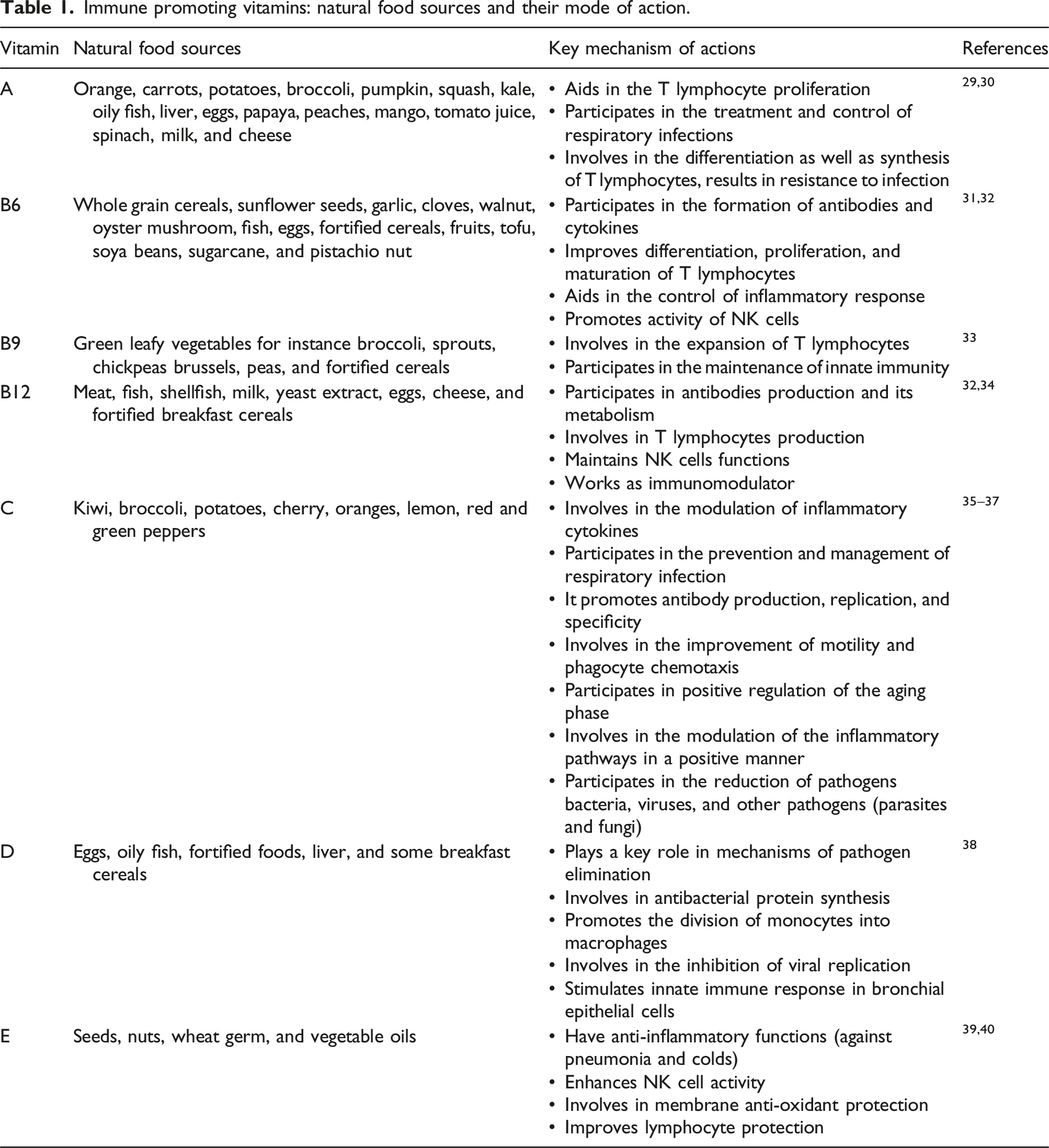
Vitamin A
Vitamin A can act against inflammations and it has a significant impact in intensifying immune performance. It plays various principal functions in the human body such as mucus integrity, vision maintenance, and epithelium prevention.5,41 The 9-cis retinoic acid metabolite of vitamin A is essential for the appropriate activity of B lymphocytes, particularly antibody production as well as lymphocyte survival and proliferation. Vitamin A supplements given to kids under the age of 5 can minimize the risks of having infections. 42
Vitamin B
Vitamin B serves as a key function in helping appropriate commencement of natural as well as adaptive immune retaliations. It minimizes the proportions of pro-inflammatory cytokines, enhances the intention of respiratory system, maintains endothelial rectitude, and forbids hypercoagulability, which can reduce hospitalization time for people suffering from viral diseases. Considering the advantages indicated earlier, vitamin B levels in COVID-19 patients should be monitored, plus it can also be employed as a non-pharmaceutical alternative to present therapies.43,44 Vitamin B1 is recognized to have an impact on the oxidative effect, suppression of oxidative intensity and concerned in the modulation of natural killer cells of immune system. 45
Vitamin B6 is considered an important factor for balancing lymphoid tissues and their immunological functions, that is, reactions mediated by cells and antibodies. 46 During COVID-19 infection, the functional state of vitamin B6 “Pyridoxal 52-phosphate” helped in the control of cytokine storm and inflammation caused due to ejection of pro-inflammatory cytokines along with excessive T cell response. 47 Vitamin B9 (folate) contributes an important function in synthesis of nucleic acid as well as the typical cellular function with potential pathogenic consequences. 48
Vitamin B12 and its functional constituents hydroxo-, adenosyl- along with methylcobalamin have many vital roles in the body of humans which counts red blood cell synthesis, cellular growth, nervous system health, quick amalgamation of DNA, myelin synthesis. 43 The previous study has reported that vitamin B12 therapy can minimize the oxidative intensity and organ damage with the support of methylcobalamin supplements. 49
Vitamin C
Vitamin C has many pharmacological qualities such as antiviral, antioxidant, and anti-inflammatory. Its immunomodulatory effects on relocation of white blood cells to infection area, phagocytosis, activity of natural killer cell, T lymphocyte along with the formulation of antibodies.42,50 About 200 mg of vitamin C can be easily obtained by combining several foods like cooked cabbage and cauliflower, strawberries, grapefruit, oranges, green peppers, and red pepper. 51 A single case-report from China described a 34 years old healthy young male patient without any comorbidities during the fight with COVID-19-associated symptoms (fatigue, poor appetite, dry cough, and subjective fever) who had received 3 g dose of vitamin C once on daily basis along with antiviral and antimicrobial treatments. 52
Vitamin E
Vitamin E is a powerful antioxidant as well as a key critical nutriment for immune system stability, particularly within aged individuals. 53 It is a vital component for natural killer cells and interleukins production, which contribute considerably to acceleration of white blood cells as well as to the induction of a potent immune response facing infections.54,55
Vitamin D
1, 25-dihydroxy Vit D3 (1,25(OH)2D3 is the dynamic variety of vitamin D that contributes in bone genesis by maintaining the phosphorus as well as calcium metabolisms. It also induces immunomodulation by influencing monocytes, dendritic cells, macrophages, T-cells, as well as B-cells, which have a significant impact on innate as well as adaptive immune responses.56,57
Minerals
Immune boosting minerals: natural sources and their impact on respiratory system.

Zinc
Zinc is considered an adjunct therapeutic agent for COVID-19 patients because of its immunological response and antiviral properties. In COVID-19 patients, zinc supplementation possesses the capability to lessen the seriousness of this illness. 65 It functions as a cofactor for thymulin, and that controls cytokine secretion as well as promotes propagation.57,66
Iron
In hemoglobin, iron is the component of heme protein and it is responsible for providing oxygen to tissues in the human body. As a component of cytochromes, it is essential for the transit of mitochondrial electrons and has broad-spectrum effects such as impairing respiratory burst, killing germs, T-cell proliferation, and cytokine production.67,68 Because of the positive benefits of iron chelation therapy on the inflammatory processes, it might be assessed during inappropriate scenario of critically sick individuals having COVID-19 to enhance survival and overall long-term outcome. 69 For preparing nano-particles in nanotechnology, ferrous/ferric oxide acts as an inert material and these nanoparticles are frequently used for developing personal protective equipment (PPE) diagnostic tests and manufacturing effective vaccinations or antiviral medications for worldwide war facing COVID-19.70,71
Selenium
Selenium is essential micronutrients that involves in up-regulation of IL-2 receptors and boosting up the immune system by B lymphocytes to promote antibody production and enhance the production of antibody by increasing cytotoxicity of killer cells. 57 Selenium seems needed for productive as well as systematic operations of immune association. It improves cytotoxic effector cells’ efficiency, plus plays a vital part in maturation as well as function of T cell and T cell-dependent development of antibodies. 72 Selenium is use against the recent COVID-19 battle reported by previous study. 73 There is connection between deficiency of selenium and mortality due to COVID-19. It is also essential for recuperation for illness.60,74
Copper
Copper bears micronutrient that is required for B cells, helper T cells, natural killer (NK) cells, neutrophils as well as macrophages to operate properly. 75 The transmission and replication of SARS-CoV2, influenza as well as additional respiratory viruses are inhibited by copper, which helps to diminish the transmission of several infectious diseases. The copper oxide may be used in the preparation of nano-based face masks, filters, clothing, etc. 76
Magnesium
Magnesium, as an electrolyte, helps our bodies increase their natural killer cells and lymphocytes. It also serves as an important source of energy for adenosine triphosphate (ATP). Magnesium also supports the hemoglobin in our blood. Whole grains, avocados, dark chocolate, and black beans are among the foods high in magnesium.62,64
Phenolic compounds
Phenolic compounds are recognized as dietary secondary metabolites which are commonly found in vegetables, fruits, seeds, flowers, food grains, tea, honey, wine as well as forage.
77
The exclusive antioxidant action of plants is linked with phenolic compounds.
78
Conventionally, consequential folk medication from polyphenol-rich plants are utilized to treat diseases of the bloodstream including stomach disorders, systolic, antiviral consequences, direct-acting mutagens, as well as burns dressing. They are also effective against various viruses such as hepadnavirus, influenza virus, retrovirus, herpesvirus, HIV, dengue virus, herpes simplex virus, poliovirus, and so on.
79
Phenol and polyphenolic-rich plants are most effective against COVID-19.80–83 The consumption of polyphenols can ameliorate the physiological activities influenced by COVID-19 as indicated in Figure 1. COVID-19 and related diseases disrupt physiological activities, which can be ameliorated with polyphenols consumption.
84

Food sources of natural phenolic compounds and their mode of action.

Conclusion
The body’s immune system plays a central role in our survival and fights against a huge number of pathogens and antigens. Therefore, enhancing the immune system’s ability is highly beneficial in preventing many health disorders. COVID-19 held the world with an inevitable threat to humans to rethink about maintenance of healthy immune system. Therefore, maintaining a nutritious diet having natural bioactive compounds has become vital for protection against viral invasion.
Footnotes
Author contributions
HRK and RS designed the study and retrieved the data as well as write the first draft. MJ assisted in the write up, HY edited and supervised while IA and SJ critically read and finalized the draft.
Declaration of conflicting interests
The author(s) declared no potential conflicts of interest with respect to the research, authorship, and/or publication of this article.
Funding
The author(s) received no financial support for the research, authorship, and/or publication of this article.
